S-1
As filed with the Securities and Exchange Commission on May 19, 2026.
Registration No. 333-
UNITED STATES
SECURITIES AND EXCHANGE COMMISSION
WASHINGTON, D.C. 20549
d
FORM S-1
REGISTRATION STATEMENT
UNDER
THE SECURITIES ACT OF 1933
Parabilis Medicines, Inc.
(Exact name of registrant as specified in its charter)
|
|
|
Delaware |
2834 |
47-4505725 |
(State or other jurisdiction of incorporation or organization) |
(Primary Standard Industrial Classification Code Number) |
(I.R.S. Employer Identification Number) |
Parabilis Medicines, Inc.
30 Acorn Park Drive
Cambridge, MA 02140
(617) 945-9510
(Address, including zip code, and telephone number, including area code, of registrant’s principal executive offices)
Mathai Mammen, M.D., Ph.D.
Chief Executive Officer
30 Acorn Park Drive
Cambridge, MA 02140
(617) 945-9510
(Name, address, including zip code, and telephone number, including area code, of agent for service)
Copies to:
|
|
|
Kingsley L. Taft Gregg L. Katz Alicia M. Tschirhart Goodwin Procter LLP 100 Northern Avenue Boston, MA 02210 (617) 570-1000 |
Teresa Jurgensen General Counsel Parabilis Medicines, Inc. 30 Acorn Park Drive Cambridge, MA 02140 (617) 945-9510 |
Brian K. Rosenzweig Alicia Zhang Charles A. Dobb Covington & Burling LLP 30 Hudson Yards New York, NY 10001 (212) 841-1000 |
Approximate date of commencement of proposed sale to the public: As soon as practicable after this registration statement becomes effective.
If any of the securities being registered on this Form are to be offered on a delayed or continuous basis pursuant to Rule 415 under the Securities Act of 1933 check the following box: ☐
If this Form is filed to register additional securities for an offering pursuant to Rule 462(b) under the Securities Act, please check the following box and list the Securities Act registration statement number of the earlier effective registration statement for the same offering. ☐
If this Form is a post-effective amendment filed pursuant to Rule 462(c) under the Securities Act, check the following box and list the Securities Act registration statement number of the earlier effective registration statement for the same offering. ☐
If this Form is a post-effective amendment filed pursuant to Rule 462(d) under the Securities Act, check the following box and list the Securities Act registration statement number of the earlier effective registration statement for the same offering. ☐
Indicate by check mark whether the registrant is a large accelerated filer, an accelerated filer, a non-accelerated filer, a smaller reporting company or an emerging growth company. See the definitions of “large accelerated filer,” “accelerated filer,” “smaller reporting company,” and “emerging growth company” in Rule 12b-2 of the Exchange Act.
|
|
|
|
Large accelerated filer |
☐ |
Accelerated filer |
☐ |
|
|
|
|
Non-accelerated filer |
☒ |
Smaller reporting company |
☒ |
|
|
|
|
|
|
Emerging growth company |
☒ |
If an emerging growth company, indicate by check mark if the registrant has elected not to use the extended transition period for complying with any new or revised financial accounting standards provided pursuant to Section 7(a)(2)(B) of the Securities Act. ☐
The Registrant hereby amends this Registration Statement on such date or dates as may be necessary to delay its effective date until the Registrant shall file a further amendment which specifically states that this Registration Statement shall thereafter become effective in accordance with Section 8(a) of the Securities Act of 1933, as amended, or until the Registration Statement shall become effective on such date as the Securities and Exchange Commission, acting pursuant to said Section 8(a), may determine.
The information in this preliminary prospectus is not complete and may be changed. We may not sell these securities until the registration statement filed with the Securities and Exchange Commission is effective. This preliminary prospectus is not an offer to sell these securities and it is not soliciting an offer to buy these securities in any state or other jurisdiction where the offer or sale is not permitted.
Subject to Completion, Dated May 19, 2026
PRELIMINARY PROSPECTUS
Shares

Common Stock
This is an initial public offering of shares of common stock of Parabilis Medicines, Inc. We are offering shares of our common stock.
Following this offering, we will have two classes of common stock: the voting common stock offered hereby and non-voting common stock. For a description of the rights of the voting common stock and non-voting common stock, see the section titled “Description of Capital Stock” beginning on page 201 of this prospectus. We are offering voting common stock in this offering, and unless otherwise noted, all references in this prospectus to our “common stock,” “common shares” or “shares” refer to our voting common stock.
Prior to this offering, there has been no public market for our common stock. It is currently estimated that the initial public offering price per share will be between $ and $ . We have applied to list our common stock on The Nasdaq Global Market under the symbol “PBLS”. We believe that upon the completion of this offering, we will meet the standards for listing on The Nasdaq Global Market, and the completion of this offering is contingent upon such listing.
We are an “emerging growth company” and “smaller reporting company” as defined under the U.S. federal securities laws and, as such, we have elected to comply with certain reduced public company reporting requirements in this prospectus and future filings.
Investing in our common stock involves a high degree of risk. See the section titled “Risk Factors” beginning on page 15 to read about factors you should carefully consider before deciding to invest in shares of our common stock.
Neither the Securities and Exchange Commission nor any state securities commission has approved or disapproved of these securities or passed upon the accuracy or adequacy of this prospectus. Any representation to the contrary is a criminal offense.
|
|
|
|
|
|
|
|
|
Per Share |
|
Total |
Initial public offering price |
|
$ |
|
|
$ |
|
Underwriting discounts and commissions (1) |
|
$ |
|
|
$ |
|
Proceeds, before expenses, to Parabilis Medicines, Inc. |
|
$ |
|
|
$ |
|
(1)See the section titled “Underwriting” for additional information regarding compensation payable to the underwriters.
We have granted the underwriters the option to purchase up to an additional shares of common stock from us, at the initial public offering price, less the underwriting discounts and commissions.
In connection with our strategic research collaboration, Regeneron Pharmaceuticals, Inc. ("Regeneron") has agreed to purchase approximately $75.0 million of shares of our common stock in a concurrent private placement exempt from the registration requirements of the Securities Act of 1933, as amended, at a per share price equal to 90% of the initial public offering price (or shares based on the assumed initial public offering price of $ per share, which is the midpoint of the price range set forth above). The private placement would close concurrently with, and be contingent and conditioned upon consummation of, this offering; however, this offering is not contingent on the consummation of the concurrent private placement. In connection with the concurrent private placement, we expect to enter into a stock purchase agreement with Regeneron. The underwriters of this offering will not receive any fee in connection with the concurrent private placement.
The underwriters expect to deliver the shares against payment on or about , 2026.
|
|
|
|
|
Leerink Partners |
BofA Securities |
Evercore ISI |
Guggenheim Securities |
LifeSci Capital |
Prospectus dated , 2026
TABLE OF CONTENTS
Neither we nor the underwriters have authorized anyone to provide you any information or make any representations other than those contained in this prospectus or in any free writing prospectuses prepared by or on behalf of us or to which we have referred you. We and the underwriters take no responsibility for, and can provide no assurance as to the reliability of, any other information that others may give you. We and the underwriters are not making an offer to sell these securities in any jurisdiction where the offer or sale is not permitted. You should assume that the information appearing in this prospectus or in any applicable free writing prospectus is current only as of its date, regardless of its time of delivery or any sale of shares of our common stock. Our business, financial condition, results of operations and prospects may have changed since that date.
For investors outside of the United States: we have not, and the underwriters have not, done anything that would permit this offering or possession or distribution of this prospectus in any jurisdiction where action for that purpose is required, other than the United States. Persons outside of the United States who come into possession of this prospectus must inform themselves about, and observe any restrictions relating to, the offering of the shares of our common stock and the distribution of this prospectus outside of the United States.
Basis of Presentation
Except where the context otherwise requires or where otherwise indicated, the terms “Parabilis,” “we,” “us,” “our,” “our company,” “Company” and “our business” refer to Parabilis Medicines, Inc. and its wholly-owned subsidiaries, Parabilis Security Corporation and Parabilis Medicines (Shanghai) Ltd Co.
Our audited consolidated financial statements include the accounts of Parabilis Medicines, Inc. Our financial statements have been prepared in accordance with generally accepted accounting principles in the United States (“GAAP”). Our fiscal year ends on December 31 of each year. References to 2024 and 2025 refer to the years ended December 31, 2024 and December 31, 2025, respectively.
Certain monetary amounts, percentages and other figures included in this prospectus have been subject to rounding adjustments. Percentage amounts included in this prospectus have not in all cases been calculated on the basis of such rounded figures, but on the basis of such amounts prior to rounding. For this reason, percentage amounts in this prospectus may vary from those obtained by performing the same calculations using the figures in our consolidated financial statements included elsewhere in this prospectus. Certain other amounts that appear in this prospectus may not sum due to rounding.
Trademarks and Trade Names
We own, have applied for or have rights to use one or more registered and common law trademarks, service marks and/or trade names in connection with our business in the United States, which may be used throughout this prospectus. This prospectus also includes trademarks, trade names, and service marks of third-parties which are the property of their respective owners. Our use or display of third parties’ trademarks, service marks, trade names or products in this prospectus and our other public filings is not intended to, and does not imply a relationship with, or endorsement or sponsorship by us. Solely for convenience, the trademarks, service marks, logos and trade names referred to in this prospectus and our other public filings may appear without the ®, TM or SM symbols, but the omission of such references is not intended to indicate, in any way, that we will not assert, to the fullest extent under applicable law, our rights or the rights of the applicable owner of or licensor to these trademarks, service marks and trade names.
Market, Industry and Other Data
The market data and certain other statistical information used throughout this prospectus are based on independent industry publications, governmental publications, reports by market research firms, or other independent sources that we believe to be reliable sources. Industry publications and third-party research, surveys, and studies generally indicate that their information has been obtained from sources believed to be reliable, although they do not guarantee the accuracy or completeness of such information. We are responsible for all of the disclosures contained in this prospectus, and we believe that these sources are reliable; however, we have not independently verified the information contained in such publications. While we are not aware of any misstatements regarding any third-party information presented in this prospectus, their estimates, in particular, as they relate to projections, involve numerous assumptions, are subject to risks and uncertainties, and are subject to change based on various factors, including those discussed under the section titled “Risk Factors” and elsewhere in this prospectus. Some data are also based on our good faith estimates.
PROSPECTUS SUMMARY
This summary highlights selected information contained elsewhere in this prospectus. This summary does not contain all of the information you should consider before investing in our common stock. You should read this entire prospectus carefully, including the sections of this prospectus titled “Risk Factors,” “Special Note Regarding Forward-Looking Statements,” “Management’s Discussion and Analysis of Financial Condition and Results of Operations” and our consolidated financial statements and the related notes included elsewhere in this prospectus, before making an investment decision.
Company Overview
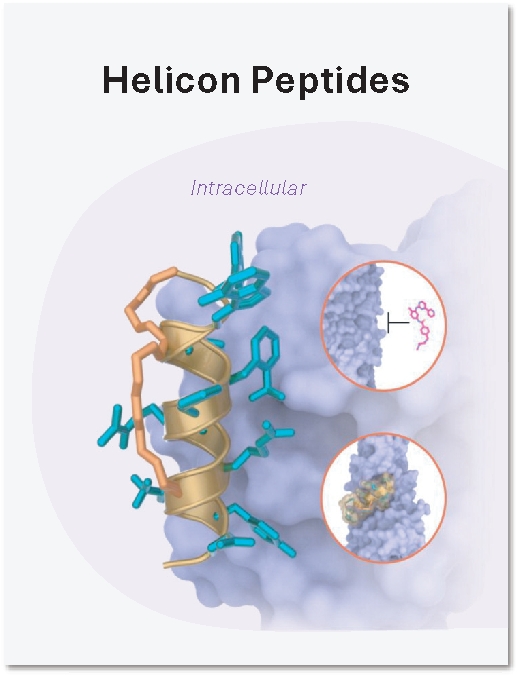
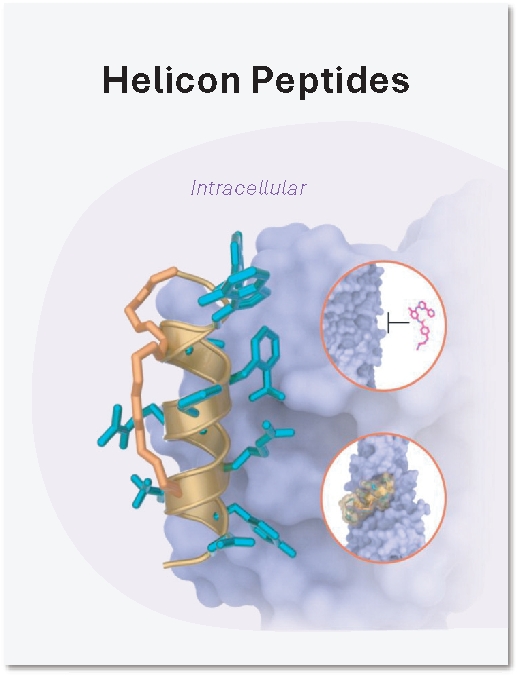
We are a clinical-stage biopharmaceutical company built to develop transformative medicines addressing some of the most consequential, yet historically undruggable, protein targets driving human disease. We leverage our proprietary platform to pioneer a novel therapeutic modality, Helicons, which are stabilized helical peptides engineered to bind and precisely modulate proteins that have long been beyond the reach of conventional medicines.
To our knowledge, our lead product candidate, zolucatetide, is the first-ever drug to directly target the interaction between b-catenin and the T-cell factor (“TCF”) family of transcription factors. This is the central node in the Wnt/b-catenin cell signaling pathway, which regulates cell proliferation and differentiation and whose hyperactivation is a driver of millions of cancer cases annually across many tumor types. Drugging this critical node eluded three decades of intensive efforts to do so across the pharmaceutical industry. Zolucatetide has been evaluated in over 150 patients to date and has generated promising clinical data in a range of solid tumors driven by alterations in the Wnt/b-catenin pathway. In our lead indication, desmoid tumors, we have observed tumor reductions in 100% of patients with a 74% objective response rate (“ORR”) in patients who have had at least two post-baseline scans.
Objective responses have been observed across patients who have failed g-secretase inhibitors (“GSIs”) and those who have never taken GSIs. Importantly, zolucatetide has been able to generate this rate of response with a tolerability profile that we believe is more favorable than that of currently available drug therapy. We plan to initiate a global registrational Phase 3 trial for zolucatetide in patients with desmoid tumors in the first half of 2027.
We believe zolucatetide provides clinical validation of our first-in-industry Helicon approach and represents an expansive opportunity for medical and commercial impact. Our preclinical pipeline provides additional examples of the repeatability of our Helicon approach and includes programs targeting two key drivers of prostate cancer, the ETS-related gene (“ERG”) and the androgen receptor (“AR”) in its active state (“ARON”). Our current pipeline is focused on various cancers and tumor types; however, we believe Helicons could also have broad applicability against targets in many diseases with substantial unmet need outside oncology, and we plan to evaluate other therapeutic areas in the future.
An estimated 80% of biologically validated disease targets are considered undruggable, largely because the majority reside inside cells and present flat interaction surfaces. Small molecules can enter cells but cannot bind flat surfaces, and antibodies and other highly-selective biologics can selectively bind flat protein surfaces but cannot enter cells to access these targets. To our knowledge, Helicons are the only modality to date with the potential to consistently solve this problem as they are engineered for cell penetration and capable of binding to flat intracellular protein target surfaces with high specificity. Helicons combine the precision of antibodies and biologics with the intracellular access and tunability of small molecules in a single modality, enabling direct engagement of historically inaccessible protein targets. Our proprietary Helicon discovery platform allows us to integrate ligands and additional functionalities at multiple positions to precisely tune potency, selectivity, and pharmacologic properties. While our initial programs are focused on disrupting protein-protein interactions and inducing targeted protein degradation, we believe our platform can incorporate other advances in small molecule drug design and extend them to targets that are likely to remain out of reach for other modalities.
Our Helicon discovery platform integrates advanced artificial intelligence (“AI”)- and physics-based computational modeling with high-throughput peptide synthesis and experimental screening to discover and develop drug candidates. Since our founding, we have advanced computational models as well as custom design, synthesis, handling and manufacturing know-how to position us to produce Helicons reliably and at scale. A decade of applying these capabilities to Helicon drug discovery has generated vast proprietary datasets, comprising millions of data points for hundreds of thousands of Helicons across dozens of drug-like properties. These data power a continuous learning loop that refines our models from target selection through lead optimization, enhancing our speed, precision, and ability to generate high quality molecules against difficult targets. As a result, our platform produces unique complex synthetic molecules at scale and a compounding advantage that we believe is difficult to replicate.
We are advancing a wholly-owned pipeline of Helicon-based product candidates against high-value targets.
Our lead product candidate, zolucatetide, is, to our knowledge, the first and only investigational therapy that inhibits the b-catenin:TCF interaction, the critical downstream node of the Wnt/b-catenin pathway. Activating mutations in this pathway, gain of function b-catenin mutations, or loss of function Adenomatous Polyposis Coli (“APC”) mutations, are present in over 10% of all cancers and span a broad range of tumor types.
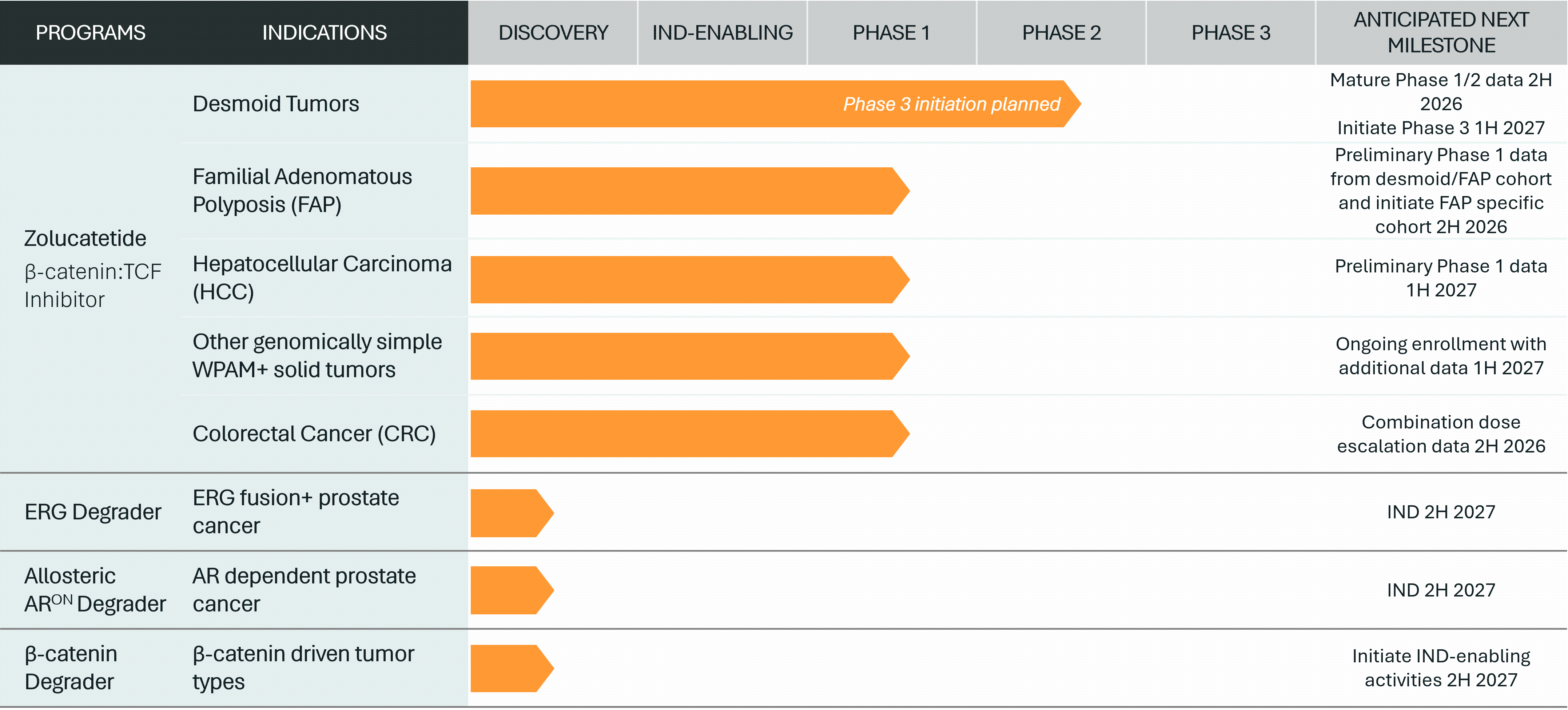
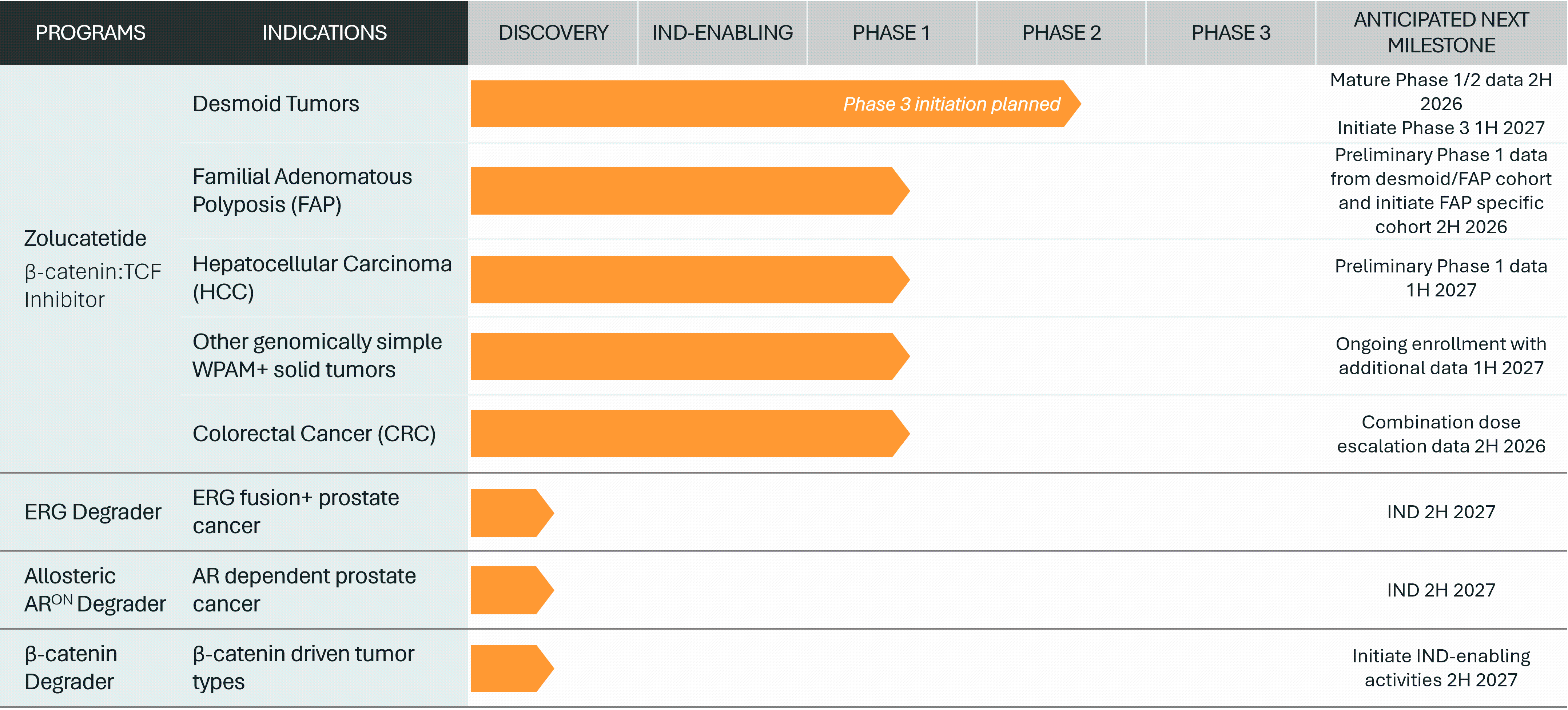
We are evaluating zolucatetide in ongoing clinical trials across multiple solid tumor indications, with more than 150 patients dosed to date. Zolucatetide has been observed to be well tolerated across the therapeutic dose range. We believe the data generated to date, along with our understanding of the underlying Wnt/b-catenin pathway, support zolucatetide’s potential to benefit patients across multiple tumor types driven by b-catenin or APC alterations and its advancement into a Phase 3 registrational trial. Our target indications include:
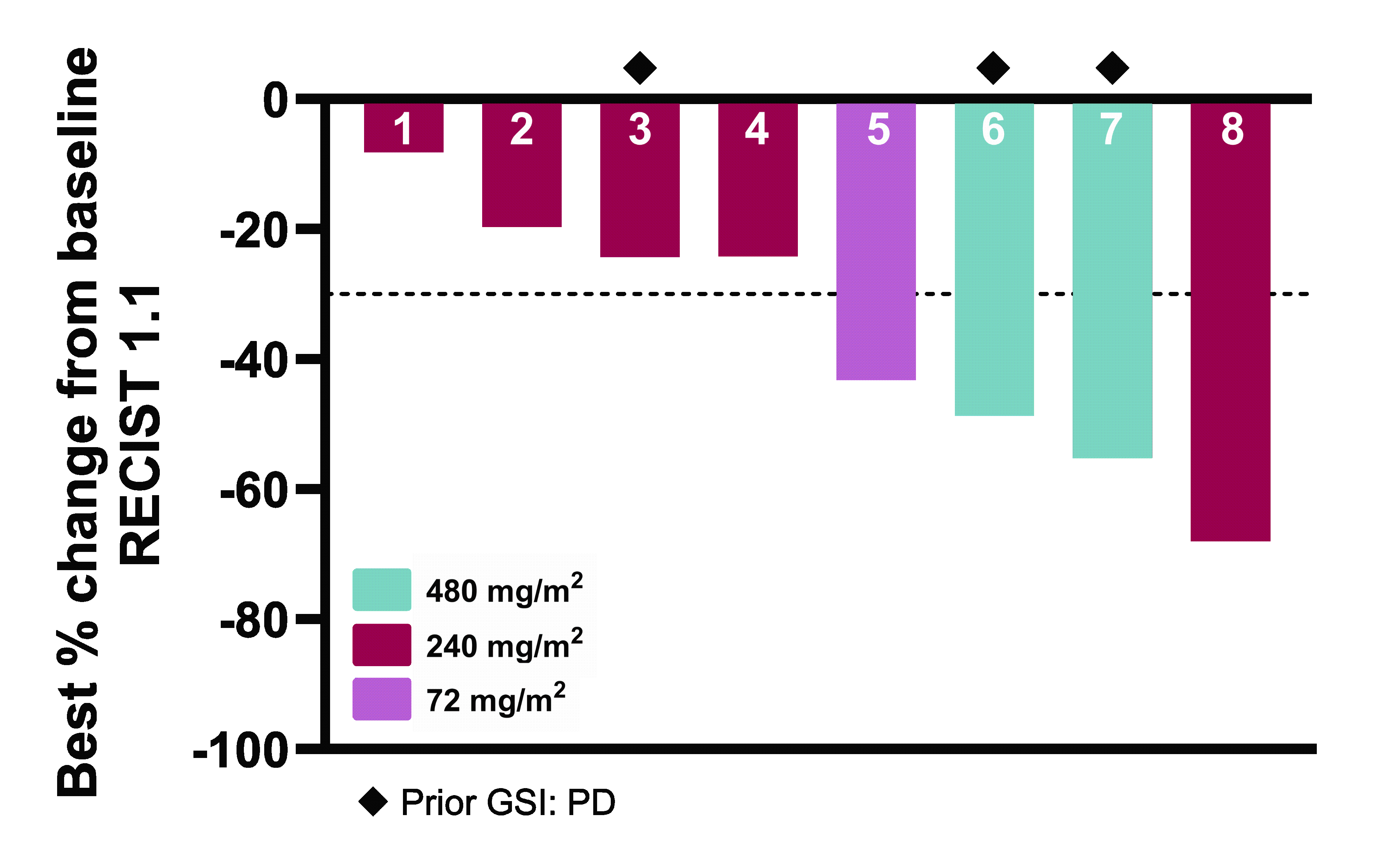
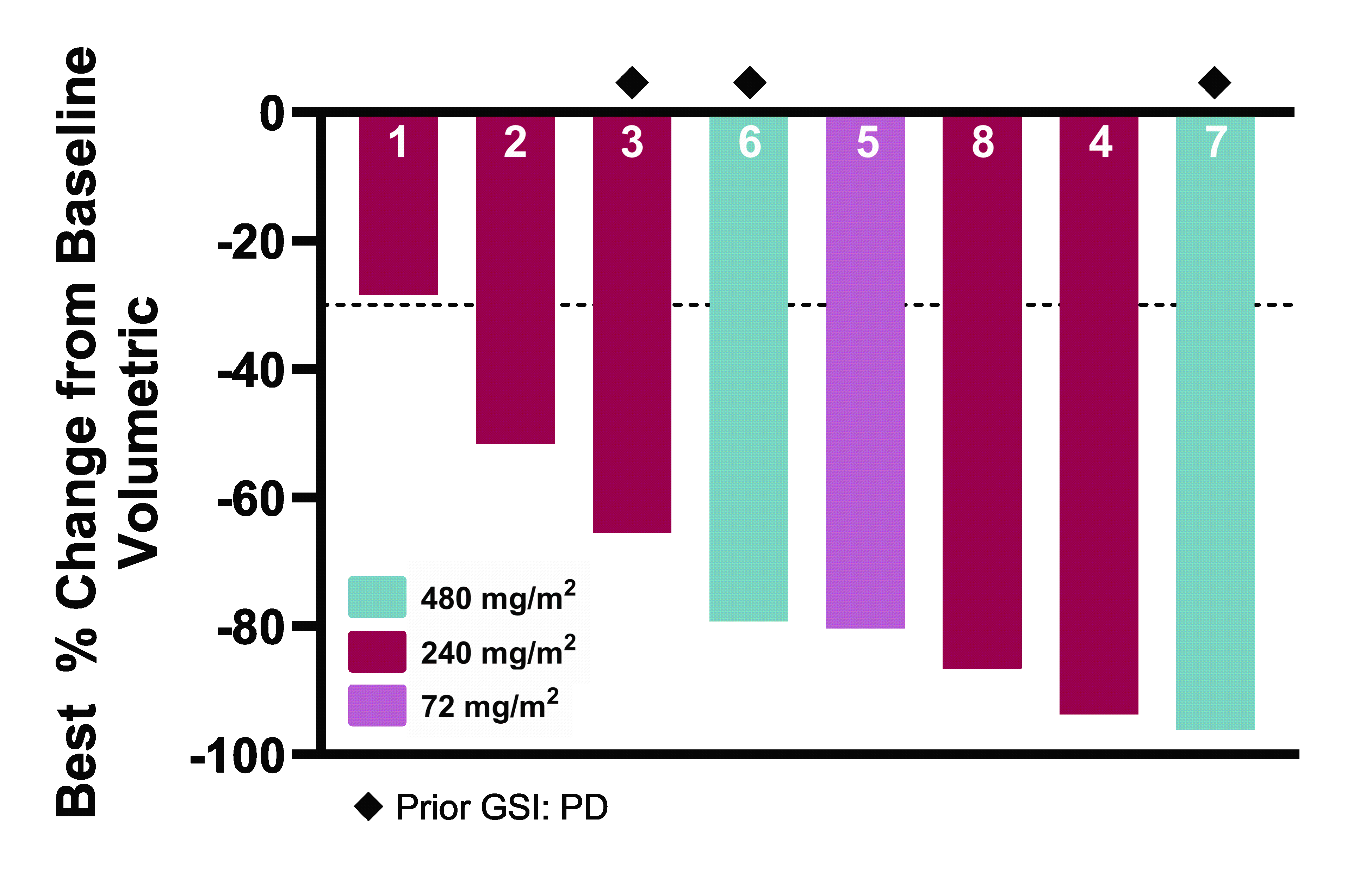
•Desmoid Tumors: Our lead indication for zolucatetide is desmoid tumors, which are rare, locally invasive soft tissue tumors driven by somatic or germline b-catenin pathway mutations. We estimate that approximately 11,000 desmoid tumor patients in the United States are actively managed under physician care. Desmoid tumors impose substantial and long-term morbidity, including pain, functional and mobility impairment, and the potential for life-threatening complications depending on tumor location. Given the chronic nature of the disease and onset in a predominantly young patient demographic with a near-normal life expectancy, prolonged or lifelong management is typically required. The only existing U.S. Food and Drug Administration (“ FDA”) approved therapy for desmoid tumors, a GSI, does not address the underlying Wnt/b-catenin-driven disease biology. In our ongoing clinical trials, as of February 16, 2026, 38 desmoid patients have been enrolled and treated with zolucatetide, of which 25 had sufficient follow up to be response-evaluable, and all 25 patients showed tumor reductions (disease control rate (“DCR”) of 100%). Of the 19 patients with at least two post-baseline scans, 74% (14/19) had an objective response per RECIST 1.1. We have observed responses in patients naive to GSI therapy, those who had progressed on GSI therapy, as well as patients that discontinued GSI therapy due to tolerability issues. To date, we have observed a tolerability profile that we believe compares favorably to the tolerability profile associated with GSIs and other off-label therapies, and supports continued development. We believe a medicine for the treatment of desmoid tumors with a superior efficacy and safety profile, compared to the existing systemic therapy, could significantly improve patient outcomes and expand the desmoid tumor commercial opportunity. We plan to initiate a registrational Phase 3 trial for zolucatetide in patients with desmoid tumors in the first half of 2027.
•Familial Adenomatous Polyposis (“FAP”): We are evaluating zolucatetide’s potential in FAP, an orphan disease that impacts an estimated 34,000 people in the United States. FAP is characterized by extensive precancerous polyps in the gastrointestinal tract, with a near-inevitable risk of polyp progression to colorectal cancer in the absence of life-altering colon-removal surgery. There is currently no approved treatment for FAP. Desmoid tumors and FAP share common b-catenin biology, and approximately 10% of desmoid tumor patients also have underlying FAP. In the desmoid tumor cohort of our ongoing Phase 1/2 clinical trial, administration of zolucatetide in two patients with FAP and an associated desmoid tumor demonstrated significant improvement in duodenal polyposis burden at 10 and 60 weeks, respectively, following initiation of treatment. As of February 16, 2026, we have enrolled six desmoid tumor patients with FAP in our ongoing clinical trial and are also planning to enroll a separate dedicated cohort of patients with FAP beginning in the second half of 2026.
•Hepatocellular Carcinoma (“HCC”): We are evaluating zolucatetide’s potential in HCC, the most common type of primary liver cancer. HCC accounts for approximately 80-90% of liver cancer cases globally, with an estimated 38,000 new HCC cases annually in the United States and approximately 700,000–800,000 new cases worldwide. Approximately 30% of HCC tumors harbor b-catenin mutations and are otherwise relatively low in mutational burden. In a heavily pre-treated patient with CTNNB1-mutant HCC treated with zolucatetide, we observed a confirmed partial response for nine months. Based on this observation, we began enrolling an HCC-specific cohort in our ongoing Phase 1/2 clinical trial.
•Additional Rare Tumors: There are over 70 different cancer types with documented APC or b-catenin mutations, equating to approximately 10% of all tumors and a prevalence in the United States of approximately 1.8 million patients. In pursuit of this significant opportunity, we are evaluating zolucatetide in additional rare Wnt/b-catenin-driven tumors that harbor APC loss or activating b-catenin mutations, including adamantinomatous craniopharyngioma (“ACP”), solid pseudopapillary neoplasm, salivary gland tumors, and ameloblastoma where we have observed partial responses to date. For these and potentially other rare tumor types, we are evaluating various regulatory strategies, including potentially accelerated development approaches based on a shared genomic signature of Wnt/b-catenin pathway activation or, where appropriate, histologic characteristic clustering. Tumor-agnostic or molecularly defined approval pathways have been used selectively in oncology, and we believe targeting the root genetic cause of Wnt/b-catenin pathway activation-driven disease may support a similar approach.
•Colorectal Cancer (“CRC”): We are also evaluating the potential for zolucatetide in CRC, the third most commonly diagnosed cancer globally with approximately two million new cases annually. APC mutations, which drive aberrant b-catenin activation, occur in more than 80% of microsatellite stable CRC patients, representing the most prevalent mutations observed in this tumor type. In our ongoing clinical trials, we have observed disease stabilization and ctDNA reductions in a subset of CRC patients treated with zolucatetide monotherapy, and we are currently evaluating multiple rational combination regimens, based on the results of paired tumor biopsies showing tumor differentiation and a dose responsive functional pathway inhibition. Our ongoing rational combination regimen includes anti-Vascular Endothelial Growth Factor (“VEGF”), DNA-damaging chemotherapy, and anti-programmed cell death protein 1 (“PD-1”) agents, as supported by preclinical and early translational data. We have also generated preclinical evidence for a rational combination with a RAS inhibitor.
Taken together, we believe the breadth of clinical activity and tolerability profile observed to date reinforce zolucatetide’s potential as a pipeline-in-a-product with the ability to address significant unmet need across multiple tumor types. We expect to generate substantial additional clinical data as we advance zolucatetide into registrational development in desmoid tumors and continue to expand our understanding of its therapeutic potential across additional indications.
Beyond zolucatetide, we are advancing two preclinical stage Helicon programs in prostate cancer: an ERG degrader and an allosteric ARON degrader. Both programs seek to leverage the unique properties of Helicons to address areas of unmet need in prostate cancer treatment by targeting degradation of the historically undruggable ERG protein, an oncogenic driver present in approximately 40-50% of prostate cancer patients, and of AR via a novel AR binding site that seeks to overcome the primary drivers of resistance to AR targeted therapies.
•ERG: We have identified novel peptide binding sites on ERG and developed bifunctional degraders that have been observed to drive potent, selective ERG degradation in cells and in vivo tumor models. We have observed that patient-derived tumor models are dependent on ERG protein expression and activity for growth, which we believe supports the clinical therapeutic potential of our ERG degrader in ERG fusion-positive prostate cancer. We are now testing our lead Helicon in Investigational New Drug (“IND”)-enabling studies and continue to advance additional Helicons for optionality.
•ARON: Our ARON degrader is designed to overcome resistance driven by AR mutations and amplification, both of which limit the effectiveness of current AR-targeted therapies. In approximately 80% of patients, resistance to AR-targeted therapies is associated with amplification of the AR gene and point mutations at the drug binding site of AR. Approved AR antagonists and clinical-stage AR degraders of which we are aware target the same ligand binding pocket, making them non-combinable and vulnerable to the same resistance mechanisms. Our AR degrader binds to a historically undruggable allosteric co-activator protein binding site that is accessible only when androgen is bound to the receptor. As we are binding to this allosteric site and are not competitive with the binding site of all approved AR antagonists, we believe we will avoid the frequent mutations that occur within the ligand binding domain. By selectively targeting this active pool of AR, we believe our ARON degrader can more effectively address AR amplification, which we consider the most clinically significant driver of resistance in metastatic castration-resistant prostate cancer (“mCRPC”). Importantly, because it binds at the allosteric co-activator protein binding site, our ARON degrader is uniquely suited for combination with existing AR antagonists. These therapies all bind the androgen-binding pocket and are not currently combinable with one another. We believe that such a combination therapy approach could slow the development of resistance, improve efficacy, and meaningfully extend treatment duration. Our ARON degrader program is in late lead optimization and advancing toward IND-enabling studies.
In addition to pursuing additional targets, we are continuing to develop novel approaches to target b-catenin, building on the foundational biology established with zolucatetide within Parabilis.
•b-catenin Degrader: Two avenues have emerged from our efforts to maximize the clinical potential of b-catenin targeting agents. First, we have identified multiple binding sites on b-catenin beyond the site leveraged by zolucatetide and are exploring how b-catenin target engagement at these sites may impact different aspects of tumor biology. The downstream biology affected by Helicon binding to these sites is dependent on the multitude of intracellular protein complexes in which b-catenin resides within the tumor cell. Second, we have successfully applied our bifunctional degrader technology to develop b-catenin degraders using both zolucatetide and the additional binding site Helicons as the anchor for this approach. The degrader functionality has the potential for improved potency via a catalytic mechanism of action and has the potential to drive unique biology by virtue of removing b-catenin protein rather than inhibiting protein-protein interactions.
We intend to advance multiple additional discovery-stage programs that target genetically validated, historically undruggable proteins where we believe Helicons may offer a meaningful advantage over existing modalities. We apply a rigorous framework to evaluate and prioritize programs that may result in substantial therapeutic and commercial opportunities before committing substantial resources toward those that we believe have the highest probability of clinical and commercial success. Given the versatility of the Helicon platform, we also believe there may be opportunities to selectively explore additional therapeutic approaches on our own and through strategic collaborations where a partner’s complementary expertise could be leveraged. We recently entered into a collaboration with Regeneron with a focus on evaluating Antibody-Helicon Conjugates (“AHCs”), a potentially novel approach that combines antibody targeting capabilities with Helicon payloads designed to modulate intracellular proteins. We view this collaboration as an opportunity to explore the broader applicability of Helicons in a focused and capital-efficient manner alongside a leading partner.
Our Strategy
We intend to advance differentiated and potentially high value Helicon medicines that address genetically validated, yet historically undruggable, targets in areas of high unmet medical need. To pursue our vision, we are focused on the following key priorities:
•Complete clinical development of, and, if approved, commercialize zolucatetide in desmoid tumors globally.
•Continue developing zolucatetide in FAP through both our current Phase 1/2 enrollment of FAP-desmoid patients as well as a dedicated FAP cohort. Evaluate registrational path with regulatory agencies, and, if approved, commercialize zolucatetide in FAP.
•Continue developing zolucatetide in HCC and other b-catenin- and APC-driven diseases, including ACP and ameloblastoma.
•Maintain and expand our position as a leader in drugging the Wnt/b-catenin pathway.
•Progress our ERG and allosteric ARON degraders, the next two programs in our pipeline of Helicon drug candidates, into IND-enabling toxicology studies.
•Continue to expand our pipeline of product candidates leveraging our proprietary Helicon discovery platform.
•Continuously improve our Helicon discovery platform to protect and extend our competitive advantage.
•Further develop integrated computational, translational, and clinical capabilities to efficiently, precisely, and effectively progress our product candidates through internal development.
•Explore and deliver on opportunities to extend the reach of our platform and capabilities through selective strategic partnerships.
Our Team
Our work requires a unique kind of organization. Tackling high-difficulty biology and building a new therapeutic modality demands a team with the judgment to identify the right problems, the technical depth to solve them, and the persistence to see them through. We apply a first principles approach to solve the complex issues that impact our business and are unafraid to challenge industry norms in our pursuit. At Parabilis, we have built a deeply integrated team of drug hunters, data scientists, and clinical and operational experts who are aligned around a shared goal of translating ambitious science into real medicines for patients.
Our team is led by Mathai Mammen, M.D., Ph.D., President, Chairman, and CEO of Parabilis. Previously, Dr. Mammen served as Global Head of R&D and a member of the Executive Committee at Johnson & Johnson. There, he led and evolved one of the world’s largest pharmaceutical research and development organizations and spearheaded the strategic integration of data science and AI across the company’s portfolio. During his tenure, his team secured global approvals for nine medicines, including Darzalex Faspro™, Balversa™, Carvykti™, Rybrevant™, and Tecvayli™ in oncology; Tremfya™ and Ponvory™ in immunology; and Spravato™ and Invega Hafyera™ in neuroscience. Before Johnson & Johnson, Dr. Mammen was a Senior Vice President at Merck, and contributed to the development of Keytruda™ and the discovery of enlicitide. Earlier in his career, he co-founded Theravance, Inc., where he led R&D toward five approved therapies. In total, he has led the discovery/development of 19 approved medicines.
Our leadership team includes additional members with deep domain expertise, such as our Chief Medical Officer, Fawzi Benzaghou, M.D., who most recently served as Senior Vice President and Global Head of Oncology R&D at Ipsen, where he contributed to the development and approval of multiple oncology therapies, including Cabometyx™ and Onivyde™. Our Scientific Co-founder and Executive Vice President of Platform Technology, John McGee, holds a Ph.D. in biochemistry from Harvard University, where he worked on both the de novo screening and multiplexing platforms that form the core of Parabilis’ discovery engine. Our Chief Financial Officer, Tom Kotarakos, previously led two biotechnology companies through initial public offerings. Our Chief Business and Strategy Officer, Helen Ho, Ph.D., previously served as Chief Business Officer at Blueprint Medicines, where she, among other responsibilities, oversaw portfolio strategy and new product planning. Our Executive Vice President of Discovery Science, Markus Haeberlein, Ph.D., previously served as Head of Research at Alkermes. Our Executive Vice President of Discovery Biology, Jonathan Hurov, Ph.D., previously worked at Agios Pharmaceuticals and Cygnal Therapeutics, where he oversaw platform development and the company’s early research.
Company History
We were founded in 2015 based on technology in-licensed from the laboratory of Greg Verdine, Ph.D., at Harvard University. This technology served as the foundation of our Helicon discovery platform, which we have subsequently advanced and expanded through continued internal development, as we advance our proprietary capabilities and pursue our mission to develop transformative medicines for patients in need. Since our founding, we have developed a substantial portfolio of wholly owned intellectual property, including patents and proprietary trade secrets. The current state and operation of the Helicon platform are not dependent on the continued use of the originally in-licensed technology or any other third party intellectual property.
Our platform was purpose-built over a decade to enable Helicon discovery. The first five years were devoted to developing and scaling high-throughput synthesis and data collection methods, generating proprietary datasets comprising millions of data points across hundreds of thousands of Helicons and dozens of drug-like properties. Over the subsequent five years, we leveraged these data to build a suite of custom AI- and physics-based computational models, and to rigorously test and refine them in the context of active discovery programs. These models are now deployed at every stage of discovery, from target selection through lead optimization. Each program we pursue feeds new data back into model training, creating a continuous learning loop. The result is a fully integrated discovery engine that has delivered repeated success against challenging targets and that we believe represents a durable competitive moat.
Since our inception, we have raised over $800 million in financing from world class investors, including ARCH Venture Partners, Cormorant Asset Management, Fidelity Investments, GV, Milky Way Investments Group Limited, Nextech, RA Capital and venBio. Prospective investors should not rely on the investment decisions of our existing investors, as these investors may have different risk tolerances and in certain cases received their shares in prior offerings at prices lower than the price offered to the public in this offering.
Summary of Risks Associated With Our Business
Our business is subject to a number of risks of which you should be aware before making an investment decision. These risks include, but are not limited to, the following:
•We are a clinical-stage biotechnology company with a limited operating history and no products approved by regulators for commercial sale, which may make it difficult to evaluate our current and future business prospects.
•Even if this offering and the concurrent private placement are completed, we will require substantial additional capital to finance our operations in the future. If we are unable to raise such capital when needed, or on acceptable terms, we may be forced to delay, reduce or eliminate programs, product candidates (including clinical trials), investment in our Helicon discovery platform, or future commercialization efforts.
•We have incurred significant losses since our inception and anticipate that we will continue to incur significant losses for the foreseeable future.
•We are dependent on the success of our product candidates, including zolucatetide, and our ongoing and anticipated trials may not be successful.
•Some of our product candidates modulate pathways for which there are currently no approved or effective therapies, and utilize novel binding locations, which may result in greater research and development expenses, regulatory issues that could delay or prevent approval, or discovery of unknown or unanticipated adverse effects.
•Preclinical and clinical development is inherently lengthy and uncertain. Preclinical and clinical trials of our product candidates may be delayed, and certain programs may never advance in the clinic or may be more costly to conduct than we anticipate, any of which would have a material adverse impact on our Helicon discovery platform or our business.
•We expect that in the future we will conduct clinical trials for product candidates outside the United States, and Regulatory Authorities (as defined in the section titled “Risk Factors”) may not accept data from such trials.
•If our clinical trials fail to replicate positive results from earlier preclinical studies or clinical trials conducted by us or third parties, we may be unable to successfully develop, obtain regulatory approval for, or commercialize our product candidates.
•Interim, initial, topline, and preliminary data from our clinical trials that we announce or publish from time to time may change as more patient data become available and are subject to audit and verification procedures that could result in material changes in the final data.
•Regulatory approval processes are lengthy, time-consuming and inherently unpredictable, and if we are not able to obtain, or if there are delays in obtaining, required regulatory approvals, we will not be able to commercialize, or will be delayed in commercializing, product candidates we may develop, and our ability to generate revenue will be materially impaired.
•Our approach to the engineering and development of our programs is unproven, and we may not be successful in our efforts to identify and develop any programs and product candidates of commercial value by leveraging our Helicon discovery platform.
•We are substantially dependent on the successful application of our Helicon discovery platform to develop programs and product candidates that can be commercialized by us or our current or future collaboration partners.
•Issues relating to our use of AI in the identification of our programs and the engineering and development of our product candidates could adversely affect our business and operating results.
•We rely on third parties for the supply and manufacture of our product candidates for our research, preclinical and clinical activities, and may do the same for commercial supplies of our products, if approved.
•We depend on sole source and limited source suppliers for certain drug substances, drug products, raw materials, samples, components, and other materials used in our product candidates.
•We rely on and expect to continue to rely on third parties to conduct aspects of our research, preclinical studies, clinical protocol development, and clinical trials for our programs and product candidates.
•Our success is largely based upon our intellectual property and proprietary technologies, and we may be unable to adequately protect and/or enforce our intellectual property.
•The biopharmaceutical market is intensely competitive. If we are unable to compete effectively with existing drugs, new treatment methods and new technologies, we may be unable to successfully commercialize any drugs that we develop.
•An active trading market for our common stock may not develop.
•The price of our common stock may be volatile and fluctuate substantially, which could result in substantial losses for purchasers of our common stock in this offering.
The summary risk factors described above should be read together with the text of the full risk factors in the section titled “Risk Factors” and the other information set forth in this prospectus, including our consolidated financial statements and the related notes, as well as in other documents that we file with the Securities and Exchange Commission (“SEC”). The risks summarized above or described in full elsewhere in this prospectus are not the only risks that we face. Additional risks and uncertainties not presently known to us, or that we currently deem to be immaterial may also materially adversely affect our business, financial condition, results of operations, and future growth prospects.
Corporate Information
We were incorporated under the laws of the State of Delaware in July 2015 under the name FOG Pharmaceuticals, Inc. We changed our name to Parabilis Medicines, Inc. in October 2024. Our principal executive offices are located at 30 Acorn Park Drive, Cambridge, MA 02140, and our telephone number is (617) 945-9510. We have two subsidiaries, Parabilis Security Corporation, formed in December 2018 under the laws of the Commonwealth of Massachusetts, and Parabilis Medicines (Shanghai) Ltd Co, formed in March 2026 under the laws of Shanghai, China. Our website address is www.parabilismed.com. The information contained in or accessible from our website is not incorporated into this prospectus, and you should not consider it part of this prospectus. We have included our website address in this prospectus solely as an inactive textual reference.
Concurrent Private Placement
In connection with our strategic research collaboration, Regeneron Pharmaceuticals, Inc. (“Regeneron”) has agreed to purchase approximately $75.0 million of shares of our common stock in a concurrent private placement exempt from the registration requirements of the Securities Act of 1933, as amended (the “Securities Act”), at a per share price equal to 90% of the initial public offering price (or shares based on the assumed initial public offering price of $ per share, which is the midpoint of the price range set forth above). The private placement would close concurrently with, and be contingent and conditioned upon consummation of, this offering; however, this offering is not contingent on the consummation of the concurrent private placement. In connection with the concurrent private placement, we expect to enter into a stock purchase agreement with Regeneron. The underwriters of this offering will not receive any fee in connection with the concurrent private placement.
Implications of Being an Emerging Growth Company and a Smaller Reporting Company
We qualify as an “emerging growth company” (“EGC”) as defined in the Jumpstart Our Business Startups Act of 2012, as amended (“JOBS Act”). As an emerging growth company, we may take advantage of specified reduced disclosure and other requirements that are otherwise applicable generally to public companies. These provisions include:
•being permitted to present only two years of audited financial statements, in addition to any required unaudited interim financial statements, with correspondingly reduced “Management’s Discussion and Analysis of Financial Condition and Results of Operations” disclosure in this prospectus;
•reduced disclosure about our executive compensation arrangements;
•not being required to hold advisory votes on executive compensation or to obtain stockholder approval of any golden parachute arrangements not previously approved;
•an exemption from the auditor attestation requirement in the assessment of our internal control over financial reporting pursuant to Section 404 of the Sarbanes-Oxley Act of 2002 (“Sarbanes-Oxley Act”); and
•an exemption from compliance with the requirements of the Public Company Accounting Oversight Board regarding the communication of critical audit matters in the auditor’s report on the financial statements.
We may take advantage of these exemptions for up to five years or such earlier time that we are no longer an emerging growth company. We would cease to be an emerging growth company on the date that is the earliest of (i) the last day of the fiscal year in which we have total annual gross revenues of $1.235 billion or more; (ii) the last day of our fiscal year following the fifth anniversary of the date of the completion of this offering; (iii) the date on which we have issued more than $1.0 billion in nonconvertible debt during the previous three years; or (iv) the date on which we are deemed to be a large accelerated filer under the rules of the SEC. We may choose to take advantage of some but not all of these exemptions. We have taken advantage of reduced reporting requirements in this prospectus. Accordingly, the information contained herein may be different from the information you receive from other public companies in which you hold stock. Additionally, the JOBS Act provides that an emerging growth company can take advantage of an extended transition period for complying with new or revised accounting standards. This allows an emerging growth company to delay the adoption of certain accounting standards until those standards would otherwise apply to private companies. We have elected to avail ourselves of this exemption and, therefore, while we are an emerging growth company we may not be subject to new or revised accounting standards at the same time that they become applicable to other public companies that are not emerging growth companies. As a result of this election, our financial statements may not be comparable to those of other public companies that comply with new or revised accounting pronouncements as of public company effective dates. We have in the past chosen and may in the future choose to early adopt any new or revised accounting standards whenever such early adoption is permitted.
We are also a “smaller reporting company,” meaning that the market value of our shares held by non-affiliates plus the proposed aggregate amount of gross proceeds to us as a result of this offering is less than $700.0 million and our annual revenue was less than $100.0 million during the most recently completed fiscal year. We may continue to be a smaller reporting company after this offering if either (i) the market value of our voting and non-voting common stock held by non-affiliates is less than $250.0 million or (ii) our annual revenue was less than $100.0 million during the most recently completed fiscal year and the market value of our voting and non-voting common stock held by non-affiliates is less than $700.0 million. If we are a smaller reporting company at the time we cease to be an emerging growth company, we may continue to rely on exemptions from certain disclosure requirements that are available to smaller reporting companies. Specifically, as a smaller reporting company, we may choose to present only the two most recent fiscal years of audited financial statements in our Annual Report on Form 10-K and, similar to emerging growth companies, smaller reporting companies have reduced disclosure obligations regarding executive compensation.
THE OFFERING
|
|
|
Common stock offered by us |
|
shares |
|
|
|
Overallotment option |
|
We have granted the underwriters an option for a period of 30 days to purchase up to additional shares of common stock from us at the public offering price, less underwriting discounts and commissions on the same terms as set forth in this prospectus. |
Concurrent Private Placement |
|
In connection with our strategic research collaboration, Regeneron has agreed to purchase approximately $75.0 million in shares of our common stock in a concurrent private placement exempt from the registration requirements of the Securities Act, at a per share price equal to 90% of the initial public offering price (or shares based on the assumed initial public offering price of $ per share, which is the midpoint of the price range set forth above). The private placement would close concurrently with, and be contingent and conditioned upon consummation of, this offering; however, this offering is not contingent on the consummation of the concurrent private placement. In connection with the concurrent private placement, we expect to enter into a stock purchase agreement with Regeneron. |
Common stock to be outstanding immediately after this offering and the concurrent private placement |
|
shares (or shares if the underwriters exercise their overallotment option in full). |
Non-voting common stock to be outstanding immediately after this offering |
|
shares. |
|
|
|
Total common stock and non-voting common stock to be outstanding immediately after this offering |
|
shares (or shares if the underwriters exercise their overallotment option in full). |
|
|
|
Use of proceeds |
|
We estimate that the net proceeds from the sale of our common stock in this offering will be approximately $ million (or approximately $ million if the underwriters exercise in full their overallotment option), based on the assumed initial public offering price of $ per share, which is the midpoint of the price range set forth on the cover page of this prospectus, after deducting underwriting discounts and commissions and estimated offering expenses payable by us. In addition, we expect to receive an additional $ million in net proceeds from the sale of shares of our common stock in the concurrent private placement, after deducting estimated private placement expenses payable by us. |
|
|
|
|
|
We currently intend to use the net proceeds we receive from this offering and the concurrent private placement, together with our existing cash and cash equivalents, to continue the ongoing clinical development of zolucatetide in desmoid tumors, to continue the ongoing clinical development of zolucatetide across several additional indications, to advance our pipeline of additional programs, and the remainder for continued evolution of the Helicon platform and for general corporate purposes, including additional development efforts, working capital and operating expenses. See the section titled “Use of Proceeds” for additional information. |
|
|
|
Risk factors |
|
Investment in our common stock involves substantial risks. See the section titled “Risk Factors” for a discussion of factors you should carefully consider before deciding whether to invest in our common stock. |
|
|
|
Proposed Nasdaq Global Market trading symbol |
|
“PBLS” |
Unless otherwise noted, the number of shares of our common stock and non-voting common stock that will be outstanding after this offering and the concurrent private placement is based on shares of common stock outstanding as of March 31, 2026, after giving effect to (1) the conversion of all outstanding shares of our convertible preferred stock into an aggregate of shares of common stock and shares of non-voting common stock upon the closing of this offering and (2) the issuance of shares of common stock issuable upon the conversion of a Simple Agreement for Future Equity (“SAFE”), in the aggregate amount of $50.0 million, based on the assumed initial offering price of $ per share, which is the midpoint of the price range set forth on the cover page of this prospectus, and excludes:
• shares of common stock issuable upon exercise of stock options outstanding as of March 31, 2026 under our 2016 Employee, Director and Consultant Equity Incentive Plan, as amended (“2016 Plan”), with a weighted average exercise price of $ per share;
• shares of common stock issuable upon exercise of stock options outstanding as of March 31, 2026 under our 2026 Stock Option and Grant Plan (“January 2026 Plan”), with a weighted average exercise price of $ per share;
• shares of common stock issuable upon exercise of outstanding stock options granted after March 31, 2026 pursuant to our January 2026 Plan, with a weighted average exercise price of $ per share;
• shares of common stock reserved for future issuance as of March 31, 2026 under the January 2026 Plan, which will cease to be available for issuance at the time that our 2026 Stock Option and Incentive Plan (“2026 Plan”) becomes effective;
• shares of common stock reserved for future issuance under our 2026 Employee Stock Purchase Plan (“ESPP”), which will become effective on the date immediately prior to the effectiveness of the registration statement of which this prospectus forms a part, as well as any automatic increases in the number of shares of common stock reserved for future issuance under the ESPP;
• shares of our common stock that will become available for future issuance under our 2026 Plan, which will become effective on the date immediately prior to the effectiveness of the registration statement of which this prospectus forms a part, as well as any shares underlying outstanding stock awards granted under the January 2026 Plan and 2016 Plan that expire or are repurchased, forfeited, cancelled, or withheld; and
• shares of our common stock issuable upon exercise of warrants outstanding as of March 31, 2026 at an exercise price of $ per share.
Unless otherwise indicated, the information in this prospectus reflects or assumes the following:
•a 1-for- reverse stock split of our common stock, which will become effective prior to the completion of this offering;
•the conversion of all outstanding shares of our convertible preferred stock into an aggregate of shares of common stock and shares of non-voting common stock upon the closing of this offering;
•the issuance of shares of common stock issuable upon the conversion of a SAFE, in the aggregate amount of $50.0 million, based on the assumed initial offering price of $ per share, which is the midpoint of the price range set forth on the cover page of this prospectus;
•the issuance of shares of our common stock (assuming an initial public offering price of $ per share, the midpoint of the price range set forth on the cover page of this prospectus) in the concurrent private placement, which is to be completed concurrently with, and be contingent and conditioned upon consummation of, the closing of this offering;
•no exercise of the outstanding stock options or warrants described above after March 31, 2026;
•no exercise of the underwriters’ overallotment option to purchase up to shares of common stock in this offering; and
•the filing and effectiveness of our seventh amended and restated certificate of incorporation immediately prior to the closing of this offering and the adoption of our amended and restated bylaws to be in effect upon the effectiveness of the registration statement of which this prospectus forms a part.
SUMMARY CONSOLIDATED FINANCIAL DATA
The following tables set forth our summary consolidated statements of operations for the years ended December 31, 2024 and 2025 and for the three months ended March 31, 2025 and 2026 and our summary consolidated balance sheet data as of March 31, 2026. We have derived the summary consolidated statements of operations data for the years ended December 31, 2024 and 2025 from our audited consolidated financial statements included elsewhere in this prospectus. We have derived the summary consolidated statements of operations data for the three months ended March 31, 2025 and 2026 and the summary consolidated balance sheet data as of March 31, 2026 from our unaudited condensed consolidated financial statements included elsewhere in this prospectus, which have been prepared on the same basis as the audited consolidated financial statements. In the opinion of management, the unaudited data reflects all adjustments, consisting only of normal recurring adjustments, necessary for a fair statement of the financial information in those statements. Our historical results are not necessarily indicative of the results that may be expected for any period in the future and our results for the three months ended March 31, 2026 are not necessarily indicative of the results that may be expected for the year ending December 31, 2026. You should read the following summary financial data together with “Management’s Discussion and Analysis of Financial Condition and Results of Operations” and our consolidated financial statements and the related notes included elsewhere in this prospectus. The summary consolidated financial data included in this section are not intended to replace the consolidated financial statements and are qualified in their entirety by our consolidated financial statements and the related notes included elsewhere in this prospectus.
|
|
|
|
|
|
|
|
|
|
|
|
|
|
|
|
|
|
|
Year Ended December 31, |
|
|
Three Months Ended March 31, |
|
(in thousands, except share and per share amounts) |
|
2024 |
|
|
2025 |
|
|
2025 |
|
|
2026 |
|
Consolidated Statements of Operations Data: |
|
|
|
|
|
|
|
|
|
|
|
|
Operating expenses: |
|
|
|
|
|
|
|
|
|
|
|
|
Research and development |
|
$ |
100,829 |
|
|
$ |
125,583 |
|
|
$ |
33,905 |
|
|
$ |
37,753 |
|
General and administrative |
|
|
25,296 |
|
|
|
26,496 |
|
|
|
6,336 |
|
|
|
9,700 |
|
Total operating expenses |
|
|
126,125 |
|
|
|
152,079 |
|
|
|
40,241 |
|
|
|
47,453 |
|
Loss from operations |
|
|
(126,125 |
) |
|
|
(152,079 |
) |
|
|
(40,241 |
) |
|
|
(47,453 |
) |
Other income (expense): |
|
|
|
|
|
|
|
|
|
|
|
|
Interest income |
|
|
6,408 |
|
|
|
3,386 |
|
|
|
1,257 |
|
|
|
2,429 |
|
Interest expense |
|
|
(1,486 |
) |
|
|
(1,522 |
) |
|
|
(399 |
) |
|
|
(292 |
) |
Sublease income - related party |
|
|
4,166 |
|
|
|
4,228 |
|
|
|
1,057 |
|
|
|
— |
|
Change in fair value of preferred stock tranche right
liability |
|
|
(975 |
) |
|
|
— |
|
|
|
— |
|
|
|
— |
|
Other income |
|
|
98 |
|
|
|
98 |
|
|
|
— |
|
|
|
— |
|
Total other income, net |
|
|
8,211 |
|
|
|
6,190 |
|
|
|
1,915 |
|
|
|
2,137 |
|
Net loss |
|
$ |
(117,914 |
) |
|
$ |
(145,889 |
) |
|
$ |
(38,326 |
) |
|
$ |
(45,316 |
) |
Cumulative dividends on convertible preferred stock |
|
|
(34,581 |
) |
|
|
(41,044 |
) |
|
|
(9,781 |
) |
|
|
(17,689 |
) |
Deemed dividend upon down round of convertible
preferred stock |
|
|
(8,986 |
) |
|
|
— |
|
|
|
— |
|
|
|
(7,875 |
) |
Net loss allocable to common stockholders(1) |
|
$ |
(161,481 |
) |
|
$ |
(186,933 |
) |
|
$ |
(48,107 |
) |
|
$ |
(70,880 |
) |
Net loss per share allocable to common stockholders,
basic and diluted(1) |
|
$ |
(54.25 |
) |
|
$ |
(60.04 |
) |
|
$ |
(15.49 |
) |
|
$ |
(22.47 |
) |
Weighted average common shares outstanding, basic
and diluted(1) |
|
|
2,976,690 |
|
|
|
3,113,464 |
|
|
|
3,104,900 |
|
|
|
3,154,788 |
|
Pro forma net loss per share allocable to common
stockholders, basic and diluted (unaudited)(2) |
|
|
|
|
|
|
|
|
|
|
|
|
Pro forma weighted average common shares outstanding,
basic and diluted (unaudited)(2) |
|
|
|
|
|
|
|
|
|
|
|
|
(1)See Notes 2 and 16 to our audited consolidated financial statements and Notes 2 and 14 to our unaudited condensed consolidated financial statements included elsewhere in this prospectus for a description of the method used to calculate net loss per share allocable to common stockholders, basic and diluted.
(2)Pro forma net loss per share allocable to common stockholders, basic and diluted for the year ended December 31, 2025 and three months ended March 31, 2026 was calculated using the weighted average number of shares of common stock and non-voting common stock outstanding, including the pro forma effect of the conversion of all outstanding shares of our convertible preferred stock into shares of our common stock and non-voting common stock, and the conversion of our outstanding SAFE into shares of our common stock, as if such conversion had occurred as of January 1, 2025, based on the assumed initial offering
price of $ per share, which is the midpoint of the price range set forth on the cover page of this prospectus. Pro forma net loss per share allocable to common stockholders, basic and diluted does not include the effect of the shares expected to be sold in this offering and the concurrent private placement.
|
|
|
|
|
|
|
|
|
|
|
As of March 31, 2026 |
(in thousands) |
|
Actual |
|
|
Pro Forma(1) |
|
Pro Forma,
As Adjusted(2) |
Consolidated Balance Sheet Data: |
|
|
|
|
|
|
|
Cash and cash equivalents |
|
$ |
329,039 |
|
|
|
|
|
Working capital(3) |
|
|
277,832 |
|
|
|
|
|
Total assets |
|
|
384,173 |
|
|
|
|
|
Simple agreement for future equity |
|
|
50,000 |
|
|
|
|
|
Convertible preferred stock |
|
|
814,540 |
|
|
|
|
|
Accumulated deficit |
|
|
(586,820 |
) |
|
|
|
|
Total stockholders' (deficit) equity |
|
|
(570,320 |
) |
|
|
|
|
(1)The pro forma consolidated balance sheet data give effect to (i) the conversion of all outstanding shares of our convertible preferred stock into an aggregate of shares of our common stock and shares of non-voting common stock upon the closing of this offering, (ii) the conversion of our outstanding SAFE into shares of our common stock, based on the assumed initial offering price of $ per share, which is the midpoint of the price range set forth on the cover page of this prospectus, and (iii) the filing and effectiveness of our seventh amended and restated certificate of incorporation, which will occur immediately prior to the closing of this offering.
(2)The pro forma as adjusted consolidated balance sheet data give effect to (i) the pro forma adjustments set forth in footnote (1) above, (ii) the issuance and sale of shares of our common stock in this offering at an assumed initial public offering price of $ per share, which is the midpoint of the price range set forth on the cover page of this prospectus, after deducting underwriting discounts and commissions and estimated offering expenses payable by us and (iii) the issuance and sale of shares of common stock in a concurrent private placement at a price per share equal to 90% of the assumed initial public offering price per share of the shares offered in this offering, or $ , which is the midpoint of the price range set forth on the cover page of this prospectus, after deducting estimated private placement expenses payable by us. Pro forma as adjusted balance sheet data is illustrative only and will change based on the actual initial public offering price and other terms of this offering and the concurrent private placement determined at pricing. Each $1.00 increase or decrease, as applicable, in the assumed initial public offering price of $ per share, which is the midpoint of the price range set forth on the cover page of this prospectus, would increase or decrease, as applicable, the pro forma as adjusted amounts of each of our cash and cash equivalents, working capital, total assets and total stockholders’ (deficit) equity by approximately $ million, assuming that the number of shares offered by us, as set forth on the cover page of this prospectus, remains the same, and after deducting underwriting discounts and commissions and estimated expenses payable by us. Similarly, each increase or decrease, as applicable, of 1.0 million shares in the number of shares of common stock offered by us would increase or decrease, as applicable, the pro forma as adjusted amounts of each of our cash and cash equivalents, working capital, total assets and total stockholders’ (deficit) equity by approximately $ million, assuming no change in the assumed initial offering price per share, and after deducting underwriting discounts and commissions and estimated expenses payable by us.
(3)We define working capital as current assets less current liabilities. See our consolidated financial statements and the related notes included elsewhere in this prospectus for further details regarding our current assets and current liabilities.
RISK FACTORS
Investing in our common stock involves a high degree of risk. You should carefully consider the following risks and uncertainties, together with all other information in this prospectus, including our consolidated financial statements and related notes and “Management’s Discussion and Analysis of Financial Condition and Results of Operations,” before investing in our common stock. Any of the risk factors we describe below could adversely affect our business, financial condition or results of operations. The market price of our common stock could decline if one or more of these risks or uncertainties actually occur, causing you to lose all or part of the money you paid to buy our common stock. Certain statements below are forward-looking statements. See the section titled “Special Note Regarding Forward-Looking Statements” appearing elsewhere in this prospectus.
Risks Related to Our Business, Financial Position, and Capital Needs
We are a clinical-stage biotechnology company with a limited operating history and no products approved by regulators for commercial sale, which may make it difficult to evaluate our current and future business prospects.
Since our inception in 2015, we have focused substantially all of our efforts and financial resources on developing our Helicon discovery platform and researching and developing programs and product candidates, including our lead product candidate, zolucatetide. All of our programs and product candidates are still in the research, preclinical development or clinical development stages. We have not yet demonstrated our ability to successfully initiate or complete Phase 3 or other pivotal clinical trials, obtain regulatory approvals, manufacture a commercial-scale product or arrange for a third party to do so on our behalf, or conduct sales, marketing, and distribution activities necessary for successful product commercialization. Additionally, we expect our financial condition and operating results to continue to fluctuate significantly from period to period due to a variety of factors, many of which are beyond our control. Consequently, any predictions made about our future success or viability may not be as accurate as they could be if we had a longer operating history.
We have no products approved for commercial sale and we can provide no assurance that we will obtain regulatory approvals to market and sell any products in the future. We therefore have never generated any revenue from product sales, and we do not expect to generate any revenue from product sales for the foreseeable future. Biopharmaceutical product development is a highly speculative undertaking and involves a substantial degree of risk. If we do not address these risks and difficulties successfully, our business will suffer.
Even if this offering and the concurrent private placement are completed, we will require substantial additional capital to finance our operations in the future. If we are unable to raise such capital when needed, or on acceptable terms, we may be forced to delay, reduce or eliminate programs, product candidates (including clinical trials), investment in our Helicon discovery platform, or future commercialization efforts.
Developing biopharmaceutical products, including conducting preclinical studies and clinical trials, is a time-consuming, expensive and uncertain process that takes years to complete. We expect to spend substantial amounts to (i) continue our research and development activities, perform preclinical studies, and conduct clinical trials of our current and future programs and product candidates, (ii) continue to develop our Helicon discovery platform, (iii) seek regulatory approvals for our product candidates, including zolucatetide and (iv) launch and commercialize any product candidates for which we receive regulatory approval, including potentially building our own commercial sales, marketing, and distribution organization.
As of March 31, 2026, we had approximately $329.0 million in cash and cash equivalents. In May 2026, we entered into a License and Collaboration Agreement with Regeneron (the “Regeneron Agreement”), and in connection therewith, we will receive a non-refundable upfront payment in the amount of $50.0 million. In addition, Regeneron has agreed to purchase $75.0 million of our common stock in the concurrent private placement. We estimate that the net proceeds from this offering will be approximately $ million, based on an assumed initial public offering price of $ per share, which is the midpoint of the price range set forth on the cover of this prospectus, after deducting underwriting discounts and commissions and estimated offering expenses payable by us. In addition, we expect to receive an additional $ million in net proceeds from the sale of shares of our common stock in the concurrent private placement, after deducting estimated private placement expenses payable by us. We believe, based on our current operating plan, that the net proceeds from this offering and the concurrent private placement together with our existing cash and cash equivalents, and an upfront payment of $50.0 million we will receive from Regeneron, will be sufficient to fund our operations through . However, our operating plan may change as a result of many factors currently unknown to us, and we may need to seek additional funds sooner than planned, through public or private equity or debt financings, royalty financings, government or other third-party grants, asset sales, partnership, collaboration, or licensing arrangements, such as our collaboration with Regeneron Pharmaceuticals, Inc. (“Regeneron”), or a combination of these approaches. Even if we believe we have sufficient funds for our current or future operating plans, we may seek additional capital if market conditions are favorable or if we have specific strategic considerations. Our spending will vary based on new and ongoing research and development and corporate activities. Because the length of time and activities associated with research and development of our programs and product candidates are highly uncertain, we are unable to estimate the actual funds we will require for research, development, marketing, and commercialization activities. Our future funding requirements, both near and long term, will depend on many factors, including, but not limited to the:
•number of programs that result in product candidates we choose to develop further;
•initiation, progress, timing, costs, and results of preclinical or nonclinical studies and clinical trials for our product candidates;
•resources required to further develop our Helicon discovery platform;
•clinical development plans we establish for our product candidates;
•terms of any agreements with our current or future collaboration partners;
•outcome, timing, and cost of meeting regulatory requirements established by the U.S. Food and Drug Administration (the “FDA”), the Medicines and Healthcare products Regulatory Agency (the “MHRA”), the European Medicines Agency (the “EMA”), the Pharmaceuticals and Medical Devices Agency, and other comparable foreign regulatory authorities (collectively, the “Regulatory Authorities”);
•cost of filing, prosecuting, maintaining, defending, and enforcing our patent claims and other intellectual property (“IP”) rights,
•effect of competing technological and market developments, including other products that may compete with one or more of our product candidates;
•cost and timing of completion and further expansion of clinical and commercial scale manufacturing activities sufficient to support all of our current and future product candidates; and
•cost of establishing sales, marketing, and distribution capabilities for any product candidates for which we may receive marketing approval and reimbursement in regions where we choose to commercialize our products on our own.
To date, we have financed our operations primarily with proceeds from sales of our convertible preferred stock, borrowings under a term loan and the issuance of a SAFE. In May 2026, we entered into the Regeneron Agreement with Regeneron, and in connection therewith, we will receive a non-refundable upfront payment in the amount of $50.0 million. In addition, Regeneron has agreed to purchase $75.0 million of our stock in the concurrent private placement.
We cannot be certain that additional funding will be available on favorable terms, or at all. Any fundraising efforts may divert our management from their day-to-day activities, which may adversely affect our ability to develop our programs, develop and, if approved, commercialize our product candidates, or develop our Helicon discovery platform. In addition, we cannot guarantee that future financing will be available in sufficient amounts, at the right time, on favorable terms, or at all. Among other possibilities, negative clinical trial data or setbacks, or perceived setbacks, in our programs or product candidates, or with respect to our Helicon discovery platform, could impair our ability to raise additional financing or grants, or our ability to enter into partnership, collaboration, and licensing arrangements, in each case, on favorable terms, or at all. Moreover, the terms of any equity or debt financing may adversely affect the holdings or the rights of our stockholders and the issuance of additional securities, or the possibility of such issuance, may cause the market price of our shares to decline. If we raise additional funds through public or private equity offerings, the terms of these securities may include liquidation or other preferences that may adversely affect our stockholders’ rights.
Further, to the extent that we raise additional capital through the sale of common stock or securities convertible into or exchangeable for common stock, your ownership interest will be diluted. If we raise additional capital through debt financing, we would be subject to fixed payment obligations and may be subject to covenants limiting or restricting our ability to take specific actions, such as incurring additional debt, making capital expenditures or declaring dividends. If we raise additional capital from third parties through public or private equity or debt financings, government or other third-party grants, asset sales, royalty financings, partnership, collaboration and licensing arrangements, or a combination of these approaches, we may have to relinquish certain valuable rights to our programs or product candidates, technologies, or future revenue streams. We also could be required to seek collaboration partners for one or more of our current or future programs and product candidates at an earlier stage than otherwise would be desirable or relinquish our rights to programs and product candidates or intellectual property that we otherwise would seek to develop or commercialize ourselves. If we are unable to raise additional capital in sufficient amounts, at the right time, on favorable terms, or at all, we may have to significantly delay, scale back, or discontinue the development of one or more of our programs, the development and commercialization of one or more of our product candidates, if approved, or one or more of our other research and development initiatives. Any of the above events could significantly harm our business, prospects, financial condition, and results of operations, cause the price of our common stock to decline, and negatively impact our ability to fund operations.
We may decide to collaborate for the future development and potential commercialization of our product candidates, and such collaborations may include funding for which we are responsible. However, we cannot guarantee that either we or any collaboration partners will have the available funds to fund the research and development activities contemplated by such agreements. If we determine to fund development or commercialization activities on our own, we will need to obtain additional capital, which may not
be available to us on acceptable terms or at all. If we do not have sufficient funds, we may not be able to further develop our programs and product candidates or bring them to market and generate product revenue.
We have incurred significant losses since our inception and anticipate that we will continue to incur significant losses for the foreseeable future.
We have no products approved for commercial sale and have not generated any revenue from product sales. We will continue to incur significant research and development and other expenses related to our programs, product candidates, Helicon discovery platform, and ongoing operations. Net losses and negative cash flows have had, and will continue to have, an adverse effect on our stockholders’ equity (deficit) and working capital. We have incurred net losses in each year since our inception in 2015, including net losses of $117.9 million and $145.9 million for the years ended December 31, 2024 and 2025, respectively and $38.3 million and $45.3 million for the three months ended March 31, 2025 and 2026, respectively. As of March 31, 2026, we had an accumulated deficit of $586.8 million.
We have devoted most of our financial resources to research and development, including our clinical and preclinical development activities and the development of our Helicon discovery platform. The amount of our future net losses will depend, in part, on the rate of our future expenditures and our ability to obtain funding, including through our licensing and collaboration arrangements. We have not initiated pivotal clinical trials for any of our product candidates, and it will be several years, if ever, before we or a collaboration partner have a product candidate ready for commercialization. Even if we or a collaboration partner obtain regulatory approval to market a product, our future revenues will depend upon the size of any markets in which such product have received approval, and our ability to achieve sufficient market acceptance, reimbursement from third-party payors, and adequate market share in those markets. We may never achieve profitability.
We expect to continue to incur significant expenses and increasing operating losses for the foreseeable future. We anticipate that our expenses will increase substantially if and as we:
•expand the number of our research and development programs;
•continue or expand our scope of research or development of our current programs and product candidates in preclinical development;
•continue or expand the scope of our clinical trials for our product candidates;
•initiate additional preclinical, clinical, or other studies or trials for our programs and product candidates, including pursuant to our licensing and collaboration arrangements;
•change or add additional manufacturers or suppliers, or create and scale internal manufacturing capabilities;
•add additional infrastructure to our quality control and quality assurance groups to support our operations as we progress our product candidates toward commercialization;
•attract and retain skilled personnel;
•create additional infrastructure to support our operations as a public company and our product development and planned future commercialization efforts;
•seek marketing approvals and reimbursement for our product candidates and products;
•establish a sales, marketing, and distribution infrastructure to commercialize any products for which we may obtain marketing approval;
•acquire or in-license technologies;
•make payments under any in-license agreements;
•maintain, protect, and expand our intellectual property portfolio; and
•experience any delays or encounter issues with any of the above.
Biopharmaceutical product development entails substantial upfront capital expenditures and significant risk that any program or product candidate will fail to demonstrate adequate efficacy or an acceptable safety profile, gain regulatory approval, secure market access and reimbursement, and become commercially viable, and therefore any investment in us is highly speculative. Accordingly, before making an investment in us, you should carefully consider our prospects, factoring in the costs, uncertainties, delays, and difficulties frequently encountered by companies in clinical development, especially clinical-stage biotechnology companies such as
ours. Any predictions about our future success or viability may not be as accurate as they would otherwise be if we had a longer operating history or a history of successfully developing and commercializing biopharmaceutical products. We may encounter unforeseen expenses, difficulties, complications, delays, and other known or unknown factors in achieving our business objectives.
Additionally, our expenses could increase beyond our expectations if we are required by any Regulatory Authorities to perform clinical trials in addition to those that we currently expect, or if there are any delays in the development of zolucatetide and our other product candidates, such as delays in completing clinical trials.
We are dependent on the success of our product candidates, including zolucatetide, and our ongoing and anticipated trials may not be successful.
Our future success is dependent on our ability to timely obtain marketing approval for, and then successfully commercialize, our product candidates, including zolucatetide. We are investing a majority of our financial resources into the research and development of our product candidates, including our clinical trial for zolucatetide for desmoid tumors and across additional indications. We may not be able to successfully develop or obtain regulatory approval for zolucatetide in any of these indications.
Our product candidates will require additional clinical development, evaluation of clinical, preclinical, and manufacturing activities, marketing approval in multiple jurisdictions, substantial investment, and significant marketing efforts before we generate any revenues from product sales. We are not permitted to market or promote product candidates before we receive marketing approval from the applicable Regulatory Authorities, and we may never receive such marketing approvals.
The success of our product candidates will depend on a variety of factors. We do not have control over many of these factors, including certain aspects of clinical development and the regulatory submission and review process, potential threats to our intellectual property rights, and our manufacturing, marketing, distribution, and sales efforts of those of any current or future collaborator. In addition, we do not have control over whether products that target the same indications as our product candidates are introduced, which could impact the competitiveness of our product candidates. Accordingly, we cannot assure you that we will ever be able to generate revenue through the sale of these product candidates, even if approved. If we are not successful in commercializing zolucatetide or any other product candidate, or are significantly delayed in doing so, our business will be materially harmed.
Some of our product candidates modulate pathways for which there are currently no approved or effective therapies, and utilize novel binding locations, which may result in greater research and development expenses, regulatory issues that could delay or prevent approval, or discovery of unknown or unanticipated adverse effects.
Some of our product candidates modulate pathways for which there are currently no approved or effective therapies, which may result in uncertainty regarding our current and future development efforts and ability to obtain regulatory approval for such candidates. We select programs for cancer driver targets based on what we believe are compelling biological rationales. We explore new programs based on extensive preclinical data analysis which sometimes cannot predict efficacy or safety in humans.
Some of our product candidates utilize novel binding locations, which may result in greater research and development expenses, regulatory issues that could delay or prevent drug candidate development and approval, or discovery of unknown or unanticipated adverse effects. Even though there may be approved therapies to treat the conditions we are targeting, our product candidates are being developed to direct our therapies to a novel target, or to target a different binding site on a known target. We utilize structural biology in tight integration with our medicinal chemistry and biology capabilities to predict and design the compounds that we believe will achieve the most desirable characteristics, including potency, selectivity, bioavailability, and drug-like properties. A disruption in any of these capabilities may have significant adverse effects in our ability to expand our pipeline of product candidates, and we cannot predict whether we will continue to have access to these capabilities in the future to support our pipeline development. In addition, there can be no assurance that we will be able to identify, design and synthesize the necessary compounds or that these or other problems related to the development of product candidates will not arise in the future, which may cause significant delays or raise problems we may not be able to resolve.
Regulatory approval of novel product candidates such as ours can be more expensive, riskier, and take longer than for other, more well-known or extensively studied pharmaceutical or biopharmaceutical product candidates due to our and Regulatory Authorities’ lack of experience with them. The novelty of the mechanism of action of any of our product candidates may lengthen the regulatory review process, require us to conduct additional studies or clinical trials, increase our development costs, lead to changes in regulatory positions and interpretations, delay or prevent approval and commercialization of our product candidates, or lead to significant post-approval limitations or restrictions. The novel mechanism of action also means that fewer people are trained in or experienced with product candidates of this type, which may make it more difficult to find, hire and retain personnel for research, development, and manufacturing positions and to identify clinical trial investigators to use our product candidates in trials. Because
our product candidates utilize a novel mechanism of action that has not been the subject of extensive study compared to more well-known product candidates, there is also an increased risk that we may discover previously unknown or unanticipated adverse effects during our preclinical studies and clinical trials. Because our product candidates are designed to target novel protein binding sites, we may be required to provide more preclinical and clinical data to demonstrate the potential of our product candidates. Any such events could adversely impact our business prospects, operating results, and financial condition.
If we do not achieve our projected development goals in the time frames we announce and expect, the commercialization of our product candidates may be delayed and, as a result, our stock price may decline.
From time to time, we estimate the timing of the anticipated accomplishment of various scientific, clinical, regulatory and other product development goals, which we sometimes refer to as milestones. These milestones may include the commencement or completion of scientific studies and clinical trials, the submission of regulatory filings or commercialization objectives, such as the expected timing of a potential Phase 3 registrational trial of zolucatetide for the treatment of desmoid tumors or our submission of an Investigational New Drug (“IND”) application for any of our other product candidates. From time to time, we may publicly announce the expected timing of some of these milestones. All of these milestones are based on a variety of assumptions which, if not realized as expected, may cause the timing of achievement of the milestones to vary considerably from our estimates, in some cases for reasons beyond our control, including:
•our available capital resources or capital constraints we experience;
•the rate of progress, costs, and results of our clinical trials and research and development activities, including the extent of scheduling conflicts with participating clinicians and collaborators;
•our substantial reliance on third-party contract research organizations (“CROs”) for the performance of certain research activities, including synthesis, biology, drug metabolism and pharmacokinetics (“DMPK”), toxicology, and other research activities for the discovery and development of products;
•our substantial reliance on third-party CROs to engage, qualify, and prepare clinical trial sites, complete these trials successfully, in compliance with regulatory requirements, and on schedule;
•our ability to identify and enroll patients who meet clinical trial eligibility criteria;
•our receipt of approvals by Regulatory Authorities and the timing thereof;
•other actions, decisions, or rules issued by regulators;
•our substantial reliance on third-party contract development and manufacturing organizations (“CDMOs”) to manufacture our product candidates;
•our CDMOs’ access to sufficient, reliable, and affordable supplies of materials used to manufacture our product candidates;
•the efforts of any collaboration partners with respect to the development, manufacturing and commercialization of our product candidates; and
•the securing of, costs related to, and timing issues associated with, product manufacturing as well as sales and marketing activities.
Any inability to meet milestones as publicly announced, or at all, may delay the commercialization of our product candidates or result in commercialization never being achieved and, as a result, our stock price may decline. Additionally, delays relative to our projected timelines are likely to cause overall expenses to increase, which may require us to raise additional capital sooner than expected and potentially on less favorable terms and prior to achieving targeted development milestones, and may decrease the attractiveness of our product candidates relative to competitive products expected to be approved by the applicable Regulatory Authorities prior to our product candidates.
Our quarterly and annual operating results may fluctuate in the future. As a result, we may fail to meet or exceed the expectations of research analysts or investors, which could cause our stock price to decline and negatively impact our financing or funding ability as well as negatively impact our ability to exist as a standalone company.
Our financial condition and operating results have varied in the past and will continue to fluctuate from quarter-to-quarter and year-to-year in the future due to a variety of factors, many of which are beyond our control. Factors relating to our business that may contribute to these fluctuations include the following, as well as other factors described elsewhere in this prospectus:
•inability to develop promising programs;
•delays or failures in advancement of existing or future product candidates into the clinic or in clinical trials;
•the feasibility of developing, manufacturing, and commercializing our product candidates;
•our ability to manage our growth;
•the outcomes of research programs, clinical trials, or other product development or approval processes conducted by us and any collaboration partners;
•our ability to develop or successfully commercialize product candidates;
•the ability of our current or any future collaboration partners to develop and successfully commercialize product candidates;
•our relationships, and any associated exclusivity terms, with any current or future collaboration partners, including Regeneron;
•our contractual or other obligations to provide resources to fund our programs and product candidates;
•our operation in a net loss position for the foreseeable future;
•risks associated with the international aspects of our business, including the conduct of clinical trials in international locations and potential commercialization in such locations, including in China;
•our ability to accurately report our financial results in a timely manner;
•our dependence on, and the need to attract and retain, key management and other personnel;
•our ability to obtain, protect, maintain, and enforce our IP rights;
•our ability to prevent the theft or misappropriation of our IP and know-how or proprietary technologies;
•potential advantages that our competitors and potential competitors may have in securing funding, obtaining and maintaining the rights to critical IP, or developing competing technologies or products;
•our ability to obtain additional capital that may be necessary to expand our business;
•our collaboration partners’ ability to obtain additional capital that may be necessary to develop programs and develop and commercialize product candidates pursuant to our partnership, collaboration, and licensing arrangements;
•the effect of changes in government regulation;
•cybersecurity breaches and other business interruptions such as power outages, strikes, acts of terrorism, or natural disasters; and
•changes in tax policy and our ability to use our net operating loss (“NOL”) carryforwards to offset future taxable income.
Our term loan contains restrictive covenants that may impair our ability to conduct business.
Our term loan with Silicon Valley Bank (“SVB”) contains a number of customary affirmative and negative covenants that, among other things, limit or restrict our ability to: sell assets; change our line of business; enter into mergers or consolidations; incur certain additional indebtedness; incur liens; pay dividends and make other distributions or payments in respect of capital stock; make certain investments; engage in certain transactions with affiliates; or become an investment company. As a result of these covenants and restrictions, we are limited in how we conduct our business and we may be unable to raise additional debt or other financing to compete effectively or to take advantage of new business opportunities. The terms of any future indebtedness we may incur could include more restrictive covenants. Failure to comply with such restrictive covenants may lead to default and acceleration under our term loan and may impair our ability to conduct business. We may not be able to maintain compliance with these covenants in the future and, if we fail to do so, we may not be able to obtain a waiver from the lender or amend the covenants, which may adversely affect our financial condition.
Risks Related to the Research, Development, Regulatory Review, and Approval of Our Product Candidates
Preclinical and clinical development is inherently lengthy and uncertain. Preclinical and clinical trials of our product candidates may be delayed, and certain programs may never advance into or through the clinic or may be more costly to conduct than we anticipate, any of which would have a material adverse impact on our business.
Preclinical and clinical testing is expensive and complex and can take many years to complete, and its outcome is inherently uncertain. We or our collaboration partner may not be able to initiate, may experience delays in, or may have to discontinue preclinical studies and clinical trials for our product candidates.
Before we can initiate clinical trials for a product candidate, we must first complete extensive preclinical studies, including IND-enabling good laboratory practices (“GLP”) toxicology testing, which support our planned INDs in the United States, or similar applications in other jurisdictions. We cannot be certain of the timely completion or outcome of our preclinical testing and studies. For example, while Regulatory Authorities like the FDA have signaled through draft guidance a movement away from animal testing for monoclonal antibodies, we have thus far depended on the availability of non-human primates (“NHPs”) to conduct certain preclinical studies that we are required to complete prior to submitting an IND or foreign equivalent prior to initiating clinical development, and prior to submitting a marketing application. During the past several years, there was a global shortage of NHPs available for drug development. If the shortages in NHPs or other laboratory animals occur in the future, this could significantly increase the costs of obtaining, or decrease the availability of, NHPs or other laboratory animals for our future preclinical studies if regulators continue to require NHP data, or we require other laboratory animals, to support our preclinical and clinical development programs. This could also result in delays in our development and approval timelines.
We must also complete extensive work on Chemistry, Manufacturing and Controls (“CMC”) activities (including yield, purity, and stability data) to be included in any IND filing. CMC activities require extensive manufacturing processes and analytical development, which is uncertain and lengthy. For instance, batch failures have occurred and may occur in the future as we scale up our manufacturing. In addition, we may have difficulty identifying appropriate buffers and storage conditions to enable sufficient shelf life of batches of our preclinical or clinical product candidates. If we are required to produce new batches of our product candidates due to insufficient shelf life, it may delay the commencement or completion of preclinical or clinical trials of such product candidates.
We cannot predict whether Regulatory Authorities will accept the results of our preclinical testing or our proposed clinical programs or whether the outcome of our preclinical testing, studies, and CMC activities will ultimately support the further development of our programs. As a result, we cannot be sure that we will be able to submit INDs or similar applications for our preclinical programs on the timelines we expect, if at all, and we cannot be sure that submission of INDs or similar applications will result in Regulatory Authorities allowing clinical trials to begin.
Our failure to successfully initiate and complete clinical trials and to demonstrate the efficacy and safety necessary to obtain regulatory approval to market our product candidates would significantly harm our business. Our development costs will also increase if we experience delays in testing or obtaining regulatory approvals, and we may be required to obtain additional funds to complete clinical trials. There can be no assurance that our clinical trials will begin as planned or be completed on schedule, if at all, or that we will not need to restructure or otherwise modify our trials after they have begun. Regulatory Authorities may require us to submit additional data, such as long-term toxicology studies, or impose other requirements before permitting us to initiate a clinical trial.
We or our collaboration partner also may experience numerous unforeseen events during, or as a result of, any clinical trials that we conduct, which could delay or prevent us or our collaboration partner from successfully developing our product candidates, including:
•Regulatory Authorities, institutional review boards (“IRBs”) or ethics committees may not authorize us or our investigators to commence a clinical trial or conduct a clinical trial at a prospective trial site for any number of reasons, including concerns regarding safety and aspects of the clinical trial design;
•we may experience delays in reaching, or fail to reach, agreement on favorable terms with prospective trial sites and prospective CROs, the terms of which can be subject to extensive negotiation and may vary significantly among different CROs and trial sites;
•we may experience challenges in manufacturing sufficient quantities of our product candidates, or obtaining sufficient quantities of combination therapies for use in clinical trials;
•we may experience challenges or delays in recruiting principal investigators or study sites to lead our clinical trials;
•the number of subjects or patients required for clinical trials of our product candidates may be larger than we anticipate, enrollment in these clinical trials may be insufficient or slower than we anticipate, and the number of clinical trials being conducted at any given time may be high and result in fewer available patients for any given clinical trial, or patients may drop out of these clinical trials at a higher rate than we anticipate;
•the outcome of our preclinical studies and our early clinical trials may not be predictive of the success of later clinical trials, and interim results of a clinical trial do not necessarily predict final results;
•we may have to amend clinical trial protocols submitted to Regulatory Authorities or conduct additional studies or add additional cohorts to reflect changes in regulatory requirements or guidance, which may be required to resubmit to an IRB, ethics committee and Regulatory Authorities for re-examination;
•clinical trials of any product candidates may fail to show safety or efficacy, or produce negative or inconclusive results, and we may decide, or Regulatory Authorities may require us, to conduct additional nonclinical studies or clinical trials, or we may decide to abandon development programs;
•our third-party contractors, including those manufacturing our product candidates or conducting clinical trials on our behalf, may fail to comply with regulatory requirements or meet their contractual obligations to us in a timely manner, or at all;
•differences in clinical trial design between early-stage clinical trials and later-stage clinical trials may make it difficult to extrapolate the results of earlier clinical trials to later clinical trials;
•preclinical and clinical data are often susceptible to varying interpretations and analyses, and many product candidates believed to have performed satisfactorily in preclinical studies and clinical trials have nonetheless failed to obtain marketing approval;
•Regulatory Authorities or other reviewing bodies may find deficiencies with, fail to approve, or subsequently find fault with the manufacturing processes or facilities of our CDMOs, or the supply or quality of any product candidate or other materials necessary to conduct clinical trials of our product candidates may be insufficient, inadequate, or not available at an acceptable cost, or we may experience interruptions in supply;
•product candidates may have undesirable side effects or degradation products, any of which could lead to serious adverse events (“SAEs”) or other unexpected characteristics;
•occurrence of SAEs in trials of the same class of product candidates conducted by other companies that could be considered similar to our product candidates; and
•the potential for approval policies or regulations of Regulatory Authorities to significantly change in a manner rendering our clinical data insufficient for approval.
For example, we are developing a new formulation of zolucatetide in a self-administered injectable formulation (the “Injectable Formulation”) for ease of use. All patients in our current Phase 1/2 trial are dosed using an intravenous (“IV”) infusion presentation. We intend ultimately to transition to an Injectable Formulation that will be delivered through an autoinjector, a pre-filled syringe or an on-body device for ease of patient dosing and for what we believe will be a greater commercial opportunity. In March 2026, in our healthy volunteers trial to bridge IV to injectable formulations, we observed several injection site reactions (“ISRs”), all at low levels (Grade 1 and Grade 2) with a first generation formulation. Although we plan to continue working toward an Injectable Formulation, we intend to conduct a pivotal Phase 3 trial of zolucatetide in desmoid tumors initially using only the IV infusion presentation. We expect Regulatory Authorities will require us to conduct, among other things, pharmacokinetic (“PK”) compatibility studies to bridge the IV infusion presentation to these new planned injection presentations, human factors testing to support self-administration of zolucatetide, and potentially a separate Phase 2 trial to validate the equivalence of the current IV formulation to the Injectable Formulation. Any of these additional steps could delay marketing approval of zolucatetide in one or more formulations and jeopardize our ability to commence product sales and generate revenue from zolucatetide, if approved. There is no assurance that we will be successful in developing an Injectable Formulation or demonstrating the equivalence of any of these delivery methods in clinical trials, any other studies, or at all, and any failure would impede our development and commercialization strategy for zolucatetide.
We could also encounter delays if a clinical trial is suspended or terminated by us or any Regulatory Authority, ethics committee or the IRBs of the institutions in which such trials are being conducted, or if such trial is recommended for suspension or termination by the Data Safety Monitoring Board (“DSMB”) for such trial. We may experience delays in gaining clearance from Regulatory Authorities to initiate clinical trials through the imposition of a clinical hold in order to address comments from such Regulatory Authorities on our clinical trial design or other elements of our clinical trials. A suspension or termination may be imposed due to a number of factors, including failure to conduct the clinical trial in accordance with regulatory requirements or our clinical protocols, inspection of the clinical trial operations or trial site by a Regulatory Authority, unforeseen safety issues or adverse side effects, failure to demonstrate a benefit or adequate benefit risk ratio from using a product candidate, failure to establish or achieve clinically meaningful trial endpoints, changes in governmental regulations or administrative actions, or lack of adequate funding to continue the clinical trial. Many of the factors that cause, or lead to, a delay in the commencement or completion of clinical trials may also ultimately lead to the denial of regulatory approval of our product candidates.
Further, conducting clinical trials in foreign countries, as we intend to do for zolucatetide and as we may in the future for our other product candidates, presents additional risks that may delay completion of our clinical trials. These risks include the failure of enrolled subjects in foreign countries to adhere to clinical protocols as a result of differences in healthcare services or cultural customs, managing additional administrative burdens associated with foreign regulatory schemes, and political and economic risks, including war, relevant to such foreign countries.
In addition, our ability to access and use clinical trial data for ongoing trials and any new trials conducted in China will be highly dependent on acceptance and approvals from Human Genetic Resources Administration of China (“HGRAC”). There is no
guarantee that the HGRAC will not impede our ability to obtain and use clinical trial data for trials conducted in China in a timely manner or in a way that facilitates our use of such data. We intend to rely on our sites in China to provide us with significant data and other information related to our product candidates, including preclinical and clinical data. We may not be able to independently verify or audit all of such data (including possibly material portions thereof). As a result, such data may be inaccurate, misleading, or incomplete.
Moreover, principal investigators for our clinical trials may serve as scientific advisors or consultants to us from time to time and receive compensation in connection with such services. Under certain circumstances, we may be required to report some of these relationships to Regulatory Authorities. A Regulatory Authority may conclude that a financial relationship between us and a principal investigator has created a conflict of interest or otherwise affected interpretation of the study. The Regulatory Authority may therefore question the integrity of the data generated at the applicable clinical trial site and the utility of the clinical trial itself may be jeopardized. This could result in a delay in approval, or rejection, of our marketing applications by the applicable Regulatory Authority, as the case may be, and may ultimately lead to the denial of regulatory approval of one or more of our product candidates.
Significant clinical trial delays also could shorten any periods during which we may have the exclusive right to commercialize zolucatetide or any other product candidates or allow our competitors to bring products to market before we do and impair our ability to successfully commercialize our product candidates, which may harm our business, financial condition, results of operations, and growth prospects. In addition, many of the factors that cause, or lead to, delays of clinical trials may ultimately lead to the denial of regulatory approval of our product candidates. Any delays in the development of our product candidates may harm our business, financial condition, and prospects significantly.
We expect that in the future we will conduct clinical trials for product candidates outside the United States, and Regulatory Authorities may not accept data from such trials.
We expect to conduct future clinical trials and arms of our clinical trials for our product candidates internationally in the future. The acceptance of data from clinical trials conducted outside the United States or another jurisdiction by Regulatory Authorities may be subject to certain conditions or may not be accepted at all. In cases where data from foreign clinical trials are intended to serve as the basis for marketing approval in the United States, regardless of whether such trials were conducted under an IND, the FDA will generally not approve the application on the basis of foreign data alone unless the data are applicable to the U.S. population and U.S. medical practice, the trials were performed by clinical investigators of recognized competence and pursuant to Good Clinical Practice (“GCP”) regulations, and the FDA can validate the data through on-site inspections or other appropriate means. Many foreign regulatory authorities have similar approval requirements, including in relation to the use of data from clinical trials conducted in foreign jurisdictions. In addition, such foreign trials are subject to the applicable local laws of the foreign jurisdictions where the trials are conducted. There can be no assurance that Regulatory Authorities will accept data from trials conducted outside of the United States or the applicable jurisdiction. If Regulatory Authorities do not accept such data, it would result in the need for additional trials, which could be costly and time-consuming, and which may result in any product candidates that we develop being delayed or not receiving approval for commercialization in the applicable jurisdiction. Additionally, recent policy proposals in the United States may make acceptance by the FDA or inclusion in a marketing application of foreign data more difficult or costly.
If our clinical trials fail to replicate positive results from earlier preclinical studies or clinical trials conducted by us or third parties, we may be unable to successfully develop, obtain regulatory approval for, or commercialize our product candidates.
The results observed from preclinical studies or early-stage clinical trials of zolucatetide or any other product candidates may not necessarily be predictive of the results of later-stage clinical trials that we conduct. Similarly, positive results from preclinical studies or early-stage clinical trials may not be replicated in our subsequent preclinical studies or clinical trials. For example, results seen in our Phase 1/2 clinical trial for zolucatetide in patients with desmoid tumors may not translate to similar results in our planned registrational Phase 3 trial or in other future clinical trials in patients with such tumors and may not be predictive of outcomes for zolucatetide in other indications. Furthermore, our product candidates may not be able to demonstrate similar activity or adverse event profiles as those observed in earlier studies and trials, and we may not have generated sufficient safety data to support a marketing application by the time of our targeted submission as other third-party products or product candidates that we believe may have similar profiles. In addition, in our planned future clinical trials, we may utilize clinical trial designs or dosing regimens or methods of delivery that have not been tested in prior clinical trials.
There can be no assurance that any of our clinical trials will ultimately be successful or support further clinical development of zolucatetide or any other product candidates. There is a high failure rate for drugs proceeding through clinical trials. Many companies in the pharmaceutical and biotechnology industries have suffered significant setbacks in late-stage clinical trials after achieving positive results in early-stage development, and we cannot be certain that we will not face similar setbacks. These setbacks have been caused by, among other things, adverse safety or efficacy observations made in clinical trials.
Additionally, we intend to utilize an “open-label” clinical trial design for certain of our clinical trials, and are currently using such design in our Phase 1/2 clinical trial of zolucatetide for the treatment of advanced solid tumors. An “open-label” clinical trial is one where both the patient and investigator know whether the patient is receiving the investigational product candidate or either an existing approved drug or placebo. Most open-label clinical trials test only the investigational product candidate and sometimes may do so at different dose levels. Open-label clinical trials are subject to various limitations that may exaggerate any therapeutic effect as patients in open-label clinical trials are aware when they are receiving treatment. Open-label clinical trials may be subject to a “patient bias” where patients perceive their symptoms to have improved merely due to their awareness of receiving an experimental treatment. In addition, open-label clinical trials may be subject to an “investigator bias” where those assessing and reviewing the physiological outcomes of the clinical trials are aware of which patients have received treatment and may interpret the information of the treated group more favorably given this knowledge. The results from an open-label trial may not be predictive of future clinical trial results of a product candidate when studied in a controlled environment with a placebo or active control.
Moreover, preclinical and clinical data are often susceptible to varying interpretations and analyses and many companies that believed their product candidates performed satisfactorily in preclinical studies and clinical trials nonetheless failed to obtain approval from Regulatory Authorities.
Interim, initial, topline, and preliminary data from our clinical trials that we announce or publish from time to time may change as more patient data become available and are subject to audit and verification procedures that could result in material changes in the final data.
From time to time, we publicly disclose preliminary or topline data from our preclinical studies and clinical trials, which are based on preliminary analyses of then-available data, and the results and related findings and conclusions are subject to change following a more comprehensive review of the data related to the particular preclinical study or clinical trial. We also make assumptions, estimations, calculations and conclusions as part of our analyses of data, and we may not have received or had the opportunity to evaluate all data fully and carefully. As a result, the topline or preliminary results that we report may differ from future results of the same studies or trials, or different conclusions or considerations may qualify such results once additional data have been received and fully evaluated. Therefore, topline data should be viewed with caution until the final data are available.
From time to time, we may also disclose interim data from our preclinical studies and clinical trials. Interim data from clinical trials that we may complete are subject to the risk that one or more of the clinical outcomes may materially change as participants’ enrollment continues and more participants’ data become available or as participants from our clinical trials continue other treatments for their disease. Similarly, we may disclose data from a small initial number of patients, or a single patient, in a particular indication as we continue to accrue data, and while initial data may be positive, the final data in a larger number of participants may not ultimately support further development in that indication. For example, we disclose elsewhere in this prospectus that, in our Phase 1/2 clinical trial studying desmoid tumor effect, administration with zolucatetide in two patients who also had Familial Adenomatous Polyposis (“FAP”) associated with desmoid tumor led to a significant improvement in duodenal polyp burden in these FAP patients including substantial reduction in polyp number and size. There can be no guarantee that these two patients will continue to show improvement or that we will see similar results in a well-controlled, multi-patient clinical trial designed to study zolucatetide for the treatment of FAP. Adverse differences between interim data and final data, and between limited data and more expanded data as it becomes available, could result in abandonment of a program or a product candidate and/or otherwise significantly harm our business prospects.
Further, others, including Regulatory Authorities, may not accept or agree with our assumptions, estimates, calculations, conclusions, study population size, safety database size, or interpretations of data or analyses or may interpret or weigh the importance of data differently, which could impact the value of the particular product candidate or the approvability or commercialization of the particular product candidate and could adversely affect the success of our business. In addition, the information we choose to publicly disclose regarding a particular study or trial is based on what is typically extensive information, and investors may not agree with what we determine is material or otherwise appropriate information to include in our disclosure. If the interim, topline or preliminary data that we report differ from actual results, or if others, including Regulatory Authorities, disagree with the conclusions reached, our ability to obtain approval for, and commercialize, our product candidates may be harmed, which could harm our business, financial condition, results of operations and growth prospects. Further, disclosure of interim, topline, or preliminary data by us or by our competitors could result in volatility in the price of our common stock.
If we encounter difficulties identifying and enrolling participants in our clinical trials, including participants with the required or desired characteristics to achieve diversity in a trial, our clinical development activities could be delayed or otherwise adversely affected.
We depend on enrollment of participants in our clinical trials for our product candidates. We may find it difficult to enroll trial participants in our clinical trials, which could delay or prevent clinical trials of our product candidates.
Delays or difficulties in enrollment may result in increased costs or otherwise affect the timing or outcome of the planned clinical trials, which could prevent completion of these trials and adversely affect our ability to advance the development of our product candidates, or result in termination of the clinical trials altogether. For example, in order to enroll a sufficient number of patients in our ongoing Phase 1/2 clinical trial for zolucatetide in patients with advanced solid tumors and our planned Phase 3 clinical trial in desmoid tumors, we plan to contract with one or more sites in Australia and China.
Identifying and qualifying trial participants to participate in clinical trials of our product candidates is critical to our success. Patient and subject enrollment is affected by factors including: severity of the disease under investigation; complexity and design of the trial protocol; size of the targeted patient population; eligibility criteria for the trial in question; proximity and availability of clinical trial for the disease or condition under investigation; available sites for prospective trial participants; availability of competing therapies and clinical trials, including between our own clinical trials; efforts to facilitate timely enrollment in clinical trials; patient referral practices of physicians; ability to monitor trial participants adequately during and after treatment; ability to recruit clinical trial investigators with the appropriate competencies and experience; clinicians’ and trial participants’ perceptions as to the potential advantages and risks of the product candidate being studied in relation to other available therapies, including any new drugs or treatments that may be approved for the indications we are investigating; our ability to obtain and maintain participant informed consent; and the risk that trial participants enrolled in clinical trials will not complete a clinical trial.
The timing of our clinical trials depends on the speed at which we can recruit trial participants to participate in testing our product candidates. If trial participants are unwilling to participate in our studies because of negative publicity from adverse events in our trials or other trials of similar products, or those related to specific therapeutic area, or for other reasons, including competitive clinical trials for similar patient populations, the timeline for recruiting trial participants, conducting studies, and obtaining regulatory approval of potential products may be delayed, which could also have significant commercial competitive impacts in the future.
In particular, our clinical trials will compete with other clinical trials for product candidates that are in the same therapeutic areas as our product candidates, and this competition may reduce the number and types of trial participants available to us, because some trial participants who might have opted to enroll in our trials may instead opt to enroll in a trial being conducted by a third party. Potential participants may elect to enroll in other clinical trials offering oral medications out of convenience, rather than participate in our clinical trials which provide for IV delivery of drug product. Since the number of qualified clinical investigators is limited, we expect to conduct some of our clinical trials at the same clinical trial sites that some of our competitors use, which may reduce the number of trial participants who are available for our clinical trials at such clinical trial sites. Additionally, if new product candidates show encouraging results, potential trial participants and their doctors may be inclined to enroll trial participants in clinical trials using those product candidates. If such new product candidates show discouraging results or other adverse safety indications, potential trial participants and their doctors may be less inclined to enroll trial participants in our clinical trials.
Due to the significant resources required for drug development and depending on our ability to access capital, we intend to prioritize the development of zolucatetide for desmoid tumors and other rare tumors. As a result, we may not focus on other indications or potential product candidates that may have been more profitable.
Due to the significant resources required for drug development, we must decide which indications to pursue and advance and the amount of resources to allocate to each product candidate. Our decisions concerning the allocation of research, development, collaboration, management, and financial resources toward particular indications may not lead to the development of viable commercial products and may divert resources away from better opportunities. For example, our current strategy is to pursue regulatory approval of zolucatetide for the treatment of desmoid tumors and to evaluate a potential label expansion into other types of rare tumors and other conditions. If we make incorrect determinations regarding the viability or market potential of zolucatetide, or misread trends in the biotechnology industry, our business, financial condition, results of operations, and growth prospects could be materially and adversely affected. As a result, we may fail to capitalize on viable commercial products or profitable market opportunities, be required to forego or delay pursuit of opportunities with other product candidates or other diseases and disease pathways that may later prove to have greater commercial potential than those we choose to pursue, or relinquish valuable rights to our product candidates through collaboration, licensing, or royalty arrangements in cases in which it would have been advantageous for us to invest additional resources to retain sole development and commercialization rights.
Regulatory approval processes are lengthy, time-consuming, and inherently unpredictable, and if we are not able to obtain, or if there are delays in obtaining, required regulatory approvals, we will not be able to commercialize, or will be delayed in commercializing, product candidates we may develop, and our ability to generate revenue will be materially impaired.
Even if we complete the necessary preclinical studies and clinical trials, the marketing approval process is expensive, time-consuming, and uncertain, and may prevent us from obtaining approvals for the commercialization of any product candidates we may develop. Any product candidate we may develop and the activities associated with its development and commercialization, including design, testing, manufacture, recordkeeping, labeling, storage, approval, advertising, promotion, sale, and distribution, are subject to
comprehensive regulation by Regulatory Authorities. To obtain the requisite regulatory approvals to commercialize any of our product candidates, we and any collaboration partners must demonstrate through extensive preclinical studies and clinical trials that our products are safe, pure and effective in humans, including the target population. Successful completion of clinical trials is a prerequisite to submitting a New Drug Application (“NDA”) to the FDA, a Marketing Authorization Application (“MAA”) to the EMA, and similar marketing applications to other Regulatory Authorities, for each product candidate and, consequently, the ultimate approval and commercial marketing of any product candidates.
Clinical evaluation of investigational drugs is expensive, difficult to design and implement, can take many years to complete and is inherently uncertain as to outcome. Generally, two adequate and well-controlled Phase 3 clinical trials of a product candidate in the relevant patient population have been required by the FDA and other major Regulatory Authorities for approval of an NDA, although there are known exceptions, including in rare diseases and oncology. In February 2026, the FDA Commissioner publicly indicated that a single adequate and well-controlled pivotal clinical trial supported by confirmatory evidence will be the FDA’s default standard moving forward for novel products, rather than two such trials. This statement was not a formal agency action and the scope, implementation, and durability of this policy position remain uncertain. The FDA retains broad discretion to require additional clinical data for any product candidate, including a second adequate and well-controlled clinical trial. Regulatory Authorities may disagree with us about whether a clinical trial is adequate and well-controlled or may request that we conduct additional clinical trials prior to regulatory approval. We cannot guarantee that any clinical trials will be conducted as planned or completed on schedule, if at all. In addition, there is no assurance that the doses, endpoints and trial designs that we intend to use for our planned clinical trials, including those that we have developed based on feedback from Regulatory Authorities or those that have been used for the approval of similar drugs, will be acceptable for future approvals. The clinical development of our product candidates is also susceptible to the risk of failure inherent at any stage of development, including failure to demonstrate purity, potency, or efficacy in a clinical trial or across a broad population of patients, the occurrence of adverse events that are severe or medically or commercially unacceptable, failure to comply with protocols or applicable regulatory requirements, and determination by Regulatory Authorities that a product candidate may not continue development or is not approvable. It is possible that even if our product candidates have a beneficial effect, that effect will not be detected during clinical evaluation as a result of one or more of a variety of factors, including the size, duration, design, measurements, conduct or analysis of our clinical trials. Conversely, as a result of the same factors, our clinical trials may indicate an apparent positive effect of such product candidate that is greater than the actual positive effect, if any. Similarly, in our clinical trials we may fail to detect toxicity of, or intolerability caused by, such product candidate, or mistakenly believe that our product candidates are toxic or not well tolerated when that is not in fact the case. Serious adverse events or other adverse events, as well as tolerability issues, could hinder or prevent market acceptance of the product candidate at issue.
Our product candidates could fail to receive regulatory approval, or regulatory approval could be delayed, for many reasons, including the following:
•Regulatory Authorities may disagree with the dosing regimen, clinical trial design, or conduct of our clinical trials;
•we may be unable to demonstrate that a product candidate’s clinical and other benefits outweigh its safety risks;
•we may be unable to demonstrate to the satisfaction of Regulatory Authorities that a product candidate is safe and effective for any of its proposed indications;
•the results of clinical trials may not meet the level of statistical significance required by Regulatory Authorities for approval;
•Regulatory Authorities may disagree with our interpretation of data from clinical trials or preclinical studies;
•the data collected from clinical trials of our product candidates may not be sufficient to support the submission of an NDA to the FDA or other submission or to obtain regulatory approval in the United States, the European Union (the “EU”), or elsewhere;
•we may be unable to demonstrate that a new formulation of a product candidate is equivalent to the formulation of an existing product candidate;
•Regulatory Authorities may not file or accept our NDA or marketing application for substantive review;
•Regulatory Authorities may find deficiencies with or fail to approve the manufacturing processes or facilities of our CDMOs;
•staffing changes and backlogs at Regulatory Authorities may create unexpected delays in the review and approval of any applications we may submit;
•the approval policies or regulations of Regulatory Authorities may significantly change in a manner rendering our clinical data insufficient for approval; and
•product labeling or product insert requirements or requirements to conduct post-marketing studies.
Failure to obtain marketing approval for a product candidate in a jurisdiction will prevent us from commercializing the product candidate in that jurisdiction. We have not received approval to market any product candidates from Regulatory Authorities in any jurisdiction, and it is possible that none of our product candidates or any product candidates we may seek to develop in the future will ever obtain regulatory approval in any market. We have no experience as an organization in filing and supporting the applications necessary to gain marketing approvals and will need to rely on CROs or regulatory consultants to assist us in this process. Securing regulatory approval requires the submission of extensive preclinical and clinical data and supporting information to the various regulatory authorities for each therapeutic indication to establish the product candidate’s safety and efficacy. Securing regulatory approval also requires the submission of information about the product manufacturing process to, and inspection of manufacturing facilities by, the relevant Regulatory Authority. Any product candidates we develop may not be effective, may be only moderately effective, or may prove to have undesirable or unintended side effects, toxicities or other characteristics that may preclude our obtaining marketing approval or prevent or limit commercial use.
The process of obtaining marketing approvals, both in the United States and abroad, is expensive, may take many years if additional clinical trials are required, and can vary substantially based upon a variety of factors, including the type, complexity, and novelty of the product candidates involved. Changes in marketing approval policies during the development period, changes in or the enactment of additional statutes or regulations, or changes in regulatory review for each submitted product application, may cause delays in the approval or rejection of an application. Regulatory Authorities have substantial discretion in the approval process and may refuse to accept any application or may decide that our data are insufficient for approval and may require additional preclinical, clinical, or other studies. In addition, varying interpretations of the data obtained from preclinical and clinical testing could delay, limit, or prevent marketing approval of a product candidate. Any marketing approval we ultimately obtain may be limited or subject to restrictions or post-approval commitments that render the approved product not commercially viable. Additional delays or non-approval may result if an FDA Advisory Committee or other Regulatory Authority recommends non-approval or restrictions on approval. In addition, we may experience delays or rejections based upon additional government regulation from future legislation or administrative action, or changes in regulatory agency policy during the period of product development, clinical trials, and the review process. Any such delays may decrease the attractiveness of our product candidates relative to competitive products that are expected to be approved by the applicable Regulatory Authorities prior to our product candidates, and adversely affect our business.
In addition, if our product candidates receive marketing approval, we will be subject to significant regulatory obligations to submit safety and other post-marketing information and reports, to register manufacturing facilities, and to comply (or ensure that our third-party providers comply) with current Good Manufacturing Practices (“cGMPs”) and Good Clinical Practices (“GCPs”) for any clinical trials that we conduct post-approval. In addition, there is always the risk that we, a Regulatory Authority, or a third party might identify previously unknown problems with a product post-approval, such as adverse events of unanticipated severity or frequency. Compliance with these requirements is costly, and any failure to comply or other issues with our product candidates post-approval could lead to civil or criminal investigations and sanctions, and could adversely affect our business, financial condition, results of operations, and growth prospects.
Regulatory Authorities also may approve a product candidate for fewer or more limited indications than requested or may grant approval subject to the performance of potentially costly post-marketing studies, may not approve the price we intend to charge for our product candidates, or may not approve the labeling claims that are necessary or desirable for the successful commercialization of our product candidates. Any of the foregoing scenarios could materially harm the commercial prospects for our product candidates.
Regulatory Authorities review the CMC section of regulatory filings. Any aspects found unsatisfactory by Regulatory Authorities may result in delays in clinical trials and commercialization. In addition, Regulatory Authorities conduct pre-approval inspections of clinical sites and manufacturing sites at the time of an NDA. Any findings by Regulatory Authorities and failure to comply with requirements may lead to delay in approval and failure to commercialize the product candidate.
If we fail to expand our development of zolucatetide into additional indications, or fail to develop and commercialize other product candidates, we may be unable to grow our business and our ability to achieve our strategic objectives would be impaired.
Although we are initially focused on developing and commercializing zolucatetide for the treatment of desmoid tumors, we also plan to evaluate developing zolucatetide for the treatment of FAP, HCC and other rare solid tumors and related conditions. Expansion into new indications will require additional, time-consuming development efforts and significant additional expense prior to commercial sale, including preclinical studies, clinical trials and approval by Regulatory Authorities. All product candidates are prone to the risks of failure that are inherent in biopharmaceutical product development, including the possibility that the product candidate will not be shown to be sufficiently safe and effective for approval by regulatory authorities. In addition, there can be no assurance that any such products that are approved will be manufactured or produced economically, successfully commercialized or widely accepted in the marketplace or be more effective than other commercially available alternatives.
Obtaining and maintaining regulatory approval of our product candidates in one jurisdiction does not mean that we will be successful in obtaining regulatory approval in other jurisdictions.
Obtaining and maintaining regulatory approval of our product candidates in one jurisdiction does not guarantee that we will be able to obtain or maintain regulatory approval in any other jurisdiction, while a failure or delay in obtaining regulatory approval in one jurisdiction may have a negative effect on the regulatory approval process in others. For example, even if the FDA grants marketing approval of a product candidate, other Regulatory Authorities must also approve the manufacturing and marketing of the product candidate in non-U.S. jurisdictions. In order to eventually market any of our product candidates in any particular foreign jurisdiction, we must establish and comply with numerous and varying regulatory requirements on a jurisdiction-by-jurisdiction basis regarding safety and efficacy. In addition, clinical trials conducted in one country may not be accepted by regulatory authorities in other countries, and regulatory approval in one country does not guarantee regulatory approval in any other country. Approval processes vary among countries and can involve product testing and validation and administrative review periods different from, and greater than, those in the United States, including additional preclinical studies or clinical trials, as clinical trials conducted in one jurisdiction may not be accepted by regulatory authorities in other jurisdictions. In many jurisdictions outside the United States, a product candidate must be approved for reimbursement before it can be approved for sale in that jurisdiction. In some cases, the price that we intend to charge for our products is also subject to approval.
Seeking foreign regulatory approval could result in difficulties and costs for us and require additional preclinical studies or clinical trials which could be costly and time-consuming. Regulatory requirements can vary widely from country to country and could delay or prevent the introduction of our products in those countries. The foreign regulatory approval process involves all of the risks associated with FDA approval. We do not have any product candidates approved for sale in any jurisdiction, including international markets, and we do not have experience in obtaining regulatory approval in international markets. If we fail to comply with regulatory requirements in international markets or to obtain and maintain required approvals, or if regulatory approvals in international markets are delayed, our target market will be reduced and our ability to realize the full market potential of our products will be unrealized.
Our current and future clinical trials may reveal significant adverse events or undesirable side effects not seen in our preclinical studies and may result in a safety profile that could halt clinical development, inhibit regulatory approval, limit commercial potential, or market acceptance of any of our product candidates.
There is typically an extremely high rate of attrition for product candidates across categories of medicines proceeding through clinical trials. These product candidates may fail to show the desired safety and efficacy or safety, purity and potency profile in later stages of clinical trials despite having progressed through nonclinical studies and initial clinical trials. A number of companies in the biotechnology industry have suffered significant setbacks in later-stage clinical trials due to lack of efficacy or unacceptable safety profiles, notwithstanding promising results in earlier trials. Most product candidates that commence clinical trials are never approved as products and there can be no assurance that any of our current or future clinical trials will ultimately be successful or support further clinical development of any of our product candidates.
Undesirable side effects caused by our product candidates, whether used alone or in combination with other therapies, could cause us or regulatory authorities to interrupt, delay or halt clinical trials and could result in a more restrictive label or the delay or denial of regulatory approval by Regulatory Authorities. We may observe unexpected and undesirable safety or tolerability issues with our product candidates in ongoing or future clinical trials. For example, in March 2026, in our healthy volunteers trial to bridge IV to injectable formulations, we paused dosing of participants with the initial Injectable Formulation due to several ISRs, all at low levels (Grade 1 and Grade 2).
If significant adverse events or unacceptable side effects are observed in any of our current or future clinical trials, we may have difficulty recruiting trial participants to any of our clinical trials, trial participants may withdraw from trials, or we may be required to abandon the trials or our development efforts of one or more product candidates altogether. We, Regulatory Authorities, or an IRB, may impose a clinical hold, suspend, or terminate clinical trials of a product candidate at any time for various reasons, including a belief that participants in such trials are being exposed to unacceptable health risks or adverse side effects. Some potential therapeutics developed in the biotechnology industry that initially showed therapeutic promise in early-stage trials have later been found to cause side effects that prevented their further development. In addition, these side effects may not be appropriately recognized or managed by the treating medical staff. We may need to train medical personnel using our product candidates to understand the side effect profiles for our clinical trials and upon any commercialization of any of our product candidates. Inadequate training in recognizing or managing the potential side effects of any of our product candidates could result in harm to patients that are administered any of our product candidates. Even if the side effects do not preclude the drug from obtaining or maintaining marketing approval, unfavorable benefit risk ratio may inhibit market acceptance of the approved product due to its tolerability versus other therapies. In addition, an extended half-life could prolong the duration of undesirable side effects, which could also inhibit market acceptance. Any of these developments could materially harm our business, financial condition and prospects.
Moreover, clinical trials are conducted in carefully defined sets of patients who have agreed to enter into clinical trials. Consequently, it is possible that our clinical trials may indicate an apparent positive effect of a product candidate that is greater than the actual positive effect, if any, or alternatively fail to identify undesirable side effects.
In addition, even if we successfully advance our product candidates or any future product candidates through clinical trials, such trials will only include a limited number of patients and limited duration of exposure to our product candidates. As a result, we cannot be assured that adverse effects of our product candidates will not be uncovered when a significantly larger number of patients are exposed to the product candidate after approval. Further, any clinical trials may not be sufficient to determine the effect and safety consequences of using our product candidates over a multi-year period.
If any of the foregoing events occur or if one or more of our product candidates prove to be unsafe, our entire pipeline or our Helicon discovery platform could be affected, which would have a material adverse effect on our business, financial condition, results of operations and prospects.
Even if we obtain regulatory approval for a product candidate, we will be subject to ongoing regulatory obligations and continued regulatory review, which may result in significant additional expense and we may be subject to penalties if we fail to comply with regulatory requirements or experience unanticipated problems with our product candidates.
Even if our product candidates are approved, they will be subject to ongoing regulatory requirements for manufacturing, labeling, packaging, storage, advertising, promotion, sampling, record-keeping, conduct of post-marketing studies and submission of safety, efficacy and other post-market information, including both federal and state requirements in the United States and requirements of comparable foreign regulatory authorities. In addition, we will be subject to continued compliance with cGMP and GCP requirements for any clinical trials that we conduct post-approval. For example, the holder of an approved NDA is obligated to monitor and report adverse events and any failure of a product to meet the specifications in the NDA. The holder of an approved NDA must also submit new or supplemental applications and obtain FDA approval for certain changes to the approved product, product labeling or manufacturing process. Advertising and promotional materials must comply with FDA rules and are subject to FDA review, in addition to other potentially applicable federal and state laws. If we fail to comply with applicable regulatory requirements following approval of any of our product candidates, a regulatory agency may: issue a warning letter asserting that we are in violation of the law and potentially restricting our ability to sell, manufacture, import or export our products; seek an injunction or impose civil or criminal penalties or monetary fines; suspend or withdraw regulatory approval or revoke a license; suspend any ongoing clinical trials; refuse to approve a pending NDA or supplements to a NDA submitted by us; seize product; or refuse to allow us to enter into supply contracts, including government contracts. Any government investigation of alleged violations of law could require us to expend significant time and resources in response and could generate negative publicity. The occurrence of any event or penalty described above may inhibit our ability to commercialize any approved products and generate revenues.
If we are successful in gaining approval for any of our product candidates, we and our CDMOs, which manufacture our products under contract, will continue to face significant regulatory oversight of the manufacturing and distribution of our products. Product manufacturers and their facilities are subject to payment of user fees and continual review and periodic inspections by Regulatory Authorities for compliance with cGMP and adherence to commitments made in the NDA. If we or a regulatory agency discovers previously unknown problems with a product such as adverse events of unanticipated severity or frequency, or problems with the facility where the product is manufactured, a regulatory agency may impose restrictions relative to that product or the manufacturing facility, including requiring recall or withdrawal of the product from the market or suspension of manufacturing.
Any regulatory approvals that we receive for our product candidates may be subject to limitations on the approved indicated uses for which the product may be marketed or to the conditions of approval, or contain requirements for potentially costly post-marketing testing, including Phase 4 clinical trials and surveillance to monitor the safety and efficacy of the product candidate. Certain endpoint data we hope to include in any approved product labeling also may not make it into such labeling, including exploratory or secondary endpoint data such as patient-reported outcome measures. The FDA may also require a Risk Evaluation and Mitigation Strategy (“REMS”) as a condition of approval of our product candidates, which could entail requirements for long-term patient follow-up, a medication guide, physician communication plans or additional elements to ensure safe use, such as restricted distribution methods, patient registries and other risk minimization tools. Comparable requirements may apply in foreign countries. In addition, if Regulatory Authorities approve any of our product candidates, we will have to comply with requirements including submissions of safety and other post-marketing information, reports and registration.
Regulatory Authorities may impose consent decrees or withdraw or vary approval if compliance with regulatory requirements and standards is not maintained or if problems occur after the product reaches the market. Later discovery of previously unknown problems with our product candidates, including adverse events of unanticipated severity or frequency, or with our CDMOs or manufacturing processes, or failure to comply with regulatory requirements, may result in revisions to the approved labeling to add new safety information, imposition of post-market studies or clinical trials to assess new safety risks or imposition of distribution restrictions or other restrictions under a REMS program or a comparable foreign program. Other potential consequences include, among other things:
•restrictions on the marketing or manufacturing of our products, withdrawal of the product from the market or voluntary product recalls;
•fines, warning letters or holds on clinical trials;
•refusal by Regulatory Authorities to approve pending applications or supplements to approved applications filed by us or suspension, variation or withdrawal of approvals;
•product seizure, detention or refusal to permit the import or export of our product candidates;
•total or partial suspension of production, distribution, manufacturing or clinical trials;
•suspension of licenses; and
•injunctions, fines or the imposition of civil or criminal penalties.
Additionally, Regulatory Authorities strictly regulate marketing, labeling, advertising and promotion of products that are placed on the market. Products may be promoted only for the approved indications and in accordance with the provisions of the approved label.
The policies of Regulatory Authorities may change and additional government regulations may be enacted that could prevent, limit or delay regulatory approval of our product candidates. In addition, the U.S. Supreme Court’s July 2024 decision to overturn established case law giving deference to Regulatory Authorities’ interpretations of ambiguous statutory language has introduced ongoing uncertainty regarding the extent to which the FDA’s regulations, policies and decisions may become subject to increasing legal challenges, delays and/or changes. We cannot predict the likelihood, nature or extent of government regulation that may arise from future legislation or administrative action, either in the United States or abroad. For more information, see the section titled “Business—Government Regulation.”
If we are slow or unable to adapt to changes in existing requirements or the adoption of new requirements or policies, or if we are not able to maintain regulatory compliance, we may lose any marketing approval that we may have obtained and we may not achieve or sustain profitability.
We may develop certain of our product candidates in combination with other therapies or as add-ons to the standard of care. Developing combination treatments increases complexity and risk, including risks of drug-drug interactions, unforeseen side effects or failures in our clinical trials that could delay or prevent their regulatory approval or limit the commercial profile of an approved label.
We are currently evaluating zolucatetide in patients receiving standard-of-care chemotherapy and other agents, including in combination with FOLFOX plus bevacizumab, trifluridine/tipiracil plus bevacizumab, and nivolumab, for the treatment of CRC, and in combination with nivolumab for the treatment of solid tumors, to assess zolucatetide’s potential as part of combination regimens for the treatment of and reduction in tumors in CRC and other solid tumors. The use of our product candidates in combination with each other and/or in patients already receiving other companies’ treatments may subject us to risks that we would not face if our product candidates were to be administered as monotherapies.
For example, either the combination of our product candidates with each other, or when used in patients already receiving other companies’ products or product candidates, may result in unexpected adverse side effects or toxicities that the product candidates or other therapy do not produce when used alone. In addition, the product candidates may interact with each other, or with other companies’ products or product candidates that patients receiving our product candidates may also be receiving, in undesirable ways that could negatively impact the potency or efficacy and safety of our product candidates, or of the other companies’ products or product candidates. Testing product candidates in patients already receiving other treatments may increase the risk of significant adverse effects or failed clinical trials. The timing, outcome and cost of the potential adverse effects of developing products to be used in patients already receiving other therapies is difficult to predict and dependent on a number of factors that are outside our reasonable control. If serious adverse or unexpected side effects are identified during development and are determined to be attributed to our product candidates, or the result of drug-drug interactions between our product candidate and any of the concomitant therapies given to the trial subjects, we, the Regulatory Authorities, or IRBs and other reviewing entities, could interrupt, delay, or halt clinical trials and could result in a more restrictive label or particularly narrow product indication (substantially limiting the product’s commercial opportunities), a REMS or the delay or denial of regulatory approval by the FDA or comparable foreign regulatory authorities.
In addition, to the extent we choose to develop and commercialize a product candidate for use in patients receiving an already approved therapy, as is the case, in part, with zolucatetide, any safety, efficacy, regulatory, manufacturing or supply issues that could arise with respect to the approved therapy could have an adverse impact on us. Prescribing information for the approved therapy, such as risk information like a boxed warning, or limitations of use, could negatively impact our ability to develop and commercialize a product as an add-on or as further supportive care to the approved therapy. If the approved therapy is replaced as the standard of care, Regulatory Authorities may require us to conduct additional clinical trials, or we may not be able to obtain adequate reimbursement from third-party payors. Further, Regulatory Authorities could revoke approval of the therapy patients in our clinical trials are receiving. The occurrence of any of these risks could result in an add-on product candidate being developed as further supportive care, if successfully developed and approved, being removed from the market or being less successful commercially. If Regulatory Authorities revoke their approval of, or if safety, efficacy, manufacturing, or supply issues arise with respect to, therapies we choose to evaluate in conjunction with or as background or standard of care therapy for any of our product candidates, we may be unable to obtain regulatory approval of or to commercialize such product candidates in combination with these therapies. If we experience safety, tolerability or toxicity issues in any of our ongoing or planned clinical trials that allow patients to remain on other therapies, or if the efficacy data from these trials of our candidates administered to patients on other therapies are not favorable, our clinical development plans could be materially negatively affected or delayed, or we may not receive regulatory approval for our product candidates, which would materially harm our business and likely cause the market price of our common stock to decline.
In addition, because zolucatetide is expected to be administered in combination with other therapies for certain indications, payors may assess the overall cost of the treatment regimen, not solely the cost or value proposition of our licensed product. Combination regimens are subject to heightened reimbursement risk, as payors may:
•decline to cover the full regimen based on the aggregated cost of the component therapies;
•require step-through use of lower-cost or single-agent treatments before approving the combination;
•assign the combination to a more restrictive formulary tier, resulting in higher patient cost-sharing or reduced utilization;
•impose prior authorization, clinical criteria or other restrictions that limit prescribing; or
•negotiate price concessions with us based on the cost structure or formulary status of the companion therapy.
Even if our product candidate demonstrates clinical benefit as part of a combination regimen, payors may determine that the incremental value is insufficient to justify the overall cost and may refuse to reimburse at levels that are acceptable to us or that support commercial viability. In addition, we do not control the pricing, contracting strategy or reimbursement profile of the companion therapy, which may change over time and adversely impact the attractiveness or economics of the combination. If coverage for the companion therapy is reduced, withdrawn, or made more restrictive, the value proposition for our product candidate could be materially weakened.
We have received Fast Track Designation for zolucatetide in desmoid tumors, and we may in the future seek additional designations for our product candidates with Regulatory Authorities that are intended to confer benefits such as a faster development process, a streamlined review or regulatory exclusivity. There can be no assurance that we will successfully obtain additional designations, and even where our product candidates have been or are granted such designations, we may not be able to realize the intended benefits of such designations.
Regulatory Authorities offer certain designations for product candidates that are designed to encourage the research and development of product candidates that are intended to address serious conditions. These designations may confer benefits such as additional interaction with Regulatory Authorities, streamlined development pathways and expedited review procedures. However, there can be no assurance that we will successfully obtain such designations for our product candidates, and if we do successfully obtain such designations, that a Regulatory Authority will not revoke such designation. In addition, while such designations could expedite the development or approval process, they generally do not change the standards for approval. Even if we obtain such designations for our product candidates, there can be no assurance that we will realize their intended benefits.
For example, if a product is intended for the treatment of a serious or life-threatening condition and preclinical or clinical data demonstrate the potential to address an unmet medical need for this condition, the product sponsor may apply for Fast Track Designation from the FDA. Fast Track Designation applies to the combination of the product candidate and the specific indication for which it is being studied. The sponsor of a Fast Track product candidate has opportunities for more frequent interactions with the applicable FDA review team during product development and, once an NDA is submitted, the application may be eligible for priority review. An NDA submitted for a Fast Track product candidate may also be eligible for rolling review, where the FDA may consider for review sections of the NDA on a rolling basis before the complete application is submitted, if the sponsor provides a schedule for the submission of the sections of the NDA, the FDA agrees to accept sections of the NDA and determines that the schedule is acceptable, and the sponsor pays any required user fees upon submission of the first section of the application. The FDA has broad
discretion whether or not to grant this designation, so even if we believe a particular product candidate is eligible for this designation, there can be no assurance that the FDA would decide to grant it. In November 2025, we obtained Fast Track Designation for zolucatetide in desmoid tumors, and we may seek additional designation for our current and future product candidates. Even where we have received and may in the future receive Fast Track Designation, we may not experience a faster development process, review or approval compared to conventional FDA procedures. Additionally, the FDA may rescind any Fast Track Designation if it believes that the designation is no longer supported by data from our clinical development activities.
Even in the absence of obtaining certain designations, a sponsor can seek priority review at the time of submitting a marketing application. The FDA may designate an application for priority review if the product is intended to treat a serious condition and, if approved, would provide a significant improvement in safety or effectiveness when compared with other available therapies. Significant improvement may be illustrated by evidence of increased effectiveness in the treatment of a condition, elimination or substantial reduction of a treatment-limiting adverse reaction, documented enhancement of patient compliance that may lead to improvement in serious outcomes, or evidence of safety and effectiveness in a new subpopulation. A priority review designation is intended to direct overall attention and resources to the evaluation of such applications, and to shorten the FDA’s goal for acting on a marketing application from ten months to six months. Priority review designation may be rescinded if a product no longer meets the qualifying criteria, and a priority review designation does not guarantee that FDA will in fact act more quickly on the application than if it were a standard review application.
Where appropriate, we may secure approval from Regulatory Authorities through the use of expedited approval pathways, such as accelerated approval from the FDA or comparable foreign abbreviated pathways. Even if we receive accelerated approval from the FDA or approval following comparable foreign abbreviated pathways by foreign Regulatory Authorities, if our confirmatory trials do not confirm clinical benefit, or if we do not comply with rigorous post-marketing requirements, the FDA or such Regulatory Authorities may seek to withdraw the accelerated approval.
Where possible, we plan to pursue accelerated development strategies in areas of high unmet need. We may seek an accelerated approval pathway for one or more of our potential future product candidates from Regulatory Authorities. Under the accelerated approval provisions in the Federal Food, Drug, and Cosmetic Act (“FDCA”), and the FDA’s implementing regulations, the FDA may grant accelerated approval to a product candidate designed to treat a serious or life-threatening condition that provides meaningful therapeutic benefit over available therapies upon a determination that the product candidate has an effect on a surrogate endpoint or intermediate clinical endpoint that is reasonably likely to predict clinical benefit. The FDA considers a clinical benefit to be a positive therapeutic effect that is clinically meaningful in the context of a given disease, such as irreversible morbidity or mortality. For the purposes of accelerated approval, a surrogate endpoint is a marker, such as a laboratory measurement, radiographic image, physical sign or other measure that is thought to predict clinical benefit, but is not itself a measure of clinical benefit. An intermediate clinical endpoint is a clinical endpoint that can be measured earlier than an effect on irreversible morbidity or mortality that is reasonably likely to predict an effect on irreversible morbidity or mortality or other clinical benefit. The accelerated approval pathway may be used in cases in which the advantage of a new drug over available therapy may not be a direct therapeutic advantage but is a clinically important improvement from a patient and public health perspective. If granted, accelerated approval is usually contingent on the sponsor’s agreement to conduct, in a diligent manner, additional post-approval confirmatory studies to verify and describe the drug’s clinical benefit. Under the Food and Drug Omnibus Reform Act of 2022 (“FDORA”), the FDA is permitted to require, as appropriate, that a post-approval confirmatory study or studies be underway prior to approval or within a specified time period after the date of approval for a product granted accelerated approval. FDORA also gives the FDA increased authority to withdraw approval of a drug granted accelerated approval on an expedited basis if the sponsor fails to conduct such studies in a timely manner, send status updates on such studies to the FDA every 180 days to be publicly posted by the agency, or if such post-approval studies fail to verify the drug’s predicted clinical benefit. The FDA is empowered to act, such as issuing fines, against companies that fail to conduct with due diligence any post-approval confirmatory study or submit timely reports to the agency on their progress.
Prior to seeking accelerated approval, or approval following comparable foreign abbreviated pathways, we would seek feedback from Regulatory Authorities and would otherwise evaluate our ability to seek and receive such accelerated approval or approval following comparable foreign abbreviated pathways. There can be no assurance that after our evaluation of the feedback and other factors we will decide to pursue or submit an NDA for accelerated approval or any other form of expedited development, review or approval. Similarly, there can be no assurance that after subsequent feedback from Regulatory Authorities, we will continue to pursue or apply for accelerated approval or any other form of expedited development, review or approval, even if we initially decide to do so. Furthermore, if we decide to apply for accelerated approval, or comparable foreign abbreviated pathways, there can be no assurance that such application will be accepted or that any approval will be granted on a timely basis, or at all. Regulatory Authorities could also require us to conduct further studies prior to considering our application or granting approval of any type, including, for example, if other products are approved via the accelerated pathway, or comparable foreign abbreviated pathway, and subsequently converted by Regulatory Authorities to full approval. A failure to obtain accelerated approval or any other form of expedited development, review or approval for our product candidate would result in a longer period to commercialization of such product candidate, could increase the cost of development of such product candidate and could harm our competitive position in the marketplace.
We have been granted Orphan Drug Designation for zolucatetide for the treatment of desmoid tumors and we may seek Orphan Drug Designation for other indications or for our other product candidates, but we may be unsuccessful in obtaining or may be unable to maintain the benefits associated with Orphan Drug Designation, including the potential for market exclusivity.
As part of our business strategy, we have sought and may in the future seek Orphan Drug Designation for the product candidates we develop, and we may be unsuccessful in obtaining or maintain such designations. Regulatory authorities in some jurisdictions, including the United States and Europe, may designate drugs for relatively small patient populations as orphan drugs. Under the Orphan Drug Act, the FDA may designate a drug as an orphan drug if it is a drug intended to treat a rare disease or condition, which is defined as a patient population of fewer than 200,000 individuals annually in the United States, or a patient population greater than 200,000 in the United States where there is no reasonable expectation that the cost of developing the drug will be recovered from sales in the United States. In the United States, Orphan Drug Designation entitles a party to financial incentives such as opportunities for grant funding towards clinical trial costs, tax advantages and user-fee waivers. In January 2026, the FDA granted Orphan Drug Designation to zolucatetide for the treatment of desmoid tumors.
Similarly, in Europe, the European Commission grants Orphan Drug Designation after receiving the opinion of the EMA Committee for Orphan Medicinal Products on an Orphan Drug Designation application. Orphan Drug Designation is intended to promote the development of drugs that are intended for the diagnosis, prevention or treatment of life-threatening or chronically debilitating conditions affecting not more than five in 10,000 persons in Europe and for which no satisfactory method of diagnosis, prevention or treatment has been authorized (or the product would be a significant benefit to those affected). Additionally, designation is granted for drugs intended for the diagnosis, prevention or treatment of a life-threatening, seriously debilitating or serious and chronic condition and when, without incentives, it is unlikely that sales of the drug in Europe would be sufficient to justify the necessary investment in developing the drug. In Europe, Orphan Drug Designation entitles a party to a number of incentives, such as protocol assistance and scientific advice specifically for designated orphan medicines, and potential fee reductions depending on the status of the sponsor.
Generally, if a drug with an Orphan Drug Designation subsequently receives the first marketing approval for the indication for which it has such designation, the drug is entitled to a period of marketing exclusivity, which precludes the EMA, or the FDA from approving another marketing application for the same drug and for the same indication during the period of exclusivity, except in limited circumstances. The applicable period is seven years in the United States and 10 years in Europe. The European exclusivity period can be reduced to six years if a drug no longer meets the criteria for Orphan Drug Designation or if the drug is sufficiently profitable such that market exclusivity is no longer justified.
Even though we have obtained Orphan Drug Designation for zolucatetide for the treatment of desmoid tumors, that exclusivity may not effectively protect such product candidate from competition because different therapies can be approved for the same condition and the same therapies can be approved for different conditions but used off-label. Even after an orphan drug is approved, the FDA can subsequently approve the same drug for the same condition if the FDA concludes that the later drug is clinically superior in that it is shown to be safer, more effective or makes a major contribution to patient care. In addition, a designated orphan drug may not receive orphan drug exclusivity if it is approved for a use that is broader than the indication for which it received orphan designation. Moreover, orphan drug exclusive marketing rights in the United States may be lost if the FDA later determines that the request for designation was materially defective or if the manufacturer is unable to assure sufficient quantity of the drug to meet the needs of patients with the rare disease or condition. Orphan Drug Designation neither shortens the development time or regulatory review time of a drug nor gives the drug any advantage in the regulatory review or approval process. While we have received Orphan Drug Designation for zolucatetide for the treatment of desmoid tumors and may seek Orphan Drug Designation for applicable indications for our current and any future product candidates, we may be unable to maintain or obtain such designations. Even where we have and may in the future receive such designations, there is no guarantee that we will enjoy the benefits of such designations.
Disruptions at the FDA and other government agencies caused by, funding shortages, staffing limitations, or global health concerns could hinder their ability to hire, retain or deploy key leadership and other personnel, prevent new or modified products from being developed, review, approved or commercialized in a timely manner or at all, which could negatively impact our business.
The ability of the FDA and Regulatory Authorities to review and approve new products can be affected by a variety of factors, including government budget and funding levels, statutory, regulatory, and policy changes, the FDA’s or foreign regulatory authorities’ ability to hire and retain key personnel and accept the payment of user fees, and other events that may otherwise affect the FDA’s or foreign Regulatory Authorities’ ability to perform routine functions. Average review times at the FDA and foreign Regulatory Authorities have fluctuated in recent years as a result. In addition, government funding of other government agencies that fund research and development activities is subject to the political process, which is inherently fluid and unpredictable. Disruptions at the FDA and other agencies may also slow the time necessary for new drugs or modifications to approved drugs to be reviewed and/or approved by necessary government agencies, which would adversely affect our business. For example, in recent years, the U.S. government has shut down several times and certain Regulatory Authorities, such as the FDA, have had to furlough critical FDA employees and stop critical activities. In addition, the current U.S. presidential administration has issued certain policies and Executive Orders directed towards reducing the employee headcount and costs associated with U.S. administrative agencies, including the FDA, and it remains unclear the degree to which these efforts may limit or otherwise adversely affect the FDA’s ability to conduct routine activities.
If a prolonged government shutdown occurs, or if renewed global health concerns, funding shortages or staffing limitations hinder or prevent the FDA or other Regulatory Authorities from conducting their regular inspections, reviews, or other regulatory activities, it could significantly impact the ability of the FDA or other such regulatory authorities to timely review and process our regulatory submissions, which could have a material adverse effect on our business.
Risks Related to Our Helicon Discovery Platform and Our Use of Artificial Intelligence
Our approach to the engineering and development of our programs is unproven, and we may not be successful in our efforts to identify and develop any programs and product candidates of commercial value by leveraging our Helicon discovery platform.
The Helicon discovery platform and our approach to drug engineering and development utilizes, among other things, our proprietary AI and machine learning solutions to create a pipeline of product candidates. Because our approach is both proprietary and pioneering, the cost and time needed to develop our programs and product candidates can be difficult to predict, and our efforts may not result in the engineering and development of commercially viable human therapeutics.
Any drug engineering and development that we are conducting with our Helicon discovery platform may not be successful in identifying programs and product candidates that have commercial value or therapeutic utility. The Helicon discovery platform may initially show promise in identifying potential programs and product candidates, yet fail to yield viable programs and product candidates for clinical development or potential commercialization for a number of reasons, including:
•research programs to identify new programs and product candidates will require substantial technical, financial and human resources, and we may be unsuccessful in our efforts to identify new programs and product candidates. If we are unable to identify suitable additional compounds for preclinical and clinical development, our ability to develop programs and product candidates and obtain product revenues in future periods could be compromised, which could result in significant harm to our financial position and adversely impact our stock price;
•programs and product candidates engineered with our Helicon discovery platform may not demonstrate efficacy, safety or tolerability, including because they may demonstrate different chemical and pharmacological properties in patients than they do in laboratory studies, or otherwise may interact with human biological systems in unforeseen, ineffective or possibly harmful ways;
•programs and product candidates may, on further study, be shown to have harmful side effects or other characteristics that indicate that they are unlikely to receive marketing approval and achieve market acceptance;
•competitors may develop alternative therapies that render our programs and product candidates non-competitive or less attractive; or
•a potential product candidate may not be capable of being produced at an acceptable cost.
In addition, we may in the future seek to identify and develop programs and engineer and develop product candidates that are based on novel targets and technologies that are unproven. If our activities fail to identify novel targets or technologies for drug engineering and development, or such targets prove to be unsuitable for treating human disease, we may not be able to develop viable additional programs and product candidates. We may never receive approval to market and commercialize any product candidate. Even if we obtain regulatory approval, the approval may be for targets, disease indications or patient populations that are not as broad as we intended or desired or may require labeling that includes significant use or distribution restrictions or safety warnings. If the product candidates resulting from our programs prove to be ineffective, unsafe or commercially unviable, our programs and product candidates would have little, if any, value, which would have a material and adverse effect on our business, financial condition, results of operations and prospects.
We are substantially dependent on the successful application of our Helicon discovery platform to develop programs and product candidates that can be commercialized by us or our current or future collaboration partners.
Since our formation, we have focused on investing in our Helicon discovery platform to unlock a new way of developing programs and product candidates for development and, if approved, potential commercialization by us and our collaboration partners. The biotechnology industry is capital intensive, and our success depends significantly on our ability to apply our Helicon discovery platform to develop programs and engineer and develop product candidates that can be further developed by us or our current or future collaboration partners. Our ability to engineer and develop product candidates and increase revenue depends in large part on our ability to continue to enhance and improve our Helicon discovery platform. We have invested, and expect to continue to invest, in research and development efforts, acquisitions and licensing agreements that further enhance our Helicon discovery platform. These investments may involve significant time, risks and uncertainties, including the risks that any new software or hardware enhancement or the integration of software or hardware from a third-party licensor may not be introduced in a timely or cost-effective manner; may interfere with our intellectual property; may not keep pace with technological developments; may not achieve the functionality necessary to generate significant revenues; or other risks inherent to the use of AI to develop software. The success of any enhancement to our Helicon discovery platform depends on several factors, including (i) the development of more advanced AI models and algorithms; (ii) the generation of additional high quality and relevant data; (iii) innovation and investment in other experimental, computational and/or infrastructure technologies, including automation technologies; and (iv) increased computational storage and processing capacity.
The Helicon discovery platform depends upon the continuous, effective and reliable operation of our laboratory systems and AI solutions, including software, hardware, databases and related tools and functions, as well as the integrity of our data. We have from time to time found defects, vulnerabilities or other errors in such tools, functions and data, and new errors may be detected in the future. The risk of errors is particularly significant when new software code or hardware is first introduced or when new versions or enhancements of existing software code or hardware are implemented. Errors may also result from the interface of our proprietary software and hardware tools with our data or with third-party systems and data.
Further, the price of new equipment and hardware, including graphics processing units (“GPUs”) and random access memory (“RAM”), is subject to market fluctuations. Such fluctuations are influenced by factors, including supply and demand for such equipment. In the case of GPUs and RAM for AI services, current demand for certain types of GPUs, RAM and networking equipment far exceeds supply, impacting the price and availability of such hardware. As a result, the cost of new equipment has been and may in the future be unpredictable, and may also be significantly higher than our historical costs.
If we are unable to successfully enhance our Helicon discovery platform, or if there are any defects or disruptions in our Helicon discovery platform that are not timely resolved, our ability to develop new innovations and ultimately gain market acceptance of our products and our Helicon discovery platform, could be materially and adversely impacted, and our reputation, business, operating results and prospects could be materially harmed.
We have limited clinical data on product candidates that were computationally engineered with our Helicon discovery platform demonstrating whether they are safe or effective for long-term treatment in humans. The long-term safety and efficacy of product candidates computationally engineered with our Helicon discovery platform is unknown. Our approach may not result in time savings, higher success rates or reduced costs as we expect it to, and if not, we may not attract collaborators or develop new product candidates as quickly or cost effectively as expected and we therefore may not be able to execute on our strategic approach as originally expected.
Product candidates engineered with our Helicon discovery platform require substantial technical, financial and human resources to develop and potentially commercialize. We may not be able to maintain sufficient resources and expertise to discover additional programs and product candidates. If we are unable to identify successful programs and product candidates for preclinical and clinical development and regulatory approval in a timely matter or at all, we could experience significant delays or an inability to successfully pursue strategic alternatives, including identifying and consummating transactions with third-party partners, to further develop, obtain marketing approval for and/or commercialize our product candidates, which could harm our business.
Issues relating to our use of AI in the identification of our programs and the engineering and development of our product candidates could adversely affect our business and operating results.
We incorporate AI solutions, among other technologies and capabilities, into our Helicon discovery platform. There are risks involved in utilizing AI, including that AI-generated content, analyses, or recommendations we utilize could be deficient, that our competitors may more quickly or effectively adopt AI capabilities, or that our use of AI or other emerging technologies increases regulatory, cybersecurity and other significant risks. If our AI systems fail to achieve their intended purposes – such as identifying binding sites on proteins, identifying viable therapeutic candidates or targets, predicting biological outcomes, producing reproducible results, and other similar or related purposes – our product development efforts may be delayed or unsuccessful. If we are unable to successfully integrate and manage AI within our business, or if AI fails to deliver the expected benefits, our ability to develop our programs and product candidates could be materially adversely affected.
Issues relating to the use of new and evolving technologies such as AI may cause us to experience brand or reputational harm, competitive harm, legal liability and new or enhanced governmental or regulatory scrutiny, and we may incur additional costs to resolve such issues. Known risks of AI generally include inaccuracy, hallucinations, bias, intellectual property infringement or misappropriation, data privacy and cybersecurity issues and data provenance disputes. Perceived or actual technical, legal, compliance, privacy, security, ethical or other issues relating to the use of AI in biopharmaceutical development may cause public confidence in AI to be undermined, which could slow market acceptance of product candidates discovered and developed using AI. In addition, litigation or government regulation related to the use of AI may also adversely impact our ability to identify programs and engineer and develop product candidates using AI, as well as increase the cost and complexity of doing so. For example, regulators may limit our ability to develop or implement our proprietary AI models and algorithms and/or may eliminate or restrict the confidentiality of our proprietary technology, or may limit our ability to secure intellectual property rights to technologies created with the assistance of our proprietary AI models and algorithms, which could have an adverse effect on our business, results of operations and financial condition.
We also face increased competition from other companies that claim to use AI and related methods for drug engineering and development, some of which have more resources than we do and may have developed more effective methods than we and any third-party collaborators have, which may reduce our and any third-party collaborators’ effectiveness in identifying potential product candidates and attracting additional collaborators to work with us. In particular, biotechnology companies based in China present both known and emerging competitive threats to our business. Many of these companies operate within innovation ecosystems characterized by substantial government investment, access to large and rapidly expanding biological and clinical datasets, and accelerated regulatory or funding pathways. These factors may allow Chinese biotechnology companies to develop, train and deploy advanced computational models, drug discovery platforms or design technologies more rapidly or at lower cost than we can. If our competitors are able to utilize new technologies more effectively (including but not limited to those that may involve AI or be created using AI) to discover, develop and commercialize products that compete with any of our programs and product candidates, such technologies could adversely impact our ability to compete.
Further, AI may have or produce errors or inadequacies that are not easily detectable. The quality of AI outputs depends heavily on the quality and quantity of input data. If the data used to train AI or the content, analyses or recommendations that AI applications assist in producing are or are alleged to be deficient, inaccurate, incomplete, hallucinatory, overbroad or biased, our business, financial condition and results of operations may be adversely affected. Developing, testing and deploying AI systems may also increase the cost profile of our product offerings due to the nature of the computing costs involved in such systems, which could impact our project margin and adversely affect our business and operating results.
The legal landscape and subsequent legal protection for the use of AI remains uncertain, and the increasing use of AI in drug discovery and development introduces new and evolving risks related to ownership, inventorship and protection of intellectual property generated by or with the assistance of AI technologies. For example, generative AI may be used improperly or inappropriately, which could lead to the tainting of our proprietary information and render us unable to qualify for certain patent or trade secret protection. Moreover, if our vendors, employees, suppliers or contractors with access to our proprietary and confidential information and know-how were to disclose such information as inputs to third-party AI tools this could lead to loss of trade secret protection and otherwise impact our ability to realize the benefit of our intellectual property. If we do not have sufficient rights to collect or use the data on which our AI relies or to the outputs produced by our Helicon discovery platform, we may incur liability through the alleged violation of certain laws, third-party privacy rights, online terms of service or other contracts to which we or our data providers are a party. In addition, we rely on third-party software and hardware for our Helicon discovery platform. If the relevant software or hardware, or updates to such software or hardware, were to become unavailable to us in the future on reasonable commercial terms, or if they became the subject of allegations of intellectual property infringement, our ability to continue to use our Helicon discovery platform could be affected. We also rely on public sources of data, such as the Protein Data Bank, Uniprot and DepMap, among others, which, if they became unavailable to us on reasonable terms, could affect our Helicon discovery platform. Regulatory and legal frameworks governing inventions created with or using AI are still developing and may create uncertainty regarding our ability to secure and enforce rights in such inventions.
AI presents risks and challenges that can impact our business including by posing security risks to our confidential information, proprietary information, and personal data.
Issues in the development and use of AI, combined with an uncertain regulatory environment, may result in reputational harm, liability or other adverse consequences to our business operations. As with many technological innovations, AI presents risks and challenges that could impact our business. In addition to our Helicon discovery platform, we have adopted and integrated, and in the future may adopt and integrate additional generative AI tools into our systems for specific use cases reviewed by our legal department and information technology department. Our vendors may incorporate generative AI tools into their offerings without disclosing this use to us, and the providers of these generative AI tools may not meet existing or rapidly evolving regulatory or industry standards with respect to privacy and data protection and may inhibit our or our vendors’ ability to maintain an adequate level of service and experience. If we, our vendors or our third-party partners experience an actual or perceived breach or privacy or security incident because of the use of generative AI, we may lose valuable intellectual property and confidential information and our reputation and the public perception of the effectiveness of our security measures could be harmed. Further, bad actors around the world use increasingly sophisticated methods, including the use of AI, to engage in illegal activities involving the theft and misuse of personal information, confidential information and intellectual property. Any of these outcomes could damage our reputation, result in the loss of valuable property and information, and adversely impact our business.
Our use of AI may also lead to novel and urgent cybersecurity and privacy risks, which may adversely affect our operations and reputation, as well as the operations of any third-party collaborators. Emerging ethical issues surround the use of AI, and we may be subject to reputational and legal risk if our deployment or use of AI becomes controversial. Our use of AI may also, in the future, result in cybersecurity incidents that implicate personal data of customers or patients. Any such cybersecurity incidents related to our use of AI could adversely affect our reputation and results of operations.
A growing number of federal, state, and international legislators, agencies and regulators are adopting laws and regulations and have focused enforcement efforts on the adoption of AI, and use of such technologies in compliance with ethical standards and societal expectations. These developments may increase our compliance burden and costs in connection with use of AI and lead to legal liability if we fail to meet evolving legal standards or if use of such technologies results in harms or other causes of action we did not predict. For example, the EU’s Artificial Intelligence Act entered into force on August 1, 2024, with most provisions becoming effective on August 2, 2026. This legislation imposes significant obligations on providers and deployers of AI systems and encourages providers and deployers of artificial intelligence systems to account for EU ethical principles in their development and use of these systems. The recently enacted United States Department of Justice Data Security Program (also known as the Bulk Data Transfer Rules), effective April 8, 2025, imposes complex additional restrictions on international data transfers, which may affect our ability to do business in manufacturing and clinical research in foreign countries. Likewise, in the United States, several states, including Colorado and California, passed laws to regulate various AI uses, including on deployment of AI in healthcare settings. At the federal level, the Trump Administration has endorsed a federal moratorium on the enforcement of state AI laws, including through a December 11, 2025, executive order on “Ensuring a National Policy Framework for Artificial Intelligence.” So far, these efforts have not been successful at curtailing state action on AI regulation, contributing to a complicated legislative patchwork, which may be litigated in state and federal courts. In addition, various federal regulators have issued guidance and focused enforcement efforts on the use of AI in regulated sectors. The FDA, for example, issued draft guidance on the use of AI in regulatory decision-making for drug products that centers on the context of use while establishing a credibility assessment framework for establishing and evaluating AI model outputs intended to support regulatory decision-making. If we develop or use AI systems governed by these laws or regulations, including as informed by regulatory guidance, we would need to meet higher standards of data quality, transparency, monitoring and human oversight, and we would need to adhere to specific and potentially burdensome and costly ethical, accountability and administrative requirements, with the potential for significant enforcement or litigation in the event of any perceived non-compliance. We expect other jurisdictions will adopt similar laws. Uncertainty in the legal regulatory regime may require significant resources to modify and maintain business practices to comply with U.S. and non-U.S. laws, the nature of which cannot be determined at this time. The scope of requirements depends on legal and risk determinations that rely on novel legal provisions that have not yet been interpreted by courts or regulators, and non-compliance can lead to significant fines or significant restrictions on our ability to conduct our business activities.
We utilize third-party open-source software (“OSS”), which presents risks that could adversely affect our business and subject us to possible litigation.
We utilize software that is licensed from third parties under open-source licenses, and we expect to continue to use such OSS in the future. Use of OSS may entail greater risks than use of third-party commercial software because open-source licensors generally do not provide support, updates or warranties or other contractual protections regarding infringement claims or the quality of the code. OSS may also be more susceptible to security vulnerabilities. The availability of OSS could be adversely affected by service outages, data loss, privacy breaches, cyber-attacks and other events relating to the availability of these applications and services they provide, which could diminish the utility of these services and harm our business. We also could be subject to lawsuits by third parties alleging that what we believe to be licensed OSS infringes such parties’ intellectual property rights, which could be costly for us to defend and require us to devote additional research and development resources to change our solutions. Some OSS licenses contain requirements that we make available source code for modifications or derivative works we create based upon the type of OSS we use. If we combine our proprietary software with OSS in a certain manner, we could, under certain of the OSS licenses, be required to release the source code of our proprietary software to the public. This could allow our competitors to create similar products with lower development effort and time, and ultimately could result in a loss of product sales for us. Although we monitor our use of OSS, the terms of many OSS licenses have not been interpreted by U.S. courts, and there is a risk that those licenses could be construed in a manner that could impose unanticipated conditions or restrictions on our ability to commercialize our product candidates. We could be required to seek licenses from third parties in order to continue using our software, to re-engineer our software or to discontinue use of our software in the event re-engineering cannot be accomplished on a timely basis, any of which could materially and adversely affect our business, financial condition, results of operations and prospects.
Risks Related to the Manufacturing of Our Product Candidates and Our Future Pipeline
We rely on third parties for the supply and manufacture of our product candidates for our research, preclinical and clinical activities, and may do the same for commercial supplies of our products, if approved. As our pipeline increases and matures, the increased demand for supplies from our manufacturers may increase the risk that we will not have sufficient supply when needed or at an acceptable cost.
We currently utilize, and expect to continue to utilize, CDMOs to, among other things, supply and manufacture raw materials, components, parts and consumables, and to perform quality testing for our preclinical and clinical supply for all of our product candidates. For example, we are party to agreements with WuXi AppTec Co. Ltd. (“WuXi”) and Bachem Americas, Inc. for our active pharmaceutical ingredient (“API”), and Alcami Corporation (“Alcami”) for our drug product manufacturing. We intend to continue to rely on these manufacturers, and other manufacturers to manufacture zolucatetide. In order to produce sufficient quantities to meet the demand for clinical trials and, if approved, subsequent commercialization of our product candidates, our CDMOs will be required to increase their production and optimize their manufacturing processes while maintaining the quality of our product candidates, as applicable. The transition to larger scale production could prove difficult. If our third-party manufacturers are not able to optimize their manufacturing processes to increase the product yield for our product candidates, or if they are unable to produce increased amounts of our product candidates while maintaining the same quality, then we may not be able to meet the demands of clinical trials or market demands, which could adversely impact our ability to timely conduct our clinical trials or commercialize our product candidates, if approved, and have a material adverse impact on our business and results of operations. Furthermore, with the increase of companies developing complex synthetic therapeutics, there may be increased competition for the supply of the raw materials that are necessary to manufacture our product candidates, which could severely impact the manufacturing of our product candidates.
Even if we are able to maintain arrangements with our CDMOs, reliance on CDMOs entails additional risks, including:
•the failure of the CDMO to comply with applicable regulatory requirements and reliance on third parties for manufacturing process development, regulatory compliance and quality assurance;
•manufacturing delays if our CDMOs give greater priority to the supply of other products over our product candidates or otherwise do not perform satisfactorily according to the terms of the agreement between us;
•limitations on supply availability resulting from capacity and scheduling constraints of third parties;
•the possible breach of manufacturing agreements by our CDMOs because of factors beyond our control;
•the possible termination or non-renewal of the manufacturing agreements by our CDMOs, at a time that is costly or inconvenient to us; and
•the possible misappropriation of our proprietary technology and IP, including our know-how.
If we are unable to maintain our key manufacturing relationships, we may fail to find replacement CDMOs, which could delay or impair our ability to obtain regulatory approval for our product candidates. If we do find replacement CDMOs, we may not be able to enter into agreements with them on terms and conditions favorable to us and there could be a substantial delay before new facilities could be qualified and registered with the Regulatory Authorities.
We do not currently have long-term supply contracts with all of our suppliers and they are not obligated to supply materials to us for any period, in any specified quantity or at any certain price beyond the delivery contemplated by the relevant purchase orders. As a result, our suppliers could stop selling to us at commercially reasonable prices, or at all. While we intend to enter into long-term master supply agreements with certain of our suppliers and manufacturers in the future as we advance our clinical trials or commercialization plans, we may not be successful in negotiating such agreements on favorable terms or at all. Our failure to secure these arrangements as needed could have a material adverse effect on our ability to complete the development of our product candidates or, to commercialize them, if approved. If we do enter into such long-term master supply agreements, or enter into such agreements on less favorable terms than we currently have with such manufacturers, we could be subject to binding long-term purchase obligations that may be harmful to our business, including in the event that we do not conduct our trials on planned timelines or utilize the materials that we are required to purchase.
Additionally, if a CDMO with whom we contract fails to perform its obligations, we may be forced to manufacture the materials ourselves, for which we may not have the capabilities or resources, or enter into an agreement with a different CDMO. In either scenario, our clinical trials supply could be delayed significantly as we establish alternative supply sources. In some cases, the technical skills required to manufacture our product candidates may be unique or proprietary to the original CDMO and we may have difficulty, or there may be contractual restrictions prohibiting us from transferring such skills to a back-up or alternate supplier, or we may be unable to transfer such skills at all. In addition, if we are required to change CDMOs for any reason, we will be required to verify that the new CDMO maintains facilities and procedures that comply with quality standards and with all applicable regulations.
We will also need to verify, such as through a manufacturing comparability study, that any new manufacturing process will produce our product candidates according to the specifications previously submitted to the Regulatory Authorities. We may be unsuccessful in demonstrating the comparability of clinical supplies, which could require the conduct of additional clinical trials. The delays associated with the verification of a new CDMO could negatively affect our ability to develop or commercialize our product candidates in a timely manner or within budget. Furthermore, a CDMO may possess technology related to the manufacture of our product candidates that such third party owns independently. This would increase our reliance on such CDMO or require us to obtain a license from such CDMO in order to have another third party manufacture our product candidates.
If any of our product candidates are approved by any Regulatory Authority, we will likely utilize arrangements with CDMOs for the commercial production of such product. This process is difficult and time-consuming and we may face competition for access to manufacturing facilities as there are a limited number of CDMOs operating under cGMPs that are capable of manufacturing our product candidates. Consequently, we may not be able to reach agreement with CDMOs on satisfactory terms, which could delay our commercialization.
The operations of our suppliers and CDMOs, some of which are located outside of the United States, are subject to additional risks that are beyond our control and that could harm our business, financial condition, results of operations and prospects. As a result of our global suppliers, we are subject to risks associated with doing business abroad, including:
•political unrest, terrorism, labor disputes and economic instability resulting in the disruption of trade from foreign countries in which our products are manufactured;
•the imposition of new laws and regulations, including those relating to labor conditions, quality, and safety standards, imports, duties, taxes and other charges on imports, as well as trade restrictions and restrictions on currency exchange or the transfer of funds, particularly new or increased tariffs imposed on imports from countries where our suppliers operate;
•greater challenges and increased costs with enforcing and periodically auditing or reviewing our suppliers’ and CDMOs’ compliance with cGMPs or status acceptable to Regulatory Authorities;
•reduced protection for intellectual property rights, including trademark protection, in some countries;
•disruptions in operations due to global, regional or local public health crises or other emergencies or natural disasters;
•disruptions or delays in shipments; and
•changes in local economic conditions in countries where our CDMOs or suppliers are located.
In particular, there is currently significant uncertainty about the future relationship between the United States and various other countries, including China, with respect to trade policies, treaties, government regulations and tariffs. It is possible further tariffs may be imposed that could affect imports of active pharmaceutical ingredients used in our product candidates, or our business may be adversely impacted by retaliatory trade measures taken by China or other countries, including restricted access to such raw materials used in our product candidates. Given the unpredictable regulatory environment in China and the United States and uncertainty regarding how the U.S. or foreign governments will act with respect to tariffs, international trade agreements and policies, further governmental action related to tariffs, additional taxes, contracting matters, regulatory changes or other retaliatory trade measures in the future could occur with a corresponding detrimental impact on our business, financial condition, results of operations and growth prospects. These and other factors beyond our control could interrupt our suppliers and CDMOs’ production, influence their ability to export and manufacture our clinical supplies, cost-effectively or at all, and inhibit their ability to procure certain materials, any of which could harm our business, financial condition, results of operations and prospects.
We depend on sole source and limited source suppliers for certain drug substances, drug products, raw materials, samples, components, and other materials used in our product candidates. If we are unable to source these supplies on a timely basis, or establish longer-term contracts with our suppliers, we will not be able to complete our clinical trials on time and the development of our product candidates may be delayed.
We depend on sole source and limited source suppliers for certain raw materials, APIs, drug products, drug substances and other materials used in our product candidates. For example, we are party to an agreement with Alcami, which is currently our sole supplier for drug product. Any change in our relationships with such suppliers or changes to contractual terms of our agreements with them could adversely affect our business, financial condition, results of operations and prospects. Moreover, there may be difficulties in scaling up the clinical or commercial quantities of our product candidates despite such agreements, and the costs of manufacturing could become prohibitive.
Furthermore, any of the sole source and limited source suppliers upon whom we rely could stop producing our supplies, cease operations or be acquired by, or enter into exclusive arrangements with, our competitors. In addition, geopolitical tensions may impact our suppliers. For example, the U.S. BIOSECURE Act, which was enacted in December 2025, prohibits federal agencies from procuring or using any biotechnology equipment or services provided or produced by “biotechnology companies of concern,” or entering, extending, or renewing any contracts with entities that use such biotechnology equipment or services from “biotechnology companies of concern” To perform on those contracts. The Office of Management and Budget (“OMB”) will issue a list of “biotechnology companies of concern” in the near term, which will include companies that are named in the Department of Defense’s 1260H List of Chinese military companies and companies that OMB designates as a “biotechnology company of concern,” which are entities under the control of a foreign adversary (like China) and that pose a risk to national security based on its research with foreign government militaries or multiomic data collection (e.g., collection of genomic information) without consent. While the U.S. BIOSECURE Act has a grandfathering period of five years for existing contracts, and has carveouts that protect drugs paid under Medicaid, subject to the Secretary of Veteran Affairs’ discretion, the impact of the U.S. BIOSECURE Act on the biotechnology industry is uncertain. This and similar laws could have the potential to restrict the ability of companies to work with certain Chinese biotechnology companies of concern without losing the ability to contract with, or otherwise receive funding from, the U.S. government. It is possible some of our contractual counterparties, including WuXi, could be impacted by such future legislation or government policies. If any of the other third-parties that we engage to supply any materials or manufacture products for our preclinical studies and clinical trials should cease to continue to do so, or if we are prevented or restricted from using their services for any reason, we could experience delays in advancing these studies and trials while we identify and qualify replacement suppliers.
Establishing additional or replacement suppliers, and obtaining regulatory clearance or approvals that may result from adding or replacing suppliers, could take a substantial amount of time, result in increased costs and impair our ability to produce our products, which would adversely impact our business, financial condition, results of operations and prospects. Any such interruption or delay may force us to seek similar supplies from alternative sources, which may not be available at reasonable prices, or at all. Any interruption in the supply of sole source or limited source components for our product candidates would adversely affect our ability to meet scheduled timelines and budget for the development and commercialization of our product candidates, could result in higher expenses and would harm our business. Although we have not experienced any significant disruption as a result of our reliance on limited or sole source suppliers, we have a limited operating history and cannot assure you that we will not experience disruptions in our supply chain in the future as a result of such reliance or otherwise.
The product candidates we develop may be complex and difficult to manufacture. We may encounter difficulties in manufacturing, product release, shelf life, testing, storage, supply chain management or shipping. If we or any of our CDMOs encounter such difficulties, our ability to supply material for clinical trials or any approved product could be delayed or stopped.
The manufacturing processes for our product candidates are complex and, if not developed and manufactured under well-controlled conditions, can adversely impact pharmacological activity. We may encounter difficulties in manufacturing, product release, shelf life, testing, storage and supply chain management or shipping. These difficulties could be due to any number of reasons, including, but not limited to, complexities of producing batches at larger scale, equipment failure, choice and quality of raw materials and excipients, analytical testing technology and product instability. Moreover, we are currently conducting, and will in the future conduct, our clinical trials internationally. For example, we plan to enroll patients in our ongoing Phase 1/2 clinical trial for zolucatetide in patients with advanced solid tumors in Australia and China, and we plan to conduct our registrational Phase 3 clinical trial for zolucatetide in patients with desmoid tumors in these countries. Logistical issues associated with shipping our product candidates and other materials globally from manufacturing sites to clinical sites, such as errors or improper handling by third-party carriers, transportation restrictions, or interruptions caused by natural disasters or force majeure events, could result in loss or destruction of, or damage to, our clinical supply, which may in turn cause delays in initiating or completing clinical trials.
As our product candidates proceed through preclinical studies to late-stage clinical trials towards potential approval and commercialization, it is common that various aspects of the development program, such as the vendors used to manufacture drug product or manufacturing methods and formulation, are altered along the way in an effort to optimize processes and results. Our rate of innovation is high, which has caused, and will continue to cause, a high degree of technological change. As we scale the manufacturing output for particular product candidates, we plan to continuously improve yield, purity and the pharmaceutical properties of our product candidates from IND-enabling studies through commercial launch, including shelf-life stability, and solubility properties of product and drug substance. Because of continuous improvement in manufacturing processes, we may switch processes for a particular product candidate during development. However, after a change in process, additional time is required for pharmaceutical property testing, such as 6- or 12-month stability testing. Such testing may require resupplying clinical material, or making additional cGMP batches to keep up with clinical trial demand before such pharmaceutical property testing is completed.
Such technological changes can negatively impact product comparability during and after clinical development. Furthermore, technological changes may drive the need for changes in, modification to or the sourcing of new manufacturing infrastructure or may adversely affect third-party relationships. Such technological changes also carry the risk that they will not achieve these intended objectives. Any of these technological changes could cause our product candidates to perform differently and affect the results of planned or future clinical trials conducted with the materials manufactured using altered processes, such as impacting the specification and stability of the product. Such changes may also require additional testing, notification or approval by Regulatory Authorities. This could delay or prevent completion of clinical trials, require conducting bridging clinical trials or the repetition of one or more clinical trials, increase clinical trial costs, delay or prevent approval of our product candidates and jeopardize our ability to commence sales and generate revenue. Changes in our manufacturing processes may lead to failure of lots and this could lead to a substantial delay in our clinical trials. Our product candidates may also prove to have a stability profile that leads to a lower than desired shelf life of the final approved product. This poses risk in supply requirements, wasted stock and higher cost of goods.
We have established a number of analytical assays, and may have to establish several more, to assess the quality of our product candidates. We may subsequently identify gaps in our analytical testing strategy that might prevent release of product or could require product withdrawal or recall. For example, we may discover new impurities that have an impact on product safety, efficacy or stability. This may lead to an inability to release product candidates until the manufacturing or testing process is rectified.
Moreover, there are risks inherent in biopharmaceutical manufacturing operations that could affect our ability and the ability of the CDMOs or contract manufacturing organizations to meet our delivery requirements or provide adequate amounts of material. The convergence of process and analytical technology, raw materials, consumables, equipment, physical infrastructure, including a clean room environment, and air handling and other utilities, results in complex procedures and systems that must work effectively to manufacture our product candidates. Failure or process defects in any of the interrelated systems at either our manufacturing facilities or those of our third-party providers could adversely impact our ability to manufacture and supply our product candidates.
Certain of our product candidates require specific shipping, storage, handling and administration, which in some cases, may require cold-chain logistics and subject our product candidates to risk of loss or damage if failures occur.
Certain of our product candidates are sensitive to temperature, storage and handling conditions. They must be stored at very low temperatures in specialized freezers or specialized shipping containers until immediately prior to use. The handling and administration of our product candidates may need to be performed according to specific instructions and in some steps within specific time periods. Failure to correctly handle our product candidates could negatively impact the efficacy and/or safety of our product candidates, or cause a loss of product candidates. In addition, because it is necessary to ship our product candidates and other materials globally from manufacturing sites to clinical sites, our product candidates will need to be frozen using specialized equipment and maintained following specific procedures in order to be shipped and stored without damage in a cost-efficient manner and without degradation. For administration, the cryopreserved product container must be carefully removed from storage, and rapidly thawed under controlled temperature conditions in an area proximal to the patient’s bedside and administered into the patient. The handling, thawing and administration of the cryopreserved therapy product must be performed according to specific instructions, typically using specific disposables, specific bags and in some steps within specific time periods. Failure to correctly handle our product candidates, including the potential breakage of the cryopreservation bags or to follow the instructions for thawing and administration and or failure to administer our product candidates within the specified period post-thaw could negatively impact the efficacy and/or safety of our product candidates, or cause a loss of our clinical supply.
If any of our product candidates are approved, we will need to scale-up a cost-effective and reliable cold-chain distribution and logistics network, which we may be unable to accomplish. Failure to effectively scale-up our cold-chain supply logistics, by us or third parties, could in the future lead to additional manufacturing costs and delays in our ability to supply required quantities for our commercial supply, if approved. For these and other reasons, we may not be able to manufacture our current or future product candidates at commercial scale or in a cost-effective manner. Even if we or our CDMOs are able to manufacture and distribute the products, if our products require specific procedures to maintain and use them, we may be limited in commercial opportunity.
We are subject to significant regulatory oversight with respect to manufacturing our product candidates. The manufacturing facilities of our CDMOs or suppliers may not meet regulatory requirements. Failure to meet cGMP requirements set forth in regulations promulgated by Regulatory Authorities could result in significant delays in and costs of our products.
The manufacturing of therapeutics for clinical trials or commercial sale is subject to extensive regulation. Components of a finished product approved for commercial use or used in clinical trials must be manufactured in accordance with cGMP requirements. These regulations govern manufacturing processes and procedures, including recordkeeping, and the implementation and operation of quality systems to control and assure the quality of products and materials used in clinical trials. Poor control of the cGMP production processes can lead to product quality failures that can impact our ability to supply product, resulting in cost overruns and delays to clinical timelines, which could be extensive.
Such production process issues include, but are not limited to: critical deviations in the manufacturing process; facility and equipment failures; contamination of the product due to an ineffective quality control strategy; facility contamination as assessed by the facility and utility environmental monitoring program; ineffective process, equipment or analytical change management, resulting in failed lot release criteria; raw material failures due to ineffective supplier qualification or regulatory compliance issues at critical suppliers; ineffective product stability; failed lot release or facility and utility quality control testing; ineffective corrective actions or preventative actions taken to correct or avoid critical deviations due to our developing understanding of the manufacturing process as we scale; and failed or defective components or consumables.
We must supply all necessary documentation in support of an NDA or other marketing authorization application on a timely basis and must adhere to the cGMP requirements of the Regulatory Authorities which are enforced, in the case of the FDA, in part through its facilities inspection program.
Regulatory Authorities typically require representative manufacturing site inspections to assess adequate compliance with cGMPs and manufacturing controls as described in the filing. If either we or one of our third-party manufacturing sites fails to provide sufficient quality assurance or control, the product approval to commercialize may not be granted. Inspections by Regulatory Authorities may occur at any time during the development or commercialization phase of products. The inspections may be product specific or facility specific for broader cGMP inspections or as a follow up to market or development issues that the regulatory agency may identify. Deficient inspection outcomes may influence the ability of our CDMOs or suppliers to fulfill their supply obligations, impacting or delaying supply or delaying product candidates.
The manufacturing process for any products that we may develop is subject to the approval process of the Regulatory Authorities, and we will need to contract with CDMOs who we believe can meet such requirements on an ongoing basis. If we or our CDMOs are unable to reliably produce product candidates to specifications acceptable to Regulatory Authorities, we or our collaboration partners may not obtain or maintain the approvals we or they need to commercialize such products. Even if we or our collaboration partners obtain regulatory approval for any of our product candidates, there is no assurance that either we or our contract manufacturing organizations will be able to manufacture the approved product to specifications acceptable to the Regulatory Authorities, to produce it in sufficient quantities to meet the requirements for the potential launch of the product, or to meet potential future demand. Any of these challenges could delay completion of clinical trials, require bridging clinical trials or the repetition of one or more clinical trials, increase clinical trial costs, delay approval of our product candidates, impair commercialization efforts or increase our cost of goods. The occurrence of any of the foregoing could have an adverse effect on our business, financial condition, results of operations and growth prospects.
We have limited control over the manufacturing process of, and are dependent on, our contract manufacturing partners for compliance with cGMPs. If our CDMOs cannot successfully manufacture material that conforms to our specifications and the strict regulatory requirements of Regulatory Authorities, we may not be able to secure and/or maintain regulatory approval for our product candidates manufactured at these facilities. In addition, we have limited control over the ability of our CDMOs to maintain adequate quality control, quality assurance and qualified personnel. Furthermore, all of our CDMOs are engaged with other companies to supply or manufacture materials or products for such companies, which exposes our CDMOs to regulatory risks for the production of such materials and products. As a result, failure to meet the regulatory requirements for the production of those materials and products may generally affect the regulatory status of our CDMOs’ facility. Our failure, or the failure of our CDMOs, to comply with applicable regulations could result in sanctions being imposed on us, including clinical holds, fines, injunctions, civil penalties, delays, suspension or withdrawal of approvals, license revocation, seizures or recalls of product candidates or products, operating restrictions and criminal prosecutions, any of which could significantly and adversely affect supplies of our products and product candidates (including those of our collaboration partners) and our overall business operations. Our dependence upon others for the manufacture of our product candidates and raw materials may adversely affect our future profit margins and our ability to commercialize any products that receive regulatory approval on a timely and competitive basis.
Regulatory Authorities may require us to submit product samples of any lot of any approved product together with the protocols showing the results of applicable tests at any time. Under some circumstances, the Regulatory Authorities may require that we do not distribute a lot or lots until the relevant agency authorizes such release. Deviations in the manufacturing process, including those affecting quality attributes and stability, may result in unacceptable changes in the product that could result in lot failures or product recalls. Lot failures or product recalls with respect to products produced by either our own facilities or those of our CDMOs could cause us and our collaboration partners to delay clinical trials or product launches, which could be costly to us and otherwise harm our business, financial condition, results of operations and prospects.
We also may encounter problems hiring and retaining the experienced scientific, quality-control and manufacturing personnel needed to operate our manufacturing processes and operations, which could result in delays in production or difficulties in maintaining compliance with applicable regulatory requirements. While we will train and qualify all personnel around the appropriate handling of our products and materials, we may not be able to control or ultimately detect intentional sabotage or negligence by any employee or contractor.
Risks Related to Our Reliance on Third Parties
We rely on and expect to continue to rely on third parties to conduct aspects of our research, preclinical studies, clinical protocol development and clinical trials for our programs and product candidates. If these third parties do not perform satisfactorily, comply with regulatory requirements or meet expected deadlines, we may not be able to develop product candidates in a timely or cost-effective manner, or obtain regulatory approval for or commercialize our product candidates and our business could be substantially harmed.
We currently rely and expect to continue to rely on third parties, such as CROs to perform early stage research work such as synthesis and biology, clinical data management organizations, medical institutions and clinical investigators, to conduct our clinical trials, including our ongoing Phase 1/2 clinical trial for zolucatetide in patients with advanced solid tumors. We currently rely and expect to continue to rely on third parties to conduct certain research and preclinical testing activities. In some cases, these third parties may terminate their engagements with us. If we need to enter into alternative arrangements, it could delay our product development activities or increase our costs.
Our reliance on these third-parties for research and development activities will reduce our control over these activities but will not relieve us of our regulatory or contractual responsibilities. We will be responsible for ensuring that each of our preclinical studies and clinical trials is conducted in accordance with the applicable protocol, legal and regulatory requirements and scientific standards. For example, we will remain responsible for ensuring that each of our clinical trials is conducted in accordance with the general investigational plan and protocols for the trial. Moreover, the FDA requires us to comply with GCPs for conducting, recording and reporting the results of clinical trials to assure that data and reported results are credible and accurate and that the rights, integrity and confidentiality of trial participants are protected. We also are required to register ongoing clinical trials and post the results of completed clinical trials on a government-sponsored database, ClinicalTrials.gov, within certain timeframes. Failure to do so can result in fines, adverse publicity and civil and criminal sanctions. For any violations of laws and regulations during the conduct of our preclinical studies and clinical trials, we could be subject to warning letters or enforcement action that may include civil penalties up to and including criminal prosecution.
We and our CROs will be required to comply with regulations, including GCPs, for conducting, monitoring, recording and reporting the results of preclinical studies and clinical trials to ensure that the data and results are scientifically credible and accurate and that the trial participants are adequately informed, among other things, of the potential risks of participating in clinical trials. We are also responsible for ensuring that the rights of our clinical trial participants are protected. These regulations are enforced by Regulatory Authorities for any product candidates in clinical development. The FDA enforces GCP regulations through periodic inspections of clinical trial sponsors, principal investigators and trial sites. If we or our CROs fail to comply with applicable GCPs, the clinical data generated in our clinical trials may be deemed unreliable and Regulatory Authorities may require us to perform additional clinical trials before approving our marketing applications. There is no assurance that the FDA or other Regulatory Authorities, upon inspection, will determine that any of our future clinical trials will comply with GCPs. In addition, our clinical trials must be conducted with product candidates produced in accordance with the requirements in cGMP regulations. Our failure or the failure of our CROs to comply with these regulations may require us to repeat clinical trials, which would delay the regulatory approval process and could also subject us to enforcement action.
Although we intend to design the clinical trials for certain of our product candidates, our collaboration partners may design the clinical trials that they are managing (in some cases, with our input) and in the case of clinical trials controlled by us, we expect that CROs will perform many of the activities required to conduct clinical trials. As a result, many important aspects of our development programs, including their conduct and timing, will, in many respects, be outside of our direct control. Our reliance on third parties to conduct future preclinical studies and clinical trials will also result in less direct control over the management of data developed through preclinical studies and clinical trials than would be the case if we were relying entirely upon our own staff. Communicating with outside parties can also potentially lead to mistakes as well as difficulties in coordinating activities. Outside parties may: have staffing difficulties; fail to comply with contractual obligations; experience regulatory compliance issues; undergo changes in priorities or become financially distressed; form relationships with other entities, some of which may be our competitors; have human errors or be subject to cyber-attacks.
These factors may materially adversely affect the willingness or ability of third parties to conduct our preclinical studies and clinical trials and may subject us to unexpected cost increases that are beyond our control. If the CROs do not perform preclinical studies and clinical trials in a satisfactory manner, breach their obligations to us or fail to comply with regulatory requirements, the development, regulatory approval and commercialization of our product candidates may be delayed, we may not be able to obtain regulatory approval and commercialize our product candidates, or our development programs may be materially and irreversibly harmed. If we are unable to rely on preclinical and clinical data collected by our CROs, we could be required to repeat, extend the duration of or increase the size of any clinical trials we conduct and this could significantly delay commercialization and require significantly greater expenditures.
We also expect to rely on other third parties to transport, store and distribute the required materials for our clinical trials. In the past, certain of our third-party vendors have mishandled our materials, resulting in loss of full or partial lots of material. Any further performance failure on the part of these third-parties could result in damaged products and could delay clinical development or marketing approval of any product candidates we may develop or commercialization of our products, if approved, producing additional losses and depriving us of potential product revenue, causing us to default on our contractual commitments, result in losses that are not covered by insurance, and damage our reputation and overall perception of our products in the marketplace.
Any of the third-party organizations we utilize may terminate their engagements with us under certain circumstances. The replacement of an existing CRO or other third party may result in the delay of the affected trials or otherwise adversely affect our efforts to obtain regulatory approvals and commercialize our product candidates. For example, although we believe there are a number of other CROs we could engage, we may not be able to enter into alternative arrangements or do so on commercially reasonable terms. In addition, while we believe there may be suitable replacements for one or more of these service providers, there is a natural transition period when a new service provider begins work. As a result, delays may occur, which could negatively impact our ability to meet our expected clinical development timelines and harm our business, financial condition, results of operations and growth prospects.
We have in the past entered into, and in the future may enter into, partnership, collaboration, and licensing arrangements with third parties to support development and potential commercialization of programs and product candidates. If these partnership, collaboration, and licensing arrangements are not successful, our business could be adversely affected.
We have entered into and may in the future seek to enter into partnership, collaboration, and licensing arrangements with third parties, which we refer to generally as our “collaboration partners” for strategic purposes, including for purposes of collaborating with collaboration partners with distinctive capabilities or experience with different modalities, working with collaboration partners capable of advancing the development and commercialization of our product candidates, and providing access to additional capital.
For example, we are party to a collaboration arrangement with Regeneron, pursuant to which we collaborate on research and preclinical development programs directed toward certain targets. We may enter into additional partnership, collaboration, and licensing arrangements to take advantage of our Helicon discovery platform, including for purposes of accessing additional capabilities, expertise and funding in the future. Our existing partnership, collaboration, and licensing arrangements, and any future partnership, collaboration, and licensing arrangements we may enter into, could pose a number of risks, including the following:
•collaboration partners may not perform their obligations as expected;
•the clinical trials conducted as part of such partnership, collaboration, and licensing arrangement may not be successful;
•collaboration partners may not pursue development and commercialization of any product candidates that achieve regulatory approval or may elect not to continue or renew development or commercialization of programs based on clinical trial results, changes in the strategic collaborators’ focus or available funding, or external factors, such as an acquisition, which divert resources or create competing priorities;
•collaboration partners may delay clinical trials, provide insufficient funding for clinical trials, stop a clinical trial, abandon a product candidate, repeat or conduct new clinical trials or require a new formulation of a product candidate for clinical testing;
•collaboration partners could independently develop, or develop with third parties, products that compete directly or indirectly with our product candidates if the strategic collaborators believe that competitive products are more likely to be successfully developed or can be commercialized under terms that are more economically attractive than ours;
•product candidates developed in partnership, collaboration, and licensing arrangements with us may be viewed by our collaboration partners as competitive with their own candidates or products, which may cause collaboration partners to cease to devote resources to the development of our programs or the development or commercialization of our product candidates;
•a collaboration partner with marketing and distribution rights to one or more of our product candidates that achieve regulatory approval may not commit sufficient resources to the marketing and distribution of any such product;
•a collaboration partner may exercise its right to terminate under a collaboration agreement which may require us to pay certain cancellations fees or reimburse such partner for certain expenses;
•disagreements with collaboration partners, including disagreements over proprietary rights, contract interpretation or the preferred course of development of any product candidates, may cause delays or termination of the research, development or commercialization of such product candidates, may lead to additional responsibilities for us with respect to such product candidates or may result in litigation or arbitration, any of which would be time-consuming and expensive;
•collaboration partners may not properly maintain or defend our IP rights or may use our proprietary information in such a way as to invite litigation that could jeopardize or invalidate our intellectual property or proprietary information or expose us to potential litigation;
•disputes may arise with respect to the interpretation of key terms regarding control, economic rights, or the ownership of intellectual property developed pursuant to our partnership, collaboration, and licensing arrangements;
•collaboration partners may infringe the intellectual property rights of third parties, which may expose us to litigation and potential liability;
•partnership, collaboration, and licensing arrangements may, in certain instances, be terminated for the convenience of the collaboration partner and, if terminated, the development of our programs and product candidates may be delayed, or we may lose rights to IP or expertise related to such programs and products candidates, and we could be required to raise additional capital to pursue further development or commercialization of the applicable product candidates;
•future relationships may require us to incur non-recurring and other charges, assume indebtedness or contingent liabilities, increase our near- and long-term expenditures, acquire intangible assets, issue securities that dilute our existing stockholders, disrupt our management and business, or otherwise impact our ability to generate revenue from acquired intellectual property, technology and/or products sufficient to meet our objectives or even to offset the associated transaction and maintenance costs;
•we could face significant competition in seeking appropriate collaboration partners and the negotiation process and diligence process is time-consuming and complex; and
•our international operations, through any future partnerships, collaborations, acquisitions or joint ventures, may expose us to certain operating, legal, and other risks not encountered in the United States.
Whether we reach a definitive agreement for a partnership, collaboration, or licensing arrangement will depend, among other things, on our assessment of the collaboration partner’s resources and expertise, the terms and conditions of the proposed partnership, collaboration, or licensing arrangement, and the potential collaboration partner’s evaluation of a number of factors. Those factors may include, among others: (i) our technologies and capabilities, including our Helicon discovery platform; (ii) our intellectual property position with respect to the subject program or product candidate; (iii) the design or results of clinical trials; (iv) the likelihood of approval by Regulatory Authorities; (v) the potential market for the subject product candidate; (vi) potential competing products; and (vii) industry and market conditions generally. In addition, the significant number of business combinations among large pharmaceutical and biotechnology companies has reduced the number of potential future collaboration partners with whom we can partner.
Partnership, collaborations, and licensing arrangements are complex and time-consuming to negotiate and document. We may have to relinquish valuable rights to our programs and product candidates, intellectual property or future revenue streams, or grant licenses on terms that are not favorable to us or in instances where it would have been more advantageous for us to retain sole development and commercialization rights. For some programs and product candidates, we depend on collaboration partners to design and conduct the clinical trials. As a result, we may not control the manner or time schedule in which these clinical trials are conducted, which may negatively impact our business operations. In addition, if any of our collaboration partners withdraws support for one or more of our programs or product candidates or otherwise impairs their development, our business could be negatively affected. In addition, management of our relationships with collaboration partners requires (i) significant time and effort from our management team; (ii) coordination of our marketing and research and development programs with the marketing and research and development priorities of our collaborators; and (iii) effective allocation of our resources across multiple projects.
Partnerships, collaborations, and licensing arrangements may never result in the successful development of programs or development and commercialization of product candidates or the generation of sales revenue. The success of these arrangements will depend heavily on the efforts and activities of our collaboration partners. Collaboration partners generally have significant discretion in determining the efforts and resources that they will apply to the development of programs and the development and commercialization of product candidates, and they may not pursue or prioritize the development and commercialization of such programs and product candidates in a manner that is in our best interests. Product revenues arising from partnership, collaboration, and licensing arrangements are likely to be lower than if we directly marketed and sold products. Disagreements with collaboration partners regarding clinical development or commercialization matters can lead to delays in the development process or commercialization of the applicable product candidate and, in some cases, the termination of the partnership, collaboration, or licensing arrangement. These disagreements can be difficult to resolve if neither of the parties has final decision-making authority. Partnership, collaboration, and licensing arrangements are often terminable by the collaboration partner, and any such termination or expiration would adversely affect us financially and could harm our business reputation. If we were to become involved in arbitration or litigation with any of our collaboration partners, it would consume time and divert management resources away from operations, damage our reputation, impact our ability to enter into future partnership, collaboration, and licensing arrangements and may further result in substantial payments from us to our collaboration partners to settle those disputes.
We may not be able to establish additional partnership, collaboration, and licensing arrangements on a timely basis, on acceptable terms, or at all, and to maintain and successfully conclude them. Such arrangements with third parties could cause us to expend significant resources and incur substantial business risk with no assurance of financial return. If we are unable to establish or maintain partnership, collaboration, and licensing arrangements on terms favorable to us and realize the intended benefits of those arrangements, our research and development efforts and potential to generate revenue may be limited and our business and operating results could be materially and adversely impacted.
As part of these collaborations, we may not fully control the progression, clinical development, regulatory strategy or eventual commercialization, if approved, of our jointly-developed product candidates. As a result, our future success and the potential to receive revenues under these partnership, collaboration, and licensing arrangements are significantly dependent on our collaboration partners’ efforts, over which we have little control. If our partnership, collaboration, and licensing arrangements do not result in the successful development and commercialization of product candidates, a collaboration partner determines not to proceed with the future development of a program or product candidate initially engineered or developed utilizing our Helicon discovery platform, a collaboration partner implements a clinical or regulatory strategy that ultimately does not enable the further development, approval or commercialization of the product candidate, or a collaboration partner terminates its arrangement with us, we may not receive any future research funding or milestone, earnout, royalty or other contingent payments under such arrangement, which may have a material and adverse effect on our business and revenues. In addition, our ability to monitor the achievement of clinical, regulatory and commercial milestones by our collaboration partners and enforce the payment of any corresponding fees is limited. If we do not receive the funding we expect under these agreements, the development of our and our other collaboration partners’ product candidates could be delayed and we may need additional resources to develop such product candidates.
In addition, our collaboration partners have, and future collaboration partners may have, the right to terminate their agreements with us for convenience. If one of our collaboration partners terminates its arrangement with us, we may be required to pay certain fees, may find it more difficult to attract new partnership, collaboration, and licensing arrangements and the perception of us in the business and financial communities could be adversely affected. We cannot assure investors that we will be able to maintain or expand our existing collaboration partners or that our Helicon discovery platform will achieve adequate market acceptance among new collaboration partners. Any failure to increase penetration in our existing markets or new markets would adversely affect our ability to improve our operating results from our collaboration, partnership and licensing strategy.
All of the risks relating to product development, regulatory approval and commercialization described in this prospectus apply to the activities of our current and future collaboration partners. If we or our collaboration partners do not achieve regulatory approval for a sufficient number of product candidates, we may not be able to sustain our business model.
Risks Related to Our Intellectual Property
Our success is largely based upon our intellectual property related to our proprietary technologies, and we may be unable to adequately obtain, maintain, protect, defend and/or enforce our intellectual property.
Our success depends, in large part, on our ability to obtain, maintain, protect, defend and/or enforce patent, trademark, and other intellectual property, including trade secret and know-how, protection of our product candidates, Helicon discovery platform and other proprietary technologies, as well as our ability to operate, develop, manufacture and commercialize our product candidates without infringing, misappropriating or otherwise violating the intellectual property or other proprietary rights of our competitors or any other third parties, including any non-practicing entities or patent assertion entities. If we (or our licensees or licensors who may have the right to prosecute, obtain, maintain, defend and/or enforce certain patents within our portfolio) fail to appropriately prosecute or are unable to obtain, maintain, defend and/or enforce patents for our product candidates (or aspects thereof), our ability to develop, manufacture, license and/or commercialize these product candidates may be adversely affected and we may not be able to prevent competitors from making, using, offering to sell, selling or importing competing products. Our failure or inability to properly and adequately protect the intellectual property rights relating to our product candidates could have a material adverse effect on our business, financial condition, results of operations and/or growth prospects.
We generally seek to protect our intellectual property position by filing and/or licensing patent applications in the United States and, in various patent families certain but not all foreign jurisdictions, related to our Helicon discovery platform, product candidates and other proprietary technologies that are important to our business. Our patent applications cannot be enforced against third parties practicing the technology claimed in such applications unless, and until, patents issue from such applications, and then only to the extent that the issued claims cover third parties’ activities in the jurisdictions in which they are performed. We cannot be certain that the claims in any of our patent applications will be considered patentable by the United States Patent and Trademark Office (“USPTO”), courts in the United States or the patent offices and courts in other jurisdictions, including Europe, nor can we be certain that the claims in our issued patents will not be found invalid or unenforceable if challenged. Accordingly, there can be no assurance that our patent applications or those of our licensors will result in additional patents being issued or that issued patents will adequately cover our product candidates or otherwise afford sufficient protection against competitors, nor can there be any assurance that the patents issued will not be infringed, designed around, invalidated or held unenforceable. Furthermore, we may not be able to apply for patents on certain aspects of our current or future Helicon discovery platform, product candidates, or other proprietary technologies in a timely fashion, at a reasonable cost, in all jurisdictions, or at all, and any potential patent protection we obtain may not be sufficient to prevent substantial competition.
The use of AI to design, develop and engineer proteins is a relatively new scientific field, the continued development and potential use of which has resulted in many different patents and patent applications from organizations and individuals seeking to obtain intellectual property protection in the field. In general, patents are reserved for human inventors and significant and novel legal questions remain in flux about the contributory roles of AI versus the human inventors in securing intellectual property rights. We may not be able to obtain, maintain, protect, defend, and/or enforce patent protection for our AI technologies including their uses in the development of Helicons including those utilized in our product candidates. Our current programs, in addition to AI technologies, include many other non-AI technologies and involve significant and critical input, direction, design optimization and/or decision-making from humans. Despite the significant and critical involvement of humans in the development of our current Helicon discovery platform and product candidates, our intellectual property rights including patents related thereto may be challenged, and we may not be able to adequately defend and/or enforce such intellectual property rights. Many aspects of our AI technologies are protected as trade secrets or otherwise as confidential information. We may not be able to preserve the confidentiality of our trade secrets and other confidential information; if confidentiality is lost, third parties including our competitors may be able to use such trade secrets and other confidential information.
The patent application process is subject to numerous risks and uncertainties, and there can be no assurance that we or our partners will be successful in protecting our product candidates by obtaining, maintaining, enforcing and defending patents. Patent applications are processed by various national patent offices around the world. There is uncertainty about which patents will issue, and, if they do, as to when, to whom, and with what claims. These risks and uncertainties include the following:
•the USPTO and various foreign government patent agencies require compliance with a number of procedural, documentary, fee payment and other provisions during the patent process, the noncompliance with which can result in abandonment or lapse of a patent or patent application or a finding that a patent is unenforceable, and partial or complete loss of patent rights in the relevant jurisdiction;
•patent applications may not result in any patent being issued;
•patents that may be issued may not include claims that cover a broad enough scope to prevent competitor activities including alternative solutions by competitors;
•patents that may be issued may be challenged, invalidated, modified, revoked, circumvented, found to be unenforceable or otherwise may not provide adequate barriers to entry or any competitive advantage;
•because of the extensive time required for development, testing and regulatory review of a product candidate, it is possible that before a potential product can be commercialized, any related patent may expire, or remain in existence for only a short period following commercialization thereby reducing, or eliminating any advantage of the patent;
•our competitors, many of which have substantially greater resources than we or our partners do, and many of which have made significant investments in competing technologies, may seek, or may already have sought or obtained, patents that will limit, interfere with or eliminate our ability to make, use, offer to sell, sell, import or otherwise exploit our product candidates or other technologies;
•other parties may design or may have designed around our patent claims, or may develop or may have developed technologies that may be related or competitive to our product candidates or other technologies, may file and may have filed or may file patent applications and may receive or may have received patents that overlap or conflict with our patent filings, either by claiming the same or overlapping methods, products, reagents or devices or by claiming subject matter that could dominate one or more of our patent claims;
•any successful opposition to any patents owned by or in-licensed to us could deprive us of rights necessary for the development and exploitation of our product candidates and other technologies or the successful commercialization of any product candidates and other technologies that we may develop;
•because patent applications in the United States and most other jurisdictions are confidential for a period of time after filing, we cannot be certain that we or our licensors were the first to file any patent application related to our product candidates or other proprietary technologies;
•a court or patent office proceeding, such as a derivative action or interference, can be provoked or instituted by a third party or a patent office, and might determine that one or more of the inventions described in our patent filings, or in those we licensed, was first invented by someone else, so that we may lose rights to such invention(s);
•a court or other patent proceeding, such as an inter partes review, post grant review or opposition, can be instituted by a third party to challenge the inventorship, scope, validity and/or enforceability of our patent claims and might result in invalidation or revision of one or more of our patent claims, or in a determination that such claims are unenforceable;
•there may be significant pressure on the U.S. government and other governmental bodies to limit the scope of patent protection or impose compulsory licensing of patent rights for disease treatments that prove successful as a matter of public policy; such a limit of the scope of our patent protection or compulsory licenses may render ineffective any patent protection we might obtain for our products and product candidates and/or could lead us to earning no or an inadequate return on our investments;
•countries other than the United States may have patent laws less robust and/or less favorable to patentees than those of the United States, allowing competitors the ability to exploit these laws to create, develop, and market competing products using our technologies; and
•we may be involved in lawsuits and/or proceedings before government agencies, such as patent offices, to defend or enforce our patents or the patents we have rights to enforce, which could be expensive, time-consuming, distracting and/or unsuccessful.
The patent position of biotechnology and biopharmaceutical companies generally is highly uncertain, involves complex legal and factual questions, and has been the subject of much litigation in recent years. The standards that the USPTO and its counterparts use to grant patents are not always applied predictably or uniformly and can change. Similarly, the ultimate degree of protection that will be afforded to biotechnology inventions, including ours, in the United States and other countries, remains uncertain and is dependent upon the scope of the protection decided upon by patent offices, courts and lawmakers. Moreover, there are periodic changes in patent law, as well as discussions in the U.S. Congress and in foreign jurisdictions about modifying various aspects of patent law. There is no uniform, worldwide policy regarding the subject matter and scope of claims granted or allowable in pharmaceutical or biotechnology patents. In certain countries, for example, methods for the medical treatment of humans are not patentable. More generally, the laws of some countries do not protect intellectual property rights to the same extent as U.S. laws, and those countries may lack adequate rules and procedures for granting, maintaining, protecting, defending and enforcing our intellectual property rights.
Furthermore, the patent prosecution process is also expensive and time-consuming, and we may not be able to file, prosecute, maintain, protect, defend, enforce or license all necessary or desirable patents or patent applications, as applicable, at a reasonable cost or in a timely manner. It is possible that we will fail to identify patentable aspects of our research and development output in time to obtain patent protection. Although we enter into non-disclosure and confidentiality agreements with parties who have access to confidential or patentable aspects of our research and development output, such as our employees, corporate collaborators, outside scientific collaborators, CROs, contract manufacturers, consultants, advisors and other third parties, any of these parties may breach such agreements and disclose such output before a patent application is filed, thereby jeopardizing our ability to seek patent protection. We also rely to a certain extent on trade secrets, know-how, and other technologies, which are not protected by patents, to maintain our competitive position. If any trade secret, know-how or other technologies not protected by a patent were to be disclosed to or independently developed by a competitor, our business and financial condition could be materially adversely affected.
The issuance of a patent is not conclusive as to its inventorship, priority date, scope, term, validity or enforceability so that any patents that may issue or that we may license may be challenged in the courts or patent offices in the United States, Europe and other jurisdictions. Once granted, patents may remain open to a variety of challenges, including opposition, interference, re-examination, post-grant review, inter partes review, nullification or derivation action in court or before patent offices or similar proceedings, and furthermore, may be challenged as a defense in any enforcement action that we might bring. Such challenges may result in loss of exclusivity or in patent claims being narrowed, terminated, disclaimed, invalidated, assigned to others or held unenforceable, any or all of which could limit our ability to stop others from using or commercializing similar or identical products, or limit the scope and/or term of patent protection of our products and product candidates and/or eliminate it altogether, thus hindering or removing our ability to limit third parties from making, using or selling products or technologies that are similar or identical to ours, and/or reduce or eliminate royalty payments to us from our licensees. Given the amount of time required for the development, testing and regulatory review of new product candidates, patents protecting such candidates might expire before or shortly after such candidates are commercialized. Furthermore, our pending and future patent applications may not result in patents being issued which protect our technology or product candidates or which effectively prevent others from commercializing competitive technologies and product candidates. As a result, our intellectual property may not provide us with sufficient rights to exclude others from commercializing products similar or identical to ours.
Our ability to enforce our owned and in-licensed patent and other intellectual property rights depends on our ability to detect infringement, misappropriation and other violation of such patents and other intellectual property. It may be difficult to detect infringers, misappropriators and other violators who do not advertise the components or methods that are used in connection with their products and services. Moreover, it may be difficult or impossible to obtain evidence of infringement, misappropriation or other violation in a competitor’s or potential competitor’s product or service, and in some cases we may not be able to introduce obtained evidence into a proceeding or otherwise utilize it to successfully demonstrate infringement. We may not prevail in any lawsuits that we initiate and the damages or other remedies awarded if we were to prevail may not be commercially meaningful.
In addition, proceedings to enforce or defend our owned or in-licensed patents could put our patents at risk of being invalidated, held unenforceable or interpreted narrowly. Such proceedings could also provoke third parties to assert claims against us, including that some or all of the claims in one or more of our patents are invalid or otherwise unenforceable. Such challenges may result in loss of patent rights, loss of exclusivity, or in patent claims being narrowed, invalidated or held unenforceable, which could limit our ability to stop others from using or commercializing similar or identical technology and products, or limit the duration of the patent protection of our technology and product candidates. If any of our owned or in-licensed patents covering our product candidates or other technologies are narrowed, invalidated or found unenforceable, or if a court found that valid, enforceable patents held by third parties covered one or more of our product candidates or other technologies, our competitive position could be harmed or we could be required to incur significant expenses to protect, enforce or defend our rights. If we initiate lawsuits to protect, defend or enforce our patents, or litigate against third-party claims, such proceedings would be expensive and would divert the attention of our management and technical personnel, even if the eventual outcome is favorable to us. The degree of future protection for our intellectual property and other proprietary rights is uncertain, and we cannot ensure that:
•any of our patents, or any of our pending patent applications, if issued, or those of our licensors, will include claims having a scope sufficient to protect our product candidates and other technologies;
•any of our pending patent applications or those of our licensors may issue as patents;
•others will not or may not be able to make, use, offer to sell or sell products that are the same as or similar to our own but that are not covered by the claims of the patents that we own or license;
•we will be able to successfully commercialize our products on a substantial scale, if approved, before the relevant patents that we own or license expire;
•we were the first to make the inventions covered by each of the patents and pending patent applications that we own or license;
•we, our co-owners or our licensors were the first to file patent applications for the inventions;
•others will not develop similar or alternative products or technologies that do not infringe the patents we own or license;
•any of the patents we own or license will be found to ultimately be valid and enforceable;
•any patents issued to us or our licensors will provide a basis for an exclusive market for our commercially viable product candidates and other technologies or will provide us with any competitive advantages;
•a third party may not challenge the patents we own or license and, if challenged, a court would hold that such patents are valid, enforceable and infringed;
•we may develop or in-license additional proprietary technologies that are patentable;
•the patents of others will not have an adverse effect on our business;
•our competitors do not conduct research and development activities in countries where we do not have enforceable patent rights to prevent such activities and then use the information learned from such activities to develop competitive products for sale in our major commercial markets;
•we will develop additional proprietary technologies or product candidates that are separately patentable; or
•our development and commercialization activities, including our manufacturing processes, or products will not infringe upon the patents of our competitors or any other third parties, including any non-practicing entities or patent assertion entities.
In addition to patents, we also rely on confidential proprietary source codes, trade secrets and know-how. Although we have taken steps to protect the confidentiality of such proprietary source codes, trade secrets and know-how, including maintaining data security protocols and capabilities and entering into confidentiality agreements with third parties, and confidential information and assignment agreements with employees, consultants and advisors, there exists the potential that third parties may still somehow obtain this information or arrive at the same or similar information independently, which could reduce or eliminate our competitive advantages. Moreover, we may become subject to allegations that we directly or indirectly (through our employees, consultants, advisors or independent contractors that we may engage to assist us in developing our product candidates) have wrongfully or inadvertently disclosed, acquired or used trade secrets or other proprietary information of third parties.
We have or may have in the future collaborations to develop collaboration product candidates. Such collaboration product candidates are subject to at least the same risks as product candidates developed by ourselves, and they may be subject to additional risks associated with our collaborators’ technologies. We may not fully control the development, manufacturing, or commercialization of our collaboration product candidates or our collaborators’ activities. We and our collaborators may be unable to adequately obtain, maintain, protect, defend and/or enforce relevant intellectual property rights to protect the collaboration product candidates, and the development, manufacturing, or commercialization of our collaboration product candidates, by us or our collaborators or jointly, may infringe or otherwise violate intellectual property rights of third parties. We may be held responsible for part or all damages and costs in connection with the development, manufacture, or commercialization of such collaboration product candidates, and/or may be required to partially or fully defend or indemnify our collaborators in connection with the development, manufacture, or commercialization of our collaboration product candidates.
We may be forced to litigate to enforce or defend our intellectual property rights.
We may be forced to litigate to enforce or defend our intellectual property rights against infringement by competitors, and to protect our trade secrets and know-how against unauthorized use, but we may not be able to detect or prevent, alone or with our licensors and/or licensees, infringement, misappropriation or other violation of our intellectual property rights. In so doing, we may place our intellectual property at risk of being invalidated, held unenforceable or rendered limited or narrowed in scope such that we may not be able to adequately prevent the manufacture, sale or import of competitive products. In an infringement proceeding, a court may decide that a patent we own or license, or a patent we license in the future is invalid, unenforceable or not infringed, or may refuse to stop the other party from using the claimed invention at issue. Even if we establish infringement, the court may decide not to grant an injunction against further infringing activity and instead award only monetary damages, which may or may not be an adequate remedy. Further, an adverse result in any litigation or other proceedings before government agencies such as the USPTO, may place pending applications at risk of non-issuance or burden them with material limitations in scope. Further, derivation proceedings, ex parte reexamination, inter partes review, post grant review and opposition proceedings initiated by third parties or brought by the USPTO or any foreign patent authority may be used to challenge the inventorship, ownership, claim scope or validity of our patents. Additionally, because of the substantial amount of discovery typically required in connection with intellectual property litigation, there is a risk that some of our confidential and proprietary information, trade secrets or know-how could be compromised by disclosure during this type of litigation. In addition, there could be public announcements of the results of hearings, motions or other interim proceedings or developments, and if securities analysts or investors perceive these results to be negative, it could have a substantial adverse effect on the value of the company. Such litigation or proceedings could substantially increase our operating losses, reduce the resources available for development activities or any future sales, marketing or distribution activities and distract our personnel from their normal responsibilities. We may not have sufficient financial or other resources to conduct such litigation or proceedings adequately. Some of our competitors may be able to sustain the costs of such litigation or proceedings more effectively than we can because of their greater financial resources and/or more mature and developed intellectual property portfolios. Uncertainties resulting from the initiation and continuation of patent litigation or other proceedings could have a material adverse effect on our ability to compete in the marketplace.
Intellectual property rights of third parties could adversely affect our ability to develop or commercialize our product candidates, and we might be required to litigate or obtain licenses from third parties in order to develop or market our product candidates.
Our commercial success depends in part on our ability and the ability of any of our current or future partners to develop, manufacture, market, offer to sell, sell, import or otherwise exploit our product candidates and our technologies without infringing the intellectual proprietary rights of third parties. There is a substantial amount of litigation and patent office proceedings, both within and outside the United States, involving patent and other intellectual property rights in the biotechnology, biopharmaceutical, pharmaceutical and high-tech industries, including patent infringement lawsuits, oppositions, ex parte reexaminations, post-grant review, inter partes review and interference proceedings before the USPTO and corresponding foreign patent offices. Numerous U.S. and foreign issued patents and pending patent applications, which are owned by third parties, exist in the fields in which we are pursuing product candidates.
Third parties may assert that we are employing or have employed their proprietary technology without authorization. There may be third-party patents or patent applications that claim compositions, formulations, methods of manufacture or methods for use that cover or relate to our product candidates, their manufacture or uses. Because patent applications in most countries remain confidential for a period of time after they are filed (commonly, 18 months from their earliest priority date), it is possible that there are unpublished patent applications that may later issue with claims that our product candidates, or their manufacturing or uses, may be alleged to infringe. Because patent applications can take many years to issue, there may be pending patent applications which do not currently seem relevant, but may later result in issued patents that our product candidates, or their manufacturing or uses, may be alleged to infringe. In addition, third parties may file and obtain patents in the future and then allege that our technologies infringe these patents. Additionally, under U.S. patent law, a patent owner may seek a reissue within two years of issuance of a patent to broaden the scope of that patent’s claims if certain legal requirements are met. As a result, patents that, at the time of issuance, do not appear relevant to our activities may later be broadened in a manner that could impact our business. There may be analogous processes for broadening the scope of patents in other jurisdictions as well. Further, patent owners may seek to amend claims in granted or issued patents or otherwise initiate proceedings at the USPTO, foreign patent agencies or courts to fix errors, deficiencies, etc. in their patents or during the prosecution, maintenance or defense of their patents so that claims that are unenforceable and/or not valid become enforceable and not invalid. We cannot guarantee that any of our or our licensors’ or licensees’ patent searches or analyses, including the identification of relevant patents, the scope of patent claims or the expiration of relevant patents, are or will be correct, complete or thorough, nor can we be certain that we or our licensors or our licensees have identified or will identify each and every third-party patent and pending patent application in the United States and abroad that is relevant to or necessary for the development, manufacture, and commercialization of our current and future products and product candidates in any jurisdiction. Our interpretation of the relevance or the scope of a patent or a pending patent application may be incorrect, which may negatively impact our ability to market our products. We or our licensors or our licensees may incorrectly determine that our products or product candidates are not covered by a third-party patent or may incorrectly predict whether a third-party’s pending patent application will issue with claims of relevant scope. Our determination of the expiration date of any patent in the United States or abroad that we consider relevant may be incorrect, and we or our licensors or our licensees may incorrectly conclude that a third-party patent is invalid and unenforceable or not infringed. Our failure to identify and correctly interpret relevant patents may negatively impact our ability to develop, manufacture and market our products and product candidates. If we fail to identify and correctly interpret relevant patents, we may be subject to infringement claims. As the number of competitors in the market grows and the number of patents issued in this area increases, the probability of patent infringement claims increases. Defense of infringement and other claims, regardless of their merit, would involve substantial litigation expense and would be a substantial diversion of employee resources from our business.
Because our product candidates are still in developmental stages, and one or more features of the product candidates or related technologies such as their structures, manufacture, formulations or uses, may still change, we cannot be confident that we are aware of all third-party intellectual property that might be relevant to products that we eventually hope to commercialize. Various third-party competitors practice in relevant spaces, and may have issued patents, or patent applications that will issue as patents in the future, that will impede or preclude our ability to commercialize products. Furthermore, while U.S. patent laws provide a “safe harbor” to our clinical product candidates under 35 U.S.C. § 271(e)(1), which exempts from patent infringement activities related to pursuing FDA approval for a drug product, that exemption expires upon or around an NDA submission. Given the uncertainty of clinical trials, we cannot be certain of the timing of their completion and it is possible that we might want to submit an NDA at a time when one or more relevant third-party patents is in force. Thus, it is possible that at the time that we commercialize our product candidates, one or more third parties may have issued or later issue patent claims that cover our products or critical features of their production or uses. We may not be able to commercialize our products if patents issued to third parties or other third-party intellectual property rights cover, or may be alleged to cover, our products or elements thereof, or their methods of manufacture or uses at the time that we seek to commercialize them. In such cases, we may not be in a position to develop or commercialize product candidates unless we successfully pursue litigation to nullify or invalidate the third-party intellectual property right concerned, successfully design around their claims, or enter into a license agreement with the intellectual property right holder(s). Such litigation or licenses could be costly or not available on commercially reasonable terms or timing or at all, and design-around could be prohibitively expensive or impossible.
If a third party alleges that we infringe its intellectual property rights, we may face a number of issues, including, but not limited to:
•infringement and other intellectual property allegations, which, regardless of merit, may be expensive and time-consuming to litigate and may divert our management’s attention and financial resources from our core business;
•substantial damages for infringement or other violation of third-party rights, which we may have to pay if a court decides that the product candidate or technology at issue infringes or otherwise violates the third-party’s rights, and, if the court finds that the infringement or other violation was willful, we could be ordered to pay treble damages and the patent owner’s attorneys’ fees (and, in certain jurisdictions outside of the United States, we could be ordered to pay the patent owner’s attorneys’ fees even without such a finding);
•a court enjoining us from developing, manufacturing, importing, marketing or selling our product candidates, or from using our proprietary technologies, unless the relevant third party grants us an adequate license, which it is not required to do;
•even if a license is available from a third party, we may have to pay substantial royalties, upfront fees, milestones and other amounts and/or grant cross-licenses to intellectual property rights at terms that are not favorable to us, and a license may not be timely obtained; and
•redesigning our product candidates or processes so they do not infringe, which may not be possible or may require substantial monetary expenditures and time.
Any of the foregoing could have a material adverse effect on our business, results of operations, financial condition and prospects.
Our ability to commercialize our product candidates in the United States and abroad may be adversely affected if we cannot successfully defend against infringement allegations or obtain a license on commercially reasonable terms to relevant third-party patents that cover our product candidates. Even if we have a strong defense and/or believe that third-party intellectual property allegations are without merit, there can be no assurance that a court would find in our favor on questions of infringement, validity, enforceability and/or priority. A court of competent jurisdiction could hold that these third-party patents are valid and enforceable and have been infringed, which could materially and adversely affect our ability to commercialize our product candidates or technologies covered by the asserted third-party patents. In order to successfully challenge the validity of any such U.S. patent in federal court, we would need to overcome a presumption of validity. As this burden is high, which requires us to present clear and convincing evidence as to the invalidity of any such U.S. patent claims, there is no assurance that a court of competent jurisdiction would invalidate the asserted claims of any such U.S. patent. Further, there is no assurance that courts or other administrative or judicial tribunals outside the United States would invalidate the claims of non-U.S. patents that may be asserted against our products and technology.
If we are found to infringe a third party’s patent rights, and we are unsuccessful in demonstrating that any such patents are invalid or unenforceable, we could be required to pay damages and to obtain a license (which can involve royalty payments) from such third party to continue developing, manufacturing, marketing or selling our product candidates and our technologies. However, we may not be able to obtain any required license on commercially reasonable terms or at all. Even if we were able to obtain such a license, it could be non-exclusive, thereby giving our competitors and other third parties access to the same technologies licensed to it, and it could require us to pay substantial licensing fees and/or make royalty, milestone and/or other payments. If we are unable to obtain a necessary license to a third-party patent on commercially reasonable terms, we may be unable to commercialize our product candidates or such commercialization efforts may be significantly delayed, which could in turn significantly harm our business. We also could be temporarily or permanently forced, including by court order, to cease developing, manufacturing, and commercializing the infringing technology or product candidates. In addition, we could be found liable for significant monetary damages, including treble damages and attorneys’ fees, if we are found to have willfully infringed a U.S. patent or other intellectual property right, and may not have to pay such damages outside the United States even if any infringement by our products or technology was not willful.
Some of our competitors may be able to sustain the costs of complex patent litigation more effectively than we can because they have substantially greater resources. In addition, any uncertainties resulting from the initiation and continuation of any litigation could have a material adverse effect on our ability to raise the funds necessary to continue our operations or could otherwise have a material adverse effect on our business, results of operations, financial condition and prospects.
Moreover, in recent years, individuals and groups that are non-practicing entities, commonly referred to as “patent trolls,” have acquired patents and other intellectual property assets for the purpose of making claims of infringement in order to extract settlements. From time to time, we may receive threatening letters, notices or “invitations to license,” or may be the subject of claims that our products and business operations infringe or violate the intellectual property rights of others. We may be forced to pay exorbitant settlement fees to settle such litigation and/or may face the negative consequences of infringement lawsuits by such patentees, such as injunctions against the commercialization of our products and technology and/or the distraction of our personnel from properly running our business due to the need to attend to such lawsuits.
Intellectual property litigation may lead to unfavorable publicity that harms our reputation and causes the market price of our common shares to decline.
During any intellectual property litigation, there could be public announcements of the initiation of the litigation as well as results of hearings, rulings on motion, and other interim proceedings or developments in the litigation. If securities analysts or investors regard these announcements as negative, the perceived value of our existing product candidates, approved products, programs, or intellectual property could be diminished. Accordingly, the market price of shares of our common stock may decline. Such announcements could also harm our reputation or the market for our future products, or discourage potential partners from entering into collaborations or business relationships with us, all of which could have a material adverse effect on our business, results of operations, financial condition and prospects.
Some of our in-licensed intellectual property rights have been developed through programs funded by the U.S. government and/or government agencies and we may in-license additional intellectual property rights that are developed through programs funded by the U.S. government and/or government agencies, and we may ourselves enter into arrangements involving government funding of certain programs and we make inventions as a result of such funding. Our intellectual property rights to inventions from programs utilizing government funding may be subject to the applicable provisions of the Bayh-Dole Act of 1980 (the “Bayh-Dole Act”).
To the extent any of our current and future owned or in-licensed intellectual property is generated through the use of U.S. government funding, the provisions of the Bayh-Dole Act may similarly apply. The U.S. government and/or government agencies have provided funding or other assistance in connection with the development of certain intellectual property rights licensed to us. In the future, we may license additional intellectual property rights in inventions supported by the U.S. government and/or government agencies. We may also enter into future arrangements involving government funding. If we make or first reduce to practice inventions as a result of such funding, our intellectual property rights to such inventions may be subject to the applicable provisions of the Bayh-Dole Act. Any exercise by the government of certain rights could harm our competitive position, business, financial condition, results of operations and growth prospects.
U.S. government rights in certain inventions supported by the U.S. government and/or government agencies include a non-exclusive, non-transferable, irrevocable worldwide license to use inventions for governmental purposes. In addition, the U.S. government has the right, under certain limited circumstances, to require us to grant exclusive, partially exclusive or non-exclusive licenses to any of these inventions to a third party if the government determines that: (i) adequate steps have not been taken to commercialize the invention; (ii) government action is necessary to meet public health or safety needs or (iii) government action is necessary to meet requirements for public use under federal regulations, which are collectively referred to as march-in rights. The U.S. government will also have the right to take title to these inventions if we fail, or the applicable licensor fails, to disclose the invention to the government, elect title and file an application to register the intellectual property within specified time limits. In addition, the U.S. government may acquire title to these inventions in any country in which a patent application is not filed within specified time limits. Intellectual property generated under a government funded program is also subject to certain reporting requirements, compliance with which may require us, or the applicable licensor, to expend substantial resources.
In addition, the U.S. government requires that any products embodying an invention supported by the U.S. government funding or produced through the use of a subject invention supported by the U.S. government funding be manufactured substantially in the United States. The manufacturing preference requirement can be waived if the owner of the intellectual property can show that reasonable but unsuccessful efforts have been made to grant licenses on similar terms to potential licensees that would be likely to manufacture substantially in the United States. or that under the circumstances domestic manufacture is not commercially feasible. We may not be able to obtain a waiver of this preference for U.S. industry, and this preference may limit our ability to contract with non-U.S. product manufacturers for products covered by such intellectual property. To the extent any of our owned or in-licensed future intellectual property is generated through the use of U.S. government funding, the provisions of the Bayh-Dole Act may similarly apply. Certain government agencies may impose stricter or additional requirements beyond the Bayh-Dole Act in their funding agreements including more stringent requirements of manufacturing in the United States. If we are unable to comply with these manufacturing requirements, we may experience a material adverse effect on our competitive position, business, financial conditions, results of operations and prospects.
We may not be successful in obtaining or maintaining adequate intellectual property rights to product components and manufacturing processes for our development pipeline and to commercialize our product candidates.
At present, we have rights to certain intellectual property, through licenses from third parties and under patent filings that we own to develop our product candidates. Because our pipeline may involve additional product candidates that could require the use of proprietary rights held by third parties, the growth of our business could depend in part on our ability to acquire, in-license or use these proprietary rights. In addition, our product candidates may require specific pharmaceutical formulations to work effectively and efficiently, and these rights may be held by others. We may be unable to acquire or in-license intellectual property rights that may be necessary to permit us to implement our platform technologies or develop, manufacture or use our product candidates. The licensing and acquisition of third-party intellectual property rights is a competitive area, and a number of more established companies are also pursuing strategies to license or acquire third-party intellectual property rights that we may consider attractive. These established companies may have a competitive advantage over us in obtaining access to the relevant third-party rights due to their size, cash resources and greater clinical development and commercialization capabilities. Further, we may be unable to negotiate a license within the specified time frame or under terms that are acceptable to us. If we are unable to do so, the third party may offer the intellectual property rights to other parties, potentially blocking our ability to pursue our product candidate and enabling our competitors to compete with our product candidate.
In addition, companies that perceive us to be a competitor may be unwilling to assign or license rights to us. We also may be unable to license or acquire third-party intellectual property rights on terms that would allow us to make an appropriate return on our investment, or at all. If we are unable to successfully obtain rights to required third-party intellectual property rights, our business, financial condition and prospects for growth could suffer.
We cannot ensure that pending claims in our and our licensors’ pending patent applications will issue or that patents based on our or our licensors’ patent applications will not be challenged and rendered invalid and/or unenforceable.
We have pending patent applications in the United States and/or foreign jurisdictions in our portfolio (owned or in-licensed) relating to our research programs and product candidates. However, we cannot predict:
•the scope of protection of any patent issuing based on our or our licensors’ patent applications;
•whether the claims of any patent issuing based on our or our licensors’ patent applications will provide adequate protection against competitors;
•whether or not third parties will find ways to challenge, narrow, invalidate or circumvent our or our licensors’ patent rights;
•whether or not others will obtain patents claiming aspects similar to those covered by our or our licensors’ patents, if issued, and patent applications;
•whether we or our licensors will need to initiate litigation or administrative proceedings to obtain, defend and/or enforce our patent rights which will be costly whether we win or lose; and/or
•whether the patent applications that we own or in-license will result in issued patents with claims that cover our product candidates or their manufacturing or uses.
We cannot be certain that the claims in our current or future patent applications directed to our product candidates, as well as technologies relating to our research programs, will be considered patentable by the USPTO or by patent offices in foreign countries. One aspect of the determination of patentability of our inventions depends on the scope and content of the “prior art,” information that was or is deemed available to a person of ordinary skill in the relevant art prior to the priority date of the claimed invention. The biotechnology and pharmaceutical industries are intense, fast-moving and highly competitive. There may be prior art of which we are not aware that may affect the patentability of our patent claims or affect the validity or enforceability of an issued patent claim relevant to our business. There is no assurance that there is no prior art of which we are aware, but which we do not believe is relevant to our patent claims or business, which may, nonetheless, ultimately be found to limit our ability to obtain, maintain, defend and/or enforce patent rights, including those that protect us against third parties to make, use, sell, offer for sale or import our products that may be approved in the future, or to otherwise impair our competitive position. In some cases, prior art may prevent us from obtaining, maintaining, defending and/or enforcing patent rights that are necessary to protect our product candidates.
Even if the patents do issue based on our owned or in-licensed patent applications, third parties may challenge the validity, enforceability or scope thereof, which may result in such patents being narrowed, revoked, invalidated or held unenforceable. Furthermore, even if they are unchallenged, patents in our portfolio may not adequately exclude third parties from practicing relevant technology or prevent others from designing around our claims. If the breadth or strength of our intellectual property position with respect to our platform or product candidates is threatened, it could dissuade companies from collaborating with us to develop and threaten our ability to commercialize our product candidates. In the event of litigation or administrative proceedings, we cannot be certain that the claims in any of our owned or in-licensed current or future issued patents will be found not invalid and enforceable by courts or other tribunals in the United States or foreign countries. Any of the foregoing could have a material adverse effect on our business, financial condition, results of operations and prospects.
Our rights to develop and commercialize our product candidates are, and in the future, may be subject to the terms and conditions of licenses granted to us by others. If we fail to comply with our obligations in the agreements under which we license intellectual property rights from third parties, or these agreements are terminated, or we otherwise experience disruptions to our business relationships with our licensors, we could lose license rights that are important to our business.
Certain aspects of some of our platform technologies and/or some of our product candidates utilize third-party technologies to which we have access through license or other agreements, and we may also enter into additional agreements with third parties in the future. Our current agreements with third parties impose, and may in the future impose additional, diligence, development and commercialization timelines, milestone payments, royalties, indemnification, insurance, non-competes or other obligations on us. If we fail to comply with our obligations to our licensors, collaborators or other third parties, our counterparties may have the right to terminate or take other actions under these agreements that are unfavorable to us. Termination of these agreements or reduction or elimination of our rights under these agreements may result in us having to negotiate new or reinstated agreements with less favorable terms, or cause us to lose our rights under these agreements, including our rights to important intellectual property or technology that are necessary for our business. In particular, we have a license agreement with the President and Fellows of Harvard College (“Harvard”), pursuant to which have obtained access to certain polypeptide technologies that can be useful for the development of one or more of our programs (the “Harvard License”). The intellectual property rights we in-licensed pursuant to the Harvard License include issued and/or pending patent filings that include claims that may generically cover the composition of matter, manufacturing and/or use of one or more of our current or future product candidates, including zolucatetide. As described elsewhere in this prospectus, Harvard may terminate the Harvard License under certain circumstances. For more information, see the section titled “Business—License Agreement.”
Our success will depend in part on the ability of our licensors to obtain, maintain, defend and enforce our licensed intellectual property rights including patent protection for our licensed intellectual property. To the extent that the licensors’ inventions are made using the U.S. government support, such intellectual property rights are subject to provisions in the relevant agreements with the government and the Bayh-Dole Act. Further, certain patent filings relating to our product candidates may now or in the future be subject to step-in rights of certain of our licensors. We have limited or no control over our licensors’ preparation, filing, obtaining, maintaining, defending or enforcing the licensed intellectual property rights, or their compliance with the provisions in their agreements with the U.S. government or other third parties. We have limited or no control over certain of our licensors’, and may in the future have limited or no control of our other licensors’, prosecution activities or use or licensing of any other intellectual property that may be related to our in-licensed intellectual property. Our licensors may not successfully prosecute the patent applications we license. Even if patents issue from these patent applications, our licensors may fail to obtain sufficient breadth of scope to protect our products and technologies, may fail to maintain these patents, may determine not to defend these patents when challenged, and may determine not to pursue litigation against other companies that are infringing these patents, or may pursue such litigation less aggressively than we would. If any of our licensors or licensees having rights to file, prosecute, maintain and defend our patent rights fail to conduct these activities for patents or patent applications protecting any of our product candidates, our ability to develop and commercialize those product candidates may be adversely affected and we may not be able to prevent competitors or other third parties from making, using or selling competing products. In addition, we may sublicense certain of our rights under various third-party licenses to our collaboration partners. Any impairment of these sublicensed rights could result in reduced revenues under our partnership, collaboration or licensing arrangement or result in termination of an agreement by one or more of our collaboration partners. In addition, intellectual property rights that we may in-license in the future may be sublicensed under intellectual property owned by third parties, in some cases through multiple tiers. The actions of our licensors may therefore affect our rights to use our sublicensed intellectual property, even if we are in compliance with all of the obligations under our license agreements. Should our licensors or any of the upstream licensors fail to comply with their obligations under the agreements pursuant to which they obtain the rights that are sublicensed to us, or should such agreements be terminated or amended, our ability to develop and commercialize our product candidates may be materially harmed.
We cannot be certain that activities by our licensors have been or will be conducted in compliance with applicable laws and regulations or will result in valid and enforceable patents or other intellectual property rights. Pursuant to the terms of the license agreements with our licensors, such licensors may have the right to control enforcement of our licensed patents or defense of any allegations asserting the invalidity or unenforceability of such patents and, even if we are permitted to pursue such enforcement or defense, we cannot ensure the cooperation of our licensors or, in some cases, other necessary parties, such as any co-owners of patents or other intellectual property from which we have not yet obtained a license or for which we obtained a license requiring consent or cooperation of the owner for purposes of enforcement. We cannot be certain that our licensors will allocate sufficient resources or prioritize their or our enforcement of such patents or defense of such allegations to protect our interests in the licensed patents. Even if we are not a party to these legal actions, an adverse outcome could harm our business because it might prevent us from continuing to license intellectual property that we may need to operate our business. In addition, even when we have the right to control patent prosecution of licensed patents and patent applications, enforcement of licensed patents, or defense of allegations asserting the invalidity or unenforceability of those patents, we may still be adversely affected or prejudiced by actions or inactions of our licensors and their counsel that took place prior to or after assuming control.
Our current or future license agreements may not provide exclusive or sufficient rights to use such intellectual property and technology in all relevant fields of use and in all territories in which we may wish to develop or commercialize our product candidates in the future. Some licenses granted to us may be subject to certain preexisting rights held by the licensors or certain third parties. As a result, we may not be able to prevent third parties from developing and commercializing competitive products in certain territories or fields.
In the event that our third-party licensors or other counterparties determine that, in spite of our efforts, we have breached a license agreement or have failed to meet certain obligations thereunder, it may elect to terminate the applicable agreement or, in some cases, one or more licenses under such agreement or otherwise restrict our rights under the agreement. Such termination or restriction of rights could result in us losing the ability to develop and commercialize product candidates and technology covered by the licensed intellectual property. In the event of such termination, or if the underlying patent rights under a third-party in-license or other agreement fail to provide the intended exclusivity, third parties may be able to seek regulatory approval of, and to market, products identical or substantially similar to ours and we may be required to cease the development and commercialization of our product candidates. Moreover, our licensors may own or control intellectual property that has not been licensed to us and, as a result, we may be subject to allegations, regardless of their merit, that we are infringing or otherwise violating a licensor’s rights. Any of these events could have a material adverse effect on our competitive position, business, financial conditions, results of operations and prospects.
In addition, the agreements under which we license or otherwise acquire intellectual property or technology from third parties are complex, and certain provisions in such agreements may be susceptible to multiple interpretations. The resolution of any contract interpretation disagreement that may arise could narrow what we believe to be the scope of our rights to the relevant patents, know-how and proprietary technology, or increase what we believe to be our financial or other obligations under the relevant agreement. Disputes may also arise between us and our licensors or other counterparties regarding intellectual property subject to a license agreement, including: the scope of rights granted under the agreement and other interpretation-related issues; whether and the extent to which our technology and processes are covered by intellectual property of the licensor that is not subject to the agreement; our right to sublicense patent and other rights to third parties under collaborative development relationships; our diligence obligations with respect to the use of the licensed or otherwise acquired technology in relation to our development and commercialization of our product candidates, and what activities satisfy those diligence obligations; and the inventorship and/or ownership of inventions and know-how resulting from the joint creation or use of intellectual property by our licensors and us and our collaboration partners.
If disputes over intellectual property that we have licensed prevent or impair our ability to maintain our current licensing arrangements on favorable terms, we may be unable to successfully develop and commercialize the affected product candidates.
We are generally also subject to all of the same risks with respect to protection of intellectual property that we license, as we are for intellectual property that we own, for example, those described below. If we or our licensors fail to adequately protect this intellectual property, our ability to commercialize products could suffer.
If we are unable to protect the confidentiality of our proprietary trade secrets or know-how, our business and competitive position would be harmed.
In addition to patent protection, we also seek to rely upon trade secret protection, data security protocols and capabilities, and non-disclosure agreements with our employees, consultants and third parties, to maintain our competitive position and to protect our confidential and proprietary source code, know-how and other information that is not patentable or processes for which patents are difficult to enforce, and any other elements of our product candidates and their discovery and development processes that involve proprietary know-how, information or technology that is not covered by patents. However, confidential information including trade secrets and know-how may be difficult to protect.
It is our policy to require our employees, corporate collaborators, outside scientific collaborators, CROs, CDMOs, consultants, advisors and other third parties to execute confidentiality agreements upon the commencement of employment, consulting or business relationships with us. However, we cannot guarantee that we have entered into agreements with each party that may have or have had access to our trade secret or proprietary technologies and processes. Despite our efforts, any of these parties may breach the agreements and we cannot be certain that our trade secrets and other confidential proprietary information will not be disclosed or that competitors will not otherwise gain access to our trade secrets or independently develop substantially equivalent information and techniques. We may not be able to obtain adequate remedies for any such breaches.
In addition to contractual measures, we try to protect the confidential nature of our trade secret and proprietary information through other appropriate precautions, such as physical and technological security measures. However, trade secrets and know-how can be difficult to protect despite these precautions. Such measures may not, for example, in the case of misappropriation of trade secrets or know-how by an employee, former employee, or third party with authorized access, provide adequate protection for our proprietary information. Our security measures may not prevent an employee, former employee, or consultant from misappropriating our trade secrets or know-how and providing them to a competitor, and recourse we take against such misconduct may not provide an adequate remedy to protect our interests fully.
Enforcing a claim that a party wrongfully or illegally disclosed or misappropriated trade secrets or know-how can be difficult, expensive and time-consuming, and the outcome is unpredictable. Some courts inside and outside the United States are less willing or unwilling to protect trade secrets and know-how. In addition, trade secrets and know-how may be lawfully obtained or independently developed by others in a manner that could prevent legal recourse by us. If any of our confidential or proprietary information, such as our trade secrets or know-how, were to be disclosed or misappropriated, or if any such information were independently developed by a competitor, our competitive position could be harmed.
Certain former employees have obtained employment with companies or academic institutions that could be considered competitive with us and are operating their business in areas that are similar to ours, including in their business model, product design efforts, product development or formulation technology. This competition may be limited by contractual provisions; however, these contractual provisions may not be enforceable by us in the Commonwealth of Massachusetts or other jurisdictions. In addition, we may not be aware of such competitive employment arrangements until after our trade secrets or know-how has been disclosed to potentially competitive companies.
If we choose to go to court to enjoin a third party from using any of our trade secrets or know-how, we may incur substantial costs and/or we may ultimately not be successful. In addition, courts inside and outside the United States are sometimes less willing or unwilling to protect trade secrets or know-how. Even if we are successful, these types of lawsuits may consume, in addition to substantial costs, significant amounts of our time and other resources. We may also need to share our trade secret or proprietary know-how with current or future partners, collaborators, contractors and others located in countries at heightened risk of theft of trade secrets, including through direct intrusion by private parties or foreign actors, and those affiliated with or controlled by state actors. As a result, we may encounter significant problems in protecting and defending our intellectual property both in the United States and abroad. Any of the foregoing could have a material adverse effect on our business, financial condition, results of operations and growth prospects.
We may be subject to allegations that our employees, consultants or independent contractors have wrongfully used or disclosed confidential information of third parties including alleged trade secrets of their former employers.
As is common in the biotechnology industry, we employ individuals, including certain of our key employees, and engage consultants and independent contractors. Many of our employees, consultants or independent contractors are or were previously employed at academic institutions or other biotechnology companies, including our competitors or potential competitors. Although we try to ensure that our employees, consultants and independent contractors do not use the proprietary information or know-how of others in their work for us, we may be subject to allegations that we, or our employees, consultants or independent contractors, have inadvertently or otherwise used or disclosed intellectual property, including trade secrets, know-how or other proprietary information, of any of their former employers or other third parties. Litigation may be necessary to defend against these allegations. If we fail in defending against, or successfully defending against, any such allegations, in addition to paying monetary damages, we may lose valuable intellectual property rights or personnel, which could adversely impact our business. Even if we are successful in defending against such allegations, litigation could result in substantial costs and be a distraction to management and other employees.
We may be subject to allegations challenging the inventorship or ownership of our patents and other intellectual property.
We may be subject to allegations that current or former employees, consultants, independent contractors, collaborators or other third parties have an ownership or other interest in our patents or other intellectual property. Ownership disputes may arise, for example, from conflicting obligations of consultants or others who are involved in developing our product candidates and technology. Litigation may be necessary to defend against these and other allegations challenging inventorship or ownership. If we fail in defending against any such allegations, in addition to paying monetary damages, we may lose valuable intellectual property rights, such as exclusive ownership of, or right to use, valuable intellectual property. Such an outcome could have a material adverse impact on our business. Even if we are successful in defending against such allegations, litigation could result in substantial costs and be a distraction to management and other employees.
In addition, while it is our policy to require our employees, consultants, and independent contractors who may be involved in the conception or development of intellectual property to execute agreements assigning such intellectual property to us, we may be unsuccessful in executing such an agreement with each party who, in fact, conceives or develops intellectual property that we regard as our own. The assignment of intellectual property rights may not be self-executing, or the assignment agreements may be breached, and we may be forced to bring claims against third parties, or defend claims that they may bring against us, to determine the inventorship and/or the ownership of what we regard as our intellectual property. Such claims could have a material adverse effect on our business, financial condition, results of operations and prospects.
Obtaining and maintaining our patent protection depends on compliance with various procedural, document submission, fee payment and other requirements imposed by governmental patent agencies, and our patent protection could be reduced or eliminated for non-compliance with these requirements.
Periodic maintenance fees, renewal fees, annuity fees and various other governmental fees on patents and applications will be due to be paid to the USPTO and various non-U.S. patent agencies in several stages over the lifetime of the patents or applications. We rely on our outside counsel or vendor to pay these fees due; however, we cannot guarantee that we will successfully pay these fees. The USPTO and various non-U.S. government patent agencies also require compliance with a number of procedural, documentary, fee payment and other similar provisions during the patent application process. We employ reputable law firms and other professionals to help us comply, and in many cases, an inadvertent lapse can be cured by payment of a late fee or by other means in accordance with the applicable rules. However, there are situations in which non-compliance can result in abandonment or lapse of the patent or patent application, resulting in partial or complete loss of patent rights in the relevant jurisdiction. We are also dependent on our licensors to take the necessary action to comply with these requirements with respect to our in-licensed intellectual property, and we cannot guarantee that they will do so. In an event of abandonment or lapse of a patent or patent application, our competitors might be able to enter the market and this circumstance would have a material adverse impact on our business. We cannot be sure that we or our licensors will be able to fully comply with these requirements, and we or our licensors may lose material patent protection as a result.
In addition, public health pandemics, geopolitical instability, natural disasters, or similar events may impair our and our licensors’ ability to comply with these procedural, document submission, fee payment, and other requirements imposed by government patent agencies, which may materially and adversely affect our ability to obtain or maintain patent protection for our product candidates. There could also be delays at the USPTO caused by staffing cuts and other U.S. government actions as a result of the U.S. Department of Government Efficiency or other executive actions to reduce the size of the U.S. government.
The USPTO and various non-U.S. government agencies require compliance with certain foreign filing requirements during the patent application process. For example, in some countries, including the United States, China, India and some European countries, a foreign filing license is required before certain patent applications are filed in other jurisdictions. The foreign filing license requirements vary by country and depend on various factors, including where the inventive activity occurred, citizenship status of the inventors, the residency of the inventors and the invention owner, the place of business for the invention owner and the nature of the subject matter to be disclosed (e.g., items related to national security or national defense). In some cases, for example in China and India, a foreign filing license cannot be obtained retroactively in accordance with the applicable rules. There are situations in which non-compliance can result in abandonment of a pending patent application or can be grounds for revoking or invalidating an issued patent and/or rendering an issued patent unenforceable, resulting in the loss of patent rights in the relevant jurisdiction. In such an event, potential competitors might be able to enter the relevant markets with similar or identical products or technology, which could have a material adverse effect on our business, financial condition, results of operations and prospects. We may also be dependent on our licensors to take the necessary actions to comply with these requirements with respect to our licensed intellectual property. We cannot ensure that our licensors will take such action, or timely take such action, in a manner sufficient to protect our rights.
Issued patents covering our product candidates could be found invalid or unenforceable if challenged in court.
If we or one of our collaboration partners were to initiate legal proceedings against a third party to enforce a patent covering one of our product candidates, the defendant could counterclaim that the patent covering our product candidate or technology is invalid and/or unenforceable. In patent litigation in the United States and other jurisdictions, counterclaims alleging invalidity or unenforceability are commonplace. Grounds for a validity challenge could be an alleged failure to meet any of several statutory requirements, including patent subject matter eligibility, novelty, non-obviousness, written description and/or enablement. Grounds for an unenforceability assertion could be an allegation that someone connected with prosecution of the patent withheld relevant information from the USPTO, or made a misleading statement, during prosecution. Third-parties may also raise similar allegations before administrative bodies in the United States or abroad, even outside the context of litigation. Such mechanisms include post- or pre-grant administrative proceedings, such as ex parte reexamination, inter partes review, post grant review, interference proceedings and equivalent proceedings in foreign jurisdictions (e.g., opposition proceedings). Such proceedings could result in revocation or amendment of our patents in such a way that they no longer cover our product candidates or technology. The outcome following legal assertions of invalidity and unenforceability is unpredictable. With respect to the validity question, for example, we cannot be certain that there is no invalidating prior art, of which we and the patent examiner were unaware during prosecution. If a third party were to prevail on a legal assertion of invalidity and/or unenforceability of patent rights covering a product candidate or technology, we would lose at least part, and perhaps all, of the patent protection on our product candidate or technology. Such a loss of patent protection could have a material adverse impact on our business. There is also a risk that, even if the validity of such patents is upheld, the court will construe the patent’s claims narrowly or decide that we do not have the right to stop the other party from using the invention at issue on the grounds that our patent claims do not cover the invention, or decide that the other party’s use of our patented technology falls within the safe harbor to patent infringement under 35 U.S.C. § 271(e)(1) or analogous laws outside the United States.
If we do not obtain sufficient patent term for our product candidates, our business may be materially harmed.
Patents have a limited term. The terms of individual patents depend upon the legal term for patents in the countries in which they are granted. In the United States, if all maintenance fees are timely paid, the natural expiration of a patent is generally 20 years from the earliest non-provisional filing date, subject to patent term adjustments, extensions and disclaimers. Many foreign jurisdictions provide a similar 20-year nominal patent term, though many require payment of regular, often annual, annuities to maintain pendency of an application or viability of an issued patent. However, the actual protection afforded by a patent varies from country to country, and also depends upon many factors, including the type of patent, the scope of coverage, the availability of regulatory related extensions, the availability of extensions for patent office delays during the examination process, the availability of legal remedies in a particular country and the validity and enforceability of the patent, and whether a portion of the patent term has been terminally disclaimed based on other patents. These factors may emerge and change over the course of time, and accordingly, a patent’s expiration date might change over time in unpredictable ways. Various extensions including patent term extension based on regulatory review and approval may be available, but the durations of such extensions, and the protections they afford, are limited in the United States and other countries and regions. Additional patent terms may be available through a patent term adjustment process in the United States, for delays caused by the USPTO during prosecution, which may be reduced by applicants’ delays. Although various extensions or adjustments may be available, the life of a patent, and the protection it affords, is limited. Even if patents covering our product candidates are obtained, once the patent life has expired for a product candidate, we may face substantially increased competition from generics or biosimilars.
Depending upon the timing, duration and specifics of FDA regulatory approval of our product candidates, one or more patents issued from U.S. patent applications that we or a future licensor file may be eligible for limited patent term restoration under the Drug Price Competition and Patent Term Restoration Act of 1984 (the “Hatch-Waxman Amendments”) through patent term extension. The Hatch-Waxman Amendments permit a patent restoration term of up to five years as compensation for patent term lost during the FDA regulatory review process based on the first regulatory approval for a particular drug. A maximum of one patent may be extended per FDA-approved drug as compensation for the patent term lost during the FDA regulatory review process. A patent term extension cannot extend the remaining term of a patent beyond a total of 14 years from the date of drug approval, and only those claims covering such approved drug product, an approved method for using it or a method for manufacturing it may be extended. Patent term extension may also be available in certain foreign countries upon regulatory approval of our product candidates.
Despite the possibility of an extension, we may not be granted an extension in the United States or another jurisdiction because of, for example, failure to exercise due diligence during the testing phase or regulatory review process, failing to apply within applicable deadlines, failing to apply prior to expiration of relevant patents or otherwise failing to satisfy applicable requirements. Moreover, the applicable time or the scope of patent protection that is granted through the extension may be less than we requested or expected and may not be sufficient to protect all uses of our products.
If we are unable to obtain patent term extension, or the foreign equivalent, or the term of any such extension is less than we requested or expected or the scope is not sufficient, our competitors or other third-parties may obtain approval of competing drugs following our patent expiration, and our revenue could be reduced, possibly materially. Further, if this occurs, our competitors or other third-parties may take advantage of our investment in development and trials by referencing our clinical and preclinical data and launch their drug earlier than might otherwise have been the case. Any of the foregoing could materially harm our business, financial condition, results of operations and growth prospects.
We will not seek to protect our intellectual property rights in all jurisdictions throughout the world, and we may not be able to adequately enforce our intellectual property rights even in the jurisdictions where we seek protection.
Filing, prosecuting, maintaining and defending patents covering our platform and product candidates in all countries throughout the world would be prohibitively expensive, and our intellectual property rights in some or all countries outside the United States can be less extensive than those in the United States. In addition, the laws of some countries do not protect intellectual property rights to the same extent as laws in the United States. Competitors may use our technologies and innovations in jurisdictions where we have not obtained patent protection to develop their own products and technologies and, further, may export otherwise infringing products or technologies to territories where we have patent protection, but where enforcement is not as strong as in the United States or Europe. These products may compete with our product candidates, and our patents or other intellectual property rights may not be effective or sufficient to prevent them from competing.
In addition, we may decide to abandon patent applications before they are granted. The examination of each patent application is an independent proceeding. As a result, patent applications in the same family may issue as patents in some jurisdictions, such as in the United States, but may issue as patents with claims of different scope or may even not issue in other jurisdictions. Furthermore, the requirements for patentability differ in certain jurisdictions and countries. For example, some countries do not grant claims directed to methods of treatment or have additional restrictions on the scope of method of treatment claims compared to the United States. Accordingly, depending on the country, the scope of patent protection may vary for the same product candidate or technology. For costs or other reasons, we may choose not to file, prosecute, maintain, defend and/or enforce certain patent filings, including abandoning pending patent applications or issued patents.
While we intend to protect our intellectual property rights in our expected significant markets, we cannot ensure that we will be able to initiate or maintain protection efforts, and achieve successful protection, in all such markets. Additionally, the prosecution of patent applications can be a long process and patents may not be timely granted if ever granted, potentially delaying our ability to assert such patents against competitors. Accordingly, our efforts to protect our intellectual property rights in the United States and foreign countries may be inadequate, which may have an adverse effect on our ability to successfully commercialize our product candidates in all of our expected significant markets. If we encounter difficulties in protecting, or are otherwise precluded from effectively protecting, the intellectual property rights important for our business, the value of these rights may be diminished, and we may face additional competition.
The laws of some jurisdictions do not protect intellectual property rights to the same extent as the laws in the United States and Europe, and many companies have encountered significant difficulties in obtaining, defending or enforcing such rights in such jurisdictions. The legal systems of certain countries, particularly certain developing countries, do not favor obtaining, defending, or enforcing patents, trade secrets and other intellectual property rights, which could make it difficult for us to stop the infringement of any patents we obtain, prevent misappropriation of our intellectual property or prevent the marketing of competing products by third parties in violation of our proprietary rights generally. Proceedings to enforce our patent rights in other jurisdictions, whether or not
successful, could result in substantial costs and divert our efforts and attention from other aspects of our business, could put any patents we obtain at risk of being invalidated or interpreted narrowly, and put our patent applications at risk of not issuing as patents, and could result in the assertion by third parties of claims or rights against us. We may not prevail in any lawsuits that we initiate, and the damages or other remedies awarded, if any, may not be commercially meaningful. Accordingly, our efforts to enforce our intellectual property rights around the world may be inadequate to obtain a significant, or any, commercial advantage from the intellectual property that we develop or license.
Some countries also have compulsory licensing laws under which a patent owner may be compelled to grant licenses to third parties. In addition, some countries limit the enforceability of patents against government agencies or government contractors. In those countries, the patent owner may have limited remedies, which could materially diminish the value of such patents. If we are forced to grant a license to third parties with respect to any patents relevant to our business, our competitive position may be materially impaired.
In Europe, a new unitary patent system took effect on June 1, 2023, which may significantly impact European patents, including those granted before the introduction of the new system. Under the new system, applicants can, upon grant of a European patent, opt for that patent to become a unitary patent which will be subject to the jurisdiction of a new unitary patent court (“UPC”). During the first seven years of the UPC’s existence, certain European patents granted before the implementation of the new system can be opted out of UPC jurisdiction, and validated as national patents in any one or more of the UPC countries. We may decide during this transition period to opt out future European patents from the UPC, but doing so may preclude us from realizing the benefits of the UPC. Moreover, if we do not meet all of the formalities and requirements for opt-out under the UPC, our future European patents could remain under the jurisdiction of the UPC. Patents that are under the jurisdiction of the UPC may be challenged in a single UPC-based revocation proceeding that, if successful, could invalidate the patent in all countries who are signatories to the UPC. The UPC may provide our competitors with a new forum to centrally revoke our European patents, and allow for the possibility of a competitor to obtain pan-European injunction. Further, because the UPC is a new court system and there is no precedent for the court’s laws, there is increased uncertainty regarding the outcome of any patent litigation. We are unable to predict what impact the new patent regime may have on our ability to exclude competitors in the European market.
If we are unable to obtain and enforce patents as needed in particular markets, our ability to exclude competitors in those markets may be reduced.
Changes in patent law could diminish the value of patents in general, thereby impairing our ability to protect our products.
As is the case with other biotechnology companies, our success is heavily dependent on intellectual property, particularly patents. Obtaining, maintaining, defending and enforcing patents in the biotechnology industry involves both technological and legal complexity and is therefore costly, time consuming and inherently uncertain. Changes in either the patent laws or interpretation of the patent laws in the United States and in other major jurisdictions could increase the uncertainties and costs surrounding the prosecution of patent applications and the enforcement or defense of issued patents, and may diminish our ability to protect our inventions and to obtain, maintain, enforce and defend our intellectual property rights and, more generally, could affect the value of our intellectual property or narrow the scope of our current or future owned and licensed patents.
The patent positions of companies in the development and commercialization of pharmaceuticals are particularly uncertain. Recent rulings from the U.S. Supreme Court and the Court of Appeals for the Federal Circuit have narrowed the scope of patent protection available in specified circumstances and weakened the rights of patent owners in specified situations. In addition to increasing uncertainty with regard to our ability to obtain patents in the future, this combination of events has created uncertainty with respect to the value of patents once obtained. Depending on decisions by the U.S. Congress, the federal courts and the USPTO, the laws and regulations governing patents could change in unpredictable ways that would weaken our or our licensors’ ability to obtain new patents and to maintain, defend and/or enforce our existing or future patents. The U.S. Supreme Court has ruled on several patent cases in recent years, narrowing the scope of patent protection available in certain circumstances or otherwise weakening the rights of patent owners. In addition to increasing uncertainty with regard to our ability to obtain patents in the future, this combination of events has created uncertainty with respect to the validity and enforceability of issued or future patents. Depending on future actions by the relevant law-making bodies in other countries, the laws and regulations governing patents could change in unpredictable ways that would weaken our or our licensors’ ability to obtain new patents in such counties and to maintain, defend and/or enforce our existing or further patents in such countries. We cannot predict how future decisions by the federal courts, the U.S. Congress, the USPTO and/or analogous courts and bodies outside the United States may impact the value of our patents. Changes in the patent laws of the United States and other jurisdictions might also adversely affect our business, financial condition, results of operations and prospects.
The USPTO has issued subject matter eligibility guidance instructing USPTO examiners on the ramifications of the Supreme Court rulings in Mayo Collaborative Services v. Prometheus Laboratories, Inc. and Association for Molecular Pathology v. Myriad Genetics, Inc., and applied the Myriad ruling to natural products and principles including all naturally occurring molecules. In addition, the USPTO continues to provide updates to its guidance that may make it impossible for us to obtain similar patent claims in future patent applications. Currently, our patent portfolio contains claims of various types and scopes, including methods of medical treatment. The presence of varying types of claims in our patent portfolio may not eliminate our exposure to potential validity challenges alleging a lack of subject matter eligibility. Furthermore, U.S. Court of Appeals for the Federal Circuit has held that an inventor on a U.S. patent must be a natural person and not a machine or AI. As a result, AI systems, regardless of their sophistication, cannot be named as inventors or joint inventors on a patent application as they are not natural persons. The USPTO has recently issued inventorship guidance for AI-assisted inventions. Given that we use AI in certain aspects of our Helicon discovery platform, certain AI-assisted inventions may be deemed ineligible for patent protection if it is determined that there is not a sufficient level of human inventive contribution.
In the United States, the Leahy-Smith America Invents Act (the “Leahy-Smith Act”) was signed into law on September 16, 2011. The Leahy-Smith Act included a number of significant changes to U.S. patent law. These included provisions that affect the way patent applications are prosecuted, redefine prior art and provide potentially more efficient and cost-effective avenues for competitors to challenge the validity of patents. The USPTO has promulgated regulations and developed procedures to govern administration of the Leahy-Smith Act. Many substantive changes to patent law associated with the Leahy-Smith Act has come into effect since March 16, 2013. The Leahy-Smith Act and its implementation could increase the uncertainties and costs surrounding the prosecution of our patent applications and the enforcement or defense of our issued patents, all of which could have a material adverse effect on our business, financial condition, results of operations and growth prospects.
An important change introduced by the Leahy-Smith Act is that, as of March 16, 2013, the United States transitioned to a “first-inventor-to-file” system for deciding which party should be granted a patent when two or more patent applications are filed by different parties claiming the same invention. This requires us to be cognizant of the time from invention to filing of a patent application. Furthermore, our ability to obtain and maintain valid and enforceable patents depends on whether the differences between our technology and the prior art allow our technology to be patentable over the prior art. Since patent applications in the United States and most other countries are confidential for a period of time after filing, we cannot be certain that we were the first to either: (i) file any patent application related to our product candidates or (ii) invent any of the inventions claimed in our patents or patent applications.
Among some of the other changes introduced by the Leahy-Smith Act are changes that limit where a patentee may file a patent infringement suit and new procedures providing opportunities for third parties to challenge any issued patent in the USPTO. These new post grant challenges include post grant review and inter partes review proceedings before the Patent Trial and Appeal Board at the USPTO. Because of a lower evidentiary standard in USPTO proceedings compared to the evidentiary standard in U.S. federal court necessary to invalidate a patent claim, a third party could potentially provide evidence in a USPTO proceeding sufficient for the USPTO to hold a claim unpatentable even though the same evidence would be insufficient to invalidate the claim if presented in a district court action. Accordingly, a third party may attempt to use the USPTO procedures to invalidate patent claims that would not have been invalidated if challenged by the third party as a defendant in a district court action. The USPTO has made many changes and may make future changes to the rules of practice for implementing post-grant proceedings. These USPTO rules and changes thereto can impact the ability of third parties, and our ability, to challenge or defend U.S. patents before the USPTO.
Similarly, changes in patent law and regulations in other jurisdictions or changes in the governmental bodies that enforce them or changes in how the relevant governmental authority enforces patent laws or regulations may weaken our ability to obtain, maintain, defend or enforce current and future patents in our portfolio.
Geopolitical actions in the United States and in foreign countries could increase the uncertainties and costs surrounding the prosecution or maintenance of patent applications and the maintenance, enforcement or defense of issued patents. For example, the United States and foreign government actions related to Russia’s invasion of Ukraine resulted in Russia issuing Decree No. 299 that effectively nullifies the enforcement of Russian patents owned by entities and individuals in “unfriendly” countries, including the United States.
Any trademarks we have obtained or may obtain may be infringed or otherwise violated or successfully challenged. If our trademarks and trade names are not adequately protected, or if we are unable to obtain desired trademarks or trade names, then we may not be able to build brand name recognition in our markets of interest and our business may be adversely affected.
We expect to utilize trademark protection for our products, product candidates and/or platform. Once we select new trademarks and apply to register them, our trademark applications may not be approved. During trademark registration proceedings in the United States and foreign jurisdictions, we may receive rejections. We are given an opportunity to respond to those rejections, but we may not be able to overcome such rejections and obtain sufficient, or any, trademark protection.
We have also not yet registered trademarks for any of our product candidates in any jurisdiction. Any trademark applications we file may be rejected and registered trademarks may not be obtained, maintained or enforced. If we do not successfully register our trademarks, we may encounter difficulty in enforcing, or be unable to enforce, our trademark rights against third parties, which could adversely affect our business and our ability to effectively compete in the marketplace.
In addition, any proprietary name we propose to use with any of our product candidate in the United States will need to be approved by the FDA, regardless of whether we have registered, or applied to register, the proposed proprietary name as a trademark. The FDA conducts a review of proposed proprietary names, including an evaluation of potential for confusion with other products’ proprietary names, as part of the NDA review process. If the FDA objects to any of our proposed proprietary product names, we may be required to expend significant additional resources in an effort to identify a suitable proprietary name that would qualify under applicable trademark laws, not infringe the existing rights of third parties and be acceptable to the FDA.
In addition, our unregistered trademarks or trade names may be challenged, infringed, circumvented, declared generic, or determined to be infringing on, misappropriating or violating other marks. In the USPTO and in comparable agencies in many foreign jurisdictions, third parties are given an opportunity to oppose pending trademark applications and to seek to cancel registered trademarks. Opposition or cancellation proceedings may be filed against our trademarks, and our trademark registrations may not survive such proceedings. In the event that our trademarks are successfully challenged, we could be forced to rebrand our product candidates, which could result in loss of brand recognition and could require us to devote resources to advertising and marketing new brands. At times, competitors may adopt trade names or trademarks similar to ours, thereby impeding our ability to build brand identity and possibly leading to market confusion.
Our competitors may also infringe or otherwise violate our trademarks and we may not have adequate resources to enforce our trademarks. We may not be able to protect our rights to our trademarks and trade names, which we need to build name recognition among potential collaborators or customers in our markets of interest. Any of the foregoing events may have a material adverse effect on our business.
Furthermore, in many countries, owning and maintaining a trademark registration may not provide an adequate defense against a subsequent infringement allegation asserted by the owner of a senior trademark. Over the long term, if we are unable to successfully register our trademarks and trade names and establish name recognition based on our trademarks and trade names, then we may not be able to compete effectively, and our business may be adversely affected. Our efforts to enforce or protect our proprietary rights related to trademarks, trade names, domain names or other intellectual property may be ineffective and could result in substantial costs and diversion of resources and could adversely impact our financial condition or results of operations.
Intellectual property rights do not necessarily address all potential threats.
The degree of future protection afforded by our intellectual property rights is uncertain because intellectual property rights have limitations and may not adequately protect our business or permit us to maintain our competitive advantage. For example:
•our product candidates, if approved, may eventually become commercially available in generic or biosimilar product forms;
•others may be able to make similar molecules to our product candidates that are not covered by the claims of the patents that we license or own now or in the future;
•we, or current or future licensors or collaborators, might not have been the first to file patent applications covering certain of our or their inventions;
•we, or current or future licensors or collaborators, might not have been the first to make the inventions covered by the issued patent or pending patent application that we license or own;
•we, or current or future licensors or collaborators, may fail to meet our obligations to the U.S. government regarding any patents and patent applications funded by U.S. government grants;
•others may independently develop similar or alternative technologies or duplicate any of our technologies without infringing on our owned or licensed intellectual property rights;
•it is possible that our pending patent applications or those that we may own or license in the future will not lead to issued patents;
•it is possible that there are prior public disclosures that could invalidate our patents;
•it is possible that there are patent applications that may later issue with claims covering our product candidates or technology similar to ours;
•it is possible that our patents or patent applications omit individual(s) that should be listed as inventor(s) or include individual(s) that should not be listed as inventor(s), which may cause these patents or patents issuing from these patent applications to be held invalid or unenforceable or result in a change in ownership;
•issued patents that we own or in-license may be held invalid, unenforceable or narrowed in scope, including as a result of legal challenges;
•the claims of our issued patents or patent applications, if and when issued, may not cover our product candidates or narrowly cover them in such a way that competitors may be able to design around to avoid infringement allegations;
•the laws of foreign countries may not protect our proprietary rights or the proprietary rights of our current or future licensors or collaborators to the same extent as the laws of the United States;
•the inventors of our patents or patent applications may become involved with competitors, develop products or processes that are similar to or alternative to those claimed in our patent filings or become hostile to our patents or patent applications on which they are named as inventors, and might take action detrimental to our patent and other intellectual property rights;
•our competitors might conduct research and development activities in countries where we do not have patent rights and then use the information learned from such activities to develop competitive products for sale in our major commercial markets;
•we have engaged in scientific collaborations in the past and we intend to continue to do so in the future, and our collaborators may develop adjacent or competing products that are outside the scope of our patents;
•we may not develop additional proprietary technologies that are patentable;
•the product candidates and technology we develop may be covered by third-party patents or other intellectual property rights;
•the patents of others may prohibit or otherwise harm our ability to conduct our business; or
•we may choose not to apply for a patent in order to maintain certain trade secrets, know-how, or other technology confidential, and a third party may subsequently commercialize such technology and/or apply for and obtain a patent covering such technology.
Should any of these events occur, they could have a material adverse effect on our business, financial condition, results of operations and growth prospects.
Risks Related to the Potential Commercialization of Our Pipeline
We have no sales, distribution or marketing experience, and may invest significant financial and management resources to establish these capabilities. If we are unable to establish such capabilities or enter into agreements with third parties to market and sell our future products, if approved, we may be unable to generate any revenues.
Given our stage of development as a company, we have no sales, distribution or marketing experience. To successfully commercialize any products that may result from our programs, we will need to develop sales and marketing capabilities in the United States, Europe and other regions, either on our own or with others. These efforts will require substantial additional resources, some or all of which may be incurred in advance of any approval of these product candidates. Any failure or delay in the development of our or third parties’ internal sales, marketing, and distribution capabilities would adversely impact the commercialization of our product candidates.
Factors that may inhibit our efforts to commercialize our product candidates on our own include:
•our inability to recruit and retain an adequate number of effective sales and marketing personnel;
•the inability of sales personnel to obtain access to or persuade an adequate number of physicians to prescribe any future products;
•the lack of complementary products to be offered by sales personnel, which may put us at a competitive disadvantage compared to companies with more extensive product lines; and
•unforeseen costs and expenses associated with creating an independent sales and marketing organization.
We may enter into partnership, collaboration, and licensing arrangements with third parties to utilize their mature marketing and distribution capabilities, but we may be unable to enter into marketing agreements on favorable terms, if at all. If these third parties do not commit sufficient resources to commercialize our future products, if any, and we are unable to develop the necessary marketing capabilities on our own, we may be unable to generate sufficient product revenue to sustain our business. We may be competing with many companies that currently have extensive and well-funded marketing and sales operations. Without a significant internal team or the support of a third party to perform marketing and sales functions, we may be unable to compete successfully against these more established companies. Our future product revenue may be lower than if we directly marketed or sold our product candidates, if approved. In addition, any revenue we receive will depend in whole or in part upon the efforts of these third parties, which may not be successful and are generally not within our control. If we are not successful in commercializing any approved products, our future product revenue will suffer and we may incur significant additional losses.
If we do not establish sales and marketing capabilities successfully, either on our own or in collaboration with third parties, we will not be successful in commercializing our product candidates.
The biopharmaceutical market is intensely competitive. If we are unable to compete effectively with existing drugs, new treatment methods and new technologies, we may be unable to successfully commercialize any drugs that we develop.
The biopharmaceutical market is intensely competitive and rapidly changing. Many large pharmaceutical and biotechnology companies, academic institutions, governmental agencies and other public and private research organizations, known and unknown, are pursuing the development of novel drugs for the same diseases that we are targeting or expect to target. Many of our competitors have:
•greater financial, technical and human resources than we have at every stage of the engineering, development, manufacture and commercialization of products;
•more extensive experience in preclinical testing, conducting clinical trials, obtaining regulatory approvals and in manufacturing, marketing and selling products;
•product candidates that are based on previously tested or accepted technologies;
•products that have been approved or are in late stages of development; and
•collaborative arrangements in our target markets with leading companies and research institutions.
Accordingly, our competitors may be more successful than us in obtaining patent protection, regulatory exclusivities or FDA approval and commercialize products or achieve widespread market acceptance more rapidly than we do, which may impact future approvals or sales of our product candidates that receive regulatory approval. If the FDA approves the commercial sale of our product candidates, we will also be competing with respect to marketing capabilities and manufacturing efficiency. We expect competition among products will be based on product efficacy and safety, the timing and scope of regulatory approvals, availability of supply, marketing and sales capabilities, product price, reimbursement coverage by government and private third-party payors, regulatory exclusivities and patent position. Our profitability and financial position will suffer if our product candidates receives regulatory approval but cannot compete effectively in the marketplace.
In addition, our competitors may develop partnership, collaboration, and licensing arrangements with or receive funding from larger pharmaceutical or biotechnology companies, providing them with an advantage over us. Our competitors may also succeed in developing, acquiring or licensing technologies and drug products that are more effective or less costly than our product candidates, which could render our product candidates obsolete and noncompetitive. Our competitors may therefore be more successful in commercializing their products than we are, which could adversely affect our competitive position and business. Competitive products may make any products we develop obsolete or noncompetitive before we can recover the expenses of developing and commercializing our products, if approved.
We expect to face intense competition from drugs that have already been approved and accepted by the medical community for the treatment of the conditions for which we may develop products. We also expect to face competition from new drugs that enter the market. There are a number of drugs currently under development, which may become commercially available in the future, for the treatment of the conditions for which we are trying, or may in the future try, to develop products. These drugs may be more effective, safer, less expensive or marketed and sold more effectively, than any products we develop. In most cases, we do not currently plan to run head-to-head clinical trials evaluating our product candidates against the current standards of care, which may make it more challenging for our product candidates to compete against the current standards of care due to the lack of head-to-head clinical trial data.
If we successfully develop any product candidates, and obtain approval for them, we expect to face competition based on many different factors, including: the safety and effectiveness of our products relative to alternative therapies, if any; the ease with which our products can be administered and the extent to which patients accept relatively new routes of administration; the timing and scope of regulatory approvals for these product candidates; the availability and cost of manufacturing, marketing and sales capabilities; the price of any approved product; reimbursement coverage; and patent position. See the section titled “Business—Competition” included elsewhere in this prospectus for examples of the competition that we face.
Mergers and acquisitions in the pharmaceutical and biotechnology industries may result in even more resources being concentrated among a smaller number of our competitors. Smaller and other early-stage companies may also prove to be significant competitors, particularly through collaborative arrangements with large and established companies. These third parties compete with us in recruiting and retaining qualified scientific and management personnel and establishing clinical trial sites, as well as in acquiring technologies complementary to, or necessary for, our product candidates.
The commercial success of any current or future product candidate, if approved, will depend upon the degree of market acceptance by physicians, patients, third-party payors and others in the medical community.
Even with the requisite approvals, the commercial success of our products will depend in part on the medical community, patients and third-party or governmental payors, and our products in particular, as medically useful, cost-effective and safe. Furthermore, the method of administration of any of our products, if approved, could have an impact on commercial acceptance of any such products and ultimately the commercial success of such products. Furthermore, ethical, social and legal concerns about the application of AI to research and development of products could result in additional regulations restricting access to or otherwise limit demand for our products. If these products do not achieve an adequate level of acceptance, we may not generate significant product revenue and may not become profitable. The degree of market acceptance of our product candidates, if approved for commercial sale, will depend on a number of factors, including: the potential efficacy and potential advantages over alternative treatments; the ability to offer our products, if approved, at competitive prices; the prevalence and severity of any side effects, including any limitations or warnings contained in a product’s approved labeling; the prevalence and severity of any side effects resulting from checkpoint inhibitors or other drugs or therapies with which our products are administered; relative convenience and ease of administration; any restrictions on the use of our products, if approved, together with other medications; the willingness of the target patient population to try new therapies and of physicians to prescribe these therapies; the strength of marketing and distribution support and timing of market introduction of competitive products; publicity concerning our products or competing products and treatments; and sufficient third-party insurance coverage or reimbursement, and patients’ willingness to pay out-of-pocket in the absence of third-party coverage or adequate reimbursement.
Even if a potential product displays a favorable efficacy and safety profile in preclinical studies and clinical trials, market acceptance of the product will not be known until after it is launched. Our efforts to educate the medical community and third-party payors on the benefits of the products may require significant resources and may never be successful. Our efforts to educate the marketplace may require more resources than are required by the conventional technologies marketed by our competitors due to the complexity and uniqueness of our product candidates.
Even if we are successful in getting marketing approval for any product, commercial success of any approved products will also depend in large part on the availability of coverage and adequate reimbursement from third-party payors, including government payors such as the Medicare and Medicaid programs and entry into managed care organizations, which may be affected by existing and future healthcare reform measures designed to reduce the cost of healthcare. Third-party payors could require us to conduct additional studies, including post-marketing studies related to the cost effectiveness of a product, to qualify for reimbursement, which could be costly and divert our resources. If government and other healthcare payors do not provide adequate coverage and reimbursement levels for any of our products once approved, whether due to healthcare reform legislation or otherwise, market acceptance and commercial success would be reduced.
In addition, if any of our products are approved for marketing, we or a collaboration partner will be subject to significant regulatory obligations regarding the submission of safety and other post-marketing information and reports for such product, and will need to continue to comply (or ensure that our third-party providers comply) with current cGMP and GCPs for any clinical trials that we or a collaboration partner conduct post-approval. In addition, there is always the risk that we or a collaboration partner or Regulatory Authority might identify previously unknown problems with a product post-approval, such as adverse events of unanticipated severity or frequency. Compliance with these requirements is costly, and any such failure to comply or other issues with our product candidates identified post-approval could have a material adverse impact on our business, financial condition and results of operations.
Our future growth may depend, in part, on our ability to operate in foreign markets, where we would be subject to additional regulatory burdens and other risks and uncertainties.
Our future growth may depend, in part, on our ability to develop and commercialize our product candidates in foreign markets for which we may rely on collaboration with third parties. Recent and ongoing changes in the United States trade policy with foreign countries, including the continued uncertainty surrounding U.S. tariffs and potential retaliatory measures by foreign governments may disrupt the global supply chain for biopharmaceutical products. For example, in April 2025, the United States imposed “reciprocal” tariffs, which were broad tariffs on imports from virtually all countries, with particularly high tariffs on imports from China. The U.S. Supreme Court invalidated the reciprocal tariffs on February 20, 2026; however, President Trump has stated that he intends to use other authorities to maintain historically elevated tariffs. In response to higher U.S. tariffs, some countries have implemented retaliatory tariffs on U.S. goods, while others have negotiated agreements regarding U.S.-imposed tariffs. Historically, increased tariffs have led to more trade and political tensions and the status of these agreements between the United States and the various countries, in light of the U.S. Supreme Court’s February 20, 2026 decision, is not yet clear. Moreover, the United States has threatened to impose special tariffs on certain imported pharmaceutical products, which could take effect with minimal public notice. In any case, it is not yet clear whether these tariffs would apply to the importation of APIs and possibly bulk drug products that are intended for use in clinical trials and not for commercial sale, which could increase the costs of materials for our clinical trials. Any direct tariffs, if imposed on pharmaceutical products, may result in increased costs for raw materials and contract manufacturing services, reduced ability to source critical contract manufacturing organizations, and a delay in our development timelines.
We are not permitted to market or promote any of our product candidates before we receive regulatory approval from the applicable foreign regulatory authority and may never receive such regulatory approval for any of our product candidates. To obtain separate regulatory approval in many other countries, we must comply with numerous and varying regulatory requirements of such countries regarding safety and efficacy and governing, among other things, clinical trials and commercial sales, pricing and distribution of our product candidates, and we cannot predict success in these jurisdictions. If we fail to comply with the regulatory requirements in international markets and receive applicable marketing approvals, our target market will be reduced and our ability to realize the full market potential of our product candidates will be harmed and our business will be adversely affected. Moreover, even if we obtain approval of our product candidates and ultimately commercialize our product candidates in foreign markets, we would be subject to the risks and uncertainties, including the burden of complying with complex and changing foreign regulatory, tax, accounting and legal requirements and reduced protection of intellectual property rights in some foreign countries.
We are subject to export and import controls, economic sanctions and anti-corruption laws and regulations of the United States and other jurisdictions. We can face criminal liability and other serious consequences for violations of these laws and regulations, which can harm our business.
Because we plan to market our products, if approved, outside of the United States, our business is subject to risks associated with doing business outside of the United States including, an increase in our expenses, diversion of our management’s attention from the acquisition or development of product candidates or forgoing profitable licensing opportunities in these geographies. Accordingly, our business and financial results in the future could be adversely affected due to a variety of factors, including: efforts to develop an international sales, marketing, and distribution organization; changes in a specific country’s or region’s political and cultural climate or economic condition; unexpected changes in foreign laws and regulatory requirements; difficulty of effective enforcement of contractual provisions in local jurisdictions; inadequate intellectual property protection in foreign countries; trade-protection measures, import or export licensing requirements such as Export Administration Regulations promulgated by the U.S. Department of Commerce and fines, penalties or suspension or revocation of export privileges; the effects of applicable foreign tax structures and potentially adverse tax consequences; and significant adverse changes in foreign currency exchange rates.
In addition to FDA and related regulatory requirements in the United States and abroad, we are subject to extensive additional federal, state and foreign anti-bribery regulations, which include the U.S. Foreign Corrupt Practices Act, U.S. domestic bribery statute contained in 18 U.S.C. § 201, the U.S. Travel Act, the UK Bribery Act 2010 and similar laws in other countries outside of the United States. We are developing and implementing a corporate compliance program based on what we believe are current best practices in the biotechnology industry for companies similar to ours, but we cannot guarantee that we, our employees, our consultants or our third-party contractors are or will be in compliance with all federal, state and foreign regulations regarding bribery and corruption. Moreover, our collaboration partners and third-party contractors located outside the United States may have inadequate compliance programs or may fail to respect the laws and guidance of the territories in which they operate. Even if we are not determined to have violated these laws, government investigations into these issues typically require the expenditure of significant resources and generate negative publicity, which could also have an adverse effect on our business, financial condition and results of operations.
The insurance coverage and reimbursement status of newly approved products, including those in a new category of medicines, is uncertain. Failure to obtain or maintain adequate coverage and reimbursement for new or current products could limit our ability to market those products and decrease our ability to generate revenue.
The availability and extent of reimbursement by governmental and private payors is essential for most patients to be able to afford expensive treatments such as the products that we hope to develop and sell. Sales of our product candidates will depend substantially, both domestically and abroad, on the extent to which the costs of our product candidates will be paid by health maintenance, managed care, pharmacy benefit and similar healthcare management organizations or reimbursed by government health administration authorities, private health coverage insurers and other third-party payors. Even if coverage is provided, the approved reimbursement amount may not be high enough to allow us to establish or maintain pricing sufficient to realize a sufficient return on our investment in any of our products. If reimbursement is not available, or is available only to limited levels, we may not be able to successfully commercialize our product candidates.
There is significant uncertainty related to the insurance coverage and reimbursement of newly approved products. Government authorities and other third-party payors, such as private health insurers and health maintenance organizations, decide which drugs and treatments they will cover and the amount of reimbursement. Coverage and reimbursement by a third-party payor may depend upon a number of factors, including the third-party payor’s determination that use of a product is: a covered benefit under its health plan; safe, effective and medically necessary; appropriate for the specific patient; cost-effective; and neither experimental nor investigational.
In the United States, no uniform policy of coverage and reimbursement for products exists among third-party payors. The Centers for Medicare & Medicaid Services (“CMS”), an agency within the U.S. Department of Health and Human Services (“HHS”), determines whether and to what extent a new medicine will be covered and reimbursed under Medicare. Private payors tend to follow CMS to a substantial degree. It is difficult to predict what CMS will decide with respect to reimbursement for products.
Net prices for drugs may be reduced by mandatory discounts or rebates required by government healthcare programs or private payors and by any future relaxation of laws that presently restrict imports of drugs from countries where they may be sold at lower prices than in the United States. Increasingly, third-party payors are requiring that drug companies provide them with predetermined discounts from list prices and are challenging the prices charged for medical products. We cannot be sure that reimbursement will be available for our product candidates that we commercialize and, if reimbursement is available, the level of reimbursement. In addition, many biopharmaceutical manufacturers must calculate and report certain price reporting metrics to the government, such as average sales price and best price. Penalties may apply in some cases when such metrics are not submitted accurately and timely. Further, these prices for drugs may be reduced by mandatory discounts or rebates required by government healthcare programs. Payment methodologies may be subject to changes in healthcare legislation and regulatory initiatives.
Outside the United States, certain countries, including a number of member states of the EU (the “Member States”), set prices and reimbursement for pharmaceutical products, or medicinal products, as they are commonly referred to in the EU, with limited participation from the marketing authorization holders. Reimbursement agencies in Europe may be more conservative than CMS. For example, a number of cancer drugs have been approved for reimbursement in the United States and have not been approved for reimbursement in certain European countries. We cannot be sure that such prices and reimbursement will be acceptable to us or our collaboration partners. If the regulatory authorities in these foreign jurisdictions set prices or reimbursement levels that are not commercially attractive for us or our collaboration partners, our revenues from sales by us or our collaboration partners and the potential profitability of our products in those countries would be negatively affected. An increasing number of countries are taking initiatives to attempt to reduce large budget deficits by focusing cost-cutting efforts on pharmaceuticals for their state-run health care systems. These international price control efforts have impacted all regions of the world but have been most drastic in the European Union.
Additionally, the requirements governing product pricing vary widely from country to country. Some countries require approval of the sale price of a product before it can be marketed, while in others, the pricing review period begins after marketing or product licensing approval is granted. As a result, we might obtain marketing approval for a product in a particular country, but then may experience delays in the reimbursement approval of our product or be subject to price regulations that would delay our commercial launch of the product, possibly for lengthy time periods, which could negatively impact the revenues we are able to generate from the sale of the product in that particular country. For example, the EU provides options for its Member States to restrict the range of medicinal products for which their national health insurance systems provide reimbursement and to control the prices of medicinal products for human use. To obtain reimbursement or pricing approval, some of these countries may require the completion of clinical trials that compare the cost effectiveness of a particular product candidate to currently available therapies. A Member State may approve a specific price for the medicinal product or it may instead adopt a system of direct or indirect controls on the profitability of the company placing the medicinal product on the market. There can be no assurance that any country that has price controls or reimbursement limitations for pharmaceutical products will allow favorable reimbursement and pricing arrangements for our product candidates. Historically, products launched in the EU do not follow price structures of the United States and generally prices tend to be significantly lower.
Moreover, increasing efforts by governmental and third-party payors, in the United States and abroad, to cap or reduce healthcare costs may cause such organizations to limit both coverage and level of reimbursement for new products approved and, as a result, they may not cover or provide adequate payment for our product candidates.
We expect to experience pricing pressures in connection with the sale of any of our product candidates, due to the trend toward managed healthcare, the increasing influence of health maintenance organizations and additional legislative changes. The downward pressure on healthcare costs in general, particularly prescription drugs and surgical procedures and other treatments, has become very intense. As a result, increasingly high barriers are being erected to the entry of new products. The implementation of cost containment measures or other healthcare reforms may prevent us from being able to generate revenue, attain profitability or commercialize our products.
For more information on the laws and regulations that may impact coverage and reimbursement of our product candidates, see the sections titled “Business—Government Regulation—Coverage and Reimbursement” and “—Healthcare Reform” included elsewhere in the prospectus.
Healthcare legislative reform discourse and potential or enacted measures may have a material adverse impact on our business and results of operations and legislative or political discussions surrounding the desire for and implementation of pricing reforms may adversely impact our business.
Changes in regulations, statutes or the interpretation of existing regulations could impact our business in the future by requiring, for example, (i) changes to our manufacturing arrangements, (ii) additions or modifications to product labeling, (iii) the recall or discontinuation of our products or (iv) additional record-keeping requirements. If any such changes were to be imposed, they could adversely affect the operation of our business. See the sections titled “Business—Government Regulation—Coverage and Reimbursement” and “—Healthcare Reform” included elsewhere in this prospectus.
The containment of healthcare costs has become a priority of federal, state and foreign governments and the prices of products have been a focus in this effort. There have been a number of federal and state proposals during the last few years regarding the pricing of pharmaceutical products, limiting coverage and the amount of reimbursement for drugs and other medical products, government control and other changes to the healthcare system in the United States. Governments have shown significant interest in implementing cost-containment programs, including price controls, restrictions on reimbursement and requirements for substitution of generic products.
For example, the Inflation Reduction Act of 2022 (the “IRA”) includes several provisions that will impact our business to varying degrees, including provisions that allow the U.S. government to negotiate Medicare Part B and Part D pricing for certain high-cost drugs without generic or biosimilar competition, among others.
Further, the IRA also imposed rebates with respect to certain drugs covered under Medicare Part B or Medicare Part D to penalize price increases that outpace inflation. Adoption of price controls and cost-containment measures, and adoption of more restrictive policies in jurisdictions with existing controls and measures, could further limit our revenue generated from the sale of any approved products.
Moreover, payment methodologies may be subject to changes in healthcare legislation and regulatory initiatives. For example, CMS may develop new payment and delivery models, such as bundled payment models. In addition, recently there has been heightened governmental scrutiny over the manner in which manufacturers set prices for their commercial products, which has resulted in several Congressional inquiries and proposed and enacted state and federal legislation designed to, among other things, bring more transparency to product pricing, review the relationship between pricing and manufacturer patient programs and reform government program reimbursement methodologies for pharmaceutical products. The U.S. Congress has indicated that it will continue to seek new legislative measures to control drug costs.
In December 2021, Regulation No 2021/2282 on Health Technology Assessment (“HTA”) amending Directive 2011/24/EU, was adopted in the EU. This Regulation, which entered into force in January 2022 and became applicable in January 2025, is intended to boost cooperation among Member States in assessing health technologies, including new medicinal products, and providing the basis for cooperation at EU level for joint clinical assessments in these areas. The Regulation will permit Member States to use common HTA tools, methodologies and procedures across the EU, working together in four main areas, including joint clinical assessment of the innovative health technologies with the most potential impact for patients, joint scientific consultations whereby developers can seek advice from HTA authorities, identification of emerging health technologies to identify promising technologies early, and continuing voluntary cooperation in other areas. Individual Member States will continue to be responsible for assessing nonclinical (e.g., economic, social, ethical) aspects of health technologies and making decisions on pricing and reimbursement.
These laws, and future supranational, national state and federal healthcare reform measures may be adopted in the future, any of which may result in additional reductions in Medicare and other healthcare funding and otherwise affect the prices we may obtain for our product candidates for which we may obtain regulatory approval or the frequency with which any such product candidate is prescribed or used.
If the market opportunities for our product candidates are smaller than we believe they are, our revenue may be adversely affected and our business may suffer.
The estimates of market opportunity and forecasts of market growth included in documents that we file with the SEC may prove to be smaller than we believe, and even if the markets in which we compete achieve the forecasted growth, our business may not grow at similar rates, or at all. Although we are initially focused on developing and commercializing zolucatetide for the treatment of desmoid tumors, we also plan to evaluate developing zolucatetide for the treatment of FAP, HCC and other rare solid tumors and cancer-related conditions. We expect this evaluation will take into account expected clinical timelines, regulatory feedback, costs and the clinical data from our Phase 1/2 trial. In addition, an important area of focus of our research and product development activities is the development of treatments for severe rare genetic diseases. Our projections of both the number of people who have these diseases, as well as the subset of people with these diseases who have the potential to benefit from treatment with our product candidates, are based on estimates and independent market research, industry and general publications obtained from third parties. Market opportunity estimates and growth forecasts included in this prospectus and the other documents that we file with the SEC are subject to significant uncertainty and are based on assumptions and estimates. These estimates, which have been derived from a variety of sources, including scientific literature, surveys of clinics, patient foundations and market research, may prove to be incorrect. Further, new studies may change the estimated incidence or prevalence of these indications. Additionally, the potentially addressable patient population may not ultimately be amenable to treatment with our product candidate if we cannot achieve our intended dosing interval. Our market opportunity may also be limited by current and future products of our competitors that are already available in the market or may enter the market for such patients. If any of our estimates prove to be inaccurate, the market opportunity for our product candidates could be significantly diminished and have an adverse material impact on our business.
We may be subject, directly or indirectly, to federal and state healthcare fraud and abuse laws, and false claims laws. If we are unable to comply, or have not fully complied with such laws, we could face substantial penalties.
If we obtain FDA approval for any of our product candidates and begin commercializing those products in the United States, our operations will be directly, or indirectly through our prescribers, customers and purchasers, subject to various federal and state fraud and abuse laws and regulations that will impact, among other things, our proposed sales, marketing, and educational programs. The laws that will affect our operations include, but are not limited to the following:
•The federal Health Care Program Anti-Kickback Statute, which prohibits, among other things, persons or entities from knowingly and willfully soliciting, receiving, offering or paying any remuneration (including any kickback, bribe or rebate), directly or indirectly, overtly or covertly, in cash or in kind, in return for the purchase, recommendation, leasing or furnishing of an item or service reimbursable under a federal healthcare program, such as the Medicare and Medicaid programs. This statute has been interpreted to apply to arrangements between pharmaceutical manufacturers on the one hand, and prescribers, purchasers, and formulary managers on the other. In addition, a person or entity does not need to have actual knowledge of this statute or specific intent to violate it in order to have committed a violation.
•The federal civil and criminal false claims laws and civil monetary penalty laws prohibit, among other things, individuals or entities from knowingly presenting, or causing to be presented, claims for payment or approval from Medicare, Medicaid or other government payors that are false or fraudulent, knowingly making, using or causing to be made or used, a false record or statement material to a false or fraudulent claim, or from knowingly making or causing to be made a false statement to avoid, decrease or conceal an obligation to pay money to the federal government. In addition, the government may assert that a claim including items or services resulting from a violation of the federal Anti-Kickback Statute constitutes a false or fraudulent claim for purposes of the federal False Claims Act.
•The federal Health Insurance Portability and Accountability Act of 1996 (“HIPAA”), which created new federal criminal statutes that prohibit a person from knowingly and willfully executing, or attempting to execute, a scheme to defraud any healthcare benefit program, or knowingly and willfully falsifying, concealing or covering up a material fact or making any materially false statement, in connection with the delivery of, or payment for, healthcare benefits, items or services. Similar to the federal Anti-Kickback Statute, a person or entity does not need to have actual knowledge of the statute or specific intent to violate it in order to have committed a violation.
•The FDCA, which prohibits, among other things, the adulteration or misbranding of drugs and medical devices.
•Federal transparency laws, including the federal Physician Payments Sunshine Act, which require disclosure of payments and other transfers of value provided to physicians (defined to include doctors, dentists, optometrists, podiatrists and chiropractors), certain non-physician practitioners (physician assistants, nurse practitioners, clinical nurse specialists, certified nurse anesthetists, anesthesiology assistants and certified nurse-midwives) and teaching hospitals, and ownership and investment interests held by physicians and their immediate family members.
•Federal government price reporting laws, which require drug makers to calculate and report complex pricing metrics in an accurate and timely manner to government programs.
•Federal consumer protection and unfair competition laws, which broadly regulate marketplace activities and activities that potentially harm consumers.
•State law equivalents of each of the above federal laws and state laws that require drug manufacturers to report information related to payments and other transfers of value to physicians and other healthcare providers or marketing expenditures are also applicable to us and many of them differ from each other in significant ways and may not have the same effect, thus complicating compliance efforts in certain circumstances.
Because of the breadth of these laws and the narrowness of the statutory exceptions and safe harbors available, it is possible that some of our business activities, including certain consulting agreements we have entered into with physicians who are paid, in part, in the form of stock or stock options could be subject to challenge under one or more such laws. If our operations are found to be in violation of any of the laws described above or any other government regulations that apply to us, we may be subject to penalties, including civil and criminal penalties, damages, fines, mandatory or discretionary exclusion from participation in government health care programs, such as Medicare and Medicaid, imprisonment, and the curtailment or restructuring of our operations, any of which could adversely affect our ability to operate our business and our results of operations.
The provision of benefits or advantages to physicians to induce or encourage the prescription, recommendation, endorsement, purchase, supply, order or use of medicinal products is prohibited in the EU. The provision of benefits or advantages to physicians is also governed by the national anti-bribery laws of Member States, such as the UK Bribery Act 2010. Infringement of these laws could result in substantial fines and imprisonment.
Payments made to physicians in certain Member States must be publicly disclosed. Moreover, agreements with physicians often must be the subject of prior notification and approval by the physician’s employer, his or her competent professional organization or the regulatory authorities of the individual Member States. These requirements are provided in the national laws, industry codes or professional codes of conduct, applicable in the Member States. Failure to comply with these requirements could result in reputational risk, public reprimands, administrative penalties, fines or imprisonment.
Product liability lawsuits against us could cause us to incur substantial liabilities and could limit commercialization of any product candidate that we may develop.
We face an inherent risk of product liability exposure related to the testing of any of our current or future product candidates in clinical trials, and we may face an even greater risk if we commercialize any product candidate that we may develop. If we cannot successfully defend ourselves against allegations that our product candidates caused injuries, or we failed to warn of potential injuries, we could incur substantial liabilities. Regardless of merit or eventual outcome, allegations of liability may result in decreased demand for any product candidate that we may develop; loss of revenue; substantial monetary awards to patients, healthy volunteers or their children; significant time and costs to defend the related litigation; withdrawal of clinical trial participants; the inability to commercialize any product candidate(s) that we may develop; and injury to our reputation and significant negative media attention.
We carry product liability insurance which we believe to be sufficient in light of our current clinical programs; however, we may not be able to maintain insurance coverage at a reasonable cost or in sufficient amounts to protect us against losses due to liability. If and when we obtain marketing approval for product candidates, we intend to expand our insurance coverage to include the sale of commercial products; however, we may be unable to obtain product liability insurance on commercially reasonable terms or in adequate amounts. On occasion, large judgments have been awarded in class action lawsuits based on drugs or medical treatments that had unanticipated adverse effects. A successful product liability claim or series of claims brought against us could cause our stock price to decline and, if judgments exceed our insurance coverage, could adversely affect our results of operations and business.
Risks Related to Our Business Operations and Employee Matters
Our future success depends on our ability to retain key employees, consultants and advisors and to attract, retain and motivate qualified personnel.
Our ability to compete in the highly competitive biotechnology industry depends upon our ability to attract and retain highly qualified managerial, scientific, technical and medical personnel. We are highly dependent upon members of our management, including our Chief Executive Officer, as well as technology and scientific teams, many of whom have been instrumental for us and have substantial experience with developing therapies, identifying potential product candidates and building the technologies related to the development of our Helicon discovery platform and our pipeline. Each of the members of our management team, and all of our employees, including key technical personnel, scientists and clinicians, are employed “at will,” meaning we or each officer or employee may terminate the employment relationship at any time. The loss of any of these persons’ services may adversely impact the achievement of our research, development, financing and commercialization objectives. We currently do not have “key person” insurance on any of our employees. Many of our key employees, including members of our leadership team, have been with us for several years, and have a significant amount of fully vested stock options or other long-term equity incentives which may become valuable and will be publicly tradable if we become a public company. We may not be able to retain these employees due to the competitive environment in the biotechnology industry, particularly in the greater Boston, Massachusetts region.
In addition, we rely on consultants, contractors and advisors, including scientific and clinical advisors, to assist us in formulating our research and development, regulatory approval and commercialization strategy. Our consultants and advisors may be employed by employers other than us and may have commitments under consulting or advisory contracts with other entities that may limit their availability to us. The loss of the services of one or more of our current employees or advisors might impede the achievement of our research, development, regulatory approval and commercialization objectives. In addition, we have flexibly added capability and capacity through the use of contractors. We may not be able to retain the services of such personnel, which might result in delays in the operation of our business.
Recruiting and retaining other qualified employees, consultants and advisors for our business, including scientific and technical personnel, also will be critical to our success. Competition for skilled personnel, including in AI, research, clinical operations, regulatory affairs, therapeutic area management and manufacturing, is intense and the turnover rate can be high. We may not be able to attract and retain personnel on favorable terms given the competition among numerous biotechnology companies and academic institutions for individuals with similar skill sets. In addition, adverse publicity, failure to succeed in preclinical or clinical trials or applications for marketing approval may make it more challenging to recruit and retain qualified personnel. The inability to recruit, or loss of services of certain executives, key employees, consultants or advisors, may impede the progress of our research, development and commercialization objectives and have a material adverse impact on our business, financial condition, results of operations and prospects.
We expect to continue to expand our development and regulatory capabilities, and as a result, we may encounter difficulties in managing our growth, which could disrupt our operations.
We have experienced significant growth since our inception in 2015. We expect continued growth in the number of our employees and the scope of our operations, particularly to continue our planned clinical operations, preclinical and IND-enabling studies or studies approved by comparable foreign authorities, establish regulatory, quality, and manufacturing supply chain logistics and facility operations.
To manage our anticipated future growth, we will continue to seek to implement and improve our managerial, operational, and financial systems, expand our facilities, and continue to recruit and train additional qualified personnel. Due to our limited financial resources and the complexity in managing a company with such anticipated growth, we may not be able to effectively manage the expansion of our operations or recruit and train additional qualified personnel. The expansion of our operations may lead to significant costs and may divert our management and business development resources. Any inability to manage growth could delay the execution of our business plans or disrupt our operations.
In addition, future growth imposes significant added responsibilities on members of management, including: identifying, recruiting, integrating, maintaining, and motivating new employees; managing our internal development efforts effectively, including the clinical and FDA, or comparable foreign regulatory authority, review process for zolucatetide and any current or future product candidates, while complying with our contractual obligations to third parties; and improving our operational, financial and management controls, reporting systems, and procedures.
We currently rely, and for the foreseeable future will continue to rely, in substantial part on certain independent organizations, advisors, and consultants to provide certain services, including strategic, financial, business development, and research and development services, as well as certain aspects of regulatory approval and manufacturing. There can be no assurance that the services of independent organizations, advisors, and consultants will continue to be available to us on a timely basis when needed or on reasonable terms, or that we can find qualified replacements. In addition, if we are unable to effectively manage our outsourced activities or if the quality or accuracy of the services provided by consultants, CROs, CDMOs or contract manufacturing organizations (“CMOs”) is compromised for any reason, our preclinical or clinical trials may be extended, delayed, or terminated, and we may not be able to obtain regulatory approval of zolucatetide or any of our other current or future product candidates or otherwise advance our business. We cannot assure you that we will be able to manage our existing consultants or find other competent outside contractors and consultants on economically reasonable terms, or at all.
If we are not able to effectively expand our organization by hiring new qualified employees and expanding our groups of consultants and contractors, we may experience delays or may not be able to successfully implement the tasks necessary to further develop and commercialize zolucatetide for desmoid tumors and any other rare tumors and any future product candidates we develop and, accordingly, we may not achieve our research, development, and commercialization goals.
Our information technology systems or our infrastructure may fail or experience security breaches and incidents that could adversely impact our business and operations and subject us to liability.
Our information technology systems and data are vulnerable to compromise or damage from cybersecurity attacks or accidents. We have experienced significant growth in the complexity of our data and the software tools that our hardware infrastructure supports. We rely significantly upon information technology systems and infrastructure owned and maintained by us or by third-party providers to generate, collect, store and transmit confidential and proprietary information and data (including but not limited to intellectual property, proprietary business information and personal information) and to operate our business. We also outsource elements of our operations to, and obtain products and services from, third-parties and engage in collaborations for drug design with third parties, each of which has or could have access to our confidential or proprietary information. Our employees on occasion travel to countries which are at elevated risk of cyber-intrusion, data theft and expropriation.
We deploy and operate an array of technical and procedural controls to reduce the risks to our information technology (“IT”) systems, infrastructure and data and to work to maintain the availability, confidentiality and integrity of our data, and we expect to continue to incur significant costs on such detection and prevention efforts. While we continue to make investments to improve the protection of data and information technology, including in the hiring of qualified IT personnel, periodic cyber security awareness trainings, improvements to IT infrastructure and controls, and conduct regular testing of our systems, there can be no assurance that our efforts will prevent service interruptions or security breaches. Despite these measures, our information technology and other internal infrastructure systems face the risk of failures, interruptions, security breaches and incidents or other harm from various causes or sources, and third parties with whom we share confidential or proprietary information face similar risks and may experience similar events that materially impact us. These causes or sources include but are not limited to the following:
•computer viruses and other malicious code;
•natural disasters and force majeure events;
•global political instability;
•cyber-intrusions by hostile nation-state actors;
•telecommunication and electrical failures;
•inadvertent or intentional actions by our employees or third-party providers; and
•cyber-attacks by malicious third parties, including the deployment of ransomware and malware, denial-of-service attacks, social engineering and other means to affect service reliability and threaten the confidentiality, integrity and availability of information.
With respect to cyber-attacks, the techniques used by cyber criminals change frequently, may not be recognized until launched, and can originate from a wide variety of sources, including outside groups and individuals with a range of motives (including industrial espionage) and expertise, such as organized crime affiliates, terrorist organizations or hostile foreign governments or agencies. These risks may be heightened in connection with geopolitical events such as the conflict between Russia and Ukraine. The costs to investigate and mitigate actual and suspected cybersecurity breaches and incidents could be significant. We may not be able to anticipate all types of security threats and implement preventive measures effective against all such threats. In addition, an increased amount of work is occurring remotely, including through the use of mobile devices. This could increase our cybersecurity risk, create data accessibility concerns and make us more susceptible to communication disruptions.
We have experienced, and we may continue to experience, cyber-attacks, security breaches and incidents and other system failures, although to our knowledge we have not experienced any material interruption or incident. The loss, corruption, unavailability of or damage to our data would interfere with and undermine the insights we draw from our Helicon discovery platform and could impair the integrity of our clinical trial data, leading to regulatory delays or the inability to get our product candidates approved. If we do not accurately predict and identify our infrastructure requirements and failures and timely enhance our infrastructure, or if our remediation efforts are not successful, it could result in a material disruption of our business operations and development programs, including the loss or unauthorized disclosure of our know-how, individuals’ personal information or other proprietary or sensitive data. A security breach or incident that leads to unauthorized acquisition, disclosure or other processing of our intellectual property or other proprietary information could also affect our intellectual property rights and enable competitors to compete with us more effectively.
Likewise, as we rely on third parties such as CROs, contractors and consultants, including for the manufacture of our product candidates and for the conduct of our clinical trials, similar events relating to their systems and operations could also have a material adverse effect on our business and lead to regulatory agency actions. For example, the loss of clinical trial data from completed, ongoing or future clinical trials could result in delays in or denials of our regulatory approval efforts and significantly increase our costs to recover or reproduce the data. Any security compromise affecting us, our collaborators or our industry, whether real or perceived, could harm our reputation, erode confidence in the effectiveness of our security measures, and lead to regulatory scrutiny. To the extent that any disruption or security breach were to result in a loss of, or damage to, our data or systems, or inappropriate disclosure of confidential or proprietary or personal information, we could incur liability, our competitive position could be harmed, and the further development and commercialization of our product candidates could be delayed, result in substantial costs and distract management.
Failures, disruptions, security breaches and incidents, cyber-attacks and other harmful events impacting data processed or maintained in our business, or information technology systems or infrastructure used in our business, including those resulting in a loss of or damage to our information technology systems or infrastructure, or the loss of or inappropriate acquisition, disclosure or other processing of confidential, proprietary or personal information, or the perception any of these has occurred, could expose us to a risk of loss, enforcement measures, regulatory agency investigations, proceedings and other actions, penalties, fines, indemnification allegations, litigation, potential civil or criminal liability, collaborators’ loss of confidence, damage to our reputation and other consequences, which could materially adversely affect our business and results of operations. While we maintain insurance coverage for certain expenses and liabilities related to failures or breaches of our information technology systems, it may not be adequate to cover all losses associated with such events. In addition, such insurance may not be available to us in the future on satisfactory terms or at all. Furthermore, if the information technology systems of third parties with whom we do business become subject to disruptions or security breaches or incidents, we may have insufficient recourse against them.
Interruptions in the availability of server systems or communications with internet or cloud-based services, or failure to maintain the security, confidentiality, accessibility or integrity of data stored on such systems, could harm our business.
We rely on third-party data centers and telecommunications solutions, including cloud infrastructure services such as Amazon Web Services, to host substantial portions of our Helicon discovery platform and to support our business operations. We have limited control over these cloud-based service or other third-party providers, although we attempt to reduce risk by minimizing reliance on any single third party or its operations. We have experienced, and expect we may in the future again experience system interruptions, outages or delays due to a variety of factors, including infrastructure changes, human or software errors, website hosting disruptions and capacity constraints. A prolonged service disruption affecting our cloud-based solutions could damage our reputation or otherwise materially harm our business.
Further, if the security measures of our third-party data center or cloud infrastructure providers are breached by cyber-attacks or other means and unauthorized access to our information technology systems or data occurs, it could result in interruptions to our operations and the loss of proprietary or confidential information, which could damage our reputation, cause us to incur substantial costs, divert our resources from other tasks and subject us to significant legal and financial exposure and liabilities, any one of which could materially adversely affect our business, results of operations, and prospects. Such third-party providers may also be subject to natural disasters, global political instability, warfare, power losses, telecommunications failures or other disruptive events that could negatively affect our business and require us to incur significant costs to secure alternate cloud-based solutions. In addition, any changes in our third-party providers’ service levels or features that we utilize or the termination of our agreements could also adversely affect our business.
Our employees, principal investigators and consultants may engage in misconduct or other improper activities, including non-compliance with regulatory standards and requirements and insider trading.
We are exposed to the risk of fraud or other misconduct by our employees, principal investigators and consultants. Misconduct by these parties could include intentional failures to comply with FDA regulations or the regulations applicable in the EU and other jurisdictions, provide accurate information to Regulatory Authorities, comply with healthcare fraud and abuse laws and regulations in the United States and abroad, report financial information or data accurately or disclose unauthorized activities to us. Such misconduct also could involve the improper use of information obtained in the course of clinical trials or interactions with Regulatory Authorities, which could result in regulatory sanctions and cause serious harm to our reputation. Sales, marketing, and business arrangements in the healthcare industry are subject to extensive laws and regulations intended to prevent fraud, misconduct, kickbacks, self-dealing and other abusive practices. These laws and regulations restrict or prohibit a wide range of pricing, discounting, marketing and promotion, sales commission, customer incentive programs and other business arrangements. It is not always possible to identify and deter employee misconduct, and the precautions we take to detect and prevent this activity may not be effective in controlling unknown or unmanaged risks or losses or in protecting us from government investigations or other actions or lawsuits stemming from a failure to comply with these laws or regulations. If any such actions are instituted against us, and we are not successful in defending ourselves or asserting our rights, those actions could have a significant impact on our business, financial condition, results of operations and prospects, including the imposition of significant fines or other sanctions.
Our business could be affected by litigation, government investigations and enforcement actions.
We currently operate and plan to operate in a highly regulated industry and although we are not currently a party to any material proceedings or claims, we could in the future be subject to litigation, government investigation and enforcement actions on a variety of matters in the United States or foreign jurisdictions, including, without limitation, intellectual property, regulatory, product liability, environmental, whistleblower, false claims, privacy, anti-kickback, anti-bribery, securities, commercial, employment and other allegations and legal proceedings which may arise from conducting our business. Any determination that our operations or activities are not in compliance with existing laws or regulations could result in the imposition of fines, civil and criminal penalties, equitable remedies, including disgorgement, injunctive relief and/or other sanctions against us, and remediation of any such findings could have an adverse effect on our business operations.
Legal proceedings, government investigations and enforcement actions can be expensive and time-consuming. An adverse outcome resulting from any such proceedings, investigations or enforcement actions could result in significant damages awards, fines, penalties, exclusion from the federal healthcare programs, healthcare debarment, injunctive relief, product recalls, reputational damage and modifications of our business practices, which could have a material adverse effect on our business and results of operations. Even if such a proceeding, investigation or enforcement action is ultimately decided in our favor, the investigation and defense thereof could require substantial financial and management resources and cause reputational harm.
Employee litigation and unfavorable publicity could negatively affect our future business.
Our employees may, from time to time, bring lawsuits against us regarding injury, creating a hostile workplace, discrimination, wage and hour disputes, sexual harassment or other employment issues. In recent years there has been an increase in the number of discrimination and harassment allegations generally. Coupled with the expansion of social media platforms and similar devices that allow individuals access to a broad audience, these allegations have had a significant negative impact on some businesses. Certain companies that have faced employment- or harassment-related lawsuits have had to terminate management or other key personnel and have suffered reputational harm that has negatively impacted their business. If we were to face any employment-related allegations, our business could be negatively affected.
Our insurance policies are expensive and protect us only from some business risks, which leaves us exposed to significant uninsured liabilities.
We do not carry insurance for all categories of risk that our business may encounter and insurance coverage is becoming increasingly expensive. We do not know if we will be able to maintain existing insurance with adequate levels of coverage in the future, and any liability insurance coverage we acquire in the future may not be sufficient to reimburse us for any expenses or losses we may suffer. If we obtain marketing approval for any product candidates that we or our collaborators may develop, we intend to acquire insurance coverage to include the sale of commercial products, but we may be unable to obtain such insurance on commercially reasonable terms or in adequate amounts. The coverage or coverage limits currently maintained under our insurance policies may not be adequate. If our losses exceed our insurance coverage, our financial condition would be adversely affected. Clinical trials or regulatory approvals for any of our product candidates could be suspended, which could adversely affect our results of operations and business, including by preventing or limiting the development and commercialization of any product candidates that we or our collaborators may identify. Additionally, operating as a public company has made it more expensive for us to obtain directors and officers liability insurance. If we do not maintain adequate levels of directors’ and officers’ liability insurance, it may be more difficult for us to attract and retain qualified individuals to serve on our board of directors and in our leadership team.
If we fail to comply with environmental, health and safety laws and regulations, we could become subject to fines or penalties or incur costs that could harm our business.
We and our current and future CDMOs are subject to numerous environmental, health and safety laws and regulations, including those governing laboratory procedures and the handling, use, storage, treatment and disposal of hazardous materials and wastes. Our operations will involve the use of hazardous and flammable materials, including chemicals and biological materials. Our operations also may produce hazardous waste products. We generally anticipate contracting with third parties for the disposal of these materials and wastes. We will not be able to eliminate the risk of contamination or injury from these materials. In the event of contamination or injury resulting from any use by us of hazardous materials, we could be held liable for any resulting damages, and any liability could exceed our resources. We also could incur significant costs associated with civil or criminal fines and penalties for failure to comply with such laws and regulations.
Although we maintain general liability insurance as well as workers’ compensation insurance to cover us for costs and expenses we may incur due to injuries to our employees resulting from the use of hazardous materials, this insurance may not provide adequate coverage against potential liabilities. We do not maintain insurance for environmental liability or toxic tort allegations that may be asserted against us in connection with our storage or disposal of biological or hazardous materials.
In addition, we may incur substantial costs in order to comply with current or future environmental, health and safety laws and regulations. These current or future laws and regulations may impair our research, development or production efforts. Our failure to comply with these laws and regulations also may result in substantial fines, penalties or other sanctions.
Further, with respect to the operations of our current and any future CDMOs, it is possible that if they fail to operate in compliance with applicable environmental, health and safety laws and regulations or properly dispose of wastes associated with our products, we could be held liable for any resulting damages, suffer reputational harm or experience a disruption in the manufacture and supply of our product candidates. In addition, our supply chain may be adversely impacted if any of our CDMOs become subject to injunctions or other sanctions as a result of their non-compliance with environmental, health and safety laws and regulations.
We or the third parties upon whom we depend may be adversely affected by natural disasters or other business interruptions such as cybersecurity attacks and our business continuity and disaster recovery plans may not adequately protect us from a serious disaster.
Natural disasters could severely disrupt our operations, and have a material adverse impact on our business, results of operations, financial condition and prospects. If a natural disaster, power outage, cybersecurity attack or other force majeure event occurred that prevented us from using all or a significant portion of our headquarters, damaged critical infrastructure, such as the manufacturing facilities of our CDMOs, limited our ability to access or use our Helicon discovery platform or that otherwise disrupted operations, it may be difficult or, in certain cases, impossible for us to continue our business for a substantial period of time. The disaster recovery and business continuity plans we have currently are limited and are unlikely to prove adequate in the event of a serious disaster or similar event. Cybersecurity liability insurance is difficult to obtain and may not cover any damages we would sustain based on any breach of our computer security protocols or other cybersecurity attack. We may incur substantial expenses as a result of the limited nature of our disaster recovery and business continuity plans, which could have a material adverse impact on our business.
Risks Related to Ownership of Our Common Stock and This Offering
An active trading market for our common stock may not develop.
Prior to this offering, there has been no public market for our common stock. The initial public offering price for our common stock was determined through negotiations with the underwriters. An active trading market for our shares may never develop or be sustained following this offering. If an active market for our common stock does not develop, it may be difficult for you to sell shares you purchase in this offering without depressing the market price for the shares, or at all. An inactive market may also impair our ability to raise capital by selling shares, which in turn could materially adversely affect our business.
The price of our common stock may be volatile and fluctuate substantially, which could result in substantial losses for purchasers of our common stock in this offering.
Our stock price is likely to be volatile. The stock market in general, and the market for biotechnology companies in particular, has experienced extreme volatility that has often been unrelated to the operating performance of particular companies. As a result of this volatility, you may not be able to sell your common stock at or above the initial public offering price. The market price for our common stock may be influenced by many factors, including: the commencement, enrollment, completion or results of preclinical and clinical trials of our product candidates or those of our competitors; the success of competitive products or technologies; commencement or termination of partnership, collaboration, and licensing arrangements; regulatory or legal developments in the United States and other countries; developments or disputes concerning patent applications, issued patents or other proprietary rights; significant lawsuits, including patent or stockholder litigation; the recruitment or departure of key personnel; the level of expenses related to any of our product candidates or clinical development programs; the results of our efforts to discover, develop, acquire or in-license additional product candidates; actual or anticipated changes in estimates as to financial results, development timelines or recommendations by securities analysts; variations in our financial results or those of companies that are perceived to be similar to us; changes in the structure of healthcare payment systems; market conditions in the biotechnology and high-tech sectors, including high interest rates and borrowing costs; general economic, industry and market conditions; and the numerous product candidates in our pipeline, the development of which could each generate news or significant adverse events that could impact financial results or recommendations by securities analysts.
If our quarterly or annual results fall below the expectations of investors or securities analysts, the price of our common stock could decline substantially. Furthermore, any quarterly or annual fluctuations in our results may, in turn, cause the price of our stock to fluctuate substantially. We believe that period-to-period comparisons of our results are not necessarily meaningful and should not be relied upon as an indication of our future performance.
In the past, following periods of volatility in the market price of a company’s securities, securities class-action litigation often has been instituted against that company. Such litigation, if instituted against us, could cause us to incur substantial costs to defend such allegations and divert management’s attention and resources, which could seriously harm our business, financial condition, results of operations and prospects.
We may not be able to satisfy listing requirements of Nasdaq or obtain or maintain a listing of our common stock on Nasdaq.
After listing on The Nasdaq Global Market (“Nasdaq”), we must meet certain financial and liquidity criteria to maintain such listing. If we violate Nasdaq’s listing requirements, our common stock may be delisted. If we fail to meet any of Nasdaq’s listing standards, our common stock may be delisted. In addition, our board of directors may determine that the cost of maintaining our listing on a national securities exchange outweighs the benefits of such listing. The delisting of our common stock from Nasdaq may materially impair our stockholders’ ability to buy and sell our common stock and could have an adverse effect on the market price of, and the efficiency of the trading market for, our common stock. The delisting of our common stock could significantly impair our ability to raise capital and the value of your investment.
Future sales of our common stock in the public market could cause our common stock price to fall.
Our common stock price could decline as a result of sales of a large number of shares of common stock after this offering or the perception that these sales could occur. These sales, or the possibility that these sales may occur, might also make it more difficult for us to sell equity securities in the future at a time and price that we deem appropriate.
Upon the completion of this offering and the concurrent private placement, shares of common stock and non-voting common stock will be outstanding (or shares if the underwriters exercise their overallotment option in full), based on the number of shares outstanding as of March 31, 2026, after giving effect to the conversion of shares of our convertible preferred stock into an aggregate of shares of our common stock and shares of our non-voting common stock and outstanding SAFE into an aggregate of shares of our common stock, based on the assumed initial offering price of $ per share, which is the midpoint of the price range set forth on the cover page of this prospectus.
Substantially all shares of common stock expected to be sold in this offering will be freely tradable without restriction or further registration under the Securities Act of 1933, as amended (the “Securities Act”), unless held by our “affiliates” as defined in Rule 144 under the Securities Act. The resale of the remaining shares, or approximately % of our outstanding shares of common stock following this offering, is currently prohibited or otherwise restricted as a result of securities law provisions, market standoff agreements entered into by certain of our stockholders with us or lock-up agreements entered into by our stockholders with the underwriters in connection with this offering. However, subject to applicable securities law restrictions, these shares will be able to be sold in the public market beginning 181 days after the date of this prospectus. Shares issued upon the exercise of stock options outstanding under our equity incentive plans or pursuant to future awards granted under those plans will become available for sale in the public market to the extent permitted by the provisions of applicable vesting schedules, market stand-off agreements and/or lock-up agreements, as well as Rules 144 and 701 under the Securities Act. For more information, see the section titled “Shares Eligible for Future Sale.”
Upon the completion of this offering and the concurrent private placement, the holders of approximately shares of our common stock and shares of our non-voting common stock, or approximately % of our outstanding capital stock shares following this offering, will have rights, subject to some conditions, to require us to file registration statements covering the sale of their shares (or, in the case of the non-voting common stock, the voting common stock to be received upon conversion of the non-voting common stock) or to include their shares in registration statements that we may file for ourselves or our other stockholders. See the section titled “Description of Capital Stock—Registration Rights” for more information. We also intend to register the offer and sale of all shares of common stock that we may issue under our equity compensation plans. Once we register the offer and sale of shares for the holders of registration rights and shares that may be issued under our equity incentive plans, these shares will be able to be sold in the public market upon issuance, subject to the lock-up agreements described under the section titled “Underwriting.”
In addition, in the future, we may issue additional shares of common stock, or other equity or debt securities convertible into common stock, in connection with a financing, acquisition, employee arrangement, or otherwise. Any such issuance could result in substantial dilution to our existing stockholders and could cause the price of our common stock to decline.
If you purchase our common stock in this offering, you will incur immediate and substantial dilution in the book value of your shares.
You will suffer immediate and substantial dilution in the net tangible book value of our common stock if you purchase in this offering. Based on the initial public offering price of $ per share, after giving effect to this offering and the concurrent private placement, purchasers of common stock in this offering and the concurrent private placement will experience immediate dilution of $ per share in net tangible book value of our common shares. In addition, after giving effect to this offering and the concurrent private placement, investors purchasing common stock in this offering will contribute % of the total amount invested by stockholders since inception but will only own % of the common stock outstanding. In the past, we issued options and other securities to acquire common stock at prices significantly below the initial public offering price. To the extent these outstanding securities are ultimately exercised, investors purchasing common stock in this offering will sustain further dilution. See the section titled “Dilution” appearing elsewhere in this prospectus for a more detailed description of the dilution to new investors in the offering and the concurrent private placement.
Raising additional capital may cause dilution to our existing stockholders, restrict our operations or require us to relinquish rights to our technologies or product candidates.
We may seek additional capital through public or private equity or debt financings, government or other third-party grants, asset sales, royalty financings, partnership, collaboration, and licensing arrangements, or a combination of these approaches. To the extent that we raise additional capital through the sale of stock or convertible or exchangeable debt securities, warrants or other similar equity securities, your ownership interest could be diluted and the terms may include liquidation or other preferences that adversely affect your rights as a stockholder. The incurrence of indebtedness would result in increased fixed payment obligations and could involve restrictive covenants, such as limitations on our ability to incur additional debt, limitations on our ability to acquire or license intellectual property rights and other operating restrictions that could adversely impact our ability to conduct our business. If we raise additional funds through collaborations and alliances and licensing arrangements with third parties or through asset sales, we may have to relinquish valuable rights to our technologies or product candidates or grant licenses on terms unfavorable to us.
If securities analysts do not publish research or reports about our business or if they publish negative evaluations of our stock, the price of our stock could decline.
The trading market for our common stock will rely, in part, on the research and reports that industry or financial analysts publish about us or our business. We do not currently have, and may never obtain, research coverage by industry or financial analysts. If no, or few, analysts commence coverage of us, the trading price of our stock may decrease. Even if we do obtain analyst coverage, if one or more of the analysts covering our business downgrade their evaluations of our stock, the price of our stock could decline. If one or more of these analysts cease to cover our stock, we could lose visibility in the market for our stock, which in turn could cause our stock price to decline.
Our principal stockholders and management own a significant percentage of our stock and will be able to exert significant control over matters subject to stockholder approval.
Our executive officers, directors, five percent stockholders and their affiliates beneficially own approximately % of our common stock and, upon closing of this offering and the concurrent private placement, that same group will beneficially own approximately % of our outstanding common stock (assuming no exercise of the underwriters’ option to purchase additional shares and no exercise of outstanding options and without giving effect to (i) any potential purchases by such persons in this offering or (ii) issuance of options granted to certain of our employees and non-employee directors upon the pricing of this offering). Therefore, even after this offering, these stockholders will have the ability to influence us through their ownership positions. For example, these stockholders, acting together, may be able to exert significant influence over matters such as elections of directors, amendments of our organizational documents, or approval of any merger, sale of assets or other major corporate transaction. This may prevent or discourage unsolicited acquisition proposals or offers for our common stock that you may believe are in your best interest as one of our stockholders.
Some of these persons or entities may have interests different than yours. For example, because many of these stockholders purchased their shares at prices substantially below the current market price of our common stock and have held their shares for a longer period, they may be more interested in selling our company to an acquirer than other investors, or they may want us to pursue strategies that deviate from the interests of other stockholders.
In addition, certain of our stockholders hold non-voting common stock that is convertible at the stockholder’s discretion into common stock, subject to certain restrictions. To the extent holders of our non-voting common stock exercise their option to make this conversion, the relative voting power of such stockholder will increase and the relative voting power of all other holders of common stock will decrease, which may limit your ability to influence matters subject to stockholder approval.
Participation in this offering by our existing stockholders and their affiliated entities may reduce the public float for our common stock.
To the extent certain of our existing stockholders and their affiliated entities participate in this offering, such purchases would reduce the non-affiliate public float of our shares, meaning the number of shares of our common stock that are not held by officers, directors and principal stockholders. A reduction in the public float could reduce the number of shares that are available to be traded at any given time, thereby adversely impacting the liquidity of our common stock and depressing the price at which you may be able to sell shares of common stock purchased in this offering.
We have broad discretion in the use of our cash and cash equivalents, including the net proceeds from this offering and the concurrent private placement, and may not use them effectively.
Our management will have broad discretion in the application of our cash and cash equivalents, including the net proceeds from this offering and the concurrent private placement, and could spend the proceeds in ways that do not improve our results of operations
or enhance the value of our common stock. The failure by our management to apply these funds effectively could result in financial losses that could have a material adverse impact on our business, cause the price of our common stock to decline, and delay the development of our product candidates. Pending their use, we may invest our cash and cash equivalents, including the net proceeds from this offering and the concurrent private placement, in a manner that does not produce income or that loses value. See the section titled “Use of Proceeds” appearing elsewhere in this prospectus.
Provisions in our amended and restated certificate of incorporation and amended and restated bylaws, as well as provisions of Delaware law, could make it more difficult for a third party to acquire us or increase the cost of acquiring us, even if doing so would benefit our stockholders or remove our current management.
Provisions in our seventh amended and restated certificate of incorporation, which will be in effect immediately prior to the closing of this offering, and amended and restated bylaws, which became effective upon the effectiveness of this registration statement of which this prospectus forms a part, may significantly reduce the value of our shares to a potential acquiror or make it difficult for a third party to acquire, or attempt to acquire, control of our company, even if a change of control was considered favorable by you and other stockholders. For example, our board of directors will have the authority to issue up to shares of preferred stock and may fix the price, rights, preferences, privileges and restrictions of the preferred stock without any further vote or action by our stockholders. The issuance of shares of preferred stock may delay or prevent a change of control transaction. As a result, the market price of our common stock and the voting and other rights of our stockholders may be adversely affected. The issuance of shares of preferred stock may result in the loss of voting control to other stockholders.
Our seventh amended and restated certificate of incorporation will contain, and our amended and restated bylaws contain, other provisions that could have an anti-takeover effect, including:
•only one of our three classes of directors will be elected each year;
•stockholders will not be entitled to remove directors other than by a two-thirds vote and only for cause;
•stockholders will not be permitted to take actions by written consent;
•stockholders cannot call a special meeting of stockholders; and
•stockholders must give advance notice to nominate directors or submit proposals for consideration at stockholder meetings.
In addition, because we are incorporated in Delaware, we are governed by the provisions of Section 203 of the Delaware General Corporation Law (“DGCL”), which regulates corporate acquisitions by prohibiting Delaware corporations from engaging in specified business combinations with particular stockholders of those companies. These provisions could discourage potential acquisition proposals and could delay or prevent a change of control transaction. They could also have the effect of discouraging others from making tender offers for our common stock, including transactions that may be in your best interests. These provisions may also prevent changes in our management or limit the price that investors are willing to pay for our stock.
Any provision of our seventh amended and restated certificate of incorporation or amended and restated bylaws or Delaware law that has the effect of delaying or deterring a change in control could limit the opportunity for our stockholders to receive a premium for their shares of our common stock, and could also affect the price that some investors are willing to pay for our common stock.
Because we do not anticipate paying any cash dividends on our capital stock in the foreseeable future, capital appreciation, if any, will be your sole source of gain.
We do not currently intend to declare or pay cash dividends on our capital stock. We currently intend to retain all of our future earnings, if any, to finance the growth and development of our business. In addition, the terms of any future debt agreements may preclude us from paying dividends.
As a result, capital appreciation, if any, of our common stock will be your sole source of gain for the foreseeable future.
Our amended and restated bylaws designate the Court of Chancery of the State of Delaware as the exclusive forum for certain litigation that may be initiated by our stockholders, which could limit our stockholders’ ability to obtain a favorable judicial forum for disputes with us.
Our amended and restated bylaws, which became effective upon the effectiveness of the registration statement of which this prospectus forms a part, provide that, unless we consent in writing to an alternative forum, the Court of Chancery of the State of Delaware will be the sole and exclusive forum for any state law claims for (i) any derivative action or proceeding brought on our
behalf, (ii) any action asserting a claim of breach of, or a claim based on, fiduciary duty owed by any of our current or former directors, officers, and employees to us or our stockholders, (iii) any action asserting a claim arising pursuant to any provision of the DGCL, our certificate of incorporation or our bylaws (including the interpretation, validity or enforceability thereof) or (iv) any action asserting a claim that is governed by the internal affairs doctrine, in each case subject to the Court of Chancery of the State of Delaware having personal jurisdiction over the indispensable parties named as defendants therein (the “Delaware Forum Provision”). The Delaware Forum Provision will not apply to any causes of action arising under the Securities Act or the Securities Exchange Act of 1934, as amended (the “Exchange Act”). Furthermore, Section 22 of the Securities Act creates concurrent jurisdiction for federal and state courts over all such Securities Act actions. Accordingly, both state and federal courts have jurisdiction to entertain such claims. To prevent having to litigate claims in multiple jurisdictions and the threat of inconsistent or contrary rulings by different courts, among other considerations, our amended and restated bylaws further provide that, unless we consent in writing to the selection of an alternative forum, the federal district courts of the United States shall be the sole and exclusive forum for resolving any complaint asserting a cause or causes of action arising under the Securities Act (the “Federal Forum Provision”). In addition, our amended and restated bylaws provide that any person or entity purchasing or otherwise acquiring any interest in shares of our common stock is deemed to have notice of and consented to the foregoing provisions; provided, however, that stockholders cannot and will not be deemed to have waived our compliance with the federal securities laws and the rules and regulations thereunder.
The Delaware Forum Provision and the Federal Forum Provision in our amended and restated bylaws may impose additional litigation costs on stockholders in pursuing any such claims. Additionally, the forum selection clauses in our amended and restated bylaws may limit our stockholders’ ability to bring a claim in a forum that they find favorable for disputes with us or our directors, officers, or employees, which may discourage such lawsuits against us and our directors, officers, and employees even though an action, if successful, might benefit our stockholders. In addition, while the Delaware Supreme Court ruled in March 2020 that federal forum selection provisions purporting to require claims under the Securities Act be brought in federal court were “facially valid” under Delaware law, there is uncertainty as to whether other courts will enforce our Federal Forum Provision. If the Federal Forum Provision is found to be unenforceable, we may incur additional costs associated with resolving such matters. The Federal Forum Provision may also impose additional litigation costs on stockholders who assert that the provision is not enforceable or invalid. The Court of Chancery of the State of Delaware and the federal district courts of the United States may also reach different judgments or results than would other courts, including courts where a stockholder considering an action may be located or would otherwise choose to bring the action, and such judgments may be more or less favorable to us than our stockholders.
General Risk Factors
We will incur increased costs as a result of operating as a public company, and our management will be required to devote substantial time to new compliance initiatives. We will be subject to financial reporting and other requirements for which our accounting and other management systems and resources may not be adequately prepared.
As a public company, and particularly after we are no longer an “emerging growth company,” we will incur significant legal, accounting and other expenses that we did not incur as a private company. In addition, the federal securities laws, including the Sarbanes-Oxley Act and rules subsequently implemented by the SEC and Nasdaq have imposed various requirements on public companies, including requirements to file annual, quarterly and event driven reports with respect to our business and financial condition, and to establish and maintain effective disclosure and financial controls and corporate governance practices. Our management and other personnel will need to devote a substantial amount of time to these compliance initiatives. Moreover, these rules and regulations will increase our legal and financial compliance costs and will make some activities more time-consuming and costly. For example, we expect that these rules and regulations may make it more difficult and more expensive for us to obtain director and officer liability insurance. We may not be able to produce reliable financial statements or file these financial statements as part of a periodic report in a timely manner with the SEC or comply with the Nasdaq listing requirements. In addition, we could make errors in our financial statements that could require us to restate our financial statements.
We are an “emerging growth company,” and the reduced disclosure requirements applicable to emerging growth companies may make our common stock less attractive to investors.
We are an EGC, as defined in the JOBS Act. We will remain an EGC until the earlier of: (i) the last day of the fiscal year in which we have total annual gross revenues of $1.235 billion or more; (ii) the last day of the fiscal year following the fifth anniversary of the date of the completion of this offering; (iii) the date on which we have issued more than $1.0 billion in non-convertible debt during the previous three years; or (iv) the date on which we are deemed to be a large accelerated filer under the rules of the SEC, which means the last day of the fiscal year in which the market value of our common stock and non-voting common stock that is held by non-affiliates exceeds $700.0 million. For so long as we remain an EGC, we are permitted and intend to rely on exemptions from certain disclosure requirements that are applicable to other public companies that are not emerging growth companies. These exemptions include: not being required to comply with the auditor attestation requirements of Section 404 of the Sarbanes-Oxley Act (“Section 404”); not being required to comply with any requirement that may be adopted by the Public Company Accounting
Oversight Board regarding mandatory audit firm rotation or a supplement to the auditor’s report providing additional information about the audit and the financial statements; reduced disclosure obligations regarding executive compensation; and exemptions from the requirements of holding a non-binding advisory vote on executive compensation and shareholder approval of any golden parachute payments not previously approved.
We may choose to take advantage of some, but not all, of the available exemptions. We have taken advantage of reduced reporting burdens in this prospectus. In particular, we have not included all of the executive compensation information that would be required if we were not an EGC. We cannot predict whether investors will find our common stock less attractive if we rely on certain or all of these exemptions. If some investors find our common stock less attractive, as a result, there may be a less active trading market for our common stock and our stock price may be more volatile.
In addition, the JOBS Act provides that an EGC may take advantage of an extended transition period for complying with new or revised accounting standards. This allows an EGC to delay the adoption of certain accounting standards until those standards would otherwise apply to private companies. We have elected to avail ourselves of this exemption and, therefore, while we are an EGC we may not be subject to new or revised accounting standards at the same time that they become applicable to other public companies that are not EGCs.
If we fail to establish and maintain proper and effective internal control over financial reporting, our operating results and our ability to operate our business could be harmed.
Ensuring that we have adequate internal financial and accounting controls and procedures in place so that we can produce accurate financial statements on a timely basis is a costly and time-consuming effort that needs to be re-evaluated frequently. Our internal control over financial reporting is a process designed to provide reasonable assurance regarding the reliability of financial reporting and the preparation of financial statements in accordance with generally accepted accounting principles. In connection with this offering, we intend to begin the process of documenting, reviewing and improving our internal controls and procedures for compliance with Section 404, which will require annual management assessment of the effectiveness of our internal control over financial reporting starting with our second filing of an Annual Report on Form 10-K.
Implementing any appropriate changes to our internal controls may distract our officers and employees, entail substantial costs to modify our existing processes and take significant time to complete. These changes may not, however, be effective in maintaining the adequacy of our internal controls, and any failure to maintain that adequacy or consequent inability to produce accurate financial statements on a timely basis could increase our operating costs and harm our business. In addition, investors’ perceptions that our internal controls are inadequate or that we are unable to produce accurate financial statements on a timely basis cause investors to lose confidence in the accuracy and completeness of our financial reports and could cause the market price of our common stock to decline significantly.
Our disclosure controls and procedures may not prevent or detect all errors or acts of fraud.
Upon the closing of this offering, we will become subject to the periodic reporting requirements of the Exchange Act. We designed our disclosure controls and procedures to reasonably assure that information we must disclose in reports we file or submit under the Exchange Act is accumulated and communicated to management, and recorded, processed, summarized and reported within the time periods specified in the rules and forms of the SEC. We believe that any disclosure controls and procedures or internal controls and procedures, no matter how well-conceived and operated, can provide only reasonable, not absolute, assurance that the objectives of the control system are met.
These inherent limitations include the facts that judgments in decision-making can be faulty and that breakdowns can occur because of simple error or mistake. Additionally, controls can be circumvented by the individual acts of some persons, by collusion of two or more people or by an unauthorized override of the controls. Accordingly, because of the inherent limitations in our control system, misstatements due to error or fraud may occur and not be detected.
Our future ability to utilize our NOL carryforwards and certain other tax attributes may be limited.
Since our inception, we have incurred losses and we may never achieve profitability. As of December 31, 2025, we had U.S. federal NOL carryforwards of $357.9 million (of which $348.9 million can be carried forward indefinitely and the remainder of which begins to expire in 2036) and state NOL carryforwards of $347.4 million (of which $2.7 million can be carried forward indefinitely and the remainder of which begin to expire in 2036). We also had U.S. federal research and development tax credit carryforwards of $17.2 million available to offset future U.S. federal income taxes, which begin to expire in 2030. As of December 31, 2025, we had state tax credit carryforwards of $7.7 million which begin to expire in 2030. To the extent that we continue to generate taxable losses,
under current law, our unused U.S. federal NOLs may be carried forward to offset a portion of future taxable income, if any. Additionally, we continue to generate business tax credits, including research and development tax credits, which generally may be carried forward to offset a portion of future taxable income, if any, subject to expiration of such credit carryforwards. Under Sections 382 and 383 of the Internal Revenue Code of 1986, as amended (the “Code”), if a corporation undergoes an “ownership change,” generally defined as one or more shareholders who own at least five percent of the corporation’s equity increasing their equity ownership in the aggregate by more than 50 percentage points (by value) over a three-year period, the corporation’s ability to use its pre-change NOLs and other pre-change tax attributes (such as research and development tax credits) to offset its post-change income or taxes may be limited. Similar rules may apply under state tax laws. We may experience ownership changes in the future as a result of this offering or subsequent shifts in our stock ownership, some of which are outside of our control. As a result, if we earn net taxable income, our ability to use our pre-change NOLs or other pre-change tax attributes to offset U.S. federal taxable income may be subject to limitations, which could potentially result in increased future tax liability to us. There is a risk that due to changes under the tax law, regulatory changes or other unforeseen reasons, our existing NOLs or business tax credits could expire or otherwise be unavailable to offset future income tax liabilities. At the state level, there may also be periods during which the use of NOLs or business tax credits is suspended or otherwise limited, which could accelerate or permanently increase state taxes. For these reasons, we may not be able to realize a tax benefit from the use of our NOLs or tax credits, even if we attain profitability.
Changes in tax laws or in their implementation or interpretation may adversely affect our business and financial condition.
The rules dealing with U.S. federal, state and local income taxation are constantly under review by persons involved in the legislative process and by the Internal Revenue Service (the “IRS”) and the U.S. Treasury Department. Changes to tax laws (which changes may have retroactive application) could adversely affect our business and our financial condition. In recent years, many such changes have been made and changes are likely to continue to occur in the future. We cannot predict whether, when, in what form or with what effective dates, tax laws, regulations and rulings may be enacted, promulgated or decided or whether they could increase our tax liability or require changes in the manner in which we operate in order to minimize increases in our tax liability. Future changes in tax law could have a material adverse effect on our business, cash flow, financial condition or results of operations.
We and our service providers are subject to a variety of stringent and evolving privacy and data security laws, regulations and rules, contractual obligations, industry standards, policies and other obligations related to privacy and data security. Any actual or perceived failure to comply with such obligations could expose us to significant fines or other penalties and otherwise harm our business and operations.
In the ordinary course of our business, we and the third parties upon which we rely collect, receive, store or otherwise process personal data, including information we may collect about participants in our clinical trials. Our data processing activities subject us to numerous, evolving privacy and data security obligations, such as various laws, regulations, guidance, industry standards, external and internal privacy and security policies, contractual requirements and other obligations relating to privacy and data security.
The legislative and regulatory framework for the processing of personal data worldwide is rapidly evolving in a manner that is increasingly stringent and, globally, this legal and regulatory framework is likely to remain uncertain for the foreseeable future. We must devote significant resources to understanding and complying with the changing landscape in this area. Each law is also subject to various interpretations by courts and Regulatory Authorities, creating additional uncertainty, and we may fail to comply with the evolving data protection laws, which may expose us to risk of enforcement actions taken by authorities, private rights of action in some jurisdictions and potential significant penalties if we are found to be non-compliant. Some of these laws and regulations also carry the possibility of criminal sanctions.
In the United States, numerous federal, state and local laws and regulations, including federal health information privacy laws, state information security and data breach notification laws, federal consumer protection laws (e.g., Section 5 of the Federal Trade Commission Act), state consumer protection and privacy laws and other similar laws (e.g., wiretapping and communications interception laws) govern the processing of health-related and other personal data. At the state level, numerous U.S. states have enacted comprehensive privacy laws that impose certain obligations on covered businesses, including providing specific disclosures in privacy notices and affording individuals certain rights concerning their personal data. Similar laws are being considered in several other states, as well as at the federal and local levels, and we expect more states to pass similar laws in the future. While existing state comprehensive privacy laws exempt some data processed in the context of clinical trials, these developments may further complicate compliance efforts and increase legal risk and compliance costs for us and the third parties upon whom we rely.
Additionally, we may be subject to new laws governing the privacy of consumer health data. These various privacy and data security laws may impact our business activities, including our identification of research subjects, relationships with business partners and ultimately the marketing and distribution of our products. Regulators and legislators in the United States are increasingly scrutinizing and restricting certain personal data transfers and transactions involving foreign countries. For example, the Biden Administration’s executive order Preventing Access to Americans’ Bulk Sensitive Personal Data and United States Government-Related Data by Countries of Concern as implemented by the Department of Justice’s final rule issued in December 2024, effective
April 8, 2025, prohibits data brokerage transactions involving certain sensitive personal data categories, including health data, genetic data and biospecimens, to certain countries of concern, including China. The final rule also restricts certain investment agreements, employment agreements and vendor agreements involving such data and countries of concern, absent specified cybersecurity controls. The final rule does not exempt key-coded or otherwise anonymized, pseudonymized, de-identified or encrypted data. Actual or alleged violations of the final rule may be punishable by criminal and/or civil sanctions and may result in exclusion from participation in federal and state programs.
Outside the United States, an increasing number of laws, regulations and industry standards may govern privacy, data security and the transfer of personal data between jurisdictions. For example, the EU’s General Data Protection Regulation (“EU GDPR”) and the United Kingdom’s General Data Protection Regulation (“UK GDPR” and, together with the EU GDPR, “GDPR”) impose strict requirements for processing personal data including relating to processing of sensitive data (such as health data), ensuring there is a legal basis or condition to justify the processing of personal data, where required requirements relating to obtaining consent of individuals, disclosures about how personal data is to be used, limitations on retention of information, implementing safeguards to protect the security and confidentiality of personal data, where required providing notification of data breaches, maintaining records of processing activities and documenting data protection impact assessments where there is high risk processing and taking certain measures when engaging third party processors. Under GDPR, companies may face temporary or definitive bans on data processing and other corrective activities, fines of up to €20.0 million (£17.5 million GBP) or 4% of annual global revenues, whichever is greater, and private litigation related to processing of personal data brought by classes of data subjects or consumer protection organizations authorized at law to represent their interests. Non-compliance could also result in a material adverse effect on our business, financial position and results of operations.
In addition, we may be unable to transfer personal data from Europe and other jurisdictions to the United States or other countries due to data localization requirements or limitations on cross-border data flows. Europe and other jurisdictions have enacted laws requiring data to be localized or limiting the transfer of personal data to other countries. In particular, the European Economic Area (“EEA”) and the United Kingdom (“UK”) have significantly restricted the transfer of personal data to the United States and other countries. Other jurisdictions may adopt similarly stringent interpretations of their data localization and cross-border data transfer laws. Although there are currently various mechanisms that may be used to transfer personal data from the EEA and UK to the United States in compliance with law, such as the EEA’s standard contractual clauses, the UK’s International Data Transfer Agreement / Addendum and the EU-U.S. Data Privacy Framework (“Framework”) and the UK extension thereto (which allows for transfers to relevant U.S.-based organizations who self-certify compliance and participate in the Framework), these mechanisms are subject to legal challenges, and there is no assurance that we can satisfy or rely on these measures to lawfully transfer personal data to the United States. If there is no lawful manner for us to transfer personal data from the EEA, the UK or other jurisdictions to the United States (or other countries), or if the requirements for a legally-compliant transfer are too onerous, we could face significant adverse consequences, including the interruption or degradation of our operations, the need to relocate part of or all of our business or data processing activities to other jurisdictions (such as Europe) at significant expense, increased exposure to regulatory actions, substantial fines and penalties, the inability to transfer data and work with partners, vendors and other third parties and injunctions against our processing or transferring of personal data necessary to operate our business. Additionally, companies that transfer personal data out of the EEA and UK to other jurisdictions, particularly to the United States, are subject to increased scrutiny from regulators, individual litigants and activities activist groups. Some European regulators have ordered certain companies to suspend or permanently cease certain transfers of personal data out of Europe for allegedly violating the GDPR’s cross-border data transfer limitations.
Although the UK is regarded as a third country under the EU GDPR, the European Commission has adopted an adequacy decision in favor of the UK, a decision recognizing the UK as providing adequate protection under the EU GDPR and enabling data transfers from Member States to the UK without additional safeguards. The UK adequacy decision was renewed in December 2025 and will automatically expire in December 2031. The EU GDPR and the UK GDPR currently impose substantially similar obligations. However, the European Commission retains the authority to monitor developments in UK law, including implementation of the Data (Use and Access) Act 2025, and may amend, suspend or repeal the adequacy decisions if it determines that the UK no longer ensures an essentially equivalent level of protection. Any such action, or a successful legal challenge to the adequacy decisions could lead to additional compliance costs and could increase our overall risk.
Additionally in the EEA, the NIS 2 Directive (“NIS 2”) is replacing the cybersecurity legal framework under the current NIS framework, aiming to ensure a high level of cybersecurity in the region. NIS 2 brings new medium and large organizations providing services in the EEA within scope of the legal framework. It extends to additional sectors and expands the list of in-scope healthcare organizations, including to certain providers engaged in research and development of medicinal products. The new regime imposes direct obligations on management in respect of an in-scope organization’s compliance with NIS 2, requires covered organizations to put in place certain cyber risk management measures, strengthens incident reporting requirements and provides supervisory authorities with greater oversight. The majority of obligations will come into force when national legislation implementing NIS 2 becomes effective in the relevant Member State. Member States had until October 17, 2024 to transpose NIS 2 into national legislation, although many countries have still not completed the transposition. As such, the cybersecurity regulatory landscape in the EEA is
currently fragmented and uncertain. To the extent we are subject to NIS 2, we will require additional investment of our resources in compliance programs. Under NIS 2 companies may be subject to administrative fines of up to the higher amount of €10.0 million or 2% of worldwide turnover.
In addition to privacy and data security laws, we are contractually subject to industry standards adopted by industry groups and may become subject to such obligations in the future. We are also bound by other contractual obligations related to privacy and data security, and our efforts to comply with such obligations may not be successful. We publish privacy policies and other statements, such as compliance with certain certifications or self-regulatory principles, regarding privacy and data security. If these policies, materials or statements are found to be deficient, lacking in transparency, deceptive, unfair or misrepresentative of our practices, we may be subject to investigation, enforcement actions by regulators or other adverse consequences.
Obligations related to privacy and data security are quickly changing, becoming increasingly stringent, and creating uncertainty. Additionally, these obligations may be subject to differing applications and interpretations, which may be inconsistent or conflict among jurisdictions. Preparing for and complying with these obligations requires us to devote significant resources and may necessitate changes to our services, information technologies, systems and practices and to those of any third parties that process personal data on our behalf.
We may at times fail in our efforts to comply with our privacy and data security obligations. Moreover, despite our efforts, our personnel or third parties on whom we rely, including CROs supporting our clinical trials, clinical trial sites with whom we have contracted and other third parties supporting our clinical trials, may fail to comply with such obligations, which could negatively impact our business operations. If we or the third parties on which we rely fail, or are perceived to have failed, to address or comply with applicable privacy and data security obligations, we could face significant consequences, including but not limited to: government enforcement actions (e.g., investigations, fines, penalties, audits, inspections and similar); litigation (including class-action claims), and mass arbitration demands; additional reporting requirements and/or oversight; bans on processing personal data; and orders to destroy or not use personal data. In particular, plaintiffs have become increasingly more active in bringing privacy-related claims against companies, including class claims and mass arbitration demands. Some of these claims allow for the recovery of statutory damages on a per violation basis, and, if viable, carry the potential for significant statutory damages, depending on the volume of data and the number of violations. Any of these events could have a material adverse effect on our reputation, business, financial condition, results of operations and growth prospects, including but not limited to: loss of customers; interruptions or stoppages in our business operations (including, as relevant, clinical trials); inability to process personal data or to operate in certain jurisdictions; limited ability to develop or commercialize our products; expenditure of time and resources to defend any claim or inquiry; adverse publicity; or substantial changes to our business model or operations.
Unfavorable U.S. or global economic conditions could adversely affect our business, financial condition or results of operations.
Our results of operations could be adversely affected by general conditions in the global economy and financial markets. The global economy and financial markets have experienced extreme volatility and disruptions, including severely diminished liquidity and credit availability, declines in consumer confidence, rising inflation, uncertainty from changes in tariff policies, fluctuating interest rates, declines in economic growth, global supply chain disruptions and uncertainty about economic stability. The global economy and financial markets may also be adversely affected by the current or anticipated impact of military conflict, terrorism or other geopolitical events, including the ongoing wars in Ukraine and the Middle East, and the increasingly strained relationship between the United States and China. Sanctions imposed by the United States and other countries in response to such conflicts may adversely impact the financial markets and the global economy, and the economic countermeasures by the affected countries or others could exacerbate market and economic instability.
There can be no assurance that further deterioration in credit and financial markets and confidence in economic conditions will not occur. A severe or prolonged economic downturn could result in a variety of risks to our business, including weakened demand for any product candidates or products we may develop and our ability to raise additional capital when needed on acceptable terms, if at all. A weak or declining economy could also strain our suppliers, possibly resulting in supply disruption. If the equity and credit markets deteriorate, it may make any necessary equity or debt financing more difficult, more costly and more dilutive. Failure to secure any necessary financing in a timely manner and on favorable terms could impair our ability to achieve our growth strategy, could harm our financial performance and stock price and could require us to delay or abandon clinical development plans. In addition, there is a risk that our current or future service providers, manufacturers or other collaborators may not survive such difficult economic times, which could directly affect our ability to attain our operating goals on schedule and on budget. We cannot anticipate all of the ways in which the current economic climate and financial market conditions could adversely impact our business.
SPECIAL NOTE REGARDING FORWARD-LOOKING STATEMENTS
This prospectus, including the sections titled “Prospectus Summary,” “Risk Factors,” “Management’s Discussion and Analysis of Financial Condition and Results of Operations,” and “Business,” contains express or implied forward-looking statements that are based on our management’s belief and assumptions and on information currently available to our management. All statements other than statements of historical facts contained in this prospectus, including statements regarding our future results of operations and financial position, business strategy, product candidates, planned preclinical studies and clinical trials, results of preclinical studies, clinical trials, research and development costs, regulatory approvals, commercial strategy, timing and likelihood of success, as well as plans and objectives of management for future operations, are forward-looking statements. These statements involve known and unknown risks, uncertainties, and other important factors that are in some cases beyond our control and may cause our actual results, performance or achievements to be materially different from any future results, performance or achievements expressed or implied by the forward-looking statements.
In some cases, you can identify forward-looking statements by terms such as “may,” “will,” “should,” “would,” “expect,” “plan,” “anticipate,” “could,” “intend,” “target,” “project,” “believe,” “estimate,” “predict,” “potential,” or “continue” or the negative of these terms or other similar expressions. Forward-looking statements contained in this prospectus include, but are not limited to, statements about:
•the initiation, timing, progress and results of our research and development programs, preclinical studies and clinical trials;
•the ability of clinical trials to demonstrate safety and efficacy of our product candidates, and other positive results, and the ability of our preclinical studies to predict later clinical trial results;
•the timing, scope and likelihood of regulatory filings and approvals of our product candidates;
•the implementation of our business model, and strategic plans for our business, platform, programs, and current and future product candidates;
•our ability to obtain additional cash and the sufficiency of our existing cash and cash equivalents to fund our future operating expenses and capital expenditure requirements;
•the accuracy of our estimates regarding expenses, future revenue, capital requirements and needs for additional financing;
•the size and growth potential of the markets for our product candidates, and our ability to serve those markets;
•our potential and ability to successfully manufacture and supply our current and future product candidates for clinical trials and for commercial use, if approved;
•the scope of protection we are able to establish and maintain for intellectual property rights covering our product candidates;
•developments relating to our competitors and our industry, including competing product candidates and therapies;
•existing regulations and regulatory developments in the United States and other jurisdictions;
•expectations regarding future events under collaboration and licensing agreements, including potential future payments, as well as our plans and strategies for entering into further collaboration and licensing agreements;
•general economic, industry and market conditions, including fluctuating interest rates and rising inflation;
•our ability to attract and retain the continued service of our key personnel and to identify, hire and then retain additional qualified personnel;
•our expectations regarding the period during which we will qualify as an EGC under the JOBS Act;
•the terms and completion of the concurrent private placement; and
•our anticipated use of our existing cash and cash equivalents and the proceeds from this offering and the concurrent private placement.
We have based these forward-looking statements largely on our current expectations and projections about our business, the industry in which we operate and financial trends that we believe may affect our business, financial condition, results of operations and prospects, and these forward-looking statements are not guarantees of future performance or development. These forward-looking statements speak only as of the date of this prospectus and are subject to a number of risks, uncertainties and assumptions described in “Risk Factors” and elsewhere in this prospectus. Because forward-looking statements are inherently subject to risks and uncertainties, some of which cannot be predicted or quantified, you should not rely on these forward-looking statements as predictions of future events. The events and circumstances reflected in our forward-looking statements may not be achieved or occur and actual results could differ materially from those projected in the forward-looking statements. No forward-looking statement is a guarantee of future performance. Except as required by applicable law, we do not plan to publicly update or revise any forward-looking statements contained herein until after we distribute this prospectus, whether as a result of any new information, future events or otherwise. Our forward-looking statements do not reflect the potential impact of any future acquisitions, mergers, dispositions, collaborations, joint ventures, or investments that we may make or enter into.
In addition, statements that “we believe” and similar statements reflect our beliefs and opinions on the relevant subject. These statements are based upon information available to us as of the date of this prospectus, and while we believe such information forms a reasonable basis for such statements, such information may be limited or incomplete, and our statements should not be read to indicate that we have conducted an exhaustive inquiry into, or review of, all potentially available relevant information. These statements are inherently uncertain, and you are cautioned not to unduly rely upon these statements.
You should read this prospectus and the documents that we reference in this prospectus and have filed with the SEC as exhibits to the registration statement of which this prospectus is a part with the understanding that our actual future results, levels of activity, performance and events and circumstances may be materially different from what we expect.
USE OF PROCEEDS
We estimate that the net proceeds to us from this offering will be approximately $ million (or approximately $ million if the underwriters exercise their overallotment option in full) based on an assumed initial public offering price of $ per share, which is the midpoint of the price range set forth on the cover page of this prospectus, after deducting underwriting discounts and commissions and estimated offering expenses payable by us. We also expect to receive net proceeds of approximately $ million from the sale of shares of our common stock in the concurrent private placement, after deducting estimated private placement expenses payable by us.
Each $1.00 increase or decrease, as applicable, in the assumed initial public offering price of $ per share, which is the midpoint of the price range set forth on the cover of this prospectus, would increase or decrease, as applicable, the net proceeds to us from this offering and the concurrent private placement by $ million, assuming the number of shares offered by us, as set forth on the cover page of this prospectus, remains the same, and after deducting underwriting discounts and commissions and estimated expenses payable by us. Similarly, each increase or decrease, as applicable, of 1.0 million shares in the number of shares of common stock offered by us, as set forth on the cover page of this prospectus, would increase or decrease, as applicable, the net proceeds to us from this offering and the concurrent private placement by $ million, assuming the assumed initial public offering price of $ per share remains the same, and after deducting underwriting discounts and commissions and estimated expenses payable by us.
The principal purposes of this offering are to create a public market for our common stock and thereby facilitate future access to the public equity markets, increase our visibility in the marketplace, and obtain additional capital to support our operations. We currently intend to use the net proceeds from this offering and the concurrent private placement, together with our existing cash and cash equivalents, as follows:
•Approximately $ to continue the ongoing clinical development of zolucatetide in desmoid tumors, including continuation of dose expansion and the initiation of a Phase 3 registrational trial to topline data;
•Approximately $ to continue the ongoing clinical development of zolucatetide across several additional indications, including dose escalation and expansion in FAP, HCC, and other rare tumors to collect data to support our registrational trial;
•Approximately $ to advance our pipeline of additional programs, including our ERG, ARON, and ß-catenin degraders to Phase 1 clinical data; and
•the remainder for continued evolution of the Helicon platform and for general corporate purposes, including additional development efforts, working capital, and operating expenses.
We may also use a portion of the remaining net proceeds and our existing cash and cash equivalents to in-license, acquire, or invest in complementary businesses, technologies, products, or assets. However, we have no current commitments, agreements, understandings or obligations to do so.
We believe that our existing cash and cash equivalents, together with the anticipated net proceeds from this offering and the concurrent private placement and the upfront payment of $50.0 million we will receive from Regeneron, will enable us to fund our operating expenses and capital expenditure requirements through . We have based this estimate on assumptions that may prove to be wrong, and we could exhaust our available capital resources sooner than we expect. Even if this offering and the concurrent private placement are successful, we will require additional funding in order to finance operations and complete our ongoing and planned clinical trials. Access to such funding on acceptable terms cannot be assured.
Our expected use of proceeds from this offering and the concurrent private placement described above represents our current intentions based on our present plans and business condition. As of the date of this prospectus, we cannot predict with certainty all of the particular uses for the net proceeds to be received upon the completion of this offering and the concurrent private placement or the actual amounts that we will spend on the uses set forth above. We expect that we will require additional funds in order to fully accomplish the specified uses of the proceeds of this offering and the concurrent private placement. The amounts and timing of our actual expenditures will depend on numerous factors, including progress of our research and development, the status of and results from preclinical studies and clinical trials that we are conducting or may conduct in the future, and other factors described in the section titled “Risk Factors” in this prospectus, as well as the amount of cash used in our operations and any unforeseen cash needs. Therefore, our actual expenditures may differ materially from the estimates described above. We may find it necessary or advisable to use the net proceeds for other purposes.
We will have broad discretion over how to use the net proceeds to us from this offering and the concurrent private placement and investors will be relying on the judgment of our management regarding the application of the net proceeds. Pending our use of the net proceeds from this offering and the concurrent private placement, we intend to invest the net proceeds in a variety of capital preservation instruments, including short-term and long-term interest-bearing instruments, investment-grade securities, and direct or guaranteed obligations of the U.S. government. We cannot predict whether the proceeds invested will yield a favorable return.
DIVIDEND POLICY
We have never declared or paid cash dividends on our capital stock. We do not anticipate declaring or paying, in the foreseeable future, any cash dividends on our capital stock. We intend to retain all available funds and future earnings, if any, to fund the development and expansion of our business. Any future determination regarding the declaration and payment of dividends, if any, will be at the discretion of our board of directors, subject to applicable laws, and will depend on then-existing conditions, including our financial condition, operating results, contractual restrictions, capital requirements, business prospects, and other factors our board of directors may deem relevant.
In addition, our ability to pay cash dividends on our capital stock is limited by our term loan from Silicon Valley Bank and may in the future be limited by the terms of any future debt or preferred securities we issue or any credit facilities we enter into.
CAPITALIZATION
The following table sets forth our existing cash and cash equivalents, excluding restricted cash, and our total capitalization as of March 31, 2026:
•on a pro forma basis, giving effect to (i) the conversion of all outstanding shares of convertible preferred stock into an aggregate of shares of our common stock and shares of our non-voting common stock upon the closing of this offering, (ii) the conversion of our outstanding SAFE into shares of our common stock, based on the assumed initial offering price of $ per share, which is the midpoint of the price range set forth on the cover page of this prospectus, and (iii) the filing and effectiveness of our seventh amended and restated certificate of incorporation, which will occur immediately prior to the closing of this offering; and
•on a pro forma as adjusted basis, giving effect to (i) the pro forma adjustments set forth above, (ii) the issuance and sale of shares of common stock in this offering at the assumed initial public offering price of $ per share, the midpoint of the price range set forth on the cover page of this prospectus, after deducting underwriting discounts and commissions and estimated offering expenses payable by us, and (iii) the issuance and sale of shares of common stock in the concurrent private placement at a price per share equal to 90% of the assumed initial public offering price per share of the shares offered in this offering, or $ , which is the midpoint of the price range set forth on the cover page of this prospectus, after deducting estimated private placement expenses payable by us.
The pro forma as adjusted information below is illustrative only, and our capitalization following the completion of this offering and the concurrent private placement will be adjusted based on the actual initial public offering price and other terms of this offering and concurrent private placement determined at pricing.
You should read this information together with our consolidated financial statements and the related notes included elsewhere in this prospectus, and the section titled “Management’s Discussion and Analysis of Financial Condition and Results of Operations.”
|
|
|
|
|
|
|
|
|
|
|
As of March 31, 2026 |
(in thousands, except share and per share data) |
|
Actual |
|
|
Pro Forma |
|
Pro Forma,
As Adjusted(1) |
Cash and cash equivalents |
|
$ |
329,039 |
|
|
|
|
|
Current liabilities: |
|
|
|
|
|
|
|
Term loan, net of discount |
|
$ |
9,401 |
|
|
|
|
|
Simple agreement for future equity |
|
|
50,000 |
|
|
|
|
|
Convertible preferred stock (Series A, Series B, Series C,
Series D, Series E and Series F), $0.0001 par value;
102,814,601 shares authorized, issued and outstanding,
actual; no shares authorized, issued or outstanding,
pro forma and pro forma as adjusted |
|
|
814,540 |
|
|
|
|
|
Stockholders’ (deficit) equity: |
|
|
|
|
|
|
|
Preferred stock, $0.0001 par value; no shares authorized,
issued or outstanding, actual; shares authorized, and
no shares issued or outstanding, pro forma and pro
forma as adjusted |
|
|
— |
|
|
|
|
|
Common stock, $0.0001 par value; 150,132,000 shares
authorized and 3,274,905 shares issued and
outstanding, actual; shares authorized, issued and
outstanding, pro forma; shares authorized, shares
issued and outstanding, pro forma as adjusted |
|
|
— |
|
|
|
|
|
Non-voting common stock, $0.0001 par value; no shares
authorized, issued or outstanding, actual; shares
authorized, and shares issued and outstanding, pro
forma and pro forma as adjusted |
|
|
— |
|
|
|
|
|
Additional paid-in capital |
|
|
16,500 |
|
|
|
|
|
Accumulated deficit |
|
|
(586,820 |
) |
|
|
|
|
Total stockholders' (deficit) equity |
|
|
(570,320 |
) |
|
|
|
|
Total capitalization |
|
$ |
303,621 |
|
|
|
|
|
(1)Each $1.00 increase or decrease, as applicable, in the assumed initial public offering price of $ per share, which is the midpoint of the price range set forth on the cover page of this prospectus, would increase or decrease, as applicable, the pro forma as adjusted amounts of each of our cash and cash equivalents, additional paid-in capital, total stockholders’ (deficit) equity and total capitalization by $ million, assuming that the number of shares offered by us, as set forth on the cover page of this prospectus, remains the same and after deducting underwriting discounts and commissions and estimated expenses payable by us. Similarly, each increase or decrease, as applicable, of 1.0 million shares in the number of shares of common stock offered by us would increase or decrease, as applicable, the pro forma as adjusted amount of each of our cash and cash equivalents, additional paid-in capital, total stockholders’ (deficit) equity and total capitalization by $ million, assuming no change in the assumed initial public offering price per share, and after deducting underwriting discounts and commissions and estimated expenses payable by us.
The number of shares of our common stock and non-voting common stock that will be outstanding after this offering and the concurrent private placement on a pro forma and pro forma as adjusted basis is based on shares of common stock outstanding as of March 31, 2026, after giving effect to (i) the conversion of all outstanding shares of our convertible preferred stock into the aggregate of shares of common stock and shares of non-voting common stock upon the closing of this offering, and (ii) the conversion of our outstanding SAFE into shares of our common stock, based on the assumed initial offering price of $ per share, which is the midpoint of the price range set forth on the cover page of this prospectus, and excludes:
• shares of common stock issuable upon exercise of stock options outstanding as of March 31, 2026 under our 2016 Plan, with a weighted average exercise price of $ per share;
• shares of common stock issuable upon exercise of stock options outstanding as of March 31, 2026 under our January 2026 Plan, with a weighted average exercise price of $ per share;
• shares of common stock issuable upon exercise of outstanding stock options granted after March 31, 2026 pursuant to our January 2026 Plan, with a weighted average exercise price of $ per share;
• shares of common stock reserved for future issuance as of March 31, 2026 under the January 2026 Plan, which will cease to be available for issuance at the time that our 2026 Plan becomes effective;
• shares of common stock reserved for future issuance under our ESPP, which will become effective on the date immediately prior to the effectiveness of the registration statement of which this prospectus forms a part, as well as any automatic increases in the number of shares of common stock reserved for future issuance under the ESPP;
• shares of our common stock that will become available for future issuance under our 2026 Plan, which will become effective on the date immediately prior to the effectiveness of the registration statement of which this prospectus forms a part, as well as any shares underlying outstanding stock awards granted under the January 2026 Plan and 2016 Plan that expire or are repurchased, forfeited, cancelled, or withheld; and
• shares of our common stock issuable upon exercise of warrants outstanding as of March 31, 2026 at an exercise price of $ per share.
DILUTION
If you invest in our common stock in this offering, your ownership interest will be diluted immediately to the extent of the difference between the initial public offering price per share of our common stock and the pro forma as adjusted net tangible book value per share of our common stock immediately after this offering and the concurrent private placement.
Our historical net tangible book deficit as of March 31, 2026 was $571.8 million, or $(174.60) per share of our common stock. Our historical net tangible book deficit represents the amount of our total tangible assets less our total liabilities, excluding the deferred offering costs, and the carrying value of our convertible preferred stock, which is not included within stockholders’ deficit. Historical net tangible book deficit per share represents historical net tangible book deficit divided by 3,274,905 shares of our common stock outstanding as of March 31, 2026.
Our pro forma net tangible book value as of March 31, 2026 was $ million, or $ per share of our common stock (including shares of non-voting common stock). Pro forma net tangible book value per share represents the amount of our total tangible assets less our total liabilities, excluding the deferred offering costs, divided by the number of shares of our common stock outstanding as of March 31, 2026, after giving effect to (i) the conversion of all outstanding shares of convertible preferred stock into shares of common stock and shares of non-voting common stock upon the closing of this offering and (ii) the conversion of our outstanding SAFE into shares of our common stock, based on the assumed initial offering price of $ per share, which is the midpoint of the price range set forth on the cover page of this prospectus.
After giving further effect to (i) the sale of shares of common stock that we are offering at the assumed initial public offering price of $ per share, which is the midpoint of the price range set forth on the cover page of this prospectus, and after deducting underwriting discounts and commissions and estimated offering expenses payable by us and (ii) the sale of shares of common stock in the concurrent private placement at a price per share equal to 90% of the assumed initial public offering price per share of the shares offered in this offering, or $ , which is the midpoint of the price range set forth on the cover page of this prospectus, after deducting estimated private placement expenses payable by us, our pro forma as adjusted net tangible book value as of March 31, 2026 would have been $ million, or $ per share of our common stock (including shares of non-voting common stock). This amount represents an immediate increase in pro forma net tangible book value of $ per share to our existing stockholders and an immediate dilution in pro forma net tangible book value of $ per share to new investors purchasing shares of common stock in this offering and the concurrent private placement.
Dilution per share to new investors is determined by subtracting pro forma as adjusted net tangible book value per share after this offering and the concurrent private placement from the initial public offering price per share paid by new investors. The following table illustrates this dilution (without giving effect to any exercise by the underwriters of their overallotment option):
|
|
|
|
|
|
|
Assumed initial public offering price per share |
|
|
|
|
|
Historical net tangible book deficit per share as of
March 31, 2026 |
|
$ |
(174.60 |
) |
|
|
Increase per share as of March 31, 2026 attributable to the
pro forma adjustments described above |
|
|
|
|
|
Pro forma net tangible book value per share as of
March 31, 2026 |
|
|
|
|
|
Increase in net tangible book value per share attributable to
new investors participating in this offering and the
concurrent private placement |
|
|
|
|
|
Pro forma as adjusted net tangible book value per share after
this offering and the concurrent private placement |
|
|
|
|
|
Dilution per share to new investors participating in this
offering and the concurrent private placement |
|
|
|
|
|
The dilution information discussed above is illustrative only and may change based on the actual initial public offering price and other terms of this offering and the concurrent private placement. Each $1.00 increase or decrease, as applicable, in the assumed initial public offering price of $ per share, which is the midpoint of the price range set forth on the cover page of this prospectus, would increase or decrease, as applicable, the pro forma as adjusted net tangible book value per share after this offering and the concurrent private placement by $ , and dilution per share to new investors purchasing common stock in this offering and the concurrent private placement by $ , assuming that the number of shares of common stock offered by us, as set forth on the cover page of this prospectus, remains the same and after deducting underwriting discounts and commissions and estimated expenses payable by us. Similarly, each increase or decrease, as applicable, of 1.0 million shares in the number of shares of common stock
offered by us would increase or decrease, as applicable, our pro forma as adjusted net tangible book value per share after this offering and the concurrent private placement by $ per share, in each case, and increase or decrease, as applicable, the dilution to investors participating in this offering and the concurrent private placement by $ per share, assuming no change in the assumed initial public offering price, and after deducting underwriting discounts and commissions and estimated expenses payable by us.
If the underwriters exercise their overallotment option in full, our pro forma as adjusted net tangible book value after the offering and the concurrent private placement would be $ per share, representing an immediate increase in pro forma as adjusted net tangible book value of $ per share to existing stockholders and immediate dilution in pro forma as adjusted net tangible book value dilution of $ per share to new investors, in each case assuming an initial public offering price of $ per share, which is the midpoint of the price range set forth on the cover page of this prospectus, and after deducting underwriting discounts and commissions and estimated offering expenses payable by us.
The following table summarizes, on the pro forma as adjusted basis described above, as of March 31, 2026, the total number of shares of common stock purchased from us, the total consideration paid or to be paid to us, and the average price per share paid by existing stockholders or to be paid by new investors in this offering and the concurrent private placement, based on the assumed initial public offering price of $ per share, which is the midpoint of the price range set forth on the cover page of this prospectus, before deducting underwriting discounts and commissions and estimated expenses payable by us. New investors purchasing shares of our common stock in this offering and the concurrent private placement will pay an average price per share substantially higher than our existing stockholders paid.
|
|
|
|
|
|
|
|
|
|
|
|
|
|
|
|
|
Shares Purchased |
|
|
Total Consideration |
|
|
Weighted-Average Price |
(in thousands, except share and per share data, and percentages) |
|
Number |
|
Percentage |
|
|
Amount |
|
Percentage |
|
|
Per Share |
Existing stockholders |
|
|
|
|
|
|
|
|
|
|
|
|
New investors purchasing shares in this offering
and the concurrent private placement |
|
|
|
|
|
|
|
|
|
|
|
|
Total |
|
|
|
|
100.0 |
% |
|
|
|
|
100.0 |
% |
|
|
The table above assumes no exercise of the underwriters’ overallotment option. If the underwriters exercise their overallotment option in full, our existing stockholders would own %, and new investors purchasing shares of our common stock in this offering and the concurrent private placement would own %, of the total number of shares of our common stock outstanding immediately after the completion of this offering and the concurrent private placement.
The number of shares of our common stock and non-voting common stock that will be outstanding after this offering and the concurrent private placement is based on shares of common stock outstanding as of March 31, 2026, after giving effect to (i) the conversion of all outstanding shares of our convertible preferred stock into an aggregate of shares of common stock and shares of non-voting common stock immediately prior to the completion of this offering and (ii) the conversion of our outstanding SAFE into shares of our common stock, based on the assumed initial offering price of $ per share, which is the midpoint of the price range set forth on the cover page of this prospectus, and excludes:
• shares of common stock issuable upon exercise of stock options outstanding as of March 31, 2026 under our 2016 Plan, with a weighted average exercise price of $ per share;
• shares of common stock issuable upon exercise of stock options outstanding as of March 31, 2026 under our January 2026 Plan, with a weighted average exercise price of $ per share;
• shares of common stock issuable upon exercise of outstanding stock options granted after March 31, 2026 pursuant to our January 2026 Plan, with a weighted average exercise price of $ per share;
• shares of common stock reserved for future issuance as of March 31, 2026 under the January 2026 Plan, which will cease to be available for issuance at the time that our 2026 Plan becomes effective;
• shares of common stock reserved for future issuance under our ESPP, which will become effective on the date immediately prior to the effectiveness of the registration statement of which this prospectus forms a part, as well as any automatic increases in the number of shares of common stock reserved for future issuance under the ESPP;
• shares of our common stock that will become available for future issuance under our 2026 Plan, which will become effective on the date immediately prior to the effectiveness of the registration statement of which this prospectus
forms a part, as well as shares underlying outstanding stock awards granted under the January 2026 Plan and 2016 Plan that expire or are repurchased, forfeited, cancelled, or withheld; and
• shares of our common stock issuable upon exercise of warrants outstanding as of March 31, 2026 at an exercise price of $ per share.
To the extent any outstanding options are exercised, new options or other equity awards are issued under our equity incentive plans, or we issue additional shares of common stock in the future, there will be further dilution to new investors. In addition, we may choose to raise additional capital because of market conditions or strategic considerations, even if we believe that we have sufficient funds for our current or future operating plans. If we raise additional capital through the sale of equity or convertible debt securities, the issuance of these securities could result in further dilution to our stockholders.
MANAGEMENT’S DISCUSSION AND ANALYSIS OF FINANCIAL CONDITION AND RESULTS OF
OPERATIONS
You should read the following discussion and analysis of our financial condition and results of operations together with our consolidated financial statements and related notes and other financial information included elsewhere in this prospectus. Some of the information contained in this discussion and analysis or set forth elsewhere in this prospectus, including information with respect to our plans and strategy for our business and related financing, includes forward-looking statements based upon our current plans and expectations that involve risks, uncertainties and assumptions, such as statements regarding our plans, strategies, objectives, expectations, intentions and beliefs. As a result of many factors, including those factors set forth in the “Special Note Regarding Forward-Looking Statements” and “Risk Factors” sections of this prospectus, our actual results could differ materially from the results described in or implied by the forward-looking statements contained in the following discussion and analysis.
Overview
We are a clinical-stage biopharmaceutical company built to develop transformative medicines addressing some of the most consequential, yet historically undruggable, protein targets driving human disease. We leverage our proprietary platform to pioneer a novel therapeutic modality, Helicons, which are stabilized helical peptides engineered to bind and precisely modulate proteins that have long been beyond the reach of conventional medicines.
To our knowledge, our lead product candidate, zolucatetide, is the first-ever drug to directly target the interaction between b-catenin and the T-cell factor (“TCF”) family of transcription factors. This is the central node in the Wnt/b-catenin cell signaling pathway which regulates cell proliferation and differentiation and whose hyperactivation is a driver of millions of cancer cases annually across many tumor types. Drugging this critical node eluded three decades of intensive efforts to do so across the pharmaceutical industry. Zolucatetide has been evaluated in over 150 patients to date and has generated promising clinical data in a range of solid tumors driven by alterations in the Wnt/b-catenin pathway. In our lead indication, desmoid tumors, we have observed tumor reductions in 100% of patients with a 74% objective response rate (“ORR”) in patients who have had at least two post-baseline scans.
Objective responses have been observed across patients who have failed g-secretase inhibitors (“GSIs”) and those who have never taken GSIs. Importantly, zolucatetide has been able to generate this rate of response with a tolerability profile that we believe is more favorable than that of currently available drug therapy. We plan to initiate a global registrational Phase 3 trial for zolucatetide in patients with desmoid tumors in the first half of 2027.
We believe zolucatetide provides clinical validation of our first-in-industry Helicon approach and represents an expansive opportunity for medical and commercial impact. Our preclinical pipeline provides additional examples of the repeatability of our Helicon approach and includes programs targeting two key drivers of prostate cancer, the ETS-related gene (“ERG”) and the androgen receptor in its active state (“ARON”). Our current pipeline is focused on various cancers and tumor types; however, we believe Helicons could also have broad applicability against targets in many diseases with substantial unmet need outside oncology, and we plan to evaluate other therapeutic areas in the future.
An estimated 80% of biologically validated disease targets are considered undruggable, largely because the majority reside inside cells and present flat interaction surfaces. Small molecules can enter cells but cannot bind flat surfaces, and antibodies and other highly-selective biologics can selectively bind flat protein surfaces but cannot enter cells to access these targets. To our knowledge, Helicons are the only modality to date that can consistently solve this problem as they are engineered for cell penetration and capable of binding to flat intracellular protein target surfaces with high specificity. Helicons combine the precision of antibodies and biologics with the intracellular access and tunability of small molecules in a single modality – enabling direct engagement of historically inaccessible protein targets. Our proprietary Helicon discovery platform allows us to integrate ligands and additional functionalities at multiple positions to precisely tune potency, selectivity, and pharmacologic properties. While our initial programs are focused on disrupting protein-protein interactions and inducing targeted protein degradation, we believe our platform can incorporate other advances in small molecule drug design and extend them to targets that are likely to remain out of reach for other modalities.
Our Helicon discovery platform integrates advanced artificial intelligence (“AI”) and physics-based computational modeling with high-throughput peptide synthesis and experimental screening to discover and develop drug candidates. Since our founding, we have advanced computational models as well as custom design, synthesis, handling and manufacturing know-how to position us to produce Helicons reliably and at scale. A decade of applying these capabilities to Helicon drug discovery has generated vast proprietary datasets, comprising millions of data points for hundreds of thousands of Helicons across dozens of drug-like properties. These data power a continuous learning loop that refines our models from target selection through lead optimization, enhancing our speed, precision, and ability to generate high quality molecules against difficult targets. As a result, our platform produces unique complex synthetic molecules at scale and a compounding advantage that we believe is difficult to replicate.
We are advancing a wholly-owned pipeline of Helicon-based product candidates against high-value targets.
To date, we have funded our operations primarily with proceeds from sales of our convertible preferred stock, borrowings under a term loan and the issuance of a Simple Agreement for Future Equity (“SAFE”). As of March 31, 2026, we received aggregate gross cash proceeds of $876.8 million, including $811.8 million from sales of our convertible preferred stock, $15.0 million from borrowings under our term loan and $50.0 million from the issuance of a SAFE. In May 2026, we entered into a license and collaboration agreement with Regeneron Pharmaceuticals, Inc. (“Regeneron”), and in connection therewith, we will receive a non-refundable upfront payment in the amount of $50.0 million. In addition, Regeneron has agreed to purchase $75.0 million of our common stock in the concurrent private placement or our next equity financing.
We have incurred significant operating losses since inception and we expect to continue to incur substantial losses for the foreseeable future. Our ability to generate product revenue sufficient to achieve profitability will depend heavily on the successful development and eventual commercialization of one or more of our product candidates and any additional product candidates we may develop. Our net losses were $117.9 million and $145.9 million for the years ended December 31, 2024 and 2025, respectively, and $38.3 million and $45.3 million for the three months ended March 31, 2025 and 2026, respectively. As of March 31, 2026, we had an accumulated deficit of $586.8 million.
We anticipate that our expenses and operating losses will increase substantially for the foreseeable future if and as we:
•expand the number of our development programs;
•continue or expand our scope of research or development of our current programs and product candidates in preclinical development;
•continue or expand the scope of our clinical trials for our product candidates;
•initiate additional preclinical, clinical or other studies or trials for our programs and product candidates, including pursuant to our licensing and collaboration arrangements;
•change or add additional manufacturers or suppliers;
•add additional infrastructure to our quality control and quality assurance groups to support our operations as we progress our product candidates toward commercialization;
•attract and retain skilled personnel;
•create additional infrastructure to support our operations as a public company and our product development and planned future commercialization efforts;
•seek marketing approvals and reimbursement for our product candidates and products;
•establish a sales, marketing and distribution infrastructure to commercialize any products for which we may obtain marketing approval;
•acquire or in-license technologies;
•make payments under any in-license agreements;
•maintain, protect and expand our intellectual property portfolio; and
•experience any delays or encounter issues with any of the above.
We will not generate revenue from product sales unless and until we successfully initiate and complete clinical development and obtain regulatory approval for one or more of our product candidates, which may not occur for several years, if at all. If we obtain regulatory approval for any of our product candidates and do not enter into a commercialization partnership, we expect to incur significant expenses related to developing our commercialization capability to support product sales, manufacturing, marketing, market access and distribution.
Our net losses may fluctuate significantly from period to period, depending on the timing of our planned clinical trials and expenditures related to our research and developmental activities. Furthermore, following the closing of this offering, we expect to incur additional costs associated with operating as a public company, including significant audit, legal, and regulatory expenses, as well as director and officer insurance premiums and investor relations costs that we did not incur as a private company. As a result, we will need substantial additional funding to support our continuing operations and pursue our growth strategy. Until such time as we can generate significant revenue from product sales, if ever, we expect to finance our operations through a combination of equity offerings, debt or royalty financings, and collaborations, strategic alliances, and marketing, distribution or licensing arrangements with third parties. We may be unable to raise additional funds or enter into such other agreements or arrangements when needed on
favorable terms, or at all. Our failure to raise capital or enter into such agreements or arrangements as, and when, needed, could have a material adverse effect on our business, results of operations, and financial condition, including requiring us to delay, reduce or eliminate product development or future commercialization efforts, or grant rights to develop and market development product candidates that we would otherwise prefer to develop and market ourselves.
As there are numerous risks and uncertainties associated with product development, we are unable to accurately predict the timing or amount of increased expenses or when or if we will be able to achieve or maintain profitability. Even if we are able to generate product sales, we may not become profitable. If we fail to become profitable or are unable to sustain profitability on a continuing basis, we may be unable to continue our operations at planned levels and be forced to reduce or terminate our operations.
As a result, we will need substantial additional capital to support our continuing operations and pursue our strategy. As of March 31, 2026, we had total cash and cash equivalents of $329.0 million. We believe that our existing cash and cash equivalents, together with the anticipated net proceeds from this offering and the concurrent private placement and the upfront payment of $50.0 million we will receive from Regeneron, will enable us to fund our operating expenses and capital expenditure requirements through . See the section titled “—Liquidity and Capital Resources” below and Note 1 to our unaudited condensed consolidated financial statements included elsewhere in this prospectus.
Components of Results of Operations
Revenue
We have not generated any product revenue. We do not expect to generate any revenue from product sales unless and until we successfully complete development and obtain regulatory approval for one or more of our product candidates, which may not occur for several years, if at all. If our development efforts for our product candidates are successful and result in regulatory approval or we successfully enter into collaboration or license agreements with third parties, we may generate revenue in the future from product sales or payments from such collaboration or license agreements, or any combination thereof.
Operating Expenses
Our operating expenses consist of (i) research and development expenses and (ii) general and administrative expenses.
Research and Development
Research and development expenses consist primarily of costs incurred in connection with the research and development of our programs. These expenses include:
•external expenses, including expenses incurred under arrangements with third parties, such as contract research organizations (“CROs”), contract manufacturing organizations (“CMOs”), consultants and our clinical and scientific advisors;
•personnel-related costs, including salaries, bonuses, benefits, and stock-based compensation for employees engaged in research and development functions;
•expenses incurred for the procurement of materials, third-party license fees, laboratory supplies and non-capital equipment used in the research and development process; and
•depreciation, amortization and other direct and allocated expenses, including rent, insurance, maintenance of facilities and other operating costs, incurred as a result of our research and development activities.
We expense research and development costs as incurred. We recognize external development costs based on an evaluation of the progress to completion of specific deliverables using information provided to us by our vendors. Payments for these activities are based on the terms of the individual agreements, which may differ from the pattern of costs incurred, and are reflected in our consolidated financial statements as prepaid expenses or accrued research and development expenses. Significant judgments and estimates are made in determining the accrued expense balances at the end of any reporting period. Non-refundable advance payments for goods and services that will be used in future research and development activities are expensed when the activity has been performed or when the goods have been received rather than when the payment is made.
We use our personnel and infrastructure resources for our research and development efforts, including the advancement and development of our product candidates and managing external research and development efforts. A significant portion of our research and development costs have been, and will continue to be, external costs. Because we are working on multiple research and development programs at one time, we track many of our external expenses on a program-by-program basis. Due to our ability to use
certain resources across several programs, personnel-related expenses and indirect or shared operating costs incurred for our research and development programs are not recorded or maintained on a program-by-program basis.
We expect that our research and development expenses will increase substantially in connection with our ongoing clinical trials and our planned clinical development activities in the near term and in the future. However, we cannot reasonably estimate the costs or timing of the efforts that will be necessary to complete the development of any of our product candidates due to the numerous risks and uncertainties associated with their development, including the uncertainty of:
•the scope, timing, costs and progress of clinical development activities related to zolucatetide, our ERG degrader and our allosteric ARON degrader, including expansion into other indications, and our other product candidates;
•the number and scope of additional preclinical and clinical programs we decide to pursue, and the number of product candidates we decide to develop further;
•our successful enrollment in and completion of clinical trials;
•seeking regulatory approvals for any of our product candidates that successfully complete clinical trials;
•securing access rights to external products, technologies or intellectual property;
•hiring additional clinical, quality control, manufacturing and other scientific personnel;
•the terms and timing of any partnership, collaboration, or license arrangement, including the terms and timing of any milestone payments thereunder, if any; and
•general economic conditions, including inflation.
Any changes in the outcome of any of these variables with respect to the development of our product candidates or any future product candidates that we may identify could result in a significant change in the costs and timing associated with the development of that product candidate. We may never succeed in achieving regulatory approval for any of our product candidates or any future product candidates that we may identify.
General and Administrative
General and administrative expenses consist primarily of personnel-related expenses, including salaries, bonuses, benefits, and stock-based compensation expense for employees in certain executive, accounting and finance, business development, human resources, information technology, legal, and other administrative functions. Other significant general and administrative expenses include allocated facility and related costs, legal fees relating to corporate and intellectual property matters, professional fees for accounting, audit and tax services, consulting fees, information technology costs and insurance costs. General and administrative costs are expensed as incurred. These costs relate to the operation of the business, unrelated to the research and development function, or any individual program.
We expect that our general and administrative expenses will increase substantially for the foreseeable future as we increase our headcount to support the expected growth in our research and development activities and the potential commercialization of our product candidates, if approved. We also expect to incur increased expenses associated with being a public company, including increased costs of accounting, audit, legal, regulatory and tax-related services associated with maintaining compliance with exchange listing and the U.S. Securities and Exchange Commission (“SEC”) requirements, director and officer insurance costs, and investor and public relations costs. Additionally, we expect to incur additional intellectual property-related expenses as we file patent applications to protect innovations arising from our research and development activities.
Interest Income
Interest income consists of interest earned from our cash, cash equivalents and marketable securities.
Interest Expense
Interest expense consists of interest incurred on our term loan, as amended, including amortization of debt discount and debt issuance costs, and interest expense associated with our finance leases for certain laboratory equipment.
Sublease Income - Related Party
Sublease income – related party consists of income earned from our sublease of office and laboratory space to a related party. The sublease expired in December 2025.
Change in Fair Value of Preferred Stock Tranche Right Liability
The purchase agreement for our Series E convertible preferred stock entered into in February 2024 provided us with an obligation to issue additional shares of Series E convertible preferred stock in a subsequent closing upon the satisfaction of certain conditions. We classified the preferred stock tranche right as a liability on our consolidated balance sheet as the preferred stock tranche right was determined to be a freestanding financial instrument that may have required us to transfer assets to settle our obligation upon events outside of our control. The preferred stock tranche right liability was initially recorded at fair value at the issuance date and was subsequently remeasured to fair value at each reporting date and immediately prior to settlement in January 2025.
Other Income
Other income consists of income associated with an award received from a Massachusetts state agency that provides incentives to life science companies.
Income Taxes
No provision for income taxes was recorded for the years ended December 31, 2024 and 2025 or for the three months ended March 31, 2025 and 2026 due to our net losses and maintenance of a full valuation allowance against our net deferred tax assets. As of December 31, 2025, we had net operating loss carryforwards for federal income tax purposes of $357.9 million, of which $348.9 million can be carried forward indefinitely and the remainder of which begins to expire in 2036. In addition, we had state net operating loss carryforwards of $347.4 million as of December 31, 2025, of which $2.7 million can be carried forward indefinitely and the remainder of which begin to expire in 2036.
As of December 31, 2025, we had federal and state research and development tax credit carryforwards of $17.2 million and $7.7 million, respectively, which are available to reduce future tax liabilities, and which begin to expire in 2030.
Results of Operations
Comparison of the three months ended March 31, 2025 and 2026
The following table summarizes our results of operations for the periods presented (in thousands, except percentages):
|
|
|
|
|
|
|
|
|
|
|
|
|
|
|
|
|
|
|
Three Months Ended March 31, |
|
|
Change |
|
|
|
2025 |
|
|
2026 |
|
|
$ |
|
|
% |
|
Operating expenses: |
|
|
|
|
|
|
|
|
|
|
|
|
Research and development |
|
$ |
33,905 |
|
|
$ |
37,753 |
|
|
$ |
3,848 |
|
|
|
11.3 |
% |
General and administrative |
|
|
6,336 |
|
|
|
9,700 |
|
|
|
3,364 |
|
|
|
53.1 |
% |
Total operating expenses |
|
|
40,241 |
|
|
|
47,453 |
|
|
|
7,212 |
|
|
|
17.9 |
% |
Loss from operations |
|
|
(40,241 |
) |
|
|
(47,453 |
) |
|
|
(7,212 |
) |
|
|
17.9 |
% |
Other income (expense): |
|
|
|
|
|
|
|
|
|
|
|
|
Interest income |
|
|
1,257 |
|
|
|
2,429 |
|
|
|
1,172 |
|
|
|
93.2 |
% |
Interest expense |
|
|
(399 |
) |
|
|
(292 |
) |
|
|
107 |
|
|
|
(26.8 |
%) |
Sublease income - related party |
|
|
1,057 |
|
|
|
— |
|
|
|
(1,057 |
) |
|
|
(100.0 |
%) |
Total other income, net |
|
|
1,915 |
|
|
|
2,137 |
|
|
|
222 |
|
|
|
11.6 |
% |
Net loss |
|
$ |
(38,326 |
) |
|
$ |
(45,316 |
) |
|
$ |
(6,990 |
) |
|
|
18.2 |
% |
Research and Development Expense
The following table summarizes our research and development expense for the periods presented (in thousands, except percentages):
|
|
|
|
|
|
|
|
|
|
|
|
|
|
|
|
|
|
|
Three Months Ended March 31, |
|
|
Change |
|
|
|
2025 |
|
|
2026 |
|
|
$ |
|
|
% |
|
External research and development expenses
by program: |
|
|
|
|
|
|
|
|
|
|
|
|
Zolucatetide |
|
$ |
13,145 |
|
|
$ |
13,094 |
|
|
$ |
(51 |
) |
|
|
(0.4 |
%) |
β-Catenin Degrader |
|
|
719 |
|
|
|
416 |
|
|
|
(303 |
) |
|
|
(42.1 |
%) |
ERG Degrader |
|
|
1,640 |
|
|
|
2,912 |
|
|
|
1,272 |
|
|
|
77.6 |
% |
ARON Degrader |
|
|
865 |
|
|
|
1,406 |
|
|
|
541 |
|
|
|
62.5 |
% |
Early discovery and other programs |
|
|
994 |
|
|
|
994 |
|
|
|
— |
|
|
|
— |
% |
Unallocated research and development
expenses: |
|
|
|
|
|
|
|
|
|
|
|
|
Personnel-related expenses |
|
|
9,350 |
|
|
|
10,701 |
|
|
|
1,351 |
|
|
|
14.4 |
% |
Other research and development expenses |
|
|
4,329 |
|
|
|
5,089 |
|
|
|
760 |
|
|
|
17.6 |
% |
Facility-related expenses |
|
|
2,863 |
|
|
|
3,141 |
|
|
|
278 |
|
|
|
9.7 |
% |
Total research and development expense |
|
$ |
33,905 |
|
|
$ |
37,753 |
|
|
$ |
3,848 |
|
|
|
11.3 |
% |
Research and development expense was $33.9 million for the three months ended March 31, 2025, as compared to $37.8 million for the three months ended March 31, 2026. The increase of $3.8 million, or 11.3%, was primarily due to:
•an increase in external expenses for our ERG degrader preclinical program of $1.3 million, which was primarily due to increases in costs for in vivo development studies and manufacturing;
•an increase in personnel-related expenses of $1.4 million, which primarily was the result of an increase in headcount to support our research and development operations; and
•an increase in other research and development expenses of $0.8 million, which was primarily due to increases in laboratory supplies, consumables, external services, and other operating costs incurred as a result of our research and development activities.
General and Administrative Expense
The following table summarizes our general and administrative expense for the periods presented (in thousands, except percentages):
|
|
|
|
|
|
|
|
|
|
|
|
|
|
|
|
|
|
|
Three Months Ended March 31, |
|
|
Change |
|
|
|
2025 |
|
|
2026 |
|
|
$ |
|
|
% |
|
Personnel-related expenses |
|
$ |
3,051 |
|
|
$ |
3,944 |
|
|
$ |
893 |
|
|
|
29.3 |
% |
Professional and consulting fees |
|
|
1,613 |
|
|
|
3,423 |
|
|
|
1,810 |
|
|
|
112.2 |
% |
Other general and administrative expenses |
|
|
1,672 |
|
|
|
2,333 |
|
|
|
661 |
|
|
|
39.5 |
% |
Total general and administrative expense |
|
$ |
6,336 |
|
|
$ |
9,700 |
|
|
$ |
3,364 |
|
|
|
53.1 |
% |
General and administrative expense was $6.3 million for the three months ended March 31, 2025, as compared to $9.7 million for the three months ended March 31, 2026. The increase of $3.4 million, or 53.1%, was primarily due to:
•an increase in personnel-related expenses of $0.9 million, which primarily was the result of an increase in headcount within our general and administrative function and severance charges;
•an increase in professional and consulting fees of $1.8 million, which primarily was the result of additional external costs incurred in preparation of our planned initial public offering (“IPO”) and intellectual property legal fees; and
•an increase in other general and administrative expenses of $0.7 million, which was primarily driven by increases in information technology costs.
Interest Income
Interest income was $1.3 million for the three months ended March 31, 2025, as compared to $2.4 million for the three months ended March 31, 2026. The increase of $1.2 million, or 93.2%, was primarily due to increases in our cash and cash equivalents balances.
Interest Expense
Interest expense was $0.4 million for the three months ended March 31, 2025, as compared to $0.3 million for the three months ended March 31, 2026. The decrease of $0.1 million, or 26.8%, was primarily attributable to a decrease in interest expense on our term loan, which matures in October 2026.
Sublease Income - Related Party
Sublease income – related party was $1.1 million for the three months ended March 31, 2025. The sublease expired in December 2025 and as a result, no sublease income was recognized during the three months ended March 31, 2026.
Comparison of the years ended December 31, 2024 and 2025
The following table summarizes our results of operations for the years presented (in thousands, except percentages):
|
|
|
|
|
|
|
|
|
|
|
|
|
|
|
|
|
|
|
Year Ended December 31, |
|
|
Change |
|
|
|
2024 |
|
|
2025 |
|
|
$ |
|
|
% |
|
Operating expenses: |
|
|
|
|
|
|
|
|
|
|
|
|
Research and development |
|
$ |
100,829 |
|
|
$ |
125,583 |
|
|
$ |
24,754 |
|
|
|
24.6 |
% |
General and administrative |
|
|
25,296 |
|
|
|
26,496 |
|
|
|
1,200 |
|
|
|
4.7 |
% |
Total operating expenses |
|
|
126,125 |
|
|
|
152,079 |
|
|
|
25,954 |
|
|
|
20.6 |
% |
Loss from operations |
|
|
(126,125 |
) |
|
|
(152,079 |
) |
|
|
(25,954 |
) |
|
|
20.6 |
% |
Other income (expense): |
|
|
|
|
|
|
|
|
|
|
|
|
Interest income |
|
|
6,408 |
|
|
|
3,386 |
|
|
|
(3,022 |
) |
|
|
(47.2 |
%) |
Interest expense |
|
|
(1,486 |
) |
|
|
(1,522 |
) |
|
|
(36 |
) |
|
|
2.4 |
% |
Sublease income - related party |
|
|
4,166 |
|
|
|
4,228 |
|
|
|
62 |
|
|
|
1.5 |
% |
Change in fair value of preferred stock tranche
right liability |
|
|
(975 |
) |
|
|
— |
|
|
|
975 |
|
|
|
(100.0 |
%) |
Other income |
|
|
98 |
|
|
|
98 |
|
|
|
— |
|
|
|
— |
% |
Total other income, net |
|
|
8,211 |
|
|
|
6,190 |
|
|
|
(2,021 |
) |
|
|
(24.6 |
%) |
Net loss |
|
$ |
(117,914 |
) |
|
$ |
(145,889 |
) |
|
$ |
(27,975 |
) |
|
|
23.7 |
% |
Research and Development Expense
The following table summarizes our research and development expenses for the years presented (in thousands, except percentages):
|
|
|
|
|
|
|
|
|
|
|
|
|
|
|
|
|
|
|
Year Ended December 31, |
|
|
Change |
|
|
|
2024 |
|
|
2025 |
|
|
$ |
|
|
% |
|
External research and development expenses by program: |
|
|
|
|
|
|
|
|
|
|
|
|
Zolucatetide |
|
$ |
32,633 |
|
|
$ |
41,798 |
|
|
$ |
9,165 |
|
|
|
28.1 |
% |
β-Catenin Degrader |
|
|
4,067 |
|
|
|
1,132 |
|
|
|
(2,935 |
) |
|
|
(72.2 |
%) |
ERG Degrader |
|
|
4,594 |
|
|
|
7,355 |
|
|
|
2,761 |
|
|
|
60.1 |
% |
ARON Degrader |
|
|
1,358 |
|
|
|
4,043 |
|
|
|
2,685 |
|
|
|
197.7 |
% |
Early discovery and other programs |
|
|
4,432 |
|
|
|
4,765 |
|
|
|
333 |
|
|
|
7.5 |
% |
Unallocated research and development expenses: |
|
|
|
|
|
|
|
|
|
|
|
|
Personnel-related expenses |
|
|
27,577 |
|
|
|
35,347 |
|
|
|
7,770 |
|
|
|
28.2 |
% |
Other research and development expenses |
|
|
14,850 |
|
|
|
19,431 |
|
|
|
4,581 |
|
|
|
30.8 |
% |
Facility-related expenses |
|
|
11,318 |
|
|
|
11,712 |
|
|
|
394 |
|
|
|
3.5 |
% |
Total research and development expense |
|
$ |
100,829 |
|
|
$ |
125,583 |
|
|
$ |
24,754 |
|
|
|
24.6 |
% |
Research and development expense was $100.8 million for the year ended December 31, 2024, as compared to $125.6 million for the year ended December 31, 2025. The increase of $24.8 million, or 24.6%, was primarily due to:
•an increase in external expenses for our lead product candidate, zolucatetide, of $9.2 million, which was primarily attributable to increases in fees paid to CROs, CMOs and consultants as we continued to advance zolucatetide through a Phase 1/2 clinical trial in patients with advanced solid tumors;
•increases in external expenses for two of our preclinical programs, ERG and ARON, of $2.8 million and $2.7 million, respectively, which was primarily due to increases in costs for in vivo and in vitro development studies and consulting fees;
•an increase in personnel-related expenses of $7.8 million, which primarily was the result of an increase in headcount to support our research and development operations; and
•an increase in other research and development expenses of $4.6 million, which was primarily due to increases in laboratory supplies, consumables, external services, and other operating costs incurred as a result of our research and development activities.
The increases were partially offset by a decrease in external expenses associated with our ß-catenin degrader program of $2.9 million, which was primarily due to a reduction in costs for in vivo and in vitro development studies and consumables during 2025.
General and Administrative Expense
The following table summarizes our general and administrative expenses for the years presented (in thousands, except percentages):
|
|
|
|
|
|
|
|
|
|
|
|
|
|
|
|
|
|
|
Year Ended December 31, |
|
|
Change |
|
|
|
2024 |
|
|
2025 |
|
|
$ |
|
|
% |
|
Personnel-related expenses |
|
$ |
11,545 |
|
|
$ |
11,640 |
|
|
$ |
95 |
|
|
|
0.8 |
% |
Professional and consulting fees |
|
|
6,919 |
|
|
|
7,316 |
|
|
|
397 |
|
|
|
5.7 |
% |
Other general and administrative expenses |
|
|
6,832 |
|
|
|
7,540 |
|
|
|
708 |
|
|
|
10.4 |
% |
Total general and administrative expense |
|
$ |
25,296 |
|
|
$ |
26,496 |
|
|
$ |
1,200 |
|
|
|
4.7 |
% |
General and administrative expense was $25.3 million for the year ended December 31, 2024, as compared to $26.5 million for the year ended December 31, 2025. The increase of $1.2 million, or 4.7%, was primarily due to:
•an increase in professional and consulting fees of $0.4 million, which primarily was the result of additional external costs required to support our growing operations; and
•an increase in other general and administrative expenses of $0.7 million, which was primarily driven by increases in information technology costs.
Interest Income
Interest income was $6.4 million for the year ended December 31, 2024, as compared to $3.4 million for the year ended December 31, 2025. The decrease of $3.0 million, or 47.2%, was due to decreases in our cash, cash equivalents and marketable securities balances and decreases in yields.
Interest Expense
Interest expense was $1.5 million for each of the years ended December 31, 2024 and 2025. Interest expense on our finance leases that were entered into in September through December 2024 increased $0.2 million, which was offset by a $0.2 million decrease of interest expense on our term loan, which matures in October 2026.
Sublease Income - Related Party
Sublease income – related party was $4.2 million for each of the years ended December 31, 2024 and 2025. The sublease expired in December 2025.
Change in Fair Value of Preferred Stock Tranche Right Liability
Change in fair value of preferred stock tranche right liability for the year ended December 31, 2024 consisted of an increase in the fair value of the liability of $1.0 million. In January 2025, the preferred stock tranche right was settled. No change in fair value of the related liability was recognized during the year ended December 31, 2025 prior to settlement.
Other Income
Other income remained consistent at $0.1 million for each of the years ended December 31, 2024 and 2025.
Liquidity and Capital Resources
Sources of Liquidity
Since our inception, we have incurred significant losses. We have not yet commercialized any of our product candidates, which are in clinical or preclinical development, and we do not expect to generate any revenue from product sales unless and until we successfully complete development and obtain regulatory approval for one or more of our product candidates, which may not occur for several years, if at all.
To date, we have funded our operations primarily with proceeds from sales of our convertible preferred stock, borrowings under a term loan, and issuance of a SAFE. As of March 31, 2026, we received aggregate gross cash proceeds of $876.8 million, including $811.8 million from sales of our convertible preferred stock, $15.0 million from borrowings under our term loan and $50.0 million from the issuance of a SAFE. In May 2026, we entered into a license and collaboration agreement with Regeneron, and in connection therewith, we will receive a non-refundable upfront payment in the amount of $50.0 million. In addition, Regeneron has agreed to purchase $75.0 million of our common stock in the concurrent private placement or our next equity financing.
Cash Flows
Comparison of the three months ended March 31, 2025 and 2026
The following table provides information regarding our cash flows for the periods presented (in thousands, except percentages):
|
|
|
|
|
|
|
|
|
|
|
|
|
|
|
|
|
|
|
Three Months Ended March 31, |
|
|
Change |
|
|
|
2025 |
|
|
2026 |
|
|
$ |
|
|
% |
|
Net cash (used in) provided by: |
|
|
|
|
|
|
|
|
|
|
|
|
Operating activities |
|
$ |
(34,154 |
) |
|
$ |
(49,200 |
) |
|
$ |
(15,046 |
) |
|
|
44.1 |
% |
Investing activities |
|
|
6,689 |
|
|
|
(369 |
) |
|
|
(7,058 |
) |
|
* |
|
Financing activities |
|
|
67,289 |
|
|
|
350,897 |
|
|
|
283,608 |
|
|
|
421.5 |
% |
Net increase in cash, cash equivalents and
restricted cash |
|
$ |
39,824 |
|
|
$ |
301,328 |
|
|
$ |
261,504 |
|
|
|
656.6 |
% |
* Not meaningful
Operating Activities
Our cash flows from operating activities are greatly influenced by our use of cash for operating expenses and working capital requirements to support our business. We have historically experienced negative cash flows from operating activities as we invested in developing our Helicon platform, drug discovery and development efforts and related infrastructure. The cash used in operating activities resulted primarily from our net losses adjusted for non-cash charges, which are generally due to stock-based compensation, depreciation and amortization and non-cash lease expense, as well as changes in components of operating assets and liabilities, which are generally due to increased expenses and timing of vendor payments.
For the three months ended March 31, 2025, net cash used in operating activities was $34.2 million, primarily due to a net loss of $38.3 million, which was offset by net non-cash expenses of $3.3 million and changes in operating assets and liabilities. The changes in operating assets and liabilities were primarily driven by an increase in accounts payable, accrued expenses and other liabilities of $3.4 million, partially offset by a decrease in operating lease liabilities of $1.5 million and an increase in prepaid expenses and other assets of $1.1 million.
For the three months ended March 31, 2026, net cash used in operating activities was $49.2 million, primarily due to a net loss of $45.3 million and changes in operating assets and liabilities, which was offset by net non-cash expenses of $3.6 million. The changes in operating assets and liabilities were primarily driven by a decrease in accounts payable, accrued expenses and other
liabilities of $3.2 million, a decrease in operating lease liabilities of $1.7 million and an increase in prepaid expenses and other assets of $2.8 million.
Investing Activities
During the three months ended March 31, 2025, net cash provided by investing activities was $6.7 million, which primarily consisted of maturities of marketable securities of $23.4 million, partially offset by purchases of marketable securities of $16.7 million.
During the three months ended March 31, 2026, net cash used in investing activities was $0.4 million which was attributable to purchases of property and equipment.
Financing Activities
During the three months ended March 31, 2025, net cash provided by financing activities was $67.3 million, which primarily consisted of gross proceeds from the issuance of our Series E convertible preferred stock and the settlement of a related preferred stock tranche right of $67.5 million.
During the three months ended March 31, 2026, net cash provided by financing activities was $350.9 million, which primarily consisted of gross proceeds from the issuance of our Series F convertible preferred stock of $305.2 million and gross proceeds from the issuance of a SAFE of $50.0 million, partially offset by principal payments on our term loan of $3.8 million.
Comparison of the years ended December 31, 2024 and 2025
The following table provides information regarding our cash flows for the years presented (in thousands, except percentages):
|
|
|
|
|
|
|
|
|
|
|
|
|
|
|
|
|
|
|
Year Ended December 31, |
|
|
Change |
|
|
|
2024 |
|
|
2025 |
|
|
$ |
|
|
% |
|
Net cash (used in) provided by: |
|
|
|
|
|
|
|
|
|
|
|
|
Operating activities |
|
$ |
(103,613 |
) |
|
$ |
(123,713 |
) |
|
$ |
(20,100 |
) |
|
|
19.4 |
% |
Investing activities |
|
|
30,242 |
|
|
|
39,758 |
|
|
|
9,516 |
|
|
|
31.5 |
% |
Financing activities |
|
|
78,068 |
|
|
|
64,382 |
|
|
|
(13,686 |
) |
|
|
(17.5 |
%) |
Net increase (decrease) in cash, cash equivalents
and restricted cash |
|
$ |
4,697 |
|
|
$ |
(19,573 |
) |
|
$ |
(24,270 |
) |
|
* |
|
* Not meaningful
Operating Activities
Our cash flows from operating activities are greatly influenced by our use of cash for operating expenses and working capital requirements to support our business. We have historically experienced negative cash flows from operating activities as we invested in developing our Helicon platform, drug discovery and development efforts and related infrastructure. The cash used in operating activities resulted primarily from our net losses adjusted for non-cash charges, which are generally due to stock-based compensation, depreciation and amortization and non-cash lease expense, as well as changes in components of operating assets and liabilities, which are generally due to increased expenses and timing of vendor payments.
For the year ended December 31, 2024, net cash used in operating activities was $103.6 million, primarily due to a net loss of $117.9 million, which was offset by net non-cash expenses of $13.4 million and changes in operating assets and liabilities. The changes in operating assets and liabilities were primarily driven by an increase in accounts payable, accrued expenses and other liabilities of $9.3 million, partially offset by a decrease in operating lease liabilities of $5.5 million and an increase in prepaid expenses and other assets of $2.5 million.
For the year ended December 31, 2025, net cash used in operating activities was $123.7 million, primarily due to a net loss of $145.9 million, which was offset by net non-cash expenses of $13.1 million and changes in operating assets and liabilities. The changes in operating assets and liabilities were primarily driven by an increase in accounts payable, accrued expenses and other liabilities of $13.6 million, partially offset by a decrease in operating lease liabilities of $6.3 million.
Investing Activities
During the year ended December 31, 2024, net cash provided by investing activities was $30.2 million, which primarily consisted of maturities of marketable securities of $122.0 million, partially offset by purchases of marketable securities of $90.9 million.
During the year ended December 31, 2025, net cash provided by investing activities was $39.8 million, which primarily consisted of maturities of marketable securities of $56.7 million, partially offset by purchases of marketable securities of $16.7 million.
Financing Activities
During the year ended December 31, 2024, net cash provided by financing activities was $78.1 million, which primarily consisted of gross proceeds from issuance of our Series E convertible preferred stock and preferred stock tranche right of $77.5 million and proceeds from the exercise of stock options of $1.1 million.
During the year ended December 31, 2025, net cash provided by financing activities was $64.4 million, which primarily consisted of gross proceeds from issuance of our Series E convertible preferred stock and settlement of related preferred stock tranche right of $67.5 million, partially offset by principal payments on our term loan of $2.5 million.
Future Funding Requirements
We have not generated any revenue. We do not expect to generate any revenue from product sales unless and until we successfully complete development and obtain regulatory approval for one or more of our product candidates, which may not occur for several years, if at all. We expect our expenses to increase substantially in connection with our ongoing activities, particularly as we continue preclinical activities and studies, advance ongoing clinical trials of our product candidates and conduct future clinical trials. In addition, if we obtain regulatory approval for any of our product candidates, we expect to incur significant expenses related to product sales, marketing, and distribution to the extent that such sales, marketing and distribution are not the responsibility of potential collaborators. Further, upon the completion of this offering, we expect to incur additional costs associated with operating as a public company. The timing and amount of our operating expenditures will depend largely on the factors set out above.
Inflation generally affects us by increasing our cost of labor and certain services. We do not believe that inflation had a material effect on our consolidated financial statements included elsewhere in this prospectus. However, the United States has recently experienced historically high levels of inflation. If the inflation rate continues to increase, it may affect our expenses, such as employee compensation and research and development charges due to, for example, increases in the costs of labor and supplies.
As of March 31, 2026, we had total cash and cash equivalents of $329.0 million. We believe that our existing cash and cash equivalents, together with the anticipated net proceeds from this offering and the concurrent private placement and the upfront payment of $50.0 million we will receive from Regeneron, will enable us to fund our operating expenses and capital expenditure requirements through . We have based this estimate on assumptions that may prove to be wrong, and we could exhaust our available capital resources sooner than we expect. Even if this offering and the concurrent private placement are successful, we will require additional funding in order to finance operations and complete our ongoing and planned clinical trials. Access to such funding on acceptable terms cannot be assured.
Because of the numerous risks and uncertainties associated with product development, and because the extent to which we may enter into collaborations with third parties for the development of our product candidates is unknown, we may incorrectly estimate the timing and amounts of increased capital outlays and operating expenses associated with completing the research and development of our product candidates. Our funding requirements and timing and amount of our operating expenditures will depend on many factors, including, but not limited to:
•the progress, results and costs of, discovery and preclinical studies for our programs and development candidates;
•our ability to advance our clinical-stage product candidates into later-stage trials, which we expect will be required in order to seek marketing approval of our product candidates;
•the costs associated with maintaining and improving our Helicon platform;
•our ability to scale up our manufacturing processes and capabilities, or arrange for a third party to do so on our behalf, to support our clinical trials of our product candidates and commercialization of any of our product candidates for which we obtain marketing approval;
•our ability to seek regulatory and marketing approvals for any of our product candidates that successfully complete clinical trials;
•the costs associated with acquiring or in-licensing products, product candidates or technologies or intellectual property;
•the costs associated with maintaining, expanding, enforcing, defending and protecting our intellectual property;
•the costs associated with hiring additional clinical, quality control, manufacturing and other scientific personnel;
•the costs and timing of establishing or securing sales and marketing capabilities if any current or future product candidate is approved; and
•the costs associated with making any milestone, royalty or other payments under any existing collaboration or license agreements or any that we enter into.
Identifying potential product candidates and conducting preclinical studies and clinical trials is a time consuming, expensive and uncertain process that takes years to complete, and we may never generate the necessary data or results required to obtain marketing approval and achieve product sales. In addition, our product candidates, if approved, may not achieve commercial success. Our commercial revenues, if any, will be derived from sales of products that we do not expect to be commercially available for many years, if ever. Accordingly, we will need to obtain substantial additional funds to achieve our business objectives.
Our expectation with respect to our ability to fund current planned operations is based on estimates that are subject to risks and uncertainties. Our operating plan may change as a result of many factors currently unknown to management and there can be no assurance that the current operating plan will be achieved in the time frame anticipated by us, and we may need to seek additional funds sooner than planned. If we are unable to raise this capital when needed, we may be forced to delay, reduce or eliminate one or more of our research and development programs or other operations.
Adequate additional funds may not be available to us on acceptable terms, or at all. We do not currently have any committed external source of funds. To the extent that we raise additional capital through the sale of equity or issuance of convertible debt securities, your ownership interest will be diluted, and the terms of these securities may include liquidation or other preferences that adversely affect your rights as a common stockholder. Additional debt financing and preferred equity financing, if available, may involve agreements that include covenants limiting or restricting our ability to take specific actions, such as incurring debt, making capital expenditures or declaring dividends and may require the issuance of warrants, which could potentially dilute your ownership interest. If we raise additional funds through strategic collaborations or licensing arrangements with third parties, we may have to relinquish valuable rights to our technologies, future revenue streams, research programs or development product candidates or grant licenses on terms that may not be favorable to us. If we are unable to raise additional funds through equity or debt financings when needed, we may be required to delay, limit or terminate our product development programs or any future commercialization efforts or grant rights to develop and market development product candidates to third parties that we would otherwise prefer to develop and market ourselves.
Contractual Obligations and Other Commitments
Leases
We lease office, research and manufacturing space in Cambridge, Massachusetts under a non-cancelable operating lease that expires in February 2031, as well as space at a vivarium facility under a non-cancelable operating lease that expires in December 2027. We also entered into finance lease agreements for laboratory equipment. Future minimum commitments under these leases are $55.0 million as of December 31, 2025. These commitments are also recognized as operating lease liabilities and finance lease liabilities, respectively, on our consolidated balance sheets. Refer to Note 10 in our audited consolidated financial statements appearing elsewhere in this prospectus for more information on our lease obligations.
Term Loan
In September 2021, we entered into a Loan and Security Agreement with Silicon Valley Bank, which was subsequently amended (the “Loan Agreement”), under which we borrowed $15.0 million. The term loan bears interest at a floating rate equal to the greater of (i) 6.75% and (ii) the prime rate plus a margin; provided that the interest rate will not exceed 6.75%. The amounts borrowed under the Loan Agreement are scheduled to mature on October 1, 2026. After triggering an interest-only extension upon the sale of our Series E convertible preferred stock in January 2025, we began paying principal in 12 equal monthly payments of approximately $1.3 million each on November 1, 2025. In addition, we will also be required to pay final payment fees of approximately $0.8 million, due upon (a) the term loan maturity date, (b) the repayment of the term loan in full, (c) as required pursuant to permitted prepayment or mandatory prepayment upon an acceleration, or (d) the termination of the Loan Agreement. As of March 31, 2026, $8.8 million of total principal remained outstanding under the Loan Agreement. Refer to Note 9 in our audited consolidated financial statements and Note 9 to our unaudited condensed consolidated financial statements appearing elsewhere in this prospectus for more information on our term loan.
Harvard License Agreement
In August 2017, we entered into a license agreement, as amended (the “Harvard License”), with the President and Fellows of Harvard College (“Harvard”), to obtain a worldwide, exclusive, royalty-bearing license to certain intellectual property which was developed by our founder.
Under the terms of the Harvard License, we are required to make payments to Harvard upon the achievement of certain development, regulatory and sales milestones up to an aggregate of $18.3 million, as well as future royalty payments, based on a percentage of aggregate net sales ranging in the low single digits. In addition, we are required to make payments to Harvard for non-royalty income received under sublicenses or strategic partnerships with third parties, with the applicable payment based on the stage of development of the first licensed product at the time we enter into such agreement (before or after enrollment of the first patient in a Phase 2 clinical study of a licensed product), ranging from a single-digit percentage to a mid-teens percentage. We are also required to pay an annual maintenance fee for the duration of the Harvard License, which can be credited against future royalty payments. As of March 31, 2026, we have achieved milestones totaling $0.3 million under the Harvard License. For a more detailed description of this agreement, see the section of this prospectus titled “Business—License and Collaboration Agreements.”
Purchase and Other Obligations
We enter into contracts in the normal course of business with third-party CROs, CMOs and other third-party vendors for preclinical, clinical trials and testing and manufacturing services. These contracts do not contain minimum purchase commitments and are cancellable by us upon written notice. Payments due upon cancellation generally consist of payments for services provided or expenses incurred up to the date of cancellation, including non-cancelable obligations of our service providers and, in some cases, wind-down costs.
License and Collaboration Agreements
Below is a summary of the key terms of our license and collaboration agreements. For more information on our research collaboration agreement with ARTBIO, Inc. (“ARTBIO”), refer to Note 12 to our audited consolidated financial statements and Note 12 to our unaudited condensed consolidated financial statements included elsewhere in this prospectus. For more information on our license and collaboration agreement with Regeneron, see the section of this prospectus titled “Business—License and Collaboration Agreements.”
ARTBIO Collaboration Agreement
In May 2024, we entered into a research collaboration agreement with ARTBIO, to co-develop multiple Helicon-enabled alpha particle radioligand therapies for the treatment of cancer. Under the terms of this agreement, we are responsible for equally participating on joint committees and carrying out at least four research programs with respect to each collaboration target. We and ARTBIO share in the costs of the research programs equally, with ARTBIO responsible for the first $10.0 million of development costs incurred by both parties, and we are responsible for the second $10.0 million of development costs incurred by both parties. Any further development costs beyond these initial funding amounts will be shared equally by both parties. Upon later regulatory approval and commercialization of related product(s), the parties will share equally in all net profits or losses. The agreement expires upon (i) the date on which products arising from the collaboration are no longer commercialized or developed for commercialization, or (ii) termination by one or both parties. As of March 31, 2026, we have incurred $5.0 million of development costs under the collaboration arrangement, which have been reimbursed by ARTBIO.
Under certain circumstances, either party can terminate the agreement, or opt out of further participation in any research programs, and we may be obligated to refund amounts received during the initial funding periods to ARTBIO, such that the total costs incurred through the effective date of termination would be shared equally. As of March 31, 2026, we have recorded a liability of $2.7 million representing fifty percent of the total costs incurred by both parties.
On April 16, 2026, ARTBIO sent notice of its intent to opt out of all the research programs under the research collaboration agreement. No eligible costs were incurred by us or ARTBIO during the three months ended March 31, 2026.
License and Collaboration Agreement with Regeneron
In May 2026, we entered into a license and collaboration agreement with Regeneron to discover, develop, and commercialize Helicons, with a particular focus on Antibody-Helicon Conjugates (“AHCs”), directed to a set of specified targets (each, a "Collaboration Target").
Under the terms of the Regeneron Agreement and during the research term for each Collaboration Target, we will collaborate with Regeneron to perform certain research and preclinical development activities, including screening, generating, testing and evaluating new Helicons and AHCs directed to such Collaboration Target (each, a “Product”). Under the Regeneron Agreement, there are five initial Collaboration Targets, with Regeneron having the right to replace up to two targets and the option to nominate up to five additional Collaboration Targets, subject to an additional option payment from Regeneron. For one initial Collaboration Target, Regeneron may add one or more additional programs with respect to such Collaboration Target, subject to payment of additional program fees.
Under the terms of the Regeneron Agreement, Regeneron has agreed to make a $50.0 million upfront payment and invest $75.0 million in our next equity financing, subject to certain conditions, which investment is expected to be the private placement of common stock concurrent with our IPO at a price per share equal to 90% of the IPO price per share. For the initial Collaboration Targets, we are eligible to receive: (i) up to $470.0 million in development milestone payments; (ii) up to $575.0 million in regulatory milestone payments; (iii) up to $1.15 billion in commercial milestone payments; and (iv) tiered royalty payments, ranging in the high single digits to low double digits during the period commencing upon the first commercial sale of such licensed product in a given country and expiring on the latest of: (a) expiration of the last valid claim of a royalty term-extending patent right of such licensed product in such country, (b) 12 years after the first commercial sale of such licensed product in such country, and (c) loss of regulatory exclusivity for such licensed product in such country, subject to customary reductions.
Critical Accounting Estimates and Significant Judgments
Our management’s discussion and analysis of our financial condition and results of operations is based on our consolidated financial statements, which have been prepared in accordance with generally accepted accounting principles in the United States (“GAAP”). The preparation of these consolidated financial statements requires us to make estimates and assumptions that affect the reported amounts of assets and liabilities and the disclosure of contingent assets and liabilities at the date of the consolidated financial statements, as well as the reported expenses incurred during the reporting periods. Our estimates are based on our historical experience and on various other factors that we believe are reasonable under the circumstances, the results of which form the basis for making judgments about the carrying value of assets and liabilities that are not readily apparent from other sources. Actual results may differ from these estimates under different assumptions or conditions.
While our significant accounting policies are described in more detail in the notes to our consolidated financial statements included elsewhere in this prospectus, we believe the following accounting policies used in the preparation of our consolidated financial statements require the most significant judgments and estimates.
Research and Development Expenses and Related Accruals
As part of the process of preparing our consolidated financial statements, we are required to estimate our accrued research and development expenses as of each balance sheet date. This process involves reviewing open contracts and purchase orders, reviewing the progress of the studies or clinical trials, including the phase or completion of events, communicating with our personnel and with vendors to identify services that have been performed on our behalf and estimating the level of service performed and the associated cost incurred for the service when we have not yet been invoiced or otherwise notified of the actual cost. The majority of our service providers invoice us monthly in arrears for services performed or when contractual milestones are met. We make estimates of our accrued expenses as of each balance sheet date based on facts and circumstances known to us at that time.
The financial terms of these agreements vary from contract to contract and may result in uneven payment flows. There may be instances in which payments made to our vendors will exceed the level of services provided and result in a prepayment of the research and development expense. The value of goods and services received from our vendors are estimated based on the level of services performed, and progress in the period in cases when we have not received an invoice from the supplier. In accruing these costs, we estimate the time period over which services will be performed and the level of effort to be expended in each period. If the actual timing of the performance of services or the level of effort varies from our estimate, we adjust the accrual or prepaid balance accordingly. To date, there have been no material differences between our estimates of such expenses and the amounts incurred.
Stock-Based Compensation
We have issued and continue to issue stock-based awards to our employees, non-employees, and directors in the form of incentive and nonqualified stock options. We account for stock-based compensation awards in accordance with the Financial Accounting Standards Board (“FASB”), ASC Topic 718, Compensation—Stock Compensation (“ASC 718”).
We generally issue stock option grants that are subject to service-based vesting conditions, and in limited instances awards are issued with either service-based and performance-based vesting conditions or market-based and performance-based vesting
conditions. Compensation expense for awards issued to grantees with service-based vesting conditions is recognized on a straight-line basis based on the grant date fair value over the associated requisite service period of the award, which is generally the vesting term. Compensation expense for awards with performance-vesting conditions and either service-based or market-based vesting conditions is recognized based on the grant-date fair value over the requisite service period using the accelerated attribution method to the extent achievement of the performance condition is probable. At each reporting date, we estimate the probability that specified performance criteria will be achieved and do not begin to recognize compensation expense until it is probable that the performance-based vesting condition will be achieved. We account for forfeitures of stock-based compensation awards as they occur.
We classify stock-based compensation expense in our consolidated statements of operations and comprehensive loss in the same manner in which the award recipient’s payroll costs or service payments are classified. In future periods, we expect stock-based compensation expense to increase due to our existing unrecognized stock-based compensation expense and due to additional stock-based awards we expect to grant to continue to attract new hires and retain our existing employees.
Determination of the Fair Value of Stock-Based Awards
We estimate the fair value of our stock option grants using the Black-Scholes option pricing model, which requires inputs of subjective assumptions, including: (i) the expected volatility of our common stock, (ii) the expected term of the award, (iii) the risk-free interest rate, (iv) expected dividends and (v) the fair value of our common stock. Due to the lack of a public market for the trading of our common stock and a lack of company-specific historical and implied volatility data, we base the estimate of expected volatility on the historical volatilities of a representative group of publicly traded peer companies. For these analyses, we select companies with comparable characteristics and with historical share price information that approximates the expected term of the stock options. We compute the historical volatility data using the daily closing prices for the selected companies’ shares during the equivalent period that approximates the calculated expected term of our stock options. We will continue to apply this method until a sufficient amount of historical information regarding the volatility of our own stock price becomes available. We estimate the expected term of our stock options granted to employees and directors using the simplified method for awards that qualify as “plain-vanilla” options, whereby the expected term equals the midpoint between the vesting date and the end of the contractual term of the option. We utilize this method as we do not have sufficient historical exercise data to provide a reasonable basis upon which to estimate the expected term. If vesting is subject to a performance condition, the expected term is based on the mid-point between the explicit service period and the contractual term of the option. The expected dividend yield is assumed to be zero as we have no current plans to pay any dividends on common stock.
Determination of the Fair Value of Common Stock
As there has been no public market for our common stock to date, the historical estimated fair value of our common stock has been determined by our board of directors, with input from management, considering our most recently available third-party valuations of common stock, as well as additional factors that may have changed since the date of the most recent valuation through the date of grant.
In accordance with the guidance outlined in the American Institute of Certified Public Accountants’ Accounting and Valuation Guide, Valuation of Privately-Held-Company Equity Securities Issued as Compensation (the “Practice Aid”), a third-party valuation firm prepared valuations of our common stock using a market approach to estimate our common stock value, using either the option-pricing method (“OPM”), or the hybrid method, both of which used a market approach to estimate our enterprise value. The market approaches used were either the recent transactions method or the market adjusted equity value method.
In accordance with the Practice Aid, the OPM method was the most appropriate method for determining the fair value of our common stock prior to March 31, 2024 and we determined the hybrid method was the most appropriate method for determining the fair value of our common stock based on our stage of development and other relevant factors for valuations as of March 31, 2024 and going forward. The OPM treats common stock and preferred stock as call options on the total equity value of a company, with exercise prices based on the value thresholds at which the allocation among the various holders of a company’s securities changes. Under this method, the common stock has value only if the funds available for distribution to stockholders exceed the value of the preferred stock liquidation preferences at the time of the liquidity event, such as a strategic sale or a merger. A discount for lack of marketability of the common stock is then applied to arrive at an indication of value for the common stock. The hybrid method is a valuation methodology that combines the probability-weighted expected return method (“PWERM”) and the OPM, where the equity value in one or more of the scenarios is allocated between our equity securities using an OPM. The PWERM is a scenario-based methodology that estimates the fair value of common stock based upon an analysis of our future values, assuming various outcomes, including an IPO. The common stock value is based on the probability-weighted present value of expected future investment returns considering each of the possible outcomes available as well as the rights of each class of stock. The future value of the common stock under each outcome is discounted back to the valuation date at an appropriate risk-adjusted discount rate and probability-weighted to arrive at an indication of value for the common stock. These third-party valuations were performed at various dates which resulted in valuation of our common stock of $0.79 per share as of February 29, 2024, $1.22 per share as of June 30, 2024, $1.24 per share as of
September 30, 2024, $1.57 per share as of January 22, 2025, $2.04 per share as of January 8, 2026, and $2.66 per share as of March 3, 2026.
Given the absence of a public market for our common stock to date, our board of directors, with input from management, considered various objective and subjective factors to determine the fair value of our common stock as of each grant date. The factors included, but were not limited to:
•our operating results and financial performance;
•the progress of our research and development efforts, including the status of preclinical and clinical studies for our product candidates;
•the lack of marketability of our equity as a private company;
•the prices of our preferred stock sold to or exchanged between new and existing investors, and the rights, preferences and privileges of our preferred stock as compared to those of our common stock;
•our stage of development and business strategy and the material risks related to our business and industry;
•the achievement of enterprise milestones, including entering into strategic alliance and license agreements;
•the valuation of publicly-traded companies in the life sciences and biotechnology sectors, as well as recently completed mergers and acquisitions of peer companies;
•any external market conditions affecting the biotechnology industry, and trends within the biotechnology industry;
•the likelihood of achieving a liquidity event, such as an IPO or a sale of our company, given prevailing market conditions;
•the analysis of IPOs and the market performance of similar companies in the biopharmaceutical industry; and
•the third-party valuations described above.
There are significant judgments and estimates inherent in these valuations. These judgments and estimates include assumptions regarding our future operating performance, and the stage of development of our product candidates. If our board of directors had made different assumptions, our stock-based compensation expense, net loss allocable to common stockholders and net loss per share allocable to common stockholders could have been significantly different.
Once a public trading market for our common stock has been established in connection with the consummation of this offering, it will no longer be necessary for our board of directors, or a committee thereof, to estimate the fair value of our common stock in connection with our accounting for granted stock options and other awards, as the fair value of our common stock will be determined based on the quoted market price of our common stock.
On the effective date of the registration statement of which this prospectus forms a part, we intend to grant certain directors and consultants an aggregate of 550,000 options to purchase shares under the 2026 Plan, subject to continued service through such grant date. Based on an assumed fair value of $ per share, which is the midpoint of the price range set forth on the cover page of this prospectus, we estimate that the aggregate grant-date fair value of the awards to be granted in connection with this offering is $ million, which is expected to be recognized as stock-based compensation expense over a period of one to four years. See the sections titled “Director Compensation” and ”Certain Relationships and Related Person Transactions” for additional information.
JOBS Act Transition Period and Smaller Reporting Company Status
We qualify as an “emerging growth company” (“EGC”) as defined in the Jumpstart Our Business Startups Act (the “JOBS Act”). As an EGC, we may take advantage of specified reduced disclosure and other requirements that are otherwise applicable generally to public companies. These provisions include:
•being permitted to present only two years of audited financial statements, in addition to any required unaudited interim financial statements, with correspondingly reduced “Management’s Discussion and Analysis of Financial Condition and Results of Operations” disclosure in this prospectus;
•reduced disclosure about our executive compensation arrangements;
•not being required to hold advisory votes on executive compensation or to obtain stockholder approval of any golden parachute arrangements not previously approved;
•an exemption from the auditor attestation requirement in the assessment of our internal control over financial reporting pursuant to Section 404 of the Sarbanes-Oxley Act of 2002; and
•an exemption from compliance with the requirements of the Public Company Accounting Oversight Board regarding the communication of critical audit matters in the auditor’s report on the financial statements.
We may take advantage of these exemptions for up to five years or such earlier time that we are no longer an emerging growth company. We would cease to be an emerging growth company on the date that is the earliest of (i) the last day of the fiscal year in which we have total annual gross revenues of $1.235 billion or more; (ii) the last day of our fiscal year following the fifth anniversary of the date of the completion of this offering; (iii) the date on which we have issued more than $1.0 billion in nonconvertible debt during the previous three years; or (iv) the date on which we are deemed to be a large accelerated filer under the rules of the SEC. We may choose to take advantage of some but not all of these exemptions. We have taken advantage of reduced reporting requirements in this prospectus. Accordingly, the information contained herein may be different from the information you receive from other public companies in which you hold stock.
Additionally, the JOBS Act provides that an EGC can take advantage of an extended transition period for complying with new or revised accounting standards. This allows an EGC to delay the adoption of certain accounting standards until those standards would otherwise apply to private companies. We have elected to avail ourselves of this exemption and, therefore, while we are an EGC we may not be subject to new or revised accounting standards at the same time that they become applicable to other public companies that are not EGCs. As a result of this election, our financial statements may not be comparable to those of other public companies that comply with new or revised accounting pronouncements as of public company effective dates. We have in the past chosen and may in the future choose to early adopt any new or revised accounting standards whenever such early adoption is permitted.
We are also a “smaller reporting company,” as defined in the Securities Exchange Act of 1934, as amended (the “Exchange Act”). We may continue to be a smaller reporting company even after we are no longer an emerging growth company. We may take advantage of certain of the scaled disclosures available to smaller reporting companies and will be able to take advantage of these scaled disclosures for so long as (i) the market value of our common stock and non-voting common stock held by non-affiliates is less than $250.0 million measured on the last business day of our second fiscal quarter, or (ii) our annual revenue is less than $100.0 million during the most recently completed fiscal year and the market value of our common stock and non-voting common stock held by non-affiliates is less than $700.0 million as measured on the last business day of our second fiscal quarter.
Recently Issued Accounting Pronouncements
A description of recently issued accounting pronouncements that may potentially impact our financial position and results of operations is disclosed in Note 2 to our unaudited condensed consolidated financial statements included elsewhere in this prospectus.
BUSINESS
Overview
We are a clinical-stage biopharmaceutical company built to develop transformative medicines addressing some of the most consequential, yet historically undruggable, protein targets driving human disease. We leverage our proprietary platform to pioneer a novel therapeutic modality, Helicons, which are stabilized helical peptides engineered to bind and precisely modulate proteins that have long been beyond the reach of conventional medicines.
To our knowledge, our lead product candidate, zolucatetide, is the first-ever drug to directly target the interaction between b-catenin and the T-cell factor (“TCF”) family of transcription factors. This is the central node in the Wnt/b-catenin cell signaling pathway which regulates cell proliferation and differentiation and whose hyperactivation is a driver of millions of cancer cases annually across many tumor types. Drugging this critical node eluded three decades of intensive efforts to do so across the pharmaceutical industry. Zolucatetide has been evaluated in over 150 patients to date and has generated promising clinical data in a range of solid tumors driven by alterations in the Wnt/b-catenin pathway. In our lead indication, desmoid tumors, we have observed tumor reductions in 100% of patients with a 74% objective response rate (“ORR”) in patients who have had at least two post-baseline scans.
Objective responses have been observed across patients who have failed g-secretase inhibitors (“GSIs”) and those who have never taken GSIs. Importantly, zolucatetide has been able to generate this rate of response with a tolerability profile that we believe is more favorable than that of currently available drug therapy. We plan to initiate a global registrational Phase 3 trial for zolucatetide in patients with desmoid tumors in the first half of 2027.
We believe zolucatetide provides clinical validation of our first-in-industry Helicon approach and represents an expansive opportunity for medical and commercial impact. Our preclinical pipeline provides additional examples of the repeatability of our Helicon approach and includes programs targeting two key drivers of prostate cancer, the ETS-related gene (“ERG”) and the androgen receptor (“AR”) in its active state (“ARON”). Our current pipeline is focused on various cancers and tumor types; however, we believe Helicons could also have broad applicability against targets in many diseases with substantial unmet need outside oncology, and we plan to evaluate other therapeutic areas in the future.
An estimated 80% of biologically validated disease targets are considered undruggable, largely because the majority reside inside cells and present flat interaction surfaces. Small molecules can enter cells but cannot bind flat surfaces, and antibodies and other highly-selective biologics can selectively bind flat protein surfaces but cannot enter cells to access these targets. To our knowledge, Helicons are the only modality to date that can consistently solve this problem as they are engineered for cell penetration and capable of binding to flat intracellular protein target surfaces with high specificity. Helicons combine the precision of antibodies and biologics with the intracellular access and tunability of small molecules in a single modality-enabling direct engagement of historically inaccessible protein targets. Our proprietary Helicon discovery platform allows us to integrate ligands and additional functionalities at multiple positions to precisely tune potency, selectivity, and pharmacologic properties. While our initial programs are focused on disrupting protein-protein interactions and inducing targeted protein degradation, we believe our platform can incorporate other advances in small molecule drug design and extend them to targets that are likely to remain out of reach for other modalities.
Our Helicon discovery platform integrates advanced artificial intelligence (“AI”)- and physics-based computational modeling with high-throughput peptide synthesis and experimental screening to discover and develop drug candidates. Since our founding, we have advanced computational models as well as custom design, synthesis, handling and manufacturing know-how to position us to produce Helicons reliably and at scale. A decade of applying these capabilities to Helicon drug discovery has generated vast proprietary datasets, comprising millions of data points for hundreds of thousands of Helicons across dozens of drug-like properties. These data power a continuous learning loop that refines our models from target selection through lead optimization, enhancing our speed, precision, and ability to generate high quality molecules against difficult targets. As a result, our platform produces unique complex synthetic molecules at scale and a compounding advantage that we believe is difficult to replicate.
We are advancing a wholly-owned pipeline of Helicon-based product candidates against high-value targets.
Our lead product candidate, zolucatetide, is, to our knowledge, the first and only investigational therapy that inhibits the b-catenin:TCF interaction, the critical downstream node of the Wnt/b-catenin pathway. Activating mutations in this pathway, gain of function b-catenin mutations, or loss of function Adenomatous Polyposis Coli (“APC”) mutations, are present in over 10% of all cancers and span a broad range of tumor types.
We are evaluating zolucatetide in ongoing clinical trials across multiple solid tumor indications, with more than 150 patients dosed to date. Zolucatetide has been observed to be well tolerated across the therapeutic dose range. We believe the data generated to date, along with our understanding of the underlying Wnt/b-catenin pathway, support zolucatetide’s potential to benefit patients across multiple tumor types driven by b-catenin or APC alterations and its advancement into a Phase 3 registrational trial. Our target indications include:
•Desmoid Tumors: Our lead indication for zolucatetide is desmoid tumors, which are rare, locally invasive soft tissue tumors driven by somatic or germline b-catenin pathway mutations. We estimate that approximately 11,000 desmoid tumor patients in the United States are actively managed under physician care. Desmoid tumors impose substantial morbidity, including pain, functional, and mobility impairment, and the potential for life-threatening complications depending on tumor location. Given the chronic nature of the disease and onset in a predominantly young patient demographic with a near-normal life expectancy, prolonged or lifelong management is typically required. The only existing FDA-approved therapy for desmoid tumors, a GSI, does not address the underlying Wnt/b-catenin-driven disease biology. In our ongoing clinical trials, as of February 16, 2026, 38 desmoid patients have been enrolled and treated with zolucatetide, of which 25 had sufficient follow up to be response-evaluable, and all 25 patients showed tumor reductions (DCR 100%). Of the 19 patients with at least two post-baseline scans, 74% (14/19) had an objective response per RECIST 1.1. We have observed responses in patients naive to GSI therapy, those who had progressed on GSI therapy, as well as patients that discontinued GSI therapy due to tolerability issues. To date, we have observed a tolerability profile that we believe compares favorably to the tolerability profile associated with GSIs and other off-label therapies, and supports continued development. We believe a medicine for the treatment of desmoid tumors with a superior efficacy and safety profile compared to the existing systemic therapy could significantly improve patient outcomes and expand the desmoid tumor commercial opportunity. We plan to initiate a registrational Phase 3 trial for zolucatetide in patients with desmoid tumors in the first half of 2027.
•Familial Adenomatous Polyposis (“FAP”): We are evaluating zolucatetide’s potential in FAP, an orphan disease that impacts an estimated 34,000 people in the United States. FAP is characterized by extensive precancerous polyps in the gastrointestinal tract, with a near-inevitable risk of polyp progression to colorectal cancer in the absence of life-altering colon-removal surgery. There is currently no approved treatment for FAP. Desmoid tumors and FAP share common b-catenin biology, and approximately 10% of desmoid tumor patients also have FAP. In the desmoid tumor cohort of our ongoing Phase 1/2 clinical trial, administration of zolucatetide in two patients with underlying FAP and an associated desmoid tumor demonstrated significant improvement in duodenal polyposis burden at 10 and 60 weeks, respectively, following initiation of treatment. As of February 16, 2026, we have enrolled six desmoid tumor patients with FAP in our ongoing clinical trial and are also planning to enroll a separate dedicated cohort of patients with FAP beginning in the second half of 2026.
•Hepatocellular Carcinoma (“HCC”): We are evaluating zolucatetide’s potential in HCC, the most common type of primary liver cancer. HCC accounts for approximately 80-90% of liver cancer cases globally, with an estimated 38,000 new HCC cases annually in the United States and approximately 700,000–800,000 new cases worldwide. Approximately 30% of HCC tumors harbor b-catenin mutations and are otherwise relatively low in mutational burden. In a heavily pre-treated patient with CTNNB1-mutant HCC treated with zolucatetide, we observed a confirmed partial response for nine months. Based on this observation, we began enrolling an HCC-specific cohort in our ongoing Phase 1/2 clinical trial.
•Additional Rare Tumors: There are over 70 different cancer types with documented APC or b-catenin mutations, equating to approximately 10% of all tumors and a prevalence in the United States of approximately 1.8 million patients. In pursuit of this significant opportunity, we are evaluating zolucatetide in additional rare Wnt/b-catenin-driven tumors that harbor APC loss or activating b-catenin mutations, including adamantinomatous craniopharyngioma (“ACP”), solid pseudopapillary neoplasm, salivary gland tumors, and ameloblastoma where we have observed partial responses to date. For these and potentially other rare tumor types, we are evaluating various regulatory strategies, including potentially accelerated development approaches based on a shared genomic signature of Wnt/b-catenin pathway activation or, where appropriate, histologic characteristic clustering. Tumor-agnostic or molecularly defined approval pathways have been used selectively in oncology, and we believe targeting the root genetic cause of Wnt/b-catenin pathway activation-driven disease may support a similar approach.
•Colorectal Cancer (“CRC”): We are also evaluating the potential for zolucatetide in CRC, the third most commonly diagnosed cancer globally with approximately two million new cases annually. APC mutations, which drive aberrant b-catenin activation, occur in more than 80% of microsatellite stable CRC patients, representing the most prevalent mutations observed in this tumor type. In our ongoing clinical trials, we have observed disease stabilization and ctDNA reductions in a subset of CRC patients treated with zolucatetide monotherapy, and we are currently evaluating multiple rational combination regimens, based on the results of paired tumor biopsies showing tumor differentiation and a dose responsive functional pathway inhibition. Our ongoing rational combination regimen includes anti-Vascular Endothelial Growth Factor (“VEGF”), DNA-damaging chemotherapy, and anti-programmed cell death protein 1 (“PD-1”) agents, as supported by preclinical and early translational data. We have also generated preclinical evidence for a rational combination with a RAS inhibitor.
Taken together, we believe the breadth of clinical activity and tolerability profile observed to date reinforce zolucatetide’s potential as a pipeline-in-a-product with the ability to address significant unmet need across multiple tumor types. We expect to generate substantial additional clinical data as we advance zolucatetide into registrational development in desmoid tumors and continue to expand our understanding of its therapeutic potential across additional indications.
Beyond zolucatetide, we are advancing two preclinical stage Helicon programs in prostate cancer: an ERG degrader and an allosteric ARON degrader. Both programs seek to leverage the unique properties of Helicons to address areas of unmet need in prostate cancer treatment by targeting degradation of the historically undruggable ERG protein, an oncogenic driver present in approximately 40-50% of prostate cancer patients, and of the androgen receptor via a novel AR binding site that seeks to overcome the primary drivers of resistance to AR targeted therapies.
•ERG: We have identified novel peptide binding sites on ERG and developed bifunctional degraders that have been observed to drive potent, selective ERG degradation in cells and in vivo tumor models. We have observed that patient-derived tumor models are dependent on ERG protein expression and activity for growth, which we believe supports the clinical therapeutic potential of our ERG degrader in ERG fusion-positive prostate cancer. We are now testing our lead Helicon in Investigational New Drug (“IND”)-enabling studies and continue to advance additional Helicons for optionality.
•ARON: Our ARON degrader is designed to overcome resistance driven by AR mutations and amplification, both of which limit the effectiveness of current AR-targeted therapies. In approximately 80% of patients, resistance to AR-targeted therapies is associated with amplification of the AR gene and point mutations at the drug binding site of AR. Approved AR antagonists and clinical-stage AR degraders of which we are aware target the same ligand binding pocket, making them non-combinable and vulnerable to the same resistance mechanisms. Our AR degrader binds to an historically undruggable allosteric co-activator protein binding site that is accessible only when androgen is bound to the receptor. By selectively targeting this active pool of AR, we believe our ARON degrader can more effectively address AR amplification, which we consider the most clinically significant driver of resistance in metastatic castration-resistant prostate cancer (“mCRPC”). Importantly, because it binds at the allosteric co-activator protein binding site, the ARON degrader is uniquely suited for combination with existing AR antagonists. These therapies all bind the androgen-binding pocket and are not currently combinable with one another. We believe that such a combination therapy approach could slow the development of resistance, improve efficacy and meaningfully extend treatment duration. Our ARON degrader program is in late lead optimization and advancing toward IND-enabling studies.
In addition to pursuing additional targets, we are continuing to develop novel approaches to target b-catenin, building on the foundational biology established with zolucatetide.
•b-catenin Degrader: Two avenues have emerged from our efforts to maximize the clinical potential of b-catenin targeting agents. First, we have identified multiple binding sites on b-catenin beyond the site leveraged by zolucatetide and are exploring how b-catenin target engagement at these sites may impact different aspects of tumor biology. The downstream biology affected by Helicon binding to these sites is dependent on the multitude of intracellular protein complexes in which b-catenin resides within the tumor cell. Second, we have successfully applied our bifunctional degrader technology to develop b-catenin degraders using both zolucatetide and the additional binding site Helicons as the anchor for this approach. The degrader functionality has the potential for improved potency via a catalytic mechanism of action and has the potential to drive unique biology by virtue of removing b-catenin protein rather than inhibiting protein-protein interactions.
We intend to advance multiple additional discovery-stage programs that target genetically validated, historically undruggable proteins where we believe Helicons may offer a meaningful advantage over existing modalities. We apply a rigorous framework to evaluate and prioritize programs that may result in substantial therapeutic and commercial opportunities before committing substantial resources toward those that we believe have the highest probability of clinical and commercial success. Given the versatility of the Helicon platform, we also believe there may be opportunities to selectively explore additional therapeutic approaches on our own and through strategic collaborations where a partner’s complementary expertise could be leveraged. We recently entered into a collaboration with Regeneron with a focus on evaluating Antibody-Helicon Conjugates (“AHCs”), a potentially novel approach that combines antibody targeting capabilities with Helicon payloads designed to modulate intracellular proteins. We view this collaboration as an opportunity to explore the broader applicability of Helicons in a focused and capital-efficient manner alongside a leading partner.
Our Strategy
We intend to advance differentiated and potentially high value Helicon medicines that address genetically validated, yet historically undruggable, targets in areas of high unmet medical need. To pursue our vision, we are focused on the following key priorities:
•Complete clinical development of, and if approved, commercialize, zolucatetide in desmoid tumors globally. We intend to complete our ongoing Phase 1/2 trial of zolucatetide to support the potential start of a Phase 3 registrational trial in the first half of 2027. If the Phase 3 trial is successful and we obtain marketing approval, we intend to commercialize zolucatetide for the treatment of desmoid tumors.
•Continue developing zolucatetide in FAP through both our current Phase 1/2 enrollment of FAP-desmoid patients as well as a dedicated FAP cohort. Evaluate registrational path with regulatory agencies and, if approved, commercialize zolucatetide in FAP. We plan to advance clinical development in FAP, both through continued enrollment of FAP-desmoid patients and by opening a dedicated FAP cohort in the second half of 2026. Once more mature data are available, we plan to discuss the registrational path regulatory agencies as there is no approved systemic regimen as of today.
•Continue developing zolucatetide in HCC and other b-catenin and APC driven diseases, including ACP and ameloblastoma. We intend to continue developing zolucatetide in HCC and other b-catenin and APC-driven diseases in our ongoing Phase 1/2 study in addition to evaluating the optimal path for further development, including potential accelerated development approaches.
•Maintain and expand our position as a leader in drugging the Wnt/b-catenin pathway. We have demonstrated the ability to target the key node of the Wnt/b-catenin pathway, the interaction between b-catenin and TCF, and intend to continue discovery efforts that enable the identification of additional differentiated product candidates against the broad range of diseases driven by b-catenin and APC mutations.
•Progress our ERG and allosteric ARON degraders, the next two programs in our pipeline of Helicon drug candidates, into IND-enabling toxicology studies. We have identified ERG and allosteric ARON degraders that we believe leverage the strengths of our Helicon technology to create potentially differentiated medicines for patients with prostate cancer.
•Continue to expand our pipeline of product candidates leveraging our proprietary Helicon discovery platform. We believe the Helicon platform positions us to develop differentiated product candidates against high-value targets often inaccessible to existing modalities, across target classes and mechanisms. We intend to leverage this platform to continue to expand a pipeline of compelling medicines, initially in oncology.
•Continuously improve our Helicon discovery platform to protect and extend our competitive advantage. We intend to continue to invest in the computational, experimental, and manufacturing capabilities to maintain the distinctiveness of our Helicon platform. This includes the development of the Helicon Foundry (our single, integrated AI/hardware engine), expansion into new mechanisms and applications, and protection of proprietary data, intellectual property, and know-how, that serve as our competitive moat.
•Further develop integrated computational, translational, and clinical capabilities to efficiently, precisely and effectively progress our product candidates through internal development. We are committed to deploying the most effective computational, translational, and clinical tools at every stage of drug development in our pipeline — from target identification through clinical and commercial patient identification — building the organizational capabilities that allow us to do so with increasing efficiency and precision over time.
•Explore and deliver on opportunities to extend the reach of our platform and capabilities through selective strategic partnerships. We intend to opportunistically evaluate partnerships, in oncology and beyond, with collaborators that can bring specific expertise, capabilities, or infrastructure that may accelerate patient impact and broaden our pipeline in a capital efficient manner.
Our Team
Our work requires a unique kind of organization. Tackling high-difficulty biology and building a new therapeutic modality demands a team with the judgment to identify the right problems, the technical depth to solve them, and the persistence to see them through. We apply a first principles approach to solve the complex issues that impact our business and are unafraid to challenge industry norms in our pursuit. At Parabilis, we have built a deeply integrated team of drug hunters, data scientists, and clinical and operational experts who are aligned around a shared goal of translating ambitious science into real medicines for patients.
Our team is led by Mathai Mammen, M.D., Ph.D., President, Chairman, and CEO of Parabilis. Previously, Dr. Mammen served as Global Head of R&D and a member of the Executive Committee at Johnson & Johnson. There, he led and evolved one of the world’s largest pharmaceutical R&D organizations and spearheaded the strategic integration of data science and AI across the company’s portfolio. During his tenure, his team secured global approvals for nine medicines, including Darzalex Faspro™, Balversa™, Carvykti™, Rybrevant™, and Tecvayli™ in oncology; Tremfya™ and Ponvory™ in immunology; and Spravato™ and Invega Hafyera™ in neuroscience. Before J&J, Dr. Mammen was a Senior Vice President at Merck, and contributed to the development of Keytruda™ and the discovery of enlicitide. Earlier in his career, he co-founded Theravance, Inc., where he led R&D toward five approved therapies. In total, he has led the discovery/development of 19 approved medicines.
Our leadership team includes additional members with deep domain expertise, such as our Chief Medical Officer, Fawzi Benzaghou, M.D., who most recently served as Senior Vice President and Global Head of Oncology R&D at Ipsen, where he contributed to the development and approval of multiple oncology therapies, including Cabometyx™ and Onivyde™. Our Scientific Co-founder and Executive Vice President of Platform Technology, John McGee, holds a Ph.D. in biochemistry from Harvard University, where he worked on both the de novo screening and multiplexing platforms that form the core of Parabilis’ discovery engine. Our Chief Financial Officer, Tom Kotarakos, previously led two biotech companies through IPOs. Our Chief Business and Strategy Officer, Helen Ho, Ph.D., previously served as Chief Business Officer at Blueprint Medicines, where she, among other responsibilities, oversaw portfolio strategy and new product planning. Our Executive Vice President of Discovery Science, Markus Haeberlein, Ph.D., previously served as Head of Research at Alkermes. Our Executive Vice President of Discovery Biology, Jonathan Hurov, Ph.D., previously worked at Agios Pharmaceuticals and Cygnal Therapeutics, where he oversaw platform development and the company’s early research.
Company History
We were founded in 2015 based on technology in-licensed from the laboratory of Greg Verdine, Ph.D., at Harvard University. This technology served as the foundation of our Helicon platform, which we have subsequently advanced and expanded through continued internal development, as we advance our proprietary capabilities and pursue our mission to develop transformative medicines for patients in need. Since our founding, we have developed a substantial portfolio of wholly owned intellectual property, including patents and proprietary trade secrets. The current state and operation of the Helicon platform are not dependent on the continued use of the originally in-licensed technology or any other third party intellectual property.
Our platform was purpose-built over a decade to enable Helicon discovery. The first five years were devoted to developing and scaling high-throughput synthesis and data collection methods, generating proprietary datasets comprising millions of data points across hundreds of thousands of Helicons and dozens of drug-like properties. Over the subsequent five years, we leveraged these data to build a suite of AI- and physics-based computational models, and to rigorously test and refine them in the context of active
discovery programs. These models are now deployed at every stage of discovery, from target selection through lead optimization. Each program we pursue feeds new data back into model training, creating a continuous learning loop. The result is a fully integrated discovery engine that has delivered repeated success against challenging targets and that we believe represents a durable competitive moat.
Since our inception, we have raised over $800 million in financing from world class investors, including ARCH Venture Partners, Cormorant Asset Management, Fidelity Investments, GV, Milky Way Investments Group Limited, Nextech, RA Capital and venBio. Prospective investors should not rely on the investment decisions of our existing investors, as these investors may have different risk tolerances and in certain cases received their shares in prior offerings at prices lower than the price offered to the public in this offering.
Our Proprietary Helicon Discovery Platform
Helicon Technology
Helicons are a new class of therapeutic candidates designed to target disease drivers that conventional modalities cannot effectively reach. Helicons can enter cells and selectively bind to flat protein surfaces, thereby combining the precision and targeting power of biologics with the tunability and intracellular access of small molecules. Despite tremendous investment and years of effort, other modalities like small-molecule glues, covalents, and degraders have had little success in accessing some of the most prevalent targets in human disease. Using our Helicon discovery platform, as set forth below, we have identified and developed multiple drug candidates with observed in vivo activity, including zolucatetide, against high-value targets historically considered undruggable.
Figure 1: Select Helicon platform candidates.
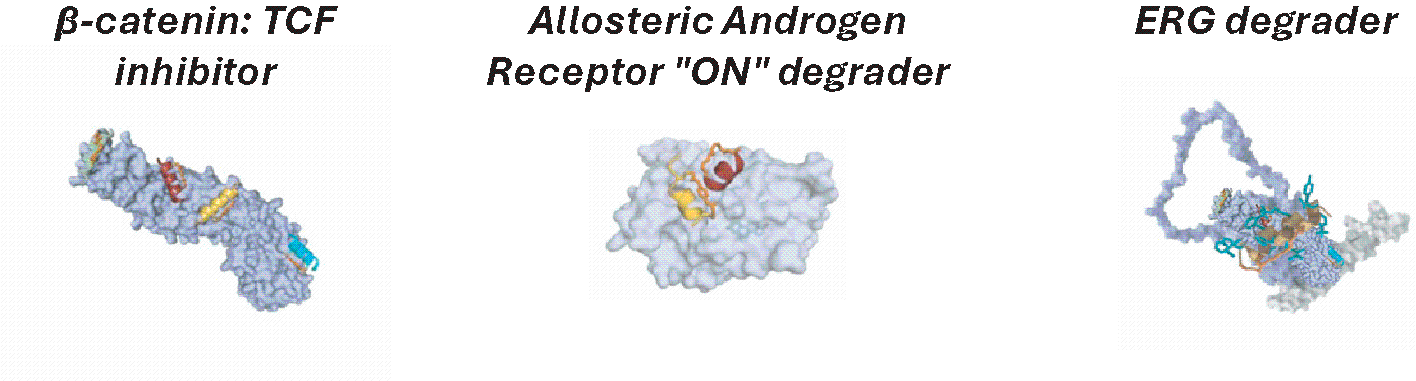
Helicons are stabilized alpha-helical peptides, taking inspiration from nature’s frequent use of alpha helices to bind to flat protein surfaces to traverse cellular membranes. We stabilize Helicons through proprietary crosslinkers and optimize their properties with a broad diversity of synthetic organic chemistry, including non-natural amino acids and a wide range of functionalization chemistries. The Helicon scaffold is highly modular and has the potential to readily incorporate additional functionalities beyond the inhibition of undruggable protein-protein interactions. These functionalities include the recruitment of E3 ubiquitin ligases for targeted protein degradation, the recruitment of essential proteins for targeted selective cell killing, and the delivery of payloads such as radionuclides.
Helicons, in contrast to most small molecules, often have the versatility to integrate ligands and additional functionalities at multiple possible positions. This provides substantial flexibility to tune potency, selectivity, and other drug-like properties. Helicons are also capable of achieving high selectivity for both target binding and degradation via formation of a ternary complex between target and E3 ligase machinery. Target binding selectivity is possible due to the larger and more polar contact surface areas Helicons use to engage proteins of interest. Selectivity for efficient target degradation that goes beyond target binding selectivity is further enabled by optimization of subtle features of target and E3 ligase complex orientation that differ even between highly related target proteins. These features of Helicon drug discovery enable the development of drug candidates that modulate the desired target while sparing closely related proteins with a high degree of biological precision. We believe that existing and future advances in small molecule drug discovery have the potential to be compatible with Helicons, which could enable us to apply emerging approaches to undruggable protein targets that we expect to remain challenging for other modalities.
The chemical and structural versatility of Helicons supports highly precise tuning of their properties and activity. However, this versatility requires effective and efficient methods of navigating the astronomical universe of over 1050 possible Helicon structures. Unlike small molecules, the modular and automated nature of our Helicon synthesis platform enables us to synthesize nearly any one of these 1050 possible structures within days in our laboratories. We have built a stack of complementary experimental and computational capabilities designed to allow us to efficiently assess a vast number of molecules and identify the most promising chemical series to pursue. These investments have resulted in a fully integrated Helicon discovery platform that has repeatedly identified biologically active molecules for targets and binding sites that have been inaccessible to other drug modalities.
Helicon Discovery Platform
All of our assets, including zolucatetide, were discovered using our Helicon discovery platform. This platform generates both drug candidates and large amounts of proprietary data. Each target we prosecute adds new and diverse information that is then fed back into model training, creating a continuous learning loop that improves our AI models and design processes. These platform advances have significantly improved our success rates in discovery, with all of the new programs we have initiated over the last three years resulting in cell-active compounds (seven distinct series for four target proteins).
We built our platform over the span of a decade specifically to enable the discovery of Helicons. The platform’s physical foundation incorporates an advanced chemistry toolkit, custom experimental methods, and extensive manufacturing and development know-how. A decade of applying these capabilities to Helicon drug discovery has generated vast proprietary datasets, comprising millions of data points for hundreds of thousands of Helicons across dozens of drug-like properties. We have used these data to construct a comprehensive suite of AI- and physics-based computational models, proprietary to Parabilis, which are now integrated into every step of our discovery process from target selection through lead optimization. This platform has enabled us to pursue multiple high-value opportunities and broaden our pipeline in recent years. We believe that the combination of our know-how, expansive platform capabilities, intellectual property, and large datasets creates a substantial barrier for other entrants.
Our platform’s core physical capabilities include the following:
•Our chemistry toolkit comprises hundreds of proprietary helix-stabilizing chemical crosslinkers and over a thousand non-natural amino acids, providing access to vast chemical diversity.
•Our display screening systems evaluate billions of Helicons for binding to target proteins, creating the potential to discover multiple, high-quality chemical series for new targets.
•Our multiplexed screening methods integrate combinatorial chemistry with mass-spectrometry-based multiplexed screening, enabling the synthesis and screening of multi-thousand-member Helicon libraries for a range of drug-like properties.
•Our customized suite of cytosolic exposure assays generates granular, quantitative data on one of the most critical properties for the successful discovery of peptides that can enter cells and access undruggable targets.
•Our full complement of in-house laboratory capabilities is used to generate datasets on additional properties, including potency, selectivity, cellular activity, physicochemical behavior, in vivo pharmacodynamic activity and efficacy, and drug, metabolism and pharmacokinetics (“DPMK”) parameters.
We have used the large and proprietary multi-parameter datasets resulting from these laboratory systems to build a set of AI- and physics-based models for dozens of different drug-like properties, which are coupled with generative AI methods both to aid human designers and to autonomously guide the design of next-generation molecules. These range from local, program-specific models for binding affinity and cellular potency to global models that predict cytosolic exposure and physicochemical properties. The first generations of our AI models were developed and integrated into discovery programs beginning in 2021, followed by years of close collaboration between data science and experimental teams to iteratively assess performance, adjust data collection, and update model architecture and training. This extended period of refinement has led both to an improved and expanded set of models and to effective, prediction-centric collaboration frameworks within teams. Both our ERG and ARON degraders were discovered by leveraging these computational capabilities.
Each stage of our Helicon drug discovery process tightly couples these high-throughput laboratory systems and AI- and physics-based computational methods to enable rapid optimization of drug candidates. The graphic below summarizes our discovery platform process.
Figure 2: Helicon discovery and optimization platform.
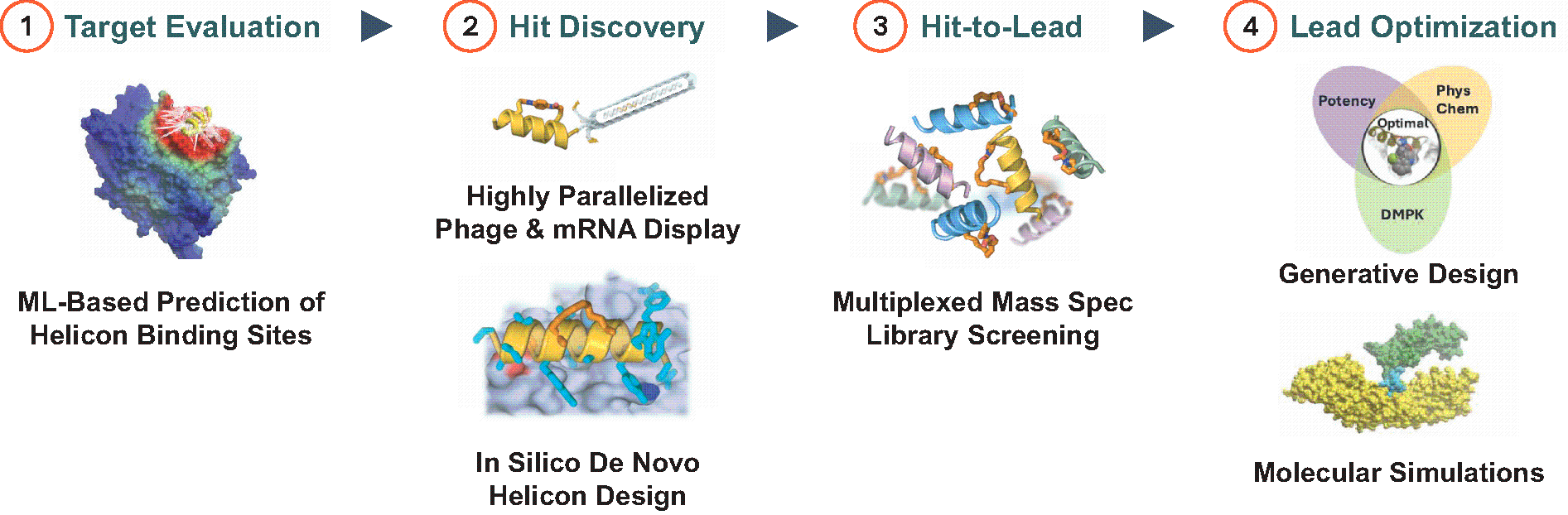
1.Target Evaluation. Our discovery process begins by evaluating potential targets for structural features that favor Helicon binding, which we refer to as Helisites. We have built a machine learning model that is able to predict the presence and location of Helisites on protein structures, including predicted structures, with high prospective accuracy. This capability enables us to identify proteins that are likely to be targetable by Helicons, and to select the binding sites that we believe are best suited to elicit the desired biological effect, since many proteins contain multiple Helisites. Using this model, we have identified Helisites across a wide range of protein classes including transcription factors, scaffolding proteins, E3 ubiquitin ligases, extracellular proteins, kinases, and other enzymes. Our Helicon platform is not intrinsically limited to any particular mechanism, and we believe that it has the potential to generate impactful medicines across disease areas where there is a strong scientific rationale for pursuing an intracellular disease driver that is challenging to target with other therapeutic modalities.
2.Hit Discovery. Once a target is selected, we deploy both experimental and computational approaches to discover hits for those targets. Our experimental screening methods include the phage display methodology used to discover the chemical series that led to zolucatetide, as well as a newer mRNA display capability that can screen up to 10 billion Helicons in a single experiment. Both our phage and mRNA display screening methods were built specifically for Helicons using custom library construction techniques and are run entirely in-house. We also apply a computational de novo hit discovery technique that we custom built specifically for Helicons to identify target-binding Helicons composed of non-natural amino acids, including all-D amino acids. The application of our experimental and computational hit discovery methods routinely leads to the identification of multiple chemical series for target proteins, often at multiple distinct Helicon binding sites on the protein surface. This optionality allows us to increase the probability of technical success for each program and enables us to tailor our targeting approach by selecting the binding sites or mechanisms that are best aligned with the biological selectivity or function that is needed.
3.Hit-to-Lead is anchored by our multiplexed screening capabilities. We utilize automated parallel peptide synthesis and combinatorial chemistry to rapidly generate libraries of thousands of highly complex Helicon peptides in less than a week, using only a single synthesizer. We then apply a suite of mass spectrometry-based assays to efficiently measure multiple drug-like properties, including target binding affinity, cell penetration, selectivity, physicochemical properties such as LogD, and stability to plasma, cell lysate, and other matrices. A particularly crucial multiplexed measurement is our proprietary cytosolic exposure assay, which quantifies whether a Helicon traverses cellular membranes and accesses intracellular targets. Using a machine learning model trained on these cytosolic exposure measurements for more than 40,000 Helicons, we use predicted cytosolic exposure to guide the selection and design of Helicons that can enter cells. This unique capability has enabled us to reliably optimize a range of properties including cell penetration, which is arguably the most formidable barrier to developing peptides that can target intracellular proteins.
4.Lead Optimization. Hits are optimized into leads and candidates through iterative AI-enabled design cycles, where local and global AI models guide multi-objective optimization across potency, solubility, selectivity, DMPK, and in vivo efficacy and pharmacodynamic activity. Our design process integrates in silico mutational scanning specific to Helicon staple and side-chain substitutions, identifying the modifications most likely to improve binding and other drug-like properties before a molecule is made. We can access a combinatorial space many orders of magnitude larger than standard peptide chemistry by combining the full range of available small molecule chemistry with our library of more than 1,000 non-natural amino acids, hundreds of staple chemistries, and a broad range of E3 ligands to a wide variety of E3 ligases. Non-natural amino acids expand the chemical design space far beyond the 20 natural amino acids, enabling precise optimization of potency, selectivity, solubility, and cell permeability.
As Helicons (or Helicon degraders) progress toward a short list of potential development candidates, we conduct an increasingly comprehensive evaluation to guide final selection. This includes formulation screening to identify viable dosing routes and delivery strategies, expanded DMPK profiling across species covering exposure predictions, pharmacodynamic and efficacy studies to confirm target engagement and dose-response relationships in relevant models, and toxicological profiling to establish preliminary safety margins. Together, this data package informs development candidate nomination and readiness for IND-enabling studies.
We are further developing our discovery platform with the goal of unifying these components into a single, integrated AI/hardware engine – the “Helicon Foundry”– designed to combine automated experimentation and high-throughput measurement with integrated data capture and continuous learning, as well as AI-driven design/optimization loops. We aim to leverage the Helicon Foundry to prosecute many targets and series in parallel with dramatically improved scalability and cycle times. As this system matures, we expect it will continue to reinforce our platform flywheel: each program can add data, improve models, refine automation, and increase the speed and quality of subsequent programs for potentially higher rates of drug development success.
Our computational capabilities extend beyond molecular drug discovery, both to upstream therapeutic hypothesis generation and downstream clinical development. Upstream, data science and AI are applied to both public and proprietary biological datasets – including the Helisite machine learning model to predict Helicon binding sites on protein structures with high accuracy. While we believe this application of data science and AI to robust biological datasets has the potential to allow us to identify high-quality targets with an increased probability of technical execution and clinical success, there can be no guarantee that this process will lead to actual clinical success or that any clinical success will result in regulatory approval. Downstream, we integrate real-world data to contextualize clinical trial outcomes, leveraging multi-modal datasets including omics, imaging, and patient-derived xenograft (“PDX”) models to support biomarker discovery and adaptive trial design. In translational science, we are leveraging the latest computational biology models to improve our understanding of which medicines are likely to work in which patients and indications, enabling us to refine our biomarker strategies and patient selection to increase the precision and efficiency of our clinical programs. In clinical development, we are building the biomarker-integrated operational infrastructure that targeted medicines require, from biomarker design through cutting-edge clinical operations designed to scale across indications as our pipeline grows.
Our Product Candidates
We are developing a range of Helicon product candidates for the treatment of solid tumors, including our lead product candidate, zolucatetide. We also have several preclinical programs, including an ERG degrader and an ARON degrader targeting prostate cancer, a b-catenin degrader effort and multiple earlier discovery-stage programs.
Zolucatetide
Zolucatetide was discovered using our platform and is, to our knowledge, the first and only investigational therapy that inhibits the interaction between b-catenin and transcriptional co-activators of the TCF family. By doing so, it inhibits tumorigenesis at the most critical downstream node of the Wnt/b-catenin pathway. We have generated early efficacy and safety data in our ongoing clinical trials in a variety of tumor types and expect to report further data in the second half of 2026.
Wnt/b-catenin pathway
The Wnt/ß-catenin signaling pathway is one of the most extensively studied signaling cascades in biology, governing essential cellular processes including proliferation, differentiation, migration, and development, and is among the most broadly implicated drivers in human cancer. b-catenin activating pathway mutations are present in over 10% of all cancers.
Under normal physiological conditions, the Wnt pathway operates as a tightly regulated molecular switch. In the absence of a Wnt ligand signal, b-catenin is captured by a multiprotein assembly known as the “destruction complex”, which is comprised of Axin and APC scaffolding proteins and glycogen synthase kinase 3b. This complex targets b-catenin for proteasomal degradation when Wnt target and gene transcription is suppressed. Upon binding of a Wnt ligand to its receptors (FZD, LRP5/6) the destruction complex is inactivated, and degradation of b-catenin ceases, leading to its accumulation in the cytoplasm and subsequent translocation to the nucleus. In the nucleus, b-catenin binds to the TCF family of transcription factors, forming a transcription complex that drives expression of Wnt target genes. Many of these target genes (e.g. c-MYC, LGR5) drive cell proliferation and maintain a stem-cell state.
Wnt pathway activation in tumor cells can happen in multiple ways, most often due to loss-of-function mutations in APC and gain-of-function mutations in CTNNB1 (b-catenin). Loss-of-function APC mutations impair the ability of the destruction complex to degrade b-catenin. Gain-of-function CTNNB1 mutations allow b-catenin to escape degradation normally driven by the destruction complex. In both cases, the resulting constitutive stabilization of b-catenin and activation of Wnt target genes occurs independently of extracellular Wnt ligand signaling, rendering these tumors ligand-independent. APC mutations in individuals have been associated with higher cancer risk across multiple tumor types, including colorectal, gastric, small bowel, thyroid, liver, and desmoid tumors, among others. CTNNB1 mutations are the predominant mechanism of Wnt activation in desmoid tumors, HCC, ACP, endometrial cancer, and several other tumor types.
The b-catenin/TCF protein-protein interaction represents the most downstream effector node of the canonical Wnt pathway. Upstream activating signals, whether arising from Wnt ligand binding, loss of destruction complex function through APC mutations, or stabilizing mutations in b-catenin itself, all converge to drive a tumorigenic transcriptional program. The downstream position of the b-catenin/TCF complex in this pathway provides the mechanistic rationale for zolucatetide and is the basis of our therapeutic strategy.
Figure 3: Downstream inhibition of Wnt/b-catenin signaling by zolucatetide.
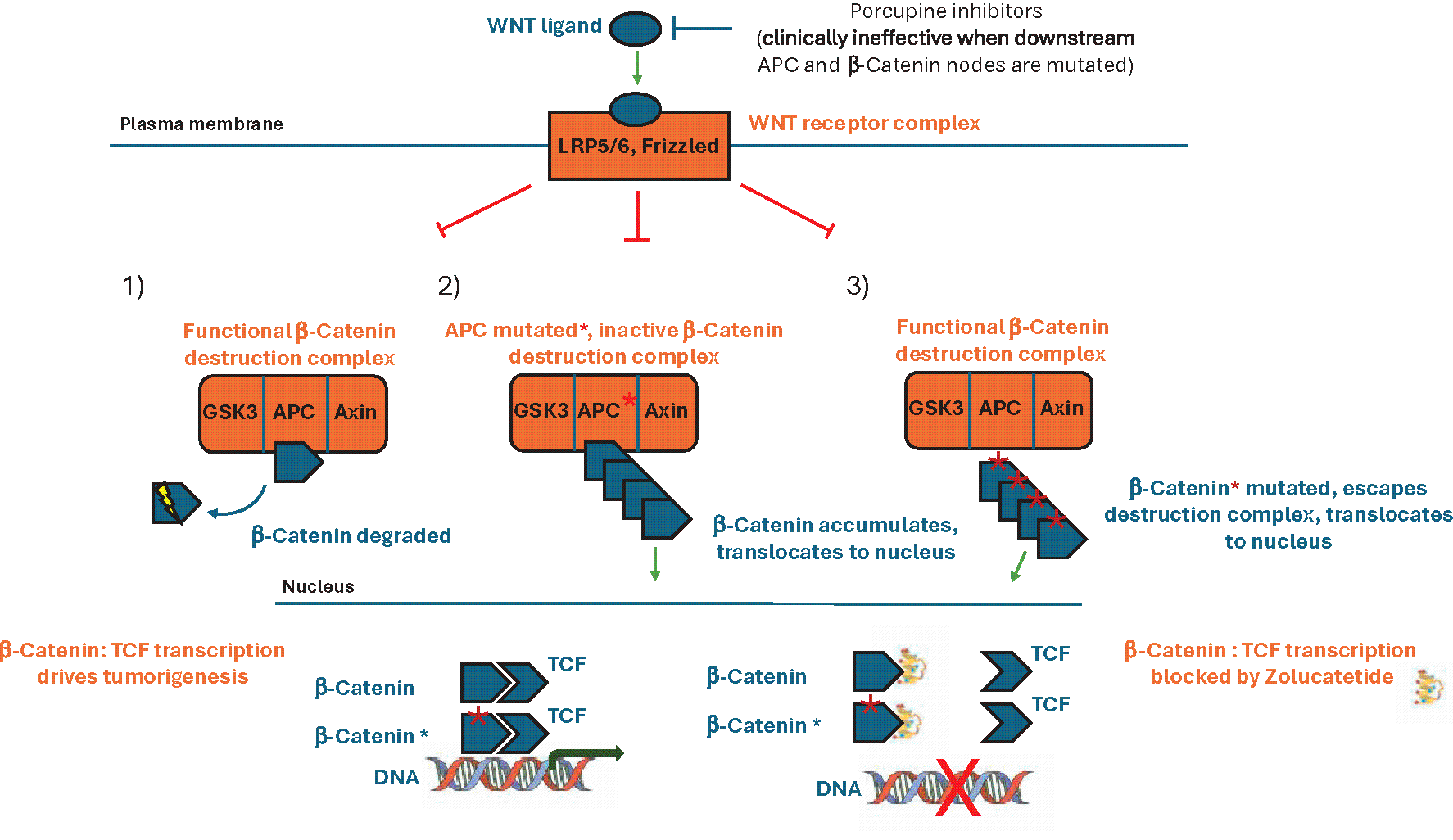
Historical Challenges in Targeting the Wnt/b-catenin pathway
Despite compelling biological and clinical rationale and more than three decades of drug discovery effort, investigational therapeutics that directly and selectively target b-catenin have not been successful in clinical development to date. Furthermore, b-catenin itself has historically been considered undruggable due to its structural and functional properties. The protein lacks deep, well-defined binding pockets and relies on large, shallow protein-protein interaction surfaces within its armadillo repeat domain to engage partners such as TCF, APC, Axin, and E-cadherin. These overlapping interaction interfaces make selective disruption of oncogenic b-catenin:TCF signaling difficult without impairing essential cellular functions like adhesion. Additionally, as an intracellular protein localized to the cytoplasm and nucleus, b-catenin has remained inaccessible to biologics, while traditional small molecules have lacked the size and structural complexity to effectively engage its large interaction surface. We have specifically engineered zolucatetide to bind the relatively flat protein-protein interaction surface of b-catenin and directly disrupt the b-catenin:TCF interaction, as illustrated in the figure below.
Figure 4: Zolucatetide’s differentiated binding capabilities.
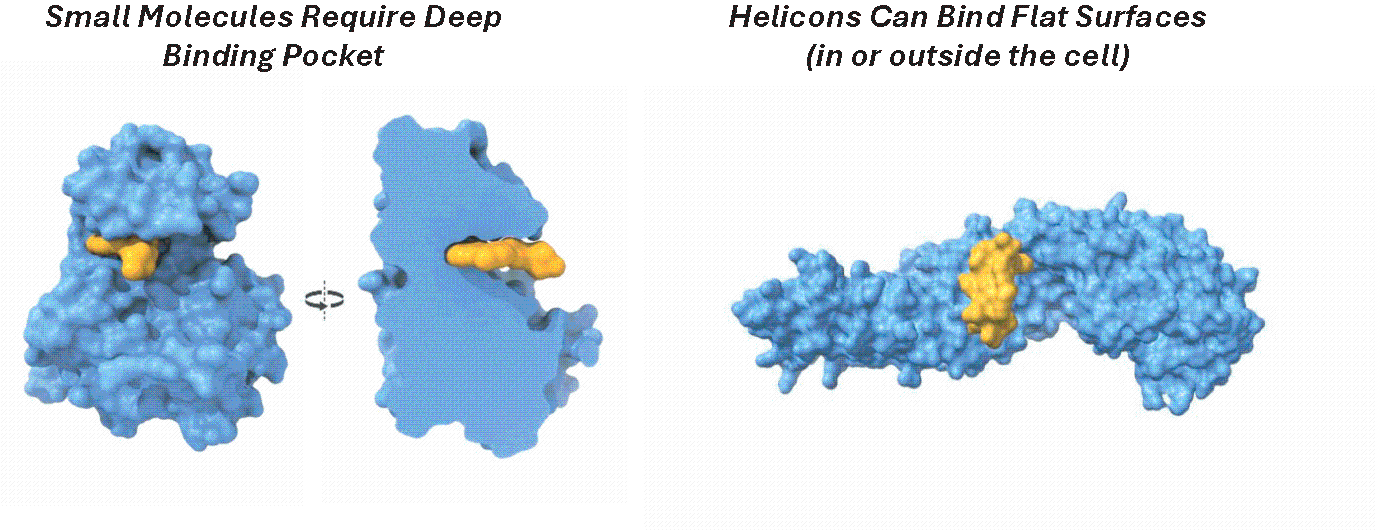
As shown in the figure below, zolucatetide inhibits the interaction between b-catenin and TCF without disrupting other interactions.
Figure 5: Zolucatetide inhibition.
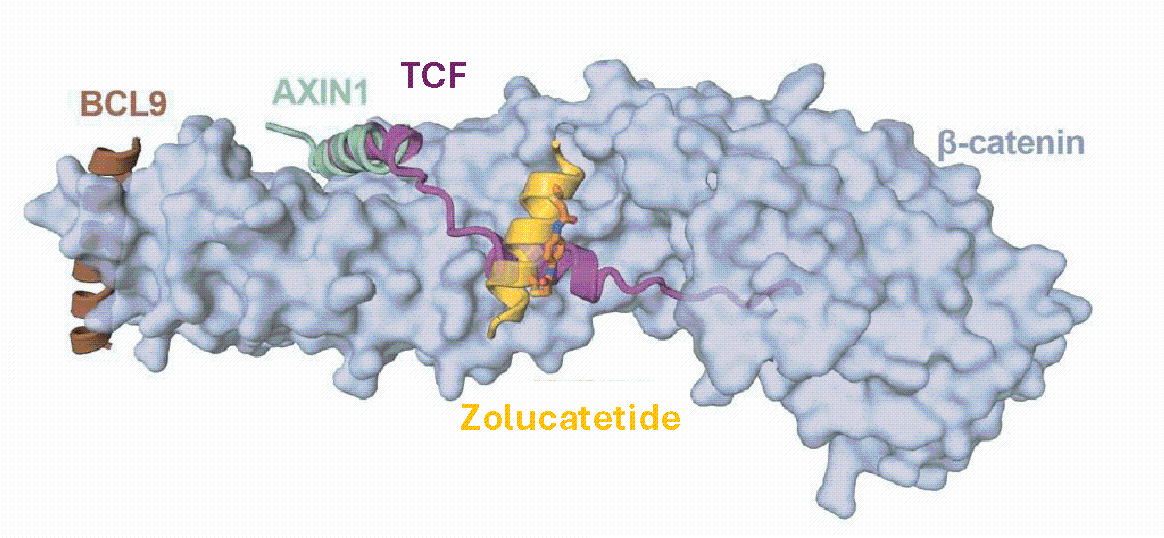
Certain historical efforts focusing on modulating b-catenin proliferation, such as the use of porcupine inhibitors, failed due to limited efficacy since these inhibitors targeted the Wnt/b-catenin pathway upstream of b-catenin itself. In tumors harboring APC or b-catenin mutations, b-catenin activity becomes independent of ligand- or receptor-mediated signaling, rendering upstream interventions largely ineffective (see Figure 3). Additionally, systemic or nonselective inhibition of the pathway as demonstrated by frizzled-targeting antibodies and decoy receptors targeting Wnt receptors has resulted in significant on-target toxicities such as bone loss and dysgeusia. Like porcupine inhibitors, these agents target the receptor-ligand axis and are therefore not expected to address tumors with downstream pathway activation. We believe zolucatetide addresses these limitations by directly targeting the b-catenin:TCF interaction at the critical downstream node of the pathway.
Our Solution – Zolucatetide
To overcome the historical challenges described above, we specifically engineered zolucatetide to enter cells without altering the cell membrane and bind to the relatively flat protein-protein interaction surface of b-catenin, directly disrupting the b-catenin:TCF interaction at the critical downstream node of the pathway. We believe zolucatetide has the potential to block b-catenin-dependent Wnt signaling in tumors mutated at APC and b-catenin, by acting at the b-catenin/TCF interface. As set forth in the graphic below, zolucatetide acts downstream of both APC loss-of-function and b-catenin gain-of-function mutations, and as a result we believe cancers driven by mutations in either of these genes will be responsive to zolucatetide. Multiple high-value indications are known to be driven by direct b-catenin activation, including desmoid tumors, FAP, HCC, CRC, and numerous other rare Wnt/b-catenin-driven indications. The figure below summarizes these indications.
Figure 6: Zolucatetide acts downstream of mutations.
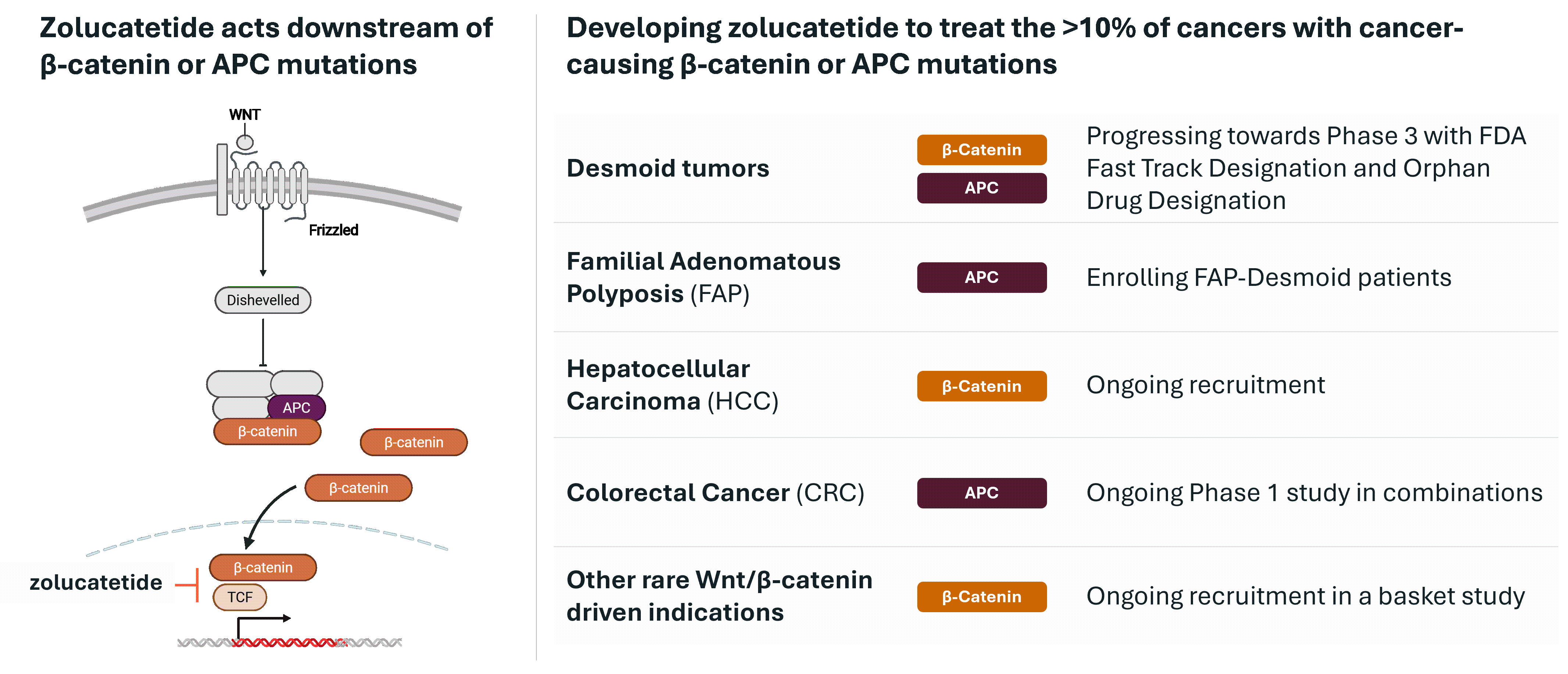
Although Wnt/b-catenin pathway alterations occur across a wide range of cancers, we have been disciplined and deliberate in choosing where to focus. We are prioritizing indications based on three criteria: (i) the Wnt/b-catenin pathway mutation is highly prevalent, (ii) b-catenin is the key driver of disease, and (iii) we have seen high levels of activity to date in our preclinical studies and clinical trials. These indications are often genomically simple tumors in which a Wnt/b-catenin pathway mutation is the main oncogenic driver detected. These indications include desmoid tumors and FAP, settings in which a monotherapy approach to direct inhibition at the b-catenin:TCF node has historically been observed to be effective. We are also exploring HCC, where we believe zolucatetide is well positioned to treat a molecularly defined subset of patients that harbor activating b-catenin mutations, as well as additional rare indications such as ACP and ameloblastoma. We also believe that zolucatetide has potential as part of combination regimens in more genomically complex tumors, such as colorectal cancer, where additional mutations beyond b-catenin are also implicated in driving disease.
We are committed to advancing zolucatetide in indications where the underlying biology supports the potential for meaningful clinical benefit and where we see potential for patient impact. We believe that the clinical data obtained to date provide evidence of successful targeting of b-catenin and therapeutic utility across multiple tumor types. We have set forth below the design of our ongoing Phase 1/2 clinical trial of zolucatetide.
Our ongoing Phase 1/2 clinical trial of zolucatetide (Study FOG-001-101) is a multi-arm, open-label study evaluating zolucatetide administered as an intravenous (“IV”) infusion, both as a monotherapy and in combination, in patients with locally advanced or metastatic solid tumors harboring Wnt pathway-activating mutations (“WPAM”), including APC and CTNNB1 mutations. The primary objectives of Part 1 are to assess the safety and tolerability of zolucatetide across a range of dose levels and dosing schedules, characterize the pharmacokinetic (“PK”) profile, identify a preliminary recommended Phase 2 dose and schedule, and evaluate preliminary antitumor activity. The trial consists of a dose-escalation and dose-optimization phase (Part 1), followed by a dose-expansion phase (Part 2). Figure 7 summarizes the trial design, enrolled patient populations, evaluated dose cohorts, and primary and secondary endpoints.
Figure 7. Zolucatetide study cohorts as of February 16, 2026.
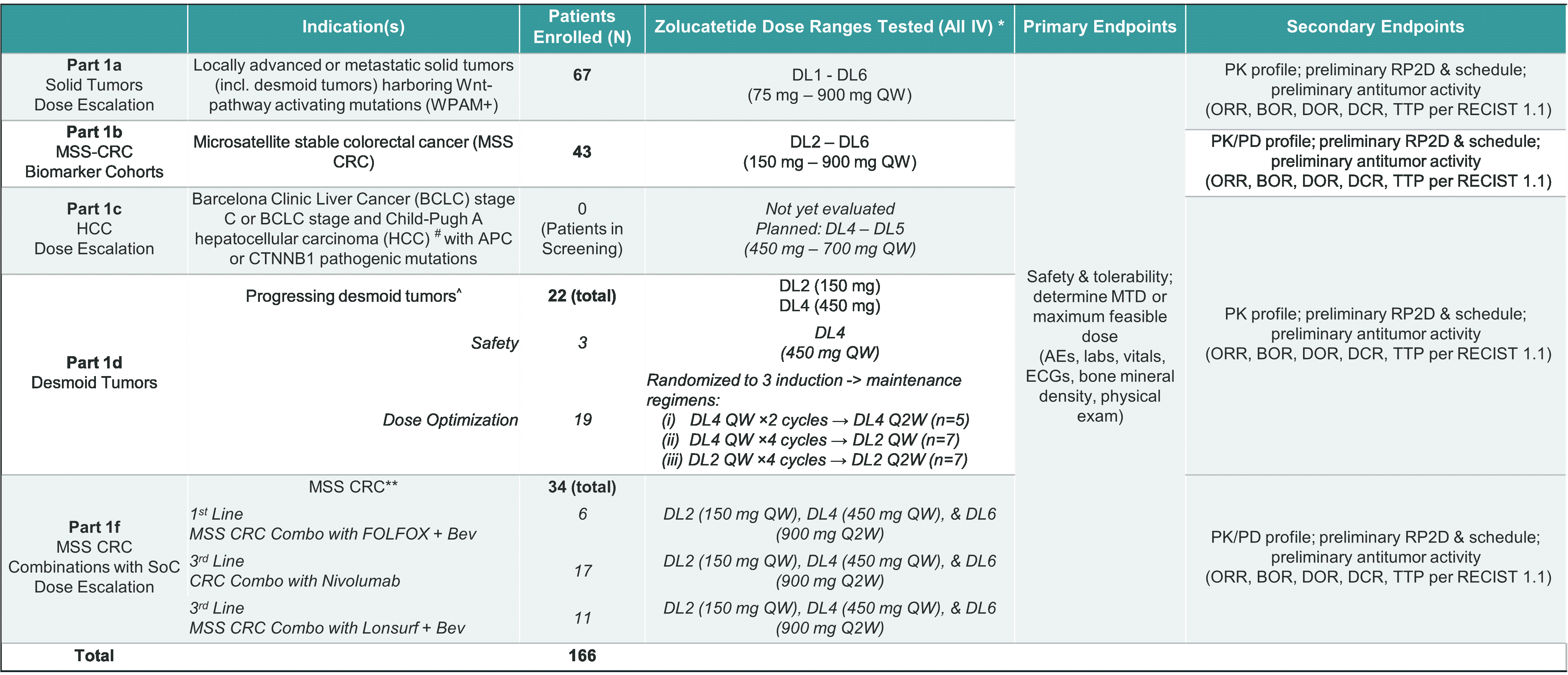
All sites are U.S.-based. Part 1 not powered for statistical significance; antitumor activity results are exploratory.
Bev = Bevacizumab; Combo = Combination; CRC = Colorectal Cancer; DL = dose level; IV = Intravenous(ly); QW = weekly; Q2W = every 2 weeks; RP2D = recommended phase 2 dose.
* One cycle = 28 days
# not amenable to locoregional therapy or relapsed after locoregional therapy and not amenable to curative treatment
^ with an increase of ≥10% by RECIST 1.1 or in the active component of the tumor within 12 months of the first dose of zolucatetide
** (Part 1f-2 open to WPAM+ solid tumors for which immunotherapy with anti-PD-1/PD-L1 +/-CTLA-4 therapy is Standard of Care (SoC) and have primary resistance or secondary resistance (within 6 months of the first dose) on anti-PD1/PD-L1 therapy or ineligible for SoC
Figure 8: Zolucatetide fixed dose equivalents for each BSA-based dose level
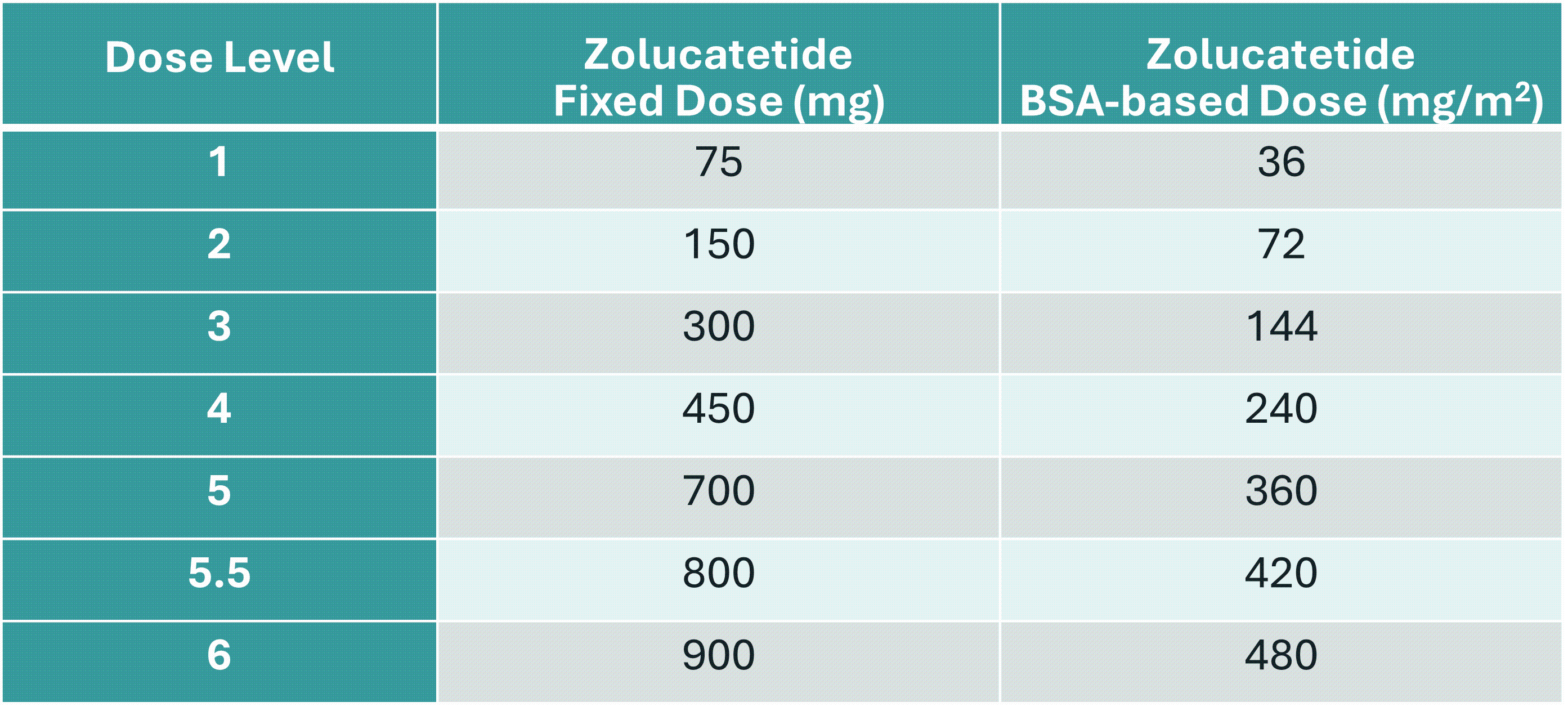
BSA = Body Surface Area
Part 1A was designed as a standard monotherapy dose-escalation study evaluating patients with desmoid tumors, microsatellite stable colorectal cancer (“MSS CRC”), and other advanced solid tumors harboring WPAM alterations. Desmoid tumor patients were enrolled across multiple dose levels, including DL2, DL4, and DL6. Based on the clinical activity observed in desmoid tumor patients during Part 1A, Part 1D was initiated to accelerate development in this setting and optimize the zolucatetide dose and schedule for potential later-stage development. Part 1D evaluates three randomized induction and maintenance dosing regimens across DL2 and DL4 weekly and every-other-week schedules in desmoid tumors.
All patients enrolled in the study to date have been treated at clinical sites in the United States. Part 1 was not designed or powered to assess for statistical significance. Antitumor activity results are reported as exploratory observations and include objective response rate (“ORR”), best overall response (“BOR”), duration of response (“DOR”), disease control rate (“DCR”), and time to progression (“TTP”), assessed using disease-appropriate response criteria, including RECIST 1.1 for desmoid tumors and other solid tumors. The clinical data presented in Figures 9 through 14 reflect patients enrolled and treated in Part 1A (dose escalation) and Part 1D (dose optimization) as of February 16, 2026, with a primary focus on the desmoid tumor indication, which currently represents the lead development opportunity for zolucatetide.
Indications
Genomically Simple Tumors
We consider genomically simple tumors to be those in which a Wnt/b-catenin pathway mutation is highly prevalent, serves as the key driver of disease, and represents the primary oncogenic alteration detected. To date we have observed meaningful responses at dose levels DL2 to DL4, or 150-450 mg weekly.
Desmoid Tumors
Our lead indication for zolucatetide is desmoid tumors, which are rare, locally invasive soft tissue tumors driven by somatic or germline b-catenin pathway mutations. We estimate that approximately 11,000 desmoid tumor patients in the United States are actively managed under physician care. Desmoid tumors are typically diagnosed in young adults, with peak incidence in individuals aged 30 to 40 years, and a higher prevalence in females. Desmoid tumors impose substantial morbidity, with pain, functional and mobility impairment, and the potential for life-threatening complications depending on tumor location. Given the chronic nature of the disease and the onset in a predominantly young patient demographic, who have a near-normal life expectancy, prolonged or lifelong management is typically required.
Although there is an FDA-approved therapy, with others in development or prescribed off-label, there remains a large unmet medical need, as many patients either do not respond to therapy or have significant side effects. The only FDA-approved therapy, Ogsiveo (nirogacestat), is a GSI that demonstrated a 41% objective response rate measured at the end of its Phase 3 trial, with responses accrued over a median duration of 20.6 months. It was associated with high rates of adverse events, including diarrhea in 84% of patients, maculopapular rash in 32% of patients, and ovarian dysfunction in 75% of female patients of reproductive potential. More than half of desmoid tumor patients treated with this therapy do not achieve objective responses and among those who do, the median time to response is 5.6 months among those that did eventually respond. Another GSI, varegacestat, which is not yet approved, has shown a 56% objective response rate at the end of trial in its Phase 3 trial and was associated with similarly high rates of GSI-related adverse events including diarrhea (82%), rash (43%), and ovarian toxicity in 55.6% of pre-menopausal women. The Phase 3 trials of Ogsiveo and varegacestat described above were conducted at a later stage in the development process using different trial designs than our Phase 1/2 clinical trial of zolucatetide. Accordingly, the trial results of Ogsiveo and varegacestat may not be directly comparable to those we have observed in our clinical trial of zolucatetide to date and described elsewhere in this prospectus, nor to those that we may observe in our planned Phase 3 registrational trial. We have not conducted, and do not currently plan to conduct, any head-to-head clinical trials with Ogsiveo or varegacestat.
The high threshold to initiate systemic therapy in desmoid tumors today may be driven in large part by toxicity and treatment burden, rather than disease biology alone. The availability of more effective and better-tolerated therapies could lower this treatment threshold, potentially significantly expanding the treated population and revealing a larger underlying market than is currently observed.
The figures below set forth data from our ongoing Phase 1/2 trial, as of February 16, 2026.
Figure 9: Observed best percentage change from baseline and overall response in desmoid tumor patients receiving zolucatetide.
CR : Complete Response DL: dose level; PR: partial response; QW: weekly dosing; Q2W: every other week dosing.
Figure 10: Observed time on study treatment per patient in zolucatetide Phase 1/2 trial in desmoid tumors as of February 16, 2026.
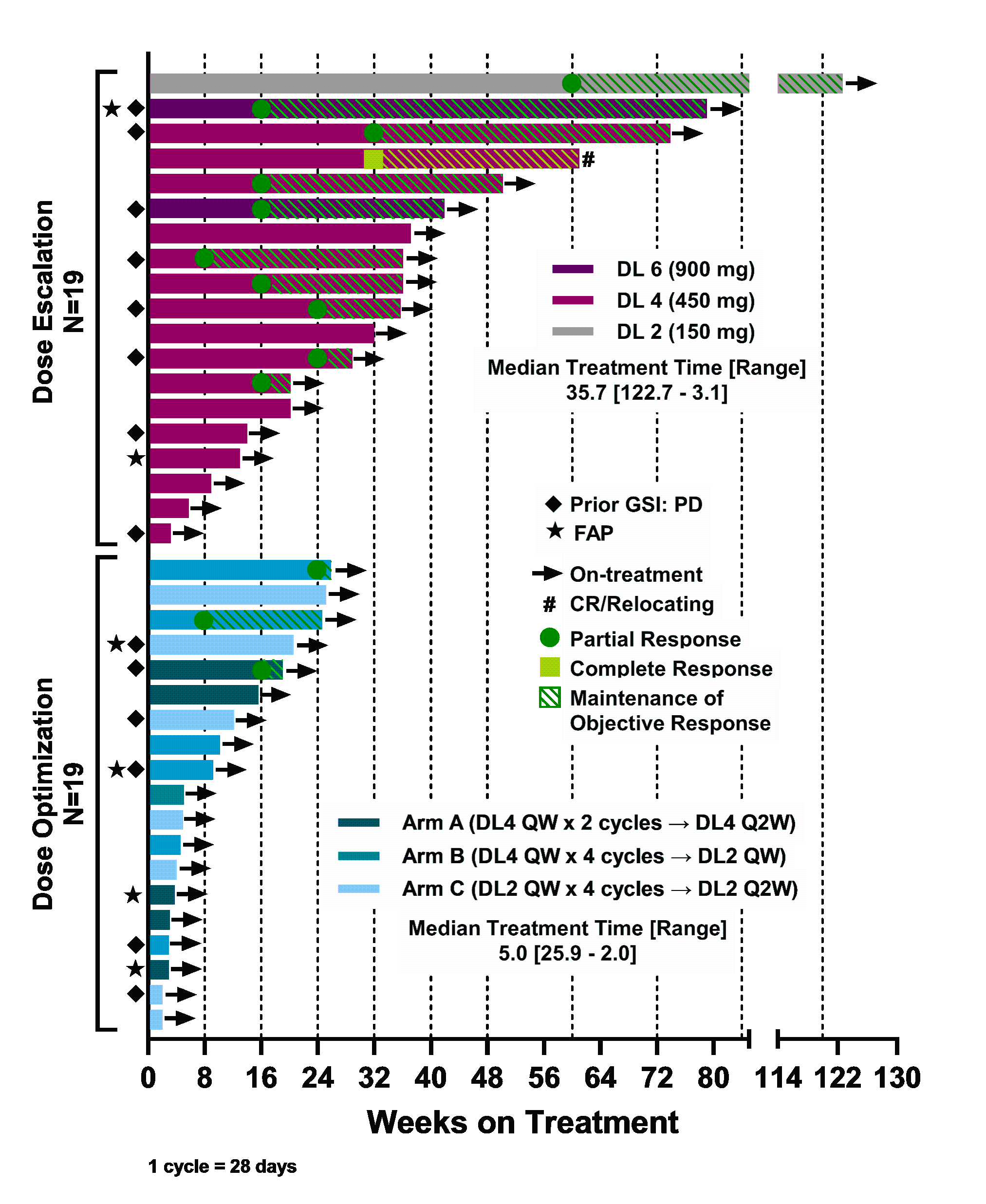
# Patient achieved a complete response and voluntarily discontinued treatment due to relocation away from study center.
Vertical dashed lines indicate timing of on treatment scans. Scans occur every eight weeks for the first 12 months, and then every 12 weeks thereafter.
Across both the dose escalation and dose optimization groups, 25 patients had at least one post-baseline scan, and 19 have more than one scan (16 weeks and beyond).
Dose optimization arms are as follows: (1) Arm A = DL4 weekly for 2 cycles, followed by DL4 every 2 weeks; (2) Arm B = DL4 weekly for 4 cycles followed by DL2 weekly; and (3) Arm C = DL2 weekly for 4 cycles followed by DL2 every 2 weeks. One cycle is 28 days.
38 desmoid patients have been enrolled and treated with zolucatetide, of which 25 had sufficient follow up to be response-evaluable, with all 25 patients showing tumor reductions (DCR 100%). Of the 19 patients with at least two post-baseline scans, 74% (14/19) had an objective response per RECIST 1.1 (a 30% or greater tumor reduction from baseline), including one complete response (CR:5.2%), with a median time to response of 3.8 months. In all patients who have achieved a partial response and who have had a subsequent scan, the partial response has been confirmed. Partial responses were observed in desmoid tumor patients regardless of prior exposure to GSIs. Patient prior treatment categories include: (1) no prior GSI exposure (GSI-naïve), (2) disease progression after treatment with a GSI, and (3) discontinuation of prior GSI due to toxicity or other reasons. We believe the ability of zolucatetide to drive responses in desmoid tumors regardless of prior GSI therapy supports our differentiated approach of targeting the direct underlying cause of desmoid tumors, mutations in b-catenin or APC, underscoring zolucatetide’s potential.
To date, data in the zolucatetide desmoid tumor program demonstrate deep and durable responses across dose levels, assessed by both RECIST 1.1 per investigator and volumetric measurements per central reader. We currently have volumetric measurements on eight patients from the central reader. Figure 11 shows substantial tumor reduction across all three dose cohorts (72, 240, and 480 mg/m²), including in patients with prior GSI progressive disease. Figure 11 tracks percent change from baseline through Week 96 and demonstrates rapid, steep tumor regression in the 240 and 480 mg/m² cohorts, with responses evident within the first weeks of treatment. A slower but consistent pattern of reduction over time, was observed in the 72 mg/m² cohort. Volumetric data from the central reader corroborate and in all cases exceed the depth of response captured by RECIST 1.1, further supporting our view of the clinical meaningfulness of the observed tumor reductions.
Figure 11. Volumetric data -- responses by dose level and prior GSI as of October 27, 2025
Figure 12. Volumetric data -- time to response by dose level as of October 27, 2025
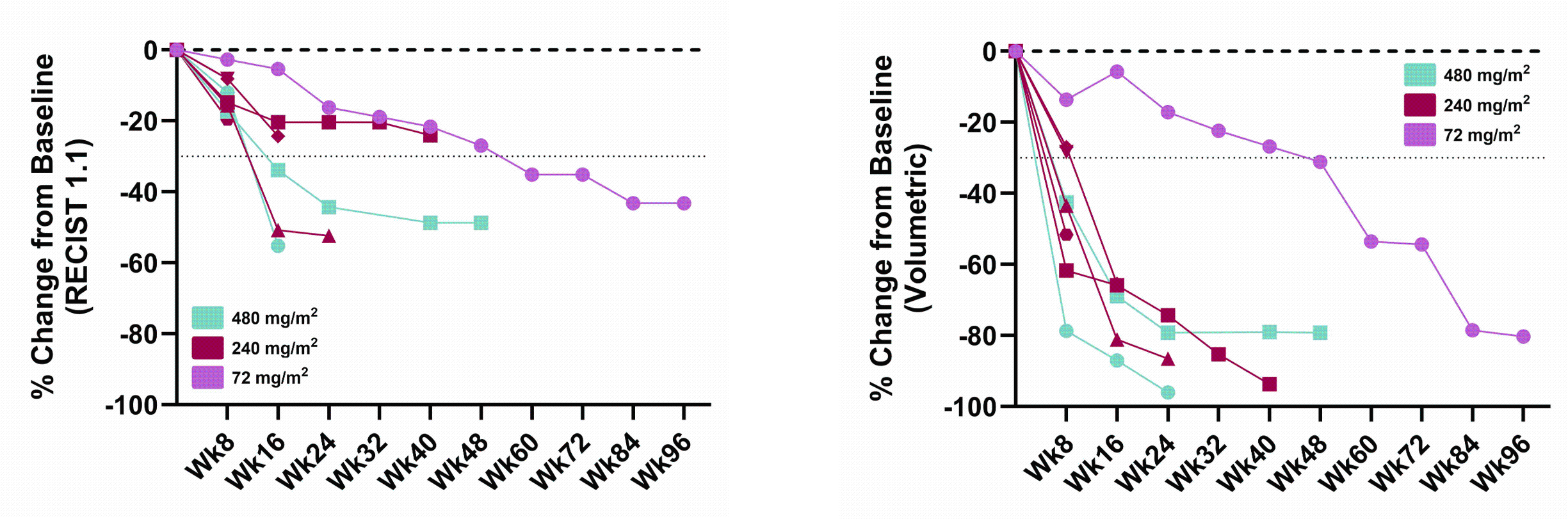
To date, we have observed chronic administration of zolucatetide to be well tolerated and to reduce tumor size over time. Additional information regarding tolerability and treatment-related adverse events (“TRAEs”) can be found below in Figure 13. We are developing a new formulation of zolucatetide to be used as a self-administered injection, either with an autoinjector, pre-filled syringe or an on-body device for ease of administration, which we believe may further support chronic use and adoption. We are currently evaluating a number of lead formulations for zolucatetide with the intention of taking the final formulation into bridging studies in healthy volunteers and patient populations. Although we plan to continue working toward a self-administered injectable formulation, we intend to conduct our pivotal Phase 3 trial of zolucatetide in desmoid tumors initially using only the current intravenous (“IV”) infusion presentation. We currently plan on launching zolucatetide, if approved, in a self-administered injectable product formulation. We expect regulatory authorities will require us to conduct, among other things, PK compatibility studies to bridge the IV infusion presentation to these new planned injection presentations, human factors testing to support self-administration of zolucatetide, and potentially a separate Phase 2 trial to validate the equivalence of the current IV formulation to the injectable formulation. Any of these additional steps could delay marketing approval of zolucatetide in one or more formulations. We expect to identify our final formulation and engage in a discussion with the FDA relating to a bridging trial to allow for approval of the self-administered injectable formulation to be approved.
Preliminary Clinical Safety Data
The table below sets forth preliminary clinical safety data for all desmoid tumor patients as of February 16, 2026. We have observed zolucatetide at optimal doses between DL2 and DL4 to have the potential for significant improvement in tolerability over GSIs and other available therapies for the treatment of desmoid tumors. The most commonly reported TRAEs at optimal doses between DL2 and DL4 were low-grade (Grade 1 or 2), with mild symptoms or asymptomatic laboratory abnormalities that were reversible. There were no treatment-related Grade 3 or higher gastrointestinal (“GI”), skin toxicities, or ovarian toxicities reported. No TRAEs have resulted in treatment discontinuation. As of February 16, 2026, all patients remain on trial with durable responses.
Figure 13: Treatment-related Adverse Events (“TRAE”) in desmoid tumor patients dosed in Part 1 in greater than or equal to 15% of patients, observed as of February 16, 2026.
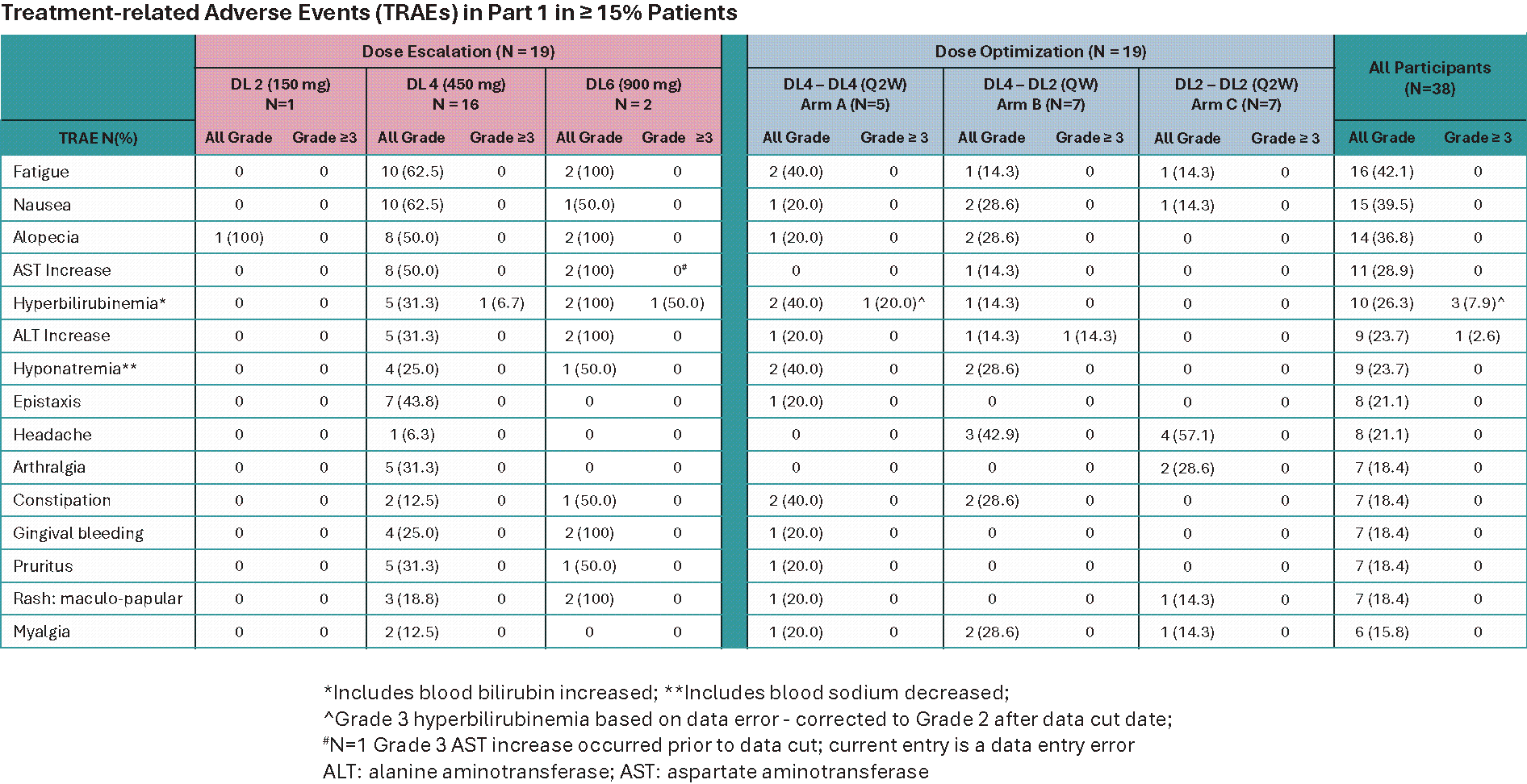
Figure 14: TRAE summary: All desmoid patients as of February 16, 2026.

*One patient had a Serious TRAE that was grade 1 fever but was hospitalized for workup, and was found to be positive for cryptococcal antigen, which may be an alternative cause of fever. Fever resolved within two days and the patient remains on treatment. This is patient noted with Grade 3 ALT TRAE in one of our desmoid dose optimization cohorts (DL4 – DL2 (QW), Arm B).
**One patient had a grade 4 TRAE (CPK increase that resolved after seven days). Four patients had grade 3 TRAEs—blood bilirubin increase, platelet decrease, ALT increase (not in the same patient as the grade 3 blood bilirubin increase). All were reversible asymptomatic lab abnormalities without clinical sequelae.
Figures 15 and 16 below show the preliminary clinical safety data for all patients enrolled in our Phase 1/2 trial and who have been treated with zolucatetide as a monotherapy, including patients whose indications are MSS CRC.
In summary, across multiple locally advanced or metastatic tumor types, including microsatellite-stable colorectal cancer (MSS CRC), zolucatetide was observed to be tolerated during the dose-limiting toxicity (DLT) evaluation period (first 28 days) at dose levels up to DL6 (900 mg). A dose-dependent increase in Grade ≥3 treatment-related adverse events (TRAEs) was observed. No maximum tolerated dose (MTD) has been identified to date.
Grade ≥3 TRAEs were generally manageable with supportive care measures and dose interruptions. Patients were able to resume zolucatetide treatment at the same or a reduced dose following resolution or improvement of adverse events. Preliminary observations suggest that proactive management of adverse events, including hyponatremia, fatigue, and thrombocytopenia, may reduce the need for dose interruptions.
No deaths attributable to TRAEs were reported.
A higher incidence of Grade ≥3 TRAEs was observed among patients with MSS CRC. We believe this finding is consistent with the more advanced disease status and overall clinical condition of this population compared with patients with desmoid tumors or FAP. In addition, a greater proportion of MSS CRC patients were treated at higher dose levels (above DL4), where we anticipated an increased frequency of adverse events based on our observed dose–response relationship.
Figure 15 : TRAEs in monotherapy in all tumor patients dosed in Part 1 in greater than or equal to 15% of patients, observed as of February 16, 2026.
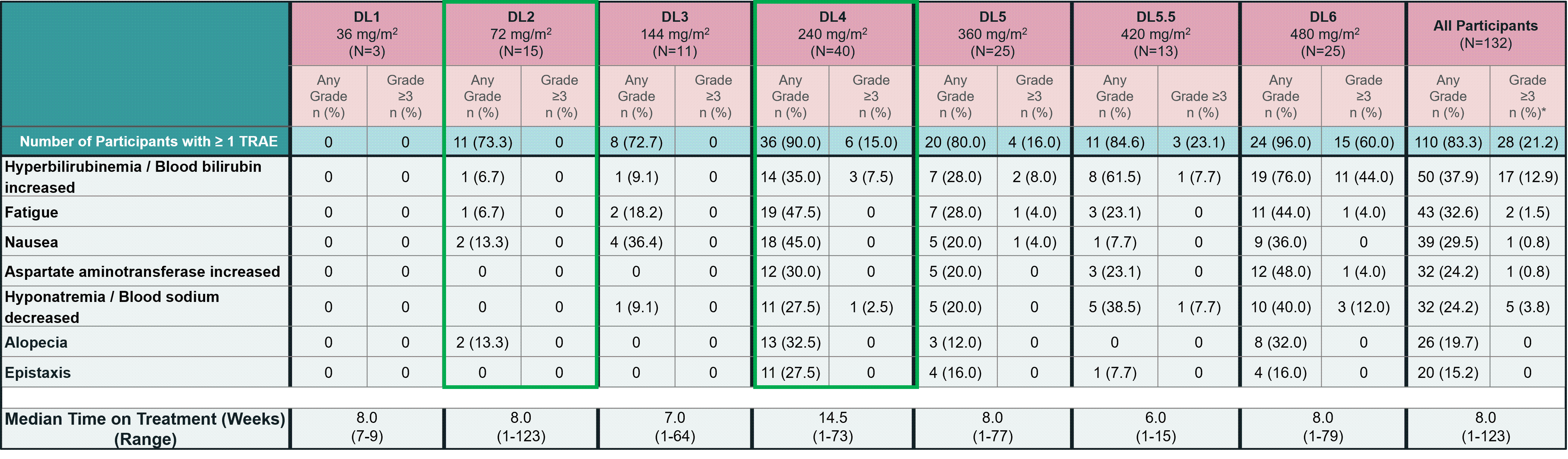
DL = Dose level; TRAE = Treatment-related adverse event
* Other ≥ Grade 3 AEs include: thrombocytopenia/blood platelet count decreased at DL6 (n=4, 3.0%), lipase increased [n=3 total, 2.3%; DL5.5 (n=1) and DL6 (n=2)], adrenal insufficiency at DL5.5 and DL6 (n=2, 1.5%), gamma-glutamyl transferase increased at DL6 (n=1, 0.8%), pyrexia at DL5 (n=1, 0.8%), blood creatine phosphokinase increased at DL4 (n=1, 0.8%), and alanine aminotransferase increased at DL3 (n=1, 0.8%).
Figure 16: Zolucatetide summary of TRAEs in all monotherapy participants, observed as of February 16, 2026.

DL = Dose level; TRAE = Treatment-related adverse event.
a Grade 1 fever but patient was hospitalized for workup and was found to be positive for cryptococcal antigen, which may be an alternative cause of the fever. The Grade 1 fever resolved within 2 days. Zolucatetide was restarted at a lower dose and Q2W schedule and remains on treatment.
b Grade 3 nausea and Grade 3 fever both initially reported as related to zolucatetide leading to drug interruption. Subsequent to the February 16, 2026 data cutoff, the Investigator determined the events to be not related to zolucatetide.
C Grade 3 worsening adrenal insufficiency leading to dose interruption occurring in the setting of a COVID-19 infection (Grade 2 not related). Patient was treated with hydrocortisone and fludrocortisone. The SAE resolved after 11 days. Zolucatetide was restarted at DL5 but the patient subsequently ended treatment due to disease progression.
d Grade 3 adrenal insufficiency leading to drug interruption. Patient was treated with fludrocortisone and corticosteroids and SAE was recovered/resolved within three days. Zolucatetide was restarted at DL5 Q2W. Patient remained on treatment for another three cycles being treated beyond progression before ending treatment due to withdrawal of consent. Note patient was taking spironolactone at the time the SAE started.
In desmoid tumors, we currently expect the chronic dose to be close to the DL2 dose, with a possible short-term induction dose close to the DL4 dose. These two doses are boxed in green above in Figure 15.
Of note, zolucatetide is a known inhibitor of the OATP1B1 and OATP1B3 transporters which mediate the hepatic uptake of bilirubin. This may sometimes lead to asymptomatic, clinically not significant elevation in blood bilirubin. This impact on bilirubin uptake is a benign laboratory abnormality that is not associated with hepatocellular injury. This phenomenon is similar to that observed in Rotor’s syndrome, a benign genetic condition characterized by OATP1B1 and OATP1B3 deficiency, which leads to
elevated blood bilirubin levels without affecting overall liver function. Patients with Rotor’s syndrome have normal liver function without any associated morbidity or impact on quality of life. In addition, treatment-related increases in other liver function markers (ALT, AST, and ALP) are less common, transient and almost exclusively low-grade.
The Wnt signaling pathway is also involved in bone homeostasis, and inhibition of the Wnt signaling pathway is known to result in on-target bone toxicity in previous attempts to drug the pathway with PORCN and Frizzled receptor inhibitors. Therefore, patients in the trial also take prophylactic anti-resorptive therapy at three to six month intervals throughout the duration of the trial treatment. In addition, inhibition of β-catenin-TCF4 can result in on-target reduction of aldosterone production in the zona glomerulosa of the adrenal gland. Decreased production of aldosterone can clinically result in fatigue and imbalances in sodium and potassium. We have not seen any high grade TRAEs reported for bone toxicity or hypoaldosteronism. Patients may take an oral medication called fludrocortisone should they experience signs or symptoms of fatigue, hyponatremia or hypoaldosteronism.
Given the chronic and recurrent nature of desmoid tumors and the limitations of available treatments, there remains a significant unmet medical need for effective, safe and well-tolerated therapies. We believe zolucatetide has the potential to meaningfully improve treatment across efficacy measures such as time to response and depth and durability of response. Zolucatetide also has the potential for a substantially improved safety and tolerability profile over existing therapies, including sparing ovarian toxicity for female patients. We completed an End of Phase 1 meeting with the FDA where we and the FDA agreed on certain key aspects of our upcoming registrational Phase 3 trial design, including the study population, placebo-controlled comparator, and the non-clinical package. We intend to hold an End of Phase 2 meeting with the FDA in the fourth quarter of 2026 to align on remaining key trial design aspects. We intend to initiate our registrational Phase 3 trial for zolucatetide in patients with desmoid tumors in the first half of 2027.
Familial Adenomatous Polyposis (“FAP”)
We are also developing zolucatetide for FAP, an orphan disease that impacts an estimated 34,000 people in the United States. FAP is a chronic, lifelong disease characterized by an evolving burden resulting in substantial morbidity and reduced quality of life with limited management options. FAP is typically diagnosed in adolescence and most commonly through family history, as it is inherited in approximately 70% of cases with the remaining approximately 30% arising de novo. Polyps can develop as early as age ten when patients begin to develop hundreds to thousands of pre-cancerous polyps in the gastrointestinal tract. In the absence of regular and aggressive polyp removal and life-altering colon-removal surgery (colectomy), patients generally have near-inevitable progression to colorectal cancer.
FAP is driven, in all cases, by germline loss-of-function mutations in the APC gene, leading to persistent activation of Wnt/b-catenin signaling. There is currently no approved drug treatment for FAP. Management relies on prophylactic colectomy at a young age. Importantly, recurrence is common even after surgery, as this aggressive intervention does not prevent continued Wnt-driven duodenal and rectal polyposis, necessitating lifelong surveillance, repeated endoscopic procedures, and often additional debilitating surgical interventions.
Desmoid tumors and FAP share common b-catenin biology, and approximately 10% of desmoid tumor patients also have FAP. Similar to its potential application in desmoid tumors, we believe that zolucatetide has the potential to be used as a chronic therapy in FAP patients.
Figure 17: In FAP, APC mutations in Wnt/b-catenin pathway drive growth of polyps and progression to colorectal cancer.
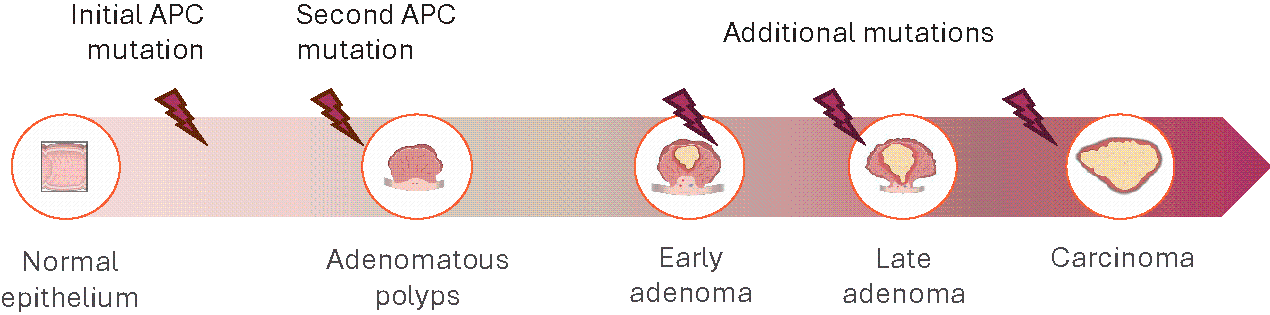
We are currently enrolling desmoid tumor patients who have FAP in our ongoing clinical trial. In the desmoid tumor cohort of our ongoing clinical trial, we have two patients with responses further detailed in this section. With the first patient, we observed significant improvement in duodenal polyposis burden at 60 weeks following initiation of treatment in one patient who had both FAP and an associated desmoid tumor and was treated with zolucatetide. Substantial reductions in polyp number and size compared with a pre-treatment evaluation nearly two years prior were also observed, consistent with downstaging from Spigelman Stage 2 to Stage 1.
Figure 18: Endoscopy showed improvement in duodenal polyp burden in the first patient with desmoid tumor and FAP following treatment with zolucatetide.
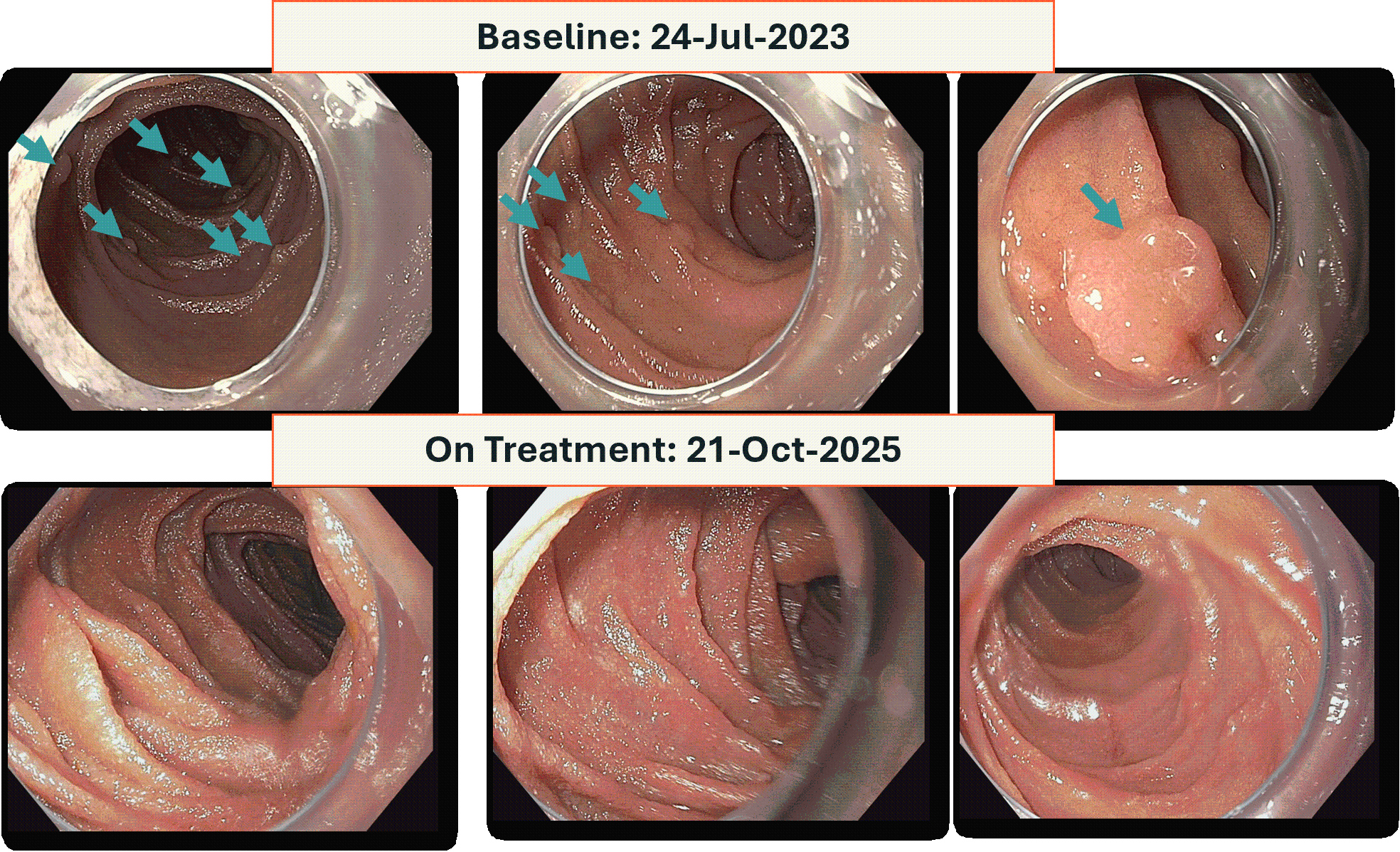
As shown on the right side of Figure 19, the patient was also observed to show tumor reduction of 49% at week 32 and continued to have a partial response (-52.2%) at week 60 in his desmoid tumor. No treatment-related serious adverse events have been reported.
Figure 19: Observed best percentage change from baseline for RECIST1.1 (desmoid) (left) and associated scans in the same patient with desmoid tumor and FAP (right).
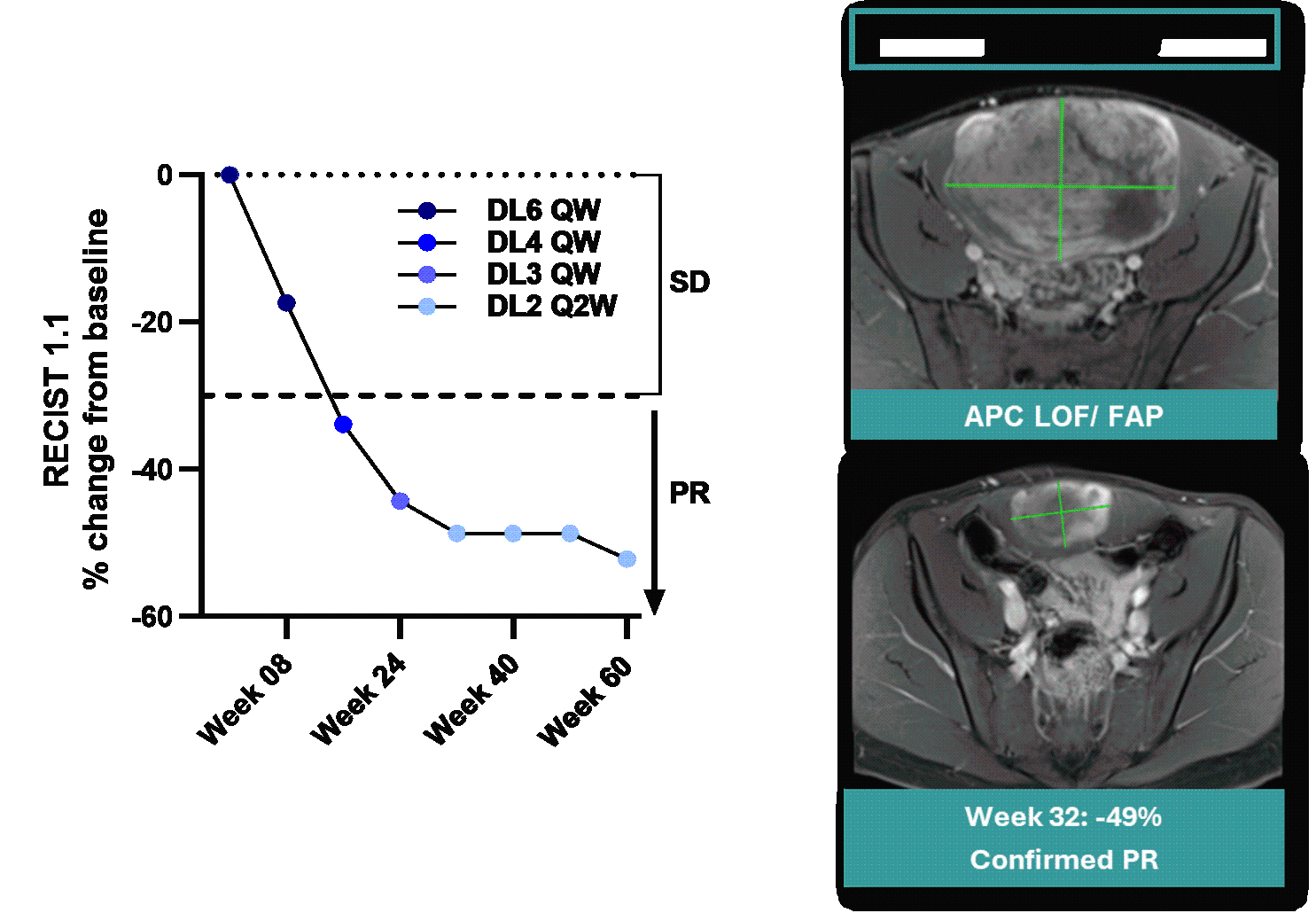
In our ongoing Phase 1/2 clinical trial, a second desmoid tumor patient with a history of FAP received a preventive colectomy associated with a multifocal desmoid tumor. The patient, who harbors an APC mutation, was enrolled and began dosing at DL4 (450 mg) weekly on January 22, 2026, consistent with the induction dosing regimen in Part 1D of the trial. The patient subsequently transitioned to DL4 (450 mg) every two weeks maintenance dosing per protocol and remains on treatment as of the date of this prospectus. As part of routine clinical monitoring, this patient underwent endoscopy at approximately 10 weeks of treatment with zolucatetide, where we observed a significant reduction in duodenal polyp burden, with improvement from Spigelman Stage 4 to findings consistent with an almost normal duodenum.
Figure 20: Endoscopy showed improvement in duodenal polyp burden in second patient with desmoid tumor and FAP following treatment with zolucatetide.
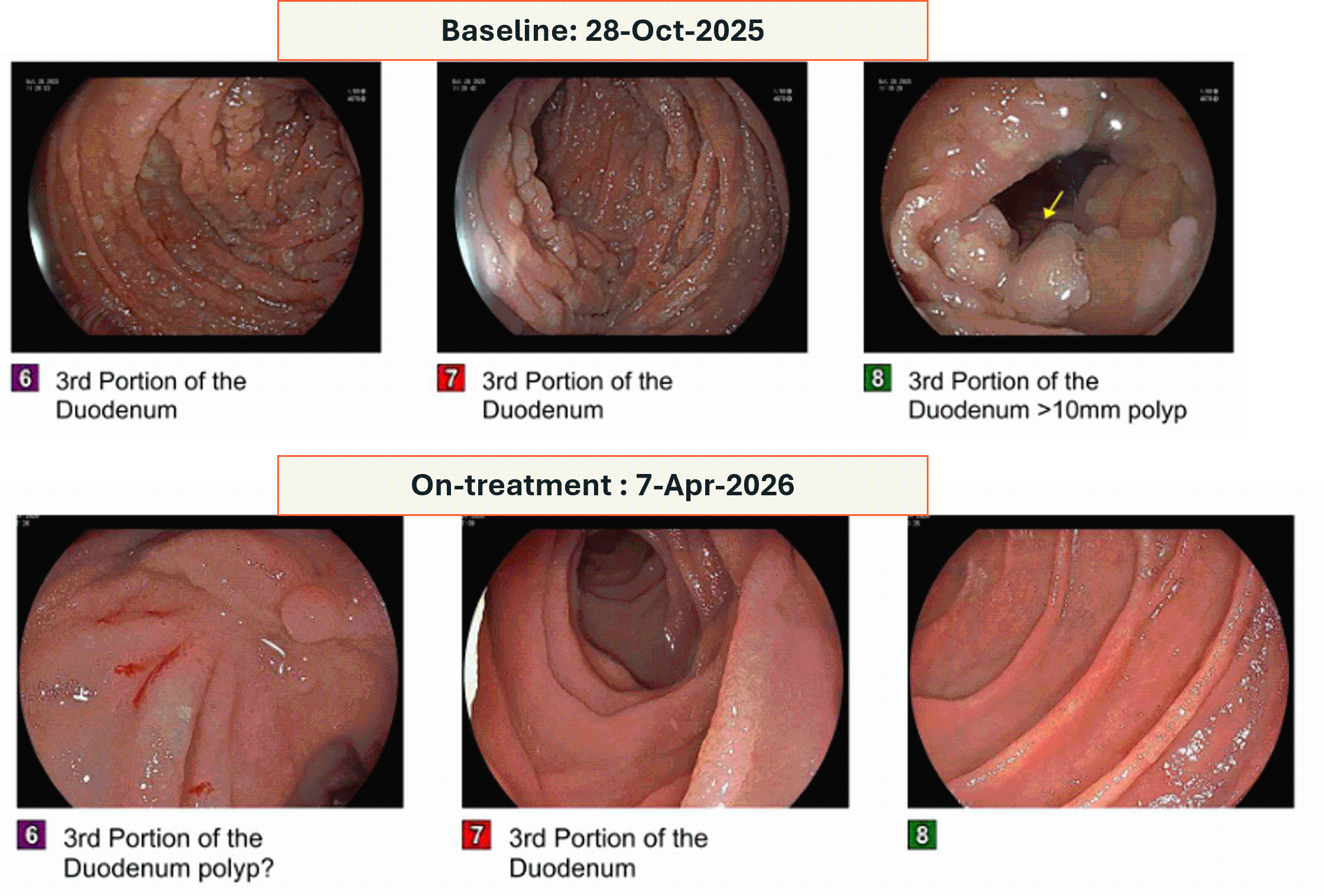
Both FAP patients described above remain on trial as of the date of this prospectus. As of May 18, 2026, we have enrolled 12 desmoid tumor patients with FAP (inclusive of the two patients described above) in our ongoing Phase 1/2 trial and we expect potential further endoscopies over the course of this year and into next year, but do not have a pre-planned schedule for these endoscopies per the Phase 1/2 trial. We are also planning to enroll a separate dedicated cohort of patients with FAP, including pre-planned endoscopies, beginning in the second half of 2026.
Given the near-certain cancer risk without surgery, the morbidity of colectomy, the lifelong disease and monitoring burden, and the absence of approved disease-modifying treatments, we believe there remains a significant unmet medical need for targeted therapies for patients with FAP that zolucatetide could address. These patients typically require chronic lifetime care, as their underlying genetic condition is not curable.
Hepatocellular Carcinoma (“HCC”)
A third indication for zolucatetide is HCC, accounting for approximately 80-90% of liver cancer cases globally, with an estimated 38,000 new cases of HCC annually in the United States and 700,000-800,000 cases worldwide, with the highest burden in Asia, particularly China, which accounts for nearly half of global cases. Approximately 30% of HCC tumors have b-catenin mutations, defining a biologically distinct and substantial patient subset. There is an existing treatment paradigm of immune checkpoint inhibitor-based combinations and VEGF-targeted therapies, however most patients nonetheless ultimately experience disease progression. Notably, Wnt/β-catenin-altered tumors may be particularly refractory to checkpoint inhibitors, reinforcing the potential unmet need in this patient population that lacks approved therapies directly targeting b-catenin-dependent signaling. Consistent with underlying biology, in our preclinical studies, b-catenin–mutant HCC PDX models showed marked sensitivity to zolucatetide.
Figure 21: Zolucatetide sensitivity in β-catenin–mutant HCC PDX models
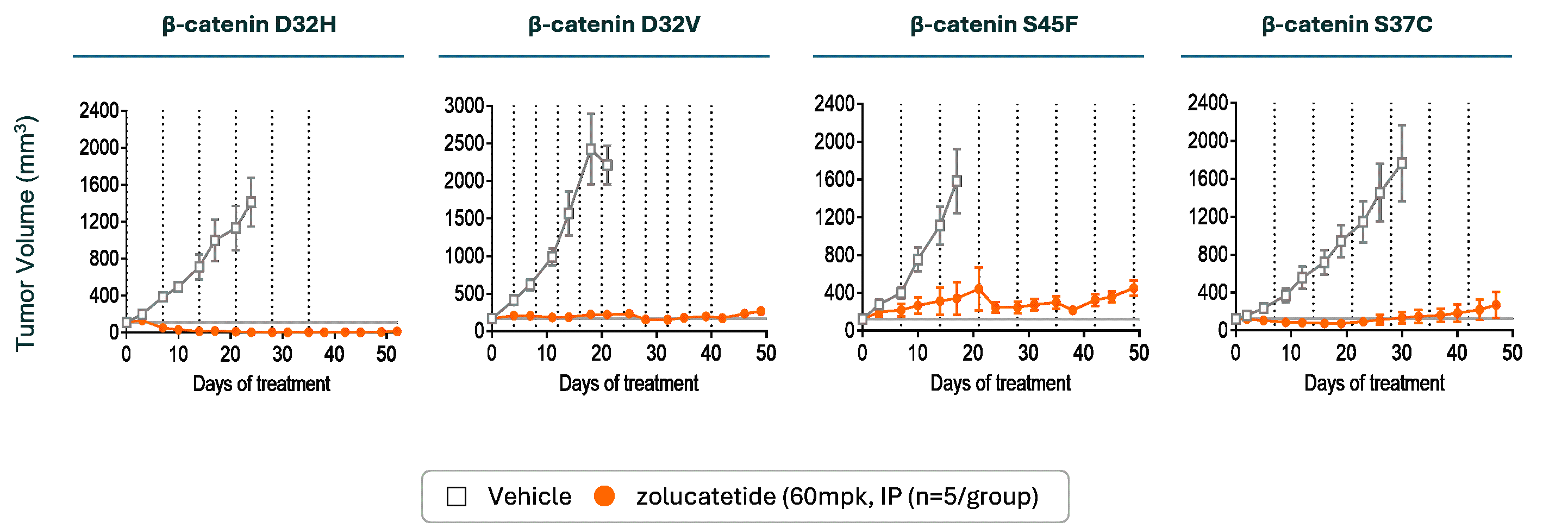
In dose escalation of our ongoing clinical trial, we observed a confirmed partial response in a heavily pre-treated patient with CTNNB1-mutant HCC who was administered zolucatetide. This patient has been on treatment since July 2025 and remains on treatment as of February 16, 2026. Based on this observation, we have started enrolling an HCC specific cohort in our ongoing trial to further evaluate and better characterize the opportunity in this compelling indication.
Figure 22: Scans in one patient with HCC
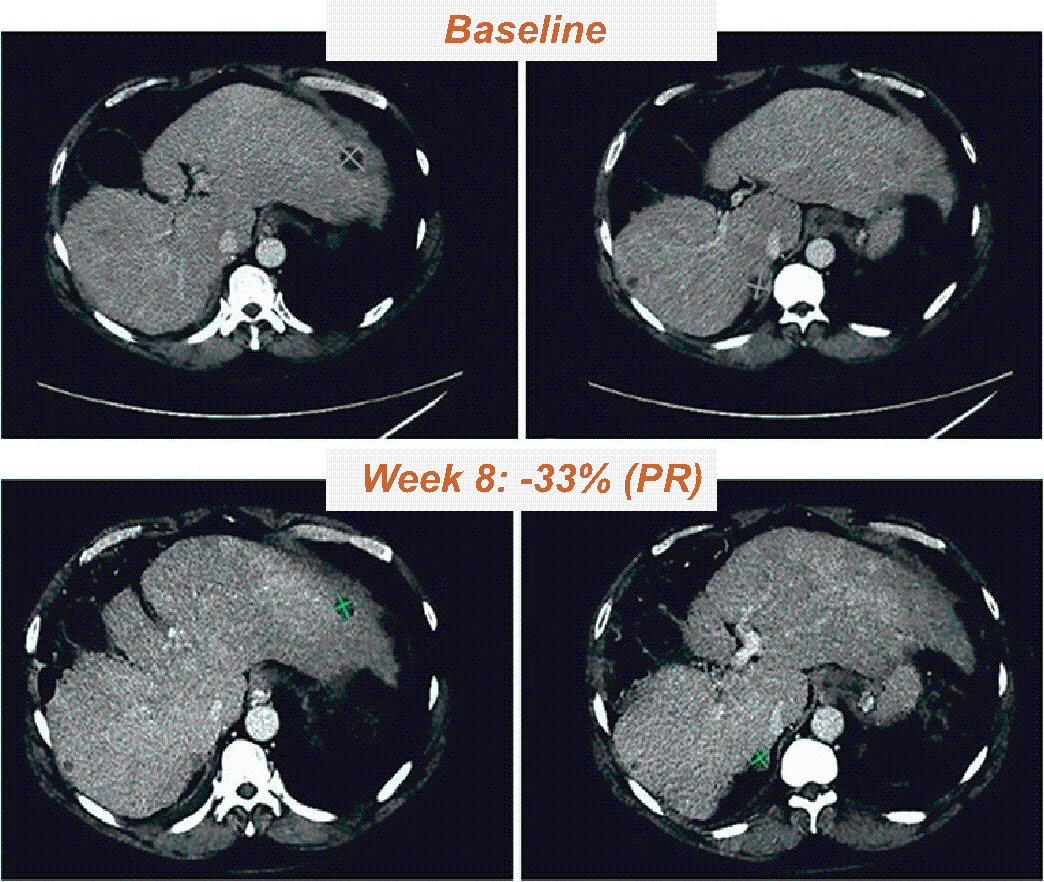
Additional Rare Indications
Beyond desmoid tumors, FAP, and HCC, we have observed partial responses in four additional indications featuring Wnt/b-catenin pathway involvement:
•Adamantinomatous craniopharyngioma (“ACP”) is a rare and chronic condition characterized by locally aggressive tumor arising near the pituitary gland, with onset typically in childhood or middle adulthood. We estimate the 15-year prevalence of ACP in the United States to be approximately 5,000-9,000 patients. Due to the tumor’s location at the base of the brain, beneath the hypothalamus, patients often experience hypothalamic dysfunction leading to severe obesity, as well as hypopituitarism requiring lifelong hormone replacement. Visual impairment is also common and clinically significant, resulting from tumor compression or invasion of the optic nerves and optic chiasm. Cognitive deficits affecting memory, attention, and executive function also contribute to significant long-term disease burden, particularly in pediatric patients. There is currently no approved drug therapy for ACP. Surgery and radiotherapy remain the primary treatment options; however, tumors are often difficult to fully resect given the location, and radiotherapies are frequently
associated with limited durability and disease recurrence. We believe that patients with ACP could benefit from long-term systemic treatment. We have seen tumor shrinkage in all three of the observable ACP patients treated with zolucatetide, including two confirmed partial responses.
Figure 23: Tumor reductions observed in three patients with ACP.
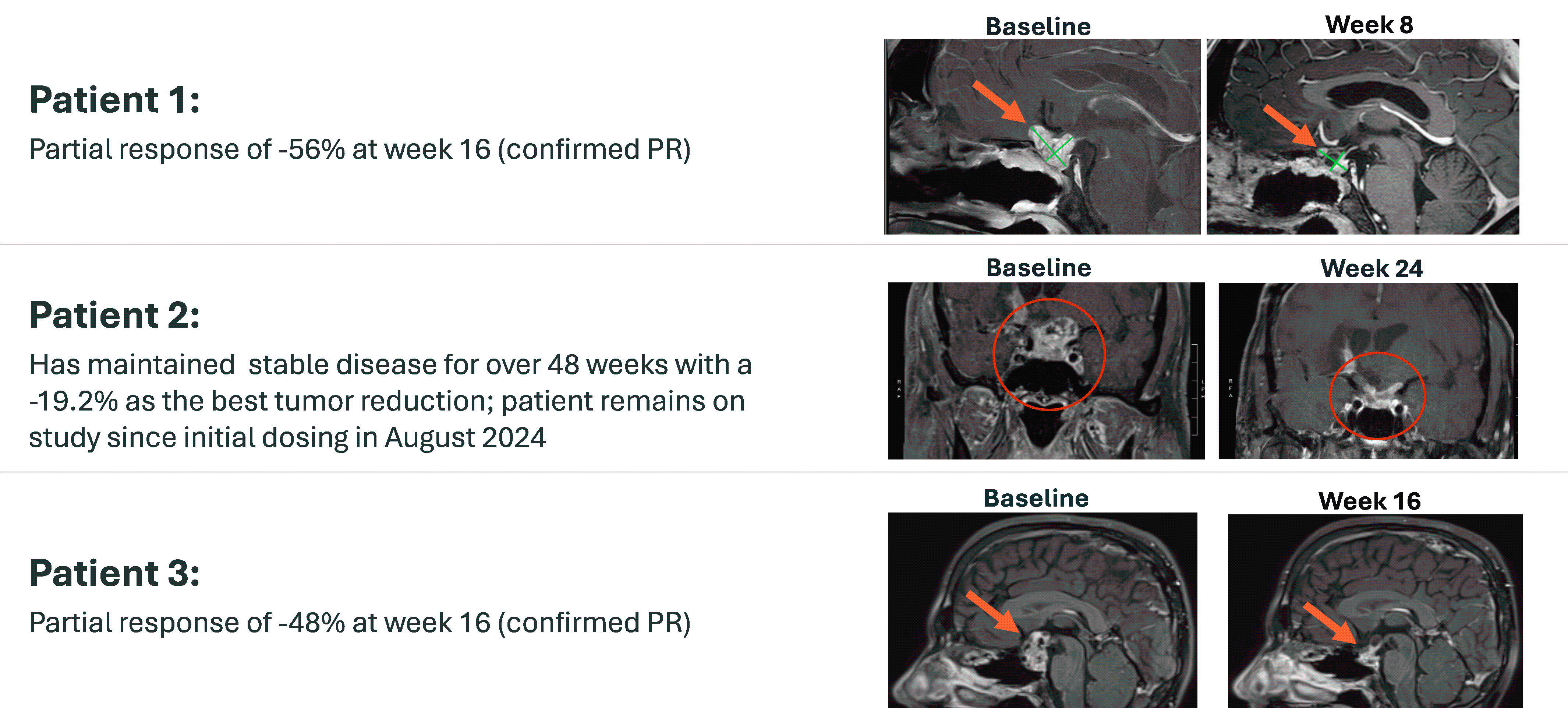
•Solid pseudopapillary neoplasm (“SPN”) of the pancreas is a rare, low-grade malignant tumor that predominantly affects young women. It represents a small fraction of pancreatic neoplasms, generally reported as <3% of exocrine pancreatic tumors. This patient achieved a confirmed partial response of -77% at week 16.
•Salivary gland tumors are rare neoplasms arising from the major or minor salivary glands and encompass a diverse group of histologies with numerous subtypes. They account for approximately 3-6% of head and neck cancers overall. This patient achieved a confirmed partial response of -48.3% at week 16.
•Ameloblastoma is a rare and locally aggressive jaw tumor and one of the most common benign neoplasms of the mandible. Calculated 15-year prevalence is approximately 5,000 patients in the United States, with higher reported rates in parts of Africa and Asia. Following treatment with zolucatetide, an investigator reported a softening of tumor masses after one cycle and at week 8, the investigator noted cerebral edema had resolved, with marked improvement in mass effect as well as reduced pain. At week 8, the patient achieved a -26.4% tumor reduction (SD) with clearance of ctDNA. Subsequently, the patient achieved a confirmed partial response at week 16 of -33.9%.
Figure 24: Scans in one patient with ameloblastoma.
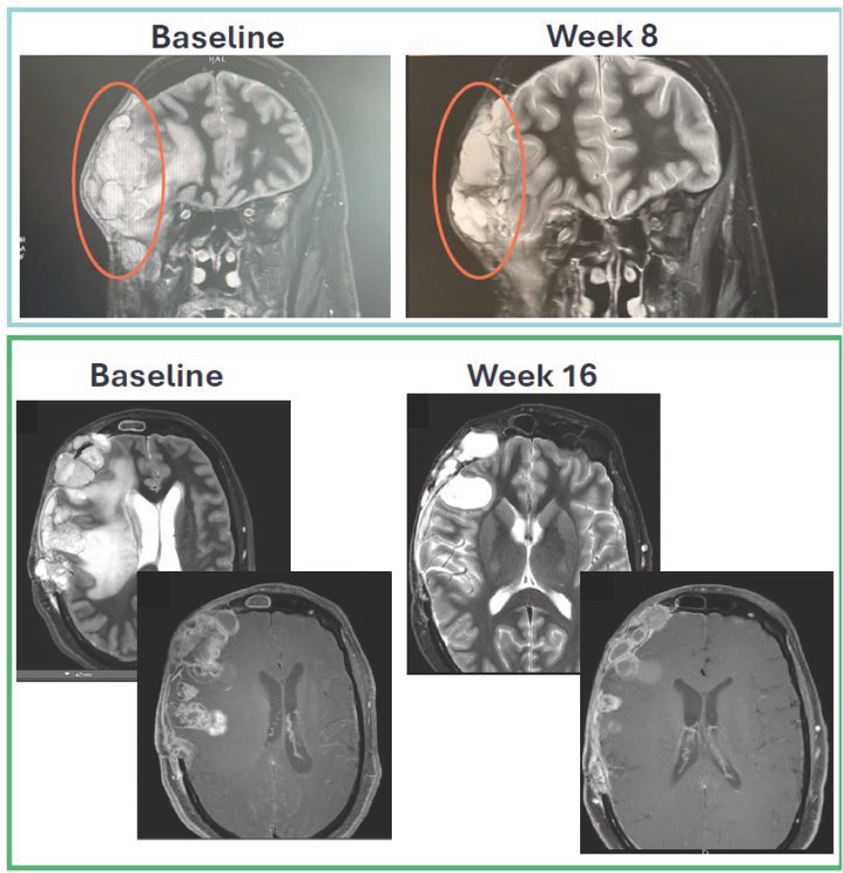
Figure 25: ctDNA collection in one patient with ameloblastoma.
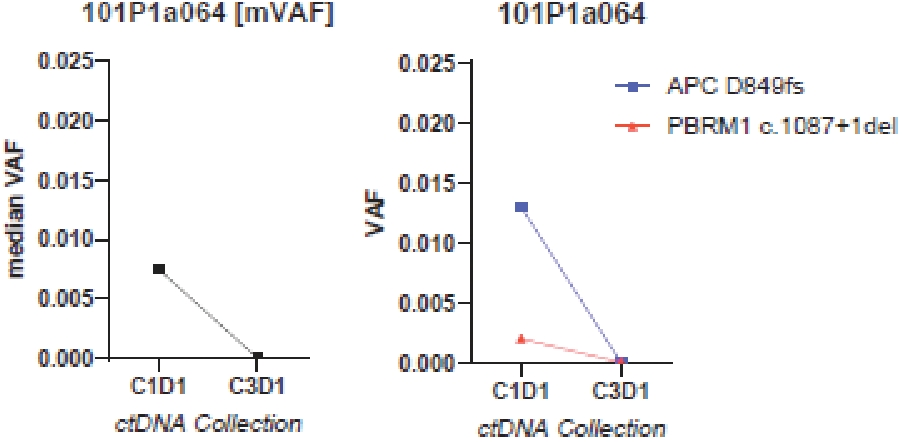
VAF = variant allele frequency represents the ratio of mutant gene copy versus wild type
Summary of Zolucatetide Data in Genomically Simple Tumors
As described further below, we are evaluating a range of solid tumors in our ongoing clinical trial, including those that are genomically simple and genomically complex. Genomically simple in this case refers to tumors that carry relatively few, if any, well-validated and otherwise prevalent oncogenic drives, like KRAS, PIK3CA or PTEN, but do, by definition, carry CTNNB1 or APC gene mutations. Conversely, genomically complex tumors, like those often observed in colorectal cancer, carry multiple such oncogenic drivers including but not limited to CTNNB1 or APC.
As of February 16, 2026, we evaluated patients with tumors of low genomic complexity at dose levels of DL2 or greater (n=54). Of those who are efficacy evaluable (n=39), we have observed 20 objective responses, including one complete response, across six different tumor types which qualitatively fit the description of genomically simple tumors, including desmoid tumors, ACP and ameloblastoma. We observed a 51% objective response rate and 87% DCR. We also have observed meaningful duration of response (>6 months) across multiple tumor types.
We intend to identify an appropriate regulatory pathway for the numerous tumors that prove to be responsive to zolucatetide. We plan to explore accelerated approvals, randomized trials and basket (tumor-agnostic) trials with FDA and global regulators.
Figure 26: Observed best percentage change from baseline and overall response for patients with genomically simple tumors receiving zolucatetide, as of February 16, 2026.
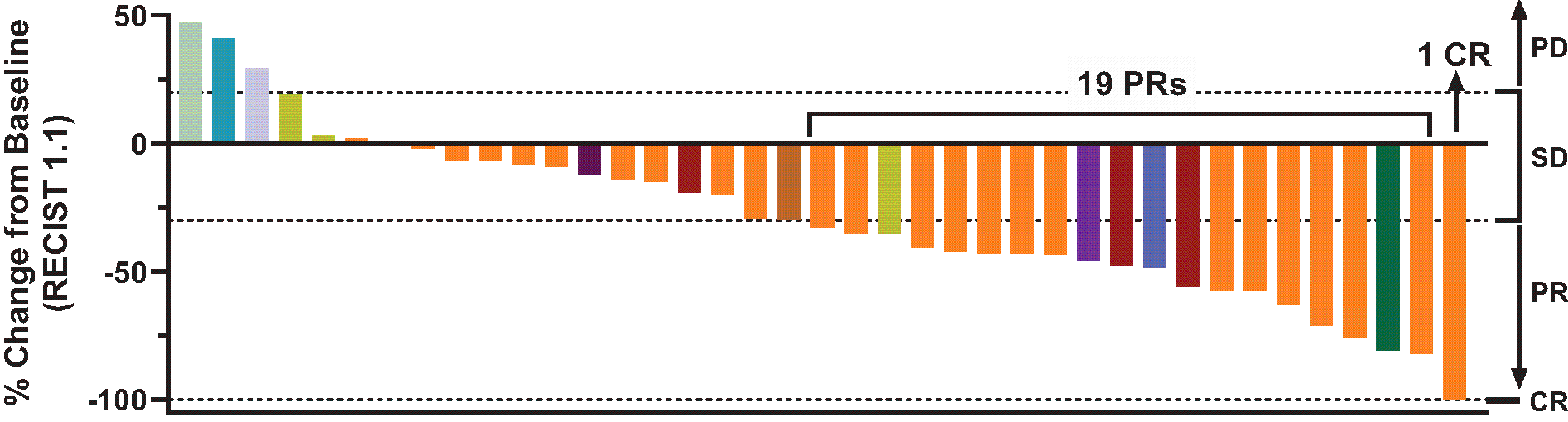
Figure 27: Observed time on study treatment per patient in the Phase 1/2 trial of zolucatetide as of February 16, 2026.
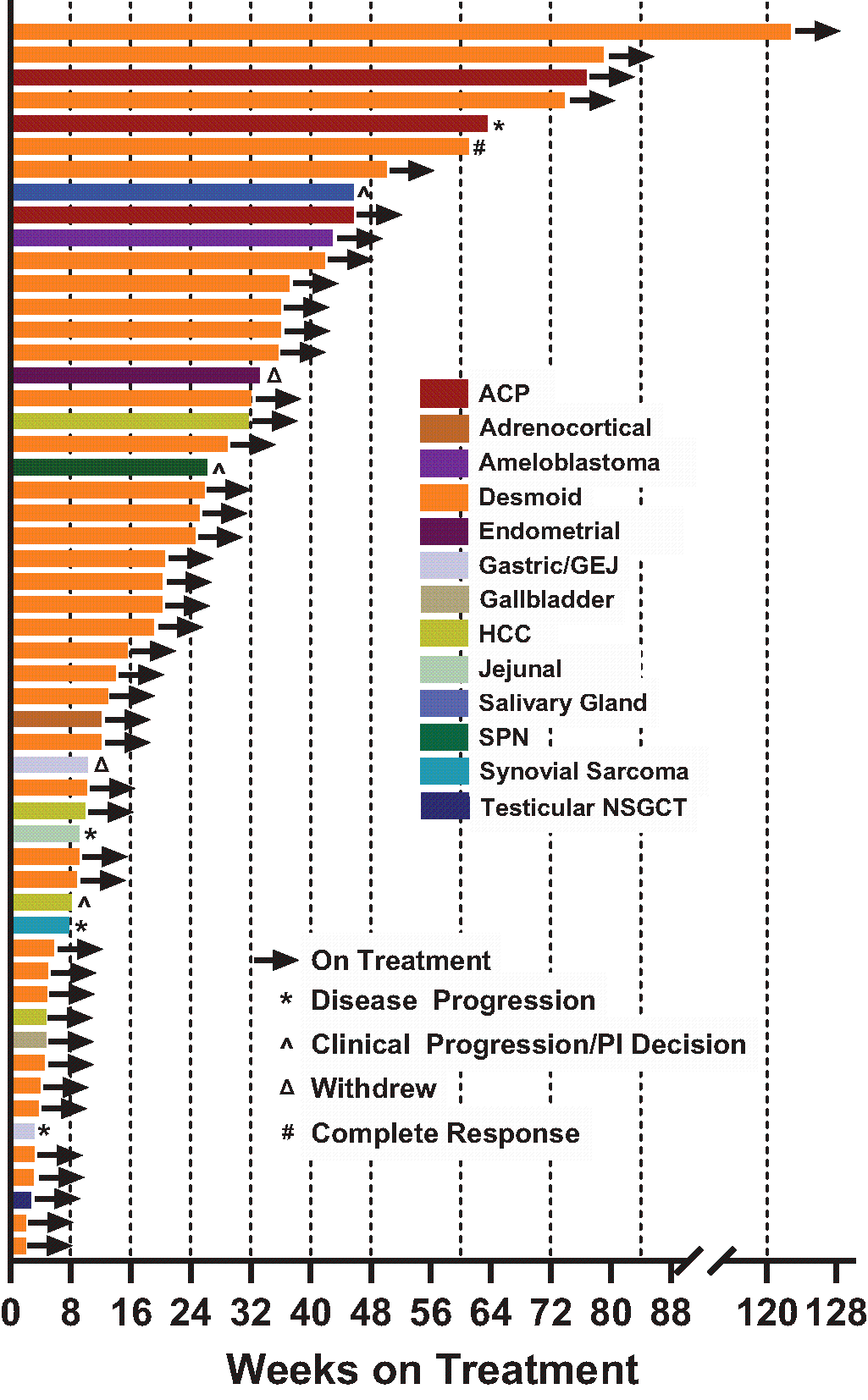
# Patient achieved a complete response and voluntarily discontinued treatment due to relocation away from study center.
GEJ: gastroesophageal junction; NSCGT: nonseminomatous germ cell tumors
Genomically Complex Tumors
While primarily focused on genomically simple tumors, we are also evaluating the potential of zolucatetide to treat genomically complex tumors. We consider genomically complex tumors to be those in which Wnt/b-catenin pathway alterations are present but are not the sole driver of disease, with additional oncogenic mutations implicated in driving tumor biology. This complexity often necessitates a combination treatment approach.
Colorectal Cancer
CRC is the third most commonly diagnosed cancer and the second leading cause of cancer-related death globally, with approximately two million new cases and nearly one million deaths each year. Despite advances in treatment, outcomes remain poor for patients with advanced disease, with five-year survival rates of approximately 16% in the metastatic setting, highlighting the need for more effective and broadly applicable therapeutic approaches.
For more than 30 years it has been appreciated that loss-of-function mutation in the APC gene is the key initiating mutational event in the evolution of CRC. Seminal studies elucidating the biology of these tumors have shown that the downstream consequence of APC mutation is the aberrant activation of b-catenin in complex with TCF proteins, which in turn drives proliferation and a stem cell-like phenotype in the tumor. b-catenin is aberrantly amplified in the context of tumor cells that have acquired APC mutations. These mutations in APC occur in more than 80% of microsatellite stable CRC patients, representing by far, the most prevalent mutations observed in this tumor type. In our preclinical studies we observed that treatment of human tumors in mouse models led to the inhibition of CRC tumor growth (see Figure 28). These data give us confidence in the potential utility of zolucatetide for the treatment of CRC patients.
Although we have seen disease stabilization, tumor shrinkage and ctDNA reductions in a subset of CRC patients treated with zolucatetide as monotherapy, we have not observed any objective responses. As such, we do not currently plan to advance zolucatetide as a monotherapy for CRC patients. Since CRC is a genetically complex tumor type, with many additional oncogenic (KRAS, PI3K, BRAF) and tumor suppressor (p53) mutations that can co-occur alongside APC mutation, we believe it is likely that these tumors have adapted multiple mechanisms of growth and survival that are best addressed with combination drug approaches. Importantly, CRC patient tumor biopsy samples collected at baseline and after zolucatetide treatment were used to interrogate transcriptional signatures that were modulated by drug treatment. These studies led to the hypotheses that via b-catenin inhibition, zolucatetide coupled with -VEGF, chemotherapeutic agents like 5-FU/FOLFOX and immune checkpoint inhibitors like nivolumab could be beneficial.
Current treatment paradigms for CRC include combinations of chemotherapy, targeted agents, and immunotherapy. While biomarker-directed therapies have improved outcomes for select molecular subsets (e.g., BRAF V600E, HER2+, KRAS G12C), the majority of patients lack access to precision therapies that meaningfully alter disease trajectory. Early translational analyses from our ongoing Phase 1/2 trial, along with patient-derived xenograft studies (as outlined in Figure 28 below), further reinforce potential for multiple combinations such as anti-VEGF + 5-FU, chemotherapy + anti-VEGF, and anti-PD-1, which we are currently evaluating in combination with zolucatetide in the dose escalation phase of our ongoing clinical trial. We may explore additional combinations in future development, including with inhibitors targeting the RAS/MAPK pathway, as multiple academic and industrial research teams have recently published data illustrating biological cross-talk between the RAS and Wnt signaling pathways. We believe data suggest that when one of the two pathways is inhibited the other appears to be upregulated to compensate for the loss of signaling in the first. This compensatory cross-talk appears to be bi-directional. Since APC and KRAS mutations represent two of the most prevalent driver mutations in CRC, we believe the concept of combination therapy to inhibit these two pathways simultaneously is compelling. Our own combination data using CRC PDX tumor models indicates that combination of zolucatetide with a panRAS inhibitor can drive deeper and more durable anti-tumor activity in a preclinical setting, as shown in the figure below.
Figure 28: Data showing significant anti-tumor activity of zolucatetide in combination with various agents.
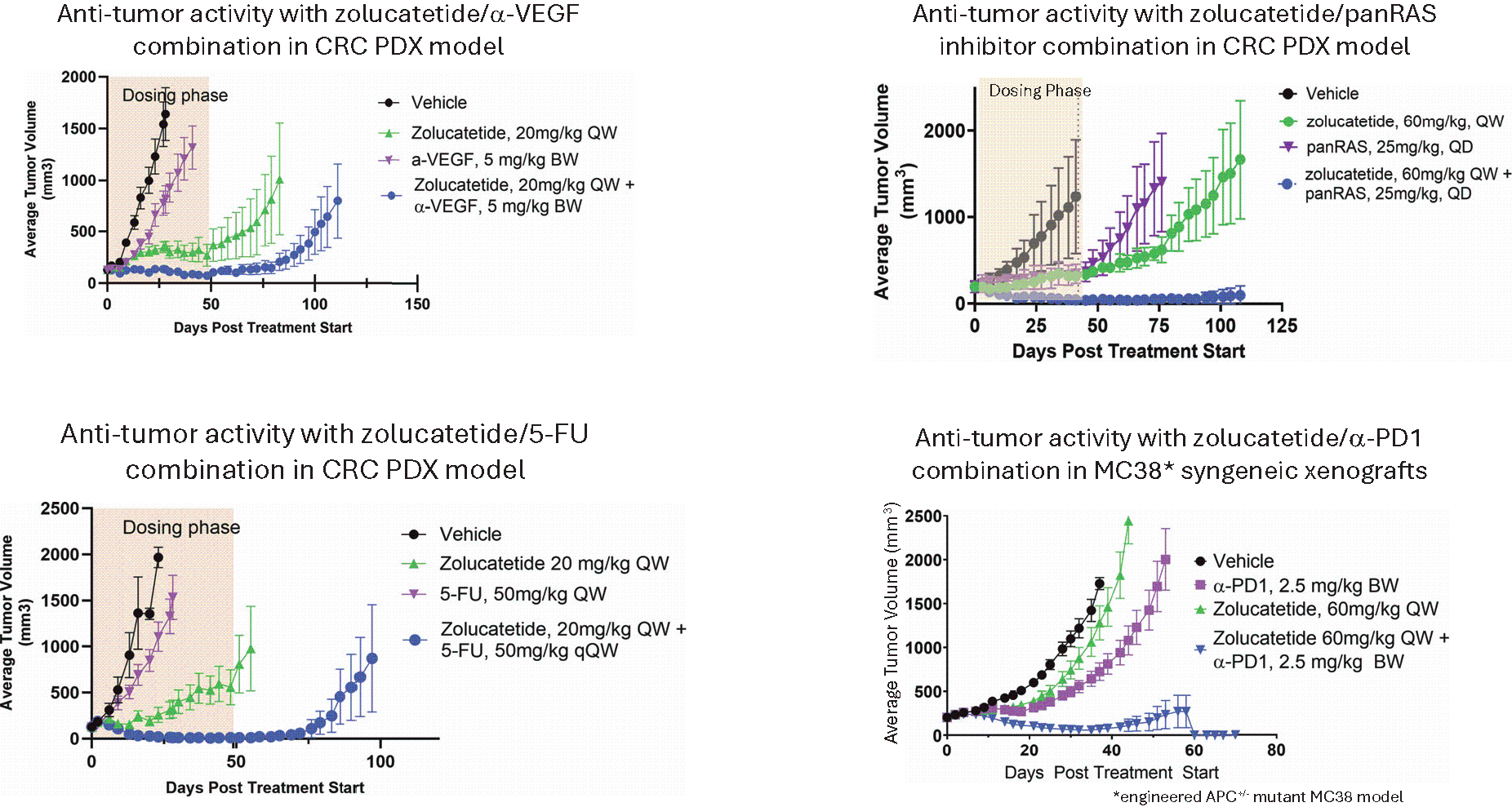
Our Preclinical Data
Zolucatetide has generated evidence of direct b-catenin inhibition with compelling on-target anti-tumor activity in multiple preclinical models. Biochemically, zolucatetide was observed to bind directly to b-catenin with a dissociation constant of 500 picomolar by surface plasmon resonance and inhibit b-catenin:TCF interaction with a half-maximal inhibitory concentration (IC50) below 5 nM as measured with competition fluorescence polarization assays. In cell-based assays, zolucatetide was observed to effectively inhibited b-catenin:TCF interaction with an IC50 of 1.2 µM and zolucatetide blocked b-catenin:TCF transcriptional activity with an IC50 of 0.7 µM in a cell-based TCF reporter assay. Zolucatetide was observed to inhibit endogenous Wnt/b-catenin target gene expression (such as AXIN2, SP5, and NOTUM) with IC50 values ranging from 0.5 to 7µM in multiple cancer cell lines carrying APC and CTNNB1 mutations. This inhibition of transcriptional activity was shown to be b-catenin dependent in an isogenic cell line pair that shows a lack of zolucatetide activity in the absence of b-catenin protein.
In proliferation assays, zolucatetide displayed IC50 values between 0.2 and 2 µM in a set of sensitive cancer cell lines derived from colorectal, gastric, ovarian, and non-small cell lung tumors carrying mutations in APC or b-catenin.
In vivo, we have observed zolucatetide to exhibit a pharmacokinetic profile that drives strong Wnt/b-catenin pathway inhibition and antitumor activity in both colorectal and hepatocellular PDX tumor models driven by documented Wnt-pathway-activating mutations in APC or b-catenin. A single dose of zolucatetide at 20 mg/kg significantly downregulated the Wnt/b-catenin pathway in PDX tumor models carrying pathway mutations, as measured with RNAseq analyses. Zolucatetide was observed to exhibit dose dependent inhibition of the expression of b-catenin:TCF target genes such as AXIN2 and C-MYC at both messenger RNA and protein levels in PDX tumors. AXIN2 and C-MYC are both relevant pharmacodynamic (PD) biomarkers since inhibition of these biomarkers is on target, dose dependent, correlated with efficacy and, in the case of C-MYC, likely to be relevant for the antitumor activity of zolucatetide downstream of b-catenin inhibition. Significant inhibition of AXIN2 and C-MYC was observed in tumors starting at 20 mg/kg and maximal inhibition is achieved at 60 mg/kg. Repeat dosing at 20 to 60 mg/kg of zolucatetide was observed to lead to tumor regression or stasis in multiple colorectal PDX models and regression or stasis in four hepatocellular PDX models harboring APC and b-catenin mutations, respectively.
Based on the aggregate of preclinical in vivo pharmacology data, we defined the 20 mg/kg dose level as having strong activity, resulting in strong tumor growth inhibition (“TGI”) or regressions in some models and defined 60 mg/kg as having maximal activity, resulting in complete, durable regressions in several models. As a result, the target exposure for efficacy in humans is based on the equivalent exposure in mice over a dose range of 20 to 60 mg/kg. We believe the evidence that zolucatetide tumor exposure levels remain higher than that observed in plasma over time, and resulted in prolonged PD effects in tumors, supports dosing with less frequency than predicted from plasma exposure, in this case using a once every 7 days schedule.
We are currently enrolling three CRC combination cohorts: (1) zolucatetide + FOLFOX/bevacizumab in 1L, (2) 3L combination of zolucatetide + nivolumab, and (3) zolucatetide + Lonsurf/bevacizumab. These combination cohorts are currently in dose escalation with potential for additional biologically rational CRC combinations including RAS in the future.
Prostate Franchise
Our Helicon platform enables the discovery of multiple product candidates against traditionally undruggable protein targets, supporting a repeatable approach across indications, including prostate cancer. In addition to inhibition, we have leveraged Helicons for targeted protein degradation, highlighting the multimodal potential of the platform. We are advancing two prostate cancer programs that exemplify these capabilities: an ERG degrader and an allosteric ARON degrader.
Prostate cancer is the fourth most commonly diagnosed cancer (second among men) and the eighth leading cause of cancer deaths (fifth among men) worldwide. Approximately 1.5 million new cases are diagnosed globally each year, and prostate cancer accounts for almost 400,000 deaths annually. The overall five-year survival rate for metastatic prostate cancer is approximately 38%, highlighting the significant clinical burden of advanced disease.
Advanced prostate cancer evolves along a well-characterized continuum beginning with metastatic hormone-sensitive prostate cancer (mHSPC), where tumors remain driven by androgen receptor signaling and are initially responsive to androgen deprivation therapy in combination with androgen receptor pathway inhibitors. Despite meaningful improvements in outcomes in this setting, most patients ultimately progress to mCRPC, a more aggressive and heterogeneous stage defined by continued disease progression despite castrate levels of testosterone. It is estimated that approximately 40,000 men in the United States are living with mCRPC. These patients continue to receive a backbone of AR-directed therapy.
While multiple therapies are approved across mHSPC and mCRPC, including next-generation hormonal agents, taxane chemotherapies, radioligand therapies, and targeted agents, these treatments are not designed to fully address the underlying drivers of disease progression and therapeutic resistance, particularly in the mCRPC setting. There remains a clear unmet medical need for novel approaches that can more fundamentally alter disease biology.
Our ERG and ARON programs represent two distinct opportunities to address a large unmet need in the prostate cancer population. The ERG degrader is designed to target a previously undrugged oncogenic driver found in almost half of all prostate tumors, analogous to the paradigm addressed by our b-catenin program and zolucatetide, which represents another previously undrugged and critical oncogene. In contrast, our ARON degrader program is designed to address a clinically validated target in prostate cancer that has been inadequately drugged multiple times with existing approaches, as previously approved drugs in the AR space have all shown transient activity and subsequent resistance driven by continued elevated AR activity. We believe both our ERG and ARON programs offer monotherapy and combination therapy opportunities in the clinic.
ERG Degrader
ERG is a transcription factor overexpressed in approximately 40-50% of prostate cancers via a TMPRSS2-ERG fusion, linking androgen signaling directly to oncogenic transcription factor activation. This ERG gene fusion event leads to aberrant expression of the ERG protein in prostate-derived cells where it is not normally expressed. As a result of this aberrant expression, ERG drives a transcriptional program that regulates multiple critical tumor functions, including proliferation and angiogenesis (see Figure 29). There are more than 15,000 newly diagnosed ERG-positive mCRPC patients annually in the United States based on reported prevalence estimates to date, and there are currently no approved therapies that directly target ERG. The prevalence of ERG fusions in prostate cancer, coupled with prior publications describing ERG’s function in modulating the biology of prostate cancer cells, provides compelling reason to drug this target; however, to our knowledge, it has never been successfully drugged due to the absence of conventional small molecule binding sites.
Figure 29: ERG degrader blocks TMPRSS2-ERG-driven transcription.
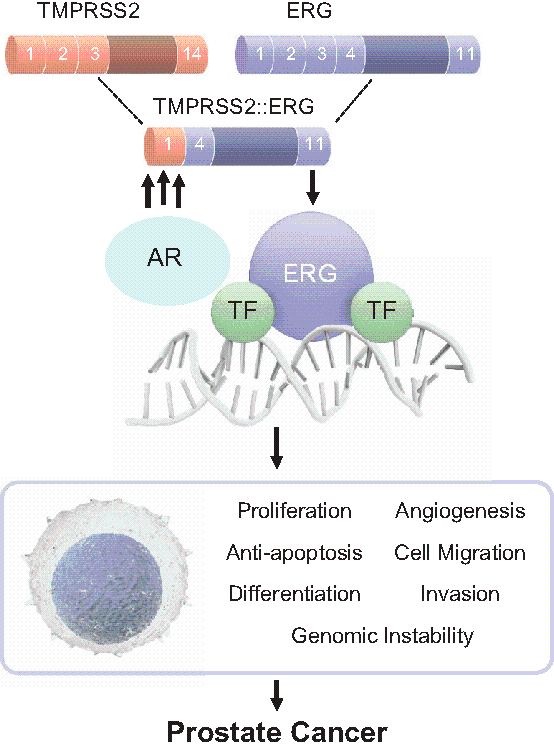
Using our Helicon discovery platform to identify novel peptide binding sites on ERG, we have identified bifunctional degraders that have been observed to achieve potent and selective ERG degradation in cells and in preclinical prostate tumor models. These Helicon degraders have enabled us to test for the first time the pharmacological consequence of ERG degradation and subsequent inhibition of activity in a number of preclinical in vivo models. We have observed that ERG degradation led to inhibition of a distinct transcriptional profile driven by ERG and resulted in robust dose-dependent prostate TGI of 60-95% in both cell line-derived xenografts (see Figure 30) and PDX models (see Figure 31) in preclinical studies. We also observed inhibition of tumor growth in the PDX context that exceeds that seen with enzalutamide, and we have combined these two agents (ERG Helicon degrader and enzalutamide) with positive anti-tumor activity of the combination. This single agent anti-tumor activity of ERG degrader exceeds that of single agent enzalutamide in our study. Furthermore, a recent report on the activity of an AR degrader in an independent study indicates that ERG degrader activity is at least equivalent to that of the AR degrader in the VCaP xenograft model run in eugonadal mice. Importantly, we have also shown the specificity of our ERG degraders using unbiased proteomics analyses from cells treated with ERG degraders. We have observed that our degraders are specific for ERG versus all detected and unrelated proteins in the cell and with predictable, tunable selectivity against closely related paralogues, like the FLI1 transcription factor which is in the same family of ETS transcription factors as ERG. In the exemplar seen in Figure 33 below, ERG protein is the only protein degraded >4-fold relative to control with a p-value of < 0.05 after treatment with a degrader concentration at 10x the cell-based DC90 for ERG degradation.
The following figure illustrates the dose dependent anti-tumor activity of ERG Helicon degrader in a cell-line derived xenograft model with ERG-fusion, and the ability of that degrader to clear ERG protein from the tumor using immunohistochemistry (“IHC”).
Figure 30: Preclinical antitumor activity and target engagement of ERG degrader in a VCaP xenograft model.
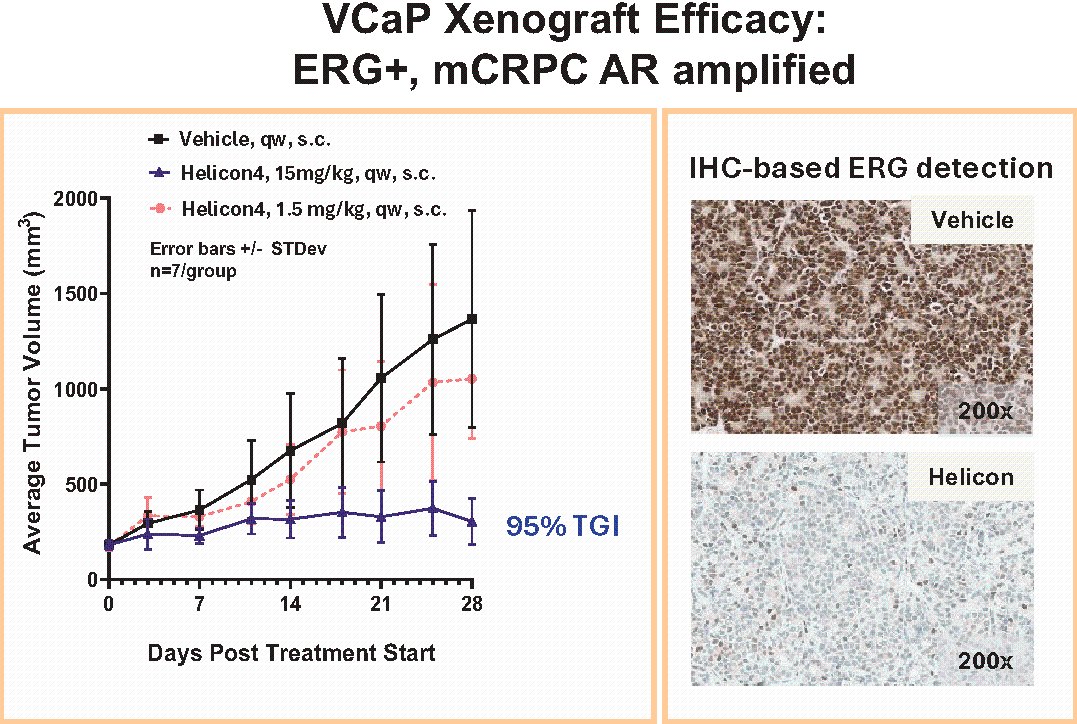
The following figure illustrates the dose dependent anti-tumor activity of ERG Helicon degrader in a patient-derived xenograft model with ERG-fusion.
Figure 31: Preclinical antitumor activity of ERG degrader in an ERG-positive, enzalutamide-resistant PDX model.
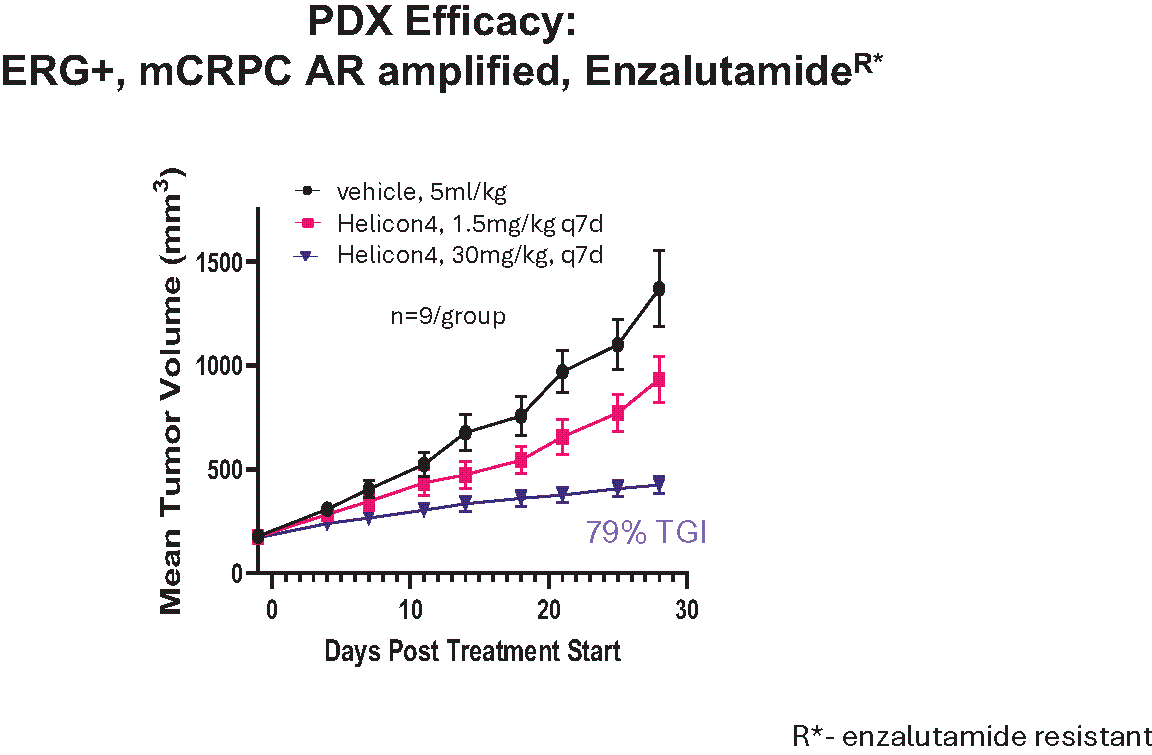
The following figure illustrates the anti-tumor activity of ERG Helicon degrader as a single agent (green curve) in a patient-derived xenograft model with ERG-fusion, compared to the activity of enzalutamide as a single agent (orange curve), and the ability of the ERG degrader and enzalutamide to be combined (blue curve) for effective anti-tumor activity.
Figure 32: Anti-tumor activity of ERG degrader in PDX as single agent and in combination with enzalutamide
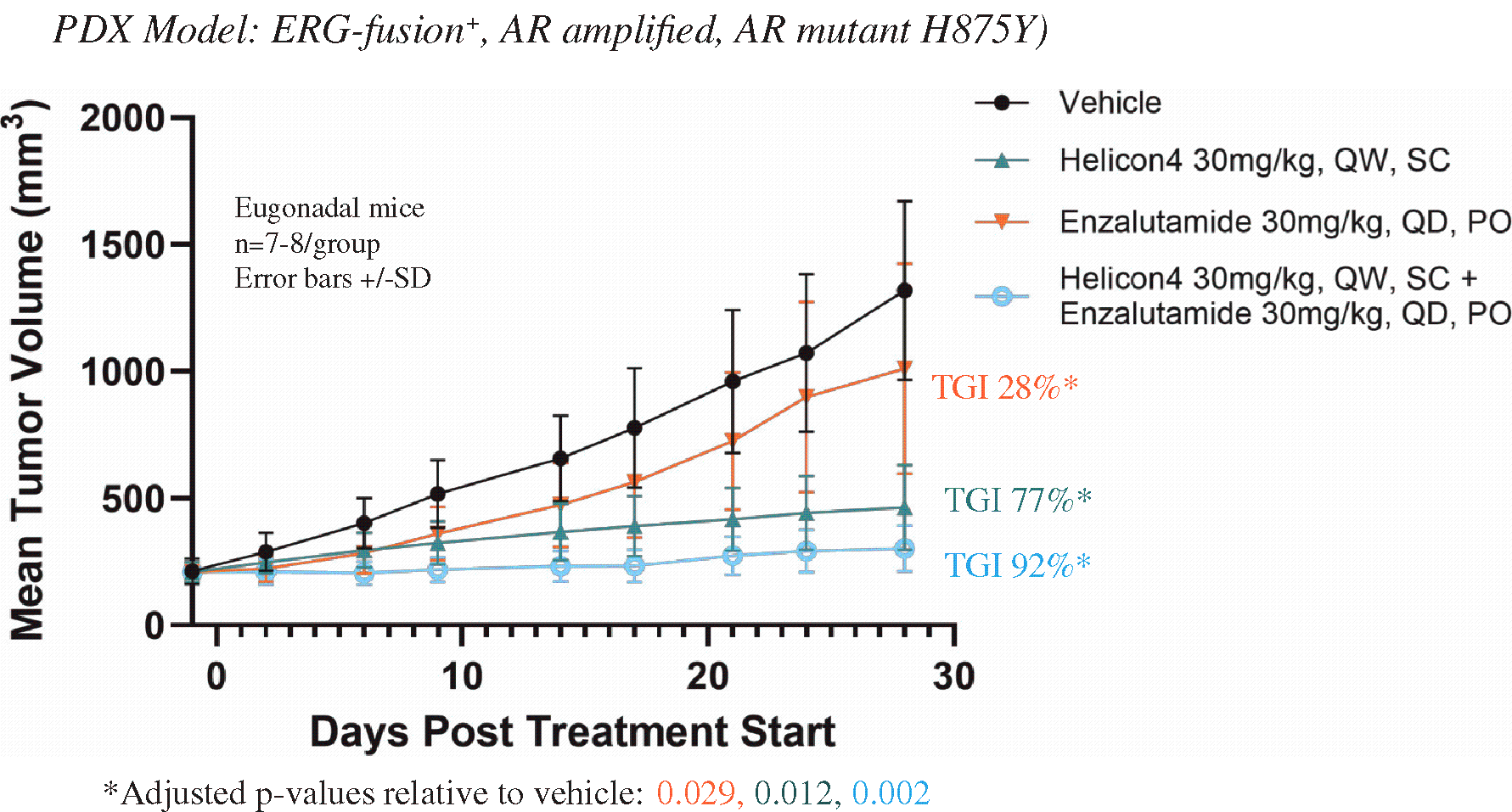
The following figure illustrates the unbiased proteomics profile of all detectable proteins in a cell line (REH) after treatment with ERG Helicon degrader for eight hours at high dose, indicating that the Helicon degrader specifically degrades ERG protein (upper left quadrant) versus all other proteins in the cell.
Figure 33: Proteomic evaluation of protein-level changes following treatment with ERG degrader.
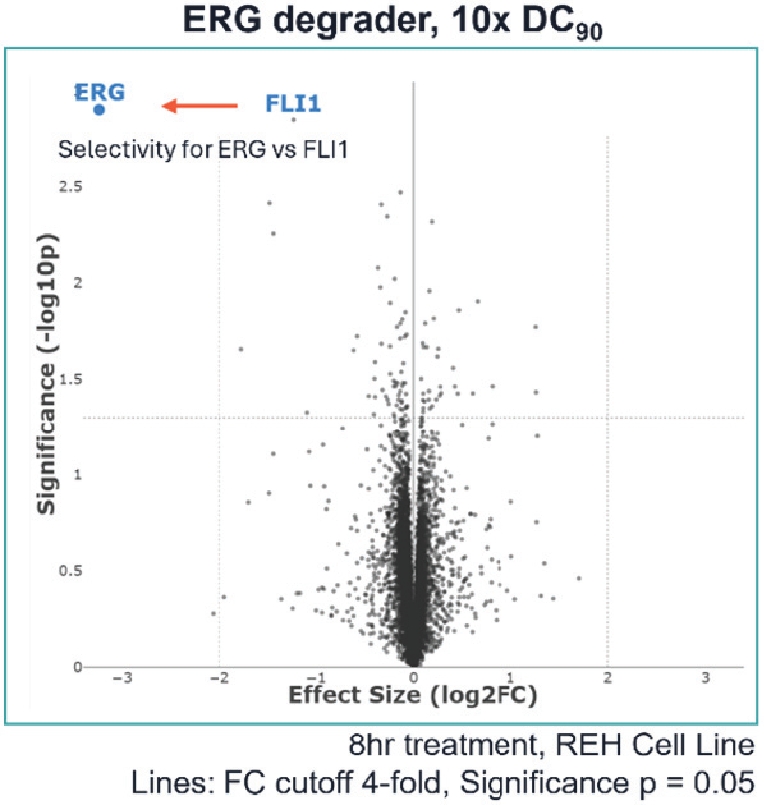
ARON Degrader
While AR directed therapies are the backbone of and provide significant anti-tumor activity in prostate cancer treatment paradigms, the majority of patients ultimately develop resistance. Resistance to AR-directed therapies in approximately 80% of patients is associated with amplification of the AR gene and point mutations at the drug binding site of AR. All approved AR antagonists and clinical-stage AR degraders that we are aware of target the same ligand binding pocket, making them non-combinable and vulnerable to the same resistance mechanisms. We have identified four main limitations of current AR antagonists and AR degraders, including:
1. Amplifications in AR. Existing therapies do not consistently achieve broad efficacy in patients with ARAMP. As such, clinical outcomes are variable, reflecting substantial heterogeneity in patient responses.
2. Mutations in AR LBD. All approved AR antagonists and clinical-stage AR degraders currently target the same ligand binding domain within the androgen binding pocket. This pocket is frequently mutated, and such mutations can significantly impair drug binding, reducing the ability of these agents to function optimally.
3. AR Splice Variants. The prevalence and expression of AR splice variants increase as disease progresses. AR-V7 is the most prominent variant and results in a truncated receptor that lacks the ligand binding domain, rendering LBD-targeted therapies ineffective.
4. Combinability. Because current AR antagonists and degraders bind to the same androgen binding pocket, they cannot be co-administered in combination regimens, limiting therapeutic flexibility and potential synergistic effects.
To overcome these challenges, we have identified a novel Helicon binding site, the AF2 co-activator binding site on AR, accessible only when AR is in its active state (i.e. when the receptor is bound to androgen). This site is distinct from and not competitive with the binding site of all approved AR antagonists including enzalutamide. Critically, we believe targeting the ARON conformation has the potential to (i) enable combination with approved AR-directed therapies for additive effects, (ii) lead to activity in tumors with AR resistance point mutations that compromise existing drug activity at the ligand binding pocket and (iii) provide preferential target engagement of the active AR pool in AR-amplified settings for maximal anti-tumor effects. Data supporting the combination potential of ARON Helicons with existing AROFF antagonists that engage the androgen binding pocket in an AR-amplified cell line (“VCaP”) is seen in Figure 36. In this experiment each single agent provided significant anti-proliferative activity and the combination of the two provided an additive benefit. We envision that this combination benefit in the clinical context will provide the ability to more completely inhibit AR activity in patient tumors, including AR amplified tumors, and ultimately lead to deeper and more durable suppression of tumor growth.
The figure below illustrates the anti-tumor activity of ARON Helicon degrader (Helicon8) in the VCaP cell-line derived xenograft model which is AR amplified, and for comparison, shows that a negative control helicon (Helicon10) that can bind to AR but lacks the ability to recruit E3 ligase, does not have activity.
Figure 34: Preclinical in vivo efficacy data using our ARON degrader.
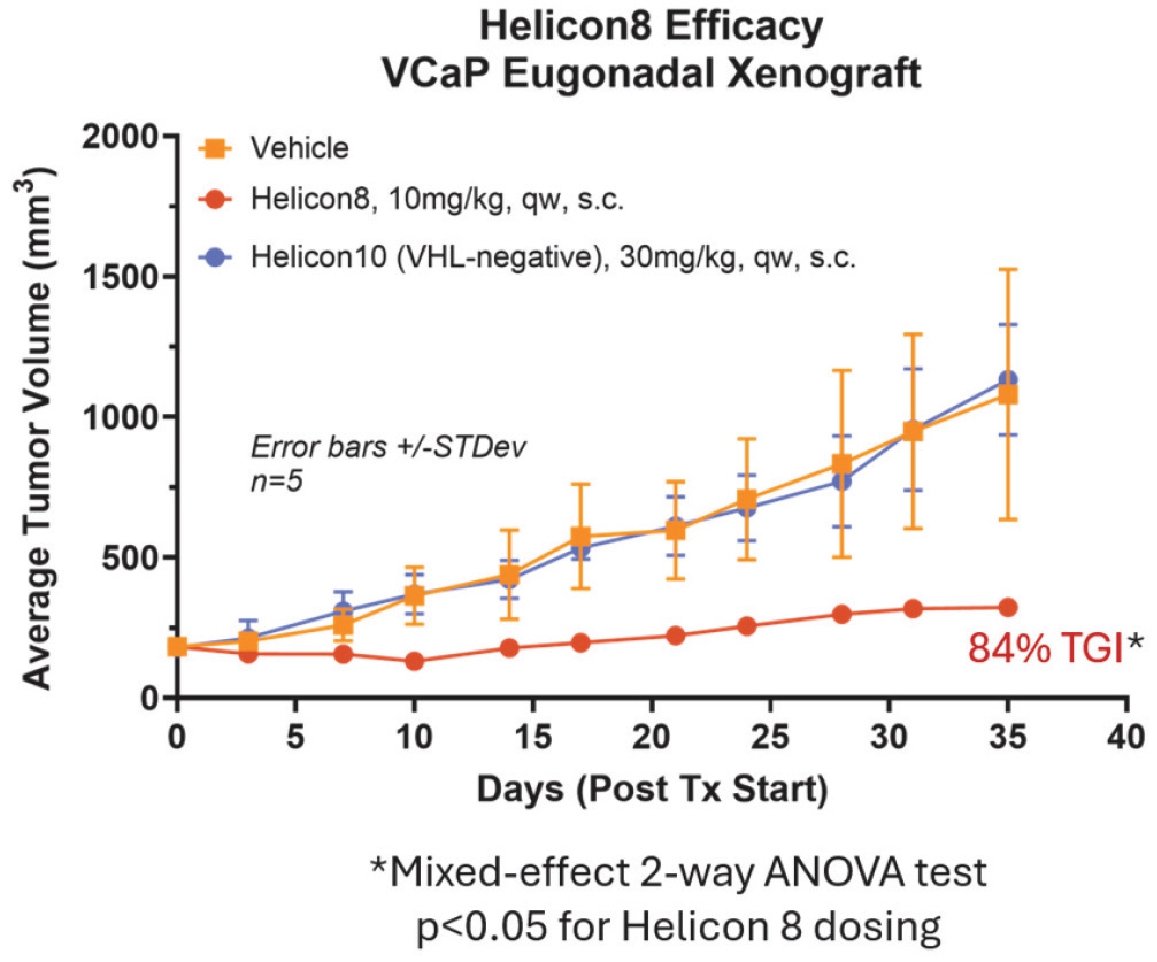
The following figure highlights three key features of our ARON Helicon degraders that are designed to improve on existing therapies: combinability, activity in tumors with resistance point mutations in AR, and activity in tumors with amplified AR.
Figure 35: Ligand binding domain Helicon series.
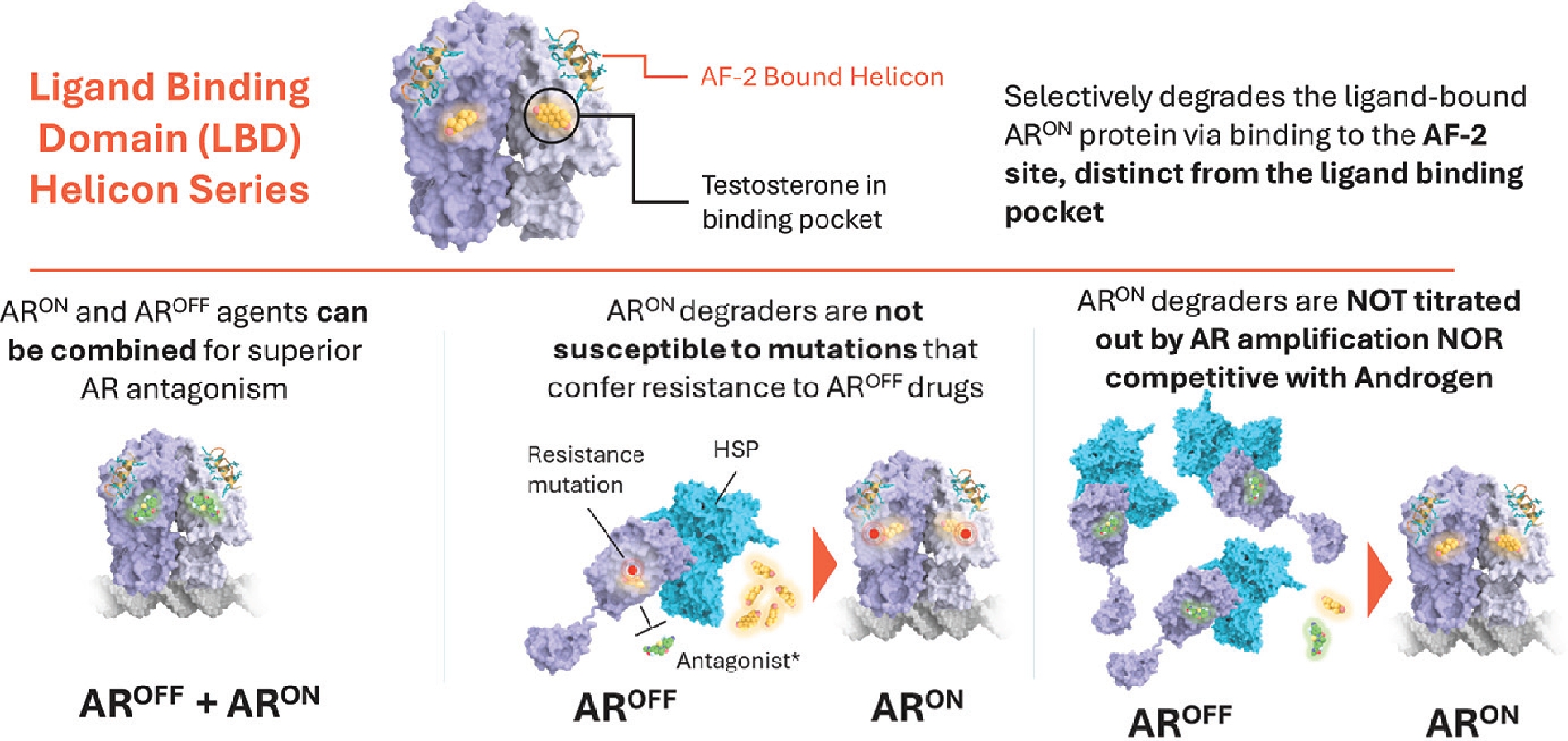
The following figure illustrates the improved anti-proliferative activity achieved by combining ARON Helicon degrader with enzalutamide versus either single agent treatment alone. We plan to conduct additional experiments to confirm the combination strategy described in VCaP cells using in vivo xenograft models.
Figure 36: Combination additivity in VCaP AR amplified prostate cancer cells.
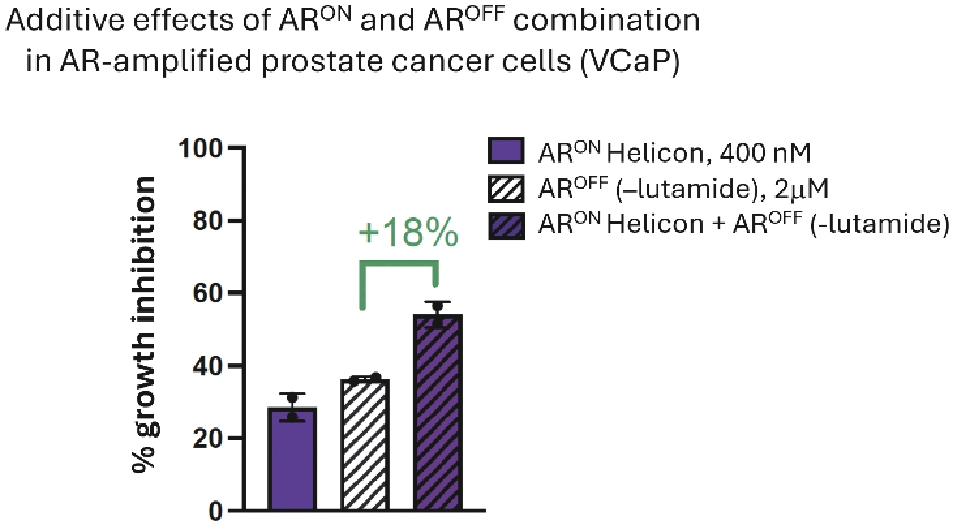
In addition, heterobifunctional Helicon degraders binding to the ARON conformation achieve potent and selective in vivo degradation of active AR, with anti-tumor activity equivalent to or exceeding approved AR antagonists in AR-amplified xenograft models. As shown below, we have observed robust tumor growth inhibition in preclinical models using our ARON degrader, and are in late lead-optimization progressing toward IND-enabling studies. In the representative in vivo experiment illustrated above in Figure 34, we observed 84% tumor growth inhibition of the AR amplified VCaP cell-line derived xenograft model when dosing Helicon8 at 10mg/kg on once weekly schedule with a subcutaneous dosing route. Importantly, when we dose the same tumor model with a negative control helicon (Helicon10) that is derived from active Helicon8 with a conservative chemical modification that retains AR binding ability but abrogates the ability of the Helicon to bind to VHL E3 ligase, anti-tumor activity of the Helicon is lost, demonstrating that the degrader functionality is critical for antitumor activity.
b-catenin Candidates Utilizing Our Helicon Discovery Platform
In addition to pursuing ERG and ARON degraders, we are continuing to develop novel approaches to target b-catenin, building on the foundational biology established through zolucatetide. We have identified multiple binding sites on b-catenin beyond the one leveraged by zolucatetide and are exploring the application of our degrader technology to develop a b-catenin targeted degrader. Data highlighting cell-based degradation of b-catenin protein using a bifunctional Helicon degrader is set forth in Figure 37. This Helicon degrader exhibited a potent DC50 of ~100nM, which was dependent on engagement of the VHL E3 ligase (illustrated with a VHL incompetent negative control Helicon), and dependent on the proteasome (illustrated by rescue with the proteasome inhibitor, bortezomib). Finally, in the same Figure, the degradation of b-catenin protein led to a dose-dependent and VHL E3 ligase-dependent inhibition of b-catenin:TCF transcriptional activity as measured by monitoring AXIN2 gene expression.
Figure 37. Cell-based validation of a bifunctional Helicon degrader of b-catenin using the COLO320DM colorectal cell line as a model system.
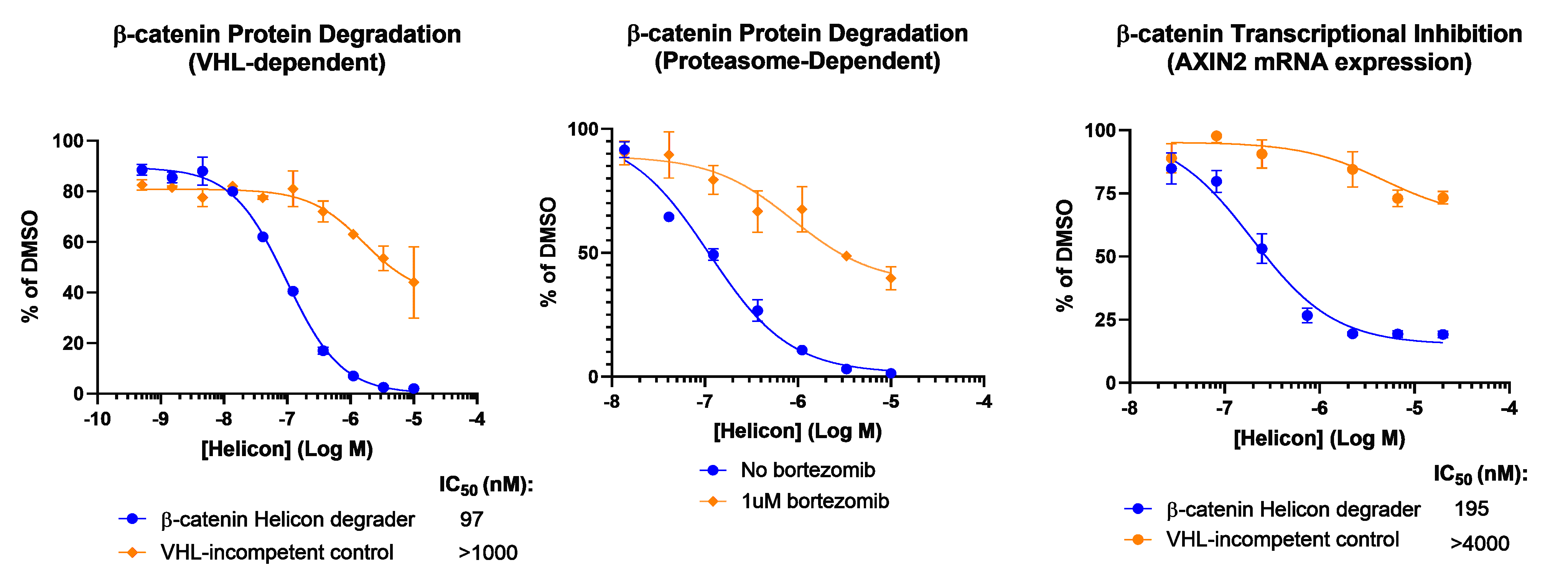
The finding that b-catenin has at least five Helisites allows us to explore the biological impact of modulating b-catenin activity and levels in multiple ways. We believe the combination of a degrader approach and the exploration of additional Helisites may enable us to create new product candidates targeting the Wnt/ b-catenin pathway and further expand the opportunity of our b-catenin franchise.
Other Discovery Candidates Utilizing Our Helicon Discovery Platform
We believe zolucatetide, our b-catenin and ERG degraders, and our allosteric ARON degrader program provide strong evidence of the potential of our Helicon discovery platform to repeatedly generate therapeutic candidates with the potential to selectively bind historically undruggable intracellular targets and exert desired biological activity. We are also actively working to broaden our platform’s reach across additional historically undruggable high-value targets such as cyclin D1 and p53, among others. These targets have been specifically selected to align with our focus on genetically validated, historically undruggable proteins where we believe Helicon peptides offer a meaningful advantage over existing modalities. We apply a rigorous framework to evaluate and prioritize programs, assessing each against genetic validation, Helicon feasibility, safety, clinical path, and potential for value creation before committing substantial resources to advancement.
We are also exploring modality expansion, building our toolkit of Helicon functionalities to include protein-protein interaction inhibitors, protein-DNA inhibitors, bifunctional degraders, target-induced cell killing, and radioligand therapeutics. We believe our modality also has the potential to implement additional mechanisms of action with high precision by incorporating functional payloads or recruiting domains into the core Helicon scaffold. This modularity allows us to leverage continued advances across biotechnology to potentially extend the reach of the platform across multiple mechanisms.
We intend to advance multiple discovery-stage programs beyond our current clinical and preclinical pipeline, reflecting our goal to build a multi-therapeutic company that leverages the distinct strengths of the Helicon platform to create differentiated medicines.
Strategic Partnerships
In addition to advancing wholly-owned programs, we intend to pursue selective strategic partnerships to maximize the impact of the Helicon platform. In oncology, where we maintain deep internal expertise in target biology, clinical development, and regulatory strategy, we expect to develop programs through regulatory approvals and commercialize the products ourselves in the United States. Outside of the United States, we may seek partnerships with global pharmaceutical companies or distributors to expand our reach to patients globally. For certain oncology indications where scaled manufacturing, broad commercial infrastructure, or other capabilities would be required to fully realize a program’s potential, we may choose to advance a program to an appropriate value inflection point and then partner with organizations that bring these capabilities. In such cases, where we believe a partnership could accelerate patient access and expand the clinical and commercial impact of a program beyond what we could achieve independently, we would seek to structure collaborations that both enable that broader reach and allow us to achieve meaningful near-term and downstream value creation.
We also intend to evaluate strategic research collaborations to advance Helicon-based programs against new targets and indications largely outside of oncology. In these partnerships, we expect to leverage our Helicon discovery platform to generate molecules against undruggable targets, while partners contribute disease-area biology, translational insight, and development and commercialization capabilities specific to their therapeutic focus. We believe this strategy allows us to expand the reach of the Helicon platform into high-value indications that we would not otherwise pursue independently, generating additional value and optionality for our company and for patients.
Consistent with this strategy, we recently entered into a License and Collaboration Agreement with Regeneron Pharmaceuticals, Inc. (“Regeneron”) pursuant to which we plan to discover and develop multiple therapeutic candidates based on our Helicon platform, with a particular focus on Antibody-Helicon Conjugates (“AHCs”) directed to historically undruggable and challenging intracellular targets. The collaboration will focus primarily on indications outside of oncology. Additional information regarding our collaboration with Regeneron is set forth in the section titled "License and Collaboration Agreements" below.
Manufacturing
We believe that Helicons can be reliably and efficiently manufactured, and that our team possesses the expertise and technical capabilities required to produce zolucatetide, as well as Helicons more broadly, at commercial scale. To date, our focused efforts have enabled us to: (1) develop manufacturing processes that we believe are scalable for commercial production; (2) establish a network of contract manufacturers capable of reliably and efficiently supplying zolucatetide for clinical trials and, ultimately, commercialization; (3) significantly reduce cost of goods sold through optimization and scale-up of our solid-phase process, as well as development of a liquid-phase process; and (4) advance the development of a self-administered injectable formulation of zolucatetide for commercial use. Looking ahead, we intend to continue innovating to support further improvements, including transitioning to our liquid-phase manufacturing process. In parallel, we are advancing a formulation development to enable convenient self-administered injectable dosing, which we expect will be used for zolucatetide at the commercial stage and may be applied across other programs. Under the oversight of our experienced manufacturing team, we intend to continue to enhance our end-to-end manufacturing capabilities.
With respect to our supply chain, we rely on third parties for the GMP manufacture of our product candidates for certain preclinical studies and clinical trial materials, including active pharmaceutical ingredients, as well as the raw materials and consumables required for their production. We expect to continue this outsourcing strategy in the future, including for commercial manufacturing, if our product candidates receive marketing approval. We do not own or operate GMP manufacturing facilities and do not currently plan to build internal GMP manufacturing capabilities for clinical or commercial production. However, our team includes personnel with extensive manufacturing experience who provide oversight of our contract manufacturing partners. In the future, we may also engage collaboration partners, in addition to contract manufacturers, to support the manufacture of our product candidates or any approved products.
We believe that zolucatetide can be manufactured using reliable and reproducible synthetic process from readily available raw materials, followed by purification and packaging suitable for clinical use. We further believe that the chemistry is amenable to scale-up, and that our continued focus on innovation will allow us to maintain robust manufacturing expertise.
Competition
The pharmaceutical industry is characterized by rapid technological evolution and intense competition. We face and will continue to face competition from pharmaceutical and biotechnology companies of all sizes, academic institutions, government agencies, and other public and private research organizations that conduct research, seek patent protection, and establish collaborative arrangements for the research, development, manufacturing, and commercialization of new products.
Any product candidates that we successfully develop and commercialize will compete with existing approved therapies, off-label treatments, and/or new therapies that may become available in the future. We believe that the key competitive factors affecting the success of zolucatetide and any future product candidates, if approved, will include efficacy, durability of response, time to response, safety and tolerability, route of administration, cost and reimbursement coverage, and the strength of our intellectual property protection.
We are developing our lead product candidate, zolucatetide, initially for the treatment of desmoid tumors. The competitive landscape for desmoid tumors has evolved in recent years with the emergence of one approved targeted therapy and others in development, and we expect this landscape to continue to evolve as additional agents advance through clinical development.
We consider our most direct competitors to be companies developing g-secretase inhibitors, including nirogacestat (Ogsiveo), an approved drug for desmoid tumors commercialized by Merck KGaA (acquired from SpringWorks Therapeutics), and varegacestat, being developed by Immunome, Inc., has completed a Phase 3 clinical trial in desmoid tumors. Varegacestat targets the same mechanistic pathway as Ogsiveo and, if approved, would represent an additional source of direct competition.
There may be additional agents in early clinical development by other companies targeting this indication through tumor-agnostic or basket studies that may enroll patients with desmoid tumors. We cannot predict whether varegacestat or other clinical-stage agents will receive regulatory approval, or on what timeline, but the potential entry of additional approved therapies could intensify the competitive environment and make it more difficult to achieve and maintain market share for zolucatetide, if approved.
Furthermore, we are aware of several therapies used off-label for the treatment of desmoid tumors, including chemotherapeutic agents such as liposomal doxorubicin and vinblastine/methotrexate, non-steroidal anti-inflammatory drugs, anti-hormonal therapies, and tyrosine kinase inhibitors such as sorafenib, imatinib, and pazopanib. These therapies, some of which are available generically and at lower cost, may continue to be used by treating physicians and could limit the addressable market for zolucatetide.
For our zolucatetide program in FAP, where there are no therapies currently approved by the FDA, we are aware of clinical-stage product candidates being evaluated. These include: eRapa (encapsulated rapamycin), an oral mTOR inhibitor being developed by Emtora Biosciences, and REC-4881, an allosteric MEK1/2 inhibitor being developed by Recursion Pharmaceuticals, as well as TPST-1495 (Tempest Therapeutics) and ONC201 (Jazz Pharmaceuticals). We are also aware of therapies being evaluated in tumor-agnostic or related gastrointestinal indications that may include FAP patients. All of these and other potential entrants could create competition for our program.
Many of our current and potential competitors have significantly greater financial resources and expertise than we do in research and development, manufacturing, preclinical and clinical testing, obtaining regulatory approvals, obtaining reimbursement, and marketing approved products. Mergers and acquisitions in the biopharmaceutical industry may result in even greater resources being concentrated among a smaller number of well-capitalized competitors. Smaller or early-stage companies may also prove to be significant competitors, particularly through collaborative arrangements with larger and more established companies.
Our competitors also compete with us in recruiting and retaining qualified scientific, clinical, and management personnel, establishing clinical trial sites and patient enrollment for clinical trials, and acquiring technologies complementary to or necessary for our programs. If our competitors develop and commercialize products that are safer, more effective, have fewer or less severe side effects, are more convenient to administer, or are less expensive than zolucatetide or any future product candidates we may develop, our commercial opportunity could be reduced or eliminated. Our competitors may also obtain FDA or other regulatory approvals for their products more rapidly than we may obtain approval for ours, which could allow them to establish a strong market position before we are able to enter the market.
The availability of reimbursement from government and private payors will also significantly affect the pricing and competitiveness of our products. Even if zolucatetide or any future product candidates achieve regulatory approval, they may be priced at a significant premium over competitive products if any have been approved by then, which could result in reduced competitiveness or limited market adoption.
Intellectual Property
We pursue a layered intellectual property strategy to protect our Helicon discovery platform, our development programs, our product candidates and other technologies. One focus of our intellectual property strategy is to provide protection for our Helicon discovery platform and product candidates currently in development. We also pursue intellectual property protection for assets that may be used in future development programs or that may be of interest to future collaborators or otherwise may prove valuable in the field.
Various aspects of our Helicon discovery platform and our product candidates are covered by claims in patent filings. We also pursue other modalities of protection, including trademark and trade secret protection, as appropriate. Many of our intellectual property assets were developed and are owned solely by us, some have been developed via collaboration and are jointly owned, and some have been licensed from third parties. We intend to continue filing additional patent applications, and to pursue opportunities to acquire and/or license additional intellectual property assets and technologies, for example, from collaborations, as developments arise or are identified.
Our commercial success depends, in large part, on our ability to obtain and maintain patents, trademarks, and other proprietary protections for commercially important technologies, including inventions, trade secrets and know-how, related to our business including our Helicon discovery platform and our product candidates; to defend and enforce our patents and other intellectual property rights; to preserve the confidentiality of our trade secrets; and to operate without infringing, misappropriating or violating patents and other intellectual property rights of third parties. See “Risk Factors—Risks Related to Our Intellectual Property” for a more comprehensive description of risks related to our intellectual property.
As of March 23, 2026, our overall owned and in-licensed patent portfolio included at least 17 patent families, each of which includes at least an application filed under the Patent Cooperation Treaty (a “PCT application”) or a filing in the United States, and several of which are pending or granted in multiple jurisdictions. The patent families include at least 12 patent families that are solely owned by us, and the rest that we have licensed from third parties.
An issued patent typically provides its owner (or possibly its exclusive licensee) with a right to exclude others from making, using, offering to sell, or selling that which is claimed in the patent, for a specified period of time (the “term” of the patent), in the jurisdiction in which the patent is issued. In the United States, a patent has a presumptive term of 20 years from its patent term filing date (which is the filing date of the patent, or if the patent claims the benefit of the filing date of another non-provisional application, the filing date of the earliest non-provisional application whose filing date the patent claims the benefit of) depending upon timely payments of maintenance fees. Many other jurisdictions provide a similar presumptive 20-year patent term. Many jurisdictions, including the United States, require the payment of periodic maintenance fees in order for patents to remain in force for the full 20-year term. The United States also has provisions that require the term of a patent to be shortened if its claims are too similar to another patent that is owned by the same party and/or shares a common inventor therewith that has a shorter term, and also permits patentees to disclaim term. The United States and certain other jurisdictions also have provisions that permit extension of patent term for patents that cover a product that is subject to regulatory approval, such as drugs and certain medical devices, approved uses thereof, or methods of manufacturing them, under certain circumstances. In the United States, such extension is called a Patent Term Extension (“PTE”), and it is limited to a period of not more than five years, and the total patent term including the PTE cannot exceed 14 years after the date of regulatory approval; only one patent can be extended per product approval. There are analogous rules for extending patents in certain other jurisdictions, such as EU Member States, Japan, South Korea, and Canada. The United States also offers a different form of patent term extension, known as Patent Term Adjustment (“PTA”), whereby a particular patent’s term is extended beyond the 20-year date if the United States Patent and Trademark Office (“USPTO”), caused delay during its examination; however, potentially available PTA is reduced by any amount of any delay caused by the patent applicant.
Below, we provide a summary of our current patent portfolio as of March 23, 2026, as it relates to different aspects of our Helicon discovery platform and product candidates. Patent prosecution is a lengthy process, during which the scope of the claims initially submitted for examination by the USPTO and its foreign equivalents can be significantly narrowed or otherwise altered by the time they issue, if they issue at all. We expect this could be the case with respect to some or all of our pending patent applications referred to below. Particularly given our clinical stage of development, we cannot be certain that any of the patent filings in our portfolio will provide meaningful protection for any product we ultimately attempt to commercialize.
Helicon Discovery Platform
Our patent portfolio includes patent filings directed to various features of our Helicon discovery platform, some of which are utilized in our development programs. For example, certain patent families in-licensed from the President and Fellow of Harvard College (“Harvard”) describe various amino acids and stapling technologies that can be useful for certain Helicons, Helicons comprising such amino acids and stapling technologies, and methods for manufacturing such Helicons. These families include issued patents and/or pending applications in multiple jurisdictions including major market jurisdictions such as the United States, Europe and/or Japan, and their presumptive 20-year terms extend to 2028-2034.
We own certain patent filings that describe certain amino acids, staples or patterns thereof, the presumptive 20-year terms of which range from 2038 to at least 2041.
Certain patent families in our portfolio describe technologies useful for identifying Helicons that can bind various targets, and Helicons identified thereby. Some of these families offer presumptive 20-year terms that extend to at least 2039.
Helicon Product Candidates
As of March 23, 2026, our most advanced product candidate is zolucatetide. Our patent portfolio includes patent families that are owned by us and may protect the composition of matter of zolucatetide. The presumptive 20-year term of such patent families extends to at least 2042. Certain patent families owned by us may provide protection of certain formulations and/or uses of zolucatetide; their presumptive 20-year expiration dates range from 2042 to at least 2044. Together, these patent families include pending patent applications in the United States and various other jurisdictions such as Brazil, Canada, China, Eurasia, Europe, Israel, India, Japan, South Korea, Mexico, and Singapore. No patents have issued from these patent families yet.
We maintain a thoughtful program for developing and protecting additional intellectual property including platform and program technologies. We also intend to prepare and submit patent filings specifically directed to protecting individual product candidates and their uses as our programs progress.
License and Collaboration Agreements
License Agreement with President and Fellows of Harvard College
On August 30, 2017, we entered into a License Agreement with President and Fellows of Harvard College, as amended on January 12, 2018, June 20, 2019 and July 16, 2020 (as amended, the “Harvard License”), pursuant to which we received an exclusive, royalty-bearing license under certain Harvard intellectual property to develop and commercialize products incorporating certain polypeptide technologies (the “Licensed Product”) solely in the field of prevention and treatment of disease in humans, worldwide. Harvard retains the right to use the licensed intellectual property for research, educational, and scholarly purposes (excluding clinical trials). The Licensed Products are further categorized as Type I Licensed Products and Type II Licensed Products based on whether such Licensed Product is covered by a valid claim licensed from Harvard. We believe that zolucatetide is a Type I Licensed Product because pending or issued claims in the licensed families cover zolucatetide. Because our earlier-stage pipeline is still under development it is not yet clear that any licensed families would cover those products. We own any improvements that we create to technology that we licensed under the Harvard License.
As partial consideration for the rights granted to us under the Harvard License, we entered into a stock subscription agreement with Harvard pursuant to which we issued shares of our common stock to Harvard. As additional consideration for the license, we are required to pay Harvard: (i) annual license maintenance fees in the low six-figures; (ii) up to an aggregate of $18.3 million in development, regulatory and sales milestone payments for each Licensed Product; (iii) royalties with a rate based on aggregate net sales per calendar year of each of Type I Licensed Products and Type II Licensed Products, ranging in the low single digits based on the type of Licensed Product; and (iv) a percentage of non-royalty income received under sublicenses or strategic partnerships with third parties based on what stage of development the first Licensed Product at the time we enter into such agreement (i.e., before or after enrollment of first patient in a Phase 2 clinical study of a Licensed Product), ranging in the low to mid-teens. The royalties due for Type I Licensed Products are subject to a potential reduction related to certain third party license fees. The royalty term for Type I Licensed Products will expire on a Licensed Product-by-Licensed Product and country-by-country basis upon the expiration or termination of the last valid claim within the Harvard licensed patents covering or claiming the composition, manufacture, sale or use of such Licensed Product in such country. The royalty term for Type II Licensed Products will expire on a Licensed Product-by-Licensed Product and country-by-country basis on the 12 year anniversary of the first commercial sale of such Licensed Product in such country.
Under the Harvard License, we have certain diligence obligations to perform certain development and commercialization activities in accordance with a development plan and timelines therein (“Development Milestones”). We may request extensions to the timelines for achieving Development Milestones subject to Harvard’s approval and an amendment to the development plan. Harvard may terminate for our failure to negotiate Development Milestones or failure to achieve a Development Milestone, subject to a cure period.
We may terminate the Harvard License for convenience upon prior written notice, and Harvard may terminate for our failure to negotiate Development Milestones or failure to achieve a Development Milestone, subject to a cure period, as described above. Either party may terminate for uncured material breach or insolvency.
Upon termination of the Harvard License for any reason, all licenses granted by Harvard will terminate and revert to Harvard and we will retain the right to sell off existing inventory and complete work-in-progress, subject to ongoing insurance, royalty and reporting obligations. Following termination, we may not have all of the rights necessary to continue our research and development and commercialization efforts for zolucatetide or any other product candidates covered by the license. Any sublicensees who obtained sublicenses from us will have a right to obtain a direct license with Harvard.
License and Collaboration Agreement with Regeneron Pharmaceuticals, Inc.
On May 15, 2026, we entered into a License and Collaboration Agreement (the “Regeneron Agreement”) with Regeneron Pharmaceuticals, Inc. (“Regeneron”) to discover, develop, and commercialize Helicons, with a particular focus on Antibody-Helicon Conjugates (“AHCs”), directed to a set of specified targets (each, a “Collaboration Target”).
Under the terms of the Regeneron Agreement and during the research term for each Collaboration Target, we will collaborate with Regeneron to perform certain research and preclinical development activities, including screening, generating, testing and evaluating new Helicons and AHCs directed to such Collaboration Target (each, a “Product”). Under the Regeneron Agreement, there are five initial Collaboration Targets, with Regeneron having the right to replace up to two targets and the option to nominate up to five additional Collaboration Targets, subject to an additional option payment from Regeneron. For one initial Collaboration Target, Regeneron may add one or more additional programs with respect to such Collaboration Target, subject to payment of additional program fees.
Following Regeneron's nomination of a Product to be a “Licensed Product” during the research term for the applicable Collaboration Target (including additional Collaboration Targets), Regeneron has the sole right to advance through development, manufacturing and worldwide commercialization of Licensed Products, including clinical and regulatory strategy, pricing, and promotion.
Under the terms of the Regeneron Agreement, Regeneron has agreed to make a $50.0 million upfront payment and invest $75.0 million in our next equity financing, subject to certain conditions, which investment is expected to be the concurrent private placement described in this prospectus. For the initial Collaboration Targets, we are eligible to receive: (i) up to $470.0 million in development milestone payments; (ii) up to $575.0 million in regulatory milestone payments; (iii) up to $1.15 billion in commercial milestone payments; and (iv) tiered royalty payments, ranging in the high single digits to low double digits during the period commencing upon the first commercial sale of such Licensed Product in a given country and expiring on the latest of: (a) expiration of the last valid claim of a royalty term-extending patent right of such Licensed Product in such country, (b) 12 years after the first commercial sale of such Licensed Product in such country, and (c) loss of regulatory exclusivity for such Licensed Product in such country, subject to customary reductions.
Under the terms of the Regeneron Agreement, we are subject to an exclusivity obligation for each Collaboration Target until the last to expire royalty term for Licensed Products directed to such Collaboration Target, which restrict us from, directly or indirectly, licensing, developing, manufacturing, commercializing, or otherwise exploiting any competing product directed to such Collaboration Target outside of activities conducted under the Regeneron Agreement, subject to customary exceptions for our acquisition of a competing product and change of control.
Unless earlier terminated pursuant to its terms, the Regeneron Agreement will remain in effect until the expiration of the last royalty term for the last Licensed Product under the Regeneron Agreement. Regeneron has the right to terminate the Regeneron Agreement for convenience and for certain violations of our exclusivity covenants. Each party may terminate the Regeneron Agreement for material breach, subject to a cure period. We may terminate the Regeneron Agreement for certain patent challenges by Regeneron or any of its affiliates on our patent rights and failure to withdraw such challenge within a certain time period, subject to certain exceptions.
Upon termination of the Regeneron Agreement for any reason, all licenses granted to Regeneron will terminate and revert to us. Any sublicensees who obtained sublicenses from Regeneron will have a right to obtain a direct license from us, provided such sublicensee was in compliance with the applicable sublicense agreement and such sublicense agreement was entered in accordance with the Regeneron Agreement.
The Regeneron Agreement includes various representations, warranties, covenants, dispute escalation and resolution mechanisms, indemnities and other provisions customary for transactions of this nature.
Government Regulation
Government authorities in the United States, at the federal, state and local level, and in other countries and jurisdictions, including the European Union (“EU”), extensively regulate, among other things, the research, development, testing, manufacture, quality control, approval, packaging, storage, recordkeeping, labeling, advertising, promotion, distribution, marketing, post-approval monitoring and reporting, and import and export of pharmaceutical products. The processes for obtaining regulatory approvals in the United States and in foreign countries and jurisdictions, along with subsequent compliance with applicable statutes and regulations, require the expenditure of substantial time and financial resources.
Review and Approval of Drugs in the United States
In the United States, the FDA regulates drugs under the U.S. Federal Food, Drug, and Cosmetic Act (“FDCA”) and its implementing regulations. The failure to comply with applicable U.S. requirements at any time during the product development process, approval process or after approval may subject an applicant and/or sponsor to a variety of administrative or judicial sanctions, including refusal by the FDA to approve pending applications, withdrawal of an approval, imposition of a clinical hold, issuance of warning letters and other types of letters, product seizures, total or partial suspension of production or distribution, injunctions, fines, refusals of government contracts, restitution, disgorgement of profits, or civil or criminal investigations and penalties brought by the FDA and the U.S. Department of Justice or other governmental entities. In addition, an applicant may need to recall a product.
An applicant seeking approval to market and distribute a new drug product in the United States must typically undertake the following:
•completion of nonclinical, or preclinical, laboratory tests, animal studies and formulation studies in compliance with the FDA’s good laboratory practice (“GLP”) regulations;
•submission to the FDA of an investigational new drug application (“IND”) which must take effect before human clinical trials may begin;
•approval by an institutional review board (“IRB”) representing each clinical site before each clinical trial may be initiated at that site;
•performance of adequate and well-controlled human clinical trials in accordance with good clinical practices (“GCPs”) to establish the safety and efficacy of the proposed drug product for each indication;
•preparation and submission to the FDA of a New Drug Application (“NDA”) and payment of user fees;
•review of the product by an FDA advisory committee, where appropriate or if applicable;
•satisfactory completion of one or more FDA inspections of the manufacturing facility or facilities at which the product, or components thereof, are produced to assess compliance with current Good Manufacturing Practices (“cGMP”) requirements and to assure that the facilities, methods and controls are adequate to preserve the product’s identity, strength, quality and purity;
•satisfactory completion of FDA audits of clinical trial sites to assure compliance with GCPs and the integrity of the clinical data;
•FDA review and approval of the NDA; and
•compliance with any post-approval requirements, any post-approval studies required by the FDA.
Preclinical Studies
Before an applicant begins testing a compound in humans, the drug candidate enters the preclinical testing stage. Preclinical studies include laboratory evaluation of the purity and stability of the manufactured drug substance or active pharmaceutical ingredient (“API”) and the formulated drug or drug product, as well as in vitro and animal studies to assess the safety and activity of
the drug for initial testing in humans and to establish a rationale for therapeutic use. The conduct of preclinical studies is subject to federal regulations and requirements, including GLP regulations. Some long-term preclinical testing, such as animal tests of reproductive adverse effects and carcinogenicity, may continue after the IND is submitted.
The IND and IRB Processes
An IND is an exemption from the FDCA that allows an unapproved drug to be shipped in interstate commerce for use in an investigational clinical trial and a request for FDA authorization to administer such investigational drug to humans. Such authorization must be secured prior to interstate shipment and administration of the investigational drug. In an IND, applicants must submit a protocol for each clinical trial and any subsequent protocol amendments. In addition, the results of the preclinical tests, manufacturing information, analytical data, any available clinical data or literature and plans for clinical trials, among other things, are submitted to the FDA as part of an IND. An IND automatically becomes effective 30 days after receipt by the FDA, unless before that time, the FDA raises concerns or questions related to one or more proposed clinical trials and places the trial on clinical hold. The FDA also may impose a clinical hold or partial clinical hold after commencement of a clinical trial under an IND. A clinical hold is an order issued by the FDA to the sponsor to delay a proposed clinical investigation or to suspend an ongoing investigation. A partial clinical hold is a delay or suspension of only part of the clinical work requested under the IND. No more than 30 days after imposition of a clinical hold or partial clinical hold, the FDA will provide the sponsor a written explanation of the basis for the hold. Following issuance of a clinical hold or partial clinical hold, an investigation (or full investigation in the case of a partial clinical hold) may only resume after the FDA has notified the sponsor that the investigation may proceed. The FDA will base that determination on information provided by the sponsor correcting the deficiencies previously cited or otherwise satisfying the FDA that the investigation can proceed.
A sponsor may choose, but is not required, to conduct a foreign clinical trial under an IND. When a foreign clinical trial is conducted under an IND, all FDA IND requirements must be met unless waived. When the foreign clinical trial is not conducted under an IND, the sponsor must ensure that the study is conducted in accordance with GCP, including review and approval by an independent ethics committee (“IEC”) and informed consent from subjects. The GCP requirements are intended to help ensure the protection of human subjects enrolled in non-IND foreign clinical trials, as well as the quality and integrity of the resulting data. FDA must also be able to validate the data from the study through an on-site inspection if necessary.
In addition to the foregoing IND requirements, an IRB representing each institution participating in the clinical trial must review and approve the plan for any clinical trial before it commences at that institution, and the IRB must conduct continuing review of the study at least annually. The IRB must review and approve, among other things, the study protocol and informed consent information to be provided to study subjects. An IRB must operate in compliance with FDA regulations. An IRB can suspend or terminate approval of a clinical trial at its institution, or an institution it represents, if the clinical trial is not being conducted in accordance with the IRB’s requirements or if the product candidate has been associated with unexpected serious harm to patients.
Additionally, some trials are overseen by an independent group of qualified experts organized by the trial sponsor, known as a data safety monitoring board or committee. This group provides authorization for whether or not a trial may move forward at designated check points based on access that only the group maintains to available data from the study. The FDA or the sponsor may suspend or terminate a clinical trial at any time on various grounds, including a finding that the research subjects are being exposed to an unacceptable health risk. Other reasons for suspension or termination may be made by us based on evolving business objectives and/or competitive climate.
Information about certain clinical trials must be submitted within specific timeframes to the National Institutes of Health (“NIH”) for public dissemination on its ClinicalTrials.gov website. Sponsors also must disclose certain results of these clinical trials, although disclosure of results may be delayed until after the new product or new indication has been approved by the FDA. Failure to timely register a covered clinical study or to submit study results as provided for in the law can give rise to public notifications of noncompliance, civil monetary penalties, and also prevent the non-compliant party from receiving future grant funds from the federal government.
Human Clinical Trials in Support of an NDA
Clinical trials involve the administration of the investigational product to human subjects under the supervision of qualified investigators in accordance with GCP requirements, which include, among other things, the requirement that all research subjects, or their legal representative, provide their informed consent in writing before their participation in any clinical trial. Clinical trials are conducted under written study protocols detailing, among other things, the inclusion and exclusion criteria, the objectives of the study, the parameters to be used in monitoring safety and the effectiveness criteria to be evaluated.
Human clinical trials are typically conducted in three sequential phases, which may overlap or be combined:
•Phase 1. The drug is initially introduced into healthy human subjects or, in certain indications such as cancer, patients with the target disease or condition and tested for safety, dosage tolerance, absorption, metabolism, distribution, excretion and, if possible, to gain an early indication of its effectiveness and to determine maximal dosage.
•Phase 2. The drug is administered to a limited patient population to identify possible Adverse Effects (“AEs”) and safety risks, to preliminarily evaluate the efficacy of the product for specific targeted diseases and to determine dosage tolerance and optimal dosage.
•Phase 3. The drug is administered to an expanded patient population, generally at geographically dispersed clinical trial sites, in well-controlled clinical trials to generate enough data to evaluate the efficacy and safety of the product for approval, to establish the overall risk-benefit profile of the product and to provide adequate information for the labeling of the product.
Post-approval studies, often referred to as Phase 4 studies, may be conducted after initial regulatory approval. These studies are used to gain additional experience from the treatment of patients in the intended therapeutic indication.
Progress reports detailing the results of the clinical trials must be submitted at least annually to the FDA. In addition, within 15 calendar days after the sponsor determines that the information qualifies for reporting, IND safety reports must be submitted to the FDA for any of the following: serious and unexpected suspected adverse reactions; findings from other studies or animal or in vitro testing that suggest a significant risk in humans exposed to the drug; and any clinically important increase in the case of a serious suspected adverse reaction over that listed in the protocol or investigator brochure. The sponsor also must notify the FDA of any unexpected fatal or life-threatening suspected adverse reaction within seven calendar days after the sponsor’s initial receipt of the information. Phase 1, Phase 2 and Phase 3 clinical trials may not be completed successfully within any specified period, or at all. The FDA will typically inspect one or more clinical sites to assure compliance with GCP and the integrity of the clinical data submitted.
Concurrent with clinical trials, companies often complete additional animal studies and must also develop additional information about the chemistry and physical characteristics of the drug as well as finalize a process for manufacturing the product in commercial quantities in accordance with cGMP requirements. The manufacturing process must be capable of consistently producing quality batches of the drug candidate and, among other things, the applicant must develop methods for testing the identity, strength, quality, purity, and potency of the final drug. Additionally, appropriate packaging must be selected and tested and stability studies must be conducted to demonstrate that the drug candidate does not undergo unacceptable deterioration over its shelf life.
Review of an NDA by the FDA
Assuming successful completion of required clinical testing and other requirements, the results of the preclinical studies and clinical trials, together with detailed information relating to the product’s chemistry, manufacture, controls and proposed labeling, among other things, are submitted to the FDA as part of an NDA requesting approval to market the drug product for one or more indications. Under federal law, the submission of most NDAs is additionally subject to a significant application user fee as well as annual prescription drug product program fees. These fees are typically increased annually. Certain exceptions and waivers are available for some of these fees.
The FDA conducts a preliminary review of an NDA within 60 days of its receipt, before accepting the NDA for filing, to determine whether the application is sufficiently complete to permit substantive review. The FDA may request additional information rather than accept an NDA for filing. In this event, the application must be resubmitted with the additional information. The resubmitted application is also subject to review before the FDA accepts it for filing. Once the submission is accepted for filing, the FDA begins an in-depth substantive review. The FDA has agreed to specified performance goals in the review process of NDAs. Applications for drugs containing new molecular entities have a “goal date” for a decision by the FDA of 10 months from the date of filing, and applications for “priority review” products containing new molecular entities have a goal date of six months from the date of filing. A goal date does not create an enforceable right to a decision by that date, and FDA does not always meet its goal dates. The review process may be extended by the FDA for three additional months to consider new information or clarification provided by the applicant to address an outstanding deficiency identified by the FDA following the original submission.
During its review of an NDA, the FDA typically will inspect the facility or facilities where the product is or will be manufactured. These pre-approval inspections may cover all facilities associated with an NDA, including drug component manufacturing (such as APIs), finished drug product manufacturing, and control testing laboratories. The FDA will not approve an NDA unless it determines that the manufacturing processes and facilities are in compliance with cGMP requirements and adequate to assure consistent production of the product within required specifications.
In addition, as a condition of approval, the FDA may require an applicant to develop risk evaluation and mitigations strategies (“REMS”). REMS use risk minimization strategies beyond the professional labeling to ensure that the benefits of the product outweigh the potential risks. To determine whether a REMS program is needed, the FDA will consider the size of the population likely to use the product, seriousness of the disease, expected benefit of the product, expected duration of treatment, seriousness of known or potential AEs, and whether the product is a new molecular entity. REMS can include medication guides, physician communication plans for healthcare professionals, and elements to assure safe use (“ETASU”). ETASU may include, but are not limited to, special training or certification for prescribing or dispensing, dispensing only under certain circumstances, special monitoring, and the use of patient registries. The FDA may require a REMS before approval or post-approval if it becomes aware of a serious risk associated with use of the product.
The FDA is required to refer an application for a novel drug to an advisory committee or explain why such referral was not made. Typically, an advisory committee is a panel of independent experts, including clinicians and other scientific experts, that reviews, evaluates and provides a recommendation as to whether the application should be approved and under what conditions. The FDA is not bound by the recommendations of an advisory committee, but it considers such recommendations carefully when making decisions.
Orphan Drug Designation and Exclusivity
Under the Orphan Drug Act, the FDA may grant orphan designation to a drug product intended to treat a rare disease or condition, which is generally a disease or condition that affects either (i) fewer than 200,000 individuals in the U.S. or (ii) more than 200,000 individuals in the U.S. and for which there is no reasonable expectation that the cost of developing and making the product available in the U.S. for this type of disease or condition will be recovered from sales of the product. A company must request orphan drug designation before submitting an NDA. If the request is granted, the FDA will disclose the identity of the therapeutic agent and its potential use. Orphan drug designation does not convey any advantage in or shorten the duration of the regulatory review and approval process.
If a product with orphan status receives the first FDA approval for the use or indication for which it has such designation, the product is entitled to orphan product exclusivity. Orphan product exclusivity means that the FDA may not approve any other applications to market the same product for the same approved indication for seven years, except in certain limited circumstances, including if a subsequent product with the same active ingredient for the same indication is shown to be clinically superior to the approved product on the basis of greater efficacy or safety, or providing a major contribution to patient care, or if the company with orphan drug exclusivity is not able to meet market demand. Further, the FDA may approve more than one product for the same orphan use or indication as long as the products contain different active ingredients. Moreover, competitors may receive approval of different products for the indication for which the orphan product has exclusivity or obtain approval for the same product but for a different indication for which the orphan drug has exclusivity. Orphan drug designation entitles a party to financial incentives such as opportunities for grant funding towards clinical trial costs, tax advantages, and user-fee waivers.
A designated orphan drug may not receive orphan drug exclusivity if it is approved for a use that is broader than the indication for which it received orphan designation. In addition, orphan drug exclusive marketing rights in the U.S. may be lost if the FDA later determines that the request for designation was materially defective or, as noted above, if a second applicant demonstrates that its product is clinically superior to the approved product with orphan exclusivity or the manufacturer of the approved product is unable to assure sufficient quantities of the product to meet the needs of patients with the rare disease or condition.
Fast Track, Breakthrough Therapy, and Priority Review
The FDA has a number of programs intended to facilitate and expedite development and review of new drugs if they are intended to address an unmet medical need in the treatment of a serious or life-threatening disease or condition. Three of these programs are referred to as Fast Track Designation, Breakthrough Therapy Designation, and priority review designation.
Specifically, the FDA may designate a product for Fast Track review if it is intended, whether alone or in combination with one or more other products, for the treatment of a serious or life-threatening disease or condition, and it demonstrates the potential to address unmet medical needs for such a disease or condition. For Fast Track products, sponsors may have greater interactions with the FDA and the FDA may initiate review of sections of a Fast Track product’s application before the application is complete. This rolling review may be available if the FDA determines, after preliminary evaluation of clinical data submitted by the sponsor, that a Fast Track product may be effective. The sponsor must also provide, and the FDA must approve, a schedule for the submission of the remaining information and the sponsor must pay applicable user fees. However, the FDA’s time period goal for reviewing a Fast Track application does not begin until the last section of the application is submitted. In addition, the Fast Track Designation may be withdrawn by the FDA if the FDA believes that the designation is no longer supported by data emerging in the clinical trial process.
Second, a product may be designated as a Breakthrough Therapy if it is intended, either alone or in combination with one or more other products, to treat a serious or life-threatening disease or condition and preliminary clinical evidence indicates that the product may demonstrate substantial improvement over existing therapies on one or more clinically significant endpoints, such as substantial treatment effects observed early in clinical development. The FDA may take certain actions with respect to Breakthrough Therapies, including holding meetings with the sponsor throughout the development process; providing timely advice to the product sponsor regarding development and approval; involving more senior staff in the review process; assigning a cross-disciplinary project lead for the review team; and taking other steps to design the clinical trials in an efficient manner.
Third, the FDA may designate an NDA review for a priority review if it is for a product that treats a serious or life-threatening disease or condition and, if approved, would provide a significant improvement in safety or effectiveness. The FDA determines, on a case-by-case basis, whether the proposed product represents a significant improvement when compared with other available therapies. Significant improvement may be illustrated by evidence of increased effectiveness in the treatment of a condition, elimination or substantial reduction of a treatment-limiting product reaction, documented enhancement of patient compliance that may lead to improvement in serious outcomes, and evidence of safety and effectiveness in a new subpopulation. A priority designation is intended to direct overall attention and resources to the evaluation of such applications, and to shorten the FDA’s goal for taking action on a marketing application from 10 months to six months.
Even if a product qualifies for one or more of these programs, the FDA may later decide that the product no longer meets the conditions for qualification or decide that the time period for FDA review or approval will not be shortened. Fast Track designation, Breakthrough Therapy designation, and priority review do not change the standards for approval and may not ultimately expedite the development or approval process.
Accelerated Approval Pathway
The FDA may grant accelerated approval to a product for a serious or life-threatening condition that provides meaningful therapeutic advantage to patients over existing treatments based upon a determination that the product has an effect on a surrogate endpoint that is reasonably likely to predict clinical benefit or on an intermediate clinical endpoint that can be measured earlier than an effect on irreversible morbidity or mortality (“IMM”), and that is reasonably likely to predict an effect on IMM or other clinical benefit, taking into account the severity, rarity, or prevalence of the condition and the availability or lack of alternative treatments. Products granted accelerated approval must meet the same statutory standards for safety and effectiveness as those granted traditional approval.
For the purposes of accelerated approval, a surrogate endpoint is a marker, such as a laboratory measurement, radiographic image, physical sign, or other measure that is thought to predict clinical benefit, but is not itself a measure of clinical benefit. Surrogate endpoints can often be measured more easily or more rapidly than clinical endpoints. An intermediate clinical endpoint is a measurement of a therapeutic effect that is considered reasonably likely to predict the clinical benefit of a product, such as an effect on IMM. The FDA has limited experience with accelerated approvals based on intermediate clinical endpoints, but has indicated that such endpoints generally may support accelerated approval where the therapeutic effect measured by the endpoint is not itself a clinical benefit and basis for traditional approval, if there is a basis for concluding that the therapeutic effect is reasonably likely to predict the ultimate clinical benefit of a product.
The accelerated approval pathway is most often used in settings in which the course of a disease is long and an extended period of time is required to measure the intended clinical benefit of a product, even if the effect on the surrogate or intermediate clinical endpoint occurs rapidly.
The accelerated approval pathway is contingent on a sponsor’s agreement to conduct, in a diligent manner, additional post-approval confirmatory studies to verify and describe the product’s clinical benefit. As a result, a product candidate approved on this basis is subject to rigorous post-marketing compliance requirements, including the completion of Phase 4 or post-approval clinical trials to confirm the effect on the clinical endpoint. Under the Food and Drug Omnibus Reform Act of 2022 (“FDORA”), the FDA is permitted to require, as appropriate, that such trials be underway prior to approval or within a specific time period after the date of approval for a product granted accelerated approval. Sponsors are also required to send updates to the FDA every 180 days on the status of such studies, including progress toward enrollment targets, and the FDA must promptly post this information publicly. Under FDORA, the FDA has increased authority for expedited procedures to withdraw approval of a drug or indication approved under accelerated approval if, for example, the sponsor fails to conduct such studies in a timely manner and send the necessary updates to the FDA, or if a confirmatory trial fails to verify the predicted clinical benefit of the product. In addition, the FDA generally requires, unless otherwise informed by the agency, pre-approval of promotional materials for product candidates approved under accelerated regulations, which could adversely impact the timing of the commercial launch of the product.
The FDA’s Decision on an NDA
On the basis of the FDA’s evaluation of the NDA and accompanying information, including the results of the inspection of the manufacturing facilities and select clinical trial sites, the FDA may issue an approval letter or a complete response letter. An approval letter authorizes commercial marketing of the product with prescribing information for specific indications. A complete response letter generally outlines the deficiencies in the submission and may require substantial additional testing or information in order for the FDA to reconsider the application ,and may cause significant delay and expense. If a complete response letter is issued, the applicant may resubmit the NDA to address all of the deficiencies identified in the letter, withdraw the application, or request a hearing. If the applicant resubmits the NDA, the FDA will issue an approval letter only when the deficiencies have been addressed to the FDA’s satisfaction. The FDA has committed to reviewing such resubmissions in two or six months depending on the type of information included. Even with submission of this additional information, the FDA ultimately may decide that the application does not satisfy the regulatory criteria for approval.
If the FDA approves a product, it may limit the approved indications for use for the product, require that contraindications, warnings or precautions be included in the product labeling, require that post-approval studies, including Phase 4 clinical trials, be conducted to further assess the drug’s safety or effectiveness after approval, require testing and surveillance programs to monitor the product after commercialization, or impose other conditions, including distribution restrictions or other risk management mechanisms, including REMS, which can materially affect the potential market and profitability of the product. The FDA may prevent or limit further marketing of a product based on the results of post-market studies or surveillance programs. All of these limits may adversely affect the commercial success of the product.
Post-Approval Requirements
Drugs manufactured or distributed pursuant to FDA approvals are subject to pervasive and continuing regulation by the FDA, including, among other things, requirements relating to recordkeeping, periodic reporting, product sampling and distribution, advertising and promotion, reporting of adverse experiences with the product and applicable product tracking and tracing requirements. After approval, many changes to the approved product, such as adding new indications or other labeling claims, are subject to prior FDA review and approval. There also are annual prescription drug product program fee requirements for certain marketed products.
In addition, drug manufacturers and other entities involved in the manufacture and distribution of approved drugs are required to register their establishments with the FDA and state agencies, and are subject to periodic unannounced inspections by the FDA and these state agencies for compliance with cGMP requirements. Changes to the manufacturing process are strictly regulated and often require prior FDA approval before being implemented. FDA regulations also require investigation and correction of any deviations from cGMP and impose reporting and documentation requirements upon the NDA holder and any third-party manufacturers that the NDA holder may decide to use. Accordingly, manufacturers must continue to expend time, money, and effort in the area of production and quality control to maintain cGMP compliance.
Once an approval is granted, the FDA may withdraw the approval if compliance with regulatory requirements and standards is not maintained or if problems occur after the product reaches the market. Later discovery of previously unknown problems with a product, including AEs of unanticipated severity or frequency, or with manufacturing processes, or failure to comply with regulatory requirements, may result in revisions to the approved labeling to add new safety information; imposition of post-market studies or clinical trials to assess new safety risks; or imposition of distribution or other restrictions under a REMS program. Other potential consequences include, among other things:
•restrictions on the marketing or manufacturing of the product, complete withdrawal of the product from the market or voluntary product recalls;
•fines, warning or untitled letters or holds on post-approval clinical trials;
•refusal of the FDA to approve pending NDAs or supplements to approved NDAs, or suspension or revocation of product approvals;
•product seizure or detention, or refusal to permit the import or export of products; or
•injunctions or the imposition of civil or criminal penalties.
The FDA strictly regulates marketing, labeling, advertising and promotion of products that are placed on the market. Drugs may be promoted only for the approved indications and in accordance with the provisions of the approved label. However, companies may share truthful and not misleading information that is otherwise consistent with a product’s FDA approved labeling. The FDA and other agencies actively enforce the laws and regulations prohibiting the promotion of off-label uses, and a company that is found to have improperly promoted off-label uses may be subject to significant liability.
In addition, the distribution of prescription pharmaceutical products is subject to the Prescription Drug Marketing Act (“PDMA”), which regulates the distribution of drugs and drug samples at the federal level, and sets minimum standards for the registration and regulation of drug distributors by the states. Both the PDMA and state laws limit the distribution of prescription pharmaceutical product samples and impose requirements to ensure accountability in distribution.
Hatch-Waxman Amendments
Section 505 of the FDCA describes three types of marketing applications that may be submitted to the FDA to request marketing authorization for a new drug. A Section 505(b)(1) NDA is an application that contains full reports of investigations of safety and efficacy. A 505(b)(2) NDA is an application that contains full reports of investigations of safety and efficacy but where at least some of the information required for approval comes from investigations that were not conducted by or for the applicant and for which the applicant has not obtained a right of reference or use from the person by or for whom the investigations were conducted. This regulatory pathway enables the applicant to rely, in part, on the FDA’s prior findings of safety and efficacy for an existing product, or published literature, in support of its application. Section 505(j) establishes an abbreviated approval process for a generic version of approved drug products through the submission of an Abbreviated New Drug Application (“ANDA”). An ANDA provides for marketing of a generic drug product that has the same active ingredients, dosage form, strength, route of administration, labeling, performance characteristics and intended use, among other things, to a previously approved product, known as a reference listed drug (“RLD”). ANDAs are termed “abbreviated” because they are generally not required to include preclinical (animal) and clinical (human) data to establish safety and efficacy. Instead, generic applicants must scientifically demonstrate that their product is bioequivalent to, or performs in the same manner as, the innovator drug through in vitro, in vivo, or other testing. The generic version must deliver the same amount of active ingredients into a subject’s bloodstream in the same amount of time as the innovator drug and can often be substituted by pharmacists under prescriptions written for the reference listed drug.
Non-Patent Exclusivity
Under the Hatch-Waxman Amendments, the FDA may not approve (or in some cases accept) an ANDA or 505(b)(2) application until any applicable period of non-patent exclusivity for the RLD has expired. The FDCA provides a period of five years of non-patent data exclusivity for a new drug containing a new chemical entity (“NCE”). For the purposes of this provision, an NCE is a drug that contains no active moiety that has previously been approved by the FDA in any other NDA. An active moiety is the molecule or ion responsible for the physiological or pharmacological action of the drug substance. In cases where such NCE exclusivity has been granted, an ANDA may not be filed with the FDA until the expiration of five years unless the submission is accompanied by a Paragraph IV certification, which states the proposed generic drug will not infringe one or more of the already approved product’s listed patents or that such patents are invalid or unenforceable, in which case the applicant may submit its application four years following the original product approval.
The FDCA also provides for a period of three years of exclusivity for non-NCE drugs if the NDA or a supplement to the NDA includes reports of one or more new clinical investigations, other than bioavailability or bioequivalence studies, that were conducted by or for the applicant and are essential to the approval of the application or supplement. This three-year exclusivity period often protects changes to a previously approved drug product, such as a new dosage form, route of administration, combination or indication, but it generally would not protect the original, unmodified product from generic competition. Unlike five-year NCE exclusivity, an award of three-year exclusivity does not block the FDA from accepting ANDAs seeking approval for generic versions of the drug as of the date of approval of the original drug product; it only prevents FDA from approving such ANDAs.
A drug product can obtain pediatric market exclusivity in the United States. Pediatric exclusivity, if granted, adds six months to existing exclusivity periods for all formulations, dosage forms, and indications of the active moiety and to patent terms. This six-month exclusivity, which runs from the end of other exclusivity protection and patent term, may be granted based on the voluntary completion of a pediatric study in accordance with an FDA-issued “Written Request” for such a study, provided that at the time pediatric exclusivity is granted there is not less than nine months of term remaining.
Hatch-Waxman Patent Certification and the 30-Month Stay
In seeking approval of an NDA or a supplement thereto, NDA sponsors are required to list with the FDA each patent with claims that cover the applicant’s product or an approved method of using the product. Upon approval, each of the patents listed by the NDA sponsor is published in the FDA’s Approved Drug Products with Therapeutic Equivalence Evaluations, commonly known as the Orange Book. Upon submission of an ANDA or 505(b)(2) NDA, an applicant is required to certify to the FDA concerning any patents listed for the RLD in the Orange Book that:
•no patent information on the drug product that is the subject of the application has been submitted to the FDA;
•such patent has expired;
•the date on which such patent expires; or
•such patent is invalid, unenforceable or will not be infringed upon by the manufacture, use, or sale of the drug product for which the application is submitted.
Generally, the ANDA or 505(b)(2) NDA cannot be approved until all listed patents have expired, except where the ANDA or 505(b)(2) NDA applicant challenges a listed patent through the last type of certification, also known as a paragraph IV certification. If the applicant does not challenge the listed patents or indicates that it is not seeking approval of a patented method of use, the ANDA or 505(b)(2) NDA application will not be approved until all of the listed patents claiming the referenced product have expired. If the ANDA or 505(b)(2) NDA applicant has provided a paragraph IV certification the applicant must send notice of the paragraph IV certification to the NDA and patent holders once the application has been accepted for filing by the FDA. The NDA and patent holders may then initiate a patent infringement lawsuit in response to the notice of the paragraph IV certification. If the paragraph IV certification is challenged by an NDA holder or the patent owner(s) asserts a patent challenge to the paragraph IV certification, the FDA may not approve that application until the earlier of 30 months from the receipt of the notice of the paragraph IV certification, the expiration of the patent, when the infringement case concerning each such patent was favorably decided in the applicant’s favor or settled, or such shorter or longer period as may be ordered by a court. This prohibition is generally referred to as the 30-month stay. In instances where an ANDA or 505(b)(2) NDA applicant files a paragraph IV certification, the NDA holder or patent owner(s) regularly take action to trigger the 30-month stay, recognizing that the related patent litigation may take many months or years to resolve. Thus, approval of an ANDA or 505(b)(2) NDA could be delayed for a significant period of time depending on the patent certification the applicant makes and the reference drug sponsor’s decision to initiate patent litigation. If the drug has NCE exclusivity and the ANDA is submitted four years after approval, the 30-month stay is extended so that it expires seven and a half years after approval of the innovator drug, unless the patent expires or there is a decision in the infringement case that is favorable to the ANDA applicant before then.
Patent Term Restoration and Extension
A patent claiming a new drug product may be eligible for a limited patent term extension under the Hatch-Waxman Amendments, which permits a patent term restoration of up to five years for patent term lost during product development and the FDA regulatory review. The restoration period granted is typically one-half the time between the effective date of an IND and the submission date of an NDA, plus the time between the submission date of an NDA and the ultimate approval date, provided the sponsor acted with diligence. Patent term restoration cannot be used to extend the remaining term of a patent past a total of 14 years from the product’s approval date. Only one patent applicable to an approved drug product is eligible for the extension, and the application for the extension must be submitted prior to the expiration of the patent in question and within 60 days of drug approval. A patent that covers multiple drugs for which approval is sought can only be extended in connection with one of the approvals. The U.S. Patent and Trademark Office (“USPTO”) reviews and approves the application for any patent term extension or restoration in consultation with the FDA.
Review and Approval of Medicinal Products in the European Union
In order to market any product outside of the United States, a company must also comply with numerous and varying regulatory requirements of other countries and jurisdictions regarding quality, safety and efficacy and governing, among other things, clinical trials, marketing authorization, commercial sales and distribution of products. Whether or not it obtains FDA approval for a product, an applicant will need to obtain the necessary approvals by the comparable foreign regulatory authorities before it can commence clinical trials or marketing of the product in those countries or jurisdictions. Specifically, the process governing approval of medicinal products in the EU generally follows similar lines as in the United States. It entails satisfactory completion of preclinical studies and adequate and well-controlled clinical trials to establish the safety and efficacy of the product for each proposed indication. It also requires the submission to the relevant competent authorities of a marketing authorization application (“MAA”) and granting of a marketing authorization by these authorities before the product can be marketed and sold in the EU.
Clinical Trial Approval
In the EU, an applicant for authorization of a clinical trial must obtain prior approval from the national competent authority of the EU Member States in which the clinical trial is to be conducted. Furthermore, the applicant may only start a clinical trial at a specific study site after the relevant independent ethics committee has issued a favorable opinion. In April 2014, the Clinical Trials Regulation, (EU) No 536/2014 (the “Clinical Trials Regulation”) was adopted in the EU. The Clinical Trials Regulation is directly applicable in all the EU Member States and repealed the Clinical Trials Directive 2001/20/EC, as of January 31, 2022.
The Clinical Trials Regulation aims to simplify and streamline the approval of clinical trials in the EU. The main characteristics of the regulation include: a streamlined application procedure via a single entry point, known as the “Clinical Trials Information System”; a single set of documents to be prepared and submitted for the application, as well as simplified reporting procedures for clinical trial sponsors; and a harmonized procedure for the assessment of applications for clinical trials, which is divided in two parts. Part I is assessed by an elected Reference Member State, with support of the competent authorities of all EU Member States in which an application for authorization of a clinical trial has been submitted (the “Member States Concerned”). Part II is assessed separately by each Member State Concerned. Strict deadlines have been established for the assessment of clinical trial applications. The role of the relevant ethics committees in the assessment procedure continues to be governed by the national law of the concerned EU Member State, however, overall related timelines are defined by the Clinical Trials Regulation.
Marketing Authorization
To obtain a marketing authorization for a product in the EU, an applicant must submit an MAA either under a centralized procedure administered by the European Medicines Agency (“EMA”) or one of the procedures administered by competent authorities in the EU Member States (decentralized procedure or mutual recognition procedure) for obtaining a marketing authorization in multiple EU Member States. A marketing authorization may be granted only to an applicant established in the European Economic Area (“EEA”) (which is comprised of the EU Member States plus Norway, Iceland and Liechtenstein).
The centralized procedure provides for the grant of a single marketing authorization by the European Commission that is valid throughout the EEA. Pursuant to Regulation (EC) No 726/2004, the centralized procedure is compulsory for specific products, including for medicines produced by certain biotechnological processes, products designated as orphan medicinal products, advanced therapy medicinal products (gene therapy, somatic cell therapy and tissue-engineered products) and products with a new active substance indicated for the treatment of certain diseases, including products for the treatment of HIV, AIDS, cancer, diabetes, neurodegenerative diseases, auto-immune and other immune dysfunctions and viral diseases. The centralized procedure is optional for products containing a new active substance not yet authorized in the EU, or for products that constitute a significant therapeutic, scientific or technical innovation or which are in the interest of public health in the EU.
Under the centralized procedure, the Committee for Medicinal Products for Human Use (“CHMP”) established at the EMA is responsible for conducting the initial assessment of a product. The CHMP is also responsible for several post-authorization and maintenance activities, such as the assessment of modifications or extensions to an existing marketing authorization. Under the centralized procedure, the maximum timeframe for the evaluation of an MAA is 210 days, excluding clock stops, when additional information or written or oral explanation is to be provided by the applicant in response to questions asked by the CHMP. Clock stops may extend the timeframe of evaluation of an MAA considerably beyond 210 days. Accelerated evaluation might be granted by the CHMP in exceptional cases, when a medicinal product is of major interest from a public health perspective and in particular from the point of view of therapeutic innovation. If the CHMP accepts such request, the time limit of 210 days will be reduced to 150 days, excluding clock stops, but it is possible that the CHMP can revert to the standard time limit for the centralized procedure if it considers that it is no longer appropriate to conduct an accelerated assessment. At the end of this period, the CHMP provides a scientific opinion on whether or not a marketing authorization should be granted in relation to a medicinal product. Within 67 days from the date of the CHMP opinion, the European Commission will adopt its final decision on the MAA.
Now that the United Kingdom (which comprises Great Britain and Northern Ireland) (“UK”) has left the EU, Great Britain is no longer covered by centralized marketing authorizations (under the Northern Ireland Protocol, centralized marketing authorizations currently continue to be recognized in Northern Ireland). On January 1, 2024, a new international recognition framework was put in place by the Medicines and Healthcare products Regulatory Agency (“MHRA”), the UK medicines and medical devices regulator, under which the MHRA may have regard to decisions on the approval of marketing authorizations made by the EMA and certain other regulators when determining an application for the grant of a UK or Great Britain marketing authorization. The MHRA also has the power to have regard to marketing authorizations approved in EU Member States through decentralized or mutual recognition procedures with a view to more quickly granting a marketing authorization in the UK or Great Britain. For additional information related to the regulatory framework in the UK, please refer to the discussion below under the section titled “ —Brexit and the Regulatory Framework in the United Kingdom.”
The decentralized marketing authorization procedure allows an applicant to apply for simultaneous authorization in more than one EU Member State of medicinal products that have not yet been authorized in any EU Member State and that do not fall within the mandatory scope of the centralized procedure. This application is identical to the application that would be submitted to the EMA for authorization through the centralized procedure. The Reference Member State prepares a draft assessment and drafts of the related materials within 120 days after receipt of a valid application. The resulting assessment report is submitted to the Concerned Member States who, within 90 days of receipt, must decide whether to approve the assessment report and related materials. If a Concerned Member State cannot approve the assessment report and related materials due to concerns relating to a potential serious risk to public health, disputed elements may be referred to the European Commission, whose decision is binding on all Member States.
The mutual recognition procedure is based on the acceptance by the competent authorities of the EU Member States of the marketing authorization of a medicinal product by the competent authorities of another EU Member State. The holder of a national marketing authorization may submit an application to the competent authority of an EU Member State requesting that this authority recognize the marketing authorization delivered by the competent authority of another EU Member State.
Pediatric Development
Regulation (EC) No 1901/2006 provides that prior to obtaining a marketing authorization in the EU, applicants have to demonstrate compliance with all measures included in an EMA-approved Pediatric Investigation Plan (“PIP”) covering all subsets of the pediatric population, unless the EMA has granted (1) a product-specific waiver, (2) a class waiver or (3) a deferral for one or more of the measures included in the PIP. The PIP sets out the timing and measures proposed to generate data to support a pediatric indication of the product for which a marketing authorization is being sought. Products that are granted a marketing authorization with the results of the pediatric clinical trials conducted in accordance with the PIP are eligible for a six-month extension of the protection under a supplementary protection certificate (“SPC”) provided an application for such extension is made at the same time as filing the SPC application for the product, or at any point up to two years before the SPC expires, even where the trial results are negative. In the case of orphan medicinal products, a two-year extension of the orphan market exclusivity may be available. This pediatric reward is subject to specific conditions and is not automatically available when data in compliance with the PIP are developed and submitted.
Data and Market Exclusivity
In the EU, innovative medicinal products approved on the basis of a complete and independent data package qualify for eight years of data exclusivity upon marketing authorization and an additional two years of market exclusivity. Data exclusivity prevents applicants for authorization of generics or biosimilars of these innovative products from referencing the innovator’s preclinical and clinical trial data contained in the dossier of the reference product when applying for a generic or biosimilar (abbreviated) marketing authorization, for a period of eight years from the date on which the reference product was first authorized in the EU. During an additional two-year period of market exclusivity, a generic or biosimilar MAA can be submitted, and the innovator’s data may be referenced, but no generic or biosimilar medicinal product can be placed on the EU market until the expiration of the market exclusivity. The overall 10-year period will be extended to a maximum of 11 years if, during the first eight years of those 10 years, the marketing authorization holder obtains an authorization for one or more new therapeutic indications which, during the scientific evaluation prior to their authorization, are held to bring a significant clinical benefit in comparison with existing therapies. There is no guarantee that a product will be considered by the EMA to be an innovative medicinal product, and products may not qualify for data exclusivity. Even if a product is considered to be an innovative medicinal product so that the innovator gains the prescribed period of data exclusivity, another company nevertheless could also market another version of the product if such company obtained a marketing authorization based on an MAA with a complete and independent data package of pharmaceutical tests, preclinical tests and clinical trials.
Orphan Designation and Exclusivity
Regulation (EC) No 141/2000 and Regulation (EC) No. 847/2000 provide that a product can be designated as an orphan medicinal product by the European Commission if its sponsor can establish that: (1) the product is intended for the diagnosis, prevention or treatment of a life-threatening or chronically debilitating condition, (2) either (i) such condition affects no more than five in ten thousand persons in the EU when the application is made, or (ii) without the benefits derived from orphan status, it is unlikely that the marketing of the product in the EU would generate sufficient return to justify the necessary investment in its development; (3) there exists no satisfactory method of diagnosis, prevention or treatment of the condition in question that has been authorized in the EU or, if such method exists, the product would be of significant benefit to those affected by that condition.
An orphan designation provides a number of benefits, including fee reductions, regulatory assistance and the possibility to apply for a centralized EU marketing authorization. Marketing authorization for an orphan medicinal product leads to a ten-year period of market exclusivity being granted following marketing approval of the orphan product. During this market exclusivity period, the EMA, the European Commission or the competent authorities of the EU Member States may only grant marketing authorization to a “similar medicinal product” for the same therapeutic indication if: (i) a second applicant can establish that its product, although similar to the authorized product, is safer, more effective or otherwise clinically superior; (ii) the marketing authorization holder for the authorized product consents to a second orphan medicinal product application; or (iii) the marketing authorization holder for the authorized product cannot supply enough orphan medicinal product. A “similar medicinal product” is defined as a medicinal product containing a similar active substance or substances as contained in an authorized orphan medicinal product, and which is intended for the same therapeutic indication. The market exclusivity period for the authorized therapeutic indication may, however, be reduced to six years if, at the end of the fifth year, it is established that the product no longer meets the criteria for orphan designation because, for example, the product is sufficiently profitable not to justify market exclusivity. Orphan designation must be requested before submitting an application for marketing approval. Orphan designation does not convey any advantage in, or shorten the duration of, the regulatory review and approval process.
Periods of Authorization and Renewals
A marketing authorization has an initial validity of five years. The marketing authorization may be renewed after five years on the basis of a re-evaluation of the risk-benefit balance by the EMA or by the competent authority of the relevant EU Member State for a nationally authorized product. To this end, the marketing authorization holder must provide the EMA or the competent authority with a consolidated version of the file in respect of quality, safety and efficacy, including all variations introduced since the marketing authorization was granted, at least nine months before the marketing authorization ceases to be valid. Once renewed, the marketing authorization is valid for an unlimited period, unless the European Commission or the competent authorities of the relevant Member States decide, on justified grounds relating to pharmacovigilance, to proceed with one further five year renewal period. Any authorization which is not followed by the actual placing of the medicinal product on the EU market (for centrally-authorized products) or on the market of the authorizing EU Member State (for nationally-authorized products) within three years after authorization ceases to be valid (the so-called “sunset clause”).
Regulatory Requirements after a Marketing Authorization has been Obtained
Where an authorization for a medicinal product in the EU is obtained, the holder of the marketing authorization is required to comply with a range of requirements applicable to the manufacturing, marketing, promotion and sale of medicinal products. These include:
•Compliance with the EU’s stringent pharmacovigilance or safety reporting rules must be ensured. These rules can impose post-authorization studies and additional monitoring obligations.
•The manufacturing of authorized medicinal products, for which a separate manufacturer’s license is mandatory, must also be conducted in strict compliance with the applicable EU laws, regulations and guidance, including Directive 2001/83/EC, Directive (EU) 2017/1572, Regulation (EC) No 726/2004 and the European Commission Guidelines for Good Manufacturing Practice. These requirements include compliance with EU cGMP standards when manufacturing medicinal products and APIs, including the manufacture of APIs outside of the EU with the intention to import the APIs into the EU.
•The marketing and promotion of authorized products, including industry-sponsored continuing medical education and advertising directed toward the prescribers of products and/or the general public, are strictly regulated in the EU notably under Directive 2001/83/EC, as amended, and EU Member State laws.
The aforementioned EU rules are generally applicable in the EEA.
Reform of the Regulatory Framework in the European Union
The European Commission introduced legislative proposals in April 2023 that, if implemented, will replace the current regulatory framework in the EU for all medicines (including those for rare diseases and for children). The European Commission has provided the legislative proposals to the European Parliament and the European Council for their review and approval. In October 2023, the European Parliament published draft reports proposing amendments to the legislative proposals, which will be debated by the European Parliament. Once the European Commission’s legislative proposals are approved (with or without amendment), they will be adopted into EU law.
Brexit and the Regulatory Framework in the United Kingdom
The UK ceased being a Member State of the EU on January 31, 2020, and the EU and the UK have concluded a trade and cooperation agreement (“TCA”), which was provisionally applicable since January 1, 2021 and has been formally applicable since May 1, 2021. The TCA includes specific provisions concerning pharmaceuticals, which include the mutual recognition of GMP, inspections of manufacturing facilities for medicinal products and GMP documents issued, but does not provide for wholesale mutual recognition of UK and EU pharmaceutical regulations. At present, Great Britain has implemented previous EU legislation on the marketing, promotion and sale of medicinal products through the Human Medicines Regulations 2012 (as amended) (under the Northern Ireland Protocol, the EU regulatory framework continues to apply in Northern Ireland). Except in respect of the EU Clinical Trials Regulation, the regulatory regime in Great Britain therefore aligns in many ways with current EU medicines regulations, however it is possible that these regimes will diverge more significantly in the future now that Great Britain’s regulatory system is independent from the EU and the TCA does not provide for mutual recognition of UK and EU pharmaceutical legislation. However, notwithstanding that there is no wholesale recognition of EU pharmaceutical legislation under the TCA, under a new international recognition framework which was put in place by the MHRA on January 1, 2024, the MHRA may take into account decisions on the approval of marketing authorizations from the EMA (and certain other regulators) when considering an application for a Great Britain or UK marketing authorization.
On February 27, 2023, the UK government and the European Commission announced a political agreement in principle to replace the Northern Ireland Protocol with a new set of arrangements, known as the “Windsor Framework.” This new framework fundamentally changes the existing system under the Northern Ireland Protocol, including with respect to the regulation of medicinal products in the UK. In particular, the MHRA will be responsible for approving all medicinal products destined for the UK market (i.e., Great Britain and Northern Ireland), and the EMA will no longer have any role in approving medicinal products destined for Northern Ireland. A single UK-wide marketing authorization will be granted by the MHRA for all medicinal products to be sold in the UK, enabling products to be sold in a single pack and under a single authorization throughout the UK. The Windsor Framework was approved by the EU-UK Joint Committee on March 24, 2023, so the UK government and the EU will enact legislative measures to bring it into law. On June 9, 2023, the MHRA announced that the medicines aspects of the Windsor Framework will apply from January 1, 2025.
Other Healthcare Laws
Our business operations and current and future arrangements with investigators, healthcare professionals, consultants, third-party payors, patient organizations and customers may expose us to broadly applicable fraud and abuse and other healthcare laws and regulations. The laws that may affect our ability to operate include, but are not limited to:
•the federal Anti-Kickback Statute, which prohibits, among other things, persons from knowingly and willfully soliciting, receiving, offering or paying any remuneration (including any kickback, bribe, or rebate), directly or indirectly, overtly or covertly, in cash or in kind, to induce, or in return for, either the referral of an individual, or the purchase, lease, order or recommendation of any good, facility, item or service for which payment may be made, in whole or in part, under a federal healthcare program, such as the Medicare and Medicaid programs. A person or entity does not need to have actual knowledge of the statute or specific intent to violate it in order to have committed a violation. Violations are subject to civil and criminal fines and penalties for each violation, plus up to three times the remuneration involved, imprisonment, and exclusion from government healthcare programs;
•federal civil and criminal false claims laws, including the False Claims Act (“FCA”), which can be enforced through civil “qui tam” or “whistleblower” actions, and civil monetary penalty laws, which impose criminal and civil penalties against individuals or entities for, among other things, knowingly presenting, or causing to be presented, claims for payment or approval from Medicare, Medicaid or other federal health care programs that are false or fraudulent; knowingly making or causing a false statement material to a false or fraudulent claim or an obligation to pay money to the federal government; or knowingly concealing or knowingly and improperly avoiding or decreasing such an obligation. Manufacturers can be held liable under the FCA even when they do not submit claims directly to government payors if they are deemed to “cause” the submission of false or fraudulent claims. In addition, the government may
assert that a claim including items or services resulting from a violation of the federal Anti-Kickback Statute constitutes a false or fraudulent claim for purposes of the FCA. The FCA also permits a private individual acting as a “whistleblower” to bring actions on behalf of the federal government alleging violations of the FCA and to share in any monetary recovery;
•the federal Health Insurance Portability and Accountability Act of 1996 (“HIPAA”), which created new federal criminal statutes that prohibit knowingly and willfully executing, or attempting to execute, a scheme to defraud any healthcare benefit program or obtain, by means of false or fraudulent pretenses, representations or promises, any of the money or property owned by, or under the custody or control of, any healthcare benefit program, regardless of the payor (e.g., public or private) and knowingly and willfully falsifying, concealing or covering up by any trick or device a material fact or making any materially false statements in connection with the delivery of, or payment for, healthcare benefits, items or services relating to healthcare matters. Similar to the federal Anti-Kickback Statute, a person or entity can be found guilty of violating these statutes without actual knowledge of the statutes or specific intent to violate them in order to have committed a violation;
•HIPAA, as amended by the Health Information Technology for Economic and Clinical Health Act of 2009 (“HITECH”), imposes requirements on certain covered healthcare providers, health plans and healthcare clearinghouses as well as their respective business associates and their subcontractors that perform services for them that involve the use, or disclosure of, individually identifiable health information, relating to the privacy, security and transmission of individually identifiable health information without appropriate authorization. HITECH also created new tiers of civil monetary penalties, amended HIPAA to make civil and criminal penalties directly applicable to business associates, and gave state attorneys general new authority to file civil actions for damages or injunctions in federal courts to enforce the federal HIPAA laws and seek attorneys’ fees and costs associated with pursuing federal civil actions;
•Even when HIPAA does not apply, according to the Federal Trade Commission (“FTC”), failing to take appropriate steps to keep consumers’ personal information secure constitutes unfair acts or practices in or affecting commerce in violation of Section 5(a) of the Federal Trade Commission Act, 15 U.S.C. § 45(a). The FTC expects a company’s data security measures to be reasonable and appropriate in light of the sensitivity and volume of consumer information it holds, the size and complexity of its business and the cost of available tools to improve security and reduce vulnerabilities. Individually identifiable health information is considered sensitive data that merits stronger safeguards;
•the federal Physician Payments Sunshine Act, created under the Patient Protection and Affordable Care Act, as amended by the Health Care and Education Reconciliation Act (collectively, the “ACA”) and its implementing regulations, which requires manufacturers of drugs, devices, biologicals and medical supplies for which payment is available under Medicare, Medicaid or the Children’s Health Insurance Program (with certain exceptions) to report annually to the Department of Health and Human Services (“HHS”) information related to payments or other transfers of value made to physicians (defined to include doctors, dentists, optometrists, podiatrists and chiropractors), certain other licensed healthcare professionals (i.e., physician assistants, nurse practitioners, clinical nurse specialists, anesthesiologist assistants, certified registered nurse anesthetists, and certified nurse midwives), and teaching hospitals, as well as ownership and investment interests held by physicians and their immediate family members;
•federal government price reporting laws, which require us to calculate and report complex pricing metrics in an accurate and timely manner to government programs;
•federal consumer protection and unfair competition laws, which broadly regulate marketplace activities and activities that potentially harm consumers; and
•analogous state and foreign laws and regulations, such as state and foreign anti-kickback, false claims, consumer protection and unfair competition laws which may apply to pharmaceutical business practices, including but not limited to, research, distribution, sales, and marketing arrangements as well as submitting claims involving healthcare items or services reimbursed by any third-party payor, including commercial insurers; state laws that require pharmaceutical companies to comply with the pharmaceutical industry’s voluntary compliance guidelines and the relevant compliance guidance promulgated by the federal government that otherwise restricts payments that may be made to healthcare providers and other potential referral sources; state laws that require drug manufacturers to file reports with states regarding pricing and marketing information, such as the tracking and reporting of gifts, compensations and other remuneration and items of value provided to healthcare professionals and entities; and state and local laws requiring the registration of pharmaceutical sales representatives.
If our operations are found to be in violation of any of such laws or any other governmental regulations that apply, we may be subject to significant penalties, including, without limitation, administrative, civil and criminal penalties, damages, fines, disgorgement, the curtailment or restructuring of operations, integrity oversight and reporting obligations, exclusion from participation in federal and state healthcare programs and responsible individuals may be subject to imprisonment.
Privacy and Data Security
In the ordinary course of business, we process sensitive data. Accordingly, we are, or may be become, subject to numerous privacy and data security obligations, including global, federal, state, and local laws, regulations, guidance, industry standards, external and internal privacy and security policies, contractual requirements and other obligations related to privacy and data security.
These privacy and data security laws are evolving and may impose potentially conflicting obligations. Such obligations may include, without limitation, federal health information privacy laws, state information security and data breach notification laws, state health information privacy laws, and federal and state consumer protection laws (e.g., the Federal Trade Commission Act). In addition, in the past few years, numerous U.S. states have passed, or are in the process of enacting comprehensive privacy laws, rules, and regulations that impose certain obligations on covered businesses, and similar laws are being considered in several other states, as well as at the federal and state levels. While these states exempt some data processed in the context of clinical trials, these developments may further complicate compliance efforts, and are examples of the increasingly stringent and evolving regulatory frameworks related to personal data processing, as more fully discussed in the section titled “Risk Factors” appearing elsewhere in this prospectus.
Additionally, to the extent we collect personal data from individuals outside of the United States, through clinical trials or otherwise, we are, or may become, subject to foreign data and data security laws, such as the European Union’s General Data Protection Regulation 2016/679 (“EU GDPR”) and other national data protection legislation in force in relevant EEA Member States, and the EU GDPR as it forms part UK law by virtue of section 3 of the European Union (Withdrawal) Act 2018 (“UK GDPR”). Foreign privacy and data security laws impose significant and complex compliance obligations on entities that are subject to those laws, as more fully discussed in the section titled “Risk Factors” appearing elsewhere in this prospectus.
Coverage and Reimbursement
In the United States and markets in other countries, patients who are prescribed treatments for their conditions and providers performing the prescribed services generally rely on third-party payors to reimburse all or part of the associated healthcare costs. Thus, even if a product candidate is approved, sales of the product will depend, in part, on the extent to which third-party payors, including government health programs in the United States such as Medicare and Medicaid, commercial health insurers and managed care organizations, provide coverage, and establish adequate reimbursement levels for, the product. Factors payors consider in determining coverage and reimbursement are based on whether the product is:
•a covered benefit under its health plan;
•safe, effective, and medically necessary;
•appropriate for the specific patient;
•neither experimental nor investigational.
In the United States, no uniform policy of coverage and reimbursement for drug products exists among third-party payors. Therefore, coverage and reimbursement for drug products can differ significantly from payor to payor. The process for determining whether a third-party payor will provide coverage for a product may be separate from the process for setting the price or reimbursement rate that the payor will pay for the product once coverage is approved. Third-party payors are increasingly challenging the prices charged, examining the medical necessity, and reviewing the cost- effectiveness of medical products and services and imposing controls to manage costs. Third-party payors may limit coverage to specific products on an approved list, also known as a formulary, which might not include all of the approved products for a particular indication.
In order to secure coverage and reimbursement for any product that might be approved for sale, a company may need to conduct expensive pharmacoeconomic studies in order to demonstrate the medical necessity and cost-effectiveness of the product, in addition to the costs required to obtain FDA or other comparable regulatory approvals. Additionally, companies may also need to provide discounts to purchasers, private health plans or government healthcare programs. Nonetheless, product candidates may not be considered medically necessary or cost effective. A decision by a third-party payor not to cover a product could reduce physician utilization once the product is approved and have a material adverse effect on sales, results of operations and financial condition. Additionally, a third-party payor’s decision to provide coverage for a product does not imply that an adequate reimbursement rate will be approved. Further, one payor’s determination to provide coverage for a product does not assure that other payors will also provide coverage and reimbursement for the product, and the level of coverage and reimbursement can differ significantly from payor to payor.
The containment of healthcare costs has become a priority of federal, state and foreign governments, and the prices of products have been a focus in this effort. There have been a number of federal and state proposals during the last few years regarding the pricing of pharmaceutical products, limiting coverage and the amount of reimbursement for drugs and other medical products, government control and other changes to the healthcare system in the United States. Governments have shown significant interest in implementing cost-containment programs, including price controls, restrictions on reimbursement and requirements for substitution of generic products. Net prices for drugs may be reduced by mandatory discounts or rebates required by government healthcare programs or private payors and by any future relaxation of laws that presently restrict imports of drugs from countries where they may be sold at lower prices than in the United States. Increasingly, third-party payors are requiring that drug companies provide them with predetermined discounts from list prices and are challenging the prices charged for medical products. We cannot be sure that reimbursement will be available for any product candidate that we commercialize and, if reimbursement is available, the level of reimbursement. Even if favorable coverage and reimbursement status is attained for one or more products for which we receive regulatory approval, less favorable coverage policies and reimbursement rates may be implemented in the future.
In addition, many pharmaceutical manufacturers must calculate and report certain price reporting metrics to the government, such as average sales price (“ASP”) and best price. Penalties may apply in some cases when such metrics are not submitted accurately and timely. Further, these prices for drugs may be reduced by mandatory discounts or rebates required by government healthcare programs. Adoption of price controls and cost-containment measures, and adoption of more restrictive policies in jurisdictions with existing controls and measures, could further limit a company’s revenue generated from the sale of any approved products. Even if we do receive a favorable coverage determination for approved products by third-party payors, coverage policies and third-party payor reimbursement rates may change at any time.
Moreover, payment methodologies may be subject to changes in healthcare legislation and regulatory initiatives. For example, the U.S. Centers for Medicare & Medicaid Services (“CMS”) may develop new payment and delivery models, such as bundled payment models. In addition, recently there has been heightened governmental scrutiny over the manner in which manufacturers set prices for their commercial products, which has resulted in several U.S. Congressional inquiries and proposed and enacted state and federal legislation designed to, among other things, bring more transparency to product pricing, review the relationship between pricing and manufacturer patient programs, and reform government program reimbursement methodologies for pharmaceutical products. Congress has indicated that it will continue to seek new legislative measures to control drug costs.
Outside the United States, ensuring coverage and adequate payment for a product also involves challenges. Pricing of prescription pharmaceuticals is subject to government control in many countries. Pricing negotiations with government authorities can extend well beyond the receipt of regulatory approval for a product and may require a clinical trial that compares the cost-effectiveness of a product to other available therapies. The conduct of such a clinical trial could be expensive and result in delays in commercialization.
In the EU, pricing and reimbursement schemes vary widely from country to country. Some countries provide that products may be marketed only after a reimbursement price has been agreed. Some countries may require the completion of additional studies that compare the cost-effectiveness of a particular product candidate to currently available therapies or so-called health technology assessments, in order to obtain reimbursement or pricing approval. For example, the EU Member States have the option to restrict the range of products for which their national health insurance systems provide reimbursement and to control the prices of medicinal products for human use. EU Member States may approve a specific price for a product or it may instead adopt a system of direct or indirect controls on the profitability of the company placing the product on the market. Other EU Member States allow companies to fix their own prices for products but monitor and control prescription volumes and issue guidance to physicians to limit prescriptions. Recently, many countries in the EU have increased the amount of discounts required on pharmaceuticals and these efforts could continue as countries attempt to manage healthcare expenditures, especially in light of the severe fiscal and debt crises experienced by many countries in the EU. The downward pressure on healthcare costs in general, particularly prescription products, has become intense. As a result, increasingly high barriers are being erected to the entry of new products. Political, economic and regulatory developments may further complicate pricing negotiations, and pricing negotiations may continue after reimbursement has been obtained. Reference pricing used by various EU Member States, and parallel trade, i.e., arbitrage between low-priced and high-priced EU Member States, can further reduce prices. There can be no assurance that any country that has price controls or reimbursement limitations for pharmaceutical products will allow favorable reimbursement and pricing arrangements for any products, if approved in those countries.
Current and Future U.S. Healthcare Reform
In the U.S., there have been a number of legislative and regulatory changes to the healthcare system that could impact our ability to sell our products profitably.
There has been increasing legislative and enforcement interest in the United States with respect to drug pricing practices. Specifically, there have been several recent U.S. Congressional inquiries and proposed federal and state legislation designed to, among other things, bring more transparency to drug pricing, reduce the cost of prescription drugs under Medicare, review the relationship between pricing and manufacturer patient programs, and reform government program reimbursement methodologies for drugs. For example, the Inflation Reduction Act of 2022 (“IRA”), among other things, (i) directs HHS to negotiate the price of certain high-expenditure, single-source drugs and biologics covered under Medicare, and subject drug manufacturers to civil monetary penalties and a potential excise tax by offering a price that is not equal to or less than the negotiated “maximum fair price” for such drugs and biologics under the law, and (ii) imposes rebates with respect to certain drugs and biologics covered under Medicare Part B or Medicare Part D to penalize price increases that outpace inflation. The IRA permits HHS to implement many of these provisions through guidance, as opposed to regulation, for the initial years. These provisions started taking effect progressively in fiscal year 2023. HHS has announced and negotiated final prices for two rounds of drugs; and HHS has also announced the third round of 15 drugs to be negotiated. The Medicare drug price negotiation program is currently subject to several constitutional challenges. It is unclear how the IRA will be implemented but is likely to have a significant impact on the pharmaceutical industry.
Additionally, on December 2, 2020, HHS published a regulation removing safe harbor protection for price reductions from pharmaceutical manufacturers to plan sponsors under Medicare Part D, either directly or through pharmacy benefit managers, unless the price reduction is required by law. The rule also creates a new safe harbor for price reductions reflected at the point-of-sale, as well as a safe harbor for certain fixed fee arrangements between pharmacy benefit managers and manufacturers. The IRA delayed implementation of this rule to January 1, 2032.
Other legislative and regulatory changes have been proposed and adopted in the United States since the ACA was enacted:
•The U.S. Budget Control Act of 2011, among other things, included aggregate reductions of Medicare payments to providers of 2% per fiscal year, and, due to subsequent legislative amendments to the statute, will remain in effect until 2032.
•The U.S. American Taxpayer Relief Act of 2012, among other things, further reduced Medicare payments to several types of providers.
•The American Rescue Plan Act of 2021 eliminates the statutory Medicaid drug rebate cap, currently set at 100% of a drug’s average manufacturer price, for single source and innovator multiple source drugs, effective January 1, 2024. These laws and regulations may result in additional reductions in Medicare and other healthcare funding and otherwise affect the prices we may obtain for any of our product candidates for which we may obtain regulatory approval or the frequency with which any such product candidate is prescribed or used.
•The IRA also includes several other provisions that may impact our business to varying degrees, including provisions that create a $2,000 out-of-pocket cap for Medicare Part D beneficiaries (effectively eliminating the Medicare Part D “donut hole” as described above), and impose new manufacturer financial liability on all drugs in Medicare Part D.
•The One Big Beautiful Bill Act of 2025 imposed significant reductions in Medicaid funding, additional work requirements for certain Medicaid beneficiaries and more frequent eligibility redeterminations. These changes are expected to place increased pressure on state Medicaid budgets and could reduce enrollment, utilization and reimbursement levels for prescription drugs, including our products, which could adversely affect our business.
The costs of drugs have also been the subject of considerable discussion in the United States. To date, there have been several recent U.S. congressional inquiries, as well as proposed and enacted federal and state legislation designed to, among other things, bring more transparency to drug pricing, review the relationship between pricing and manufacturer patient programs, reduce the costs of drugs under Medicare and reform government program reimbursement methodologies for drug products. The Trump Administration has issued executive orders and supported proposed regulatory initiatives in 2025 that could have a significant impact on the prices that we, or any collaborators, may receive for any approved products.
On May 12, 2025, President Trump signed an executive order directing the Secretary of HHS to set and communicate most-favored-nation (“MFN”) price targets to manufacturers and propose a rulemaking plan to impose MFN pricing if “significant progress” is not made, and also directing the federal government to support regulatory paths to allow direct-to-patient sales for companies that meet these targets. The executive order further states that the Administration will take additional action (for example, examining whether marketing approvals should be modified or rescinded or considering individual drug importation waiver authorities) should manufacturers fail to offer American consumers the MFN lowest price. In July 2025, President Trump sent letters to certain pharmaceutical companies demanding that these companies extend MFN pricing to Medicaid and newly launched drugs as well as move to direct-to-consumer models priced at MFN pricing, and soliciting binding commitments by September 29, 2025. Since this time, multiple drug manufacturers have announced plans to, for certain of their drugs, lower prices to reflect similar pricing around the world, and to sell these reduced-price drugs on a direct-to-consumer purchasing platform developed by the federal government; however, it is not known what results will occur to the extent the recipients of these letters do not reduce their U.S. prices.
On December 19, 2025, CMS released two proposed rules that would incorporate MFN pricing principles into federal reimbursement for prescription drugs. The first proposal, the Global Benchmark for Efficient Drug Pricing Model (“GLOBE”) for Medicare Part B, would require manufacturers of specified single source drugs and sole source biologics to pay incremental rebates based on international benchmark prices, with participation triggered for products meeting CMS’s spending and eligibility criteria. The second proposal, the Guarding U.S. Medicare Against Rising Drug Costs (“GUARD”) model for Medicare Part D, would similarly mandate manufacturer rebates for qualifying sole source drugs where the Medicare net price exceeds an MFN benchmark derived from international reference pricing methodologies. As proposed, GLOBE would begin a five year performance period on October 1, 2026 and GUARD would begin its performance period in 2027. These proposals will likely be subject to legal challenges that could delay their implementation or modify their impact on manufacturer pricing and revenue. Additionally, in November 2025, CMS introduced the GENErating cost Reductions for U.S. Medicaid (“GENEROUS”) Model, a voluntary MFN framework for manufacturers participating in the Medicaid Drug Rebate Program. Although it is voluntary, the GENEROUS Model could also impact the drug pricing landscape for manufacturers.
Individual states have also been increasingly active in passing legislation and implementing regulations designed to control pharmaceutical and biological product pricing, including price or patient reimbursement constraints, discounts, restrictions on certain product access and marketing cost disclosure and transparency measures, and, in some cases, designed to encourage importation from other countries and bulk purchasing. In addition, regional health care authorities and individual hospitals are increasingly using bidding procedures to determine what pharmaceutical products and which suppliers will be included in their prescription drug and other health care programs. We expect that additional state and federal healthcare reform measures will be adopted in the future, particularly in light of the new presidential administration, any of which could limit the amounts that federal and state governments will pay for healthcare products and services.
Facilities
Our corporate headquarters are located in Cambridge, Massachusetts, where we lease approximately 122,000 square feet of office, laboratory and manufacturing space. Our Cambridge lease expires in February 2031, and includes two five-year renewal options.
We believe our existing facilities in Cambridge are sufficient for our needs for the foreseeable future. To meet the future needs of our business, we may lease additional or alternate space, and we believe suitable additional or alternative space will be available in the future on commercially reasonable terms.
Employees and Human Capital Resources
As of April 1, 2026, we had 145 full-time employees and 31 full-time consultants, and 69 of our employees have M.D. or Ph.D. degrees. Within our workforce, 122 employees are engaged in research and development and 23 are engaged in business development, finance, legal, and general management and administration. Our human capital resources objectives include identifying, recruiting, retaining, incentivizing and integrating our existing and new employees, advisors and consultants. None of our employees are represented by a labor union or covered by a collective bargaining agreement. We consider our relationship with our employees to be good.
Legal Proceedings
From time to time, we may become involved in litigation or other legal proceedings. We are not currently a party to any litigation or legal proceedings that, in the opinion of our management, are probable to have a material adverse effect on our business. Regardless of outcome, litigation can have an adverse impact on our business, financial condition, results of operations and prospects because of defense and settlement costs, diversion of management resources and other factors.
MANAGEMENT
Executive Officers and Directors
The following table sets forth information regarding our executive officers and directors as of April 1, 2026:
|
|
|
|
|
Name |
|
Age |
|
Position |
Executive Officers: |
|
|
|
|
Mathai Mammen, M.D., Ph.D. |
|
58 |
|
Chairman, Chief Executive Officer and President |
Fawzi Benzaghou, M.D. |
|
50 |
|
Chief Medical Officer |
Helen Ho, Ph.D. |
|
47 |
|
Chief Business and Strategy Officer |
Thomas Kotarakos |
|
44 |
|
Chief Financial Officer |
Rohin Mhatre, Ph.D. |
|
61 |
|
Chief Technical Operations Officer |
Teresa Jurgensen, J.D. |
|
48 |
|
General Counsel |
Non-Employee Directors: |
|
|
|
|
Alexis Borisy(2) |
|
54 |
|
Director |
Edward Fitzgerald(3) |
|
71 |
|
Director |
Rick Klausner, M.D.(1) |
|
74 |
|
Director |
Alan M. Sebulsky(2)(3) |
|
67 |
|
Director |
Jake Simson, Ph.D.(2) |
|
40 |
|
Director |
Barbara Weber, M.D.(2)(3) |
|
69 |
|
Director |
Krishna Yeshwant, M.D.(1) |
|
47 |
|
Director |
(1)Member of the compensation committee.
(2)Member of the nominating and corporate governance committee.
(3)Member of the audit committee.
Executive Officers
Mathai Mammen, M.D., Ph.D. has served as our Chief Executive Officer and Chairman of our board of directors since June 2023. Dr. Mammen served as the Global Head of R&D, Pharmaceuticals at Johnson & Johnson (NYSE: JNJ) from June 2017 to August 2022. Prior to joining Janssen Pharmaceutical Companies, Dr. Mammen was Senior Vice President at Merck Research Laboratories from March 2016 to June 2017. Prior to Merck, Dr. Mammen led research and development at Theravance, a company he co-founded in 1997 until March 2016. In 2014, he and the Theravance Leadership Team separated Theravance into two publicly traded companies: Innoviva (NASDAQ: INVA) and Theravance Biopharma (NASDAQ GS: TBPH). Through his career, Dr Mammen was responsible for leading teams in discovery and development that led to the approval and global commercialization of 19 medicines, many of them medical practice changing. Dr Mammen is an author or inventor on over 100 peer reviewed papers and patents. Dr. Mammen has served on the board of directors of Sandoz Group, AG, a Swiss public company (SWX: SDZ), since May 2024 and previously served on the board of directors of 10X Genomics (NASDAQ: TXG) from August 2017 to October 2024. Dr. Mammen received his M.D. from Harvard Medical School/Massachusetts Institute of Technology (Health Sciences and Technology program) and his Ph.D. in Chemistry from Harvard University’s Department of Chemistry. He received his B.Sc. in Chemistry and Biochemistry from Dalhousie University in Halifax, Nova Scotia. We believe Dr. Mammen is qualified to serve as a member of our board of directors because of his significant academic training and current and previous experience serving as a director and co-founder of another life sciences company, as well as his operating experience with several life sciences companies.
Fawzi Benzaghou, M.D. has served as our Chief Medical Officer since September 2025. Previously, Dr. Benzaghou served as Senior Vice President, Global Head of Oncology R&D at Ipsen (XPAR: IPN.PA), a publicly traded biopharmaceutical company where he spent nine years in several senior roles in the oncology area. During this time, he led and secured six global approvals. Prior to his roles at Ipsen, Dr. Fawzi was Head of Development at Steba Biotech. Dr. Benzaghou is a board-certified pediatric surgeon and a graduate from Algiers University and then from Paris Cité University, where he practiced for several years, including at Necker Children’s Hospital. He obtained several certificates in oncology and clinical research. He also holds a Master’s Degree in strategy and management in health industries from ESSEC Business School and is a graduate of an executive education program at Harvard Business School. Dr. Benzaghou is a member of several scientific societies including the American Society of Clinical Oncology and the European Society for Medical Oncology and is a co-author of several peer-reviewed publications.
Helen Ho, Ph.D. has served as our Chief Business and Strategy Officer since April 2026. Prior to joining us, Dr. Ho served as Chief Business Officer of Blueprint Medicines Corporation (formerly NASDAQ: BPMC) from January 2022 to January 2025. Dr. Ho previously served as Blueprint’s Senior Vice President, Head of Corporate Development from January 2021 to January 2022, and as Blueprint’s Vice President, Head of Corporate Development from April 2018 to January 2021. Prior to joining Blueprint, Dr. Ho was Head of Corporate Development at TCR2 Therapeutics (formerly NASDAQ: TCRR) from 2016 to 2018 and held various business development and operations roles at Agios Pharmaceuticals (NASDAQ GS: AGIO) from 2011 to 2016. Prior to her time at Agios, Dr. Ho worked as a Management Consultant at L.E.K. Consulting from 2007 to 2011. Dr. Ho holds a Ph.D. in Cell Biology from Yale University and a B.S. in Biochemistry from the University of California, Los Angeles.
Thomas Kotarakos has served as our Chief Financial Officer since February 2026 and previously was our Executive Vice President of Finance from March 2023 to February 2026 and Senior Vice President of Finance from December 2021 to March 2023. Prior to joining us, Mr. Kotarakos was the Senior Vice President of Finance and Business Operations at Codiak BioSciences (formerly NASDAQ: CDAK), from December 2018 to December 2021. Mr. Kotarakos previously served as the Corporate Controller at Seres Therapeutics (NASDAQ GS: MCRB) from December 2014 to December 2018. Before his time at Seres, Mr. Kotarakos held various management positions at GT Advanced Technologies and served as an audit manager at PricewaterhouseCoopers. Mr. Kotarakos is a certified public accountant and received his M.S. and B.S. degrees in Accounting from Bentley University.
Rohin Mhatre, Ph.D. has served as our Chief Technical Operations Officer since October 2023. Prior to joining us, Dr. Mhatre served as Biogen Inc.’s ("Biogen") (NASDAQ: BIIB) Senior Vice President, Pharmaceutical Development, Engineering and Technology from January 2017 to August 2023. Dr. Mhatre previously held several other roles at Biogen, including Vice President, Global Regulatory Affairs from October 2015 to January 2017, Vice President, Biopharmaceutical Development, Senior Director, CMC Management, and Director, Biopharmaceutical Development. Dr. Mhatre has also served as a member of the board of directors of Repligen Corp. (NASDAQ: RGEN) since March 2020. Dr. Mhatre has a Ph.D. in Chemistry from Northeastern University.
Teresa Jurgensen, J.D. has served as our General Counsel since August 2024. Prior to joining us, Ms. Jurgensen served as the Senior Vice President, General Counsel and Head of Enabling Functions at 2seventy bio (formerly NASDAQ: TSVT), a spin-out of bluebird bio, from November 2021 to August 2024. Ms. Jurgensen previously served as Vice President, General Counsel, Oncology at bluebird bio (formerly NASDAQ: BLUE) from January 2021 to November 2021 and as bluebird bio’s Senior Director, Business Development and Alliance Management Counsel from December 2018 to January 2021. Prior to her time at bluebird bio, Ms. Jurgensen served as Associate General Counsel at Teva Pharmaceutical Industries Ltd. (NYSE: TEVA) from October 2016 to November 2018, as Teva’s Director, Executive Counsel from September 2015 to October 2016, and as Teva’s Transactional Counsel from October 2014 to September 2015. Prior to her time at Teva, Ms. Jurgensen worked as an Associate at Saul Ewing LLP and as Corporate Counsel at Synthes, Inc. Ms. Jurgensen holds a B.S. in Marketing from Penn State University and a J.D. from Widener University School of Law.
Non-Executive Directors
Alexis Borisy has served as a member of our board of directors since February 2024. Mr. Borisy is the co-founder and operating chairman of Curie.Bio, a new model for venture in biotech. In 2022, Mr. Borisy co-founded IDRx, Inc., a biopharmaceutical company. Also in July 2022, Mr. Borisy became a director of Nextech Invest, a Swiss-based venture firm, where he also serves as Chairman. Prior to its acquisition by Revolution Medicines, Inc. (NASDAQ: RVMD) in November 2023, Mr. Borisy served as Chief Executive Officer and Chairman of EQRx, Inc., (formerly NASDAQ: EQRX), a biotechnology company, from August 2019 to November 2023. From 2010 to June 2019, Mr. Borisy was a partner at Third Rock Ventures, a series of venture capital funds investing in life science companies. Mr. Borisy co-founded Blueprint Medicines Corporation (formerly NASDAQ: BPMC), a biopharmaceutical company, and served as its Interim Chief Executive Officer from 2013 to 2014 and served as a member of its board of directors from 2011 until its acquisition by Sanofi in July 2025. Mr. Borisy co-founded Foundation Medicine, Inc. and served as its Interim Chief Executive Officer from 2009 to 2011 and served as a member of its board of directors from 2009 to July 2018, until its acquisition by Roche. In addition, Mr. Borisy serves as a member of the board of directors of Relay Therapeutics, Inc. (NASDAQ: RLAY) and Revolution Medicines, Inc. (NASDAQ: RVMD). During the past five years, Mr. Borisy also served as a member of the board of directors of Magenta Therapeutics, Inc. (formerly NASDAQ: MGTA), Editas Medicine, Inc. (NASDAQ: EDIT), OPKO Health, Inc. (NASDAQ: OPK), and Tango Therapeutics, Inc. (NASDAQ: TNGX). Mr. Borisy received an A.B. in Chemistry from the University of Chicago and an A.M. in Chemistry and Chemical Biology from Harvard University. We believe Mr. Borisy’s extensive experience as an executive of, and working with and serving on the boards of directors of, multiple biopharmaceutical and life sciences companies, his educational background and his experience working in the venture capital industry provide him with the qualifications and skills necessary to serve as a member of our board of directors.
Edward Fitzgerald has served as a member of our board of directors since July 2017. Mr. Fitzgerald has worked as an independent business advisor since 2016, and previously served as a member of the board of directors of Akcea Therapeutics, Inc. (formerly NASDAQ GS: AKCA) from May 2017 to April 2020 and a member of the advisory board of Analgesic Solutions, LLC from May 2016 to April 2019. Mr. Fitzgerald previously served as Chief Financial Officer and Treasurer of ARIAD Pharmaceuticals, Inc. (NASDAQ: ARIA) and Senior Vice President, Chief Financial Officer and Secretary at AltaRex, Inc. (formerly NYSE: AYX). Mr. Fitzgerald also held management roles at BankBoston Corporation and served as a Partner at Arthur Anderson & Co. Mr. Fitzgerald received a B.S. and an M.B.A. from Babson College and served on the college’s board of trustees from 1997 to 2006, chairing its finance committee. We believe Mr. Fitzgerald is qualified to serve on our board of directors due to his extensive executive, financial and management experience, including his tenure as Chief Financial Officer of ARIAD Pharmaceuticals, Inc.
Rick Klausner, M.D. has served as a member of our board of directors since November 2022. Dr. Klausner is the founder and current Board Chair of Lyell Immunopharma, Inc. (NASDAQ GS: LYEL) and was previously its Chief Executive Officer from September 2018 to July 2020 and Executive Chairman from August 2020 to October 2021. Dr. Klausner is the founder and co-chair of Altos Labs, Inc. a private life sciences company. He is the President of the Milky Way Research Foundation and founder and Managing Partner of Milky Way Investments. He was the founder and Director of Juno Therapeutics Inc. (formerly NASDAQ: JUNO) and the founder and Director of GRAIL LLC (NASDAQ GS: GRAL). He is the Chairman of Sonoma Biotherapeutics, Co-Founder and Chairman of LifeMine Therapeutics Inc. and Board member of Ohalo Genetics Inc. He is the former Senior Vice President, Chief Medical Officer, and Chief Opportunity Officer of Illumina Inc. (NASDAQ: ILMN). Previously, he was Executive Director for Global Health of the Bill and Melinda Gates Foundation. Dr. Klausner was appointed by Presidents Clinton and Bush as the eleventh Director of the U.S. National Cancer Institute between 1995 and 2001. Dr. Klausner served as chief of the Cell Biology and Metabolism Branch of the National Institute of Child Health and Human Development and a past president of the American Society of Clinical Investigation. Dr. Klausner earned an M.D. from Duke Medical School and a B.S. from Yale University. We believe that Dr. Klausner’s scientific and medical expertise, particularly in cell biology, molecular biology and cancer, as well as his industry, academic and public service leadership roles, make him an appropriate member of our board of directors.
Alan M. Sebulsky has served as a member of our board of directors since May 2026. Mr. Sebulsky has served as the Managing Member of Apothecary Capital LLC since its reestablishment in April 2026. Mr. Sebulsky previously served as a Partner and Portfolio Manager at Adage Capital Management, LP. from July 2012 to April 2026, where he was responsible for managing a biopharmaceutical portfolio. Prior to that Mr. Sebulsky served as a Portfolio Manager at BBT Capital Management Advisory LLC from April 2003 to March 2012, through his role as the Managing Partner of Apothecary Capital LLC over the same period. From 1994 to 2002, Mr. Sebulsky held various positions, most recently as a Managing Director, at Lincoln Capital Management, a private investment management firm, where he was responsible for investments in the healthcare industry. Mr. Sebulsky previously served as a director of Jazz Pharmaceuticals PLC (NASDAQ: JAZZ) and Arrow International, Inc. (formerly NASDAQ: ARRO). Mr. Sebulsky received a B.B.A. and an M.S. from the University of Wisconsin, Madison. We believe Mr. Sebulsky is qualified to serve on our board of directors due to his experience and perspective as a former Wall Street healthcare stock analyst and an investor who actively follows the healthcare industry and previously managed a dedicated healthcare investment fund.
Jake Simson, Ph.D., has served as a member of our board of directors since January 2026. Since December 2020, Dr. Simson has served as a Partner of RA Capital Management, L.P., a life sciences investment advisor. Dr. Simson previously served as an associate, analyst and principal at RA Capital Management, L.P. from July 2013 to December 2020. Dr. Simson serves as a member of the board of directors of Tyra Biosciences Inc, a public biotechnology company (NASDAQ GS: TYRA), Janux Therapeutics, Inc, a public biopharmaceutical company (NASDAQ: JANX), Septerna, Inc., a public biotechnology company (NASDAQ: SEPN), and Bicara Therapeutics Inc., a public biotechnology company (NASDAQ: BCAX). Dr. Simson also served on the board of directors of DICE Therapeutics, Inc., a biotechnology company (NASDAQ: DICE), from December 2020 until it was acquired by Eli Lilly and Company (NYSE: LLY) in August 2023. Dr. Simson also serves on the boards of directors of various private companies. Dr. Simson received his Ph.D. in Biomedical Engineering from Johns Hopkins University and his S.B. in Materials Science and Engineering from Massachusetts Institute of Technology. We believe Dr. Simson is qualified to serve on our board of directors due to his experience serving as a director for several private and public life science companies and his experience in the life sciences investment industry.
Barbara Weber, M.D. has served as a member of our board of directors since October 2018. Dr. Weber has served as Executive Chairman of Tango Therapeutics, Inc. (NASDAQ: TNGX) since January 2026, and was previously President and Chief Executive Officer and a member of the board of directors of Tango Therapeutics, Inc. from March 2017 to January 2026. Dr. Weber was a Venture Partner at Third Rock Ventures from March 2015 until June 2022. Previously, Dr. Weber served as Senior Vice President, Oncology Translational Medicine, Novartis (SIX: NVS) from 2009 to 2015, Vice President, Oncology at GSK Plc (LSE: GSK) from 2005 to 2009 and Professor, Medicine and Genetics at the University of Pennsylvania from 1994 to 2005. Dr. Weber served on the board of directors of Revolution Medicines, Inc. (NASDAQ: RVMD), a biotechnology company, from April 2018 until June 2025. Dr. Weber previously served as a director of OPY Acquisition Corp. I (NASDAQ: OHAA), a special purpose acquisition company. Dr. Weber received a B.S. in Chemistry and an M.D. from the University of Washington, was a resident in internal medicine at Yale University and a fellow in medical oncology at the Dana Farber Cancer Institute. We believe Dr. Weber is qualified
to serve on our board based on her position as President and Chief Executive Officer of Tango Therapeutics, Inc. and her extensive leadership experience in the biopharmaceutical industry.
Krishna Yeshwant, M.D. has served as a member of our board of directors since April 2018. Dr. Yeshwant has served as a general partner at GV Management Co. LLC, a venture capital firm, since June 2009 and has been working with GV since June 2008. Dr. Yeshwant was previously employed by Partners Healthcare, a not-for-profit health care system, as an internal medicine physician at The Brigham and Women’s Hospital from 2009 to 2021. Before joining GV, Dr. Yeshwant helped start Stanford Students Consulting, an electronic data interchange company that was acquired by The Hewlett-Packard Company in 2000. In 2000, he was part of the early team at Recourse Technologies, Inc., a network security company that was acquired by Symantec Corporation in 2002. Dr. Yeshwant previously served on the board of directors of Foundation Medicine, Inc. (formerly NASDAQ: FMI), a molecular information company, from 2011 to July 2018, on the board of directors of EQRx, Inc. (formerly NASDAQ: EQRX), a biotechnology company that was acquired by Revolution Medicines, Inc. in 2023, from January 2020 to November 2023, and on the board of directors of Verve Therapeutics, Inc. (formerly NASDAQ: VERV), a biotechnology company that was acquired by Eli Lilly and Company in 2025, from August 2018 to July 2025. Dr. Yeshwant received a B.S. in computer science from Stanford University, an M.D. from Harvard Medical School and an M.B.A. from Harvard Business School. We believe Dr. Yeshwant is qualified to serve on our board of directors because of his medical experience as a physician, his experience working with and serving on the boards of directors of life sciences companies and his experience working in the venture capital industry.
Family Relationships
There are no family relationships among any of our executive officers or directors.
Composition of Our Board of Directors
Our business and affairs are managed under the direction of our board of directors, which currently consists of nine members. The primary responsibilities of our board of directors are to provide oversight, strategic guidance, counseling and direction to our management. Our board of directors meets on a regular basis and additionally as required.
Certain members of our board of directors were elected under the provisions of our sixth amended and restated certificate of incorporation and agreements with our stockholders, which agreements are described under the section of this prospectus entitled “Certain Relationships and Related Person Transactions.” Subject to and under the terms of our sixth amended and restated certificate of incorporation and our fifth amended and restated voting agreement, the stockholders who are party to our fifth amended and restated voting agreement agreed to vote their respective shares to elect: (i) one person designated by the holders of at least 75% of our Series A preferred stock then outstanding, currently vacant, (ii) one person designated by GV 2017, L.P., currently Krishna Yeshwant, M.D., (iii) one person designated by venBio Global Strategic Fund III, L.P., currently vacant, (iv) one person designated by Milky Way Investments Group Limited, currently Rick Klausner, M.D., (v) one person designated by Nextech VIII Oncology SCSp, currently Alexis Borisy, (vi) one person designated by RA Capital Healthcare Fund, L.P. and RA Capital Nexus Fund III, L.P., currently Jake Simson, Ph.D. (vii) our Chief Executive Officer, currently Mathai Mammen, M.D., Ph.D., and (viii) up to three individuals to serve as independent directors, currently Edward Fitzgerald, Alan M. Sebulsky and Barbara Weber, M.D. These board composition provisions will terminate upon the closing of this offering. Upon the termination of these provisions, there will be no further contractual obligations regarding the election of our directors. Our nominating and corporate governance committee and our board of directors may therefore consider a broad range of factors relating to the qualifications and background of nominees. Our nominating and corporate governance committee’s and our board of directors’ priority in selecting board members is the identification of persons who will further the interests of our stockholders through their established record of professional accomplishment, the ability to contribute positively to the collaborative culture among board members, knowledge of our business, understanding of the competitive landscape, professional and personal experiences, and expertise relevant to our growth strategy. Our directors hold office until their successors have been elected and qualified or until the earlier of their resignation or removal. Our seventh amended and restated certificate of incorporation, which will become effective immediately prior to the closing of this offering, and our amended and restated bylaws, which will become effective upon the effectiveness of the registration statement of which this prospectus forms a part, also provide that our directors may be removed only for cause by the affirmative vote of the holders of at least two-thirds of the votes that all our stockholders would be entitled to cast in an annual election of directors, and that any vacancy on our board of directors, including a vacancy resulting from an enlargement of our board of directors, may be filled only by vote of a majority of our directors then in office.
Staggered Board
Our seventh amended and restated certificate of incorporation, which will become effective immediately prior to the closing of this offering, and our amended and restated bylaws, which will be effective upon the effectiveness of the registration statement of which this prospectus forms a part, will permit our board of directors to establish the authorized number of directors from time to time by resolution. Each director serves until the expiration of the term for which such director was elected or appointed, or until such director’s earlier death, resignation or removal. In accordance with our seventh amended and restated certificate of incorporation, our board of directors will be divided into three classes with staggered three-year terms. At each annual meeting of stockholders, the successors to directors whose terms then expire will be elected to serve from the time of election and qualification until the third annual meeting following election. Our directors will be divided among the three classes as follows:
•the Class I directors will be and their terms will expire at our first annual meeting of stockholders following this offering, to be held in ;
•the Class II directors will be and their terms will expire at our second annual meeting of stockholders following this offering, to be held in ; and
•the Class III directors will be and their terms will expire at our third annual meeting of stockholders following this offering, to be held in .
We expect that any additional directorships resulting from an increase in the number of directors will be distributed among the three classes so that, as nearly as possible, each class will consist of one third of the directors. The division of our board of directors into three classes with staggered three-year terms may delay or prevent a change of our management or a change in control.
This classification of our board of directors may have the effect of delaying or preventing changes in control of our company.
Director Independence
Under the listing standards, requirements and rules of The Nasdaq Stock Market LLC (“Nasdaq Listing Rules”), independent directors must comprise a majority of our board of directors as a listed company within one year of the listing date.
Our board of directors has undertaken a review of the independence of each director. Based on information provided by each director concerning her or his background, employment, and affiliations, including family relationships, our board of directors has determined that , and do not have relationships that would interfere with the exercise of independent judgment in carrying out the responsibilities of a director and that each of these directors is “independent” as that term is defined under the Nasdaq Listing Rules. Our board of directors has determined that Dr. Mammen, by virtue of his employment relationship with us, is not independent under applicable rules and regulations of the SEC and the Nasdaq Listing Rules. In making these determinations, our board of directors considered the current and prior relationships that each non-employee director has with our company and all other facts and circumstances our board of directors deemed relevant in determining their independence, including the beneficial ownership of our shares by each non-employee director and the transactions described in the section titled “Certain Relationships and Related Person Transactions.” Upon the completion of this offering, we expect that the composition and functioning of our board of directors and each of our committees will comply with all applicable requirements of Nasdaq and the rules and regulations of the SEC.
Board Policies
In connection with this offering, we intend to adopt policies and procedures for director candidates for our nominating and corporate governance committee, which will provide for factors, such as a candidate’s character, judgment, skills, education, expertise, and absence of conflicts of interest that should be considered in determining director candidates. Our priority in selection of board members will be identification of members who will further the interests of our stockholders through their established records of professional accomplishment, their ability to contribute positively to the collaborative culture among board members, and their knowledge of our business and understanding of the competitive landscape in which we operate and adherence to high ethical standards.
Board Leadership Structure
Our board of directors recognizes that one of its key responsibilities is to evaluate and determine its optimal leadership structure so as to provide effective oversight of management. Our bylaws and corporate governance guidelines will provide our board of directors with flexibility to combine or separate the positions of Chairman of our board of directors and Chief Executive Officer. Our board of directors currently believes that our Chief Executive Officer is best situated to serve as Chairman because he is the director who is most familiar with our business and industry and possesses detailed and in-depth knowledge of the issues, opportunities and challenges facing us and is therefore best positioned to ensure that our board of directors’ time and attention are focused on the most critical matters. Our independent directors bring experience, oversight and expertise from outside the Company and industry, while the Chief Executive Officer brings Company-specific experience and expertise. Our board of directors believes that the combined role of Chairman and Chief Executive Officer facilitates information flow between management and the board of directors, which is essential to effective governance.
Effective 2026, Alexis Borisy was appointed as our Lead Independent Director. The duties of our Lead Independent Director include (i) presiding at all meetings of our board of directors at which the Chairman of our board of directors is not present and leading executive sessions of the independent directors; (ii) providing input on board of directors agendas and materials in advance of meetings of our board of directors; (iii) if requested by stockholders, ensuring that our Lead Independent Director is available for consultation and direct communication; and (iv) performing such other functions as our board of directors may delegate to our Lead Independent Director from time to time. Our board of directors will continue to periodically review our leadership structure and may make such changes in the future as it deems appropriate.
Board’s Role in Risk Oversight
Risk is inherent with every business, and how well a business manages risk can ultimately determine its success. We face a number of risks, including risks relating to our financial condition, development and commercialization activities, operations, strategic direction, and intellectual property as more fully discussed in the section titled “Risk Factors” appearing elsewhere in this prospectus. Management is responsible for the day-to-day management of risks we face, while our board of directors, as a whole and through its committees, has responsibility for the oversight of risk management. In its risk oversight role, our board of directors has the responsibility to satisfy itself that the risk management processes designed and implemented by management are adequate and functioning as designed.
The role of the board of directors in overseeing the management of our risks is conducted primarily through committees of the board of directors, as disclosed in the descriptions of each of the committees below and in the charters of each of the committees. The full board of directors (or the appropriate board committee in the case of risks that are under the purview of a particular committee) discusses with management our major risk exposures, their potential impact on us, and the steps we take to manage them. When a board committee is responsible for evaluating and overseeing the management of a particular risk or risks, the chairperson of the relevant committee reports on the discussion to the full board of directors during the committee reports portion of the next board meeting. This enables the board of directors and its committees to coordinate the risk oversight role, particularly with respect to risk interrelationships.
Committees of Our Board of Directors
Our board of directors has established an audit committee, a compensation committee, and a nominating and corporate governance committee. The composition and responsibilities of each of the committees of our board of directors are described below. Members serve on these committees until their resignation or until otherwise determined by our board of directors. Each committee intends to adopt a written charter, which will be effective upon the closing of this offering, that satisfies the applicable rules and regulation of the SEC, the Sarbanes-Oxley Act and the Nasdaq Listing Rules.
Our board of directors has also established a science and technology committee of the board of directors that will operate under a charter duly adopted by the board of directors.
We will post the written charters to our website at www.parabilismed.com upon the completion of this offering. The information contained in or accessible from our website is not incorporated into this prospectus, and you should not consider it part of this prospectus. We have included our website address in this prospectus solely as an inactive textual reference. Our board of directors may establish other committees as it deems necessary or appropriate from time to time.
Audit Committee
Upon the completion of this offering, our audit committee will consist of Edward Fitzgerald, Alan M. Sebulsky and Barbara Weber, and the chair of our audit committee will be Edward Fitzgerald. Our board of directors has determined that each member of the audit committee is independent under Nasdaq Listing Rules and Rule 10A-3(b)(1) of the Exchange Act and can read and understand fundamental financial statements in accordance with applicable requirements. Our board of directors has also determined that is an “audit committee financial expert” within the meaning of SEC regulations. In arriving at these determinations, our board of directors has examined each audit committee member’s scope of experience and the nature of their employment in the corporate finance sector. Both our independent registered public accounting firm and management will periodically meet privately with our audit committee.
The primary purpose of the audit committee is to discharge the responsibilities of our board of directors with respect to our corporate accounting and financial reporting processes, systems of internal control and financial-statement audits, and to oversee our independent registered public accounting firm. Specific responsibilities of our audit committee include:
•appointing, approving the compensation of, and assessing the independence of our independent registered public accounting firm;
•pre-approving auditing and permissible non-audit services, and the terms of such services, to be provided by our independent registered public accounting firm;
•reviewing the overall audit plan with our independent registered public accounting firm and members of management responsible for preparing our financial statements;
•reviewing and discussing with management and our independent registered public accounting firm our annual and quarterly financial statements and related disclosures as well as critical accounting policies and practices used by us;
•coordinating the oversight and reviewing the adequacy of our internal control over financial reporting;
•establishing policies and procedures for the receipt and retention of accounting-related complaints and concerns;
•recommending based upon the audit committee’s review and discussions with management and our independent registered public accounting firm whether our audited financial statements shall be included in our Annual Report on Form 10-K;
•monitoring the integrity of our financial statements and our compliance with legal and regulatory requirements as they relate to our financial statements and accounting matters;
•preparing the audit committee report required by SEC rules to be included in our annual proxy statement;
•reviewing all related person transactions for potential conflict of interest situations and approving all such transactions; and
•reviewing quarterly earnings releases.
Compensation Committee
Upon the completion of this offering, our compensation committee will consist of Rick Klausner, Barbara Weber and Krishna Yeshwant, and the chair of our compensation committee will be Krishna Yeshwant. Our board of directors has determined that each member of the compensation committee is independent under the Nasdaq Listing Rules and is a “non-employee director” as defined in Rule 16b-3 under the Exchange Act.
The primary purpose of our compensation committee is to discharge the responsibilities of our board of directors in overseeing our compensation policies, plans, and programs and to review and determine the compensation to be paid to our executive officers, directors, and other senior management, as appropriate. Specific responsibilities of our compensation committee include:
•annually reviewing and recommending to the board of directors the corporate goals and objectives relevant to the compensation of our Chief Executive Officer;
•evaluating the performance of our Chief Executive Officer in light of such corporate goals and objectives and based on such evaluation (i) reviewing and determining the cash compensation of our Chief Executive Officer and (ii) reviewing and approving grants and awards to our Chief Executive Officer under equity-based plans;
•reviewing and approving the compensation of our other executive officers;
•reviewing and establishing our overall management compensation, philosophy and policy;
•overseeing and administering our compensation and similar plans;
•evaluating and assessing potential and current compensation advisors in accordance with the independence standards identified in the applicable Nasdaq listing rules;
•reviewing and approving our policies and procedures for the grant of equity-based awards;
•reviewing and recommending to the board of directors the compensation of our directors;
•preparing our compensation committee report if and when required by SEC rules;
•reviewing and discussing annually with management our “Compensation Discussion and Analysis,” if and when required, to be included in our annual proxy statement; and
•reviewing and approving the retention or termination of any consulting firm or outside advisor to assist in the evaluation of compensation matters.
Nominating and Corporate Governance Committee
Upon the completion of this offering, our nominating and corporate governance committee will consist of Alexis Borisy, Alan M. Sebulsky and Jake Simson, and the chair of our nominating and corporate governance committee will be Alexis Borisy. Our board of directors has determined that each member of the nominating and corporate governance committee is independent under the Nasdaq Listing Rules, a non-employee director, and free from any relationship that would interfere with the exercise of his or her independent judgment.
The primary purpose of the nominating and corporate governance committee is to discharge the responsibilities of our board of directors with respect to our corporate governance functions and to identify, communicate with, evaluate and recommend candidates for our board of directors. Specific responsibilities of our nominating and corporate governance committee include:
•developing and recommending to the board of directors criteria for board and committee membership;
•establishing procedures for identifying and evaluating board of director candidates, including nominees recommended by stockholders;
•reviewing the composition of the board of directors to ensure that it is composed of members containing the appropriate skills and expertise to advise us;
•identifying individuals qualified to become members of the board of directors;
•recommending to the board of directors the persons to be nominated for election as directors and to each of the board’s committees;
•developing and recommending to the board of directors a code of business conduct and ethics and a set of corporate governance guidelines; and
•overseeing the evaluation of our board of directors and management.
Science and Technology Committee
The science and technology committee, which consists of Alexis Borisy, Rick Klausner, Barbara Weber and Krishna Yeshwant, and is chaired by Rick Klausner, supports board oversight of our research and development, and manufacturing and supply activities, by providing a forum for review of strategic considerations and issues in such areas, as well as to evaluate relevant emerging technology and advances in our field.
Code of Business Conduct and Ethics
In connection with this offering, we intend to adopt an amended written code of business conduct and ethics that applies to all our employees, officers, and directors. This includes our principal executive officer, principal financial officer, and principal accounting officer or controller, or persons performing similar functions. The full text of our code of business conduct and ethics will be posted on our website at www.parabilismed.com. We intend to disclose on our website any future amendments of our code of business conduct and ethics or waivers that exempt any principal executive officer, principal financial officer, principal accounting officer or controller, persons performing similar functions, or our directors from provisions in the code of business conduct and ethics. The information contained in or accessible from our website is not incorporated into this prospectus, and you should not consider it a part of this prospectus. We have included our website address in this prospectus solely as an inactive textual reference.
Compensation Committee Interlocks and Insider Participation
None of the members of the compensation committee is currently, or has been at any time, one of our officers or employees. None of our officers currently serve, or have served during the last calendar year, as a member of the board of directors or compensation committee of any entity that has one or more executive officers serving as a member of our board of directors or compensation committee.
Limitations on Liability and Indemnification Agreements
As permitted by Delaware law, provisions in our seventh amended and restated certificate of incorporation and amended and restated bylaws, which will become effective immediately prior to the closing of this offering, and upon the effectiveness of the registration statement of which this prospectus forms a part, respectively, limit or eliminate the personal liability of directors and officers for a breach of their fiduciary duty of care as a director or officer. The duty of care generally requires that, when acting on behalf of the corporation, a director and or officer exercise an informed business judgment based on all material information reasonably available to him or her. Consequently, a director or officer will not be personally liable to us or our stockholders for monetary damages or breach of fiduciary duty as a director or officer, except for liability for:
•any breach of the director or officer’s duty of loyalty to us or our stockholders;
•any act or omission not in good faith or that involves intentional misconduct or a knowing violation of law;
•for our directors, unlawful payments of dividends or unlawful stock repurchases, or redemptions as provided in Section 174 of the Delaware General Corporation Law (“DGCL”);
•for our officers, any derivative action by or in the right of the corporation; or
•any transaction from which the director or officer derived an improper personal benefit.
These limitations of liability do not limit or eliminate our rights or any stockholder’s rights to seek non-monetary relief, such as injunctive relief or rescission. These provisions will not alter a director or officer’s liability under other laws, such as the federal securities laws or other state or federal laws. Our seventh amended and restated certificate of incorporation that will become effective upon the closing of this offering also authorizes us to indemnify our officers, directors and other agents to the fullest extent permitted under Delaware law.
As permitted by Delaware law, our amended and restated bylaws, become effective upon the effectiveness of the registration statement of which this prospectus forms a part, will provide that:
•we will indemnify our directors, officers, employees and other agents to the fullest extent permitted by law;
•we must advance expenses to our directors and officers, and may advance expenses to our employees and other agents, in connection with a legal proceeding to the fullest extent permitted by law; and
•the rights provided in our amended and restated bylaws are not exclusive.
If Delaware law is amended to authorize corporate action further eliminating or limiting the personal liability of a director or officer, then the liability of our directors or officers will be so eliminated or limited to the fullest extent permitted by Delaware law, as so amended. Our amended and restated bylaws will also permit us to secure insurance on behalf of any officer, director, employee or other agent for any liability arising out of his or her actions in connection with their services to us, regardless of whether our amended and restated bylaws permit such indemnification. We have obtained such insurance.
In addition to the indemnification that will be provided for in our seventh amended and restated certificate of incorporation and amended and restated bylaws, we plan to enter into separate indemnification agreements with each of our directors and executive officers, which may be broader than the specific indemnification provisions contained in the DGCL. These indemnification agreements may require us, among other things, to indemnify our directors and executive officers for some expenses, including attorneys’ fees, expenses, judgments, fines and settlement amounts incurred by a director or executive officer in any action or proceeding arising out of his service as one of our directors or executive officers or any other company or enterprise to which the person provides services at our request. We believe that these provisions and agreements are necessary to attract and retain qualified individuals to serve as directors and executive officers.
This description of the indemnification provisions of our seventh amended and restated certificate of incorporation, our amended and restated bylaws and our indemnification agreements is qualified in its entirety by reference to these documents, each of which is attached as an exhibit to the registration statement of which this prospectus forms a part.
Insofar as indemnification for liabilities arising under the Securities Act may be permitted to our directors, officers, and controlling persons pursuant to the foregoing provisions, or otherwise, we have been advised that, in the opinion of the SEC, such indemnification is against public policy as expressed in the Securities Act, and is, therefore, unenforceable.
There is no pending litigation or proceeding naming any of our directors or officers as to which indemnification is being sought, nor are we aware of any pending or threatened litigation that may result in claims for indemnification by any director or officer.
EXECUTIVE COMPENSATION
The following discussion contains forward-looking statements that are based on our current plans, considerations, expectations and determinations regarding future compensation programs. The actual amount and form of compensation and the compensation policies and practices that we adopt in the future may differ materially from currently planned programs as summarized in this discussion.
As an emerging growth company, we have opted to comply with the executive compensation disclosure rules applicable to “smaller reporting companies” as such term is defined in the rules promulgated under the Securities Act. Our named executive officers (“NEOs”) for the year ended December 31, 2025 consist of (i) our principal executive officer; (ii) our two most highly compensated executive officers (other than our Chief Executive Officer) who were serving as our executive officers on December 31, 2025 and (iii) our former Chief Medical Officer, who would have been one of our two most highly compensated executive officers (other than our Chief Executive Officer) but for the fact that he was no longer serving as an executive officer on December 31, 2025. Our former Chief Medical Officer resigned as our Chief Medical Officer effective April 11, 2025, and our current Chief Medical Officer commenced employment as our Chief Medical Officer effective September 2, 2025. Accordingly, our NEOs for the fiscal year ended December 31, 2025 are:
•Mathai Mammen, M.D., Ph.D., our President, and Chief Executive Officer;
•Fawzi Benzaghou, M.D., our Chief Medical Officer;
•Teresa Jurgensen, J.D., our General Counsel; and
•Keith Orford, M.D., Ph.D., our former Chief Medical Officer.
To date, the compensation of our NEOs has primarily consisted of a combination of base salary, annual cash incentive compensation, and long-term incentive compensation, as described in more detail below. Our executive officers, like all full-time employees, are eligible to participate in our health, welfare and retirement benefit plans. As we transition from a private company to a publicly traded company, we intend to evaluate our compensation values and philosophy and compensation plans and arrangements as circumstances require.
2025 Summary Compensation Table
The following table sets forth information regarding compensation awarded to, earned by, or paid to our NEOs for services rendered to us in all capacities during the fiscal year ended December 31, 2025.
|
|
|
|
|
|
|
|
|
|
|
|
|
|
|
|
|
|
|
Name and principal position |
|
Year |
|
Salary
($) |
|
Bonus
($)(1) |
|
|
Option
awards
($)(2) |
|
|
Non-equity
incentive plan
compensation
($) |
|
All other
compensation
($) |
|
|
Total
($) |
|
Mathai Mammen, M.D., Ph.D. |
|
|
|
|
|
|
|
|
|
|
|
|
|
|
|
|
|
|
President & Chief Executive Officer |
|
2025 |
|
784,840 |
|
496,411 |
|
|
— |
|
|
— |
|
14,000 |
(3) |
|
1,295,251 |
|
Fawzi Benzaghou, M.D. |
|
|
|
|
|
|
|
|
|
|
|
|
|
|
|
|
|
|
Chief Medical Officer(4) |
|
2025 |
|
198,904 |
|
206,496 |
(5) |
|
671,354 |
|
|
— |
|
2,769 |
(3) |
|
1,079,523 |
|
Teresa Jurgensen, J.D. |
|
|
|
|
|
|
|
|
|
|
|
|
|
|
|
|
|
|
General Counsel |
|
2025 |
|
464,100 |
|
213,486 |
|
|
— |
|
|
— |
|
14,000 |
(3) |
|
691,586 |
|
Keith Orford, M.D., Ph.D. |
|
|
|
|
|
|
|
|
|
|
|
|
|
|
|
|
|
|
Former Chief Medical Officer(6) |
|
2025 |
|
168,566 |
|
— |
|
|
1,486 |
(7) |
|
— |
|
613,688 |
(8) |
|
783,740 |
|
(1)The amounts reported represent the annual discretionary bonuses each NEO earned during the applicable fiscal year based on achievement of company performance, which were paid in the first quarter of the following fiscal year.
(2)Except as set forth below, the amounts reported in this column represent the aggregate grant date fair value of stock options awarded to our NEOs in the applicable fiscal year, calculated in accordance with the Financial Accounting Standards Board Accounting Standards Codification Topic 718, or FASB ASC Topic 718, disregarding estimated forfeitures related to service-based vesting. The assumptions used in calculating the grant date fair values are set forth in Note 8 of our consolidated audited financial statements for fiscal year 2025, included elsewhere in this prospectus. The amounts reported in this column reflect the accounting cost for the options and do not correspond to the actual economic value that may be received by our NEOs upon the exercise of the options or any sale of the underlying shares.
(3)The amounts reported reflect matching contributions under our 401(k) plan for the applicable NEO.
(4)Dr. Benzaghou commenced employment with the Company on September 2, 2025 and his annual base salary and annual bonus for fiscal year 2025 were pro-rated accordingly.
(5)The amount reported includes a $115,000 sign-on bonus paid to Dr. Benzaghou pursuant to his sign-on bonus agreement in connection with his commencement of employment, as further described under the section titled “Employment Arrangements in Place Prior to the Offering with our NEOs” below.
(6)Dr. Orford resigned as our Chief Medical Officer effective April 11, 2025 and his annual base salary for fiscal year 2025 was pro-rated accordingly. Dr. Orford’s salary for fiscal year 2025 includes $19,353 in accrued paid time off paid in connection with Dr. Orford’s separation from the Company.
(7)The amount reported represents the incremental fair value, calculated in accordance with FASB ASC Topic 718, related to the acceleration of vesting of certain equity awards held by Dr. Orford in connection with his separation from the Company, as further described under the section titled “Employment Arrangements in Place Prior to the Offering with our NEOs” below.
(8)The amount reported includes matching contributions under our 401(k) plan ($12,233) and severance payments ($601,455) payable to Dr. Orford in connection with his separation from the Company, as further described under the section titled “Employment Arrangements in Place Prior to the Offering with our NEOs” below.
Narrative Disclosure to the 2025 Summary Compensation Table
Elements of Compensation
The compensation of our NEOs generally consists of three key elements: (i) base salary; (ii) annual cash bonus opportunities; and (iii) long term incentive compensation in the form of equity awards.
Annual Base Salaries
The annual base salary payable to each NEO is intended to provide a fixed component of compensation reflecting the executive’s skill set, experience, role, responsibilities, and contributions. Each NEO’s initial annual base salary was specified in their offer letter or employment agreement, as described below, and is reviewed (and, if applicable, adjusted) from time to time by our board of directors or compensation committee thereof.
For the fiscal year ended December 31, 2025, the annual base salaries for Dr. Mammen, Dr. Benzaghou, Ms. Jurgensen and Dr. Orford were $784,840, $600,000, $464,100 and $539,235 respectively. Dr. Orford resigned as our Chief Medical Officer effective April 11, 2025 and Dr. Benzaghou commenced employment as our Chief Medical Officer effective September 2, 2025. As a result, their base salaries for fiscal year 2025 were pro-rated accordingly.
2025 Bonuses
Annual Discretionary Cash Bonus Opportunities
For the fiscal year ended December 31, 2025, each of our NEOs was eligible to earn an annual discretionary bonus based on the Company’s achievement of certain performance objectives. The 2025 target annual bonuses for Dr. Mammen, Dr. Benzaghou, Ms. Jurgensen and Dr. Orford were 55%, 40%, 40% and 40% of their annual base salaries, respectively. Dr. Benzaghou’s 2025 bonus was prorated based on his partial year of employment with us in 2025.
Pursuant to our bonus program, each NEO’s annual cash bonus for 2025 was determined by reference to the Company’s achievement of certain performance milestones relating to pre-determined clinical, financial, organizational, and pipeline goals. Following a review of our 2025 performance, our board of directors determined that we had achieved our 2025 goals at 115% and approved 2025 annual discretionary cash bonuses to Dr. Mammen, Dr. Benzaghou and Ms. Jurgensen equal to 115% of their respective target annual bonuses .
Dr. Orford was not paid an annual discretionary cash bonus for fiscal year 2025 because his employment with the Company ended in April 2025.
Other Bonuses
In connection with Dr. Benzaghou’s commencement of employment, he was entitled to a one-time sign-on bonus equal to $100,000 multiplied by our 2025 corporate bonus multiplier, payable in a lump sum at the same time that 2025 annual discretionary cash bonuses are paid to other executives. Dr. Benzaghou received his sign-on bonus payment of $115,000 on March 6, 2026. Dr. Benzaghou’s sign-on bonus is subject to full repayment if he voluntarily terminates employment for any reason within 12 months following his start date. If Dr. Benzaghou voluntarily terminates his employment for any reason within months 13 to 24 following his start date, he is required to repay a monthly pro-rated portion of this sign-on bonus.
Equity-based Compensation
Although we do not have a formal policy with respect to the grant of equity incentive awards to our executive officers, we believe that equity grants provide our executives with a strong link to our long-term performance, create an ownership culture and help to align the interests of our executives and our stockholders. In addition, we believe that equity grants promote executive retention because they incentivize our executive officers to remain in our employment during the vesting period.
Accordingly, our board of directors or our compensation committee, as applicable, periodically reviews the equity incentive compensation of our NEOs and may grant equity incentive awards to them from time to time. See “—Outstanding Equity Awards at 2025 Fiscal Year-End” for more information regarding equity awards made to our NEOs.
Perquisites/Personal Benefits
Perquisites or other personal benefits are not a significant component of our executive compensation program. Accordingly, we do not provide significant perquisites or other personal benefits to our executive officers, including our NEOs.
401(k) Plan
We currently maintain a tax-qualified 401(k) retirement savings plan for our employees, including our NEOs, who satisfy certain eligibility requirements. Our NEOs are eligible to participate in the 401(k) plan on the same terms as other full-time employees. Our 401(k) plan is intended to qualify for favorable tax treatment under Section 401(a) of the Internal Revenue Code of 1986, as amended (the “Code”), and contains a cash or deferred feature that is intended to meet the requirements of Section 401(k) of the Code. We make matching contributions equal to 100% of employee deferrals of up to 4% of eligible compensation.
Compensation Recovery Policy
In accordance with the requirements of the SEC and Nasdaq Listing Rules, our board of directors plans to adopt a compensation recovery policy, which will become effective upon the date on which the registration statement of which this prospectus is part is declared effective by the SEC. The compensation recovery policy will provide that in the event we are required to prepare a restatement of financial statements due to material noncompliance with any financial reporting requirement under securities laws, we will seek to recover any incentive-based compensation that was based upon the attainment of a financial reporting measure and that was received by any current or former executive officer during the three-year period preceding the date that the restatement was required if such compensation exceeds the amount that the executive officers would have received based on the restated financial statements.
Outstanding Equity Awards at 2025 Fiscal Year-End
The following table provides information regarding the outstanding equity awards held by our NEOs as of December 31, 2025. All awards were granted pursuant to the 2016 Employee, Director and Consultant Incentive Plan, as amended from time to time (the “2016 Plan”). See “—Equity Incentive Plans—2016 Plan” below for additional information.
|
|
|
|
|
|
|
|
|
|
|
|
|
|
|
|
|
|
|
|
|
Option Awards |
|
Name |
|
Grant
Date |
|
Vesting
Commencement
Date |
|
Number of
Securities
Underlying
Unexercised
Options (#)
Exercisable |
|
|
Number of
Securities
Underlying
Unexercised
Options
(#)
Unexercisable |
|
|
Equity
Incentive
Plan Awards:
Number of
Securities
Underlying
Unexercised
Unearned
Options (#) |
|
|
Option
Exercise
Price ($) |
|
Option
Expiration
Date |
|
Mathai Mammen, M.D. Ph.D. |
|
4/21/2023 |
|
— |
|
— |
|
|
— |
|
|
645,578 |
(1) |
|
2.23 |
|
4/20/2033 |
|
|
|
4/21/2023 |
|
3/16/2023 |
|
2,515,064 |
(2) |
|
1,143,212 |
(2) |
|
|
|
|
2.23 |
|
4/20/2033 |
|
|
|
3/28/2024 |
|
3/28/2024 |
|
398,887 |
(3) |
|
512,855 |
(3) |
|
|
|
|
0.96 |
|
3/27/2034 |
|
|
|
3/28/2024 |
|
3/28/2024 |
|
397,862 |
(4) |
|
511,536 |
(4) |
|
|
|
|
0.96 |
|
3/27/2034 |
|
Fawzi Benzaghou, M.D. |
|
9/11/2025 |
|
9/2/2025 |
|
— |
|
|
550,000 |
(2) |
|
|
|
|
1.57 |
|
9/10/2035 |
|
Teresa Jurgensen, J.D. |
|
9/5/2024 |
|
8/1/2024 |
|
110,000 |
(2) |
|
220,000 |
(2) |
|
|
|
|
1.22 |
|
9/4/2034 |
|
Keith Orford, M.D., Ph.D. (5) |
|
— |
|
— |
|
— |
|
|
— |
|
|
|
|
|
— |
|
— |
|
(1)This award vests on the effective date of the sale and issuance of the Company’s capital stock in one or more related financings primarily for equity financing purposes in which an aggregate of at least $100,000,000 worth of capital stock is issued and sold by the Company at a price per share of at least $21.5262 per share or other financial transaction that generates equivalent value for the Company as determined by our board of directors, or other sufficient value for which vesting is deemed appropriate by our board of directors (a “Qualified Financing”), provided that Dr. Mammen remains employed by the Company as the Chief Executive Officer on the effective date of a such Qualified Financing; provided further that, in the event that a change in control (as defined in Dr. Mammen’s offer letter, further described below) occurs while he is employed by the Company as the Chief Executive Officer, all unvested shares shall vest in full on the date of consummation of such change in control. Dr. Mammen’s award is also subject to certain acceleration of vesting rights as set forth in his Amended Employment Agreement (as defined below) and the Severance Plan (as defined below), as described below.
(2)The shares underlying this award vest as follows: 25% on the first anniversary of the Vesting Commencement Date, with the remainder vesting in 36 equal monthly installments over the following three years, subject to the applicable NEO’s continued service through the applicable vesting date. The award is also subject to certain acceleration of vesting rights as set forth in the applicable NEO’s Amended Employment Agreement and the Severance Plan, as described below.
(3)The shares underlying this award vest in equal monthly installments over four years from the Vesting Commencement Date, subject to the applicable NEO’s continued service through the applicable vesting date. The award is also subject to certain acceleration of vesting rights as set forth in the applicable NEO’s Amended Employment Agreement and the Severance Plan, as described below.
(4)The shares underlying this award are subject to both performance- and time-vesting conditions. The performance-vesting condition, which was met on January 22, 2025, required the Company to close the second tranche of its Series E preferred stock financing. After satisfaction of this condition, the award vests in equal monthly installments over four years from the Vesting Commencement Date, subject to Dr. Mammen’s continued service through the applicable vesting date. The award is also subject to certain acceleration of vesting rights as set forth in Dr. Mammen’s Amended Employment Agreement and the Severance Plan, as described below.
(5)All unvested options held by Dr. Orford upon his termination of employment on April 11, 2025 were forfeited at such time for no consideration. All of Dr. Orford’s vested options subsequently expired on July 10, 2025 without being exercised.
Employment Arrangements in Place Prior to the Offering with our NEOs
Mathai Mammen, M.D., Ph.D.
On March 12, 2023, we entered into an employment agreement with Dr. Mammen (the “Mammen Offer Letter”), for the position of our President and Chief Executive Officer. The Mammen Offer Letter provides for Dr. Mammen’s at-will employment and sets forth his initial annual base salary, an initial target annual bonus opportunity, and an initial equity incentive award in the form of stock options.
The Mammen Offer Letter provides for severance benefits upon a termination of Dr. Mammen’s employment by us without cause or his resignation for good reason (each, a “Qualifying Termination”), subject to Dr. Mammen’s execution and delivery of an irrevocable separation agreement, including a general release of claims in the Company’s favor, consisting of: (i) continuation of base salary for 12 months, payable in substantially equal installments over 12 months (or, in the event of a Qualifying Termination occurring on or within 12 months following a change in control (as defined in the Mammen Offer Letter), a lump sum payment equal to 1.5 times the sum of Dr. Mammen’s annual base salary plus target bonus); (ii) payment of COBRA premiums for up to 18 months following such termination, and if Dr. Mammen remains eligible for COBRA at the end of such 18-month period and he is still not eligible for health benefits under another employer’s group medical plan, he is entitled to an additional lump sum payment equal to six months of employer health insurance contributions the Company would have made if he had remained employed by the Company; (iii) 12 months of accelerated vesting of outstanding time-based equity awards; and (iv) any earned but unpaid prior-year bonus and a pro rata bonus for the year of termination based on actual Company performance. In addition, the Mammen Offer Letter provides that, upon any termination of employment other than for cause, the post-termination exercise period for Dr. Mammen’s vested stock options will continue until the earlier of 24 months following termination or the original 10-year expiration date. The Mammen Offer Letter also provides that (i) all unvested shares subject to Dr. Mammen’s initial option grant and the option that would vest upon a Qualified Financing (as defined in the Mammen Offer Letter) will fully vest upon a change in control occurring within three months following a termination of Dr. Mammen’s employment without cause, and (ii) the options which would vest upon a Qualified Financing will fully vest in the event such Qualified Financing occurs within three months following a termination of Dr. Mammen’s employment without cause. Finally, in the event Dr. Mammen’s employment by the Company is terminated due to death or disability, he will be entitled to any unpaid bonus earned for the previous performance year and a prorated bonus for the year in which such termination occurs based on the Company’s actual performance with any individual performance goals deemed fully satisfied.
The payments and benefits provided to Dr. Mammen in connection with a change in control may not be eligible for a federal income tax deduction for the company pursuant to Section 280G of the Code, and may subject Dr. Mammen to an excise tax under Section 4999 of the Code. If the payments or benefits payable to Dr. Mammen in connection with a change in control would be subject to the excise tax on golden parachutes imposed under Section 4999 of the Code, then those payments or benefits will be reduced if such reduction would result in a higher net after-tax benefit to Dr. Mammen.
Fawzi Benzaghou, M.D.
On July 7, 2025, we entered into an employment agreement with Dr. Benzaghou (the “Benzaghou Offer Letter”), for our position of our Chief Medical Officer. The Benzaghou Offer Letter provides for Dr. Benzaghou’s at will employment and sets forth his initial annual base salary, an initial target annual bonus opportunity, and an initial equity incentive award in the form of stock options. In addition, we entered into a sign-on bonus agreement in connection with Dr. Benzaghou’s commencement of employment, dated as of July 7, 2025, that provides a one-time sign-on bonus equal to $100,000, multiplied by our 2025 corporate bonus multiplier and payable in a lump-sum at the same time that 2025 annual discretionary cash bonuses are paid to other executives. Dr. Benzaghou received his sign-on bonus payment of $115,000 on March 6, 2026. The sign-on bonus is subject to full repayment if Dr. Benzaghou voluntarily terminates employment for any reason within 12 months following his start date. If Dr. Benzaghou voluntarily terminates his employment for any reason within months 13 to 24 following his start date, he is required to repay a monthly pro-rated portion of this sign-on bonus.
The Benzaghou Offer Letter provides for severance benefits upon a termination of Dr. Benzaghou’s employment by us without cause or his resignation for good reason, subject to his execution of a separation agreement and general release of claims in a form satisfactory to the Company, consisting of: (i) continuation of base salary for 12 months, paid in accordance with the Company’s customary payroll practices and (ii) payment of the portion of COBRA premiums equal to the employer portion of premiums the Company pays for coverage of active and similarly situated employees who receive the same type of coverage for up to 12 months, subject to earlier cessation upon his eligibility for other substantially equivalent health coverage in connection with new employment or self-employment. In addition, the Benzaghou Offer Letter provides for full acceleration of vesting of the unvested portion of his initial equity incentive award in the event of a termination by the Company without cause or by Dr. Benzaghou for good reason, in each case occurring on or within 12 months following a change in control.
Teresa Jurgensen, J.D.
On June 11, 2024, we entered into an employment agreement with Ms. Jurgensen (the “Jurgensen Offer Letter”). The Jurgensen Offer Letter provides for Ms. Jurgensen’s at-will employment and sets forth her initial annual base salary, an initial target annual bonus opportunity, and an initial equity incentive award in the form of stock options.
The Jurgensen Offer Letter provides for severance benefits upon a termination of Ms. Jurgensen’s employment by us without cause or her resignation for good reason, subject to her execution of a separation agreement and general release of claims in a form satisfactory to the Company, consisting of: (i) continuation of base salary for 12 months, paid in accordance with the Company’s customary payroll practices; (ii) payment of the portion of COBRA premiums equal to the employer portion of premiums the Company pays for coverage of active and similarly situated employees who receive the same type of coverage for up to 12 months, subject to earlier cessation upon her eligibility for other substantially equivalent health coverage in connection with new employment or self-employment; and (iii) any earned but unpaid prior-year bonus and the target bonus for the year of termination prorated to the period of full-time service provide to the Company in the year of termination, with such bonus payments to be paid on the first date of payment of the severance base salary described in (i) of this sentence. In addition, the Jurgensen Offer Letter provides for full acceleration of vesting of the unvested portion of time-vesting options held by Ms. Jurgensen in the event of a termination by the Company without cause or by Ms. Jurgensen for good reason, in each case occurring on or within 12 months following a change in control.
Keith Orford, M.D., Ph.D.
On June 2, 2021, we entered into an offer letter with Dr. Orford, which was superseded by a new offer letter entered into on March 28, 2024 (the “2024 Orford Offer Letter”). The 2024 Orford Offer Letter provides for Dr. Orford’s at will employment and sets forth his then-current annual base salary, then-current target annual bonus opportunity, and eligibility for equity incentive awards in the form of stock options.
The 2024 Orford Offer Letter provides for severance benefits upon a termination of Dr. Orford’s employment by us without cause or his resignation for good reason, subject to his execution of a separation agreement and general release of claims in a form satisfactory to the Company, consisting of: (i) continuation of base salary for 12 months, paid in accordance with the Company’s customary payroll practices; (ii) payment of the portion of COBRA premiums equal to the employer portion of premiums the Company pays for coverage of active and similarly situated employees who receive the same type of coverage for up to 12 months, subject to earlier cessation upon his eligibility for other substantially equivalent health coverage in connection with new employment or self-employment; and (iii) any earned but unpaid prior-year bonus and the target bonus for the year of termination prorated to the period of full-time service provide to the Company in the year of termination, with such bonus payments to be paid on the first date of payment of the severance base salary described in (i) of this sentence. In addition, the 2024 Orford Offer Letter provides for full acceleration of vesting of the unvested portion of time-vesting options held by Dr. Orford in the event of a termination by the Company without cause or by Dr. Orford for good reason, in each case occurring on or within 12 months following a change in control.
On February 26, 2025, we entered into a separation and release agreement with Dr. Orford in connection with his departure from the Company in his role as Chief Medical Officer (the “Orford Separation Agreement”). Pursuant to the Orford Separation Agreement, Dr. Orford received (i) 12 months of his base salary to be paid in substantially equal installments in accordance with our payroll practice over 12 months, (ii) subject to Dr. Orford’s copayment of premium amounts at the applicable active employees’ rate and proper election to continue COBRA health coverage, payment of the portion of the premium equal to the amount that the Company would have paid to provide health insurance to Dr. Orford had he remained employed with the Company until the earliest of: (x) the first anniversary of the date of termination; (y) Dr. Orford’s eligibility for group medical plan benefits under any other employer’s group medical plan or otherwise through other employment; or (z) the cessation of Dr. Orford’s continuation coverage rights under COBRA; and (iii) a payment in an amount equal to Dr. Orford’s target bonus for 2025, prorated based upon his date of termination and his earned, but not yet paid, 2024 target bonus, which will be payable on the date the of the first severance payment described above. In addition, the Orford Separation Agreement provides that Dr. Orford’s unvested equity awards granted on December 19, 2021 shall accelerate in vesting and become vested as of the later of (x) of Dr. Orford’s date of termination and (y) the effective date of the Orford Separation Agreement. The Orford Separation Agreement also contains a reaffirmation of Dr. Orford’s confidentiality and nonsolicitation obligations to the Company and a general release of claims by Dr. Orford.
Amended and Restated Employment Agreements
We will enter into new employment agreements with Dr. Mammen, Dr. Benzaghou, and Ms. Jurgensen, effective as of and subject to the closing of this offering, (each, an “Amended Employment Agreement,” and collectively, the “Amended Employment Agreements”). The Amended Employment Agreements will supersede, in all respects, all prior employment arrangements and offer letters between each of Dr. Mammen, Dr. Benzaghou, and Ms. Jurgensen and the Company.
Under the Amended Employment Agreements, each of Dr. Mammen, Dr. Benzaghou, and Ms. Jurgensen will continue to serve in their respective roles on an at-will basis. The Amended Employment Agreements will provide for each of Dr. Mammen, Dr. Benzaghou, and Ms. Jurgensen’s base salary, target annual bonus eligibility, and continued compliance with their applicable restrictive covenants agreements. In addition, though each such NEO will be eligible to participate in our Executive Severance Plan, as further described below, such NEO’s existing severance benefits, as described above in the applicable prior offer letters, will also continue to apply.
Executive Severance Plan
Our board of directors has adopted an Executive Severance Plan (the “Severance Plan”), subject to the effectiveness of this offering, in which our NEOs, and certain other executives, will participate. The benefits provided in the Severance Plan will not replace any severance arrangements for which our NEOs may be eligible under their Amended Employment Agreements or prior offer letters.
The Severance Plan will provide that upon a termination by us for any reason other than for “cause,” as defined in the Severance Plan, death or “disability,” as defined in the Severance Plan, or resignation for “good reason”, as defined in the Severance Plan, in each case outside of the change in control period (i.e., the period beginning three months before and ending one year after a “change in control,” as defined in the Severance Plan), an eligible participant will be entitled to receive, subject to the execution and delivery of an effective release of claims in favor of the Company and continued compliance with all applicable restrictive covenants, (i) 12 months of “base salary” (i.e., the annual base salary in effect immediately prior to the date of termination unless the eligible participant has resigned for good reason following a material diminution of the eligible participant’s annual base salary, in which case the “base salary” shall mean the annual base salary immediately prior to such diminution) for our Chief Executive Officer, nine months for Tier 2 executives (which is determined by the plan administrator and includes the NEOs other than the Chief Executive Officer) and six months for Tier 3 executives (which is determined by the plan administrator) and (ii) an amount equal to the monthly employer contribution, based on the premiums as of the date of termination, that we would have made to provide health insurance for the eligible participant if he or she had remained employed by us until the earlier of (x) 12 months for our Chief Executive Officer, nine months for Tier 2 executives and six months for Tier 3 executives, (y) the date that the eligible participant becomes eligible for group medical plan benefits under any other employer’s group medical plan, or (z) the cessation of the eligible participant’s health continuation rights under COBRA. The payments under (i) and (ii) will be paid in substantially equal installments in accordance with our payroll practice over 12 months for our Chief Executive Officer, nine months for Tier 2 executives and six months for Tier 3 executives.
The Severance Plan will also provide that upon a (A) termination by us other than for cause, death or disability or (B) resignation for good reason, in each case within the change in control period, an eligible participant will be entitled to receive, in lieu of the payments and benefits above and subject to the execution and delivery of an effective release of claims in favor of the Company and continued compliance with all applicable restrictive covenants, (I) a lump sum amount equal to 18 months of the base salary and 1.5x of the “target bonus” (i.e., the higher of the target annual bonus in effect immediately prior to the date of termination or the target annual bonus in effect immediately prior to the change in control) for our Chief Executive Officer, 12 months of the base salary and 1.0x of the target bonus for our Tier 2 executives and nine months of the base salary and 0.75x target bonus for our Tier 3 executives, (II) a monthly cash payment in an amount equal to the monthly employer contribution, based on the premiums as of the date of termination, that we would have made to provide health insurance for the eligible participant if he or she had remained employed by us until (x) 18 months for our Chief Executive Officer, 12 months for our Tier 2 executives and 9 months for our Tier 3 executives, (y) the date that the eligible participant becomes eligible for group medical plan benefits under any other employer’s group medical plan, or (z) the cessation of the eligible participant’s health continuation rights under the Consolidated Omnibus Budget
Reconciliation Act of 1985 (“COBRA”), and (III) for all outstanding and unvested equity awards of the Company that are subject to time-based vesting held by the participant, full accelerated vesting of such awards; provided, that the performance conditions applicable to any outstanding and unvested equity awards subject to performance-based vesting will be subject to the terms of the applicable award agreement.
The payments and benefits provided under the Severance Plan in connection with a change in control may not be eligible for a federal income tax deduction by us pursuant to Section 280G of the Code. These payments and benefits may also subject an eligible participant, including the NEOs, to an excise tax under Section 4999 of the Code. If the payments or benefits payable in connection
with a change in control would be subject to the excise tax imposed under Section 4999 of the Code, then those payments or benefits will be reduced if such reduction would result in a higher net after-tax benefit to the participant.
Equity Incentive Plans
2016 Employee, Director and Consultant Incentive Plan
Our 2016 Plan, as amended, was originally adopted by our board of directors and approved by our stockholders on May 25, 2016 to enable the issuance of stock options, stock grants, and other stock-based awards to our employees, directors, and consultants. As of March 31, 2026, options to purchase 13,578,012 shares of our common stock were outstanding under the 2016 Plan. Our board of directors determined not to make any further awards under the 2016 Plan following the adoption of the January 2026 Plan (as described below), but all outstanding awards under the 2016 Plan will continue to be governed by the 2016 Plan. The following summary describes the material terms of the 2016 Plan. This summary is not a complete description of all provisions of the 2016 Plan.
Under the terms of the January 2026 Plan, if an award under the 2016 Plan is forfeited, canceled, reacquired by the Company prior to vesting, satisfied without the issuance of stock or otherwise terminated (other than by exercise), the unissued or reacquired shares that were subject to such award and any shares that were withheld upon exercise of an option or settlement of an award to cover the exercise price or tax withholding will become available for issuance under the January 2026 Plan.
The 2016 Plan provided for the grant of both incentive stock options (“ISOs”) and non-qualified stock options to purchase shares of our common stock at a stated exercise price. The 2016 Plan required the exercise price of non-qualified stock options granted under the 2016 Plan to be at least equal to the fair market value of our common stock on the date of grant. For ISOs, the exercise price was required to be at least 100% of fair market value (or 110% for participants owning more than 10% of the total combined voting power of all classes of our stock) on the date of grant. The maximum term of options granted under the 2016 Plan is ten years (or five years for ISOs granted to participants owning more than 10% of the total combined voting power of all classes of our stock).
The 2016 Plan provided for the grant of stock-based grants and stock awards. The purchase price per share, if any, of shares covered by a stock grant was required to be determined by the plan administrator but could not be less than the minimum consideration required by the DGCL. The plan administrator also had the right to grant other stock-based awards based upon our common stock, including the grant of shares based upon certain conditions, securities convertible into shares, stock appreciation rights, phantom stock awards or stock units, on such terms and conditions as the plan administrator determined.
If we are to be consolidated with or acquired by another entity in a merger, consolidation, or sale of all or substantially all of our assets (a “Corporate Transaction”), the plan administrator or the board of directors of any successor entity may, with respect to outstanding options, either (i) make appropriate provision for the continuation of such options by substituting equivalent consideration, (ii) upon written notice to participants, provide that such options must be exercised within a specified period, at the end of which period such options will terminate, or (iii) terminate such options in exchange for a cash payment equal to the consideration payable in the Corporate Transaction less the aggregate exercise price. With respect to outstanding stock grants, the plan administrator or the successor board will make appropriate provision for the continuation of such stock grants or, in lieu thereof, may terminate each outstanding stock grant in exchange for a cash payment equal to the consideration payable in the Corporate Transaction.
In the event that shares of our common stock are subdivided or combined into a greater or smaller number of shares, or if we issue any shares of common stock as a stock dividend on our outstanding common stock, or if additional shares or new or different shares or other securities or other non-cash assets are distributed with respect to such shares, each stock right and the number of shares deliverable thereunder will be appropriately increased or decreased proportionately, and appropriate adjustments will be made to the exercise or purchase price per share, to reflect such events.
Unless otherwise approved by the plan administrator and set forth in the applicable agreement, 2016 Plan stock rights generally may not be transferred by a participant other than by will or by the laws of descent and distribution, and no stock right may be transferred by a participant for value. During a participant’s lifetime, a stock right may only be exercised by or issued to such participant (or his or her legal representative) and may not be assigned, pledged or hypothecated in any way or be subject to execution, attachment or similar process.
2026 Stock Option and Grant Plan
Our 2026 Stock Option and Grant Plan (the “January 2026 Plan”) was adopted by our board of directors and approved by our stockholders on January 6, 2026 to enable the issuance of stock options, restricted stock awards, stock grants, and restricted stock unit awards to our officers, employees, directors, consultants, and other key persons. As of March 31, 2026, options to purchase 9,212,497
shares of our common stock were outstanding under the January 2026 Plan. A summary of the material terms of the January 2026 Plan follows below.
The January 2026 Plan authorizes the award of equity-based awards, including: (i) stock options (both ISOs and nonqualified stock options), (ii) restricted stock awards (“RSAs”), (iii) unrestricted stock grants, and (iv) restricted stock units (“RSUs”). ISOs may be granted only to employees. All other types of awards may be issued to employees, directors, consultants and other service providers. No awards may be granted under the January 2026 Plan after the date that is ten years from the effective date of the January 2026 Plan.
We reserved 13,655,004 shares of our common stock for issuance under our January 2026 Plan. No more than 136,550,040 shares of our common stock may be issued under the January 2026 Plan through ISOs. Shares of our common stock issued by us through the assumption or substitution of awards in connection with a future acquisition of another entity will not reduce the shares available for issuance under the January 2026 Plan.
Our board of directors has acted as administrator of the January 2026 Plan. The administrator has full power to, among other things, select, from among the individuals eligible for awards, the individuals to whom awards will be granted, to make any combination of awards to participants, to accelerate at any time the exercisability or vesting of any award and to determine the specific terms and conditions of each award, subject to the provisions of the January 2026 Plan. Persons eligible to participate in the January 2026 Plan are those full or part-time officers, employees, non-employee directors, consultants and key persons as selected from time to time by the administrator in its discretion.
The January 2026 Plan permits the granting of both options to purchase common stock intended to qualify as ISOs under Section 422 of the Code and options that do not so qualify. The option exercise price of each option will be determined by the administrator but may not be less than 100% of the fair market value of our common stock on the date of grant, or in the case of an ISO granted to an employee who holds more than 10% of the combined voting power of all classes of our stock (a “10% owner”), the exercise price shall not be less than 110% of the fair market value of our common stock on the date of grant. The term of each option will be fixed by the January 2026 Plan administrator and may not exceed ten years from the date of grant, or five years from the date of grant in the case of an ISO granted to a 10% owner. The January 2026 Plan administrator will determine at what time or times each option may be exercised.
An RSA is an issuance of shares of our common stock subject to forfeiture restrictions that lapse based on the satisfaction of service and/or performance conditions. The price, if any, of each share subject to an RSA will be determined by the January 2026 Plan administrator. During the vesting period, a participant will have the right to vote and receive any dividends with respect to restricted stock. RSUs represent the right to receive shares of our common stock (or cash equal to the value of such shares) at a specified time in the future, following the satisfaction of specified service and/or performance conditions.
Other stock-based awards (including awards to receive unrestricted shares of our common stock) may be granted to participants. The January 2026 Plan administrator will determine the terms and conditions of each such award, including, as applicable, the term, any exercise or purchase price, performance goals, vesting conditions and other terms and conditions. Payment in respect of other stock-based award may be made in cash, shares of our common stock, or a combination of both, at the discretion of the January 2026 Plan administrator.
Upon the effective time of a “sale event” (as defined in the January 2026 Plan), all outstanding option awards granted under the January 2026 Plan shall terminate unless assumed or continued by a successor entity. In the event of such termination, individuals holding options will be permitted to exercise such options within a specified period of time prior to the sale event. In the event of a sale event, all unvested restricted stock awards and restricted stock units (other than those that become vested as a result of the sale event) will be forfeited unless assumed or continued by a successor entity. With respect to individuals holding restricted stock that is forfeited upon a sale event, such restricted stock shall be repurchased by the Company at a price per share equal to the original per share purchase price paid by the holder for such shares of our restricted stock. In addition, in connection with a sale event, we may make or provide for a cash payment to participants in exchange for the cancellation of their options (to the extent then vested and exercisable, including by reason of acceleration in connection with such sale event) or outstanding restricted stock or restricted stock units, in an amount equal to the difference between (a) the per share consideration in the sale event times the number of shares subject to such awards being cancelled and (b) the aggregate exercise price of such outstanding vested and exercisable stock options. We may also make or provide for a cash payment to participants in exchange for the cancellation of their restricted stock or restricted stock units, in an amount equal to the per share consideration in the sales event times the number of shares subject to such awards being cancelled, with any such cash payments in respect of restricted stock or restricted stock units to be paid at the time of the sale event or upon the later vesting of such awards.
Except for certain estate planning transfers authorized by the January 2026 Plan administrator, awards granted under the January 2026 Plan are generally nontransferable except by will or by the laws of descent and distribution.
Our board of directors may amend or discontinue the January 2026 Plan and the January 2026 Plan administrator may amend or cancel outstanding awards for purposes of satisfying changes in law or any other lawful purpose, but no such action may adversely affect rights under any outstanding award without the holder’s consent. Certain amendments to the January 2026 Plan require the approval of our stockholders. The January 2026 Plan administrator may exercise its discretion to reduce the exercise price of outstanding stock options or to effect repricing through the cancellation of outstanding stock options and grant of replacement awards.
2026 Stock Option and Incentive Plan
Our 2026 Stock Option and Incentive Plan (the “2026 Plan”) was adopted by our board of directors on , 2026, approved by our stockholders on , 2026, and will become effective upon the date immediately preceding the date on which the registration statement of which this prospectus is part is declared effective by the SEC. The 2026 Plan will replace the January 2026 Plan as our board of directors has determined not to make additional awards under the January 2026 Plan following the completion of this offering. However, the January 2026 Plan and the 2016 Plan will continue to govern outstanding equity awards granted thereunder. The 2026 Plan allows us to make equity-based and cash-based incentive awards to our officers, employees, directors and consultants. The following summary describes the material terms of the 2026 Plan. This summary is not a complete description of all provisions of the 2026 Plan and is qualified in its entirety by reference to the 2026 Plan, which will be filed as an exhibit to the registration statement to which this prospectus is a part.
We have initially reserved shares of our common stock for the issuance of awards under the 2026 Plan (the “Initial Limit”). The 2026 Plan provides that the number of shares reserved and available for issuance under the 2026 Plan will automatically increase on January 1, 2027 and each January 1 thereafter through January 1, 2036, by (i) 5% of the sum of (A) the number of shares of our common stock issued and outstanding on the immediately preceding December 31, (B) the number of shares underlying the Company’s preferred stock (determined on an as-converted basis without regard to any limitations on such conversion) on the immediately preceding December 31, and (C) the number of shares of common stock issuable pursuant to the exercise of any outstanding pre-funded warrants to acquire such common stock for a nominal exercise price on the immediately preceding December 31 or (ii) such lesser number of shares as determined by our compensation committee (the “Annual Increase”). The number of shares reserved under the 2026 Plan is subject to adjustment in the event of a stock split, stock dividend, or other change in our capitalization.
The shares we issue under the 2026 Plan will be authorized but unissued shares or shares that we reacquire. The shares of our common stock underlying any awards under the 2026 Plan and the January 2026 Plan that are forfeited, cancelled, held back upon exercise or settlement of an award to satisfy the exercise price or tax withholding, reacquired by us prior to vesting, satisfied without the issuance of stock, expire or are otherwise terminated (other than by exercise) will be added back to the shares of our common stock available for issuance under the 2026 Plan.
The maximum number of shares of our common stock that may be issued in the form of ISOs shall not exceed the Initial Limit, cumulatively increased on January 1, 2027 and on each January 1 thereafter by the lesser of the Annual Increase for such year or shares of our common stock.
The grant date fair value of all awards made under our 2026 Plan and all other cash compensation paid by us to any non-employee director in any calendar year for services as a non-employee director shall not exceed $750,000; provided, however, that such amount shall be $1,000,000 for the calendar year in which the applicable non-employee director is initially elected or appointed to our board of directors.
The 2026 Plan will be administered by our compensation committee. Our compensation committee has the full power to select, from among the individuals eligible for awards, the individuals to whom awards will be granted and the number of shares subject to such awards, to make any combination of awards to participants, to accelerate at any time the exercisability or vesting of any award and to determine the specific terms and conditions of each award, subject to the provisions of the 2026 Plan. Persons eligible to participate in the 2026 Plan will be those full or part-time officers, employees, non-employee directors and consultants as selected from time to time by our compensation committee in its discretion.
The 2026 Plan permits the granting of both options to purchase common stock intended to qualify as ISOs under Section 422 of the Code and options that do not so qualify. The option exercise price of each option will be determined by our compensation committee but may not be less than 100% of the fair market value of our common stock on the date of grant (110% in the case of certain ISOs) unless the option (i) is granted pursuant to a transaction described in, and in a manner consistent with Section 424(a) of the Code, (ii) is granted to an individual who is not subject to U.S. income tax, or (iii) complies with or is exempt from Section 409A of the Code. The term of each option will be fixed by our compensation committee and may not exceed ten years from the date of
grant (or five years in the case of certain ISOs). Our compensation committee will determine at what time or times each option may be exercised.
Our compensation committee may award stock appreciation rights under the 2026 Plan subject to such conditions and restrictions as it may determine. Stock appreciation rights entitle the recipient to shares of our common stock, or cash, equal to the value of the appreciation in our stock price over the exercise price. The exercise price of each stock appreciation right generally may not be less than 100% of the fair market value of our common stock on the date of grant unless the share appreciation right (i) is granted pursuant to a transaction described in, and in a manner consistent with Section 424(a) of the Code, (ii) is granted to an individual who is not subject to U.S. income tax, or (iii) complies with or is exempt from Section 409A of the Code. The term of each stock appreciation right will be fixed by our compensation committee and may not exceed 10 years from the date of grant. Our compensation committee will determine at what time or times each stock appreciation right may be exercised.
Our compensation committee may award restricted shares of our common stock and restricted stock units to participants subject to such conditions and restrictions as it may determine. These conditions and restrictions may include the achievement of certain performance goals and/or continued employment with us through a specified vesting period. Our compensation committee may also grant shares of our common stock that are free from any restrictions under the 2026 Plan. Unrestricted stock may be granted to participants in recognition of past services or for other valid consideration and may be issued in lieu of cash compensation due to such participant.
Our compensation committee may grant dividend equivalent rights to participants that entitle the recipient to receive credits for dividends that would be paid if the recipient had held a specified number of shares of our common stock.
Our compensation committee may grant cash bonuses under the 2026 Plan to participants, subject to the achievement of certain performance goals.
The 2026 Plan provides that upon the effectiveness of a “sale event,” as defined in the 2026 Plan, an acquirer or successor entity may assume, continue or substitute outstanding awards under the 2026 Plan. To the extent that awards granted under the 2026 Plan are not assumed or continued or substituted by the successor entity, upon the effective time of the sale event, such awards shall terminate. In such case, except as may be otherwise provided in the relevant award agreement, all awards with time-based vesting, conditions or restrictions shall become fully vested and nonforfeitable as of the effective time of the sale event and all awards with conditions and restrictions relating to the attainment of performance goals may become vested and nonforfeitable in connection with a sale event in the administrator’s discretion or to the extent specified in the relevant award agreement. In the event of such termination, (i) individuals holding options and stock appreciation rights will be permitted to exercise such options and stock appreciation rights (to the extent exercisable) within a specified period of time prior to the sale event or (ii) we may make or provide for a payment, in cash or in kind, to participants holding vested and exercisable options and stock appreciation rights equal to the difference between the per share consideration payable to our stockholders in the sale event and the exercise price of the options or stock appreciation rights and we may make or provide for a payment, in cash or in kind, to participants holding other vested awards.
Our board of directors may amend or discontinue the 2026 Plan, and our compensation committee may amend or cancel outstanding awards for purposes of satisfying changes in law or any other lawful purpose, but no such action may adversely affect rights under an award without the holder’s consent. Certain amendments to the 2026 Plan require the approval of our stockholders. The administrator of the 2026 Plan is specifically authorized to exercise its discretion to reduce the exercise price of outstanding stock options and stock appreciation rights or effect the repricing of such awards through cancellation and re-grants without stockholder consent. No awards may be granted under the 2026 Plan after the date that is 10 years from the effective date of the 2026 Plan. No awards under the 2026 Plan have been made prior to the date of this prospectus.
Employee Stock Purchase Plan
Our 2026 Employee Stock Purchase Plan (the “ESPP”), was adopted by our board of directors on , 2026, approved by our stockholders on , 2026, and will become effective on the date immediately preceding the date on which the registration statement of which this prospectus forms a part is declared effective by the SEC. The ESPP is intended to have two components: a component intended to qualify as an “employee stock purchase plan” within the meaning of Section 423 of the Code (the “423 Component”) and a component that is not intended to qualify (the “Non-423 Component”). Except as otherwise provided, the Non-423 Component will be operated and administered in the same manner as the 423 Component, except where prohibited by law. The following summary describes the material terms of the ESPP. This summary is not a complete description of all provisions of the ESPP and is qualified in its entirety by reference to the ESPP, which will be filed as an exhibit to the registration statement to which this prospectus is a part.
The ESPP initially reserves and authorizes the issuance of up to a total of shares of our common stock to participating employees. The ESPP provides that the number of shares reserved and available for issuance will automatically increase on January 1, 2027 and each January 1 thereafter through January 1, 2036, by the least of (i) shares of common stock, (ii) 1% of the sum of (A) the number of shares of our common stock issued and outstanding on the immediately preceding December 31, (B) the number of shares underlying the Company’s preferred stock (determined on an as-converted basis without regard to any limitations on such conversion) on the immediately preceding December 31, and (C) the number of shares of common stock issuable pursuant to the exercise of any outstanding, pre-funded warrants to acquire such common stock for a nominal exercise price immediately preceding December 31, or (iii) such lesser number of shares of our common stock as determined by the administrator of the ESPP. The number of shares reserved under the ESPP is subject to adjustment in the event of a stock split, stock dividend or other change in our capitalization.
All employees who are customarily employed by us or one of our designated subsidiaries for more than 20 hours per week and who have been employed for a number of days as determined by the administrator prior to each offering period are eligible to participate in the ESPP. However, any employee who owns 5% or more of the total combined voting power or value of all classes of our stock will not be eligible to purchase shares of our common stock under the ESPP.
We may make one or more offerings, consisting of one or more purchase periods, each year to our employees to purchase shares under the ESPP. The administrator may, in its discretion, determine when each offering will occur, including the duration of any offering; provided, that no offering will exceed 27 months in duration. Each eligible employee may elect to participate in any offering by submitting an enrollment form at least 15 business days before the applicable offering date.
Each employee who is a participant in the ESPP may purchase shares of our common stock by authorizing payroll deductions of up to 15% of his or her eligible compensation during an offering period. Unless the participating employee has previously withdrawn from the offering, his or her accumulated payroll deductions will be used to purchase shares of our common stock on the last business day of the offering period at a price equal to 85% of the closing price of the shares of our common stock on the first business day or the last business day of the offering period, whichever is lower, provided that no more than a number of shares of common stock determined by dividing $25,000 by the fair market value of our common stock on the offering date of such offering (or such other lesser maximum number of shares as may be established by the administrator) may be purchased by any one employee during any offering period. Under applicable tax rules, an employee may purchase no more than $25,000 worth of shares of our common stock, valued at the start of the offering period, under the ESPP for each calendar year during which any option granted to the employee is outstanding at any time.
In the case of and subject to the consummation of a “sale event,” as defined in the ESPP, the administrator of the ESPP, in its discretion, and on such terms and conditions as it deems appropriate, is authorized to take any one or more of the following actions under the ESPP or with respect to any right under the ESPP or to facilitate such transactions or events: (i) provide for either (A) termination of any outstanding option in exchange for an amount of cash, if any, equal to the amount that would have been obtained upon the exercise of such option had such option been currently exercisable or (B) the replacement of such outstanding option with other options or property selected by the administrator of the ESPP in its sole discretion; (ii) provide that the outstanding options under the ESPP shall be assumed by the successor or survivor corporation, or a parent or subsidiary thereof, or shall be substituted for similar options covering the stock of the successor or survivor corporation, or a parent or subsidiary thereof, with appropriate adjustments as to the number and kind of shares and prices; (iii) make adjustments in the number and type of shares of common stock (or other securities or property) subject to outstanding options under the ESPP and/or in terms and conditions of outstanding options and options that may be granted in the future; (iv) provide that the offering with respect to which an option relates will be shortened by setting a new exercise date on which such offering period will end; and (v) provide that all outstanding options shall terminate without being exercised and all amounts in the accounts of participants shall be promptly refunded.
The accumulated payroll deductions of any employee who is not a participant on the last day of an offering period will be refunded. An employee’s rights under the ESPP terminate upon voluntary withdrawal from the plan or when the employee ceases employment with us for any reason.
The ESPP may be terminated or amended by our board of directors at any time. An amendment that increases the number of shares of our common stock authorized under the ESPP and certain other amendments require the approval of our stockholders.
Senior Executive Cash Incentive Bonus Plan
Our board of directors has adopted the Senior Executive Cash Incentive Bonus Plan (the “Bonus Plan”). The Bonus Plan provides for cash bonus payments based upon Company and individual performance targets established by our compensation committee. The payment targets will be related to financial and operational measures or objectives with respect to our company (“corporate performance goals”), as well as individual performance objectives. The following summary describes the material terms of
the Bonus Plan. This summary is not a complete description of all provisions of the Bonus Plan and is qualified in its entirety by reference to the Bonus Plan, which is filed as an exhibit to the registration statement of which this prospectus is a part.
Our compensation committee may select corporate performance goals from among the following: developmental, publication, clinical or regulatory milestones; cash flow (including, but not limited to, operating cash flow and free cash flow); revenue; corporate revenue; earnings before interest, taxes, depreciation and amortization; net income (loss) (either before or after interest, taxes, depreciation and/or amortization); changes in the market price of our common stock; economic value-added; acquisitions, licenses, collaborations or strategic transactions; financing or other capital raising transactions; operating income (loss); return on capital, assets, equity, or investment; stockholder returns; return on sales; total stockholder return; gross or net profit levels; productivity; expense efficiency; margins; operating efficiency; customer satisfaction; working capital; earnings (loss) per share of the Company’s common stock; bookings, new bookings or renewals; sales or market shares; number of prescriptions or prescribing physicians; coverage decisions; leadership development, employee retention and recruiting and other human resources matters; operating income and/or net annual recurring revenue, or any other performance goal selected by our compensation committee, any of which may be (A) measured in absolute terms or compared to any incremental increase, (B) measured in terms of growth, (C) compared to another company or companies or to results of a peer group, (D) measured against the market as a whole and/or as compared to applicable market indices and/or (E) measured on a pre-tax or post-tax basis (if applicable).
Each executive officer who is selected to participate in the Bonus Plan will have a target bonus opportunity set for each performance period. The bonus formulas will be adopted in each performance period by our compensation committee and communicated to each executive. The corporate performance goals will be measured at the end of each performance period after our financial reports have been published or such other appropriate time as our compensation committee determines. If the corporate performance goals and individual performance objectives are met, payments will be made as soon as practicable following the end of each performance period, but not later than 2.5 months after the end of the year in which such performance period ends. Subject to the rights contained in any agreement between the executive officer and us, an executive officer shall be required to be employed by us on the bonus payment date to be eligible to receive a bonus payment under the Bonus Plan. The Bonus Plan also permits our compensation committee to approve additional bonuses to executive officers in its sole discretion.
DIRECTOR COMPENSATION
The following table presents the compensation awarded to, earned by, or paid to each person who served as a non-employee member of our board of directors during the fiscal year ended December 31, 2025. Other than as set forth in the table and described more fully below, we did not pay any compensation, make any equity awards or non-equity awards to, or pay any other compensation to any of the non-employee members of our board of directors in 2025. During the year ended December 31, 2025, Mathai Mammen, M.D., Ph.D., who is our Chief Executive Officer, did not receive any additional compensation for his service as a director. The compensation received by Dr. Mammen, as an NEO, is presented in “2025 Summary Compensation Table” above.
2025 Director Compensation Table
|
|
|
|
|
|
|
|
Name(1) |
|
Fees Earned or
Paid in
Cash($)(2) |
|
All Other
Compensation
($) |
|
|
Total
($) |
Alexis Borisy |
|
— |
|
— |
|
|
— |
Edward Fitzgerald |
|
80,000 |
|
— |
|
|
80,000 |
Corey Goodman, Ph.D.(4) |
|
— |
|
— |
|
|
— |
Rick Klausner, M.D. |
|
— |
|
20,000 |
(3) |
|
20,000 |
Jeffrey Leerink(5) |
|
50,000 |
|
— |
|
|
50,000 |
Jake Simson |
|
— |
|
— |
|
|
— |
Barbara Weber, M.D. |
|
80,000 |
|
|
|
|
80,000 |
Krishna Yeshwant, M.D. |
|
— |
|
— |
|
|
— |
(1)As of December 31, 2025, Mr. Borisy, Dr. Goodman, Mr. Simson and Dr. Yeshwant did not hold any outstanding equity awards. As of December 31, 2025, Mr. Fitzgerald, Dr. Klausner, Mr. Leerink, and Dr. Weber held outstanding options to purchase an aggregate of 50,000; 107,738; 50,000; and 50,000 shares of our common stock, respectively.
(2)The amounts reported represent the cash fees each director received for their services to our board of directors during the year ended December 31, 2025.
(3)Amount reflects fees for scientific advisory board services.
(4)Corey Goodman resigned from our board of directors on May 12, 2026.
(5)Jeffrey Leerink resigned from our board of directors on May 14, 2026.
Non-Employee Director Compensation Policy
In connection with this offering, our board of directors intends to adopt a non-employee director compensation policy, to be effective as of the date on which the registration statement of which this prospectus forms a part is declared effective. The policy will be designed to enable us to attract and retain, on a long-term basis, highly qualified non-employee directors. Under the policy, our non-employee directors will be eligible to receive cash retainers (which will be payable quarterly in arrears and prorated for partial years of service) and equity awards as set forth below:
|
|
|
|
|
Annual Retainer for Board Membership: |
|
|
|
|
Members |
|
$ |
40,000 |
|
Additional retainer for non-executive chair/lead independent director |
|
|
$30,000/$25,000 |
|
Additional Annual Retainer for Committee Membership: |
|
|
|
|
|
|
|
|
|
Audit Committee: |
|
|
|
|
Members (other than chair) |
|
$ |
10,000 |
|
Chair |
|
$ |
20,000 |
|
Compensation Committee: |
|
|
|
|
Members (other than chair) |
|
$ |
7,500 |
|
Chair |
|
$ |
15,000 |
|
Nominating and Corporate Governance Committee: |
|
|
|
|
Members (other than chair) |
|
$ |
5,000 |
|
Chair |
|
$ |
10,000 |
|
Science and Technology Committee |
|
|
|
|
Members (other than chair) |
|
$ |
7,500 |
|
Chair |
|
$ |
15,000 |
|
In addition, the non-employee director compensation policy will provide that, upon initial election or appointment to our board of directors, each non-employee director will be granted a one-time stock option award to purchase 110,000 shares of our common stock, up to a maximum Value (as defined in the non-employee director compensation policy) of $600,000 (the “Director Initial Grant”). The Director Initial Grant will vest in equal monthly installments over three years following the grant date, subject to continued service through the applicable vesting date. The Director Initial Grant will expire ten years from the date of grant and have an exercise price per share equal to the fair market value of our common stock on the date of grant.
Furthermore, on the date of each annual meeting of stockholders following the completion of this offering, each non-employee director who continues as a non-employee director following such meeting (other than a non-employee director receiving a Director Initial Grant) will be granted an annual stock option award to purchase 55,000 shares of our common stock, up to a maximum Value of $300,000 (the “Director Annual Grant”). The Director Annual Grant will vest in full upon the earlier of (i) the first anniversary of the date of grant or (ii) the date of the next annual meeting of our stockholders, subject to continued service through the applicable vesting date. If a non-employee director joins our board of directors on a date other than the date of the annual meeting of our stockholders, then in lieu of the Director Annual Grant, such non-employee director will be granted a prorated portion of the Director Annual Grant corresponding to such partial year of service at the next annual meeting of stockholders. The pro-rated Director Annual Grant will vest in full upon the earlier of (i) the first anniversary of the date of grant or (ii) the date of the next annual meeting of our stockholders, subject to continued service through the applicable vesting date. The Director Annual Grant (including any pro-rata portions thereof) will expire ten years from the date of grant and have an exercise price per share equal to the fair market value of our common stock on the date of grant.
The Director Initial Grant and the Director Annual Grant (including any pro-rata portions thereof) are subject to full accelerated vesting upon the sale of the company.
The aggregate amount of compensation, including both equity compensation and cash compensation, paid to any non-employee director for service as a non-employee director in a calendar year period will not exceed $1,000,000 in the first calendar year such individual becomes a non-employee director and $750,000 in any other calendar year.
We will reimburse all reasonable out-of-pocket expenses incurred by directors for their attendance at meetings of our board of directors or any committee thereof.
Employee directors will receive no additional compensation for their service as a director.
2026 Stock Option Grants to Directors
In connection with this offering, we will grant each of our directors, other than Dr. Mammen and Alan M. Sebulsky, a non-statutory stock option to purchase 55,000 shares of our common stock, contingent on, and effective immediately following, the time the registration statement of which this prospectus is a part is declared effective (the “IPO Effective Date”), subject to each applicable director’s continuous service relationship with us through such date and the IPO Effective Date occurring no later than December 31, 2026. If our initial public offering does not close within five business days after the IPO Effective Date, then the stock options will be forfeited at such time. The stock options will have a per share exercise price equal to the “price to the public” (or equivalent) set forth on the cover page of the final prospectus included in the registration statement, which will be the fair market value of a share of our common stock on the grant date of the stock options. The stock options will vest in full on the earlier of (A) the one-year anniversary of the grant date or (B) the next annual meeting of stockholders, so long as the grantee continues to be a member of our board of directors through each applicable vesting date. The stock options will be subject to the terms and conditions of the 2026 Plan, and the applicable stock option agreements thereunder. Our board of directors has elected to make these stock option grants to recognize the services of our non-employee directors to date.
Director Appointment Grant
Mr. Sebulsky was appointed to our board of directors on May 7, 2026 and will be granted a non-statutory stock option to purchase 110,000 shares of our common stock (the “Sebulsky Option”), contingent on, and effective as of the IPO Effective Date, subject to his continuous service relationship with us through such date and the IPO Effective Date occurring no later than December 31, 2026. If our initial public offering does not close within five business days after the IPO Effective Date, then the stock option will be forfeited at such time. The Sebulsky Option will have a per share exercise price equal to the “price to the public” (or equivalent) set forth on the cover page of the final prospectus included in the registration statement, which will be the fair market value of a share of our common stock on the grant date of the stock option, and will vest in equal monthly installments over three years following the grant date, subject to continued service through the applicable vesting date.
CERTAIN RELATIONSHIPS AND RELATED PERSON TRANSACTIONS
In addition to the compensation arrangements, including employment, termination of employment and change in control arrangements, and indemnification arrangements discussed, when required, in the sections titled “Management” and “Executive Compensation” and the registration rights described in the section titled “Description of Capital Stock—Registration Rights,” the following is a description of all transactions since January 1, 2023 and each currently proposed transaction in which:
•we have been or are to be a participant;
•the amounts involved exceeded or will exceed the lesser of $120,000 or 1% of the average of our total assets at year-end for the last two completed fiscal years; and
•any of our directors, executive officers or holders of more than 5% or more of our outstanding capital stock, or any immediate family member of, or person sharing the household with, any of these individuals or entities or affiliated entities, had or will have a direct or indirect material interest.
Series E Convertible Preferred Stock Financing
In February 2024, we issued and sold an aggregate of 12,445,024 shares of our Series E convertible preferred stock at a price per share of $6.2281 to certain investors, for an aggregate purchase price of approximately $77.5 million.
In January 2025, we issued and sold an additional aggregate of 10,836,539 shares of our Series E convertible preferred stock at a price per share of $6.2281 to certain investors in a second closing, for an aggregate purchase price of approximately $67.5 million.
The following table summarizes the shares of our Series E convertible preferred stock issued to our related parties:
|
|
|
|
|
|
|
|
Purchasers (1) |
|
Series E Convertible
Preferred Stock |
|
Total Purchase Price |
|
Arch Venture Fund XII, L.P. (2) |
|
1,605,626 |
|
|
$ |
10,000,000 |
|
Entities affiliated with Cormorant (3) |
|
1,093,259 |
|
|
$ |
6,808,926 |
|
Entities affiliated with Fidelity (4) |
|
1,600,441 |
|
|
$ |
9,967,707 |
|
GV 2017, L.P. (5) |
|
1,926,751 |
|
|
$ |
11,999,998 |
|
Jeffrey Leerink (6) |
|
44,154 |
|
|
$ |
274,996 |
|
Milky Way Investments Group Limited (7) |
|
80,281 |
|
|
$ |
499,998 |
|
Nextech VII Oncology SCSp (8) |
|
4,442,359 |
|
|
$ |
27,667,456 |
|
Entities affiliated with RA Capital (9) |
|
802,812 |
|
|
$ |
4,999,993 |
|
venBio Global Strategic Fund III, L.P. (10) |
|
642,250 |
|
|
$ |
3,999,997 |
|
(1)Additional details regarding these stockholders and their equity holdings are included in the section titled “Principal Stockholders.”
(2)Arch Venture Fund XII, L.P. beneficially owns more than 5% of our outstanding capital stock.
(3)Cormorant collectively refers to Cormorant Global Healthcare Master Fund, LP, Cormorant Private Healthcare Fund IV, LP and Cormorant Private Healthcare Fund V, LP. Cormorant beneficially owns more than 5% of our outstanding capital stock.
(4)Fidelity collectively refers to Fidelity Growth Company Commingled Pool By: Fidelity Management Trust Company, as Trustee; Fidelity Mount Vernon Street Trust: Fidelity Growth Company Fund; Fidelity Mt. Vernon Street Trust: Fidelity Growth Company K6 Fund; and Fidelity Mt. Vernon Street Trust: Fidelity Series Growth Company Fund. Fidelity beneficially owns more than 5% of our outstanding capital stock.
(5)GV 2017, L.P., together with its affiliates (collectively, “GV”), beneficially own more than 5% of our outstanding capital stock. Dr. Yeshwant, a member of our board of directors, was designated to our board of directors by GV and is a general partner at GV.
(6)Reflects shares purchased by Healthcare Innovation Investment Fund LLC (“HIIF”), an investment fund associated
with Leerink Partners LLC, and a trust for the benefit of Mr. Leerink’s family. Mr. Leerink, a former member of our board of
directors, is the Chairman and CEO of Leerink Partners LLC.
(7)Milky Way Investments Group Limited beneficially owns more than 5% of our outstanding capital stock Dr. Klausner, a member of our board of directors, was designated to our board of directors by Milky Way Investments Group Limited and is the founder and managing partner of Milky Way Investments Group Limited.
(8)Nextech VII Oncology SCSp beneficially owns more than 5% of our outstanding capital stock. Mr. Borisy a member of our board of directors, was designated to our board of directors by Nextech VII Oncology SCSp and is Chairman of Nextech Invest.
(9)RA Capital collectively refers to RA Capital Healthcare Fund, L.P. and RA Capital Nexus Fund III, L.P. RA Capital beneficially owns more than 5% of our outstanding capital stock. Dr. Simson, a member of our board of directors, was designated to our board of directors by RA Capital and is a partner at RA Capital Management.
(9)venBio Global Strategic Fund III, L.P., together with its affiliate, venBio Fund III SPV I, L.P. (together, “venBio”), beneficially owns more than 5% of our outstanding capital stock. Dr. Goodman, a member of our board of directors, was designated to our board of directors by venBio and is managing partner of venBio Partners.
Series F Convertible Preferred Stock Financing
In January 2026, we issued and sold an aggregate of 49,518,175 shares of our Series F convertible preferred stock at a price per share of $6.1644 to certain investors, for an aggregate purchase price of approximately $305.2 million.
The following table summarizes the shares of our Series F convertible preferred stock issued to our related parties:
|
|
|
|
|
|
|
|
Purchasers (1) |
|
Series F Convertible
Preferred Stock |
|
Total Purchase Price |
|
Arch Venture Fund XII, L.P. (2) |
|
3,244,435 |
|
|
$ |
19,999,995 |
|
Alexis Borisy (3) |
|
162,221 |
|
|
$ |
999,995 |
|
Entities affiliated with Cormorant (4) |
|
2,919,991 |
|
|
$ |
17,999,993 |
|
Entities affiliated with Fidelity (5) |
|
8,111,084 |
|
|
$ |
49,999,966 |
|
GV 2019, L.P. (6) |
|
2,108,883 |
|
|
$ |
12,999,998 |
|
Jeffrey Leerink(7) |
|
89,221 |
|
|
$ |
549,994 |
|
Milky Way Investments Group Limited (8) |
|
1,946,661 |
|
|
$ |
11,999,997 |
|
Nextech VII Oncology SCSp (9) |
|
1,946,661 |
|
|
$ |
11,999,997 |
|
Entities affiliated with RA Capital (10) |
|
11,112,192 |
|
|
$ |
68,499,996 |
|
venBio Fund III SPV I, L.P. (11) |
|
3,244,435 |
|
|
$ |
19,999,995 |
|
(1)Additional details regarding these stockholders and their equity holdings are included in the section titled “Principal Stockholders.”
(2)Arch Venture Fund XII, L.P. beneficially owns more than 5% of our outstanding capital stock.
(3)Alexis Borisy is a member of our board of directors.
(4)Cormorant collectively refers to Cormorant Global Healthcare Master Fund, LP and Cormorant Private Healthcare Fund VI, LP. Cormorant beneficially owns more than 5% of our outstanding capital stock.
(5)Fidelity collectively refers to Fidelity Advisor Series VII: Fidelity Advisor Biotechnology Fund; Fidelity Advisor Series VII: Fidelity Advisor Health Care Fund; Fidelity Growth Company Commingled Pool By: Fidelity Management Trust Company, as Trustee; Fidelity Mount Vernon Street Trust: Fidelity Growth Company Fund; Fidelity Mt. Vernon Street Trust: Fidelity Growth Company K6 Fund; Fidelity Mt. Vernon Street Trust: Fidelity Series Growth Company Fund; Fidelity Securities Fund: Fidelity Small Cap Growth Fund Mag & Co.; Fidelity Securities Fund: Fidelity Small Cap Growth K6 Fund; Fidelity Select Portfolios: Biotechnology Portfolio Mag & Co.; Fidelity Select Portfolios: Health Care Portfolio Mag & Co.; and Variable Insurance Products Fund IV: VIP Health Care Portfolio. Fidelity beneficially owns more than 5% of our outstanding capital stock.
(6)GV 2019, L.P., together with its affiliates (collectively, “GV”), beneficially own more than 5% of our outstanding capital stock. Dr. Yeshwant, a member of our board of directors, was designated to our board of directors by GV and is a general partner at GV.
(7)Reflects shares purchased by HIIF, Leerink Intermediate Holdings LLC, an affiliate of Leerink Partners LLC, and a trust for the benefit of Mr. Leerink's family. Mr. Leerink, a former member of our board of directors, is the Chairman and CEO of Leerink Partners LLC.
(8)Milky Way Investments Group Limited beneficially owns more than 5% of our outstanding capital stock. Dr. Klausner, a member of our board of directors, was designated to our board of directors by Milky Way Investments Group Limited and is the founder and managing partner of Milky Way Investments Group Limited.
(9)Nextech VII Oncology SCSp beneficially owns more than 5% of our outstanding capital stock. Mr. Borisy a member of our board of directors, was designated to our board of directors by Nextech VII Oncology SCSp and is Chairman of Nextech Invest.
(10)RA Capital collectively refers to RA Capital Healthcare Fund, L.P. and RA Capital Nexus Fund III, L.P. RA Capital beneficially owns more than 5% of our outstanding capital stock. Dr. Simson, a member of our board of directors, was designated to our board of directors by RA Capital and is a partner at RA Capital Management.
(11)venBio Fund III SPV I, L.P., together with its affiliate venBio Global Strategic Fund III, L.P. (together, “venBio”), beneficially owns more than 5% of our outstanding capital stock. Dr. Goodman, a member of our board of directors, was designated to our board of directors by venBio and is managing partner of venBio Partners.
Agreements with Stockholders
Investors’ Rights Agreement
We are a party to a sixth amended and restated investors’ rights agreement, dated as of January 6, 2026 (“investors’ rights agreement”), with certain holders of our convertible preferred stock, including holders of five percent or more of our outstanding capital stock and entities affiliated with certain of our directors.
The investors’ rights agreement provides certain holders of our convertible preferred stock with a participation right to purchase their pro rata share of new securities that we may propose to sell and issue, subject to certain exceptions. Such participation right will terminate immediately prior to the closing of this offering. The investors’ rights agreement further provides certain holders of our convertible preferred stock with certain rights, including certain registration rights with respect to the registrable securities held by them. See the section titled “Description of Capital Stock—Registration Rights” for additional information.
Voting Agreement
We are a party to a fifth amended and restated voting agreement, dated as of January 6, 2026 (“voting agreement”), with the holders of our convertible preferred stock and certain holders of our common stock, including holders of five percent or more of our capital stock, and entities affiliated with certain of our directors. Pursuant to the voting agreement, we agreed to appoint to our board of directors: one representative designated by holders of our Series A convertible preferred stock, currently vacant; one representative designated by GV 2017, L.P., Krishna Yeshwant; one representative designated by venBio Global Strategic Fund III, L.P., currently vacant; one representative designated by Milky Way Investments Group Limited, Rick Klausner; one representative designated by Nextech VII Oncology SCSp, Alexis Borisy; one representative designated by RA Capital, Jake Simson; the Company’s Chief Executive Officer, Mathai Mammen, and up to three individuals not otherwise affiliated with the Company or any investor, including Edward Fitzgerald and Barbara Weber. The voting agreement will terminate upon the closing of this offering, and members previously elected to our board of directors pursuant to this agreement will continue to serve as directors until they resign, are removed or their successors are duly elected by holders of our common stock. The composition of our board of directors after this offering is described in more detail under the section titled “Management—Board Composition and Filling Vacancies.”
Right of Refusal and Co-Sale Agreement
We are a party to a fifth amended and restated right of first refusal and co-sale agreement, dated as of January 6, 2026 (the “ROFR agreement”), with the holders of our convertible preferred stock and certain holders of our common stock, including holders of five percent or more of our capital stock, and entities affiliated with certain of our directors. Pursuant to the ROFR agreement, we have a right of first refusal on certain transfers of our shares by certain key holders of our convertible preferred stock, certain significant holders of our convertible preferred stock have a secondary right of first refusal on such transfers, and such convertible preferred stockholders have a right of co-sale to participate in respect of such transfers on a pro rata basis. The ROFR agreement will terminate immediately prior to the closing of this offering.
Management Rights and Side Letters
In connection with the initial issuance and sale of our convertible preferred stock, we entered into management rights and side letters with certain purchasers of our preferred stock, including holders of five percent or more of our capital stock and entities affiliated with certain of our directors. Pursuant to these agreements, such entities were granted certain management rights, including, among other things, the right to consult with and advise our management on significant business issues, examine our books and records, inspect our facilities and to receive information concerning the general status of our financial condition and operations, all subject to certain exceptions for highly confidential proprietary information and attorney-client privileged materials. Except for certain confidentiality obligations, publicity restrictions, legend removal matters, rights of investors to conduct investment activities, market standoff provisions and provisions related to material non-public information, the rights under these management rights and side letters will terminate upon closing of this offering.
Sublease
In December 2019, we entered into a sublease with LifeMine Therapeutics, Inc. (“LifeMine”), as subsequently amended, pursuant to which we subleased to LifeMine approximately 56,000 square feet of office and laboratory space at our Cambridge, Massachusetts headquarters. The sublease expired on December 31, 2025. Rick Klausner, M.D., a member of our board of directors, is the Co-Founder and Chairman of LifeMine. Under the terms of the sublease, LifeMine paid us $6.1 million, $6.5 million and $6.2 million for each of the years ended December 31, 2023, 2024 and 2025, respectively.
Employment Arrangements
We have entered into offer letter agreements with certain of our executive officers, and granted stock options to our executive officers, as more fully described in the section titled “Executive Compensation.”
Equity Grants
We have granted options to purchase shares of our common stock to certain of our executive officers and directors. For more information regarding the options granted to our executive officers and directors, see the sections titled “Executive Compensation” and “Director Compensation” included elsewhere in this prospectus.
Indemnification Agreements
Our seventh amended and restated certificate of incorporation will contain provisions limiting the liability of directors and officers, and our amended and restated bylaws will provide that we will indemnify each of our directors and officers to the fullest extent permitted under Delaware law. Our seventh amended and restated certificate of incorporation and amended and restated bylaws will also provide our board of directors with discretion to indemnify our employees and other agents when determined appropriate by our board of directors. In addition, we have entered into or intend to enter into an indemnification agreement with each of our directors and executive officers, which will require us to indemnify them. For more information regarding these agreements, see the section titled “Management—Limitations on Liability and Indemnification Agreements” included elsewhere in this prospectus.
Jeffrey Leerink
Jeffrey Leerink, who stepped down as a member of our board of directors in May 2026, is the Chairman and CEO of Leerink Partners, an underwriter of this offering. In connection with the consummation of this offering, Leerink Partners will receive its proportional share of the underwriting fees described in the “Underwriting” section of this prospectus. We expect the proportional fee paid to Leerink Partners will exceed $120,000. Mr. Leerink does not have any direct or indirect interest in the underwriting arrangement other than in his position as Chairman and CEO and as a stockholder of Leerink Partners.
Following Mr. Leerink’s departure from our board of directors in May 2026, we and Mr. Leerink entered into an advisory agreement pursuant to which Mr. Leerink will provide advisory services to the Company. As consideration for these advisory services, we have agreed to grant Mr. Leerink a non-statutory stock option to purchase 110,000 shares of our common stock, contingent on, and effective immediately following, the IPO Effective Date, subject to continued service to us pursuant to the advisory agreement through such date and the IPO Effective Date occurring no later than December 31, 2026. If this offering does not close within five business days after the IPO Effective Date, then the stock options will be forfeited at such time. The stock options will have a per share exercise price equal to the “price to the public” (or equivalent) set forth on the cover page of the final prospectus included in the registration statement, which will be the fair market value of a share of our common stock on the grant date of the stock options. The stock options will vest monthly over a four-year period, subject to Mr. Leerink’s continued service to us pursuant to the advisory agreement.The stock options will be granted under the 2026 Plan.
Policies and Procedures for Transactions with Related Persons
Prior to completion of this offering, we intend to adopt a written policy that our executive officers, directors, nominees for election as a director, beneficial owners of more than 5% of our common stock, and any members of the immediate family of any of the foregoing persons are not permitted to enter into a related person transaction with us without the approval or ratification of our board of directors or our audit committee. Any request for us to enter into a transaction with an executive officer, director, nominee for election as a director, beneficial owner of more than 5% of our common stock, or any member of the immediate family of any of the foregoing persons, in which the amount involved exceeds $120,000 (or, if less, 1% of the average of our total assets in a fiscal year) and such person would have a direct or indirect interest, must be presented to our board of directors or our audit committee for review, consideration, and approval. In approving or rejecting any such proposal, our board of directors or our audit committee is to consider the material facts of the transaction, including whether the transaction is on terms no less favorable than terms generally available to an unaffiliated third party under the same or similar circumstances and the extent of the related person’s interest in the transaction.
PRINCIPAL STOCKHOLDERS
The following table sets forth information regarding beneficial ownership of our capital stock as of April 30, 2026 by:
•each person, or group of affiliated persons, known by us to beneficially own more than 5% of our common stock;
•each of our named executive officers; and
•all of our current executive officers and directors as a group.
We have determined beneficial ownership in accordance with the rules of the SEC. Under these rules, beneficial ownership includes any shares of common stock as to which the individual or entity has sole or shared voting power or investment power. Unless otherwise indicated below, to our knowledge the persons and entities named in the table have sole voting and sole investment power with respect to all shares that they beneficially own, subject to community property laws where applicable. We have deemed shares of common stock subject to options that are currently exercisable or exercisable within 60 days of April 30, 2026 to be outstanding and to be beneficially owned by the person holding the option for the purpose of computing the percentage ownership of that person but have not treated them as outstanding for the purpose of computing the percentage ownership of any other person.
Applicable percentage ownership before the offering is based on an aggregate of 119,586,303 shares of common stock and no non-voting common stock deemed to be outstanding as of April 30, 2026, after giving effect to the conversion of all outstanding shares of convertible preferred stock upon the closing of this offering and excludes the shares issuable upon the conversion of our outstanding SAFE.
Applicable percentage ownership after the offering and the concurrent private placement is based on shares of common stock (including shares of non-voting common stock) assumed to be outstanding immediately after the closing of this offering (assuming the sale of shares of common stock in this offering and no exercise of the underwriters’ overallotment option) including (1) the conversion of all outstanding shares of convertible preferred stock into an aggregate of shares of our common stock and shares of non-voting common stock, and (2) shares issuable upon the conversion of our outstanding SAFE into shares of our common stock at an assumed initial public offering price of $ per share, which is the midpoint of the price range set forth on the cover page of this prospectus.
Unless otherwise indicated, the address for each beneficial owner listed in the table below is c/o Parabilis Medicines, Inc., 30 Acorn Park Drive, Cambridge, MA 02140.
|
|
|
|
|
|
|
|
|
|
|
|
|
|
|
Before this Offering |
|
After this Offering and the Concurrent Private Placement |
Name of Beneficial Owner |
|
Number of Shares of Common Stock
Beneficially Owned |
|
Number of Shares of Non-Voting Common Stock Beneficially Owned |
|
Percentage of Common Stock Beneficially Owned |
|
Number of Shares of Common Stock
Beneficially Owned |
|
Number of Shares of Non-Voting Common Stock Beneficially Owned |
|
Percentage of Common Stock Beneficially Owned |
5% or Greater Shareholders: |
|
|
|
|
|
|
|
|
|
|
|
|
ARCH Venture Fund XII, L.P. (1) |
|
9,868,608 |
|
— |
|
8.25% |
|
|
|
|
|
|
Entities affiliated with Cormorant(2) |
|
6,718,230 |
|
— |
|
5.62% |
|
|
|
|
|
|
Entities affiliated with FMR LLC(3) |
|
13,477,013 |
|
— |
|
11.27% |
|
|
|
|
|
|
Entities affiliated with GV(4) |
|
7,437,876 |
|
— |
|
6.22% |
|
|
|
|
|
|
Milky Way Investments Group Limited(5) |
|
7,039,416 |
|
— |
|
5.89% |
|
|
|
|
|
|
Nextech VII Oncology SCSp (6) |
|
6,406,708 |
|
— |
|
5.36% |
|
|
|
|
|
|
Entities affiliated with RA Capital (7) |
|
11,918,200 |
|
— |
|
9.97% |
|
|
|
|
|
|
Entities affiliated with venBio(8) |
|
7,951,016 |
|
— |
|
6.65% |
|
|
|
|
|
|
|
|
|
|
|
|
|
|
|
|
|
|
|
|
|
Before this Offering |
|
After the Offering and the Concurrent Private Placement |
Name of Beneficial Owner |
|
Number of Shares of Common Stock
Beneficially Owned |
|
Number of Shares of Non-Voting Common Stock Beneficially Owned |
|
Percentage of Common Stock Beneficially Owned |
|
Number of Shares of Common Stock
Beneficially Owned |
|
Number of Shares of Non-Voting Common Stock Beneficially Owned |
|
Percentage of Common Stock Beneficially Owned |
Named Executive Officers and Directors: |
|
|
|
|
|
|
|
|
|
|
|
|
Mathai Mammen, M.D., Ph.D., Chairman, Chief Executive Officer and President(9) |
|
4,288,405 |
|
— |
|
3.46% |
|
|
|
|
|
|
Fawzi Benzaghou, M.D., Chief Medical Officer (10) |
|
31,250 |
|
— |
|
* |
|
|
|
|
|
|
Helen Ho, Ph.D., Chief Business and Strategy Officer |
|
— |
|
— |
|
— |
|
|
|
|
|
|
Thomas Kotarakos, Chief Financial Officer (11) |
|
266,562 |
|
— |
|
* |
|
|
|
|
|
|
Rohin Mhatre, Ph.D., Chief Technical Operations Officer(12) |
|
254,166 |
|
— |
|
* |
|
|
|
|
|
|
Teresa Jurgensen, J.D., General Counsel(13) |
|
172,083 |
|
— |
|
* |
|
|
|
|
|
|
Keith Orford, M.D., Ph.D., former Chief Medical Officer |
|
— |
|
— |
|
— |
|
|
|
|
|
|
Alexis Borisy(14) |
|
162,221 |
|
— |
|
* |
|
|
|
|
|
|
Edward Fitzgerald(15) |
|
76,770 |
|
— |
|
* |
|
|
|
|
|
|
Rick Klausner, M.D. (16) |
|
60,863 |
|
— |
|
* |
|
|
|
|
|
|
Alan M. Sebulsky |
|
— |
|
— |
|
— |
|
|
|
|
|
|
Jake Simson |
|
— |
|
— |
|
— |
|
|
|
|
|
|
Barbara Weber, M.D. (17) |
|
54,166 |
|
— |
|
* |
|
|
|
|
|
|
Krishna Yeshwant, M.D. |
|
— |
|
— |
|
— |
|
|
|
|
|
|
All executive officers and directors as a group (13 persons) (18) |
|
5,366,486 |
|
— |
|
4.30% |
|
|
|
|
|
|
* Represents beneficial ownership of less than 1%.
(1)Consists of (i) 5,012,154 shares of common stock issuable upon conversion of Series D convertible preferred stock held by ARCH Venture Fund XII, L.P. (“ARCH Venture Fund XII”); (ii) 1,612,019 shares of common stock issuable upon conversion of Series E convertible preferred stock held by ARCH Venture Fund XII; and (iii) 3,244,435 shares of common stock issuable upon conversion of Series F convertible preferred stock held by ARCH Venture Fund XII. In aggregate, the total number of shares of common stock upon conversion issuable to ARCH Venture Fund XII is 9,868,608 (“XII Record Shares”). ARCH Venture Partners XII, L.P. (“AVP XII LP”), as the sole general partner of ARCH Venture Fund XII, may be deemed to beneficially own the XII Record Shares. ARCH Venture Partners XII, LLC (“AVP XII LLC”), as the sole general partner of AVP XII LP, may be deemed to beneficially own the XII Record Shares. As members of the investment committee of AVP XII LLC, each of Kristina M. Burow, Keith Crandell, Steven Gillis and Robert Nelsen (the “AVP XII Committee Members”) may also be deemed to share the power to direct the disposition and vote of the XII Record Shares. Each of AVP XII LP, AVP XII LLC, and the AVP XII Committee Members disclaims beneficial ownership except to the extent of their pecuniary interest therein, if any. The address of ARCH Venture Partners and the individuals listed above is c/o ARCH Venture Partners, 8755 West Higgins Road, Suite 1025, Chicago, IL 60631.
(2)Consists of (A)(i) 383,472 shares of common stock issuable upon conversion of Series C convertible preferred stock held by Cormorant Global Healthcare Master Fund, LP; (ii) 7,780 shares of common stock issuable upon conversion of Series D convertible preferred stock held by Cormorant Global Healthcare Master Fund, LP; (iii) 74,529 shares of common stock issuable upon conversion of Series E convertible preferred stock held by Cormorant Global Healthcare Master Fund, LP; and (iv) 958,633 shares of common stock issuable upon conversion of Series F convertible preferred stock held by Cormorant Global Healthcare Master Fund, LP; (B) 1,189,421 shares of common stock issuable upon conversion of Series C convertible preferred stock held by Cormorant Private Healthcare Fund III, LP; (C) (i) 1,119,953 shares of common stock issuable upon conversion of Series D convertible preferred stock held by Cormorant Private Healthcare Fund IV, LP; and (ii) 275,830 shares of common stock issuable upon conversion of Series E convertible preferred stock held by Cormorant Private Healthcare Fund IV, LP; (D) 747,254 shares of common stock issuable upon conversion of Series E convertible preferred stock held by Cormorant Private Healthcare Fund V, LP; and (E) 1,961,358 shares of common stock issuable upon conversion of Series F convertible preferred stock held by Cormorant Private Healthcare Fund VI, LP (collectively, the “Cormorant Funds”). Cormorant Asset Management, LP is the manager of the Cormorant Funds. Bihua Chen is the founder and managing member of Cormorant Asset Management, LP and has voting and investment discretion with respect to the shares of common stock held by each Cormorant Fund. The principal address for the Cormorant Funds is 200 Clarendon Street 52nd Floor, Boston, MA 02116.
(3)Consists of (A) (i) 322,708 shares of common stock issuable upon conversion of Series D convertible preferred stock held by Fidelity Advisor Series VII: Fidelity Advisor Biotechnology Fund; and (ii) 491,600 shares of common stock issuable upon conversion of Series F convertible preferred stock held by Fidelity Advisor Series VII: Fidelity Advisor Biotechnology Fund; (B) 456,500 shares of common stock issuable upon conversion of Series F convertible preferred stock held by Fidelity Advisor Series VII: Fidelity Advisor Health Care Fund; (C) (i) 1,543,302 shares of common stock issuable upon conversion of Series D convertible preferred stock held by Fidelity Growth Company Commingled Pool; (ii) 795,467 shares of common stock issuable upon conversion of Series E convertible preferred stock held by Fidelity Growth Company Commingled Pool; and (iii) 2,283,800 shares of common stock issuable upon conversion of Series F convertible preferred stock held by Fidelity Growth Company Commingled Pool; (D) (i) 1,191,545 shares of common stock issuable upon conversion of Series D convertible preferred stock held by Fidelity Mt. Vernon Street Trust: Fidelity Growth Company Fund; (ii) 493,003 shares of common stock issuable upon conversion of Series E convertible preferred stock held by Fidelity Mt. Vernon Street Trust: Fidelity Growth Company Fund; and (iii) 1,705,600 shares of common stock issuable upon conversion of Series F convertible preferred stock held by Fidelity Mt. Vernon Street Trust: Fidelity Growth Company Fund; (E) (i) 367,640 shares of common stock issuable upon conversion of Series D convertible preferred stock held by Fidelity Mt. Vernon Street Trust: Fidelity Growth Company K6 Fund; (ii) 203,346 shares of common stock issuable upon conversion of Series E convertible preferred stock held by Fidelity Mt. Vernon Street Trust: Fidelity Growth Company K6 Fund; and (iii) 490,784 shares of common stock issuable upon conversion of Series F convertible preferred stock held by Fidelity Mt. Vernon Street Trust: Fidelity Growth Company K6 Fund; (F) (i) 333,921 shares of common stock issuable upon conversion of Series D convertible preferred stock held by Fidelity Mt. Vernon Street Trust: Fidelity Series Growth Company Fund; (ii) 114,997 shares of common stock issuable upon conversion of Series E convertible preferred stock held by Fidelity Mt. Vernon Street Trust: Fidelity Series Growth Company Fund; and (iii) 435,600 shares of common stock issuable upon conversion of Series F convertible preferred stock held by Fidelity Mt. Vernon Street Trust: Fidelity Series Growth Company Fund; (G) 149,200 shares of common stock issuable upon conversion of Series F convertible preferred stock held by Variable Insurance Products Fund IV: VIP Health Care Portfolio; (H) 492,000 shares of common stock issuable upon conversion of Series F convertible preferred stock held by Fidelity Securities Fund: Fidelity Small Cap Growth Fund; (I) 245,400 shares of common stock issuable upon conversion of Series F convertible preferred stock held by Fidelity Securities Fund: Fidelity Small Cap Growth K6 Fund; (J) 491,600 shares of common stock issuable upon conversion of Series F convertible preferred stock held by Fidelity Select Portfolios: Biotechnology Portfolio; and (K) 869,000 shares of common stock issuable upon conversion of Series F convertible preferred stock held by Fidelity Select Portfolios: Health Care Portfolio. The funds and accounts identified in this footnote are advised or managed by direct or indirect subsidiaries of FMR LLC. Abigail P. Johnson is a Director, the Chairman, and the Chief Executive Officer of FMR LLC. Members of the Johnson family, including Abigail P. Johnson, are the predominant owners, directly or through trusts, of Series B voting common shares of FMR LLC, representing 49% of the voting power of FMR LLC. The Johnson family group and all other Series B shareholders have entered into a shareholders’ voting agreement under which all Series B voting common shares will be voted in accordance with the majority vote of Series B voting common shares. Accordingly, through their ownership of voting common shares and the execution of the shareholders’ voting agreement, members of the Johnson family may be deemed, under the Investment Company Act of 1940, to form a controlling group with respect to FMR LLC. The address for each of the funds or accounts identified in this footnote is 245 Summer Street, Boston, Massachusetts 02210.
(4)Consists of (A) (i) 1,705,088 shares of common stock issuable upon conversion of Series B convertible preferred stock held by GV 2017, L.P. and (ii) 1,934,423 shares of common stock issuable upon conversion of Series E convertible preferred stock held by GV 2017, L.P.; (B) (i) 561,748 shares of common stock issuable upon conversion of Series C convertible preferred stock held by GV 2019, L.P. and (ii) 2,108,883 shares of common stock issuable upon conversion of Series F convertible preferred stock held by GV 2019, L.P.; and (C) 1,127,734 shares of common stock issuable upon conversion of Series D convertible preferred stock held by GV 2021, L.P. Regarding GV 2017, L.P.: GV 2017 GP, L.P. (the general partner of GV 2017, L.P.), GV 2017 GP, L.L.C. (the general partner of GV 2017 GP, L.P.), Alphabet Holdings LLC (the sole member of GV 2017 GP, L.L.C.), XXVI Holdings Inc. (the sole member of Alphabet Holdings LLC), and Alphabet Inc. (the controlling stockholder of XXVI Holdings Inc.) may each be deemed to share power to vote or dispose of the shares held directly by GV 2017, L.P. Regarding GV 2019, L.P.: GV 2019 GP, L.P. (the general partner of GV 2019, L.P.), GV 2019 GP, L.L.C. (the general partner of GV 2019 GP, L.P.), Alphabet Holdings LLC (the sole member of GV 2019 GP, L.L.C.), XXVI Holdings Inc. (the sole member of Alphabet Holdings LLC), and Alphabet Inc. (the controlling stockholder of XXVI Holdings Inc.) may each be deemed to share power to vote or dispose of the shares held directly by GV 2019, L.P. Regarding GV 2021, L.P.: GV 2021 GP, L.P. (the general partner of GV 2021, L.P.), GV 2021 GP, L.L.C. (the general partner of GV 2021 GP, L.P.), Alphabet Holdings LLC (the sole member of GV 2021 GP, L.L.C.), XXVI Holdings Inc. (the sole member of Alphabet Holdings LLC), and Alphabet Inc. (the controlling stockholder of XXVI Holdings Inc.) may each be deemed to share power to vote or dispose of the shares held directly by GV 2021, L.P. The address for each of these entities is 1600 Amphitheatre Parkway, Mountain View, CA 94043.
(5)Consists of (i) 5,012,154 shares of common stock issuable upon conversion of Series D convertible preferred stock held by Milky Way Investments Group Limited (“Milky Way”); (ii) 80,601 shares of common stock issuable upon conversion of Series E convertible preferred stock held by Milky Way; and (iii) 1,946,661 shares of common stock issuable upon conversion of Series F convertible preferred stock held by Milky Way. Milky Way is controlled by MWG Caph Limited, its corporate director. The principal business address of Milky Way is c/o Trident Trust Company (B.V.I.) Limited, Trident Chambers, P.O. Box 146, Road Town, Tortola, British Virgin Islands.
(6)Consists of (i) 4,460,047 shares of common stock issuable upon conversion of Series E convertible preferred stock held by Nextech VII Oncology SCSP; and (ii) 1,946,661 shares of common stock issuable upon conversion of Series F convertible preferred stock held by Nextech VII Oncology SCSP. Nextech VII GP S.à.r.l. is the general partner of Nextech VII Oncology SCSP and may be deemed to beneficially own the shares held by Nextech VII Oncology SCSP. Costas Constantinides, Ian Charoub and Rocco Sgobbo, as managers of Nextech VII GP S.à.r.l., have voting and investment power over the shares held by Nextech VII Oncology SCSP and, accordingly, may be deemed to beneficially own the shares held by Nextech VII Oncology SCSP. The principal address for Nextech VII Oncology SCSP is 8 rue Lou Hemmer, L 1748 Senningerberg, Luxembourg.
(7)Consists of (A) (i) 644,807 shares of common stock issuable upon conversion of Series E convertible preferred stock held by RA Capital Healthcare Fund, LP; and (ii) 9,445,363 shares of common stock issuable upon conversion of Series F convertible preferred stock held by RA Capital Healthcare Fund, L.P; and (B) (i) 161,201 shares of common stock issuable upon conversion of Series E convertible preferred stock held by RA Capital Nexus Fund III, L.P.; and (ii) 1,666,829 shares of common stock issuable upon conversion of Series F convertible preferred stock held by RA Capital Nexus Fund III, L.P (the “RA Funds”). RA Capital Management, L.P. is the investment manager for the RA Funds. The general partner of RA Capital Management, L.P. is RA Capital Management GP, LLC, of which Peter Kolchinsky and Rajeev Shah are the managing members. Each of RA Capital Management, L.P., RA Capital Management GP, LLC, Mr. Kolchinsky and Mr. Shah may be deemed to have voting and investment power over the shares held by the RA Funds. RA Capital Management, L.P., RA Capital Management GP, LLC, Mr. Kolchinsky and Mr. Shah disclaim beneficial ownership of such shares, except to the extent of any pecuniary interest therein. The principal business address of the persons and entities listed above is 200 Berkeley Street, 18th Floor, Boston, MA 02116.
(8)Consists of (A) 3,244,435 shares of common stock issuable upon conversion of Series F convertible preferred stock held by venBio Fund III SPV I, L.P.; and (B) (i) 2,808,736 shares of common stock issuable upon conversion of Series C convertible preferred stock held by venBio Global Strategic Fund III, L.P.; (ii) 1,253,038 shares of common stock issuable upon conversion of Series D convertible preferred stock held by venBio Global Strategic Fund III, L.P.; and (iii) 644,807 shares of common stock issuable upon conversion of Series E convertible preferred stock held by venBio Global Strategic Fund III, L.P. (the ‘‘venBio Funds’’). venBio Partners LLC serves as the investment manager of the venBio Funds. The General Partners of venBio Partners LLC include Aaron Royston, Richard Gaster and Corey Goodman and may share voting and dispositive power over securities held by venBio Fund. The address for venBio Fund is located at 1700 Owens Street, Suite 595, San Francisco, CA 94158.
(9)Consists of 4,288,405 shares of common stock subject to options exercisable within 60 days of April 30, 2026.
(10)Consists of 31,250 shares of common stock subject to options exercisable within 60 days of April 30, 2026.
(11)Consists of 266,562 shares of common stock subject to options exercisable within 60 days of April 30, 2026.
(12)Consists of 254,166 shares of common stock subject to options exercisable within 60 days of April 30, 2026.
(13)Consists of 172,083 shares of common stock subject to options exercisable within 60 days of April 30, 2026.
(14)Consists of 162,221 shares of common stock issuable upon the conversion of Series F convertible preferred stock.
(15)Consists of (i) 8,525 shares of common stock issuable upon the conversion of Series B convertible preferred stock; (ii) 5,968 shares of common stock issuable upon the conversion of Series C convertible preferred stock; and (iii) 8,111 shares of common stock issuable upon the conversion of Series F convertible preferred stock; and (iv) 54,166 shares of common stock subject to options exercisable within 60 days of April 30, 2026.
(16)Consists of 60,863 shares of common stock subject to options exercisable within 60 days of April 30, 2026.
(17)Consists of 54,166 shares of common stock subject to options exercisable within 60 days of April 30, 2026.
(18)Consists of (i) 8,525 shares of common stock issuable upon the conversion of Series B convertible preferred stock, (ii) 5,968 shares of common stock issuable upon the conversion of Series C convertible preferred stock, (iii) 170,332 shares of common stock issuable upon the conversion of Series F convertible preferred stock, and (iv) 5,181,661 shares of common stock subject to options exercisable within 60 days of April 30, 2026.
DESCRIPTION OF CAPITAL STOCK
General
The following description of our capital stock and certain provisions of our seventh amended and restated certificate of incorporation and amended and restated bylaws are summaries and are qualified by reference to the seventh amended and restated certificate of incorporation, which will become effective immediately prior to the closing of this offering, and the amended and restated bylaws, which will become effective upon the effectiveness of the registration statement of which this prospectus forms a part. Copies of these documents have been filed with the SEC as exhibits to our registration statement, of which this prospectus forms a part. The descriptions of the common stock, non-voting common stock and preferred stock reflect changes to our capital structure that will be in effect on the completion of this offering.
Upon filing of our seventh amended and restated certificate of incorporation and the closing of this offering, our authorized capital stock will consist of shares of common stock, par value $0.0001 per share, shares of non-voting common stock, par value $0.0001 per share, and shares of preferred stock, par value $0.0001 per share, all of which shares of preferred stock will be undesignated.
As of March 31, 2026, there were shares of common stock outstanding and held of record by 130 stockholders. This amount assumes the conversion of all outstanding shares of our convertible preferred stock into shares of common stock and shares of non-voting common stock, which will occur upon closing of this offering.
Voting Common Stock and Non-Voting Common Stock
We will have two series of common stock authorized immediately following this offering: voting common stock and non-voting common stock. We are offering shares of voting common stock in this offering and unless otherwise noted or context otherwise requires, all references in this prospectus to our “common stock” refer to our voting common stock. The non-voting common stock will not be listed for trading on any securities exchange.
The holders of our common stock and non-voting common stock have identical rights, except that, (i) except as otherwise expressly provided in our seventh amended and restated certificate of incorporation or as required by applicable law, on any matter that is submitted to a vote by our stockholders, holders of our voting common stock are entitled to one vote per share of common stock, and holders of our non-voting common stock are not entitled to any votes per share of non-voting common stock, including for the election of directors, and (ii) holders of our voting common stock have no conversion rights, while holders of our non-voting common stock will have the right to convert each share of our non-voting common stock into one share of voting common stock at such holder’s election, provided that as a result of such conversion, such holder, together with its affiliates and any members of a Schedule 13(d) group with such holder, would not beneficially own in excess of 9.99% of our common stock immediately prior to and following such conversion, subject to certain limited exceptions provided for in our seventh amended and restated certificate of incorporation. However, this ownership limitation may be increased or decreased to any other percentage (not to exceed 19.99%) designated by such holder of non-voting common stock upon 61 days’ notice to us.
The holders of our common stock do not have any cumulative voting rights. Holders of our common stock and non-voting common stock are entitled to receive ratably any dividends declared by our board of directors out of funds legally available for that purpose, subject to any preferential dividend rights of any outstanding preferred stock. Our common stock and non-voting common stock have no preemptive rights, conversion rights or other subscription rights or redemption or sinking fund provisions.
In the event of our liquidation, dissolution or winding up, holders of our common stock and non-voting common stock will be entitled to share ratably in all assets remaining after payment of all debts and other liabilities and any liquidation preference of any outstanding preferred stock. The shares to be issued by us in this offering and the concurrent private placement will be, when issued and paid for, validly issued, fully paid and non-assessable.
Preferred Stock
Upon the closing of this offering, all outstanding shares of our convertible preferred stock will be converted into shares of our common stock and shares of our non-voting common stock. Upon the closing of this offering, our board of directors will have the authority, without further action by our stockholders, to issue up to shares of preferred stock in one or more series and to fix the rights, preferences, privileges, and restrictions thereof. These rights, preferences, and privileges could include dividend rights, conversion rights, voting rights, terms of redemption, liquidation preferences, sinking fund terms, and the number of shares constituting, or the designation of, such series, any or all of which may be greater than the rights of common stock. The issuance of our preferred stock could adversely affect the voting power of holders of common stock and the likelihood that such
holders will receive dividend payments and payments upon our liquidation. In addition, the issuance of preferred stock could have the effect of delaying, deferring or preventing a change in control of our Company or other corporate action. Immediately after consummation of this offering, no shares of preferred stock will be outstanding, and we have no present plan to issue any shares of preferred stock.
Stock Options
As of March 31, 2026, 13,578,012 shares of common stock were issuable upon the exercise of outstanding stock options under the 2016 Plan, at a weighted-average exercise price of $1.73 per share; 9,212,497 shares of common stock were issuable upon the exercise of outstanding stock options under the January 2026 Plan, at a weighted-average exercise price of $2.04 per share; no shares of common stock were issuable upon exercise of outstanding stock options outside of our 2016 Plan or January 2026 Plan; and shares of our common stock reserved for future issuance under the 2026 Plan, which will become effective on the date immediately prior to the date on which the registration statement of which this prospectus forms a part is declared effective, as well as any future automatic annual increases in the number of shares of common stock reserved for issuance under the 2026 Plan and any shares underlying outstanding stock awards granted under the 2016 Plan or January 2026 Plan, that expire or are repurchased, forfeited, cancelled, or withheld. For additional information regarding terms of our equity incentive plans, see the section titled “Executive Compensation—Employee Benefit and Equity Compensation Plans.”
Warrants
In connection with the Loan Agreement, we issued warrants to purchase up to 37,169 shares of our common stock to Silicon Valley Bank, which are exercisable at an exercise price of $3.13 per share (subject to adjustment) prior to expiration on September 20, 2031.
Simple Agreement for Future Equity (“SAFE”)
On March 27, 2026, the Company issued a SAFE and received proceeds of $50.0 million. The amount invested by the investor in the SAFE is automatically convertible into the number of shares of our common stock obtained by dividing (i) $50.0 million by (ii) the IPO Discount Price (as defined below) upon the closing of an initial public offering. The “IPO Discount Price” in connection with an initial public offering is the offering price in the initial public offering (the “IPO Price”) multiplied by 90% (such product, the “Initial IPO Discount Price”), provided that (i) if the IPO Price is greater than or equal to $6.1644 per share, and (ii) the Initial IPO Discount Price is equal to or less than $6.1644 per share, then the IPO Discount Price will equal $6.1644 per share; and provided further that if the IPO Price is less than $6.1644, the IPO Discount Price will equal the IPO Price. In connection with the automatic conversion of the SAFE, the investor will enter into a lock-up agreement and agree to be bound by the provisions of our investors’ right agreement as a holder thereunder.
Registration Rights
Upon the closing of this offering and the concurrent private placement and subject to the lock-up agreements entered into in connection with this offering and federal securities laws, holders of 116,299,592 shares of our common stock and non-voting common stock, including those shares of our common stock and non-voting common stock that will be issued upon the conversion of our convertible preferred stock in connection with this offering, will initially be entitled to certain rights with respect to registration of the shares of common stock (including those available upon conversion of the non-voting common stock) under the Securities Act. These shares are referred to as registrable securities. The holders of these registrable securities possess registration rights pursuant to the terms of our investors’ rights agreement and are described in additional detail below. In addition, Regeneron Pharmaceuticals, Inc. (“Regeneron”) will have piggyback registration rights (as described below) only with respect to the shares of common stock (assuming an initial public offering price of $ , the midpoint of the price range set forth on the cover page of this prospectus) Regeneron is purchasing in the concurrent private placement. The registration of shares of our common stock pursuant to the exercise of the registration rights described below would enable the holders to trade these shares without restriction under the Securities Act when the applicable registration statement is declared effective. We will pay all registration expenses, other than underwriting discounts, selling commissions and stock transfer taxes, of the shares registered pursuant to the demand, piggyback and short-form registrations described below.
Generally, in an underwritten offering, the managing underwriter, if any, has the right, subject to specified conditions and limitations, to limit the number of shares the holders may include. The demand, piggyback and short-form registration rights described below will expire no later than five years after the completion of this offering.
Demand Registration Rights
Upon the closing of this offering, certain holders of our common stock, including those issuable upon the conversion of shares of our convertible preferred stock upon the closing of this offering and those issuable upon exchange of non-voting common stock, will be entitled to certain demand registration rights. At any time beginning 12 months after the completion of this offering, the holders of at least 25% of these shares may request that we register all or a portion of their shares. We are not required to effect more than two registration statements which are declared or ordered effective. Such request for registration must cover shares with an anticipated aggregate offering price of at least $10 million, net of selling expenses, within 60 days of such request. With certain exceptions, we are not required to effect the filing of a registration statement during the period starting with the date of the filing of, and ending on a date 180 days following the effective date of the registration statement for this offering.
Piggyback Registration Rights
In connection with this offering, certain holders of our common stock, including those issuable upon the conversion of shares of our convertible preferred stock upon the closing of this offering, were entitled to, their rights to notice of this offering and to include their shares of registrable securities in this offering. However, these rights were effectively waived. After this offering, in the event that we propose to register any of our securities under the Securities Act, either for our own account or for the account of other security holders, the holders of these shares will be entitled to certain piggyback registration rights allowing the holder to include their shares in such registration, subject to certain marketing and other limitations.
Short Form Registration Rights
Upon the closing of this offering, certain holders of shares of our common stock, including those issuable upon the conversion of shares of our convertible preferred stock upon completion of this offering and those issuable upon conversion of non-voting common stock, will be entitled to certain short form registration rights. Holders of at least 25% of these shares can make a request that we register their shares on Form S-3 if we are qualified to file a registration statement on Form S-3 and if the reasonably anticipated aggregate net proceeds of the shares offered would equal or exceed $5.0 million, net of selling expenses. We will not be required to effect more than two registrations on Form S-3 within any twelve-month period. The right to have such shares registered on Form S-3 is further subject to other specified conditions and limitations.
Expiration of Registration Rights
The demand registration rights and short form registration rights granted under the investors’ rights agreement will terminate upon the earliest of (i) the closing of a “Deemed Liquidation Event,” as such term is defined in our sixth amended and restated certificate of incorporation (as currently in effect), (ii) with respect to each stockholder, the date, following the closing of this offering, on which (x) such holder, together with its affiliates, holds less than 1% of our outstanding capital stock and (y) all registrable shares held by such holder may immediately be sold during any three-month period pursuant to Rule 144 under the Securities Act or another similar exemption, and (iii) the fifth anniversary of the completion of this offering.
Anti-Takeover Effects of Our Certificate of Incorporation and Bylaws and Delaware Law
Delaware law includes, and our seventh amended and restated certificate of incorporation and amended and restated bylaws will include a number of provisions that may have the effect of delaying, deferring or preventing another party from acquiring control of us and encouraging persons considering unsolicited tender offers or other unilateral takeover proposals to negotiate with our board of directors rather than pursue non-negotiated takeover attempts. These provisions include the items described below.
Board Composition and Filling Vacancies
Our seventh amended and restated certificate of incorporation will provide for the division of our board of directors into three classes serving staggered three-year terms, with one class being elected each year. Our seventh amended and restated certificate of incorporation also will provide that directors may be removed only for cause and then only by the affirmative vote of the holders of two-thirds or more of the shares then entitled to vote at an election of directors. Furthermore, any vacancy on our board of directors, however occurring, including a vacancy resulting from an increase in the size of our board, will only be able to be filled by the affirmative vote of a majority of our directors then in office even if less than a quorum. The classification of directors, together with the limitations on removal of directors and treatment of vacancies, will have the effect of making it more difficult for stockholders to change the composition of our board of directors.
No Written Consent of Stockholders
Our seventh amended and restated certificate of incorporation will provide that all stockholder actions will be required to be taken by a vote of the stockholders at an annual or special meeting, and that stockholders will not be able to take any action by written consent in lieu of a meeting. This limit may lengthen the amount of time required to take stockholder actions and will prevent the amendment of our amended and restated bylaws or removal of directors by our stockholders without holding a meeting of stockholders.
Meetings of Stockholders
Our seventh amended and restated certificate of incorporation and amended and restated bylaws will provide that only a majority of the members of our board of directors then in office may call special meetings of stockholders and only those matters set forth in the notice of the special meeting may be considered or acted upon at a special meeting of stockholders. Our amended and restated bylaws will limit the business that may be conducted at an annual meeting of stockholders to those matters properly brought before the meeting.
Advance Notice Requirements
Our amended and restated bylaws will establish advance notice procedures with regard to stockholder proposals relating to the nomination of candidates for election as directors or new business to be brought before meetings of our stockholders. These procedures will provide that notice of stockholder proposals must be timely given in writing to our corporate secretary prior to the meeting at which the action is to be taken. Generally, to be timely, notice will be required to be received at our principal executive offices not less than 90 days nor more than 120 days prior to the first anniversary date of the annual meeting for the preceding year. Our amended and restated bylaws will specify the requirements as to form and content of all stockholders’ notices. These requirements may preclude stockholders from bringing matters before the stockholders at an annual or special meeting.
Amendment to Certificate of Incorporation and Bylaws
Any amendment of our seventh amended and restated certificate of incorporation will first need to be approved by a majority of our board of directors, and if required by law or our seventh amended and restated certificate of incorporation, will thereafter need to be approved by a majority of the outstanding shares entitled to vote on the amendment and a majority of the outstanding shares of each class entitled to vote thereon as a class, except that the amendment of the provisions relating to stockholder action, board composition, and limitation of liability will need to be approved by not less than two-thirds of the outstanding shares entitled to vote on the amendment, and not less than two-thirds of the outstanding shares of each class entitled to vote thereon as a class. Our amended and restated bylaws will be able be amended by the affirmative vote of a majority of the directors then in office, subject to any limitations set forth in the amended and restated bylaws; and will also be able to be amended by the affirmative vote of a majority of the outstanding shares entitled to vote on the amendment, voting together as a single class, except that the amendment of the provisions relating to notice of stockholder business and nominations and special meetings will need to be approved by not less than two-thirds of the outstanding shares entitled to vote on the amendment, and not less than two-thirds of the outstanding shares of each class entitled to vote thereon as a class, or, if our board of directors recommends that the stockholders approve the amendment, by the affirmative vote of the majority of the outstanding shares entitled to vote on the amendment, in each case voting together as a single class.
Undesignated Preferred Stock
Our seventh amended and restated certificate of incorporation will provide for authorized shares of preferred stock. The existence of authorized but unissued shares of preferred stock may enable our board of directors to discourage an attempt to obtain control of us by means of a merger, tender offer, proxy contest, or otherwise. For example, if in the due exercise of its fiduciary obligations, our board of directors were to determine that a takeover proposal is not in the best interests of our stockholders, our board of directors could cause shares of preferred stock to be issued without stockholder approval in one or more private offerings or other transactions that might dilute the voting or other rights of the proposed acquirer or insurgent stockholder or stockholder group. In this regard, our seventh amended and restated certificate of incorporation will grant our board of directors broad power to establish the rights and preferences of authorized and unissued shares of preferred stock. The issuance of shares of preferred stock could decrease the amount of earnings and assets available for distribution to holders of shares of common stock and non-voting common stock. The issuance may also adversely affect the rights and powers, including voting rights, of these holders and may have the effect of delaying, deterring or preventing a change in control of us.
Section 203 of the Delaware General Corporation Law
Upon completion of this offering, we will be subject to the provisions of Section 203 of the DGCL. In general, Section 203 prohibits a publicly held Delaware corporation from engaging in a “business combination” with an “interested stockholder” for a three-year period following the time that this stockholder becomes an interested stockholder, unless the business combination is approved in a prescribed manner. Under Section 203, a business combination between a corporation and an interested stockholder is prohibited unless it satisfies one of the following conditions:
•before the stockholder became interested, our board of directors approved either the business combination or the transaction which resulted in the stockholder becoming an interested stockholder;
•upon consummation of the transaction which resulted in the stockholder becoming an interested stockholder, the interested stockholder owned at least 85% of the voting stock of the corporation outstanding at the time the transaction commenced, excluding for purposes of determining the voting stock outstanding, shares owned by persons who are directors and also officers, and employee stock plans, in some instances, but not the outstanding voting stock owned by the interested stockholder; or
•at or after the time the stockholder became interested, the business combination was approved by our board of directors and authorized at an annual or special meeting of the stockholders by the affirmative vote of at least two-thirds of the outstanding voting stock which is not owned by the interested stockholder.
Section 203 defines a business combination to include:
•any merger or consolidation involving the corporation and the interested stockholder;
•any sale, transfer, lease, pledge, or other disposition involving the interested stockholder of 10% or more of the assets of the corporation;
•subject to exceptions, any transaction that results in the issuance or transfer by the corporation of any stock of the corporation to the interested stockholder;
•subject to exceptions, any transaction involving the corporation that has the effect of increasing the proportionate share of the stock of any class or series of the corporation beneficially owned by the interested stockholder; and
•the receipt by the interested stockholder of the benefit of any loans, advances, guarantees, pledges, or other financial benefits provided by or through the corporation.
In general, Section 203 defines an interested stockholder as any entity or person beneficially owning 15% or more of the outstanding voting stock of the corporation and any entity or person affiliated with or controlling or controlled by the entity or person.
Choice of Forum
Our amended and restated bylaws will provide that the Court of Chancery of the State of Delaware is the sole and exclusive forum for the following claims or causes of action under the Delaware statutory or common law: (i) any derivative action or proceeding brought on our behalf, (ii) any action asserting a claim of, or a claim based on, a breach of a fiduciary duty owed by any of our current or former directors, officers, or other employees or stockholders to us or our stockholders, (iii) any action asserting a claim arising pursuant to any provision of the DGCL or our seventh amended and restated certificate of incorporation or amended and restated bylaws (including the interpretation, validity or enforceability thereof) or as to which the DGCL confers jurisdiction on the Court of Chancery of the State of Delaware, or (iv) any action asserting a claim governed by the internal affairs doctrine.
However, Section 27 of the Exchange Act creates exclusive federal jurisdiction over all claims brought to enforce any duty or liability created by the Exchange Act or the rules and regulations thereunder. Consequently, this choice of forum provision would not apply to claims or causes of action brought to enforce a duty or liability created by the Exchange Act or any other claim for which the federal courts have exclusive jurisdiction or the Securities Act. Moreover, Section 22 of the Securities Act creates concurrent jurisdiction for federal and state courts over all claims brought to enforce any duty or liability created by the Securities Act or the rules and regulations thereunder.
In addition, our amended and restated bylaws will provide that, unless we consent in writing to the selection of an alternative forum, to the fullest extent permitted by law, the federal district courts of the United States of America shall be the exclusive forum for the resolution of any complaint asserting a cause or causes of action arising under the Securities Act, including all causes of action asserted against any defendant to such complaint. For the avoidance of doubt, this provision is intended to benefit and may be enforced by us, our officers and directors, the underwriters to any offering giving rise to such complaint, and any other professional entity whose profession gives authority to a statement made by that person or entity and who has prepared or certified any part of the documents underlying the offering.
While the Delaware courts have determined that such choice of forum provisions are facially valid, a stockholder may nevertheless seek to bring a claim in a venue other than those designated in the exclusive forum provisions, and there can be no assurance that such provisions will be enforced by a court in those other jurisdictions. We note that investors cannot waive compliance with the federal securities laws and the rules and regulations thereunder.
Additionally, our amended and restated bylaws will provide that any person or entity holding, owning or otherwise acquiring any interest in any of our securities shall be deemed to have notice of and consented to these provisions.
Limitations on Liability and Indemnification
See the section titled “Management—Limitations on Liability and Indemnification Agreements” included elsewhere in this prospectus.
Exchange Listing
Our common stock is currently not listed on any securities exchange. We have applied to have our common stock approved for listing on The Nasdaq Global Market under the symbol “PBLS”. Our non-voting common stock is not listed for trading on any securities exchange and we do not plan to list our non-voting common stock on any securities exchange.
Transfer Agent and Registrar
On the closing of this offering, the transfer agent and registrar for our common stock and non-voting common stock will be Computershare Trust Company, N.A. The transfer agent’s address is 150 Royall Street, Canton, Massachusetts 02021.
SHARES ELIGIBLE FOR FUTURE SALE
Prior to this offering, there has been no public market for our common stock. Future sales of substantial amounts of our common stock, including shares issued on the exercise of outstanding options, in the public market after this offering and the concurrent private placement, or the possibility of these sales or issuances occurring, could adversely affect the prevailing market price for our common stock or impair our ability to raise equity capital. Although we have applied to list our common stock on The Nasdaq Global Market, we cannot assure you that there will be an active public market for our common stock.
Following the completion of this offering and the concurrent private placement, based on our shares outstanding as of March 31, 2026, a total of shares of common stock and non-voting common stock will be outstanding, after giving effect to the conversion of all outstanding shares of our convertible preferred stock into an aggregate of shares of our common stock and shares of our non-voting common stock immediately prior to the closing of this offering, assuming no exercise of the underwriters’ overallotment option and no exercise of outstanding options or other securities. Of the outstanding shares, all of the shares sold in this offering will be freely tradable, except that any shares held by our affiliates, as that term is defined in Rule 144 under the Securities Act (“Rule 144”), may only be sold in compliance with the limitations described below.
All remaining shares of common stock held by existing stockholders upon the completion of this offering and the concurrent private placement will be “restricted securities” as such term is defined in Rule 144. These restricted securities were issued and sold by us in private transactions and are eligible for public sale only if registered under the Securities Act or if they qualify for an exemption from registration under the Securities Act, including the exemptions provided by Rule 144 or Rule 701 summarized below.
Rule 144
In general, under Rule 144 as currently in effect, once we have been subject to public company reporting requirements of Section 13 or Section 15(d) of the Exchange Act for at least 90 days, an eligible stockholder is entitled to sell such shares without complying with the manner of sale, volume limitation, or notice provisions of Rule 144, subject to compliance with the public information requirements of Rule 144. To be an eligible stockholder under Rule 144, such stockholder must not be deemed to have been one of our affiliates for purposes of the Securities Act at any time during the 90 days preceding a sale and must have beneficially owned the shares proposed to be sold for at least six months, including the holding period of any prior owner other than our affiliates. If such a person has beneficially owned the shares proposed to be sold for at least one year, including the holding period of any prior owner other than our affiliates, then such person is entitled to sell such shares without complying with any of the requirements of Rule 144, subject to the expiration of the lock-up agreements described below.
In general, under Rule 144 as currently in effect, our affiliates or persons selling shares on behalf of our affiliates are entitled to sell shares subject to the following restrictions and the expiration of the lock-up agreements described below. Beginning 90 days after the date of this prospectus, within any three-month period, such stockholders may sell a number of shares that does not exceed the greater of:
•1% of the number of shares of common stock then outstanding, which will equal approximately shares immediately after this offering and the concurrent private placement, assuming no exercise of the underwriters’ overallotment option; or
•the average weekly trading volume of our common stock on Nasdaq during the four calendar weeks preceding the filing of a notice on Form 144 with respect to such sale.
Sales under Rule 144 by our affiliates or persons selling shares on behalf of our affiliates are also subject to certain manner of sale provisions and notice requirements and to the availability of current public information about us.
Rule 701
Rule 701 under the Securities Act (“Rule 701”) generally allows a stockholder who was issued shares under a written compensatory plan or contract and who is not deemed to have been an affiliate of our company during the immediately preceding 90 days, to sell these shares in reliance on Rule 144, but without being required to comply with the public information, holding period, volume limitation, or notice provisions of Rule 144. Rule 701 also permits affiliates of our company to sell their Rule 701 shares under Rule 144 without complying with the holding period requirements of Rule 144. All holders of Rule 701 shares, however, are required by that rule to wait until 90 days after the date of this prospectus before selling those shares under Rule 701, subject to the expiration of the lock-up agreements described below.
Form S-8 Registration Statements
We intend to file one or more registration statements on Form S-8 under the Securities Act with the SEC to register the offer and sale of shares of our common stock that are issuable under the 2016 Plan, the January 2026 Plan, the 2026 Plan, and the ESPP. These registration statements will become effective immediately upon filing. Shares covered by these registration statements will then be eligible for sale in the public markets, subject to vesting restrictions, any applicable lock-up agreements described below, and Rule 144 limitations applicable to affiliates.
Lock-up Arrangements
We, all of our directors and executive officers, and the holders of substantially all of our capital stock and securities convertible into or exchangeable for our capital stock (including the shares of common stock to be issued in the concurrent private placement) have entered into lock-up agreements with the underwriters and/or are subject to market standoff agreements or other agreements with us, which prevents them from selling any of our common stock or any securities convertible into or exercisable or exchangeable for common stock (including non-voting common stock) for a period of not less than 180 days from the date of this prospectus without the prior written consent of Leerink Partners LLC and BofA Securities, Inc., subject to certain exceptions. See the section titled “Underwriting” appearing elsewhere in this prospectus for more information.
Registration Rights
Upon completion of this offering and the concurrent private placement, certain holders of our securities will be entitled to various rights with respect to registration of their shares under the Securities Act. Registration of these shares under the Securities Act would result in these shares becoming fully tradable without restriction under the Securities Act immediately upon the effectiveness of the registration, subject to the expiration of the lock-up agreements described above. See the section titled “Description of Capital Stock—Registration Rights” appearing elsewhere in this prospectus for more information.
MATERIAL U.S. FEDERAL INCOME TAX CONSEQUENCES FOR NON-U.S. HOLDERS
The following discussion is a summary of material U.S. federal income tax consequences to non-U.S. holders (as defined below) of the purchase, ownership and disposition of our common stock issued pursuant to this offering. This discussion is based on the Internal Revenue Code of 1986, as amended (referred to as the “Code”), Treasury Regulations promulgated or proposed thereunder, published rulings and administrative pronouncements of the U.S. Internal Revenue Service (the “IRS”) and judicial decisions, all as in effect on the date hereof. These authorities are subject to differing interpretations and may change, possibly with retroactive effect, resulting in U.S. federal income tax consequences different from those discussed below. We have not requested a ruling from the IRS with respect to the statements made and the conclusions reached in the following summary, and there can be no assurance that the IRS or a court will agree with such statements and conclusions.
This discussion is limited to non-U.S. holders who purchase our common stock pursuant to this offering and who hold our common stock as a “capital asset” within the meaning of Section 1221 of the Code (generally, property held for investment). This discussion is not a complete analysis of all potential U.S. federal income tax consequences relating thereto, does not address the potential application of the Medicare contribution tax on net investment income, the alternative minimum tax, or the special tax accounting rules under Section 451(b) of the Code, and also does not address any U.S. federal non-income tax consequences, such as estate or gift tax consequences, or any tax consequences arising under any state, local or non-U.S. tax laws. This discussion does not address all of the U.S. federal income tax consequences that may be relevant to a non-U.S. holder in light of such non-U.S. holder’s particular circumstances. This discussion also does not consider any specific facts or circumstances that may be relevant to non-U.S. holders subject to special rules under the U.S. federal income tax laws, including:
•certain former citizens, or long-term residents of the United States;
•partnerships or other entities or arrangements treated as pass-through or disregarded entities for U.S. federal income tax purposes (and investors therein);
•persons who hold or receive our common stock pursuant to the exercise of any employee stock option or otherwise as compensation;
•“controlled foreign corporations”;
•“passive foreign investment companies”;
•corporations that accumulate earnings to avoid U.S. federal income tax;
•banks, mutual funds, financial institutions, investment funds, insurance companies, brokers, dealers or traders in stock, securities, commodities or currencies;
•tax-exempt organizations and governmental organizations;
•tax-qualified retirement plans;
•qualified foreign pension funds as defined in Section 897(l)(2) of the Code and entities all of the interests of which are held by qualified foreign pension funds;
•persons that elect to apply Section 1400Z-2 of the Code to gains recognized with respect to shares of our common stock;
•persons that own, or have owned, actually or constructively, more than 5% of our common stock;
•persons who have elected to mark securities to market; and
•persons holding our common stock as part of a hedging or conversion transaction or straddle, or synthetic security or a constructive sale, or other risk reduction strategy or integrated investment.
If an entity or arrangement that is classified as a partnership for U.S. federal income tax purposes holds our common stock, the U.S. federal income tax treatment of a partner in the partnership generally will depend on the status of the partner, the activities of the partnership and certain determinations made at the partner level. Partnerships holding our common stock and the partners in such partnerships are urged to consult their tax advisors about the particular U.S. federal income tax consequences to them of owning and disposing of our common stock.
THIS DISCUSSION IS FOR INFORMATIONAL PURPOSES ONLY AND IS NOT TAX ADVICE. PROSPECTIVE INVESTORS SHOULD CONSULT THEIR TAX ADVISORS REGARDING THE PARTICULAR U.S. FEDERAL INCOME TAX CONSEQUENCES TO THEM OF ACQUIRING, OWNING AND DISPOSING OF OUR COMMON STOCK, AS WELL AS ANY TAX CONSEQUENCES ARISING UNDER ANY STATE, LOCAL OR NON-U.S. TAX LAWS AND ANY OTHER U.S. FEDERAL TAX LAWS OR UNDER ANY APPLICABLE INCOME TAX TREATY.
Definition of Non-U.S. Holder
For purposes of this discussion, a non-U.S. holder is any beneficial owner of our common stock that is for U.S. federal income tax purposes:
•a non-resident alien individual;
•a corporation or any organization taxable as a corporation for U.S. federal income taxes that is not created or organized under the laws of the United States, any state thereof, or the District of Columbia;
•a foreign trust (i) whose administration is not subject to the primary supervision of a U.S. court or (ii) which does not have one or more U.S. persons who have the authority to control all substantial decisions of the trust (provided that such trust does not have a valid election in effect under applicable Treasury Regulations to be treated as a U.S. person); or
•a foreign estate, the income of which is not subject to U.S. federal income tax on a net income basis.
Distributions on Our Common Stock
As described under “Dividend Policy,” we do not currently anticipate declaring or paying, for the foreseeable future, any distributions on our capital stock. However, if we were to distribute cash or other property on our common stock, such distributions will constitute dividends for U.S. federal income tax purposes to the extent paid from our current or accumulated earnings and profits, as determined under U.S. federal income tax principles. Amounts not treated as dividends for U.S. federal income tax purposes will then constitute a return of capital and will first be applied against and reduce a holder’s tax basis in our common stock, but not below zero. Any excess will be treated as gain realized on the sale or other disposition of our common stock and will be treated as described under “—Gain on sale or other taxable disposition of our common stock” below.
Subject to the discussions below regarding effectively connected income, backup withholding and FATCA (as defined below), dividends paid to a non-U.S. holder of our common stock generally will be subject to U.S. federal withholding tax at a rate of 30% of the gross amount of the dividends or such lower rate specified by an applicable income tax treaty. To receive the benefit of a reduced treaty rate, a non-U.S. holder must furnish to us or our withholding agent with a timely and valid IRS Form W-8BEN (in the case of individuals) or IRS Form W-8BEN-E (in the case of entities), or other appropriate form, certifying such holder’s qualification for the reduced rate. This certification must be provided to us or our withholding agent before the payment of the dividends and must be updated periodically. If the non-U.S. holder holds our common stock through a financial institution or other agent acting on the non-U.S. holder’s behalf, the non-U.S. holder will be required to provide appropriate documentation to the agent, which then will be required to provide certification to us or our withholding agent, either directly or through other intermediaries.
If a non-U.S. holder holds our common stock in connection with the conduct of a trade or business in the United States, and dividends paid on our common stock are effectively connected with such holder’s U.S. trade or business (and, if required by an applicable tax treaty, are attributable to such holder’s permanent establishment or fixed base in the United States), such non-U.S. holder generally will be exempt from U.S. federal withholding tax. To claim the exemption, the non-U.S. holder generally must furnish a valid IRS Form W-8ECI (or applicable successor form), certifying that the dividends are effectively connected with the non-U.S. Holder’s conduct of a trade or business within the United States to the applicable withholding agent.
However, any such effectively connected dividends paid on our common stock generally will be subject to U.S. federal income tax on a net income basis at the regular U.S. federal income tax rates in the same manner as if such holder were a resident of the United States. A non-U.S. holder that is a corporation also may be subject to an additional branch profits tax equal to 30% (or such lower rate specified by an applicable income tax treaty) of its effectively connected dividends, as adjusted for certain items.
Non-U.S. holders that do not provide the required certification on a timely basis, but that qualify for a reduced treaty rate, may obtain a refund or credit of any excess amounts withheld by timely filing an appropriate claim with the IRS. Non-U.S. holders should consult their tax advisors regarding any applicable income tax treaties that may provide for different rules.
Gain on Disposition of Our Common Stock
Subject to the discussions below regarding backup withholding and FATCA (as defined below), a non-U.S. holder generally will not be subject to U.S. federal income tax on any gain realized on the sale or other taxable disposition of our common stock, unless:
•the gain is effectively connected with the non-U.S. holder’s conduct of a trade or business in the United States and, if required by an applicable income tax treaty, is attributable to a permanent establishment or fixed base maintained by the non-U.S. holder in the United States;
•the non-U.S. holder is a nonresident alien individual who is present in the United States for a period or periods aggregating 183 days or more during the taxable year of the disposition, and certain other requirements are met; or
•our common stock constitutes a “United States real property interest” by reason of our status as a United States real property holding corporation (“USRPHC”) for U.S. federal income tax purposes at any time within the shorter of the five-year period preceding the disposition or the non-U.S. holder’s holding period for our common stock, and our common stock is not “regularly traded” on an “established securities market” within the meaning of applicable Treasury Regulations, during the calendar year in which the sale or other disposition occurs.
Gain described in the first bullet point above generally will be subject to U.S. federal income tax on a net (assuming a U.S. tax return is timely filed, otherwise gross) income basis at the regular U.S. federal income tax rates in the same manner as if such holder were a resident of the United States. A non-U.S. holder that is a corporation also may be subject to an additional branch profits tax equal to 30% (or such lower rate specified by an applicable income tax treaty) of its effectively connected earnings and profits for the taxable year, as adjusted for certain items.
Gain described in the second bullet point above will be subject to U.S. federal income tax at a flat 30% rate (or such lower rate specified by an applicable income tax treaty), but may be offset by certain U.S.- source capital losses of the non-U.S. holder (even though the individual is not considered a resident of the United States), provided that the non-U.S. holder has timely filed U.S. federal income tax returns with respect to such losses.
Determining whether we are a USRPHC depends on the fair market value of our United States real property interests relative to the fair market value of our worldwide real property interests and our other trade or business assets. We believe that we are not currently and we do not anticipate becoming a USRPHC for U.S. federal income tax purposes, although there can be no assurance we have not been, are not currently, or will not in the future become a USRPHC. Even if we are treated as a USRPHC, gain realized by a non-U.S. holder on a disposition of our common stock will not be subject to U.S. federal income tax so long as (1) the non-U.S. holder owned, directly, indirectly and constructively, no more than 5% of our common stock at all times within the shorter of (a) the five-year period preceding the disposition or (b) the holder’s holding period and (2) our common stock is “regularly traded” on an “established securities market” within the meaning of applicable U.S. Treasury Regulations. There can be no assurance that our common stock qualifies as regularly traded on an established securities market for purposes of the rules described above. Prospective investors are encouraged to consult their own tax advisors regarding the possible consequences to them if we have been, are or were to become a USRPHC.
Non-U.S. holders should consult their tax advisors regarding any applicable income tax treaties that may provide for different rules.
Information Reporting and Backup Withholding
Annual reports are required to be filed with the IRS and provided to each non-U.S. holder indicating the amount of distributions on our common stock paid to such holder and the amount of any tax withheld with respect to those distributions. These information reporting requirements apply even if no withholding was required because the distributions were effectively connected with the holder’s conduct of a U.S. trade or business, or withholding was reduced or eliminated by an applicable income tax treaty. This information also may be made available under a specific treaty or agreement with the tax authorities in the country in which the non-U.S. holder resides or is established. Backup withholding, currently at a 24% rate, generally will not apply to payments to a non-U.S. holder of distributions on or the gross proceeds of a disposition of our common stock provided the non-U.S. holder furnishes the required certification for its non-U.S. status, such as by providing a valid IRS Form W-8BEN, IRS Form W-8BEN-E or IRS Form W-8ECI, or otherwise establishes an exemption, and if the payor does not have actual knowledge, or reason to know, that the holder is a U.S. person who is not an exempt recipient.
Backup withholding is not an additional tax. If any amount is withheld under the backup withholding rules, the non-U.S. holder should consult with a U.S. tax advisor regarding the possibility of and procedure for obtaining a refund or a credit against the non-U.S. holder’s U.S. federal income tax liability, if any.
Withholding on Foreign Entities
Sections 1471 through 1474 of the Code, which are commonly referred to as “FATCA”, impose a U.S. federal withholding tax of 30% on certain payments made to a “foreign financial institution” (as specially defined under these rules) unless such institution enters into an agreement with the U.S. government to withhold on certain payments and to collect and provide to the U.S. tax authorities substantial information regarding certain U.S. account holders of such institution (which includes certain equity and debt holders of such institution, as well as certain account holders that are foreign entities with U.S. owners) or an exemption applies. FATCA also generally imposes a U.S. federal withholding tax of 30% on certain payments made to a “non-financial foreign entity” (as specially defined under these rules) unless such entity provides the withholding agent a certification that it does not have any “substantial United States owners” or provides information identifying certain direct and indirect U.S. owners of the entity or an exemption applies. An intergovernmental agreement between the United States and an applicable foreign country may modify these requirements. Under certain circumstances, a non-U.S. holder might be eligible for refunds or credits of such taxes. FATCA currently applies to dividends paid on our common stock and would have applied also to payments of gross proceeds from the sale or other disposition of our common stock. However, proposed regulations under FATCA provide for the elimination of the federal withholding tax of 30% applicable to gross proceeds of a sale or other disposition of from property of a type that can produce U.S. source dividends or interest. Under these proposed Treasury Regulations (which may be relied upon by taxpayers prior to finalization), FATCA withholding does not apply to gross proceeds from sales or other dispositions of our common stock.
Prospective investors are encouraged to consult with their tax advisors regarding the possible implications of FATCA on their investment in our common stock.
EACH PROSPECTIVE INVESTOR SHOULD CONSULT ITS TAX ADVISOR REGARDING THE TAX CONSEQUENCES OF ACQUIRING, OWNING AND DISPOSING OF OUR COMMON STOCK, INCLUDING THE CONSEQUENCES OF ANY RECENT AND PROPOSED CHANGE IN APPLICABLE LAW, AS WELL AS TAX CONSEQUENCES ARISING UNDER ANY STATE, LOCAL, NON-U.S. OR U.S. FEDERAL NON-INCOME TAX LAWS.
UNDERWRITING
Leerink Partners LLC, BofA Securities, Inc., Evercore Group L.L.C. and Guggenheim Securities, LLC are acting as representatives of each of the underwriters named below and as active bookrunning managers for this offering. LifeSci Capital LLC is acting as a passive bookrunning manager for this offering. Subject to the terms and conditions set forth in the underwriting agreement among us and the underwriters, we have agreed to sell to the underwriters, and each of the underwriters has agreed, severally and not jointly, to purchase from us, the number of shares of common stock set forth opposite its name below.
|
|
|
Underwriter |
|
Number of
Shares |
Leerink Partners LLC |
|
|
BofA Securities, Inc. |
|
|
Evercore Group L.L.C. |
|
|
Guggenheim Securities, LLC |
|
|
LifeSci Capital LLC |
|
|
Total |
|
|
Subject to the terms and conditions set forth in the underwriting agreement, the underwriters have agreed, severally and not jointly, to purchase all of the shares sold under the underwriting agreement if any of the shares are purchased. If an underwriter defaults, the underwriting agreement provides that the purchase commitments of the non-defaulting underwriters may be increased or the underwriting agreement may be terminated.
We have agreed to indemnify the underwriters against certain liabilities, including liabilities under the Securities Act, or to contribute to payments the underwriters may be required to make in respect of those liabilities.
The underwriters are offering the shares, subject to prior sale, when, as and if issued to and accepted by them, subject to approval of legal matters by their counsel, including the validity of the shares, and subject to other conditions contained in the underwriting agreement, such as the receipt by the underwriters of officers’ certificates and legal opinions. The underwriters reserve the right to withdraw, cancel or modify offers to the public and to reject orders in whole or in part.
Discounts and Commissions
The representatives have advised us that the underwriters propose initially to offer the shares to the public at the initial public offering price set forth on the cover page of this prospectus and to dealers at that price less a concession not in excess of $ per share. After the initial offering of the shares, the public offering price, concession or any other term of this offering may be changed by the representatives.
The following table shows the initial public offering price, underwriting discounts and commissions and proceeds, before expenses, to us. The information assumes either no exercise or full exercise by the underwriters of their over-allotment option.
|
|
|
|
|
|
|
|
|
|
|
|
|
|
Total |
|
|
Per Share |
|
Without
Option |
|
With
Option |
Initial public offering price |
|
$ |
|
|
$ |
|
$ |
|
Underwriting discounts and commissions |
|
$ |
|
|
$ |
|
$ |
|
Proceeds, before expenses, to us |
|
$ |
|
|
$ |
|
$ |
|
We estimate expenses payable by us in connection with this offering and the concurrent private placement, other than the underwriting discounts and commissions referred to above, will be approximately $ . We also have agreed to reimburse the underwriters for up to $ for their FINRA counsel fee. In accordance with FINRA Rule 5110, this reimbursed fee is deemed underwriting compensation for this offering.
Over-Allotment Option
We have granted an option to the underwriters, exercisable for 30 days after the date of this prospectus, to purchase up to additional shares at the initial public offering price, less underwriting discounts and commissions. If the underwriters exercise this option, each underwriter will be obligated, subject to the conditions contained in the underwriting agreement, to purchase a number of additional shares proportionate to that underwriter’s initial amount reflected in the above table. The underwriters may exercise this option solely for the purpose of covering over-allotments, if any, made in connection with the offering of the shares of common stock offered by this prospectus.
No Sales of Similar Securities
We, our executive officers and directors and substantially all of our other existing security holders have agreed not to sell or transfer any common stock or securities convertible into or exchangeable or exercisable for common stock, for 180 days after the date of this prospectus without first obtaining the written consent of Leerink Partners LLC and BofA Securities, Inc. on behalf of the underwriters. Specifically, we and these other persons have agreed, with certain limited exceptions, not to directly or indirectly:
•offer, pledge, sell or contract to sell any common stock;
•sell any option or contract to purchase any common stock;
•purchase any option or contract to sell any common stock;
•grant any option, right or warrant for the sale of any common stock;
•otherwise dispose of or transfer any common stock;
•request or demand that we file a registration statement related to the common stock; or
•enter into any swap or other agreement or any transaction that transfers, in whole or in part, the economic consequence of ownership of any common stock, whether any such swap, agreement or transaction is to be settled by delivery of shares or other securities, in cash or otherwise.
The lock-up provisions apply to common stock and to securities convertible into or exchangeable or exercisable for common stock.
The restrictions on our actions, as described above, do not apply to certain transactions, including: (i) the issuance of shares
of common stock in this offering or in the concurrent private placement; (ii) the issuance of shares of common stock upon the
exercise of an option or warrant or the conversion of a convertible security outstanding on the date of the Underwriting Agreement
and referred to in this prospectus; (iii) the issuance of any shares of common stock or grant of any options to purchase common stock
granted pursuant to existing employee benefit plans referred to in this prospectus; (iv) the issuance of shares of common stock
pursuant to any existing non-employee director stock plan or dividend reinvestment plan referred to in this prospectus; or (v) the
filing by the Company of any registration statement on Form S-8 or a successor form thereto.
The restrictions on the actions of our executive officers, directors and other stockholders described above do not apply,
subject in certain cases to various conditions, to certain transactions, including transfers (i) as a bona fide gift or gifts, including,
without limitation, to a charitable organization or educational institution, or for bona fide estate planning purposes; (ii) to any trust,
partnership, limited liability company or any other entities for the direct or indirect benefit of the locked-up party or the immediate
family of the locked-up party; (iii) pursuant to distributions by a trust to its beneficiaries; (iv) to any corporation, partnership, limited
liability company or other entity, all of the ownership interests of which are held by the locked-up party; (v) as a distribution or other
transfer by a partnership to its partners or former partners or by a limited liability company to its members or retired members or by a
corporation to its stockholders or former stockholders or to any wholly-owned subsidiary of such corporation; (vi) to the locked-up
party’s affiliates or to any investment fund or other entity controlled or managed by the locked-up party; (vii) pursuant to a qualified
domestic relations order or in connection with a divorce settlement, divorce decree or separation agreement; (viii) by will,
testamentary document or intestate succession upon the death of the locked-up party; or (ix) to the Company in satisfaction of any tax
withholding obligation. Furthermore, the lock-up agreements do not restrict or prohibit, subject in certain cases to various conditions,
(a) transfers to the Company in connection with the termination of the locked-up party’s services to the Company; (b) the exercise,
vesting, settlement or exchange by the locked-up party of any option or warrant to acquire any shares of common stock or options to
purchase shares of common stock, in each case for cash or on a “cashless” or “net exercise” basis, pursuant to any warrant, stock
option, stock bonus or other stock plan or arrangement; (c) transfers upon the completion of a bona fide third-party tender offer,
merger, consolidation or other similar transaction made to all holders of the Company’s securities involving a change of control of the
Company; (d) the conversion of outstanding preferred stock and simple agreements for future equity (SAFEs) of the Company; (e)
the transfer or disposition of shares of common stock purchased by the locked-up party in this offering or on the open market
following this offering; or (f) the establishment of a 10b5-1 trading plan that complies with Rule 10b5-1 under the Exchange Act or
from amending any existing such plan so long as, among other things, there are no sales thereunder for the duration of the lock-up.
Nasdaq Global Market Listing
We have applied to list our common stock on The Nasdaq Global Market, subject to notice of issuance, under the symbol “PBLS”.
Determination of Offering Price
Prior to this offering, there has been no public market for our common stock. The initial public offering price for our common stock will be determined through negotiations between us and the representatives. In addition to prevailing market conditions, the factors to be considered in determining the initial public offering price are:
•the valuation multiples of publicly traded companies that the representatives believe to be comparable to us;
•our financial information;
•the history of, and the prospects for, our company and the industry in which we compete;
•an assessment of our management, its past and present operations, and the prospects for, and timing of, our future revenues;
•the present state of our development; and
•the above factors in relation to market values and various valuation measures of other companies engaged in activities similar to ours.
An active trading market for the shares may not develop. It is also possible that after this offering, our common stock will not trade in the public market at or above the initial public offering price.
The underwriters do not expect to sell more than 5% of the shares in the aggregate to accounts over which they exercise discretionary authority.
Price Stabilization, Short Positions and Penalty Bids
Until the distribution of the shares is completed, SEC rules may limit underwriters and selling group members from bidding for and purchasing our common stock. However, the representatives may engage in transactions that stabilize the price of the common stock, such as bids or purchases to peg, fix or maintain that price.
In connection with this offering, the underwriters may purchase and sell our common stock in the open market. These transactions may include short sales, purchases on the open market to cover positions created by short sales and stabilizing transactions. Short sales involve the sale by the underwriters of a greater number of shares than they are required to purchase in this offering. “Covered” short sales are sales made in an amount not greater than the underwriters’ over-allotment option described above. The underwriters may close out any covered short position by either exercising their over-allotment option or purchasing shares in the open market. In determining the source of shares to close out the covered short position, the underwriters will consider, among other things, the price of shares available for purchase in the open market as compared to the price at which they may purchase shares through the over-allotment option granted to them under the underwriting agreement described above. “Naked” short sales are sales in excess of such over-allotment option. The underwriters must close out any naked short position by purchasing shares in the open market. A naked short position is more likely to be created if the underwriters are concerned that there may be downward pressure on the price of our common stock in the open market after pricing that could adversely affect investors who purchase in this offering. Stabilizing transactions consist of various bids for or purchases of shares of common stock made by the underwriters in the open market prior to the closing of this offering.
The underwriters may also impose a penalty bid. This occurs when a particular underwriter repays to the underwriters a portion of the underwriting discount received by it because the representatives have repurchased shares sold by or for the account of such underwriter in stabilizing or short covering transactions.
Similar to other purchase transactions, the underwriters’ purchases to cover the syndicate short sales may have the effect of raising or maintaining the market price of our common stock or preventing or retarding a decline in the market price of our common stock. As a result, the price of our common stock may be higher than the price that might otherwise exist in the open market. The underwriters may conduct these transactions on The Nasdaq Global Market, in the over-the-counter market or otherwise.
Neither we nor any of the underwriters make any representation or prediction as to the direction or magnitude of any effect that the transactions described above may have on the price of our common stock. In addition, neither we nor any of the underwriters make any representation that the representatives will engage in these transactions or that these transactions, once commenced, will not be discontinued without notice.
Electronic Distribution
In connection with this offering, certain of the underwriters or securities dealers may distribute prospectuses by electronic means, such as e-mail.
Other Relationships
The underwriters and certain of their affiliates are full service financial institutions engaged in various activities, which may include securities trading, commercial and investment banking, financial advisory, investment management, investment research, principal investment, hedging, financing and brokerage activities. Some of the underwriters and certain of their affiliates may in the future engage in investment banking and other commercial dealings in the ordinary course of business with us and our affiliates, for which they may in the future receive customary fees, commissions and expenses.
In addition, in the ordinary course of their business activities, the underwriters and their affiliates may make or hold a broad array of investments and actively trade debt and equity securities (or related derivative securities) and financial instruments (including bank loans) for their own account and for the accounts of their customers. Such investments and securities activities may involve securities and/or instruments of ours or our affiliates. The underwriters and their affiliates may also make investment recommendations and/or publish or express independent research views in respect of such securities or financial instruments and may hold, or recommend to clients that they acquire, long and/or short positions in such securities and instruments.
Selling Restrictions
Notice to Prospective Investors in the European Economic Area
In relation to each Member State of the European Economic Area (each, a “Relevant State”), no shares have been offered or will be offered pursuant to the offering to the public in that Relevant State prior to the publication of a prospectus in relation to the shares which has been approved by the competent authority in that Relevant State or, where appropriate, approved in another Relevant State and notified to the competent authority in that Relevant State, all in accordance with the Prospectus Regulation, except that shares may be offered to the public in that Relevant State at any time:
A.to any legal entity which is a qualified investor as defined under Article 2 of the Prospectus Regulation;
B.to fewer than 150 natural or legal persons (other than qualified investors as defined under Article 2 of the Prospectus Regulation), subject to obtaining the prior consent of the representatives for any such offer; or
C.in any other circumstances falling within Article 1(4) of the Prospectus Regulation,
provided that no such offer of shares shall require us or any of the representatives to publish a prospectus pursuant to Article 3 of the Prospectus Regulation or supplement a prospectus pursuant to Article 23 of the Prospectus Regulation.
For the purposes of this provision, the expression an “offer to the public” in relation to any shares in any Relevant State means the communication in any form and by any means of sufficient information on the terms of the offer and any shares to be offered so as to enable an investor to decide to purchase or subscribe for any shares, and the expression “Prospectus Regulation” means Regulation (EU) 2017/1129, as amended.
Notice to Prospective Investors in the United Kingdom
No shares have been offered or will be offered pursuant to the offering to the public in the United Kingdom prior to the publication of a prospectus in relation to the Shares which has been approved by the Financial Conduct Authority, except that the shares may be offered to the public in the United Kingdom at any time:
A.to any legal entity which is a qualified investor as defined under Article 2 of the UK Prospectus Regulation;
B.to fewer than 150 natural or legal persons (other than qualified investors as defined under Article 2 of the UK Prospectus Regulation), subject to obtaining the prior consent of the representatives for any such offer; or
C.in any other circumstances falling within Section 86 of the Financial Services and Markets Act 2000 (the “FSMA”),
provided that no such offer of the shares shall require us or any representative to publish a prospectus pursuant to Section 85 of the FSMA or supplement a prospectus pursuant to Article 23 of the UK Prospectus Regulation. For the purposes of this provision, the expression an “offer to the public” in relation to the shares in the United Kingdom means the communication in any form and by any means of sufficient information on the terms of the offer and any shares to be offered so as to enable an investor to decide to purchase
or subscribe for any shares and the expression “UK Prospectus Regulation” means Regulation (EU) 2017/1129 as it forms part of domestic law by virtue of the European Union (Withdrawal) Act 2018.
Notice to Prospective Investors in Canada
The shares may be sold only to purchasers purchasing, or deemed to be purchasing, as principal that are accredited investors, as defined in National Instrument 45-106 Prospectus Exemptions or subsection 73.3(1) of the Securities Act (Ontario), and are permitted clients, as defined in National Instrument 31-103 Registration Requirements, Exemptions and Ongoing Registrant Obligations. Any resale of the shares must be made in accordance with an exemption from, or in a transaction not subject to, the prospectus requirements of applicable securities laws.
Securities legislation in certain provinces or territories of Canada may provide a purchaser with remedies for rescission or damages if this prospectus (including any amendment thereto) contains a misrepresentation, provided that the remedies for rescission or damages are exercised by the purchaser within the time limit prescribed by the securities legislation of the purchaser’s province or territory. The purchaser should refer to any applicable provisions of the securities legislation of the purchaser’s province or territory for particulars of these rights or consult with a legal advisor.
Pursuant to section 3A.3 of National Instrument 33-105 Underwriting Conflicts (NI 33-105), the underwriters are not required to comply with the disclosure requirements of NI 33-105 regarding underwriter conflicts of interest in connection with this offering.
LEGAL MATTERS
The validity of the shares of our common stock being offered in this prospectus will be passed upon for us by Goodwin Procter LLP, Boston, Massachusetts. Covington & Burling LLP, New York, New York, is counsel to the underwriters in connection with this offering.
EXPERTS
The financial statements as of December 31, 2025 and 2024 and for the years then ended included in this prospectus have been so included in reliance on the report of PricewaterhouseCoopers LLP, an independent registered public accounting firm, given on the authority of said firm as experts in auditing and accounting.
WHERE YOU CAN FIND ADDITIONAL INFORMATION
We have filed with the SEC a registration statement on Form S-1 (File Number 333- ) under the Securities Act with respect to the shares of common stock offered by this prospectus. This prospectus, which constitutes a part of the registration statement, does not contain all the information set forth in the registration statement, some of which is contained in exhibits to the registration statement as permitted by the rules and regulations of the SEC. For further information with respect to us and our common stock, we refer you to the registration statement, including the exhibits filed as a part of the registration statement. Statements contained in this prospectus concerning the contents of any contract or any other document are not necessarily complete. If a contract or document has been filed as an exhibit to the registration statement, please see the copy of the contract or document that has been filed. Each statement in this prospectus relating to a contract or document filed as an exhibit is qualified in all respects by the filed exhibit. The SEC also maintains an internet website that contains reports and other information about issuers, like us, that file electronically with the SEC. The address of that website is www.sec.gov/edgar.
We currently do not file periodic reports with the SEC. On the completion of this offering, we will be subject to the information reporting requirements of the Exchange Act, and we will file reports, proxy statements and other information with the SEC. These reports, proxy statements and other information will be available for review at the website of the SEC referred to above.
We also maintain a website at www.parabilismed.com. The information contained in or accessible from our website is not incorporated into this prospectus, and you should not consider it part of this prospectus. We have included our website address in this prospectus solely as an inactive textual reference. Upon the closing of this offering, you may access, free of charge, our annual reports on Form 10-K, quarterly reports on Form 10-Q, current reports on Form 8-K and amendments to those reports filed or furnished pursuant to Section 13(a) or 15(d) of the Exchange Act as soon as reasonably practicable after such material is electronically filed with, or furnished to, the SEC.
Parabilis Medicines, Inc.
INDEX TO CONSOLIDATED FINANCIAL STATEMENTS
Report of Independent Registered Public Accounting Firm
To the Board of Directors and Stockholders of Parabilis Medicines, Inc.
Opinion on the Financial Statements
We have audited the accompanying consolidated balance sheets of Parabilis Medicines, Inc. and its subsidiary (the “Company”) as of December 31, 2025 and 2024, and the related consolidated statements of operations and comprehensive loss, of convertible preferred stock and stockholders’ deficit and of cash flows for the years then ended, including the related notes (collectively referred to as the “consolidated financial statements”). In our opinion, the consolidated financial statements present fairly, in all material respects, the financial position of the Company as of December 31, 2025 and 2024, and the results of its operations and its cash flows for the years then ended in conformity with accounting principles generally accepted in the United States of America.
Basis for Opinion
These consolidated financial statements are the responsibility of the Company’s management. Our responsibility is to express an opinion on the Company’s consolidated financial statements based on our audits. We are a public accounting firm registered with the Public Company Accounting Oversight Board (United States) (PCAOB) and are required to be independent with respect to the Company in accordance with the U.S. federal securities laws and the applicable rules and regulations of the Securities and Exchange Commission and the PCAOB.
We conducted our audits of these consolidated financial statements in accordance with the standards of the PCAOB. Those standards require that we plan and perform the audits to obtain reasonable assurance about whether the consolidated financial statements are free of material misstatement, whether due to error or fraud.
Our audits included performing procedures to assess the risks of material misstatement of the consolidated financial statements, whether due to error or fraud, and performing procedures that respond to those risks. Such procedures included examining, on a test basis, evidence regarding the amounts and disclosures in the consolidated financial statements. Our audits also included evaluating the accounting principles used and significant estimates made by management, as well as evaluating the overall presentation of the consolidated financial statements. We believe that our audits provide a reasonable basis for our opinion.
/s/ PricewaterhouseCoopers LLP
Boston, Massachusetts
April 2, 2026
We have served as the Company’s auditor since 2023, which includes periods before the Company became subject to SEC reporting requirements.
Parabilis Medicines, Inc.
Consolidated Balance Sheets
(in thousands, except share and per share amounts)
|
|
|
|
|
|
|
|
|
|
|
December 31, |
|
|
|
2024 |
|
|
2025 |
|
Assets |
|
|
|
|
|
|
Current assets: |
|
|
|
|
|
|
Cash and cash equivalents |
|
$ |
47,284 |
|
|
$ |
27,711 |
|
Marketable securities |
|
|
40,694 |
|
|
|
— |
|
Prepaid expenses and other current assets |
|
|
3,870 |
|
|
|
1,647 |
|
Rent receivable – related party |
|
|
258 |
|
|
|
— |
|
Due from related party |
|
|
102 |
|
|
|
— |
|
Total current assets |
|
|
92,208 |
|
|
|
29,358 |
|
Property and equipment, net |
|
|
8,864 |
|
|
|
6,715 |
|
Restricted cash |
|
|
2,855 |
|
|
|
2,855 |
|
Operating lease right-of-use assets |
|
|
44,064 |
|
|
|
39,360 |
|
Other assets |
|
|
1,262 |
|
|
|
2,532 |
|
Total assets |
|
$ |
149,253 |
|
|
$ |
80,820 |
|
|
|
|
|
|
|
|
Liabilities, convertible preferred stock and stockholders’ deficit |
|
|
|
|
|
|
Current liabilities: |
|
|
|
|
|
|
Accounts payable |
|
$ |
9,514 |
|
|
$ |
17,272 |
|
Accrued expenses and other current liabilities |
|
|
13,522 |
|
|
|
18,630 |
|
Operating lease liabilities, current portion |
|
|
6,295 |
|
|
|
7,174 |
|
Finance lease liabilities, current portion |
|
|
581 |
|
|
|
638 |
|
Current portion of term loan, net of discount |
|
|
2,500 |
|
|
|
13,077 |
|
Total current liabilities |
|
|
32,412 |
|
|
|
56,791 |
|
Term loan, net of discount and current portion |
|
|
12,788 |
|
|
|
— |
|
Operating lease liabilities, net of current portion |
|
|
41,926 |
|
|
|
36,341 |
|
Finance lease liabilities, net of current portion |
|
|
2,108 |
|
|
|
1,470 |
|
Preferred stock tranche right liability |
|
|
2,167 |
|
|
|
— |
|
Other liabilities |
|
|
1,413 |
|
|
|
2,742 |
|
Total liabilities |
|
|
92,814 |
|
|
|
97,344 |
|
Commitments and contingencies (Note 11) |
|
|
|
|
|
|
Convertible preferred stock (Series A, B, C, D and E), $0.0001 par value;
53,296,426 shares authorized at December 31, 2024 and 2025; 42,459,887 and
53,296,426 shares issued and outstanding at December 31, 2024 and 2025,
respectively (liquidation preference of $550,437 and $658,972 at December 31,
2024 and 2025, respectively) |
|
|
440,375 |
|
|
|
509,971 |
|
Stockholders’ deficit: |
|
|
|
|
|
|
Common stock, $0.0001 par value; 81,000,000 shares authorized at
December 31, 2024 and 2025; 3,104,900 and 3,132,248 shares issued
and outstanding at December 31, 2024 and 2025, respectively |
|
|
— |
|
|
|
— |
|
Additional paid-in capital |
|
|
11,658 |
|
|
|
15,009 |
|
Accumulated other comprehensive income |
|
|
21 |
|
|
|
— |
|
Accumulated deficit |
|
|
(395,615 |
) |
|
|
(541,504 |
) |
Total stockholders’ deficit |
|
|
(383,936 |
) |
|
|
(526,495 |
) |
Total liabilities, convertible preferred stock and stockholders’ deficit |
|
$ |
149,253 |
|
|
$ |
80,820 |
|
The accompanying notes are an integral part of the consolidated financial statements.
Parabilis Medicines, Inc.
Consolidated Statements of Operations and Comprehensive Loss
(in thousands, except share and per share amounts)
|
|
|
|
|
|
|
|
|
|
|
Year Ended December 31, |
|
|
|
2024 |
|
|
2025 |
|
Operating expenses: |
|
|
|
|
|
|
Research and development |
|
$ |
100,829 |
|
|
$ |
125,583 |
|
General and administrative |
|
|
25,296 |
|
|
|
26,496 |
|
Total operating expenses |
|
|
126,125 |
|
|
|
152,079 |
|
Loss from operations |
|
|
(126,125 |
) |
|
|
(152,079 |
) |
Other income (expense): |
|
|
|
|
|
|
Interest income |
|
|
6,408 |
|
|
|
3,386 |
|
Interest expense |
|
|
(1,486 |
) |
|
|
(1,522 |
) |
Sublease income - related party |
|
|
4,166 |
|
|
|
4,228 |
|
Change in fair value of preferred stock tranche right liability |
|
|
(975 |
) |
|
|
— |
|
Other income |
|
|
98 |
|
|
|
98 |
|
Total other income, net |
|
|
8,211 |
|
|
|
6,190 |
|
Net loss |
|
$ |
(117,914 |
) |
|
$ |
(145,889 |
) |
Cumulative dividends on convertible preferred stock |
|
|
(34,581 |
) |
|
|
(41,044 |
) |
Deemed dividend upon down-round of convertible preferred stock |
|
|
(8,986 |
) |
|
|
— |
|
Net loss allocable to common stockholders |
|
$ |
(161,481 |
) |
|
$ |
(186,933 |
) |
Net loss per share allocable to common stockholders, basic and diluted |
|
$ |
(54.25 |
) |
|
$ |
(60.04 |
) |
Weighted average common shares outstanding, basic and diluted |
|
|
2,976,690 |
|
|
|
3,113,464 |
|
Comprehensive loss: |
|
|
|
|
|
|
Net loss |
|
$ |
(117,914 |
) |
|
$ |
(145,889 |
) |
Change in unrealized gain on marketable securities |
|
|
(5 |
) |
|
|
(21 |
) |
Comprehensive loss |
|
$ |
(117,919 |
) |
|
$ |
(145,910 |
) |
The accompanying notes are an integral part of the consolidated financial statements.
Parabilis Medicines, Inc.
Consolidated Statements of Convertible Preferred Stock and Stockholders’ Deficit
(in thousands, except share amounts)
|
|
|
|
|
|
|
|
|
|
|
|
|
|
|
|
|
|
|
|
|
|
|
|
|
|
|
|
|
|
|
|
|
|
|
|
Convertible
Preferred Stock |
|
|
|
Common Stock |
|
|
Additional
Paid-in |
|
|
Accumulated
Other
Comprehensive |
|
|
Accumulated |
|
|
Total
Stockholders’ |
|
|
|
Shares |
|
|
Amount |
|
|
|
Shares |
|
|
Amount |
|
|
Capital |
|
|
Income |
|
|
Deficit |
|
|
Deficit |
|
Balance at December 31, 2023 |
|
|
30,014,863 |
|
|
$ |
364,557 |
|
|
|
|
2,723,598 |
|
|
$ |
— |
|
|
$ |
6,277 |
|
|
$ |
26 |
|
|
$ |
(277,701 |
) |
|
$ |
(271,398 |
) |
Issuance of common stock upon
exercise of stock options |
|
|
— |
|
|
|
— |
|
|
|
|
381,302 |
|
|
|
— |
|
|
|
1,071 |
|
|
|
— |
|
|
|
— |
|
|
|
1,071 |
|
Issuance of Series E convertible
preferred stock, net of preferred
stock tranche right liability of
$1,192 and issuance costs
of $498 |
|
|
12,445,024 |
|
|
|
75,818 |
|
|
|
|
— |
|
|
|
— |
|
|
|
— |
|
|
|
— |
|
|
|
— |
|
|
|
— |
|
Stock-based compensation expense |
|
|
— |
|
|
|
— |
|
|
|
|
— |
|
|
|
— |
|
|
|
4,310 |
|
|
|
— |
|
|
|
— |
|
|
|
4,310 |
|
Change in unrealized gain on
marketable securities |
|
|
— |
|
|
|
— |
|
|
|
|
— |
|
|
|
— |
|
|
|
— |
|
|
|
(5 |
) |
|
|
— |
|
|
|
(5 |
) |
Net loss |
|
|
— |
|
|
|
— |
|
|
|
|
— |
|
|
|
— |
|
|
|
— |
|
|
|
— |
|
|
|
(117,914 |
) |
|
|
(117,914 |
) |
Balance at December 31, 2024 |
|
|
42,459,887 |
|
|
$ |
440,375 |
|
|
|
|
3,104,900 |
|
|
$ |
— |
|
|
$ |
11,658 |
|
|
$ |
21 |
|
|
$ |
(395,615 |
) |
|
$ |
(383,936 |
) |
Issuance of common stock upon
exercise of stock options |
|
|
— |
|
|
|
— |
|
|
|
|
27,348 |
|
|
|
— |
|
|
|
34 |
|
|
|
— |
|
|
|
— |
|
|
|
34 |
|
Issuance of Series E convertible
preferred stock, inclusive of
preferred stock tranche right
liability of $2,167, net of issuance
costs of $62 |
|
|
10,836,539 |
|
|
|
69,596 |
|
|
|
|
— |
|
|
|
— |
|
|
|
— |
|
|
|
— |
|
|
|
— |
|
|
|
— |
|
Stock-based compensation expense |
|
|
— |
|
|
|
— |
|
|
|
|
— |
|
|
|
— |
|
|
|
3,317 |
|
|
|
— |
|
|
|
— |
|
|
|
3,317 |
|
Change in unrealized gain on
marketable securities |
|
|
— |
|
|
|
— |
|
|
|
|
— |
|
|
|
— |
|
|
|
— |
|
|
|
(21 |
) |
|
|
— |
|
|
|
(21 |
) |
Net loss |
|
|
— |
|
|
|
— |
|
|
|
|
— |
|
|
|
— |
|
|
|
— |
|
|
|
— |
|
|
|
(145,889 |
) |
|
|
(145,889 |
) |
Balance at December 31, 2025 |
|
|
53,296,426 |
|
|
$ |
509,971 |
|
|
|
|
3,132,248 |
|
|
$ |
— |
|
|
$ |
15,009 |
|
|
$ |
— |
|
|
$ |
(541,504 |
) |
|
$ |
(526,495 |
) |
The accompanying notes are an integral part of the consolidated financial statements.
Parabilis Medicines, Inc.
Consolidated Statements of Cash Flows
(in thousands)
|
|
|
|
|
|
|
|
|
|
|
Year Ended December 31, |
|
|
|
2024 |
|
|
2025 |
|
Cash flows from operating activities |
|
|
|
|
|
|
Net loss |
|
$ |
(117,914 |
) |
|
$ |
(145,889 |
) |
Adjustments to reconcile net loss to net cash used in operating activities: |
|
|
|
|
|
|
Depreciation and amortization |
|
|
2,107 |
|
|
|
2,502 |
|
Accretion of discounts on marketable securities |
|
|
(609 |
) |
|
|
609 |
|
Stock-based compensation expense |
|
|
4,310 |
|
|
|
3,317 |
|
Change in fair value of preferred stock tranche right liability |
|
|
975 |
|
|
|
— |
|
Non-cash interest expense |
|
|
457 |
|
|
|
289 |
|
Non-cash lease expense |
|
|
5,791 |
|
|
|
6,342 |
|
Losses on fixed asset disposals |
|
|
360 |
|
|
|
— |
|
Changes in operating assets and liabilities: |
|
|
|
|
|
|
Rent receivable - related party |
|
|
208 |
|
|
|
258 |
|
Due from related party |
|
|
(102 |
) |
|
|
102 |
|
Due to related party |
|
|
(474 |
) |
|
|
— |
|
Prepaid expenses and other assets |
|
|
(2,468 |
) |
|
|
1,511 |
|
Operating lease liabilities |
|
|
(5,538 |
) |
|
|
(6,344 |
) |
Accounts payable, accrued expenses and other liabilities |
|
|
9,284 |
|
|
|
13,590 |
|
Net cash used in operating activities |
|
|
(103,613 |
) |
|
|
(123,713 |
) |
|
|
|
|
|
|
|
Cash flows from investing activities |
|
|
|
|
|
|
Purchases of marketable securities |
|
|
(90,858 |
) |
|
|
(16,664 |
) |
Proceeds from maturities of marketable securities |
|
|
121,979 |
|
|
|
56,728 |
|
Purchases of property and equipment |
|
|
(879 |
) |
|
|
(306 |
) |
Net cash provided by investing activities |
|
|
30,242 |
|
|
|
39,758 |
|
|
|
|
|
|
|
|
Cash flows from financing activities |
|
|
|
|
|
|
Proceeds from issuance of Series E convertible preferred stock and preferred stock tranche
right liability |
|
|
77,508 |
|
|
|
67,491 |
|
Payments of Series E convertible preferred stock issuance costs |
|
|
(494 |
) |
|
|
(62 |
) |
Principal payments on finance leases |
|
|
— |
|
|
|
(581 |
) |
Principal payments on debt |
|
|
— |
|
|
|
(2,500 |
) |
Proceeds from exercise of stock options |
|
|
1,071 |
|
|
|
34 |
|
Payments of debt issuance costs and fees |
|
|
(17 |
) |
|
|
— |
|
Net cash provided by financing activities |
|
|
78,068 |
|
|
|
64,382 |
|
Increase (decrease) in cash, cash equivalents and restricted cash |
|
|
4,697 |
|
|
|
(19,573 |
) |
Cash, cash equivalents and restricted cash at beginning of period |
|
|
45,442 |
|
|
|
50,139 |
|
Cash, cash equivalents and restricted cash at end of period |
|
$ |
50,139 |
|
|
$ |
30,566 |
|
|
|
|
|
|
|
|
Supplemental disclosure of cash flow information: |
|
|
|
|
|
|
Cash paid for interest |
|
$ |
1,029 |
|
|
$ |
1,247 |
|
Supplemental disclosure of non-cash investing and financing activities: |
|
|
|
|
|
|
Purchases of property and equipment included in accounts payable |
|
$ |
13 |
|
|
$ |
60 |
|
Deferred offering costs included in accounts payable and accrued expenses |
|
$ |
— |
|
|
$ |
558 |
|
Settlement of Series E preferred stock tranche right liability |
|
$ |
— |
|
|
$ |
2,167 |
|
The accompanying notes are an integral part of the consolidated financial statements.
Parabilis Medicines, Inc.
Notes to Consolidated Financial Statements
1. Nature of the Business and Basis of Presentation
Nature of Business
Parabilis Medicines, Inc. (the “Company”) is a clinical-stage biopharmaceutical company developing medicines addressing some of the most consequential, yet historically undruggable, protein targets driving human disease. The Company leverages its platform to pioneer a therapeutic modality, Helicons, which are stabilized helical peptides engineered to bind and precisely modulate proteins. The Company, formerly known as FOG Pharmaceuticals, Inc., was incorporated in Delaware on July 10, 2015. On October 25, 2024, the Company changed its name from FOG Pharmaceuticals, Inc. to Parabilis Medicines, Inc. The Company is developing preclinical and clinical drug candidates, operates in the United States of America, and, to date, has devoted substantially all its efforts on research and development and fundraising activities.
Risk and Uncertainties
The Company is subject to risks and uncertainties common to clinical-stage companies in the biotechnology industry, including, but not limited to, development by competitors of new technological innovations, dependence on key personnel, protection of proprietary technology, compliance with government regulations, and ability to secure additional capital to fund operations. Product candidates resulting from the Company’s current discovery efforts will require significant additional research and development efforts, including extensive preclinical and clinical testing and regulatory approval prior to commercialization. These efforts will require significant amounts of additional capital, adequate personnel, infrastructure, and extensive compliance reporting capabilities. Even if the Company’s product development efforts are successful, it is uncertain when, if ever, the Company will realize significant revenue from product sales.
Liquidity
The Company’s consolidated financial statements have been prepared on the basis of continuity of operations, the realization of assets and satisfaction of liabilities in the ordinary course of business. From its inception through December 31, 2025, the Company has received aggregate gross proceeds of $506.6 million from sales of convertible preferred stock and $15.0 million from borrowings under a term loan. The Company has incurred net losses and negative operating cash flows since inception and has an accumulated deficit of $541.5 million at December 31, 2025. The Company expects that its cash and cash equivalents, including the $305.2 million of gross proceeds received from its sale of Series F convertible preferred stock (the “Series F Preferred Stock”) in January 2026 and the $50.0 million of gross proceeds received from the sale of a simple agreement for future equity (“SAFE”) in March 2026 (see Note 18, Subsequent Events), will be sufficient to fund its operations through at least twelve months from the date the consolidated financial statements were available to be issued.
The Company is seeking to complete an initial public offering (“IPO”) of its common stock. Upon the completion of a qualified public offering on specified terms, the Company’s outstanding convertible preferred stock will be automatically converted into shares of common stock (see Note 6, Convertible Preferred Stock). Additionally, the Company’s outstanding SAFE will be automatically converted into shares of common stock upon an IPO. In the event the Company does not complete an IPO, the Company expects to finance its cash needs through a combination of equity offerings, debt or royalty financings, and collaborations. The Company may not be able to obtain financing on acceptable terms, or at all, and the Company may not be able to enter into collaborations or other arrangements. The terms of any financing may adversely affect the holdings or the rights of the Company’s stockholders. If the Company is unable to raise additional funds through these sources or other sources of funding when needed, the Company could be forced to delay, reduce or eliminate its research and development programs, product portfolio expansion or commercialization efforts, which could adversely affect its business prospects. Although management continues to pursue these plans, there is no assurance that the Company will be successful in obtaining sufficient funding on terms acceptable to the Company to fund continuing operations, if at all.
Basis of Presentation
The accompanying consolidated financial statements include the accounts of the Company and its wholly owned subsidiary, FOG Security Corporation. All intercompany accounts and transactions have been eliminated in consolidation.
The Company’s consolidated financial statements have been prepared in conformity with accounting principles generally accepted in the United States of America (“GAAP”). Any reference in these notes to applicable guidance is meant to refer to the authoritative GAAP as found in the Accounting Standards Codification (“ASC”) and Accounting Standards Updates (“ASU”) of the Financial Accounting Standards Board (“FASB”).
2. Summary of Significant Accounting Policies
Use of Estimates
The preparation of the Company’s consolidated financial statements in conformity with GAAP requires management to make estimates, judgments and assumptions that affect the reported amounts of assets and liabilities, the disclosure of contingent assets and liabilities at the date of the consolidated financial statements and the reported amounts of expenses during the reporting periods. Significant estimates reflected within these consolidated financial statements include the estimated fair value of the Company’s common stock utilized in the determination of stock-based compensation expense, the determination of the incremental borrowing rate for leases, the estimated fair value of the preferred stock tranche right liability, and convertible preferred stock, as well as accrued research and development expenses. On an ongoing basis, management evaluates its estimates as there are changes in circumstances, facts and experience. Changes in estimates are recorded in the period in which they become known. Actual results may differ from those estimates or assumptions.
Cash and Cash Equivalents
The Company considers all highly liquid investments with an original maturity of three months or less at the date of purchase to be cash equivalents. The Company’s cash equivalents consist of funds deposited in money market mutual funds and are recorded at fair value.
A reconciliation of the cash, cash equivalents, and restricted cash reported within the consolidated balance sheets that sum to the total of the same amounts shown in the consolidated statements of cash flows is as follows (in thousands):
|
|
|
|
|
|
|
|
|
|
|
December 31, |
|
|
|
2024 |
|
|
2025 |
|
Cash and cash equivalents |
|
$ |
47,284 |
|
|
$ |
27,711 |
|
Restricted cash – long-term |
|
|
2,855 |
|
|
|
2,855 |
|
Total cash, cash equivalents and restricted cash |
|
$ |
50,139 |
|
|
$ |
30,566 |
|
Restricted Cash
As of December 31, 2024 and 2025, restricted cash consists of $2.9 million serving as collateral for a letter of credit required under the Company’s facility lease arrangement.
Marketable Securities
The Company’s marketable securities consist of investments in debt securities, including U.S. Treasury bills, with remaining maturities beyond three months at the date of purchase. The Company’s marketable securities are classified as available-for-sale and are carried at fair value, with any unrealized gains or losses reported as a component of accumulated other comprehensive income within stockholders’ deficit. The Company has classified its investments as current as all of the securities had maturity dates within twelve months of December 31, 2024 and 2025. Changes in unrealized gains or losses are recorded in other comprehensive loss in the consolidated statements of operations and comprehensive loss. Premiums and discounts on marketable securities are amortized and accreted, respectively, to earliest call date and maturity, respectively, and are included in interest income in the consolidated statements of operations and comprehensive loss.
Marketable securities in an unrealized loss position are evaluated for impairment at least quarterly. For marketable securities in an unrealized loss position, the Company first assesses whether it intends to sell, or it is more likely than not that it will be required to sell the security before recovery of its amortized cost basis. If either of the criteria regarding intent or requirement to sell is met, the investment security’s amortized cost basis is written down to fair value through net loss.
For marketable securities that do not meet the aforementioned criteria, the Company evaluates whether the decline in fair value has resulted from credit losses or other factors. In conducting this assessment for marketable securities in an unrealized loss position, management evaluates the extent to which fair value is less than amortized cost, any changes to the rating of the security by a rating agency, and adverse conditions specifically related to the security, among other factors.
If this assessment indicates that a credit loss exists, the present value of cash flows expected to be collected from the investment security are compared to the amortized cost basis of the security. If the present value of cash flows expected to be collected is less than the amortized cost basis, a credit loss exists and an allowance for credit losses is recorded for the credit loss, limited by the amount that the fair value is less than the amortized cost basis. Any unrealized loss that has not been recorded through an allowance for credit loss is recognized in other comprehensive loss. There were no credit losses recorded for the years ended December 31, 2024 or 2025.
Comprehensive Loss
Comprehensive loss consists of net loss plus other changes in stockholders’ deficit that result from transactions and economic events other than those with stockholders. For the years ended December 31, 2024 and 2025, other comprehensive loss consisted of changes in unrealized gains or losses on marketable securities.
Concentration of Risk
Financial instruments that potentially subject the Company to credit risk consist of cash and cash equivalents, and marketable securities. The Company’s cash deposits generally do not exceed Federal Deposit Insurance Corporation (“FDIC”) limits. The Company’s cash equivalents consist of money market funds that are not insured by the FDIC; however, the Company has not experienced any losses in such accounts and believes that such funds are not exposed to any significant credit or concentration risk beyond the risks associated with commercial banking relationships. The Company maintains each of its cash and cash equivalents balances with financial institutions that management believes are creditworthy. The Company’s investment policy includes guidelines on the quality of the financial institutions and financial instruments and defines allowable investments that the Company believes minimizes the exposure to concentration of credit risk. The Company’s marketable securities consist of U.S. Treasury bills. The Company believes these investments present minimal credit risk.
The Company relies, and expects to continue to rely, on a small number of vendors and contract research organizations to manufacture certain supplies and raw materials for its research and development programs and to conduct clinical trials. These programs could be adversely affected by a significant interruption in these manufacturing services or the availability of raw materials, or an interruption in the provision of services provided by the Company’s contract research organizations.
Research and Development Expenses
Research and development expenses include personnel-related expenses, such as salaries, bonuses, benefits, and stock-based compensation expense, consulting, contract research and manufacturing, depreciation, allocated facility and related costs, and other costs attributable to research and development activities and are expensed as incurred. Non-refundable pre-payments for goods or services that will be used or rendered for future research and development activities are deferred and capitalized. Such amounts are recognized as expense as the goods or services are delivered or the related services are performed, or until it is no longer expected that the goods will be delivered, or the services rendered.
Upfront payments under license agreements are expensed upon receipt of the license, and annual maintenance fees under license agreements are expensed over the maintenance period. Contingent milestone payments, if any, are expensed when the milestone results are probable and estimable, which is generally upon the achievement of the milestone.
The Company has entered into various research and development-related contracts with third parties. The expenses related to these agreements and related payments are recorded as research and development expenses as incurred. At each balance sheet date, the Company records accruals for estimated research costs incurred. When evaluating the adequacy of the accrued liabilities, the Company analyzes the progress of the studies, including the phase or completion of events, invoices received and contracted costs. Certain judgments and estimates are made in determining the accrued balances at the end of any reporting period.
General and Administrative Expenses
General and administrative expenses consist primarily of personnel-related expenses, including salaries, bonuses, benefits, and stock-based compensation expense for employees in certain executive, accounting and finance, business development, human resources, information technology, legal, and other administrative functions. Other significant general and administrative expenses include allocated facility and related costs, legal fees relating to corporate and intellectual property matters, professional fees for accounting, audit and tax services, consulting fees, information technology costs and insurance costs. General and administrative costs are expensed as incurred.
Patent Costs
All patent-related costs incurred for filing and prosecuting patent applications are expensed as incurred. Amounts incurred are classified as general and administrative expenses in the consolidated statements of operations and comprehensive loss.
Property and Equipment
Property and equipment are stated at cost less accumulated depreciation. Depreciation expense is recognized using the straight-line method over the estimated useful life of each of the asset categories as follows:
|
|
|
Asset Classification |
|
Estimated Useful Life |
Laboratory equipment |
|
5 years |
Computers |
|
3 years |
Furniture and fixtures |
|
5 years |
Leasehold improvements |
|
Shorter of remaining life of lease or useful life |
Costs for capital assets not yet placed in service are capitalized and depreciation begins once placed into service. Upon retirement or sale, the cost of disposed assets and the related accumulated depreciation are removed from the accounts and any resulting gain or loss is included in the consolidated statements of operations and comprehensive loss. Expenditures for repairs and maintenance that do not improve or extend the life of the respective assets are charged to expense as incurred.
Impairment of Long-Lived Assets
Long-lived assets to be held and used, comprised of property and equipment and operating lease right-of-use assets, are tested for recoverability whenever events or changes in business circumstances indicate that the carrying amount of the assets may not be fully recoverable. Factors that the Company considers in determining when to perform an impairment review include significant underperformance of the business in relation to expectations, significant negative industry or economic trends and significant changes or planned changes in the use of the assets. If the Company performs an impairment review to evaluate a long-lived asset or asset group for recoverability, it compares forecasts of undiscounted cash flows expected to result from the use and eventual disposition of the long-lived asset or asset group to its carrying value. An impairment loss would be recognized when estimated undiscounted future cash flows expected to result from the use of an asset or asset group are less than its carrying amount. The impairment loss would be equal to the excess of the carrying value of the impaired asset or asset group over its fair value, determined based on discounted cash flows. To date, the Company has not recorded any impairment losses.
Income Taxes
The Company accounts for income taxes using the asset and liability method, which requires the recognition of deferred tax assets and liabilities for the expected future tax consequences of events that have been recognized in the consolidated financial statements or in the Company’s tax returns. Deferred taxes are determined based on the difference between the consolidated financial statements and tax basis of assets and liabilities using enacted tax rates in effect in the years in which the differences are expected to reverse. Changes in deferred tax assets and liabilities are recorded in the provision for income taxes in the consolidated statements of operations and comprehensive loss. The Company assesses the likelihood that its deferred tax assets will be realized and, to the extent it believes, based upon the weight of available evidence, that it is more likely than not that all or a portion of the deferred tax assets will not be realized, a valuation allowance is established through a charge to income tax expense.
The Company accounts for uncertainty in income taxes recognized in the consolidated financial statements by applying a two-step process to determine the amount of tax benefit to be recognized. First, the tax position must be evaluated to determine the likelihood that it will be sustained upon external examination by the taxing authorities. If the tax position is deemed more-likely-than-not to be sustained, the tax position is then assessed to determine the amount of benefit to recognize in the consolidated financial statements. The amount of the benefit that may be recognized is the largest amount that has a greater than 50% likelihood of being realized upon ultimate settlement. The provision for income taxes includes the effects of any resulting tax reserves, or unrecognized tax benefits, that are considered appropriate as well as the related net interest and penalties.
Stock-Based Compensation
The Company measures all stock options and other stock-based awards granted to employees, directors and non-employees based on the award’s fair value on the date of the grant and recognizes compensation expense related to those awards over the requisite service period, which is generally the vesting period of the respective award. The Company primarily issues stock options with only service-based vesting conditions and records the expense for these awards using the straight-line method. To a lesser extent, the Company has also granted awards with either service and performance-based vesting conditions or market and performance-based vesting conditions, and records expense based on the grant-date fair value over the requisite service period using the accelerated attribution method if the achievement of the performance condition is considered probable. At each reporting date, the Company estimates the probability that specified performance criteria will be achieved and does not begin to recognize compensation expense until it is probable that the performance-based vesting condition will be achieved.
The Company classifies stock-based compensation expense in its consolidated statements of operations and comprehensive loss in the same manner in which the award recipient’s payroll costs or service payments are classified.
The fair values of stock options with only service-based or performance-based conditions are estimated using the Black-Scholes option-pricing model. The Company’s board of directors (the “Board of Directors”) determines the fair value of the Company’s common stock, with input from management, considering the Company’s most recently available third-party valuations of common stock, as well as additional factors which may have changed since the date of the most recent valuation through the date of grant. The Company is a private company and lacks company-specific historical and implied volatility information. Therefore, it estimates its expected stock volatility based on the historical volatility of a set of publicly-traded peer companies. The expected term of the Company’s stock options granted has been determined utilizing the “simplified” method for awards that qualify as “plain-vanilla” options, which is presumed to be the midpoint between the vesting date and the end of the contractual term. If vesting is subject to a performance condition, the expected term is based on the mid-point between the explicit service period and the contractual term of the option. The risk-free interest rate is determined by reference to the U.S. Treasury yield curve in effect at the time of grant of the award for time periods approximately equal to the expected term of the award. The expected dividend yield is zero, because the Company has never paid cash dividends on common stock and does not expect to pay any such dividends in the foreseeable future. The Company accounts for forfeitures of share-based compensation awards as they occur.
Leases
The Company determines whether an arrangement is, or contains, a lease at inception. The Company determines a contract contains a lease when all of the following criteria based on the specific circumstances of the arrangement are met: (1) there is an identified asset for which there are no substantive substitution rights; (2) the Company has the right to obtain substantially all of the economic benefits from the identified asset; and (3) the Company has the right to direct the use of the identified asset.
The Company classifies each of its leases as operating or financing considering factors such as the length of the lease term, the present value of the lease payments, the nature of the leased asset, and the potential for ownership of the asset to transfer during the lease term. Leases with terms greater than one year are recognized on the consolidated balance sheets as right-of-use assets and lease liabilities and are measured at the present value of the fixed payments due over the expected lease term, with the asset value reduced by the present value of any incentives, rebates or abatements the Company expects to receive from the lessor. The present value of lease payments is determined by using the interest rate implicit in the lease, if that rate is readily determinable; otherwise, the Company uses its estimated secured incremental borrowing rate for a period equal to the expected lease term. Options to extend a lease by the Company are included in the expected lease term if exercise of the option is deemed reasonably certain. Options to extend the lease held by the lessor are included in the calculation of the lease term. Variable lease payments are amounts the Company owes to a lessor that are not fixed, such as reimbursement for common area maintenance and utilities costs for facility leases. Variable lease payments are not included in the measurement of right-of-use assets and lease liabilities, but rather are expensed when incurred. The Company recognizes expense for fixed lease payments on its operating leases on a straight-line basis over the expected lease term as an operating expense. For its finance leases, amortization expense and interest expense are recognized separately in the consolidated statements of operations and comprehensive loss, with amortization expense recognized on a straight-line basis and interest expense recognized using the effective interest method. The Company has elected the practical expedient not to separate lease and non-lease components for leases.
The Company’s operating lease assets and liabilities are reflected in its consolidated balance sheets with the captions operating lease right-of-use assets; operating lease liabilities, current portion; and operating lease liabilities, net of current portion. The Company’s finance lease assets and liabilities are reflected in its consolidated balance sheets as property and equipment, net; finance lease liabilities, current portion; and finance lease liabilities, net of current portion. The Company does not record short-term leases, defined as leases that have a term of 12 months or less at the commencement date, on its consolidated balance sheets. The related expenses are recognized in the consolidated statements of operations and comprehensive loss on a straight-line basis over the lease term.
Convertible Preferred Stock
The Company has presented all series of its convertible preferred stock as temporary equity in the accompanying consolidated balance sheets since redemption of the preferred shares is outside the control of the Company. The Company recorded its convertible preferred stock at fair value upon issuance, net of preferred stock tranche right liabilities, when applicable, and associated issuance costs. The holders of all series of convertible preferred stock are entitled to receive cumulative dividends if and when declared by the Company's Board of Directors or upon redemption. The Company recognizes dividends when declared. The Company has not recorded periodic accretion to the carrying values of its outstanding convertible preferred stock such that the carrying value of the convertible preferred stock would equal the redemption value, which includes the applicable original issue price plus all accrued but unpaid dividends, at the earliest date of redemption; as such, accretion or adjustment to redemption value is unnecessary unless or until it becomes probable that the convertible preferred stock will become redeemable. If redemption becomes probable, adjustments to the carrying values of the convertible preferred stock would be made at the relevant reporting date which would result in a decrease to additional paid-in capital or increase to accumulated deficit, as applicable.
Preferred Stock Tranche Right Liability
The purchase agreement for the Company’s Series E convertible preferred stock provided the Company an obligation to issue additional shares of Series E convertible preferred stock in a subsequent closing upon the satisfaction of certain conditions (refer to Note 6, Convertible Preferred Stock). The Company classified the preferred stock tranche right as a liability on its consolidated balance sheets as the preferred stock tranche right was determined to be a freestanding financial instrument that may have required the Company to transfer assets to settle its obligation upon events outside of its control. The preferred stock tranche right liability was initially recorded at fair value upon the initial issuance date and was subsequently remeasured to fair value at each reporting date and immediately prior to being settled. Changes in fair value of the preferred stock tranche right liability were recognized as a component of other income (expense) in the consolidated statements of operations and comprehensive loss. Upon settlement of the preferred stock tranche right, the Company derecognized the related liability and stopped recognizing changes in the fair value of the preferred stock tranche right liability.
Fair Value Measurements
Under GAAP, certain assets and liabilities are carried at fair value. Fair value is defined as the exchange price that would be received for an asset or paid to transfer a liability (an exit price) in the principal or most advantageous market for the asset or liability in an orderly transaction between market participants on the measurement date. Valuation techniques used to measure fair value must maximize the use of observable inputs and minimize the use of unobservable inputs. Financial assets and liabilities carried at fair value are to be classified and disclosed in one of the following three levels of the fair value hierarchy, of which the first two are considered observable and the last is considered unobservable:
Level 1 – Quoted prices in active markets that are accessible at the measurement date for identical, unrestricted assets or liabilities.
Level 2 – Inputs other than quoted prices within Level 1 that are observable, either directly or indirectly, for substantially the full term through corroboration with observable market data.
Level 3 – Unobservable inputs for which there is little or no market data, which requires the Company to develop its own assumptions.
The Company’s cash equivalents, marketable securities and preferred stock tranche right liability were carried at fair value, as determined according to the fair value hierarchy (refer to Note 3, Fair Value Measurements).
Collaborative Arrangements
The Company analyzes its collaboration agreements to assess whether they are within the scope of ASC Topic 808, Collaborative Arrangements (“ASC 808”), by determining whether such arrangements involve joint operating activities performed by parties that are both active participants in the activities and exposed to significant risks and rewards that are dependent on the commercial success of such activities. To the extent the arrangement is within the scope of ASC 808, the Company assesses whether aspects of the arrangement between the Company and the collaboration partner are within the scope of other accounting literature. If the Company concludes that some or all aspects of the arrangement represent a transaction with a customer, the Company accounts for those aspects of the arrangement within the scope of ASC Topic 606, Revenue from Contracts with Customers (“ASC 606”). For a collaborative arrangement that is wholly or partially outside the scope of other topics, including ASC 606, the Company accounts for the arrangement based on an analogy to authoritative accounting literature or, if there is no appropriate analogy, a reasonable, rational, and consistently applied accounting policy election.
Deferred Offering Costs
The Company capitalizes certain legal, professional, accounting and other third-party fees that are directly associated with in-process equity financings as deferred offering costs until such financings are consummated. After consummation of the equity financing, these costs are recorded as a reduction of the proceeds from the offering, either as a reduction of the carrying value of the convertible preferred stock or in stockholders’ deficit as a reduction of additional paid-in capital. Should the planned equity financing be abandoned, the deferred offering costs are expensed immediately as a charge to operating expenses in the consolidated statements of operations and comprehensive loss. The Company had no deferred offering costs as of December 31, 2024. As of December 31, 2025, the Company had $0.6 million of deferred offering costs included in other assets on the consolidated balance sheet.
Net Loss Per Share
Basic net loss per common share is calculated by dividing net loss adjusted for cumulative dividends on convertible preferred stock accrued during the period, whether or not declared, and the value of any deemed dividends resulting from down-round adjustments to convertible preferred stock, where applicable, by the weighted-average number of shares of common stock outstanding during the period, without consideration of potentially dilutive securities. Diluted net loss per share is computed by dividing the net loss allocable to common stockholders by the weighted-average number of shares of common stock and potentially dilutive securities outstanding for the period. For purposes of the diluted net loss per share calculation, the convertible preferred stock, common stock warrants, preferred stock tranche rights and stock options are considered potentially dilutive securities.
Basic and diluted net loss allocable to common stockholders per share is presented in conformity with the two-class method required for participating securities as all series of convertible preferred stock are considered participating securities. The Company’s participating securities do not have a contractual obligation to share in the Company’s losses. As such, the net loss was attributed entirely to common stockholders.
Segment Information
Operating segments are defined as components of an enterprise for which separate and discrete information is available for evaluation by the chief operating decision-maker (“CODM”), in deciding how to allocate resources and assess performance. The Company’s CODM, its chief executive officer, manages the Company’s operations on a consolidated basis for the purpose of allocating resources. All of the Company’s long-lived assets are held in the United States. Refer to Note 17, Segment Reporting, for further disclosure regarding the Company’s segment information.
Recently Issued Accounting Pronouncements Not Yet Adopted
From time to time, new accounting pronouncements are issued by the FASB or other standard setting bodies and adopted by the Company as of the specified effective date. The Company qualifies as an “emerging growth company” as defined in the Jumpstart Our Business Startups Act of 2012 and has elected not to “opt out” of the extended transition related to complying with new or revised accounting standards, which means that when a standard is issued or revised and it has different application dates for public and non-public companies, the Company can adopt the new or revised standard at the time non-public companies adopt the new or revised standard and can do so until such time that the Company either (i) irrevocably elects to “opt out” of such extended transition period or (ii) no longer qualifies as an emerging growth company. The Company may choose to adopt any new or revised accounting standards early whenever such early adoption is permitted for non-public companies.
In November 2024, the FASB issued ASU No. 2024-03, Income Statement—Reporting Comprehensive Income—Expense Disaggregation Disclosures (Subtopic 220-40): Disaggregation of Income Statement Expenses (“ASU 2024-03”). ASU 2024-03 requires disclosure of disaggregated information about certain income statement expense line items on an annual and interim basis, including purchases of inventory, employee compensation, depreciation, intangible asset amortization and depletion for each income statement line item that contains those expenses. ASU 2024-03 also requires certain amounts already disclosed under existing GAAP to also be disclosed as a separate category in disaggregated expense tables, if those amounts are recognized in the relevant expense line item. The amendments in ASU 2024-03 will be effective for the Company in annual reporting periods beginning after December 15, 2026, and interim reporting periods within annual reporting periods beginning after December 15, 2027, with early adoption permitted. The standard may be applied prospectively or retrospectively. The Company is currently evaluating the impact of adopting ASU 2024-03.
Recently Adopted Accounting Pronouncements
In November 2023, the FASB issued ASU No. 2023-07, Segment Reporting (Topic 280) - Improvements to Reportable Segment Disclosures, which improves reportable segment disclosure requirements, primarily through additional disclosures about significant segment expenses. This standard became effective for the Company for the year ended December 31, 2024, using the retrospective method. The amendments were applied retroactively to all prior periods presented in the consolidated financial statements. Refer to Note 17, Segment Reporting, in the accompanying notes to the consolidated financial statements for further details.
In December 2023, the FASB issued ASU No. 2023-09, Income Taxes (Topic 740): Improvements to Income Tax Disclosures (“ASU 2023-09”), which requires public entities to disclose specific categories in the effective tax rate reconciliation, as well as additional information for reconciling items that exceed a quantitative threshold. ASU 2023-09 also requires all entities to disclose income taxes paid disaggregated by federal, state and foreign taxes, and further disaggregated for specific jurisdictions that exceed 5% of total income taxes paid, among other expanded disclosures. The Company early adopted this standard for the year ended December 31, 2025 and applied the disclosure requirements on a retrospective basis for all periods presented. The adoption did not have a material impact on the Company’s consolidated financial statements. Refer to Note 13, Income Taxes, in the accompanying notes to the consolidated financial statements for the Company’s updated income tax disclosure.
3. Fair Value Measurements
The carrying values of cash, prepaid expenses and other current assets, rent receivable – related party, amounts due from related parties, accounts payable, and accrued expenses and other current liabilities approximate their fair values due to their short-term nature. The carrying value of the Company’s term debt (refer to Note 9, Term Loan) approximates its fair value due to its time to maturity.
The following tables present information about the Company’s financial assets and liabilities measured at fair value on a recurring basis and indicate the level of the fair value hierarchy utilized to determine such fair values (in thousands):
|
|
|
|
|
|
|
|
|
|
|
|
|
|
|
|
|
|
|
Fair Value Measurements as of
December 31, 2024: |
|
|
|
Level 1 |
|
|
Level 2 |
|
|
Level 3 |
|
|
Total |
|
Assets |
|
|
|
|
|
|
|
|
|
|
|
|
Cash equivalents: |
|
|
|
|
|
|
|
|
|
|
|
|
Money market funds |
|
$ |
46,443 |
|
|
$ |
— |
|
|
$ |
— |
|
|
$ |
46,443 |
|
Marketable securities: |
|
|
|
|
|
|
|
|
|
|
|
|
U.S. Treasury bills |
|
|
— |
|
|
|
40,694 |
|
|
|
— |
|
|
|
40,694 |
|
Total assets |
|
$ |
46,443 |
|
|
$ |
40,694 |
|
|
$ |
— |
|
|
$ |
87,137 |
|
Liabilities |
|
|
|
|
|
|
|
|
|
|
|
|
Series E preferred stock tranche right liability |
|
$ |
— |
|
|
$ |
— |
|
|
$ |
2,167 |
|
|
$ |
2,167 |
|
Total liabilities |
|
$ |
— |
|
|
$ |
— |
|
|
$ |
2,167 |
|
|
$ |
2,167 |
|
|
|
|
|
|
|
|
|
|
|
|
|
|
|
|
|
|
|
|
Fair Value Measurements as of
December 31, 2025: |
|
|
|
Level 1 |
|
|
Level 2 |
|
|
Level 3 |
|
|
Total |
|
Assets |
|
|
|
|
|
|
|
|
|
|
|
|
Cash equivalents: |
|
|
|
|
|
|
|
|
|
|
|
|
Money market funds |
|
$ |
27,133 |
|
|
$ |
— |
|
|
$ |
— |
|
|
$ |
27,133 |
|
Total assets |
|
$ |
27,133 |
|
|
$ |
— |
|
|
$ |
— |
|
|
$ |
27,133 |
|
During the years ended December 31, 2024 and 2025, there were no transfers among the Level 1, Level 2 and Level 3 categories.
The Company’s cash equivalents are classified within Level 1 of the fair value hierarchy as they are invested in highly liquid money market funds which are based on a quoted price with a net asset value of $1 per share.
The fair values of the Company’s marketable securities are based on prices obtained from independent pricing sources. Consistent with the fair value hierarchy described in Note 2, Summary of Significant Accounting Policies, marketable securities with validated quotes from pricing services are reflected within Level 2, as they are primarily based on observable pricing for similar assets or other market observable inputs. Typical inputs used by these pricing services include, but are not limited to, reported trades, benchmark yields, issuer spreads, bids, offers or estimates of cash flow, prepayment spreads and default rates.
The following table summarizes the gross unrealized gains and losses of the Company’s marketable securities (in thousands):
|
|
|
|
|
|
|
|
|
|
|
|
|
|
|
|
|
|
|
December 31, 2024 |
|
|
|
Amortized
Cost |
|
|
Unrealized
Gains |
|
|
Unrealized
Losses |
|
|
Fair
Value |
|
Marketable securities: |
|
|
|
|
|
|
|
|
|
|
|
|
U.S. Treasury bills |
|
$ |
40,673 |
|
|
$ |
21 |
|
|
$ |
— |
|
|
$ |
40,694 |
|
As of December 31, 2024, none of the Company’s marketable securities were in an unrealized loss position. The Company held no marketable securities as of December 31, 2025.
As of December 31, 2024 and 2025, there was no allowance for credit losses recorded on the Company’s consolidated balance sheets.
Valuation of Preferred Stock Tranche Right Liability
The preferred stock tranche right liability represents the fair value of an obligation to issue shares of Series E convertible preferred stock (refer to Note 6, Convertible Preferred Stock). The fair value of the preferred stock tranche right liability was determined based on significant inputs not observable in the market, which represented a Level 3 measurement within the fair value hierarchy.
The Company estimated the fair value of the preferred stock tranche right liability at the time of issuance and subsequently remeasured its fair value at each reporting period and prior to settlement. The initial fair value of the preferred stock tranche right liability was determined using a contingent forward model, which considered as inputs the risk-free interest rate of 5.2%, and estimated time to tranche settlement of 8.4 months. The risk-free rate was determined by reference to the U.S. Treasury yield curve for time periods approximately equal to the remaining estimated time to the tranche settlement.
As of December 31, 2024, in light of the near-term completion of the Series E convertible preferred stock second closing in January 2025 (refer to Note 6, Convertible Preferred Stock), the fair value of the preferred stock tranche right liability was determined based on the difference between the estimated fair value of the Series E convertible preferred stock, or $6.43 per share, and its contractual purchase price, or $6.23 per share. The Company estimated the fair value per share of the underlying Series E convertible preferred stock by taking into consideration the results obtained from third-party valuations which included the most recent sales of its preferred stock, market conditions and trends since the last preferred stock issuance.
The following table presents changes in the aggregate fair value of the Company’s Series E preferred stock tranche right liability (in thousands):
|
|
|
|
|
|
|
Amount |
|
Balance as of December 31, 2023 |
|
$ |
— |
|
Fair value of Series E preferred stock tranche right
liability at issuance |
|
|
1,192 |
|
Changes in fair value of Series E preferred stock
tranche right liability |
|
|
975 |
|
Balance as of December 31, 2024 |
|
$ |
2,167 |
|
Settlement of Series E preferred stock tranche
right liability |
|
|
(2,167 |
) |
Balance as of December 31, 2025 |
|
$ |
— |
|
4. Property and Equipment, Net
Property and equipment, net consisted of the following (in thousands):
|
|
|
|
|
|
|
|
|
|
|
December 31, |
|
|
|
2024 |
|
|
2025 |
|
Laboratory equipment |
|
$ |
13,728 |
|
|
$ |
13,830 |
|
Leasehold improvements |
|
|
4,498 |
|
|
|
4,563 |
|
Computer equipment |
|
|
382 |
|
|
|
307 |
|
Furniture and fixtures |
|
|
697 |
|
|
|
697 |
|
Assets not yet in service |
|
|
13 |
|
|
|
131 |
|
Property and equipment |
|
|
19,318 |
|
|
|
19,528 |
|
Less: accumulated depreciation and amortization |
|
|
(10,454 |
) |
|
|
(12,813 |
) |
Property and equipment, net |
|
$ |
8,864 |
|
|
$ |
6,715 |
|
Included in laboratory equipment are finance lease right-of-use assets with a cost basis of $2.9 million as of December 31, 2024 and 2025, and accumulated amortization expense of $0.1 million and $0.7 million as of December 31, 2024 and 2025, respectively.
During the years ended December 31, 2024 and 2025, depreciation and amortization expense amounted to $2.1 million and $2.5 million, respectively, which includes $0.1 million and $0.6 million of finance lease right-of-use asset amortization, respectively.
5. Accrued Expenses and Other Current Liabilities
The following table summarizes accrued expenses and other current liabilities (in thousands):
|
|
|
|
|
|
|
|
|
|
|
December 31, |
|
|
|
2024 |
|
|
2025 |
|
Accrued employee compensation and benefits |
|
$ |
6,349 |
|
|
$ |
9,079 |
|
Accrued research and development expenses |
|
|
6,551 |
|
|
|
8,334 |
|
Other |
|
|
622 |
|
|
|
1,217 |
|
Total |
|
$ |
13,522 |
|
|
$ |
18,630 |
|
6. Convertible Preferred Stock
Prior to January 1, 2024, the Company issued Series A convertible preferred stock, (the “Series A Preferred Stock”), Series B convertible preferred stock (the “Series B Preferred Stock”), Series C convertible preferred stock (the “Series C Preferred Stock”) and Series D convertible preferred stock (the “Series D Preferred Stock”) totaling 30,014,863 shares and aggregate gross proceeds of $361.6 million. Aggregate issuance costs incurred were $1.1 million.
On February 29, 2024, the Company entered into the Series E Preferred Stock Purchase Agreement with the purchaser’s party thereto (the “Series E Agreement”). On the initial closing (the “Series E Initial Closing”), the Company issued to the purchasers an aggregate of 12,445,024 shares of Series E convertible preferred stock (the “Series E Preferred Stock”) at a purchase price of $6.23 per share for gross proceeds of $77.5 million. The gross proceeds were offset by $0.5 million of issuance costs.
In connection with entering into the Series E Agreement, the Company was also obligated to sell up to 10,836,539 additional shares (the “Series E Second Closing Shares”) of Series E Preferred Stock to certain purchasers at the same purchase price as the Series E Initial Closing. The sale of Series E Second Closing Shares (the “Series E Second Closing”) was contingent upon the election and approval of the Company’s Board of Directors, and may have occurred at any time from October 1, 2024 through December 31, 2025. In addition, if elected by a purchaser, the Company was obligated to sell Series E Second Closing Shares to such purchaser prior to the Series E Second Closing.
The Company concluded that the Series E preferred stock tranche right met the definition of a freestanding instrument as the Series E preferred stock tranche right was legally detachable and separately exercisable from the Series E Preferred Stock. Since the Series E preferred stock tranche right liability was subject to fair value accounting, the Company allocated the proceeds to the liability based on the fair value at the date of issuance of $1.2 million, with the remaining proceeds of $75.8 million being allocated to the Series E Preferred Stock. Refer to Note 3, Fair Value Measurements, for further details regarding the fair value of the Series E preferred stock tranche right liability.
In accordance with the terms of the Company’s certificate of incorporation, the Series E Preferred Stock issued in connection with the Series E Initial Closing triggered adjustments to the respective conversion prices of the Series A Preferred Stock, Series B Preferred Stock, Series C Preferred Stock and Series D Preferred Stock (as described further below). As a result, the Company recorded an increase to additional paid-in capital and a deemed dividend of $9.0 million which is equal to the change in fair value of the Series A Preferred Stock, Series B Preferred Stock, Series C Preferred Stock and Series D Preferred Stock due to the triggering of the down-round feature. As the Company did not have retained earnings at the time of the Series E Initial Closing, the deemed dividend was charged against additional paid-in capital resulting in no net impact to additional paid-in capital.
The fair value of each preferred share class was determined using a “with-and-without” model under which the equity value of the Company was allocated to the various classes of equity using the option-pricing method based on the rights and preferences of the convertible preferred stock, both before and after the adjustment to the respective conversion price. Under the option-pricing method, equity value is allocated across each equity class by creating a series of call options with exercise prices based on the liquidation preferences and conversion terms of each equity class. The values of the preferred and common stock are inferred by analyzing these options. The following table summarizes the significant Level 3 unobservable inputs used to estimate the fair value of the Series A Preferred Stock, Series B Preferred Stock, Series C Preferred Stock and Series D Preferred Stock at the date of the Series E Initial Closing:
|
|
|
|
|
February 29, 2024 |
Expected volatility |
|
97.0% |
Expected dividend yield |
|
— |
Expected term (in years) |
|
2.0 |
Risk-free interest rate |
|
4.6% |
On January 22, 2025, the Company completed the Series E Second Closing and issued to the purchasers an aggregate of 10,836,539 shares of Series E Preferred Stock at a purchase price of $6.23 per share for gross proceeds of $67.5 million. The Series E Preferred Stock was recorded at its fair value of $69.6 million which included the proceeds and the settlement of the preferred stock tranche right liability of $2.2 million, net of issuance costs of $0.1 million.
Upon the issuance of each series of convertible preferred stock, the Company assessed the embedded conversion and liquidation features of the securities and determined that the Company was not required to separately account for these features.
Convertible preferred stock consisted of the following at December 31, 2024 (in thousands, except share and per share amounts):
|
|
|
|
|
|
|
|
|
|
|
|
|
|
|
|
|
|
|
|
|
|
|
|
|
|
|
Shares of Preferred
Stock
Authorized |
|
|
Original Issuance Price Per Share |
|
|
Shares of Preferred Stock
Issued and Outstanding |
|
|
Carrying
Value |
|
|
Liquidation
Preference |
|
|
Shares of Common Stock Issuable
Upon Conversion |
|
Series A |
|
|
1,434,062 |
|
|
$ |
7.75 |
|
|
|
1,434,062 |
|
|
$ |
14,914 |
|
|
$ |
18,588 |
|
|
|
1,543,214 |
|
Series B |
|
|
4,658,112 |
|
|
$ |
14.06 |
|
|
|
4,658,112 |
|
|
|
65,388 |
|
|
|
101,110 |
|
|
|
6,261,931 |
|
Series C |
|
|
7,384,710 |
|
|
$ |
14.49 |
|
|
|
7,384,710 |
|
|
|
106,674 |
|
|
|
141,031 |
|
|
|
10,064,421 |
|
Series D |
|
|
16,537,979 |
|
|
$ |
10.76 |
|
|
|
16,537,979 |
|
|
|
177,581 |
|
|
|
209,508 |
|
|
|
19,497,429 |
|
Series E |
|
|
23,281,563 |
|
|
$ |
6.23 |
|
|
|
12,445,024 |
|
|
|
75,818 |
|
|
|
80,200 |
|
|
|
12,445,024 |
|
|
|
|
53,296,426 |
|
|
|
|
|
|
42,459,887 |
|
|
$ |
440,375 |
|
|
$ |
550,437 |
|
|
|
49,812,019 |
|
Convertible preferred stock consisted of the following at December 31, 2025 (in thousands, except share and per share amounts):
|
|
|
|
|
|
|
|
|
|
|
|
|
|
|
|
|
|
|
|
|
|
|
|
|
|
|
Shares of Preferred
Stock
Authorized |
|
|
Original Issuance Price Per Share |
|
|
Shares of Preferred Stock
Issued and Outstanding |
|
|
Carrying
Value |
|
|
Liquidation
Preference |
|
|
Shares of Common Stock Issuable
Upon Conversion |
|
Series A |
|
|
1,434,062 |
|
|
$ |
7.75 |
|
|
|
1,434,062 |
|
|
$ |
14,914 |
|
|
$ |
19,477 |
|
|
|
1,543,214 |
|
Series B |
|
|
4,658,112 |
|
|
$ |
14.06 |
|
|
|
4,658,112 |
|
|
|
65,388 |
|
|
|
106,351 |
|
|
|
6,261,931 |
|
Series C |
|
|
7,384,710 |
|
|
$ |
14.49 |
|
|
|
7,384,710 |
|
|
|
106,674 |
|
|
|
152,175 |
|
|
|
10,064,421 |
|
Series D |
|
|
16,537,979 |
|
|
$ |
10.76 |
|
|
|
16,537,979 |
|
|
|
177,581 |
|
|
|
225,956 |
|
|
|
19,497,429 |
|
Series E |
|
|
23,281,563 |
|
|
$ |
6.23 |
|
|
|
23,281,563 |
|
|
|
145,414 |
|
|
|
155,013 |
|
|
|
23,281,563 |
|
|
|
|
53,296,426 |
|
|
|
|
|
|
53,296,426 |
|
|
$ |
509,971 |
|
|
$ |
658,972 |
|
|
|
60,648,558 |
|
The rights and preferences of all series of convertible preferred stock at December 31, 2025 are summarized below:
Voting Rights
The holders of all series of convertible preferred stock are entitled to vote, together with the holders of common stock, on all matters submitted to stockholders for a vote. Each preferred stockholder is entitled to a number of votes equal to the number of shares of common stock into which their convertible preferred stock would be convertible at the time of such vote. In addition, the holders of all series of convertible preferred stock are entitled to vote on certain matters as a separate class.
Dividends
The holders of all series of convertible preferred stock are entitled to receive cumulative dividends in preference to any dividend on common stock. Holders of Series A Preferred Stock and Series B Preferred Stock are entitled to preferential dividends at the rate per annum of $0.62 and $1.125176, respectively, per share. Holders of Series C Preferred Stock, Series D Preferred Stock and Series E Preferred Stock are entitled to preferential dividends at the rate per annum of 8.0% of the respective original issue price on each share of convertible preferred stock, plus the amount of previously accrued dividends, compounded annually. Dividends are only payable when declared by the Company’s Board of Directors or upon redemption. As of December 31, 2025, the Company has not declared nor paid any dividends.
Cumulative dividends on the convertible preferred stock were as follows (in thousands):
|
|
|
|
|
|
|
|
|
|
|
December 31, |
|
|
|
2024 |
|
|
2025 |
|
Series A Preferred Stock |
|
$ |
7,474 |
|
|
$ |
8,363 |
|
Series B Preferred Stock |
|
|
35,595 |
|
|
|
40,836 |
|
Series C Preferred Stock |
|
|
34,031 |
|
|
|
45,175 |
|
Series D Preferred Stock |
|
|
31,508 |
|
|
|
47,956 |
|
Series E Preferred Stock |
|
|
2,691 |
|
|
|
10,013 |
|
Total |
|
$ |
111,299 |
|
|
$ |
152,343 |
|
Conversion
Each share of convertible preferred stock is convertible at any time, at the option of the stockholder into a number of shares of the Company’s common stock determined by dividing the original issue price of the respective series of preferred stock by the conversion price of the respective series of preferred stock in effect at the time of conversion (conversion ratio). The conversion price is subject to certain customary adjustments, including those resulting from the triggering of down-round features during the year ended December 31, 2024 as a result of the issuance of the Series E Preferred Stock in connection with the Series E Initial Closing. As of December 31, 2024 and 2025, the conversion ratio for Series A Preferred Stock was 1.08 to 1, the conversion ratio for Series B Preferred Stock was 1.34 to 1, the conversion ratio for Series C Preferred Stock was 1.36 to 1, the conversion ratio for Series D Preferred Stock was 1.18 to 1, and the conversion ratio for Series E Preferred Stock was 1 to 1.
Pursuant to the Company’s certificate of incorporation in effect as of December 31, 2025, the shares of all series of convertible preferred stock would automatically convert into shares of the Company’s common stock at the conversion ratio then in effect in the event of (i) an initial public offering of the Company’s common stock at a price of at least $7.4737 per share and resulting in at least $50.0 million in gross proceeds to the Company, or (ii) a vote or written consent of the holders of at least 70% of the then issued and outstanding shares convertible preferred stock, voting on an as-converted basis and together as a single class.
Redemption
The holders of all series of convertible preferred stock do not have the option to demand redemption except in the case of a liquidation or Deemed Liquidation Event (defined below), nor does the Company have the right to call the shares.
Liquidation
In the event of any voluntary or involuntary liquidation, dissolution or winding-up of the Company, or in a Deemed Liquidation Event, the holders of convertible preferred stock then outstanding are entitled to be paid out of the assets of the Company available for distribution to its stockholders before any payment shall be made to holders of common stock in an amount per share equal to the applicable original issue price, plus all accrued but unpaid dividends (the “Preference Amount”). The Preference Amounts are paid first to holders of Series E Preferred Stock, then Series D Preferred Stock, then Series C Preferred Stock, then Series B Preferred Stock, and then Series A Preferred Stock.
After the payment of all Preference Amounts required to be paid to the holders of shares of all series of convertible preferred stock, the remaining assets of the Company available for distribution to its stockholders will be distributed among the holders of the shares of all series of convertible preferred stock and common stock, pro rata, based on the number of shares held by each such holder, treating for this purpose all such securities as if they had been converted to common stock pursuant to the terms of the Company’s certificate of incorporation immediately prior to such liquidation, dissolution or winding-up of the Company.
Unless each of (i) the holders of at least 70% of the issued and outstanding shares of convertible preferred stock, voting on an as-converted basis and together as a single class, (ii) the holders of at least 66 2/3% of the issued and outstanding shares of Series C Preferred Stock, exclusively and as a separate class, (iii) the holders of a majority of the issued and outstanding shares of Series D Preferred Stock, voting on an as-converted basis and together as a single class, and (iv) the holders of at least 60% of the issued and outstanding shares of Series E Preferred Stock, voting on an as-converted basis and together as a single class elect otherwise, the following events are considered a “Deemed Liquidation Event”: a merger, consolidation, statutory conversion, transfer, domestication, or continuance (other than one in which stockholders of the Company own a majority by voting power of the outstanding shares of the surviving or acquiring corporation) or a sale, lease, transfer, exclusive license or other disposition of all or substantially all of the assets or intellectual property of the Company.
Protective Rights
The holders of all series of convertible preferred stock are entitled to protective rights, which require the affirmative vote of 70% of the then issued and outstanding shares of convertible preferred stock, voting on an as-converted basis and together as a single class, for certain corporate actions, which include, but are not limited to the sale of the Company, its liquidation, and the authorization of additional shares of the Company’s capital.
7. Stockholders’ Deficit
Common Stock Warrants
The Company issued common stock warrants as part of the Loan Agreement (refer to Note 9, Term Loan) which were determined to be a freestanding instrument and met the criteria for equity classification as they are indexed to the Company’s own common stock and settled in a fixed number of shares for a fixed exercise price, with no cash settlement feature. As of December 31, 2024 and 2025, warrants to purchase 37,169 shares of common stock with an exercise price of $3.13 per share were outstanding. The common stock warrants expire in September 2031.
Common Stock
The voting, dividend and liquidation rights of the holders of common stock are subject to and qualified by the rights, powers, and preferences of the holders of the Company’s convertible preferred stock. Each share of common stock entitles the holder to one vote on all matters submitted to a vote of the Company’s stockholders. Common stockholders are entitled to receive dividends, as may be declared by the Company’s Board of Directors, if any, subject to the preferential dividend rights of holders of all series of convertible preferred stock. As of December 31, 2025, the Company has not declared nor paid any dividends.
The Company has reserved shares of common stock for the conversion or exercise of the following securities:
|
|
|
|
|
|
|
|
|
|
|
December 31, |
|
|
|
2024 |
|
|
2025 |
|
Series A Preferred Stock |
|
|
1,543,214 |
|
|
|
1,543,214 |
|
Series B Preferred Stock |
|
|
6,261,931 |
|
|
|
6,261,931 |
|
Series C Preferred Stock |
|
|
10,064,421 |
|
|
|
10,064,421 |
|
Series D Preferred Stock |
|
|
19,497,429 |
|
|
|
19,497,429 |
|
Series E Preferred Stock |
|
|
12,445,024 |
|
|
|
23,281,563 |
|
Preferred stock tranche rights |
|
|
10,836,539 |
|
|
|
— |
|
Common stock warrants |
|
|
37,169 |
|
|
|
37,169 |
|
Outstanding stock options |
|
|
13,751,281 |
|
|
|
14,001,272 |
|
Unissued stock-based awards under the 2016 Employee,
Director and Consultant Equity Incentive Plan |
|
|
202,799 |
|
|
|
1,688,968 |
|
Total |
|
|
74,639,807 |
|
|
|
76,375,967 |
|
8. Equity Incentive Plan
2016 Employee, Director and Consultant Equity Incentive Plan
The Company’s 2016 Employee, Director and Consultant Equity Incentive Plan, as amended (the “2016 Plan”), provides for the Company to sell or award restricted common stock or to grant incentive and nonqualified stock options for the purchase of common stock (or other stock-based awards) to its founders, employees, officers, directors and consultants. The 2016 Plan is administered by the Board of Directors, or at the discretion of the Board of Directors, by a committee of the Board of Directors. The exercise prices, vesting and other restrictions are determined at the discretion of the Board of Directors, or its committee if so delegated.
As of December 31, 2024, 14,896,969 shares of common stock were authorized and reserved for issuance under the 2016 Plan. In January 2025, the Board of Directors further increased the number of shares of common stock authorized and reserved for issuance under the 2016 Plan to 16,660,477 shares. As of December 31, 2025, there were 1,688,968 shares available for future issuance under the 2016 Plan. Shares of unused common stock underlying any awards that are forfeited, canceled or reacquired by the Company will again be available for grant under the 2016 Plan. Upon stock option exercise, the Company delivers newly issued shares to the participant.
Stock option vesting typically occurs over four years for employees and directors and is at the discretion of the Company’s Board of Directors. Stock options typically have a maximum term of ten years.
Stock Option Valuation
The fair value of each stock option granted was estimated on the date of grant using the Black-Scholes option-pricing model and the assumptions summarized in the following table:
|
|
|
|
|
|
|
Year Ended December 31, |
|
|
2024 |
|
2025 |
Expected volatility |
|
93.28% - 94.56% |
|
91.99% - 93.00% |
Expected dividend yield |
|
— |
|
— |
Expected term (in years) |
|
6.25 |
|
6.25 |
Risk-free interest rate |
|
3.56% - 4.26% |
|
3.66% - 4.04% |
Fair value of common stock |
|
$0.79 - $1.24 |
|
$1.57 |
The following table presents a summary of all stock option activity under the 2016 Plan:
|
|
|
|
|
|
|
|
|
|
|
|
|
|
|
|
|
|
|
Shares |
|
|
Weighted-
Average Exercise
Price per Share |
|
|
Weighted-
Average
Remaining
Contractual Term
(in years) |
|
|
Aggregate
Intrinsic Value
(in thousands) |
|
Outstanding at December 31, 2024 |
|
|
13,751,281 |
|
|
$ |
1.74 |
|
|
|
8.54 |
|
|
$ |
1,448 |
|
Granted |
|
|
953,687 |
|
|
|
1.57 |
|
|
|
|
|
|
|
Exercised |
|
|
(27,348 |
) |
|
|
1.23 |
|
|
|
|
|
|
|
Canceled or forfeited |
|
|
(676,348 |
) |
|
|
2.02 |
|
|
|
|
|
|
|
Outstanding at December 31, 2025 |
|
|
14,001,272 |
|
|
$ |
1.71 |
|
|
|
7.72 |
|
|
$ |
3,386 |
|
Vested and expected to vest at December 31, 2025 |
|
|
14,001,272 |
|
|
$ |
1.71 |
|
|
|
7.72 |
|
|
$ |
3,386 |
|
Vested and exercisable at December 31, 2025 |
|
|
7,869,744 |
|
|
$ |
1.90 |
|
|
|
7.33 |
|
|
$ |
1,541 |
|
The weighted-average grant date fair values of stock options granted during the years ended December 31, 2024 and 2025 were $0.68 and $1.23 per share, respectively. The intrinsic values of stock options exercised was less than $0.1 million during each of the years ended December 31, 2024 and 2025.
Total unrecognized compensation expense related to unvested stock options was approximately $5.4 million as of December 31, 2025, which the Company expects to recognize over a weighted-average period of approximately 2.0 years.
During the year ended December 31, 2024, the Company granted performance-based stock options to an officer for the purchase of 909,398 shares of common stock with vesting contingent upon the achievement of the Series E Second Closing and a four-year service period from the grant date. As of December 31, 2024, the criteria for the performance-based vesting condition was considered probable and was subsequently achieved in January 2025. The Company recognized stock-based compensation expense of $0.3 million and $0.2 million in the years ended December 31, 2024 and 2025, respectively. As of December 31, 2025, the total unrecognized stock-based compensation expense related to these awards was $0.1 million, which is expected to be recognized over the remaining 2.1 years.
During the year ended December 31, 2023, the Company granted stock options to an officer for the purchase of 645,578 shares of common stock with vesting contingent on both a performance and a market condition, specifically the closing of a future financing transaction at a specific price per share. The Company estimated the service period as four years. As of December 31, 2024, the criteria for the performance-based vesting condition was considered probable and was subsequently achieved in January 2025 in connection with the Series E Second Closing. The Company recognized stock-based compensation expense of $0.4 million and $0.2 million in the years ended December 31, 2024 and 2025, respectively. As of December 31, 2025, the total unrecognized stock-based compensation expense related to these awards was $0.3 million, which is expected to be recognized over the remaining 1.2 years.
Stock-Based Compensation Expense
The following table presents the classification of stock-based compensation expense included in the Company’s consolidated statements of operations and comprehensive loss (in thousands):
|
|
|
|
|
|
|
|
|
|
|
Year Ended December 31, |
|
|
|
2024 |
|
|
2025 |
|
Research and development |
|
$ |
845 |
|
|
$ |
792 |
|
General and administrative |
|
|
3,465 |
|
|
|
2,525 |
|
Total |
|
$ |
4,310 |
|
|
$ |
3,317 |
|
9. Term Loan
On September 21, 2021, the Company entered into a Loan and Security Agreement with Silicon Valley Bank (the “Lender”), which was subsequently amended (the “Loan Agreement”), that provided for aggregate term loans of $15.0 million. In connection with the Loan Agreement, the Company also issued common stock warrants to the Lender (refer to Note 7, Stockholders’ Deficit).
On November 22, 2024, the Company and the Lender executed an amendment to the Loan Agreement under which the Lender extended the term loan amortization date to April 1, 2025 and added two interest-only extension events that could further extend the term loan amortization date. The amendment also required the Company to maintain the lesser of $60.0 million or 50% of the Company’s consolidated cash within the Company’s primary operating account with the Lender. The amendment was accounted for as a debt modification, rather than an extinguishment, as the difference in the present value of the cash flows under the terms of the original debt agreement and the terms immediately after the amendment was less than 10%. As a result, issuance costs paid to the Lender in connection with the amendment, which were not significant, were recorded as a reduction of the carrying amount of the debt liability. Unamortized issuance costs as of the date of the modification are amortized to interest expense using the effective interest method through the loan maturity date.
Term loan balances, including final payments, are summarized as follows (in thousands):
|
|
|
|
|
|
|
|
|
|
|
December 31, |
|
|
|
2024 |
|
|
2025 |
|
Total term loan principal |
|
$ |
15,000 |
|
|
$ |
12,500 |
|
Final payments |
|
|
476 |
|
|
|
647 |
|
Unamortized debt discount and issuance costs |
|
|
(188 |
) |
|
|
(70 |
) |
Term loan, net of discount |
|
|
15,288 |
|
|
|
13,077 |
|
Less current portion |
|
|
(2,500 |
) |
|
|
(13,077 |
) |
Term loan, net of discount and current portion |
|
$ |
12,788 |
|
|
$ |
— |
|
The term loan matures on October 1, 2026. After triggering an interest-only extension upon the Series E Second Closing in January 2025, which extended the interest-only period on the term loan, the Company began paying principal in 12 equal monthly payments of approximately $1.3 million each on November 1, 2025. The term loan bears interest at a floating rate equal to the greater of (i) 6.75% and (ii) the prime rate plus a margin; provided that the interest rate will not exceed 6.75%. The term loan calls for an additional final payment equal to 4.5% of the aggregate principal amount borrowed, as well as a fee of approximately $0.1 million, due upon (a) the term loan maturity date, (b) the repayment of the term loan in full, (c) as required pursuant to permitted prepayment or mandatory prepayment upon an acceleration, or (d) the termination of the Loan Agreement. The Company may, at its option, prepay the term loan in full or in part at any time prior to maturity, subject to a prepayment fee ranging between 0% and 3% of the outstanding principal amount of the term loan. The prepayment fee would also be due and payable in the event of an acceleration of the principal amount of the loan due to an event of default. The Loan Agreement contains affirmative covenants and certain restrictive covenants. The Company is in compliance with all financial and nonfinancial covenants as of December 31, 2025.
In addition, the Company is accreting the final payments over the term of the Loan Agreement as interest expense using the effective interest method. As of December 31, 2024 and 2025, the Company accreted a cumulative final payment of $0.5 million and $0.6 million, respectively, which is presented within term loan, net of discount and current portion, and current portion of term loan, net of discount, respectively, on its consolidated balance sheets.
As of December 31, 2025, the effective interest rate of the term loan is 8.8%.
The term loan includes an embedded derivative related to the payment of interest upon an event of default. The Company determined the estimated fair value of the embedded derivative was not material to the consolidated financial statements. Additionally, the term loan includes contingent payment features which also represent an embedded derivative which requires bifurcation from the debt host. As of December 31, 2025, the Company determined the estimated fair value of the contingent payment features embedded derivative was not material to the consolidated financial statements. The Company will reassess the probability of these contingent payment events and the estimated fair value of the related embedded derivatives at each reporting period and revise the estimated fair value of the derivative in the Company’s consolidated financial statements.
10. Leases
Operating Leases
30 Acorn Park Drive
On April 23, 2019, the Company entered into a non-cancelable operating lease for office, research and manufacturing space located at 30 Acorn Park Drive in Cambridge, Massachusetts through February 28, 2031. The lease commenced in January 2020 and includes two five-year lease renewal options.
The lease also includes certain free rentals and rent escalations over the term of the lease, which are deferred and recognized on a straight-line basis as rent expense over the term of the lease.
In connection with the lease agreement, the Company provided a security deposit to the lessor in the form of a bank letter of credit, which is supported by $2.9 million of restricted cash. The letter of credit automatically renews annually until the lease ends. The Company is also responsible for its utilities and a proportional share of property taxes and other operating costs.
Rent expense for the leased space at 30 Acorn Park Drive amounted to $9.1 million for each of the years ended December 31, 2024 and 2025.
As discussed in Note 14, Related Party Transactions, in December 2019, the Company entered into a non-cancelable sublease arrangement with a related party to sublease approximately 50% of the leased space through February 2025. In January 2024, the Company and the sublessee amended the sublease arrangement to extend the sublease date through December 2025. Sublease rental income amounted to $4.2 million during each of the years ended December 31, 2024 and 2025, and is reflected in the consolidated statements of operations and comprehensive loss with the caption sublease income—related party. The sublease expired in December 2025.
Vivarium Facility #1
The Company leased space at a vivarium facility which is classified as an operating lease. In December 2025, the lease expired. Rent expense for the lease amounted to $0.6 million for each of the years ended December 31, 2024 and 2025.
Vivarium Facility #2
On November 1, 2025, the Company entered into a non-cancelable operating lease for two private animal suites in order to conduct in vivo studies. The lease, which commenced in November 2025, includes two free months of rent and is otherwise subject to rental payments of approximately $0.1 million per month over the lease term. The lease term extends through December 2027 and the lease includes an extension option subject to mutual agreement between the parties.
Upon the lease commencement date, the Company recorded an operating lease liability and operating lease right-of-use asset of $1.6 million each. Additionally, the Company provided a refundable cash deposit to the lessor of $0.2 million which is classified in other assets as of December 31, 2025. Rent expense for the lease amounted to $0.1 million during the year ended December 31, 2025.
The components of operating lease expense were as follows (in thousands):
|
|
|
|
|
|
|
|
|
|
|
Year Ended December 31, |
|
|
|
2024 |
|
|
2025 |
|
Operating lease cost |
|
$ |
9,657 |
|
|
$ |
9,813 |
|
Variable lease cost |
|
|
1,797 |
|
|
|
1,900 |
|
Short-term lease cost |
|
|
— |
|
|
|
— |
|
Sublease income |
|
|
(4,166 |
) |
|
|
(4,228 |
) |
Total net lease expense |
|
$ |
7,288 |
|
|
$ |
7,485 |
|
Expected future minimum operating lease payments as of December 31, 2025 are as follows (in thousands):
|
|
|
|
|
|
|
Amount |
|
Year Ending December 31: |
|
|
|
2026 |
|
$ |
10,174 |
|
2027 |
|
|
10,510 |
|
2028 |
|
|
9,822 |
|
2029 |
|
|
10,068 |
|
2030 |
|
|
10,320 |
|
Thereafter |
|
|
1,727 |
|
Total future minimum lease payments |
|
|
52,621 |
|
Less: imputed interest |
|
|
(9,106 |
) |
Total operating lease liabilities |
|
$ |
43,515 |
|
The weighted-average remaining lease term and incremental borrowing rate for the year ended December 31, 2024 was 6.1 years and 8.0%, respectively. The weighted-average remaining lease term and incremental borrowing rate for the year ended December 31, 2025 was 5.0 years and 8.0%, respectively.
The following table presents supplemental disclosure of cash flow information related to the Company’s operating leases (in thousands):
|
|
|
|
|
|
|
|
|
|
|
Year Ended December 31, |
|
|
|
2024 |
|
|
2025 |
|
Operating cash used for operating leases |
|
$ |
9,404 |
|
|
$ |
9,816 |
|
Right-of-use assets obtained in exchange for
operating lease liabilities |
|
$ |
595 |
|
|
$ |
1,638 |
|
Finance Leases
The Company entered into finance lease agreements for laboratory equipment during the year ended December 31, 2024, which mature in December 2028. The following table summarizes the Company’s finance lease costs and other information, including supplemental disclosure of cash flow information related to the Company’s finance leases (in thousands, except for lease term and borrowing rate):
|
|
|
|
|
|
|
|
|
|
|
|
|
Year Ended December 31, |
|
|
Classification |
|
2024 |
|
|
2025 |
|
Finance Lease Cost: |
|
|
|
|
|
|
|
Amortization of finance lease right-of-use assets |
Research and development expense |
|
$ |
91 |
|
|
$ |
569 |
|
Interest expense on finance lease liabilities |
Interest expense |
|
|
49 |
|
|
|
227 |
|
Total finance lease cost |
|
|
$ |
140 |
|
|
$ |
796 |
|
Other Information: |
|
|
|
|
|
|
|
Operating cash used for finance leases |
|
|
$ |
— |
|
|
$ |
227 |
|
Financing cash used for finance leases |
|
|
$ |
— |
|
|
$ |
581 |
|
Right-of use assets obtained in exchange for finance
lease liabilities |
|
|
$ |
2,858 |
|
|
$ |
— |
|
Weighted-average remaining lease term (in years) |
|
|
|
4.0 |
|
|
|
3.0 |
|
Weighted-average incremental borrowing rate |
|
|
|
9.37 |
% |
|
|
9.37 |
% |
Maturities of finance lease liabilities as of December 31, 2025 were as follows (in thousands):
|
|
|
|
|
|
|
Amount |
|
Year Ending December 31: |
|
|
|
2026 |
|
$ |
809 |
|
2027 |
|
|
809 |
|
2028 |
|
|
809 |
|
Total future minimum lease payments |
|
|
2,427 |
|
Less: imputed interest |
|
|
(319 |
) |
Total finance lease liabilities |
|
$ |
2,108 |
|
11. Commitments and Contingencies
Harvard Agreement
In August 2017, the Company entered into a license agreement, as amended (the “Harvard Agreement”), with the President and Fellows of Harvard College (“Harvard”), to obtain a worldwide, exclusive, royalty-bearing license to certain intellectual property which was developed by the Company’s founder.
Under the terms of the Harvard Agreement, the Company is required to make payments to Harvard upon the achievement of certain development, regulatory and sales milestones up to an aggregate of $18.3 million, as well as future royalty payments, based on a percentage of aggregate net sales ranging in the low single digits. In addition, the Company is required to make payments to Harvard for non-royalty income received under sublicenses or strategic partnerships with third parties, with the applicable payment based on the stage of development of the first licensed product at the time the Company enters into such agreement (before or after enrollment of the first patient in a Phase 2 clinical study of a licensed product), ranging from a single-digit percentage to a mid-teens percentage. During the year ended December 31, 2025, the Company met one milestone of $0.2 million. The Company recorded $0.2 million of research and development expense for the milestone which is included in accounts payable on the consolidated balance sheet as of December 31, 2025. As of December 31, 2025, the Company has achieved milestones totaling $0.3 million under the Harvard Agreement. None of the remaining milestones were deemed probable of achievement as of December 31, 2025.
The Company is also required to pay a low six-digit annual maintenance fee for the duration of the Harvard Agreement, which can be credited against future royalty payments.
Legal Proceedings
From time to time, the Company may become involved in legal proceedings or other litigation relating to claims arising in the ordinary course of business. The Company accrues a liability for such matters when it is probable that future expenditures will be made and that such expenditures can be reasonably estimated. Legal fees and other costs associated with such proceedings are expensed as incurred. As of December 31, 2024 and 2025, the Company was not a party to any material legal proceedings or claims.
Indemnification Agreements
In the ordinary course of business, the Company may provide indemnification of varying scope and terms to vendors, lessors, business partners and other parties with respect to certain matters including, but not limited to, losses arising out of breach of such agreements or from intellectual property infringement claims made by third parties. In addition, the Company has entered into indemnification agreements with the Board of Directors that will require the Company, among other things, to indemnify them against certain liabilities that may arise by reason of their status or service as directors. The maximum potential amount of future payments the Company could be required to make under these indemnification agreements is, in many cases, unlimited. To date, the Company has not incurred any material costs as a result of such indemnifications. The Company is not aware of any indemnification arrangements that could have a material effect on its financial position, results of operations or cash flows, and it has not accrued any liabilities related to such obligations in its consolidated financial statements as of December 31, 2024 and 2025.
12. Collaboration Agreement
In May 2024, the Company entered into a research collaboration agreement with ARTBIO, Inc. (“ARTBIO”) to co-develop multiple Helicon-enabled alpha particle radioligand therapies (HEARTs) for the treatment of cancer. Under the terms of this agreement, the Company is responsible for equally participating on joint committees and carrying out at least four research programs with respect to each collaboration target. The Company and ARTBIO share in the costs of the research programs equally, with ARTBIO responsible for funding the first $10.0 million of development costs incurred by both parties and the Company responsible for funding the next $10.0 million of development costs. Any further development costs beyond these initial funding amounts will also be shared equally by both parties. Under certain circumstances, either party can terminate the agreement, and the Company may be obligated to refund, to ARTBIO, amounts received during the initial funding periods, such that the total costs incurred through the effective date of termination would be shared equally.
Upon later regulatory approval and commercialization of related product(s), the parties will share equally in all net profits or losses. The agreement expires upon (1) the date on which products arising from the collaboration are no longer commercialized or developed for commercialization, or (2) termination by one or both parties.
The Company determined the agreement was a collaboration arrangement under ASC 808. The Company and ARTBIO are jointly overseeing and are active participants in the research and development activities under the agreement. In addition, both parties are exposed to the significant risks and potential rewards under the agreement.
During the years ended December 31, 2024 and 2025, the Company incurred $2.6 million and $2.4 million, respectively, in costs related to the research programs within the scope of the agreement, which have been fully reimbursed by ARTBIO. Pursuant to the contract termination and funding provisions noted above, and based on the current development plan, the Company has recorded a long-term liability of $1.3 million and $2.7 million as of December 31, 2024 and 2025, respectively, to represent its portion of the research and development expense incurred to date. The Company recorded the remaining amounts, totaling $1.3 million and $1.0 million, as a reduction of research and development expenses within the statements of operations and comprehensive loss for the years ended December 31, 2024 and 2025, respectively. In addition, the Company had a receivable due from ARTBIO with respect to the reimbursement of development costs totaling $1.4 million, which was recorded within prepaid expenses and other current assets on the consolidated balance sheet at December 31, 2024.
13. Income Taxes
No provision for income taxes was recorded for the years ended December 31, 2024 and 2025 due to the Company incurring net losses and maintaining a full valuation allowance against its net deferred tax assets.
The following table summarizes the loss before income tax expense by jurisdiction for the periods indicated (in thousands):
|
|
|
|
|
|
|
|
|
|
|
Year Ended December 31, |
|
|
|
2024 |
|
|
2025 |
|
Domestic |
|
$ |
117,914 |
|
|
$ |
145,889 |
|
Foreign |
|
|
— |
|
|
|
— |
|
Loss before income tax expense |
|
$ |
117,914 |
|
|
$ |
145,889 |
|
A reconciliation of the U.S. federal statutory income tax rate to the Company’s effective income tax rate is as follows (in thousands):
|
|
|
|
|
|
|
|
|
|
|
|
|
|
|
|
|
|
|
Year Ended December 31, |
|
|
|
2024 |
|
|
2025 |
|
|
|
Amount |
|
|
Rate |
|
|
Amount |
|
|
Rate |
|
U.S. federal statutory income tax rate |
|
$ |
(24,762 |
) |
|
|
21.0 |
% |
|
$ |
(30,637 |
) |
|
|
21.0 |
% |
Tax credits |
|
|
|
|
|
|
|
|
|
|
|
|
Research and development tax credits |
|
|
(4,490 |
) |
|
|
3.8 |
% |
|
|
(4,316 |
) |
|
|
3.0 |
% |
Nontaxable and nondeductible items |
|
|
562 |
|
|
|
(0.5 |
)% |
|
|
429 |
|
|
|
(0.3 |
)% |
Changes in valuation allowance |
|
|
28,690 |
|
|
|
(24.3 |
)% |
|
|
34,524 |
|
|
|
(23.7 |
)% |
State and local income taxes, net of federal effect |
|
|
— |
|
|
|
— |
% |
|
|
— |
|
|
|
— |
% |
Total |
|
$ |
— |
|
|
|
— |
% |
|
$ |
— |
|
|
|
— |
% |
There were no income taxes paid (net of refunds received) for the years ended December 31, 2024 and 2025.
The components of the Company’s deferred tax assets and liabilities are as follows (in thousands):
|
|
|
|
|
|
|
|
|
|
|
December 31, |
|
|
|
2024 |
|
|
2025 |
|
Deferred tax assets: |
|
|
|
|
|
|
Net operating loss carryforwards |
|
$ |
53,563 |
|
|
$ |
97,074 |
|
Research and development credits |
|
|
17,537 |
|
|
|
23,287 |
|
Accrued expenses and other |
|
|
2,009 |
|
|
|
3,522 |
|
Lease liabilities |
|
|
12,968 |
|
|
|
11,630 |
|
Capitalized research and development expenses |
|
|
46,553 |
|
|
|
39,519 |
|
Equity based compensation |
|
|
1,749 |
|
|
|
2,251 |
|
Depreciation |
|
|
432 |
|
|
|
361 |
|
Total deferred tax assets |
|
|
134,811 |
|
|
|
177,644 |
|
Less valuation allowance |
|
|
(122,217 |
) |
|
|
(166,536 |
) |
Total deferred tax assets, net |
|
|
12,594 |
|
|
|
11,108 |
|
Deferred tax liabilities: |
|
|
|
|
|
|
Right-of-use lease assets |
|
|
(12,594 |
) |
|
|
(11,108 |
) |
Total deferred tax liabilities |
|
|
(12,594 |
) |
|
|
(11,108 |
) |
Net deferred tax asset |
|
$ |
— |
|
|
$ |
— |
|
As of December 31, 2025, the Company had net operating loss carryforwards for federal income tax purposes of $357.9 million, of which $348.9 million can be carried forward indefinitely and the remainder of which begin to expire in 2036. In addition, as of December 31, 2025 the Company had state net operating loss carryforwards of $347.4 million, of which $2.7 million can be carried forward indefinitely and the remainder of which begin to expire in 2036. As of December 31, 2025, the Company had federal and state research and development tax credit carryforwards of $17.2 million and $7.7 million, respectively, which are available to reduce future tax liabilities, and which begin to expire in 2030.
Net operating loss and tax credit carryforwards are subject to review and possible adjustment by the Internal Revenue Service (“IRS”) and may become subject to an annual limitation in the event of certain cumulative changes in the ownership interest of significant shareholders over a three-year period in excess of 50% as defined under Sections 382 and 383 in the Internal Revenue Code, which could limit the amount of tax attributes that can be utilized annually to offset future taxable income or tax liabilities. The amount of the annual limitation is determined based on the Company’s value immediately prior to the ownership change. Subsequent ownership changes may further affect the limitation in future years. To date, the Company has not yet conducted a study to determine if any such changes have occurred that could limit its ability to use its net operating loss and tax credit carryforwards.
The Company has not yet conducted a study of its research and development credit carryforwards. This study may result in an increase or decrease to the Company’s credit carryforwards; however, until a study is completed, and any adjustment is known, no amounts are being presented as an uncertain tax position. A full valuation allowance has been provided against the Company’s credits; therefore, there would be no impact to the consolidated statements of operations and comprehensive loss or consolidated statements of cash flows if an adjustment were required.
The Company has recorded a valuation allowance against its deferred tax assets as of December 31, 2024 and 2025, because the Company’s management believes that it is more likely than not that these assets will not be realized. The valuation allowance increased by approximately $36.6 million and $44.3 million during the years ended December 31, 2024 and 2025, respectively, primarily as a result of operating losses incurred, research and development credits generated, and capitalized research expenditures incurred during the respective years.
A reconciliation of the beginning and ending amount of unrecognized tax benefits is as follows (in thousands):
|
|
|
|
|
|
|
|
|
|
|
Year Ended December 31, |
|
|
|
2024 |
|
|
2025 |
|
Beginning balance |
|
$ |
85,622 |
|
|
$ |
122,217 |
|
Change in valuation allowance |
|
|
36,595 |
|
|
|
44,319 |
|
Ending balance |
|
$ |
122,217 |
|
|
$ |
166,536 |
|
The Company had no unrecognized tax benefits or related interest and penalties accrued as of December 31, 2024 and 2025. The Company’s accounting policy is to recognize any interest and penalties related to uncertain tax positions as components of income tax expense.
The Company is subject to U.S. federal income tax as well as state income tax in various U.S. states. The statutes of limitations for assessment by the IRS and state tax authorities are open for the tax years since 2021. Currently, no federal or state income tax returns are under examination by the respective taxing authorities. All tax years remain open to examination by these jurisdictions, as carryforward attributes generated in past years may be adjusted in a future period.
On July 4, 2025, the U.S. government enacted The One Big Beautiful Bill Act of 2025 (“OBBBA”) which includes, among other provisions, changes to the U.S. corporate income tax system. Key corporate tax provisions include the restoration of 100% bonus depreciation, immediate expensing for domestic research and experimental expenditures, changes to Section 163(j) interest limitations, updates to GILTI and FDII rules, amendments to energy credits, and expanded Section 162(m) aggregation requirements. In accordance with ASC 740, the Company recognized the effects of the new tax law in the period that includes the enactment date. While OBBBA did not have a material impact on the Company’s consolidated financial statements as of and for year ended December 31, 2025, the Company will continue to assess the changes. However, the Company does not expect such changes will have a material effect on its consolidated financial statements in future periods.
14. Related Party Transactions
The Company subleased a portion of the 30 Acorn Park Drive property discussed in Note 10, Leases, to a subtenant that is considered a related party due to common board members and stockholders. The related party is required to make lease payments and payments for its proportionate share of related occupancy costs to the Company.
The Company recorded sublease income of $4.2 million for each of the years ended December 31, 2024 and 2025. In addition, the Company received payments from the related party of $2.3 million and $2.0 million during the years ended December 31, 2024 and 2025, respectively, representing the related party’s share of occupancy costs. Of the amounts received, $2.1 million and $1.8 million were recorded as a reduction of research and development expense for the years ended December 31, 2024 and 2025, respectively, and $0.2 million was recorded as a reduction of general and administrative expense for each of the years ended December 31, 2024 and 2025 in the consolidated statements of operations and comprehensive loss.
As of December 31, 2024, there was $0.1 million due from the related party on the consolidated balance sheet related to rent and occupancy costs. The Company recorded a rent receivable from the related party of $0.3 million as of December 31, 2024 which was classified as current on the consolidated balance sheet. The sublease expired in December 2025.
15. Retirement Plan
The Company has a U.S. tax-qualified employee savings and retirement 401(k) plan, covering all qualified employees. Participants may elect a salary deferral up to the statutorily prescribed annual limit for tax-deferred contributions. The Company may make matching contributions to each eligible participant’s account based on a percentage of the participant’s elective deferral contribution. Matching contributions were $0.9 million and $1.2 million during the years ended December 31, 2024 and 2025, respectively.
The following table sets forth the outstanding shares of common stock equivalents, presented based on amounts outstanding at each period end, that were excluded from the calculation of diluted net loss per share allocable to common stockholders for the periods indicated because including them would have been anti-dilutive:
|
|
|
|
|
|
|
|
|
|
|
Year Ended December 31, |
|
|
|
2024 |
|
|
2025 |
|
Series A Preferred Stock |
|
|
1,543,214 |
|
|
|
1,543,214 |
|
Series B Preferred Stock |
|
|
6,261,931 |
|
|
|
6,261,931 |
|
Series C Preferred Stock |
|
|
10,064,421 |
|
|
|
10,064,421 |
|
Series D Preferred Stock |
|
|
19,497,429 |
|
|
|
19,497,429 |
|
Series E Preferred Stock |
|
|
12,445,024 |
|
|
|
23,281,563 |
|
Common stock warrants |
|
|
37,169 |
|
|
|
37,169 |
|
Outstanding stock options |
|
|
12,196,305 |
|
|
|
12,446,296 |
|
Preferred stock tranche rights |
|
|
10,836,539 |
|
|
|
— |
|
Total |
|
|
72,882,032 |
|
|
|
73,132,023 |
|
The amounts of outstanding stock options in the table above for the years ended December 31, 2024 and 2025 exclude 1,554,976 potentially dilutive securities as these outstanding stock options relate to contingently issuable shares for which the market condition was not satisfied as of the respective period end.
17. Segment Reporting
The Company manages its operations as a single operating and reportable segment that is focused on developing Helicon medicines targeting historically undruggable proteins. The CODM manages the Company’s operations on a consolidated basis and uses consolidated net loss to assess financial performance and allocate resources. Consolidated net loss is used by the CODM to make key operating decisions, such as the determination of the rate at which the Company seeks to grow its research and development initiatives and the allocation of capital between research and development and general and administrative expenses. The CODM does not review assets in evaluating the results of the segments, and therefore, such information is not presented.
The following table presents selected financial information with respect to the Company’s single operating segment (in thousands):
|
|
|
|
|
|
|
|
|
|
|
Year Ended December 31, |
|
|
|
2024 |
|
|
2025 |
|
Operating expenses: |
|
|
|
|
|
|
External research and development expense
- Zolucatetide |
|
$ |
32,633 |
|
|
$ |
41,798 |
|
External research and development expense
- ß-Catenin Degrader |
|
|
4,067 |
|
|
|
1,132 |
|
External research and development expense - ERG |
|
|
4,594 |
|
|
|
7,355 |
|
External research and development expense - ARON |
|
|
1,358 |
|
|
|
4,043 |
|
External research and development expense
- Early discovery and other programs |
|
|
4,432 |
|
|
|
4,765 |
|
Other research and development expenses |
|
|
24,249 |
|
|
|
28,758 |
|
Personnel-related research and development expenses
(excluding stock-based compensation expense) |
|
|
26,732 |
|
|
|
34,555 |
|
Personnel-related general and administrative expenses
(excluding stock-based compensation expense) |
|
|
8,080 |
|
|
|
9,115 |
|
Other general and administrative expenses |
|
|
13,563 |
|
|
|
14,739 |
|
Depreciation and amortization expense |
|
|
2,107 |
|
|
|
2,502 |
|
Stock-based compensation expense |
|
|
4,310 |
|
|
|
3,317 |
|
Other segment items(1) |
|
|
(8,211 |
) |
|
|
(6,190 |
) |
Consolidated net loss |
|
$ |
117,914 |
|
|
$ |
145,889 |
|
Notes
(1)Other segment items consist of interest income, interest expense, sublease income – related party, changes in fair value of preferred stock tranche right liability and other income.
18. Subsequent Events
The Company has evaluated subsequent events through April 2, 2026, the date these consolidated financial statements were available to be issued and has concluded that no events or transactions have occurred that require disclosure in the accompanying consolidated financial statements, except as follows:
Series F Preferred Stock
On January 6, 2026, the Company entered into the Series F Preferred Stock Purchase Agreement (the “Series F Agreement”) and issued to investors an aggregate of 49,518,175 shares of Series F Preferred Stock at a purchase price of $6.16 per share for gross proceeds of $305.2 million. The issuance of the Series F Preferred Stock triggered adjustments to the respective conversion prices of the Series A Preferred Stock, Series B Preferred Stock, Series C Preferred Stock, Series D Preferred Stock and Series E Preferred Stock.
2026 Stock Option and Grant Plan
On January 6, 2026, the Company’s Board of Directors and stockholders approved the 2026 Stock Option and Grant Plan (the “January 2026 Plan”). The January 2026 Plan provides for the grant of incentive stock options, nonqualified stock options, restricted stock awards and other stock-based awards. The number of shares of common stock authorized and reserved for issuance under the January 2026 Plan is 13,655,004 shares. The shares of common stock underlying any awards that are forfeited, canceled, reacquired by the Company prior to vesting, satisfied without the issuance of common stock or otherwise terminated and shares that are withheld upon exercise of an option or settlement of an award to satisfy the exercise price or tax withholding under the 2016 Plan and January 2026 Plan will be added back to the shares of common stock available for issuance under the January 2026 Plan. No further grants will be made under the 2016 Plan.
Grants of Stock Options
In February 2026, the Company granted stock options to purchase an aggregate of 9,205,300 shares of common stock, at an exercise price of $2.04 per share. In March 2026, the Company granted stock options to purchase an aggregate of 71,700 shares of common stock, at an exercise price of $2.66 per share. The stock options are expected to vest over a four-year period.
Simple Agreement for Future Equity
On March 27, 2026, the Company issued a SAFE for gross proceeds of $50.0 million. The amount invested by the investor in the SAFE is automatically convertible into either shares of common stock upon the closing of an initial public offering or in connection with a direct listing, or shares of preferred stock in connection with an equity financing. The number of shares to be received by the SAFE investor upon conversion is based on a 10% discount to the pricing in the applicable initial public offering, direct listing, or equity financing, subject to certain adjustments.
Parabilis Medicines, Inc.
Condensed Consolidated Balance Sheets
(in thousands, except share and per share amounts)
(unaudited)
|
|
|
|
|
|
|
|
|
|
|
December 31, |
|
|
March 31, |
|
|
|
2025 |
|
|
2026 |
|
Assets |
|
|
|
|
|
|
Current assets: |
|
|
|
|
|
|
Cash and cash equivalents |
|
$ |
27,711 |
|
|
$ |
329,039 |
|
Prepaid expenses and other current assets |
|
|
1,647 |
|
|
|
3,033 |
|
Total current assets |
|
|
29,358 |
|
|
|
332,072 |
|
Property and equipment, net |
|
|
6,715 |
|
|
|
6,658 |
|
Restricted cash |
|
|
2,855 |
|
|
|
2,855 |
|
Operating lease right-of-use assets |
|
|
39,360 |
|
|
|
37,697 |
|
Other assets |
|
|
2,532 |
|
|
|
4,891 |
|
Total assets |
|
$ |
80,820 |
|
|
$ |
384,173 |
|
|
|
|
|
|
|
|
Liabilities, convertible preferred stock and stockholders’ deficit |
|
|
|
|
|
|
Current liabilities: |
|
|
|
|
|
|
Accounts payable |
|
$ |
17,272 |
|
|
$ |
15,038 |
|
Due to related party |
|
|
— |
|
|
|
211 |
|
Accrued expenses and other current liabilities |
|
|
18,630 |
|
|
|
21,557 |
|
Operating lease liabilities, current portion |
|
|
7,174 |
|
|
|
7,380 |
|
Finance lease liabilities, current portion |
|
|
638 |
|
|
|
653 |
|
Term loan, net of discount |
|
|
13,077 |
|
|
|
9,401 |
|
Total current liabilities |
|
|
56,791 |
|
|
|
54,240 |
|
Operating lease liabilities, net of current portion |
|
|
36,341 |
|
|
|
34,412 |
|
Finance lease liabilities, net of current portion |
|
|
1,470 |
|
|
|
1,301 |
|
Simple agreement for future equity |
|
|
— |
|
|
|
50,000 |
|
Other liabilities |
|
|
2,742 |
|
|
|
— |
|
Total liabilities |
|
|
97,344 |
|
|
|
139,953 |
|
Commitments and contingencies (Note 11) |
|
|
|
|
|
|
Convertible preferred stock, $0.0001 par value; 53,296,426 and 102,814,601 shares
authorized at December 31, 2025 and March 31, 2026, respectively; 53,296,426
and 102,814,601 shares issued and outstanding at December 31, 2025 and
March 31, 2026, respectively (liquidation preference of $658,972 and $989,587
at December 31, 2025 and March 31, 2026, respectively) |
|
|
509,971 |
|
|
|
814,540 |
|
Stockholders’ deficit: |
|
|
|
|
|
|
Common stock, $0.0001 par value; 81,000,000 and 150,132,000 shares authorized
at December 31, 2025 and March 31, 2026, respectively; 3,132,248 and
3,274,905 shares issued and outstanding at December 31, 2025 and
March 31, 2026, respectively |
|
|
— |
|
|
|
— |
|
Additional paid-in capital |
|
|
15,009 |
|
|
|
16,500 |
|
Accumulated deficit |
|
|
(541,504 |
) |
|
|
(586,820 |
) |
Total stockholders’ deficit |
|
|
(526,495 |
) |
|
|
(570,320 |
) |
Total liabilities, convertible preferred stock and stockholders’ deficit |
|
$ |
80,820 |
|
|
$ |
384,173 |
|
The accompanying notes are an integral part of the condensed consolidated financial statements.
Parabilis Medicines, Inc.
Condensed Consolidated Statements of Operations and Comprehensive Loss
(in thousands, except share and per share amounts)
(unaudited)
|
|
|
|
|
|
|
|
|
|
|
Three Months Ended March 31, |
|
|
|
2025 |
|
|
2026 |
|
Operating expenses: |
|
|
|
|
|
|
Research and development |
|
$ |
33,905 |
|
|
$ |
37,753 |
|
General and administrative |
|
|
6,336 |
|
|
|
9,700 |
|
Total operating expenses |
|
|
40,241 |
|
|
|
47,453 |
|
Loss from operations |
|
|
(40,241 |
) |
|
|
(47,453 |
) |
Other income (expense): |
|
|
|
|
|
|
Interest income |
|
|
1,257 |
|
|
|
2,429 |
|
Interest expense |
|
|
(399 |
) |
|
|
(292 |
) |
Sublease income - related party |
|
|
1,057 |
|
|
|
— |
|
Total other income, net |
|
|
1,915 |
|
|
|
2,137 |
|
Net loss |
|
$ |
(38,326 |
) |
|
$ |
(45,316 |
) |
Cumulative dividends on convertible preferred stock |
|
|
(9,781 |
) |
|
|
(17,689 |
) |
Deemed dividend upon down-round of convertible preferred stock |
|
|
— |
|
|
|
(7,875 |
) |
Net loss allocable to common stockholders |
|
$ |
(48,107 |
) |
|
$ |
(70,880 |
) |
Net loss per share allocable to common stockholders, basic and diluted |
|
$ |
(15.49 |
) |
|
$ |
(22.47 |
) |
Weighted average common shares outstanding, basic and diluted |
|
|
3,104,900 |
|
|
|
3,154,788 |
|
Comprehensive loss: |
|
|
|
|
|
|
Net loss |
|
$ |
(38,326 |
) |
|
$ |
(45,316 |
) |
Change in unrealized gain on marketable securities |
|
|
(16 |
) |
|
|
— |
|
Comprehensive loss |
|
$ |
(38,342 |
) |
|
$ |
(45,316 |
) |
The accompanying notes are an integral part of the condensed consolidated financial statements.
Parabilis Medicines, Inc.
Condensed Consolidated Statements of Convertible Preferred Stock and Stockholders’ Deficit
(in thousands, except share amounts)
(unaudited)
|
|
|
|
|
|
|
|
|
|
|
|
|
|
|
|
|
|
|
|
|
|
|
|
|
|
|
|
|
|
|
|
|
|
|
|
Convertible Preferred Stock |
|
|
|
Common Stock |
|
|
Additional
Paid-in |
|
|
Accumulated
Other
Comprehensive |
|
|
Accumulated |
|
|
Total Stockholders’ |
|
|
|
Shares |
|
|
Amount |
|
|
|
Shares |
|
|
Amount |
|
|
Capital |
|
|
Income |
|
|
Deficit |
|
|
Deficit |
|
Balance at December 31, 2024 |
|
|
42,459,887 |
|
|
$ |
440,375 |
|
|
|
|
3,104,900 |
|
|
$ |
— |
|
|
$ |
11,658 |
|
|
$ |
21 |
|
|
$ |
(395,615 |
) |
|
$ |
(383,936 |
) |
Issuance of Series E convertible
preferred stock, inclusive of
preferred stock tranche right
liability of $2,167, net of issuance
costs of $62 |
|
|
10,836,539 |
|
|
|
69,596 |
|
|
|
|
— |
|
|
|
— |
|
|
|
— |
|
|
|
— |
|
|
|
— |
|
|
|
— |
|
Stock-based compensation expense |
|
|
— |
|
|
|
— |
|
|
|
|
— |
|
|
|
— |
|
|
|
852 |
|
|
|
— |
|
|
|
— |
|
|
|
852 |
|
Change in unrealized gain on
marketable securities |
|
|
— |
|
|
|
— |
|
|
|
|
— |
|
|
|
— |
|
|
|
— |
|
|
|
(16 |
) |
|
|
— |
|
|
|
(16 |
) |
Net loss |
|
|
— |
|
|
|
— |
|
|
|
|
— |
|
|
|
— |
|
|
|
— |
|
|
|
— |
|
|
|
(38,326 |
) |
|
|
(38,326 |
) |
Balance at March 31, 2025 |
|
|
53,296,426 |
|
|
$ |
509,971 |
|
|
|
|
3,104,900 |
|
|
$ |
— |
|
|
$ |
12,510 |
|
|
$ |
5 |
|
|
$ |
(433,941 |
) |
|
$ |
(421,426 |
) |
|
|
|
|
|
|
|
|
|
|
|
|
|
|
|
|
|
|
|
|
|
|
|
|
|
|
|
|
|
|
|
|
|
|
|
|
Convertible Preferred Stock |
|
|
|
Common Stock |
|
|
Additional
Paid-in |
|
|
Accumulated
Other
Comprehensive |
|
|
Accumulated |
|
|
Total Stockholders’ |
|
|
|
Shares |
|
|
Amount |
|
|
|
Shares |
|
|
Amount |
|
|
Capital |
|
|
Income |
|
|
Deficit |
|
|
Deficit |
|
Balance at December 31, 2025 |
|
|
53,296,426 |
|
|
$ |
509,971 |
|
|
|
|
3,132,248 |
|
|
$ |
— |
|
|
$ |
15,009 |
|
|
$ |
— |
|
|
$ |
(541,504 |
) |
|
$ |
(526,495 |
) |
Issuance of common stock upon
exercise of stock options |
|
|
— |
|
|
|
— |
|
|
|
|
142,657 |
|
|
|
— |
|
|
|
187 |
|
|
|
— |
|
|
|
— |
|
|
|
187 |
|
Issuance of Series F convertible
preferred stock, net of issuance
costs of $680 |
|
|
49,518,175 |
|
|
|
304,569 |
|
|
|
|
— |
|
|
|
— |
|
|
|
— |
|
|
|
— |
|
|
|
— |
|
|
|
— |
|
Stock-based compensation expense |
|
|
— |
|
|
|
— |
|
|
|
|
— |
|
|
|
— |
|
|
|
1,304 |
|
|
|
— |
|
|
|
— |
|
|
|
1,304 |
|
Net loss |
|
|
— |
|
|
|
— |
|
|
|
|
— |
|
|
|
— |
|
|
|
— |
|
|
|
— |
|
|
|
(45,316 |
) |
|
|
(45,316 |
) |
Balance at March 31, 2026 |
|
|
102,814,601 |
|
|
$ |
814,540 |
|
|
|
|
3,274,905 |
|
|
$ |
— |
|
|
$ |
16,500 |
|
|
$ |
— |
|
|
$ |
(586,820 |
) |
|
$ |
(570,320 |
) |
The accompanying notes are an integral part of the condensed consolidated financial statements.
Parabilis Medicines, Inc.
Condensed Consolidated Statements of Cash Flows
(in thousands)
(unaudited)
|
|
|
|
|
|
|
|
|
|
|
Three Months Ended March 31, |
|
|
|
2025 |
|
|
2026 |
|
Cash flows from operating activities |
|
|
|
|
|
|
Net loss |
|
$ |
(38,326 |
) |
|
$ |
(45,316 |
) |
Adjustments to reconcile net loss to net cash used in operating activities: |
|
|
|
|
|
|
Depreciation and amortization |
|
|
654 |
|
|
|
606 |
|
Accretion of discounts on marketable securities |
|
|
188 |
|
|
|
— |
|
Stock-based compensation expense |
|
|
852 |
|
|
|
1,304 |
|
Non-cash interest expense |
|
|
84 |
|
|
|
74 |
|
Non-cash lease expense |
|
|
1,523 |
|
|
|
1,663 |
|
Changes in operating assets and liabilities: |
|
|
|
|
|
|
Rent receivable - related party |
|
|
51 |
|
|
|
— |
|
Due from related party |
|
|
24 |
|
|
|
— |
|
Due to related party |
|
|
— |
|
|
|
211 |
|
Prepaid expenses and other assets |
|
|
(1,132 |
) |
|
|
(2,812 |
) |
Operating lease liabilities |
|
|
(1,512 |
) |
|
|
(1,723 |
) |
Accounts payable, accrued expenses and other liabilities |
|
|
3,440 |
|
|
|
(3,207 |
) |
Net cash used in operating activities |
|
|
(34,154 |
) |
|
|
(49,200 |
) |
|
|
|
|
|
|
|
Cash flows from investing activities |
|
|
|
|
|
|
Purchases of marketable securities |
|
|
(16,664 |
) |
|
|
— |
|
Proceeds from maturities of marketable securities |
|
|
23,427 |
|
|
|
— |
|
Purchases of property and equipment |
|
|
(74 |
) |
|
|
(369 |
) |
Net cash provided by (used in) investing activities |
|
|
6,689 |
|
|
|
(369 |
) |
|
|
|
|
|
|
|
Cash flows from financing activities |
|
|
|
|
|
|
Proceeds from issuance of Series E convertible preferred stock and preferred stock
tranche right liability |
|
|
67,491 |
|
|
|
— |
|
Proceeds from issuance of Series F convertible preferred stock |
|
|
— |
|
|
|
305,249 |
|
Payments of convertible preferred stock issuance costs |
|
|
(62 |
) |
|
|
(635 |
) |
Proceeds from issuance of simple agreement for future equity |
|
|
— |
|
|
|
50,000 |
|
Principal payments on finance leases |
|
|
(140 |
) |
|
|
(154 |
) |
Principal payments on debt |
|
|
— |
|
|
|
(3,750 |
) |
Proceeds from exercise of stock options |
|
|
— |
|
|
|
187 |
|
Net cash provided by financing activities |
|
|
67,289 |
|
|
|
350,897 |
|
Increase in cash, cash equivalents and restricted cash |
|
|
39,824 |
|
|
|
301,328 |
|
Cash, cash equivalents and restricted cash at beginning of period |
|
|
50,139 |
|
|
|
30,566 |
|
Cash, cash equivalents and restricted cash at end of period |
|
$ |
89,963 |
|
|
$ |
331,894 |
|
|
|
|
|
|
|
|
Supplemental disclosure of cash flow information: |
|
|
|
|
|
|
Cash paid for interest |
|
$ |
315 |
|
|
$ |
239 |
|
Supplemental disclosure of non-cash investing and financing activities: |
|
|
|
|
|
|
Purchases of property and equipment included in accounts payable and accrued expenses |
|
$ |
— |
|
|
$ |
240 |
|
Deferred offering costs included in accounts payable and accrued expenses |
|
$ |
— |
|
|
$ |
1,491 |
|
Convertible preferred stock issuance costs included in accounts payable |
|
$ |
— |
|
|
$ |
45 |
|
Settlement of Series E preferred stock tranche right liability |
|
$ |
2,167 |
|
|
$ |
— |
|
The accompanying notes are an integral part of the condensed consolidated financial statements.
Parabilis Medicines, Inc.
Notes to Condensed Consolidated Financial Statements
(unaudited)
1. Nature of the Business and Basis of Presentation
Nature of Business
Parabilis Medicines, Inc. (the “Company”) is a clinical-stage biopharmaceutical company developing medicines addressing some of the most consequential, yet historically undruggable, protein targets driving human disease. The Company leverages its platform to pioneer a therapeutic modality, Helicons, which are stabilized helical peptides engineered to bind and precisely modulate proteins. The Company, formerly known as FOG Pharmaceuticals, Inc., was incorporated in Delaware on July 10, 2015. On October 25, 2024, the Company changed its name from FOG Pharmaceuticals, Inc. to Parabilis Medicines, Inc. The Company is developing preclinical and clinical drug candidates, primarily operates in the United States of America, and, to date, has devoted substantially all its efforts on research and development and fundraising activities.
Risk and Uncertainties
The Company is subject to risks and uncertainties common to clinical-stage companies in the biotechnology industry, including, but not limited to, development by competitors of new technological innovations, dependence on key personnel, protection of proprietary technology, compliance with government regulations, and ability to secure additional capital to fund operations. Product candidates resulting from the Company’s current discovery efforts will require significant additional research and development efforts, including extensive preclinical and clinical testing and regulatory approval prior to commercialization. These efforts will require significant amounts of additional capital, adequate personnel, infrastructure, and extensive compliance reporting capabilities. Even if the Company’s product development efforts are successful, it is uncertain when, if ever, the Company will realize significant revenue from product sales.
Liquidity
The Company’s condensed consolidated financial statements have been prepared on the basis of continuity of operations, the realization of assets and satisfaction of liabilities in the ordinary course of business. From its inception through March 31, 2026, the Company has received aggregate gross proceeds of $811.8 million from sales of convertible preferred stock, $15.0 million from borrowings under a term loan, and $50.0 million of gross proceeds from the sale of a simple agreement for future equity (“SAFE”). Additionally, under the terms of the License and Collaboration Agreement (the “Regeneron Agreement”) which the Company entered into with Regeneron Pharmaceuticals, Inc. (“Regeneron”) in May 2026, the Company will receive a $50.0 million upfront payment, and Regeneron has also agreed to invest $75.0 million in the Company’s next equity financing, subject to certain conditions, which includes a private placement of common stock concurrent with the Company’s initial public offering (see Note 17, Subsequent Events). The Company has incurred net losses and negative operating cash flows since inception and has an accumulated deficit of $586.8 million at March 31, 2026. The Company expects that its cash and cash equivalents will be sufficient to fund its operations through at least twelve months from the date the condensed consolidated financial statements were available to be issued.
The Company is seeking to complete an initial public offering (“IPO”) of its common stock. Upon the completion of a qualified public offering on specified terms, the Company’s outstanding convertible preferred stock will be automatically converted into shares of common stock (see Note 6, Convertible Preferred Stock). Additionally, the Company’s outstanding SAFE will be automatically converted into shares of common stock upon an IPO (see Note 10, Simple Agreement for Future Equity). In the event the Company does not complete an IPO, the Company expects to finance its cash needs through a combination of equity offerings, debt or royalty financings, and collaborations. The Company may not be able to obtain financing on acceptable terms, or at all, and the Company may not be able to enter into collaborations or other arrangements. The terms of any financing may adversely affect the holdings or the rights of the Company’s stockholders. If the Company is unable to raise additional funds through these sources or other sources of funding when needed, the Company could be forced to delay, reduce or eliminate its research and development programs, product portfolio expansion or commercialization efforts, which could adversely affect its business prospects. Although management continues to pursue these plans, there is no assurance that the Company will be successful in obtaining sufficient funding on terms acceptable to the Company to fund continuing operations, if at all.
Basis of Presentation
The accompanying unaudited condensed consolidated financial statements include the accounts of the Company and its wholly owned subsidiaries, Parabilis Security Corporation, formerly known as FOG Security Corporation, and Parabilis Medicines (Shanghai) Ltd. Co. All intercompany accounts and transactions have been eliminated in consolidation.
Parabilis Medicines, Inc.
Notes to Condensed Consolidated Financial Statements
(unaudited)
The Company’s unaudited condensed consolidated financial statements have been prepared in conformity with accounting principles generally accepted in the United States of America (“GAAP”) for interim reporting and as required by Regulation S-X, Rule 10-01. Any reference in these notes to applicable guidance is meant to refer to the authoritative GAAP as found in the Accounting Standards Codification (“ASC”) and Accounting Standards Updates (“ASU”) of the Financial Accounting Standards Board (“FASB”).
The condensed consolidated interim financial statements have been prepared on the same basis as the audited annual financial statements and, in the opinion of management, reflect all adjustments, which include only normal recurring adjustments, necessary for a fair statement of the Company’s financial position as of March 31, 2026, and the results of its operations and cash flows for the three months ended March 31, 2025 and 2026. The condensed balance sheet as of December 31, 2025 was derived from audited annual financial statements but does not include all disclosures required by GAAP. The results of operations for the interim periods are not necessarily indicative of results to be expected for the year ending December 31, 2026, any other interim periods, or any future year or period.
2. Summary of Significant Accounting Policies
The Company’s significant accounting policies are disclosed in Note 2 of the “Notes to Consolidated Financial Statements” in the audited annual financial statements included elsewhere in this prospectus. During the three months ended March 31, 2026, there were no material changes to the Company’s significant accounting policies.
Use of Estimates
The preparation of the Company’s condensed consolidated financial statements in conformity with GAAP requires management to make estimates, judgments and assumptions that affect the reported amounts of assets and liabilities, the disclosure of contingent assets and liabilities at the date of the condensed consolidated financial statements and the reported amounts of expenses during the reporting periods. Significant estimates reflected within these condensed consolidated financial statements include the estimated fair value of the Company’s common stock utilized in the determination of stock-based compensation expense, the determination of the incremental borrowing rate for leases, the estimated fair value of the preferred stock tranche right liability, convertible preferred stock and SAFE, as well as accrued research and development expenses. On an ongoing basis, management evaluates its estimates as there are changes in circumstances, facts and experience. Changes in estimates are recorded in the period in which they become known. Actual results may differ from those estimates or assumptions.
Cash and Cash Equivalents
The Company considers all highly liquid investments with an original maturity of three months or less at the date of purchase to be cash equivalents. The Company’s cash equivalents consist of funds deposited in money market mutual funds and are recorded at fair value.
A reconciliation of the cash, cash equivalents, and restricted cash reported within the condensed consolidated balance sheets that sum to the total of the same amounts shown in the condensed consolidated statements of cash flows is as follows (in thousands):
|
|
|
|
|
|
|
|
|
|
|
March 31, |
|
|
|
2025 |
|
|
2026 |
|
Cash and cash equivalents |
|
$ |
87,108 |
|
|
$ |
329,039 |
|
Restricted cash – long-term |
|
|
2,855 |
|
|
|
2,855 |
|
Total cash, cash equivalents and restricted cash |
|
$ |
89,963 |
|
|
$ |
331,894 |
|
Restricted Cash
As of December 31, 2025 and March 31, 2026, restricted cash consists of $2.9 million serving as collateral for a letter of credit required under the Company’s facility lease arrangement.
Parabilis Medicines, Inc.
Notes to Condensed Consolidated Financial Statements
(unaudited)
Concentration of Risk
Financial instruments that potentially subject the Company to credit risk consist of cash and cash equivalents, and marketable securities. The Company’s cash deposits generally do not exceed Federal Deposit Insurance Corporation (“FDIC”) limits. The Company’s cash equivalents consist of money market funds that are not insured by the FDIC; however, the Company has not experienced any losses in such accounts and believes that such funds are not exposed to any significant credit or concentration risk beyond the risks associated with commercial banking relationships. The Company maintains each of its cash and cash equivalents balances with financial institutions that management believes are creditworthy. The Company’s investment policy includes guidelines on the quality of the financial institutions and financial instruments and defines allowable investments that the Company believes minimizes the exposure to concentration of credit risk. The Company’s marketable securities consist of U.S. Treasury bills. The Company believes these investments present minimal credit risk.
The Company relies, and expects to continue to rely, on a small number of vendors and contract research organizations to manufacture certain supplies and raw materials for its research and development programs and to conduct clinical trials. These programs could be adversely affected by a significant interruption in these manufacturing services or the availability of raw materials, or an interruption in the provision of services provided by the Company’s contract research organizations.
Stock-Based Compensation
The Company measures all stock options and other stock-based awards granted to employees, directors and non-employees based on the award’s fair value on the date of the grant and recognizes compensation expense related to those awards over the requisite service period, which is generally the vesting period of the respective award. The Company primarily issues stock options with only service-based vesting conditions and records the expense for these awards using the straight-line method. To a lesser extent, the Company has also granted awards with either service and performance-based vesting conditions or market and performance-based vesting conditions, and records expense based on the grant-date fair value over the requisite service period using the accelerated attribution method if the achievement of the performance condition is considered probable. At each reporting date, the Company estimates the probability that specified performance criteria will be achieved and does not begin to recognize compensation expense until it is probable that the performance-based vesting condition will be achieved.
The Company classifies stock-based compensation expense in its condensed consolidated statements of operations and comprehensive loss in the same manner in which the award recipient’s payroll costs or service payments are classified.
The fair values of stock options with only service-based or performance-based conditions are estimated using the Black-Scholes option-pricing model. The Company’s board of directors (the “Board of Directors”) determines the fair value of the Company’s common stock, with input from management, considering the Company’s most recently available third-party valuations of common stock, as well as additional factors which may have changed since the date of the most recent valuation through the date of grant. The Company is a private company and lacks company-specific historical and implied volatility information. Therefore, it estimates its expected stock volatility based on the historical volatility of a set of publicly-traded peer companies. The expected term of the Company’s stock options granted has been determined utilizing the “simplified” method for awards that qualify as “plain-vanilla” options, which is presumed to be the midpoint between the vesting date and the end of the contractual term. If vesting is subject to a performance condition, the expected term is based on the mid-point between the explicit service period and the contractual term of the option. The risk-free interest rate is determined by reference to the U.S. Treasury yield curve in effect at the time of grant of the award for time periods approximately equal to the expected term of the award. The expected dividend yield is zero, because the Company has never paid cash dividends on common stock and does not expect to pay any such dividends in the foreseeable future. The Company accounts for forfeitures of share-based compensation awards as they occur.
Deferred Offering Costs
The Company capitalizes certain legal, professional, accounting and other third-party fees that are directly associated with in-process equity financings as deferred offering costs until such financings are consummated. After consummation of the equity financing, these costs are recorded as a reduction of the proceeds from the offering, either as a reduction of the carrying value of the convertible preferred stock or in stockholders’ deficit as a reduction of additional paid-in capital. Should the planned equity financing be abandoned, the deferred offering costs are expensed immediately as a charge to operating expenses in the condensed consolidated statements of operations and comprehensive loss. As of December 31, 2025 and March 31, 2026, the Company had $0.6 million and $1.5 million, respectively, of deferred offering costs included in other assets on the condensed consolidated balance sheets.
Parabilis Medicines, Inc.
Notes to Condensed Consolidated Financial Statements
(unaudited)
Net Loss Per Share
Basic net loss per common share is calculated by dividing net loss adjusted for cumulative dividends on convertible preferred stock accrued during the period, whether or not declared, and the value of any deemed dividends resulting from down-round adjustments to convertible preferred stock, where applicable, by the weighted-average number of shares of common stock outstanding during the period, without consideration of potentially dilutive securities. Diluted net loss per share is computed by dividing the net loss allocable to common stockholders by the weighted-average number of shares of common stock and potentially dilutive securities outstanding for the period. For purposes of the diluted net loss per share calculation, the convertible preferred stock, common stock warrants, preferred stock tranche rights, stock options, and SAFE are considered potentially dilutive securities.
Basic and diluted net loss allocable to common stockholders per share is presented in conformity with the two-class method required for participating securities as all series of convertible preferred stock and SAFE are considered participating securities. The Company’s participating securities do not have a contractual obligation to share in the Company’s losses. As such, the net loss was attributed entirely to common stockholders.
Segment Information
Operating segments are defined as components of an enterprise for which separate and discrete information is available for evaluation by the chief operating decision-maker (“CODM”), in deciding how to allocate resources and assess performance. The Company's CODM, its chief executive officer, manages the Company’s operations on a consolidated basis for the purpose of allocating resources. All of the Company’s long-lived assets are held in the United States. Refer to Note 16, Segment Reporting, for further disclosure regarding the Company’s segment information.
Recently Issued Accounting Pronouncements Not Yet Adopted
From time to time, new accounting pronouncements are issued by the FASB or other standard setting bodies and adopted by the Company as of the specified effective date. The Company qualifies as an “emerging growth company” as defined in the Jumpstart Our Business Startups Act of 2012 and has elected not to “opt out” of the extended transition related to complying with new or revised accounting standards, which means that when a standard is issued or revised and it has different application dates for public and non-public companies, the Company can adopt the new or revised standard at the time non-public companies adopt the new or revised standard and can do so until such time that the Company either (i) irrevocably elects to “opt out” of such extended transition period or (ii) no longer qualifies as an emerging growth company. The Company may choose to adopt any new or revised accounting standards early whenever such early adoption is permitted for non-public companies.
In November 2024, the FASB issued ASU No. 2024-03, Income Statement—Reporting Comprehensive Income—Expense Disaggregation Disclosures (Subtopic 220-40): Disaggregation of Income Statement Expenses (“ASU 2024-03”). ASU 2024-03 requires disclosure of disaggregated information about certain income statement expense line items on an annual and interim basis, including purchases of inventory, employee compensation, depreciation, intangible asset amortization and depletion for each income statement line item that contains those expenses. ASU 2024-03 also requires certain amounts already disclosed under existing GAAP to also be disclosed as a separate category in disaggregated expense tables, if those amounts are recognized in the relevant expense line item. The amendments in ASU 2024-03 will be effective for the Company in annual reporting periods beginning after December 15, 2026, and interim reporting periods within annual reporting periods beginning after December 15, 2027, with early adoption permitted. The standard may be applied prospectively or retrospectively. The Company is currently evaluating the impact of adopting ASU 2024-03.
3. Fair Value Measurements
The carrying values of cash, prepaid expenses and other current assets, accounts payable, due to related party and accrued expenses and other current liabilities approximate their fair values due to their short-term nature. The carrying value of the Company’s term debt (refer to Note 9, Term Loan) approximates its fair value due to its time to maturity.
Parabilis Medicines, Inc.
Notes to Condensed Consolidated Financial Statements
(unaudited)
The following tables present information about the Company’s financial assets and liabilities measured at fair value on a recurring basis and indicate the level of the fair value hierarchy utilized to determine such fair values (in thousands):
|
|
|
|
|
|
|
|
|
|
|
|
|
|
|
|
|
|
|
Fair Value Measurements as of
December 31, 2025: |
|
|
|
Level 1 |
|
|
Level 2 |
|
|
Level 3 |
|
|
Total |
|
Assets |
|
|
|
|
|
|
|
|
|
|
|
|
Cash equivalents: |
|
|
|
|
|
|
|
|
|
|
|
|
Money market funds |
|
$ |
27,133 |
|
|
$ |
— |
|
|
$ |
— |
|
|
$ |
27,133 |
|
Total assets |
|
$ |
27,133 |
|
|
$ |
— |
|
|
$ |
— |
|
|
$ |
27,133 |
|
|
|
|
|
|
|
|
|
|
|
|
|
|
|
|
|
|
|
|
Fair Value Measurements as of
March 31, 2026: |
|
|
|
Level 1 |
|
|
Level 2 |
|
|
Level 3 |
|
|
Total |
|
Assets |
|
|
|
|
|
|
|
|
|
|
|
|
Cash equivalents: |
|
|
|
|
|
|
|
|
|
|
|
|
Money market funds |
|
$ |
328,463 |
|
|
$ |
— |
|
|
$ |
— |
|
|
$ |
328,463 |
|
Total assets |
|
$ |
328,463 |
|
|
$ |
— |
|
|
$ |
— |
|
|
$ |
328,463 |
|
Liabilities |
|
|
|
|
|
|
|
|
|
|
|
|
SAFE |
|
$ |
— |
|
|
$ |
— |
|
|
$ |
50,000 |
|
|
$ |
50,000 |
|
Total liabilities |
|
$ |
— |
|
|
$ |
— |
|
|
$ |
50,000 |
|
|
$ |
50,000 |
|
During the three months ended March 31, 2025 and 2026, there were no transfers among the Level 1, Level 2 and Level 3 categories.
The Company’s cash equivalents are classified within Level 1 of the fair value hierarchy as they are invested in highly liquid money market funds which are based on a quoted price with a net asset value of $1 per share.
Valuation of Preferred Stock Tranche Right Liability
The preferred stock tranche right liability represents the fair value of an obligation to issue shares of Series E convertible preferred stock. The fair value of the preferred stock tranche right liability was determined based on significant inputs not observable in the market, which represented a Level 3 measurement within the fair value hierarchy.
The Company estimated the fair value of the preferred stock tranche right liability at the time of issuance and subsequently remeasured its fair value at each reporting period and prior to settlement.
As of December 31, 2024, in light of the near-term completion of the Series E convertible preferred stock second closing in January 2025, the fair value of the preferred stock tranche right liability was determined based on the difference between the estimated fair value of the Series E convertible preferred stock, or $6.43 per share, and its contractual purchase price, or $6.23 per share. The Company estimated the fair value per share of the underlying Series E convertible preferred stock by taking into consideration the results obtained from third-party valuations which included the most recent sales of its preferred stock, market conditions and trends since the last preferred stock issuance.
The following table presents changes in the aggregate fair value of the Company’s Series E preferred stock tranche right liability (in thousands):
|
|
|
|
|
|
|
Amount |
|
Balance as of December 31, 2024 |
|
$ |
2,167 |
|
Settlement of Series E preferred stock tranche right liability |
|
|
(2,167 |
) |
Balance as of March 31, 2025 |
|
$ |
— |
|
Parabilis Medicines, Inc.
Notes to Condensed Consolidated Financial Statements
(unaudited)
Valuation of Simple Agreement for Future Equity
On March 27, 2026, the Company issued a SAFE to an investor (refer to Note 10, Simple Agreement for Future Equity). The SAFE is accounted for as a liability and represents a Level 3 measurement within the fair value hierarchy.
The fair value of the SAFE upon issuance was determined to be equal to the proceeds received of $50.0 million. There was no change in fair value of the SAFE during the three months ended March 31, 2026.
4. Property and Equipment, Net
Property and equipment, net consisted of the following (in thousands):
|
|
|
|
|
|
|
|
|
|
|
December 31, |
|
|
March 31, |
|
|
|
2025 |
|
|
2026 |
|
Laboratory equipment |
|
$ |
13,830 |
|
|
$ |
13,916 |
|
Leasehold improvements |
|
|
4,563 |
|
|
|
4,692 |
|
Computer equipment |
|
|
307 |
|
|
|
307 |
|
Furniture and fixtures |
|
|
697 |
|
|
|
697 |
|
Assets not yet in service |
|
|
131 |
|
|
|
422 |
|
Property and equipment |
|
|
19,528 |
|
|
|
20,034 |
|
Less: accumulated depreciation and amortization |
|
|
(12,813 |
) |
|
|
(13,376 |
) |
Property and equipment, net |
|
$ |
6,715 |
|
|
$ |
6,658 |
|
Included in laboratory equipment are finance lease right-of-use assets with a cost basis of $2.9 million as of December 31, 2025 and March 31, 2026, and accumulated amortization expense of $0.7 million and $0.8 million as of December 31, 2025 and March 31, 2026, respectively.
During the three months ended March 31, 2025 and 2026, depreciation and amortization expense amounted to $0.7 million and $0.6 million, respectively, which includes $0.1 million of finance lease right-of-use asset amortization in each period.
5. Accrued Expenses and Other Current Liabilities
The following table summarizes accrued expenses and other current liabilities (in thousands):
|
|
|
|
|
|
|
|
|
|
|
December 31, |
|
|
March 31, |
|
|
|
2025 |
|
|
2026 |
|
Accrued employee compensation and benefits |
|
$ |
9,079 |
|
|
$ |
3,736 |
|
Accrued research and development expenses |
|
|
8,334 |
|
|
|
12,626 |
|
Accrued deferred offering costs |
|
|
491 |
|
|
|
1,318 |
|
Other |
|
|
726 |
|
|
|
3,877 |
|
Total |
|
$ |
18,630 |
|
|
$ |
21,557 |
|
6. Convertible Preferred Stock
On January 6, 2026, the Company entered into the Series F Preferred Stock Purchase Agreement (the “Series F Agreement”) and issued to certain investors an aggregate of 49,518,175 shares of Series F convertible preferred stock (the “Series F Preferred Stock”) at a purchase price of $6.16 per share for gross proceeds of $305.2 million. The gross proceeds were offset by $0.7 million of issuance costs.
Parabilis Medicines, Inc.
Notes to Condensed Consolidated Financial Statements
(unaudited)
In accordance with the terms of the Company’s certificate of incorporation, the issuance of the Series F Preferred Stock triggered adjustments to the respective conversion prices of the Series A convertible preferred stock (the “Series A Preferred Stock”), the Series B convertible preferred stock (the “Series B Preferred Stock”), the Series C convertible preferred stock (the “Series C Preferred Stock”), the Series D convertible preferred stock (the “Series D Preferred Stock”) and the Series E convertible preferred stock (the “Series E Preferred Stock”) (as described further below). As a result, the Company recorded an increase to additional paid-in capital and a deemed dividend of $7.9 million which is equal to the change in fair value of the Series A Preferred Stock, Series B Preferred Stock, Series C Preferred Stock, Series D Preferred Stock and Series E Preferred Stock due to the triggering of the down-round feature. As the Company did not have retained earnings at the time the Series F Preferred Stock was issued, the deemed dividend was charged against additional paid-in capital resulting in no net impact to additional paid-in capital. The fair value of each preferred share class was determined using a “with-and-without” model under which the equity value of the Company was allocated using a hybrid method, whereby the equity value in the IPO scenario was allocated to each class of shares using the fully-diluted shares outstanding and whereby the equity value in the non-IPO scenario was allocated using an option-pricing model to reflect the full distribution of possible non-IPO outcomes, both before and after the adjustment to the respective conversion price. The following table summarizes the significant Level 3 unobservable inputs used to estimate the fair value of the Series A Preferred Stock, Series B Preferred Stock, Series C Preferred Stock, Series D Preferred Stock and Series E Preferred Stock at the Series F Preferred Stock issuance date:
|
|
|
|
|
January 6, 2026 |
Expected volatility |
|
78.0% |
Expected dividend yield |
|
— |
Expected term (in years) |
|
0.85 - 2.5 |
Risk-free interest rate |
|
3.6% |
Upon the issuance of each series of convertible preferred stock, the Company assessed the embedded conversion and liquidation features of the securities and determined that the Company was not required to separately account for these features.
Convertible preferred stock consisted of the following at December 31, 2025 (in thousands, except share and per share amounts):
|
|
|
|
|
|
|
|
|
|
|
|
|
|
|
|
|
|
|
|
|
|
|
|
|
|
|
Shares of
Preferred
Stock
Authorized |
|
|
Original
Issuance Price
Per Share |
|
|
Shares of
Preferred Stock
Issued and
Outstanding |
|
|
Carrying
Value |
|
|
Liquidation
Preference |
|
|
Shares of
Common Stock
Issuable Upon
Conversion |
|
Series A |
|
|
1,434,062 |
|
|
$ |
7.75 |
|
|
|
1,434,062 |
|
|
$ |
14,914 |
|
|
$ |
19,477 |
|
|
|
1,543,214 |
|
Series B |
|
|
4,658,112 |
|
|
$ |
14.06 |
|
|
|
4,658,112 |
|
|
|
65,388 |
|
|
|
106,351 |
|
|
|
6,261,931 |
|
Series C |
|
|
7,384,710 |
|
|
$ |
14.49 |
|
|
|
7,384,710 |
|
|
|
106,674 |
|
|
|
152,175 |
|
|
|
10,064,421 |
|
Series D |
|
|
16,537,979 |
|
|
$ |
10.76 |
|
|
|
16,537,979 |
|
|
|
177,581 |
|
|
|
225,956 |
|
|
|
19,497,429 |
|
Series E |
|
|
23,281,563 |
|
|
$ |
6.23 |
|
|
|
23,281,563 |
|
|
|
145,414 |
|
|
|
155,013 |
|
|
|
23,281,563 |
|
|
|
|
53,296,426 |
|
|
|
|
|
|
53,296,426 |
|
|
$ |
509,971 |
|
|
$ |
658,972 |
|
|
|
60,648,558 |
|
Convertible preferred stock consisted of the following at March 31, 2026 (in thousands, except share and per share amounts):
|
|
|
|
|
|
|
|
|
|
|
|
|
|
|
|
|
|
|
|
|
|
|
|
|
|
|
Shares of
Preferred
Stock
Authorized |
|
|
Original
Issuance
Price Per
Share |
|
|
Shares of
Preferred Stock
Issued and
Outstanding |
|
|
Carrying
Value |
|
|
Liquidation
Preference |
|
|
Shares of
Common Stock
Issuable Upon
Conversion |
|
Series A |
|
|
1,434,062 |
|
|
$ |
7.75 |
|
|
|
1,434,062 |
|
|
$ |
14,914 |
|
|
$ |
19,699 |
|
|
|
1,634,435 |
|
Series B |
|
|
4,658,112 |
|
|
$ |
14.06 |
|
|
|
4,658,112 |
|
|
|
65,388 |
|
|
|
107,662 |
|
|
|
7,447,249 |
|
Series C |
|
|
7,384,710 |
|
|
$ |
14.49 |
|
|
|
7,384,710 |
|
|
|
106,674 |
|
|
|
155,348 |
|
|
|
12,021,393 |
|
Series D |
|
|
16,537,979 |
|
|
$ |
10.76 |
|
|
|
16,537,979 |
|
|
|
177,581 |
|
|
|
230,909 |
|
|
|
22,304,077 |
|
Series E |
|
|
23,281,563 |
|
|
$ |
6.23 |
|
|
|
23,281,563 |
|
|
|
145,414 |
|
|
|
165,032 |
|
|
|
23,374,263 |
|
Series F |
|
|
49,518,175 |
|
|
$ |
6.16 |
|
|
|
49,518,175 |
|
|
|
304,569 |
|
|
|
310,937 |
|
|
|
49,518,175 |
|
|
|
|
102,814,601 |
|
|
|
|
|
|
102,814,601 |
|
|
$ |
814,540 |
|
|
$ |
989,587 |
|
|
|
116,299,592 |
|
The rights and preferences of all series of convertible preferred stock at March 31, 2026 are summarized below:
Parabilis Medicines, Inc.
Notes to Condensed Consolidated Financial Statements
(unaudited)
Voting Rights
The holders of all series of convertible preferred stock are entitled to vote, together with the holders of common stock, on all matters submitted to stockholders for a vote. Each preferred stockholder is entitled to a number of votes equal to the number of shares of common stock into which their convertible preferred stock would be convertible at the time of such vote. In addition, the holders of all series of convertible preferred stock are entitled to vote on certain matters as a separate class.
Dividends
The holders of all series of convertible preferred stock are entitled to receive cumulative dividends in preference to any dividend on common stock. Holders of Series A Preferred Stock and Series B Preferred Stock are entitled to preferential dividends at the rate per annum of $0.62 and $1.125176, respectively, per share. Holders of Series C Preferred Stock, Series D Preferred Stock, Series E Preferred Stock and Series F Preferred Stock are entitled to preferential dividends at the rate per annum of 8.0% of the respective original issue price on each share of convertible preferred stock, plus the amount of previously accrued dividends, compounded annually. Dividends are only payable when declared by the Company’s Board of Directors or upon redemption. As of March 31, 2026, the Company has not declared nor paid any dividends.
Cumulative dividends on the convertible preferred stock were as follows (in thousands):
|
|
|
|
|
|
|
|
|
|
|
December 31, |
|
|
March 31, |
|
|
|
2025 |
|
|
2026 |
|
Series A Preferred Stock |
|
$ |
8,363 |
|
|
$ |
8,585 |
|
Series B Preferred Stock |
|
|
40,836 |
|
|
|
42,147 |
|
Series C Preferred Stock |
|
|
45,175 |
|
|
|
48,348 |
|
Series D Preferred Stock |
|
|
47,956 |
|
|
|
52,910 |
|
Series E Preferred Stock |
|
|
10,013 |
|
|
|
20,032 |
|
Series F Preferred Stock |
|
|
— |
|
|
|
5,687 |
|
Total |
|
$ |
152,343 |
|
|
$ |
177,709 |
|
Conversion
Each share of convertible preferred stock is convertible at any time, at the option of the stockholder into a number of shares of the Company’s common stock determined by dividing the original issue price of the respective series of preferred stock by the conversion price of the respective series of preferred stock in effect at the time of conversion (conversion ratio). The conversion price is subject to certain customary adjustments, including those resulting from the triggering of down-round features which occurred during the three months ended March 31, 2026 as a result of the issuance of the Series F Preferred Stock. The original issue price and conversion price for each class of convertible preferred stock at March 31, 2026 was as follows:
|
|
|
|
|
|
|
|
|
|
|
Original Issue Price |
|
|
Conversion Price |
|
Series A Preferred Stock |
|
$ |
7.75 |
|
|
$ |
6.7999 |
|
Series B Preferred Stock |
|
$ |
14.0647 |
|
|
$ |
8.7972 |
|
Series C Preferred Stock |
|
$ |
14.4894 |
|
|
$ |
8.9008 |
|
Series D Preferred Stock |
|
$ |
10.7631 |
|
|
$ |
7.9806 |
|
Series E Preferred Stock |
|
$ |
6.2281 |
|
|
$ |
6.2034 |
|
Series F Preferred Stock |
|
$ |
6.1644 |
|
|
$ |
6.1644 |
|
Pursuant to the Company’s certificate of incorporation in effect as of March 31, 2026, the shares of all series of convertible preferred stock would automatically convert into shares of the Company’s common stock at the conversion ratio then in effect in the event of (i) an initial public offering of the Company’s common stock at a price of at least $7.09 per share and resulting in at least $50.0 million in gross proceeds to the Company, or (ii) a vote or written consent of (a) the holders of a majority of the issued and outstanding shares of convertible preferred stock, voting on an as-converted basis and together as a single class (in the case of a conversion effected other than in connection with a Deemed Liquidation Event), or (b) the holders of 60% of the issued and outstanding shares of convertible preferred stock, voting on an as-converted basis and together as a single class (in the case of a conversion effected in connection with a Deemed Liquidation Event).
Parabilis Medicines, Inc.
Notes to Condensed Consolidated Financial Statements
(unaudited)
Redemption
The holders of all series of convertible preferred stock do not have the option to demand redemption except in the case of a liquidation or Deemed Liquidation Event (defined below), nor does the Company have the right to call the shares.
Liquidation
In the event of any voluntary or involuntary liquidation, dissolution or winding-up of the Company, or in a Deemed Liquidation Event, the holders of convertible preferred stock then outstanding are entitled to be paid out of the assets of the Company available for distribution to its stockholders before any payment shall be made to holders of common stock in an amount per share equal to the applicable original issue price, plus all accrued but unpaid dividends (the “Preference Amount”). The Preference Amounts are paid first to holders of Series F Preferred Stock, then Series E Preferred Stock, then Series D Preferred Stock, then Series C Preferred Stock, then Series B Preferred Stock, and then Series A Preferred Stock.
After the payment of all Preference Amounts required to be paid to the holders of shares of all series of convertible preferred stock, the remaining assets of the Company available for distribution to its stockholders will be distributed among the holders of the shares of all series of convertible preferred stock and common stock, pro rata, based on the number of shares held by each such holder, treating for this purpose all such securities as if they had been converted to common stock pursuant to the terms of the Company’s certificate of incorporation immediately prior to such liquidation, dissolution or winding-up of the Company.
Unless each of (i) the holders of a majority of the issued and outstanding shares of convertible preferred stock, voting on an as-converted basis and together as a single class, (ii) the holders of at least 66 2/3% of the issued and outstanding shares of Series C Preferred Stock, exclusively and as a separate class, (iii) the holders of a majority of the issued and outstanding shares of Series D Preferred Stock, voting on an as-converted basis and together as a single class, (iv) the holders of at least 60% of the issued and outstanding shares of Series E Preferred Stock, voting on an as-converted basis and together as a single class, and (v) the holders of at least 65% of the issued and outstanding shares of Series F Preferred Stock, voting on an as-converted basis and together as a single class, elect otherwise, the following events are considered a “Deemed Liquidation Event”: a merger, consolidation, statutory conversion, transfer, domestication, or continuance (other than one in which stockholders of the Company own a majority by voting power of the outstanding shares of the surviving or acquiring corporation) or a sale, lease, transfer, exclusive license or other disposition of all or substantially all of the assets or intellectual property of the Company.
Protective Rights
The holders of all series of convertible preferred stock are entitled to protective rights, which require the affirmative vote the majority of the issued and outstanding shares of convertible preferred stock, voting on an as-converted basis and together as a single class, for certain corporate actions, which include, but are not limited to the sale of the Company, its liquidation, and the authorization of additional shares of the Company’s capital.
7. Stockholders’ Deficit
Common Stock Warrants
The Company issued common stock warrants as part of the Loan Agreement (refer to Note 9, Term Loan) which were determined to be a freestanding instrument and met the criteria for equity classification as they are indexed to the Company’s own common stock and settled in a fixed number of shares for a fixed exercise price, with no cash settlement feature. As of December 31, 2025 and March 31, 2026, warrants to purchase 37,169 shares of common stock with an exercise price of $3.13 per share were outstanding. The common stock warrants expire in September 2031.
Common Stock
The voting, dividend and liquidation rights of the holders of common stock are subject to and qualified by the rights, powers, and preferences of the holders of the Company’s convertible preferred stock. Each share of common stock entitles the holder to one vote on all matters submitted to a vote of the Company’s stockholders. Common stockholders are entitled to receive dividends, as may be declared by the Company’s Board of Directors, if any, subject to the preferential dividend rights of holders of all series of convertible preferred stock. As of March 31, 2026, the Company has not declared nor paid any dividends.
Parabilis Medicines, Inc.
Notes to Condensed Consolidated Financial Statements
(unaudited)
The Company has reserved shares of common stock for the conversion or exercise of the following securities:
|
|
|
|
|
|
|
|
|
|
|
December 31, |
|
|
March 31, |
|
|
|
2025 |
|
|
2026 |
|
Series A Preferred Stock |
|
|
1,543,214 |
|
|
|
1,634,435 |
|
Series B Preferred Stock |
|
|
6,261,931 |
|
|
|
7,447,249 |
|
Series C Preferred Stock |
|
|
10,064,421 |
|
|
|
12,021,393 |
|
Series D Preferred Stock |
|
|
19,497,429 |
|
|
|
22,304,077 |
|
Series E Preferred Stock |
|
|
23,281,563 |
|
|
|
23,374,263 |
|
Series F Preferred Stock |
|
|
— |
|
|
|
49,518,175 |
|
Common stock warrants |
|
|
37,169 |
|
|
|
37,169 |
|
Outstanding stock options |
|
|
14,001,272 |
|
|
|
22,790,509 |
|
Unissued stock-based awards under the 2016 Employee,
Director and Consultant Equity Incentive Plan |
|
|
1,688,968 |
|
|
|
— |
|
Unissued stock-based awards under the 2026 Stock Option
and Grant Plan |
|
|
— |
|
|
|
4,723,110 |
|
Total |
|
|
76,375,967 |
|
|
|
143,850,380 |
|
The SAFE was excluded from the table above as of March 31, 2026 as the number of shares that would be issuable upon conversion was indeterminable.
8. Stock-Based Compensation
2016 Employee, Director and Consultant Equity Incentive Plan
The Company’s 2016 Employee, Director and Consultant Equity Incentive Plan, as amended (the “2016 Plan”), provides for the Company to sell or award restricted common stock or to grant incentive and nonqualified stock options for the purchase of common stock (or other stock-based awards) to its founders, employees, officers, directors and consultants.
As of December 31, 2025, 16,660,477 shares of common stock were authorized and reserved for issuance under the 2016 Plan. The remaining shares reserved for issuance under the 2016 Plan ceased to be available for issuance at the time the January 2026 Plan was adopted. There will be no further awards granted under the 2016 Plan, but all outstanding awards under the 2016 Plan will continue to be governed by the 2016 Plan.
2026 Stock Option and Grant Plan
On January 6, 2026, the Company’s Board of Directors adopted and its stockholders approved the 2026 Stock Option and Grant Plan (the “January 2026 Plan”). The January 2026 Plan provides for the grant of incentive stock options, nonqualified stock options, restricted stock awards and other stock-based awards to the Company’s officers, employees, directors, consultants, and other key persons.
The number of shares of common stock authorized and reserved for issuance under the January 2026 Plan was initially 13,655,004 shares. As of March 31, 2026, there were 4,723,110 shares available for future issuance under the January 2026 Plan. The shares of common stock underlying any awards that are forfeited, canceled, reacquired by the Company prior to vesting, satisfied without the issuance of common stock or otherwise terminated and shares that are withheld upon exercise of an option or settlement of an award to satisfy the exercise price or tax withholding under the 2016 Plan and January 2026 Plan will be added back to the shares of common stock available for issuance under the January 2026 Plan.
Upon stock option exercise, the Company delivers newly issued shares to the participant. Stock option vesting typically occurs over four years for employees and directors and is at the discretion of the Company’s Board of Directors. Stock options typically have a maximum term of ten years.
Parabilis Medicines, Inc.
Notes to Condensed Consolidated Financial Statements
(unaudited)
Stock Option Valuation
The fair value of each stock option granted was estimated on the date of grant using the Black-Scholes option-pricing model and the assumptions summarized in the following table:
|
|
|
|
|
|
|
Three Months Ended March 31, |
|
|
2025 |
|
2026 |
Expected volatility |
|
93.00% |
|
89.80% - 90.15% |
Expected dividend yield |
|
— |
|
— |
Expected term (in years) |
|
6.25 |
|
6.25 |
Risk-free interest rate |
|
4.04% |
|
3.70% - 4.14% |
Fair value of common stock |
|
$1.57 |
|
$2.04 - $2.66 |
The following table presents a summary of all stock option activity under the 2016 Plan and January 2026 Plan:
|
|
|
|
|
|
|
|
|
|
|
|
|
|
|
|
|
|
|
Shares |
|
|
Weighted-
Average Exercise
Price per Share |
|
|
Weighted-
Average Remaining Contractual Term (in years) |
|
|
Aggregate Intrinsic Value (in thousands) |
|
Outstanding at December 31, 2025 |
|
|
14,001,272 |
|
|
$ |
1.71 |
|
|
|
7.72 |
|
|
$ |
3,386 |
|
Granted |
|
|
9,277,000 |
|
|
|
2.04 |
|
|
|
|
|
|
|
Exercised |
|
|
(142,657 |
) |
|
|
1.31 |
|
|
|
|
|
|
|
Canceled or forfeited |
|
|
(345,106 |
) |
|
|
1.18 |
|
|
|
|
|
|
|
Outstanding at March 31, 2026 |
|
|
22,790,509 |
|
|
$ |
1.86 |
|
|
|
8.44 |
|
|
$ |
18,660 |
|
Vested and expected to vest at March 31, 2026 |
|
|
22,790,509 |
|
|
$ |
1.86 |
|
|
|
8.44 |
|
|
$ |
18,660 |
|
Vested and exercisable at March 31, 2026 |
|
|
8,549,937 |
|
|
$ |
1.88 |
|
|
|
7.18 |
|
|
$ |
7,023 |
|
The weighted-average grant date fair values of stock options granted during the three months ended March 31, 2025 and 2026 were $1.23 and $1.57 per share, respectively. The intrinsic value of stock options exercised was $0.2 million during the three months ended March 31, 2026. No stock options were exercised during the three months ended March 31, 2025.
Total unrecognized compensation expense related to unvested stock options was approximately $18.4 million as of March 31, 2026, which the Company expects to recognize over a weighted-average period of approximately 3.3 years.
Total unrecognized compensation expense related to unvested stock options with a market condition was approximately $0.2 million as of March 31, 2026, which the Company expects to recognize over a weighted-average period of approximately 1.0 year.
Stock-Based Compensation Expense
The following table presents the classification of stock-based compensation expense included in the Company’s condensed consolidated statements of operations and comprehensive loss (in thousands):
|
|
|
|
|
|
|
|
|
|
|
Three Months Ended March 31, |
|
|
|
2025 |
|
|
2026 |
|
Research and development |
|
$ |
212 |
|
|
$ |
469 |
|
General and administrative |
|
|
640 |
|
|
|
835 |
|
Total |
|
$ |
852 |
|
|
$ |
1,304 |
|
Parabilis Medicines, Inc.
Notes to Condensed Consolidated Financial Statements
(unaudited)
9. Term Loan
On September 21, 2021, the Company entered into a Loan and Security Agreement with Silicon Valley Bank (the “Lender”), which was subsequently amended (the “Loan Agreement”), that provided for aggregate term loans of $15.0 million. In connection with the Loan Agreement, the Company also issued common stock warrants to the Lender (refer to Note 7, Stockholders’ Deficit).
On November 22, 2024, the Company and the Lender executed an amendment to the Loan Agreement under which the Lender extended the term loan amortization date to April 1, 2025 and added two interest-only extension events that could further extend the term loan amortization date. The amendment also required the Company to maintain the lesser of $60.0 million or 50% of the Company’s consolidated cash within the Company’s primary operating account with the Lender. The amendment was accounted for as a debt modification, rather than an extinguishment, as the difference in the present value of the cash flows under the terms of the original debt agreement and the terms immediately after the amendment was less than 10%. As a result, issuance costs paid to the Lender in connection with the amendment, which were not significant, were recorded as a reduction of the carrying amount of the debt liability. Unamortized issuance costs as of the date of the modification are amortized to interest expense using the effective interest method through the loan maturity date.
Term loan balances, including final payments, are summarized as follows (in thousands):
|
|
|
|
|
|
|
|
|
|
|
December 31, |
|
|
March 31, |
|
|
|
2025 |
|
|
2026 |
|
Total term loan principal |
|
$ |
12,500 |
|
|
$ |
8,750 |
|
Final payments |
|
|
647 |
|
|
|
691 |
|
Unamortized debt discount and issuance costs |
|
|
(70 |
) |
|
|
(40 |
) |
Term loan, net of discount |
|
$ |
13,077 |
|
|
$ |
9,401 |
|
The term loan matures on October 1, 2026. After triggering an interest-only extension upon the issuance of the Series E Preferred Stock in January 2025, which extended the interest-only period on the term loan, the Company began paying principal in 12 equal monthly payments of approximately $1.3 million each on November 1, 2025. The term loan bears interest at a floating rate equal to the greater of (i) 6.75% and (ii) the prime rate plus a margin; provided that the interest rate will not exceed 6.75%. The term loan calls for an additional final payment equal to 4.5% of the aggregate principal amount borrowed, as well as a fee of approximately $0.1 million, due upon (a) the term loan maturity date, (b) the repayment of the term loan in full, (c) as required pursuant to permitted prepayment or mandatory prepayment upon an acceleration, or (d) the termination of the Loan Agreement. The Company may, at its option, prepay the term loan in full or in part at any time prior to maturity, subject to a prepayment fee ranging between 0% and 3% of the outstanding principal amount of the term loan. The prepayment fee would also be due and payable in the event of an acceleration of the principal amount of the loan due to an event of default. The Loan Agreement contains affirmative covenants and certain restrictive covenants. The Company was in compliance with all financial and nonfinancial covenants as of March 31, 2026.
In addition, the Company is accreting the final payments over the term of the Loan Agreement as interest expense using the effective interest method. As of December 31, 2025 and March 31, 2026, the Company accreted a cumulative final payment of $0.6 million and $0.7 million, respectively, which is presented within term loan, net of discount on its condensed consolidated balance sheets.
For the three months ended March 31, 2025 and 2026, the effective interest rate of the term loan was 8.9% and 8.8%, respectively.
The term loan includes an embedded derivative related to the payment of interest upon an event of default. The Company determined the estimated fair value of the embedded derivative was not material to the condensed consolidated financial statements. Additionally, the term loan includes contingent payment features which also represent an embedded derivative which requires bifurcation from the debt host. As of December 31, 2025 and March 31, 2026, the Company determined the estimated fair value of the contingent payment features embedded derivative was not material to the condensed consolidated financial statements. The Company will reassess the probability of these contingent payment events and the estimated fair value of the related embedded derivatives at each reporting period and revise the estimated fair value of the derivative in the Company’s condensed consolidated financial statements.
Parabilis Medicines, Inc.
Notes to Condensed Consolidated Financial Statements
(unaudited)
10. Simple Agreement for Future Equity
On March 27, 2026, the Company issued a SAFE to an investor for gross proceeds of $50.0 million. The SAFE has no interest rate or maturity date. The SAFE investor has no voting rights prior to conversion, and if the Company pays a dividend on outstanding shares of its common stock while the SAFE is outstanding, the investor will also receive a dividend.
The SAFE will automatically convert into the number of shares of common stock obtained by dividing (i) $50.0 million by (ii) the IPO Discount Price upon the closing of an IPO. The “IPO Discount Price” in connection with an IPO is the offering price in the IPO (the “IPO Price”) multiplied by 90% (such product, the “Initial IPO Discount Price”), provided that (i) if the IPO Price is greater than or equal to $6.1644 per share, and (ii) the Initial IPO Discount Price is equal to or less than $6.1644 per share, then the IPO Discount Price will equal $6.1644 per share; and provided further that if the IPO Price is less than $6.1644, the IPO Discount Price will equal the IPO Price. The SAFE will also automatically convert into preferred stock or common stock upon an equity financing other than an IPO based on similar conversion terms and discount rate.
Upon a liquidation event, if not converted earlier, the investor will automatically be entitled, subject to its liquidation priority, to receive a portion of proceeds equal to the greater of (i) $50.0 million, or (ii) the amount payable on the number of common shares equal to $50.0 million divided by the Liquidity Price. The “Liquidity Price” is the price per share equal to the fair market value of the common stock at the time of the liquidation event, as determined by reference to the purchase price payable in connection with such liquidation event, multiplied by 90%. Upon a dissolution event, if not converted earlier, the investor will automatically be entitled, subject to its liquidation priority, to receive a portion of proceeds equal to $50.0 million.
The Company concluded the SAFE is a freestanding financial instrument that requires liability classification pursuant to the guidance in ASC Topic 480, Distinguishing Liabilities from Equity as it embodies a conditional obligation to issue a variable number of shares based predominately on a fixed monetary amount known at inception. The SAFE was initially recorded at fair value upon the issuance date, with subsequent changes in fair value recorded in the condensed consolidated statements of operations and comprehensive loss at each reporting date. The fair value of the SAFE at issuance was $50.0 million. There was no change in fair value of the SAFE during the three months ended March 31, 2026.
11. Commitments and Contingencies
Harvard Agreement
In August 2017, the Company entered into a license agreement, as amended (the “Harvard Agreement”), with the President and Fellows of Harvard College (“Harvard”), to obtain a worldwide, exclusive, royalty-bearing license to certain intellectual property which was developed by the Company’s founder.
Under the terms of the Harvard Agreement, the Company is required to make payments to Harvard upon the achievement of certain development, regulatory and sales milestones up to an aggregate of $18.3 million, as well as future royalty payments, based on a percentage of aggregate net sales ranging in the low single digits. In addition, the Company is required to make payments to Harvard for non-royalty income received under sublicenses or strategic partnerships with third parties, with the applicable payment based on the stage of development of the first licensed product at the time the Company enters into such agreement (before or after enrollment of the first patient in a Phase 2 clinical study of a licensed product), ranging from a single-digit percentage to a mid-teens percentage. During the year ended December 31, 2025, the Company met one milestone of $0.2 million which is included in accounts payable on the condensed consolidated balance sheet as of December 31, 2025 and which the Company paid during the three months ended March 31, 2026. As of March 31, 2026, the Company has achieved milestones totaling $0.3 million under the Harvard Agreement. None of the remaining milestones were deemed probable of achievement as of March 31, 2026.
The Company is also required to pay a low six-digit annual maintenance fee for the duration of the Harvard Agreement, which can be credited against future royalty payments.
Legal Proceedings
From time to time, the Company may become involved in legal proceedings or other litigation relating to claims arising in the ordinary course of business. The Company accrues a liability for such matters when it is probable that future expenditures will be made and that such expenditures can be reasonably estimated. Legal fees and other costs associated with such proceedings are expensed as incurred. As of December 31, 2025 and March 31, 2026, the Company was not a party to any material legal proceedings or claims.
Parabilis Medicines, Inc.
Notes to Condensed Consolidated Financial Statements
(unaudited)
Indemnification Agreements
In the ordinary course of business, the Company may provide indemnification of varying scope and terms to vendors, lessors, business partners and other parties with respect to certain matters including, but not limited to, losses arising out of breach of such agreements or from intellectual property infringement claims made by third parties. In addition, the Company has entered into indemnification agreements with the Board of Directors that will require the Company, among other things, to indemnify them against certain liabilities that may arise by reason of their status or service as directors. The maximum potential amount of future payments the Company could be required to make under these indemnification agreements is, in many cases, unlimited. To date, the Company has not incurred any material costs as a result of such indemnifications. The Company is not aware of any indemnification arrangements that could have a material effect on its financial position, results of operations or cash flows, and it has not accrued any liabilities related to such obligations in its condensed consolidated financial statements as of December 31, 2025 and March 31, 2026.
12. Collaboration Agreement
In May 2024, the Company entered into a research collaboration agreement with ARTBIO, Inc. (“ARTBIO”) to co-develop multiple Helicon-enabled alpha particle radioligand therapies (HEARTs) for the treatment of cancer. Under the terms of this agreement, the Company is responsible for equally participating on joint committees and carrying out at least four research programs with respect to each collaboration target. The Company and ARTBIO share in the costs of the research programs equally, with ARTBIO responsible for funding the first $10.0 million of development costs incurred by both parties and the Company responsible for funding the next $10.0 million of development costs. Any further development costs beyond these initial funding amounts will also be shared equally by both parties. Under certain circumstances, either party can terminate the agreement, or opt out of further participation in any research programs, and the Company may be obligated to refund, to ARTBIO, amounts received during the initial funding periods, such that the total costs incurred through the effective date of termination would be shared equally.
Upon later regulatory approval and commercialization of related product(s), the parties will share equally in all net profits or losses. The agreement expires upon (1) the date on which products arising from the collaboration are no longer commercialized or developed for commercialization, or (2) termination by one or both parties.
The Company determined the agreement was a collaboration arrangement under ASC Topic 808, Collaborative Arrangements. The Company and ARTBIO are jointly overseeing and are active participants in the research and development activities under the agreement. In addition, both parties are exposed to the significant risks and potential rewards under the agreement.
During the three months ended March 31, 2025, the Company incurred $1.6 million in costs related to the research programs within the scope of the agreement, which have been fully reimbursed by ARTBIO. No costs were incurred by the Company during the three months ended March 31, 2026. Pursuant to the contract termination and funding provisions noted above, and based on the current development plan, the Company recorded a liability representing its portion of the research and development expense incurred to date. During the three months ended March 31, 2025, the Company recorded an increase to the liability of $0.9 million. The Company recorded the remaining amount of $0.7 million as a reduction of research and development expenses within the condensed consolidated statements of operations and comprehensive loss for the three months ended March 31, 2025. No increase in the liability balance was recorded during the three months ended March 31, 2026. As of December 31, 2025 and March 31, 2026, the liability balance totaled $2.7 million and is classified in other liabilities and accrued expenses and other current liabilities, respectively, on the condensed consolidated balance sheets (refer to Note 17, Subsequent Events).
13. Related Party Transactions
In December 2019, the Company entered into a non-cancelable sublease arrangement with a related party to sublease approximately 50% of the Company’s leased space at 30 Acorn Park Drive in Cambridge, Massachusetts through February 2025. In January 2024, the Company and the sublessee amended the sublease arrangement to extend the sublease date through December 2025. The sublessee is considered a related party due to common board members and stockholders. The related party was required to make lease payments and payments for its proportionate share of related occupancy costs to the Company. The sublease expired in December 2025.
Parabilis Medicines, Inc.
Notes to Condensed Consolidated Financial Statements
(unaudited)
The Company recorded sublease income of $1.1 million for the three months ended March 31, 2025. In addition, the Company received payments from the related party of $0.6 million during the three months ended March 31, 2025, representing the related party’s share of occupancy costs. Of the amounts received, $0.5 million was recorded as a reduction of research and development expense and $0.1 million was recorded as a reduction of general and administrative expense for the three months ended March 31, 2025 in the condensed consolidated statements of operations and comprehensive loss. As of March 31, 2026, there was $0.2 million recorded as due to related party on the condensed consolidated balance sheet resulting from a refund of an overpayment of occupancy costs by the sublessee.
14. Net Loss Per Share
The following table sets forth the outstanding shares of common stock equivalents, presented based on amounts outstanding at each period end, which were excluded from the calculation of diluted net loss per share allocable to common stockholders for the periods indicated because including them would have been anti-dilutive:
|
|
|
|
|
|
|
|
|
|
|
Three Months Ended March 31, |
|
|
|
2025 |
|
|
2026 |
|
Series A Preferred Stock |
|
|
1,543,214 |
|
|
|
1,634,435 |
|
Series B Preferred Stock |
|
|
6,261,931 |
|
|
|
7,447,249 |
|
Series C Preferred Stock |
|
|
10,064,421 |
|
|
|
12,021,393 |
|
Series D Preferred Stock |
|
|
19,497,429 |
|
|
|
22,304,077 |
|
Series E Preferred Stock |
|
|
23,281,563 |
|
|
|
23,374,263 |
|
Series F Preferred Stock |
|
|
— |
|
|
|
49,518,175 |
|
Common stock warrants |
|
|
37,169 |
|
|
|
37,169 |
|
Outstanding stock options |
|
|
13,241,356 |
|
|
|
22,144,931 |
|
Total |
|
|
73,927,083 |
|
|
|
138,481,692 |
|
The amounts of outstanding stock options in the table above for the three months ended March 31, 2025 and 2026 exclude 645,578 potentially dilutive securities as these outstanding stock options relate to contingently issuable shares for which the market condition was not satisfied as of the respective period end. The SAFE was excluded from the table above for the three months ended March 31, 2026 as the number of shares that would be issuable upon conversion was indeterminable.
15. Retirement Plan
The Company has a U.S. tax-qualified employee savings and retirement 401(k) plan, covering all qualified employees. Participants may elect a salary deferral up to the statutorily prescribed annual limit for tax-deferred contributions. The Company may make matching contributions to each eligible participant’s account based on a percentage of the participant’s elective deferral contribution. Matching contributions were $0.4 million and $0.5 million during the three months ended March 31, 2025 and 2026, respectively.
16. Segment Reporting
The Company manages its operations as a single operating and reportable segment that is focused on developing Helicon medicines targeting historically undruggable proteins. The CODM manages the Company’s operations on a consolidated basis and uses consolidated net loss to assess financial performance and allocate resources. Consolidated net loss is used by the CODM to make key operating decisions, such as the determination of the rate at which the Company seeks to grow its research and development initiatives and the allocation of capital between research and development and general and administrative expenses. The CODM does not review assets in evaluating the results of the segments, and therefore, such information is not presented.
Parabilis Medicines, Inc.
Notes to Condensed Consolidated Financial Statements
(unaudited)
The following table presents selected financial information with respect to the Company’s single operating segment (in thousands):
|
|
|
|
|
|
|
|
|
|
|
Three Months Ended March 31, |
|
|
|
2025 |
|
|
2026 |
|
Operating expenses: |
|
|
|
|
|
|
External research and development expense - Zolucatetide |
|
$ |
13,145 |
|
|
$ |
13,094 |
|
External research and development expense - ß-Catenin Degrader |
|
|
719 |
|
|
|
416 |
|
External research and development expense - ERG |
|
|
1,640 |
|
|
|
2,912 |
|
External research and development expense - ARON |
|
|
865 |
|
|
|
1,406 |
|
External research and development expense - Early discovery and
other programs |
|
|
994 |
|
|
|
994 |
|
Other research and development expenses |
|
|
6,572 |
|
|
|
7,650 |
|
Personnel-related research and development expenses (excluding
stock-based compensation expense) |
|
|
9,138 |
|
|
|
10,232 |
|
Personnel-related general and administrative expenses (excluding
stock-based compensation expense) |
|
|
2,411 |
|
|
|
3,109 |
|
Other general and administrative expenses |
|
|
3,251 |
|
|
|
5,730 |
|
Depreciation and amortization expense |
|
|
654 |
|
|
|
606 |
|
Stock-based compensation expense |
|
|
852 |
|
|
|
1,304 |
|
Other segment items(1) |
|
|
(1,915 |
) |
|
|
(2,137 |
) |
Consolidated net loss |
|
$ |
38,326 |
|
|
$ |
45,316 |
|
Notes
(1)Other segment items consist of interest income, interest expense and sublease income – related party.
17. Subsequent Events
The Company has evaluated subsequent events through May 19, 2026, the date these condensed consolidated financial statements were available to be issued and has concluded that no events or transactions have occurred that require disclosure in the accompanying condensed consolidated financial statements, except as follows:
ARTBIO Collaboration
On April 16, 2026, ARTBIO sent notice of its intent to opt out of all the research programs under the research collaboration agreement described in Note 12, Collaboration Agreement. No eligible costs were incurred by the Company or ARTBIO during the three months ended March 31, 2026.
Grants of Stock Options
In April 2026, the Company granted stock options to purchase an aggregate of 1,808,100 shares of common stock, at an exercise price of $2.66 per share. The stock options are expected to vest over a four-year period.
License and Collaboration Agreement with Regeneron
On May 15, 2026, the Company entered into the Regeneron Agreement with Regeneron to discover, develop, and commercialize Helicons, with a particular focus on Antibody-Helicon Conjugates (“AHCs”), directed to a set of specified targets (each, a “Collaboration Target”).
Under the terms of the Regeneron Agreement and during the research term for each Collaboration Target, the Company will collaborate with Regeneron to perform certain research and preclinical development activities, including screening, generating, testing and evaluating new Helicons and AHCs directed to such Collaboration Target (each, a “Product”). Under the Regeneron Agreement, there are five initial Collaboration Targets, with Regeneron having the right to replace up to two targets and the option to nominate up to five additional Collaboration Targets, subject to an additional option payment from Regeneron. For one initial Collaboration Target,
Parabilis Medicines, Inc.
Notes to Condensed Consolidated Financial Statements
(unaudited)
Regeneron may add one or more additional programs with respect to such Collaboration Target, subject to payment of additional program fees.
Following Regeneron’s nomination of a Product to be a “Licensed Product” during the research term for the applicable Collaboration Target (including additional Collaboration Targets), Regeneron has the sole right to advance through development, manufacturing and worldwide commercialization of Licensed Products, including clinical and regulatory strategy, pricing, and promotion.
Under the terms of the Regeneron Agreement, Regeneron has agreed to make a $50.0 million upfront payment and invest $75.0 million in the Company's next equity financing, subject to certain conditions, which includes a private placement of common stock concurrent with the Company’s IPO at a price per share equal to 90% of the IPO price per share. For the initial Collaboration Targets, the Company is eligible to receive: (i) up to $470.0 million in development milestone payments; (ii) up to $575.0 million in regulatory milestone payments; (iii) up to $1.15 billion in commercial milestone payments; and (iv) tiered royalty payments, ranging in the high single digits to low double digits during the period commencing upon the first commercial sale of such Licensed Product in a given country and expiring on the latest of: (a) expiration of the last valid claim of a royalty term-extending patent right of such Licensed Product in such country, (b) 12 years after the first commercial sale of such Licensed Product in such country, and (c) loss of regulatory exclusivity for such Licensed Product in such country, subject to customary reductions.
Under the terms of the Regeneron Agreement, the Company is subject to an exclusivity obligation for each Collaboration Target until the last to expire royalty term for Licensed Products directed to such Collaboration Target. Unless earlier terminated pursuant to its terms, the Regeneron Agreement will remain in effect until the expiration of the last royalty term for the last Licensed Product under the Regeneron Agreement.
Regeneron has the right to terminate the Regeneron Agreement for convenience and for certain violations of the Company’s exclusivity covenants.
Shares

Common Stock
|
|
|
|
|
|
|
|
|
|
Leerink Partners |
BofA Securities |
Evercore ISI |
Guggenheim Securities |
LifeSci Capital |
Through and including , 2026 (the 25th day after the date of this prospectus), all dealers effecting transactions in our common stock, whether or not participating in this offering, may be required to deliver a prospectus. This delivery requirement is in addition to a dealer’s obligation to deliver a prospectus when acting as an underwriter and with respect to an unsold allotment or subscription.
PART II
INFORMATION NOT REQUIRED IN PROSPECTUS
Item 13. Other Expenses of Issuance and Distribution.
The following table sets forth all expenses to be paid by us, other than underwriting discounts and commissions, in connection with this offering. All amounts shown are estimates except for the Securities and Exchange Commission (“SEC”) registration fee, the Financial Industry Regulatory Authority, Inc. (“FINRA”) filing fee and the Nasdaq Global Market (“Nasdaq”) listing fee.
|
|
|
|
SEC registration fee |
$ |
13,810 |
|
FINRA filing fee |
|
15,500 |
|
Nasdaq Global Market listing fee |
|
* |
|
Printing and mailing expenses |
|
* |
|
Legal fees and expenses |
|
* |
|
Accounting fees and expenses |
|
* |
|
Transfer agent and registrar fees and expenses |
|
* |
|
Miscellaneous expenses |
|
* |
|
Total |
$ |
* |
|
* To be provided by amendment.
Item 14. Indemnification of Directors and Officers.
Section 145 of the Delaware General Corporation Law (“DGCL”) authorizes a corporation to indemnify its directors and officers against liabilities arising out of actions, suits and proceedings to which they are made or threatened to be made a party by reason of the fact that they have served or are currently serving as a director or officer to a corporation. The indemnity may cover expenses (including attorneys’ fees) judgments, fines, and amounts paid in settlement actually and reasonably incurred by the director or officer in connection with any such action, suit or proceeding. Section 145 permits corporations to pay expenses (including attorneys’ fees) incurred by directors and officers in advance of the final disposition of such action, suit or proceeding. In addition, Section 145 provides that a corporation has the power to purchase and maintain insurance on behalf of its directors and officers against any liability asserted against them and incurred by them in their capacity as a director or officer, or arising out of their status as such, whether or not the corporation would have the power to indemnify the director or officer against such liability under Section 145.
We will adopt provisions in our seventh amended and restated certificate of incorporation, which will become effective immediately prior to the closing of this offering, that limit or eliminate the personal liability of our directors and officers to the fullest extent permitted by the DGCL, as it now exists or may in the future be amended. Consequently, our directors and officers will not be personally liable to us or our stockholders for monetary damages or breach of fiduciary duty as directors or officers, except for liability for:
•any breach of their duty of loyalty to us or our stockholders;
•any act or omission not in good faith or that involves intentional misconduct or a knowing violation of law;
•for our directors, any unlawful payments related to dividends or unlawful stock purchases, redemptions or other distributions;
•any transaction from which they derived an improper personal benefit; or
•for our officers, any derivative action by or in the right of the corporation.
These limitations of liability do not alter director and officer liability under the federal securities laws and do not affect the availability of equitable remedies such as an injunction or rescission.
In addition, our amended and restated bylaws will provide that:
•we will indemnify our directors, officers and, in the discretion of our board of directors, certain employees to the fullest extent permitted by the DGCL, as it now exists or may in the future be amended; and
•we will advance reasonable expenses, including attorneys’ fees, to our directors and, in the discretion of our board of directors, to our officers and certain employees, in connection with legal proceedings relating to their service for or on behalf of us, subject to limited exceptions.
We have entered into indemnification agreements with each of our directors and intend to enter into such agreements with our executive officers. These agreements provide that we will indemnify each of our directors, our executive officers and, at times, their affiliates to the fullest extent permitted by Delaware law. We will advance expenses, including attorneys’ fees (but excluding judgments, fines and settlement amounts), to each indemnified director, executive officer or affiliate in connection with any proceeding in which indemnification is available and we will indemnify our directors and officers for any action or proceeding arising out of that person’s services as a director or officer brought on behalf of us or in furtherance of our rights. Additionally, certain of our directors or officers may have certain rights to indemnification, advancement of expenses or insurance provided by their affiliates or other third parties, which indemnification relates to and might apply to the same proceedings arising out of such director’s or officer’s services as a director referenced herein. Nonetheless, we have agreed in the indemnification agreements that our obligations to those same directors or officers are primary and any obligation of such affiliates or other third parties to advance expenses or to provide indemnification for the expenses or liabilities incurred by those directors are secondary.
We also maintain general liability insurance which covers certain liabilities of our directors and officers arising out of claims based on acts or omissions in their capacities as directors or officers, including liabilities under the Securities Act of 1933, as amended (“Securities Act”).
The underwriting agreement filed as Exhibit 1.1 to this registration statement provides for indemnification of the Company and our directors and officers by the underwriters against certain liabilities under the Securities Act and the Securities Exchange Act of 1934, as amended.
Item 15. Recent Sales of Unregistered Securities.
Set forth below is information regarding securities we have issued within the past three years that were not registered under the Securities Act.
(a) Preferred Stock Issuances
From February 2024 through January 2025, we sold an aggregate of 23,281,563 shares of Series E convertible preferred stock to accredited investors at a purchase price of $6.2281 per share, for an aggregate purchase price of approximately $145.0 million.
In January 2026 we sold an aggregate of 49,518,175 shares of Series F convertible preferred stock to accredited investors at a purchase price of $6.1644 per share, for an aggregate purchase price of approximately $305.2 million.
(b) Simple Agreement for Future Equity
In March 2026, we received gross proceeds of $50.0 million from one investor pursuant to the issuance of a Simple Agreement for Future Equity.
(c) Grants and exercises of stock options
Since April 1, 2023, we have granted certain employees, consultants, and directors options to purchase an aggregate of 12,178,134 shares of our common stock under our 2016 Employee, Director and Consultant Equity Incentive Plan, as amended, at exercise prices ranging from $0.96 to $2.23 per share.
Since February 18, 2026, we have granted to certain employees and directors options to purchase an aggregate of 11,085,100 shares of our common stock under our 2026 Stock Option and Grant Plan, at exercise prices ranging from $2.04 to $2.66 per share.
None of the foregoing transactions involved any underwriters, underwriting discounts or commissions, or any public offering. The offers, sales and issuances of the securities described above were deemed to be exempt from registration under Rule 701 under the Securities Act as transactions under compensatory benefit plans and contracts relating to compensation, or under Section 4(a)(2) of the Securities Act as a transaction by an issuer not involving a public offering. The recipients of such securities were our directors, employees or bona fide consultants and received the securities under our equity incentive plans. Appropriate legends were affixed to the securities issued in these transactions. Each of the recipients of securities in these transactions had adequate access, through employment, business or other relationships, to information about us. The sales of these securities were made without any general solicitation or advertising.
Item 16. Exhibits and Financial Statement Schedules.
(a) Exhibits.
|
|
|
Exhibit
Number |
|
Description |
|
|
|
1.1* |
|
Form of Underwriting Agreement. |
|
|
|
3.1 |
|
Sixth Amended and Restated Certificate of Incorporation, as amended, as currently in effect. |
|
|
|
3.2* |
|
Form of Seventh Amended and Restated Certificate of Incorporation, to be in effect immediately prior to the closing of this offering. |
|
|
|
3.3 |
|
Bylaws, as currently in effect. |
|
|
|
3.4* |
|
Form of Amended and Restated Bylaws, to be in effect as of the effectiveness of the registration statement of which this prospectus forms a part. |
|
|
|
4.1* |
|
Specimen Common Stock Certificate. |
|
|
|
4.2+ |
|
Sixth Amended and Restated Investors’ Rights Agreement, by and among the Registrant and certain of its stockholders, dated as of January 6, 2026. |
|
|
|
4.3 |
|
Warrant to Purchase Stock, by and between the Registrant and Silicon Valley Bank, dated September 21, 2021, as amended by Amendment No. 1 to Warrant to Purchase Stock dated April 12, 2022. |
|
|
|
4.4 |
|
Simple Agreement for Future Equity, by and between the Registrant and Explore Investments LLC, dated March 27, 2026. |
|
|
|
5.1* |
|
Opinion of Goodwin Procter LLP. |
|
|
|
10.1# |
|
2016 Employee, Director and Consultant Equity Incentive Plan, as amended, and forms of award agreements thereunder. |
|
|
|
10.2# |
|
2026 Stock Option and Grant Plan and forms of award agreements thereunder. |
|
|
|
10.3*# |
|
Parabilis Medicines, Inc. 2026 Stock Option and Incentive Plan and forms of award agreements thereunder. |
|
|
|
10.4*# |
|
Parabilis Medicines, Inc. 2026 Employee Stock Purchase Plan. |
|
|
|
10.5*# |
|
Form of Indemnification Agreement, by and between the Registrant and its directors and executive officers. |
|
|
|
10.6*# |
|
Senior Executive Cash Incentive Bonus Plan. |
|
|
|
10.7*# |
|
Non-Employee Director Compensation Policy. |
|
|
|
10.8*# |
|
Form of Executive Offer Letter. |
|
|
|
10.9† |
|
License Agreement, by and between the Registrant and the President and Fellows of Harvard College, dated August 30, 2017, as amended by Amendment No. 1 to License Agreement dated January 12, 2018, as further amended by Amendment No. 2 to License Agreement dated June 20, 2019 and as further amended by Amendment No. 3 to License Agreement dated July 16, 2020. |
|
|
|
10.10+ |
|
Loan and Security Agreement, by and between the Registrant and Silicon Valley Bank, dated September 21, 2021, as amended by First Amendment to Loan and Security Agreement, dated April 12, 2022, as further amended by Second Amendment to Loan and Security Agreement dated November 30, 2022, as further amended by Waiver and Third Amendment to Loan and Security Agreement, dated April 25, 2023 and as further amended by Fourth Amendment to Loan and Security Agreement dated November 22, 2024. |
|
|
|
10.11+ |
|
Lease, by and between the Registrant and 400 Discovery Park, LLC, dated April 22, 2019, as amended by First Amendment of Lease dated December 21, 2019 and Second Amendment of Lease, Confirmation of Terms and Reconciliation dated June 18, 2020. |
|
|
|
10.12†* |
|
License and Collaboration Agreement, by and between the Registrant and Regeneron Pharmaceuticals, Inc. dated May 15, 2026. |
|
|
|
10.13*# |
|
Executive Severance Plan. |
|
|
|
21.1 |
|
Subsidiaries of Registrant. |
|
|
|
23.1 |
|
Consent of PricewaterhouseCoopers LLP, Independent Registered Public Accounting Firm. |
|
|
|
23.2 |
|
Consent of Goodwin Procter LLP (included in Exhibit 5.1). |
|
|
|
24.1 |
|
Power of Attorney (included on signature page). |
|
|
|
* To be filed by amendment.
# Indicates a management contract or any compensatory plan, contract or arrangement.
† Certain portions of this document that constitute confidential information have been redacted pursuant to Item 601(b)(10) of Regulation S-K.
+ Certain exhibits and schedules to these agreements have been omitted pursuant to Item 601(a)(5) and (6) of Regulation S-K. The registrant will furnish copies of any of the exhibits and schedules to the Securities and Exchange Commission upon request.
(b) Financial Statement Schedules.
All financial statement schedules are omitted because the information required to be set forth therein is not applicable or is shown in the financial statements or the notes thereto.
Item 17. Undertakings.
Insofar as indemnification for liabilities arising under the Securities Act may be permitted to directors, officers, and controlling persons of the registrant pursuant to the foregoing provisions, or otherwise, the registrant has been advised that in the opinion of the Securities and Exchange Commission such indemnification is against public policy as expressed in the Securities Act and is, therefore, unenforceable. In the event that a claim for indemnification against such liabilities (other than the payment by the registrant of expenses incurred or paid by a director, officer or controlling person of the registrant in the successful defense of any action, suit or proceeding) is asserted by such director, officer or controlling person in connection with the securities being registered, the registrant will, unless in the opinion of its counsel the matter has been settled by controlling precedent, submit to a court of appropriate jurisdiction the question whether such indemnification by it is against public policy as expressed in the Securities Act and will be governed by the final adjudication of such issue.
The registrant hereby undertakes that:
(a)The Registrant will provide to the underwriter at the closing as specified in the underwriting agreement, certificates in such denominations and registered in such names as required by the underwriter to permit prompt delivery to each purchaser.
(b)For purposes of determining any liability under the Securities Act, the information omitted from a form of prospectus filed as part of this registration statement in reliance upon Rule 430A and contained in the form of prospectus filed by the Registrant pursuant to Rule 424(b)(1) or (4) or 497(h) under the Securities Act, shall be deemed to be part of this registration statement as of the time it was declared effective.
(c)For the purpose of determining any liability under the Securities Act of 1933, as amended, each post-effective amendment that contains a form of prospectus shall be deemed to be a new registration statement relating to the securities offered therein, and the offering of such securities at that time shall be deemed to be the initial bona fide offering thereof.
SIGNATURES
Pursuant to the requirements of the Securities Act of 1933, as amended, the registrant has duly caused this Registration Statement on Form S-1 to be signed on its behalf by the undersigned, thereunto duly authorized, in the City of Cambridge, Massachusetts, on the 19th of May, 2026.
|
|
PARABILIS MEDICINES, INC. |
|
|
By: |
/s/Mathai Mammen |
|
Name: Mathai Mammen, M.D., Ph.D. |
|
Title: Chairman, Chief Executive Officer and President |
POWER OF ATTORNEY AND SIGNATURES
Each individual whose signature appears below hereby constitutes and appoints Mathai Mammen, M.D., Ph.D., and Thomas Kotarakos as such person’s true and lawful attorney-in-fact and agent with full power of substitution and resubstitution, for such person in such person’s name, place and stead, in any and all capacities, to sign any and all amendments (including post-effective amendments) to this Registration Statement (or any Registration Statement for the same offering that is to be effective upon filing pursuant to Rule 462(b) under the Securities Act of 1933, as amended), and to file the same, with all exhibits thereto, and all documents in connection therewith, with the Securities and Exchange Commission granting unto each said attorney-in-fact and agent full power and authority to do and perform each and every act and thing requisite and necessary to be done in and about the premises, as fully to all intents and purposes as such person might or could do in person, hereby ratifying and confirming all that any said attorney-in-fact and agent, or any substitute or substitutes of any of them, may lawfully do or cause to be done by virtue hereof.
Pursuant to the requirements of the Securities Act of 1933, as amended, this Registration Statement and Power of Attorney has been signed by the following person in the capacities and on the date indicated.
|
|
|
|
|
Signature |
|
Title |
|
Date |
|
|
|
|
|
/s/Mathai Mammen |
|
Chairman, Chief Executive Officer and President (Principal Executive Officer) |
|
May 19, 2026 |
Mathai Mammen, M.D., Ph.D. |
|
|
|
|
|
|
|
/s/Thomas Kotarakos |
|
Chief Financial Officer (Principal Financial Officer and Principal Accounting Officer) |
|
May 19, 2026 |
Thomas Kotarakos |
|
|
|
|
|
|
|
/s/Alexis Borisy |
|
Director |
|
May 19, 2026 |
Alexis Borisy |
|
|
|
|
|
|
|
/s/Edward Fitzgerald |
|
Director |
|
May 19, 2026 |
Edward Fitzgerald |
|
|
|
|
|
|
|
/s/Rick Klausner |
|
Director |
|
May 19, 2026 |
Rick Klausner, M.D. |
|
|
|
|
|
|
|
/s/Alan Sebulsky |
|
Director |
|
May 19, 2026 |
Alan Sebulsky |
|
|
|
|
|
|
|
/s/Jake Simson |
|
Director |
|
May 19, 2026 |
Jake Simson, Ph.D. |
|
|
|
|
|
|
|
/s/Barbara Weber |
|
Director |
|
May 19, 2026 |
Barbara Weber, M.D. |
|
|
|
|
|
|
|
/s/Krishna Yeshwant |
|
Director |
|
May 19, 2026 |
Krishna Yeshwant, M.D. |
|
|
EX-3.1
Exhibit 3.1
SIXTH AMENDED AND RESTATED
CERTIFICATE OF INCORPORATION
OF
PARABILIS MEDICINES, INC.
(Pursuant to Sections 242 and 245 of the
General Corporation Law of the State of Delaware)
Parabilis Medicines, Inc., a corporation organized and existing under and by virtue of the provisions of the General Corporation Law of the State of Delaware (the “General Corporation Law”).
DOES HEREBY CERTIFY:
1. That the name of this corporation is Parabilis Medicines, Inc., and that this corporation was originally incorporated pursuant to the General Corporation Law on July 10, 2015 under the name FOG Pharmaceuticals, Inc.
2. That the Board of Directors of this corporation (the “Board of Directors”) duly adopted resolutions proposing to amend and restate the Certificate of Incorporation of this corporation, declaring said amendment and restatement to be advisable and in the best interests of this corporation and its stockholders, and authorizing the appropriate officers of this corporation to solicit the consent of the stockholders therefor, which resolution setting forth the proposed amendment and restatement is as follows:
RESOLVED, that the Fifth Amended and Restated Certificate of Incorporation of this corporation be amended and restated in its entirety to read as follows:
First: The name of this corporation is Parabilis Medicines, Inc. (the “Corporation”).
SECOND: The address of the registered office of the Corporation in the State of Delaware is 251 Little Falls Drive in the City of Wilmington, County of New Castle, Delaware 19808. The name of its registered agent at such address is Corporation Service Company.
THIRD: The nature of the business or purposes to be conducted or promoted is to engage in any lawful act or activity for which corporations may be organized under the General Corporation Law.
Fourth: The total number of shares of all classes of stock which the Corporation shall have authority to issue is (i) 150,132,000 shares of Common Stock, $0.0001 par value per share (“Common Stock”) and (ii) 102,814,601 shares of Preferred Stock, $0.0001 par value per share (“Preferred Stock”).
The following is a statement of the designations and the powers, preferences and special rights, and the qualifications, limitations or restrictions thereof in respect of each class of capital stock of the Corporation.
A. COMMON STOCK
1. General. The voting, dividend and liquidation rights of the holders of the Common Stock are subject to and qualified by the rights, powers and preferences of the holders of the Preferred Stock set forth herein.
2. Voting. Except as otherwise provided herein or by applicable law, the holders of the Common Stock shall be entitled to one vote for each share of Common Stock held as of the applicable record date for each meeting of stockholders (and written actions in lieu of meetings); provided, however, that, except as otherwise required by law, holders of Common Stock, as such, shall not be entitled to vote on any amendment to this Sixth Amended and Restated Certificate of Incorporation (the “Certificate of Incorporation”) that relates solely to the terms of one or more outstanding series of Preferred Stock if the holders of such affected series are entitled, either separately or together with the holders of one or more other such series, to vote thereon pursuant to the Certificate of Incorporation or pursuant to the General Corporation Law. There shall be no cumulative voting. The number of authorized shares of Common Stock may be increased or decreased (but not below the number of shares thereof then outstanding) by (in addition to any vote of the holders of one or more series of Preferred Stock that may be required by the terms of the Certificate of Incorporation) the affirmative vote of the holders of shares of capital stock of the Corporation representing a majority of the votes
represented by all outstanding shares of capital stock of the Corporation entitled to vote, irrespective of the provisions of Section 242(b)(2) of the General Corporation Law.
B. PREFERRED STOCK
One Million Four Hundred Thirty-Four Thousand Sixty-Two (1,434,062) shares of the authorized Preferred Stock of the Corporation are hereby designated “Series A Preferred Stock”, Four Million Six Hundred Fifty-Eight Thousand One Hundred Twelve (4,658,112) shares of the authorized Preferred Stock of the Corporation are hereby designated “Series B Preferred Stock”, Seven Million Three Hundred Eighty Four Thousand Seven Hundred and Ten (7,384,710) shares of the authorized Preferred Stock of the Corporation are hereby designated “Series C Preferred Stock”, Sixteen Million Five Hundred Thirty Seven Thousand Nine Hundred and Seventy Nine (16,537,979) shares of the authorized Preferred Stock of the Corporation are hereby designated “Series D Preferred Stock”, Twenty Three Million Two Hundred Eighty One Thousand Five Hundred Sixty Three (23,281,563) shares of the authorized Preferred Stock of the Corporation are hereby designated “Series E Preferred Stock,”, and Forty-Nine Million Five Hundred Eighteen Thousand One Hundred Seventy-Five (49,518,175) shares of the authorized Preferred Stock of the Corporation are hereby designated “Series F Preferred Stock,” each with the following rights, preferences, powers, privileges and restrictions, qualifications and limitations. Unless otherwise indicated, references to “sections” or “subsections” in this Part B of this Article Fourth refer to sections and subsections of Part B of this Article Fourth.
1. Dividends.
1.1 Series F Dividends. From and after the date of the issuance of any shares of Series F Preferred Stock, dividends at the rate per annum of eight percent (8%) of the Series F Original Issue Price (as defined below) of such share, plus the amount of previously accrued dividends, compounded annually, shall accrue on each share then outstanding (subject to appropriate adjustment in the event of any stock dividend, stock split, combination or other similar recapitalization with respect to the Series F Preferred Stock) (the “Series F Accruing Dividends”). Series F Accruing Dividends shall accrue from day to day, whether or not declared, and shall be cumulative; provided, however, that except as set forth in the following sentence of this Subsection 1.1 or in Subsection 2.1, such Series F Accruing Dividends shall be payable only when, as, and if declared by the Board of Directors and the Corporation shall be under no obligation to pay such Series F Accruing Dividends. The Corporation shall not declare, pay or set aside any dividends on shares of any other class or series of capital stock of the Corporation (other than dividends on shares of Common Stock payable in shares of Common Stock) unless (in addition to the obtaining of any consents required elsewhere in the Certificate of Incorporation) the holders of the Series F Preferred Stock then outstanding shall first receive, or simultaneously receive, a dividend on each outstanding share of Series F Preferred Stock in an amount at least equal to the greater of (i) the amount of the aggregate Series F Accruing Dividends then accrued on such share of Series F Preferred Stock and not previously paid and (ii) (A) in the case of a dividend on Common Stock or any class or series that is convertible into Common Stock, that dividend per share of Series F Preferred Stock as would equal the product of (1) the dividend payable on each share of such class or series determined, if applicable, as if all shares of such class or series had been converted into Common Stock and (2) the number of shares of Common Stock issuable upon conversion of a share of Series F Preferred Stock, in each case calculated on the record date for determination of holders entitled to receive such dividend or (B) in the case of a dividend on any class or series that is not convertible into Common Stock, at a rate per share of Series F Preferred Stock determined by (1) dividing the amount of the dividend payable on each share of such class or series of capital stock by the original issuance price of such class or series of capital stock (subject to appropriate adjustment in the event of any stock dividend, stock split, combination or other similar recapitalization with respect to such class or series) and (2) multiplying such fraction by an amount equal to the Series F Original Issue Price (as defined below); provided that if the Corporation declares, pays or sets aside, on the same date, a dividend on shares of more than one class or series of capital stock of the Corporation, the dividend payable to the holders of Series F Preferred Stock pursuant to this Section 1 shall be calculated based upon the dividend on the class or series of capital stock that would result in the highest Series F Preferred Stock dividend. The “Series F Original Issue Price” shall mean $6.1644 per share, subject to appropriate adjustment in the event of any stock dividend, stock split, combination or other similar recapitalization with respect to the Series F Preferred Stock.
1.2 Series E Dividends. Subject to Subsection 1.1, from and after the date of the issuance of any shares of Series E Preferred Stock, dividends at the rate per annum of eight percent (8%) of the Series E Original Issue Price (as defined below) of such share, plus the amount of previously accrued dividends, compounded annually, shall accrue on each share then outstanding (subject to appropriate adjustment in the event of any stock dividend, stock split, combination or other similar recapitalization with respect to the Series E Preferred Stock) (the “Series E Accruing Dividends”). Series E Accruing Dividends shall accrue from day to day, whether or not declared, and shall be cumulative; provided, however, that except as set forth in the following sentence of this Subsection 1.2 or in Subsection 2.2, such Series E Accruing Dividends shall be payable only when, as, and if declared by the Board of Directors and the Corporation shall be under no obligation to pay such Series E Accruing Dividends; provided, further, that such Series E Accruing Dividends shall be payable only after the dividends provided for in Subsection 1.1 have been paid on each outstanding share of Series F Preferred Stock. Subject to Subsection 1.1, the Corporation shall not declare, pay or set aside any dividends on shares of any other class or series of capital stock of the Corporation (other than dividends on shares of Common Stock payable in shares of Common
Stock) unless (in addition to the obtaining of any consents required elsewhere in the Certificate of Incorporation) the holders of the Series E Preferred Stock then outstanding shall first receive, or simultaneously receive, a dividend on each outstanding share of Series E Preferred Stock in an amount at least equal to the greater of (i) the amount of the aggregate Series E Accruing Dividends then accrued on such share of Series E Preferred Stock and not previously paid and (ii) (A) in the case of a dividend on Common Stock or any class or series that is convertible into Common Stock, that dividend per share of Series E Preferred Stock as would equal the product of (1) the dividend payable on each share of such class or series determined, if applicable, as if all shares of such class or series had been converted into Common Stock and (2) the number of shares of Common Stock issuable upon conversion of a share of Series E Preferred Stock, in each case calculated on the record date for determination of holders entitled to receive such dividend or (B) in the case of a dividend on any class or series that is not convertible into Common Stock, at a rate per share of Series E Preferred Stock determined by (1) dividing the amount of the dividend payable on each share of such class or series of capital stock by the original issuance price of such class or series of capital stock (subject to appropriate adjustment in the event of any stock dividend, stock split, combination or other similar recapitalization with respect to such class or series) and (2) multiplying such fraction by an amount equal to the Series E Original Issue Price (as defined below); provided that if the Corporation declares, pays or sets aside, on the same date, a dividend on shares of more than one class or series of capital stock of the Corporation, the dividend payable to the holders of Series E Preferred Stock pursuant to this Section 1 shall be calculated based upon the dividend on the class or series of capital stock that would result in the highest Series E Preferred Stock dividend. The “Series E Original Issue Price” shall mean $6.2281 per share, subject to appropriate adjustment in the event of any stock dividend, stock split, combination or other similar recapitalization with respect to the Series E Preferred Stock.
1.3 Series D Dividends. Subject to Subsection 1.1 and 1.2, from and after the date of the issuance of any shares of Series D Preferred Stock, dividends at the rate per annum of eight percent (8%) of the Series D Original Issue Price (as defined below) of such share, plus the amount of previously accrued dividends, compounded annually, shall accrue on each share then outstanding (subject to appropriate adjustment in the event of any stock dividend, stock split, combination or other similar recapitalization with respect to the Series D Preferred Stock) (the “Series D Accruing Dividends”). Series D Accruing Dividends shall accrue from day to day, whether or not declared, and shall be cumulative; provided, however, that except as set forth in the following sentence of this Subsection 1.3 or in Subsection 2.3, such Series D Accruing Dividends shall be payable only when, as, and if declared by the Board of Directors and the Corporation shall be under no obligation to pay such Series D Accruing Dividends; provided, further, that such Series D Accruing Dividends shall be payable only after the dividends provided for in Subsections 1.1 and 1.2, have been paid on each outstanding share of Series F Preferred Stock and Series E Preferred Stock, respectively. Subject to Subsections 1.1 and 1.2, the Corporation shall not declare, pay or set aside any dividends on shares of any other class or series of capital stock of the Corporation (other than dividends on shares of Common Stock payable in shares of Common Stock) unless (in addition to the obtaining of any consents required elsewhere in the Certificate of Incorporation) the holders of the Series D Preferred Stock then outstanding shall first receive, or simultaneously receive, a dividend on each outstanding share of Series D Preferred Stock in an amount at least equal to the greater of (i) the amount of the aggregate Series D Accruing Dividends then accrued on such share of Series D Preferred Stock and not previously paid and (ii) (A) in the case of a dividend on Common Stock or any class or series that is convertible into Common Stock, that dividend per share of Series D Preferred Stock as would equal the product of (1) the dividend payable on each share of such class or series determined, if applicable, as if all shares of such class or series had been converted into Common Stock and (2) the number of shares of Common Stock issuable upon conversion of a share of Series D Preferred Stock, in each case calculated on the record date for determination of holders entitled to receive such dividend or (B) in the case of a dividend on any class or series that is not convertible into Common Stock, at a rate per share of Series D Preferred Stock determined by (1) dividing the amount of the dividend payable on each share of such class or series of capital stock by the original issuance price of such class or series of capital stock (subject to appropriate adjustment in the event of any stock dividend, stock split, combination or other similar recapitalization with respect to such class or series) and (2) multiplying such fraction by an amount equal to the Series D Original Issue Price (as defined below); provided that if the Corporation declares, pays or sets aside, on the same date, a dividend on shares of more than one class or series of capital stock of the Corporation, the dividend payable to the holders of Series D Preferred Stock pursuant to this Section 1 shall be calculated based upon the dividend on the class or series of capital stock that would result in the highest Series D Preferred Stock dividend. The “Series D Original Issue Price” shall mean $10.7631 per share, subject to appropriate adjustment in the event of any stock dividend, stock split, combination or other similar recapitalization with respect to the Series D Preferred Stock.
1.4 Series C Dividends. Subject to Subsection 1.1, 1.2 and 1.3, from and after the date of the issuance of any shares of Series C Preferred Stock, dividends at the rate per annum of eight percent (8%) of the Series C Original Issue Price (as defined below) of such share, plus the amount of previously accrued dividends, compounded annually, shall accrue on each share then outstanding (subject to appropriate adjustment in the event of any stock dividend, stock split, combination or other similar recapitalization with respect to the Series C Preferred Stock) (the “Series C Accruing Dividends”). Series C Accruing Dividends shall accrue from day to day, whether or not declared, and shall be cumulative; provided, however, that except as set forth in the following sentence of this Subsection 1.4 or in Subsection 2.4, such Series C Accruing Dividends shall be payable only when, as, and if declared by the Board of Directors and the Corporation shall be under no obligation to pay such Series C Accruing Dividends; provided, further, that such Series C Accruing Dividends shall be payable only after the dividends provided for in Subsections 1.1, 1.2 and 1.3, have been paid on each outstanding share of Series F Preferred Stock, Series E Preferred Stock and Series D Preferred Stock, respectively. Subject to Subsections 1.1, 1.2 and 1.3, the Corporation shall not declare, pay or set aside any dividends on shares of any
other class or series of capital stock of the Corporation (other than dividends on shares of Common Stock payable in shares of Common Stock) unless (in addition to the obtaining of any consents required elsewhere in the Certificate of Incorporation) the holders of the Series C Preferred Stock then outstanding shall first receive, or simultaneously receive, a dividend on each outstanding share of Series C Preferred Stock in an amount at least equal to the greater of (i) the amount of the aggregate Series C Accruing Dividends then accrued on such share of Series C Preferred Stock and not previously paid and (ii) (A) in the case of a dividend on Common Stock or any class or series that is convertible into Common Stock, that dividend per share of Series C Preferred Stock as would equal the product of (1) the dividend payable on each share of such class or series determined, if applicable, as if all shares of such class or series had been converted into Common Stock and (2) the number of shares of Common Stock issuable upon conversion of a share of Series C Preferred Stock, in each case calculated on the record date for determination of holders entitled to receive such dividend or (B) in the case of a dividend on any class or series that is not convertible into Common Stock, at a rate per share of Series C Preferred Stock determined by (1) dividing the amount of the dividend payable on each share of such class or series of capital stock by the original issuance price of such class or series of capital stock (subject to appropriate adjustment in the event of any stock dividend, stock split, combination or other similar recapitalization with respect to such class or series) and (2) multiplying such fraction by an amount equal to the Series C Original Issue Price (as defined below); provided that if the Corporation declares, pays or sets aside, on the same date, a dividend on shares of more than one class or series of capital stock of the Corporation, the dividend payable to the holders of Series C Preferred Stock pursuant to this Section 1 shall be calculated based upon the dividend on the class or series of capital stock that would result in the highest Series C Preferred Stock dividend. The “Series C Original Issue Price” shall mean $14.4894 per share, subject to appropriate adjustment in the event of any stock dividend, stock split, combination or other similar recapitalization with respect to the Series C Preferred Stock.
1.5 Series B Dividends. Subject to Subsection 1.1, 1.2, 1.3 and 1.4, from and after the date of the issuance of any shares of Series B Preferred Stock, dividends at the rate per annum of $1.125176 shall accrue on such shares of Series B Preferred Stock (subject to appropriate adjustment in the event of any stock dividend, stock split, combination or other similar recapitalization with respect to the Series B Preferred Stock) (the “Series B Accruing Dividends”). Series B Accruing Dividends shall accrue from day to day, whether or not declared, and shall be cumulative; provided, however, that except as set forth in the following sentence of this Subsection 1.5 or in Subsection 2.5, such Series B Accruing Dividends shall be payable only when, as, and if declared by the Board of Directors and the Corporation shall be under no obligation to pay such Series B Accruing Dividends; provided, further, that such Series B Accruing Dividends shall be payable only after the dividends provided for in Subsections 1.1, 1.2, 1.3 and 1.4, have been paid on each outstanding share of Series F Preferred Stock, Series E Preferred Stock, Series D Preferred Stock and Series C Preferred Stock, respectively. Subject to Subsections 1.1, 1.2, 1.3 and 1.4, the Corporation shall not declare, pay or set aside any dividends on shares of any other class or series of capital stock of the Corporation (other than dividends on shares of Common Stock payable in shares of Common Stock) unless (in addition to the obtaining of any consents required elsewhere in the Certificate of Incorporation) the holders of the Series B Preferred Stock then outstanding shall first receive, or simultaneously receive, a dividend on each outstanding share of Series B Preferred Stock in an amount at least equal to the greater of (i) the amount of the aggregate Series B Accruing Dividends then accrued on such share of Series B Preferred Stock and not previously paid and (ii) (A) in the case of a dividend on Common Stock or any class or series that is convertible into Common Stock, that dividend per share of Series B Preferred Stock as would equal the product of (1) the dividend payable on each share of such class or series determined, if applicable, as if all shares of such class or series had been converted into Common Stock and (2) the number of shares of Common Stock issuable upon conversion of a share of Series B Preferred Stock, in each case calculated on the record date for determination of holders entitled to receive such dividend or (B) in the case of a dividend on any class or series that is not convertible into Common Stock, at a rate per share of Series B Preferred Stock determined by (1) dividing the amount of the dividend payable on each share of such class or series of capital stock by the original issuance price of such class or series of capital stock (subject to appropriate adjustment in the event of any stock dividend, stock split, combination or other similar recapitalization with respect to such class or series) and (2) multiplying such fraction by an amount equal to the Series B Original Issue Price (as defined below); provided that if the Corporation declares, pays or sets aside, on the same date, a dividend on shares of more than one class or series of capital stock of the Corporation, the dividend payable to the holders of Series B Preferred Stock pursuant to this Section 1 shall be calculated based upon the dividend on the class or series of capital stock that would result in the highest Series B Preferred Stock dividend. The “Series B Original Issue Price” shall mean $14.0647 per share, subject to appropriate adjustment in the event of any stock dividend, stock split, combination or other similar recapitalization with respect to the Series B Preferred Stock.
1.6 Series A Dividends. Subject to Subsection 1.1, 1.2, 1.3, 1.4 and 1.5, from and after the date of the issuance of any shares of Series A Preferred Stock, dividends at the rate per annum of $0.62 shall accrue on such shares of Series A Preferred Stock (subject to appropriate adjustment in the event of any stock dividend, stock split, combination or other similar recapitalization with respect to the Series A Preferred Stock) (the “Series A Accruing Dividends”). Series A Accruing Dividends shall accrue from day to day, whether or not declared, and shall be cumulative; provided, however, that except as set forth in the following sentence of this Subsection 1.6 or in Subsection 2.6, such Series A Accruing Dividends shall be payable only when, as, and if declared by the Board of Directors and the Corporation shall be under no obligation to pay such Series A Accruing Dividends; provided, further, that such Series A Accruing Dividends shall be payable only after the dividends provided for in Subsections 1.1, 1.2, 1.3, 1.4 and 1.5, have been paid on each outstanding share of Series F Preferred Stock, Series E Preferred Stock, Series D Preferred Stock, Series C Preferred Stock and Series B Preferred Stock, respectively. Subject to Subsection 1.1, 1.2, 1.3, 1.4 and 1.5, the Corporation shall not
declare, pay or set aside any dividends on shares of any other class or series of capital stock of the Corporation (other than dividends on shares of Common Stock payable in shares of Common Stock) unless (in addition to the obtaining of any consents required elsewhere in the Certificate of Incorporation) the holders of the Series A Preferred Stock then outstanding shall first receive, or simultaneously receive, a dividend on each outstanding share of Series A Preferred Stock in an amount at least equal to the greater of (i) the amount of the aggregate Series A Accruing Dividends then accrued on such share of Series A Preferred Stock and not previously paid and (ii) (A) in the case of a dividend on Common Stock or any class or series that is convertible into Common Stock, that dividend per share of Series A Preferred Stock as would equal the product of (1) the dividend payable on each share of such class or series determined, if applicable, as if all shares of such class or series had been converted into Common Stock and (2) the number of shares of Common Stock issuable upon conversion of a share of Series A Preferred Stock, in each case calculated on the record date for determination of holders entitled to receive such dividend or (B) in the case of a dividend on any class or series that is not convertible into Common Stock, at a rate per share of Series A Preferred Stock determined by (1) dividing the amount of the dividend payable on each share of such class or series of capital stock by the original issuance price of such class or series of capital stock (subject to appropriate adjustment in the event of any stock dividend, stock split, combination or other similar recapitalization with respect to such class or series) and (2) multiplying such fraction by an amount equal to the Series A Original Issue Price (as defined below); provided that if the Corporation declares, pays or sets aside, on the same date, a dividend on shares of more than one class or series of capital stock of the Corporation, the dividend payable to the holders of Series A Preferred Stock pursuant to this Section 1 shall be calculated based upon the dividend on the class or series of capital stock that would result in the highest Series A Preferred Stock dividend. The “Series A Original Issue Price” shall mean $7.75 per share, subject to appropriate adjustment in the event of any stock dividend, stock split, combination or other similar recapitalization with respect to the Series A Preferred Stock.
2. Liquidation, Dissolution or Winding Up; Certain Mergers, Consolidations and Asset Sales.
2.1 Preferential Payments to Holders of Series F Preferred Stock. In the event of any voluntary or involuntary liquidation, dissolution or winding up of the Corporation or Deemed Liquidation Event, the holders of shares of Series F Preferred Stock then outstanding shall be entitled to be paid out of the assets of the Corporation available for distribution to its stockholders before any payment shall be made to the holders of Series E Preferred Stock, Series D Preferred Stock, Series C Preferred Stock, Series B Preferred Stock, Series A Preferred Stock and Common Stock by reason of their ownership thereof, an amount per share equal to the Series F Original Issue Price, plus any Series F Accruing Dividends accrued but unpaid thereon, whether or not declared, together with any other dividends declared but unpaid thereon (the sum of such per share amounts being the “Series F Preference Amount”). If upon any such liquidation, dissolution or winding up of the Corporation or Deemed Liquidation Event, the assets of the Corporation available for distribution to its stockholders shall be insufficient to pay the holders of shares of Series F Preferred Stock the full amount to which they shall be entitled under this Subsection 2.1, the holders of shares of Series F Preferred Stock shall share ratably in any distribution of the assets available for distribution in proportion to the respective amounts which would otherwise be payable in respect of the shares of Series F Preferred Stock held by them upon such distribution if all amounts payable on or with respect to such shares of Series F Preferred Stock were paid in full.
2.2 Preferential Payments to Holders of Series E Preferred Stock. In the event of any voluntary or involuntary liquidation, dissolution or winding up of the Corporation or Deemed Liquidation Event, after the payment of all preferential amounts required to be paid to the holders of shares of Series F Preferred Stock pursuant to Subsection 2.1 hereof, the holders of shares of Series E Preferred Stock then outstanding shall be entitled to be paid out of the assets of the Corporation available for distribution to its stockholders before any payment shall be made to the holders of Series D Preferred Stock, Series C Preferred Stock, Series B Preferred Stock, Series A Preferred Stock and Common Stock by reason of their ownership thereof, an amount per share equal to the Series E Original Issue Price, plus any Series E Accruing Dividends accrued but unpaid thereon, whether or not declared, together with any other dividends declared but unpaid thereon (the sum of such per share amounts being the “Series E Preference Amount”). If upon any such liquidation, dissolution or winding up of the Corporation or Deemed Liquidation Event, the assets of the Corporation available for distribution to its stockholders shall be insufficient to pay the holders of shares of Series E Preferred Stock the full amount to which they shall be entitled under this Subsection 2.2, the holders of shares of Series E Preferred Stock shall share ratably in any distribution of the assets available for distribution in proportion to the respective amounts which would otherwise be payable in respect of the shares of Series E Preferred Stock held by them upon such distribution if all amounts payable on or with respect to such shares of Series E Preferred Stock were paid in full.
2.3 Preferential Payments to Holders of Series D Preferred Stock. In the event of any voluntary or involuntary liquidation, dissolution or winding up of the Corporation or Deemed Liquidation Event, after the payment of all preferential amounts required to be paid to the holders of shares of Series F Preferred Stock and Series E Preferred Stock, pursuant to Subsection 2.1 and 2.2 hereof, the holders of shares of Series D Preferred Stock then outstanding shall be entitled to be paid out of the assets of the Corporation available for distribution to its stockholders before any payment shall be made to the holders of Series C Preferred Stock, Series B Preferred Stock, Series A Preferred Stock and Common Stock by reason of their ownership thereof, an amount per share equal to the Series D Original Issue Price, plus any Series D Accruing Dividends accrued but unpaid thereon, whether or not declared, together with any other dividends declared but unpaid thereon (the sum of such per share amounts being the “Series D Preference Amount”). If upon any such liquidation, dissolution or winding up of the Corporation or Deemed Liquidation Event, the assets of the
Corporation available for distribution to its stockholders shall be insufficient to pay the holders of shares of Series D Preferred Stock the full amount to which they shall be entitled under this Subsection 2.3, the holders of shares of Series D Preferred Stock shall share ratably in any distribution of the assets available for distribution in proportion to the respective amounts which would otherwise be payable in respect of the shares of Series D Preferred Stock held by them upon such distribution if all amounts payable on or with respect to such shares of Series D Preferred Stock were paid in full.
2.4 Preferential Payments to Holders of Series C Preferred Stock. In the event of any voluntary or involuntary liquidation, dissolution or winding up of the Corporation or Deemed Liquidation Event, after the payment of all preferential amounts required to be paid to the holders of shares of Series F Preferred Stock, Series E Preferred Stock and Series D Preferred Stock, pursuant to Subsection 2.1, 2.2 and 2.3 hereof, the holders of shares of Series C Preferred Stock then outstanding shall be entitled to be paid out of the assets of the Corporation available for distribution to its stockholders before any payment shall be made to the holders of Series B Preferred Stock, Series A Preferred Stock and Common Stock by reason of their ownership thereof, an amount per share equal to the Series C Original Issue Price, plus any Series C Accruing Dividends accrued but unpaid thereon, whether or not declared, together with any other dividends declared but unpaid thereon (the sum of such per share amounts being the “Series C Preference Amount”). If upon any such liquidation, dissolution or winding up of the Corporation or Deemed Liquidation Event, the assets of the Corporation available for distribution to its stockholders shall be insufficient to pay the holders of shares of Series C Preferred Stock the full amount to which they shall be entitled under this Subsection 2.4, the holders of shares of Series C Preferred Stock shall share ratably in any distribution of the assets available for distribution in proportion to the respective amounts which would otherwise be payable in respect of the shares of Series C Preferred Stock held by them upon such distribution if all amounts payable on or with respect to such shares of Series C Preferred Stock were paid in full.
2.5 Preferential Payments to Holders of Series B Preferred Stock. In the event of any voluntary or involuntary liquidation, dissolution or winding up of the Corporation or Deemed Liquidation Event, after the payment of all preferential amounts required to be paid to the holders of shares of Series F Preferred Stock, Series E Preferred Stock, Series D Preferred Stock and Series C Preferred Stock pursuant to Subsections 2.1, 2.2, 2.3 and 2.4 hereof, respectively, the holders of shares of Series B Preferred Stock then outstanding shall be entitled to be paid out of the assets of the Corporation available for distribution to its stockholders before any payment shall be made to the holders of Series A Preferred Stock and Common Stock by reason of their ownership thereof, an amount per share equal to the Series B Original Issue Price, plus any Series B Accruing Dividends accrued but unpaid thereon, whether or not declared, together with any other dividends declared but unpaid thereon (the sum of such per share amounts being the “Series B Preference Amount”). If upon any such liquidation, dissolution or winding up of the Corporation or Deemed Liquidation Event, the assets of the Corporation available for distribution to its stockholders shall be insufficient to pay the holders of shares of Series B Preferred Stock the full amount to which they shall be entitled under this Subsection 2.5, the holders of shares of Series B Preferred Stock shall share ratably in any distribution of the assets available for distribution in proportion to the respective amounts which would otherwise be payable in respect of the shares of Series B Preferred Stock held by them upon such distribution if all amounts payable on or with respect to such shares of Series B Preferred Stock were paid in full.
2.6 Preferential Payments to Holders of Series A Preferred Stock. In the event of any voluntary or involuntary liquidation, dissolution or winding up of the Corporation or Deemed Liquidation Event, after the payment of all preferential amounts required to be paid to the holders of shares of Series F Preferred Stock, Series E Preferred Stock, Series D Preferred Stock, Series C Preferred Stock and Series B Preferred Stock pursuant to Subsections 2.1, 2.2, 2.3, 2.4 and 2.5 hereof, respectively, the holders of shares of Series A Preferred Stock then outstanding shall be entitled to be paid out of the assets of the Corporation available for distribution to its stockholders before any payment shall be made to the holders of Common Stock by reason of their ownership thereof, an amount per share equal to the Series A Original Issue Price, plus any Series A Accruing Dividends accrued but unpaid thereon, whether or not declared, together with any other dividends declared but unpaid thereon (the sum of such per share amounts being the “Series A Preference Amount” and the Series A Preference Amount, Series B Preference Amount, Series C Preference Amount, Series D Preference Amount, Series E Preference Amount and Series F Preference Amount, each, a “Preference Amount”). If upon any such liquidation, dissolution or winding up of the Corporation or Deemed Liquidation Event, the assets of the Corporation available for distribution to its stockholders shall be insufficient to pay the holders of shares of Series A Preferred Stock the full amount to which they shall be entitled under this Subsection 2.6, the holders of shares of Series A Preferred Stock shall share ratably in any distribution of the assets available for distribution in proportion to the respective amounts which would otherwise be payable in respect of the shares of Series A Preferred Stock held by them upon such distribution if all amounts payable on or with respect to such shares of Series A Preferred Stock were paid in full.
2.7 Distribution of Remaining Assets. In the event of any voluntary or involuntary liquidation, dissolution or winding up of the Corporation or Deemed Liquidation Event, after the payment of all preferential amounts required to be paid to the holders of shares of Preferred Stock the remaining assets of the Corporation available for distribution to its stockholders shall be distributed among the holders of the shares of Preferred Stock and Common Stock, pro rata based on the number of shares held by each such holder, treating for this purpose all such securities as if they had been converted to Common Stock pursuant to the terms of the Certificate of Incorporation immediately prior to such liquidation, dissolution or winding up of the Corporation. The aggregate amount which a holder of a share of Series A Preferred Stock is entitled to receive under Subsections 2.6 and 2.7 is hereinafter
referred to as the “Series A Liquidation Amount.” The aggregate amount which a holder of a share of Series B Preferred Stock is entitled to receive under Subsections 2.5 and 2.7 is hereinafter referred to as the “Series B Liquidation Amount”. The aggregate amount which a holder of a share of Series C Preferred Stock is entitled to receive under Subsections 2.4 and 2.7 is hereinafter referred to as the “Series C Liquidation Amount”. The aggregate amount which a holder of a share of Series D Preferred Stock is entitled to receive under Subsections 2.3 and 2.7 is hereinafter referred to as the “Series D Liquidation Amount”. The aggregate amount which a holder of a share of Series E Preferred Stock is entitled to receive under Subsections 2.2 and 2.7 is hereinafter referred to as the “Series E Liquidation Amount”. The aggregate amount which a holder of a share of Series F Preferred Stock is entitled to receive under Subsections 2.1 and 2.7 is hereinafter referred to as the “Series F Liquidation Amount,” and, together with the Series A Liquidation Amount, Series B Liquidation Amount, Series C Liquidation Amount, Series D Liquidation Amount and Series E Liquidation Amount, each a “Liquidation Amount”.
2.8 Deemed Liquidation Events.
2.8.1 Definition. Each of the following events shall be considered a “Deemed Liquidation Event” unless each of (i) the holders of a majority of the issued and outstanding shares of Preferred Stock, voting on an as-converted basis and together as a single class (the “Requisite Preferred Stock Holders”), (ii) the holders of at least sixty-six and two-thirds percent (66 2/3%) of the issued and outstanding shares of Series C Preferred Stock, exclusively and as a separate class (the “Requisite Series C Holders”), (iii) the holders of a majority of the issued and outstanding shares of Series D Preferred Stock, voting on an as-converted basis and together as a single class (the “Requisite Series D Holders”), (iv) the holders of at least sixty percent (60%) of the issued and outstanding shares of Series E Preferred Stock, voting on an as-converted basis and together as a single class (the “Requisite Series E Holders”), and (v) the holders of at least sixty-five percent (65%) of the issued and outstanding shares of Series F Preferred Stock, voting on an as-converted basis and together as a single class (the “Requisite Series F Holders”) elect otherwise by written notice sent to the Corporation at least ten (10) days prior to the effective date of any such event:
(a) a merger, consolidation, statutory conversion, transfer of the Corporation, domestication, or continuance in which
(i) the Corporation is a constituent party or
(ii) a subsidiary of the Corporation is a constituent party and the Corporation issues shares of its capital stock pursuant to such merger, consolidation, statutory conversion, transfer of the Corporation, domestication, or continuance except any such merger, consolidation, statutory conversion, transfer of the Corporation, domestication, or continuance involving the Corporation or a subsidiary in which the shares of capital stock of the Corporation outstanding immediately prior to such merger, consolidation statutory conversion, transfer of the Corporation, domestication, or continuance continue to represent, or are converted into or exchanged for shares of capital stock or other equity interests that represent, immediately following such merger, consolidation, statutory conversion, transfer of the Corporation, domestication, or continuance, a majority, by voting power, of the capital stock or other equity interests of (1) the surviving or resulting corporation or entity; or (2) if the surviving or resulting corporation or entity is a wholly owned subsidiary of another corporation or entity immediately following such merger, consolidation, statutory conversion, transfer of the Corporation, domestication, or continuance, the parent corporation or entity of such surviving or resulting corporation or entity; or
(b) (i) the sale, lease, transfer, exclusive license or other disposition, in a single transaction or series of related transactions, by the Corporation or any subsidiary of the Corporation of all or substantially all the assets or intellectual property of the Corporation and its subsidiaries taken as a whole, or (ii) the sale, lease, transfer, exclusive license or other disposition (whether by merger, consolidation, statutory conversion, transfer of the Corporation, domestication, continuance or otherwise, and whether in a single transaction or a series of related transactions) of one or more subsidiaries of the Corporation if substantially all of the assets or intellectual property of the Corporation and its subsidiaries taken as a whole are held by such subsidiary or subsidiaries, except where such sale, lease, transfer, exclusive license or other disposition is to a wholly owned subsidiary of the Corporation.
2.8.2 Effecting a Deemed Liquidation Event.
(a) The Corporation shall not have the power to effect a Deemed Liquidation Event referred to in Subsection 2.8.1(a)(i) unless the agreement or plan with respect to such transaction, or terms of such transaction (any such agreement, plan or terms, the “Transaction Document”) provides that the consideration payable to the stockholders of the Corporation in such Deemed Liquidation Event shall be allocated among the holders of capital stock of the Corporation in accordance with Subsections 2.1, 2.2, 2.3, 2.4, 2.5, 2.6 and 2.7.
(b) In the event of a Deemed Liquidation Event referred to in Subsection 2.8.1(a)(ii) or 2.8.1(b), if the Corporation does not effect a dissolution of the Corporation under the General Corporation Law within ninety (90) days after such Deemed Liquidation Event, then (i) the Corporation shall send a written notice to each holder of Preferred Stock no later than the ninetieth (90th) day after the Deemed Liquidation Event advising such holders of their right (and the requirements to be met to secure such right) pursuant to the terms of the following clause; (ii) to require the redemption of such shares of Preferred Stock, and (iii) if holders representing the Requisite Preferred Stock Holders so request in a written instrument delivered to the Corporation not later than one hundred twenty (120) days after such Deemed Liquidation Event, the Corporation shall use the consideration received by the Corporation for such Deemed Liquidation Event (net of any retained liabilities associated with the assets sold or technology licensed, as determined in good faith by the Board of Directors), together with any other assets of the Corporation available for distribution to its stockholders, all to the extent permitted by Delaware law governing distributions to stockholders (the “Available Proceeds”), on the one hundred fiftieth (150th) day after such Deemed Liquidation Event (the “Redemption Date”), to redeem all outstanding shares of each series of Preferred Stock at a price per share equal to the applicable Liquidation Amount for such series (the “Redemption Price”). Notwithstanding the foregoing, in the event of a redemption pursuant to the preceding sentence, if the Available Proceeds are not sufficient to redeem all outstanding shares of Preferred Stock, the Corporation shall first, ratably redeem each holder’s shares of Series F Preferred Stock to the fullest extent of such Available Proceeds based on the respective amounts which would otherwise be payable in respect of the shares of Series F Preferred Stock if the Available Proceeds were sufficient to redeem all such shares, second, ratably redeem each holder’s shares of Series E Preferred Stock to the fullest extent of such Available Proceeds (after the payment to holders of Series F Preferred Stock of all amounts owed with respect thereto pursuant to this Subsection 2.8.2.(b)) based on the respective amounts which would otherwise be payable in respect of the shares of Series E Preferred Stock if the Available Proceeds were sufficient to redeem all such shares, third, ratably redeem each holder’s shares of Series D Preferred Stock to the fullest extent of such Available Proceeds (after the payment to holders of Series F Preferred Stock and Series E Preferred Stock of all amounts owed with respect thereto pursuant to this Subsection 2.8.2.(b)) based on the respective amounts which would otherwise be payable in respect of the shares of Series D Preferred Stock if the Available Proceeds were sufficient to redeem all such shares, fourth, ratably redeem each holder’s shares of Series C Preferred Stock to the fullest extent of such Available Proceeds (after the payment to holders of Series F Preferred Stock, Series E Preferred Stock and Series D Preferred Stock of all amounts owed with respect thereto pursuant to this Subsection 2.8.2.(b)) based on the respective amounts which would otherwise be payable in respect of the shares of Series C Preferred Stock to be redeemed if the Available Proceeds were sufficient to redeem all such shares, fifth, ratably redeem each holder’s shares of Series B Preferred Stock to the fullest extent of such Available Proceeds (after the payment to holders of Series F Preferred Stock, Series E Preferred Stock, Series D Preferred Stock and Series C Preferred Stock of all amounts owed with respect thereto pursuant to this Subsection 2.8.2(b)) based on the respective amounts which would otherwise be payable in respect of the shares of Series B Preferred Stock if the Available Proceeds were sufficient to redeem all such shares, sixth, ratably redeem each holder’s shares of Series A Preferred Stock to the fullest extent of such remaining Available Proceeds (after the payment to holders of Series F Preferred Stock, Series E Preferred Stock, Series D Preferred Stock, Series C Preferred Stock and Series B Preferred Stock of all amounts owed with respect thereto pursuant to this Subsection 2.8.2(b)) based on the respective amounts which would otherwise be payable in respect of the shares of Series A Preferred Stock if the Available Proceeds were sufficient to redeem all such shares and then shall redeem the remaining shares as soon as it may lawfully do so under Delaware law governing distributions to stockholders. Prior to the distribution or redemption provided for in this Subsection 2.8.2(b), the Corporation shall not expend or dissipate the consideration received for such Deemed Liquidation Event, except to discharge expenses incurred in connection with such Deemed Liquidation Event.
(c) Redemption Notice. The Corporation shall send a written notice of the redemption (the “Redemption Notice”) to each holder of record of Preferred Stock not less than twenty (20) days prior to the Redemption Date. Such Redemption Notice shall state:
(i) the number of shares of Preferred Stock held by the holder that the Corporation shall redeem on the Redemption Date;
(ii) the Redemption Date and the applicable Liquidation Amount; and
(iii) that the holder is to surrender to the Corporation, in the manner and at the place designated, his, her or its certificate or certificates representing the shares of Preferred Stock to be redeemed.
(d) Surrender of Certificates: Payment. On or before the Redemption Date, each holder of shares of Preferred Stock to be redeemed on such Redemption Date, unless such holder has exercised his, her or its right to convert such shares as provided in Section 4 shall, if a holder of shares in certificated form, surrender the certificate or certificates representing such shares (or, if such registered holder alleges that such certificate has been lost, stolen or destroyed, a lost certificate affidavit and agreement reasonably acceptable to the Corporation to indemnify the Corporation against any claim that may be made against the Corporation on account of the alleged loss, theft or destruction of such certificate) to the Corporation, in the manner and at the place designated in the notice described in Subsection 2.8.2(c), and thereupon the amount payable for such shares in accordance with Subsection 2.8.2(c) shall be payable to the order of the person whose name appears on such certificate or certificates as the owner thereof. In the event less than all of the shares of Preferred Stock represented by a certificate are redeemed, a new certificate, instrument, or book entry representing the unredeemed shares of Preferred Stock shall promptly be issued to such holder.
(e) Rights Subsequent to Redemption. If the notice described in Subsection 2.8.2(c) shall have been duly given, and if on the Redemption Date the amount payable upon redemption of the shares of Preferred Stock to be redeemed on such Redemption Date is paid or tendered for payment or deposited with an independent payment agent so as to be available therefor in a timely manner, then notwithstanding that any certificates evidencing any of the shares of Preferred Stock so called for redemption shall not have been surrendered, dividends with respect to such shares of Preferred Stock shall cease to accrue after such Redemption Date and all rights with respect to such shares shall forthwith after the Redemption Date terminate, except only the right of the holders to receive the Redemption Price without interest upon surrender of any such certificate or certificates therefor.
2.8.3 Amount Deemed Paid or Distributed. The amount deemed paid or distributed to the holders of capital stock of the Corporation upon any such merger, consolidation, sale, transfer, exclusive license, other disposition or redemption shall be the cash or the value of the property, rights or securities paid or distributed to such holders by the Corporation or the acquiring person, firm or other entity. The value of such property, rights or securities shall be determined in good faith by the Board of Directors, including a majority of the Preferred Directors then serving (as defined below)(the “Requisite Preferred Directors”).
2.8.4 Allocation of Escrow and Contingent Consideration. In the event of a Deemed Liquidation Event pursuant to Subsection 2.8.1(a)(i), if any portion of the consideration payable to the stockholders of the Corporation is placed into escrow and/or is payable only upon satisfaction of contingencies (the “Additional Consideration”), the Transaction Document shall provide that (a) the portion of such consideration that is not Additional Consideration (such portion, the “Initial Consideration”) shall be allocated among the holders of capital stock of the Corporation in accordance with Subsections 2.1, 2.2, 2.3, 2.4, 2.5, 2.6 and 2.7 as if the Initial Consideration were the only consideration payable in connection with such Deemed Liquidation Event; and (b) any Additional Consideration which becomes payable to the stockholders of the Corporation upon release from escrow and/or satisfaction of such contingencies shall be allocated among the holders of capital stock of the Corporation in accordance with Subsections 2.1, 2.2, 2.3, 2.4, 2.5, 2.6 and 2.7 after taking into account the previous payment of the Initial Consideration as part of the same transaction. For the purposes of this Subsection 2.8.4, consideration placed into escrow or retained as holdback to be available for satisfaction of indemnification or similar obligations in connection with such Deemed Liquidation Event shall be deemed to be Additional Consideration.
3. Voting.
3.1 General. On any matter presented to the stockholders of the Corporation for their action or consideration at any meeting of stockholders of the Corporation (or by written consent of stockholders in lieu of a meeting), each holder of outstanding shares of Preferred Stock shall be entitled to cast the number of votes equal to the number of whole shares of Common Stock into which the shares of Preferred Stock held by such holder are convertible as of the record date for determining stockholders entitled to vote on such matter. Except as provided by law or by the other provisions of the Certificate of Incorporation, holders of Preferred Stock shall vote together with the holders of Common Stock as a single class and on an as-converted to Common Stock basis.
3.2 Election of Directors. The holders of record of at least sixty percent (60%) of the outstanding shares of Series A Preferred Stock, exclusively and as a separate class (the “Requisite Series A Holders”), shall be entitled to elect one (1) director of the Corporation (the “Series A Director”). The holders of record of least sixty percent (60%) of the outstanding shares of Series B Preferred Stock, exclusively and as a separate class (the “Requisite Series B Holders”), shall be entitled to elect one (1) director of the Corporation (the “Series B Director”). The Requisite Series C Holders shall be entitled to elect one (1) director of the Corporation
(the “Series C Director”). The Requisite Series D Holders, exclusively and as a separate class, shall be entitled to elect one (1) director of the Corporation (the “Series D Director”). The Requisite Series E Holders, exclusively and as a separate class, shall be entitled to elect one (1) director of the Corporation (the “Series E Director”). The Requisite Series F Holders, exclusively and as a separate class, shall be entitled to elect one (1) director of the Corporation (the “Series F Director,” and together with the Series A Director, Series B Director, Series C Director, Series D Director and Series E Director, the “Preferred Directors”). The holders of record of the shares of Common Stock and Preferred Stock, voting together as a single class (on an as converted basis in accordance with Subsection 3.1), shall be entitled to elect the balance of the directors of the Corporation. Notwithstanding the foregoing, for administrative convenience, the initial Series F Director may also be appointed by the Board of Directors in connection with the approval of the initial issuance of Series F Preferred Stock without a separate action by the Requisite Series F Holders. Any director elected as provided in the preceding sentences may be removed without cause by, and only by, the affirmative vote of the holders of the shares of the class or series of capital stock entitled to elect such director or directors, given either at a special meeting of such stockholders duly called for that purpose or pursuant to a written consent of stockholders. If the holders of shares of Series A Preferred Stock, Series B Preferred Stock, Series C Preferred Stock, Series D Preferred Stock, Series E Preferred Stock, Series F Preferred Stock or Common Stock, as the case may be, fail to elect a sufficient number of directors to fill all directorships for which they are entitled to elect directors, voting exclusively and as a separate class, pursuant to this Subsection 3.2, then any directorship not so filled shall remain vacant until such time as the holders of Series A Preferred Stock, Series B Preferred Stock, Series C Preferred Stock, Series D Preferred Stock, Series E Preferred Stock, Series F Preferred Stock or Common Stock, as the case may be, elect a person to fill such directorship by vote or written consent in lieu of a meeting; and no such directorship may be filled by stockholders of the Corporation other than by the stockholders of the Corporation that are entitled to elect a person to fill such directorship, voting exclusively and as a separate class. At any meeting held for the purpose of electing a director, the presence in person or by proxy of the holders of a majority of the outstanding shares of the class or series entitled to elect such director shall constitute a quorum for the purpose of electing such director. Except as otherwise provided in this Subsection 3.2, a vacancy in any directorship filled by the holders of any class or series shall be filled only by vote or written consent in lieu of a meeting of the holders of such class or series or by any remaining director or directors elected by the holders of such class or series pursuant to this Subsection 3.2.
3.3 Preferred Stock Protective Provisions. At any time when shares of Preferred Stock (subject to appropriate adjustment in the event of any stock dividend, stock split, combination or other similar recapitalization with respect to the Preferred Stock) are outstanding, the Corporation shall not, either directly or indirectly by amendment, merger, consolidation, domestication, transfer of the Corporation, continuance, reorganization, recapitalization, reclassification, waiver, statutory conversion, or otherwise, effect any of the following acts or transactions without (in addition to any other vote required by law or the Certificate of Incorporation) the written consent or affirmative vote of the Requisite Preferred Stock Holders, given in writing or by vote at a meeting, consenting or voting (as the case may be) separately as a class, and any such act or transaction that has not been approved by such consent or vote prior to such act or transaction being effected shall be null and void ab initio, and of no force or effect.
3.3.1 liquidate, dissolve or wind-up the business and affairs of the Corporation, effect any merger or consolidation or any other Deemed Liquidation Event, or consent to any of the foregoing;
3.3.2 amend, alter or repeal any provision of the Certificate of Incorporation or Bylaws of the Corporation;
3.3.3 create, or authorize the creation of, or issue or obligate itself to issue shares of, any additional class or series of capital stock unless the same ranks junior to the Preferred Stock with respect to the distribution of assets on the liquidation, dissolution or winding up of the Corporation, the payment of dividends and rights of redemption, or increase the authorized number of shares of Preferred Stock or increase the authorized number of shares of any additional class or series of capital stock (other than the Preferred Stock) unless the same ranks junior to the Preferred Stock with respect to the distribution of assets on the liquidation, dissolution or winding up of the Corporation, the payment of dividends and rights of redemption;
3.3.4 (a) reclassify, alter or amend any existing security of the Corporation that is pari passu with any series of Preferred Stock in respect of the distribution of assets on the liquidation, dissolution or winding up of the Corporation, the payment of dividends or rights of redemption, if such reclassification, alteration or amendment would render such other security senior to such series of Preferred Stock in respect of any such right, preference, or privilege, or (b) reclassify, alter or amend any existing security of the Corporation that is junior to any series of Preferred Stock in respect of the distribution of assets on the liquidation, dissolution or winding up of the Corporation, the payment of dividends or rights of redemption, if such reclassification, alteration or amendment would render such other security senior to or pari passu with such series of Preferred Stock in respect of any such right, preference or privilege;
3.3.5 create, or authorize the creation of, or issue or obligate itself to issue any security convertible into or exercisable for any equity security (or reclassify any outstanding security such that it has) rights, preferences or privileges senior to or pari passu with any series of Preferred Stock;
3.3.6 purchase or redeem (or permit any subsidiary to purchase or redeem) or pay or declare any dividend or make any distribution on, any shares of capital stock of the Corporation other than repurchases of stock from former employees, officers, directors, consultants or other persons who performed services for the Corporation or any subsidiary in connection with the cessation of such employment or service at the lower of the original purchase price or the then-current fair market value thereof;
3.3.7 create, or authorize the creation of, or issue, or authorize the issuance of any debt security, or permit any subsidiary to take any such action with respect to any debt security, if the aggregate indebtedness of the Corporation and its subsidiaries for borrowed money following such action would exceed $1,000,000, other than equipment leases or bank lines of credit;
3.3.8 create, or hold capital stock in, any subsidiary that is not wholly owned (either directly or through one or more other subsidiaries) by the Corporation, or sell, transfer or otherwise dispose of any capital stock of any direct or indirect subsidiary of the Corporation, or permit any direct or indirect subsidiary to sell, lease, transfer, exclusively license or otherwise dispose (in a single transaction or series of related transactions) of all or substantially all of the assets of such subsidiary;
3.3.9 increase or decrease the authorized number of directors constituting the Board of Directors;
3.3.10 increase the number of authorized shares of any class or series of the Corporation’s capital stock; or
3.3.11 approve the closing of the sale of shares of Common Stock to the public in a firm-commitment underwritten public offering pursuant to an effective registration statement under the Securities Act of 1933, as amended, that does not qualify as a QIPO (as defined below).
3.4 Series F Preferred Stock Protective Provisions. At any time when shares of Series F Preferred Stock are outstanding, the Corporation shall not, either directly or indirectly by amendment, merger, consolidation, domestication, transfer of the Corporation, continuance, reorganization, recapitalization, reclassification, waiver, statutory conversion, or otherwise, effect any of the following acts or transactions without (in addition to any other vote required by law or the Certificate of Incorporation) the written consent or affirmative vote of the Requisite Series F Holders, given in writing or by vote at a meeting, consenting or voting (as the case may be) separately as a class, and any such act or transaction that has not been approved by such consent or vote prior to such act or transaction being effected shall be null and void ab initio, and of no force or effect.
3.4.1 amend, alter or repeal any provision of the Certificate of Incorporation or Bylaws of the Corporation in a manner that adversely affects the powers, preferences or rights of the Series F Preferred Stock (it being understood that the creation of a new security having powers, preferences or special rights shall not constitute an amendment or alteration of the powers, preferences or rights of the Series F Preferred Stock for this purpose);
3.4.2 increase the par value of the Series F Preferred Stock;
3.4.3 increase the authorized number of shares of Series F Preferred Stock;
3.4.4 amend, alter, or modify or waive the Series F Liquidation Amount;
3.4.5 reclassify, alter or amend any existing security of the Corporation that is pari passu with, or junior to, as applicable, the Series F Preferred Stock in respect of the distribution of assets on the liquidation, dissolution or winding up of the Corporation, the payment of dividends or rights of redemption, if such reclassification, alteration or amendment would increase the liquidation preference of such security or render such other security senior to, or pari passu with, as applicable, the Series F Preferred Stock in respect of any such right, preference or privilege;
3.4.6 (i) amend, alter or modify the Series F Conversion Price, (ii) waive any other adjustment to Series F Conversion Price or (iii) exempt any new issuance that is not contemplated by the definition of “Exempted Securities” (as in effect on the date of the filing of this Certificate of Incorporation) from the antidilution provisions in Section 4.4 with respect to the Series F Preferred Stock;
3.4.7 exchange or convert the Series F Preferred Stock into any other security of the Corporation other than by operation of Sections 4.1 and 5 (in each case, as in effect on the date of the filing of this Certificate of Incorporation); or
3.4.8 effect or consent to a Deemed Liquidation Event.
3.5 Series E Preferred Stock Protective Provisions. At any time when shares of Series E Preferred Stock are outstanding, the Corporation shall not, either directly or indirectly by amendment, merger, consolidation, domestication, transfer of the
Corporation, continuance, reorganization, recapitalization, reclassification, waiver, statutory conversion, or otherwise, effect any of the following acts or transactions without (in addition to any other vote required by law or the Certificate of Incorporation) the written consent or affirmative vote of the Requisite Series E Holders, given in writing or by vote at a meeting, consenting or voting (as the case may be) separately as a class, and any such act or transaction that has not been approved by such consent or vote prior to such act or transaction being effected shall be null and void ab initio, and of no force or effect.
3.5.1 amend, alter or repeal any provision of the Certificate of Incorporation or Bylaws of the Corporation in a manner that adversely affects the powers, preferences or rights of the Series E Preferred Stock (it being understood that the creation of a new security having powers, preferences or special rights shall not constitute an amendment or alteration of the powers, preferences or rights of the Series E Preferred Stock for this purpose);
3.5.2 increase the par value of the Series E Preferred Stock;
3.5.3 increase the authorized number of shares of Series E Preferred Stock; or
3.5.4 effect or consent to a Deemed Liquidation Event.
3.6 Series D Preferred Stock Protective Provisions. At any time when shares of Series D Preferred Stock are outstanding, the Corporation shall not, either directly or indirectly by amendment, merger, consolidation, domestication, transfer of the Corporation, continuance, reorganization, recapitalization, reclassification, waiver, statutory conversion, or otherwise, effect any of the following acts or transactions without (in addition to any other vote required by law or the Certificate of Incorporation) the written consent or affirmative vote of the Requisite Series D Holders, given in writing or by vote at a meeting, consenting or voting (as the case may be) separately as a class, and any such act or transaction that has not been approved by such consent or vote prior to such act or transaction being effected shall be null and void ab initio, and of no force or effect.
3.6.1 amend, alter or repeal any provision of the Certificate of Incorporation or Bylaws of the Corporation in a manner that adversely affects the powers, preferences or rights of the Series D Preferred Stock (it being understood that the creation of a new security having powers, preferences or special rights shall not constitute an amendment or alteration of the powers, preferences or rights of the Series D Preferred Stock for this purpose);
3.6.2 increase the par value of the Series D Preferred Stock;
3.6.3 increase the authorized number of shares of Series D Preferred Stock; or
3.6.4 effect or consent to a Deemed Liquidation Event.
3.7 Series C Preferred Stock Protective Provisions. At any time when shares of Series C Preferred Stock are outstanding, the Corporation shall not, either directly or indirectly by amendment, merger, consolidation, domestication, transfer of the Corporation, continuance, reorganization, recapitalization, reclassification, waiver, statutory conversion, or otherwise, effect any of the following acts or transactions without (in addition to any other vote required by law or the Certificate of Incorporation) the written consent or affirmative vote of the Requisite Series C Holders, given in writing or by vote at a meeting, consenting or voting (as the case may be) separately as a class, and any such act or transaction that has not been approved by such consent or vote prior to such act or transaction being effected shall be null and void ab initio, and of no force or effect.
3.7.1 amend, alter or repeal any provision of the Certificate of Incorporation or Bylaws of the Corporation in a manner that adversely affects the powers, preferences or rights of the Series C Preferred Stock (it being understood that the creation of a new security having powers, preferences or special rights shall not constitute an amendment or alteration of the powers, preferences or rights of the Series C Preferred Stock for this purpose);
3.7.2 increase the par value of the Series C Preferred Stock; or
3.7.3 increase the authorized number of shares of Series C Preferred Stock.
3.8 Series B Preferred Stock Protective Provisions. At any time when shares of Series B Preferred Stock are outstanding, the Corporation shall not, either directly or indirectly by amendment, merger, consolidation, domestication, transfer of the Corporation, continuance, reorganization, recapitalization, reclassification, waiver, statutory conversion, or otherwise, effect any of the following acts or transactions without (in addition to any other vote required by law or the Certificate of Incorporation) the written consent or affirmative vote of the Requisite Series B Holders, given in writing or by vote at a meeting, consenting or voting (as the
case may be) separately as a class, and any such act or transaction that has not been approved by such consent or vote prior to such act or transaction being effected shall be null and void ab initio, and of no force or effect.
3.8.1 amend, alter or repeal any provision of the Certificate of Incorporation or Bylaws of the Corporation in a manner that adversely affects the powers, preferences or rights of the Series B Preferred Stock (it being understood that the creation of a new security having powers, preferences or special rights shall not constitute an amendment or alteration of the powers, preferences or rights of the Series B Preferred Stock for this purpose);
3.8.2 increase the par value of the Series B Preferred Stock; or
3.8.3 increase the authorized number of shares of Series B Preferred Stock.
3.9 Series A Preferred Stock Protective Provisions. At any time when shares of Series A Preferred Stock are outstanding, the Corporation shall not, either directly or indirectly by amendment, merger, consolidation, domestication, transfer of the Corporation, continuance, reorganization, recapitalization, reclassification, waiver, statutory conversion, or otherwise, effect any of the following acts or transactions without (in addition to any other vote required by law or the Certificate of Incorporation) the written consent or affirmative vote of the Requisite Series A Holders, given in writing or by vote at a meeting, consenting or voting (as the case may be) separately as a class, and any such act or transaction that has not been approved by such consent or vote prior to such act or transaction being effected shall be null and void ab initio, and of no force or effect.
3.9.1 amend, alter or repeal any provision of the Certificate of Incorporation or Bylaws of the Corporation in a manner that adversely affects the powers, preferences or rights of the Series A Preferred Stock (it being understood that the creation of a new security having powers, preferences or special rights shall not constitute an amendment or alteration of the powers, preferences or rights of the Series A Preferred Stock for this purpose);
3.9.2 increase the par value of the Series A Preferred Stock; or
3.9.3 increase the authorized number of shares of Series A Preferred Stock.
4. Optional Conversion.
The holders of the Preferred Stock shall have conversion rights as follows (the “Conversion Rights”):
4.1 Right to Convert.
4.1.1 Conversion Ratio. Each share of each series of Preferred Stock shall be convertible, at the option of the holder thereof, at any time and from time to time, and without the payment of additional consideration by the holder thereof, into such whole number of fully paid and nonassessable shares of Common Stock as is determined by dividing the Original Issue Price applicable to such series of Preferred Stock by the applicable Conversion Price (as defined below) in effect at the time of conversion. The “Series A Conversion Price”, as of the Series F Original Issue Date (as defined below), is equal to $6.7999 and shall not be further adjusted upon the issuance of up to 49,518,175 shares of Series F Preferred Stock. The “Series B Conversion Price”, as of the Series F Original Issue Date, is equal to $8.7972 and shall not be further adjusted upon the issuance of up to 49,518,175 shares of Series F Preferred Stock. The “Series C Conversion Price”, as of the Series F Original Issue Date, is equal to $8.9008 and shall not be further adjusted upon the issuance of up to 49,518,175 shares of Series F Preferred Stock. The “Series D Conversion Price”, as of the Series F Original Issue Date, is equal to $7.9806 and shall not be further adjusted upon the issuance of up to 49,518,175 shares of Series F Preferred Stock. The “Series E Conversion Price”, as of the Series F Original Issue Date, is equal to $6.2034 and shall not be further adjusted upon the issuance of up to 49,518,175 shares of Series F Preferred Stock. The “Series F Conversion Price” shall initially be equal to $6.1644. Each such Conversion Price, and the rate at which shares of a series of Preferred Stock may be converted into shares of Common Stock, shall be subject to adjustment as provided below.
4.1.2 Termination of Conversion Rights. In the event of a liquidation, dissolution or winding up of the Corporation or a Deemed Liquidation Event, the Conversion Rights shall terminate at the close of business on the last full day preceding the date fixed for the payment of any such amounts distributable on such event to the holders of Preferred Stock.
4.2 Number of Shares Issuable Upon Conversion. The number of shares of Common Stock issuable to a holder of Preferred Stock upon conversion of such Preferred Stock shall be the nearest whole share, after aggregating all fractional interests in shares of Common Stock that would otherwise be issuable upon conversion of all shares of that same series of Preferred Stock being converted by such holder (with any fractional interests after such aggregation representing 0.5 or greater of a whole share being
entitled to a whole share). For the avoidance of doubt, no fractional interests in shares of Common Stock shall be created or issuable as a result of the conversion of the Preferred Stock pursuant to Section 4.1.1.
4.3 Mechanics of Conversion.
4.3.1 Notice of Conversion. In order for a holder of Preferred Stock to voluntarily convert shares of Preferred Stock into shares of Common Stock, such holder shall (a) provide written notice to the Corporation’s transfer agent at the office of the transfer agent for the Preferred Stock (or at the principal office of the Corporation if the Corporation serves as its own transfer agent) that such holder elects to convert all or any number of such holder’s shares of Preferred Stock and, if applicable, any event on which such conversion is contingent and (b), if such holder’s shares are certificated, surrender the certificate or certificates for such shares of Preferred Stock (or, if such registered holder alleges that such certificate has been lost, stolen or destroyed, a lost certificate affidavit and agreement reasonably acceptable to the Corporation to indemnify the Corporation against any claim that may be made against the Corporation on account of the alleged loss, theft or destruction of such certificate), at the office of the transfer agent for the Preferred Stock (or at the principal office of the Corporation if the Corporation serves as its own transfer agent). Such notice shall state such holder’s name or the names of the nominees in which such holder wishes the shares of Common Stock to be issued. If required by the Corporation, any certificates surrendered for conversion shall be endorsed or accompanied by a written instrument or instruments of transfer, in form satisfactory to the Corporation duly executed by the registered holder or his, her or its attorney duly authorized in writing. The close of business on the date of receipt by the transfer agent (or by the Corporation if the Corporation serves as its own transfer agent) of such notice and, if applicable, certificates (or lost certificate affidavit and agreement) shall be the time of conversion (the “Conversion Time”), and the shares of Common Stock issuable upon conversion of the specified shares shall be deemed to be outstanding of record as of such date. The Corporation shall, as soon as practicable after the Conversion Time (i) issue and deliver to such holder of Preferred Stock, or to his, her or its nominees, a certificate or certificates for the number of full shares of Common Stock issuable upon such conversion in accordance with the provisions hereof and a certificate for the number (if any) of the shares of Preferred Stock represented by the surrendered certificate that were not converted into Common Stock (ii) pay all declared but unpaid dividends on the shares of Preferred Stock converted.
4.3.2 Reservation of Shares, The Corporation shall at all times when any Preferred Stock shall be outstanding, reserve and keep available out of its authorized but unissued capital stock, for the purpose of effecting the conversion of the Preferred Stock, such number of its duly authorized shares of Common Stock as shall from time to time be sufficient to effect the conversion of all outstanding Preferred Stock; and if at any time the number of authorized but unissued shares of Common Stock shall not be sufficient to effect the conversion of all then outstanding shares of the Preferred Stock, the Corporation shall take such corporate action as may be necessary to increase its authorized but unissued shares of Common Stock to such number of shares as shall be sufficient for such purposes, including, without limitation, engaging in best efforts to obtain the requisite stockholder approval of any necessary amendment to the Certificate of Incorporation. Before taking any action which would cause an adjustment reducing the Conversion Price applicable to a series of Preferred Stock below the then par value of the shares of Common Stock issuable upon conversion of such series of Preferred Stock, the Corporation will take any corporate action which may, in the opinion of its counsel, be necessary in order that the Corporation may validly and legally issue fully paid and non-assessable shares of Common Stock at the adjusted Conversion Price applicable to such series of Preferred Stock.
4.3.3 Effect of Conversion. All shares of Preferred Stock which shall have been surrendered for conversion as herein provided shall no longer be deemed to be outstanding and all rights with respect to such shares shall immediately cease and terminate at the Conversion Time, except only the right of the holders thereof to receive shares of Common Stock in exchange therefor, to receive payment in lieu of any fraction of a share otherwise issuable upon such conversion as provided in Subsection 4.2 and to receive payment of any dividends declared but unpaid thereon. Any shares of Preferred Stock so converted shall be retired and cancelled and may not be reissued as shares of such series, and the Corporation may thereafter take such appropriate action (without the need for stockholder action) as may be necessary to reduce the authorized number of shares of Preferred Stock accordingly.
4.3.4 No Further Adjustment. Upon any such conversion, no adjustment to the Conversion Price applicable to a series of Preferred Stock shall be made for any declared but unpaid dividends on such series of Preferred Stock surrendered for conversion or on the Common Stock delivered upon conversion.
4.3.5 Taxes. The Corporation shall pay any and all issue and other similar taxes that may be payable in respect of any issuance or delivery of shares of Common Stock upon conversion of shares of Preferred Stock pursuant to this Section 4. The Corporation shall not, however, be required to pay any tax which may be payable in respect of any transfer involved in the issuance and delivery of shares of Common Stock in a name other-than that in which the shares of Preferred Stock so converted were registered, and no such issuance or delivery shall be made unless and until the person or entity requesting such issuance has paid to the Corporation the amount of any such tax or has established, to the satisfaction of the Corporation, that such tax has been paid.
4.4 Adjustments to Conversion Price for Diluting Issues.
4.4.1 Special Definitions. For purposes of this Article Fourth, the following definitions shall apply:
(a) “Option” shall mean rights, options or warrants to subscribe for, purchase or otherwise acquire Common Stock or Convertible Securities.
(b) “Series F Original Issue Date” shall mean the date on which the first share of Series F Preferred Stock was issued.
(c) “Convertible Securities” shall mean any evidences of indebtedness, shares or other securities directly or indirectly convertible into or exchangeable for Common Stock, but excluding Options.
(d) “Additional Shares of Common Stock” shall mean all shares of Common Stock issued (or, pursuant to Subsection 4.4.3 below, deemed to be issued) by the Corporation after the Series F Original Issue Date, other than (1) the following shares of Common Stock and (2) shares of Common Stock deemed issued pursuant to the following Options and Convertible Securities (clauses (1) and (2), collectively, “Exempted Securities”):
(i) shares of Common Stock, Options or Convertible Securities issued as a dividend or distribution on Preferred Stock;
(ii) shares of Common Stock, Options or Convertible Securities issued by reason of a dividend, stock split, split-up or other distribution on shares of Common Stock that is covered by Subsection 4.5, 4.6, 4.7 or 4.8;
(iii) shares of Common Stock or Options issued to employees or directors of, or consultants or advisors to, the Corporation or any of its subsidiaries pursuant to a plan, agreement or arrangement approved (i) prior to the Series F Original Issue Date or (ii) by the Board of Directors, including the Requisite Preferred Directors;
(iv) shares of Common Stock or Convertible Securities actually issued upon the exercise of Options or shares of Common Stock actually issued upon the conversion or exchange of Convertible Securities, in each case provided such issuance is pursuant to the terms of such Option or Convertible Security;
(v) shares of Common Stock, Options or Convertible Securities issued to banks, equipment lessors or other financial institutions, or to real property lessors, pursuant to a debt financing, equipment leasing or real property leasing transaction approved by the Board of Directors, including the Requisite Preferred Directors;
(vi) shares of Common Stock, Options or Convertible Securities issued in connection with sponsored research, collaboration, technology license, development, OEM, marketing or other similar agreements or strategic partnerships approved by the Board of Directors, including the Requisite Preferred Directors; or
(vii) shares of Common Stock issued in connection with a firm underwritten public offering of Common Stock pursuant to an effective registration statement.
4.4.2 No Adjustment of Conversion Price. No adjustment in the Conversion Price applicable to a series of Preferred Stock shall be made as the result of the issuance or deemed issuance of Additional Shares of Common Stock if the Corporation receives written notice from (i) with respect to each series of Preferred Stock except for the Series F Preferred Stock, the Requisite Preferred Stock Holders, and (ii) with respect to the Series F Preferred Stock, the Requisite Series F Holders agreeing that no such adjustment shall be made as the result of the issuance or deemed issuance of such Additional Shares of Common Stock.
4.4.3 Deemed Issue of Additional Shares of Common Stock.
(a) If the Corporation at any time or from time to time after the Series F Original Issue Date shall issue any Options or Convertible Securities (excluding Options or Convertible Securities which are themselves Exempted Securities) or shall fix a record date for the determination of holders of any class of securities entitled to receive any such Options or Convertible Securities, then the maximum number of shares of Common Stock (as set forth in the instrument relating thereto, assuming the satisfaction of any conditions to exercisability, convertibility or exchangeability but without regard to any provision contained therein for a subsequent adjustment of such number) issuable upon the exercise of such Options or, in the case of Convertible Securities and Options therefor, the conversion or exchange of such Convertible Securities, shall be deemed to be Additional Shares of Common Stock issued as of the time of such issue or, in case such a record date shall have been fixed, as of the close of business on such record date.
(b) If the terms of any Option or Convertible Security, the issuance of which resulted in an adjustment to the Conversion Price applicable to a series of Preferred Stock pursuant to the terms of Subsection 4.4.4, are revised as a result of an amendment to such terms or any other adjustment pursuant to the provisions of such Option or Convertible Security (but excluding automatic adjustments to such terms pursuant to anti-dilution or similar provisions of such Option or Convertible Security) to provide for either (1) any increase or decrease in the number of shares of Common Stock issuable upon the exercise, conversion and/or exchange of any such Option or Convertible Security or (2) any increase or decrease in the consideration payable to the Corporation upon such exercise, conversion and/or exchange, then, effective upon such increase or decrease becoming effective, the Conversion Price for such series of Preferred Stock computed upon the original issue of such Option or Convertible Security (or upon the occurrence of a record date with respect thereto) shall be readjusted to such Conversion Price as would have obtained had such revised terms been in effect upon the original date of issuance of such Option or Convertible Security. Notwithstanding the foregoing, no readjustment pursuant to this clause (b) shall have the effect of increasing the Conversion Price applicable to a series of Preferred Stock to an amount which exceeds the lower of (i) the Conversion Price in effect immediately prior to the original adjustment made as a result of the issuance of such Option or Convertible Security, or (ii) the Conversion Price applicable to such series of Preferred Stock that would have resulted from any issuances of Additional Shares of Common Stock (other than deemed issuances of Additional Shares of Common Stock as a result of the issuance of such Option or Convertible Security) between the original adjustment date and such readjustment date.
(c) If the terms of any Option or Convertible Security (excluding Options or Convertible Securities which are themselves Exempted Securities), the issuance of which did not result in an adjustment to the Conversion Price applicable to a series of Preferred Stock pursuant to the terms of Subsection 4.4.4 (either because the consideration per share (determined pursuant to Subsection 4.4.5) of the Additional Shares of Common Stock subject thereto was equal to or greater than the Conversion Price then in effect for such series of Preferred Stock, or because such Option or Convertible Security was issued before the Series F Original Issue Date), are revised after the Series F Original Issue Date as a result of an amendment to such terms or any other adjustment pursuant to the provisions of such Option or Convertible Security (but excluding automatic adjustments to such terms pursuant to anti-dilution or similar provisions of such Option or Convertible Security) to provide for either (1) any increase in the number of shares of Common Stock issuable upon the exercise, conversion or exchange of any such Option or Convertible Security or (2) any decrease in the consideration payable to the Corporation upon such exercise, conversion or exchange, then such Option or Convertible Security, as so amended or adjusted, and the Additional Shares of Common Stock subject thereto (determined in the manner provided in Subsection 4.4.3(a)) shall be deemed to have been issued effective upon such increase or decrease becoming effective.
(d) Upon the expiration or termination of any unexercised Option or unconverted or unexchanged Convertible Security (or portion thereof) which resulted (either upon its original issuance or upon a revision of its terms) in an adjustment to the Conversion Price applicable to a series of Preferred Stock pursuant to the terms of Subsection 4.4.4, the Conversion Price applicable to such series of Preferred Stock shall be readjusted to such Conversion Price as would have obtained had such Option or Convertible Security (or portion thereof) never been issued.
(e) If the number of shares of Common Stock issuable upon the exercise, conversion and/or exchange of any Option or Convertible Security, or the consideration payable to the Corporation upon such exercise, conversion and/or exchange, is calculable at the time such Option or Convertible Security is issued or amended but is subject to adjustment based upon subsequent events, any adjustment to the Conversion Price applicable to a series of Preferred Stock provided for in this Subsection 4.4.3 shall be effected at the time of such issuance or amendment based on such number of shares or amount of consideration without regard to any provisions for subsequent adjustments (and any subsequent adjustments shall be treated as provided in clauses (b) and (c) of this Subsection 4.4.3). If the number of shares of Common Stock issuable upon the exercise, conversion and/or exchange of any Option or Convertible Security, or the consideration payable to the Corporation upon such exercise, conversion and/or exchange, cannot be calculated at all at the time such Option or Convertible Security is issued or amended, any adjustment to the Conversion Price applicable to a series of Preferred Stock that would result under the terms of this Subsection 4.4.3 at the time of such issuance or amendment shall instead be effected at the time such number of shares and/or amount of consideration is first calculable (even if subject to subsequent adjustments), assuming for purposes of calculating such adjustment to the Conversion Price applicable to such series of Preferred Stock that such issuance or amendment took place at the time such calculation can first be made. In the event an Option or Convertible Security contains alternative conversion terms, such as a cap on the valuation of the Corporation at which such conversion will be effected, or circumstances where the Option or Convertible Security may be repaid in lieu of conversion, then the number of shares of Common Stock issuable upon the exercise, conversion and/or exchange of such Option or Convertible Security shall be deemed not calculable until such time as the applicable conversion terms are determined.
4.4.4 Adjustment of Conversion Price Upon Issuance of Additional Shares of Common Stock.
(a) In the event the Corporation shall at any time after the Series F Original Issue Date issue Additional Shares of Common Stock (including Additional Shares of Common Stock deemed to be issued pursuant to Subsection 4.4.3), without consideration or for a consideration per share less than the Series F Conversion Price in effect immediately prior to such issuance or deemed issuance, then the Conversion Price for such series of Preferred Stock shall be reduced, concurrently with such issue, to a price (calculated to the nearest one-hundredth of a cent) determined in accordance with the following formula:
Step 1: CP2a = CP1a * (A + B)÷(A + C).
Step 2: CP2 = CP1 – (CP1a – CP2a).
For purposes of the foregoing formula, the following definitions shall apply:
(b) “CP2” shall mean the Conversion Price in respect of such series of Preferred Stock in effect immediately after such issuance or deemed issuance of Additional Shares of Common Stock;
(c) “CP1” shall mean the Conversion Price in respect of such series of Preferred Stock effect immediately prior to such issuance or deemed issuance of Additional Shares of Common Stock;
(d) “CP1a” shall mean the lesser of CP1 or the Series F Conversion Price in effect immediately prior to such issuance or deemed issuance;
(e) “A” shall mean the number of shares of Common Stock outstanding immediately prior to such issuance or deemed issuance of Additional Shares of Common Stock (treating for this purpose as outstanding all shares of Common Stock issuable upon exercise of Options outstanding immediately prior to such issuance or deemed issuance or upon conversion or exchange of Convertible Securities (including the Preferred Stock) outstanding (assuming exercise of any outstanding Options therefor) immediately prior to such issue);
(f) “B” shall mean the number of shares of Common Stock that would have been issued if such Additional Shares of Common Stock had been issued or deemed issued at a price per share equal to CP1a (determined by dividing the aggregate consideration received by the Corporation in respect of such issue by CP1a); and
(g) “C” shall mean the number of such Additional Shares of Common Stock issued in such transaction.
4.4.5 Determination of Consideration. For purposes of this Subsection 4.4, the consideration received by the Corporation for the issuance or deemed issuance of any Additional Shares of Common Stock shall be computed as follows:
(a) Cash and Property: Such consideration shall:
(i) insofar as it consists of cash, be computed at the aggregate amount of cash received by the Corporation, excluding amounts paid or payable for accrued interest;
(ii) insofar as it consists of property other than cash, be computed at the fair market value thereof at the time of such issue, as determined in good faith by the Board of Directors, including the Requisite Preferred Directors; and
(iii) in the event Additional Shares of Common Stock are issued together with other shares or securities or other assets of the Corporation for consideration which covers both, be the proportion of such consideration so received, computed as provided in clauses (i) and (ii) above, as determined in good faith by the Board of Directors, including the Requisite Preferred Directors.
(b) Options and Convertible Securities. The consideration per share received by the Corporation for Additional Shares of Common Stock deemed to have been issued pursuant to Subsection 4.4.3, relating to Options and Convertible Securities, shall be determined by dividing:
(i) The total amount, if any, received or receivable by the Corporation as consideration for the issue of such Options or Convertible Securities, plus the minimum aggregate amount of additional consideration (as set forth in the instruments relating thereto, without regard to any provision contained therein for a subsequent adjustment of such consideration) payable to the Corporation upon the exercise of such Options or the conversion or exchange of such Convertible Securities, or in the case of Options for Convertible Securities, the exercise of such Options for Convertible Securities and the conversion or exchange of such Convertible Securities, by
(ii) the maximum number of shares of Common Stock (as set forth in the instruments relating thereto, without regard to any provision contained therein for a subsequent adjustment of such number) issuable upon the exercise of such Options or the conversion or exchange of such Convertible Securities, or in the case of Options for Convertible Securities, the exercise of such Options for Convertible Securities and the conversion or exchange of such Convertible Securities.
4.4.6 Multiple Closing Dates. In the event the Corporation shall issue on more than one date Additional Shares of Common Stock that are a part of one transaction or a series of related transactions and that would result in an adjustment to the Conversion Price applicable to a series of Preferred Stock pursuant to the terms of Subsection 4.4.4, and such issuance dates occur within a period of no more than ninety (90) days from the first such issuance to the final such issuance, then, upon the final such issuance, the Conversion Price applicable to such series of Preferred Stock shall be readjusted to give effect to all such issuances as if they occurred on the date of the first such issuance (and without giving effect to any additional adjustments as a result of any such subsequent issuances within such period).
4.5 Adjustment for Stock Splits and Combinations. If the Corporation shall at any time or from time to time after the Series F Original Issue Date effect a subdivision of the outstanding Common Stock, the Conversion Price applicable to a series of Preferred Stock in effect immediately before that subdivision shall be proportionately decreased so that the number of shares of Common Stock issuable on conversion of each share of such series shall be increased in proportion to such increase in the aggregate number of shares of Common Stock outstanding. If the Corporation shall at any time or from time to time after the Series F Original Issue Date combine the outstanding shares of Common Stock, the Conversion Price applicable to a series of Preferred Stock in effect immediately before the combination shall be proportionately increased so that the number of shares of Common Stock issuable on conversion of each share of such series shall be decreased in proportion to such decrease in the aggregate number of shares of Common Stock outstanding. Any adjustment under this Subsection 4.5 shall become effective at the close of business on the date the subdivision or combination becomes effective.
4.6 Adjustment for Certain Dividends and Distributions. In the event the Corporation at any time or from time to time after the Series F Original Issue Date shall make or issue, or fix a record date for the determination of holders of Common Stock entitled to receive, a dividend or other distribution payable on the Common Stock in additional shares of Common Stock, then and in each such event the Conversion Price applicable to a series of Preferred Stock in effect immediately before such event shall be
decreased as of the time of such issuance or, in the event such a record date shall have been fixed, as of the close of business on such record date, by multiplying the Conversion Price applicable to such series of Preferred Stock then in effect by a fraction:
(1) the numerator of which shall be the total number of shares of Common Stock issued and outstanding immediately prior to the time of such issuance or the close of business on such record date, and
(2) the denominator of which shall be the total number of shares of Common Stock issued and outstanding immediately prior to the time of such issuance or the close of business on such record date plus the number of shares of Common Stock issuable in payment of such dividend or distribution.
Notwithstanding the foregoing (a) if such record date shall have been fixed and such dividend is not fully paid or if such distribution is not fully made on the date fixed therefor, the Conversion Price applicable to a series of Preferred Stock shall be recomputed accordingly as of the close of business on such record date and thereafter the Conversion Price applicable to such series of Preferred Stock shall be adjusted pursuant to this Subsection 4.6 as of the time of actual payment of such dividends or distributions; and (b) that no such adjustment shall be made if the holders of such series of Preferred Stock simultaneously receive a dividend or other distribution of shares of Common Stock in a number equal to the number of shares of Common Stock as they would have received if all outstanding shares of such series of Preferred Stock had been converted into Common Stock on the date of such event.
4.7 Adjustments for Other Dividends and Distributions. In the event the Corporation at any time or from time to time after the Series F Original Issue Date shall make or issue, or fix a record date for the determination of holders of Common Stock entitled to receive, a dividend or other distribution payable in securities of the Corporation (other than a distribution of shares of Common Stock in respect of outstanding shares of Common Stock) or in other property and the provisions of Section 1 do not apply to such dividend or distribution, then and in each such event the holders of Preferred Stock shall receive, simultaneously with the distribution to the holders of Common Stock, a dividend or other distribution of such securities or other property in an amount equal to the amount of such securities or other property as they would have received if all outstanding shares of Preferred Stock had been converted into Common Stock on the date of such event.
4.8 Adjustment for Merger or Reorganization, etc. Subject to the provisions of Subsection 2.8, if there shall occur any reorganization, recapitalization, reclassification, consolidation or merger involving the Corporation in which the Common Stock (but not the Preferred Stock) is converted into or exchanged for securities, cash or other property (other than a transaction covered by Subsections 4.4, 4.6 or 4.7), then, following any such reorganization, recapitalization, reclassification, consolidation or merger, each share of Preferred Stock shall thereafter be convertible in lieu of the Common Stock into which it was convertible prior to such event into the kind and amount of securities, cash or other property which a holder of the number of shares of Common Stock of the Corporation issuable upon conversion of one share of Preferred Stock immediately prior to such reorganization, recapitalization, reclassification, consolidation or merger would have been entitled to receive pursuant to such transaction; and, in such case, appropriate adjustment (as determined in good faith by the Board of Directors, including the Requisite Preferred Directors) shall be made in the application of the provisions in this Section 4 with respect to the rights and interests thereafter of the holders of the Preferred Stock, to the end that the provisions set forth in this Section 4 (including provisions with respect to changes in and other adjustments of the Conversion Price applicable to a series of Preferred Stock) shall thereafter be applicable, as nearly as reasonably may be, in relation to any securities or other property thereafter deliverable upon the conversion of the Preferred Stock, For the avoidance of doubt, nothing in this Subsection 4.8 shall be construed as preventing the holders of Preferred Stock from seeking any appraisal rights to which they are otherwise entitled under the DGCL in connection with a merger triggering an adjustment hereunder, nor shall this Subsection 4.8 be deemed conclusive evidence of the fair value of the shares of Preferred Stock in any such appraisal proceeding.
4.9 Certificate as to Adjustments. Upon the occurrence of each adjustment or readjustment of the Conversion Price applicable to a series of Preferred Stock pursuant to this Section 4, the Corporation at its expense shall, as promptly as reasonably practicable but in any event not later than ten (10) days thereafter, compute such adjustment or readjustment in accordance with the terms hereof and furnish to each holder of such series of Preferred Stock a certificate setting forth such adjustment or readjustment (including the kind and amount of securities, cash or other property into which such series of Preferred Stock is convertible) and showing in detail the facts upon which such adjustment or readjustment is based. The Corporation shall, as promptly as reasonably practicable after the written request at any time of any holder of any series of Preferred Stock (but in any event not later than ten (10) days thereafter), furnish or cause to be furnished to such holder a certificate setting forth (i) the Conversion Price then in effect in respect of such series of Preferred Stock, and (ii) the number of shares of Common Stock and the amount, if any, of other securities, cash or property which then would be received upon the conversion of such series of Preferred Stock.
4.10 Notice of Record Date. In the event:
(a) the Corporation shall take a record of the holders of its Common Stock (or other capital stock or securities at the time issuable upon conversion of the Preferred Stock) for the purpose of entitling or enabling them to receive any dividend or other distribution, or to receive any right to subscribe for or purchase any shares of capital stock of any class or series or any other securities, or to receive any other security; or
(b) of any capital reorganization of the Corporation, any reclassification of the Common Stock of the Corporation, or any Deemed Liquidation Event; or
(c) of the voluntary or involuntary dissolution, liquidation or winding-up of the Corporation, then, and in each such case, the Corporation will send or cause to be sent to the holders of the Preferred Stock a notice specifying, as the case may be, (i) the record date for such dividend, distribution or right, and the amount and character of such dividend, distribution or right, or (ii) the effective date on which such reorganization, reclassification, consolidation, merger, transfer, dissolution, liquidation or winding-up is proposed to take place, and the time, if any is to be fixed, as of which the holders of record of Common Stock (or such other capital stock or securities at the time issuable upon the conversion of the Preferred Stock) shall be entitled to exchange their shares of Common Stock (or such other capital stock or securities) for securities or other property deliverable upon such reorganization, reclassification, consolidation, merger, transfer, dissolution, liquidation or winding-up, and the amount per share and character of such exchange applicable to the Preferred Stock and the Common Stock. Such notice shall be sent at least ten (10) days prior to the record date or effective date for the event specified in such notice.
5. Mandatory Conversion.
5.1 Trigger Events. Upon either (a) the closing of the sale of shares of Common Stock to the public at a price of at least $7.09 per share (subject to appropriate adjustment in the event of any stock dividend, stock split, combination or other similar recapitalization with respect to the Common Stock), in a firm-commitment underwritten public offering pursuant to an effective registration statement under the Securities Act of 1933, as amended, resulting in at least $50,000,000 of gross proceeds to the Corporation and in connection with such offering the shares of Common Stock are listed for trading on the Nasdaq Stock Market, the New York Stock Exchange or another exchange or marketplace approved by the Board of Directors, including the Requisite Preferred Directors (a “QIPO”) or (b) the date and time, or the occurrence of an event, specified by vote or written consent of the Requisite Preferred Stock Holders (in the case of a conversion effected other than in connection with a Deemed Liquidation Event) or the holders of 60% of the issued and outstanding shares of Preferred Stock, voting on an as-converted basis and together as a single class (in the case of a conversion effected in connection with a Deemed Liquidation Event) (the time of such closing or the date and time specified or the time of the event specified in such vote or written consent is referred to herein as the “Mandatory Conversion Time”), then (i) all outstanding shares of Preferred Stock shall automatically be converted into shares of Common Stock, at the then effective conversion rate as calculated pursuant to Subsection 4.1.1, and (ii) such shares may not be reissued by the Corporation; provided, however, that, with respect to a conversion pursuant to clause (b) above, no shares of Series F Preferred Stock shall be converted in connection with a Deemed Liquidation Event unless (x) the amount that holders of shares of Series F Preferred Stock receive per share of Series F Preferred Stock from the proceeds from such Deemed Liquidation Event is greater than or equal to the greater of the Series F Liquidation Amount or the Series F Original Issue Price, or (y) the Requisite Series F Holders consent in writing to such conversion.
5.2 Procedural Requirements. All holders of record of shares of Preferred Stock (or the applicable series thereof) shall be sent written notice of the Mandatory Conversion Time and the place designated for mandatory conversion of all such shares of Preferred Stock pursuant to this Section 5. Such notice need not be sent in advance of the occurrence of the Mandatory Conversion Time. Upon receipt of such notice, each holder of shares of Preferred Stock being converted that holds such shares of Preferred Stock in certificated form shall surrender his, her or its certificate or certificates for all such shares (or, if such holder alleges that such certificate has been lost, stolen or destroyed, a lost certificate affidavit and agreement reasonably acceptable to the Corporation to indemnify the Corporation against any claim that may be made against the Corporation on account of the alleged loss, theft or destruction of such certificate) to the Corporation at the place designated in such notice. If so required by the Corporation, any certificates surrendered for conversion shall be endorsed or accompanied by written instrument or instruments of transfer, in form satisfactory to the Corporation, duly executed by the registered holder or by his, her or its attorney duly authorized in writing. All rights with respect to the Preferred Stock converted pursuant to Subsection 5.1, including the rights, if any, to receive notices and vote (other than as a holder of Common Stock), will terminate at the Mandatory Conversion Time (notwithstanding the failure of the holder or holders thereof to surrender any certificates at or prior to such time), except only the rights of the holders thereof, upon surrender of any certificate or certificates of such holders (or lost certificate affidavit and agreement) therefor, to receive the items provided for in the next sentence of this Subsection 5.2. As soon as practicable after the Mandatory Conversion Time and, if applicable, the surrender of any certificate or certificates (or lost certificate affidavit and agreement) for Preferred Stock, the Corporation shall (a) issue and
deliver to such holder, or to his, her or its nominees, a certificate or certificates for the number of full shares of Common Stock issuable on such conversion in accordance with the provisions hereof and (b) pay any declared but unpaid dividends on the shares of Preferred Stock converted. Such converted Preferred Stock shall be retired and cancelled and may not be reissued as shares of such series, and the Corporation may thereafter take such appropriate action (without the need for stockholder action) as may be necessary to reduce the authorized number of shares of Preferred Stock accordingly.
6. Redeemed or Otherwise Acquired Shares. Any shares of Preferred Stock that are redeemed, converted or otherwise acquired by the Corporation or any of its subsidiaries shall be automatically and immediately cancelled and retired and shall not be reissued, sold or transferred. Neither the Corporation nor any of its subsidiaries may exercise any voting or other rights granted to the holders of Preferred Stock following redemption, conversion or acquisition.
7. Waiver and Amendment. Except as otherwise set forth herein, any of the rights, powers, preferences and other terms of a series of Preferred Stock set forth herein may be waived or amended on behalf of all holders of such series of Preferred Stock (i) in the case of the Series A Preferred Stock, by the affirmative written consent or vote of the Requisite Series A Holders, (ii) in the case of the Series B Preferred Stock, by the affirmative written consent or vote of the Requisite Series B Holders, (iii) in the case of the Series C Preferred Stock, by the affirmative written consent or vote of the Requisite Series C Holders, (iv) in the case of the Series D Preferred Stock, by the affirmative written consent or vote of the Requisite Series D Holders, (v) in the case of the Series E Preferred Stock, by the affirmative written consent or vote of the Requisite Series E Holders, and (vi) in the case of the Series F Preferred Stock, by the affirmative written consent or vote of the Requisite Series F Holders.
8. Notices. Any notice required or permitted by the provisions of this Article Fourth to be given to a holder of shares of Preferred Stock shall be mailed, postage prepaid, to the post office address last shown on the records of the Corporation, or given by electronic communication in compliance with the provisions of the General Corporation Law, and shall be deemed sent upon such mailing or electronic transmission.
FIFTH: Subject to any additional vote required by the Certificate of Incorporation or Bylaws, in furtherance and not in limitation of the powers conferred by statute, the Board of Directors is expressly authorized to make, repeal, alter, amend and rescind any or all of the Bylaws of the Corporation.
SIXTH: Subject to any additional vote required by the Certificate of Incorporation, the number of directors of the Corporation shall be determined in the manner set forth in the Bylaws of the Corporation.
SEVENTH: Elections of directors need not be by written ballot unless the Bylaws of the Corporation shall so provide.
EIGHTH: Meetings of stockholders may be held within or outside of the State of Delaware, as the Bylaws of the Corporation may provide. The books of the Corporation may be kept outside of the State of Delaware at such place or places or in such manner or manners as may be designated from time to time by the Board of Directors or in the Bylaws of the Corporation.
NINTH: To the fullest extent permitted by law, a director or officer of the Corporation shall not be personally liable to the Corporation or its stockholders for monetary damages for breach of fiduciary duty as a director or officer. If the General Corporation Law or any other law of the State of Delaware is amended after approval by the stockholders of this Article Ninth to authorize corporate action further eliminating or limiting the personal liability of directors or officers, then the liability of a director or officer of the Corporation shall be eliminated or limited to the fullest extent permitted by the General Corporation Law as so amended.
Any amendment, repeal or elimination of the foregoing provisions of this Article Ninth by the stockholders of the Corporation shall not adversely affect any right or protection of a director or officer of the Corporation existing at the time of, or increase the liability of any director or officer of the Corporation with respect to any acts or omissions of such director or officer occurring prior to, such amendment, repeal or elimination.
TENTH: The following indemnification provisions shall apply to the persons enumerated below.
1. Right to Indemnification of Directors and Officers. The Corporation shall indemnify and hold harmless, to the fullest extent permitted by applicable law as it presently exists or may hereafter be amended, any person (an “Indemnified Person”) who was or is made or is threatened to be made a party or is otherwise involved in any action, suit or proceeding, whether civil, criminal, administrative or investigative (a “Proceeding”), by reason of the fact that such person, or a person for whom such person is the legal representative, is or was a director or officer of the Corporation or, while a director or officer of the Corporation, is or was serving at the request of the Corporation as a director, officer, employee or agent of another corporation or of a partnership, joint venture, limited liability company, trust, enterprise or nonprofit entity, including service with respect to employee benefit plans, against all liability and loss suffered and expenses (including attorneys’ fees) reasonably incurred by such Indemnified Person in such Proceeding.
Notwithstanding the preceding sentence, except as otherwise provided in Section 3 of this Article Tenth, the Corporation shall be required to indemnify an Indemnified Person in connection with a Proceeding (or part thereof) commenced by such Indemnified Person only if the commencement of such Proceeding (or part thereof) by the Indemnified Person was authorized in advance by the Board of Directors.
2. Prepayment of Expenses of Directors and Officers. The Corporation shall pay the expenses (including attorneys’ fees) incurred by an Indemnified Person in defending any Proceeding in advance of its final disposition, provided, however, that, to the extent required by law, such payment of expenses in advance of the final disposition of the Proceeding shall be made only upon receipt of an undertaking by the Indemnified Person to repay all amounts advanced if it should be ultimately determined that the Indemnified Person is not entitled to be indemnified under this Article Tenth or otherwise.
3. Claims by Directors and Officers. If a claim for indemnification or advancement of expenses under this Article Tenth is not paid in full within thirty (30) days after a written claim therefor by the Indemnified Person has been received by the Corporation, the Indemnified Person may file suit to recover the unpaid amount of such claim and, if successful in whole or in part, shall be entitled to be paid the expense of prosecuting such claim. In any such action the Corporation shall have the burden of proving that the Indemnified Person is not entitled to the requested indemnification or advancement of expenses under applicable law.
4. Indemnification of Employees and Agents. The Corporation may indemnify and advance expenses to any person who was or is made or is threatened to be made or is otherwise involved in any Proceeding by reason of the fact that such person, or a person for whom such person is the legal representative, is or was an employee or agent of the Corporation or, while an employee or agent of the Corporation, is or was serving at the request of the Corporation as a director, officer, employee or agent of another corporation or of a partnership, joint venture, limited liability company, trust, enterprise or nonprofit entity, including service with respect to employee benefit plans, against all liability and loss suffered and expenses (including attorneys’ fees) reasonably incurred by such person in connection with such Proceeding. The ultimate determination of entitlement to indemnification of persons who are nondirector or officer employees or agents shall be made in such manner as is determined by the Board of Directors in its sole discretion. Notwithstanding the foregoing sentence, the Corporation shall not be required to indemnify a person in connection with a Proceeding initiated by such person if the Proceeding was not authorized in advance by the Board of Directors.
5. Advancement of Expenses of Employees and Agents. The Corporation may pay the expenses (including attorneys’ fees) incurred by an employee or agent in defending any Proceeding in advance of its final disposition on such terms and conditions as may be determined by the Board of Directors.
6. Non-Exclusivity of Rights. The rights conferred on any person by this Article Tenth shall not be exclusive of any other rights which such person may have or hereafter acquire under any statute, provision of the Certificate of Incorporation, the by-laws of the Corporation as then in effect, or any agreement, or pursuant to any vote of stockholders or disinterested directors or otherwise.
7. Other Indemnification. The Corporation’s obligation, if any, to indemnify any person who was or is serving at its request as a director, officer or employee of another corporation, partnership, limited liability company, joint venture, trust, organization or other enterprise shall be reduced by any amount such person may collect as indemnification from such other corporation, partnership, limited liability company joint venture, trust, organization or other enterprise.
8. Insurance. The Board of Directors may, to the full extent permitted by applicable law as it presently exists, or may hereafter be amended from time to time, authorize an appropriate officer or officers to purchase and maintain at the Corporation’s expense insurance: (a) to indemnify the Corporation for any obligation which it incurs as a result of the indemnification of directors, officers and employees under the provisions of this Article Tenth; and (b) to indemnify or insure directors, officers and employees against liability in instances in which they may not otherwise be indemnified by the Corporation under the provisions of this Article Tenth.
9. Amendment or Repeal. Any repeal or modification of the foregoing provisions of this Article Tenth shall not adversely affect any right or protection hereunder of any person in respect of any act or omission occurring prior to the time of such repeal or modification. The rights provided hereunder shall inure to the benefit of any Indemnified Person and such person’s heirs, executors and administrators.
Eleventh: The Corporation renounces, to the fullest extent permitted by law, any interest or expectancy of the Corporation in, or in being offered an opportunity to participate in, any Excluded Opportunity. An “Excluded Opportunity” is any matter, transaction or interest that is presented to, or acquired, created or developed by, or which otherwise comes into the possession of (i) any director of the Corporation who is not an employee of the Corporation or any of its subsidiaries, or (ii) any holder of Preferred Stock or any partner, member, director, affiliate, stockholder, employee or agent of any such holder, other than someone who is an
employee of the Corporation or any of its subsidiaries (collectively, “Covered Persons”), unless such matter, transaction or interest is presented to, or acquired, created or developed by, or otherwise comes into the possession of, a Covered Person expressly and solely in such Covered Person’s capacity as a director of the Corporation while such Covered Person is performing services in such capacity. Any repeal or modification of this Article Eleventh will only be prospective and will not affect the rights under this Article Eleventh in effect at the time of the occurrence of any actions or omissions to act giving rise to liability. Notwithstanding anything to the contrary contained elsewhere in the Certificate of Incorporation, the affirmative vote of (a) the Requisite Series A Holders, (b) the Requisite Series B Holders, (c) the Requisite Series C Holders, (d) the Requisite Series D Holders, (e) the Requisite Series E Holders and (f) the Requisite Series F Holders will be required to amend or repeal, or to adopt any provisions inconsistent with this Article Eleventh.
TWELFTH: Unless the Corporation consents in writing to the selection of an alternative forum, the Court of Chancery in the State of Delaware shall be the sole and exclusive forum for any stockholder (including a beneficial owner) to bring (i) any derivative action or proceeding brought on behalf of the Corporation, (ii) any action asserting a claim of breach of fiduciary duty owed by any director, officer or other employee of the Corporation to the Corporation or the Corporation’s stockholders, (iii) any action asserting a claim against the Corporation, its directors, officers or employees arising pursuant to any provision of the Delaware General Corporation Law or the Corporation’s certificate of incorporation or bylaws or (iv) any action asserting a claim against the Corporation, its directors, officers or employees governed by the internal affairs doctrine, except for, as to each of (i) through (iv) above, any claim as to which the Court of Chancery determines that there is an indispensable party not subject to the jurisdiction of the Court of Chancery (and the indispensable party does not consent to the personal jurisdiction of the Court of Chancery within ten days following such determination), which is vested in the exclusive jurisdiction of a court or forum other than the Court of Chancery, or for which the Court of Chancery does not have subject matter jurisdiction. If any provision or provisions of this Article Twelfth shall be held to be invalid, illegal or unenforceable as applied to any person or entity or circumstance for any reason whatsoever, then, to the fullest extent permitted by law, the validity, legality and enforceability of such provisions in any other circumstance and of the remaining provisions of this Article Twelfth (including, without limitation, each portion of any sentence of this Article Twelfth containing any such provision held to be invalid, illegal or unenforceable that is not itself held to be invalid, illegal or unenforceable) and the application of such provision to other persons or entities and circumstances shall not in any way be affected or impaired thereby.
3. That the foregoing amendment and restatement was approved by the holders of the requisite number of shares of this corporation in accordance with Section 228 of the General Corporation Law.
4. That this Sixth Amended and Restated Certificate of Incorporation, which restates and integrates and further amends the provisions of this Corporation’s Fifth Amended and Restated Certificate of Incorporation, has been duly adopted in accordance with Sections 242 and 245 of the General Corporation Law.
* * *
IN WITNESS WHEREOF, this Sixth Amended and Restated Certificate of Incorporation has been executed by a duly authorized officer of this corporation on this 6th day of January, 2026.
|
|
PARABILIS MEDICINES, INC. |
|
By: |
/s/ Mathai Mammen |
|
Mathai Mammen, Chief Executive Officer |
EX-3.3
Exhibit 3.3
PARABILIS MEDICINES, INC.
BY-LAWS
ARTICLE I - STOCKHOLDERS
Section 1. Annual Meeting.
An annual meeting of the stockholders, for the election of directors to succeed those whose terms expire and for the transaction of such other business as may properly come before the meeting, shall be held at ten o’clock a.m. or such other time as is determined by the Board of Directors, on such date (other than a Saturday, Sunday or legal holiday) as is determined by the Board of Directors, which date shall be within thirteen (13) months subsequent to the later of the date of incorporation or the last annual meeting of stockholders, and at such place as the Board of Directors shall each year fix.
Section 2. Special Meetings.
Subject to the rights of the holders of any class or series of preferred stock of the Corporation, special meetings of stockholders of the Corporation may be called only by the Board of Directors pursuant to a resolution adopted by a majority of the total number of directors authorized. Special meetings of the stockholders may be held at such place within or without the State of Delaware as may be stated in such resolution.
Section 3. Notice of Meetings.
Written notice of the place, date, and time of all meetings of the stockholders shall be given, not less than ten (10) nor more than sixty (60) days before the date on which the meeting is to be held, to each stockholder entitled to vote at such meeting, except as otherwise provided herein or required by law (meaning, here and hereinafter, as required from time to time by the Delaware General Corporation Law or the Certificate of Incorporation of the Corporation).
When a meeting is adjourned to another place, date or time, written notice need not be given of the adjourned meeting if the place, date and time thereof are announced at the meeting at which the adjournment is taken; provided, however, that if the date of any adjourned meeting is more than thirty (30) days after the date for which the meeting was originally noticed, or if a new record date is fixed for the adjourned meeting, written notice of the place, date, and time of the adjourned meeting shall be given in conformity herewith. At any adjourned meeting, any business may be transacted which might have been transacted at the original meeting.
Section 4. Quorum.
At any meeting of the stockholders, the holders of a majority of all of the shares of the stock entitled to vote at the meeting, present in person or by proxy, shall constitute a quorum for all purposes, unless or except to the extent that the presence of a larger number may be required by law. Where a separate vote by a class or classes is required, a majority of the shares of such class or classes present in person or represented by proxy shall constitute a quorum entitled to take action with respect to that vote on that matter.
If a quorum shall fail to attend any meeting, the chairman of the meeting or the holders of a majority of the shares of stock entitled to vote who are present, in person or by proxy, may adjourn the meeting to another place, date, or time.
Section 5. Organization.
The Chairman of the Board of Directors or, in his or her absence, such person as the Board of Directors may have designated or, in his or her absence, the chief executive officer of the Corporation or, in his or her absence, such person as may be chosen by the holders of a majority of the shares entitled to vote who are present, in person or by proxy, shall call to order any meeting of the stockholders and act as chairman of the meeting. In the absence of the Secretary of the Corporation, the secretary of the meeting shall be such person as the chairman of the meeting appoints.
Section 6. Conduct of Business.
The Chairman of the Board of Directors or his or her designee or, if neither the Chairman of the Board nor his or her designee is present at the meeting, then a person appointed by a majority of the Board of Directors, shall preside at, and act as chairman of, any meeting of the stockholders. The chairman of any meeting of stockholders shall determine the order of business and the procedures at the meeting, including such regulation of the manner of voting and the conduct of discussion as he or she deems to be appropriate.
Section 7. Proxies and Voting.
At any meeting of the stockholders, every stockholder entitled to vote may vote in person or by proxy authorized by an instrument in writing filed in accordance with the procedure established for the meeting.
Each stockholder shall have one (1) vote for every share of stock entitled to vote which is registered in his or her name on the record date for the meeting, except as otherwise provided herein or required by law.
All voting, including on the election of directors but excepting where otherwise required by law, may be by a voice vote; provided, however, that upon demand therefor by a stockholder entitled to vote or his or her proxy, a vote by ballot shall be taken.
Except as otherwise provided in the terms of any class or series of preferred stock of the Corporation, all elections shall be determined by a plurality of the votes cast, and except as otherwise required by law, all other matters shall be determined by a majority of the votes cast.
Section 8. Action Without Meeting.
Any action required to be taken at any annual or special meeting of stockholders, or any action which may be taken at any annual or special meeting of such stockholders, may be taken without a meeting, without prior notice and without a vote, if a consent or consents in writing, setting forth the action so taken, shall be (1) signed and dated by the holders of outstanding stock having not less than the minimum number of votes that would be necessary to authorize or take such action at a meeting at which all shares entitled to vote thereon were present and voted and (2) delivered to the Corporation within sixty (60) days of the earliest dated consent by delivery to its registered office in the State of Delaware (in which case delivery shall be by hand or by certified or registered mail, return receipt requested), its principal place of business, or an officer or agent of the Corporation having custody of the book in which proceedings of meetings of stockholders are recorded. Prompt notice of the taking of the corporate action without a meeting by less than unanimous written consent shall be given to those stockholders who have not consented in writing.
Section 9. Stock List.
A complete list of stockholders entitled to vote at any meeting of stockholders, arranged in alphabetical order for each class of stock and showing the address of each such stockholder and the number of shares registered in his or her name, shall be open to the examination of any such stockholder, for any purpose germane to the meeting, during ordinary business hours for a period of at least ten (10) days prior to the meeting, either at a place within the city where the meeting is to be held, which place shall be specified in the notice of the meeting, or if not so specified, at the place where the meeting is to be held.
The stock list shall also be kept at the place of the meeting during the whole time thereof and shall be open to the examination of any such stockholder who is present. Such list shall presumptively determine the identity of the stockholders entitled to vote at the meeting and the number of shares held by each of them.
ARTICLE II - BOARD OF DIRECTORS
Section 1. Number, Election, Tenure and Qualification.
Except as otherwise specified in the Certificate of Incorporation of the Corporation, the number of directors which shall constitute the whole board shall be determined by resolution of the Board of Directors or by the stockholders at the annual meeting or at any special meeting of stockholders. The directors shall be elected at the annual meeting or at any special meeting of the stockholders, except as provided in Section 2 of this Article, and each director elected shall hold office until his or her successor is elected and qualified, unless sooner displaced. Directors need not be stockholders.
Section 2. Vacancies and Newly Created Directorships.
Subject to the rights of the holders of any class or series of preferred stock of the Corporation to elect directors, newly created directorships resulting from any increase in the authorized number of directors or any vacancies in the Board of Directors resulting from death, resignation, retirement, disqualification, removal from office or other cause may be filled only by a majority vote of the directors then in office, though less than a quorum, or the sole remaining director. No decrease in the number of authorized directors constituting the Board of Directors shall shorten the term of any incumbent director.
Section 3. Resignation and Removal.
Any director may resign at any time upon written notice to the Corporation at its principal place of business or to the chief executive officer or secretary. Such resignation shall be effective upon receipt unless it is specified to be effective at some other time or upon the happening of some other event. Any director or the entire Board of Directors may be removed, with or without cause, by the holders of a majority of the shares then entitled to vote at an election of directors, unless otherwise specified by law or the Certificate of Incorporation.
Section 4. Regular Meetings.
Regular meetings of the Board of Directors shall be held at such place or places, on such date or dates, and at such time or times as shall have been established by the Board of Directors and publicized among all directors. A written notice of each regular meeting shall not be required.
Section 5. Special Meetings.
Special meetings of the Board of Directors may be called by the Chairman of the Board of Directors, if any, the President, the Treasurer, the Secretary or one or more of the directors then in office and shall be held at such place, on such date, and at such time as they or he or she shall fix. Notice of the place, date, and time of each such special meeting shall be given each director by whom it is not waived by mailing written notice not less than three (3) days before the meeting or orally, by telegraph, telex, cable or telecopy given not less than twenty-four (24) hours before the meeting. Unless otherwise indicated in the notice thereof, any and all business may be transacted at a special meeting.
Section 6. Quorum.
At any meeting of the Board of Directors, a majority of the total number of members of the Board of Directors shall constitute a quorum for all purposes. If a quorum shall fail to attend any meeting, a majority of those present may adjourn the meeting to another place, date, or time, without further notice or waiver thereof.
Section 7. Action by Consent.
Unless otherwise restricted by the Certificate of Incorporation or these By-Laws, any action required or permitted to be taken at any meeting of the Board of Directors or of any committee thereof may be taken without a meeting, if all members of the Board or committee, as the case may be, consent thereto in writing, and the writing or writings are filed with the minutes of proceedings of the Board or committee.
Section 8. Participation in Meetings By Conference Telephone.
Members of the Board of Directors, or of any committee thereof, may participate in a meeting of such Board or committee by means of conference telephone or similar communications equipment by means of which all persons participating in the meeting can hear each other and such participation shall constitute presence in person at such meeting.
Section 9. Conduct of Business.
At any meeting of the Board of Directors, business shall be transacted in such order and manner as the Board may from time to time determine, and all matters shall be determined by the vote of a majority of the directors present, except as otherwise provided herein or required by law.
Section 10. Powers.
The Board of Directors may, except as otherwise required by law, exercise all such powers and do all such acts and things as may be exercised or done by the Corporation, including, without limiting the generality of the foregoing, the unqualified power:
(1)To declare dividends from time to time in accordance with law;
(2)To purchase or otherwise acquire any property, rights or privileges on such terms as it shall determine;
(3)To authorize the creation, making and issuance, in such form as it may determine, of written obligations of every kind, negotiable or non- negotiable, secured or unsecured, to borrow funds and guarantee obligations, and to do all things necessary in connection therewith;
(4)To remove any officer of the Corporation with or without cause, and from time to time to devolve the powers and duties of any officer upon any other person for the time being;
(5)To confer upon any officer of the Corporation the power to appoint, remove and suspend subordinate officers, employees and agents;
(6)To adopt from time to time such stock, option, stock purchase, bonus or other compensation plans for directors, officers, employees and agents of the Corporation and its subsidiaries as it may determine;
(7)To adopt from time to time such insurance, retirement, and other benefit plans for directors, officers, employees and agents of the Corporation and its subsidiaries as it may determine; and,
(8)To adopt from time to time regulations, not inconsistent with these By- Laws, for the management of the Corporation’s business and affairs.
Section 11. Compensation of Directors.
Directors, as such, may receive, pursuant to a resolution of the Board of Directors, fixed fees and other compensation for their services as directors, including, without limitation, their services as members of committees of the Board of Directors.
ARTICLE III - COMMITTEES
Section 1. Committees of the Board of Directors.
The Board of Directors, by a vote of a majority of the Board of Directors, may from time to time designate committees of the Board, with such lawfully delegable powers and duties as it thereby confers, to serve at the pleasure of the Board and shall, for those committees and any others provided for herein, elect a director or directors to serve as the member or members, designating, if it desires, other directors as alternate members who may replace any absent or disqualified member at any meeting of the committee. Any such committee, to the extent provided in the resolution of the Board of Directors, shall have and may exercise all the powers and authority of the Board of Directors in the management of the business and affairs of the Corporation, and may authorize the seal of the Corporation to be affixed to all papers which may require it; but no such committee shall have the power or authority in reference to amending the Certificate of Incorporation, adopting an agreement of merger or consolidation, recommending to the stockholders the sale, lease or exchange of all or substantially all of the Corporation’s property and assets, recommending to the stockholders a dissolution of the Corporation or a revocation of a dissolution, or amending the By-Laws of the Corporation. Any committee so designated may exercise the power and authority of the Board of Directors to declare a dividend, to authorize the issuance of stock or to adopt a certificate of ownership and merger pursuant to Section 253 of the Delaware General Corporation Law if the resolution which designates the committee or a supplemental resolution of the Board of Directors shall so provide. In the absence or disqualification of any member of any committee and any alternate member in his or her place, the member or members of the committee present at the meeting and not disqualified from voting, whether or not he or she or they constitute a quorum, may by unanimous vote appoint another member of the Board of Directors to act at the meeting in the place of the absent or disqualified member.
Section 2. Conduct of Business.
Each committee may determine the procedural rules for meeting and conducting its business and shall act in accordance therewith, except as otherwise provided herein or required by law. Adequate provision shall be made for notice to members of all meetings; one-third (1/3) of the members shall constitute a quorum; and all matters shall be determined by a majority vote of the members present. Action may be taken by any committee without a meeting if all members thereof consent thereto in writing, and the writing or writings are filed with the minutes of the proceedings of such committee.
ARTICLE IV - OFFICERS
Section 1. Enumeration.
The officers of the Corporation shall be the President, the Treasurer, the Secretary and such other officers as the Board of Directors or the Chairman of the Board may determine, including, but not limited to, the Chairman of the Board of Directors, one or more Vice Presidents, Assistant Treasurers and Assistant Secretaries.
Section 2. Election.
The Chairman of the Board, if any, the President, the Treasurer and the Secretary shall be elected annually by the Board of Directors at their first meeting following the annual meeting of the stockholders. The Board of Directors or such officer of the Corporation as it may designate, if any, may, from time to time, elect or appoint such other officers as it or he or she may determine, including, but not limited to, one or more Vice Presidents, Assistant Treasurers and Assistant Secretaries.
Section 3. Qualification.
No officer need be a stockholder. The Chairman of the Board, if any, and any Vice Chairman appointed to act in the absence of the Chairman, if any, shall be elected by and from the Board of Directors, but no other officer need be a director. Two or more offices may be held by any one person. If required by vote of the Board of Directors, an officer shall give bond to the Corporation for the faithful performance of his or her duties, in such form and amount and with such sureties as the Board of Directors may determine. The premiums for such bonds shall be paid by the Corporation.
Section 4. Tenure and Removal.
Each officer elected or appointed by the Board of Directors shall hold office until the first meeting of the Board of Directors following the next annual meeting of the stockholders and until his or her successor is elected or appointed and qualified, or until he or she dies, resigns, is removed or becomes disqualified, unless a shorter term is specified in the vote electing or appointing said officer. Each officer appointed by an officer designated by the Board of Directors to elect or appoint such officer, if any, shall hold office until his or her successor is elected or appointed and qualified, or until he or she dies, resigns, is removed or becomes disqualified, unless a shorter term is specified by any agreement or other instrument appointing such officer. Any officer may resign by giving written notice of his or her resignation to the Chairman of the Board, if any, the President, or the Secretary, or to the Board of Directors at a meeting of the Board, and such resignation shall become effective at the time specified therein. Any officer may be removed from office with or without cause by vote of a majority of the directors. Any officer appointed by an officer designated by the Board of Directors to elect or appoint such officer, if any, may be removed with or without cause by such officer.
Section 5. Chairman of the Board
The Chairman of the Board, if any, shall preside at all meetings of the Board of Directors and stockholders at which he or she is present and shall have such authority and perform such duties as may be prescribed by these By-Laws or from time to time be determined by the Board of Directors.
Section 6. President.
The President shall, subject to the control and direction of the Board of Directors, have and perform such powers and duties as may be prescribed by these By-Laws or from time to time be determined by the Board of Directors.
Section 7. Vice Presidents.
The Vice Presidents, if any, in the order of their election, or in such other order as the Board of Directors may determine, shall have and perform the powers and duties of the President (or such of the powers and duties as the Board of Directors may determine) whenever the President is absent or unable to act. The Vice Presidents, if any, shall also have such other powers and duties as may from time to time be determined by the Board of Directors.
Section 8. Treasurer and Assistant Treasurers.
The Treasurer shall, subject to the control and direction of the Board of Directors, have and perform such powers and duties as may be prescribed in these By-Laws or be determined from time to time by the Board of Directors. All property of the Corporation in the custody of the Treasurer shall be subject at all times to the inspection and control of the Board of Directors. Unless otherwise voted by the Board of Directors, each Assistant Treasurer, if any, shall have and perform the powers and duties of the Treasurer whenever the Treasurer is absent or unable to act, and may at any time exercise such of the powers of the Treasurer, and such other powers and duties, as may from time to time be determined by the Board of Directors.
Section 9. Secretary and Assistant Secretaries.
The Board of Directors shall appoint a Secretary and, in his or her absence, an Assistant Secretary. The Secretary or, in his or her absence, any Assistant Secretary, shall attend all meetings of the directors and shall record all votes of the Board of Directors and minutes of the proceedings at such meetings. The Secretary or, in his or her absence, any Assistant Secretary, shall notify the directors of their meetings, and shall have and perform such other powers and duties as may from time to time be determined by the Board of Directors. If the Secretary or an Assistant Secretary is elected but is absent from any meeting of directors, a temporary secretary may be appointed by the directors at the meeting.
Section 10. Bond.
If required by the Board of Directors, any officer shall give the Corporation a bond in such sum and with such surety or sureties and upon such terms and conditions as shall be satisfactory to the Board of Directors, including without limitation a bond for the faithful performance of the duties of his office and for the restoration to the Corporation of all books, papers, vouchers, money and other property of whatever kind in his or her possession or under his control and belonging to the Corporation.
Section 11. Action with Respect to Securities of Other Corporations.
Unless otherwise directed by the Board of Directors, the President, the Treasurer or any officer of the Corporation authorized by the President shall have power to vote and otherwise act on behalf of the Corporation, in person or by proxy, at any meeting of stockholders of or with respect to any action of stockholders of any other corporation in which this Corporation may hold securities and otherwise to exercise any and all rights and powers which this Corporation may possess by reason of its ownership of securities in such other corporation.
ARTICLE V - STOCK
Section 1. Certificates of Stock.
Each stockholder shall be entitled to a certificate signed by, or in the name of the Corporation by the Chairman of the Board of Directors, or the President or a Vice President, and by the Treasurer or an Assistant Treasurer, or the Secretary or an Assistant Secretary, certifying the number of shares owned by him or her. Any or all of the signatures on the certificate may be by facsimile.
Section 2. Transfers of Stock.
Transfers of stock shall be made only upon the transfer books of the Corporation kept at an office of the Corporation or by transfer agents designated to transfer shares of the stock of the Corporation. Except where a certificate is issued in accordance with Section 4 of this Article of these By-Laws, an outstanding certificate for the number of shares involved shall be surrendered for cancellation before a new certificate is issued therefor.
Section 3. Record Date.
In order that the Corporation may determine the stockholders entitled to notice of or to vote at any meeting of stockholders, or to receive payment of any dividend or other distribution or allotment of any rights or to exercise any rights in respect of any change, conversion or exchange of stock or for the purpose of any other lawful action, the Board of Directors may fix a record date, which record date shall not precede the date on which the resolution fixing the record date is adopted and which record date shall not be more than sixty (60) nor less than ten (10) days before the date of any meeting of stockholders, nor more than sixty (60) days prior to the time for such other action as hereinbefore described; provided, however, that if no record date is fixed by the Board of Directors, the record date for determining stockholders entitled to notice of or to vote at a meeting of stockholders shall be at the close of business on the day next preceding the day on which notice is given or, if notice is waived, at the close of business on the day next preceding the day on which the meeting is held, and, for determining stockholders entitled to receive payment of any dividend or other distribution or allotment of rights or to exercise any rights of change, conversion or exchange of stock or for any other purpose, the record date shall be at the close of business on the day on which the Board of Directors adopts a resolution relating thereto.
A determination of stockholders of record entitled to notice of or to vote at a meeting of stockholders shall apply to any adjournment of the meeting; provided, however, that the Board of Directors may fix a new record date for the adjourned meeting.
Section 4. Lost, Stolen or Destroyed Certificates.
In the event of the loss, theft or destruction of any certificate of stock, another may be issued in its place pursuant to such regulations as the Board of Directors may establish concerning proof of such loss, theft or destruction and concerning the giving of a satisfactory bond or bonds of indemnity.
Section 5. Regulations.
The issue, transfer, conversion and registration of certificates of stock shall be governed by such other regulations as the Board of Directors may establish.
Section 6. Interpretation.
The Board of Directors shall have the power to interpret all of the terms and provisions of these By-Laws, which interpretation shall be conclusive.
ARTICLE VI - NOTICES
Section 1. Notices.
Except as otherwise specifically provided herein or required by law, all notices required to be given to any stockholder, director, officer, employee or agent shall be in writing and may in every instance be effectively given by hand delivery to the recipient thereof, by depositing such notice in the mail, postage paid, or by sending such notice by courier service, prepaid telegram or mailgram, or telecopy, cable, or telex. Any such notice shall be addressed to such stockholder, director, officer, employee or agent at his or her last known address as the same appears on the books of the Corporation. The time when such notice is received, if hand delivered, or dispatched, if delivered through the mail or by courier, telegram, mailgram, telecopy, cable, or telex shall be the time of the giving of the notice.
Section 2. Waiver of Notice.
A written waiver of any notice, signed by a stockholder, director, officer, employee or agent, whether before or after the time of the event for which notice is to be given, shall be deemed equivalent to the notice required to be given to such stockholder, director, officer, employee or agent. Neither the business nor the purpose of any meeting need be specified in such a waiver. Attendance of a director or stockholder at a meeting without protesting prior thereto or at its commencement the lack of notice shall also constitute a waiver of notice by such director or stockholder.
ARTICLE VII - INDEMNIFICATION
Section 1. Actions other than by or in the Right of the Corporation.
The Corporation shall indemnify any person who was or is a party or is threatened to be made a party to any threatened, pending or completed action, suit or proceeding, whether civil, criminal, administrative or investigative (other than an action by or in the right of the Corporation) by reason of the fact that he or she is or was a director, officer, employee or agent of the Corporation, or is or was serving at the request of the Corporation as a director, officer, employee or agent of another corporation, partnership, joint venture, trust or other enterprise, against expenses (including attorneys’ fees), judgments, fines and amounts paid in settlement actually and reasonably incurred by him or her in connection with such action, suit or proceeding if he or she acted in good faith and in a manner he or she reasonably believed to be in or not opposed to the best interests of the Corporation, and, with respect to any criminal action or proceedings, had no reasonable cause to believe his or her conduct was unlawful. The termination of any action, suit or proceeding by judgment, order, settlement, conviction, or upon a plea of nolo contendere or its equivalent, shall not, of itself, create a presumption that the person did not act in good faith and in a manner which he or she reasonably believed to be in or not opposed to the best interests of the Corporation, and, with respect to any criminal action or proceeding, had reasonable cause to believe that his or her conduct was unlawful.
Section 2. Actions by or in the Right of the Corporation.
The Corporation shall indemnify any person who was or is a party or is threatened to be made a party to any threatened, pending or completed action or suit by or in the right of the Corporation to procure a judgment in its favor by reason of the fact that he or she is or was a director, officer, employee or agent of the Corporation, or is or was serving at the request of the Corporation as a director, officer, employee or agent of another corporation, partnership, joint venture, trust, or other enterprise against expenses (including attorneys’ fees) actually and reasonably incurred by him or her in connection with the defense or settlement of such action or suit if he acted in good faith and in a manner he or she reasonably believed to be in or not opposed to the best interests of the Corporation and except that no indemnification shall be made in respect of any claim, issue or matter as to which such person shall have been adjudged to be liable to the Corporation unless and only to the extent that the Court of Chancery of the State of Delaware or the court in which such action or suit was brought shall determine upon application that, despite the adjudication of liability but in view of all the circumstances of the case, such person is fairly and reasonably entitled to indemnity for such expenses which the Court of Chancery of the State of Delaware or such other court shall deem proper.
Section 3. Success on the Merits.
To the extent that any person described in Section 1 or Section 2 of this Article has been successful on the merits or otherwise in defense of any action, suit or proceeding referred to in said Sections, or in defense of any claim, issue or matter therein, he or she shall be indemnified against expenses (including attorneys’ fees) actually and reasonably incurred by him or her in connection therewith.
Section 4. Specific Authorization.
Any indemnification under Section 1 or Section 2 of this Article (unless ordered by a court) shall be made by the Corporation only as authorized in the specific case upon a determination that indemnification of any person described in said Sections is proper in the circumstances because he or she has met the applicable standard of conduct set forth in said Sections. Such determination shall be made (1) by the Board of Directors by a majority vote of a quorum consisting of directors who were not parties to such action, suit or proceeding, or (2) if such a quorum is not obtainable, or, even if obtainable, a quorum of disinterested directors so directs, by independent legal counsel in a written opinion, or (3) by the stockholders of the Corporation.
Section 5. Advance Payment.
Expenses incurred in defending any civil, criminal, administrative, or investigative action, suit or proceeding may be paid by the Corporation in advance of the final disposition of such action, suit or proceeding upon receipt of an undertaking by or on behalf of any person described in said Section to repay such amount if it shall ultimately be determined that he or she is not entitled to indemnification by the Corporation as authorized in this Article.
Section 6. Non-Exclusivity.
The indemnification and advancement of expenses provided by, or granted pursuant to, the other Sections of this Article shall not be deemed exclusive of any other rights to which those provided indemnification or advancement of expenses may be entitled under any bylaw, agreement, vote of stockholders or disinterested directors or otherwise, both as to action in such person’s official capacity and as to action in another capacity while holding such office.
Section 7. Insurance.
The Board of Directors may authorize, by a vote of the majority of the full board, the Corporation to purchase and maintain insurance on behalf of any person who is or was a director, officer, employee or agent of the Corporation, or is or was serving at the request of the corporation as a director, officer, employee or agent of another corporation, partnership joint venture, trust or other enterprise against any liability asserted against him or her and incurred by him or her in any such capacity, or arising out of his or her status as such, whether or not the corporation would have the power to indemnify him or her against such liability under the provisions of this Article.
Section 8. Continuation of Indemnification and Advancement of Expenses.
The indemnification and advancement of expenses provided by, or granted pursuant to, this Article shall continue as to a person who has ceased to be a director, officer, employee or agent and shall inure to the benefit of the heirs, executors and administrators of such a person.
Section 9. Severability.
If any word, clause or provision of this Article or any award made hereunder shall for any reason be determined to be invalid, the provisions hereof shall not otherwise be affected thereby but shall remain in full force and effect.
Section 10. Intent of Article.
The intent of this Article is to provide for indemnification and advancement of expenses to the fullest extent permitted by Section 145 of the General Corporation Law of Delaware. To the extent that such Section or any successor section may be amended or supplemented from time to time, this Article shall be amended automatically and construed so as to permit indemnification and advancement of expenses to the fullest extent from time to time permitted by law.
ARTICLE VIII - CERTAIN TRANSACTIONS
Section 1. Transactions with Interested Parties.
No contract or transaction between the Corporation and one or more of its directors or officers, or between the Corporation and any other corporation, partnership, association, or other organization in which one or more of its directors or officers are directors or officers, or have a financial interest, shall be void or voidable solely for this reason, or solely because the director or officer is present at or participates in the meeting of the Board or committee thereof which authorizes the contract or transaction or solely because the votes of such director or officer are counted for such purpose, if:
(a)The material facts as to his or her relationship or interest and as to the contract or transaction are disclosed or are known to the Board of Directors or the committee, and the Board or committee in good faith authorizes the contract or transaction by the affirmative votes of a majority of the disinterested directors, even though the disinterested directors be less than a quorum; or
(b)The material facts as to his or her relationship or interest and as to the contract or transaction are disclosed or are known to the stockholders entitled to vote thereon, and the contract or transaction is specifically approved in good faith by vote of the stockholders; or
(c)The contract or transaction is fair as to the Corporation as of the time it is authorized, approved or ratified, by the Board of Directors, a committee thereof, or the stockholders.
Section 2. Quorum.
Common or interested directors may be counted in determining the presence of a quorum at a meeting of the Board of Directors or of a committee which authorizes the contract or transaction.
ARTICLE IX - MISCELLANEOUS
Section 1. Facsimile Signatures.
In addition to the provisions for use of facsimile signatures elsewhere specifically authorized in these By-Laws, facsimile signatures of any officer or officers of the Corporation may be used whenever and as authorized by the Board of Directors or a committee thereof.
Section 2. Corporate Seal.
The Board of Directors may provide a suitable seal, containing the name of the Corporation, which seal shall be in the charge of the Secretary. If and when so directed by the Board of Directors or a committee thereof, duplicates of the seal may be kept and used by the Treasurer or by an Assistant Secretary or Assistant Treasurer.
Section 3. Reliance upon Books, Reports and Records.
Each director, each member of any committee designated by the Board of Directors, and each officer of the Corporation shall, in the performance of his or her duties, be fully protected in relying in good faith upon the books of account or other records of the Corporation and upon such information, opinions, reports or statements presented to the Corporation by any of its officers or employees, or committees of the Board of Directors so designated, or by any other person as to matters which such director or committee member reasonably believes are within such other person’s professional or expert competence and who has been selected with reasonable care by or on behalf of the Corporation.
Section 4. Fiscal Year.
Except as otherwise determined by the Board of Directors from time to time, the fiscal year of the Corporation shall end on the last day of December of each year.
Section 5. Time Periods.
In applying any provision of these By-Laws which requires that an act be done or not be done a specified number of days prior to an event or that an act be done during a period of a specified number of days prior to an event, calendar days shall be used, the day of the doing of the act shall be excluded, and the day of the event shall be included.
ARTICLE X - AMENDMENTS
These By-Laws may be amended, added to, rescinded or repealed by the stockholders or by the Board of Directors, when such power is conferred upon the Board of Directors by the Certificate of Incorporation, at any meeting of the stockholders or of the Board of Directors, provided notice of the proposed change was given in the notice of the meeting or, in the case of a meeting of the Board of Directors, in a notice given not less than two (2) days prior to the meeting.
EX-4.2
Exhibit 4.2
SIXTH AMENDED AND RESTATED
INVESTORS’ RIGHTS AGREEMENT
THIS SIXTH AMENDED AND RESTATED INVESTORS’ RIGHTS AGREEMENT (this “Agreement”), is made as of the 6th day of January, 2026, by and among Parabilis Medicines, Inc. (formerly known as “FOG Pharmaceuticals, Inc.”), a Delaware corporation (the “Company”), each of the investors listed on Schedule A hereto, each of which is referred to in this Agreement as an “Investor” and any Additional Purchaser (as defined in the Purchase Agreement) that becomes a party to this Agreement in accordance with Section 6.9 hereof.
RECITALS
WHEREAS, certain of the Investors (the “Prior Investors”) hold shares of Series A Preferred Stock, Series B Preferred Stock, Series C Preferred Stock, Series D Preferred Stock and Series E Preferred Stock (each as defined herein) and are parties to that certain Fifth Amended and Restated Investors’ Rights Agreement dated as of February 29, 2024 by and among the Company and the Prior Investors named therein (the “Prior IRA”);
WHEREAS, certain of the Investors and the Company are party to that certain Series F Preferred Stock Purchase Agreement of even date herewith (the “Purchase Agreement”), pursuant to which the Company will issue to such Investors shares of Series F Preferred Stock;
WHEREAS, the Purchase Agreement provides that the execution and delivery of this Agreement is a condition to the obligations of the Company and the Investors under the Purchase Agreement and the Company and the Prior Investors therefore wish to amend and restate the Prior IRA in its entirety;
WHEREAS, Section 6.6 of the Prior IRA provides that the Prior IRA may be amended with the written consent of (i) the Company, (ii) Investors holding at least seventy percent (70%) of the Common Stock issuable or issued upon the conversion of the outstanding Preferred Stock, and such holders have executed and delivered this Agreement.
NOW, THEREFORE, in consideration of the mutual premises and covenants set forth herein, the Company and the Prior Investors hereby agree that the Prior IRA shall be amended and restated in its entirety as set forth herein, and the parties hereto, intending to be legally bound, hereby agree as follows:
1. Definitions. For purposes of this Agreement:
“Affiliate” means, with respect to any specified Person, any other Person who, directly or indirectly, controls, is controlled by, or is under common control with such Person, including without limitation any general partner, managing member, officer, director, or trustee of such Person or any venture capital fund or other investment fund now or hereafter existing that is controlled by one or more general partners, managing members or investment advisers of, or shares the same management company or investment adviser with, such Person.
“Board of Directors” means the board of directors of the Company.
“Certificate of Incorporation” means the Company’s Sixth Amended and Restated Certificate of Incorporation, as amended and/or restated from time to time.
“Common Stock” means shares of the Company’s common stock, par value $0.0001 per share.
“Competitor” means a Person engaged, directly or indirectly (including through any partnership, limited liability company, corporation, joint venture or similar arrangement (whether now existing or formed hereafter)), in a business substantially similar to the Company, but shall not include (i) any financial investment firm or collective investment vehicle that, together with its Affiliates, holds less than twenty percent (20)% of the outstanding equity of any Competitor and does not, nor do any of its Affiliates, have a right to designate any members of the Board of Directors of any Competitor, (ii) Deerfield Private Design Fund III, L.P, Deerfield Healthcare Innovations Fund, L.P. and together with any affiliated funds that are not operating companies (collectively, “Deerfield”), (iii) 6 Dimensions Capital, L.P. and its Affiliates that are not operating companies, (iv) Pivotal Alpha Limited and its Affiliates that are not operating companies, (v) Jeffrey A. Leerink, (vi) Kenneth Novack, (vii) venBio Global Strategic Fund III, L.P. and its
Affiliates that are not operating companies (“venBio”), (viii) GV 2017, L.P., GV 2019, L.P. and their respective Affiliates that are not operating companies (“GV”), (ix) Cormorant Private Healthcare Fund IV, LP, Cormorant Private Healthcare Fund III, LP, Cormorant Global Healthcare Master Fund, LP, and CRMA SPV, L.P. and their respective Affiliates that are not operating companies (“Cormorant”), (x) The Stuart Partners, LLC and its Affiliates that are not operating companies (“Pags”), (xi) Invus Public Equities, L.P. and its Affiliates that are not operating companies (“Invus”), (xii) Milky Way Investments Group Limited and its Affiliates that are not operating companies (“Milky Way”), (xiii) Fidelity Management & Research Company LLC and its Affiliates (“Fidelity”), (xiv) ARCH Venture Fund XII, L.P. and its Affiliates (“ARCH”) and Casdin Private Growth Equity Fund, L.P., (xv) Casdin Private Equity Growth Fund II, L.P. (“Casdin”), (xvi) HBM Healthcare Investments (Cayman) Ltd. (“HBM”), (xvii) General Catalyst Group XI – Health Assurance, L.P and its Affiliates (“GC”), (xviii) Nextech VII Oncology SCSp and its Affiliates (“Nextech”), (xix) RA Capital Healthcare Fund, L.P. and RA Capital Nexus Fund III, L.P. and their affiliates (“RA Capital”), (xx) Foresite Capital Fund VI, LP and its Affiliates (“Foresite”) (xxi) MW XO Health Innovations Fund II, LP and its Affiliates (“Marshall Wace”); (xxii) Sixty Degree Capital Fund III L.P. and its Affiliates (“Sixty Degree”), (xiii) Rock Springs Capital Master Fund, LP and Four Pines Master Fund, LP and their Affiliates (“Rock Springs”), (xiv) Baker Brothers Life Sciences, L.P., 667, L.P. and their Affiliates (“Baker Brothers”), (xv) Samsara BioCapital, L.P. and its Affiliates (“Samsara”) and (xvi) Frazier Life Sciences Public Fund, L.P and its Affiliates (“Frazier”).
“Damages” means any loss, damage, claim or liability (joint or several) to which a party hereto may become subject under the Securities Act, the Exchange Act, or other federal or state law, insofar as such loss, damage, claim or liability (or any action in respect thereof) arises out of or is based upon: (i) any untrue statement or alleged untrue statement of a material fact contained in any registration statement of the Company, including any preliminary prospectus or final prospectus contained therein or any amendments or supplements thereto; (ii) an omission or alleged omission to state therein a material fact required to be stated therein, or necessary to make the statements therein not misleading; or (iii) any violation or alleged violation by the indemnifying party (or any of its agents or Affiliates) of the Securities Act, the Exchange Act, any state securities law, or any rule or regulation promulgated under the Securities Act, the Exchange Act, or any state securities law.
“Derivative Securities” means any securities or rights convertible into, or exercisable or exchangeable for (in each case, directly or indirectly), Common Stock, including options and warrants.
“DPA” means Section 721 of the Defense Production Act, as amended, including all implementing regulations thereof.
“DPA Triggering Rights” means (i) “control” (as defined in the DPA); (ii) access to any “material non-public technical information” (as defined in the DPA) in the possession of the Company; (iii) membership or observer rights on the Board of Directors or equivalent governing body of the Company or the right to nominate an individual to a position on the Board of Directors or equivalent governing body of the Company; (iv) any involvement, other than through the voting of shares, in substantive decision-making of the Company regarding (x) the use, development, acquisition or release of any Company “critical technology” (as defined in the DPA); (y) the use, development, acquisition, safekeeping, or release of “sensitive personal data” (as defined in the DPA) of U.S. citizens maintained or collected by the Company, or (z) the management, operation, manufacture, or supply of “covered investment critical infrastructure” (as defined in the DPA).
“Exchange Act” means the Securities Exchange Act of 1934, as amended, and the rules and regulations promulgated thereunder.
“Excluded Registration” means (i) a registration relating to the sale or grant of securities to employees of the Company or a subsidiary pursuant to a stock option, stock purchase, equity incentive or similar plan; (ii) a registration relating to an SEC Rule 145 transaction; (iii) a registration on any form that does not include substantially the same information as would be required to be included in a registration statement covering the sale of the Registrable Securities; or (iv) a registration in which the only Common Stock being registered is Common Stock issuable upon conversion of debt securities that are also being registered.
“FOIA Party” means a Person that, in the reasonable determination of the Board of Directors, may be subject to, and thereby required to disclose non-public information furnished by or relating to the Company under, the Freedom of Information Act, 5 U.S.C. 552 (“FOIA”), any state public records access law, any state or other jurisdiction’s laws similar in intent or effect to FOIA, or any other similar statutory or regulatory requirement.
“Foreign Person” means either (i) a Person or government that is a “foreign person” within the meaning of the DPA or (ii) a Person through whose investment a “foreign person” within the meaning of the DPA would obtain any DPA Triggering Rights.
“Form S-1” means such form under the Securities Act as in effect on the date hereof or any successor registration form under the Securities Act subsequently adopted by the SEC.
“Form S-3” means such form under the Securities Act as in effect on the date hereof or any registration form under the Securities Act subsequently adopted by the SEC that permits forward incorporation of substantial information by reference to other documents filed by the Company with the SEC.
“GAAP” means generally accepted accounting principles in the United States as in effect from time to time.
“Holder” means any holder of Registrable Securities who is a party to this Agreement.
“Immediate Family Member” means a child, stepchild, grandchild, parent, stepparent, grandparent, spouse, life partner or similar statutorily recognized domestic partner, sibling, mother-in-law, father-in-law, son-in-law, daughter-in-law, brother-in-law, or sister-in-law, including, adoptive relationships, of a natural person referred to herein.
“Initiating Holders” means, collectively, Holders who properly initiate a registration request under this Agreement.
“IPO” means the Company’s first underwritten public offering of its Common Stock under the Securities Act.
“Key Employee” means any executive-level employee (including, division director and vice president-level positions) as well as any employee who, either alone or in concert with others, develops, invents, programs, or designs any Company Intellectual Property (as defined in the Purchase Agreement).
“Major Investor” means any Investor that, individually or together with such Investor’s Affiliates, holds at least 700,000 shares of Preferred Stock (as adjusted for any stock split, stock dividend, combination, or other recapitalization or reclassification effected after the date hereof).
“New Securities” means, collectively, equity securities of the Company, whether or not currently authorized, as well as rights, options, or warrants to purchase such equity securities, or securities of any type whatsoever that are, or may become, convertible or exchangeable into or exercisable for such equity securities.
“Person” means any individual, corporation, partnership, trust, limited liability company, association or other entity.
“Preferred Directors” means the Series A Director, the Series B Director, the Series C Director, the Series D Director, the Series E Director and the Series F Director.
“Preferred Stock” means the Series A Preferred Stock, Series B Preferred Stock, Series C Preferred Stock, Series D Preferred Stock, the Series E Preferred Stock and the Series F Preferred Stock.
“Registrable Securities” means (i) the Common Stock issuable or issued upon conversion of the Preferred Stock; (ii) any Common Stock, or any Common Stock issued or issuable (directly or indirectly) upon conversion and/or exercise of any other securities of the Company, held by the Investors from time to time; and (iii) any Common Stock issued as (or issuable upon the conversion or exercise of any warrant, right, or other security that is issued as) a dividend or other distribution with respect to, or in exchange for or in replacement of, the shares referenced in clauses (i) and (ii) above; excluding in all cases, however, any Registrable Securities sold by a Person in a transaction in which the applicable rights under this Agreement are not assigned pursuant to Subsection 6.1, and excluding for purposes of Section 2 any shares for which registration rights have terminated pursuant to Subsection 2.13 of this Agreement.
“Registrable Securities then outstanding” means the number of shares determined by adding the number of shares of outstanding Common Stock that are Registrable Securities and the number of shares of Common Stock issuable (directly or indirectly) pursuant to then exercisable and/or convertible securities that are Registrable Securities.
“Restricted Securities” means the securities of the Company required to be notated with the legend set forth in Subsection 2.12(b) hereof.
“SEC” means the Securities and Exchange Commission.
“SEC Rule 144” means Rule 144 promulgated by the SEC under the Securities Act.
“SEC Rule 145” means Rule 145 promulgated by the SEC under the Securities Act.
“Securities Act” means the Securities Act of 1933, as amended, and the rules and regulations promulgated thereunder.
“Selling Expenses” means all underwriting discounts, selling commissions, and stock transfer taxes applicable to the sale of Registrable Securities, and fees and disbursements of counsel for any Holder, except for the fees and disbursements of the Selling Holder Counsel borne and paid by the Company as provided in Subsection 2.6.
“Series A Director” means any director of the Company that the holders of record of the Series A Preferred Stock are entitled to elect pursuant to the Company’s Certificate of Incorporation.
“Series A Preferred Stock” means shares of the Company’s Series A Preferred Stock, par value $0.0001 per share.
“Series B Director” means any director of the Company that the holders of record of the Series B Preferred Stock are entitled to elect pursuant to the Company’s Certificate of Incorporation.
“Series B Preferred Stock” means shares of the Company’s Series B Preferred Stock, par value $0.0001 per share.
“Series C Director” means any director of the Company that the holders of record of the Series C Preferred Stock are entitled to elect pursuant to the Company’s Certificate of Incorporation.
“Series C Preferred Stock” means shares of the Company’s Series C Preferred Stock, par value $0.0001 per share.
“Series D Director” means any director of the Company that the holders of record of the Series D Preferred Stock are entitled to elect pursuant to the Company’s Certificate of Incorporation.
“Series D Preferred Stock” means shares of the Company’s Series D Preferred Stock, par value $0.0001 per share.
“Series E Director” means any director of the Company that the holders of record of the Series E Preferred Stock are entitled to elect pursuant to the Company’s Certificate of Incorporation.
“Series E Preferred Stock” means shares of the Company’s Series E Preferred Stock, par value $0.0001 per share.
“Series F Director” means any director of the Company that the holders of record of the Series F Preferred Stock are entitled to elect pursuant to the Company’s Certificate of Incorporation.
“Series F Preferred Stock” means shares of the Company’s Series F Preferred Stock, par value $0.0001 per share.
2. Registration Rights. The Company covenants and agrees as follows:
2.1 Demand Registration.
(a) Form S-1 Demand. If at any time after twelve (12) months after the effective date of the registration statement for the IPO, the Company receives a request from Holders of twenty-five percent (25%) of the Registrable Securities then outstanding that the Company file a Form S-1 registration statement with respect to the Registrable Securities then outstanding having an anticipated aggregate offering price, net of Selling Expenses, of at least $10 million, then the Company shall (x) within ten (10) days after the date such request is given, give notice thereof (the “Demand Notice”) to all Holders other than the Initiating Holders; and (y) as soon as practicable, and in any event within sixty (60) days after the date such request is given by the Initiating Holders, file a Form S-1 registration statement under the Securities Act covering all Registrable Securities that the Initiating Holders requested to be registered and any additional Registrable Securities requested to be included in such registration by any other Holders, as specified by notice given by each such Holder to the Company within twenty (20) days of the date the Demand Notice is given, and in each case,
subject to the limitations of Subsections 2.1(c) and 2.3; provided, however, that this right to request the filing of a Form S-1 registration statement shall in no event be made available to any Holder that is a Foreign Person.
(b) Form S-3 Demand. If at any time when it is eligible to use a Form S-3 registration statement, the Company receives a request from Holders of at least twenty-five percent (25%) of the Registrable Securities then outstanding that the Company file a Form S-3 registration statement with respect to outstanding Registrable Securities of such Holders having an anticipated aggregate offering price, net of Selling Expenses, of at least $5 million, then the Company shall (i) within ten (10) days after the date such request is given, give a Demand Notice to all Holders other than the Initiating Holders; and (ii) as soon as practicable, and in any event within forty-five (45) days after the date such request is given by the Initiating Holders, file a Form S-3 registration statement under the Securities Act covering all Registrable Securities requested to be included in such registration by any other Holders, as specified by notice given by each such Holder to the Company within twenty (20) days of the date the Demand Notice is given, and in each case, subject to the limitations of Subsections 2.1(c) and 2.3.
(c) Notwithstanding the foregoing obligations, if the Company furnishes to Holders requesting a registration pursuant to this Subsection 2.1 a certificate signed by the Company’s chief executive officer stating that in the good faith judgment of the Company’s Board of Directors it would be materially detrimental to the Company and its stockholders for such registration statement to either become effective or remain effective for as long as such registration statement otherwise would be required to remain effective, because such action would (i) materially interfere with a significant acquisition, corporate reorganization, or other similar transaction involving the Company; (ii) require premature disclosure of material information that the Company has a bona fide business purpose for preserving as confidential; or (iii) render the Company unable to comply with requirements under the Securities Act or Exchange Act, then the Company shall have the right to defer taking action with respect to such filing, and any time periods with respect to filing or effectiveness thereof shall be tolled correspondingly, for a period of not more than one hundred twenty (120) days after the request of the Initiating Holders is given; provided, however, that the Company may not invoke this right more than once in any twelve (12) month period; and provided further that the Company shall not register any securities for its own account or that of any other stockholder during such one hundred twenty (120) day period other than an Excluded Registration.
(d) The Company shall not be obligated to effect, or to take any action to effect, any registration pursuant to Subsection 2.1(a), (i) during the period that is sixty (60) days before the Company’s good faith estimate of the date of filing of, and ending on a date that is one hundred eighty (180) days after the effective date of, a Company-initiated registration, provided that the Company is actively employing in good faith commercially reasonable efforts to cause such registration statement to become effective; (ii) after the Company has effected two registrations pursuant to Subsection 2.1(a); or (iii) if the Initiating Holders propose to dispose of shares of Registrable Securities that may be immediately registered on Form S-3 pursuant to a request made pursuant to Subsection 2.1(b). The Company shall not be obligated to effect, or to take any action to effect, any registration pursuant to Subsection 2.1(b) (i) during the period that is thirty (30) days before the Company’s good faith estimate of the date of filing of, and ending on a date that is ninety (90) days after the effective date of, a Company-initiated registration, provided that the Company is actively employing in good faith commercially reasonable efforts to cause such registration statement to become effective; or (ii) if the Company has effected two registrations pursuant to Subsection 2.1(b) within the twelve (12) month period immediately preceding the date of such request. A registration shall not be counted as “effected” for purposes of this Subsection 2.1(d) until such time as the applicable registration statement, covering all Registrable Securities required to be registered, has been declared effective by the SEC, unless the Initiating Holders withdraw their request for such registration (other than promptly following becoming aware of a material adverse change in the condition, business, or prospects of the Company from that known to the Holders at the time of their request), elect not to pay the registration expenses therefor, and forfeit their right to one demand registration statement pursuant to Subsection 2.6, in which case such withdrawn registration statement shall be counted as “effected” for purposes of this Subsection 2.1(d); provided, that if such withdrawal is during a period the Company has deferred taking action pursuant to Section 2.1(c), then the Initiating Holders may withdraw their request for registration and such registration will not be counted as “effected” for purposes of this Section 2.1(d).
(e) In addition to, and without limiting the foregoing provisions of this Section 2.1, in the event that a Holder is an Affiliate of the Company and would not be permitted to sell all of its Registrable Securities pursuant to SEC Rule 144 within a single three-month period, such Holder will have the right to require the Company to register on Form S-1 or Form S-3 (if available for use by the Company) such Holder’s Registrable Securities for re-sale (and not an underwritten offering), provided that the registration is for at least 50% of the Registrable Securities held by such Affiliate Holder and is for an aggregate offering price of at least $3 million per registration. There will be no limit on the aggregate number of such registrations, provided that there are no more than two (2) of any of the foregoing registrations per year.
2.2 Company Registration. If the Company proposes to register (including, for this purpose, a registration effected by the Company for stockholders other than the Holders) of any of its Common Stock under the Securities Act in connection with the public offering of such securities solely for cash (other than in an Excluded Registration or a registration pursuant to Subsection 2.1), the Company shall, at such time, promptly give each Holder notice of such registration. Upon the request of each Holder given within twenty (20) days after such notice is given by the Company, the Company shall, subject to the provisions of Subsection 2.3, cause to be registered all of the Registrable Securities that each such Holder has requested to be included in such registration. The Company shall have the right to terminate or withdraw any registration initiated by it under this Subsection 2.2 before the effective date of such
registration, whether or not any Holder has elected to include Registrable Securities in such registration. The expenses (other than Selling Expenses) of such withdrawn registration shall be borne by the Company in accordance with Subsection 2.6.
2.3 Underwriting Requirements.
(a) If, pursuant to Subsection 2.1, the Initiating Holders intend to distribute the Registrable Securities covered by their request by means of an underwriting, they shall so advise the Company as a part of their request made pursuant to Subsection 2.1, and the Company shall include such information in the Demand Notice. The underwriter(s) will be selected by the Company and shall be reasonably acceptable to a majority in interest of the Initiating Holders. In such event, the right of any Holder to include such Holder’s Registrable Securities in such registration shall be conditioned upon such Holder’s participation in such underwriting and the inclusion of such Holder’s Registrable Securities in the underwriting to the extent provided herein. All Holders proposing to distribute their securities through such underwriting shall (together with the Company as provided in Subsection 2.4(e)) enter into an underwriting agreement in customary form with the underwriter(s) selected for such underwriting; provided, however, that no Holder (or any of their assignees) shall be required to make any representations, warranties or indemnities except as they relate to such Holder’s ownership of shares and authority to enter into the underwriting agreement and to such Holder’s intended method of distribution, and the liability of such Holder shall be several and not joint, and limited to an amount equal to the net proceeds from the offering received by such Holder. Notwithstanding any other provision of this Subsection 2.3, if the underwriter(s) advise(s) the Initiating Holders in writing that marketing factors require a limitation on the number of shares to be underwritten, then the Initiating Holders shall so advise all Holders of Registrable Securities that otherwise would be underwritten pursuant hereto, and the number of Registrable Securities that may be included in the underwriting shall be allocated among such Holders of Registrable Securities, including the Initiating Holders, in proportion (as nearly as practicable) to the number of Registrable Securities owned by each Holder or in such other proportion as shall mutually be agreed to by all such selling Holders; provided, however, that the number of Registrable Securities held by the Holders to be included in such underwriting shall not be reduced unless all other securities are first entirely excluded from the underwriting. To facilitate the allocation of shares in accordance with the above provisions, the Company or the underwriters may round the number of shares allocated to any Holder to the nearest one hundred (100) shares.
(b) In connection with any offering involving an underwriting of shares of the Company’s capital stock pursuant to Subsection 2.2, the Company shall not be required to include any of the Holders’ Registrable Securities in such underwriting unless the Holders accept the terms of the underwriting as agreed upon between the Company and its underwriters, and then only in such quantity as the underwriters in their sole discretion determine will not jeopardize the success of the offering by the Company. If the total number of securities, including Registrable Securities, requested by stockholders to be included in such offering exceeds the number of securities to be sold (other than by the Company) that the underwriters in their reasonable discretion determine is compatible with the success of the offering, then the Company shall be required to include in the offering only that number of such securities, including Registrable Securities, which the underwriters and the Company in their sole discretion determine will not jeopardize the success of the offering. If the underwriters determine that less than all of the Registrable Securities requested to be registered can be included in such offering, then the Registrable Securities that are included in such offering shall be allocated among the selling Holders in proportion (as nearly as practicable to) the number of Registrable Securities owned by each selling Holder or in such other proportions as shall mutually be agreed to by all such selling Holders. To facilitate the allocation of shares in accordance with the above provisions, the Company or the underwriters may round the number of shares allocated to any Holder to the nearest one hundred (100) shares. Notwithstanding the foregoing, in no event shall (i) the number of Registrable Securities included in the offering be reduced unless all other securities (other than securities to be sold by the Company) are first entirely excluded from the offering, or (ii) the number of Registrable Securities included in the offering be reduced below fifteen percent (15%) of the total number of securities included in such offering, unless such offering is the IPO, in which case the selling Holders may be excluded further if the underwriters make the determination described above and no other stockholder’s securities are included in such offering. For purposes of the provision in this Subsection 2.3(b) concerning apportionment, for any selling Holder that is a partnership, limited liability company, or corporation, the partners, members, retired partners, retired members, stockholders, and Affiliates of such Holder, or the estates and Immediate Family Members of any such partners, retired partners, members, and retired members and any trusts for the benefit of any of the foregoing Persons, shall be deemed to be a single “selling Holder,” and any pro rata reduction with respect to such “selling Holder” shall be based upon the aggregate number of Registrable Securities owned by all Persons included in such “selling Holder,” as defined in this sentence.
(c) For purposes of Subsection 2.1, a registration shall not be counted as “effected” if, as a result of an exercise of the underwriter’s cutback provisions in Subsection 2.3(a), fewer than 75% of the total number of Registrable Securities that Holders have requested to be included in such registration statement are actually included.
2.4 Obligations of the Company. Whenever required under this Section 2 to effect the registration of any Registrable Securities, the Company shall, as expeditiously as reasonably possible:
(a) prepare and file with the SEC a registration statement with respect to such Registrable Securities and use its commercially reasonable efforts to cause such registration statement to become effective and, upon the request of the Holders of a majority of the Registrable Securities registered thereunder, keep such registration statement effective for a period of up to one hundred twenty (120) days or, if earlier, until the distribution contemplated in the registration statement has been completed; provided,
however, that (i) such one hundred twenty (120) day period shall be extended for a period of time equal to the period the Holder refrains, at the request of an underwriter of Common Stock (or other securities) of the Company, from selling any securities included in such registration, and (ii) in the case of any registration of Registrable Securities on Form S-3 that are intended to be offered on a continuous or delayed basis, subject to compliance with applicable SEC rules, such one hundred twenty (120) day period shall be extended for up to thirty (30) days, if necessary, to keep the registration statement effective until all such Registrable Securities are sold;
(b) prepare and file with the SEC such amendments and supplements to such registration statement, and the prospectus used in connection with such registration statement, as may be necessary to comply with the Securities Act in order to enable the disposition of all securities covered by such registration statement;
(c) furnish to the selling Holders such numbers of copies of a prospectus, including a preliminary prospectus, as required by the Securities Act, and such other documents as the Holders may reasonably request in order to facilitate their disposition of their Registrable Securities;
(d) use its commercially reasonable efforts to register and qualify the securities covered by such registration statement under such other securities or blue-sky laws of such jurisdictions as shall be reasonably requested by the selling Holders; provided that the Company shall not be required to qualify to do business or to file a general consent to service of process in any such states or jurisdictions, unless the Company is already subject to service in such jurisdiction and except as may be required by the Securities Act;
(e) in the event of any underwritten public offering, enter into and perform its obligations under an underwriting agreement, in usual and customary form, with the underwriter(s) of such offering;
(f) use its commercially reasonable efforts to cause all such Registrable Securities covered by such registration statement to be listed on a national securities exchange or trading system and each securities exchange and trading system (if any) on which similar securities issued by the Company are then listed;
(g) provide a transfer agent and registrar for all Registrable Securities registered pursuant to this Agreement and provide a CUSIP number for all such Registrable Securities, in each case not later than the effective date of such registration;
(h) promptly make available for inspection by the selling Holders, any managing underwriter(s) participating in any disposition pursuant to such registration statement, and any attorney or accountant or other agent retained by any such underwriter or selected by the selling Holders, all financial and other records, pertinent corporate documents, and properties of the Company, and cause the Company’s officers, directors, employees, and independent accountants to supply all information reasonably requested by any such seller, underwriter, attorney, accountant, or agent, in each case, as necessary or advisable to verify the accuracy of the information in such registration statement and to conduct appropriate due diligence in connection therewith;
(i) notify each selling Holder, promptly after the Company receives notice thereof, of the time when such registration statement has been declared effective or a supplement to any prospectus forming a part of such registration statement has been filed; and
(j) after such registration statement becomes effective, notify each selling Holder of any request by the SEC that the Company amend or supplement such registration statement or prospectus.
In addition, the Company shall ensure that, at all times after any registration statement covering a public offering of securities of the Company under the Securities Act shall have become effective, its insider trading policy shall provide that the Company’s directors may implement a trading program under Rule 10b5-1 of the Exchange Act.
2.5 Furnish Information. It shall be a condition precedent to the obligations of the Company to take any action pursuant to this Section 2 with respect to the Registrable Securities of any selling Holder that such Holder shall furnish to the Company such information regarding itself, the Registrable Securities held by it, and the intended method of disposition of such securities as is reasonably required to effect the registration of such Holder’s Registrable Securities.
2.6 Expenses of Registration. All expenses (other than Selling Expenses) incurred in connection with registrations, filings, or qualifications pursuant to Section 2, including all registration, filing, and qualification fees; printers’ and accounting fees; fees and disbursements of counsel for the Company; and the reasonable fees and disbursements, not to exceed $50,000, of one counsel for the selling Holders (“Selling Holder Counsel”), shall be borne and paid by the Company; provided, however, that the Company shall not be required to pay for any expenses of any registration proceeding begun pursuant to Subsection 2.1 if the registration request is subsequently withdrawn at the request of the Holders of a majority of the Registrable Securities to be registered (in which case all selling Holders shall bear such expenses pro rata based upon the number of Registrable Securities that were to be included in the withdrawn registration), unless the Holders of a majority of the Registrable Securities agree to forfeit their right to one registration pursuant to Subsections 2.1(a) or 2.1(b), as the case may be; provided further that if, at the time of such withdrawal, the Holders shall have learned of a material adverse change in the condition, business, or prospects of the Company from that known to the Holders at the time of their request and have withdrawn the request with reasonable promptness after learning of such information then the Holders shall not be required to pay any of such expenses and shall not forfeit their right to one registration pursuant to Subsections 2.1(a) or 2.1(b). All Selling Expenses relating to Registrable Securities registered pursuant to this Section 2 shall be borne and paid by the Holders pro rata on the basis of the number of Registrable Securities registered on their behalf.
2.7 Delay of Registration. No Holder shall have any right to obtain or seek an injunction restraining or otherwise delaying any registration pursuant to this Agreement as the result of any controversy that might arise with respect to the interpretation or implementation of this Section 2.
2.8 Indemnification. If any Registrable Securities are included in a registration statement under this Section 2:
(a) To the extent permitted by law, the Company will indemnify and hold harmless each selling Holder, and the partners, members, officers, directors, and stockholders of each such Holder; legal counsel and accountants for each such Holder; any underwriter (as defined in the Securities Act) for each such Holder; and each Person, if any, who controls such Holder or underwriter within the meaning of the Securities Act or the Exchange Act, against any Damages, and the Company will pay to each such Holder, underwriter, controlling Person, or other aforementioned Person any legal or other expenses reasonably incurred thereby in connection with investigating or defending any claim or proceeding from which Damages may result, as such expenses are incurred; provided, however, that the indemnity agreement contained in this Subsection 2.8(a) shall not apply to amounts paid in settlement of any such claim or proceeding if such settlement is effected without the consent of the Company, which consent shall not be unreasonably withheld, nor shall the Company be liable for any Damages to the extent that they arise out of or are based upon actions or omissions made in reliance upon and in conformity with written information furnished by or on behalf of any such Holder, underwriter, controlling Person, or other aforementioned Person expressly for use in connection with such registration.
(b) To the extent permitted by law, each selling Holder, severally and not jointly, will indemnify and hold harmless the Company, and each of its directors, each of its officers who has signed the registration statement, each Person (if any), who controls the Company within the meaning of the Securities Act, legal counsel and accountants for the Company, any underwriter (as defined in the Securities Act), any other Holder selling securities in such registration statement, and any controlling Person of any such underwriter or other Holder, against any Damages, in each case only to the extent that such Damages arise out of or are based upon actions or omissions made in reliance upon and in conformity with written information furnished by or on behalf of such selling Holder expressly for use in connection with such registration; and each such selling Holder will pay to the Company and each other aforementioned Person any legal or other expenses reasonably incurred thereby in connection with investigating or defending any claim or proceeding from which Damages may result, as such expenses are incurred; provided, however, that the indemnity agreement contained in this Subsection 2.8(b) shall not apply to amounts paid in settlement of any such claim or proceeding if such settlement is effected without the consent of the Holder, which consent shall not be unreasonably withheld; and provided further that in no event shall the aggregate amounts payable by any Holder by way of indemnity or contribution under Subsections 2.8(b) and 2.8(d) exceed the proceeds from the offering received by such Holder (net of any Selling Expenses paid by such Holder), except in the case of fraud or willful misconduct by such Holder.
(c) Promptly after receipt by an indemnified party under this Subsection 2.8 of notice of the commencement of any action (including any governmental action) for which a party may be entitled to indemnification hereunder, such indemnified party will, if a claim in respect thereof is to be made against any indemnifying party under this Subsection 2.8, give the indemnifying party notice of the commencement thereof. The indemnifying party shall have the right to participate in such action and, to the extent the indemnifying party so desires, participate jointly with any other indemnifying party to which notice has been given, and to assume the defense thereof with counsel mutually satisfactory to the parties; provided, however, that an indemnified party (together with all other indemnified parties that may be represented without conflict by one counsel) shall have the right to retain one separate counsel, with the fees and expenses to be paid by the indemnifying party, if representation of such indemnified party by the counsel retained by the indemnifying party would be inappropriate due to actual or potential differing interests between such indemnified party and any other party represented by such counsel in such action. The failure to give notice to the indemnifying party within a reasonable time of the commencement of any such action shall relieve such indemnifying party of any liability to the indemnified party under this Subsection 2.8, to the extent that such failure materially prejudices the indemnifying party’s ability to defend such action. The failure to give
notice to the indemnifying party will not relieve it of any liability that it may have to any indemnified party otherwise than under this Subsection 2.8.
(d) To provide for just and equitable contribution to joint liability under the Securities Act in any case in which either: (i) any party otherwise entitled to indemnification hereunder makes a claim for indemnification pursuant to this Subsection 2.8 but it is judicially determined (by the entry of a final judgment or decree by a court of competent jurisdiction and the expiration of time to appeal or the denial of the last right of appeal) that such indemnification may not be enforced in such case, notwithstanding the fact that this Subsection 2.8 provides for indemnification in such case, or (ii) contribution under the Securities Act may be required on the part of any party hereto for which indemnification is provided under this Subsection 2.8, then, and in each such case, such parties will contribute to the aggregate losses, claims, damages, liabilities, or expenses to which they may be subject (after contribution from others) in such proportion as is appropriate to reflect the relative fault of each of the indemnifying party and the indemnified party in connection with the statements, omissions, or other actions that resulted in such loss, claim, damage, liability, or expense, as well as to reflect any other relevant equitable considerations. The relative fault of the indemnifying party and of the indemnified party shall be determined by reference to, among other things, whether the untrue or allegedly untrue statement of a material fact, or the omission or alleged omission of a material fact, relates to information supplied by the indemnifying party or by the indemnified party and the parties’ relative intent, knowledge, access to information, and opportunity to correct or prevent such statement or omission; provided, however, that, in any such case (x) no Holder will be required to contribute any amount in excess of the public offering price of all such Registrable Securities offered and sold by such Holder pursuant to such registration statement, and (y) no Person guilty of fraudulent misrepresentation (within the meaning of Section 11(f) of the Securities Act) will be entitled to contribution from any Person who was not guilty of such fraudulent misrepresentation; and provided further that in no event shall a Holder’s liability pursuant to this Subsection 2.8(d), when combined with the amounts paid or payable by such Holder pursuant to Subsection 2.8(b), exceed the proceeds from the offering received by such Holder (net of any Selling Expenses paid by such Holder), except in the case of willful misconduct or fraud by such Holder.
(e) Unless otherwise superseded by an underwriting agreement entered into in connection with the underwritten public offering, the obligations of the Company and Holders under this Subsection 2.8 shall survive the completion of any offering of Registrable Securities in a registration under this Section 2, and otherwise shall survive the termination of this Agreement.
2.9 Reports Under Exchange Act. With a view to making available to the Holders the benefits of SEC Rule 144 and any other rule or regulation of the SEC that may at any time permit a Holder to sell securities of the Company to the public without registration or pursuant to a registration on Form S-3, the Company shall:
(a) make and keep available adequate current public information, as those terms are understood and defined in SEC Rule 144, at all times after the effective date of the registration statement filed by the Company for the IPO;
(b) use commercially reasonable efforts to file with the SEC in a timely manner all reports and other documents required of the Company under the Securities Act and the Exchange Act (at any time after the Company has become subject to such reporting requirements); and
(c) furnish to any Holder, so long as the Holder owns any Registrable Securities, forthwith upon request (i) to the extent accurate, a written statement by the Company that it has complied with the reporting requirements of SEC Rule 144 (at any time after ninety (90) days after the effective date of the registration statement filed by the Company for the IPO), the Securities Act, and the Exchange Act (at any time after the Company has become subject to such reporting requirements), or that it qualifies as a registrant whose securities may be resold pursuant to Form S-3 (at any time after the Company so qualifies); and (ii) such other information as may be reasonably requested in availing any Holder of any rule or regulation of the SEC that permits the selling of any such securities without registration (at any time after the Company has become subject to the reporting requirements under the Exchange Act) or pursuant to Form S-3 (at any time after the Company so qualifies to use such form).
2.10 Limitations on Subsequent Registration Rights. From and after the date of this Agreement, the Company shall not, without the prior written consent of the Holders of a majority of the Registrable Securities then outstanding, enter into any agreement with any holder or prospective holder of any securities of the Company that would (i) provide to such holder or prospective holder the right to include securities in any registration on other than either a pro rata basis with respect to the Registrable Securities or on a subordinate basis after all Holders have had the opportunity to include in the registration and offering all shares of Registrable Securities that they wish to so include; or (ii) allow such holder or prospective holder to initiate a demand for registration of any securities held by such holder or prospective holder; provided that this limitation shall not apply to any additional Investor who becomes a party to this Agreement in accordance with Subsection 6.9.
2.11 “Market Stand-off” Agreement. Each Holder hereby agrees that it will not, without the prior written consent of the managing underwriter, during the period commencing on the date of the final prospectus relating to the registration by the Company of shares of its Common Stock or any other equity securities under the Securities Act on a registration statement on Form S-1, and ending on the date specified by the Company and the managing underwriter (such period not to exceed one hundred eighty (180) days, subject to customary extensions to accommodate regulatory restrictions on (1) the publication or other distribution of research reports,
and (2) analyst recommendations and opinions, including, but not limited to, the restrictions contained in applicable FINRA rules, or any successor provisions or amendments thereto), (i) lend; offer; pledge; sell; contract to sell; sell any option or contract to purchase; purchase any option or contract to sell; grant any option, right, or warrant to purchase; or otherwise transfer or dispose of, directly or indirectly, any shares of Common Stock or any securities convertible into or exercisable or exchangeable (directly or indirectly) for Common Stock held immediately before the effective date of the registration statement for such offering or (ii) enter into any swap, hedging, or other transaction or arrangement that transfers, or is designed to transfer, to another, in whole or in part, any of the economic consequences of ownership, directly or indirectly, of such securities, whether any such transaction or arrangement described in clause (i) or (ii) above is to be settled by delivery of Common Stock or other securities, in cash, or otherwise. The foregoing provisions of this Subsection 2.11 shall apply only to the IPO, shall not apply to the sale of any shares to an underwriter pursuant to an underwriting agreement, to open market transactions on or after the closing of the IPO, or the transfer of any shares to any trust for the direct or indirect benefit of the Holder or one or more Immediate Family Members of the Holder, provided that the trustee of the trust agrees to be bound in writing by the restrictions set forth herein, and provided further that any such transfer shall not involve a disposition for value, and shall be applicable to the Holders only if all officers and directors of the Company are subject to the same restrictions and the Company obtains a similar agreement from all stockholders individually owning more than one percent (1%) of the Company’s outstanding Common Stock (after giving effect to the conversion into Common Stock of all outstanding Preferred Stock). The underwriters in connection with such registration are intended third-party beneficiaries of this Subsection 2.11 and shall have the right, power and authority to enforce the provisions hereof as though they were a party hereto. Each Holder further agrees to execute such agreements as may be reasonably requested by the underwriters in connection with such registration that are consistent with this Subsection 2.11 or that are necessary to give further effect thereto. Any discretionary waiver or termination of the restrictions of any or all of such agreements by the Company or the underwriters shall apply pro rata to all Holders subject to such agreements, based on the number of shares subject to such agreements.
2.12 Restrictions on Transfer.
(a) The Preferred Stock and the Registrable Securities shall not be sold, pledged, or otherwise transferred, and the Company shall not recognize and shall issue stop-transfer instructions to its transfer agent with respect to any such sale, pledge, or transfer, except upon the conditions specified in this Agreement, which conditions are intended to ensure compliance with the provisions of the Securities Act and all other applicable U.S. laws and regulations. A transferring Holder will cause any proposed purchaser, pledgee, or transferee of the Preferred Stock and the Registrable Securities held by such Holder to agree to take and hold such securities subject to the provisions and upon the conditions specified in this Agreement. Notwithstanding the foregoing, the Company shall not require any transferee of shares pursuant to an effective registration statement or, following the IPO, SEC Rule 144, in each case, to be bound by the terms of this Agreement.
(b) Each certificate, instrument, or book entry representing (i) the Preferred Stock, (ii) the Registrable Securities, and (iii) any other securities issued in respect of the securities referenced in clauses (i) and (ii), upon any stock split, stock dividend, recapitalization, merger, consolidation, or similar event, shall (unless otherwise permitted by the provisions of Subsection 2.12(c)) be notated with a legend substantially in the following form:
THE SECURITIES REPRESENTED HEREBY HAVE BEEN ACQUIRED FOR INVESTMENT AND HAVE NOT BEEN REGISTERED UNDER THE SECURITIES ACT OF 1933. SUCH SHARES MAY NOT BE SOLD, PLEDGED, OR TRANSFERRED IN THE ABSENCE OF SUCH REGISTRATION OR A VALID EXEMPTION FROM THE REGISTRATION AND PROSPECTUS DELIVERY REQUIREMENTS OF SAID ACT.
THE SECURITIES REPRESENTED HEREBY MAY BE TRANSFERRED ONLY IN ACCORDANCE WITH THE TERMS OF AN AGREEMENT BETWEEN THE COMPANY AND THE STOCKHOLDER, A COPY OF WHICH IS ON FILE WITH THE SECRETARY OF THE COMPANY.
The Holders consent to the Company making a notation in its records and giving instructions to any transfer agent of the Restricted Securities in order to implement the restrictions on transfer set forth in this Subsection 2.12.
(c) The holder of such Restricted Securities, by acceptance of ownership thereof, agrees to comply in all respects with the provisions of this Section 2. Before any proposed sale, pledge, or transfer of any Restricted Securities, unless there is in effect a registration statement under the Securities Act covering the proposed transaction or following the IPO, the transfer is made pursuant to SEC Rule 144, the Holder thereof shall give notice to the Company of such Holder’s intention to effect such sale, pledge, or transfer, provided that no such notice shall be required in connection if the intended sale, pledge or transfer complies with SEC Rule 144. Each such notice shall describe the manner and circumstances of the proposed sale, pledge, or transfer in sufficient detail and, if reasonably requested by the Company, shall be accompanied at such Holder’s expense by either (i) a written opinion of legal counsel who shall, and whose legal opinion shall, be reasonably satisfactory to the Company, addressed to the Company, to the effect that the proposed transaction may be effected without registration under the Securities Act; (ii) a “no action” letter from the SEC to the effect that the proposed sale, pledge, or transfer of such Restricted Securities without registration will not result in a recommendation by the staff of the SEC that action be taken with respect thereto; or (iii) any other evidence reasonably satisfactory to counsel to the Company to the effect that the proposed sale, pledge, or transfer of the Restricted Securities may be effected without registration under the
Securities Act, whereupon the Holder of such Restricted Securities shall be entitled to sell, pledge, or transfer such Restricted Securities in accordance with the terms of the notice given by the Holder to the Company. The Company will not require such a notice, legal opinion or “no action” letter (x) in any transaction in compliance with SEC Rule 144; or (y) in any transaction in which such Holder distributes Restricted Securities to an Affiliate of such Holder for no consideration; provided that with respect to transfers under the foregoing clause (y), each transferee agrees in writing to be subject to the terms of this Subsection 2.12. Each certificate, instrument, or book entry representing the Restricted Securities transferred as above provided shall be notated with, except if such transfer is made pursuant to SEC Rule 144, the appropriate restrictive legend set forth in Subsection 2.12(b), except that such certificate, instrument, or book entry shall not be notated with such restrictive legend if (A) the Registrable Securities have been sold by the Holder without restriction under SEC Rule 144(b)(1) (as evidenced by customary non-affiliate certifications), including without limitation, any volume and manner of sale restrictions, and without any requirement that “current public information” (within the meaning of SEC Rule 144 under the Securities Act) be available at the time of sale of such securities, including as a result of SEC Rule 144(i) under the Securities Act, (B) the Holder has sold or transferred Registrable Securities in compliance with SEC Rule 144 (in which case the Holder shall submit a letter agreement reasonably satisfactory to the Company and its transfer agent with respect to ongoing compliance with SEC Rule 144 under the Securities Act of 1933) or (C) the Registrable Securities are registered for resale under the Securities Act pursuant to an effective registration statement and the Holder has sold or transferred such Registrable Securities pursuant to such then-effective Registration Statement (in which case the Holder shall submit a letter agreement reasonably satisfactory to the Company and its transfer agent with respect to such sale pursuant to such then-effective Registration Statement). To effect the foregoing, the Company shall, if requested by the Holder, use its commercially reasonable efforts to (i) cause the removal of any restrictive legend related to compliance with the federal securities laws set forth on such Registrable Securities (including by using commercially reasonable efforts to cause its legal counsel to deliver an opinion, if necessary, to the Company’s transfer agent in connection with the removal of such legends, if required by such transfer agent), and (ii) reasonably promptly after such request issue such Registrable Securities without any such legend in certificated or book-entry form or by electronic delivery (if then eligible for such delivery through the facilities of The Depository Trust Company).
2.13 Termination of Registration Rights. The right of any Holder to request registration or inclusion of Registrable Securities in any registration pursuant to Subsections 2.1 or 2.2 shall terminate, as to such Holder, upon the earliest to occur of:
(a) the closing of a Deemed Liquidation Event, as such term is defined in the Company’s Certificate of Incorporation;
(b) such time following the IPO when the Holder (A) together with its “affiliates” (as determined under SEC Rule 144) holds less than 1% of the outstanding capital stock of the Company and (B) may immediately sell all of the Holder’s Registrable Securities under SEC Rule 144 without volume limitation, or another similar exemption under the Securities Act is available for the sale of all of such Holder’s shares without limitation, during a three-month period without registration; and
(c) the fifth (5th) anniversary of the IPO.
3. Information Rights.
3.1 Delivery of Financial Statements. The Company shall deliver to each Major Investor, provided that the Board of Directors has not reasonably determined that such Major Investor is a Competitor of the Company:
(a) as soon as practicable, but in any event within one hundred twenty (120) days after the end of each fiscal year of the Company (i) a balance sheet as of the end of such year, (ii) statements of income and of cash flows for such year, and a comparison between (x) the actual amounts as of and for such fiscal year and (y) the comparable amounts for the prior year and as included in the Budget (as defined in Subsection 3.1(d)) for such year, with an explanation of any material differences between such amounts and a schedule as to the sources and applications of funds for such year, and (iii) a statement of stockholders’ equity as of the end of such year, all such financial statements audited and certified by independent public accountants of nationally recognized standing selected by the Company unless otherwise determined by the Board, including a majority of Preferred Directors;
(b) as soon as practicable, but in any event within forty-five (45) days after the end of each quarter of each fiscal year of the Company, unaudited statements of income and cash flows for such fiscal quarter, and an unaudited balance sheet as of the end of such fiscal quarter, all prepared in accordance with GAAP (except that such financial statements may (i) be subject to normal year-end audit adjustments; and (ii) not contain all notes thereto that may be required in accordance with GAAP);
(c) as soon as practicable, but in any event within forty-five (45) days after the end of each quarter of each fiscal year of the Company, a statement showing the number of shares of each class and series of capital stock and securities convertible into or exercisable for shares of capital stock outstanding at the end of the period, the Common Stock issuable upon conversion or exercise of any outstanding securities convertible or exercisable for Common Stock and the exchange ratio or exercise price applicable thereto, and the number of shares of issued stock options and stock options not yet issued but reserved for issuance, if any, all in sufficient detail as to permit the Major Investors to calculate their respective percentage equity ownership in the Company;
(d) as soon as practicable, but in any event thirty (30) days before the end of each fiscal year, a budget and business plan for the next fiscal year (collectively, the “Budget”), approved by the Board of Directors and prepared on a monthly basis, including balance sheets, income statements, and statements of cash flow for such months and, promptly after prepared, any other budgets or revised budgets prepared by the Company; and
(e) such other information relating to the financial condition, business, prospects, or corporate affairs of the Company as any Major Investor may from time to time reasonably request; provided, however, that the Company shall not be obligated under this Subsection 3.1 to provide information (i) that the Company reasonably determines in good faith to be a trade secret or confidential information (unless covered by an enforceable confidentiality agreement, in a form acceptable to the Company); or (ii) the disclosure of which would adversely affect the attorney-client privilege between the Company and its counsel.
If, for any period, the Company has any subsidiary whose accounts are consolidated with those of the Company, then in respect of such period the financial statements delivered pursuant to the foregoing sections shall be the consolidated and consolidating financial statements of the Company and all such consolidated subsidiaries.
Notwithstanding anything else in this Subsection 3.1 to the contrary, the Company may cease providing the information set forth in this Subsection 3.1 during the period starting with the date sixty (60) days before the Company’s good-faith estimate of the date of filing of a registration statement if it reasonably concludes it must do so to comply with the SEC rules applicable to such registration statement and related offering; provided that the Company’s covenants under this Subsection 3.1 shall be reinstated at such time as the Company is no longer actively employing its commercially reasonable efforts to cause such registration statement to become effective.
3.2 Inspection. The Company shall permit each Major Investor (provided that the Board of Directors has not reasonably determined that such Major Investor is a Competitor of the Company), at such Major Investor’s expense, to visit and inspect the Company’s properties; examine its books of account and records; and discuss the Company’s affairs, finances, and accounts with its officers, during normal business hours of the Company as may be reasonably requested by the Major Investor in connection with monitoring or making decisions with respect to its investment in the Company with reasonable advance notice; provided, however, that the Company shall not be obligated pursuant to this Subsection 3.2 to (a) create any new information or materials or (b) provide access to any information that it reasonably and in good faith considers to be a trade secret or confidential information (unless covered by an enforceable confidentiality agreement, in form acceptable to the Company) or the disclosure of which would adversely affect the attorney-client privilege between the Company and its counsel.
3.3 Termination of Information Rights. The covenants set forth in Subsection 3.1 and Subsection 3.2 shall terminate and be of no further force or effect (a) immediately before the consummation of the IPO, (b) when the Company first becomes subject to the periodic reporting requirements of Section 12(g) or 15(d) of the Exchange Act, or (c) upon the closing of a Deemed Liquidation Event, as such term is defined in the Company’s Certificate of Incorporation, whichever event occurs first.
3.4 Confidentiality. Each Investor agrees, severally and not jointly, that such Investor will keep confidential and will not disclose, divulge, or use for any purpose (other than to monitor its investment in the Company) any confidential information obtained from the Company pursuant to the terms of this Agreement (including notice of the Company’s intention to file a registration statement), unless such confidential information (a) is known or becomes known to the public in general (other than as a result of a breach of this Subsection 3.4 by such Investor), (b) is or has been independently developed or conceived by the Investor without use of the Company’s confidential information, or (c) is or has been made known or disclosed to the Investor by a third party without a breach of any obligation of confidentiality such third party may have to the Company; provided, however, that an Investor may disclose confidential information (i) to its attorneys, accountants, consultants, and other professionals to the extent necessary to obtain their services in connection with monitoring its investment in the Company; (ii) upon prior notice to the Company, to any prospective purchaser of any Registrable Securities from such Investor, if such prospective purchaser agrees to be bound by the provisions of this Subsection 3.4 and is not determined to be a Competitor of the Company in the good faith determination of the Board; (iii) in the ordinary course of business, to any existing or prospective Affiliate, partner, member, stockholder, or wholly owned subsidiary of such Investor that is not a Competitor, provided that such Investor informs such Person that such information is confidential and directs such Person to maintain the confidentiality of such information; or (iv) as may otherwise be required by law, provided that the Investor promptly notifies the Company of such disclosure and takes reasonable steps to minimize the extent of any such required disclosure.
3.5 Limitation on Foreign Person Investors. Notwithstanding the covenants set forth in Section 3.1 and Section 3.2, the Company shall not provide any Investor that is a Foreign Person access to any “material non-public technical information” within the meaning of the DPA.
4. Rights to Future Stock Issuances.
4.1 Right of First Offer. Subject to the terms and conditions of this Subsection 4.1 and applicable securities laws, if the Company proposes to offer or sell any New Securities, the Company shall first offer such New Securities to each Major Investor. A Major Investor shall be entitled to apportion the right of first offer hereby granted to it in such proportions as it deems appropriate, among (a) itself, (b) its Affiliates and (c) its beneficial interest holders, such as limited partners, members or any other Person having “beneficial ownership,” as such term is defined in Rule 13d-3 promulgated under the Exchange Act, of such Major Investor (“Investor Beneficial Owners”); provided that each such Affiliate or Investor Beneficial Owner (x) is not a Competitor of the Company or FOIA Party, unless such party’s purchase of New Securities is otherwise consented to by the Board of Directors, including a majority of the Preferred Directors, (y) agrees to enter into this Agreement and each of the Fifth Amended and Restated Voting Agreement and Fifth Amended and Restated Right of First Refusal and Co-Sale Agreement of even date herewith among the Company, the Investors and the other parties named therein, as an “Investor” under each such agreement (provided that any Competitor or FOIA Party shall not be entitled to any rights as a Major Investor under Subsections 3.1, 3.2 and 4.1 hereof), and (z) agrees to purchase at least such number of New Securities as are allocable hereunder to the Major Investor holding the fewest number of Preferred Stock and any other Derivative Securities.
(a) The Company shall give notice (the “Offer Notice”) to each Major Investor, stating (i) its bona fide intention to offer such New Securities, (ii) the number of such New Securities to be offered, and (iii) the price and terms, if any, upon which it proposes to offer such New Securities.
(b) By notification to the Company within twenty (20) days after the Offer Notice is given, each Major Investor may elect to purchase or otherwise acquire, at the price and on the terms specified in the Offer Notice, up to that portion of such New Securities which equals the proportion that (x) the Common Stock then held by such Major Investor (including all shares of Common Stock then issuable (directly or indirectly) upon conversion and/or exercise, as applicable, of the Preferred Stock and any other Derivative Securities then held by such Major Investor) bears to (y) the total Common Stock of the Company then outstanding (assuming full conversion and/or exercise, as applicable, of all Preferred Stock and any other Derivative Securities then outstanding). At the expiration of such twenty (20) day period, the Company shall promptly notify each Major Investor that elects to purchase or acquire all the shares available to it (each, a “Fully Exercising Investor”) of any other Major Investor’s failure to do likewise. During the ten (10) day period commencing after the Company has given such notice, each Fully Exercising Investor may, by giving notice to the Company, elect to purchase or acquire, in addition to the number of shares specified above, up to that portion of the New Securities for which Major Investors were entitled to subscribe but that were not subscribed for by the Major Investors which is equal to the proportion that the Common Stock issued and held, or issuable (directly or indirectly) upon conversion and/or exercise, as applicable, of Preferred Stock and any other Derivative Securities then held, by such Fully Exercising Investor bears to the Common Stock issued and held, or issuable (directly or indirectly) upon conversion and/or exercise, as applicable, of the Preferred Stock and any other Derivative Securities then held, by all Fully Exercising Investors who wish to purchase such unsubscribed shares. The closing of any sale pursuant to this Subsection 4.1(b) shall occur within the later of one hundred and twenty (120) days of the date that the Offer Notice is given and the date of initial sale of New Securities pursuant to Subsection 4.1(c).
(c) If all New Securities referred to in the Offer Notice are not elected to be purchased or acquired as provided in Subsection 4.1(b), the Company may, during the ninety (90) day period following the expiration of the periods provided in Subsection 4.1(b), offer and sell the remaining unsubscribed portion of such New Securities to any Person or Persons at a price not less than, and upon terms no more favorable to the offeree than, those specified in the Offer Notice. If the Company does not enter into an agreement for the sale of the New Securities within such period, or if such agreement is not consummated within thirty (30) days of the execution thereof, the right provided hereunder shall be deemed to be revived and such New Securities shall not be offered unless first reoffered to the Major Investors in accordance with this Subsection 4.1.
(d) The right of first offer in this Subsection 4.1 shall not be applicable to (i) Exempted Securities (as defined in the Company’s Certificate of Incorporation as in effect on the date hereof) and (ii) shares of Common Stock issued in the IPO.
4.2 Termination. The covenants set forth in Subsection 4.1 shall terminate and be of no further force or effect (i) immediately before the consummation of the IPO, (ii) when the Company first becomes subject to the periodic reporting requirements of Section 12(g) or 15(d) of the Exchange Act, or (iii) upon the closing of a Deemed Liquidation Event, as such term is defined in the Company’s Certificate of Incorporation, whichever event occurs first.
5. Additional Covenants.
5.1 Insurance. Notwithstanding any other provision of this Section 5.1 to the contrary, for so long as a Preferred Director is serving on the Board of Directors, the Company shall not cease to maintain a Directors and Officers liability insurance policy in an amount and provided by a carrier satisfactory to the Board of Directors, including a majority of the Preferred Directors. In the event the Company merges with another entity and is not the surviving corporation, or transfers all of its assets, the Company shall use commercially reasonable best efforts (a) for proper provisions to be made so that successors of the Company assume the Company’s
obligations with respect to indemnification of the members of the Board of Directors of the Company following such a transaction, and (b) to bind a customary D&O “tail” policy.
5.2 Employee Agreements. The Company will cause (a) each person currently or hereafter employed by the Company or by any subsidiary (or engaged by the Company or any subsidiary as a consultant/independent contractor) with access to confidential information and/or trade secrets, including each Key Employee, to enter into a nondisclosure and proprietary rights assignment agreement substantially in the form approved by the Board of Directors, including a majority of the Preferred Directors and (b) Mathai Mammen, each executive officer of the Company, each current Key Employee of the Company and each newly hired or engaged Key Employee to enter into a one (1) year noncompetition and nonsolicitation agreement, substantially in the form approved by the Board of Directors, including a majority of the Preferred Directors. In addition, the Company shall not amend, modify, terminate, waive, or otherwise alter, in whole or in part, any of the above-referenced agreements or any restricted stock agreement between the Company and any employee, without the consent of a majority of the Preferred Directors.
5.3 Employee Stock. Unless otherwise approved by the Board of Directors, including a majority of the Preferred Directors, all future employees of the Company who purchase, receive options to purchase, or receive awards of shares of the Company’s capital stock after the date hereof shall be required to execute restricted stock or option agreements, as applicable, providing for (i) vesting of shares over a four (4) year period, with the first twenty-five percent (25%) of such shares vesting following twelve (12) months of continued employment or service, and the remaining shares vesting in equal monthly installments over the following thirty-six (36) months, and (ii) a market stand-off provision substantially similar to that in Subsection 2.11. Without prior approval by the Board of Directors, including a majority of the Preferred Directors, the Company shall not amend, modify, terminate, waive or otherwise alter, in whole or in part, any stock purchase, stock restriction or option agreement with any existing employee or service provider if such amendment would result in a modification or acceleration of the vesting schedule or lock-up period set forth therein. In addition, unless otherwise approved by the Board of Directors, including a majority of the Preferred Directors, the Company shall retain (and not waive) a “right of first refusal” on employee transfers until the Company’s IPO and shall have the right to repurchase unvested shares at cost upon termination of employment of a holder of restricted stock.
5.4 Matters Requiring Preferred Director Approval. So long as the holders of Series A Preferred Stock, Series B Preferred Stock, Series C Preferred Stock, Series D Preferred Stock, Series E Preferred Stock and Series F Preferred Stock are entitled to elect any Preferred Directors, the Company hereby covenants and agrees with each of the Investors that it shall not, without approval of the Board of Directors, which approval must include a majority of the Preferred Directors then serving:
(a) make, or permit any subsidiary to make, any loan or advance to, or own any stock or other securities of, any subsidiary or other corporation, partnership, or other entity unless it is wholly owned by the Company;
(b) make, or permit any subsidiary to make, any loan or advance to any Person, including, without limitation, any employee or director of the Company or any subsidiary, except advances and similar expenditures in the ordinary course of business or under the terms of an employee stock or option plan approved by the Board of Directors;
(c) guarantee, directly or indirectly, or permit any subsidiary to guarantee, directly or indirectly, any indebtedness except for trade accounts of the Company or any subsidiary arising in the ordinary course of business;
(d) make any investment inconsistent with any investment policy approved by the Board of Directors, nor alter or amend any such investment policy or cash management policy or practice;
(e) incur any aggregate indebtedness in excess of $250,000 that is not already included in a budget approved by the Board of Directors, other than trade credit incurred in the ordinary course of business;
(f) otherwise enter into or be a party to any transaction with any director, officer, employee, or holder of at least 10% of the issued and outstanding capital stock of the Company or any “associate” (as defined in Rule 12b-2 promulgated under the Exchange Act) of any such Person, except (i) for transactions contemplated by this Agreement or the Purchase Agreement, (ii) individual transactions in the ordinary course of business and consistent with past practice involving amounts less than $50,000 and (iii) transactions made in the ordinary course of business and pursuant to reasonable requirements of the Company’s business and upon fair and reasonable terms that are approved by a majority of the disinterested members of the Board of Directors;
(g) hire, terminate, or change the compensation of the chief executive officer, including approving any option grants or stock awards to the chief executive officer;
(h) change the principal business of the Company, enter new lines of business, or exit the current line of business; or
(i) sell, assign, exclusively license, pledge, or encumber material technology or intellectual property, other than licenses granted in the ordinary course of business (for clarity, material research and development collaborations and corporate strategic relationships shall be deemed outside of the ordinary course of business).
5.5 Board Matters. Unless otherwise determined by the vote of a majority of the directors then in office, the Board of Directors shall meet at least quarterly in accordance with an agreed-upon schedule. The Company shall reimburse the directors for all reasonable out-of-pocket travel expenses incurred (consistent with the Company’s travel policy) in connection with attending meetings of the Board of Directors. Each Preferred Director shall have the right to join each committee of the Board of Directors that may be established from time to time.
5.6 Successor Indemnification. If the Company or any of its successors or assignees consolidates with or merges into any other Person and is not the continuing or surviving corporation or entity of such consolidation or merger, then to the extent necessary, proper provision shall be made so that the successors and assignees of the Company assume the obligations of the Company with respect to indemnification of members of the Board of Directors as in effect immediately before such transaction, whether such obligations are contained in the Company’s Bylaws, its Certificate of Incorporation, or elsewhere, as the case may be.
5.7 Expenses of Counsel. In the event of a transaction which is a Sale of the Company (as defined in the Fifth Amended and Restated Voting Agreement of even date herewith among the Investors and the Company and the other parties named therein), the reasonable fees and disbursements, not to exceed $50,000 of one counsel for the Major Investors that are not Competitors (“Investor Counsel”), in their capacities as stockholders, shall be borne and paid by the Company. Following the execution of a definitive term sheet in respect of any transaction which if consummated would constitute a Sale of the Company, the Company shall use commercially reasonable efforts to obtain the ability to share with the Investor Counsel (and such counsel’s clients that are Major Investors and not Competitors), and shall share, the confidential information (including, without limitation, the initial and all subsequent drafts of memoranda of understanding, letters of intent and other transaction documents and related noncompete, employment, consulting and other compensation agreements and plans) pertaining to and memorializing any of the transactions which, individually or when aggregated with others would constitute the Sale of the Company. The Company shall be obligated to share (and cause the Company’s counsel and investment bankers to share) such materials with Investor Counsel concurrently with the distribution of such materials to any other stockholder of the Company in his or her capacity as such. In the event that Investor Counsel deems it appropriate, in its reasonable discretion, to enter into a joint defense agreement or other arrangement to enhance the ability of the parties to protect their communications and other reviewed materials under the attorney client privilege, the Company shall, and shall direct its counsel to, execute and deliver to Investor Counsel and its clients such an agreement in form and substance reasonably acceptable to the Company and Investor Counsel. In the event that one or more of the other parties to such transactions require the Major Investor clients of Investor Counsel to enter into a confidentiality agreement and/or joint defense agreement in order to receive such information, then the Company shall share whatever information can be shared without entry into such agreement and shall, at the same time, in good faith work expeditiously to enable Investor Counsel and its Major Investor clients to negotiate and enter into the appropriate agreement(s) without undue burden to the clients of Investor Counsel.
5.8 Indemnification Matters. The Company hereby acknowledges that one (1) or more of the directors nominated to serve on the Board of Directors by the Investors (each an “Investor Director”) may have certain rights to indemnification, advancement of expenses and/or insurance provided by one or more of the Investors and certain of their Affiliates (collectively, the “Investor Indemnitors”). The Company hereby agrees (a) that it is the indemnitor of first resort (i.e., its obligations to any such Investor Director are primary and any obligation of the Investor Indemnitors to advance expenses or to provide indemnification for the same expenses or liabilities incurred by such Investor Director are secondary), (b) that it shall be required to advance the full amount of expenses incurred by such Investor Director and shall be liable for the full amount of all expenses, judgments, penalties, fines and amounts paid in settlement by or on behalf of any such Investor Director to the extent legally permitted and as required by the Company’s Certificate of Incorporation or Bylaws of the Company (or any agreement between the Company and such Investor Director), without regard to any rights such Investor Director may have against the Investor Indemnitors, and, (c) that it irrevocably waives, relinquishes and releases the Investor Indemnitors from any and all claims against the Investor Indemnitors for contribution, subrogation or any other recovery of any kind in respect thereof. The Company further agrees that no advancement or payment by the Investor Indemnitors on behalf of any such Investor Director with respect to any claim for which such Investor Director has sought indemnification from the Company shall affect the foregoing and the Investor Indemnitors shall have a right of contribution and/or be subrogated to the extent of such advancement or payment to all of the rights of recovery of such Investor Director against the Company. The Investor Directors and the Investor Indemnitors are intended third-party beneficiaries of this Subsection 5.9 and shall have the right, power and authority to enforce the provisions hereof as though they were a party hereto.
5.9 FCPA. The Company covenants that it shall not (and shall not permit any of its subsidiaries or Affiliates or any of its or their respective directors, officers, managers, employees, independent contractors, representatives or agents to) promise, authorize or make any payment to, or otherwise contribute any item of value to, directly or indirectly, to any third party, including any Non-U.S. Official (as such term is defined in the U.S. Foreign Corrupt Practices Act of 1977, as amended (the “FCPA”)), in each case, in violation of the FCPA, the U.K. Bribery Act, or any other applicable anti-bribery or anti-corruption law. The Company further covenants that it shall (and shall cause each of its subsidiaries and Affiliates to) cease all of its or their respective activities, as well as remediate any actions taken by the Company, its subsidiaries or Affiliates, or any of their respective directors, officers, managers, employees, independent contractors, representatives or agents in violation of the FCPA, the U.K. Bribery Act, or any other applicable anti-bribery or anti-corruption law. The Company further covenants that it shall (and shall cause each of its subsidiaries and Affiliates
to) maintain commercially reasonable systems of internal controls (including, but not limited to, accounting systems, purchasing systems and billing systems) to provide reasonable assurances regarding compliance with the FCPA, the U.K. Bribery Act, or any other applicable anti-bribery or anti-corruption law. Upon request by a Major Investor, the Company agrees to provide responsive information and/or certifications to such Major Investor concerning its compliance with applicable anti-corruption laws. The Company shall promptly notify each Major Investor if the Company becomes aware of any Enforcement Action (as defined in the Purchase Agreement). The Company shall, and shall cause any direct or indirect subsidiary or entity controlled by it, whether now in existence or formed in the future, to comply with the FCPA. The Company shall use its best efforts to cause any direct or indirect subsidiary, whether now in existence or formed in the future, to comply in all material respects with all applicable laws.
5.10 CFIUS and Foreign Person Limitations.
(a) Unless otherwise approved by the Board of Directors, the Company will not provide to any Foreign Person any DPA Triggering Rights. No Investor who is a Foreign Person shall be permitted to obtain any DPA Triggering Rights or a voting equity interest in the Company that exceeds nine and nine-tenths percent (9.9%) of the Company’s total voting securities pursuant to the Purchase Agreement, Section 4 of this Agreement, or otherwise, including by way of any secondary transaction(s), without the approval of the Board of Directors.
(b) Each Investor covenants that it will notify the Company in advance of permitting any Foreign Person affiliated with Investor, whether affiliated as a limited partner or otherwise, to obtain through Investor any DPA Triggering Rights.
(c) Each Investor acknowledges and agrees that the Company is authorized, without the consent of any Person, including any Investor, to take any action as the Board of Directors determines, in its good faith discretion, to be necessary or advisable to comply with the DPA and/or the laws, rules, regulations, directives, or special measures adopted or implemented by the Committee on Foreign Investment in the United States (“CFIUS”) pursuant to the DPA, which shall include (i) restricting access to facilities, information, and/or materials, including access to facilities, information, and/or materials that the Company may otherwise be required to provide pursuant to Section 3 and/or (ii) limiting or eliminating an Investor’s right of first offer pursuant to Section 4.
5.11 Qualified Small Business Stock. The Company shall use commercially reasonable efforts to cause the shares of Series A Preferred Stock and Series B Preferred Stock, as well as any shares into which such shares are converted, within the meaning of Section 1202(f) of the Internal Revenue Code (the “Code”), to constitute “qualified small business stock” as defined in Section 1202(c) of the Code; provided, however, that such requirement shall not be applicable if the Board of Directors of the Company determines, in its good-faith business judgment, that such qualification is inconsistent with the best interests of the Company. The Company shall submit to its stockholders (including the Investors) and to the Internal Revenue Service any reports that may be required under Section 1202(d)(1)(C) of the Code and the regulations promulgated thereunder. In addition, within twenty (20) business days after any Investor’s written request therefor, the Company shall, at its option, either (i) deliver to such Investor a written statement indicating whether (and what portion of) such Investor’s interest in the Company constitutes “qualified small business stock” as defined in Section 1202(c) of the Code or (ii) deliver to such Investor such factual information in the Company’s possession as is reasonably necessary to enable such Investor to determine whether (and what portion of) such Investor’s interest in the Company constitutes “qualified small business stock” as defined in Section 1202(c) of the Code.
5.12 Real Property Holding Corporation. Within a reasonable period following (and in any event within 20 days after receipt of) written request by an Investor, the Company shall provide such Investor with a written statement informing such Investor whether such Investor’s interest in the Company constitutes a United States real property interest. The Company’s determination shall comply with the requirements of Treasury Regulation Section 1.897-2(h)(1) or any successor regulation, and the Company shall provide timely notice to the Internal Revenue Service, in accordance with and to the extent required by Treasury Regulation Section 1.897-2(h)(2) or any successor regulation, that such statement has been made. The Company’s obligation to furnish such written statement shall continue notwithstanding the fact that a class of the Company’s stock may be regularly traded on an established securities market or the fact that there is no Preferred Stock then outstanding; provided, such obligation shall terminate as to any particular Investor when the Investor no longer owns shares of Preferred Stock or any shares of Common Stock issued upon conversion of Preferred Stock.
5.13 Termination of Covenants. The covenants set forth in this Section 5, except for Subsections 5.6, 5.7 and 5.8, shall terminate and be of no further force or effect (a) immediately before the consummation of the IPO, (b) when the Company first becomes subject to the periodic reporting requirements of Section 12(g) or 15(d) of the Exchange Act, or (c) upon the closing of a Deemed Liquidation Event, as such term is defined in the Company’s Certificate of Incorporation, whichever event occurs first.
6. Miscellaneous.
6.1 Successors and Assigns. The rights under this Agreement may be assigned (but only with all related obligations) by a Holder to a transferee of Registrable Securities that (a) is an Affiliate of a Holder and not determined in the good faith discretion of the Board of Directors to be a Competitor; or (b) is a Holder’s Immediate Family Member or trust for the benefit of an individual Holder or one or more of such Holder’s Immediate Family Members; or (c) after such transfer, holds at least 600,000 shares of Registrable Securities (subject to appropriate adjustment for stock splits, stock dividends, combinations, and other recapitalizations); provided, however, that (x) the Company is, within a reasonable time after such transfer, furnished with written notice of the name and address of such transferee and the Registrable Securities with respect to which such rights are being transferred; and (y) such transferee agrees in a written instrument delivered to the Company to be bound by and subject to the terms and conditions of this Agreement, including the provisions of Subsection 2.11. For the purposes of determining the number of shares of Registrable Securities held by a transferee, the holdings of a transferee (1) that is an Affiliate or stockholder of a Holder; (2) who is a Holder’s Immediate Family Member; or (3) that is a trust for the benefit of an individual Holder or such Holder’s Immediate Family Member shall be aggregated together and with those of the transferring Holder; provided further that all transferees who would not qualify individually for assignment of rights shall, as a condition to the applicable transfer, have a single attorney-in-fact for the purpose of exercising any rights, receiving notices, or taking any action under this Agreement. The terms and conditions of this Agreement inure to the benefit of and are binding upon the respective successors and permitted assignees of the parties. Nothing in this Agreement, express or implied, is intended to confer upon any party other than the parties hereto or their respective successors and permitted assignees any rights, remedies, obligations or liabilities under or by reason of this Agreement, except as expressly provided herein.
6.2 Governing Law. This Agreement shall be governed by the internal law of the State of Delaware, without regard to conflict of law principles that would result in the application of any law other than the law of the State of Delaware.
6.3 Counterparts. This Agreement may be executed in two (2) or more counterparts, each of which shall be deemed an original, but all of which together shall constitute one and the same instrument. Counterparts may be delivered via facsimile, electronic mail (including pdf or any electronic signature complying with the U.S. federal ESIGN Act of 2000, e.g., www.docusign.com) or other transmission method and any counterpart so delivered shall be deemed to have been duly and validly delivered and be valid and effective for all purposes.
6.4 Titles and Subtitles. The titles and subtitles used in this Agreement are for convenience only and are not to be considered in construing or interpreting this Agreement.
6.5 Notices.
(a) General. All notices and other communications given or made pursuant to this Agreement shall be in writing and shall be deemed effectively given upon the earlier of actual receipt or (a) personal delivery to the party to be notified; (b) when sent, if sent by electronic mail or facsimile during the recipient’s normal business hours, and if not sent during normal business hours, then on the recipient’s next business day; (c) five (5) days after having been sent by registered or certified mail, return receipt requested, postage prepaid; or (d) one (1) business day after the business day of deposit with a nationally recognized overnight courier, freight prepaid, specifying next-day delivery, with written verification of receipt. All communications shall be sent to the respective parties at their addresses as set forth on Schedule A or Schedule B (as applicable) hereto, or to the principal office of the Company and to the attention of the Chief Executive Officer, in the case of the Company, or to such email address, facsimile number, or address as subsequently modified by written notice given in accordance with this Subsection 6.5. If notice is given to the Company, it shall be sent to 30 Acorn Park Drive, Cambridge, MA 02140, Email: mmammen@parabilismed.com, with a copy sent to Goodwin Procter LLP, 100 Northern Ave, Boston, MA 02210, Attention: Kingsley L. Taft, Ph.D., Esq., Email: ktaft@goodwinlaw.com and Gregg L. Katz, Esq., Email: gkatz@goodwinlaw.com, and if notice is given to Investors, a copy (which shall not constitute notice) shall also be given to any “cc” address noted on Schedule A for such Investor.
(b) Consent to Electronic Notice. Each party to this Agreement consents to the delivery of any stockholder notice pursuant to the Delaware General Corporation Law (the “DGCL”), as amended or superseded from time to time, by electronic mail pursuant to Section 232 of the DGCL (or any successor thereto) at the electronic mail address set forth below such party’s name on the Schedules hereto, as updated from time to time by notice to the Company, or as on the books of the Company. To the extent that any notice given by means of electronic mail is returned or undeliverable for any reason, the foregoing consent shall be deemed to have been revoked until a new or corrected electronic mail address has been provided, and such attempted electronic notice shall be ineffective and deemed to not have been given. Each party to this Agreement agrees to promptly notify the Company of any change in such stockholder’s electronic mail address, and that failure to do so shall not affect the foregoing.
6.6 Amendments and Waivers.
(a) Any term of this Agreement may be amended or terminated and the observance of any term of this Agreement may be waived (either generally or in a particular instance, and either retroactively or prospectively) only with the written consent of (i) the Company and (ii) Investors holding a majority of the Common Stock issuable or issued upon the conversion of the outstanding Preferred Stock; provided that the Company may in its sole discretion waive compliance with Subsection 2.12(c) (and the Company’s failure to object promptly in writing after notification of a proposed assignment allegedly in violation of Subsection 2.12(c) shall be deemed to be a waiver); and provided further that (1) any provision hereof may be waived by any waiving party on such party’s own behalf, without the consent of any other party and (2) any amendment or waiver to the definition of Competitor, Section 2.11, this Section 6.6 or Section 6.13 that materially and adversely affects the rights of an Investor shall require the affirmative written consent of such Investor. Notwithstanding the foregoing, (i) this Agreement may not be amended or terminated and the observance of any term hereof may not be waived with respect to any Investor without the written consent of such Investor, unless such amendment, termination, or waiver applies to all Investors in the same fashion (it being agreed that, subject to the immediately following sentence, a waiver of the provisions of Section 4 with respect to a particular transaction shall be deemed to apply to all Investors in the same fashion if such waiver does so by its terms, notwithstanding the fact that certain Investors may nonetheless, by agreement with the Company, purchase securities in such transaction) and (ii) the defined term “Major Investor,” Section 3.1, Section 3.2, Section 4, and Section 5.7 and any other section of this Agreement applicable to the Major Investors (including this clause (ii) of this Section 6.6(a) and Section 6.6(b)) may be amended, modified, terminated or waived with only the written consent of the Company and the holders of a majority of the Registrable Securities then outstanding and held by the Major Investors.
(b) If holders of Registrable Securities amend or waive the rights of the Major Investors to purchase New Securities pursuant to Section 4 hereof and the Company thereafter determines to allocate a portion of such New Securities (such portion referred to herein as the “Residual New Securities”) for offer and sale to any Major Investor, then each Major Investor shall be entitled to purchase up to that amount of the Residual New Securities which equals the product of (A) the total number of Residual New Securities multiplied by (B) the fraction X/Y, where X equals the number of shares of Common Stock held by such Major Investor prior to such financing (including all shares of Common Stock then issuable (directly or indirectly) upon conversion and/or exercise, as applicable, of the Preferred Stock and any other Derivative Securities then held by such Major Investor), and where Y equals the total number of shares of Common Stock held by all Major Investors prior to such financing (including all shares of Common Stock then issuable (directly or indirectly) upon conversion and/or exercise, as applicable, of the Preferred Stock and any other Derivative Securities then held by all Major Investors). Any Major Investor may exercise its right to purchase Residual New Securities pursuant to the immediately preceding sentence by delivering written notice to the Company of its irrevocable commitment to purchase within five (5) business days following the Company’s notice of its determination to offer Residual New Securities to any Major Investor, and upon expiration of such fifth (5th) business day, said right shall expire.
(c) The Company shall give prompt notice of any amendment or termination hereof or waiver hereunder to any party whose rights and/or obligations were affected by such amendment or termination and that did not consent in writing to such amendment, termination or waiver; provided that the failure to provide such notice shall not invalidate any amendment, termination or waiver effected in accordance with this Subsection 6.6. Any amendment, termination or waiver effected in accordance with this Subsection 6.6 shall be binding on all parties hereto, regardless of whether any such party has consented thereto or received notice thereof. No waivers of or exceptions to any term, condition, or provision of this Agreement, in any one or more instances, shall be deemed to be or construed as a further or continuing waiver of any such term, condition, or provision.
6.7 Severability. In case any one or more of the provisions contained in this Agreement is for any reason held to be invalid, illegal or unenforceable in any respect, such invalidity, illegality, or unenforceability shall not affect any other provision of this Agreement, and such invalid, illegal, or unenforceable provision shall be reformed and construed so that it will be valid, legal, and enforceable to the maximum extent permitted by law.
6.8 Aggregation of Stock; Apportionment. All shares of Registrable Securities held or acquired by Affiliates shall be aggregated together for the purpose of determining the availability of any rights under this Agreement and such Affiliates may apportion such rights as among themselves in any manner they deem appropriate.
6.9 Additional Investors. Notwithstanding anything to the contrary contained herein, if the Company issues additional shares of the Company’s Preferred Stock after the date hereof, whether pursuant to the Purchase Agreement or otherwise, any purchaser of such shares of Preferred Stock may become a party to this Agreement by executing and delivering an additional counterpart signature page to this Agreement, and thereafter shall be deemed an “Investor” for all purposes hereunder. No action or consent by the Investors shall be required for such joinder to this Agreement by such additional Investor, so long as such additional Investor has agreed in writing to be bound by all of the obligations as an “Investor” hereunder.
6.10 Entire Agreement. This Agreement (including any Schedules and Exhibits hereto) constitutes the full and entire understanding and agreement among the parties with respect to the subject matter hereof, and any other written or oral agreement relating to the subject matter hereof existing between the parties is expressly canceled. Upon the effectiveness of this Agreement, the Prior IRA shall be deemed amended and restated and superseded and replaced in its entirety by this Agreement, and shall be of no further force or effect.
6.11 Dispute Resolution. The parties (a) hereby irrevocably and unconditionally submit to the jurisdiction of the state courts of Delaware and to the jurisdiction of the United States District Court for the District of Delaware for the purpose of any suit, action or other proceeding arising out of or based upon this Agreement, (b) agree not to commence any suit, action or other proceeding arising out of or based upon this Agreement except in the state courts of Delaware or the United States District Court for the District of Delaware, and (c) hereby waive, and agree not to assert, by way of motion, as a defense, or otherwise, in any such suit, action or proceeding, any claim that it is not subject personally to the jurisdiction of the above-named courts, that its property is exempt or immune from attachment or execution, that the suit, action or proceeding is brought in an inconvenient forum, that the venue of the suit, action or proceeding is improper or that this Agreement or the subject matter hereof may not be enforced in or by such court.
Waiver of Jury Trial: EACH PARTY HEREBY WAIVES ITS RIGHTS TO A JURY TRIAL OF ANY CLAIM OR CAUSE OF ACTION BASED UPON OR ARISING OUT OF THIS AGREEMENT, THE OTHER TRANSACTION AGREEMENTS, THE SECURITIES OR THE SUBJECT MATTER HEREOF OR THEREOF. THE SCOPE OF THIS WAIVER IS INTENDED TO BE ALL-ENCOMPASSING OF ANY AND ALL DISPUTES THAT MAY BE FILED IN ANY COURT AND THAT RELATE TO THE SUBJECT MATTER OF THIS TRANSACTION, INCLUDING, WITHOUT LIMITATION, CONTRACT CLAIMS, TORT CLAIMS (INCLUDING NEGLIGENCE), BREACH OF DUTY CLAIMS, AND ALL OTHER COMMON LAW AND STATUTORY CLAIMS. THIS SECTION HAS BEEN FULLY DISCUSSED BY EACH OF THE PARTIES HERETO AND THESE PROVISIONS WILL NOT BE SUBJECT TO ANY EXCEPTIONS. EACH PARTY HERETO HEREBY FURTHER WARRANTS AND REPRESENTS THAT SUCH PARTY HAS REVIEWED THIS WAIVER WITH ITS LEGAL COUNSEL, AND THAT SUCH PARTY KNOWINGLY AND VOLUNTARILY WAIVES ITS JURY TRIAL RIGHTS FOLLOWING CONSULTATION WITH LEGAL COUNSEL.
The prevailing party shall be entitled to reasonable attorney’s fees, costs, and necessary disbursements in addition to any other relief to which such party may be entitled. Each of the parties to this Agreement consents to personal jurisdiction for any equitable action sought in the U.S. District Court for the District of Delaware or any court of the State of Delaware having subject matter jurisdiction.
6.12 Delays or Omissions. No delay or omission to exercise any right, power, or remedy accruing to any party under this Agreement, upon any breach or default of any other party under this Agreement, shall impair any such right, power, or remedy of such nonbreaching or nondefaulting party, nor shall it be construed to be a waiver of or acquiescence to any such breach or default, or to any similar breach or default thereafter occurring, nor shall any waiver of any single breach or default be deemed a waiver of any other breach or default theretofore or thereafter occurring. All remedies, whether under this Agreement or by law or otherwise afforded to any party, shall be cumulative and not alternative.
6.13 Right to Conduct Activities. The Company acknowledges that Deerfield, 6 Dimensions, GV, venBio, Cormorant, Invus, Pags, Milky Way, Fidelity, ARCH, HBM, Casdin, GC, Nextech, RA Capital, Foresite, Marshall Wace, Sixty Degree, Rock Springs, Baker Brothers, Samsara, Frazier and certain of the other Investors are in the business of venture capital or private equity investing and therefore review the business plans and related proprietary information of many enterprises, including enterprises which may have products or services which compete directly or indirectly with those of the Company. Nothing in this Agreement shall preclude or in any way restrict the Investors from investing or participating in any particular enterprise whether or not such enterprise has products or services which compete with those of the Company. The Company hereby agrees and acknowledges that such Investors (together with their Affiliates) invest in numerous portfolio companies (including publicly traded companies), some of which may be deemed competitive with the Company’s business (as currently conducted or as currently proposed to be conducted). The Company hereby agrees that, to the extent permitted under applicable law, such Investors shall not be liable to the Company for any claim arising out of, or based upon, (a) the investment by such Investors in any entity, including entities that are competitive with the Company, or (b) actions taken by any partner, officer or other representative of such Investors to assist any such company, whether or not such action was taken as a member of the board of directors of a competitive company or otherwise, and whether or not such action has a detrimental effect on the Company; provided, however, that the foregoing shall not relieve (x) any of the Investors from liability associated with the unauthorized disclosure or use of the Company’s confidential information obtained pursuant to this Agreement, or (y) any director or officer of the Company from any liability associated with his or her fiduciary duties to the Company.
[Remainder of Page Intentionally Left Blank]
IN WITNESS WHEREOF, the parties have executed this Sixth Amended and Restated Investors’ Rights Agreement as of the date first written above.
|
|
Parabilis Medicines, Inc. |
|
|
By: |
/s/ Mathai Mammen |
Name: |
Mathai Mammen |
Title: |
President |
EX-4.3
Exhibit 4.3
THIS WARRANT AND THE SHARES ISSUABLE HEREUNDER HAVE NOT BEEN REGISTERED UNDER THE SECURITIES ACT OF 1933, AS AMENDED (THE “ACT”), OR THE SECURITIES LAWS OF ANY STATE AND, EXCEPT AS SET FORTH IN SECTIONS 6.3 AND 6.4 BELOW, MAY NOT BE OFFERED, SOLD, PLEDGED OR OTHERWISE TRANSFERRED UNLESS AND UNTIL REGISTERED UNDER SAID ACT AND LAWS OR, IN THE OPINION OF LEGAL COUNSEL IN FORM AND SUBSTANCE SATISFACTORY TO THE COMPANY, SUCH OFFER, SALE, PLEDGE OR OTHER TRANSFER IS EXEMPT FROM SUCH REGISTRATION.
WARRANT TO PURCHASE STOCK
This WARRANT TO PURCHASE STOCK (as amended and in effect from time to time, this “Warrant”) is issued as of the issue date set forth on Schedule I hereto (the “Issue Date”) by the company set forth on Schedule I hereto (the “Company”) to SILICON VALLEY BANK in connection with that certain Loan and Security Agreement of even date herewith between them (as amended and/or modified and in effect from time to time, the “Loan Agreement”), and shall be transferred to SVB FINANCIAL GROUP pursuant to Section 6.4 below. The parties agree as follows:
SCHEDULE I. WARRANT PROVISIONS.
|
|
|
Warrant Section |
|
Warrant Provision |
|
|
|
Recitals – “Issue Date” |
|
September 21, 2021 |
|
|
|
Recitals – “Company” |
|
FOG Pharmaceuticals, Inc., a Delaware corporation |
|
|
|
1.1 – “Class” |
|
Common Stock, $0.001 par value per share |
|
|
|
1.1 – “Exercise Price” |
|
$3.13 per Share |
|
|
|
1.2 – “Initial Shares” |
|
18,584 |
|
|
|
1.3 – “Additional Shares” |
|
18,585 |
|
|
|
1.3 – Conditions for exercisability of Additional Shares |
|
The making (if any) of the first Term B Loan Advance (as defined in the Loan Agreement) to the Company in any amount. |
|
|
|
4.1(b) – Share percentage as of the Issue Date |
|
0.200% of the Company’s total fully-diluted shares outstanding. |
|
|
|
6.1(a) – “Expiration Date” |
|
September 20, 2031 |
SECTION 1. RIGHT TO PURCHASE SHARES.
1.1 Grant of Right. For good and valuable consideration, the Company hereby grants to SILICON VALLEY BANK (together with any successor or permitted assignee or transferee of this Warrant or of any shares issued upon exercise hereof, “Holder”) the right, and Holder is entitled, to purchase from the Company up to the number of fully paid and non-assessable shares (as determined pursuant to Section 1.2 below) of the class set forth on Schedule I hereto (the “Class”), at a purchase price per Share set forth on Schedule I hereto (the “Exercise Price”), subject to the provisions and upon the terms and conditions set forth in this Warrant.
1.2 Number of Shares. This Warrant shall be exercisable for the number of initial shares of the Class set forth on Schedule I hereto (the “Initial Shares”), plus the Additional Shares (as hereinafter defined), if any (collectively, and as may be adjusted from time to time in accordance with the provisions of this Warrant, the “Shares”).
1.3 Additional Shares. This Warrant shall automatically become exercisable for the number of additional shares of the Class set forth on Schedule I hereto (the “Additional Shares”) upon the occurrence of the event set forth on Schedule I hereto. The number of Additional Shares shall be adjusted from time to time in accordance with the provisions of this Warrant, including, without limitation, adjustments in respect of events occurring prior to the date, if any, on which this Warrant becomes exercisable for such shares as if they constituted “Shares” hereunder for such purpose at all times from the Issue Date.
SECTION 2. EXERCISE.
2.1 Method of Exercise. Holder may exercise this Warrant in whole or in part at any time and from time to time prior to the expiration or earlier termination of this Warrant, by delivering to the Company the original of this Warrant together with a duly executed Notice of Exercise in substantially the form attached hereto as Appendix 1 and, unless Holder is exercising this Warrant pursuant to a cashless exercise set forth in Section 2.2 below, a check, wire transfer of same-day funds (to an account designated by the Company), or other form of payment acceptable to the Company for the aggregate Exercise Price for the Shares being purchased. Notwithstanding any contrary provision herein, to the extent that the original of this Warrant is an electronic original, in no event shall an original ink-signed paper copy of this Warrant be required for any exercise of a Holder’s rights hereunder, nor shall this Warrant or any physical copy hereof be required to be physically surrendered at the time of any exercise hereof.
2.2 Cashless Exercise. On any exercise of this Warrant, in lieu of payment of the aggregate Exercise Price in the manner specified in Section 2.1 above, Holder may elect to surrender to the Company Shares having an aggregate value equal to the aggregate Exercise Price. If Holder makes such election, the Company shall issue to Holder such number of fully paid and non-assessable Shares determined by the following formula:
X = Y(A-B)/A
where:
X = the number of Shares to be issued to Holder;
Y = the number of Shares with respect to which this Warrant is being exercised (inclusive of the Shares surrendered to the Company in payment of the aggregate Exercise Price);
A = the fair market value (as determined pursuant to Section 2.3 below) of one Share; and
B = the Exercise Price.
2.3 Fair Market Value. If shares of the Class are then traded or quoted on a nationally recognized securities exchange, inter-dealer quotation system or over-the-counter market (a “Trading Market”), the fair market value of a Share shall be the closing price or last sale price of a share of the Class reported for the Business Day immediately before the date on which Holder delivers this Warrant together with its Notice of Exercise to the Company. If shares of the Class are not then traded in a Trading Market, the Board of Directors of the Company shall determine the fair market value of a Share in its reasonable good faith judgment.
2.4 Delivery of Certificate and New Warrant. Within a reasonable time after Holder exercises this Warrant in the manner set forth in Sections 2.1 or 2.2 above, the Company shall deliver to Holder a certificate (or, in the case of uncertificated securities, provide notice of book entry) representing the Shares issued to Holder upon such exercise and, if this Warrant has not been fully exercised and has not expired, a new warrant of like tenor representing the Shares not so acquired (or surrendered in payment of the aggregate Exercise Price).
2.5 Replacement of Warrant.
(a) Paper Original Warrant. To the extent that the original of this Warrant is a paper original, on receipt of evidence reasonably satisfactory to the Company of the loss, theft, destruction or mutilation of this Warrant and, in the case of loss, theft or destruction, on delivery of an indemnity agreement reasonably satisfactory in form, substance and amount to the Company or, in the case of mutilation, on surrender of this Warrant to the Company for cancellation, the Company shall, within a reasonable time, execute and deliver to Holder, in lieu of this Warrant, a new warrant of like tenor and amount.
(b) Electronic Original Warrant. To the extent that the original of this Warrant is an electronic original, if at any time this Warrant is rejected by any person (including, but not limited to, paying or escrow agents) or any such person fails to comply with the terms of this Warrant based on this Warrant being presented to such person as an electronic record or a printout hereof, or any signature hereto being in electronic form, the Company shall, promptly upon Holder’s request and without indemnity, execute and deliver to Holder, in lieu of electronic original versions of this Warrant, a new warrant of like tenor and amount in paper form with original ink signatures.
2.6 Treatment of Warrant Upon Acquisition of Company.
(a) Acquisition. “Acquisition” means any transaction or series of related transactions involving: (i) the sale, lease, exclusive license, or other disposition of all or substantially all of the assets of the Company; (ii) any merger or consolidation of the Company into or with another person or entity (other than a merger or consolidation effected exclusively to change the Company’s domicile), or any other corporate reorganization, in which the stockholders of the Company in their capacity as such immediately prior to such merger, consolidation or reorganization, own less than a majority of the Company’s (or the surviving or successor entity’s) outstanding voting power immediately after such merger, consolidation or reorganization; or (iii) any sale or other transfer by the stockholders of the Company of shares representing at least a majority of the Company’s then-total outstanding combined voting power. For the avoidance of doubt, “Acquisition” shall not include any sale and issuance by the Company of shares of its capital stock or of securities or instruments exercisable for or convertible into, or otherwise representing the right to acquire, shares of its capital stock to one or more investors for cash in a transaction or series of related transactions the primary purpose of which is a bona fide equity financing of the Company.
(b) Treatment of Warrant in Cash/Public Acquisition. In the event of an Acquisition in which the consideration to be received by the holders of the outstanding shares of the Class (in their capacity as such) consists solely of cash, solely of Marketable Securities (as hereinafter defined) or a combination of cash and Marketable Securities (a “Cash/Public Acquisition”), and the fair market value of one Share as determined in accordance with Section 2.3 above would be greater than the Exercise Price in effect as of immediately prior to the closing of such Cash/Public Acquisition, and Holder has not previously exercised this Warrant in full, then, in lieu of Holder’s exercise of the unexercised portion of this Warrant, this Warrant shall, as of immediately prior to such closing (but subject to the occurrence thereof) automatically cease to represent the right to purchase Shares and shall, from and after such closing, represent solely the right to receive the aggregate consideration that would have been payable in such Acquisition on and in respect of all Shares for which this Warrant was exercisable as of immediately prior to the closing thereof, net of the aggregate Exercise Price therefor, as if such Shares had been issued and outstanding to Holder as of immediately prior to such closing, as and when such consideration is paid to the holders of the outstanding shares of the Class. In the event of a Cash/Public Acquisition in which the fair market value of one Share as determined in accordance with Section 2.3 above would be equal to or less than the Exercise Price in effect as of immediately prior to the closing of such Cash/Public Acquisition, then this Warrant will automatically and without further action of any party terminate as of immediately prior to such closing.
(c) Treatment of Warrant in non-Cash/Public Acquisition. Upon the closing of any Acquisition other than a Cash/Public Acquisition, the acquiring, surviving or successor entity shall assume this Warrant and the Company’s obligations hereunder, and this Warrant shall thereafter be exercisable for the same securities and/or other property as would have been paid for the Shares issuable upon exercise of the unexercised portion of this Warrant as if such Shares were outstanding on and as of the closing of such Acquisition, at an aggregate Exercise Price equal to the aggregate Exercise Price in effect as of immediately prior to such closing, all subject to further adjustment from time to time thereafter in accordance with the provisions of this Warrant.
(d) Marketable Securities. “Marketable Securities” means securities meeting all of the following requirements (determined as of immediately prior to the closing of the Acquisition): (i) the issuer thereof is then subject to the reporting requirements of Section 13 or Section 15(d) of the Securities Exchange Act of 1934, as amended (the “Exchange Act”), and is then current in its filing of all required reports and other information under the Act and the Exchange Act; (ii) the class and series of shares or other security of the issuer that would be received by Holder in connection with the Acquisition were Holder to exercise this Warrant on or prior to the closing thereof is then traded in a Trading Market, and (iii) following the closing of such Acquisition, Holder would not be restricted from publicly re-selling all of the issuer’s shares and/or other securities that would be received by Holder in such Acquisition were Holder to exercise this Warrant in full on or prior to the closing of such Acquisition, except to the extent that any such restriction (x) arises solely under federal or state securities laws, rules or regulations, and (y) does not extend
beyond six (6) months from the closing of such Acquisition. Notwithstanding the foregoing provisions of this Section 2.6(d), securities held in escrow or subject to holdback to cover indemnification-related claims shall be deemed to be Marketable Securities if they would otherwise be Marketable Securities but for the fact that they are held in escrow or subject to holdback to cover indemnification-related claims.
SECTION 3. CERTAIN ADJUSTMENTS TO THE SHARES, CLASS AND EXERCISE PRICE.
3.1 Stock Dividends, Splits, Etc. If the Company declares or pays a dividend or distribution on the outstanding shares of the Class payable in additional shares of the Class (including fractional shares) or other securities or property (other than cash), then upon exercise of this Warrant, for each Share acquired, Holder shall receive, without additional cost to Holder, the total number and kind of securities and property which Holder would have received had Holder owned the Shares of record as of the date the dividend or distribution occurred. If the Company subdivides the outstanding shares of the Class by reclassification or otherwise into a greater number of shares, the number of Shares purchasable hereunder shall be proportionately increased, even if such number would include fractional shares, and the Exercise Price shall be proportionately decreased. If the outstanding shares of the Class are combined or consolidated, by reclassification or otherwise, into a lesser number of shares, the Exercise Price shall be proportionately increased and the number of Shares shall be proportionately decreased, even if such number would include fractional shares.
3.2 Reclassification, Exchange, Combination or Substitution. Upon any event whereby all of the outstanding shares of the Class are reclassified, exchanged, combined, substituted, or replaced for, into, with or by Company securities of a different class and/or series, then from and after the consummation of such event, “Class” shall mean such securities and this Warrant will be exercisable for the number of such securities that Holder would have received had the Shares been outstanding on and as of the consummation of such event, at an aggregate Exercise Price equal to the aggregate Exercise Price in effect as of immediately prior to such event, all subject to further adjustment thereafter from time to time in accordance with the provisions of this Warrant. The provisions of this Section 3.2 shall similarly apply to successive reclassifications, exchanges, combinations, substitutions, replacements or other similar events.
3.3 Adjustment to Exercise Price on Cash Dividend. In the event that the Company at any time or from time to time prior to the exercise in full of this Warrant pays any cash dividend on the outstanding shares of the Class or makes any cash distribution on or in respect of all outstanding shares of the Class (other than a distribution of cash proceeds received by the Company in connection with an Acquisition described in Section 2.6(a)(i) above), then on and as of the date of each such dividend payment and/or distribution, the Exercise Price shall be reduced by an amount equal to the amount paid or distributed upon or in respect of each outstanding share of the Class; provided that in no event shall the Exercise Price be reduced below the then-par value, if any, of a share of the Class.
3.4 No Fractional Share. No fractional Share shall be issued upon exercise of this Warrant, and the number of Shares to be issued shall be rounded down to the nearest whole Share. If a fractional Share interest arises upon any exercise of this Warrant, the Company shall eliminate such fractional Share interest by paying Holder in cash an amount equal to (a) such fractional interest, multiplied by (b)(i) the fair market value (as determined in accordance with Section 2.3 above) of a full Share, less (ii) the then-effective Exercise Price (the “Fractional Share Value”), unless Holder otherwise elects, in its sole discretion, to waive such payment. Notwithstanding any contrary provision herein, if this Warrant becomes exercisable for a fractional Share interest at any time or from time to time prior to the exercise in full of this Warrant, and the Company eliminates such fractional Share interest prior to any exercise of this Warrant, then the then-effective Exercise Price shall be reduced by an amount equal to the Fractional Share Value, unless Holder otherwise elects, in its sole discretion, to waive such reduction.
3.5 Certificate as to Adjustments. Within a reasonable time following each adjustment of the Exercise Price, Class and/or number of Shares pursuant to the terms of this Warrant, the Company, at its expense, shall deliver a certificate of its Chief Financial Officer or other authorized officer to Holder setting forth the adjustments to the Exercise Price, Class and/or number of Shares and the facts upon which such adjustments are based. The Company shall, at any time and from time to time within a reasonable time following Holder’s written request and at the Company’s expense, furnish Holder with a certificate of its Chief Financial Officer or other authorized officer setting forth the then-current Exercise Price, Class and number of Shares and the computations or other determinations thereof.
SECTION 4. REPRESENTATIONS AND COVENANTS OF THE COMPANY.
4.1 Representations and Warranties. The Company represents and warrants to, and agrees with, Holder as follows:
(a) The initial Exercise Price first set forth above is not greater than the fair market value of a share of the Class as determined by the most recently completed third-party valuation, approved or accepted by the Company’s Board of Directors, of a share of the Class obtained for purposes of the Company’s compliance with Section 409A of the Internal Revenue Code of 1986, as amended (or the corresponding section of any successor statute) (a “409A Valuation”).
(b) The number of Initial Shares set forth on Schedule I hereto plus the number of Additional Shares set forth on Schedule I hereto collectively represent not less than the share percentage set forth on Schedule I hereto, calculated on and as of the Issue Date hereof on a fully-diluted, common stock-equivalent basis (but without excluding shares of capital stock that are not convertible into shares of common stock) assuming (i) the conversion into common stock of all outstanding securities and instruments (including, without limitation, securities deemed to be outstanding pursuant to clause (ii) of this Section 4.1(b)) convertible by their terms into shares of common stock (regardless of whether such securities or instruments are by their terms now so convertible), (ii) the exercise in full of all outstanding options, warrants (including, without limitation, this Warrant) and other rights to purchase or acquire shares of common stock or securities exercisable for or convertible into shares of common stock (regardless of whether such options, warrants or other rights to purchase or acquire are by their terms now exercisable); and (iii) the inclusion of all shares of common stock reserved for issuance under all of the Company’s incentive stock and stock option plans and not now subject to outstanding grants or options.
(c) All Shares which may be issued upon the exercise of this Warrant, shall, upon issuance, be duly authorized, validly issued, fully paid and non-assessable, and free of any liens and encumbrances except for restrictions on transfer provided for herein or under the Company’s Certificate of Incorporation or Bylaws, each as amended and in effect from time to time (the “Charter Documents”), any Stockholder Agreement (to the extent Holder is then a party thereto or otherwise subject thereto in accordance with the provisions of Section 5.4 below) or applicable federal and state securities laws. The Company covenants that it shall at all times cause to be reserved and kept available out of its authorized and unissued capital stock such number of shares of the Class and other securities as will be sufficient to permit the exercise in full of this Warrant.
(d) The Company’s capitalization table attached hereto as Appendix 2 is true and complete, in all material respects, as of the Issue Date.
4.2 Notice of Certain Events. If the Company proposes at any time to:
(a) declare any dividend or distribution upon the outstanding shares of the Class, whether in cash, stock or other securities or property and whether or not a regular cash dividend;
(b) offer for subscription or sale pro rata to all holders of the outstanding shares of the Class any additional securities of the Company (other than pursuant to contractual pre-emptive or first refusal rights);
(c) effect any redemption, reclassification, exchange, combination, substitution, reorganization or recapitalization of the outstanding shares of the Class;
(d) effect an Acquisition, or to liquidate, dissolve or wind up the Company; or
(e) effect its initial, underwritten offering and sale of its securities to the public pursuant to an effective registration statement under the Act (the “IPO”); then, in connection with each such event, the Company shall give Holder (pursuant to Section 6.5 below):
(1)in the case of the matters referred to in (a) and (b) above, at least seven (7) Business Days prior written notice of the earlier to occur of the effective date thereof or the date on which a record will be taken for such dividend, distribution, or subscription rights (and specifying the date on which the holders of outstanding shares of the Class will be entitled thereto) or for determining rights to vote, if any;
(2)in the case of the matters referred to in (c) and (d) above, at least seven (7) Business Days prior written notice of the date when the same will take place (and specifying the date on which the holders of outstanding shares of the Class will be entitled to exchange their shares for the securities or other property deliverable upon the occurrence of such event and such reasonable information as Holder may reasonably require regarding the treatment of this Warrant in connection with such event giving rise to the notice); and
(3)with respect to the IPO, at least seven (7) Business Days prior written notice of the date on which the Company proposes to make the first public filing of its registration statement in connection therewith.
4.3 Certain Company Information. The Company will provide such information requested by Holder from time to time, within a reasonable time following each such request, that is reasonably necessary to enable Holder to comply with Holder’s accounting or reporting requirements. Prior to the IPO, such information may include, but shall not be limited to, the Company’s then-current summary capitalization table, the price per share for which the Company most recently prior thereto sold or issued shares of its convertible preferred stock to investors for cash in a bona fide equity financing of the Company, and the Company’s most recent 409A Valuation.
SECTION 5. REPRESENTATIONS AND COVENANTS OF HOLDER.
Holder represents and warrants to, and agrees with, the Company as follows:
5.1 Investment Representations.
(a) Purchase for Own Account. Except for the one-time transfer of this Warrant from Silicon Valley Bank to its parent SVB Financial Group described in Section 6.4 below, this Warrant and the Shares to be acquired upon exercise hereof are being acquired for investment for Holder’s account, not as a nominee or agent, and not with a view to the public resale or distribution within the meaning of the Act. Holder also represents that it has not been formed for the specific purpose of acquiring this Warrant or the Shares.
(b) Disclosure of Information. Holder is aware of the Company’s business affairs and financial condition and has received or has had full access to all the information it considers necessary or appropriate to make an informed investment decision with respect to the acquisition of this Warrant and its underlying securities. Holder further has had an opportunity to ask questions of and receive answers from the Company regarding the terms and conditions of the offering of this Warrant and its underlying securities and to obtain additional information (to the extent the Company possessed such information or could acquire it without unreasonable effort or expense) necessary to verify any information furnished to Holder or to which Holder has access.
(c) Investment Experience. Holder understands that the purchase of this Warrant and its underlying securities involves substantial risk. Holder has experience as an investor in securities of companies in the development stage and acknowledges that Holder can bear the economic risk of such Holder’s investment in this Warrant and its underlying securities for an indefinite period of time, and has such knowledge and experience in financial or business matters that Holder is capable of evaluating the merits and risks of its investment in this Warrant and its underlying securities and/or has a preexisting personal or business relationship with the Company and certain of its officers, directors or controlling persons of a nature and duration that enables Holder to be aware of the character, business acumen and financial circumstances of such persons.
(d) Accredited Investor Status. Holder is an “accredited investor” within the meaning of Regulation D promulgated under the Act.
(e) The Act. Holder understands that this Warrant and the Shares issuable upon exercise hereof have not been registered under the Act or registered or qualified under the securities laws of any state, and are issued in reliance upon specific exemptions therefrom, which exemptions depend upon, among other things, the bona fide nature of the Holder’s investment intent as expressed herein. Holder understands that the Company is under no obligation to so register or qualify this Warrant, the Shares or such other securities. Holder understands that this Warrant and the Shares issued upon any exercise hereof are “restricted securities” under applicable federal and state securities laws and must be held indefinitely unless subsequently registered under the Act and registered or qualified under applicable state securities laws, or unless exemptions from such registration and qualification are otherwise available. Holder is aware of the provisions of Rule 144 promulgated under the Act.
5.2 No Stockholder Rights. Without limiting any provision of this Warrant, Holder agrees that as a Holder of this Warrant it will not have any rights (including, but not limited to, voting rights) as a stockholder of the Company with respect to the Shares issuable hereunder unless and until the exercise of this Warrant and then only with respect to the Shares issued on such exercise.
5.3 Market Stand-off Agreement. The Holder agrees that the Shares shall be subject to the Market Standoff provisions in Section 2.11 of the Company’s Investor Rights Agreement or similar agreement, as amended and in effect from time to time.
5.4 Stockholder Agreements. Following any exercise of this Warrant and solely with respect to the Shares issued thereupon, if the Company so requests in writing, Holder shall become a party to the Company’s then-effective right of first refusal and co-sale
agreement, voting agreement and/or each other agreement entered into among the Company and holders of the outstanding shares of the Class, each as may be amended and in effect from time to time (collectively, the “Stockholder Agreements”), by execution and delivery to the Company of a counterpart signature page, joinder agreement, instrument of accession or similar instrument, provided that such Stockholder Agreement is by its terms in force and effect at the time of such exercise. If the foregoing condition is met, then effective upon such exercise, Holder shall automatically become bound by, and the Shares issued upon such exercise shall automatically become subject to, such Stockholder Agreement.
5.5 Confidential Information. Holder agrees to treat and hold all information provided by the Company pursuant to this Warrant in confidence in accordance with the provisions of Section 11.8 of the Loan Agreement (regardless of whether the Loan Agreement shall then be in effect).
SECTION 6. MISCELLANEOUS.
6.1 Term; Automatic Cashless Exercise Upon Expiration.
(a) Term. Subject to the provisions of Section 2.6 above, this Warrant is exercisable in whole or in part at any time and from time to time on or before 6:00 PM, Pacific time, on the expiration date set forth on Schedule I hereto (the “Expiration Date”) and shall be void thereafter; provided that if the Company does not deliver to Holder written confirmation of the fair market value of a Share pursuant to Section 6.1(b) below, then the Expiration Date shall automatically be extended until the earlier to occur of (i) such date as the Company delivers such written confirmation and (ii) one (1) year after the Expiration Date.
(b) Automatic Cashless Exercise upon Expiration. In the event that, upon the Expiration Date, the fair market value of one Share as determined in accordance with Section 2.3 above is greater than the Exercise Price in effect on such date, then this Warrant shall automatically be deemed on and as of such date to be exercised pursuant to Section 2.2 above as to all Shares for which it shall not previously have been exercised, and the Company shall, within a reasonable time following Holder’s written request, deliver a certificate (or, in the case of uncertificated securities, provide notice of book entry) representing the Shares issued to Holder upon such exercise. If shares of the Class are not then traded in a Trading Market, the Company shall deliver to Holder, prior to the Expiration Date, written confirmation of the fair market value of a Share (as determined pursuant to Section 2.3 above) to be used in determining whether this Warrant shall automatically exercise on the Expiration Date pursuant to this Section 6.1(b).
6.2 Legends. Each certificate or notice of book entry evidencing Shares shall be imprinted with a legend in substantially the following form (together with such additional legends as may be required by the Charter Documents or under any Stockholder Agreement (to the extent Holder is then a party thereto or otherwise subject thereto in accordance with the provisions of Section 5.4 above)):
THE SHARES EVIDENCED BY THIS CERTIFICATE HAVE NOT BEEN REGISTERED UNDER THE SECURITIES ACT OF 1933, AS AMENDED (THE “ACT”), OR THE SECURITIES LAWS OF ANY STATE AND, EXCEPT AS SET FORTH IN THAT CERTAIN WARRANT TO PURCHASE STOCK ISSUED BY THE ISSUER TO SILICON VALLEY BANK DATED SEPTEMBER 21,2021, MAY NOT BE OFFERED, SOLD, PLEDGED OR OTHERWISE TRANSFERRED UNLESS AND UNTIL REGISTERED UNDER SAID ACT AND LAWS OR, IN THE OPINION OF LEGAL COUNSEL IN FORM AND SUBSTANCE SATISFACTORY TO THE ISSUER, SUCH OFFER, SALE, PLEDGE OR OTHER TRANSFER IS EXEMPT FROM SUCH REGISTRATION.
And, if then applicable, a legend in substantially the following form:
THE SECURITIES EVIDENCED BY THIS CERTIFICATE ARE SUBJECT TO CERTAIN RESTRICTIONS ON TRANSFERABILITY AND RESALE, INCLUDING A LOCK-UP PERIOD AFTER THE EFFECTIVE DATE OF THE ISSUER’S REGISTRATION STATEMENT FILED UNDER THE SECURITIES ACT OF 1933, AS AMENDED, AS SET FORTH IN THAT CERTAIN WARRANT TO PURCHASE STOCK ISSUED BY THE ISSUER TO SILICON VALLEY BANK DATED SEPTEMBER 21, 2021, A COPY OF WHICH MAY BE OBTAINED AT THE ISSUER’S PRINCIPAL OFFICE. SUCH RESTRICTIONS ARE BINDING ON TRANSFEREES OF THESE SECURITIES.
6.3 Compliance with Securities Laws on Transfer. This Warrant and the Shares issued upon exercise hereof may not be transferred or assigned in whole or in part except in compliance with applicable federal and state securities laws by the transferor and the transferee (including, without limitation, the delivery of investment representation letters and legal opinions reasonably satisfactory to the Company, as reasonably requested by the Company). The Company shall not require Holder to provide an opinion of counsel if the transfer is to SVB Financial Group (Silicon Valley Bank’s parent company) or any other affiliate of Holder; provided that any such transferee is an “accredited investor” as defined in Regulation D promulgated under the Act.
6.4 Transfer Procedure. After receipt by Silicon Valley Bank of the executed Warrant, Silicon Valley Bank will transfer, for value received, all of its rights, title and interest in and to this Warrant to its parent company, SVB Financial Group, without any separate assignment agreement. By its acceptance of this Warrant, SVB Financial Group, on and as of the date of such assignment, hereby makes to the Company each of the representations and warranties set forth in Section 5.1 hereof and agrees to be bound by all of the terms and conditions of this Warrant as if it were the original Holder hereof. Subject to the provisions of Section 6.3 and upon providing the Company with written notice, SVB Financial Group and any subsequent Holder may transfer all or part of this Warrant or the Shares issued upon exercise of this Warrant to any transferee; provided that in connection with any such transfer, SVB Financial Group or any subsequent Holder will give the Company notice of the portion of the Warrant and/or Shares being transferred with the name, address and taxpayer identification number of the transferee, and Holder will surrender this Warrant, or the certificates or other evidence of such Shares or other securities, to the Company for reissuance to the transferee(s) (and to Holder if applicable); and provided further, that any subsequent transferee other than SVB Financial Group shall make substantially the representations set forth in Section 5.1 above and shall agree in writing with the Company to be bound by all of the terms and conditions of this Warrant; and provided further, that the transfer of any Shares issued on exercise hereof shall be subject to the provisions of the Stockholder Agreements to the extent Holder is then a party thereto or otherwise subject thereto in accordance with the provisions of Section above. Notwithstanding any contrary provision herein, at all times prior to the IPO, Holder may not, without the Company’s prior written consent, transfer this Warrant or any portion hereof, or any Shares issued upon any exercise hereof to any person or entity who directly competes with the Company (as determined by the Company’s Board of Directors in its reasonable good faith judgment), except in connection with an Acquisition of the Company by such a direct competitor.
6.5 Notices. All notices and other communications hereunder from the Company to the Holder, or vice versa, shall be deemed delivered and effective (i) when given personally, (ii) on the third (3rd) Business Day after being mailed by first-class registered or certified mail, postage prepaid, (iii) upon actual receipt if given by electronic mail and such receipt is confirmed in writing by the recipient, or (iv) on the first Business Day following delivery to a reliable overnight courier service, courier fee prepaid, in any case at such address as may have been furnished to the Company or Holder, as the case may be, in writing by the Company or such Holder from time to time in accordance with the provisions of this Section 6.5. All notices to Holder shall be addressed as follows until the Company receives notice of a change of address in connection with a transfer or otherwise:
SVB Financial Group
Attn: Warrants
80 East Rio Salado Parkway, Suite 600
Tempe, AZ 85281
Telephone: ***
Email: ***
All notices to the Company shall be addressed as follows until Holder receives notice of a change in address:
FOG Pharmaceuticals, Inc.
Attn: Chief Financial Officer
Address: 30 Acorn Park Drive, Cambridge, MA 02140
Telephone: [ ]
Email: [ ]
With a copy (which shall not constitute notice) to:
Faber Daeufer & Itrato PC
Attn: Timothy J. LaBua and Joseph L. Faber
Address: 890 Winter Street, Waltham, MA 02451
Telephone:
Email: timothy.labua@faberlawgroup.com
6.6 Amendment and Waiver. Notwithstanding any contrary provision herein or in the Loan Agreement, this Warrant may be amended and any provision hereof waived (either generally or in a particular instance and either retroactively or prospectively) only by an instrument in writing signed by Holder and any party against which enforcement of such amendment or waiver is sought.
6.7 Counterparts; Electronic Signatures; Status as Certificated Security. This Warrant may be executed by one or more of the parties hereto in any number of separate counterparts, all of which together shall constitute one and the same instrument. The Company, Holder and any other party hereto may execute this Warrant by electronic means and each party hereto recognizes and accepts the use of electronic signatures and the keeping of records in electronic form by any other party hereto in connection with the execution and storage hereof. To the extent that this Warrant or any agreement subject to the terms hereof or any amendment hereto is executed, recorded or delivered electronically, it shall be binding to the same extent as though it had been executed on paper with an
original ink signature, as provided under applicable law, including, without limitation, any state law based on the Uniform Electronic Transactions Act. The fact that this Warrant is executed, signed, stored or delivered electronically shall not prevent the transfer by any Holder of this Warrant pursuant to Section 6.4 or the enforcement of the terms hereof. To the extent that the original of this Warrant is an electronic original, this Warrant, and any copies hereof, shall NOT be deemed to be a “certificated security” within the meaning of Section 8102(a)(4) of the California Commercial Code. Physical possession of the original of this Warrant or any paper copy thereof shall confer no special status to the bearer thereof.
6.8 Headings. The headings in this Warrant are for purposes of reference only and shall not limit or otherwise affect the meaning of any provision of this Warrant.
6.9 Business Days. “Business Day” means any day that is not a Saturday, Sunday or a day on which banks in California are closed.
SECTION 7. GOVERNING LAW, VENUE AND JURY TRIAL WAIVER; JUDICIAL REFERENCE.
7.1 Governing Law. This Warrant shall be governed by and construed in accordance with the laws of the State of Delaware, without giving effect to its principles regarding conflicts of law.
7.2 Jurisdiction and Venue. The Company and Holder each irrevocably and unconditionally submit to the exclusive jurisdiction of the State and Federal courts in Suffolk County, Massachusetts; provided, however, that nothing in this Warrant shall be deemed to operate to preclude Holder from bringing suit or taking other legal action in any other jurisdiction to enforce a judgment or other court order in favor of Holder. The Company expressly, irrevocably and unconditionally submits and consents in advance to such jurisdiction in any action or suit commenced in any such court, and the Company hereby irrevocably and unconditionally waives, to the fullest extent permitted by applicable law, any objection that it may have based upon lack of personal jurisdiction, improper venue, or forum non conveniens and hereby irrevocably and unconditionally consents to the granting of such legal or equitable relief as is deemed appropriate by such court. The Company hereby waives personal service of the summons, complaints, and other process issued in such action or suit and agrees that service of such summons, complaints, and other process may be made by registered or certified mail addressed to the Company in accordance with Section 6.5 of this Warrant and that service so made shall be deemed completed upon the earlier to occur of the Company’s actual receipt thereof or three (3) days after deposit in the U.S. mails, proper postage prepaid.
7.3 Jury Trial Waiver. TO THE FULLEST EXTENT PERMITTED BY APPLICABLE LAW, THE COMPANY AND HOLDER EACH WAIVES ITS RIGHT TO A JURY TRIAL OF ANY CLAIM OR CAUSE OF ACTION ARISING OUT OF OR BASED UPON THIS WARRANT, THE LOAN AGREEMENT OR ANY CONTEMPLATED TRANSACTION, INCLUDING CONTRACT, TORT, BREACH OF DUTY AND ALL OTHER CLAIMS. THIS WAIVER IS A MATERIAL INDUCEMENT FOR THE PARTIES’ AGREEMENT TO THIS WARRANT. EACH PARTY HERETO HAS REVIEWED THIS WAIVER WITH ITS COUNSEL.
7.4 Survival. This Section 7 shall survive the termination of this Warrant.
[Signature page follows]
IN WITNESS WHEREOF, the parties have caused this Warrant To Purchase Stock to be executed by their duly authorized representatives effective as of the Issue Date written above.
|
|
COMPANY: |
|
FOG PHARMACEUTICALS, INC. |
|
|
By: |
/s/ Anthony Gibney |
Name: Anthony Gibney |
Title: CFO/CBO |
|
HOLDER: |
|
SILICON VALLEY BANK |
|
|
By: |
/s/ Lauren Cole |
Name: Lauren Cole |
Title: Director |
APPENDIX 1
Form of Notice of Exercise of Warrant
1. The undersigned Holder hereby exercises its right to purchase shares of the [Common] / [Series Preferred] [circle one] Stock of (the “Company”) in accordance with the attached Warrant To Purchase Stock, and tenders payment of the aggregate Exercise Price for such shares as follows:
|
|
|
|
[ ] |
Check in the amount of $ payable to order of the Company enclosed herewith |
[ ] |
Wire transfer of immediately available funds to the Company’s account |
[ ] |
Cashless exercise pursuant to Section 2.2 of the Warrant, resulting in the issuance of shares of the [Common] / [Series Preferred] [circle one] Stock of the Company |
[ ] |
Other [Describe] |
2. Please issue a certificate or certificates (or evidence of book entry) representing the Shares in the name specified below:
3. By its execution below and for the benefit of the Company, Holder hereby makes each of the representations and warranties set forth in Section 5.1 of the Warrant To Purchase Stock as of the date hereof.
|
|
HOLDER: |
|
By: |
|
Name: |
|
Title: |
|
(Date): |
|
AMENDMENT NO. 1 TO WARRANT TO PURCHASE STOCK
THIS AMENDMENT NO. 1 TO WARRANT TO PURCHASE STOCK is made this 12th day of April, 2022, by and between SVB Financial Group (“Holder”) and FOG Pharmaceuticals, Inc., a Delaware corporation (the “Company”).
WHEREAS, Holder is the holder, by assignment from Silicon Valley Bank (“Bank”), of that certain Warrant to Purchase Stock dated September 21, 2021 issued by the Company to Bank (the “Warrant”); and
WHEREAS, in connection with certain credit transactions of even date herewith between Bank and the Company, the parties desire to amend the Warrant in the manner set forth below;
NOW, THEREFORE, in consideration of the premises and for good and valuable consideration, the receipt and sufficiency of which are hereby acknowledged, the parties agree as follows:
1.Amendment of Warrant. The Warrant is hereby amended as follows:
(a) The number of Initial Shares set forth in Schedule 1 thereto is hereby changed to 27,877.
(b) The number of Additional Shares set forth in Schedule 1 thereto is hereby changed to 9,292.
2.No Adjustment Events. The Company represents and warrants that, since the original Issue Date of the Warrant, there has occurred no event of a type described in Section 3 thereof that resulted in an adjustment to the number of Shares, the Class or the Exercise Price (as such terms are defined in the Warrant).
3.No Other Amendments. Except as amended hereby, the Warrant shall remain in full force and effect as originally written.
4.Governing Law. This Amendment No. 1 shall be governed by and construed in accordance with the laws of the State of Delaware, without regard to its conflict of laws provisions.
5.Electronic Signatures. Each party hereto may execute this Amendment No. 1 by electronic means and recognizes and accepts the use of electronic signatures and records by any other party hereto in connection with the execution and storage hereof.
IN WITNESS WHEREOF, the parties have executed this Amendment No. 1 to Warrant to Purchase Stock as of the date first above written.
|
|
FOG PHARMACEUTICALS, INC. |
|
|
By: |
/s/ Gregory L. Verdine |
Name: Gregory L. Verdine |
Title: President, Treasurer and Secretary |
|
SVB FINANCIAL GROUP |
|
|
By: |
/s/ Ryan Henry |
Name: Ryan Henry |
Title: Senior Portfolio Manager |
EX-4.4
Exhibit 4.4
CERTAIN CONFIDENTIAL INFORMATION CONTAINED IN THIS DOCUMENT, MARKED BY [***], HAS BEEN OMITTED BECAUSE IT IS NOT MATERIAL AND IS THE TYPE THAT THE REGISTRANT TREATS AS PRIVATE OR CONFIDENTIAL.
THIS INSTRUMENT AND ANY SECURITIES ISSUABLE PURSUANT HERETO HAVE NOT BEEN REGISTERED UNDER THE SECURITIES ACT OF 1933, AS AMENDED (THE “SECURITIES ACT”), OR UNDER THE SECURITIES LAWS OF CERTAIN STATES. THESE SECURITIES MAY NOT BE OFFERED, SOLD OR OTHERWISE TRANSFERRED, PLEDGED OR HYPOTHECATED EXCEPT AS PERMITTED IN THIS SAFE AND UNDER THE ACT AND APPLICABLE STATE SECURITIES LAWS PURSUANT TO AN EFFECTIVE REGISTRATION STATEMENT OR AN EXEMPTION THEREFROM.
PARABILIS MEDICINES, INC.
SAFE
(Simple Agreement for Future Equity)
THIS CERTIFIES THAT in exchange for the payment by Explore Investments LLC (the “Investor”) of $50,000,000.00 (the “Purchase Amount”) on or about March 27th, 2026, Parabilis Medicines, Inc., a Delaware corporation (the “Company”), issues to the Investor the right to certain shares of the Company’s Capital Stock, subject to the terms described below.
See Section 2 for certain defined terms.
1. Events
(a) Equity Financing. If there is an Equity Financing before the termination of this Safe, on the initial closing of such Equity Financing, this Safe will automatically convert into the number of shares of Safe Preferred Stock equal to the Purchase Amount divided by the Equity Financing Discount Price.
In connection with the automatic conversion of this Safe into shares of Safe Preferred Stock, the Investor will execute and deliver to the Company all of the transaction documents related to the Equity Financing; provided, that such documents (i) are the same documents to be entered into with the purchasers of Standard Preferred Stock, with appropriate variations for the Safe Preferred Stock if applicable and (ii) have customary exceptions to any drag-along applicable to the Investor, including (without limitation) limited representations, warranties, liability and indemnification obligations for the Investor.
Notwithstanding anything else to the contrary contained herein, the Company may elect (in its sole and absolute discretion) to issue Standard Preferred Stock in lieu of Safe Preferred Stock upon any conversion hereof.
(b) Initial Public Offering. If there is an Initial Public Offering before the termination of this Safe, then immediately prior to the closing of the Initial Public Offering, this Safe will automatically be cancelled and converted into that number of shares of Common Stock obtained by dividing (i) the Purchase Amount by (ii) the IPO Discount Price.
(c) Direct Listing. If the Company registers its Common Stock via Direct Listing before the termination of this Safe, then immediately prior to the effectiveness of the registration statement filed in connection with the Direct Listing, this Safe will automatically be cancelled and converted into that number of shares of Common Stock obtained by dividing (i) the Purchase Amount by (ii) the Direct Listing Discount Price.
In connection with the automatic conversion of this Safe into Common Stock in connection with an Initial Public Offering or Direct Listing, the Investor (i) will execute and deliver to the Company all of the transaction documents related to the Initial Public Offering or Direct Listing as are reasonably requested by the Company, including a customary “lock-up” agreement and (ii) agrees to be bound by the provisions of Section 2.11 of that certain Sixth Amended and Restated Investors’ Rights Agreement, dated January 6, 2026, by and among the Company and the other parties thereto (as amended, restated and/or modified) as if he, she or it were a “Holder” as defined therein.
(d) Liquidation Event. If there is a Liquidation Event before the termination of this Safe, the Investor will automatically be entitled (subject to the liquidation priority set forth in Section 1(f) below) to receive a portion of Proceeds, due and payable to the Investor immediately prior to, or concurrent with, the consummation of such Liquidation Event, equal to the greater of (i) the Purchase Amount or (ii) the amount payable on the number of shares of Common Stock equal to the Purchase Amount divided by the Liquidity Price (the “Conversion Amount”). The amounts received pursuant to rights and obligations as are generally applicable to shares of
the Common Stock in such Liquidation Event, including without limitation, the (i) form of consideration, (ii) conditions to payment, (iii) contributions to escrows, holdbacks or similar arrangements, (iv) indemnification obligations, (v) restrictions on consideration received in such Liquidation Event and (vi) conditions to receiving deferred or conditional payments. If any holder of Common Stock in such Liquidation Event is given a choice as to the form and amount of Proceeds to be received in such Liquidation Event, the Investor will be given the same choice, provided that the Investor may not choose to receive a form of consideration that the Investor would be ineligible to receive as a result of the Investor’s failure to satisfy any requirement or limitation generally applicable to the Company’s securityholders, or under any applicable laws.
Notwithstanding the foregoing, in connection with a Liquidation Event intended to qualify as a tax-free reorganization, the Company may reduce the cash portion of Proceeds payable to the Investor by the amount determined by its board of directors in good faith for such Liquidation Event to qualify as a tax-free reorganization for U.S. federal income tax purposes, provided that such reduction (A) does not reduce the total Proceeds payable to such Investor and (B) is applied in the same manner and on a pro rata basis to all securityholders who have equal priority to the Investor under Section 1(f).
(e) Dissolution Event. If there is a Dissolution Event before the termination of this Safe, the Investor will automatically be entitled (subject to the liquidation priority set forth in Section 1(f) below) to receive a portion of Proceeds equal to the Purchase Amount, due and payable to the Investor immediately prior to the consummation of the Dissolution Event.
(f) Liquidation Priority. In a Liquidation Event or Dissolution Event, this Safe is intended to operate like senior non-participating Preferred Stock. The Investor’s right to receive the Purchase Amount is:
(i) Junior to payment of outstanding indebtedness and creditor claims, including contractual claims for payment and convertible promissory notes (to the extent such convertible promissory notes are not actually or notionally converted into Capital Stock);
(ii) On par with payments for the Series F Stock, and if the applicable Proceeds are insufficient to permit full payments to the Investor with respect to this Safe and the Series F Stock, the applicable Proceeds will be distributed pro rata to the Investor and the Series F Stock in proportion to the full payments that would otherwise be due; and
(iii) Senior to payments for the Company’s Preferred Stock (other than the Series F Stock) and Common Stock.
The Investor’s right to receive its Conversion Amount is (A) on par with payments for Common Stock and other Safes and/or Preferred Stock who are also receiving Conversion Amounts or Proceeds on a similar as-converted to Common Stock basis, and (B) junior to payments described in clauses (i) and (ii) above (in the latter case, to the extent such payments are liquidation preferences of the Series F Stock).
(f) Termination. This Safe will automatically terminate (without relieving the Company of any obligations arising from a prior breach of or non-compliance with this Safe) immediately following the earliest to occur of: (i) the issuance of Capital Stock to the Investor pursuant to the automatic conversion of this Safe under Section 1(a), Section 1(b)or Section 1(c); or (ii) the payment, or setting aside for payment, of amounts due the Investor pursuant to Section 1(d) or Section 1(e).
2. Definitions
“Capital Stock” means the capital stock of the Company, including, without limitation, the “Common Stock” and the “Preferred Stock.”
“Certificate” means the Company’s Sixth Amended and Restated Certificate of Incorporation, as may be further amended, restated and/or modified.
“Common Stock” means the Company’s common stock with the rights set out in the Certificate.
“Direct Listing” means the Company’s initial listing of its Common Stock (other than shares of Common Stock not eligible for resale under Rule 144 under the Securities Act) on a national securities exchange by means of an effective registration statement on Form S-1 filed by the Company with the U.S. Securities and Exchange Commission that registers shares of existing capital stock of the Company for resale, as approved by the Company’s board of directors, which does not involve any underwriting services.
“Direct Listing Discount Price” means the reference price per share of Common Stock announced or published by the national securities exchange upon which the shares of Common Stock are to be listed in connection with the Direct Listing (the “Direct Listing Price”) multiplied by the Discount Rate (such product, the “Initial Direct Listing Discount Price”); provided that if (i) the Direct Listing Price is greater than or equal to the Series F Price and (ii) the Initial Direct Listing Discount Price is equal to or less than the Series F Price, the Direct Listing Discount Price shall equal the Series F Price; provided further that if the Direct Listing Price is less than the Series F Price, the Direct Listing Discount Price shall equal the Direct Listing Price.
“Discount Rate” means 90%.
“Dissolution Event” means (i) a voluntary termination of operations, (ii) a general assignment for the benefit of the Company’s creditors or (iii) any other liquidation, dissolution or winding up of the Company (excluding a Liquidation Event), whether voluntary or involuntary.
“Dividend Amount” means, with respect to any date on which the Company pays a dividend on its outstanding Common Stock, the amount of such dividend that is paid per share of Common Stock multiplied by (x) the Purchase Amount divided by (y) the Liquidity Price (treating the dividend date as a Liquidation Event solely for purposes of calculating such Liquidity Price).
“Equity Financing” means a bona fide transaction or series of transactions with the principal purpose of raising capital, pursuant to which the Company issues and sells Preferred Stock at a fixed valuation, including but not limited to, a pre-money or post-money valuation, other than an Initial Public Offering or in connection with a Direct Listing.
“Equity Financing Discount Price” means the lowest price per share of the Standard Preferred Stock sold for cash in the Equity Financing (for the avoidance of doubt, excluding any Standard Preferred Stock issued upon the conversion of this Safe) (the “Equity Financing Price”) multiplied by the Discount Rate (such product, the “Initial Equity Financing Discount Price”); provided that if (i) the Equity Financing Price is greater than or equal to the Series F Price and (ii) the Initial Equity Financing Discount Price is equal to or less than the Series F Price, the Equity Financing Discount Price shall equal the Series F Price; provided further that if the Equity Financing Price is less than the Series F Price, the Equity Financing Discount Price shall equal the Equity Financing Price.
“Initial Public Offering” means the closing of the Company’s first sale of its Common Stock to the public in a firm commitment underwritten initial public offering pursuant to a registration statement under the Securities Act.
“IPO Discount Price” means the per share offering price to the public of the Common Stock set forth on the cover of the final prospectus for the Initial Public Offering (the “IPO Price”) multiplied by the Discount Rate (such product, the “Initial IPO Discount Price”); provided that if (i) the IPO Price is greater than or equal to the Series F Price and (ii) the Initial IPO Discount Price is equal to or less than the Series F Price, the IPO Discount Price shall equal the Series F Price; provided further that if the IPO Price is less than the Series F Price, the IPO Discount Price shall equal the IPO Price.
“Liquidation Event” means (i) a transaction or series of related transactions in which any “person” or “group” (within the meaning of Section 13(d) and 14(d) of the Securities Exchange Act of 1934, as amended), becomes the “beneficial owner” (as defined in Rule 13d-3 under the Securities Exchange Act of 1934, as amended), directly or indirectly, of more than 50% of the outstanding voting securities of the Company having the right to vote for the election of members of the Company’s board of directors, (ii) any reorganization, merger or consolidation of the Company, other than a transaction or series of related transactions in which the holders of the voting securities of the Company outstanding immediately prior to such transaction or series of related transactions retain, immediately after such transaction or series of related transactions, at least a majority of the total voting power represented by the outstanding voting securities of the Company or such other surviving or resulting entity or (iii) a sale, lease or other disposition of all or substantially all of the assets of the Company.
“Liquidity Price” means the price per share equal to the fair market value of the Common Stock at the time of the Liquidation Event, as determined by reference to the purchase price payable in connection with such Liquidation Event, multiplied by the Discount Rate.
“Preferred Stock” means the Company’s preferred stock with the rights set out in the Certificate.
“Proceeds” means cash and other assets (including without limitation stock consideration) that are proceeds from the Liquidation Event or the Dissolution Event, as applicable, and legally available for distribution.
“Safe” means an instrument containing a future right to shares of Capital Stock, similar in form and content to this instrument, purchased by investors for the purpose of funding the Company’s business operations. References to “this Safe” mean this specific instrument.
“Safe Preferred Stock” means the shares of the series of Preferred Stock issued to the Investor in an Equity Financing, having the identical rights, privileges, preferences, seniority, liquidation multiple and restrictions as the shares of Standard Preferred Stock, except that any price-based preferences (such as the per share liquidation amount, initial conversion price and per share dividend amount) will be based on the Equity Financing Discount Price.
“Series F Price” means $6.1644 per share, subject to appropriate adjustment in the event of any stock dividend, stock split, combination or other similar recapitalization with respect to the Series F Stock.
“Series F Stock” means the Series F Preferred Stock, par value $0.0001 per share, of the Company.
“Standard Preferred Stock” means the shares of a series of Preferred Stock issued to the investors investing new money in the Company in connection with the initial closing of the Equity Financing.
3. Company Representations
(a) The Company is a corporation duly organized, validly existing and in good standing under the laws of its state of incorporation, and has the power and authority to own, lease and operate its properties and carry on its business as now conducted.
(b) The execution, delivery and performance by the Company of this Safe is within the power of the Company and has been duly authorized by all necessary actions on the part of the Company (subject to Section 3(d)). This Safe constitutes a legal, valid and binding obligation of the Company, enforceable against the Company in accordance with its terms, except as limited by bankruptcy, insolvency or other laws of general application relating to or affecting the enforcement of creditors’ rights generally and general principles of equity. To its knowledge, the Company is not in violation of (i) its current certificate of incorporation or bylaws, (ii) any material statute, rule or regulation applicable to the Company or (iii) any material debt or contract to which the Company is a party or by which it is bound, where, in each case, such violation or default, individually, or together with all such violations or defaults, could reasonably be expected to have a material adverse effect on the Company.
(c) The performance and consummation of the transactions contemplated by this Safe do not and will not: (i) violate any material judgment, statute, rule or regulation applicable to the Company; (ii) result in the acceleration of any material debt or contract to which the Company is a party or by which it is bound; or (iii) result in the creation or imposition of any lien on any property, asset or revenue of the Company or the suspension, forfeiture, or nonrenewal of any material permit, license or authorization applicable to the Company, its business or operations.
(d) No consents or approvals are required in connection with the performance of this Safe, other than: (i) the Company’s corporate and stockholder approvals; (ii) any qualifications or filings under applicable securities laws; and (iii) necessary corporate approvals for the authorization of Capital Stock issuable pursuant to Section 1.
(e) To its knowledge, the Company owns or possesses (or can obtain on commercially reasonable terms) sufficient legal rights to all patents, trademarks, service marks, trade names, copyrights, trade secrets, licenses, information, processes and other intellectual property rights necessary for its business as now conducted and as currently proposed to be conducted, without any conflict with, or infringement of the rights of, others.
4. Investor Representations
(a) The Investor has full legal capacity, power and authority to execute and deliver this Safe and to perform its obligations hereunder. This Safe constitutes a valid and binding obligation of the Investor, enforceable in accordance with its terms, except as limited by bankruptcy, insolvency or other laws of general application relating to or affecting the enforcement of creditors’ rights generally and general principles of equity.
(b) The Investor is an accredited investor as such term is defined in Rule 501 of Regulation D under the Securities Act, and acknowledges and agrees that if not an accredited investor at the time of an Equity Financing, the Company may void this Safe and return the Purchase Amount. The Investor has been advised that this Safe and the underlying securities have not been registered
under the Securities Act, or any other applicable securities laws and, therefore, cannot be resold unless they are registered under the Securities Act and applicable securities laws or unless an exemption from such registration requirements is available. The Investor is purchasing this Safe and the securities to be acquired by the Investor hereunder for its own account for investment, not as a nominee or agent, and not with a view to, or for resale in connection with, the distribution thereof, and the Investor has no present intention of selling, granting any participation in, or otherwise distributing the same. The Investor has such knowledge and experience in financial and business matters that the Investor is capable of evaluating the merits and risks of such investment, is able to incur a complete loss of such investment without impairing the Investor’s financial condition and is able to bear the economic risk of such investment for an indefinite period of time.
5. Miscellaneous
(a) Any provision of this Safe may be amended, waived or modified only by written consent of the Company and the Investor.
(b) Any notice required or permitted by this Safe will be deemed sufficient when delivered personally or by overnight courier to the relevant address listed on the signature page, immediately when sent by email to the relevant email address listed on the signature page, or 48 hours after being deposited in the U.S. mail as certified or registered mail with postage prepaid, addressed to the party to be notified at such party’s address listed on the signature page, as subsequently modified by written notice.
(c) The Investor is not entitled, as a holder of this Safe, to vote or be deemed a holder of Capital Stock for any purpose other than tax purposes, nor will anything in this Safe be construed to confer on the Investor, as such, any rights of a Company stockholder or rights to vote for the election of directors or on any matter submitted to Company stockholders, or to give or withhold consent to any corporate action or to receive notice of meetings, until shares have been issued on the terms described in Section 1. However, if the Company pays a dividend on outstanding shares of Common Stock (that is not payable in shares of Common Stock) while this Safe is outstanding, the Company will pay the Dividend Amount to the Investor at the same time.
(d) Neither this Safe nor the rights in this Safe are transferable or assignable, by operation of law or otherwise, by either party without the prior written consent of the other; provided, however, that this Safe and/or its rights may be assigned without the Company’s consent by the Investor (i) to the Investor’s estate, heirs, executors, administrators, guardians and/or successors in the event of Investor’s death or disability, or (ii) to any other entity who directly or indirectly, controls, is controlled by or is under common control with the Investor, including, without limitation, any general partner, managing member, officer or director of the Investor, or any venture capital fund now or hereafter existing which is controlled by one or more general partners or managing members of, or shares the same management company with, the Investor.
(e) In the event any one or more of the provisions of this Safe is for any reason held to be invalid, illegal or unenforceable, in whole or in part or in any respect, or in the event that any one or more of the provisions of this Safe operate or would prospectively operate to invalidate this Safe, then and in any such event, such provision(s) only will be deemed null and void and will not affect any other provision of this Safe and the remaining provisions of this Safe will remain operative and in full force and effect and will not be affected, prejudiced, or disturbed thereby.
(f) All rights and obligations hereunder will be governed by the laws of the State of Delaware, without regard to the conflicts of law provisions of such jurisdiction.
(g) The parties acknowledge and agree that for United States federal and state income tax purposes this Safe is, and at all times has been, intended to be characterized as stock, and more particularly as common stock for purposes of Sections 304, 305, 306, 354, 368, 1036 and 1202 of the Internal Revenue Code of 1986, as amended. Accordingly, the parties agree to treat this Safe consistent with the foregoing intent for all United States federal and state income tax purposes (including, without limitation, on their respective tax returns or other informational statements).
(Signature page follows)
IN WITNESS WHEREOF, the undersigned have caused this Safe to be duly executed and delivered.
|
|
|
|
COMPANY: |
|
PARABILIS MEDICINES, INC. |
|
|
By: |
/s/Mathai Mammen |
Name: Mathai Mammen |
Title: President & Chief Executive Officer |
|
Email: mmammen@parabilismed.com |
|
Address: |
|
30 Acorn Park Drive |
Cambridge, MA 02140 |
|
INVESTOR: |
|
EXPLORE INVESTMENTS LLC |
|
|
By: |
/s/Paul Dauber |
Name: Paul Dauber |
Title: Manager |
|
Email: |
|
Address: |
|
9429 Harding Ave, Box 295 |
Surfside, FL 33154 |
[Signature Page to SAFE]
EX-10.1
Exhibit 10.1
PARABILIS MEDICINES, INC.
2016 EMPLOYEE, DIRECTOR AND CONSULTANT EQUITY INCENTIVE PLAN
1. DEFINITIONS.
Unless otherwise specified or unless the context otherwise requires, the following terms, as used in this Parabilis Medicines, Inc. 2016 Employee, Director and Consultant Equity Incentive Plan, have the following meanings:
Administrator means the Board of Directors, unless it has delegated power to act on its behalf to the Committee, in which case the Administrator means the Committee.
Affiliate means a corporation which, for purposes of Section 424 of the Code, is a parent or subsidiary of the Company, direct or indirect.
Agreement means an agreement between the Company and a Participant delivered pursuant to the Plan and pertaining to a Stock Right, in such form as the Administrator shall approve.
Board of Directors means the Board of Directors of the Company.
California Participant means a Participant who resides in the State of California.
Cause means, with respect to a Participant (a) dishonesty with respect to the Company or any Affiliate, (b) insubordination, substantial malfeasance or non-feasance of duty, (c) unauthorized disclosure of confidential information.
(d) breach by a Participant of any provision of any employment, consulting, advisory, nondisclosure, non-competition or similar agreement between the Participant and the Company or any Affiliate, and (e) conduct substantially prejudicial to the business of the Company or any Affiliate; provided, however, that any provision in an agreement between a Participant and the Company or an Affiliate, which contains a conflicting definition of Cause for termination and which is in effect at the time of such termination, shall supersede this definition with respect to that Participant. The determination of the Administrator as to the existence of Cause will be conclusive on the Participant and the Company.
Code means the United States Internal Revenue Code of 1986, as amended including any successor statute, regulation and guidance thereto.
Committee means the committee of the Board of Directors to which the Board of Directors has delegated power to act under or pursuant to the provisions of the Plan.
Common Stock means shares of the Company’s common stock, $0.0001 par value per share.
Company means Parabilis Medicines, Inc., a Delaware corporation.
Consultant means any natural person who is an advisor or consultant that provides bona fide services to the Company or its Affiliates, provided that such services are not in connection with the offer or sale of securities in a capital raising transaction, and do not directly or indirectly promote or maintain a market for the Company’s or its Affiliates’ securities.
Disability or Disabled means permanent and total disability as defined in Section 22(e)(3) of the Code.
Employee means any employee of the Company or of an Affiliate (including, without limitation, an employee who is also serving as an officer or director of the Company or of an Affiliate), designated by the Administrator to be eligible to be granted one or more Stock Rights under the Plan.
Exchange Act means the Securities Exchange Act of 1934, as amended.
Fair Market Value of a Share of Common Stock means:
(1) If the Common Stock is listed on a national securities exchange or traded in the over-the-counter market and sales prices are regularly reported for the Common Stock, the closing or, if not applicable, the last price of the Common Stock on the composite tape or other comparable reporting system for the trading day on the applicable date and if such applicable date is not a trading day, the last market trading day prior to such date;
(2) If the Common Stock is not traded on a national securities exchange but is traded on the over-the-counter market, if sales prices are not regularly reported for the Common Stock for the trading day referred to in clause (1), and if bid and asked prices for the Common Stock are regularly reported, the mean between the bid and the asked price for the Common Stock at the close of trading in the over-the-counter market for the trading day on which Common Stock was traded on the applicable date and if such applicable date is not a trading day, the last market trading day prior to such date; and
(3) If the Common Stock is neither listed on a national securities exchange nor traded in the over-the-counter market, such value as the Administrator, in good faith, shall determine.
ISO means an option intended to qualify as an incentive stock option under Section 422 of the Code.
Non-Qualified Option means an option which is not intended to qualify as an ISO.
Option means an ISO or Non-Qualified Option granted under the Plan.
Participant means an Employee, director or Consultant of the Company or an Affiliate to whom one or more Stock Rights are granted under the Plan. As used herein, “Participant” shall include “Participant’s Survivors” where the context requires.
Plan means this Parabilis Medicines, Inc. 2016 Employee, Director and Consultant Equity Incentive Plan.
Securities Act means the Securities Act of 1933, as amended.
Shares means shares of the Common Stock as to which Stock Rights have been or may be granted under the Plan or any shares of capital stock into which the Shares are changed or for which they are exchanged within the provisions of Paragraph 3 of the Plan. The Shares issued under the Plan may be authorized and unissued shares or shares held by the Company in its treasury, or both.
Stock-Based Award means a grant by the Company under the Plan of an equity award or an equity based award which is not an Option or a Stock Grant.
Stock Grant means a grant by the Company of Shares under the Plan.
Stock Right means a right to Shares or the value of Shares of the Company granted pursuant to the Plan — an ISO, a Non-Qualified Option, a Stock Grant or a Stock-Based Award.
Survivor means a deceased Participant’s legal representatives and/or any person or persons who acquired the Participant’s rights to a Stock Right by will or by the laws of descent and distribution.
2. PURPOSES OF THE PLAN.
The Plan is intended to encourage ownership of Shares by Employees and directors of and certain Consultants to the Company and its Affiliates in order to attract and retain such people, to induce them to work for the benefit of the Company or of an Affiliate and to provide additional incentive for them to promote the success of the Company or of an Affiliate. The Plan provides for the granting of ISOs, Non-Qualified Options, Stock Grants and Stock-Based Awards.
3. SHARES SUBJECT TO THE PLAN.
(a) The number of Shares which may be issued from time to time pursuant to this Plan shall be five hundred eighty-three thousand two hundred forty-six (583,236), or the equivalent of such number of Shares after the Administrator, in its sole discretion, has interpreted the effect of any stock split, stock dividend, combination, recapitalization or similar transaction in accordance with Paragraph 24 of the Plan.
(b) If an Option ceases to be “outstanding”, in whole or in part (other than by exercise), or if the Company shall reacquire (at not more than its original issuance price) any Shares issued pursuant to a Stock Grant or Stock-Based Award, or if any Stock Right expires or is forfeited, cancelled, or otherwise terminated or results in any Shares not being issued, the unissued or reacquired Shares which were subject to such Stock Right shall again be available for issuance from time to time pursuant to this Plan. Notwithstanding the foregoing, if a Stock Right is exercised, in whole or in part, by tender of Shares or if the Company or an Affiliate’s tax withholding obligation is satisfied by withholding Shares, the number of Shares deemed to have been issued under the Plan for purposes of the limitation set forth in Paragraph 3(a) above shall be the number of Shares that were subject to the Stock Right or portion thereof, and not the net number of Shares actually issued. However, in the case of ISOs, the foregoing provisions shall be subject to any limitations under the Code.
4. ADMINISTRATION OF THE PLAN.
The Administrator of the Plan will be the Board of Directors, except to the extent the Board of Directors delegates its authority to the Committee, in which case the Committee shall be the Administrator. Subject to the provisions of the Plan, the Administrator is authorized to:
(a) Interpret the provisions of the Plan and all Stock Rights and to make all rules and determinations which it deems necessary or advisable for the administration of the Plan;
(b) Determine which Employees, directors and Consultants shall be granted Stock Rights;
(c) Determine the number of Shares for which a Stock Right or Stock Rights shall be granted;
(d) Specify the terms and conditions upon which a Stock Right or Stock Rights may be granted;
(e) Amend any term or condition of any outstanding Stock Right, including, without limitation, to reduce or increase the exercise price or purchase price, accelerate the vesting schedule or extend the expiration date, provided that (i) such term or condition as amended is permitted by the Plan; (ii) any such amendment shall not impair the rights of a Participant under any Stock Right previously granted without such Participant’s consent or in the event of death of the Participant the Participant’s Survivors; and (iii) any such amendment shall be made only after the Administrator determines whether such amendment would cause any adverse tax consequences to the Participant, including, but not limited to, the annual vesting limitation contained in Section 422(d) of the Code and described in Paragraph 6(b)(iv) below with respect to ISOs and pursuant to Section 409A of the Code;
(f) Buy out for a payment in cash or Shares, a Stock Right previously granted and/or cancel any such Stock Right and grant in substitution therefor other Stock Rights, covering the same or a different number of Shares and having an exercise price or purchase price per share which may be lower or higher than the exercise price or purchase price of the cancelled Stock Right, based on such terms and conditions as the Administrator shall establish and the Participant shall accept; and
(g) Adopt any sub-plans applicable to residents of any specified jurisdiction as it deems necessary or appropriate in order to comply with or take advantage of any tax or other laws applicable to the Company, any Affiliate or to Participants or to otherwise facilitate the administration of the Plan, which sub-plans may include additional restrictions or conditions applicable to Stock Rights or Shares issuable pursuant to a Stock Right;
provided, however, that all such interpretations, rules, determinations, terms and conditions shall be made and prescribed in the context of not causing any adverse tax consequences under Section 409A of the Code and preserving the tax status under Section 422 of the Code of those Options which are designated as ISOs. Subject to the foregoing, the interpretation and construction by the Administrator of any provisions of the Plan or of any Stock Right granted under it shall be final, unless otherwise determined by the Board of Directors, if the Administrator is the Committee. In addition, if the Administrator is the Committee, the Board of Directors may take any action under the Plan that would otherwise be the responsibility of the Committee.
To the extent permitted under applicable law, the Board of Directors or the Committee may allocate all or any portion of its responsibilities and powers to any one or more of its members and may delegate all or any portion of its responsibilities and powers to any other person selected by it. The Board of Directors or the Committee may revoke any such allocation or delegation at any time.
5. ELIGIBILITY FOR PARTICIPATION.
The Administrator will, in its sole discretion, name the Participants in the Plan; provided, however, that each Participant must be an Employee, director or Consultant of the Company or of an Affiliate at the time a Stock Right is granted. Notwithstanding the foregoing, the Administrator may authorize the grant of a Stock Right to a person not then an Employee, director or Consultant of the Company or of an Affiliate; provided, however, that the actual grant of such Stock Right shall be conditioned upon such person becoming eligible to become a Participant at or prior to the time of the execution of the Agreement evidencing such Stock Right. ISOs may be granted only to Employees who are deemed to be residents of the United States for tax purposes. Non-Qualified Options, Stock Grants and Stock-Based Awards may be granted to any Employee, director or Consultant of the Company or an Affiliate. The granting of any Stock Right to any individual shall neither entitle that individual to, nor disqualify him or her from, participation in any other grant of Stock Rights or any grant under any other benefit plan established by the Company or any Affiliate for Employees, directors or Consultants.
6. TERMS AND CONDITIONS OF OPTIONS.
Each Option shall be set forth in writing in an Option Agreement, duly executed by the Company and, to the extent required by law or requested by the Company, by the Participant. The Administrator may provide that Options be granted subject to such terms and conditions, consistent with the terms and conditions specifically required under this Plan, as the Administrator may deem appropriate including, without limitation, subsequent approval by the shareholders of the Company of this Plan or any amendments thereto. The Option Agreements shall be subject to at least the following terms and conditions:
(a) Non-Qualified Options: Each Option intended to be a Non-Qualified Option shall be subject to the terms and conditions which the Administrator determines to be appropriate and in the best interest of the Company, subject to the following minimum standards for any such Non-Qualified Option:
(i)Exercise Price: Each Option Agreement shall state the exercise price (per share) of the Shares covered by each Option, which exercise price shall be determined by the Administrator and shall be at least equal to the Fair Market Value per share of Common Stock on the date of grant of the Option provided, that if the exercise price is less than Fair Market Value, the terms of such Option must comply with the requirements of Section 409A of the Code unless granted to a Consultant to whom Section 409A of the Code does not apply.
(ii)Number of Shares: Each Option Agreement shall state the number of Shares to which it pertains.
(iii)Option Periods: Each Option Agreement shall state the date or dates on which it first is exercisable and the date after which it may no longer be exercised, and may provide that the Option rights accrue or become exercisable in installments over a period of months or years, or upon the occurrence of certain conditions or the attainment of stated goals or events. For California Participants, the exercise period of the Option set forth in the Option Agreement shall not be more than 120 months from the date of grant.
(iv)Option Conditions: Exercise of any Option may be conditioned upon the Participant’s execution of a Share purchase agreement in form satisfactory to the Administrator providing for certain protections for the Company and its other shareholders, including requirements that:
A.The Participant’s or the Participant’s Survivors’ right to sell or transfer the Shares may be restricted; and
B.The Participant or the Participant’s Survivors may be required to execute letters of investment intent and must also acknowledge that the Shares will bear legends noting any applicable restrictions.
(v)Term of Option: Each Option shall terminate not more than ten years from the date of the grant or at such earlier time as the Option Agreement may provide.
(b) ISOs: Each Option intended to be an ISO shall be issued only to an Employee who is deemed to be a resident of the United States for tax purposes, and shall be subject to the following terms and conditions, with such additional restrictions or changes as the Administrator determines are appropriate but not in conflict with Section 422 of the Code and relevant regulations and rulings of the Internal Revenue Service:
(i)Minimum standards: The ISO shall meet the minimum standards required of Non-Qualified Options, as described in Paragraph 6(a) above, except clause (i) and (v) thereunder.
(ii)Exercise Price: Immediately before the ISO is granted, if the Participant owns, directly or by reason of the applicable attribution rules in Section 424(d) of the Code:
A.10% or less of the total combined voting power of all classes of stock of the Company or an Affiliate, the exercise price per share of the Shares covered by each ISO shall not be less than 100% of the Fair Market Value per share of the Common Stock on the date of grant of the Option; or
B.More than 10% of the total combined voting power of all classes of stock of the Company or an Affiliate, the exercise price per share of the Shares covered by each ISO shall not be less than 110% of the Fair Market Value per share of the Common Stock on the date of grant of the Option.
(iii)Term of Option: For Participants who own:
A.10% or less of the total combined voting power of all classes of stock of the Company or an Affiliate, each ISO shall terminate not more than ten years from the date of the grant or at such earlier time as the Option Agreement may provide; or
B.More than 10% of the total combined voting power of all classes of stock of the Company or an Affiliate, each ISO shall terminate not more than five years from the date of the grant or at such earlier time as the Option Agreement may provide.
(iv)Limitation on Yearly Exercise: The Option Agreements shall restrict the amount of ISOs which may become exercisable in any calendar year (under this or any other ISO plan of the Company or an Affiliate) so that the aggregate Fair Market Value (determined on the date each ISO is granted) of the stock with respect to which ISOs are exercisable for the first time by the Participant in any calendar year does not exceed $100,000.
7. TERMS AND CONDITIONS OF STOCK GRANTS.
Each Stock Grant to a Participant shall state the principal terms in an Agreement duly executed by the Company and, to the extent required by law or requested by the Company, by the Participant. For California Participants, each Stock Grant shall be issued within ten (10) years from the earlier of the date the Plan is adopted or approved by the Company’s shareholders. The Agreement shall be in a form approved by the Administrator and shall contain terms and conditions which the Administrator determines to be appropriate and in the best interest of the Company, subject to the following minimum standards:
(a) Each Agreement shall state the purchase price per share, if any, of the Shares covered by each Stock Grant, which purchase price shall be determined by the Administrator but shall not be less than the minimum consideration required by the Delaware General Corporation Law, if any, on the date of the grant of the Stock Grant;
(b) Each Agreement shall state the number of Shares to which the Stock Grant pertains; and
(c) Each Agreement shall include the terms of any right of the Company to restrict or reacquire the Shares subject to the Stock Grant, including the time and events upon which such rights shall accrue and the purchase price therefor, if any.
8. TERMS AND CONDITIONS OF OTHER STOCK-BASED AWARDS.
The Administrator shall have the right to grant other Stock-Based Awards based upon the Common Stock having such terms and conditions as the Administrator may determine, including, without limitation, the grant of Shares based upon certain conditions, the grant of securities convertible into Shares and the grant of stock appreciation rights, phantom stock awards or stock units. The principal terms of each Stock-Based Award shall be set forth in an Agreement, duly executed by the Company and, to the extent required by law or requested by the Company, by the Participant. The Agreement shall be in a form approved by the Administrator and shall contain terms and conditions which the Administrator determines to be appropriate and in the best interest of the Company.
The Company intends that the Plan and any Stock-Based Awards granted hereunder be exempt from the application of Section 409A of the Code or meet the requirements of paragraphs (2), (3) and (4) of subsection (a) of Section 409A of the Code, to the extent applicable, and be operated in accordance with Section 409A so that any compensation deferred under any Stock- Based Award (and applicable investment earnings) shall not be included in income under Section 409A of the Code. Any ambiguities in the Plan shall be construed to effect the intent as described in this Paragraph 8.
9. EXERCISE OF OPTIONS AND ISSUE OF SHARES.
An Option (or any part or installment thereof) shall be exercised by giving written notice to the Company or its designee (in a form acceptable to the Administrator, which may include electronic notice), together with provision for payment of the aggregate exercise price in accordance with this Paragraph for the Shares as to which the Option is being exercised, and upon compliance with any other condition(s) set forth in the Option Agreement. Such notice shall be signed by the person exercising the Option (which signature may be provided electronically in a form acceptable to the Administrator), shall state the number of Shares with respect to which the Option is being exercised and shall contain any representation required by the Plan or the Option Agreement. Payment of the exercise price for the Shares as to which such Option is being exercised shall be made (a) in United States dollars in cash or by check, or (b) at the discretion of the Administrator, through delivery of shares of Common Stock held for at least six months (if required to avoid negative accounting treatment) having a Fair Market Value equal as of the date of the exercise to the aggregate cash exercise price for the number of Shares as to which the Option is being exercised, or (c) at the discretion of the Administrator, by having the Company retain from the Shares otherwise issuable upon exercise of the Option, a number of Shares having a Fair Market Value equal as of the date of exercise to the aggregate exercise price for the number of Shares as to which the Option is being exercised, or (d) at the discretion of the Administrator (after consideration of applicable securities, tax and accounting implications), by delivery of the grantee’s personal recourse note bearing interest payable not less than annually at no less than 100% of the applicable Federal rate, as defined in Section 1274(d) of the Code, or (e) at the discretion of the Administrator, in accordance with a cashless exercise program established with a securities brokerage firm, and approved by the Administrator, or (f) at the discretion of the Administrator, by any combination of (a), (b), (c), (d) and (e) above or (g) at the discretion of the Administrator, by payment of such other lawful consideration as the Administrator may determine. Notwithstanding the foregoing, the Administrator shall accept only such payment on exercise of an ISO as is permitted by Section 422 of the Code.
The Company shall then reasonably promptly deliver the Shares as to which such Option was exercised to the Participant (or to the Participant’s Survivors, as the case may be). In determining what constitutes “reasonably promptly,” it is expressly understood that the issuance and delivery of the Shares may be delayed by the Company in order to comply with any law or regulation (including, without limitation, state securities or “blue sky” laws) which requires the Company to take any action with respect to the Shares prior to their issuance. The Shares shall, upon delivery, be fully paid, non-assessable Shares.
10. PAYMENT IN CONNECTION WITH THE ISSUANCE OF STOCK GRANTS AND STOCK-BASED AWARDS AND ISSUE OF SHARES.
Any Stock Grant or Stock-Based Award requiring payment of a purchase price for the Shares as to which such Stock Grant or Stock-Based Award is being granted shall be made (a) in United States dollars in cash or by check, or (b) at the discretion of the Administrator, through delivery of shares of Common Stock held for at least six months (if required to avoid negative accounting treatment) and having a Fair Market Value equal as of the date of payment to the purchase price of the Stock Grant or Stock-Based Award, or (c) at the discretion of the Administrator (after consideration of applicable securities, tax and accounting implications), by delivery of the grantee’s personal recourse note bearing interest payable not less than annually at no less than 100% of the applicable Federal rate, as defined in Section 1274(d) of the Code, or (d) at the discretion of the Administrator, by any combination of (a), (b) and (c) above; or (e) at the discretion of the Administrator, by payment of such other lawful consideration as the Administrator may determine.
The Company shall when required by the applicable Agreement, reasonably promptly deliver the Shares as to which such Stock Grant or Stock-Based Award was made to the Participant (or to the Participant’s Survivors, as the case may be), subject to any escrow provision set forth in the applicable Agreement. In determining what constitutes “reasonably promptly,” it is expressly understood that the issuance and delivery of the Shares may be delayed by the Company in order to comply with any law or regulation (including, without limitation, state securities or “blue sky” laws) which requires the Company to take any action with respect to the Shares prior to their issuance.
11. RIGHTS AS A SHAREHOLDER.
No Participant to whom a Stock Right has been granted shall have rights as a shareholder with respect to any Shares covered by such Stock Right except after due exercise of an Option or issuance of Shares as set forth in any Agreement, tender of the aggregate exercise or purchase price, if any, for the Shares being purchased and registration of the Shares in the Company’s share register in the name of the Participant.
12. ASSIGNABILITY AND TRANSFERABILITY OF STOCK RIGHTS.
By its terms, a Stock Right granted to a Participant shall not be transferable by the Participant other than (i) by will or by the laws of descent and distribution, or (ii) as approved by the Administrator in its discretion and set forth in the applicable Agreement provided that no Stock Right may be transferred by a Participant for value. For California Participants, Stock Rights shall not be transferable by the Participant other than by will or by the laws of descent and distribution, to a revocable trust, or as permitted by Rule 701 of the Securities Act. Notwithstanding the foregoing, an ISO transferred except in compliance with clause (i) above shall no longer qualify as an ISO. The designation of a beneficiary of a Stock Right by a Participant, with the prior approval of the Administrator and in such form as the Administrator shall prescribe, shall not be deemed a transfer prohibited by this Paragraph. Except as provided above during the Participant’s lifetime a Stock Right shall only be exercisable by or issued to such Participant (or his or her legal representative) and shall not be assigned, pledged or hypothecated in any way (whether by operation of law or otherwise) and shall not be subject to execution, attachment or similar process. Any attempted transfer, assignment, pledge, hypothecation or other disposition of any Stock Right or of any rights granted thereunder contrary to the provisions of this Plan, or the levy of any attachment or similar process upon a Stock Right, shall be null and void.
13. EFFECT ON OPTIONS OF TERMINATION OF SERVICE OTHER THAN FOR CAUSE OR DEATH OR DISABILITY.
Except as otherwise provided in a Participant’s Option Agreement, in the event of a termination of service (whether as an Employee, director or Consultant) with the Company or an Affiliate before the Participant has exercised an Option, the following rules apply:
(a) A Participant who ceases to be an Employee, director or Consultant of the Company or of an Affiliate (for any reason other than termination for Cause, Disability, or death for which events there are special rules in Paragraphs 14, 15, and 16, respectively), may exercise any Option granted to him or her to the extent that the Option is exercisable on the date of such termination of service, but only within such term as the Administrator has designated in a Participant’s Option Agreement.
(b) Except as provided in Subparagraph (c) below, or Paragraph 15 or 16, in no event may an Option intended to be an ISO, be exercised later than three months after the Participant’s termination of employment. For Options granted to California Participants, an Option must be exercisable for at least thirty (30) days from the date of a Participant’s termination of employment.
(c) The provisions of this Paragraph, and not the provisions of Paragraph 15 or 16, shall apply to a Participant who subsequently becomes Disabled or dies after the termination of employment, director status or consultancy; provided, however, in the case of a Participant’s Disability or death within three months after the termination of employment, director status or consultancy, the Participant or the Participant’s Survivors may exercise the Option within one year after the date of the Participant’s termination of service, but in no event after the date of expiration of the term of the Option.
(d) Notwithstanding anything herein to the contrary, if subsequent to a Participant’s termination of employment, termination of director status or termination of consultancy, but prior to the exercise of an Option, the Administrator determines that, either prior or subsequent to the Participant’s termination, the Participant engaged in conduct which would constitute Cause, then such Participant shall forthwith cease to have any right to exercise any Option.
(e) A Participant to whom an Option has been granted under the Plan who is absent from the Company or an Affiliate because of temporary disability (any disability other than a Disability as defined in Paragraph 1 hereof), or who is on leave of absence for any purpose, shall not, during the period of any such absence, be deemed, by virtue of such absence alone, to have terminated such Participant’s employment, director status or consultancy with the Company or with an Affiliate, except as the Administrator may otherwise expressly provide; provided, however, that, for ISOs, any leave of absence granted by the Administrator of greater than ninety days, unless pursuant to a contract or statute that guarantees the right to reemployment, shall cause such ISO to become a Non-Qualified Option on the 181st day following such leave of absence.
(f) Except as required by law or as set forth in a Participant’s Option Agreement, Options granted under the Plan shall not be affected by any change of a Participant’s status within or among the Company and any Affiliates, so long as the Participant continues to be an Employee, director or Consultant of the Company or any Affiliate.
14. EFFECT ON OPTIONS OF TERMINATION OF SERVICE FOR CAUSE.
Except as otherwise provided in a Participant’s Option Agreement, the following rules apply if the Participant’s service (whether as an Employee, director or Consultant) with the Company or an Affiliate is terminated for Cause prior to the time that all his or her outstanding Options have been exercised:
(a) All outstanding and unexercised Options as of the time the Participant is notified his or her service is terminated for Cause will immediately be forfeited.
(b) Cause is not limited to events which have occurred prior to a Participant’s termination of service, nor is it necessary that the Administrator’s finding of Cause occur prior to termination. If the Administrator determines, subsequent to a Participant’s termination of service but prior to the exercise of an Option, that either prior or subsequent to the Participant’s termination the Participant engaged in conduct which would constitute Cause, then the right to exercise any Option is forfeited.
15. EFFECT ON OPTIONS OF TERMINATION OF SERVICE FOR DISABILITY.
(a) Except as otherwise provided in a Participant’s Option Agreement a Participant who ceases to be an Employee, director or Consultant of the Company or of an Affiliate by reason of Disability may exercise any Option granted to such Participant:
(i)To the extent that the Option has become exercisable but has not been exercised on the date of the Participant’s termination of service due to Disability; and
(ii)In the event rights to exercise the Option accrue periodically, to the extent of a pro rata portion through the date of the Participant’s termination of service due to Disability of any additional vesting rights that would have accrued on the next vesting date had the Participant not become Disabled. The proration shall be based upon the number of days accrued in the current vesting period prior to the date of the Participant’s termination of service due to Disability.
(b) A Disabled Participant may exercise the Option only within the period ending one year after the date of the Participant’s termination of service due to Disability, notwithstanding that the Participant might have been able to exercise the Option as to some or all of the Shares on a later date if the Participant had not been terminated due to Disability and had continued to be an Employee, director or Consultant or, if earlier, within the originally prescribed term of the Option. For Options granted to California Participants, a Participant may exercise such rights for at least six (6) months from the date of termination of service due to Disability.
(c) The Administrator shall make the determination both of whether Disability has occurred and the date of its occurrence (unless a procedure for such determination is set forth in another agreement between the Company and such Participant, in which case such procedure shall be used for such determination). If requested, the Participant shall be examined by a physician selected or approved by the Administrator, the cost of which examination shall be paid for by the Company.
16. EFFECT ON OPTIONS OF DEATH WHILE AN EMPLOYEE, DIRECTOR OR CONSULTANT.
(a) Except as otherwise provided in a Participant’s Option Agreement in the event of the death of a Participant while the Participant is an Employee, director or Consultant of the Company or of an Affiliate, such Option may be exercised by the Participant’s Survivors:
(i)To the extent that the Option has become exercisable but has not been exercised on the date of death; and
(ii)In the event rights to exercise the Option accrue periodically, to the extent of a pro rata portion through the date of death of any additional vesting rights that would have accrued on the next vesting date had the Participant not died. The proration shall be based upon the number of days accrued in the current vesting period prior to the Participant’s date of death.
(b) If the Participant’s Survivors wish to exercise the Option, they must take all necessary steps to exercise the Option within one year after the date of death of such Participant, notwithstanding that the decedent might have been able to exercise the Option as to some or all of the Shares on a later date if he or she had not died and had continued to be an Employee, director or Consultant or, if earlier, within the originally prescribed term of the Option. For Options granted to California Participants, the Participant’s Survivors must be allowed to take all necessary steps to exercise the Option for at least six (6) months from the date of death of such Participant.
17. EFFECT OF TERMINATION OF SERVICE ON STOCK GRANTS AND STOCK-BASED AWARDS.
In the event of a termination of service (whether as an Employee, director or Consultant) with the Company or an Affiliate for any reason before the Participant has accepted a Stock Grant or a Stock-Based Award and paid the purchase price, if required, such grant shall terminate.
For purposes of this Paragraph 17 and Paragraph 18 below, a Participant to whom a Stock Grant or a Stock-Based Award has been issued under the Plan who is absent from work with the Company or with an Affiliate because of temporary disability (any disability other than a Disability as defined in Paragraph 1 hereof), or who is on leave of absence for any purpose, shall not, during the period of any such absence, be deemed, by virtue of such absence alone, to have terminated such Participant’s employment, director status or consultancy with the Company or with an Affiliate, except as the Administrator may otherwise expressly provide.
In addition, for purposes of this Paragraph 17 and Paragraph 18 below, any change of employment or other service within or among the Company and any Affiliates shall not be treated as a termination of employment, director status or consultancy so long as the Participant continues to be an Employee, director or Consultant of the Company or any Affiliate.
18. EFFECT ON STOCK GRANTS OF TERMINATION OF SERVICE OTHER THAN FOR CAUSE OR DEATH OR DISABILITY.
Except as otherwise provided in a Participant’s Stock Grant Agreement, in the event of a termination of service (whether as an Employee, director or Consultant), other than termination for Cause, Disability, or death for which events there are special rules in Paragraphs 19, 20, and 21, respectively, before all forfeiture provisions or Company rights of repurchase shall have lapsed, then the Company shall have the right to cancel or repurchase that number of Shares subject to a Stock Grant as to which the Company’s forfeiture or repurchase rights have not lapsed.
19. EFFECT ON STOCK GRANTS OF TERMINATION OF SERVICE FOR CAUSE.
Except as otherwise provided in a Participant’s Stock Grant Agreement, the following rules apply if the Participant’s service (whether as an Employee, director or Consultant) with the Company or an Affiliate is terminated for Cause:
(a) All Shares subject to any Stock Grant that remain subject to forfeiture provisions or as to which the Company shall have a repurchase right shall be immediately forfeited to the Company as of the time the Participant is notified his or her service is terminated for Cause.
(b) Cause is not limited to events which have occurred prior to a Participant’s termination of service, nor is it necessary that the Administrator’s finding of Cause occur prior to termination. If the Administrator determines, subsequent to a Participant’s termination of service, that either prior or subsequent to the Participant’s termination the Participant engaged in conduct which would constitute Cause, then all Shares subject to any Stock Grant that remained subject to forfeiture provisions or as to which the Company had a repurchase right on the date of termination shall be immediately forfeited to the Company.
20. EFFECT ON STOCK GRANTS OF TERMINATION OF SERVICE FOR DISABILITY.
Except as otherwise provided in a Participant’s Stock Grant Agreement, the following rules apply if a Participant ceases to be an Employee, director or Consultant of the Company or of an Affiliate by reason of Disability: to the extent the forfeiture provisions or the Company’s rights of repurchase have not lapsed on the date of Disability, they shall be exercisable; provided, however, that in the event such forfeiture provisions or rights of repurchase lapse periodically, such provisions or rights shall lapse to the extent of a pro rata portion of the Shares subject to such Stock Grant through the date of Disability as would have lapsed had the Participant not become Disabled. The proration shall be based upon the number of days accrued prior to the date of Disability.
The Administrator shall make the determination both as to whether Disability has occurred and the date of its occurrence (unless a procedure for such determination is set forth in another agreement between the Company and such Participant, in which case such procedure shall be used for such determination). If requested, the Participant shall be examined by a physician selected or approved by the Administrator, the cost of which examination shall be paid for by the Company.
21. EFFECT ON STOCK GRANTS OF DEATH WHILE AN EMPLOYEE, DIRECTOR OR CONSULTANT.
Except as otherwise provided in a Participant’s Stock Grant Agreement, the following rules apply in the event of the death of a Participant while the Participant is an Employee, director or Consultant of the Company or of an Affiliate: to the extent the forfeiture provisions or the Company’s rights of repurchase have not lapsed on the date of death, they shall be exercisable; provided, however, that in the event such forfeiture provisions or rights of repurchase lapse periodically, such provisions or rights shall lapse to the extent of a pro rata portion of the Shares subject to such Stock Grant through the date of death as would have lapsed had the Participant not died. The proration shall be based upon the number of days accrued prior to the Participant’s date of death.
22. PURCHASE FOR INVESTMENT.
Unless the offering and sale of the Shares shall have been effectively registered under the Securities Act, the Company shall be under no obligation to issue Shares under the Plan unless and until the following conditions have been fulfilled:
(a) The person who receives a Stock Right shall warrant to the Company, prior to the receipt of Shares, that such person is acquiring such Shares for his or her own account, for investment, and not with a view to, or for sale in connection with, the distribution of any such Shares, in which event the person acquiring such Shares shall be bound by the provisions of the following legend (or a legend in substantially similar form) which shall be endorsed upon the certificate evidencing the Shares issued pursuant to such exercise or such grant:
“The shares represented by this certificate have been taken for investment and they may not be sold or otherwise transferred by any person, including a pledgee, unless (1) either (a) a Registration Statement with respect to such shares shall be effective under the Securities Act of 1933, as amended, or (b) the Company shall have received an opinion of counsel satisfactory to it that an exemption from registration under such Act is then available, and (2) there shall have been compliance with all applicable state securities laws.”
(b) At the discretion of the Administrator, the Company shall have received an opinion of its counsel that the Shares may be issued in compliance with the Securities Act without registration thereunder.
23. DISSOLUTION OR LIQUIDATION OF THE COMPANY.
Upon the dissolution or liquidation of the Company, all Options granted under this Plan which as of such date shall not have been exercised and all Stock Grants and Stock-Based Awards which have not been accepted, to the extent required under the applicable Agreement, will terminate and become null and void; provided, however, that if the rights of a Participant or a Participant’s Survivors have not otherwise terminated and expired, the Participant or the Participant’s Survivors will have the right immediately prior to such dissolution or liquidation to exercise or accept any Stock Right to the extent that the Stock Right is exercisable or subject to acceptance as of the date immediately prior to such dissolution or liquidation. Upon the dissolution or liquidation of the Company, any outstanding Stock-Based Awards shall immediately terminate unless otherwise determined by the Administrator or specifically provided in the applicable Agreement.
24. ADJUSTMENTS.
Upon the occurrence of any of the following events, a Participant’s rights with respect to any Stock Right granted to him or her hereunder shall be adjusted as hereinafter provided, unless otherwise specifically provided in a Participant’s Agreement:
(a) Stock Dividends and Stock Splits. If (i) the shares of Common Stock shall be subdivided or combined into a greater or smaller number of shares or if the Company shall issue any shares of Common Stock as a stock dividend on its outstanding Common Stock, or (ii) additional shares or new or different shares or other securities of the Company or other non- cash assets are distributed with respect to such shares of Common Stock, each Stock Right and the number of shares of Common Stock deliverable thereunder shall be appropriately increased or decreased proportionately, and appropriate adjustments shall be made including, in the exercise or purchase price per share, to reflect such events. The number of Shares subject to the limitations in Paragraph 3(a) shall also be proportionately adjusted upon the occurrence of such events.
(b) Corporate Transactions. If the Company is to be consolidated with or acquired by another entity in a merger, consolidation, or sale of all or substantially all of the Company’s assets other than a transaction to merely change the state of incorporation (a “Corporate Transaction”), the Administrator or the board of directors of any entity assuming the obligations of the Company hereunder (the “Successor Board”), shall, as to outstanding Options, either (i) make appropriate provision for the continuation of such Options by substituting on an equitable basis for the Shares then subject to such Options either the consideration payable with respect to the outstanding shares of Common Stock in connection with the Corporate Transaction or securities of any successor or acquiring entity; or (ii) upon written notice to the Participants, provide that such Options must be exercised (either (A) to the extent then exercisable or, (B) at the discretion of the Administrator, any such Options being made partially or fully exercisable for purposes of this Subparagraph), within a specified number of days of the date of such notice, at the end of which period such Options which have not been exercised shall terminate; or (iii) terminate such Options in exchange for payment of an amount equal to the consideration
payable upon consummation of such Corporate Transaction to a holder of the number of shares of Common Stock into which such Option would have been exercisable (either (A) to the extent then exercisable or, (B) at the discretion of the Administrator, any such Options being made partially or fully exercisable for purposes of this Subparagraph) less the aggregate exercise price thereof. For purposes of determining the payments to be made pursuant to Subclause (iii) above, in the case of a Corporate Transaction the consideration for which, in whole or in part, is other than cash, the consideration other than cash shall be valued at the fair value thereof as determined in good faith by the Board of Directors.
With respect to outstanding Stock Grants, the Administrator or the Successor Board, shall make appropriate provision for the continuation of such Stock Grants on the same terms and conditions by substituting on an equitable basis for the Shares then subject to such Stock Grants either the consideration payable with respect to the outstanding Shares of Common Stock in connection with the Corporate Transaction or securities of any successor or acquiring entity. In lieu of the foregoing, in connection with any Corporate Transaction, the Administrator may provide that, upon consummation of the Corporate Transaction, each outstanding Stock Grant shall be terminated in exchange for payment of an amount equal to the consideration payable upon consummation of such Corporate Transaction to a holder of the number of shares of Common Stock comprising such Stock Grant (to the extent such Stock Grant is no longer subject to any forfeiture or repurchase rights then in effect or, at the discretion of the Administrator, all forfeiture and repurchase rights being waived upon such Corporate Transaction).
In taking any of the actions permitted under this Paragraph 24(b), the Administrator shall not be obligated by the Plan to treat all Stock Rights, all Stock Rights held by a Participant, or all Stock Rights of the same type, identically.
(c) Recapitalization or Reorganization. In the event of a recapitalization or reorganization of the Company other than a Corporate Transaction pursuant to which securities of the Company or of another corporation are issued with respect to the outstanding shares of Common Stock, a Participant upon exercising an Option or accepting a Stock Grant after the recapitalization or reorganization shall be entitled to receive for the price paid upon such exercise or acceptance if any, the number of replacement securities which would have been received if such Option had been exercised or Stock Grant accepted prior to such recapitalization or reorganization.
(d) Adjustments to Stock-Based Awards. Upon the happening of any of the events described in Subparagraphs (a), (b) or (c) above, any outstanding Stock-Based Award shall be appropriately adjusted to reflect the events described in such Subparagraphs. The Administrator or the Successor Board shall determine the specific adjustments to be made under this Paragraph 24, including, but not limited to the effect of any Corporate Transaction and, subject to Paragraph 4, its determination shall be conclusive.
(e) Modification of Options. Notwithstanding the foregoing, any adjustments made pursuant to Subparagraph (a), (b) or (c) above with respect to Options shall be made only after the Administrator determines whether such adjustments would (i) constitute a “modification” of any ISOs (as that term is defined in Section 424(h) of the Code) or (ii) cause any adverse tax consequences for the holders of Options, including, but not limited to, pursuant to Section 409A of the Code. If the Administrator determines that such adjustments made with respect to Options would constitute a modification or other adverse tax consequence, it may refrain from making such adjustments, unless the holder of an Option specifically agrees in writing that such adjustment be made and such writing indicates that the holder has full knowledge of the consequences of such “modification” on his or her income tax treatment with respect to the Option. This paragraph shall not apply to the acceleration of the vesting of any ISO that would cause any portion of the ISO to violate the annual vesting limitation contained in Section 422(d) of the Code, as described in Paragraph 6(b)(iv).
25. ISSUANCES OF SECURITIES.
Except as expressly provided herein, no issuance by the Company of shares of stock of any class, or securities convertible into shares of stock of any class, shall affect, and no adjustment by reason thereof shall be made with respect to, the number or price of shares subject to Stock Rights. Except as expressly provided herein, no adjustments shall be made for dividends paid in cash or in property (including without limitation, securities) of the Company prior to any issuance of Shares pursuant to a Stock Right.
26. FRACTIONAL SHARES.
No fractional shares shall be issued under the Plan and the person exercising a Stock Right shall receive from the Company cash in lieu of such fractional shares equal to the Fair Market Value thereof.
27. CONVERSION OF ISOs INTO NON-QUALIFIED OPTIONS; TERMINATION OF ISOs.
The Administrator, at the written request of any Participant, may in its discretion take such actions as may be necessary to convert such Participant’s ISOs (or any portions thereof) that have not been exercised on the date of conversion into Non-Qualified Options at any time prior to the expiration of such ISOs, regardless of whether the Participant is an Employee of the Company or an Affiliate at the time of such conversion. At the time of such conversion, the Administrator (with the consent of the Participant) may impose such conditions on the exercise of the resulting Non-Qualified Options as the Administrator in its discretion may determine, provided that such conditions shall not be inconsistent with this Plan. Nothing in the Plan shall be deemed to give any Participant the
right to have such Participant’s ISOs converted into Non-Qualified Options, and no such conversion shall occur until and unless the Administrator takes appropriate action. The Administrator, with the consent of the Participant, may also terminate any portion of any ISO that has not been exercised at the time of such conversion.
28. WITHHOLDING.
In the event that any federal, state, or local income taxes, employment taxes, Federal Insurance Contributions Act (“F.I.C.A.”) withholdings or other amounts are required by applicable law or governmental regulation to be withheld from the Participant’s salary, wages or other remuneration in connection with the issuance of a Stock Right or Shares under the Plan or for any other reason required by law, the Company may withhold from the Participant’s compensation, if any, or may require that the Participant advance in cash to the Company, or to any Affiliate of the Company which employs or employed the Participant, the statutory minimum amount of such withholdings unless a different withholding arrangement, including the use of shares of the Company’s Common Stock or a promissory note, is authorized by the Administrator (and permitted by law). For purposes hereof, the fair market value of the shares withheld for purposes of payroll withholding shall be determined in the manner set forth under the definition of Fair Market Value provided in Paragraph 1 above, as of the most recent practicable date prior to the date of exercise. If the Fair Market Value of the shares withheld is less than the amount of payroll withholdings required, the Participant may be required to advance the difference in cash to the Company or the Affiliate employer. The Administrator in its discretion may condition the exercise of an Option for less than the then Fair Market Value on the Participant’s payment of such additional withholding.
29. NOTICE TO COMPANY OF DISQUALIFYING DISPOSITION.
Each Employee who receives an ISO must agree to notify the Company in writing immediately after the Employee makes a Disqualifying Disposition of any Shares acquired pursuant to the exercise of an ISO. A Disqualifying Disposition is defined in Section 424(c) of the Code and includes any disposition (including any sale or gift) of such Shares before the later of (a) two years after the date the Employee was granted the ISO, or (b) one year after the date the Employee acquired Shares by exercising the ISO, except as otherwise provided in Section 424(c) of the Code. If the Employee has died before such Shares are sold, these holding period requirements do not apply and no Disqualifying Disposition can occur thereafter.
30. TERMINATION OF THE PLAN.
The Plan will terminate on May 25, 2026, the date which is ten years from the earlier of the date of its adoption by the Board of Directors and the date of its approval by the shareholders of the Company. The Plan may be terminated at an earlier date by vote of the shareholders or the Board of Directors of the Company; provided, however, that any such earlier termination shall not affect any Agreements executed prior to the effective date of such termination. Termination of the Plan shall not affect any Stock Rights theretofore granted.
31. AMENDMENT OF THE PLAN AND AGREEMENTS.
The Plan may be amended by the shareholders of the Company. The Plan may also be amended by the Administrator, including, without limitation, to the extent necessary to qualify any or all outstanding Stock Rights granted under the Plan or Stock Rights to be granted under the Plan for favorable federal income tax treatment as may be afforded incentive stock options under Section 422 of the Code (including deferral of taxation upon exercise), and to the extent necessary to qualify the Shares issuable under the Plan for listing on any national securities exchange or quotation in any national automated quotation system of securities dealers. Any amendment approved by the Administrator which the Administrator determines is of a scope that requires shareholder approval shall be subject to obtaining such shareholder approval. Any modification or amendment of the Plan shall not, without the consent of a Participant, adversely affect his or her rights under a Stock Right previously granted to him or her. With the consent of the Participant affected, the Administrator may amend outstanding Agreements in a manner which may be adverse to the Participant but which is not inconsistent with the Plan. In the discretion of the Administrator, outstanding Agreements may be amended by the Administrator in a manner which is not adverse to the Participant.
32. EMPLOYMENT OR OTHER RELATIONSHIP.
Nothing in this Plan or any Agreement shall be deemed to prevent the Company or an Affiliate from terminating the employment, consultancy or director status of a Participant, nor to prevent a Participant from terminating his or her own employment, consultancy or director status or to give any Participant a right to be retained in employment or other service by the Company or any Affiliate for any period of time.
33. GOVERNING LAW.
This Plan shall be construed and enforced in accordance with the law of the State of Delaware.
PARABILIS MEDICINES, INC.
Stock Option Grant Notice
Stock Option Grant under the Company’s
2016 Employee, Director and Consultant Equity Incentive Plan
|
|
|
1. |
Name and Address of Participant: |
|
|
|
|
|
|
|
|
|
|
2. |
Date of Option Grant: |
|
|
|
|
3. |
Type of Grant: |
|
|
|
|
4. |
Maximum Number of Shares for |
|
|
which this Option is exercisable: |
|
|
|
5. |
Exercise (purchase) price per share: |
|
|
|
|
6. |
Option Expiration Date: |
|
|
|
|
7. |
[Vesting Start Date]1: |
|
|
|
|
8. |
Vesting Schedule: This Option shall become exercisable (and the Shares issued upon exercise shall be vested) as follows provided the Participant is an Employee, director or Consultant of the Company or of an Affiliate on the applicable vesting date: |
[Insert Vesting Schedule]
The foregoing rights are cumulative and are subject to the other terms and conditions of this Agreement and the Company’s 2016 Employee, Director and Consultant Equity Incentive Plan (the “Plan”).
The Company and the Participant acknowledge receipt of this Stock Option Grant Notice and agree to the terms of the Stock Option Agreement attached hereto and incorporated by reference herein, the Plan and the terms of this Option Grant as set forth above.
PARABILIS MEDICINES, INC.
1.Note: This date is only necessary if the Company has decided to trigger vesting from a date that is different from the date of option grant, such as a hire date, and is to be used as a point of reference for future vesting only. Otherwise, this line should be removed.
|
|
|
By: |
|
|
Name: |
|
|
Title: |
|
|
|
|
|
Participant |
PARABILIS MEDICINES, INC.
STOCK OPTION AGREEMENT- INCORPORATED TERMS AND CONDITIONS
AGREEMENT made as of the date of grant set forth in the Stock Option Grant Notice by and between Parabilis Medicines, Inc. (the “Company”), a Delaware corporation, and the individual whose name appears on the Stock Option Grant Notice (the “Participant”).
WHEREAS, the Company desires to grant to the Participant an Option to purchase shares of its common stock, $0.0001 par value per share (the “Shares”), under and for the purposes set forth in the Company’s 2016 Employee, Director and Consultant Equity Incentive Plan (the “Plan”);
WHEREAS, the Company and the Participant understand and agree that any terms used and not defined herein have the same meanings as in the Plan; and
WHEREAS, the Company and the Participant each intend that the Option granted herein shall be of the type set forth in the Stock Option Grant Notice.
NOW, THEREFORE, in consideration of the mutual covenants hereinafter set forth and for other good and valuable consideration, the parties hereto agree as follows:
1. GRANT OF OPTION.
The Company hereby grants to the Participant the right and option to purchase all or any part of an aggregate of the number of Shares set forth in the Stock Option Grant Notice, on the terms and conditions and subject to all the limitations set forth herein, under United States securities and tax laws, and in the Plan, which is incorporated herein by reference. The Participant acknowledges receipt of a copy of the Plan.
2. EXERCISE PRICE.
The exercise price of the Shares covered by the Option shall be the amount per Share set forth in the Stock Option Grant Notice, subject to adjustment, as provided in the Plan, in the event of a stock split, reverse stock split or other events affecting the holders of Shares after the date hereof (the “Exercise Price”). Payment shall be made in accordance with Paragraph 9 of the Plan.
3. EXERCISABILITY OF OPTION.
Subject to the terms and conditions set forth in this Agreement and the Plan, the Option granted hereby shall become vested and exercisable as set forth in the Stock Option Grant Notice and is subject to the other terms and conditions of this Agreement and the Plan.
4. TERM OF OPTION.
This Option shall terminate on the Option Expiration Date as specified in the Stock Option Grant Notice and, if this Option is designated in the Stock Option Grant Notice as an ISO and the Participant owns as of the date hereof more than 10% of the total combined voting power of all classes of capital stock of the Company or an Affiliate, such date may not be more than five years from the date of this Agreement, but shall be subject to earlier termination as provided herein or in the Plan.
If the Participant ceases to be an Employee, director or Consultant of the Company or of an Affiliate for any reason other than the death or Disability of the Participant, or termination of the Participant for Cause (the “Termination Date”), the Option to the extent then vested and exercisable pursuant to Section 3 hereof as of the Termination Date, and not previously terminated in accordance with this Agreement, may be exercised within three months after the Termination Date, or on or prior to the Option Expiration Date as specified in the Stock Option Grant Notice, whichever is earlier, but may not be exercised thereafter except as set forth below. In such event, the unvested portion of the Option shall not be exercisable and shall expire and be cancelled on the Termination Date.
If this Option is designated in the Stock Option Grant Notice as an ISO and the Participant ceases to be an Employee of the Company or of an Affiliate but continues after termination of employment to provide service to the Company or an Affiliate as a director or Consultant, this Option shall continue to vest in accordance with Section 3 above as if this Option had not terminated until
the Participant is no longer providing services to the Company. In such case, this Option shall automatically convert and be deemed a Non-Qualified Option as of the date that is three months from termination of the Participant’s employment and this Option shall continue on the same terms and conditions set forth herein until such Participant is no longer providing service to the Company or an Affiliate.
Notwithstanding the foregoing, in the event of the Participant’s Disability or death within three months after the Termination Date, the Participant or the Participant’s Survivors may exercise the Option within one year after the Termination Date, but in no event after the Option Expiration Date as specified in the Stock Option Grant Notice.
In the event the Participant’s service is terminated by the Company or an Affiliate for Cause, the Participant’s right to exercise any unexercised portion of this Option even if vested shall cease immediately as of the time the Participant is notified his or her service is terminated for Cause, and this Option shall thereupon terminate. Notwithstanding anything herein to the contrary, if subsequent to the Participant’s termination, but prior to the exercise of the Option, the Administrator determines that, either prior or subsequent to the Participant’s termination, the Participant engaged in conduct which would constitute Cause, then the Participant shall immediately cease to have any right to exercise the Option and this Option shall thereupon terminate.
In the event of the Disability of the Participant, as determined in accordance with the Plan, the Option shall be exercisable within one year after the Participant’s termination of service due to Disability or, if earlier, on or prior to the Option Expiration Date as specified in the Stock Option Grant Notice. In such event, the Option shall be exercisable:
(a)to the extent that the Option has become exercisable but has not been exercised as of the date of the Participant’s termination of service due to Disability; and
(b)in the event rights to exercise the Option accrue periodically, to the extent of a pro rata portion through the date of the Participant’s termination of service due to Disability of any additional vesting rights that would have accrued on the next vesting date had the Participant not become Disabled. The proration shall be based upon the number of days accrued in the current vesting period prior to the date of the Participant’s termination of service due to Disability.
In the event of the death of the Participant while an Employee, director or Consultant of the Company or of an Affiliate, the Option shall be exercisable by the Participant’s Survivors within one year after the date of death of the Participant or, if earlier, on or prior to the Option Expiration Date as specified in the Stock Option Grant Notice. In such event, the Option shall be exercisable:
(x)to the extent that the Option has become exercisable but has not been exercised as of the date of death; and
(y)in the event rights to exercise the Option accrue periodically, to the extent of a pro rata portion through the date of death of any additional vesting rights that would have accrued on the next vesting date had the Participant not died. The proration shall be based upon the number of days accrued in the current vesting period prior to the Participant’s date of death.
5. METHOD OF EXERCISING OPTION.
Subject to the terms and conditions of this Agreement, the Option may be exercised by written notice to the Company or its designee, in substantially the form of Exhibit A attached hereto (or in such other form acceptable to the Company, which may include electronic notice). Such notice shall state the number of Shares with respect to which the Option is being exercised and shall be signed by the person exercising the Option (which signature may be provided electronically in a form acceptable to the Company). Payment of the Exercise Price for such Shares shall be made in accordance with Paragraph 9 of the Plan. The Company shall deliver such Shares as soon as practicable after the notice shall be received, provided, however, that the Company may delay issuance of such Shares until completion of any action or obtaining of any consent, which the Company deems necessary under any applicable law (including, without limitation, state securities or “blue sky” laws). The Shares as to which the Option shall have been so exercised shall be registered in the Company’s share register in the name of the person so exercising the Option (or, if the Option shall be exercised by the Participant and if the Participant shall so request in the notice exercising the Option, shall be registered in the Company’s share register in the name of the Participant and another person jointly, with right of survivorship) and shall be delivered as provided above to or upon the written order of the person exercising the Option. In the event the Option shall be exercised, pursuant to Section 4 hereof, by any person other than the Participant, such notice shall be accompanied by appropriate proof of the right of such person to exercise the Option. All Shares that shall be purchased upon the exercise of the Option as provided herein shall be fully paid and nonassessable.
6. PARTIAL EXERCISE.
Exercise of this Option to the extent above stated may be made in part at any time and from time to time within the above limits, except that no fractional share shall be issued pursuant to this Option.
7. NON-ASSIGNABILITY.
The Option shall not be transferable by the Participant otherwise than by will or by the laws of descent and distribution. For California Participants, the Option shall not be transferable other than by will, by the laws of descent and distribution, to a revocable trust or as permitted by Rule 701 of the Securities Act of 1933. If this Option is a Non-Qualified Option then it may also be transferred pursuant to a qualified domestic relations order as defined by the Code or Title I of the Employee Retirement Income Security Act or the rules thereunder. Except as provided above in this paragraph, the Option shall be exercisable, during the Participant’s lifetime, only by the Participant (or, in the event of legal incapacity or incompetency, by the Participant’s guardian or representative) and shall not be assigned, pledged or hypothecated in any way (whether by operation of law or otherwise) and shall not be subject to execution, attachment or similar process. Any attempted transfer, assignment, pledge, hypothecation or other disposition of the Option or of any rights granted hereunder contrary to the provisions of this Section 7, or the levy of any attachment or similar process upon the Option shall be null and void.
8. NO RIGHTS AS STOCKHOLDER UNTIL EXERCISE.
The Participant shall have no rights as a stockholder with respect to Shares subject to this Agreement until registration of the Shares in the Company’s share register in the name of the Participant. Except as is expressly provided in the Plan with respect to certain changes in the capitalization of the Company, no adjustment shall be made for dividends or similar rights for which the record date is prior to the date of such registration.
9. ADJUSTMENTS.
The Plan contains provisions covering the treatment of Options in a number of contingencies such as stock splits and mergers. Provisions in the Plan for adjustment with respect to stock subject to Options and the related provisions with respect to successors to the business of the Company are hereby made applicable hereunder and are incorporated herein by reference.
10. TAXES.
The Participant acknowledges and agrees that (i) any income or other taxes due from the Participant with respect to this Option or the Shares issuable upon exercise of this Option shall be the Participant’s responsibility; (ii) the Participant was free to use professional advisors of his or her choice in connection with this Agreement, has received advice from his or her professional advisors in connection with this Agreement, understands its meaning and import, and is entering into this Agreement freely and without coercion or duress; (iii) the Participant has not received and is not relying upon any advice, representations or assurances made by or on behalf of the Company or any Affiliate or any Employee of or counsel to the Company or any Affiliate regarding any tax or other effects or implications of the Option, the Shares or other matters contemplated by this Agreement and (iv) neither the Administrator, the Company, its Affiliates, nor any of its officers or directors, shall be held liable for any applicable costs, taxes, or penalties associated with the Option if, in fact, the Internal Revenue Service were to determine that the Option constitutes deferred compensation under Section 409A of the Code.
If this Option is designated in the Stock Option Grant Notice as a Non-Qualified Option or if the Option is an ISO and is converted into a Non-Qualified Option and such Non- Qualified Option is exercised, the Participant agrees that the Company may withhold from the Participant’s remuneration, if any, the minimum statutory amount of federal, state and local withholding taxes attributable to such amount that is considered compensation includable in such person’s gross income. At the Company’s discretion, the amount required to be withheld may be withheld in cash from such remuneration, or in kind from the Shares otherwise deliverable to the Participant on exercise of the Option. The Participant further agrees that, if the Company does not withhold an amount from the Participant’s remuneration sufficient to satisfy the Company’s income tax withholding obligation, the Participant will reimburse the Company on demand, in cash, for the amount under-withheld.
11. PURCHASE FOR INVESTMENT.
Unless the offering and sale of the Shares to be issued upon the particular exercise of the Option shall have been effectively registered under the Securities Act of 1933, as now in force or hereafter amended (the “1933 Act”), the Company shall be under no obligation to issue the Shares covered by such exercise unless the Company has determined that such exercise and issuance would be exempt from the registration requirements of the 1933 Act and until the following conditions have been fulfilled:
(a)The person(s) who exercise the Option shall warrant to the Company, at the time of such exercise, that such person(s) are acquiring such Shares for their own respective accounts, for investment, and not with a view to, or for sale in connection with, the distribution of any such Shares, in which event the person(s) acquiring such Shares shall be bound by the provisions of the following legend which shall be endorsed upon any certificate(s) evidencing the Shares issued pursuant to such exercise:
“The shares represented by this certificate have been taken for investment and they may not be sold or otherwise transferred by any person, including a pledgee, unless (1) either (a) a Registration Statement with respect to such shares shall be effective under the Securities Act of 1933, as amended, or (b) the Company shall have received an opinion of counsel satisfactory to it that an exemption from registration under such Act is then available, and (2) there shall have been compliance with all applicable state securities laws;” and
(b) If the Company so requires, the Company shall have received an opinion of its counsel that the Shares may be issued upon such particular exercise in compliance with the 1933 Act without registration thereunder. Without limiting the generality of the foregoing, the Company may delay issuance of the Shares until completion of any action or obtaining of any consent, which the Company deems necessary under any applicable law (including without limitation state securities or “blue sky” laws).
12. RESTRICTIONS ON TRANSFER OF SHARES.
12.1 The Shares acquired by the Participant pursuant to the exercise of the Option granted hereby shall not be transferred by the Participant except as permitted herein.
12.2 In the event of the Participant’s termination of service for any reason, the Company shall have the option, but not the obligation, to repurchase all or any part of the Shares issued pursuant to this Agreement (including, without limitation, Shares purchased after termination of service, Disability or death in accordance with Section 4 hereof). In the event the Company does not, upon the termination of service of the Participant (as described above), exercise its option pursuant to this Section 12.2, the restrictions set forth in the balance of this Agreement shall not thereby lapse, and the Participant for himself or herself, his or her heirs, legatees, executors, administrators and other successors in interest, agrees that the Shares shall remain subject to such restrictions. The following provisions shall apply to a repurchase under this Section 12.2:
(i)The per share repurchase price of the Shares to be sold to the Company upon exercise of its option under this Section 12.2 shall be equal to the Fair Market Value of each such Share determined in accordance with the Plan as of the date of repurchase provided, however, in the event of a termination by the Company for Cause, the per share repurchase price of the Shares to be sold to the Company upon exercise of its option under this Section 12.2 shall be equal to the lesser of the Exercise Price and the Fair Market Value on the date of the repurchase.
(ii)The Company’s option to repurchase the Participant’s Shares in the event of termination of service shall be valid for a period of 12 months commencing with the date of such termination of service.
(iii)In the event the Company shall be entitled to and shall elect to exercise its option to repurchase the Participant’s Shares under this Section 12.2, the Company shall notify the Participant, or in case of death, his or her Survivor, in writing of its intent to repurchase the Shares. Such written notice may be mailed by the Company up to and including the last day of the time period provided for in Section 12.2(ii) for exercise of the Company’s option to repurchase.
(iv)The written notice to the Participant shall specify the address at, and the time and date on, which payment of the repurchase price is to be made (the “Closing”). The date specified shall not be less than ten days nor more than 60 days from the date of the mailing of the notice, and the Participant or his or her successor in interest with respect to the Shares shall have no further rights as the owner thereof from and after the date specified in the notice. At the Closing, the repurchase price shall be delivered to the Participant or his or her successor in interest and the Shares being purchased, duly endorsed for transfer, shall, to the extent that they are not then in the possession of the Company, be delivered to the Company by the Participant or his or her successor in interest.
12.3 It shall be a condition precedent to the validity of any sale or other transfer of any Shares by the Participant that the following restrictions be complied with (except as otherwise provided in this Section 12):
(i)No Shares owned by the Participant may be sold, pledged or otherwise transferred (including by gift or devise) to any person or entity, voluntarily, or by operation of law, except in accordance with the terms and conditions hereinafter set forth.
(ii)Before selling or otherwise transferring all or part of the Shares, the Participant shall give written notice of such intention to the Company, which notice shall include the name of the proposed transferee, the proposed purchase price per share, the terms of payment of such purchase price and all other matters relating to such sale or transfer and shall be accompanied by a copy of the binding written agreement of the proposed transferee to purchase the Shares of the Participant. Such notice shall constitute a binding offer by the Participant to sell to the Company such number of the Shares then held by the Participant as are proposed to be sold in the notice at the monetary price per share designated in such notice, payable on the terms offered to the Participant by the proposed transferee (provided, however, that the Company shall not be required to meet any non-monetary terms of the proposed transfer, including, without limitation, delivery of other securities in exchange for the Shares proposed to be sold). The Company shall give written notice to the Participant as to whether such offer has been accepted in whole by the Company within 60 days after its receipt of written notice from the Participant. The Company may only accept such offer in whole and may not accept such offer in part. Such acceptance notice shall fix a time, location and date for the Closing on such purchase (“Closing Date”) which shall not be less than ten nor more than sixty days after the giving of the acceptance notice, provided, however, if any of the Shares to be sold pursuant to this Section 12.3 have been held by the Participant for less than six months, then the Closing Date may be extended by the Company until no more than ten days after such Shares have been held by the Participant for six months if required under applicable accounting rules in effect at the time. The place for such Closing shall be at the Company’s principal office. At such Closing, the Participant shall accept payment as set forth herein and shall deliver to the Company in exchange therefor certificates for the number of Shares stated in the notice accompanied by duly executed instruments of transfer.
(iii)If the Company shall fail to accept any such offer, the Participant shall be free to sell all, but not less than all, of the Shares set forth in his or her notice to the designated transferee at the price and terms designated in the Participant’s notice, provided that (i) such sale is consummated within six months after the giving of notice by the Participant to the Company as aforesaid, and (ii) the transferee first agrees in writing to be bound by the provisions of this Section 12 so that such transferee (and all subsequent transferees) shall thereafter only be permitted to sell or transfer the Shares in accordance with the terms hereof. After the expiration of such six months, the provisions of this Section 12.3 shall again apply with respect to any proposed voluntary transfer of the Participant’s Shares.
(iv)The restrictions on transfer contained in this Section 12.3 shall not apply to (a) transfers by the Participant to his or her spouse or children or to a trust for the benefit of his or her spouse or children, (b) transfers by the Participant to his or her guardian or conservator, and (c) transfers by the Participant, in the event of his or her death, to his or her executor(s) or administrator(s) or to trustee(s) under his or her will (collectively, “Permitted Transferees”); provided however, that in any such event the Shares so transferred in the hands of each such Permitted Transferee shall remain subject to this Agreement, and each such Permitted Transferee shall so acknowledge in writing as a condition precedent to the effectiveness of such transfer.
(v)The provisions of this Section 12.3 may be waived by the Company. Any such waiver may be unconditional or based upon such conditions as the Company may impose.
12.4 In the event that the Participant or his or her successor in interest fails to deliver the Shares to be repurchased by the Company under this Agreement, the Company may elect (a) to establish a segregated account in the amount of the repurchase price, such account to be turned over to the Participant or his or her successor in interest upon delivery of such Shares, and (b) immediately to take such action as is appropriate to transfer record title of such Shares from the Participant to the Company and to treat the Participant and such Shares in all respects as if delivery of such Shares had been made as required by this Agreement. The Participant hereby irrevocably grants the Company a power of attorney which shall be coupled with an interest for the purpose of effectuating the preceding sentence.
12.5 If the Company shall pay a stock dividend or declare a stock split on or with respect to any of its Common Stock, or otherwise distribute securities of the Company to the holders of its Common Stock, the number of shares of stock or other securities of the Company issued with respect to the shares then subject to the restrictions contained in this Agreement shall be added to the Shares subject to the Company’s rights to repurchase pursuant to this Agreement. If the Company shall distribute to its stockholders shares of stock of another corporation, the shares of stock of such other corporation, distributed with respect to the Shares then subject to the restrictions contained in this Agreement, shall be added to the Shares subject to the Company’s rights to repurchase pursuant to this Agreement.
12.6 If the outstanding shares of Common Stock of the Company shall be subdivided into a greater number of shares or combined into a smaller number of shares, or in the event of a reclassification of the outstanding shares of Common Stock of the Company, or if the Company shall be a party to a merger, consolidation or capital reorganization, there shall be substituted for the Shares then subject to the restrictions contained in this Agreement such amount and kind of securities as are issued in such subdivision, combination, reclassification, merger, consolidation or capital reorganization in respect of the Shares subject immediately prior thereto to the Company’s rights to repurchase pursuant to this Agreement.
12.7 The Company shall not be required to transfer any Shares on its books which shall have been sold, assigned or otherwise transferred in violation of this Agreement, or to treat as owner of such Shares, or to accord the right to vote as such owner or to pay dividends to, any person or organization to which any such Shares shall have been so sold, assigned or otherwise transferred, in violation of this Agreement.
12.8 The provisions of Sections 12.1, 12.2 and 12.3 shall terminate upon the effective date of the registration of the Shares pursuant to the Securities Exchange Act of 1934.
12.9 The Participant agrees that in the event the Company proposes to offer for sale to the public any of its equity securities and such Participant is requested by the Company and any underwriter engaged by the Company in connection with such offering to sign an agreement restricting the sale or other transfer of Shares, then it will promptly sign such agreement and will not transfer, whether in privately negotiated transactions or to the public in open market transactions or otherwise, any Shares or other securities of the Company held by him or her during such period as is determined by the Company and the underwriters, not to exceed 180 days following the closing of the offering, plus such additional period of time as may be required to comply with FINRA Rules or similar rules thereto promulgated by another regulatory authority (such period, the “Lock-Up Period”). Such agreement shall be in writing and in form and substance reasonably satisfactory to the Company and such underwriter and pursuant to customary and prevailing terms and conditions. Notwithstanding whether the Participant has signed such an agreement, the Company may impose stop-transfer instructions with respect to the Shares or other securities of the Company subject to the foregoing restrictions until the end of the Lock-Up Period.
12.10 The Participant acknowledges and agrees that neither the Company, its shareholders nor its directors and officers, has any duty or obligation to disclose to the Participant any material information regarding the business of the Company or affecting the value of the Shares before, at the time of, or following a termination of the service of the Participant by the Company, including, without limitation, any information concerning plans for the Company to make a public offering of its securities or to be acquired by or merged with or into another firm or entity.
12.11 All certificates representing the Shares to be issued to the Participant pursuant to this Agreement shall have endorsed thereon a legend substantially as follows: “The shares represented by this certificate are subject to restrictions set forth in a Stock Option Agreement dated [Date] with this Company, a copy of which Agreement is available for inspection at the offices of the Company or will be made available upon request.”
13. NO OBLIGATION TO MAINTAIN RELATIONSHIP.
The Participant acknowledges that: (i) the Company is not by the Plan or this Option obligated to continue the Participant as an Employee, director or Consultant of the Company or an Affiliate; (ii) the Plan is discretionary in nature and may be suspended or terminated by the Company at any time; (iii) the grant of the Option is a one-time benefit which does not create any contractual or other right to receive future grants of options, or benefits in lieu of options; (iv) all determinations with respect to any such future grants, including, but not limited to, the times when options shall be granted, the number of shares subject to each option, the option price, and the time or times when each option shall be exercisable, will be at the sole discretion of the Company; (v) the Participant’s participation in the Plan is voluntary; (vi) the value of the Option is an extraordinary item of compensation which is outside the scope of the Participant’s employment or consulting contract, if any; and (vii) the Option is not part of normal or expected compensation for purposes of calculating any severance, resignation, redundancy, end of service payments, bonuses, long-service awards, pension or retirement benefits or similar payments.
14. IF OPTION IS INTENDED TO BE AN ISO.
If this Option is designated in the Stock Option Grant Notice as an ISO so that the Participant (or the Participant’s Survivors) may qualify for the favorable tax treatment provided to holders of Options that meet the standards of Section 422 of the Code then any provision of this Agreement or the Plan which conflicts with the Code so that this Option would not be deemed an ISO is null and void and any ambiguities shall be resolved so that the Option qualifies as an ISO. The Participant should consult with the Participant’s own tax advisors regarding the tax effects of the Option and the requirements necessary to obtain favorable tax treatment under Section 422 of the Code, including, but not limited to, holding period requirements.
Notwithstanding the foregoing, to the extent that the Option is designated in the Stock Option Grant Notice as an ISO and is not deemed to be an ISO pursuant to Section 422(d) of the Code because the aggregate Fair Market Value (determined as of the Date of Option Grant) of any of the Shares with respect to which this ISO is granted becomes exercisable for the first time during any calendar year in excess of $100,000, the portion of the Option representing such excess value shall be treated as a Non-Qualified Option and the Participant shall be deemed to have taxable income measured by the difference between the then Fair Market Value of the Shares received upon exercise and the price paid for such Shares pursuant to this Agreement.
Neither the Company nor any Affiliate shall have any liability to the Participant, or any other party, if the Option (or any part thereof) that is intended to be an ISO is not an ISO or for any action taken by the Administrator, including without limitation the conversion of an ISO to a Non-Qualified Option.
15. NOTICE TO COMPANY OF DISQUALIFYING DISPOSITION OF AN ISO.
If this Option is designated in the Stock Option Grant Notice as an ISO then the Participant agrees to notify the Company in writing immediately after the Participant makes a Disqualifying Disposition of any of the Shares acquired pursuant to the exercise of the ISO. A Disqualifying Disposition is defined in Section 424(c) of the Code and includes any disposition (including any sale) of such Shares before the later of (a) two years after the date the Participant was granted the ISO or (b) one year after the date the Participant acquired Shares by exercising the ISO, except as otherwise provided in Section 424(c) of the Code. If the Participant has died before the Shares are sold, these holding period requirements do not apply and no Disqualifying Disposition can occur thereafter.
16. NOTICES.
Any notices required or permitted by the terms of this Agreement or the Plan shall be given by recognized courier service, facsimile, registered or certified mail, return receipt requested, addressed as follows:
If to the Company:
Parabilis Medicines, Inc.
245 First Street, 18th Floor
Boston, Massachusetts
Attention: Secretary
If to the Participant at the address set forth on the Stock Option Grant Notice
or to such other address or addresses of which notice in the same manner has previously been given. Any such notice shall be deemed to have been given upon the earlier of receipt, one business day following delivery to a recognized courier service or three business days following mailing by registered or certified mail.
17. GOVERNING LAW.
This Agreement shall be governed by and construed in accordance with the laws of the State of Delaware, without giving effect to its internal principles governing the conflict of law. For the purpose of litigating any dispute that arises under this Agreement, the parties hereby consent to exclusive jurisdiction in the Commonwealth of Massachusetts and agree that such litigation shall be conducted in the state courts of Suffolk County, Massachusetts or the federal courts of the United States for the District of Massachusetts.
18. BENEFIT OF AGREEMENT.
Subject to the provisions of the Plan and the other provisions hereof, this Agreement shall be for the benefit of and shall be binding upon the heirs, executors, administrators, successors and assigns of the parties hereto.
19. ENTIRE AGREEMENT.
This Agreement, together with the Plan, embodies the entire agreement and understanding between the parties hereto with respect to the subject matter hereof and supersedes all prior oral or written agreements and understandings relating to the subject matter hereof. No statement, representation, warranty, covenant or agreement not expressly set forth in this Agreement shall affect or be used to interpret, change or restrict, the express terms and provisions of this Agreement, provided, however, in any event, this Agreement shall be subject to and governed by the Plan.
20. MODIFICATIONS AND AMENDMENTS.
The terms and provisions of this Agreement may be modified or amended as provided in the Plan.
21. WAIVERS AND CONSENTS.
Except as provided in the Plan, the terms and provisions of this Agreement may be waived, or consent for the departure therefrom granted, only by written document executed by the party entitled to the benefits of such terms or provisions. No such waiver or consent shall be deemed to be or shall constitute a waiver or consent with respect to any other terms or provisions of this Agreement, whether or not similar. Each such waiver or consent shall be effective only in the specific instance and for the purpose for which it was given, and shall not constitute a continuing waiver or consent.
22. DATA PRIVACY.
By entering into this Agreement, the Participant: (i) authorizes the Company and each Affiliate, and any agent of the Company or any Affiliate administering the Plan or providing Plan recordkeeping services, to disclose to the Company or any of its Affiliates such information and data as the Company or any such Affiliate shall request in order to facilitate the grant of options and the administration of the Plan; and (ii) authorizes the Company and each Affiliate to store and transmit such information in electronic form for the purposes set forth in this Agreement.
[REMAINDER OF PAGE INTENTIONALLY LEFT BLANK]
Exhibit A
NOTICE OF EXERCISE OF STOCK OPTION
[Form for Unregistered Shares]
To: Parabilis Medicines, Inc.
Ladies and Gentlemen:
I hereby exercise my Stock Option to purchase [#] shares (the “Shares”) of the common stock, $0.0001 par value per share, of Parabilis Medicines, Inc. (the “Company”), at the exercise price of $[ ] per share, pursuant to and subject to the terms of that certain Stock Option Agreement between the undersigned and the Company dated [Date].
I am aware that the Shares have not been registered under the Securities Act of 1933, as amended (the “1933 Act”), or any state securities laws. I understand that the reliance by the Company on exemptions under the 1933 Act is predicated in part upon the truth and accuracy of the statements by me in this Notice of Exercise.
I hereby represent and warrant that (1) I have been furnished with all information which I deem necessary to evaluate the merits and risks of the purchase of the Shares; (2) I have had the opportunity to ask questions concerning the Shares and the Company and all questions posed have been answered to my satisfaction; (3) I have been given the opportunity to obtain any additional information I deem necessary to verify the accuracy of any information obtained concerning the Shares and the Company; and (4) I have such knowledge and experience in financial and business matters that I am able to evaluate the merits and risks of purchasing the Shares and to make an informed investment decision relating thereto.
I hereby represent and warrant that I am purchasing the Shares for my own personal account for investment and not with a view to the sale or distribution of all or any part of the Shares.
I understand that because the Shares have not been registered under the 1933 Act, I must continue to bear the economic risk of the investment for an indefinite time and the Shares cannot be sold unless the Shares are subsequently registered under applicable federal and state securities laws or an exemption from such registration requirements is available.
I agree that I will in no event sell or distribute or otherwise dispose of all or any part of the Shares unless (1) there is an effective registration statement under the 1933 Act and applicable state securities laws covering any such transaction involving the Shares or (2) the Company receives an opinion of my legal counsel (concurred in by legal counsel for the Company) stating that such transaction is exempt from registration or the Company otherwise satisfies itself that such transaction is exempt from registration.
I consent to the placing of a legend on my certificate for the Shares stating that the Shares have not been registered and setting forth the restriction on transfer contemplated hereby and to the placing of a stop transfer order on the books of the Company and with any transfer agents against the Shares until the Shares may be legally resold or distributed without restriction.
I understand that at the present time Rule 144 of the Securities and Exchange Commission (the “SEC”) may not be relied on for the resale or distribution of the Shares by me. I understand that the Company has no obligation to me to register the sale of the Shares with the SEC and has not represented to me that it will register the sale of the Shares.
I understand the terms and restrictions on the right to dispose of the Shares set forth in the 2016 Employee, Director and Consultant Equity Incentive Plan and the Stock Option Agreement, both of which I have carefully reviewed. I consent to the placing of a legend on my certificate for the Shares referring to such restriction and the placing of stop transfer orders until the Shares may be transferred in accordance with the terms of such restrictions.
I have considered the Federal, state and local income tax implications of the exercise of my Option and the purchase and subsequent sale of the Shares.
I am paying the option exercise price for the Shares as follows:
Please issue the Shares (check one):
☐ to me; or
☐ to me and , as joint tenants with right of survivorship and mail the certificate to me at the following address:
My mailing address for shareholder communications, if different from the address listed above is:
|
|
Very truly yours, |
|
|
|
Participant (signature) |
|
|
|
|
Print Name |
|
|
|
|
Date |
|
|
|
|
Social Security Number |
Exhibit B
NOTICE OF EXERCISE OF STOCK OPTION
[Form for Shares Registered in the United States]
To: Parabilis Medicines, Inc.
IMPORTANT NOTICE: This form of Notice of Exercise may only be used at such time as the Company has filed a Registration Statement with the Securities and Exchange Commission under which the issuance of the Shares for which this exercise is being made is registered and such Registration Statement remains effective.
Ladies and Gentlemen:
I hereby exercise my Stock Option to purchase shares (the “Shares”) of the common stock, $0.0001 par value per share, of Parabilis Medicines, Inc. (the “Company”), at the exercise price of $ per share, pursuant to and subject to the terms of that Stock Option Grant Notice dated , 201_.
I understand the nature of the investment I am making and the financial risks thereof. I am aware that it is my responsibility to have consulted with competent tax and legal advisors about the relevant national, state and local income tax and securities laws affecting the exercise of the Option and the purchase and subsequent sale of the Shares.
I am paying the option exercise price for the Shares as follows:
Please issue the Shares (check one):
☐ to me; or
☐ to me and , as joint tenants with right of survivorship, at the following address:
My mailing address for shareholder communications, if different from the address listed above, is:
|
|
Very truly yours, |
|
|
|
|
|
|
Participant (signature) |
|
|
|
|
Print Name |
|
|
|
|
Date |
|
|
|
|
Social Security Number |
EX-10.2
Exhibit 10.2
PARABILIS MEDICINES, INC.
2026 STOCK OPTION AND GRANT PLAN
SECTION 1. GENERAL PURPOSE OF THE PLAN; DEFINITIONS
The name of the plan is the Parabilis Medicines, Inc. 2026 Stock Option and Grant Plan (the “Plan”). The purpose of the Plan is to encourage and enable the officers, employees, directors, Consultants and other key persons of Parabilis Medicines, Inc., a Delaware corporation (including any successor entity, the “Company”) and its Subsidiaries, upon whose judgment, initiative and efforts the Company largely depends for the successful conduct of its business, to acquire a proprietary interest in the Company.
The following terms shall be defined as set forth below:
“Affiliate” of any Person means a Person that directly or indirectly, through one or more intermediaries, controls, is controlled by or is under common control with the first mentioned Person. A Person shall be deemed to control another Person if such first Person possesses directly or indirectly the power to direct, or cause the direction of, the management and policies of the second Person, whether through the ownership of voting securities, by contract or otherwise.
“Award” or “Awards,” except where referring to a particular category of grant under the Plan, shall include Incentive Stock Options, Non-Qualified Stock Options, Restricted Stock Awards, Unrestricted Stock Awards, Restricted Stock Units or any combination of the foregoing.
“Award Agreement” means a written or electronic agreement setting forth the terms and provisions applicable to an Award granted under the Plan. Each Award Agreement may contain terms and conditions in addition to those set forth in the Plan; provided, however, in the event of any conflict in the terms of the Plan and the Award Agreement, the terms of the Plan shall govern.
“Board” means the Board of Directors of the Company.
“Cause” shall have the meaning as set forth in the Award Agreement(s). In the case that any Award Agreement does not contain a definition of “Cause,” it shall mean (i) the grantee’s dishonest statements or acts with respect to the Company or any Affiliate of the Company, or any current or prospective customers, suppliers vendors or other third parties with which such entity does business; (ii) the grantee’s commission of (A) a felony or (B) any misdemeanor involving moral turpitude, deceit, dishonesty or fraud; (iii) the grantee’s failure to perform his assigned duties and responsibilities to the reasonable satisfaction of the Company which failure continues, in the reasonable judgment of the Company, after written notice given to the grantee by the Company; (iv) the grantee’s gross negligence, willful misconduct or insubordination with respect to the Company or any Affiliate of the Company; or (v) the grantee’s material violation of any provision of any agreement(s) between the grantee and the Company relating to noncompetition, nonsolicitation, nondisclosure and/or assignment of inventions.
“Chief Executive Officer” means the Chief Executive Officer of the Company or, if there is no Chief Executive Officer, then the President of the Company.
“Code” means the Internal Revenue Code of 1986, as amended, and any successor Code, and related rules, regulations and interpretations.
“Committee” means the Committee of the Board referred to in Section 2.
“Consultant” means any natural person that provides bona fide services to the Company (including a Subsidiary), and such services are not in connection with the offer or sale of securities in a capital-raising transaction and do not directly or indirectly promote or maintain a market for the Company’s securities.
“Disability” means “disability” as defined in Section 422(c) of the Code.
“Effective Date” means the date on which the Plan is adopted as set forth on the final page of the Plan.
“Exchange Act” means the Securities Exchange Act of 1934, as amended, and the rules and regulations thereunder.
“Fair Market Value” of the Stock on any given date means the fair market value of the Stock determined in good faith by the Committee based on the reasonable application of a reasonable valuation method not inconsistent with Section 409A of the Code. If the Stock is admitted to trade on a national securities exchange, the determination shall be made by reference to the closing price reported on such exchange. If there is no closing price for such date, the determination shall be made by reference to the last date preceding such date for which there is a closing price. If the date for which Fair Market Value is determined is the first day when trading prices for the Stock are reported on a national securities exchange, the Fair Market Value shall be the “Price to the Public” (or equivalent) set forth on the cover page for the final prospectus relating to the Company’s Initial Public Offering.
“Good Reason” shall have the meaning as set forth in the Award Agreement(s). In the case that any Award Agreement does not contain a definition of “Good Reason,” it shall mean (i) a material diminution in the grantee’s base salary except for across-the-board salary reductions similarly affecting all or substantially all similarly situated employees of the Company or (ii) a change of more than 50 miles in the geographic location at which the grantee provides services to the Company, so long as the grantee provides at least 90 days notice to the Company following the initial occurrence of any such event and the Company fails to cure such event within 30 days thereafter.
“Grant Date” means the date that the Committee designates in its approval of an Award in accordance with applicable law as the date on which the Award is granted, which date may not precede the date of such Committee approval.
“Holder” means, with respect to an Award or any Shares, the Person holding such Award or Shares, including the initial recipient of the Award or any Permitted Transferee.
“Incentive Stock Option” means any Stock Option designated and qualified as an “incentive stock option” as defined in Section 422 of the Code.
“Initial Public Offering” means the consummation of the first firm commitment underwritten public offering pursuant to an effective registration statement under the Securities Act covering the offer and sale by the Company of its equity securities, as a result of or following which the Stock shall be publicly held.
“Non-Qualified Stock Option” means any Stock Option that is not an Incentive Stock Option.
“Option” or “Stock Option” means any option to purchase shares of Stock granted pursuant to Section 5.
“Permitted Transferees” shall mean any of the following to whom a Holder may transfer Shares hereunder (as set forth in Section 9(a)(ii)(A)): the Holder’s child, stepchild, grandchild, parent, stepparent, grandparent, spouse, former spouse, sibling, niece, nephew, mother-in-law, father-in-law, son-in-law, daughter-in-law, brother-in-law, or sister-in-law, including adoptive relationships, any person sharing the Holder’s household (other than a tenant or employee), a trust in which these persons have more than fifty percent of the beneficial interest, a foundation in which these persons control the management of assets, and any other entity in which these persons own more than fifty percent of the voting interests; provided, however, that any such trust does not require or permit distribution of any Shares during the term of the Award Agreement unless subject to its terms. Upon the death of the Holder, the term Permitted Transferees shall also include such deceased Holder’s estate, executors, administrators, personal representatives, heirs, legatees and distributees, as the case may be.
“Person” shall mean any individual, corporation, partnership (limited or general), limited liability company, limited liability partnership, association, trust, joint venture, unincorporated organization or any similar entity.
“Prior Plan” means the FOG Pharmaceuticals, Inc. 2016 Employee, Director and Consultant Equity Incentive Plan, as amended from time to time.
“Restricted Stock Award” means Awards granted pursuant to Section 6 and “Restricted Stock” means Shares issued pursuant to such Awards.
“Restricted Stock Unit” means an Award of phantom stock units to a grantee, which may be settled in cash or Shares as determined by the Committee, pursuant to Section 8.
“Sale Event” means the consummation of (i) the dissolution or liquidation of the Company, (ii) the sale of all or substantially all of the assets of the Company on a consolidated basis to an unrelated person or entity, (iii) a merger, reorganization or consolidation pursuant to which the holders of the Company’s outstanding voting power immediately prior to such transaction do not own a majority of the outstanding voting power of the surviving or resulting entity (or its ultimate parent, if applicable), (iv) the acquisition of all or a
majority of the outstanding voting stock of the Company in a single transaction or a series of related transactions by a Person or group of Persons, or (v) any other acquisition of the business of the Company, as determined by the Board; provided, however, that the Company’s Initial Public Offering, any subsequent public offering or another capital raising event, or a merger effected solely to change the Company’s domicile shall not constitute a “Sale Event.”
“Section 409A” means Section 409A of the Code and the regulations and other guidance promulgated thereunder.
“Securities Act” means the Securities Act of 1933, as amended, and the rules and regulations thereunder.
“Service Relationship” means any relationship as a full-time employee, part-time employee, director or other key person (including Consultants) of the Company or any Subsidiary or any successor entity (e.g., a Service Relationship shall be deemed to continue without interruption in the event an individual’s status changes from full-time employee to part-time employee or Consultant).
“Shares” means shares of Stock.
“Stock” means the Common Stock, par value $0.0001 per share, of the Company.
“Subsidiary” means any corporation or other entity (other than the Company) in which the Company has more than a 50 percent interest, either directly or indirectly.
“Ten Percent Owner” means an employee who owns or is deemed to own (by reason of the attribution rules of Section 424(d) of the Code) more than 10 percent of the combined voting power of all classes of stock of the Company or any parent of the Company or any Subsidiary.
“Termination Event” means the termination of the Award recipient’s Service Relationship with the Company and its Subsidiaries for any reason whatsoever, regardless of the circumstances thereof, and including, without limitation, upon death, disability, retirement, discharge or resignation for any reason, whether voluntarily or involuntarily. The following shall not constitute a Termination Event: (i) a transfer to the service of the Company from a Subsidiary or from the Company to a Subsidiary, or from one Subsidiary to another Subsidiary or (ii) an approved leave of absence for military service or sickness, or for any other purpose approved by the Committee, if the individual’s right to re-employment is guaranteed either by a statute or by contract or under the policy pursuant to which the leave of absence was granted or if the Committee otherwise so provides in writing.
“Unrestricted Stock Award” means any Award granted pursuant to Section 7 and “Unrestricted Stock” means Shares issued pursuant to such Awards.
SECTION 2. ADMINISTRATION OF PLAN; COMMITTEE AUTHORITY TO SELECT GRANTEES AND DETERMINE AWARDS
(a) Administration of Plan. The Plan shall be administered by the Board, or at the discretion of the Board, by a committee of the Board, comprised of not less than two directors. All references herein to the “Committee” shall be deemed to refer to the group then responsible for administration of the Plan at the relevant time (i.e., either the Board of Directors or a committee or committees of the Board, as applicable).
(b) Powers of Committee. The Committee shall have the power and authority to grant Awards consistent with the terms of the Plan, including the power and authority:
(i) to select the individuals to whom Awards may from time to time be granted;
(ii) to determine the time or times of grant, and the amount, if any, of Incentive Stock Options, Non-Qualified Stock Options, Restricted Stock Awards, Unrestricted Stock Awards, Restricted Stock Units, or any combination of the foregoing, granted to any one or more grantees;
(iii) to determine the number of Shares to be covered by any Award and, subject to the provisions of the Plan, the price, exercise price, conversion ratio or other price relating thereto;
(iv) to determine and, subject to Section 12, to modify from time to time the terms and conditions, including restrictions, not inconsistent with the terms of the Plan, of any Award, which terms and conditions may differ among individual Awards and grantees, and to approve the form of Award Agreements;
(v) to accelerate at any time the exercisability or vesting of all or any portion of any Award;
(vi) to impose any limitations on Awards, including limitations on transfers, repurchase provisions and the like, and to exercise repurchase rights or obligations;
(vii) subject to Section 5(a)(ii) and any restrictions imposed by Section 409A, to extend at any time the period in which Stock Options may be exercised; and
(viii) at any time to adopt, alter and repeal such rules, guidelines and practices for administration of the Plan and for its own acts and proceedings as it shall deem advisable; to interpret the terms and provisions of the Plan and any Award (including Award Agreements); to make all determinations it deems advisable for the administration of the Plan; to decide all disputes arising in connection with the Plan; and to otherwise supervise the administration of the Plan.
All decisions and interpretations of the Committee shall be binding on all persons, including the Company and all Holders.
(c) Delegation of Authority to Grant Options. Subject to applicable law, the Committee, in its discretion, may delegate to the Chief Executive Officer of the Company the power to designate non-officer employees to be recipients of Options, and to determine the number of such Options to be received by such employees; provided, however, that the resolution so authorizing the Chief Executive Officer shall specify the total number of Options the Chief Executive Officer may so award and may not delegate to the Chief Executive Officer the authority to set the exercise price or the vesting terms of such Options. Any such delegation by the Committee shall also provide that the Chief Executive Officer may not grant Awards to himself or herself (or other officers) without the approval of the Committee. The Committee may revoke or amend the terms of a delegation at any time but such action shall not invalidate any prior actions of the Committee’s delegate or delegates that were consistent with the terms of the Plan.
(d) Award Agreement. Awards under the Plan shall be evidenced by Award Agreements that set forth the terms, conditions and limitations for each Award.
(e) Indemnification. Neither the Board nor the Committee, nor any member of either or any delegate thereof, shall be liable for any act, omission, interpretation, construction or determination made in good faith in connection with the Plan, and the members of the Board and the Committee (and any delegate thereof) shall be entitled in all cases to indemnification and reimbursement by the Company in respect of any claim, loss, damage or expense (including, without limitation, reasonable attorneys’ fees) arising or resulting therefrom to the fullest extent permitted by law and/or under the Company’s governing documents, including its certificate of incorporation or bylaws, or any directors’ and officers’ liability insurance coverage which may be in effect from time to time and/or any indemnification agreement between such individual and the Company.
(f) Foreign Award Recipients. Notwithstanding any provision of the Plan to the contrary, in order to comply with the laws in other countries in which the Company and any Subsidiary operate or have employees or other individuals eligible for Awards, the Committee, in its sole discretion, shall have the power and authority to: (i) determine which Subsidiaries, if any, shall be covered by the Plan; (ii) determine which individuals, if any, outside the United States are eligible to participate in the Plan; (iii) modify the terms and conditions of any Award granted to individuals outside the United States to comply with applicable foreign laws; (iv) establish subplans and modify exercise procedures and other terms and procedures, to the extent the Committee determines such actions to be necessary or advisable (and such subplans and/or modifications shall be attached to the Plan as appendices); provided, however, that no such subplans and/or modifications shall increase the share limitation contained in Section 3(a) hereof; and (v) take any action, before or after an Award is made, that the Committee determines to be necessary or advisable to obtain approval or comply with any local governmental regulatory exemptions or approvals.
SECTION 3. STOCK ISSUABLE UNDER THE PLAN; MERGERS AND OTHER TRANSACTIONS; SUBSTITUTION
(a) Stock Issuable. The maximum number of Shares reserved and available for issuance under the Plan shall be 13,655,004 Shares, subject to adjustment as provided in Section 3(b). For purposes of this limitation, the Shares underlying any awards (i) previously granted under the Prior Plan that, after January 6, 2026, or (ii) under the Plan, that are forfeited, canceled, reacquired by the Company prior to vesting, satisfied without the issuance of Stock or otherwise terminated (other than by exercise) and Shares that are withheld upon exercise of an option or settlement of an award to cover the exercise price or tax withholding shall be added back to the Shares available for issuance under the Plan. Subject to such overall limitations, Shares may be issued up to such maximum number
pursuant to any type or types of Award, and no more than 136,550,040 Shares may be issued pursuant to Incentive Stock Options. The Shares available for issuance under the Plan may be authorized but unissued Shares or Shares reacquired by the Company.
(b) Changes in Stock. Subject to Section 3(c) hereof, if, as a result of any reorganization, recapitalization, reclassification, stock dividend, stock split, reverse stock split or other similar change in the Company’s capital stock, the outstanding Shares are increased or decreased or are exchanged for a different number or kind of shares or other securities of the Company, or additional Shares or new or different shares or other securities of the Company or other non-cash assets are distributed with respect to such Shares or other securities, in each case, without the receipt of consideration by the Company, or, if, as a result of any merger or consolidation, or sale of all or substantially all of the assets of the Company, the outstanding Shares are converted into or exchanged for other securities of the Company or any successor entity (or a parent or subsidiary thereof), the Committee shall make an appropriate and proportionate adjustment in (i) the maximum number of Shares reserved for issuance under the Plan, (ii) the number and kind of Shares or other securities subject to any then outstanding Awards under the Plan, (iii) the repurchase price, if any, per Share subject to each outstanding Award, and (iv) the exercise price for each Share subject to any then outstanding Stock Options under the Plan, without changing the aggregate exercise price (i.e., the exercise price multiplied by the number of Stock Options) as to which such Stock Options remain exercisable. The Committee shall in any event make such adjustments as may be required by Section 25102(o) of the California Corporation Code and the rules and regulations promulgated thereunder. The adjustment by the Committee shall be final, binding and conclusive. No fractional Shares shall be issued under the Plan resulting from any such adjustment, but the Committee in its discretion may make a cash payment in lieu of fractional shares.
(c) Sale Events.
(i) Options.
(A) In the case of and subject to the consummation of a Sale Event, the Plan and all outstanding Options issued hereunder shall terminate upon the effective time of any such Sale Event unless assumed or continued by the successor entity, or new stock options or other awards of the successor entity or parent thereof are substituted therefor, with an equitable or proportionate adjustment as to the number and kind of shares and, if appropriate, the per share exercise prices, as such parties shall agree (after taking into account any acceleration hereunder and/or pursuant to the terms of any Award Agreement).
(B) In the event of the termination of the Plan and all outstanding Options issued hereunder pursuant to Section 3(c), each Holder of Options shall be permitted, within a period of time prior to the consummation of the Sale Event as specified by the Committee, to exercise all such Options which are then exercisable or will become exercisable as of the effective time of the Sale Event; provided, however, that the exercise of Options not exercisable prior to the Sale Event shall be subject to the consummation of the Sale Event.
(C) Notwithstanding anything to the contrary in Section 3(c)(i)(A), in the event of a Sale Event, the Company shall have the right, but not the obligation, to make or provide for a cash payment to the Holders of Options, without any consent of the Holders, in exchange for the cancellation thereof, in an amount equal to the difference between (A) the value as determined by the Committee of the consideration payable per share of Stock pursuant to the Sale Event (the “Sale Price”) times the number of Shares subject to outstanding Options being cancelled (to the extent then vested and exercisable, including by reason of acceleration in connection with such Sale Event, at prices not in excess of the Sale Price) and (B) the aggregate exercise price of all such outstanding vested and exercisable Options.
(ii) Restricted Stock and Restricted Stock Unit Awards.
(A) In the case of and subject to the consummation of a Sale Event, all unvested Restricted Stock and unvested Restricted Stock Unit Awards (other than those becoming vested as a result of the Sale Event) issued hereunder shall be forfeited immediately prior to the effective time of any such Sale Event unless assumed or continued by the successor entity, or awards of the successor entity or parent thereof are substituted therefor, with an equitable or proportionate adjustment as to the number and kind of shares subject to such awards as such parties shall agree (after taking into account any acceleration hereunder and/or pursuant to the terms of any Award Agreement).
(B) In the event of the forfeiture of Restricted Stock pursuant to Section 3(c)(ii)(A), such Restricted Stock shall be repurchased from the Holder thereof at a price per share equal to the original per share purchase price paid by the Holder (subject to adjustment as provided in Section 3(b)) for such Shares.
(C) Notwithstanding anything to the contrary in Section 3(c)(ii)(A), in the event of a Sale Event, the Company shall have the right, but not the obligation, to make or provide for a cash payment to the Holders of Restricted Stock or
Restricted Stock Unit Awards, without consent of the Holders, in exchange for the cancellation thereof, in an amount equal to the Sale Price times the number of Shares subject to such Awards, to be paid at the time of such Sale Event or upon the later vesting of such Awards.
SECTION 4. ELIGIBILITY
Grantees under the Plan will be such full or part-time officers and other employees, directors, Consultants and key persons of the Company and any Subsidiary who are selected from time to time by the Committee in its sole discretion; provided, however, that Awards shall be granted only to those individuals described in Rule 701(c) of the Securities Act.
SECTION 5. STOCK OPTIONS
Upon the grant of a Stock Option, the Company and the grantee shall enter into an Award Agreement. The terms and conditions of each such Award Agreement shall be determined by the Committee, and such terms and conditions may differ among individual Awards and grantees.
Stock Options granted under the Plan may be either Incentive Stock Options or Non-Qualified Stock Options. Incentive Stock Options may be granted only to employees of the Company or any Subsidiary that is a “subsidiary corporation” within the meaning of Section 424(f) of the Code. To the extent that any Option does not qualify as an Incentive Stock Option, it shall be deemed a Non-Qualified Stock Option.
(a) Terms of Stock Options. The Committee in its discretion may grant Stock Options to those individuals who meet the eligibility requirements of Section 4. Stock Options shall be subject to the following terms and conditions and shall contain such additional terms and conditions, not inconsistent with the terms of the Plan, as the Committee shall deem desirable.
(i) Exercise Price. The exercise price per share for the Shares covered by a Stock Option shall be determined by the Committee at the time of grant but shall not be less than 100 percent of the Fair Market Value on the Grant Date. In the case of an Incentive Stock Option that is granted to a Ten Percent Owner, the exercise price per share for the Shares covered by such Incentive Stock Option shall not be less than 110 percent of the Fair Market Value on the Grant Date.
(ii) Option Term. The term of each Stock Option shall be fixed by the Committee, but no Stock Option shall be exercisable more than ten years from the Grant Date. In the case of an Incentive Stock Option that is granted to a Ten Percent Owner, the term of such Stock Option shall be no more than five years from the Grant Date.
(iii) Exercisability; Rights of a Stockholder. Stock Options shall become exercisable and/or vested at such time or times, whether or not in installments, as shall be determined by the Committee at or after the Grant Date. The Award Agreement may permit a grantee to exercise all or a portion of a Stock Option immediately at grant; provided that the Shares issued upon such exercise shall be subject to restrictions and a vesting schedule identical to the vesting schedule of the related Stock Option, such Shares shall be deemed to be Restricted Stock for purposes of the Plan, and the optionee may be required to enter into an additional or new Award Agreement as a condition to exercise of such Stock Option. An optionee shall have the rights of a stockholder only as to Shares acquired upon the exercise of a Stock Option and not as to unexercised Stock Options. An optionee shall not be deemed to have acquired any Shares unless and until a Stock Option shall have been exercised pursuant to the terms of the Award Agreement and this Plan and the optionee’s name has been entered on the books of the Company as a stockholder.
(iv) Method of Exercise. Stock Options may be exercised by an optionee in whole or in part, by the optionee giving written or electronic notice of exercise to the Company, specifying the number of Shares to be purchased. Payment of the purchase price may be made by one or more of the following methods (or any combination thereof) to the extent provided in the Award Agreement:
(A) In cash, by certified or bank check, by wire transfer of immediately available funds, or other instrument acceptable to the Committee;
(B) If permitted by the Committee, by the optionee delivering to the Company a promissory note, if the Board has expressly authorized the loan of funds to the optionee for the purpose of enabling or assisting the optionee to effect the exercise of his or her Stock Option; provided, that at least so much of the exercise price as represents the par value of the Stock shall be paid in cash if required by state law;
(C) If permitted by the Committee and the Initial Public Offering has occurred (or the Stock otherwise becomes publicly-traded), through the delivery (or attestation to the ownership) of Shares that have been purchased by the optionee on the open market or that are beneficially owned by the optionee and are not then subject to restrictions under any Company plan. To the extent required to avoid variable accounting treatment under ASC 718 or other applicable accounting rules, such surrendered Shares if originally purchased from the Company shall have been owned by the optionee for at least six months. Such surrendered Shares shall be valued at Fair Market Value on the exercise date;
(D) If permitted by the Committee and the Initial Public Offering has occurred (or the Stock otherwise becomes publicly-traded), by the optionee delivering to the Company a properly executed exercise notice together with irrevocable instructions to a broker to promptly deliver to the Company cash or a check payable and acceptable to the Company for the purchase price; provided that in the event the optionee chooses to pay the purchase price as so provided, the optionee and the broker shall comply with such procedures and enter into such agreements of indemnity and other agreements as the Committee shall prescribe as a condition of such payment procedure; or
(E) If permitted by the Committee, and only with respect to Stock Options that are not Incentive Stock Options, by a “net exercise” arrangement pursuant to which the Company will reduce the number of Shares issuable upon exercise by the largest whole number of Shares with a Fair Market Value that does not exceed the aggregate exercise price.
Payment instruments will be received subject to collection. No certificates for Shares so purchased will be issued to the optionee or, with respect to uncertificated Stock, no transfer to the optionee on the records of the Company will take place, until the Company has completed all steps it has deemed necessary to satisfy legal requirements relating to the issuance and sale of the Shares, which steps may include, without limitation, (i) receipt of a representation from the optionee at the time of exercise of the Option that the optionee is purchasing the Shares for the optionee’s own account and not with a view to any sale or distribution of the Shares or other representations relating to compliance with applicable law governing the issuance of securities, (ii) the legending of the certificate (or notation on any book entry) representing the Shares to evidence the foregoing restrictions, and (iii) obtaining from optionee payment or provision for all withholding taxes due as a result of the exercise of the Option. The delivery of certificates representing the shares of Stock (or the transfer to the optionee on the records of the Company with respect to uncertificated Stock) to be purchased pursuant to the exercise of a Stock Option will be contingent upon (A) receipt from the optionee (or a purchaser acting in his or her stead in accordance with the provisions of the Stock Option) by the Company of the full purchase price for such Shares and the fulfillment of any other requirements contained in the Award Agreement or applicable provisions of laws and (B) if required by the Company, the optionee shall have entered into any stockholders agreements or other agreements with the Company and/or certain other of the Company’s stockholders relating to the Stock. In the event an optionee chooses to pay the purchase price by previously-owned Shares through the attestation method, the number of Shares transferred to the optionee upon the exercise of the Stock Option shall be net of the number of Shares attested to.
(b) Annual Limit on Incentive Stock Options. To the extent required for “incentive stock option” treatment under Section 422 of the Code, the aggregate Fair Market Value (determined as of the Grant Date) of the Shares with respect to which Incentive Stock Options granted under the Plan and any other plan of the Company or its parent and any Subsidiary that become exercisable for the first time by an optionee during any calendar year shall not exceed $100,000 or such other limit as may be in effect from time to time under Section 422 of the Code. To the extent that any Stock Option exceeds this limit, it shall constitute a Non-Qualified Stock Option.
(c) Termination. Any portion of a Stock Option that is not vested and exercisable on the date of termination of an optionee’s Service Relationship shall immediately expire and be null and void. Once any portion of the Stock Option becomes vested and exercisable, the optionee’s right to exercise such portion of the Stock Option (or the optionee’s representatives and legatees as applicable) in the event of a termination of the optionee’s Service Relationship shall continue until the earliest of: (i) the date which is: (A) 12 months following the date on which the optionee’s Service Relationship terminates due to death or Disability (or such longer period of time as determined by the Committee and set forth in the applicable Award Agreement), or (B) three months following the date on which the optionee’s Service Relationship terminates if the termination is due to any reason other than death or Disability (or such longer period of time as determined by the Committee and set forth in the applicable Award Agreement), or (ii) the Expiration Date set forth in the Award Agreement; provided that notwithstanding the foregoing, an Award Agreement may provide that if the optionee’s Service Relationship is terminated for Cause, the Stock Option shall terminate immediately and be null and void upon the date of the optionee’s termination and shall not thereafter be exercisable.
SECTION 6. RESTRICTED STOCK AWARDS
(a) Nature of Restricted Stock Awards. The Committee may, in its sole discretion, grant (or sell at par value or such other purchase price determined by the Committee) to an eligible individual under Section 4 hereof a Restricted Stock Award under the Plan. The Committee shall determine the restrictions and conditions applicable to each Restricted Stock Award at the time of grant.
Conditions may be based on continuing employment (or other Service Relationship), achievement of pre-established performance goals and objectives and/or such other criteria as the Committee may determine. Upon the grant of a Restricted Stock Award, the Company and the grantee shall enter into an Award Agreement. The terms and conditions of each such Award Agreement shall be determined by the Committee, and such terms and conditions may differ among individual Awards and grantees.
(b) Rights as a Stockholder. Upon the grant of the Restricted Stock Award and payment of any applicable purchase price, a grantee of Restricted Stock shall be considered the record owner of and shall be entitled to vote the Restricted Stock if, and to the extent, such Shares are entitled to voting rights, subject to such conditions contained in the Award Agreement. The grantee shall be entitled to receive all dividends and any other distributions declared on the Shares; provided, however, that the Company is under no duty to declare any such dividends or to make any such distribution. Unless the Committee shall otherwise determine, certificates evidencing the Restricted Stock shall remain in the possession of the Company until such Restricted Stock is vested as provided in subsection (d) below of this Section, and the grantee shall be required, as a condition of the grant, to deliver to the Company a stock power endorsed in blank and such other instruments of transfer as the Committee may prescribe.
(c) Restrictions. Restricted Stock may not be sold, assigned, transferred, pledged or otherwise encumbered or disposed of except as specifically provided herein or in the Award Agreement. Except as may otherwise be provided by the Committee either in the Award Agreement or, subject to Section 12 below, in writing after the Award Agreement is issued, if a grantee’s Service Relationship with the Company and any Subsidiary terminates, the Company or its assigns shall have the right, as may be specified in the relevant instrument, to repurchase some or all of the Shares subject to the Award at such purchase price as is set forth in the Award Agreement.
(d) Vesting of Restricted Stock. The Committee at the time of grant shall specify in the Award Agreement the date or dates and/or the attainment of pre-established performance goals, objectives and other conditions on which the substantial risk of forfeiture imposed shall lapse and the Restricted Stock shall become vested, subject to such further rights of the Company or its assigns as may be specified in the Award Agreement.
SECTION 7. UNRESTRICTED STOCK AWARDS
The Committee may, in its sole discretion, grant (or sell at par value or such other purchase price determined by the Committee) to an eligible person under Section 4 hereof an Unrestricted Stock Award under the Plan. Unrestricted Stock Awards may be granted in respect of past services or other valid consideration, or in lieu of cash compensation due to such grantee.
SECTION 8. RESTRICTED STOCK UNITS
(a) Nature of Restricted Stock Units. The Committee may, in its sole discretion, grant to an eligible person under Section 4 hereof Restricted Stock Units under the Plan. The Committee shall determine the restrictions and conditions applicable to each Restricted Stock Unit at the time of grant. Vesting conditions may be based on continuing employment (or other Service Relationship), achievement of pre-established performance goals and objectives and/or other such criteria as the Committee may determine. Upon the grant of Restricted Stock Units, the grantee and the Company shall enter into an Award Agreement. The terms and conditions of each such Award Agreement shall be determined by the Committee and may differ among individual Awards and grantees. On or promptly following the vesting date or dates applicable to any Restricted Stock Unit, but in no event later than March 15 of the year following the year in which such vesting occurs, such Restricted Stock Unit(s) shall be settled in the form of cash or shares of Stock, as specified in the Award agreement. Restricted Stock Units may not be sold, assigned, transferred, pledged, or otherwise encumbered or disposed of.
(b) Rights as a Stockholder. A grantee shall have the rights of a stockholder only as to Shares, if any, acquired upon settlement of Restricted Stock Units. A grantee shall not be deemed to have acquired any such Shares unless and until the Restricted Stock Units shall have been settled in Shares pursuant to the terms of the Plan and the Award Agreement, the Company shall have issued and delivered a certificate representing the Shares to the grantee (or transferred on the records of the Company with respect to uncertificated stock), and the grantee’s name has been entered in the books of the Company as a stockholder.
(c) Termination. Except as may otherwise be provided by the Committee either in the Award Agreement or in writing after the Award Agreement is issued, a grantee’s right in all Restricted Stock Units that have not vested shall automatically terminate upon the grantee’s cessation of Service Relationship with the Company and any Subsidiary for any reason.
SECTION 9. transfer restrictions; company RIGHT OF FIRST REFUSAL; COMPANY repurchase rights
(a) Restrictions on Transfer.
(i) Non-Transferability of Stock Options. Stock Options and, prior to exercise, the Shares issuable upon exercise of such Stock Option, shall not be transferable by the optionee otherwise than by will, or by the laws of descent and distribution, and all Stock Options shall be exercisable, during the optionee’s lifetime, only by the optionee, or by the optionee’s legal representative or guardian in the event of the optionee’s incapacity. Notwithstanding the foregoing, the Committee, in its sole discretion, may provide in the Award Agreement regarding a given Stock Option that the optionee may transfer by gift, without consideration for the transfer, his or her Non-Qualified Stock Options to his or her family members (as defined in Rule 701 of the Securities Act), to trusts for the benefit of such family members, or to partnerships in which such family members are the only partners (to the extent such trusts or partnerships are considered “family members” for purposes of Rule 701 of the Securities Act), provided that the transferee agrees in writing with the Company to be bound by all of the terms and conditions of this Plan and the applicable Award Agreement, including the execution of a stock power upon the issuance of Shares. Stock Options, and the Shares issuable upon exercise of such Stock Options, shall be restricted as to any pledge, hypothecation, or other transfer, including any short position, any “put equivalent position” (as defined in the Exchange Act) or any “call equivalent position” (as defined in the Exchange Act) prior to exercise.
(ii) Shares. No Shares shall be sold, assigned, transferred, pledged, hypothecated, given away or in any other manner disposed of or encumbered, whether voluntarily or by operation of law, unless (i) the transfer is in compliance with the terms of the applicable Award Agreement, all applicable securities laws (including, without limitation, the Securities Act), and with the terms and conditions of this Section 9, (ii) the transfer does not cause the Company to become subject to the reporting requirements of the Exchange Act, and (iii) the transferee consents in writing to be bound by the provisions of the Plan and the Award Agreement, including this Section 9. In connection with any proposed transfer, the Committee may require the transferor to provide at the transferor’s own expense an opinion of counsel to the transferor, satisfactory to the Committee, that such transfer is in compliance with all foreign, federal and state securities laws (including, without limitation, the Securities Act). Any attempted transfer of Shares not in accordance with the terms and conditions of this Section 9 shall be null and void, and the Company shall not reflect on its records any change in record ownership of any Shares as a result of any such transfer, shall otherwise refuse to recognize any such transfer and shall not in any way give effect to any such transfer of Shares. The Company shall be entitled to seek protective orders, injunctive relief and other remedies available at law or in equity including, without limitation, seeking specific performance or the rescission of any transfer not made in strict compliance with the provisions of this Section 9. Subject to the foregoing general provisions, and unless otherwise provided in the applicable Award Agreement, Shares may be transferred pursuant to the following specific terms and conditions (provided that with respect to any transfer of Restricted Stock, all vesting and forfeiture provisions shall continue to apply with respect to the original recipient):
(A) Transfers to Permitted Transferees. The Holder may transfer any or all of the Shares to one or more Permitted Transferees; provided, however, that following such transfer, such Shares shall continue to be subject to the terms of this Plan (including this Section 9) and such Permitted Transferee(s) shall, as a condition to any such transfer, deliver a written acknowledgment to that effect to the Company and shall deliver a stock power to the Company with respect to the Shares. Notwithstanding the foregoing, the Holder may not transfer any of the Shares to a Person whom the Company reasonably determines is a direct competitor or a potential competitor of the Company or any of its Subsidiaries.
(B) Transfers Upon Death. Upon the death of the Holder, any Shares then held by the Holder at the time of such death and any Shares acquired after the Holder’s death by the Holder’s legal representative shall be subject to the provisions of this Plan, and the Holder’s estate, executors, administrators, personal representatives, heirs, legatees and distributees shall be obligated to convey such Shares to the Company or its assigns under the terms contemplated by the Plan and the Award Agreement.
(b) Right of First Refusal. In the event that a Holder desires at any time to sell or otherwise transfer all or any part of his or her Shares (other than shares of Restricted Stock which by their terms are not transferrable), the Holder first shall give written notice to the Company of the Holder’s intention to make such transfer. Such notice shall state the number of Shares that the Holder proposes to sell (the “Offered Shares”), the price and the terms at which the proposed sale is to be made and the name and address of the proposed transferee. At any time within 30 days after the receipt of such notice by the Company, the Company or its assigns may elect to purchase all or any portion of the Offered Shares at the price and on the terms offered by the proposed transferee and specified in the notice. The Company or its assigns shall exercise this right by mailing or delivering written notice to the Holder within the foregoing 30-day period. If the Company or its assigns elect to exercise its purchase rights under this Section 9(b), the closing for such purchase shall, in any event, take place within 45 days after the receipt by the Company of the initial notice from the Holder. In the event that the Company or its assigns do not elect to exercise such purchase right, or in the event that the Company or its assigns do not pay the full purchase price within such 45-day period, the Holder shall be required to pay a transaction processing fee of $10,000 to the Company (unless waived by the Committee) and then may, within 60 days thereafter, sell the Offered Shares to the proposed
transferee and at the same price and on the same terms as specified in the Holder’s notice. Any Shares not sold to the proposed transferee shall remain subject to the Plan. If the Holder is a party to any stockholders agreements or other agreements with the Company and/or certain other of the Company’s stockholders relating to the Shares, (i) the transferring Holder shall comply with the requirements of such stockholders agreements or other agreements relating to any proposed transfer of the Offered Shares, and (ii) any proposed transferee that purchases Offered Shares shall enter into such stockholders agreements or other agreements with the Company and/or certain of the Company’s stockholders relating to the Offered Shares on the same terms and in the same capacity as the transferring Holder.
(c) Company’s Right of Repurchase.
(i) Right of Repurchase for Unvested Shares Issued Upon the Exercise of an Option. Upon a Termination Event, the Company or its assigns shall have the right and option to repurchase from a Holder of Shares acquired upon exercise of a Stock Option which are still subject to a risk of forfeiture as of the Termination Event. Such repurchase rights may be exercised by the Company within the later of (A) six months following the date of such Termination Event or (B) seven months after the acquisition of Shares upon exercise of a Stock Option. The repurchase price shall be equal to the lower of the original per share price paid by the Holder, subject to adjustment as provided in Section 3(b) of the Plan, or the current Fair Market Value of such Shares as of the date the Company elects to exercise its repurchase rights.
(ii) Right of Repurchase With Respect to Restricted Stock. Upon a Termination Event, the Company or its assigns shall have the right and option to repurchase from a Holder of Shares received pursuant to a Restricted Stock Award any Shares that are still subject to a risk of forfeiture as of the Termination Event. Such repurchase right may be exercised by the Company within six months following the date of such Termination Event. The repurchase price shall be the lower of the original per share purchase price paid by the Holder, subject to adjustment as provided in Section 3(b) of the Plan, or the current Fair Market Value of such Shares as of the date the Company elects to exercise its repurchase rights.
(iii) Procedure. Any repurchase right of the Company shall be exercised by the Company or its assigns by giving the Holder written notice on or before the last day of the repurchase period of its intention to exercise such repurchase right. Upon such notification, the Holder shall promptly surrender to the Company, free and clear of any liens or encumbrances, any certificates representing the Shares being purchased, together with a duly executed stock power for the transfer of such Shares to the Company or the Company’s assignee or assignees. Upon the Company’s or its assignee’s receipt of the certificates from the Holder, the Company or its assignee or assignees shall deliver to him, her or them a check for the applicable repurchase price; provided, however, that the Company may pay the repurchase price by offsetting and canceling any indebtedness then owed by the Holder to the Company.
(d) [Reserved.]
(e) Escrow Arrangement.
(i) Escrow. In order to carry out the provisions of this Section 9 of this Plan more effectively, the Company shall hold any Shares issued pursuant to Awards granted under the Plan in escrow together with separate stock powers executed by the Holder in blank for transfer. The Company shall not dispose of the Shares except as otherwise provided in this Plan. In the event of any repurchase by the Company (or any of its assigns), the Company is hereby authorized by the Holder, as the Holder’s attorney-in-fact, to date and complete the stock powers necessary for the transfer of the Shares being purchased and to transfer such Shares in accordance with the terms hereof. At such time as any Shares are no longer subject to the Company’s repurchase and first refusal rights, the Company shall, at the written request of the Holder, deliver to the Holder a certificate representing such Shares with the balance of the Shares to be held in escrow pursuant to this Section.
(ii) Remedy. Without limitation of any other provision of this Plan or other rights, in the event that a Holder or any other Person is required to sell a Holder’s Shares pursuant to the provisions of Sections 9(b) or (c) hereof and in the further event that he or she refuses or for any reason fails to deliver to the Company or its designated purchaser of such Shares the certificate or certificates evidencing such Shares together with a related stock power, the Company or such designated purchaser may deposit the applicable purchase price for such Shares with a bank designated by the Company, or with the Company’s independent public accounting firm, as agent or trustee, or in escrow, for such Holder or other Person, to be held by such bank or accounting firm for the benefit of and for delivery to him, her, them or it, and/or, in its discretion, pay such purchase price by offsetting any indebtedness then owed by such Holder as provided above. Upon any such deposit and/or offset by the Company or its designated purchaser of such amount and upon notice to the Person who was required to sell the Shares to be sold pursuant to the provisions of Sections 9(b) or (c), such Shares shall at such time be deemed to have been sold, assigned, transferred and conveyed to such purchaser, such Holder shall have no further rights thereto (other than the right to withdraw the payment thereof held in escrow, if applicable), and the Company shall record such transfer in its stock transfer book or in any appropriate manner.
(f) Lockup Provision. If requested by the Company, a Holder shall not sell or otherwise transfer or dispose of any Shares (including, without limitation, pursuant to Rule 144 under the Securities Act) held by him or her for such period following the effective date of a public offering by the Company of Shares as the Company shall specify reasonably and in good faith. If requested by the underwriter engaged by the Company, each Holder shall execute a separate letter confirming his or her agreement to comply with this Section.
(g) Adjustments for Changes in Capital Structure. If, as a result of any reorganization, recapitalization, reclassification, stock dividend, stock split, reverse stock split or other similar change in the Common Stock, the outstanding Shares are increased or decreased or are exchanged for a different number or kind of securities of the Company, the restrictions contained in this Section 9 shall apply with equal force to additional and/or substitute securities, if any, received by Holder in exchange for, or by virtue of his or her ownership of, Shares.
(h) Termination. The terms and provisions of Section 9(b) and Section 9(c) (except for the Company’s right to repurchase Shares still subject to a risk of forfeiture upon a Termination Event) shall terminate upon the closing of the Company’s Initial Public Offering or upon consummation of any Sale Event, in either case as a result of which Shares are registered under Section 12 of the Exchange Act and publicly-traded on any national security exchange.
SECTION 10. TAX WITHHOLDING
(a) Payment by Grantee. Each grantee shall, no later than the date as of which the value of an Award or of any Shares or other amounts received thereunder first becomes includable in the gross income of the grantee for income tax purposes, pay to the Company, or make arrangements satisfactory to the Committee regarding payment of, any Federal, state, or local taxes of any kind required by law to be withheld by the Company with respect to such income. The Company and any Subsidiary shall, to the extent permitted by law, have the right to deduct any such taxes from any payment of any kind otherwise due to the grantee. The Company’s obligation to deliver stock certificates (or evidence of book entry) to any grantee is subject to and conditioned on any such tax withholding obligations being satisfied by the grantee.
(b) Payment in Stock. The Company’s required tax withholding obligation may be satisfied, in whole or in part, by the Company (i) withholding from Shares to be issued pursuant to an Award a number of Shares having an aggregate Fair Market Value (as of the date the withholding is effected) that would satisfy the withholding amount due or (ii) causing its transfer agent to sell a number of Shares with an aggregate Fair Market Value (as of the date the withholding is effected) that would satisfy the withholding amount due and remitting the proceeds from such sale to the Company.
SECTION 11. Section 409A AWARDS.
To the extent that any Award is determined to constitute “nonqualified deferred compensation” within the meaning of Section 409A (a “409A Award”), the Award shall be subject to such additional rules and requirements as may be specified by the Committee from time to time. In this regard, if any amount under a 409A Award is payable upon a “separation from service” (within the meaning of Section 409A) to a grantee who is considered a “specified employee” (within the meaning of Section 409A), then no such payment shall be made prior to the date that is the earlier of (i) six months and one day after the grantee’s separation from service, or (ii) the grantee’s death, but only to the extent such delay is necessary to prevent such payment from being subject to interest, penalties and/or additional tax imposed pursuant to Section 409A. The Company makes no representation or warranty and shall have no liability to any grantee under the Plan or any other Person with respect to any penalties or taxes under Section 409A that are, or may be, imposed with respect to any Award.
SECTION 12. AMENDMENTS AND TERMINATION
The Board may, at any time, amend or discontinue the Plan and the Committee may, at any time, amend or cancel any outstanding Award for the purpose of satisfying changes in law or for any other lawful purpose, but no such action shall adversely affect rights under any outstanding Award without the consent of the holder of the Award. The Committee may exercise its discretion to reduce the exercise price of outstanding Stock Options or effect repricing through cancellation of outstanding Stock Options and by granting such holders new Awards in replacement of the cancelled Stock Options. To the extent determined by the Committee to be required either by the Code to ensure that Incentive Stock Options granted under the Plan are qualified under Section 422 of the Code or otherwise, Plan amendments shall be subject to approval by the Company stockholders entitled to vote at a meeting of stockholders. Nothing in this Section 12 shall limit the Board’s or Committee’s authority to take any action permitted pursuant to Section 3(c). The Board reserves the right to amend the Plan and/or the terms of any outstanding Stock Options to the extent reasonably necessary to comply with the requirements of the exemption pursuant to paragraph (f)(4) of Rule 12h-1 of the Exchange Act.
SECTION 13. STATUS OF PLAN
With respect to the portion of any Award that has not been exercised and any payments in cash, Stock or other consideration not received by a grantee, a grantee shall have no rights greater than those of a general creditor of the Company unless the Committee shall otherwise expressly so determine in connection with any Award.
SECTION 14. GENERAL PROVISIONS
(a) No Distribution; Compliance with Legal Requirements. The Committee may require each person acquiring Shares pursuant to an Award to represent to and agree with the Company in writing that such person is acquiring the Shares without a view to distribution thereof. No Shares shall be issued pursuant to an Award until all applicable securities law and other legal and stock exchange or similar requirements have been satisfied. The Committee may require the placing of such stop-orders and restrictive legends on certificates for Stock and Awards as it deems appropriate.
(b) Delivery of Stock Certificates. Stock certificates to grantees under the Plan shall be deemed delivered for all purposes when the Company or a stock transfer agent of the Company shall have mailed such certificates in the United States mail, addressed to the grantee, at the grantee’s last known address on file with the Company; provided that stock certificates to be held in escrow pursuant to Section 9 of the Plan shall be deemed delivered when the Company shall have recorded the issuance in its records. Uncertificated Stock shall be deemed delivered for all purposes when the Company or a stock transfer agent of the Company shall have given to the grantee by electronic mail (with proof of receipt) or by United States mail, addressed to the grantee, at the grantee’s last known address on file with the Company, notice of issuance and recorded the issuance in its records (which may include electronic “book entry” records).
(c) No Employment Rights. The adoption of the Plan and the grant of Awards do not confer upon any Person any right to continued employment or Service Relationship with the Company or any Subsidiary.
(d) Trading Policy Restrictions. Option exercises and other Awards under the Plan shall be subject to the Company’s insider trading policy-related restrictions, terms and conditions as may be established by the Committee, or in accordance with policies set by the Committee, from time to time.
(e) Designation of Beneficiary. Each grantee to whom an Award has been made under the Plan may designate a beneficiary or beneficiaries to exercise any Award on or after the grantee’s death or receive any payment under any Award payable on or after the grantee’s death. Any such designation shall be on a form provided for that purpose by the Committee and shall not be effective until received by the Committee. If no beneficiary has been designated by a deceased grantee, or if the designated beneficiaries have predeceased the grantee, the beneficiary shall be the grantee’s estate.
(f) Legend. Any certificate(s) representing the Shares shall carry substantially the following legend (and with respect to uncertificated Stock, the book entries evidencing such shares shall contain the following notation):
The transferability of this certificate and the shares of stock represented hereby are subject to the restrictions, terms and conditions (including repurchase and restrictions against transfers) contained in the Parabilis Medicines, Inc. 2026 Stock Option and Grant Plan and any agreements entered into thereunder by and between the company and the holder of this certificate (a copy of which is available at the offices of the company for examination).
(g) Information to Holders of Options. In the event the Company is relying on the exemption from the registration requirements of Section 12(g) of the Exchange Act contained in paragraph (f)(1) of Rule 12h-1 of the Exchange Act, the Company shall provide the information described in Rule 701(e)(3), (4) and (5) of the Securities Act to all holders of Options in accordance with the requirements thereunder. The foregoing notwithstanding, the Company shall not be required to provide such information unless the optionholder has agreed in writing, on a form prescribed by the Company, to keep such information confidential.
SECTION 15. EFFECTIVE DATE OF PLAN
The Plan shall become effective upon adoption by the Board and shall be approved by stockholders in accordance with applicable state law and the Company’s articles of incorporation and bylaws within 12 months thereafter. If the stockholders fail to approve the Plan within 12 months after its adoption by the Board of Directors, then any Awards granted or sold under the Plan shall be rescinded and no additional grants or sales shall thereafter be made under the Plan. Subject to such approval by stockholders and to the requirement that no Shares may be issued hereunder prior to such approval, Stock Options and other Awards may be granted hereunder on and after adoption of the Plan by the Board. No grants of Stock Options and other Awards may be made hereunder after the tenth anniversary of the date the Plan is adopted by the Board or the date the Plan is approved by the Company’s stockholders, whichever is earlier.
SECTION 16. GOVERNING LAW
This Plan, all Awards and any controversy arising out of or relating to this Plan and all Awards shall be governed by and construed in accordance with the General Corporation Law of the State of Delaware as to matters within the scope thereof, and as to all other matters shall be governed by and construed in accordance with the internal laws of the State of Delaware, without regard to conflict of law principles that would result in the application of any law other than the law of the State of Delaware.
DATE ADOPTED BY THE BOARD OF DIRECTORS: January 6, 2026
DATE APPROVED BY THE STOCKHOLDERS: January 6, 2026
INCENTIVE STOCK OPTION GRANT NOTICE
UNDER THE PARABILIS MEDICINES, INC.
2026 STOCK OPTION AND GRANT PLAN
Pursuant to the Parabilis Medicines, Inc. 2026 Stock Option and Grant Plan (the “Plan”), Parabilis Medicines, Inc., a Delaware corporation (together with any successor, the “Company”), has granted to the individual named below, an option (the “Stock Option”) to purchase on or prior to the Expiration Date, or such earlier date as is specified herein, all or any part of the number of shares of Common Stock, par value $0.0001 per share (“Common Stock”), of the Company indicated below (the “Shares”), at the Option Exercise Price per share, subject to the terms and conditions set forth in this Incentive Stock Option Grant Notice (the “Grant Notice”), the attached Incentive Stock Option Agreement (the “Agreement”) and the Plan. This Stock Option is intended to qualify as an “incentive stock option” as defined in Section 422(b) of the Internal Revenue Code of 1986, as amended from time to time (the “Code”). To the extent that any portion of the Stock Option does not so qualify, it shall be deemed a non-qualified stock option.
|
|
|
|
Name of Optionee: |
|
|
(the “Optionee”) |
|
|
|
|
No. of Shares: |
|
Shares of Common Stock |
|
|
|
|
Grant Date: |
|
|
|
|
|
|
|
Vesting Commencement Date: |
|
|
(the “Vesting Commencement Date”) |
|
|
|
|
Expiration Date: |
|
|
(the “Expiration Date”) |
|
|
|
|
Option Exercise Price/Share: |
$ |
|
(the “Option Exercise Price”) |
|
|
|
|
Vesting Schedule: |
[25] percent of the Shares shall vest and become exercisable on the first anniversary of the Vesting Commencement Date; provided that the Optionee continues to have a Service Relationship with the Company at such time. Thereafter, the remaining [75] percent of the Shares shall vest and become exercisable in [36] equal monthly installments following the first anniversary of the Vesting Commencement Date, provided the Optionee continues to have a Service Relationship with the Company on each vesting date. Notwithstanding anything in the Agreement to the contrary, in the case of a Sale Event, this Stock Option and the Shares shall be treated as provided in Section 3(c) of the Plan[ provided; however INSERT ANY ACCELERATED VESTING PROVISION HERE]. |
Attachments: Incentive Stock Option Agreement, 2026 Stock Option and Grant Plan
INCENTIVE STOCK OPTION AGREEMENT
UNDER THE PARABILIS MEDICINES, INC.
2026 STOCK OPTION AND GRANT PLAN
All capitalized terms used herein and not otherwise defined shall have the respective meanings set forth in the Grant Notice and the Plan.
1. Vesting, Exercisability and Termination.
(a) No portion of this Stock Option may be exercised until such portion shall have vested and become exercisable.
(b) Except as set forth below, and subject to the determination of the Committee in its sole discretion to accelerate the vesting schedule hereunder, this Stock Option shall be vested and exercisable on the respective dates indicated below:
(i) This Stock Option shall initially be unvested and unexercisable.
(ii) This Stock Option shall vest and become exercisable in accordance with the Vesting Schedule set forth in the Grant Notice.
(c) Termination. Except as may otherwise be provided by the Committee, if the Optionee’s Service Relationship is terminated, the period within which to exercise this Stock Option will be subject to earlier termination as set forth below (and if not exercised within such period, shall thereafter terminate subject, in each case, to Section 3(c) of the Plan):
(i) Termination Due to Death or Disability. If the Optionee’s Service Relationship terminates by reason of such Optionee’s death or Disability, this Stock Option may be exercised, to the extent exercisable on the date of such termination, by the Optionee, the Optionee’s legal representative or legatee for a period of 12 months from the date of death or Disability or until the Expiration Date, if earlier.
(ii) Other Termination. If the Optionee’s Service Relationship terminates for any reason other than death or Disability, and unless otherwise determined by the Committee, this Stock Option may be exercised, to the extent exercisable on the date of termination, for a period of 3 months from the date of termination or until the Expiration Date, if earlier; provided however, if the Optionee’s Service Relationship is terminated for Cause, this Stock Option shall terminate immediately upon the date of such termination.
For purposes hereof, the Committee’s determination of the reason for termination of the Optionee’s Service Relationship shall be conclusive and binding on the Optionee and his or her representatives or legatees. Any portion of this Stock Option that is not vested and exercisable on the date of termination of the Service Relationship shall terminate immediately and be null and void. (d) It is understood and intended that this Stock Option is intended to qualify as an “incentive stock option” as defined in Section 422 of the Code to the extent permitted under applicable law. Accordingly, the Optionee understands that in order to obtain the benefits of an incentive stock option under Section 422 of the Code, no sale or other disposition may be made of Shares for which incentive stock option treatment is desired within the one-year period beginning on the day after the day of the transfer of such Shares to him or her, nor within the two-year period beginning on the day after Grant Date of this Stock Option and further that this Stock Option must be exercised within three months after termination of employment as an employee (or 12 months in the case of death or disability) to qualify as an incentive stock option. If the Optionee disposes (whether by sale, gift, transfer or otherwise) of any such Shares within either of these periods, he or she will notify the Company within 30 days after such disposition. The Optionee also agrees to provide the Company with any information concerning any such dispositions required by the Company for tax purposes. Further, to the extent this Stock Option and any other incentive stock options of the Optionee having an aggregate Fair Market Value in excess of $100,000 (determined as of the Grant Date) first become exercisable in any year, such options will not qualify as incentive stock options.
2. Exercise of Stock Option.
(a) The Optionee may exercise this Stock Option only in the following manner: Prior to the Expiration Date, the Optionee may deliver a Stock Option exercise notice (an “Exercise Notice”) in the form of Appendix A hereto indicating his or her election to purchase some or all of the Shares with respect to which this Stock Option is then exercisable. Such notice shall specify the number of Shares to be purchased. Payment of the purchase price may be made by one or more of the methods described in Section 5 of the Plan, subject to the limitations contained in such Section of the Plan, including the requirement that the Committee specifically approve in advance certain payment methods.
(b) Notwithstanding any other provision hereof or of the Plan, no portion of this Stock Option shall be exercisable after the Expiration Date.
3. Incorporation of Plan. Notwithstanding anything herein to the contrary, this Stock Option shall be subject to and governed by all the terms and conditions of the Plan.
4. Transferability of Stock Option. This Stock Option is personal to the Optionee and is not transferable by the Optionee in any manner other than by will or by the laws of descent and distribution. The Stock Option may be exercised during the Optionee’s lifetime only by the Optionee (or by the Optionee’s guardian or personal representative in the event of the Optionee’s incapacity). The Optionee may elect to designate a beneficiary by providing written notice of the name of such beneficiary to the Company, and may revoke or change such designation at any time by filing written notice of revocation or change with the Company; such beneficiary may exercise the Optionee’s Stock Option in the event of the Optionee’s death to the extent provided herein. If the Optionee does not designate a beneficiary, or if the designated beneficiary predeceases the Optionee, the legal representative of the Optionee may exercise this Stock Option to the extent provided herein in the event of the Optionee’s death.
5. Restrictions on Transfer of Shares. The Shares acquired upon exercise of the Stock Option shall be subject to certain transfer restrictions and other limitations including, without limitation, the provisions contained in Section 9 of the Plan.
6. Miscellaneous Provisions.
(a) Equitable Relief. The parties hereto agree and declare that legal remedies may be inadequate to enforce the provisions of this Agreement and that equitable relief, including specific performance and injunctive relief, may be used to enforce the provisions of this Agreement.
(b) Adjustments for Changes in Capital Structure. If, as a result of any reorganization, recapitalization, reincorporation, reclassification, stock dividend, stock split, reverse stock split or other similar change in the Common Stock, the outstanding shares of Common Stock are increased or decreased or are exchanged for a different number or kind of securities of the Company, the restrictions contained in this Agreement shall apply with equal force to additional and/or substitute securities, if any, received by the Optionee in exchange for, or by virtue of his or her ownership of, this Stock Option or Shares acquired pursuant thereto.
(c) Change and Modifications. This Agreement may not be orally changed, modified or terminated, nor shall any oral waiver of any of its terms be effective. This Agreement may be changed, modified or terminated only by an agreement in writing signed by the Company and the Optionee.
(d) Governing Law. This Agreement shall be governed by and construed in accordance with the General Corporation Law of the State of Delaware as to matters within the scope thereof, and as to all other matters shall be governed by and construed in accordance with the internal laws of the State of Delaware, without regard to conflict of law principles that would result in the application of any law other than the law of the State of Delaware.
(e) Headings. The headings are intended only for convenience in finding the subject matter and do not constitute part of the text of this Agreement and shall not be considered in the interpretation of this Agreement.
(f) Saving Clause. If any provision(s) of this Agreement shall be determined to be illegal or unenforceable, such determination shall in no manner affect the legality or enforceability of any other provision hereof.
(g) Notices. All notices, requests, consents and other communications shall be in writing and be deemed given when delivered personally, by telex or facsimile transmission or when received if mailed by first class registered or certified mail, postage prepaid. Notices to the Company or the Optionee shall be addressed as set forth underneath their signatures below, or to such other address or addresses as may have been furnished by such party in writing to the other.
(h) Benefit and Binding Effect. This Agreement shall be binding upon and shall inure to the benefit of the parties hereto, their respective successors, assigns, and legal representatives. The Company has the right to assign this Agreement, and such assignee shall become entitled to all the rights of the Company hereunder to the extent of such assignment.
(i) Counterparts. For the convenience of the parties and to facilitate execution, this Agreement may be executed in two or more counterparts, each of which shall be deemed an original, but all of which shall constitute one and the same document.
(j) Integration. This Agreement constitutes the entire agreement between the parties with respect to this Stock Option and supersedes all prior agreements and discussions between the parties concerning such subject matter.
7. Dispute Resolution.
(a) Except as provided below, any dispute arising out of or relating to the Plan or this Stock Option, this Agreement, or the breach, termination or validity of the Plan, this Stock Option or this Agreement, shall be finally settled by binding arbitration conducted expeditiously in accordance with the J.A.M.S./Endispute Comprehensive Arbitration Rules and Procedures (the “J.A.M.S. Rules”). The arbitration shall be governed by the United States Arbitration Act, 9 U.S.C. Sections 1 16, and judgment upon the award rendered by the arbitrators may be entered by any court having jurisdiction thereof. The place of arbitration shall be Suffolk County, Massachusetts.
(b) The arbitration shall commence within 60 days of the date on which a written demand for arbitration is filed by any party hereto. In connection with the arbitration proceeding, the arbitrator shall have the power to order the production of documents by each party and any third-party witnesses. In addition, each party may take up to three depositions as of right, and the arbitrator may in his or her discretion allow additional depositions upon good cause shown by the moving party. However, the arbitrator shall not have the power to order the answering of interrogatories or the response to requests for admission. In connection with any arbitration, each party to the arbitration shall provide to the other, no later than seven business days before the date of the arbitration, the identity of all persons that may testify at the arbitration and a copy of all documents that may be introduced at the arbitration or considered or used by a party’s witness or expert. The arbitrator’s decision and award shall be made and delivered within six months of the selection of the arbitrator. The arbitrator’s decision shall set forth a reasoned basis for any award of damages or finding of liability. The arbitrator shall not have power to award damages in excess of actual compensatory damages and shall not multiply actual damages or award punitive damages, and each party hereby irrevocably waives any claim to such damages.
(c) The Company, the Optionee, each party to the Agreement and any other holder of Shares issued pursuant to this Agreement (each, a “Party”) covenants and agrees that such party will participate in the arbitration in good faith. This Section 7 applies equally to requests for temporary, preliminary or permanent injunctive relief, except that in the case of temporary or preliminary injunctive relief any party may proceed in court without prior arbitration for the limited purpose of avoiding immediate and irreparable harm.
(d) Each Party (i) hereby irrevocably submits to the jurisdiction of any United States District Court of competent jurisdiction for the purpose of enforcing the award or decision in any such proceeding, (ii) hereby waives, and agrees not to assert, by way of motion, as a defense, or otherwise, in any such suit, action or proceeding, any claim that it is not subject personally to the jurisdiction of the above named courts, that its property is exempt or immune from attachment or execution (except as protected by applicable law), that the suit, action or proceeding is brought in an inconvenient forum, that the venue of the suit, action or proceeding is improper or that this Agreement or the subject matter hereof may not be enforced in or by such court, and (iii) hereby waives and agrees not to seek any review by any court of any other jurisdiction which may be called upon to grant an enforcement of the judgment of any such court. Each Party hereby consents to service of process by registered mail at the address to which notices are to be given. Each Party agrees that its, his or her submission to jurisdiction and its, his or her consent to service of process by mail is made for the express benefit of each other Party. Final judgment against any Party in any such action, suit or proceeding may be enforced in other jurisdictions by suit, action or proceeding on the judgment, or in any other manner provided by or pursuant to the laws of such other jurisdiction.
8. Waiver of Statutory Information Rights. The Optionee understands and agrees that, but for the waiver made herein, the Optionee would be entitled, upon written demand under oath stating the purpose thereof, to inspect for any proper purpose, and to make copies and extracts from, the Company’s stock ledger, a list of its stockholders, and its other books and records, and the books and records of subsidiaries of the Company, if any, under the circumstances and in the manner provided in Section 220 of the General Corporation Law of Delaware (any and all such rights, and any and all such other rights of the Optionee as may be provided for in Section 220, the “Inspection Rights”). In light of the foregoing, until the first sale of Stock of the Company to the general public pursuant to a registration statement filed with and declared effective by the Securities and Exchange Commission under the Securities Act, the Optionee hereby unconditionally and irrevocably waives the Inspection Rights, whether such Inspection Rights would be exercised or pursued directly or indirectly pursuant to Section 220 or otherwise, and covenants and agrees never to directly or indirectly commence, voluntarily aid in any way, prosecute, assign, transfer, or cause to be commenced any claim, action, cause of action, or other proceeding to pursue or exercise the Inspection Rights. The foregoing waiver shall not affect any rights of a director, in his or her capacity as such, under Section 220. The foregoing waiver shall not apply to any contractual inspection rights of the Optionee under any other written agreement between the Optionee and the Company.
[SIGNATURE PAGE FOLLOWS]
The foregoing Agreement is hereby accepted and the terms and conditions thereof hereby agreed to by the undersigned as of the date first above written.
|
|
PARABILIS MEDICINES, INC. |
|
|
By: |
|
|
Name: |
|
Title: |
|
Address: |
|
|
|
|
|
|
The undersigned hereby acknowledges receiving and reviewing a copy of the Plan, including, without limitation, Section 9 thereof, and understands that this Stock Option is subject to the terms of the Plan and of this Agreement. This Agreement is hereby accepted, and the terms and conditions of the Plan, the Grant Notice and this Agreement, SPECIFICALLY INCLUDING THE ARBITRATION PROVISIONS SET FORTH IN SECTION 7 AND THE WAIVER OF STATUTORY INFORMATION RIGHTS SET FORTH IN SECTION 8 OF THIS AGREEMENT, are hereby agreed to, by the undersigned as of the date first above written.
|
|
|
|
[SPOUSE’S CONSENT1 |
|
I acknowledge that I have read the foregoing Incentive Stock Option Agreement and understand the contents thereof. |
|
|
|
] |
1 A spouse’s consent is recommended only if the Optionee’s state of residence is one of the following community property states: Arizona, California, Idaho, Louisiana, Nevada, New Mexico, Texas, Washington and Wisconsin.
|
|
DESIGNATED BENEFICIARY: |
|
|
|
Beneficiary’s Address: |
|
|
|
|
|
|
Appendix A
STOCK OPTION EXERCISE NOTICE
Parabilis Medicines, Inc.
Attention: [____________________]
Pursuant to the terms of the grant notice and stock option agreement between the undersigned and Parabilis Medicines, Inc. (the “Company”) dated __________ (the “Agreement”) under the Parabilis Medicines, Inc. 2026 Stock Option and Grant Plan, I, [Insert Name] ________________, hereby [Circle One] partially/fully exercise such option by including herein payment in the amount of $______ representing the purchase price for [Fill in number of Shares] _______ Shares. I have chosen the following form(s) of payment:
|
|
|
|
|
|
|
[ ] |
1. |
Cash |
|
|
|
[ ] |
2. |
Certified or bank check payable to Parabilis Medicines, Inc. |
|
|
|
[ ] |
3. |
Other (as referenced in the Agreement and described in the Plan (please describe)) |
|
|
. |
In connection with my exercise of the option as set forth above, I hereby represent and warrant to the Company as follows:
(i) I am purchasing the Shares for my own account for investment only, and not for resale or with a view to the distribution thereof.
(ii) I have had such an opportunity as I have deemed adequate to obtain from the Company such information as is necessary to permit me to evaluate the merits and risks of my investment in the Company and have consulted with my own advisers with respect to my investment in the Company.
(iii) I have sufficient experience in business, financial and investment matters to be able to evaluate the risks involved in the purchase of the Shares and to make an informed investment decision with respect to such purchase.
(iv) I can afford a complete loss of the value of the Shares and am able to bear the economic risk of holding such Shares for an indefinite period of time.
(v) I understand that the Shares may not be registered under the Securities Act of 1933 (it being understood that the Shares are being issued and sold in reliance on the exemption provided in Rule 701 thereunder) or any applicable state securities or “blue sky” laws and may not be sold or otherwise transferred or disposed of in the absence of an effective registration statement under the Securities Act of 1933 and under any applicable state securities or “blue sky” laws (or exemptions from the registration requirement thereof). I further acknowledge that certificates representing Shares will bear restrictive legends reflecting the foregoing and/or that book entries for uncertificated Shares will include similar restrictive notations.
(vi) I have read and understand the Plan and acknowledge and agree that the Shares are subject to all of the relevant terms of the Plan, including without limitation, the transfer restrictions set forth in Section 9 of the Plan.
(vii) I understand and agree that the Company has a right of first refusal with respect to the Shares pursuant to Section 9(b) of the Plan.
(viii) I understand and agree that the Company has certain repurchase rights with respect to the Shares pursuant to Section 9(c) of the Plan.
(ix) I understand and agree that I may not sell or otherwise transfer or dispose of the Shares for a period of time following the effective date of a public offering by the Company as described in Section 9(f) of the Plan.
(x) I understand and agree to the waiver of statutory information rights as set forth in Section 8 of the Agreement.
|
|
|
|
Sincerely yours, |
|
|
Name: |
|
Address: |
|
|
|
|
|
|
Date: |
|
NON-QUALIFIED STOCK OPTION GRANT NOTICE
UNDER THE parabilis medicines, inc.
2026 STOCK OPTION AND GRANT PLAN
Pursuant to the Parabilis Medicines, Inc. 2026 Stock Option and Grant Plan (the “Plan”), Parabilis Medicines, Inc., a Delaware corporation (together with any successor, the “Company”), has granted to the individual named below, an option (the “Stock Option”) to purchase on or prior to the Expiration Date, or such earlier date as is specified herein, all or any part of the number of shares of Common Stock, par value $0.0001 per share (“Common Stock”), of the Company indicated below (the “Shares”), at the Option Exercise Price per share, subject to the terms and conditions set forth in this Non-Qualified Stock Option Grant Notice (the “Grant Notice”), the attached Non-Qualified Stock Option Agreement (the “Agreement”) and the Plan. This Stock Option is not intended to qualify as an “incentive stock option” as defined in Section 422(b) of the Internal Revenue Code of 1986, as amended from time to time (the “Code”).
|
|
|
|
Name of Optionee: |
|
|
(the “Optionee”) |
|
|
|
|
No. of Shares: |
|
Shares of Common Stock |
|
|
|
|
Grant Date: |
|
|
|
|
|
|
|
Vesting Commencement Date: |
|
|
(the “Vesting Commencement Date”) |
|
|
|
|
Expiration Date: |
|
|
(the “Expiration Date”) |
|
|
|
|
Option Exercise Price/Share: |
$ |
|
(the “Option Exercise Price”) |
|
|
|
|
Vesting Schedule: |
[25] percent of the Shares shall vest and become exercisable on the first anniversary of the Vesting Commencement Date; provided that the Optionee continues to have a Service Relationship with the Company at such time. Thereafter, the remaining [75] percent of the Shares shall vest and become exercisable in [36] equal monthly installments following the first anniversary of the Vesting Commencement Date, provided the Optionee continues to have a Service Relationship with the Company on each vesting date. Notwithstanding anything in the Agreement to the contrary, in the case of a Sale Event, this Stock Option and the Shares shall be treated as provided in Section 3(c) of the Plan[ provided; however INSERT ANY ACCELERATED VESTING PROVISION HERE]. |
Attachments: Non-Qualified Stock Option Agreement, 2026 Stock Option and Grant Plan
NON-QUALIFIED STOCK OPTION AGREEMENT
UNDER THE parabilis medicines, inc.
2026 STOCK OPTION AND GRANT PLAN
All capitalized terms used herein and not otherwise defined shall have the respective meanings set forth in the Grant Notice and the Plan.
1. Vesting, Exercisability and Termination.
(a) No portion of this Stock Option may be exercised until such portion shall have vested and become exercisable.
(b) Except as set forth below, and subject to the determination of the Committee in its sole discretion to accelerate the vesting schedule hereunder, this Stock Option shall be vested and exercisable on the respective dates indicated below:
(i) This Stock Option shall initially be unvested and unexercisable.
(ii) This Stock Option shall vest and become exercisable in accordance with the Vesting Schedule set forth in the Grant Notice.
(c) Termination. Except as may otherwise be provided by the Committee, if the Optionee’s Service Relationship is terminated, the period within which to exercise this Stock Option will be subject to earlier termination as set forth below (and if not exercised within such period, shall thereafter terminate subject, in each case, to Section 3(c) of the Plan):
(i) Termination Due to Death or Disability. If the Optionee’s Service Relationship terminates by reason of such Optionee’s death or Disability, this Stock Option may be exercised, to the extent exercisable on the date of such termination, by the Optionee, the Optionee’s legal representative or legatee for a period of 12 months from the date of death or Disability or until the Expiration Date, if earlier.
(ii) Other Termination. If the Optionee’s Service Relationship terminates for any reason other than death or Disability, and unless otherwise determined by the Committee, this Stock Option may be exercised, to the extent exercisable on the date of termination, for a period of 3 months from the date of termination or until the Expiration Date, if earlier; provided however, if the Optionee’s Service Relationship is terminated for Cause, this Stock Option shall terminate immediately upon the date of such termination.
For purposes hereof, the Committee’s determination of the reason for termination of the Optionee’s Service Relationship shall be conclusive and binding on the Optionee and his or her representatives or legatees and any Permitted Transferee. Any portion of this Stock Option that is not vested and exercisable on the date of termination of the Service Relationship shall terminate immediately and be null and void.
2. Exercise of Stock Option.
(a) The Optionee may exercise this Stock Option only in the following manner: Prior to the Expiration Date, the Optionee may deliver a Stock Option exercise notice (an “Exercise Notice”) in the form of Appendix A hereto indicating his or her election to purchase some or all of the Shares with respect to which this Stock Option is then exercisable. Such notice shall specify the number of Shares to be purchased. Payment of the purchase price may be made by one or more of the methods described in Section 5 of the Plan, subject to the limitations contained in such Section of the Plan, including the requirement that the Committee specifically approve in advance certain payment methods.
(b) Notwithstanding any other provision hereof or of the Plan, no portion of this Stock Option shall be exercisable after the Expiration Date.
3. Incorporation of Plan. Notwithstanding anything herein to the contrary, this Stock Option shall be subject to and governed by all the terms and conditions of the Plan.
4. Transferability of Stock Option. This Stock Option is personal to the Optionee and is not transferable by the Optionee in any manner other than by will or by the laws of descent and distribution. The Stock Option may be exercised during the Optionee’s lifetime only by the Optionee (or by the Optionee’s guardian or personal representative in the event of the Optionee’s incapacity). The Optionee may elect to designate a beneficiary by providing written notice of the name of such beneficiary to the Company, and may
revoke or change such designation at any time by filing written notice of revocation or change with the Company; such beneficiary may exercise the Optionee’s Stock Option in the event of the Optionee’s death to the extent provided herein. If the Optionee does not designate a beneficiary, or if the designated beneficiary predeceases the Optionee, the legal representative of the Optionee may exercise this Stock Option to the extent provided herein in the event of the Optionee’s death.
5. Restrictions on Transfer of Shares. The Shares acquired upon exercise of the Stock Option shall be subject to certain transfer restrictions and other limitations including, without limitation, the provisions contained in Section 9 of the Plan.
6. Miscellaneous Provisions.
(a) Equitable Relief. The parties hereto agree and declare that legal remedies may be inadequate to enforce the provisions of this Agreement and that equitable relief, including specific performance and injunctive relief, may be used to enforce the provisions of this Agreement.
(b) Adjustments for Changes in Capital Structure. If, as a result of any reorganization, recapitalization, reincorporation, reclassification, stock dividend, stock split, reverse stock split or other similar change in the Common Stock, the outstanding shares of Common Stock are increased or decreased or are exchanged for a different number or kind of securities of the Company, the restrictions contained in this Agreement shall apply with equal force to additional and/or substitute securities, if any, received by the Optionee in exchange for, or by virtue of his or her ownership of, this Stock Option or Shares acquired pursuant thereto.
(c) Change and Modifications. This Agreement may not be orally changed, modified or terminated, nor shall any oral waiver of any of its terms be effective. This Agreement may be changed, modified or terminated only by an agreement in writing signed by the Company and the Optionee.
(d) Governing Law. This Agreement shall be governed by and construed in accordance with the General Corporation Law of the State of Delaware as to matters within the scope thereof, and as to all other matters shall be governed by and construed in accordance with the internal laws of the State of Delaware, without regard to conflict of law principles that would result in the application of any law other than the law of the State of Delaware.
(e) Headings. The headings are intended only for convenience in finding the subject matter and do not constitute part of the text of this Agreement and shall not be considered in the interpretation of this Agreement.
(f) Saving Clause. If any provision(s) of this Agreement shall be determined to be illegal or unenforceable, such determination shall in no manner affect the legality or enforceability of any other provision hereof.
(g) Notices. All notices, requests, consents and other communications shall be in writing and be deemed given when delivered personally, by telex or facsimile transmission or when received if mailed by first class registered or certified mail, postage prepaid. Notices to the Company or the Optionee shall be addressed as set forth underneath their signatures below, or to such other address or addresses as may have been furnished by such party in writing to the other.
(h) Benefit and Binding Effect. This Agreement shall be binding upon and shall inure to the benefit of the parties hereto, their respective successors, assigns, and legal representatives. The Company has the right to assign this Agreement, and such assignee shall become entitled to all the rights of the Company hereunder to the extent of such assignment.
(i) Counterparts. For the convenience of the parties and to facilitate execution, this Agreement may be executed in two or more counterparts, each of which shall be deemed an original, but all of which shall constitute one and the same document.
(j) Integration. This Agreement constitutes the entire agreement between the parties with respect to this Stock Option and supersedes all prior agreements and discussions between the parties concerning such subject matter.
7. Dispute Resolution.
(a) Except as provided below, any dispute arising out of or relating to the Plan or this Stock Option, this Agreement, or the breach, termination or validity of the Plan, this Stock Option or this Agreement, shall be finally settled by binding arbitration conducted expeditiously in accordance with the J.A.M.S./Endispute Comprehensive Arbitration Rules and Procedures (the “J.A.M.S. Rules”). The arbitration shall be governed by the United States Arbitration Act, 9 U.S.C. Sections 1-16, and judgment upon the award rendered by the arbitrators may be entered by any court having jurisdiction thereof. The place of arbitration shall be Suffolk County, Massachusetts.
(b) The arbitration shall commence within 60 days of the date on which a written demand for arbitration is filed by any party hereto. In connection with the arbitration proceeding, the arbitrator shall have the power to order the production of documents by each party and any third-party witnesses. In addition, each party may take up to three depositions as of right, and the arbitrator may in his or her discretion allow additional depositions upon good cause shown by the moving party. However, the arbitrator shall not have the power to order the answering of interrogatories or the response to requests for admission. In connection with any arbitration, each party to the arbitration shall provide to the other, no later than seven business days before the date of the arbitration, the identity of all persons that may testify at the arbitration and a copy of all documents that may be introduced at the arbitration or considered or used by a party’s witness or expert. The arbitrator’s decision and award shall be made and delivered within six months of the selection of the arbitrator. The arbitrator’s decision shall set forth a reasoned basis for any award of damages or finding of liability. The arbitrator shall not have power to award damages in excess of actual compensatory damages and shall not multiply actual damages or award punitive damages, and each party hereby irrevocably waives any claim to such damages.
(c) The Company, the Optionee, each party to the Agreement and any other holder of Shares issued pursuant to this Agreement (each, a “Party”) covenants and agrees that such party will participate in the arbitration in good faith. This Section 7 applies equally to requests for temporary, preliminary or permanent injunctive relief, except that in the case of temporary or preliminary injunctive relief any party may proceed in court without prior arbitration for the limited purpose of avoiding immediate and irreparable harm.
(d) Each Party (i) hereby irrevocably submits to the jurisdiction of any United States District Court of competent jurisdiction for the purpose of enforcing the award or decision in any such proceeding, (ii) hereby waives, and agrees not to assert, by way of motion, as a defense, or otherwise, in any such suit, action or proceeding, any claim that it is not subject personally to the jurisdiction of the above named courts, that its property is exempt or immune from attachment or execution (except as protected by applicable law), that the suit, action or proceeding is brought in an inconvenient forum, that the venue of the suit, action or proceeding is improper or that this Agreement or the subject matter hereof may not be enforced in or by such court, and (iii) hereby waives and agrees not to seek any review by any court of any other jurisdiction which may be called upon to grant an enforcement of the judgment of any such court. Each Party hereby consents to service of process by registered mail at the address to which notices are to be given. Each Party agrees that its, his or her submission to jurisdiction and its, his or her consent to service of process by mail is made for the express benefit of each other Party. Final judgment against any Party in any such action, suit or proceeding may be enforced in other jurisdictions by suit, action or proceeding on the judgment, or in any other manner provided by or pursuant to the laws of such other jurisdiction.
8. Waiver of Statutory Information Rights. The Optionee understands and agrees that, but for the waiver made herein, the Optionee would be entitled, upon written demand under oath stating the purpose thereof, to inspect for any proper purpose, and to make copies and extracts from, the Company’s stock ledger, a list of its stockholders, and its other books and records, and the books and records of subsidiaries of the Company, if any, under the circumstances and in the manner provided in Section 220 of the General Corporation Law of Delaware (any and all such rights, and any and all such other rights of the Optionee as may be provided for in Section 220, the “Inspection Rights”). In light of the foregoing, until the first sale of Stock of the Company to the general public pursuant to a registration statement filed with and declared effective by the Securities and Exchange Commission under the Securities Act, the Optionee hereby unconditionally and irrevocably waives the Inspection Rights, whether such Inspection Rights would be exercised or pursued directly or indirectly pursuant to Section 220 or otherwise, and covenants and agrees never to directly or indirectly commence, voluntarily aid in any way, prosecute, assign, transfer, or cause to be commenced any claim, action, cause of action, or other proceeding to pursue or exercise the Inspection Rights. The foregoing waiver shall not affect any rights of a director, in his or her capacity as such, under Section 220. The foregoing waiver shall not apply to any contractual inspection rights of the Optionee under any other written agreement between the Optionee and the Company.
[SIGNATURE PAGE FOLLOWS]
The foregoing Agreement is hereby accepted and the terms and conditions thereof hereby agreed to by the undersigned as of the date first above written.
|
|
|
|
PARABILIS MEDICINES, INC. |
|
|
By: |
|
|
Name: |
|
Title: |
Address: |
|
|
|
The undersigned hereby acknowledges receiving and reviewing a copy of the Plan, including, without limitation, Section 9 thereof, and understands that this Stock Option is subject to the terms of the Plan and of this Agreement. This Agreement is hereby accepted, and the terms and conditions of the Plan, the Grant Notice and this Agreement, SPECIFICALLY INCLUDING THE ARBITRATION PROVISIONS SET FORTH IN SECTION 7 AND THE WAIVER OF STATUTORY INFORMATION RIGHTS SET FORTH IN SECTION 8 OF THIS AGREEMENT, are hereby agreed to, by the undersigned as of the date first above written.
|
|
|
|
[SPOUSE’S CONSENT1 |
|
I acknowledge that I have read the foregoing Non-Qualified Stock Option Agreement and understand the contents thereof. |
|
|
|
] |
1 A spouse’s consent is recommended only if the Optionee’s state of residence is one of the following community property states: Arizona, California, Idaho, Louisiana, Nevada, New Mexico, Texas, Washington and Wisconsin.
|
|
DESIGNATED BENEFICIARY: |
|
|
Beneficiary’s Address: |
|
|
|
Appendix A
STOCK OPTION EXERCISE NOTICE
Parabilis Medicines, Inc.
Attention: [ ]
Pursuant to the terms of the grant notice and stock option agreement between the undersigned and Parabilis Medicines, Inc.(the “Company”) dated __________ (the “Agreement”) under the Parabilis Medicines, Inc. 2026 Stock Option and Grant Plan, I, [Insert Name] ________________, hereby [Circle One] partially/fully exercise such option by including herein payment in the amount of $______ representing the purchase price for [Fill in number of Shares] _______ Shares. I have chosen the following form(s) of payment:
|
|
|
|
|
|
[ ] |
1. |
Cash |
|
|
|
[ ] |
2. |
Certified or bank check payable to Parabilis Medicines, Inc. |
|
|
|
[ ] |
3. |
Other (as referenced in the Agreement and described in the Plan (please describe)) |
_____________________________________________________.
In connection with my exercise of the option as set forth above, I hereby represent and warrant to the Company as follows:
(i) I am purchasing the Shares for my own account for investment only, and not for resale or with a view to the distribution thereof.
(ii) I have had such an opportunity as I have deemed adequate to obtain from the Company such information as is necessary to permit me to evaluate the merits and risks of my investment in the Company and have consulted with my own advisers with respect to my investment in the Company.
(iii) I have sufficient experience in business, financial and investment matters to be able to evaluate the risks involved in the purchase of the Shares and to make an informed investment decision with respect to such purchase.
(iv) I can afford a complete loss of the value of the Shares and am able to bear the economic risk of holding such Shares for an indefinite period of time.
(v) I understand that the Shares may not be registered under the Securities Act of 1933 (it being understood that the Shares are being issued and sold in reliance on the exemption provided in Rule 701 thereunder) or any applicable state securities or “blue sky” laws and may not be sold or otherwise transferred or disposed of in the absence of an effective registration statement under the Securities Act of 1933 and under any applicable state securities or “blue sky” laws (or exemptions from the registration requirement thereof). I further acknowledge that certificates representing Shares will bear restrictive legends reflecting the foregoing and/or that book entries for uncertificated Shares will include similar restrictive notations.
(vi) I have read and understand the Plan and acknowledge and agree that the Shares are subject to all of the relevant terms of the Plan, including without limitation, the transfer restrictions set forth in Section 9 of the Plan.
(vii) I understand and agree that the Company has a right of first refusal with respect to the Shares pursuant to Section 9(b) of the Plan.
(viii) I understand and agree that the Company has certain repurchase rights with respect to the Shares pursuant to Section 9(c) of the Plan.
(ix) I understand and agree that I may not sell or otherwise transfer or dispose of the Shares for a period of time following the effective date of a public offering by the Company as described in Section 9(f) of the Plan.
(x) I understand and agree to the waiver of statutory information rights as set forth in Section 8 of the Agreement.
|
|
|
|
Sincerely yours, |
|
|
Name: |
Address: |
|
|
|
Date: |
|
early exercise
Non-qualified STOCK OPTION GRANT NOTICE
UNDER THE parabilis medicines, inc.
2026 STOCK OPTION AND GRANT PLAN
Pursuant to the Parabilis Medicines, Inc. 2026 Stock Option and Grant Plan (the “Plan”), Parabilis Medicines, Inc., a Delaware corporation (together with any successor thereto, the “Company”), has granted to the individual named below, an option (the “Stock Option”) to purchase on or prior to the Expiration Date, or such earlier date as is specified herein, all or any part of the number of shares of Common Stock, par value $0.0001 per share (“Common Stock”), of the Company indicated below (the “Shares”), at the Option Exercise Price per share, subject to the terms and conditions set forth in this Early Exercise Non-Qualified Stock Option Grant Notice (the “Grant Notice”), the attached Early Exercise Non-Qualified Stock Option Agreement (the “Agreement”) and the Plan. This Stock Option is not intended to qualify as an “incentive stock option” as defined in Section 422(b) of the Internal Revenue Code of 1986, as amended from time to time (the “Code”).
|
|
|
|
Name of Optionee: |
|
|
(the “Optionee”) |
|
|
|
|
No. of Shares: |
|
Shares of Common Stock |
|
|
|
|
Grant Date: |
|
|
|
|
|
|
|
Vesting Commencement Date: |
|
|
(the “Vesting Commencement Date”) |
|
|
|
|
Expiration Date: |
|
|
(the “Expiration Date”) |
|
|
|
|
Option Exercise Price/Share: |
$ |
|
(the “Option Exercise Price”) |
|
|
|
|
Vesting Schedule: |
[25] percent of the Shares shall vest on the first anniversary of the Vesting Commencement Date; provided that the Optionee continues to have a Service Relationship with the Company at such time. Thereafter, the remaining [75] percent of the Shares shall vest in [36] equal monthly installments following the first anniversary of the Vesting Commencement Date, provided the Optionee continues to have a Service Relationship with the Company on each vesting date. Notwithstanding anything in the Agreement to the contrary, in the case of a Sale Event, this Stock Option and the Shares shall be treated as provided in Section 3(c) of the Plan[ provided; however INSERT ANY ACCELERATED VESTING PROVISION HERE]. |
Attachments: Early Exercise Non-Qualified Stock Option Agreement, Restricted Stock Agreement, 2026 Stock Option and Grant Plan
early exercise
NON-QUALIFIED STOCK OPTION AGREEMENT
UNDER THE parabilis medicines, inc.
2026 STOCK OPTION AND GRANT PLAN
All capitalized terms used herein and not otherwise defined shall have the respective meanings set forth in the Grant Notice and the Plan.
1. Vesting, Exercisability and Termination.
(a) This Stock Option shall be immediately exercisable, regardless of whether the Shares are vested.
(b) Except as set forth below, and subject to the determination of the Committee in its sole discretion to accelerate the vesting schedule hereunder, the Shares shall be vested on the respective dates indicated below:
(i) All Shares shall initially be unvested.
(ii) The Shares shall vest in accordance with the Vesting Schedule set forth in the Grant Notice.
(c) Termination. Except as may otherwise be provided by the Committee, if the Optionee’s Service Relationship is terminated, the period within which to exercise this Stock Option will be subject to earlier termination as set forth below (and if not exercised within such period, shall thereafter terminate subject, in each case, to Section 3(c) of the Plan):
(i) Termination Due to Death or Disability. If the Optionee’s Service Relationship terminates by reason of such Optionee’s death or Disability, this Stock Option may continue to be exercised, to the extent the Shares are vested on the date of termination, by the Optionee, the Optionee’s legal representative or legatee for a period of 12 months from the date of death or Disability or until the Expiration Date, if earlier.
(ii) Other Termination. If the Optionee’s Service Relationship terminates for any reason other than death or Disability, and unless otherwise determined by the Committee, this Stock Option may continue to be exercised, to the extent the Shares are vested on the date of termination, for a period of 3 months from the date of termination or until the Expiration Date, if earlier; provided however, if the Optionee’s Service Relationship is terminated for Cause, this Stock Option shall terminate immediately upon the date of such termination.
For purposes hereof, the Committee’s determination of the reason for termination of the Optionee’s Service Relationship shall be conclusive and binding on the Optionee and his or her representatives or legatees and any Permitted Transferee. Any portion of this Stock Option with respect to Shares that are not vested and exercisable on the date of termination of the Service Relationship shall terminate immediately and be null and void.
2. Exercise of Stock Option.
(a) The Optionee may exercise this Stock Option only in the following manner: Prior to the Expiration Date, the Optionee may deliver a Stock Option exercise notice (an “Exercise Notice”) in the form of Appendix A hereto indicating his or her election to purchase some or all of the Shares. Such notice shall specify the number of Shares to be purchased. To the extent this Stock Option is only partially exercised, such exercise shall first be with respect to the Shares, if any, that have previously vested, and then with respect to the Shares that will next vest, with the Shares that vest at the latest date being exercised last. Payment of the purchase price may be made by one or more of the methods described in Section 5 of the Plan, subject to the limitations contained in such Section of the Plan, including the requirement that the Committee specifically approve in advance certain payment methods.
(b) In the event the Optionee exercises a portion of this Stock Option with respect to Shares that have not vested, the Optionee shall also deliver a Restricted Stock Agreement covering such unvested Shares in the form of Appendix B hereto (the “Restricted Stock Agreement”) with the same vesting schedule for such Shares as set forth for such Shares herein.
(c) Notwithstanding any other provision hereof or of the Plan, no portion of this Stock Option shall be exercisable after the Expiration Date.
3. Incorporation of Plan. Notwithstanding anything herein to the contrary, this Stock Option shall be subject to and governed by all the terms and conditions of the Plan.
4. Transferability of Stock Option. This Stock Option is personal to the Optionee and is not transferable by the Optionee in any manner other than by will or by the laws of descent and distribution. The Stock Option may be exercised during the Optionee’s lifetime only by the Optionee (or by the Optionee’s guardian or personal representative in the event of the Optionee’s incapacity). The Optionee may elect to designate a beneficiary by providing written notice of the name of such beneficiary to the Company, and may revoke or change such designation at any time by filing written notice of revocation or change with the Company; such beneficiary may exercise the Optionee’s Stock Option in the event of the Optionee’s death to the extent provided herein. If the Optionee does not designate a beneficiary, or if the designated beneficiary predeceases the Optionee, the legal representative of the Optionee may exercise this Stock Option to the extent provided herein in the event of the Optionee’s death.
5. Restrictions on Transfer of Shares. The Shares acquired upon exercise of the Stock Option shall be subject to certain transfer restrictions and other limitations including, without limitation, the provisions contained in Section 9 of the Plan and, if applicable, the Restricted Stock Agreement.
6. Miscellaneous Provisions.
(a) Equitable Relief. The parties hereto agree and declare that legal remedies may be inadequate to enforce the provisions of this Agreement and that equitable relief, including specific performance and injunctive relief, may be used to enforce the provisions of this Agreement.
(b) Adjustments for Changes in Capital Structure. If, as a result of any reorganization, recapitalization, reincorporation, reclassification, stock dividend, stock split, reverse stock split or other similar change in the Common Stock, the outstanding shares of Common Stock are increased or decreased or are exchanged for a different number or kind of securities of the Company, the restrictions contained in this Agreement shall apply with equal force to additional and/or substitute securities, if any, received by the Optionee in exchange for, or by virtue of his or her ownership of, this Stock Option or Shares acquired pursuant thereto.
(c) Change and Modifications. This Agreement may not be orally changed, modified or terminated, nor shall any oral waiver of any of its terms be effective. This Agreement may be changed, modified or terminated only by an agreement in writing signed by the Company and the Optionee.
(d) Governing Law. This Agreement shall be governed by and construed in accordance with the General Corporation Law of the State of Delaware as to matters within the scope thereof, and as to all other matters shall be governed by and construed in accordance with the internal laws of the State of Delaware, without regard to conflict of law principles that would result in the application of any law other than the law of the State of Delaware.
(e) Headings. The headings are intended only for convenience in finding the subject matter and do not constitute part of the text of this Agreement and shall not be considered in the interpretation of this Agreement.
(f) Saving Clause. If any provision(s) of this Agreement shall be determined to be illegal or unenforceable, such determination shall in no manner affect the legality or enforceability of any other provision hereof.
(g) Notices. All notices, requests, consents and other communications shall be in writing and be deemed given when delivered personally, by telex or facsimile transmission or when received if mailed by first class registered or certified mail, postage prepaid. Notices to the Company or the Optionee shall be addressed as set forth underneath their signatures below, or to such other address or addresses as may have been furnished by such party in writing to the other.
(h) Benefit and Binding Effect. This Agreement shall be binding upon and shall inure to the benefit of the parties hereto, their respective successors, assigns, and legal representatives. The Company has the right to assign this Agreement, and such assignee shall become entitled to all the rights of the Company hereunder to the extent of such assignment.
(i) Counterparts. For the convenience of the parties and to facilitate execution, this Agreement may be executed in two or more counterparts, each of which shall be deemed an original, but all of which shall constitute one and the same document.
(j) Integration. This Agreement constitutes the entire agreement between the parties with respect to this Stock Option and supersedes all prior agreements and discussions between the parties concerning such subject matter.
7. Dispute Resolution.
(a) Except as provided below, any dispute arising out of or relating to the Plan or this Stock Option, this Agreement, or the breach, termination or validity of the Plan, this Stock Option or this Agreement, shall be finally settled by binding arbitration conducted expeditiously in accordance with the J.A.M.S./Endispute Comprehensive Arbitration Rules and Procedures (the “J.A.M.S. Rules”). The arbitration shall be governed by the United States Arbitration Act, 9 U.S.C. Sections 1—16, and judgment upon the award rendered by the arbitrators may be entered by any court having jurisdiction thereof. The place of arbitration shall be Suffolk County, Massachusetts.
(b) The arbitration shall commence within 60 days of the date on which a written demand for arbitration is filed by any party hereto. In connection with the arbitration proceeding, the arbitrator shall have the power to order the production of documents by each party and any third-party witnesses. In addition, each party may take up to three depositions as of right, and the arbitrator may in his or her discretion allow additional depositions upon good cause shown by the moving party. However, the arbitrator shall not have the power to order the answering of interrogatories or the response to requests for admission. In connection with any arbitration, each party to the arbitration shall provide to the other, no later than seven business days before the date of the arbitration, the identity of all persons that may testify at the arbitration and a copy of all documents that may be introduced at the arbitration or considered or used by a party’s witness or expert. The arbitrator’s decision and award shall be made and delivered within six months of the selection of the arbitrator. The arbitrator’s decision shall set forth a reasoned basis for any award of damages or finding of liability. The arbitrator shall not have power to award damages in excess of actual compensatory damages and shall not multiply actual damages or award punitive damages, and each party hereby irrevocably waives any claim to such damages.
(c) The Company, the Optionee, each party to the Agreement and any other holder of Shares issued pursuant to this Agreement (each, a “Party”) covenants and agrees that such party will participate in the arbitration in good faith. This Section 7 applies equally to requests for temporary, preliminary or permanent injunctive relief, except that in the case of temporary or preliminary injunctive relief any party may proceed in court without prior arbitration for the limited purpose of avoiding immediate and irreparable harm.
(d) Each Party (i) hereby irrevocably submits to the jurisdiction of any United States District Court of competent jurisdiction for the purpose of enforcing the award or decision in any such proceeding, (ii) hereby waives, and agrees not to assert, by way of motion, as a defense, or otherwise, in any such suit, action or proceeding, any claim that it is not subject personally to the jurisdiction of the above named courts, that its property is exempt or immune from attachment or execution (except as protected by applicable law), that the suit, action or proceeding is brought in an inconvenient forum, that the venue of the suit, action or proceeding is improper or that this Agreement or the subject matter hereof may not be enforced in or by such court, and (iii) hereby waives and agrees not to seek any review by any court of any other jurisdiction which may be called upon to grant an enforcement of the judgment of any such court. Each Party hereby consents to service of process by registered mail at the address to which notices are to be given. Each Party agrees that its, his or her submission to jurisdiction and its, his or her consent to service of process by mail is made for the express benefit of each other Party. Final judgment against any Party in any such action, suit or proceeding may be enforced in other jurisdictions by suit, action or proceeding on the judgment, or in any other manner provided by or pursuant to the laws of such other jurisdiction.
8. Waiver of Statutory Information Rights. The Optionee understands and agrees that, but for the waiver made herein, the Optionee would be entitled, upon written demand under oath stating the purpose thereof, to inspect for any proper purpose, and to make copies and extracts from, the Company’s stock ledger, a list of its stockholders, and its other books and records, and the books and records of subsidiaries of the Company, if any, under the circumstances and in the manner provided in Section 220 of the General Corporation Law of Delaware (any and all such rights, and any and all such other rights of the Optionee as may be provided for in Section 220, the “Inspection Rights”). In light of the foregoing, until the first sale of Stock of the Company to the general public pursuant to a registration statement filed with and declared effective by the Securities and Exchange Commission under the Securities Act, the Optionee hereby unconditionally and irrevocably waives the Inspection Rights, whether such Inspection Rights would be exercised or pursued directly or indirectly pursuant to Section 220 or otherwise, and covenants and agrees never to directly or indirectly commence, voluntarily aid in any way, prosecute, assign, transfer, or cause to be commenced any claim, action, cause of action, or other proceeding to pursue or exercise the Inspection Rights. The foregoing waiver shall not affect any rights of a director, in his or her capacity as such, under Section 220. The foregoing waiver shall not apply to any contractual inspection rights of the Optionee under any other written agreement between the Optionee and the Company.
[SIGNATURE PAGE FOLLOWS]
The foregoing Agreement is hereby accepted and the terms and conditions thereof hereby agreed to by the undersigned as of the date first above written.
|
|
|
PARABILIS MEDICINES, INC. |
|
|
|
By: |
|
|
|
Name: |
|
|
Title: |
|
|
|
|
Address: |
|
|
|
The undersigned hereby acknowledges receiving and reviewing a copy of the Plan, including, without limitation, Section 9 thereof, and understands that this Stock Option is subject to the terms of the Plan and of this Agreement. This Agreement is hereby accepted, and the terms and conditions of the Plan, the Grant Notice and this Agreement, SPECIFICALLY INCLUDING THE ARBITRATION PROVISIONS SET FORTH IN SECTION 7 AND THE WAIVER OF STATUTORY INFORMATION RIGHTS SET FORTH IN SECTION 8 OF THIS AGREEMENT, are hereby agreed to, by the undersigned as of the date first above written.
|
|
|
|
[SPOUSE’S CONSENT1 |
|
I acknowledge that I have read the foregoing Non-Qualified Stock Option Agreement and understand the contents thereof. |
|
|
|
] |
1 A spouse’s consent is recommended only if the Optionee’s state of residence is one of the following community property states: Arizona, California, Idaho, Louisiana, Nevada, New Mexico, Texas, Washington and Wisconsin.
|
|
DESIGNATED BENEFICIARY: |
|
|
Beneficiary’s Address: |
|
|
|
Appendix A
STOCK OPTION EXERCISE NOTICE
Parabilis Medicines, Inc.
Attention: [____________________]
Pursuant to the terms of the grant notice and stock option agreement between the undersigned and Parabilis Medicines, Inc. (the “Company”) dated __________ (the “Agreement”) under the Parabilis Medicines, Inc. 2026 Stock Option and Grant Plan, I, [Insert Name] ________________, hereby [Circle One] partially/fully exercise such option by including herein payment in the amount of $______ representing the purchase price for [Fill in number of Shares] _______ Shares. I have chosen the following form(s) of payment:
|
|
|
|
|
|
[ ] |
1. |
Cash |
|
|
|
[ ] |
2. |
Certified or bank check payable to Parabilis Medicines, Inc. |
|
|
|
[ ] |
3. |
Other (as referenced in the Agreement and described in the Plan (please describe)) _____________________________________________________. |
In connection with my exercise of the option as set forth above, I hereby represent and warrant to the Company as follows:
(i) I am purchasing the Shares for my own account for investment only, and not for resale or with a view to the distribution thereof.
(ii) I have had such an opportunity as I have deemed adequate to obtain from the Company such information as is necessary to permit me to evaluate the merits and risks of my investment in the Company and have consulted with my own advisers with respect to my investment in the Company.
(iii) I have sufficient experience in business, financial and investment matters to be able to evaluate the risks involved in the purchase of the Shares and to make an informed investment decision with respect to such purchase.
(iv) I can afford a complete loss of the value of the Shares and am able to bear the economic risk of holding such Shares for an indefinite period of time.
(v) I understand that the Shares may not be registered under the Securities Act of 1933 (it being understood that the Shares are being issued and sold in reliance on the exemption provided in Rule 701 thereunder) or any applicable state securities or “blue sky” laws and may not be sold or otherwise transferred or disposed of in the absence of an effective registration statement under the Securities Act of 1933 and under any applicable state securities or “blue sky” laws (or exemptions from the registration requirement thereof). I further acknowledge that certificates representing Shares will bear restrictive legends reflecting the foregoing and/or that book entries for uncertificated Shares will include similar restrictive notations.
(vi) To the extent required, I have executed and delivered to the Company the Restricted Stock Agreement attached as Appendix B to the Agreement.
(vii) I have read and understand the Plan and acknowledge and agree that the Shares are subject to all of the relevant terms of the Plan, including without limitation, the transfer restrictions set forth in Section 9 of the Plan.
(viii) I understand and agree that the Company has a right of first refusal with respect to the Shares pursuant to Section 9(b) of the Plan.
(ix) I understand and agree that the Company has certain repurchase rights with respect to the Shares pursuant to Section 9(c) of the Plan.
(x) I understand and agree that I may not sell or otherwise transfer or dispose of the Shares for a period of time following the effective date of a public offering by the Company as described in Section 9(f) of the Plan.
(xi) I understand and agree to the waiver of statutory information rights as set forth in Section 8 of the Agreement.
|
|
Sincerely yours, |
|
|
Name: |
|
Address: |
|
|
|
Date: |
|
|
|
Appendix B
Restricted Stock Agreement for early exercise option
under the parabilis medicines, inc.
2026 Stock Option and Grant Plan
All capitalized terms used herein and not otherwise defined shall have the respective meanings set forth in the Early Exercise Non-Qualified Stock Option Grant Notice (the “Grant Notice”) and Early Exercise Non-Qualified Stock Option Agreement (the “Option Agreement”) between Parabilis Medicines, Inc. (the “Company”) and _______________ (the “Grantee”) for __________________ Shares of Common Stock with a Grant Date of ___________, ______ under the Parabilis Medicines, Inc. 2026 Stock Option and Grant Plan (the “Plan”).
1. Purchase and Sale of Shares; Vesting.
(a) Purchase and Sale. The Company hereby sells to the Grantee, and the Grantee hereby purchases from the Company, on ________________, 20[__],the number of Shares set forth in the Stock Option Exercise Notice (_______ Shares) dated __________ , pursuant to the Grant Notice and Option Agreement, for the aggregate Option Exercise Price for the Shares so purchased.
(b) Vesting. The risk of forfeiture shall lapse with respect to the Shares, and such Shares shall become vested, on the respective dates indicated on the Vesting Schedule set forth in the Grant Notice.
2. Repurchase Right. Upon a Termination Event, the Company shall have the right to repurchase Shares of Restricted Stock that are unvested as of the date of such Termination Event as set forth in Section 9(c) of the Plan.
3. Restrictions on Transfer of Shares. The Shares (whether or not vested) shall be subject to certain transfer restrictions and other limitations including, without limitation, the provisions contained in Section 9 of the Plan
4. Incorporation of Plan. Notwithstanding anything herein to the contrary, this Restricted Stock Agreement shall be subject to and governed by all the terms and conditions of the Plan.
5. Miscellaneous Provisions.
(a) Record Owner; Dividends. The Grantee and any Permitted Transferees, during the duration of this Agreement, shall be considered the record owners of and shall be entitled to vote the Shares if and to the extent the Shares are entitled to voting rights. The Grantee and any Permitted Transferees shall be entitled to receive all dividends and any other distributions declared on the Shares; provided, however, that the Company is under no duty to declare any such dividends or to make any such distribution.
(b) Section 83(b) Election. The Grantee shall consult with the Grantee’s tax advisor to determine whether it would be appropriate for the Grantee to make an election under Section 83(b) of the Code with respect to the Shares. Any such election must be filed with the Internal Revenue Service within 30 days of the date of exercise. If the Grantee makes an election under Section 83(b) of the Code, the Grantee shall give prompt notice to the Company (and provide a copy of such election to the Company). A sample Section 83(b) election is attached to this Agreement as Exhibit A.
(c) Equitable Relief. The parties hereto agree and declare that legal remedies may be inadequate to enforce the provisions of this Agreement and that equitable relief, including specific performance and injunctive relief, may be used to enforce the provisions of this Agreement.
(d) Change and Modifications. This Agreement may not be orally changed, modified or terminated, nor shall any oral waiver of any of its terms be effective. This Agreement may be changed, modified or terminated only by an agreement in writing signed by the Company and the Grantee.
(e) Governing Law. This Agreement shall be governed by and construed in accordance with the General Corporation Law of the State of Delaware as to matters within the scope thereof, and as to all other matters shall be governed by and construed in accordance with the internal laws of the State of Delaware, without regard to conflict of law principles that would result in the application of any law other than the law of the State of Delaware.
(f) Headings. The headings are intended only for convenience in finding the subject matter and do not constitute part of the text of this Agreement and shall not be considered in the interpretation of this Agreement.
(g) Saving Clause. If any provision(s) of this Agreement shall be determined to be illegal or unenforceable, such determination shall in no manner affect the legality or enforceability of any other provision hereof.
(h) Notices. All notices, requests, consents and other communications shall be in writing and be deemed given when delivered personally, by telex or facsimile transmission or when received if mailed by first class registered or certified mail, postage prepaid. Notices to the Company or the Grantee shall be addressed as set forth underneath their signatures below, or to such other address or addresses as may have been furnished by such party in writing to the other.
(i) Benefit and Binding Effect. This Agreement shall be binding upon and shall inure to the benefit of the parties hereto, their respective successors, assigns, and legal representatives. The Company has the right to assign this Agreement, and such assignee shall become entitled to all the rights of the Company hereunder to the extent of such assignment.
(j) Counterparts. For the convenience of the parties and to facilitate execution, this Agreement may be executed in two or more counterparts, each of which shall be deemed an original, but all of which shall constitute one and the same document.
6. Dispute Resolution.
(a) Except as provided below, any dispute arising out of or relating to the Plan or the Shares, this Agreement, or the breach, termination or validity of the Plan, the Shares or this Agreement, shall be finally settled by binding arbitration conducted expeditiously in accordance with the J.A.M.S./Endispute Comprehensive Arbitration Rules and Procedures (the “J.A.M.S. Rules”). The arbitration shall be governed by the United States Arbitration Act, 9 U.S.C. Sections 1—16, and judgment upon the award rendered by the arbitrators may be entered by any court having jurisdiction thereof. The place of arbitration shall be Suffolk County, Massachusetts.
(b) The arbitration shall commence within 60 days of the date on which a written demand for arbitration is filed by any party hereto. In connection with the arbitration proceeding, the arbitrator shall have the power to order the production of documents by each party and any third-party witnesses. In addition, each party may take up to three depositions as of right, and the arbitrator may in his or her discretion allow additional depositions upon good cause shown by the moving party. However, the arbitrator shall not have the power to order the answering of interrogatories or the response to requests for admission. In connection with any arbitration, each party to the arbitration shall provide to the other, no later than seven business days before the date of the arbitration, the identity of all persons that may testify at the arbitration and a copy of all documents that may be introduced at the arbitration or considered or used by a party’s witness or expert. The arbitrator’s decision and award shall be made and delivered within six months of the selection of the arbitrator. The arbitrator’s decision shall set forth a reasoned basis for any award of damages or finding of liability. The arbitrator shall not have power to award damages in excess of actual compensatory damages and shall not multiply actual damages or award punitive damages, and each party hereby irrevocably waives any claim to such damages.
(c) The Company, the Grantee, each party to the Agreement and any other holder of Shares issued pursuant to this Agreement (each, a “Party”) covenants and agrees that such party will participate in the arbitration in good faith. This Section 6 applies equally to requests for temporary, preliminary or permanent injunctive relief, except that in the case of temporary or preliminary injunctive relief any party may proceed in court without prior arbitration for the limited purpose of avoiding immediate and irreparable harm.
(d) Each Party (i) hereby irrevocably submits to the jurisdiction of any United States District Court of competent jurisdiction for the purpose of enforcing the award or decision in any such proceeding, (ii) hereby waives, and agrees not to assert, by way of motion, as a defense, or otherwise, in any such suit, action or proceeding, any claim that it is not subject personally to the jurisdiction of the above named courts, that its property is exempt or immune from attachment or execution (except as protected by applicable law), that the suit, action or proceeding is brought in an inconvenient forum, that the venue of the suit, action or proceeding is improper or that this Agreement or the subject matter hereof may not be enforced in or by such court, and (iii) hereby waives and agrees not to seek any review by any court of any other jurisdiction which may be called upon to grant an enforcement of the judgment of any such court. Each Party hereby consents to service of process by registered mail at the address to which notices are to be given. Each Party agrees that its, his or her submission to jurisdiction and its, his or her consent to service of process by mail is made for the express benefit of each other Party. Final judgment against any Party in any such action, suit or proceeding may be enforced in other jurisdictions by suit, action or proceeding on the judgment, or in any other manner provided by or pursuant to the laws of such other jurisdiction.
7. Waiver of Statutory Information Rights. The Grantee understands and agrees that, but for the waiver made herein, the Grantee would be entitled, upon written demand under oath stating the purpose thereof, to inspect for any proper purpose, and to make copies and extracts from, the Company’s stock ledger, a list of its stockholders, and its other books and records, and the books and records of subsidiaries of the Company, if any, under the circumstances and in the manner provided in Section 220 of the General Corporation Law of Delaware (any and all such rights, and any and all such other rights of the Grantee as may be provided for in Section 220, the “Inspection Rights”). In light of the foregoing, until the first sale of Stock of the Company to the general public pursuant to a registration statement filed with and declared effective by the Securities and Exchange Commission under the Securities Act, the Grantee hereby unconditionally and irrevocably waives the Inspection Rights, whether such Inspection Rights would be exercised or pursued directly or indirectly pursuant to Section 220 or otherwise, and covenants and agrees never to directly or indirectly commence, voluntarily aid in any way, prosecute, assign, transfer, or cause to be commenced any claim, action, cause of action, or other proceeding to pursue or exercise the Inspection Rights. The foregoing waiver shall not affect any rights of a director, in his or her capacity as such, under Section 220. The foregoing waiver shall not apply to any contractual inspection rights of the Grantee under any other written agreement between the Grantee and the Company.
[SIGNATURE PAGE FOLLOWS]
The foregoing Restricted Stock Agreement is hereby accepted and the terms and conditions thereof are hereby agreed to by the undersigned as of the date written in Section 1(a) above.
|
|
|
|
PARABILIS MEDICINES, INC. |
|
|
By: |
|
|
Name: |
|
Title: |
|
Address: |
|
|
|
|
|
The undersigned hereby acknowledges receiving and reviewing a copy of the Plan, including, without limitation, Section 9 thereof and understands that the Shares purchased hereby are subject to the terms of the Plan, the Grant Notice, and this Agreement. This Agreement is hereby accepted, and the terms and conditions of the Plan, the Grant Notice and this Agreement, SPECIFICALLY INCLUDING THE ARBITRATION PROVISIONS SET FORTH IN SECTION 6 AND THE WAIVER OF STATUTORY INFORMATION RIGHTS SET FORTH IN SECTION 7 OF THIS AGREEMENT, are hereby agreed to, by the undersigned as of the date first above written.
|
|
|
|
[SPOUSE’S CONSENT2 |
|
I acknowledge that I have read the foregoing Restricted Stock Agreement and understand the contents thereof. |
|
|
|
] |
2 A spouse’s consent is required only if the Grantee’s state of residence is one of the following community property states: Arizona, California, Idaho, Louisiana, New Mexico, Nevada, Texas, Washington and Wisconsin.
EXHIBIT A
Section 83(b) Election
The undersigned hereby elects pursuant to §83(b) of the Internal Revenue Code of 1986, as amended, to include in gross income as compensation for services the excess (if any) of the fair market value of the shares described below over the amount paid for those shares.
1.The name, taxpayer identification number, address of the undersigned, and the taxable year for which this election is being made are:
|
|
Name: |
|
Address: |
|
|
|
Social Security No.: |
|
Taxable Year: Calendar Year 20__ |
|
2.The property which is the subject of this election is [number of unvested shares] shares of common stock of Parabilis Medicines, Inc.
3.The property was transferred to the undersigned on [date of purchase/transfer].
4.The property is subject to the following restrictions:
The Shares will be subject to restrictions on transfer and risk of forfeiture upon termination of service relationship and in certain other events.
5.The fair market value of the property at time of transfer (determined without regard to any restrictions other than nonlapse restrictions as defined in §1.83-3(h) of the Income Tax Regulations) is $[current FMV] per share x [number of unvested shares] shares = $_______________.
6.For the property transferred, the undersigned paid $[exercise price] per share x [number of unvested shares] shares = $_________________.
7.The amount to include in gross income is $[amount reported in Item 5 minus the amount reported in Item 6].
The undersigned taxpayer will file this election with the Internal Revenue Service Office with which the taxpayer files his or her annual income tax return not later than 30 days after the date of transfer of the property, at the IRS address listed for the taxpayer’s state under “Are you not including a check or money order . . .” given in Where Do You File in the Instructions for Form 1040 and the Instructions for Form 1040A (which information can also be found at: Where to file paper tax returns with or without a payment | Internal Revenue Service). A copy of the election will also be furnished to the person for whom the services were performed. The undersigned is the person performing services in connection with which the property was transferred.
|
|
|
|
Dated: __________________, 20__ |
|
|
Taxpayer |
Restricted Stock AWARD NOTICE
under the PARABILIS MEDICINES, INC.
2026 Stock Option and Grant Plan
Pursuant to the Parabilis Medicines, Inc. 2026 Stock Option and Grant Plan (the “Plan”), Parabilis Medicines, Inc., a Delaware corporation (together with any successor, the “Company”), hereby grants, sells and issues to the individual named below, the Shares at the Per Share Purchase Price, subject to the terms and conditions set forth in this Restricted Stock Award Notice (the “Award Notice”), the attached Restricted Stock Agreement (the “Agreement”) and the Plan. The Grantee agrees to the provisions set forth herein and acknowledges that each such provision is a material condition of the Company’s agreement to issue and sell the Shares to him or her. The Company hereby acknowledges receipt of $[_______] in full payment for the Shares. All references to share prices and amounts herein shall be equitably adjusted to reflect stock splits, stock dividends, recapitalizations, mergers, reorganizations and similar changes affecting the capital stock of the Company, and any shares of capital stock of the Company received on or in respect of Shares in connection with any such event (including any shares of capital stock or any right, option or warrant to receive the same or any security convertible into or exchangeable for any such shares or received upon conversion of any such shares) shall be subject to this Agreement on the same basis and extent at the relevant time as the Shares in respect of which they were issued, and shall be deemed Shares as if and to the same extent they were issued at the date hereof.
|
|
|
|
Name of Grantee: |
_________________ (the “Grantee”) |
|
|
No. of Shares: |
_________ Shares of Common Stock (the “Shares”) |
|
|
Grant Date: |
____________ __, ____ |
|
|
Date of Purchase of Shares: |
____________ __, ____ |
|
|
Vesting Commencement Date: |
____________ __, ____ (the “Vesting Commencement Date”) |
|
|
Per Share Purchase Price: |
$________ (the “Per Share Purchase Price”) |
|
|
Vesting Schedule: |
[25] percent of the Shares shall vest on the [first] anniversary of the Vesting Commencement Date; provided that the Grantee continues to have a Service Relationship with the Company at such time. Thereafter, the remaining [75] percent of the Shares shall vest in [36] equal monthly installments following the first anniversary of the Vesting Commencement Date, provided the Grantee continues to have a Service Relationship with the Company at such time. Notwithstanding anything in the Agreement to the contrary in the case of a Sale Event, the Shares of Restricted Stock shall be treated as provided in Section 3(c) of the Plan [provided; however INSERT ANY ACCELERATED VESTING PROVISION HERE]. |
Attachments: Restricted Stock Agreement, 2026 Stock Option and Grant Plan
Restricted Stock Agreement
under the PARABILIS MEDICINES, INC.
2026 Stock Option and Grant Plan
All capitalized terms used herein and not otherwise defined shall have the respective meanings set forth in the Award Notice and the Plan.
1. Purchase and Sale of Shares; Vesting; Investment Representations.
(a) Purchase and Sale. The Company hereby sells to the Grantee, and the Grantee hereby purchases from the Company, the number of Shares set forth in the Award Notice for the Per Share Purchase Price.
(b) Vesting. Initially, all of the Shares are non-transferable and subject to a substantial risk of forfeiture and are Shares of Restricted Stock. The risk of forfeiture shall lapse with respect to the Shares on the respective dates indicated on the Vesting Schedule set forth in the Award Notice.
(c) Investment Representations. In connection with the purchase and sale of the Shares contemplated by Section 1(a) above, the Grantee hereby represents and warrants to the Company as follows:
(i) The Grantee is purchasing the Shares for the Grantee’s own account for investment only, and not for resale or with a view to the distribution thereof.
(ii) The Grantee has had such an opportunity as he or she has deemed adequate to obtain from the Company such information as is necessary to permit him or her to evaluate the merits and risks of the Grantee’s investment in the Company and has consulted with the Grantee’s own advisers with respect to the Grantee’s investment in the Company.
(iii) The Grantee has sufficient experience in business, financial and investment matters to be able to evaluate the risks involved in the purchase of the Shares and to make an informed investment decision with respect to such purchase.
(iv) The Grantee can afford a complete loss of the value of the Shares and is able to bear the economic risk of holding such Shares for an indefinite period.
(v) The Grantee understands that the Shares are not registered under the Act (it being understood that the Shares are being issued and sold in reliance on the exemption provided in Rule 701 thereunder) or any applicable state securities or “blue sky” laws and may not be sold or otherwise transferred or disposed of in the absence of an effective registration statement under the Act and under any applicable state securities or “blue sky” laws (or exemptions from the registration requirements thereof). The Grantee further acknowledges that certificates representing the Shares will bear restrictive legends reflecting the foregoing and/or that book entries for uncertificated Shares will include similar restrictive notations.
(vi) The Grantee has read and understands the Plan and acknowledges and agrees that the Shares are subject to all of the relevant terms of the Plan, including without limitation, the transfer restrictions set forth in Section 9 of the Plan.
(vii) The Grantee understands and agrees that the Company has a right of first refusal with respect to the Shares pursuant to Section 9(b) of the Plan.
(viii) The Grantee understands and agree that the Company has certain repurchase rights with respect to the Shares pursuant to Section 9(c) of the Plan.
(ix) The Grantee understands and agrees that the Grantee may not sell or otherwise transfer or dispose of the Shares for a period of time following the effective date of a public offering by the Company as described in Section 9(f) of the Plan.
2. Repurchase Right. Upon a Termination Event, the Company shall have the right to repurchase Shares of Restricted Stock that are unvested as of the date of such Termination Event as set forth in Section 9(c) of the Plan.
3. Restrictions on Transfer of Shares. The Shares (whether or not vested) shall be subject to certain transfer restrictions and other limitations including, without limitation, the provisions contained in Section 9 of the Plan
4. Incorporation of Plan. Notwithstanding anything herein to the contrary, this Restricted Stock Award shall be subject to and governed by all the terms and conditions of the Plan.
5. Miscellaneous Provisions.
(a) Record Owner; Dividends. The Grantee and any Permitted Transferees, during the duration of this Agreement, shall be considered the record owners of and shall be entitled to vote the Shares if and to the extent the Shares are entitled to voting rights. The Grantee and any Permitted Transferees shall be entitled to receive all dividends and any other distributions declared on the Shares; provided, however, that the Company is under no duty to declare any such dividends or to make any such distribution.
(b) Section 83(b) Election. The Grantee shall consult with the Grantee’s tax advisor to determine whether it would be appropriate for the Grantee to make an election under Section 83(b) of the Code with respect to this Award. Any such election must be filed with the Internal Revenue Service within 30 days of the date of this Award. If the Grantee makes an election under Section 83(b) of the Code, the Grantee shall give prompt notice to the Company (and provide a copy of such election to the Company). A sample Section 83(b) election is attached to this Agreement as Exhibit A.
(c) Equitable Relief. The parties hereto agree and declare that legal remedies may be inadequate to enforce the provisions of this Agreement and that equitable relief, including specific performance and injunctive relief, may be used to enforce the provisions of this Agreement.
(d) Change and Modifications. This Agreement may not be orally changed, modified or terminated, nor shall any oral waiver of any of its terms be effective. This Agreement may be changed, modified or terminated only by an agreement in writing signed by the Company and the Grantee.
(e) Governing Law. This Agreement shall be governed by and construed in accordance with the General Corporation Law of the State of Delaware as to matters within the scope thereof, and as to all other matters shall be governed by and construed in accordance with the internal laws of the State of Delaware, without regard to conflict of law principles that would result in the application of any law other than the law of the State of Delaware.
(f) Headings. The headings are intended only for convenience in finding the subject matter and do not constitute part of the text of this Agreement and shall not be considered in the interpretation of this Agreement.
(g) Saving Clause. If any provision(s) of this Agreement shall be determined to be illegal or unenforceable, such determination shall in no manner affect the legality or enforceability of any other provision hereof.
(h) Notices. All notices, requests, consents and other communications shall be in writing and be deemed given when delivered personally, by telex or facsimile transmission or when received if mailed by first class registered or certified mail, postage prepaid. Notices to the Company or the Grantee shall be addressed as set forth underneath their signatures below, or to such other address or addresses as may have been furnished by such party in writing to the other.
(i) Benefit and Binding Effect. This Agreement shall be binding upon and shall inure to the benefit of the parties hereto, their respective successors, assigns, and legal representatives. The Company has the right to assign this Agreement, and such assignee shall become entitled to all the rights of the Company hereunder to the extent of such assignment.
(j) Counterparts. For the convenience of the parties and to facilitate execution, this Agreement may be executed in two or more counterparts, each of which shall be deemed an original, but all of which shall constitute one and the same document.
(k) Integration. This Agreement constitutes the entire agreement between the parties with respect to this Award and supersedes all prior agreements and discussions between the parties concerning such subject matter.
6. Dispute Resolution.
(a) Except as provided below, any dispute arising out of or relating to the Plan or the Shares, this Agreement, or the breach, termination or validity of the Plan, the Shares or this Agreement, shall be finally settled by binding arbitration conducted expeditiously in accordance with the J.A.M.S./Endispute Comprehensive Arbitration Rules and Procedures (the “J.A.M.S. Rules”). The arbitration shall be governed by the United States Arbitration Act, 9 U.S.C. Sections 1—16, and judgment upon the award rendered by the arbitrators may be entered by any court having jurisdiction thereof. The place of arbitration shall be Suffolk County, Massachusetts.
(b) The arbitration shall commence within 60 days of the date on which a written demand for arbitration is filed by any party hereto. In connection with the arbitration proceeding, the arbitrator shall have the power to order the production of documents by each party and any third-party witnesses. In addition, each party may take up to three depositions as of right, and the arbitrator may in his or her discretion allow additional depositions upon good cause shown by the moving party. However, the arbitrator shall not have the power to order the answering of interrogatories or the response to requests for admission. In connection with any arbitration, each party to the arbitration shall provide to the other, no later than seven business days before the date of the arbitration, the identity of all persons that may testify at the arbitration and a copy of all documents that may be introduced at the arbitration or considered or used by a party’s witness or expert. The arbitrator’s decision and award shall be made and delivered within six months of the selection of the arbitrator. The arbitrator’s decision shall set forth a reasoned basis for any award of damages or finding of liability. The arbitrator shall not have power to award damages in excess of actual compensatory damages and shall not multiply actual damages or award punitive damages, and each party hereby irrevocably waives any claim to such damages.
(c) The Company, the Grantee, each party to the Agreement and any other holder of Shares issued pursuant to this Agreement (each, a “Party”) covenants and agrees that such party will participate in the arbitration in good faith. This Section 6 applies equally to requests for temporary, preliminary or permanent injunctive relief, except that in the case of temporary or preliminary injunctive relief any party may proceed in court without prior arbitration for the limited purpose of avoiding immediate and irreparable harm.
(d) Each Party (i) hereby irrevocably submits to the jurisdiction of any United States District Court of competent jurisdiction for the purpose of enforcing the award or decision in any such proceeding, (ii) hereby waives, and agrees not to assert, by way of motion, as a defense, or otherwise, in any such suit, action or proceeding, any claim that it is not subject personally to the jurisdiction of the above named courts, that its property is exempt or immune from attachment or execution (except as protected by applicable law), that the suit, action or proceeding is brought in an inconvenient forum, that the venue of the suit, action or proceeding is improper or that this Agreement or the subject matter hereof may not be enforced in or by such court, and (iii) hereby waives and agrees not to seek any review by any court of any other jurisdiction which may be called upon to grant an enforcement of the judgment of any such court. Each Party hereby consents to service of process by registered mail at the address to which notices are to be given. Each Party agrees that its, his or her submission to jurisdiction and its, his or her consent to service of process by mail is made for the express benefit of each other Party. Final judgment against any Party in any such action, suit or proceeding may be enforced in other jurisdictions by suit, action or proceeding on the judgment, or in any other manner provided by or pursuant to the laws of such other jurisdiction.
7. Waiver of Statutory Information Rights. The Grantee understands and agrees that, but for the waiver made herein, the Grantee would be entitled, upon written demand under oath stating the purpose thereof, to inspect for any proper purpose, and to make copies and extracts from, the Company’s stock ledger, a list of its stockholders, and its other books and records, and the books and records of subsidiaries of the Company, if any, under the circumstances and in the manner provided in Section 220 of the General Corporation Law of Delaware (any and all such rights, and any and all such other rights of the Grantee as may be provided for in Section 220, the “Inspection Rights”). In light of the foregoing, until the first sale of Stock of the Company to the general public pursuant to a registration statement filed with and declared effective by the Securities and Exchange Commission under the Securities Act, the Grantee hereby unconditionally and irrevocably waives the Inspection Rights, whether such Inspection Rights would be exercised or pursued directly or indirectly pursuant to Section 220 or otherwise, and covenants and agrees never to directly or indirectly commence, voluntarily aid in any way, prosecute, assign, transfer, or cause to be commenced any claim, action, cause of action, or other proceeding to pursue or exercise the Inspection Rights. The foregoing waiver shall not affect any rights of a director, in his or her capacity as such, under Section 220. The foregoing waiver shall not apply to any contractual inspection rights of the Grantee under any other written agreement between the Grantee and the Company.
[SIGNATURE PAGE FOLLOWS]
The foregoing Restricted Stock Agreement is hereby accepted and the terms and conditions thereof are hereby agreed to by the undersigned as of the date of purchase of Shares above written.
|
|
|
|
PARABILIS MEDICINES, INC. |
|
|
By: |
|
|
Name: |
|
Title: |
|
Address: |
|
|
|
|
|
|
The undersigned hereby acknowledges receiving and reviewing a copy of the Plan, including, without limitation, Section 9 thereof and understands that the Shares granted hereby are subject to the terms of the Plan and of this Agreement. This Agreement is hereby accepted, and the terms and conditions of the Plan, the Award Notice and this Agreement, SPECIFICALLY INCLUDING THE ARBITRATION PROVISIONS SET FORTH IN SECTION 6 AND THE WAIVER OF STATUTORY INFORMATION RIGHTS SET FORTH IN SECTION 7 OF THIS AGREEMENT, are hereby agreed to, by the undersigned as of the date first above written.
|
|
|
|
[SPOUSE’S CONSENT1 |
|
I acknowledge that I have read the foregoing Restricted Stock Agreement and understand the contents thereof. |
|
|
|
] |
1 A spouse’s consent is required only if the Grantee’s state of residence is one of the following community property states: Arizona, California, Idaho, Louisiana, New Mexico, Nevada, Texas, Washington and Wisconsin.
EXHIBIT A
Section 83(b) Election
The undersigned hereby elects pursuant to §83(b) of the Internal Revenue Code of 1986, as amended, to include in gross income as compensation for services the excess (if any) of the fair market value of the shares described below over the amount paid for those shares.
1.The name, taxpayer identification number, address of the undersigned, and the taxable year for which this election is being made are:
|
|
Name: |
|
Address: |
|
|
|
Social Security No.: |
|
Taxable Year: Calendar Year 20__ |
|
2.The property which is the subject of this election is [number of unvested shares] shares of common stock of Parabilis Medicines, Inc.
3.The property was transferred to the undersigned on [date of purchase/transfer].
4.The property is subject to the following restrictions:
The Shares will be subject to restrictions on transfer and risk of forfeiture upon termination of service relationship and in certain other events.
5.The fair market value of the property at time of transfer (determined without regard to any restrictions other than nonlapse restrictions as defined in §1.83-3(h) of the Income Tax Regulations) is $[current FMV] per share x [number of unvested shares] shares = $_______________.
6.For the property transferred, the undersigned paid $[exercise price] per share x [number of unvested shares] shares = $_________________.
7.The amount to include in gross income is $[amount reported in Item 5 minus the amount reported in Item 6].
The undersigned taxpayer will file this election with the Internal Revenue Service Office with which the taxpayer files his or her annual income tax return not later than 30 days after the date of transfer of the property, at the IRS address listed for the taxpayer’s state under “Are you not including a check or money order . . .” given in Where Do You File in the Instructions for Form 1040 and the Instructions for Form 1040A (which information can also be found at Where to file paper tax returns with or without a payment | Internal Revenue Service). A copy of the election will also be furnished to the person for whom the services were performed. The undersigned is the person performing services in connection with which the property was transferred.
|
|
|
|
Dated: __________________, 20__ |
|
|
Taxpayer |
EX-10.9
Exhibit 10.9
CERTAIN CONFIDENTIAL INFORMATION CONTAINED IN THIS DOCUMENT, MARKED BY [***], HAS BEEN OMITTED BECAUSE IT IS NOT MATERIAL AND IS THE TYPE THAT THE REGISTRANT TREATS AS PRIVATE OR CONFIDENTIAL.
LICENSE AGREEMENT
This License Agreement (this “Agreement”) is entered into as of this 30th day of August, 2017 (the “Effective Date”), by and between FOG Pharmaceuticals, Inc., a corporation existing under the laws Delaware, having a place of business at 100 Acom Park Drive, Sixth Floor, Cambridge, MA 02140 (“Licensee”) and President and Fellows of Harvard College, an educational and charitable corporation existing under the laws and the constitution of the Commonwealth of Massachusetts, having a place of business at Richard A. and Susan F. Smith Campus Center, Suite 727, 1350 Massachusetts Avenue, Cambridge, Massachusetts 02138 (“Harvard”).
WHEREAS, the technology claimed in the Patent Rights (as defined below) was developed in research conducted by Dr. Greg Verdine and other Harvard researchers;
WHEREAS, Licensee wishes to obtain a license under the Patent Rights;
WHEREAS, Harvard desires to have products based on the inventions described in the Patent Rights developed and commercialized to benefit the public;
WHEREAS, such products and/or services may be applicable to the improvement of the health of individuals throughout the world; and
WHEREAS, Licensee has represented to Harvard, in order to induce Harvard to enter into this Agreement, that Licensee shall commit itself to commercially reasonable efforts to develop, obtain any applicable regulatory approval for and commercialize such products, and thereafter make them available in both Developed Countries and Developing Countries, each as defined below.
NOW, THEREFORE, the parties hereto, intending to be legally bound, hereby agree as follows:
1. Definitions.
As used in this Agreement, the terms with initial letters capitalized, whether used in the singular or plural form, shall have the meanings set forth in this Article 1 or, if not listed below, the meaning designated in places throughout this Agreement.
1.1 “Affiliate” means, with respect to a person, organization or entity, any person, organization or entity controlling, controlled by or under common control with, such person, organization or entity. For purposes of this definition only, “control” of another person, organization or entity will mean the possession, directly or indirectly, of the power to direct or cause the direction of the activities, management or policies of such person, organization or entity, whether through the ownership of voting securities, by contract or otherwise. Without limiting the foregoing, control will be presumed to exist when a person, organization or entity (a) owns or directly controls [***] or more of the outstanding voting stock or other ownership interest of the other organization or entity or (b) possesses, directly or indirectly, the power to elect or appoint [***] or more of the members of the governing body of the other organization or entity. The parties acknowledge that in the case of certain entities organized under the laws of certain countries outside of the United States, the maximum percentage ownership permitted by law for a foreign investor may be less than [***], and that in such cases such lower percentage will be substituted in the preceding sentence.
1.2 “Calendar Quarter” means each of the periods of three (3) consecutive calendar months ending on March 31, June 30, September 30 and December 31 during the Term.
1.3 “Combination Product” means a combination of materials or products sold for a single price and consisting of one or more Licensed Products and one or more Non-Covered Components.
1.4 “Developed Country” means any country other than a Developing Country.
1.5 “Developing Country” means each country identified as “low income” or “lower-middle income” economies in the World Bank “Country and Lending Groups” classification for 2017, or any country listed as eligible to receive support from the GAVI Alliance (formerly known as the Global Alliance for Vaccines and Immunisation), as such list may be updated from to time by the GAVI Alliance.
1.6 “Development Milestones” means the development and commercialization milestones to be attached hereto as Exhibit 1.6 on or before [***] after the Effective Date.
1.7 “Development Plan” means the plan for the development and commercialization of Licensed Products to be attached hereto as Exhibit 1.7 on or before [***] after the Effective Date, as such plan may be adjusted from time to time pursuant to Section 3.2.
1.8 “European Union” means (i) any of the current or former member countries of the European Union, including, for clarity, the United Kingdom, as well as Iceland, Norway and Switzerland, or (ii) the European Union as a whole.
1.9 “FDA” means the United States Food and Drug Administration.
1.10 “Field” means prevention and treatment of disease in humans.
1.11 “First Commercial Sale” means, [***].
1.12 “Force Majeure” means any occurrence beyond the reasonable control of a Party that (a) prevents or substantially interferes with the performance by such Party of any of its obligations hereunder, and (b) occurs by reason of any act of God, flood, fire, explosion, earthquake, strike, lockout, labor dispute, casualty or accident, or war, revolution, civil commotion, act of terrorism, blockage or embargo, or any injunction, law, order, proclamation, regulation, ordinance, demand or requirement of any government or of any subdivision, authority or representative of any such government.
1.13 “IND” means an investigational new drug application, clinical study application, clinical trial exemption, or similar application or submission for approval to conduct human clinical investigations filed with or submitted to a Regulatory Authority in any country in conformance with the requirements of such Regulatory Authority. In the United States, “IND” means an application for approval to conduct human clinical investigations that satisfies the requirements of 21 C.F.R. 312.
1.14 “Licensed Product” means, collectively, any Type I Licensed Product and any Type II Licensed Product.
1.15 “Major Market EU Country” means any of the following current or former European Union countries: the United Kingdom, France, Italy, Spain, and Germany.
1.16 “Marketing Authorization” means all approvals from the relevant Regulatory Authority necessary to market and sell a Licensed Product in a country.
1.17 “NDA” means a new drug application or product license application or its equivalent filed after completion of human clinical trials to obtain marketing approval for a Licensed Product. In the United States, “NDA” means an application to obtain marketing approval for a Licensed Product that satisfies the requirements of 21 C.F.R. 314.
1.18 “Net Sales” means [***].
1.19 “Non-Covered Component” means [***].
1.20 “Non-Royalty Income” means [***].
1.21 “Patent Rights” means, in each case to the extent owned and controlled by Harvard: (a) the patents and patent applications listed in Exhibit 1.21 (including the PCT and/or U.S. utility application claiming priority to such application(s)); (b) any patent or patent application that claims priority to and is a divisional, continuation, reissue, renewal, reexamination, substitution or extension of any patent application identified in (a); (c) any patents issuing on any patent application identified in (a) or (b), including any reissues, renewals, reexaminations, substitutions or extensions thereof; (d) any claim of a continuation-in-part application or patent (including any reissues, renewals, reexaminations, substitutions or extensions thereof) that is entitled to the priority date of, and is directed specifically to subject matter specifically described in, at least one of the patents or patent applications identified in (a), (b) or (c); (e) any foreign counterpart (including PCTs) of any patent or patent application identified in (a), (b) or (c) or of the claims identified in (d); and (f) any supplementary protection certificates, pediatric exclusivity periods, any other patent term extensions and exclusivity periods and the like of any patents and patent applications identified in (a) through (e).
1.22 “Phase 1 Clinical Study” means a clinical study in any country involving the initial introduction of an investigational new drug into humans, typically designed to determine the metabolism and pharmacologic actions of the drug in humans, the side effects associated with increasing doses, and, if possible, to gain early evidence on effectiveness. In the United States, “Phase 1 Clinical Study’’ means a human clinical study that satisfies the requirements of 21 C.F.R. § 312.21(a).
1.23 “Phase 2 Clinical Study” means a human clinical study in any country conducted to evaluate the effectiveness of a drug for a particular indication or indications in patients with the disease or condition under study and, possibly, to determine the common short-term side effects and risks associated with the drug. In the United States, “Phase 2 Clinical Study” means a human clinical study that satisfies the requirements of 21 C.F.R. § 312.21 (b).
1.24 “Phase 3 Clinical Study” means a human clinical study in any country, whether controlled or uncontrolled, that is performed after preliminary evidence suggesting effectiveness of the drug under evaluation has been obtained, and intended to gather the additional information about effectiveness and safety that is needed to evaluate the overall benefit-risk relationship of the drug and to provide an adequate basis for physician labeling. In the United States, “Phase 3 Clinical Study” means a human clinical study that satisfies the requirements of 21 C.F.R. § 312.21 (c).
1.25 “Qualified Third Party” means, with respect to any Third Party that makes a Third Party Product Proposal of an Undeveloped Product, a company, having the financial resources sufficient to pursue such Third Party Product Proposal and management and staff expertise in the Undeveloped Product for which it makes such a Third Party Product Proposal.
1.26 “Regulatory Approval” means with respect to a Licensed Product in any country or jurisdiction, any approval (including where required, pricing and reimbursement approvals), registration, license or authorization from a Regulatory Authority in a country or other jurisdiction that is necessary to market and sell such Licensed Product in such country or jurisdiction.
1.27 “Regulatory Authority” means any applicable government regulatory authority involved in granting approvals for the manufacturing and marketing of a Licensed Product, including, in the United States, the FDA.
1.28 “Strategic Partner” means any entity that enters into a Strategic Partnership with Licensee or an Affiliate of Licensee. Any entity which meets the foregoing criteria that also is granted a Sublicense shall be considered a Sublicensee, and not a Strategic Partner, for the purposes of this Agreement.
1.29 “Strategic Partnership” means any agreement between Licensee or any of its Affiliates and a Third Party, under which such Third Party agrees to compensate Licensee or its Affiliate in exchange for Licensee’s or its Affiliate’s practice of the Patent Rights and development of Licensed Products, on behalf of or in collaboration with such Third Party, including without limitation, for commercialization and development activities for Licensed Products.
1.30 “Sublicense” means: (a) any right granted, license given or agreement entered into by Licensee to or with any other person or entity, under or with respect to or permitting any use or exploitation of any of the Patent Rights or otherwise permitting the development, manufacture, marketing, distribution, use and/or sale of Licensed Products; (b) any option or other right granted by Licensee to any other person or entity to negotiate for or receive any of the rights described under clause (a); or (c) any standstill or similar obligation undertaken by Licensee toward any other person or entity not to grant any of the rights described in clause (a) or (b) to any Third Party; in each case regardless of whether such grant of rights, license given or agreement entered into is referred to or is described as a sublicense.
1.31 “Sublicensee” means any person or entity granted a Sublicense.
1.32 “Term” means the term of this Agreement as set forth in Section 10.1.
1.33 “Third Party” means any entity or person other than Harvard or Licensee or its Affiliates.
1.34 “Third Party Patent” means any patent and/or patent application owned or controlled by a Third Party (a) that has not been abandoned, held invalid, revoked, held or rendered unenforceable or lost through interference and (b) the claims of which would be infringed by the developing, making, selling or importing of Licensed Products for use in the Field.
1.35 “Third Party Product Proposal” means any bona fide written proposal of a Qualified Third Party with respect to the research, development and commercialization of an actual or potential Licensed Product for an Undeveloped Product that includes, at a minimum, a reasonably detailed development plan (including development milestones) applicable to such Licensed Product and Undeveloped Product and reasonably detailed terms (including terms for consideration) that, if included as part of a license agreement, would be reasonably acceptable to Harvard.
1.36 “Type I Licensed Product” means on a country-by-country basis, any product, the making, using, selling, offering for sale, importing or exporting in the country in question would (without the license granted under this Agreement) infringe, directly, indirectly by inducement of infringement, or indirectly by contributory infringement, at least one pending Valid Claim within the Patent Rights within the country in question (were it to have issued) or issued Valid Claim within the Patent Rights in that country.
1.37 “Type II Licensed Product” means any product, other than a Type I Licensed Product, which (i) is a modification, improvement or optimization of a Type I Licensed Product, or (ii) is described in, or is developed through the practice of the technology enabled by the subject matter of the Patent Rights, including, without limitation, the Patent Rights listed on Exhibit 1.21 as of the Effective Date.
1.38 “Undeveloped Product” means any product that is directed at a target for which Licensee is unable to reasonably demonstrate, based upon reasonable supporting evidence, that Licensee or any of its Affiliates or Sublicensees is actively developing and/or commercializing a Licensed Product; provided, that, (a) Harvard hereby acknowledges that reasonable supporting evidence of active development by Licensee may include a specific reference in any Development Plan to the applicable product and (b) no product that is part of a Third Party Product Proposal for use in the prevention or treatment of a given indication shall be deemed to be for an Undeveloped Product for purposes of this Agreement if that product (i) contains the same active pharmaceutical ingredient as, or exhibits significant structural or sequence similarity to, or is in the same chemical genus as, a Licensed Product that is being developed or commercialized by Licensee as of the date of the Third Party Product Proposal or (ii) targets the same biological pathway as a Licensed Product that is being developed or commercialized by Licensee as of the date of the Third Party Product Proposal.
1.39 “Valid Claim” means: (a) a claim of an issued and unexpired patent within the Patent Rights that has not been (i) held permanently revoked, unenforceable, unpatentable or invalid by a decision of a court or governmental body of competent jurisdiction, unappealable or unappealed within the time allowed for appeal, (ii) rendered unenforceable through disclaimer or otherwise, (iii) abandoned or (iv) permanently lost through an interference or opposition proceeding without any right of appeal or review; or (b) a pending claim of a pending patent application within the Patent Rights that (i) has been asserted and continues to be prosecuted in good faith and has not been abandoned or finally rejected without the possibility of appeal or refiling and (ii) has been pending for less than [***] from the date of the first substantive office action considering patentability of such claim (for claims filed in the United States) or the date of the first regional or national phase Examiner’s report considering patentability of such claim (for claims filed outside of the United States) (at which time such pending claim shall cease to be a Valid Claim for purposes of this Agreement unless and until such claim becomes the claim of an issued patent pursuant to clause (a) above).
2. License.
2.1 License Grant. Subject to the terms and conditions set forth in this Agreement, Harvard hereby grants to Licensee an exclusive, worldwide, royalty-bearing license under Harvard’s interest in the Patent Rights, solely to develop, make, have made, offer for sale, sell, have sold, import, have imported, distribute and have distributed Licensed Products solely for use in the Field; provided, however, that:
2.1.1 Harvard retains the right, for itself and for other not-for-profit research organizations, to practice the Patent Rights within the scope of the license granted above, solely for research, educational and scholarly purposes only (which, for clarity, shall not include the conduct of clinical trials); provided, that, (a) [***] and (b) nothing herein shall be construed as permitting Harvard, or any such not-for-profit research organization to grant any rights to any third party, including any for-profit sponsor, under, or with respect to, or permitting any use or exploitation of, any of the Patent Rights, including any right to develop, manufacture, market or sell Licensed Products, that are outside the scope of such retained rights but within the scope of the license granted above; and
2.1.2 the United States federal government retains rights in the Patent Rights pursuant to 35 U.S.C. §§ 200-212 and 37 C.F.R. § 401 et seq., and any right granted in this Agreement greater than that permitted under 35 U.S.C. §§ 200-212 or 37 C.F.R. § 401 et seq. will be subject to modification as maybe required to conform to the provisions of those statutes and regulations.
2.2 Affiliates. The license granted to Licensee under Section 2.1 includes the right to have some or all of Licensee’s rights or obligations under this Agreement exercised or performed by one or more of Licensee’s Affiliates, solely on Licensee’s behalf; provided, however, that:
2.2.1 no such Affiliate shall be entitled to grant, directly or indirectly, to any third party any right of whatever nature under, or with respect to, or permitting any use or exploitation of, any of the Patent Rights, including any right to develop, manufacture, market or sell Licensed Products; and
2.2.2 any act or omission taken or made by an Affiliate of Licensee under this Agreement will be deemed an act or omission by Licensee under this Agreement.
2.3 Sublicenses.
2.3.1 Sublicense Grant. Licensee and its direct Sublicensees will be entitled to grant Sublicenses to Third Parties under the license granted pursuant to Section 2.1 subject to the terms of this Section 2.3. For clarity, Licensee may not grant Sublicenses that constitute the simple brokering by Licensee of a naked sublicense to practice the Patent Rights (i.e. a license only of the Patent Rights and no other intellectual property owned or controlled by Licensee). All Sublicenses shall be subject to the terms of this Section 2.3 and shall be on terms and conditions in compliance with and not inconsistent with the terms of this Agreement.
2.3.2 Sublicense Agreements. Licensee shall grant Sublicenses pursuant to written agreements, which will be subject and subordinate to the terms and conditions of this Agreement. Such Sublicense agreements will contain, among other things, the following:
2.3.2.1 no Sublicense shall relieve Licensee of any of its obligations hereunder, and Licensee shall take all steps that may be reasonably necessary to enforce compliance by Sublicensees with the terms and conditions of the respective Sublicense agreement to the extent required to allow Licensee to fully comply with all of its obligations under this Agreement;
2.3.2.2 a section substantially the same as Article 9 of this Agreement, which also will state that the Indemnitees (as defined in Section 9.1) are intended third party beneficiaries of such Sublicense agreement for the purpose of enforcing such indemnification;
2.3.2.3 a provision clarifying that, in the event of termination of the license set forth in Section 2.1 (in whole or in part (e.g., termination in a particular country)), any existing Sublicensee shall have the right to enter into a direct license with Harvard, pursuant to Section 10.3.1;
2.3.2.4 except with respect to the single tier of sublicensing rights granted to Licensee’s direct Sublicensees, as set forth in Section 2.3.1, a provision prohibiting the Sublicensee from sublicensing its rights under such Sublicense agreement; and
2.3.2.5 a provision prohibiting the Sublicensee from assigning the Sublicense agreement without the prior written consent of Harvard, except that Sublicensee may assign the Sublicense agreement to a successor without such prior written consent in connection with the merger, consolidation or sale of all or substantially all of its assets or that portion of its business to which the Sublicense agreement relates; provided, however, that any such assignee agrees in writing to be bound by the terms of such Sublicense agreement.
2.3.3 Delivery of Sublicense Agreement. Licensee shall furnish Harvard with a fully executed copy of any Sublicense agreement, promptly after its execution, the terms of which shall be confidential information of Licensee under this Agreement and subject to Section 11.16. Harvard shall keep all such copies in its confidential files and shall use them solely for the purpose of monitoring Licensee’s and Sublicensees’ compliance with their obligations hereunder and enforcing Harvard’s rights under this Agreement.
2.3.4 Compliance by Sublicensee. No Sublicense shall relieve Licensee of any of its obligations hereunder, and Licensee shall take all steps that may be reasonably necessary to enforce compliance by Sublicensees with the terms and conditions of the respective Sublicense agreement to the extent required to allow Licensee to fully comply with all of its obligations under this Agreement. Licensee shall be responsible for any act or omission by a Sublicensee that results in a material breach of this Agreement, and shall either cure such material breach in accordance with Section 10.2.2. of this Agreement or enforce its rights by terminating such Sublicense agreement in accordance with the terms thereof, in which case the material breach shall be deemed to have been cured for purposes of this Agreement.
2.4 Third Party Proposed Products.
2.4.1 If at any time on and after the third anniversary of the Effective Date, a Qualified Third Party submits a Third Party Product Proposal to Harvard, Harvard may notify Licensee in writing of such Third Party Product Proposal, which notice shall include all non-confidential information provided by the Qualified Third Party to Harvard as part of the Third Party Product Proposal that may be reasonably required for Licensee to evaluate such Third Party Product Proposal. If Licensee notifies Harvard in writing that it requires additional information, including confidential information of the Qualified Third Party in order to evaluate the Third Party Product Proposal, Harvard will use reasonable good faith efforts to obtain such additional information from the Qualified Third Party and/or convince such Qualified Third Party to provide such information to Licensee under an appropriate confidentiality agreement.
2.4.2 As soon as practicable (and in any event within [***]) following Licensee’s receipt of all of the information that it requests (or Harvard’s written notification to the Licensee that it has completed its good faith, reasonable efforts to convince the Qualified Third Party to provide such information to the Licensee), Licensee shall provide Harvard with a written response (the “Licensee Response”) as to whether Licensee is interested in pursuing the Third Party Product Proposal itself or through the negotiation of sublicense agreements with one or more third parties. If Licensee notifies Harvard within such [***] period that it is interested in developing such Third Party Product Proposal in the Undeveloped Product, (a) Licensee will, on or before [***] from the date of the Licensee Response, prepare in good faith and provide to Harvard a Development Plan and Development Milestones with respect to such Third Party Product Proposal in the Undeveloped Product included as part of the Third Party Product Proposal that are reasonably acceptable to Harvard and (b) subject to Section 3.5, Licensee shall thereafter be obligated to (i) use commercially reasonable efforts to develop and commercialize the Licensed Product in accordance with such Development Plan and (ii) meet the Development Milestones with respect to the Licensed Product in the Undeveloped Product, in each case, in accordance with Section 3.5.
2.4.3 If Licensee indicates in the Licensee Response that it is interested in pursuing such Third Party Product Proposal in the Undeveloped Product comprising the Third Party Product Proposal through the negotiation of sublicense agreements with one or more third parties, Licensee will (a) commence commercially reasonable, good faith negotiations with respect thereto with one or more third parties identified by Licensee (including the Qualified Third Party that submitted the Third Party Product Proposal to Harvard), which may include the negotiation and execution of confidentiality agreements and/or material transfer agreements with such third parties on commercially reasonable terms, (b) diligently pursue such negotiations in good faith and use commercially reasonable efforts to enter into a sublicense agreement with respect to such Third Party Product Proposal in the Undeveloped Product comprising the Third Party Product Proposal as soon as is commercially reasonable and (c) provide Harvard with written updates not less than [***] with respect to the progress of its negotiations. If Licensee elects to pursue the negotiation of sublicense agreements under this Section 2.4.3, it shall execute at least one definitive bona fide term sheet with a third party with respect to a Third Party Product Proposal in the Undeveloped Product comprising the Third Party Product Proposal no later than [***] after the date of the Licensee Response. In addition, Licensee shall execute at least one sublicense agreement with respect to a Third Party Product Proposal in the Undeveloped Product comprising the Third Party Product Proposal no later than the date that is [***] from the date of execution of such definitive bona fide term sheet. During such time, Licensee shall comply with the obligations set forth in clauses (a) through (c) above. Notwithstanding the foregoing, Licensee may choose to initiate development of a Licensed Product in the Undeveloped Product comprising the Third Party Product Proposal at any time during its pursuit of a sublicense agreement under this Section 2.4.3, in which case Section 2.4.2 will apply. If Licensee fails to execute a sublicense agreement prior to the expiration of the time period specified above, and does not choose to initiate development of a Licensed Product in the Undeveloped Product comprising the Third Party Product Proposal at any time during its pursuit of a Sublicense agreement, or otherwise fails to comply with its obligations under this Section 2.4.3, the terms of Section 2.4.4 will apply. Harvard agrees to consider in good faith an extension of such periods of time for delays resulting from the actions or inactions of the Qualified Third Party, as demonstrated by reasonable evidence provided by Licensee.
2.4.4 If Licensee (a) states in the Licensee Response that it is not interested in developing such Third Party Product Proposal itself through the pursuit of a Licensed Product in the Undeveloped Product included in the Third Party Product Proposal or through the negotiation of sublicense agreements with one or more third parties or (b) decides to proceed under Section 2.4.3 but fails to execute at least one sublicense agreement with respect to the Third Party Product Proposal or a Licensed Product in the Undeveloped Product comprising the Third Party Proposed Product within the period set forth in Section 2.4.3 above or any extensions thereof, then Harvard will thereafter have the right to pursue the Third Party Product Proposal with the Qualified Third Party that provided the Third Party Product Proposal to Harvard. Harvard will as soon as practicable enter into good faith negotiations with such Qualified Third Party with respect to the Third Party Product Proposal. In addition, Harvard will notify Licensee when it commences such negotiations. If Harvard reaches agreement with such Qualified Third Party with respect to such Third Party Product Proposal, (a) Harvard shall, (i) [***] (the “Patent Expenses”) [***], and (ii) include in such agreement an obligation of such Qualified Third Party to be responsible for an appropriate portion of the Patent Expenses incurred by Harvard after the effective date of the agreement with the Qualified Third Party for so long as such agreement is in effect; (b) Harvard and Licensee will promptly enter into an amendment to this Agreement that will exclude the Third Party Product Proposal from the exclusive license granted to Licensee hereunder, adjust the Patent Expenses for which Licensee is responsible under this Agreement in accordance with subsection (ii) above; and (c) [***].
2.4.5 Each of Harvard and Licensee hereby acknowledges that the existence and terms of the rights set forth in this Section 2.4 constitute Confidential Information of both Parties the disclosure of which to any third party would adversely affect the rights of Licensee under this Agreement. In light of the above, each of Harvard and Licensee hereby agrees during the term of this Agreement that it will not disclose any such Confidential Information to any third party.
2.5 No Other Grant of Rights. Except as expressly provided herein, nothing in this Agreement will be construed to confer any ownership interest, license or other rights upon Licensee by implication, estoppel or otherwise as to any technology, intellectual property rights, products or biological materials of Harvard, or any other entity, regardless of whether such technology, intellectual property rights, products or biological materials are dominant, subordinate or otherwise related to any Patent Rights.
3. Development and Commercialization Diligence.
3.1 General. Licensee shall use commercially reasonable efforts, itself or through its Affiliates and Sublicensees: (a) to develop Licensed Products in accordance with the Development Plan; (b) to introduce Licensed Products into the commercial market; (c) to market Licensed Products following such introduction into the market; and (d) to make Licensed Products available at locally-affordable prices in Developing Countries. In addition, Licensee, by itself or through its Affiliates or Sublicensees, shall achieve each of the Development Milestones within the time periods specified in Exhibit 1.6. Licensee and Harvard shall negotiate in good faith the Development Milestones to be set forth in Exhibit 1.6, and shall amend this Agreement and include such Development Milestones in Exhibit 1.6, within [***] after the Effective Date. If, however, Harvard and Licensee both negotiate in good faith but fail to agree on Development Milestones reasonably acceptable to Harvard within such [***] period, Harvard shall have the right to terminate this Agreement upon [***] notice to Licensee at any time after such [***] period.
3.2 Developing Countries. At any time beginning [***] after the date that the first Marketing Authorization of any Licensed Product is received in a country, Harvard shall have the right to grant third parties a non-exclusive license under Harvard’s interests in the Patent Rights solely to develop, manufacture, have manufactured such Licensed Product or an equivalent thereof (e.g., a generic product), in each case solely for sale, importation or other distribution of such Licensed Product or equivalent on a locally-affordable basis in any Developing Country(ies) in which such Licensed Product is not then available on a locally-affordable basis and not in any Developed Country; provided, that, (a) Harvard shall provide Licensee with not less than [***] prior written notice of its execution of any such license in any Developing Country and (b) any such license shall expressly exclude the right to export any Licensed Product from any Developing Country into any Developed Country or to use the Licensed Product in any Developed Country. If either Licensee or Harvard becomes aware or has reason to believe that any Third Party licensee of Harvard is selling or exporting Licensed Products, itself or through any other Third Party, outside of any Developing Country or within any Developing Country for use outside of any Developing Country, as the case may be (a “Third Party Violation”), such party shall provide the other party with written notice thereof, and within [***] of such notice Harvard shall (i) take all reasonable actions to prevent the continuation of such Third Party Violation, which may include terminating such license with the Third Party with respect to Licensed Products as promptly as possible pursuant to the terms thereof, and (ii) notify Licensee in writing within [***] after taking any such steps.
3.3 Adjustments of Development Plan. Licensee will be entitled, from time to time, to make such adjustments to the then applicable Development Plan as Licensee believes, in its good faith judgment, are needed in order to improve Licensee’s ability to meet the Development Milestones.
3.4 Reporting. Within [***] after the end of each calendar year, Licensee shall furnish Harvard with a written report summarizing its, its Affiliates’ and its Sublicensees’ efforts during the prior year to develop and commercialize Licensed Products, including: (a) research and development activities; (b) commercialization and/or other distribution efforts; (c) marketing efforts; and (d) availability and pricing of Licensed Products in Developing Countries. Each report must contain a sufficient level of detail for Harvard to assess whether Licensee is in compliance with its obligations under Section 3.1 and a discussion of intended efforts for the then current year. Together with each report, Licensee shall provide Harvard with a copy of the then current Development Plan.
3.5 Failure to Meet Development Milestone; Opportunity to Cure. If Licensee believes that it will not achieve a Development Milestone, it may notify Harvard in writing in advance of the relevant deadline. Licensee shall include with such notice (a) a reasonable explanation of the reasons for such failure (and lack of finances will not constitute reasonable basis for such failure) (“Explanation”) and (b) a reasonable, detailed, written plan for promptly achieving a reasonable extended and/or amended milestone (“Plan”). Harvard acknowledges that a reasonable Explanation may be adverse experimental, toxicology or efficacy results received in preclinical trials or adverse results achieved in clinical trials with respect to any Licensed Product that are beyond the reasonable control of Licensee or the occurrence of a Force Majeure event. If Licensee so notifies Harvard, but fails to provide Harvard with both an Explanation and Plan, then Licensee will have an additional [***] or until the original deadline of the relevant Development Milestone, whichever is later, to meet such Development Milestone. Licensee’s failure to do so shall constitute a material breach of this Agreement and Harvard shall have the right to terminate this Agreement immediately upon written notice to Licensee. If Licensee so notifies Harvard and provides Harvard with an Explanation and Plan, both of which are acceptable to Harvard in its reasonable discretion, then Exhibit 1.6 will be amended automatically to incorporate the extended and/or amended milestone set forth in the Plan. If Licensee so notifies Harvard and provides Harvard with an Explanation and Plan, but the Explanation is not acceptable to Harvard in its reasonable discretion (e.g., Licensee asserts lack of finances or development preference for a non-Licensed Product, as an Explanation), then Licensee will have an additional [***] or until the original deadline of the relevant Development Milestone, whichever is later, to meet such Development Milestone. Licensee’s failure to do so shall constitute a material breach of this Agreement and Harvard shall have the right to terminate this Agreement immediately upon written notice to Licensee. If Licensee so notifies Harvard and provides Harvard with an Explanation and Plan, but the Plan is not acceptable to Harvard in its reasonable discretion, then Harvard will explain to Licensee why the Plan is not acceptable and provide Licensee with suggestions for an acceptable Plan. Licensee will have one opportunity to provide Harvard with an acceptable Plan within [***], during which time Harvard agrees to work with Licensee in its effort to develop an acceptable Plan. If, within such [***], Licensee provides Harvard
with an acceptable Plan, then Exhibit 1.6 will be amended automatically to incorporate the extended and/or amended milestone set forth in the Plan. If, within such [***], Licensee fails to provide an acceptable Plan, then Licensee will have an additional [***] or until the original deadline of the relevant Development Milestone, whichever is later, to meet such Development Milestone. Licensee’s failure to do so shall constitute a material breach of this Agreement and Harvard shall have the right to terminate this Agreement immediately upon written notice to Licensee. For clarity, if Licensee fails to achieve a Development Milestone and does not avail itself of the procedure set forth in this Section 3.5, such failure shall be a material breach that entitles Harvard to proceed under Section 10.2.2.1.
4. Consideration for Grant of License.
4.1 Equity.
4.1.1 Issuance. As partial consideration for the license granted hereunder and pursuant to a mutually-agreeable stock purchase or subscription agreement to be executed by each of Harvard and Licensee on the Effective Date, within [***] after the Effective Date, Licensee shall issue to Harvard [***] shares of Licensee’s common stock, which represents [***] of Licensee’s capital stock on a Fully Diluted Basis (as defined below) as of [***] (the “Shares”). The Shares shall have the rights and obligations set forth in the then-effective Certificate of Incorporation and Bylaws of Licensee, which such documents shall be in the same form, without modification, amendment or supplement, as those provided to Harvard and as certified by Licensee as of the Effective Date. [***]. Upon the Effective Date, Licensee shall provide to Harvard a capitalization table setting forth all of the capital stock of Licensee, on a Fully-Diluted Basis as of the date of the Series A Equity Investment.
4.1.2 Representations and Warranties. Licensee represents and warrants to Harvard that:
4.1.2.1 the capitalization table attached at Exhibit 4.1.2.1 (the “Cap Table”) sets forth all of the capital stock of Licensee on a Fully-Diluted Basis as of the date of the Series A Equity Investment;
4.1.2.2 other than as set forth in the Cap Table, as of the date of the Series A Equity Investment, there are no outstanding shares of capital stock, convertible securities, outstanding warrants, options or other rights to subscribe for, purchase or acquire from Licensee any capital stock of Licensee and there are no contracts or binding commitments providing for the issuance of, or the granting of rights to acquire, any capital stock of Licensee or under which Licensee is, or may become, obligated to issue any of its securities; and
4.1.2.3 the Shares, when issued pursuant to the terms hereof, shall, upon such issuance, be duly authorized, validly issued, fully paid and nonassessable, and represent [***] of Licensee’s capital stock on a Fully Diluted Basis as of [***].
4.1.3 Definitions. The following terms shall have the following meanings:
4.1.3.1 “Fully Diluted Basis” shall mean, as of the date of the Series A Equity Investment, the number of shares of common stock and Series A Shares issued as part of the Series A Equity Investment of Licensee then-outstanding (assuming conversion of all outstanding stock other than common stock into common stock), plus the number of shares of common stock of Licensee issuable upon exercise or conversion of then-outstanding convertible securities, options, rights or warrants of Licensee (which shall be determined without regard to whether such securities are then vested, exercisable or convertible), plus the number of shares of common stock of Licensee that would be outstanding or acquirable, directly or indirectly, upon the issuance (and exercise, conversion or exchange, if applicable) of all securities reserved or otherwise intended for future issuance under any stock purchase, stock option or other compensatory benefit plan or arrangement of Licensee.
4.1.3.2 “Series A Equity Investment” shall mean the capital investment (in cash, in one or more tranches) in Licensee by third party investors of [***] in exchange for shares of Series A Preferred Stock (the “Series A Shares”) issued by Licensee in one or more closings, wherein each such issuance is made at the same per share price and pursuant to agreements granting the same rights to all the holders of such class of preferred equity security.
4.2 Annual License Maintenance Fees. Licensee shall pay Harvard annual license maintenance fee as follows:
4.2.1 [***];
4.2.2 [***]; and
4.2.3 [***].
4.2.4 Each such fee shall be due and payable on January 30th of the calendar year immediately following the calendar year to which such fee applies.
4.2.5 Each annual license maintenance fee shall be creditable against any royalty amounts payable under Section 4.4 below with respect to Licensed Products sold in the same calendar year to which such annual license maintenance fee applies.
4.3 Milestone Payments.
4.3.1 Licensee shall pay Harvard the following milestones with respect to each Licensed Product under this Agreement to reach each milestone, regardless of whether such milestone is achieved by Licensee or any Affiliate, Sublicensee or licensee of Licensee: [***].
4.3.2 Licensee shall notify Harvard in writing within [***] following the achievement of such milestone described in Section 4.3.1, and shall make the appropriate milestone payment within [***] after the achievement of such milestone.
4.3.3 The milestones set forth in Section 4.3.1.1-4.3.1.4 are intended to be successive. If a Licensed Product is not required to undergo the event associated with a particular milestone for a Licensed Product (each, a “Skipped Milestone”), such Skipped Milestone will be deemed to have been achieved upon the achievement by such Licensed Product of the next successive milestone set forth in Section 4.3.1.1-4.3.1.4 or any milestone set forth in Sections 4.3.1.5-4.3.1.7 (each, an “Achieved Milestone”). Payment for any Skipped Milestone that is owed in accordance with the provisions of this Section 4.3.3 shall be due within [***] after the achievement of the Achieved Milestone.
4.3.4 For purposes of clarity, Licensee shall make a milestone payment corresponding to each of the foregoing milestone events only once per Licensed Product under Section 4.3.1, regardless of the number of times such milestone event is achieved with respect to such Licensed Product and/or the number of indications for which such Licensed Product is developed and commercialized. [***].
4.3.5 If Licensee or any of its Affiliates receives Non-Royalty Income with respect to a Sublicensee ‘s achievement of any milestone listed in this Section 4.3, the amount of the milestone payment actually paid by Licensee under this Section 4.3 with respect to the achievement of the corresponding milestone shall be deducted from Non-Royalty Income on which Licensee must pay fees to Harvard under Section 4.5.
4.4 Royalty on Net Sales.
4.4.1 Type I Licensed Product Rate. Licensee shall pay Harvard, on a country-by-country basis, an amount equal to [***] of Net Sales of Type I Licensed Products made at any time prior to the expiration of the last to expire Valid Claim within the Patent Rights covering or claiming the composition, manufacture, sale or use of such Type I Licensed Product in such country. With respect to Net Sales attributable to Licensed Product(s) sold in any Developing Country(ies) in which Licensee, either directly or through any of its Affiliates, Sublicensees or agents, makes such Licensed Product(s) available on a locally-affordable basis, solely for use in Developing Countries and not for further sale or use in any Developed Country(ies), the applicable royalty rate shall be reduced to [***].
4.4.2 Type II Licensed Product Rate. Licensee shall pay Harvard an amount equal to [***] of Net Sales of Type II Licensed Products on a country-by-country basis for a period of twelve (12) years from the date of the First Commercial Sale of such Licensed Product in such country. For clarity, the Parties hereby agree that if a Licensed Product ceases to be a Type I Licensed Product in such country due to expiration of Patent Rights prior to the end of the twelve-year period following First Commercial Sale of such Licensed Product in such country, such Licensed Product shall be deemed a Type II Licensed Product thereafter for the balance of such twelve (12) year period, and Licensee shall pay Harvard royalties on Net Sales of such Licensed Product at a rate that is [***] the rate charged for such Licensed Product under Section 4.4.1 prior to expiration of Patent Rights covering such Licensed Product, on a country-by-country basis until the expiration of the applicable twelve-year period following the First Commercial Sale of such Licensed Product in such country. With respect to Net Sales attributable to Licensed Product(s) sold in any Developing Country(ies) in which Licensee, either directly or through any of its Affiliates or Sublicensees, makes such Licensed Product(s) available on a locally-affordable basis, solely for use in Developing Countries and not for further sale or use in any Developed Country(ies), the applicable royalty rate shall be reduced to [***]. The Parties acknowledge that the consideration terms and structure set forth in this Section 4.4.2 were agreed upon for convenience purposes with the intent of compensating Harvard for the rights granted under this Agreement, and the key role such rights and intellectual property will have in the activities of Licensee and its ability to develop and commercialize Licensed Products, and represent the fair market value of such rights as determined and agreed upon by the Parties.
4.4.3 Third Party Royalty Set-Off. If Licensee obtains a license from a Third Party to a Third Party Patent in a particular country after arm’s length negotiations, it may offset [***] of any royalty payments due thereunder with respect to sales of Type I Licensed Products against the royalty payments that are due to Harvard with respect to Net Sales of such Type I Licensed Products in such country; provided that in no event shall [***].
4.4.4 Patent Challenge. If Licensee, its Affiliate or a Sublicensee (“Challenging Party”) commences an action in which it challenges the validity, enforceability or scope of any of the Patent Rights (a “Challenge Proceeding”), the royalty rates specified in Sections 4.4.1 and 4.4.2 [***] with respect to Net Sales of Licensed Products that are sold during the pendency of such Challenge Proceeding. If the outcome of such Challenge Proceeding is a determination against the Challenging Party, (a) the royalty rates specified in Sections 4.4.1 and 4.4.3 with respect to Net Sales of Licensed Products that are covered by the Patent Rights that are the subject of such Challenge Proceeding shall [***] and (b) Licensee shall reimburse Harvard for all expenses incurred by Harvard (including reasonable attorneys’ fees) in connection with such Challenge Proceeding. If the outcome of such Challenge Proceeding is a determination in favor of the Challenging Party, Licensee will have no right to recoup any royalties paid before or during the pendency of such Challenge Proceeding.
4.5 Non-Royalty Income. Licensee will pay Harvard an amount equal to the following percentages of Non-Royalty Income specified below, based on the time that any such Sublicense is granted or Strategic Partnership is entered into:
4.5.1 [***] of Non-Royalty Income received under Sublicenses or Strategic Partnerships entered into prior to the enrollment of the first patient in a Phase 2 Clinical Study, on the first Licensed Product covered by such Sublicenses or Strategic Partnerships; and
4.5.2 [***] of Non-Royalty Income received under Sublicenses or Strategic Partnerships entered into after the enrollment of the first patient in a Phase 2 Clinical Study on the first Licensed Product covered by such Sublicenses or Strategic Partnerships.
For clarity, these percentages apply to all Non-Royalty Income, and if a Licensed Product is covered by separate Sublicenses or Strategic Partnerships, the above percentages, as applied to Non-Royalty Income derived from each such Sublicense or Strategic Partnership, will be determined by reference [***] for the first Licensed Product covered by each such Sublicense or Strategic Partnership. Non-Royalty Income subject to the rates above shall not be subject to allocation or offset of any kind for any reason.
4.6 Participation. In any private financing following the achievement of the Funding Threshold, where Licensee proposes to sell any equity securities of Licensee, or any securities of any type whatsoever that are, or may become, convertible or exchangeable into or exercisable for equity securities of Licensee (an “Equity Offering”), then Harvard and/or its Assignee (as defined below) will have the right to purchase shares of Licensee capital stock in such Equity Offering by Licensee of such capital stock in exchange for cash to [***], pursuant to terms and conditions at least as favorable as those granted generally to the other offerees. For purposes of this Section 4.6, “Assignee” means any entity to which Harvard’s participation rights have been assigned by Harvard with the prior written consent of Licensee (such consent not to be unreasonably withheld). The foregoing participation right will be subject to the preemptive rights granted by Licensee to its preferred stock investors and will terminate immediately prior to any initial public offering or sale of Licensee. Notwithstanding the above, Harvard may assign its participation right hereunder to Osage Capital Partners (“Osage”), any Affiliate thereof, or any fund managed by Osage, upon written notice to Licensee without Licensee’s prior written consent.
5. Reports; Payments; Records.
5.1 Reports and Payments.
5.1.1 Reports. Within [***] after the conclusion of each Calendar Quarter commencing with the first Calendar Quarter in which Net Sales are generated or Non-Royalty Income is received, Licensee shall deliver to Harvard a report containing the following information (in each instance, with a Licensed Product-by-Licensed Product and country-by-country breakdown):
5.1.1.1 the number of units of Licensed Products sold, leased or otherwise transferred by Invoicing Entities for the applicable Calendar Quarter (with a breakdown by type of Licensed Products—i.e., Type I Licensed Products vs. Type II Licensed Products);
5.1.1.2 the gross amount billed or invoiced for Licensed Products sold, leased or otherwise transferred by Invoicing Entities during the applicable Calendar Quarter;
5.1.1.3 with respect to each Licensed Product sold or otherwise distributed in any Developing Country on a tiered-pricing schedule, the sale prices of such Licensed Product during the applicable Calendar Quarter and number of units of Licensed Product sold at each price;
5.1.1.4 a calculation of Net Sales for the applicable Calendar Quarter, including an itemized listing of allowable deductions;
5.1.1.5 a detailed accounting of all Non-Royalty Income received during the applicable Calendar Quarter; and
5.1.1.6 the total amount payable to Harvard in U.S. Dollars on Net Sales and Non-Royalty Income for the applicable Calendar Quarter, together with the exchange rates used for conversion; and
5.1.1.7 a list of Harvard Case numbers for all Patent Rights covering the Licensed Products or that describe or the subject matter of which enabled the practice of the technology in the development of the Licensed Products (on a Licensed Product-by-Licensed Product basis).
Each such report shall be certified on behalf of Licensee as true, correct and complete in all material respects. If no amounts are due to Harvard for a particular Calendar Quarter, the report shall so state.
5.1.2 Payment. Within [***] after the end of each Calendar Quarter, Licensee shall pay Harvard all amounts due with respect to Net Sales and Non-Royalty Income for the applicable Calendar Quarter.
5.2 Payment Currency. All payments due under this Agreement will be paid in U.S. Dollars. Conversion of foreign currency to U.S. Dollars will be made at the conversion rate existing in the United States (as reported in the Wall Street Journal) on the last working day of the applicable Calendar Quarter. Such payments will be without deduction of exchange, collection or other charges.
5.3 Records. Licensee shall maintain, and shall cause its Affiliates to maintain and shall include in each Sublicense Agreement an obligation of each Sublicensee to maintain, complete and accurate records of Licensed Products that are made, used, sold, leased or transferred under this Agreement, any amounts payable to Harvard in relation to such Licensed Products, and all Non-Royalty Income received by Licensee and its Affiliates, which records shall contain sufficient information to permit Harvard to confirm the accuracy of any reports or notifications delivered to Harvard under Section 5.1. Licensee, its Affiliates and/or its Sublicensees, as applicable, shall retain such records relating to a given Calendar Quarter for at least [***] after the conclusion of that Calendar Quarter, during which time Harvard will have the right, at its expense, to cause an independent, certified public accountant (or, in the event of a non-financial audit, other appropriate auditor) reasonably acceptable to Licensee to inspect such records during normal business hours for the purposes of verifying the accuracy of any reports and payments delivered under this Agreement and Licensee’s compliance with the terms hereof. Such accountant or other auditor, as applicable, will, if requested by Licensee, execute a standard form of confidentiality agreement with Licensee and shall not disclose to Harvard any information other than information relating to the accuracy ofreports and payments delivered under this Agreement. The parties shall reconcile any underpayment or overpayment within [***] after the accountant delivers the results of the audit. If any audit performed under this Section 5.3 reveals an underpayment in excess of [***] in any calendar year, Licensee shall reimburse Harvard for all amounts incurred in connection with such audit. If any audit performed under this Section reveals an overpayment, Licensee may credit the amount of the overpayment, without interest, against future payments payable to Harvard under this Agreement and, if no such payments are payable, then Harvard shall pay to Licensee the amount of the overpayment, without interest, within [***] of Harvard’s receipt of the report. Harvard may exercise its rights under this Section 5.3 only once every calendar year per audited entity and only with reasonable (not less than [***]) prior written notice to the audited entity.
5.4 Late Payments. Any payments by Licensee that are not paid on or before the date such payments are due under this Agreement will bear interest at the lower of (a) [***] per month and (b) the maximum rate allowed by law. Interest will accrue beginning [***] following the due date for payment and will be compounded quarterly. Payment of such interest by Licensee shall not limit, in any way, Harvard’s right to exercise any other remedies Harvard may have under this Agreement as a consequence of the lateness of any payment.
5.5 Payment Method. Each payment due to Harvard under this Agreement shall be paid by check or wire transfer of funds to Harvard’s account in accordance with written instructions provided by Harvard. If made by wire transfer, such payments shall be marked so as to refer to this Agreement.
5.6 Withholding and Similar Taxes. All amounts to be paid to Harvard pursuant to this Agreement shall be without deduction of exchange, collection, or other charges, and, specifically, without deduction of withholding or similar taxes or other government imposed fees or taxes, except as permitted in the definition of Net Sales.
6. Patent Filing, Prosecution and Maintenance.
6.1 Control. Harvard will be responsible for the preparation, filing, prosecution, protection, defense and maintenance of all Patent Rights, using independent patent counsel reasonably acceptable to Licensee. Harvard will: (a) subject to Section 6.2, prepare, file, prosecute, protect and maintain Patent Rights in all countries that are not Developing Countries that Licensee may request in writing; (b) instruct such patent counsel to furnish the Licensee with copies of all correspondence relating to the Patent Rights from the United States Patent and Trademark Office (USPTO) and any other patent office, as well as copies of all proposed responses to such correspondence in time for Licensee to review and comment on such response; (c) give Licensee an opportunity to review the text of each patent application before filing; (d) consult with Licensee with respect thereto; (e) supply Licensee with a copy of the application as filed, together with notice of its filing date and serial number; (f) supply Licensee with copies of information disclosure statements prior to filing and provide Licensee with an opportunity to supplement such information; and (g) keep Licensee advised of the status of actual and prospective patent filings. Harvard shall give Licensee the opportunity to provide comments on and make requests of Harvard concerning the preparation, filing, prosecution, protection, defense and maintenance of the Patent Rights, and shall seriously consider such comments and requests; however, final decision-making authority shall vest in Harvard. In particular, and without intending to limit any of Harvard’s rights pursuant to this Agreement, (i) Harvard expressly reserves the right to decline Licensee’s request to file, prosecute, maintain or defend any of the Patent Rights in any Developing Country(ies) unless Licensee demonstrates to Harvard’s reasonable satisfaction that the filing, prosecution, maintenance or defense of such Patent Rights in such Developing Country(ies) would materially increase the locally-affordable availability of Licensed Products or equivalents thereof (e.g., generic products) in those and/or other Developing Country(ies), and (ii) the provisions of Section 7 notwithstanding, Licensee agrees that Harvard shall hold final decision-making authority, on a case-by-case basis, as to whether Licensee will be permitted to enforce such Patent Rights in such Developing Country(ies). Harvard agrees to use good faith efforts not to make any decision relating to the Patent Rights in a Developing Country that undermines any of the Patent Rights in a Developed Country. In connection with such objective, Harvard shall give Licensee the opportunity to provide comments on and make requests of Harvard concerning the preparation, filing, prosecution, protection and maintenance of the Patent Rights in all Developing Countries even if Licensee has abandoned its rights in any Developing Country pursuant to Section 6.3 below; provided, however, that final decision-making authority shall vest in Harvard.
6.2 Expenses.
6.2.1 Ongoing Patent Expenses. Subject to Section 6.3 below, Licensee shall reimburse Harvard for all documented, out-of-pocket expenses incurred by Harvard pursuant to this Article 6 in connection with the preparation, filing, prosecution, protection and maintenance of the Patent Rights incurred by Harvard after the Effective Date (“Ongoing Patent Expenses”) within [***] after the date of each invoice from Harvard for such Ongoing Patent Expenses.
6.2.2 Past Patent Expenses. Licensee shall reimburse Harvard for all documented, out-of-pocket expenses incurred by Harvard prior to the Effective Date and not previously reimbursed by Licensee, with respect to the preparation, filing, prosecution, protection and maintenance of the Patent Rights (“Past Patent Expenses”) as provided in Section 6.2.2.1. The aggregate amount of Past Patent Expenses are estimated to be approximately [***] as of the Effective Date. For purposes of this Section 6.2, expenses incurred for work or filing fees authorized by Harvard prior to the Effective Date for which Harvard has not received a bill from outside counsel by the Effective Date shall be deemed incurred after the Effective Date.
6.2.2.1 Schedule of Payment of Past Patent Expenses. Licensee shall reimburse Harvard for such Past Patent Expenses as follows: [***].
6.2.3 Supporting Documentation. Upon the request of Licensee, Harvard will provide Licensee with reasonable supporting documentation [***] evidencing such Past Patent Expenses and Ongoing Patent Expenses.
6.3 Abandonment. If Licensee decides that it does not wish to pay for the preparation, filing, prosecution, protection or maintenance of any Patent Rights in a particular country (“Abandoned Patent Rights”), Licensee shall provide Harvard with prompt written notice of such election. Upon receipt of such notice by Harvard, Licensee shall be released from its obligation to reimburse Harvard for the expenses incurred thereafter as to such Abandoned Patent Rights; provided, however, that expenses authorized prior to the receipt by Harvard of such notice and incurred within [***] after such receipt shall be deemed incurred prior to the notice. In the event of Licensee’s abandonment of any Patent Rights, any license granted by Harvard to Licensee hereunder with respect to such Abandoned Patent Rights will terminate, and Licensee will have no rights whatsoever to exploit such Abandoned Patent Rights. Harvard will then be free, without further notice or obligation to Licensee, to grant rights in and to such Abandoned Patent Rights to third parties.
6.4 Small Entity Designation. If Licensee, its Affiliates, any Sublicensee and/or any holder of an option to obtain a Sublicense does not qualify, or at any point during the Term ceases to qualify, as an entity entitled to pay lesser fees as provided by the USPTO (i.e., a “small entity”) or the patent office of any other country, Licensee shall so notify Harvard promptly after it is aware of any such change in entity status, in order to enable Harvard to comply with regulations regarding payment of fees with respect to Patent Rights.
6.5 Marking. Licensee shall, and shall cause its Affiliates and Sublicensees to, mark all Licensed Products sold or otherwise disposed of in such a manner as to conform with the patent laws and practice of the country to which such products are shipped or in which such products are sold for purposes of ensuring maximum enforceability of Patent Rights in such country.
7. Enforcement of Patent Rights.
7.1 Notice. In the event either party becomes aware of any possible or actual infringement of any Patent Rights with respect to Licensed Products in the Field (an “Infringement”), that party shall promptly notify the other party and provide it with details regarding such Infringement.
7.2 Suit by Licensee. Licensee shall have the first right, but not the obligation, to take action in the prosecution, prevention, or termination of any Infringement. Before Licensee commences an action with respect to any Infringement, Licensee shall consider in good faith the views of Harvard and potential effects on the public interest in making its decision whether to sue, including with regard to the locally-affordable availability of Licensed Products or equivalents thereof, e.g., generic products, in Developing Countries. Should Licensee elect to bring suit against an infringer, Licensee shall keep Harvard reasonably informed of the progress of the action and shall give Harvard a reasonable opportunity in advance to consult with Licensee and offer its views about major decisions affecting the litigation. Licensee shall give careful consideration to those views, but shall have the right to control the action; provided, however, that, if Licensee does not pursue an enforcement action against an alleged Infringement within [***] of its receipt of notice thereof, Harvard may elect to take control of the action pursuant to Section 7.3. Should Licensee elect to bring suit in an Infringement and Harvard is joined as party plaintiff in any such suit, Harvard shall have the right to approve the counsel selected by Licensee to represent Licensee and Harvard, such approval not to be unreasonably withheld. The expenses of such suit or suits that Licensee elects to bring, including any expenses incurred by Harvard due to its involvement as a party plaintiff or other involvement at the express request of Licensee in conjunction with the prosecution of such suits or the settlement thereof (including reasonable attorneys’ fees), shall be paid for entirely by Licensee; provided, that, to the extent Harvard elects to participate in such suit or suits and be represented in such suit or suit by counsel of its choice (apart from counsel retained by Licensee), it shall do so at its sole
expense. Licensee shall not compromise or settle such Infringement litigation without the prior written consent of Harvard, which consent shall not be unreasonably withheld or delayed. In the event Licensee exercises its right to sue pursuant to this Section 7.2, it shall first reimburse itself out of any sums recovered in such suit or in settlement thereof for all costs and expenses of every kind and character, including reasonable attorneys’ fees, necessarily incurred in the prosecution of any such suit. If, after such reimbursement, any funds shall remain from said recovery, then Harvard shall receive an amount equal to [***] of such funds and the remaining [***] of such funds shall be retained by Licensee.
7.3 Suit by Harvard. If Licensee does not take action in the prosecution, prevention, or termination of any Infringement pursuant to Section 7.2 above, and has not commenced negotiations with the infringer for the discontinuance of said Infringement, within [***] after receipt of notice to Licensee by Harvard of the existence of an Infringement, Harvard may elect to do so. Should Harvard elect to bring suit against an infringer and Licensee is joined as party plaintiff in any such suit, Licensee shall have the right to approve the counsel selected by Harvard to represent Harvard and Licensee, such approval not to be unreasonably withheld. The expenses of such suit or suits that Harvard elects to bring, including any expenses incurred by Licensee due to its involvement as a party plaintiff or other involvement at the express request of Harvard in conjunction with the prosecution of such suits or the settlement thereof, shall be paid for entirely by Harvard; provided, that, to the extent Licensee elects to participate in such suit or suits and be represented in such suit or suit by counsel of its choice (apart from counsel retained by Harvard), it shall do so at its sole expense. Harvard shall not compromise or settle such litigation without the prior written consent of Licensee, which consent shall not be unreasonably withheld or delayed. In the event Harvard exercises its right to sue pursuant to this Section 7.3, it shall first reimburse itself out of any sums recovered in such suit or in settlement thereof for all costs and expenses of every kind and character, including reasonable attorneys’ fees, necessarily incurred in the prosecution of any such suit. If, after such reimbursement, any funds shall remain from said recovery, then Licensee shall receive an amount equal to [***] of such funds and the remaining [***] of such funds shall be retained by Harvard.
7.4 Own Counsel. Each party shall always have the right to be represented by counsel of its own selection and at its own expense in any suit instituted under this Article 7 by the other party for Infringement.
7.5 Cooperation. Each party agrees to cooperate fully in any action under this Article 7 that is controlled by the other party, provided that the controlling party reimburses the cooperating party promptly for any costs and expenses incurred by the cooperating party in connection with providing such assistance.
7.6 Declaratory Judgment. If a declaratory judgment action is brought naming Licensee and/or any of its Affiliates or Sublicensees as a defendant and alleging invalidity or unenforceability of any claims within the Patent Rights, Licensee shall promptly notify Harvard in writing. Similarly, if Harvard is named as a defendant in a declaratory judgment action related to the Patent Rights, Harvard shall promptly notify Licensee in writing. In either case, Harvard may elect, upon written notice to Licensee (such written notice to be given within [***] after Harvard receives notice of the commencement of such action, in the case of actions of which Licensee notifies Harvard) to conduct or to take over the sole defense of the invalidity and/or unenforceability aspect of the action [***].
8. Representations and Warranties; Limitation of Liability.
8.1 [***].
8.2 Licensee acknowledges and agrees that (i) the consideration from Licensee to Harvard under this Agreement is in exchange for the license granted under Section 2.1 solely to Harvard’s interests in and to the Patent Rights, and in respect of no other intellectual property owned or controlled by Harvard, and (ii) Harvard is under no obligation under this Agreement to license any additional intellectual property to Licensee.
8.3 Compliance with Law. Licensee represents and warrants that it will comply, and will ensure that its Affiliates comply, and shall include in each Sublicense agreement an obligation for each Sublicensee to comply, with all local, state, federal and international laws and regulations relating to the development, manufacture, use, sale and importation of Licensed Products. Without limiting the foregoing, Licensee represents and warrants, that it shall comply, and that it will ensure that its Affiliates comply, and shall include in each Sublicense agreement an obligation for each Sublicensee to comply, with all United States laws and regulations controlling the export of certain commodities and technical data, including without limitation all Export Administration Regulations of the United States Department of Commerce. Among other things, these laws and regulations prohibit or require a license for the export of certain types of commodities and technical data to specified countries. Licensee hereby gives written assurance that it will comply with, and will cause its Affiliates to comply with (and will contractually obligate its Sublicensees to comply with), all United States export control laws and regulations, and that it will indemnify, defend, and hold Harvard harmless for any Claims that are based on, arise out of, or otherwise relate to such violation in accordance with Section 9.1.
8.4 No Warranty.
8.4.1 NOTHING CONTAINED HEREIN SHALL BE DEEMED TO BE A WARRANTY BY HARVARD THAT IT CAN OR WILL BE ABLE TO OBTAIN PATENTS ON PATENT APPLICATIONS INCLUDED IN THE PATENT RIGHTS, OR THAT ANY OF THE PATENT RIGHTS WILL AFFORD ADEQUATE OR COMMERCIALLY WORTHWHILE PROTECTION.
8.4.2 HARVARD MAKES NO WARRANTIES WHATSOEVER AS TO THE COMMERCIAL OR SCIENTIFIC VALUE OF THE PATENT RIGHTS. HARVARD MAKES NO REPRESENTATION THAT THE PRACTICE OF THE PATENT RIGHTS OR THE DEVELOPMENT, MANUFACTURE, USE, SALE OR IMPORTATION OF ANY LICENSED PRODUCT, OR ANY ELEMENT THEREOF, WILL NOT INFRINGE ANY PATENT OR PROPRIETARY RIGHTS OF ANY THIRD PARTY.
8.4.3 EXCEPT AS OTHERWISE EXPRESSLY PROVIDED IN THIS AGREEMENT, NEITHER PARTY MAKES ANY WARRANTY WITH RESPECT TO ANY TECHNOLOGY, PATENTS, GOODS, SERVICES, RIGHTS OR OTHER SUBJECT MATTER OF THIS AGREEMENT AND EACH PARTY HEREBY DISCLAIMS WARRANTIES OF MERCHANTABILITY, FITNESS FOR A PARTICULAR PURPOSE AND NONINFRINGEMENT WITH RESPECT TO ANY AND ALL OF THE FOREGOING.
8.5 Limitation of Liability.
8.5.1 Except with respect to matters for which Licensee is obligated to indemnify Harvard under Article 9, neither party will be liable to the other with respect to any subject matter of this Agreement under any contract, negligence, strict liability or other legal or equitable theory for (a) any indirect, incidental, consequential or punitive damages or lost profits or (b) cost of procurement of substitute goods, technology or services.
8.5.2 Harvard’s aggregate liability for all damages of any kind arising out of or relating to this Agreement or its subject matter under any contract, negligence, strict liability or other legal or equitable theory shall not exceed the amounts paid to Harvard under this Agreement.
9. Indemnification and Insurance.
9.1 Indemnity.
9.1.1 Licensee shall indemnify, defend and hold harmless Harvard and its current and former directors, governing board members, trustees, officers, faculty, medical and professional staff, employees, students, and agents and their respective successors, heirs and assigns (collectively, the “Indemnitees”) from and against any claim, liability, cost, expense, damage, deficiency, loss or obligation of any kind or nature (including reasonable attorneys’ fees and other costs and expenses of litigation) resulting from any third party claim based upon, arising out of, or otherwise relating to this Agreement or any Sublicense or Strategic Partnership, including any cause of action relating to product liability concerning any product, process, or service made, used, sold or performed pursuant to any right or license granted under this Agreement (collectively, “Claims”). The previous sentence will not apply to any Claim that is determined with finality by a court of competent jurisdiction to result solely from the gross negligence or willful misconduct of an Indemnitee [***]. An Indemnitee shall provide Licensee with prompt notice of any Claim for which indemnification may be sought pursuant to this Agreement. Notwithstanding the foregoing, the delay or failure of any Indemnitee to give reasonably prompt notice to Licensee of any such Claim shall not affect the rights of such Indemnitee unless, and then only to the extent that, such delay or failure is prejudicial to or otherwise adversely affects Licensee. Neither Licensee nor Harvard shall settle any Claim without the prior written consent of the other, which consent shall not be unreasonably withheld.
9.1.2 Harvard shall cooperate as reasonably requested (at the expense of Licensee) in the investigation and defense of any Claim. Harvard shall permit Licensee to assume direction and control of the defense of the Claim; provided, however, that, Licensee shall not settle any Claim without the prior written consent of Harvard.
9.1.3 Licensee shall, at its own expense, provide attorneys reasonably acceptable to Harvard to defend against any actions brought or filed against any Indemnitee hereunder with respect to the subject of indemnity contained herein, whether or not such actions are rightfully brought.
9.2 Insurance.
9.2.1 Beginning at the time any Licensed Product is being commercially distributed or sold (other than for the purpose of obtaining regulatory approvals) by Licensee, or by an Affiliate, Sublicensee or agent of Licensee, Licensee shall, at its sole cost and expense, procure and maintain commercial general liability insurance in amounts not less than [***] per incident and [***] annual aggregate and naming the Indemnitees as additional insureds. During clinical trials of any such Licensed Product,
Licensee shall, at its sole cost and expense, procure and maintain commercial general liability insurance in such equal or lesser amount as is consistent with industry standards, naming the Indemnitees as additional insureds. Such commercial general liability insurance shall provide: (a) product liability coverage and (b) broad form contractual liability coverage for Licensee’s indemnification obligations under this Agreement.
9.2.2 If Licensee elects to self-insure all or part of the limits described above in Section 9.2.1 (including deductibles or retentions that are in excess of [***] annual aggregate) such self-insurance program must be acceptable to Harvard and CRICO/RMF (Harvard’s insurer) in their sole discretion. The minimum amounts of insurance coverage required shall not be construed to create a limit of Licensee’s liability with respect to its indemnification obligations under this Agreement.
9.2.3 Licensee shall provide Harvard with written evidence of such insurance upon request of Harvard. Licensee shall provide Harvard with written notice at least [***] prior to the cancellation, non-renewal or material change in such insurance and shall obtain replacement insurance providing comparable coverage within such [***] period. If Licensee fails to maintain insurance, or to obtain such replacement insurance, in accordance with the terms of this Section 9.2, Harvard shall have the right to terminate this Agreement effective at the end of such [***] period upon written notice to Licensee.
9.2.4 Licensee shall maintain such commercial general liability insurance beyond the expiration or termination of this Agreement during: (a) the period that any Licensed Product is being commercially distributed or sold by Licensee, or an Affiliate, Sublicensee or agent of Licensee; and (b) a reasonable period after the period referred to in (a) above which in no event shall be less than [***].
10. Term and Termination.
10.1 Term; Expiration. The term of this Agreement shall commence on the Effective Date and, unless earlier terminated as provided in this Article 10, shall continue in full force and effect until the later of the expiration of the last to expire Valid Claim and the date on which all payments due and payable by Licensee to Harvard under this Agreement have been made (the “Term”). Upon the expiration of the Term, all licenses granted to Licensee under this Agreement shall be deemed to be fully-paid, perpetual licenses.
10.2 Termination.
10.2.1 Termination Without Cause. Licensee may terminate this Agreement upon [***] prior written notice to Harvard.
10.2.2 Termination for Default.
10.2.2.1 In the event that either party commits a material breach of its obligations under this Agreement and fails to cure that breach within [***] after receiving written notice thereof, the other party may terminate this Agreement immediately upon written notice to the party in breach.
10.2.2.2 If Licensee defaults in its obligations under Section 9.2 to procure and maintain insurance or, if Licensee has in any event failed to comply with the notice requirements contained therein, then Harvard may terminate this Agreement immediately without notice or additional waiting period.
10.2.2.3 Harvard shall be entitled to terminate this Agreement in accordance with the provisions of Section 3.1 and Section 3.5.
10.2.3 Bankruptcy. Harvard may terminate this Agreement upon notice to Licensee if Licensee becomes insolvent, is adjudged bankrupt, applies for judicial or extra judicial settlement with its creditors, makes an assignment for the benefit of its creditors, voluntarily files for bankruptcy or has a receiver or trustee (or the like) in bankruptcy appointed by reason of its insolvency, or in the event an involuntary bankruptcy action is filed against Licensee and not dismissed within [***], or if Licensee becomes the subject of liquidation or dissolution proceedings or otherwise discontinues business.
10.3 Effect of Termination.
10.3.1 Termination of Rights. Upon expiration or termination of this Agreement by either party pursuant to any of the provisions of Section 10.2: (a) the rights and licenses granted to Licensee under Article 2 shall terminate, all rights in and to and under the Patent Rights will revert to Harvard and neither Licensee nor its Affiliates may make any further use or exploitation of the Patent Rights; and (b) each Sublicensee that is not at such time in breach of its Sublicense agreement shall have the right to obtain a direct license from Harvard on the same terms and conditions as set forth in its Sublicense, but in any event on terms and conditions no less favorable to Harvard than those hereunder, and which shall not impose any representations, warranties, obligations or liabilities on Harvard that are not included in this Agreement, provided however, that (i) the scope of the license granted directly by Harvard to such Sublicensee shall be co-extensive with the scope of the license granted by Licensee to such Sublicensee, (ii) if the Sublicense granted to such Sublicensee was non-exclusive, such Sublicensee shall not have the right to participate in the prosecution or enforcement of the Patent Rights under the license granted to it directly by Harvard and (iii) if there is more than one Sublicensee, each Sublicensee that is granted a direct license shall be responsible for a pro rata share of the reimbursement due under Section 6.2 of this Agreement (based on the number of direct licenses under the Patent Rights in effect on the date of reimbursement). Any such Sublicensee that wishes to obtain a license from Harvard pursuant to this Section 10.3.1 shall notify Harvard within [***] after the termination of this Agreement.
10.3.2 Accruing Obligations. Termination or expiration of this Agreement shall not relieve the parties of obligations accruing prior to such termination or expiration, including obligations to pay amounts accruing hereunder up to the date of termination or expiration. After the date of termination or expiration (except in the case of termination by Harvard pursuant to Section 10.2), Licensee, its Affiliates and Sublicensees (a) may sell Licensed Products then in stock and (b) may complete the production of Licensed Products then in the process of production and sell the same; provided that, in the case of both (a) and (b), Licensee shall pay the applicable royalties and payments to Harvard in accordance with Article 4, provide reports and audit rights to Harvard pursuant to Article 5 and maintain insurance in accordance with the requirements of Section 9.2. The parties agree that the obligations in Section 4.1, 4.6, and 6.2 will accrue immediately upon execution of this Agreement by both parties, regardless of the events, invoice and payment timing details set forth therein.
10.3.3 Regulatory Filings. Licensee shall have the exclusive right to prepare and present all regulatory filings necessary or appropriate in any country and to obtain and maintain any regulatory approval required to market Licensed Products in any such country. Licensee shall solely own all right, title and interest in and to all such regulatory approvals and filings. In the event Licensee terminates this Agreement pursuant to Section 10.2.1 or Harvard terminates this Agreement pursuant to any of the provisions of Section 10.2, and Harvard wishes to have the right to reference, cross-reference, review, have access to, incorporate and use any documents and other materials filed by or on behalf of Licensee and its Affiliates with any regulatory authority in furtherance of applications for regulatory approval in the relevant country with respect to Licensed Products (“Reference Materials”), it shall provide written notice of same to Licensee. As soon as practicable following Licensee’s receipt of Harvard’s notice, the parties shall negotiate in good faith for a period of [***] with respect to the terms and conditions applicable to the grant by Licensee to Harvard of the right to use the Reference Materials, including specification of financial terms. If the parties are unable to agree upon terms and conditions applicable to such rights on or before expiration of such one hundred twenty [***] period, then Licensee shall have no further obligation to Harvard under this Section 10.3.3.
10.4 Survival. The parties’ respective rights, obligations and duties under Articles 5, 9, 10 and 11 and Sections 4.1, 4.4.2, 4.6, 6.2.2, 8.2 and 8.3, as well as any rights, obligations and duties which by their nature extend beyond the expiration or termination of this Agreement, shall survive any expiration or termination of this Agreement. In addition, Licensee’s obligations under Section 4.5 with respect to Sublicenses granted or Strategic Partnerships entered into prior to expiration or termination of this Agreement shall survive such expiration or termination.
11. Miscellaneous.
11.1 Preference for United States Industry. During the period of exclusivity of this license in the United States, Licensee shall comply with 37 C.F.R. § 401.14 (i) or any successor rule or regulation.
11.2 No Security Interest. Licensee shall not enter into any agreement under which Licensee grants to or otherwise creates in any third party a security interest in this Agreement or any of the rights granted to Licensee herein. Any grant or creation of a security interest purported or attempted to be made in violation of the terms of this Section 11.2 shall be null and void and of no legal effect.
11.3 Use of Name. Except as provided below, Licensee shall not, and shall ensure that its Affiliates and Sublicensees shall not, use or register the name “Harvard” (alone or as part of another name) or any logos, seals, insignia or other words, names, symbols or devices that identify Harvard or any Harvard school, unit, division or affiliate (“Harvard Names”) for any purpose except with the prior written approval of, and in accordance with restrictions required by, Harvard. Without limiting the foregoing, Licensee shall, and shall ensure that its Affiliates shall and shall contractually bind its Sublicensees to, cease all use of Harvard Names on the termination or expiration of this Agreement except as otherwise approved by Harvard. This restriction shall not apply to any information required by law to be disclosed to any governmental entity.
11.4 Entire Agreement. This Agreement is the sole agreement with respect to the subject matter hereof and except as expressly set forth herein, supersedes all other agreements and understandings between the parties with respect to the same.
11.5 Notices. Unless otherwise specifically provided, all notices required or permitted by this Agreement shall be in writing and may be delivered personally, or may be sent by email, expedited delivery or certified mail, return receipt requested, to the following addresses, unless the parties are subsequently notified of any change of address in accordance with this Section 11.5:
|
|
|
|
If to Licensee (other than invoices): |
FOG Pharmaceuticals, Inc. 100 Acom Park Drive, Sixth Floor, Cambridge, MA 02140 Attn: [***] Email: [***] |
|
|
|
|
If to Licensee (invoices only): |
FOG Pharmaceuticals, Inc. 100 Acom Park Drive, Sixth Floor, Cambridge, MA 02140 Attn: [***] Email: [***] |
|
|
|
|
If to Harvard: |
Office of Technology Development Harvard University Richard A. and Susan F. Smith Campus Center, Suite 727 1350 Massachusetts Avenue Cambridge, Massachusetts 02138 Email: [***] Attn.: [***] |
Any notice shall be deemed to have been received as follows: (a) by personal delivery or expedited delivery, upon receipt; (b) by email, upon transmission and electronic confirmation of delivery; (c) by certified mail, as evidenced by the return receipt. If notice is sent by email, a confirming copy of the same shall be sent by mail to the same address.
11.6 Governing Law and Jurisdiction. This Agreement will be governed by, and construed in accordance with, the substantive laws of the Commonwealth of Massachusetts, without giving effect to any choice or conflict of law provision, except that questions affecting the construction and effect of any patent shall be determined by the law of the country in which the patent shall have been granted. Any action, suit or other proceeding arising under or relating to this Agreement (a “Suit”) shall be brought in a court of competent jurisdiction in the Commonwealth of Massachusetts, and the parties hereby consent to the sole jurisdiction of the state and federal courts sitting in the Commonwealth of Massachusetts. Each party agrees not to raise any objection at any time to the laying or maintaining of the venue of any Suit in any of the specified courts, irrevocably waives any claim that Suit has been brought in any inconvenient forum and further irrevocably waives the right to object, with respect to any Suit, that such court does not have any jurisdiction over such party.
11.7 Binding Effect. This Agreement shall be binding upon and inure to the benefit of the parties and their respective legal representatives, successors and permitted assigns.
11.8 Headings. Section and subsection headings are inserted for convenience of reference only and do not form a part of this Agreement.
11.9 Counterparts. The parties may execute this Agreement in two or more counterparts, each of which shall be deemed an original, but both of which together shall constitute one and the same instrument. Transmission by electronic mail of an executed counterpart of this Agreement shall be deemed to constitute due and sufficient delivery of such counterpart. If by electronic mail, the executed Agreement must be delivered in a .pdf format.
11.10 Amendment; Waiver. This Agreement may be amended, modified, superseded or canceled, and any of the terms may be waived, only by a written instrument executed by each party or, in the case of waiver, by the party waiving compliance. The delay or failure of either party at any time or times to require performance of any provisions hereof shall in no manner affect the rights at a later time to enforce the same. No waiver by either party of any condition or of the breach of any term contained in this Agreement, whether by conduct, or otherwise, in any one or more instances, shall be deemed to be, or considered as, a further or continuing waiver of any such condition or of the breach of such term or any other term of this Agreement.
11.11 No Agency or Partnership. Nothing contained in this Agreement shall give either party the right to bind the other, or be deemed to constitute either party as agent for or partner of the other or any third party.
11.12 Assignment and Successors. This Agreement may not be assigned by either party without the consent of the other, which consent shall not be unreasonably withheld, except that Licensee may, without such consent, assign this Agreement and the rights, obligations and interests of such party to (a) any purchaser of all or substantially all of its assets to which this Agreement relates, (b) any purchaser of all of its equity, or (c) to any successor corporation resulting from any merger or consolidation of such party with or into such corporation; provided, that, in each case, the assignee agrees in writing to be bound by the terms of this Agreement. Any assignment purported or attempted to be made in violation of the terms of this Section 10.12 shall be null and void and of no legal effect.
11.13 Force Majeure. Except for monetary obligations hereunder, neither party will be responsible for any failure or delay in performing any of its obligations under this Agreement, and shall not be deemed in breach of this Agreement, if such failure or delay is due to a Force Majeure; provided, that, the nonperforming party uses commercially reasonable efforts to avoid or remove such causes of nonperformance and continues performance under this Agreement with reasonable dispatch whenever such causes are removed.
11.14 Interpretation. Each party hereto acknowledges and agrees that: (a) it and/or its counsel reviewed and negotiated the terms and provisions of this Agreement and has contributed to its revision; (b) the rule of construction to the effect that any ambiguities are resolved against the drafting party shall not be employed in the interpretation of this Agreement; (c) the terms and provisions of this Agreement shall be construed fairly as to both parties hereto and not in favor of or against either party, regardless of which party was generally responsible for the preparation of this Agreement; and (d) the use of “include,” “includes,” or “including” herein shall not be limiting and “or” shall not be exclusive.
11.15 Severability. If any provision of this Agreement is or becomes invalid or is ruled invalid by any court of competent jurisdiction or is deemed unenforceable, it is the intention of the parties that the remainder of this Agreement shall not be affected.
11.16 Confidentiality. Harvard agrees to keep confidential all information disclosed in writing by Licensee to Harvard pursuant to this Agreement (collectively, the “Confidential Information”); provided, however, that, the confidentiality obligation shall not apply to any information that is or becomes part of the public domain other than by Harvard’s breach of this Section 10.16 or is required to be disclosed by Harvard pursuant to interrogatories, requests for information or documents, subpoena, civil investigative demand issued by a court or governmental agency or as otherwise required by law (provided that, in such case, Harvard shall notify Licensee promptly upon receipt thereof and give Licensee sufficient advance notice to permit it to seek a protective order or other similar order with respect to such information); and provided further that (a) to the extent that it is reasonably necessary, Harvard may disclose Confidential Information to (i) its employees on a need-to-know basis and on condition that such employees abide by the obligations set forth in this Section 11.16 and (ii) in confidence, to lawyers, accountants and financial advisors, and (b) Harvard may include in its annual reports totals derived from Confidential Information (without attribution to Licensee) that show revenues generated by the patents and patent applications licensed under this Agreement.
[Signature Page Follows]
IN WITNESS WHEREOF, the parties have caused this Agreement to be executed by their duly authorized representatives as of the date first written above.
|
|
|
|
|
President and Fellows of Harvard College |
|
FOG Pharmaceuticals, Inc. |
|
|
|
|
|
By: |
/s/ Isaac T. Kohlberg |
|
By: |
/s/ Gregory L. Verdine |
Name: Isaac T. Kohlberg |
|
Name: Gregory L. Verdine |
Title: Senior Associate Provost, Chief Technology Development Officer |
|
Title: President & CEO |
Exhibit 1.6
Development Milestones
[***]
Exhibit 1.7
Development Plan
[***]
Exhibit 1.21
Patent Rights
[***]
Exhibit 4.1.2.1
Capitalization Table
[***]
Amendment No. 1 to License Agreement
This Amendment No. 1 to the License Agreement (this “Amendment No. 1”) is dated as of January 12, 2018 (the “Amendment No. 1 Effective Date’’), by and between FOG Pharmaceuticals, Inc., a corporation existing under the laws of the province of Delaware, having a place of business at 100 Acorn Park Drive, Sixth Floor, Cambridge, MA 02140 (“Licensee”) and President and Fellows of Harvard College, an educational and charitable corporation existing under the laws and the constitution of the Commonwealth of Massachusetts, having a place of business at Richard A. and Susan F. Smith Campus Center, Suite 727E, 1350 Massachusetts Avenue, Cambridge, Massachusetts 02138 (“Harvard”). Harvard, on the one hand, and Licensee, on the other, each shall be referred to herein as a “Party” and together as the “Parties”.
WHEREAS, Harvard and Licensee entered into a License Agreement dated as of August 30, 2017 (the “License Agreement”); and
WHEREAS, Harvard and Licensee desire to amend the License Agreement in accordance with Section 11.10, in order to add the Development Milestones and Development Plan;
NOW, THEREFORE, the Parties hereto, intending to be legally bound, hereby agree as follows:
1. Capitalized terms used in this Amendment No. 1 that are not defined herein shall have the meanings set forth in the License Agreement.
2. Exhibit 1.6 (Development Milestones) in the License Agreement is hereby amended by deleting Exhibit 1.6 in its entirety and replacing it with Exhibit 1.6 attached hereto as Schedule I.
3. Exhibit 1.7 (Development Plan) in the License Agreement is hereby amended by deleting Exhibit 1.7 in its entirety and replacing it with Exhibit 1.7 attached hereto as Schedule II.
4. Except as amended hereby, all other terms of the License Agreement shall remain unchanged and in full force and effect.
<signature page follows>
IN WITNESS WHEREOF, the Parties hereto have caused this Amendment No. 1 to be executed by their duly authorized representatives.
|
|
|
|
|
President and Fellows of Harvard College |
|
FOG Pharmaceuticals, Inc. |
|
|
|
|
|
By: |
/s/ Jordan Grant |
|
By: |
/s/ Gregory L. Verdine |
Name: Jordan Grant |
|
Name: Gregory L. Verdine |
Title: Director of Technology Transactions |
|
Title: President & CEO |
Schedule I.
Exhibit 1.6
Development Milestones
For [***] Licensed Products developed under this Agreement, the following milestones shall be achieved on or before the date set forth beside each such milestone.
[***].
Schedule II.
Exhibit 1.7
Development Plan
[***].
Amendment No. 2 to License Agreement
This Amendment No. 2 to the License Agreement (this “Amendment No. 2”) is dated as of June 20, 2019 (the “Amendment No. 2 Effective Date”), by and between FOG Pharmaceuticals, Inc., a corporation existing under the laws of Delaware, having a place of business at 100 Acom Park Drive, Sixth Floor, Cambridge, MA 02140 (“Licensee”) and President and Fellows of Harvard College, an educational and charitable corporation existing under the laws and the constitution of the Commonwealth of Massachusetts, having a place of business at Richard A. and Susan F. Smith Campus Center, Suite 727E, 1350 Massachusetts Avenue, Cambridge, Massachusetts 02138 (“Harvard”). Harvard, on the one hand, and Licensee, on the other, each shall be referred to herein as a “Party” and together as the “Parties”.
WHEREAS, Harvard and Licensee entered into a License Agreement dated as of August 30, 2017, as amended January 12, 2018 (the “Agreement”); and
WHEREAS, Harvard and Licensee desire to amend the Agreement in accordance with Section 11.10 in order to add Patent Rights under [***] (the “[***] Patent Rights”) and confirm removal of Patent Rights under [***].
NOW, THEREFORE, the Parties hereto, intending to be legally bound, hereby agree as follows:
1. Capitalized terms used in this Amendment No. 2 that are not defined herein shall have the meanings set forth in the Agreement.
2. The Agreement is hereby amended to include the [***] Patent Rights as Patent Rights under the Agreement, and to confirm removal of the Patent Rights under [***]. Accordingly, Exhibit 1.21 of the Agreement is deleted and replaced in its entirety with the Exhibit 1.21 attached hereto.
3. As consideration for adding the [***] Patent Rights to the Patent Rights licensed under the Agreement, Licensee shall pay Harvard a non-refundable license issuance fee in the amount of [***] within [***] after the Amendment No. 2 Effective Date. Solely for the purposes of Harvard’s internal distributions, [***] Patent Rights shall be entitled to milestone payments under Section 4.3, royalties under Section 4.4 to the extent the [***] Patent Rights cover the Licensed Product subject to such royalty, and Non-Royalty Sublicense Income under Section 4.5 to the extent the [***] Patent Rights are included in the relevant Sublicense, but no consideration under Sections 4.1 or 4.2 of the Agreement.
4. Licensee shall reimburse Harvard for all the documented, out-of-pocket expenses incurred by Harvard prior to the Amendment No. 2 Effective Date with respect to the preparation, filing, prosecution, protection and maintenance of the [***] Patent Rights within [***] after the Amendment No. 2 Effective Date. For purposes of this Section 4, expenses incurred for work or filing fees authorized by Harvard prior to the Amendment No. 2 Effective Date for which Harvard has not received a bill from outside counsel by the Amendment No. 2 Effective Date shall be deemed incurred after the Amendment No. 2 Effective Date.
5. Except as amended hereby, all other terms of the Agreement shall remain unchanged and in full force and effect.
IN WITNESS WHEREOF, the Parties hereto have caused this Amendment No. 1 to be executed by their duly authorized representatives.
|
|
|
|
|
President and Fellows of Harvard College |
|
FOG Pharmaceuticals, Inc. |
|
|
|
|
|
By: |
/s/ Isaac T. Kohlberg |
|
By: |
/s/ Gregory L. Verdine |
Name: Isaac T. Kohlberg |
|
Name: Gregory L. Verdine |
Title: Senior Associate Provost, Chief Technology Development Officer |
|
Title: President & CEO |
Exhibit 1.21
Patent Rights
[***]
Amendment No. 3 to License Agreement
This Amendment No. 3 to the License Agreement (this “Amendment No. 3”) is dated as of July 16, 2020 (the “Amendment No. 3 Effective Date”), by and between FOG Pharmaceuticals, Inc., a corporation existing under the laws of Delaware, having a place of business at 30 Acorn Park Drive, Cambridge, MA 02140 (“Licensee”) and President and Fellows of Harvard College, an educational and charitable corporation existing under the laws and the constitution of the Commonwealth of Massachusetts, having a place of business at Richard A. and Susan F. Smith Campus Center, Suite 727E, 1350 Massachusetts Avenue, Cambridge, Massachusetts 02138 (“Harvard”). Harvard, on the one hand, and Licensee, on the other, each shall be referred to herein as a “Party” and together as the “Parties”.
WHEREAS, Harvard and Licensee entered into a License Agreement dated as of August 30, 2017, as amended January 12, 2018 and as further amended June 20, 2019 (the “Agreement”); and
WHEREAS, Harvard and Licensee desire to amend the Agreement in accordance with Section 11.10 in order to add Patent Rights under [***] (the “[***] Patent Rights”) and to update the existing Patent Rights.
NOW, THEREFORE, the Parties hereto, intending to be legally bound, hereby agree as follows:
1. Capitalized terms used in this Amendment No. 3 that are not defined herein shall have the meanings set forth in the Agreement.
2. The Agreement is hereby amended to include the [***] Patent Rights as Patent Rights under the Agreement. Accordingly, Exhibit 1.21 of the Agreement is deleted and replaced in its entirety with the Exhibit 1.21 attached hereto.
3. As consideration for adding the [***] Patent Rights to the Patent Rights licensed under the Agreement, Licensee shall pay Harvard a non-refundable license issuance fee in the amount of [***] within [***] after the Amendment No. 3 Effective Date. Solely for the purposes of Harvard’s internal distributions, [***] Patent Rights shall be entitled to milestone payments under Section 4.3, royalties under Section 4.4 to the extent the [***] Patent Rights cover the Licensed Product subject to such royalty, and Non-Royalty Income under Section 4.5 to the extent the [***] Patent Rights are included in the relevant Sublicense or Strategic Partnership, but no consideration under Sections 4.1 or 4.2 of the Agreement.
4. Licensee shall reimburse Harvard for all the documented, out-of-pocket expenses incurred by Harvard prior to the Amendment No. 3 Effective Date with respect to the preparation, filing, prosecution, protection and maintenance of the [***] Patent Rights within [***] after the Amendment No. 3 Effective Date. For purposes of this Section 4, expenses incurred for work or filing fees authorized by Harvard prior to the Amendment No. 3 Effective Date for which Harvard has not received a bill from outside counsel by the Amendment No. 3 Effective Date shall be deemed incurred after the Amendment No. 3 Effective Date.
5. Except as amended hereby, all other terms of the Agreement shall remain unchanged and in full force and effect.
[signature page follows]
IN WITNESS WHEREOF, the Parties hereto have caused this Amendment No. 3 to be executed by their duly authorized representatives.
|
|
|
|
|
President and Fellows of Harvard College |
|
FOG Pharmaceuticals, Inc. |
|
|
|
|
|
By: |
/s/ Isaac T. Kohlberg |
|
By: |
/s/ Gregory L. Verdine |
Name: Isaac T. Kohlberg |
|
Name: Gregory L. Verdine |
Title: Senior Associate Provost, Chief Technology Development Officer |
|
Title: President & CEO |
Exhibit 1.21
Patent Rights
[***]
EX-10.10
Exhibit 10.10
LOAN AND SECURITY AGREEMENT
THIS LOAN AND SECURITY AGREEMENT (this “Agreement”) is dated as of the Effective Date between SILICON VALLEY BANK, a California corporation (“Bank”), and the borrower listed on Schedule I hereto (“Borrower”). The parties agree as follows:
1. LOAN AND TERMS OF PAYMENT
1.1 Term Loan.
(a) Availability. Subject to the terms and conditions of this Agreement, upon Borrower’s request, Bank shall make 1 term loan advance in an amount equal to the Term Loan A Availability Amount (the “Term Loan A Advance”) on or about the Effective Date. Subject to the terms and conditions of this Agreement, upon Borrower’s request, during the Draw Period, Bank shall make term loan advances not exceeding the Term Loan B Availability Amount (each such advance is referred to herein as a “Term Loan B Advance” and, collectively, as the “Term Loan B Advances”). The Term Loan A Advance and the Term Loan B Advances are each referred to herein as a “Term Loan Advance” and, collectively, as the “Term Loan Advances”. Borrower may request Term Loan Advances as set forth on Schedule I hereto.
(b) Repayment. Borrower shall repay each Term Loan Advance as set forth in Schedule I hereto. All outstanding principal and accrued and unpaid interest under each Term Loan Advance, and all other outstanding Obligations with respect to such Term Loan Advance, are due and payable in full on the Term Loan Maturity Date.
(c) Permitted Prepayment. Borrower shall have the option to prepay all, but not less than all, of the Term Loan Advances, provided Borrower (i) delivers written notice to Bank of its election to prepay the Term Loan Advances at least ten (10) days prior to such prepayment, and (ii) pays, on the date of such prepayment (A) the outstanding principal plus accrued and unpaid interest with respect to the Term Loan Advances, (B) the Final Payment, (C) the Prepayment Fee, and (D) all other sums, if any, that shall have become due and payable with respect to the Term Loan Advances, including interest at the Default Rate with respect to any past due amounts.
(d) Mandatory Prepayment Upon an Acceleration. If the Term Loan Advances are accelerated by Bank following the occurrence and during the continuance of an Event of Default, Borrower shall immediately pay to Bank an amount equal to the sum of (i) all outstanding principal plus accrued and unpaid interest with respect to the Term Loan Advances, (ii) the Final Payment, (iii) the Prepayment Fee, and (iv) all other sums, if any, that shall have become due and payable with respect to the Term Loan Advances, including interest at the Default Rate with respect to any past due amounts.
1.2 Payment of Interest on the Credit Extensions.
(a) Interest Payments. Interest on the principal amount of each Term Loan Advance is payable as set forth on Schedule I hereto.
(b) Interest Rate.
(i) Term Loan Advances. Subject to Section 1.2(c), the outstanding principal amount of any Term Loan Advance shall accrue interest as set forth on Schedule I hereto.
(ii) All-In Rate. Notwithstanding any terms in this Agreement to the contrary, if at any time the interest rate applicable to any Obligations is less than zero percent (0.0%), such interest rate shall be deemed to be zero percent (0.0%) for all purposes of this Agreement.
(c) Default Rate. Immediately upon the occurrence and during the continuance of an Event of Default, the outstanding Obligations shall bear interest at a rate per annum which is five percent (5.0%) above the rate that is otherwise applicable thereto (the “Default Rate”). Fees and expenses which are required to be paid by Borrower pursuant to the Loan Documents (including, without limitation, Bank Expenses) but are not paid when due shall bear interest until paid at a rate equal to the highest rate applicable to the Obligations. Payment or acceptance of the increased interest rate provided in this Section 1.2(c) is not a permitted alternative to timely payment and shall not constitute a waiver of any Event of Default or otherwise prejudice or limit any rights or remedies of Bank.
(d) Adjustment to Interest Rate. Each change in the interest rate applicable to any amounts payable under the Loan Documents based on changes to the Prime Rate shall be effective on the effective date of any change to the Prime Rate and to the extent of such change.
(e) Interest Computation. Interest shall be computed as set forth on Schedule I hereto. In computing interest, the date of the making of any Credit Extension shall be included and the date of payment shall be excluded; provided, however, that if any Credit Extension is repaid on the same day on which it is made, such day shall be included in computing interest on such Credit Extension.
1.3 Fees. Borrower shall pay to Bank:
(a) Final Payment. The Final Payment, when due hereunder, which shall be fully earned and non-refundable as of such date;
(b) Prepayment Fee. The Prepayment Fee, when due hereunder, which shall be fully earned and non-refundable as of such date; and
(c) Bank Expenses. All Bank Expenses incurred through and after the Effective Date, when due (or, if no stated due date, upon demand by Bank).
Unless otherwise provided in this Agreement or in a separate writing by Bank, Borrower shall not be entitled to any credit, rebate, or repayment of any fees earned by Bank pursuant to this Agreement notwithstanding any termination of this Agreement or the suspension or termination of Bank’s obligation to make loans and advances hereunder. Bank may deduct amounts owing by Borrower under the clauses of this Section 1.3 pursuant to the terms of Section 1.4(c). Bank shall provide Borrower written notice of deductions made pursuant to the terms of the clauses of this Section 1.3.
1.4 Payments; Application of Payments; Debit of Accounts.
(a) All payments (including prepayments) to be made by Borrower under any Loan Document shall be made in immediately available funds in Dollars, without setoff, counterclaim, or deduction, before 12:00 p.m. Eastern time on the date when due. Payments of principal and/or interest received after 12:00 p.m. Eastern time are considered received at the opening of business on the next Business Day. When a payment is due on a day that is not a Business Day, the payment shall be due the next Business Day, and additional fees or interest, as applicable, shall continue to accrue until paid.
(b) Bank has the exclusive right to determine the order and manner in which all payments with respect to the Obligations may be applied. Borrower shall have no right to specify the order or the accounts to which Bank shall allocate or apply any payments required to be made by Borrower to Bank or otherwise received by Bank under this Agreement when any such allocation or application is not specified elsewhere in this Agreement.
(c) Bank may debit any of Borrower’s deposit accounts maintained with Bank, including the Designated Deposit Account, for principal and interest payments or any other amounts Borrower owes Bank when due under the Loan Documents. These debits shall not constitute a set-off.
1.5 Change in Circumstances.
(a) Increased Costs. If any Change in Law shall: (i) impose, modify or deem applicable any reserve, special deposit, compulsory loan, insurance charge or similar requirement against assets of, deposits with or for the account of, or advances, loans or other credit extended or participated in by, Bank, (ii) subject Bank to any Taxes (other than (A) Indemnified Taxes, (B) Taxes described in clauses (b) through (d) of the definition of Excluded Taxes, and (C) Connection Income Taxes) on its loans, loan principal, letters of credit, commitment, or other obligations, or its deposits, reserves, other liabilities or capital attributable thereto, or (iii) impose on Bank any other condition, cost or expense (other than Taxes) affecting this Agreement or Credit Extensions made by Bank, and the result of any of the foregoing shall be to increase the cost to Bank of making, converting to, continuing or maintaining any Credit Extension (or of maintaining its obligation to make any such Credit Extension), or to reduce the amount of any sum received or receivable by Bank hereunder (whether of principal, interest or any other amount) then, upon written request of Bank, Borrower shall promptly pay to Bank such additional amount or amounts as will compensate Bank for such additional costs incurred or reduction suffered.
(b) Capital Requirements. If Bank determines that any Change in Law affecting Bank regarding capital or liquidity requirements, has or would reasonably be expected to have the effect of reducing the rate of return on Bank’s capital as a consequence of this Agreement, any term loan facility, or the Credit Extensions made by Bank to a level below that which Bank could have
achieved but for such Change in Law (taking into consideration Bank’s policies with respect to capital adequacy and liquidity), then from time to time upon written request of Bank, Borrower shall promptly pay to Bank such additional amount or amounts as will compensate Bank for any such reduction suffered.
(c) Delay in Requests. Failure or delay on the part of Bank to demand compensation pursuant to this Section 1.5 shall not constitute a waiver of Bank’s right to demand such compensation; provided that Borrower shall not be required to compensate Bank pursuant to subsection (a) for any increased costs incurred or reductions suffered more than nine (9) months prior to the date that Bank notifies Borrower of the Change in Law giving rise to such increased costs or reductions (except that if the Change in Law giving rise to such increased costs or reductions is retroactive, then the nine (9) month period shall be extended to include the period of retroactive effect).
1.6 Taxes.
(a) Payments Free of Taxes. Any and all payments by or on account of any obligation of Borrower under any Loan Document shall be made without deduction or withholding for any Taxes, except as required by Applicable Law. If any Applicable Law (as determined in the good faith discretion of Borrower) requires the deduction or withholding of any Tax from any such payment by Borrower, then (i) Borrower shall be entitled to make such deduction or withholding, (ii) Borrower shall timely pay the full amount deducted or withheld to the relevant Governmental Authority in accordance with Applicable Law, and (iii) if such Tax is an Indemnified Tax, the sum payable by Borrower shall be increased as necessary so that after such deduction or withholding has been made (including such deductions and withholdings applicable to additional sums payable under this Section 1.6) Bank receives an amount equal to the sum it would have received had no such deduction or withholding been made.
(b) Payment of Other Taxes by Borrower. Without limiting the provisions of subsection (a) above, Borrower shall timely pay any Other Taxes to the relevant Governmental Authority in accordance with Applicable Law.
(c) Tax Indemnification. Without limiting the provisions of subsections (a) and (b) above, Borrower shall, and does hereby, indemnify Bank, within ten (10) days after demand therefor, for the full amount of any Indemnified Taxes (including Indemnified Taxes imposed or asserted on or attributable to amounts payable under this Section 1.6) payable or paid by Bank or required to be withheld or deducted from a payment to Bank and any reasonable expenses arising therefrom or with respect thereto, whether or not such Indemnified Taxes were correctly or legally imposed or asserted by the relevant Governmental Authority. A certificate as to the amount of such payment or liability delivered to Borrower by Bank shall be conclusive absent manifest error.
(d) Evidence of Payments. As soon as practicable after any payment of Taxes by Borrower to a Governmental Authority pursuant to this Section 1.6, Borrower shall deliver to Bank a certified copy of a receipt issued by such Governmental Authority evidencing such payment, a copy of the return reporting such payment or other evidence of such payment reasonably satisfactory to Bank.
(e) Status of Bank. If Bank (including any assignee or successor) is entitled to an exemption from or reduction of withholding tax with respect to payments made under any Loan Document, it shall deliver to Borrower, at the time or times reasonably requested by Borrower, such properly completed and executed documentation reasonably requested by Borrower as will permit such payments to be made without withholding or at a reduced rate of withholding. In addition, Bank, if reasonably requested by Borrower, shall deliver such other documentation prescribed by Applicable Law or reasonably requested by Borrower as will enable Borrower to determine whether or not Bank is subject to backup withholding or information reporting requirements. Without limiting the generality of the foregoing, Bank shall deliver whichever of IRS Form W-9, IRS Form W-8BEN-E, IRS Form W-8ECI or W-8IMY is applicable, as well as any applicable supporting documentation or certifications.
1.7 Procedures for Borrowing.
(a) Subject to the prior satisfaction of all other applicable conditions to the making of a Term Loan Advance set forth in this Agreement (which must be satisfied no later than 12:00 p.m. Eastern time on the applicable Funding Date), to obtain a Term Loan Advance, Borrower shall notify Bank (which notice shall be irrevocable) by 12:00 p.m. Eastern time at least two (2) Business Days prior to the proposed Funding Date of the Term Loan Advance. Such notice shall be made by electronic mail or by telephone and, together with any such notification, Borrower shall deliver to Bank by electronic mail a completed Payment/Advance Form executed by an Authorized Signer and such other reports and information as Bank may reasonably request. Bank may rely on any telephone notice given by a person whom Bank reasonably believes is an Authorized Signer. Borrower will indemnify Bank for any loss Bank suffers due to such reasonable belief or reliance. Bank shall have received satisfactory evidence that the Board has approved that such Authorized Signer may provide such notices and request such Term Loan Advance (which requirement may be deemed satisfied by the prior delivery of Borrowing Resolutions or a secretary’s certificate that certifies as to such Board approval).
(b) Bank shall credit proceeds of a Credit Extension to the Designated Deposit Account. Bank may make Term Loan Advances under this Agreement based on instructions from an Authorized Signer or without instructions if such Term Loan Advances are necessary to meet Obligations which have become due.
2. CONDITIONS OF CREDIT EXTENSIONS
2.1 Conditions Precedent to Initial Credit Extension. Bank’s obligation to make the initial Credit Extension is subject to the condition precedent that Bank shall have received, in form and substance satisfactory to Bank, such documents, and completion of such other matters, as Bank may reasonably deem necessary or appropriate, including, without limitation:
(a) duly executed Loan Documents;
(b) duly executed Warrant, together with a capitalization table and copies of Borrower’s equity documents;
(c) duly executed Control Agreements required by Bank;
(d) the Operating Documents of Borrower and (i) a long-form good standing certificate of Borrower certified by the Secretary of State of the State of Delaware and (ii) a good standing/foreign qualification certificate certified by the Secretary of State of the Commonwealth of Massachusetts, in the case of (i) and (ii), each as of a date no earlier than 30 days prior to the Effective Date;
(e) certificate duly executed by a Responsible Officer or secretary of Borrower with respect to Borrower’s (i) Operating Documents and (ii) Borrowing Resolutions;
(f) certified copies, dated as of a recent date, of searches for financing statement filed in the central filing office of the State of Delaware, accompanied by written evidence (including any UCC termination statements) that the Liens indicated in any such financing statements either constitute Permitted Liens or have been or, in connection with the initial Credit Extension, will be terminated or released;
(g) duly executed Perfection Certificate of Borrower;
(h) duly executed signature to the Stock Pledge Agreement;
(i) stock power forms (5 originals) executed by Borrower with respect to capital stock of Securities Corp. and delivery of stock certificates evidencing ownership interest in Securities Corp.;
(j) evidence satisfactory to Bank that the insurance policies and endorsements required by Section 5.5 hereof are in full force and effect, together with appropriate evidence showing lender loss payable and additional insured clauses or endorsements in favor of Bank; and
(k) payment of the fees and Bank Expenses then due as specified in Section 1.3 hereof.
2.2 Conditions Precedent to all Credit Extensions. Bank’s obligation to make each Credit Extension, including the initial Credit Extension, is subject to the following conditions precedent:
(a) receipt of Borrower’s Credit Extension request and the related materials and documents as required by and in accordance with Section 1.7;
(b) the representations and warranties in this Agreement shall be true and correct in all material respects as of the date of any Credit Extension request and as of the Funding Date of each Credit Extension; provided, however, that such materiality qualifier shall not be applicable to any representations and warranties that already are qualified or modified by materiality in the text thereof; and provided, further that those representations and warranties expressly referring to a specific date shall be true and correct in all material respects as of such date, and no Default or Event of Default shall have occurred and be continuing or result from the Credit Extension. Each Credit Extension is Borrower’s representation and warranty on that date that the representations and warranties in this Agreement remain true and correct in all material respects; provided, however, that such materiality qualifier shall not be applicable to any representations and warranties that already are qualified or modified by materiality in the text thereof; and provided, further that those representations and warranties expressly referring to a specific date shall be true and correct in all material respects as of such date; and
(c) a Material Adverse Change shall not have occurred and be continuing.
2.3 Covenant to Deliver. Borrower shall deliver to Bank each item required to be delivered to Bank under this Agreement as a condition precedent to any Credit Extension. A Credit Extension made prior to the receipt by Bank of any such item shall not constitute a waiver by Bank of Borrower’s obligation to deliver such item, and the making of any Credit Extension in the absence of a required item shall be in Bank’s sole discretion.
3. CREATION OF SECURITY INTEREST
3.1 Grant of Security Interest.
(a) Borrower hereby grants Bank, to secure the payment and performance in full of all of the Obligations, a continuing security interest in, and pledges to Bank, the Collateral, wherever located, whether now owned or hereafter acquired or arising, and all proceeds and products thereof.
(b) Borrower acknowledges that it previously has entered, or may in the future enter, into Bank Services Agreements with Bank. Regardless of the terms of any Bank Services Agreement, Borrower agrees that any amounts Borrower owes Bank thereunder shall be deemed to be Obligations hereunder and that it is the intent of Borrower and Bank to have all such Obligations secured by the first priority perfected security interest in the Collateral granted herein (subject to Permitted Liens).
3.2 Authorization to File Financing Statements. Borrower hereby authorizes Bank to file financing statements, without notice to Borrower, with all jurisdictions deemed necessary or appropriate by Bank to perfect or protect Bank’s interest or rights hereunder, including a notice that any disposition of the Collateral, by either Borrower or any other Person, shall be deemed to violate the rights of Bank under the Code. Such financing statements may indicate the Collateral as “all assets of the Debtor” or words of similar effect.
3.3 Termination. If this Agreement is terminated, Bank’s Lien in the Collateral shall continue until the Obligations (other than inchoate indemnity obligations) are repaid in full in cash. Upon payment in full in cash of the Obligations (other than inchoate indemnity obligations) and at such time as Bank’s obligation to make Credit Extensions has terminated, Bank promptly shall, at Borrower’s sole cost and expense, terminate its security interest in the Collateral and all rights therein shall revert to Borrower. In the event (a) all Obligations (other than inchoate indemnity obligations), except for Bank Services, are satisfied in full, and (b) this Agreement is terminated, Bank shall promptly terminate the security interest granted herein upon Borrower providing cash collateral acceptable to Bank in its sole discretion for Bank Services, if any. In the event such Bank Services consist of outstanding Letters of Credit, Borrower shall provide to Bank cash collateral in an amount equal to at least (x) 105.0% of the face amount of all such Letters of Credit denominated in Dollars and (y) 115.0% of the Dollar Equivalent of the face amount of all such Letters of Credit denominated in a Foreign Currency, plus, in each case, all interest, fees, and costs due or estimated by Bank to become due in connection therewith, to secure all of the Obligations relating to such Letters of Credit.
4. REPRESENTATIONS AND WARRANTIES
Borrower represents and warrants as follows:
4.1 Due Organization, Authorization; Power and Authority.
(a) Borrower and each of its Subsidiaries are each duly organized, validly existing and in good standing as a Registered Organization in their respective jurisdictions of formation and are qualified and licensed to do business and are in good standing in any jurisdiction in which the conduct of their respective business or their ownership of property requires that they be qualified except where the failure to do so could not reasonably be expected to have a material adverse effect on Borrower’s business or operations.
(b) All information set forth on the Perfection Certificate pertaining to Borrower and each of its Subsidiaries is true and correct in all material respects (it being understood and agreed that Borrower may from time to time update certain information in the Perfection Certificate after the Effective Date to the extent permitted by one or more specific provisions in this Agreement and the Perfection Certificate shall be deemed to be updated to the extent such notice is provided to Bank of such permitted update).
(c) The execution, delivery and performance by Borrower and each of its Subsidiaries of the Loan Documents to which it is a party have been duly authorized, and do not (i) conflict with any of Borrower’s or any such Subsidiary’s organizational documents, (ii) contravene, conflict with, constitute a default under or violate any material Applicable Law, (iii) contravene, conflict with or violate any applicable order, writ, judgment, injunction, decree, determination or award of any Governmental Authority by which Borrower or any of its Subsidiaries or any of their property or assets may be bound or affected, (iv) require any action by, filing, registration, or qualification with, or Governmental Approval from, any Governmental Authority (except such Governmental Approvals which have already been obtained and are in full force and effect), or (v) conflict with, contravene, constitute a default or breach under, or result in or permit the termination or acceleration of, any material agreement by which Borrower or any of its
Subsidiaries is bound. Neither Borrower nor any of its Subsidiaries are in default under any agreement to which it is a party or by which it is bound in which the default could reasonably be expected to have a material adverse effect on Borrower’s or any of its Subsidiary’s business or operations.
4.2 Collateral.
(a) The security interest granted herein is and shall at all times continue to be a first priority perfected security interest in the Collateral (subject to Permitted Liens). Borrower has good title to, rights in, and the power to transfer each item of the Collateral upon which it purports to grant a Lien hereunder, free and clear of any and all Liens except Permitted Liens.
(b) Borrower has no Collateral Accounts at or with any bank or financial institution other than Bank or Bank’s Affiliates except for the Collateral Accounts described in the Perfection Certificate delivered to Bank in connection herewith and which Borrower has taken such actions as are necessary to give Bank a perfected security interest therein, pursuant to the terms of Section 5.7(c). The Accounts are bona fide, existing obligations of the Account Debtors.
(c) The Collateral is not in the possession of any third party bailee (such as a warehouse) except as otherwise provided in the Perfection Certificate or as permitted pursuant to Section 6.2. None of the components of the Collateral shall be maintained at locations other than as provided in the Perfection Certificate or as permitted pursuant to Section 6.2.
(d) All Inventory is in all material respects of good and marketable quality, free from material defects.
(e) Borrower owns, or possesses the right to use to the extent necessary in its business, all Intellectual Property, licenses and other intangible assets that are used in the conduct of its business as now operated, except to the extent that such failure to own or possess the right to use such asset would not reasonably be expected to have a material adverse effect on Borrower’s business or operations, and no such asset, to the best knowledge of Borrower, conflicts with the valid Intellectual Property, license, or intangible asset of any other Person to the extent that such conflict could reasonably be expected to have a material adverse effect on Borrower’s business or operations. For avoidance of doubt, nothing in this subsection 4.2(e) shall require an outside the ordinary course independent analysis or investigation of the Borrower’s freedom to operate.
(f) Except as noted on the Perfection Certificate or for which notice has been given to Bank pursuant to and in accordance with Section 5.8(b), Borrower is not a party to, nor is it bound by, any Restricted License.
4.3 Litigation. Other than as set forth in the Perfection Certificate or as disclosed to Bank pursuant to Section 5.3(h), there are no actions, investigations or proceedings pending or, to the knowledge of any Responsible Officer, threatened in writing by or against Borrower or any of its Subsidiaries involving more than, individually or in the aggregate, $50,000.00, not covered by independent third party insurance as to which liability has been accepted by the carrier providing such insurance.
4.4 Financial Statements; Financial Condition. All consolidated financial statements for Borrower and any of its Subsidiaries delivered to Bank by submission to the Financial Statement Repository or otherwise submitted to Bank fairly present in all material respects Borrower’s consolidated financial condition and Borrower’s consolidated results of operations for the periods covered thereby, subject, in the case of unaudited financial statements, to normal year-end adjustments and the absence of footnote disclosures. There has not been any material deterioration in Borrower’s consolidated financial condition since the date of the most recent financial statements submitted to the Financial Statement Repository or otherwise submitted to Bank.
4.5 Solvency. The fair salable value of Borrower’s consolidated assets (including goodwill minus disposition costs) exceeds the fair value of Borrower’s liabilities; Borrower is not left with unreasonably small capital after the transactions in this Agreement; and Borrower and each of its Subsidiaries are able to pay their debts (including trade debts) as they mature.
4.6 Regulatory Compliance. Borrower is not an “investment company” or a company “controlled” by an “investment company” under the Investment Company Act of 1940, as amended. Borrower is not engaged as one of its important activities in extending credit for margin stock (under Regulations X, T and U of the Federal Reserve Board of Governors). Borrower and each of its Subsidiaries (a) have complied in all material respects with all Applicable Law, and (b) have not violated any Applicable Law the violation of which could reasonably be expected to have a material adverse effect on Borrower’s business or operations. Borrower and each of its Subsidiaries have duly complied with, and their respective facilities, business, assets, property, leaseholds, real property and Equipment are in compliance with, Environmental Laws, except where the failure to do so could not reasonably be expected to have a material adverse effect on Borrower’s business or operations; there have been no outstanding citations, notices or orders of non-compliance issued to Borrower or any of its Subsidiaries or relating to their respective facilities, businesses, assets, property, leaseholds, real property or Equipment under such Environmental Laws. Borrower and each of its Subsidiaries have obtained all consents, approvals and authorizations of, made all declarations or filings with, and given all notices to, all Governmental Authorities
that are necessary to continue their respective businesses as currently conducted, except where the failure to obtain or make or file the same would not reasonably be expected to have a material adverse effect on Borrower’s business or operations.
4.7 Subsidiaries; Investments. Borrower does not own any stock, partnership, or other ownership interest or other equity securities except for Permitted Investments.
4.8 Tax Returns and Payments; Pension Contributions.
(a) Borrower and each of its Subsidiaries have timely filed, or submitted extensions for, all required tax returns and reports, and Borrower and each of its Subsidiaries have timely paid all foreign, federal, state and local taxes, assessments, deposits and contributions owed by Borrower and each of its Subsidiaries except (a) to the extent such taxes are being contested in good faith by appropriate proceedings promptly instituted and diligently conducted, so long as such reserve or other appropriate provision, if any, as shall be required in conformity with GAAP shall have been made therefor, or (b) if such taxes, assessments, deposits and contributions do not, individually or in the aggregate, exceed $5,000.00. Borrower is unaware of any claims or adjustments proposed for any of Borrower’s or any of its Subsidiary’s prior tax years which could result in additional taxes becoming due and payable by Borrower or any of its Subsidiaries in excess of $5,000.00 in the aggregate.
(b) Borrower and each of its Subsidiaries have paid all amounts necessary to fund all present pension, profit sharing and deferred compensation plans in accordance with their terms, and neither Borrower nor any of its Subsidiaries has withdrawn from participation in, and has not permitted partial or complete termination of, or permitted the occurrence of any other event with respect to, any such plan which could reasonably be expected to result in any liability of Borrower or any of its Subsidiaries, including any liability to the Pension Benefit Guaranty Corporation or its successors or any other Governmental Authority.
4.9 Full Disclosure. No written representation, warranty or other statement of Borrower or any of its Subsidiaries in any report, certificate or written statement submitted to the Financial Statement Repository or otherwise submitted to Bank, as of the date such representation, warranty, or other statement was made, taken together with all such reports, certificates and written statements submitted to the Financial Statement Repository or otherwise submitted to Bank, contains any untrue statement of a material fact or omits to state a material fact necessary to make the statements contained in the reports, certificates or written statements not misleading in light of the circumstances under which they were made (it being recognized by Bank that the projections and forecasts provided by Borrower or any of its Subsidiaries in good faith and based upon reasonable assumptions are not viewed as facts and that actual results during the period or periods covered by such projections and forecasts may differ from the projected or forecasted results).
4.10 Sanctions. Neither Borrower nor any of its Subsidiaries is: (a) in violation of any Sanctions; or (b) a Sanctioned Person. Neither Borrower nor any of its Subsidiaries, directors, officers, employees, agents or Affiliates: (i) conducts any business or engages in any transaction or dealing with any Sanctioned Person, including making or receiving any contribution of funds, goods or services to or for the benefit of any Sanctioned Person; (ii) deals in, or otherwise engages in any transaction relating to, any property or interests in property blocked pursuant to any Sanctions; (iii) engages in or conspires to engage in any transaction that evades or avoids, or has the purpose of evading or avoiding, or attempts to violate, any of the prohibitions set forth in any Sanctions; or (iv) otherwise engages in any transaction that could cause Bank to violate any Sanctions.
5. AFFIRMATIVE COVENANTS
Borrower shall do all of the following:
5.1 Use of Proceeds. Cause the proceeds of the Credit Extensions to be used solely (a) as working capital or (b) to fund its general business purposes, and not for personal, family, household or agricultural purposes.
5.2 Government Compliance.
(a) Maintain its and all of its Subsidiaries’ legal existence (except as permitted under Section 6.3 with respect to Subsidiaries only) and good standing in their respective jurisdictions of formation and maintain qualification in each jurisdiction in which the failure to so qualify would reasonably be expected to have a material adverse effect on Borrower’s business or operations. Borrower shall comply, and have each Subsidiary comply, in all material respects, with all laws, ordinances and regulations to which it is subject.
(b) Obtain all of the Governmental Approvals necessary for the performance by Borrower and each of its Subsidiaries of their obligations under the Loan Documents to which it is a party, including any grant of a security interest to Bank. Borrower shall promptly provide copies of any such obtained Governmental Approvals to Bank.
5.3 Financial Statements, Reports. Deliver to Bank by submitting to the Financial Statement Repository:
(a) Monthly Financial Statements. As soon as available, but no later than 30 days after the last day of each month, a company prepared consolidated balance sheet and income statement covering Borrower’s consolidated operations for such month and in a form reasonably acceptable to Bank;
(b) Compliance Statement. Within 30 days after the last day of each month and together with the statements set forth in Section 5.3(a), a duly completed Compliance Statement, confirming that as of the end of such month, Borrower was in full compliance with all of the terms and conditions of this Agreement, and setting forth calculations showing compliance with the financial covenants set forth in this Agreement (if any) and such other information as Bank may reasonably request;
(c) Annual Operating Budget and Financial Projections. As soon as available, and in any event no later than 30 days following the end of Borrower’s fiscal year, and within 5 days following any updates or amendments thereto, (A) annual operating budgets (including income statements, balance sheets and cash flow statements, by month) for the upcoming fiscal year of Borrower, and (B) annual financial projections for the following fiscal year (on a quarterly basis), in each case as approved by the Board, together with any related business forecasts used in the preparation of such annual financial projections;
(d) Annual Audited Financial Statements. As soon as available, and in any event within 180 days following the end of Borrower’s fiscal year, audited consolidated financial statements prepared under GAAP, consistently applied, together with an unqualified opinion on the financial statements from an independent certified public accounting firm reasonably acceptable to Bank;
(e) SEC Filings. In the event that Borrower or any of its Subsidiaries becomes subject to the reporting requirements under the Exchange Act within five (5) days of filing, notification of the filing and copies of all periodic and other reports, proxy statements and other materials filed by Borrower and/or any of its Subsidiaries or any Guarantor with the SEC, any Governmental Authority succeeding to any or all of the functions of the SEC or with any national securities exchange, or distributed to its shareholders, as the case may be. Documents required to be delivered pursuant to the terms hereof (to the extent any such documents are included in materials otherwise filed with the SEC) may be delivered electronically and if so delivered, shall be deemed to have been delivered on the date on which Borrower or any of its Subsidiaries posts such documents, or provides a link thereto, on Borrower’s or any of its Subsidiaries’ website on the internet at Borrower’s or any of its Subsidiaries’ website address; provided, however, Borrower shall promptly notify Bank in writing (which may be by electronic mail) of the posting of any such documents;
(f) Security Holder and Subordinated Debt Holder Reports. Within five (5) days of delivery, copies of all statements, reports and notices made available to Borrower’s security holders or to any holders of Subordinated Debt (solely in their capacities as security holders or holders of Subordinated Debt and not in any other role);
(g) Beneficial Ownership Information. Prompt written notice of any changes to the beneficial ownership information set out in Section 14 of the Perfection Certificate. Borrower understands and acknowledges that Bank relies on such true, accurate and up-to-date beneficial ownership information to meet Bank’s regulatory obligations to obtain, verify and record information about the beneficial owners of its legal entity customers;
(h) Legal Action Notice. Prompt written notice of any legal actions, investigations or proceedings pending or threatened in writing against Borrower or any of its Subsidiaries that could reasonably be expected to result in damages or costs to Borrower or any of its Subsidiaries of, individually or in the aggregate, $50,000.00 or more;
(i) Tort Claim Notice. If Borrower shall acquire a commercial tort claim, Borrower shall promptly notify Bank in a writing signed by Borrower of the general details thereof and grant to Bank in such writing a security interest therein and in the proceeds thereof, all upon the terms of this Agreement, with such writing to be in form and substance reasonably satisfactory to Bank;
(j) Government Filings. Within five (5) days after the same are sent or received, copies of all correspondence, reports, documents and other filings by Borrower or any of its Subsidiaries with any Governmental Authority regarding compliance with or maintenance of Governmental Approvals or Applicable Law or that could reasonably be expected to have a material effect on any of the Governmental Approvals or otherwise on the business of Borrower or any of its Subsidiaries;
(k) Registered Organization. If Borrower is not a Registered Organization as of the Effective Date but later becomes one, promptly notify Bank of such occurrence and provide Bank with Borrower’s organizational identification number;
(l) Default. Prompt written notice of the occurrence of a Default or Event of Default; and
(m) Other Information. Promptly, from time to time, such other information regarding Borrower or any of its Subsidiaries or compliance with the terms of any Loan Documents as reasonably requested by Bank.
Any submission by Borrower of a Compliance Statement or any other financial statement submitted to the Financial Statement Repository pursuant to this Section 5.3 or otherwise submitted to Bank shall be deemed to be a representation by Borrower that (i) as of the date of such Compliance Statement or other financial statement, the information and calculations set forth therein are true and correct, (ii) as of the end of the compliance period set forth in such submission, Borrower is in complete compliance with all required covenants except as noted in such Compliance Statement or other financial statement, as applicable, (iii) as of the date of such submission, no Events of Default have occurred or are continuing, (iv) all representations and warranties other than any representations or warranties that are made as of a specific date in Section 4 remain true and correct in all material respects as of the date of such submission except as noted in such Compliance Statement or other financial statement, as applicable, (v) as of the date of such submission, Borrower and each of its Subsidiaries has timely filed all required tax returns and reports, and Borrower has timely paid all foreign, federal, state and local taxes, assessments, deposits and contributions owed by Borrower except as otherwise permitted pursuant to the terms of Section 4.8, and (vi) as of the date of such submission, no Liens have been levied or claims made against Borrower or any of its Subsidiaries relating to unpaid employee payroll or benefits of which Borrower has not previously provided written notification to Bank.
5.4 Taxes; Pensions.
(a) Timely file, and require each of its Subsidiaries to timely file (in each case, unless subject to a valid extension), all required tax returns and reports and timely pay, and require each of its Subsidiaries to timely pay, all foreign, federal, state and local taxes, assessments, deposits and contributions owed by Borrower and each of its Subsidiaries, except for deferred payment of any taxes contested pursuant to the terms of Section 4.8(a) hereof, and shall deliver to Bank, on demand, appropriate certificates attesting to such payments, and pay, and require each of its Subsidiaries to pay, all amounts necessary to fund all present pension, profit sharing and deferred compensation plans in accordance with their terms.
(b) To the extent Borrower or any of its Subsidiaries defers payment of any contested taxes, (i) notify Bank in writing of the commencement of, and any material development in, the proceedings, and (ii) post bonds or take any other steps required to prevent the Governmental Authority levying such contested taxes from obtaining a Lien upon any of the Collateral that is other than a “Permitted Lien.”
5.5 Insurance.
(a) Keep its business and the Collateral insured for risks and in amounts standard for companies of similar stage and size in Borrower’s industry and location and as Bank may reasonably request. Insurance policies shall be in a form, with financially sound and reputable insurance companies that are not Affiliates of Borrower, and in amounts that are satisfactory to Bank.
(b) All property policies shall have a lender’s loss payable endorsement showing Bank as lender loss payee. All liability policies shall show, or have endorsements showing, Bank as an additional insured. Bank shall be named as lender loss payee and/or additional insured with respect to any such insurance providing coverage in respect of any Collateral.
(c) Ensure that proceeds payable under any property policy are, at Bank’s option, payable to Bank on account of the Obligations.
(d) At Bank’s request, Borrower shall deliver certified copies of insurance policies and evidence of all premium payments. Each provider of any such insurance required under this Section 5.5 shall agree, by endorsement upon the policy or policies issued by it or by independent instruments furnished to Bank, that it will give Bank 30 days’ prior written notice before any such policy or policies shall be canceled or altered in any material respect. If Borrower fails to obtain insurance as required under this Section 5.5 or to pay any amount or furnish any required proof of payment to third persons and Bank, Bank may make all or part of such payment or obtain such insurance policies required in this Section 5.5, and take any action under the policies Bank deems prudent.
5.6 Access to Collateral; Books and Records. At reasonable times, on one (1) Business Day’s notice (provided no notice is required if an Event of Default has occurred and is continuing), Bank, or its agents, shall have the right to inspect the Collateral and the right to audit and copy Borrower’s Books. Such inspections and audits shall be conducted as frequently as Bank determines in its sole discretion that conditions warrant. The foregoing inspections and audits shall be conducted at Borrower’s expense and the charge therefor shall be $1,000.00 per person per day (or such higher amount as shall represent Bank’s then-current standard charge for the same), plus out-of-pocket expenses. In the event Borrower and Bank schedule an audit more than eight (8) days in advance, and Borrower cancels or seeks to or reschedules the audit with less than eight (8) days written notice to Bank, then (without limiting any of
Bank’s rights or remedies) Borrower shall pay Bank a fee of $2,000.00 plus any out-of-pocket expenses incurred by Bank to compensate Bank for the anticipated costs and expenses of the cancellation or rescheduling.
5.7 Accounts.
(a) Maintain all of Borrower’s, any of its Subsidiaries’ (excluding Securities Corp.), and any Guarantor’s operating accounts, depository accounts and excess cash with Bank or Bank’s Affiliates. In addition to the foregoing, Borrower shall at all times have on deposit in operating and depository accounts maintained in the name of Borrower with Bank, cash in an amount equal to the lesser of (i) one hundred percent (100.0%) of the Dollar value of Borrower’s consolidated cash, including any Subsidiaries’, Affiliates’, or related entities’ cash, in the aggregate, at all financial institutions, and (ii) one hundred ten percent (110.0%) of the then-outstanding Obligations of Borrower to Bank.
(b) In addition to the foregoing, Borrower, any Subsidiary of Borrower and any Guarantor, shall obtain any business credit card (other than the Permitted Credit Cards) and letter of credit exclusively from Bank.
(c) In addition to and without limiting the restrictions in (a), Borrower shall provide Bank five (5) days prior written notice before establishing any Collateral Account at or with any bank or financial institution other than Bank or Bank’s Affiliates. For each Collateral Account that Borrower at any time maintains, Borrower shall cause the applicable bank or financial institution (other than Bank) at or with which any Collateral Account is maintained to execute and deliver a Control Agreement or other appropriate instrument with respect to such Collateral Account to perfect Bank’s Lien in such Collateral Account in accordance with the terms hereunder which Control Agreement may not be terminated without the prior written consent of Bank. The provisions of the previous sentence shall not apply to deposit accounts exclusively used for payroll, payroll taxes, and other employee wage and benefit payments to or for the benefit of Borrower’s employees and identified to Bank by Borrower as such.
5.8 Protection of Intellectual Property Rights.
(a) (i) Protect, defend and maintain the validity and enforceability of Borrower’s and each Subsidiary’s Intellectual Property, except to the extent that such failure to do so would not reasonably be expected to have a material adverse effect on Borrower’s business or operations; (ii) promptly advise Bank in writing of infringements or any other event that could reasonably be expected to materially and adversely affect the value of Borrower’s and each Subsidiary’s Intellectual Property; and (iii) not allow any Intellectual Property material to Borrower’s or any Subsidiary’s business, as determined in the good faith business discretion of the Board, to be abandoned, forfeited or dedicated to the public without Bank’s written consent.
(b) Provide written notice to Bank within ten (10) days of entering or becoming bound by any Restricted License (other than over-the-counter software that is commercially available to the public). Borrower shall take such steps as Bank requests to obtain the consent of, or waiver by, any person whose consent or waiver is necessary for (i) any such Restricted License to be deemed “Collateral” and for Bank to have a security interest in it that might otherwise be restricted or prohibited by law or by the terms of any such Restricted License, whether now existing or entered into in the future, and (ii) Bank to have the ability in the event of a liquidation of any Collateral to dispose of such Collateral in accordance with Bank’s rights and remedies under this Agreement and the other Loan Documents.
5.9 Litigation Cooperation. From the date hereof and continuing through the termination of this Agreement, make available to Bank, without expense to Bank, Borrower and its officers, employees and agents and Borrower’s books and records, to the extent that Bank may deem them reasonably necessary to prosecute or defend any third-party suit or proceeding instituted by or against Bank with respect to any Collateral or relating to Borrower.
5.10 Inventory; Returns. Keep all Inventory in good and marketable condition, free from material defects. Returns and allowances between Borrower and its Account Debtors shall follow Borrower’s customary practices as they exist at the Effective Date. Borrower shall promptly notify Bank of all returns, recoveries, disputes and claims that involve more than $50,000.00.
5.11 Further Assurances. Execute any further instruments and take such further action as Bank reasonably requests to perfect, protect, ensure the priority of or continue Bank’s Lien on the Collateral or to effect the purposes of this Agreement.
5.12 Sanctions. (a) Not, and not permit any of its Subsidiaries to, engage in any of the activities described in Section 4.10 in the future; (b) not, and not permit any of its Subsidiaries to, become a Sanctioned Person; (c) ensure that the proceeds of the Obligations are not used to violate any Sanctions; and (d) deliver to Bank any certification or other evidence requested from time to time by Bank in its sole discretion, confirming each such Person’s compliance with this Section 5.12. In addition, have implemented, and will consistently apply while this Agreement is in effect, procedures to ensure that the representations and warranties in Section 4.10 remain true and correct while this Agreement is in effect.
6. NEGATIVE COVENANTS
Borrower shall not do any of the following without Bank’s prior written consent:
6.1 Dispositions. Convey, sell, lease, transfer, assign, or otherwise dispose of (including, without limitation, pursuant to a Division) (collectively, “Transfer”), or permit any of its Subsidiaries to Transfer, all or any part of its business or property, except for Transfers (a) of Inventory in the ordinary course of business; (b) of worn-out or obsolete Equipment that is, in the reasonable judgment of Borrower, no longer economically practicable to maintain or useful in the ordinary course of business of Borrower; (c) consisting of Permitted Liens and Permitted Investments; (d) consisting of the sale or issuance of any stock, partnership, membership, or other ownership interest or other equity securities of Borrower permitted under Section 6.2 of this Agreement; (e) consisting of Borrower’s or its Subsidiaries’ use or transfer of money or Cash Equivalents in a manner that is not prohibited by the terms of this Agreement or the other Loan Documents; and (f) consisting of non-exclusive licenses for the use of the property of Borrower or its Subsidiaries in the ordinary course of business.
6.2 Changes in Business, Management, Control, or Business Locations. (a) Engage in or permit any of its Subsidiaries to engage in any business other than the businesses currently engaged in by Borrower and such Subsidiary, as applicable, or reasonably related thereto; (b) liquidate or dissolve or permit any of its Subsidiaries to liquidate or dissolve; (c) fail to provide notice to Bank of any Key Person departing from or ceasing to be employed by Borrower within five (5) days after such Key Person’s departure from Borrower; (d) permit, allow or suffer to occur any Change in Control; or (e) without at least 30 days prior written notice to Bank, (i) add any new offices or business locations, including warehouses (unless such new offices or business locations contain less than $10,000.00 in Borrower’s assets or property) or deliver any portion of the Collateral valued, individually or in the aggregate, in excess of $10,000.00 to a bailee at a location other than to a bailee and at a location already disclosed in the Perfection Certificate, (ii) change its jurisdiction of organization, (iii) change its organizational structure or type, (iv) change its legal name, or (v) change any organizational number (if any) assigned by its jurisdiction of organization. If Borrower intends to add any new offices or business locations, including warehouses, containing in excess of $10,000.00 of Borrower’s assets or property, then Borrower will cause the landlord of any such new offices or business locations, including warehouses, to execute and deliver a landlord consent in form and substance satisfactory to Bank. If Borrower intends to deliver any portion of the Collateral valued, individually or in the aggregate, in excess of $10,000.00 to a bailee, and Bank and such bailee are not already parties to a bailee agreement governing both the Collateral and the location to which Borrower intends to deliver the Collateral, then Borrower will cause such bailee to execute and deliver a bailee agreement in form and substance satisfactory to Bank.
6.3 Mergers or Acquisitions. Merge or consolidate, or permit any of its Subsidiaries to merge or consolidate, with any other Person, or acquire, or permit any of its Subsidiaries to acquire, all or substantially all of the stock, partnership, membership, or other ownership interest or other equity securities or property of another Person (including, without limitation, by the formation of any Subsidiary or pursuant to a Division). A Subsidiary may merge or consolidate into another Subsidiary or into Borrower.
6.4 Indebtedness. Create, incur, assume, or be liable for any Indebtedness, or permit any Subsidiary to do so, other than Permitted Indebtedness.
6.5 Encumbrance. Create, incur, allow, or suffer to exist any Lien on any of its property, or assign or convey any right to receive income, including the sale of any Accounts, or permit any of its Subsidiaries to do so, except for Permitted Liens, permit any Collateral not to be subject to the first priority security interest granted herein, or enter into any agreement, document, instrument or other arrangement (except with or in favor of Bank) with any Person which directly or indirectly prohibits or has the effect of prohibiting Borrower or any Subsidiary from assigning, mortgaging, pledging, granting a security interest in or upon, or encumbering any of Borrower’s or any Subsidiary’s Intellectual Property, except as is otherwise permitted in Section 6.1 hereof and the definition of “Permitted Liens” herein.
6.6 Maintenance of Collateral Accounts. Maintain any Collateral Account except pursuant to the terms of Section 5.7(c).
6.7 Distributions; Investments. (a) Pay any dividends or make any distribution or payment or redeem, retire or purchase any stock, partnership, membership, or other ownership interest or other equity securities, provided that Borrower may repurchase the stock of former employees, officers, directors, or consultants pursuant to stock repurchase agreements so long as an Event of Default does not exist at the time of any such repurchase and would not exist after giving effect to any such repurchase, provided that the aggregate amount of all such repurchases does not exceed $100,000.00 per fiscal year; or (b) directly or indirectly make any Investment (including, without limitation, by the formation of any Subsidiary) other than Permitted Investments, or permit any of its Subsidiaries to do so.
6.8 Transactions with Affiliates. Directly or indirectly enter into or permit to exist any material transaction with any Affiliate of Borrower, except for transactions that are in the ordinary course of Borrower’s business, upon fair and reasonable terms that are no less favorable to Borrower than would be obtained in an arm’s length transaction with a non-affiliated Person.
6.9 Subordinated Debt. Except as expressly permitted under the terms of the subordination, intercreditor, or other similar agreement to which any Subordinated Debt is subject: (a) make or permit any payment on such Subordinated Debt; or (b) amend any provision in any document relating to such Subordinated Debt which would increase the amount thereof, provide for earlier or greater principal, interest, or other payments thereon, or adversely affect the subordination thereof to Obligations owed to Bank.
6.10 Compliance. (a) Become an “investment company” or a company controlled by an “investment company”, under the Investment Company Act of 1940, as amended, or undertake as one of its important activities extending credit to purchase or carry margin stock (as defined in Regulation U of the Board of Governors of the Federal Reserve System), or use the proceeds of any Credit Extension for that purpose; (b)(i) fail to meet the minimum funding requirements of ERISA, (ii) permit a Reportable Event or Prohibited Transaction, as defined in ERISA, to occur, (iii) fail to comply with the Federal Fair Labor Standards Act or (iv) violate any other law or regulation, if the foregoing subclauses (i) through (iv), individually or in the aggregate, could reasonably be expected to have a material adverse effect on Borrower’s business or operations, or permit any of its Subsidiaries to do so; or (c) withdraw or permit any Subsidiary to withdraw from participation in, permit partial or complete termination of, or permit the occurrence of any other event with respect to, any present pension, profit sharing and deferred compensation plan which could reasonably be expected to result in any liability of Borrower, including any liability to the Pension Benefit Guaranty Corporation or its successors or any other Governmental Authority.
7. EVENTS OF DEFAULT
Any one of the following shall constitute an event of default (an “Event of Default”) under this Agreement:
7.1 Payment Default. Borrower fails to (a) make any payment of principal or interest on any Credit Extension on its due date, or (b) pay any other Obligations within three (3) Business Days after such Obligations are due and payable (which three (3) Business Day cure period shall not apply to payments due on the Term Loan Maturity Date). During the cure period, the failure to make or pay any payment specified under clause (b) hereunder is not an Event of Default (but no Credit Extension will be made during the cure period);
7.2 Covenant Default.
(a) Borrower fails or neglects to perform any obligation in Section 5 (other than Sections 5.2 (Government Compliance), 5.9 (Litigation Cooperation), 5.10 (Inventory; Returns) and 5.11 (Further Assurances)) or violates any covenant in Section 6; or
(b) Borrower fails or neglects to perform, keep, or observe any other term, provision, condition, covenant or agreement contained in this Agreement or any Loan Documents, and as to any default (other than those specified in this Section 7) under such other term, provision, condition, covenant or agreement that can be cured, has failed to cure the default within ten (10) days after the occurrence thereof; provided, however, that if the default cannot by its nature be cured within the ten (10) day period or cannot after diligent attempts by Borrower be cured within such ten (10) day period, and such default is likely to be cured within a reasonable time, then Borrower shall have an additional period (which shall not in any case exceed 30 days) to attempt to cure such default, and within such reasonable time period the failure to cure the default shall not be deemed an Event of Default (but no Credit Extensions shall be made during such cure period). Cure periods provided under this section shall not apply, among other things, to financial covenants or any other covenants that are required to be satisfied, completed or tested by a date certain or any covenants set forth in clause (a) above;
7.3 Material Adverse Change. A Material Adverse Change occurs;
7.4 Attachment; Levy; Restraint on Business.
(a) (i) The service of process seeking to attach, by trustee or similar process, any funds of Borrower or any Subsidiary, or (ii) a notice of lien or levy is filed against any of Borrower’s or any of its Subsidiaries’ assets by any Governmental Authority, and the same under subclauses (i) and (ii) hereof are not, within ten (10) days after the occurrence thereof, discharged or stayed (whether through the posting of a bond or otherwise); provided, however, no Credit Extensions shall be made during any ten (10) day cure period; or
(b) (i) any material portion of Borrower’s or any of its Subsidiaries’ assets is attached, seized, levied on, or comes into possession of a trustee or receiver, or (ii) any court order enjoins, restrains, or prevents Borrower or any of its Subsidiaries from conducting all or any material part of its business;
7.5 Insolvency. (a) Borrower or any of its Subsidiaries is unable to pay its debts (including trade debts) as they become due or otherwise becomes insolvent; (b) Borrower or any of its Subsidiaries begins an Insolvency Proceeding; or (c) an Insolvency Proceeding is begun against Borrower or any of its Subsidiaries and is not dismissed or stayed within 45 days (but no Credit Extensions shall be made while any of the conditions described in clause (a) exist or until any Insolvency Proceeding is dismissed);
7.6 Other Agreements. There is, under any agreement to which Borrower, any of Borrower’s Subsidiaries, or any Guarantor is a party with a third party or parties, (a) any default resulting in a right by such third party or parties, whether or not exercised, to accelerate the maturity of any Indebtedness in an amount individually or in the aggregate in excess of $250,000.00; or (b) any breach or default by Borrower, any of Borrower’s Subsidiaries, or Guarantor, the result of which could reasonably be expected have a material adverse effect on Borrower’s, any of Borrower’s Subsidiaries’, or any Guarantor’s business or operations;
7.7 Judgments; Penalties. One or more fines, penalties or final judgments, orders or decrees for the payment of money in an amount, individually or in the aggregate, of at least $250,000.00 (not covered by independent third-party insurance as to which liability has been accepted by such insurance carrier) shall be rendered against Borrower or any of its Subsidiaries by any Governmental Authority, and the same are not, within ten (10) days after the entry, assessment or issuance thereof, discharged, or after execution thereof, or stayed pending appeal, or such judgments are not discharged prior to the expiration of any such stay (provided that no Credit Extensions will be made prior to the discharge, or stay of such fine, penalty, judgment, order or decree);
7.8 Misrepresentations. Borrower or any of its Subsidiaries or any Person acting for Borrower or any of its Subsidiaries makes any representation, warranty, or other statement now or later in this Agreement, any Loan Document or in any writing delivered to Bank or to induce Bank to enter this Agreement or any Loan Document, and such representation, warranty, or other statement is incorrect in any material respect when made (it being agreed and acknowledged by Bank that the projections and forecasts provided by Borrower or any of its Subsidiaries in good faith and based upon reasonable assumptions are not viewed as facts and that actual results during the period or periods covered by such projections and forecasts may differ from the projected or forecasted results);
7.9 Subordinated Debt. If: (a) any document, instrument, or agreement evidencing any Subordinated Debt shall for any reason be revoked or invalidated or otherwise cease to be in full force and effect, or any Person (other than Bank) shall be in breach thereof or contest in any manner the validity or enforceability thereof or deny that it has any further liability or obligation thereunder; (b) a default or event of default (however defined) has occurred under any document, instrument, or agreement evidencing any Subordinated Debt, which default shall not have been cured or waived within any applicable grace period; or (c) the Obligations shall for any reason be subordinated or shall not have the priority contemplated by this Agreement or any applicable subordination or intercreditor agreement;
7.10 Lien Priority. There is a material impairment in the perfection or priority of Bank’s security interest in the Collateral that is not attributable to Bank’s own action or failure;
7.11 Guaranty. (a) Any guaranty of any Obligations terminates or ceases for any reason to be in full force and effect; (b) any Guarantor does not perform any obligation or covenant under any guaranty of the Obligations; (c) any circumstance described in Sections 7.3, 7.4, 7.5, 7.6, 7.7, or 7.8 of this Agreement occurs with respect to any Guarantor, (d) the death, liquidation, winding up, or termination of existence of any Guarantor; or (e)(i) a material impairment in the perfection or priority of Bank’s Lien in the collateral provided by Guarantor or in the value of such collateral or (ii) a material adverse change in the general affairs, management, results of operation, condition (financial or otherwise) or the prospect of repayment of the Obligations occurs with respect to any Guarantor; or
7.12 Governmental Approvals. Any Governmental Approval shall have been (a) revoked, rescinded, suspended, modified in an adverse manner or not renewed in the ordinary course for a full term or (b) subject to any decision by a Governmental Authority that designates a hearing with respect to any applications for renewal of any of such Governmental Approval or that could result in the Governmental Authority taking any of the actions described in clause (a) above, and such decision or such revocation, rescission, suspension, modification or non-renewal (i) causes, or could reasonably be expected to cause, a Material Adverse Change, or (ii) adversely affects the legal qualifications of Borrower or any of its Subsidiaries to hold such Governmental Approval in any applicable jurisdiction and such revocation, rescission, suspension, modification or non-renewal could reasonably be expected to affect the status of or legal qualifications of Borrower or any of its Subsidiaries to hold any Governmental Approval in any other jurisdiction.
8. BANK’S RIGHTS AND REMEDIES
8.1 Rights and Remedies. Upon the occurrence and during the continuance of an Event of Default, Bank may, without notice or demand, do any or all of the following:
(a) declare all Obligations immediately due and payable (but if an Event of Default described in Section 7.5 occurs all Obligations are immediately due and payable without any action by Bank);
(b) stop advancing money or extending credit for Borrower’s benefit under this Agreement or under any other agreement between Borrower and Bank;
(c) demand that Borrower (i) deposit cash with Bank in an amount equal to at least (A) 105.0% of the aggregate face amount of any Letters of Credit denominated in Dollars remaining undrawn, and (B) 115.0% of the Dollar Equivalent of the aggregate face amount of any Letters of Credit denominated in a Foreign Currency remaining undrawn (plus, in each case, all interest, fees, and costs due or estimated by Bank to become due in connection therewith), to secure all of the Obligations relating to such Letters of Credit, as collateral security for the repayment of any future drawings under such Letters of Credit, and Borrower shall forthwith deposit and pay such amounts, and (ii) pay in advance all letter of credit fees scheduled to be paid or payable over the remaining term of any Letters of Credit;
(d) terminate any FX Contracts (it being understood and agreed that (i) Bank is not obligated to deliver the currency which Borrower has contracted to receive under any FX Contract, and Bank may cover its exposure for any FX Contracts by purchasing or selling currency in the interbank market as Bank deems appropriate; (ii) Borrower shall be liable for all losses, damages, costs, margin obligations and expenses incurred by Bank arising from Borrower’s failure to satisfy its obligations under any FX Contract or the execution of any FX Contract; and (iii) Bank shall not be liable to Borrower for any gain in value of a FX Contract that Bank may obtain in covering Borrower’s breach);
(e) verify the amount of, demand payment of and performance under, and collect any Accounts and General Intangibles, settle or adjust disputes and claims directly with Account Debtors for amounts on terms and in any order that Bank considers advisable, and notify any Person owing Borrower money of Bank’s security interest in such funds;
(f) make any payments and do any acts it considers necessary or reasonable to protect the Collateral and/or its security interest in the Collateral. Borrower shall assemble the Collateral if Bank requests and make it available as Bank designates. Bank may enter premises where the Collateral is located, take and maintain possession of any part of the Collateral, and pay, purchase, contest, or compromise any Lien which appears to be prior or superior to its security interest and pay all expenses incurred. Borrower grants Bank a license to enter and occupy any of its premises, without charge, to exercise any of Bank’s rights or remedies;
(g) apply to the Obligations any (i) balances and deposits of Borrower it holds, or (ii) amount held by Bank owing to or for the credit or the account of Borrower;
(h) ship, reclaim, recover, store, finish, maintain, repair, prepare for sale, advertise for sale, and sell the Collateral. For use solely upon the occurrence and during the continuation of an Event of Default, Bank is hereby granted a non-exclusive, royalty-free license or other right to use, without charge, Borrower’s labels, Patents, Copyrights, mask works, rights of use of any name, trade secrets, trade names, Trademarks, and advertising matter, or any similar property as it pertains to the Collateral, in completing production of, advertising for sale, and selling any Collateral and, in connection with Bank’s exercise of its rights under this Section 8.1, Borrower’s rights under all licenses and all franchise agreements inure to Bank’s benefit;
(i) place a “hold” on any account maintained with Bank and/or deliver a notice of exclusive control, any entitlement order, or other directions or instructions pursuant to any Control Agreement or similar agreements providing control of any Collateral;
(j) demand and receive possession of Borrower’s Books; and
(k) exercise all rights and remedies available to Bank under the Loan Documents or at law or equity, including all remedies provided under the Code or any Applicable Law (including disposal of the Collateral pursuant to the terms thereof).
8.2 Power of Attorney. Borrower hereby irrevocably appoints Bank as its true and lawful attorney-in- fact, (a) exercisable upon the occurrence and during the continuance of an Event of Default under Section 7.1, to: (i) endorse Borrower’s name on any checks, payment instruments, or other forms of payment or security; (ii) sign Borrower’s name on any invoice or bill of lading for any Account or drafts against Account Debtors; (iii) demand, collect, sue, and give releases to any Account Debtor for monies due, settle and adjust disputes and claims about the Accounts directly with Account Debtors, and compromise, prosecute, or defend any action, claim, case, or proceeding about any Collateral (including filing a claim or voting a claim in any bankruptcy case in Bank’s or Borrower’s name, as Bank chooses); (iv) make, settle, and adjust all claims under Borrower’s insurance policies; (v) pay, contest or settle any Lien, charge, encumbrance, security interest, or other claim in or to the Collateral, or any judgment based thereon, or otherwise take any action to terminate or discharge the same; and (vi) transfer the Collateral into the name of Bank or a third party as the Code permits; and (b) regardless of whether an Event of Default has occurred, to sign Borrower’s name on any documents necessary to perfect or continue the perfection of Bank’s security interest in the Collateral. Bank’s foregoing appointment as Borrower’s attorney in fact, and all of Bank’s rights and powers, coupled with an interest, are irrevocable until such time as all Obligations (other than inchoate indemnity obligations) have been satisfied in full, Bank is under no further obligation to make Credit Extensions and the Loan Documents have been terminated. Bank shall not incur any liability in connection with or arising from the exercise of such power of attorney and shall have no obligation to exercise any of the foregoing rights and remedies.
8.3 Protective Payments. If Borrower fails to obtain the insurance called for by Section 5.5 or fails to pay any premium thereon or fails to pay any other amount which Borrower is obligated to pay under this Agreement or any other Loan Document or which may be required to preserve the Collateral, Bank may obtain such insurance or make such payment, and all amounts so paid by Bank are Bank Expenses and immediately due and payable, bearing interest at the then highest rate applicable to the Obligations, and secured by the Collateral. Bank will make reasonable efforts to provide Borrower with notice of Bank obtaining such insurance at the time it is obtained or within a reasonable time thereafter. No payments by Bank are deemed an agreement to make similar payments in the future or Bank’s waiver of any Event of Default.
8.4 Application of Payments and Proceeds. Bank may apply any funds in its possession, whether from Borrower account balances, payments, proceeds realized as the result of any collection of Accounts or other disposition of the Collateral, or otherwise, to the Obligations in such order as Bank shall determine in its sole discretion. Any surplus shall be paid to Borrower or other Persons legally entitled thereto; Borrower shall remain liable to Bank for any deficiency. If Bank, in its commercially reasonable discretion, directly or indirectly, enters into a deferred payment or other credit transaction with any purchaser at any sale of Collateral, Bank shall have the option, exercisable at any time, of either reducing the Obligations by the principal amount of the purchase price or deferring the reduction of the Obligations until the actual receipt by Bank of cash therefor.
8.5 Bank’s Liability for Collateral. Bank’s sole duty with respect to the custody, safekeeping and physical preservation of the Collateral in its possession or under its control, under Section 9-207 of the Code or otherwise, shall be to deal with it in the same manner as Bank deals with its own property consisting of similar instruments or interests. Borrower bears all risk of loss, damage or destruction of the Collateral.
8.6 No Waiver; Remedies Cumulative. Bank’s failure, at any time or times, to require strict performance by Borrower of any provision of this Agreement or any other Loan Document shall not waive, affect, or diminish any right of Bank thereafter to demand strict performance and compliance herewith or therewith. No waiver hereunder shall be effective unless signed by the party granting the waiver and then is only effective for the specific instance and purpose for which it is given. Bank’s rights and remedies under this Agreement and the other Loan Documents are cumulative. Bank has all rights and remedies provided under the Code, by law, or in equity. Bank’s exercise of one right or remedy is not an election and shall not preclude Bank from exercising any other remedy under this Agreement or other remedy available at law or in equity, and Bank’s waiver of any Event of Default is not a continuing waiver. Bank’s delay in exercising any remedy is not a waiver, election, or acquiescence.
8.7 Demand Waiver. Borrower waives demand, notice of default or dishonor, notice of payment and nonpayment, notice of any default, nonpayment at maturity, release, compromise, settlement, extension, or renewal of accounts, documents, instruments, chattel paper, and guarantees held by Bank on which Borrower is liable.
9. NOTICES
All notices, consents, requests, approvals, demands, or other communication by any party to this Agreement or any other Loan Document must be in writing and shall be deemed to have been validly served, given, or delivered: (a) upon the earlier of actual receipt and three (3) Business Days after deposit in the U.S. mail, first class, registered or certified mail return receipt requested, with proper postage prepaid; (b) upon transmission, when sent by electronic mail; (c) one (1) Business Day after deposit with a reputable overnight courier with all charges prepaid; or (d) when delivered, if hand-delivered by messenger, all of which shall be addressed to the party to be notified and sent to the address or email address indicated below; provided that, for clause (b), if such notice, consent, request, approval, demand or other communication is not sent during the normal business hours of the recipient, it shall be deemed to
have been sent at the opening of business on the next Business Day of the recipient. Bank or Borrower may change its mailing or electronic mail address by giving the other party written notice thereof in accordance with the terms of this Section 9.
|
|
|
If to Borrower: |
|
FOG Pharmaceuticals, Inc. 30 Acorn Park Drive Cambridge, MA 02139 Attn: Chief Financial Officer |
|
|
|
If to Bank: |
|
Silicon Valley Bank 53 State Street, 28th Floor Boston, Massachusetts 02109 Attn: Lauren Cole Email: LCole@svb.com |
|
|
|
with a copy to (which shall not constitute notice): |
|
Morrison & Foerster LLP 200 Clarendon Street Boston, Massachusetts 02116 Attn: David A. Ephraim, Esquire Email: DEphraim@mofo.com |
10. CHOICE OF LAW, VENUE AND JURY TRIAL WAIVER
Except as otherwise expressly provided in any of the Loan Documents, Massachusetts law governs the Loan Documents without regard to principles of conflicts of law that would require the application of the laws of another jurisdiction. Borrower and Bank each irrevocably and unconditionally submit to the exclusive jurisdiction of the State and Federal courts in Boston, Massachusetts; provided, however, that nothing in this Agreement shall be deemed to operate to preclude Bank from bringing suit or taking other legal action in any other jurisdiction with respect to the Loan Documents or to realize on the Collateral or any other security for the Obligations, or to enforce a judgment or other court order in favor of Bank. Borrower expressly, irrevocably and unconditionally submits and consents in advance to such jurisdiction in any action or suit commenced in any such court, and Borrower hereby irrevocably and unconditionally waives, to the fullest extent permitted by Applicable Law, any objection that it may have based upon lack of personal jurisdiction, improper venue, or forum non conveniens and hereby irrevocably and unconditionally consents to the granting of such legal or equitable relief as is deemed appropriate by such court. Borrower hereby waives personal service of the summons, complaints, and other process issued in such action or suit and agrees that service of such summons, complaints, and other process may be made by registered or certified mail addressed to Borrower at the address set forth in, or subsequently provided by Borrower in accordance with, Section 9 of this Agreement and that service so made shall be deemed completed upon the earlier to occur of Borrower’s actual receipt thereof or three (3) days after deposit in the U.S. mails, proper postage prepaid.
TO THE FULLEST EXTENT PERMITTED BY APPLICABLE LAW, BORROWER AND BANK EACH WAIVES ITS RIGHT TO A JURY TRIAL OF ANY CLAIM OR CAUSE OF ACTION ARISING OUT OF OR BASED UPON THIS AGREEMENT, THE LOAN DOCUMENTS OR ANY CONTEMPLATED TRANSACTION, INCLUDING CONTRACT, TORT, BREACH OF DUTY AND ALL OTHER CLAIMS. THIS WAIVER IS A MATERIAL INDUCEMENT FOR THE PARTIES HERETO TO ENTER INTO THIS AGREEMENT. EACH PARTY HERETO HAS REVIEWED THIS WAIVER WITH ITS COUNSEL.
This Section 10 shall survive the termination of this Agreement and the repayment of all Obligations.
11. GENERAL PROVISIONS
11.1 Termination Prior to Maturity Date; Survival. All covenants, representations and warranties made in this Agreement shall continue in full force until this Agreement has terminated pursuant to its terms and all Obligations (other than inchoate indemnity obligations) have been satisfied. So long as Borrower has satisfied the Obligations (other than inchoate indemnity obligations, and any other obligations which, by their terms, are to survive the termination of this Agreement and the repayment of all Obligations, and any Obligations under Bank Services Agreements that are cash collateralized in accordance with Section 3.3 of this Agreement), this Agreement may be terminated prior to the Term Loan Maturity Date by Borrower, effective three (3) Business Days after written notice of termination is given to Bank. Those obligations that are expressly specified in this Agreement as surviving this Agreement’s termination and the repayment of all Obligations shall continue to survive notwithstanding this Agreement’s termination and the repayment of all Obligations.
11.2 Successors and Assigns. This Agreement binds and is for the benefit of the successors and permitted assigns of each party. Borrower may not assign or transfer this Agreement or any rights or obligations under it without Bank’s prior written consent (which may be granted or withheld in Bank’s sole discretion) and any other attempted assignment or transfer by Borrower shall be null and void. Bank has the right, without the consent of or notice to Borrower, to sell, transfer, assign, negotiate, or grant participation in all or any part of, or any interest in, Bank’s obligations, rights, and benefits under this Agreement and the other Loan Documents (other than the Warrant, as to which assignment, transfer and other such actions are governed by the terms thereof).
11.3 Indemnification.
(a) General Indemnification. Borrower shall indemnify, defend and hold Bank and its Affiliates and the partners, directors, officers, employees, agents, trustees, administrators, managers, advisors and representatives of Bank and its Affiliates (each, an “Indemnified Person”) harmless against: all losses, claims, damages, liabilities and related expenses (including Bank Expenses and the reasonable fees, charges and disbursements of any counsel for any Indemnified Person) (collectively, “Claims”) arising out of, in connection with, or as a result of (i) the execution or delivery of this Agreement, any other Loan Document or any agreement or instrument contemplated hereby or thereby, the performance by the parties hereto of their respective obligations hereunder or thereunder or the consummation of the transactions contemplated hereby or thereby, (ii) any Credit Extension or the use or proposed use of the proceeds therefrom, (iii) any actual or alleged presence or release of hazardous materials on or from any property owned or operated by Borrower or any of its Subsidiaries, or any environmental liability related in any way to Borrower or any of its Subsidiaries, or (iv) any actual or prospective claim, litigation, investigation or proceeding relating to any of the foregoing, whether based on contract, tort or any other theory, whether brought by a third party or by Borrower, and regardless of whether any Indemnified Person is a party thereto; provided that such indemnity shall not, as to any Indemnified Person, be available to the extent that such losses, claims, damages, liabilities or related expenses are determined by a court of competent jurisdiction by final and nonappealable judgment to have resulted from the gross negligence or willful misconduct of such Indemnified Person. All amounts due under this Section 11.3 shall be payable promptly after demand therefor.
(b) Waiver of Consequential Damages, Etc. To the fullest extent permitted by Applicable Law, Borrower shall not assert, and hereby waives, any claim against any Indemnified Person, on any theory of liability, for special, indirect, consequential or punitive damages (as opposed to direct or actual damages) or any loss of profits arising out of, in connection with, or as a result of, this Agreement, any other Loan Document or any agreement or instrument contemplated hereby, the transactions contemplated hereby or thereby, any Credit Extension, or the use of the proceeds thereof. No Indemnified Person shall be liable for any damages arising from the use by unintended recipients of any information or other materials distributed by it through telecommunications, electronic or other information transmission systems in connection with this Agreement or the other Loan Documents or the transactions contemplated hereby or thereby.
This Section 11.3 shall survive the termination of this Agreement and the repayment of all Obligations until all statutes of limitation with respect to the Claims, losses, and expenses for which indemnity is given shall have run.
11.4 Time of Essence. Time is of the essence for the performance of all Obligations in this Agreement.
11.5 Severability of Provisions. Each provision of this Agreement is severable from every other provision in determining the enforceability of any provision.
11.6 Amendments in Writing; Waiver; Integration. No purported amendment or modification of any Loan Document, or waiver, discharge or termination of any obligation under any Loan Document, shall be effective unless, and only to the extent, expressly set forth in a writing signed by each party hereto. Without limiting the generality of the foregoing, no oral promise or statement, nor any action, inaction, delay, failure to require performance or course of conduct shall operate as, or evidence, an amendment, supplement or waiver or have any other effect on any Loan Document. Any waiver granted shall be limited to the specific circumstance expressly described in it, and shall not apply to any subsequent or other circumstance, whether similar or dissimilar, or give rise to, or evidence, any obligation or commitment to grant any further waiver. The Loan Documents represent the entire agreement about this subject matter and supersede prior negotiations or agreements. All prior agreements, understandings, representations, warranties, and negotiations between the parties about the subject matter of the Loan Documents merge into the Loan Documents.
11.7 Counterparts. This Agreement may be executed in any number of counterparts and by different parties on separate counterparts, each of which, when executed and delivered, is an original, and all taken together, constitute one Agreement. Delivery of an executed signature page of this Agreement by electronic mail transmission shall be effective as delivery of a manually executed counterpart hereof.
11.8 Confidentiality. Bank agrees to maintain the confidentiality of Information (as defined below), except that Information may be disclosed (a) to Bank’s Subsidiaries and Affiliates and their respective employees, directors, agents, attorneys, accountants and other professional advisors (collectively, “Representatives” and, together with Bank, collectively, “Bank Entities”); (b) to prospective transferees, assignees, credit providers or purchasers of Bank’s interests under or in connection with this Agreement and their Representatives (provided, however, that any prospective transferee or purchaser shall have entered into an agreement containing provisions substantially the same as those in this Section 11.8); (c) as required by law, regulation, subpoena, or other order; (d) to Bank’s regulators or as otherwise required or requested in connection with Bank’s examination or audit; (e) in connection with the exercise of remedies under the Loan Documents or any action or proceeding relating to this Agreement or any other Loan Document or the enforcement of rights hereunder or thereunder; and (f) to third-party service providers of Bank so long as such service providers have executed a confidentiality agreement with Bank with terms no less restrictive than those contained herein. “Information” means all information received from Borrower regarding Borrower or its business, in each case other than information that is either: (i) in the public domain or in Bank’s possession when disclosed to Bank, or becomes part of the public domain (other than as a result of its disclosure by Bank in violation of this Agreement) after disclosure to Bank; or (ii) disclosed to Bank by a third party, if Bank does not know that the third party is prohibited from disclosing the information.
11.9 Electronic Execution of Documents. The words “execution,” “signed,” “signature” and words of like import in any Loan Document shall be deemed to include electronic signatures, including any Electronic Signature as defined in the Electronic Transactions Law (2003 Revision) of the Cayman Islands (the “Cayman Islands Electronic Signature Law”), if applicable, or the keeping of records in electronic form, including any Electronic Record, as defined in Cayman Islands Electronic Signature Law, each of which shall be of the same legal effect, validity and enforceability as a manually executed signature or the use of a paper-based recordkeeping systems, as the case may be, to the extent and as provided for in any Applicable Law, including, without limitation, any state law based on the Uniform Electronic Transactions Act or the Cayman Islands Electronic Signature Law; provided, however that sections 8 and 19(3) of the Cayman Islands Electronic Signature Law shall not apply to this Agreement or the execution or delivery thereof.
11.10 Right of Setoff. Borrower hereby grants to Bank a Lien and a right of setoff as security for all Obligations to Bank, whether now existing or hereafter arising upon and against all deposits, credits, collateral and property, now or hereafter in the possession, custody, safekeeping or control of Bank or any entity under the control of Bank (including a subsidiary of Bank) or in transit to any of them, and other obligations owing to Bank or any such entity. At any time after the occurrence and during the continuance of an Event of Default, without demand or notice, Bank may setoff the same or any part thereof and apply the same to any liability or Obligation of Borrower even though unmatured and regardless of the adequacy of any other collateral securing the Obligations. ANY AND ALL RIGHTS TO REQUIRE BANK TO EXERCISE ITS RIGHTS OR REMEDIES WITH RESPECT TO ANY OTHER COLLATERAL WHICH SECURES THE OBLIGATIONS, PRIOR TO EXERCISING ITS RIGHT OF SETOFF WITH RESPECT TO SUCH DEPOSITS, CREDITS OR OTHER PROPERTY OF BORROWER, ARE HEREBY KNOWINGLY, VOLUNTARILY AND IRREVOCABLY WAIVED.
11.11 Captions and Section References. The headings used in this Agreement are for convenience only and shall not affect the interpretation of this Agreement. Unless indicated otherwise, section references herein are to sections of this Agreement.
11.12 Construction of Agreement. The parties hereto mutually acknowledge that they and their attorneys have participated in the preparation and negotiation of this Agreement. In cases of uncertainty this Agreement shall be construed without regard to which of the parties caused the uncertainty to exist.
11.13 Relationship. The relationship of the parties to this Agreement is determined solely by the provisions of this Agreement. The parties do not intend to create any agency, partnership, joint venture, trust, fiduciary or other relationship with duties or incidents different from those of parties to an arm’s-length contract.
11.14 Third Parties. Nothing in this Agreement, whether express or implied, is intended to: (a) confer any benefits, rights or remedies under or by reason of this Agreement on any Persons other than the express parties to it and their respective permitted successors and assigns; (b) relieve or discharge the obligation or liability of any Person not an express party to this Agreement; or (c) give any Person not an express party to this Agreement any right of subrogation or action against any party to this Agreement.
11.15 Anti-Terrorism Law. Bank hereby notifies Borrower that, pursuant to the requirements of Anti-Terrorism Law, Bank may be required to obtain, verify and record information that identifies Borrower, which information may include the name and address of Borrower and other information that will allow Bank to identify Borrower in accordance with Anti-Terrorism Law. Borrower hereby agrees to take any action necessary to enable Bank to comply with the requirements of Anti-Terrorism Law.
12. ACCOUNTING TERMS AND OTHER DEFINITIONS
12.1 Accounting and Other Terms.
(a) Accounting terms not defined in this Agreement shall be construed following GAAP. Calculations and determinations must be made following GAAP (except for with respect to unaudited financial statements for the absence of footnotes and subject to year-end audit adjustments), provided that if at any time any change in GAAP would affect the computation of any financial ratio or requirement set forth in any Loan Document, and either Borrower or Bank shall so request, Borrower and Bank shall negotiate in good faith to amend such ratio or requirement to preserve the original intent thereof in light of such change in GAAP; provided, further, that, until so amended, (i) such ratio or requirement shall continue to be computed in accordance with GAAP prior to such change therein and (ii) Borrower shall provide Bank financial statements and other documents required under this Agreement or as reasonably requested hereunder setting forth a reconciliation between calculations of such ratio or requirement made before and after giving effect to such change in GAAP.
(b) As used in the Loan Documents: (i) the words “shall” or “will” are mandatory, the word “may” is permissive, the word “or” is not exclusive, the words “includes” and “including” are not limiting, the singular includes the plural, and numbers denoting amounts that are set off in brackets are negative; (ii) the term “continuing” in the context of an Event of Default means that the Event of Default has not been remedied (if capable of being remedied) or waived; and (iii) whenever a representation or warranty is made to Borrower’s knowledge or awareness, to the “best of” Borrower’s knowledge, or with a similar qualification, knowledge or awareness means the actual knowledge, after reasonable investigation, of any Responsible Officer.
12.2 Definitions. Capitalized terms not otherwise defined in this Agreement shall have the meanings set forth in this Section 12.2. All other terms contained in this Agreement, unless otherwise indicated, shall have the meaning provided by the Code to the extent such terms are defined therein. As used in this Agreement, the following capitalized terms have the following meanings:
“Account” is, as to any Person, any “account” of such Person as “account” is defined in the Code with such additions to such term as may hereafter be made, and includes, without limitation, all accounts receivable and other sums owing to such Person.
“Account Debtor” is any “account debtor” as defined in the Code with such additions to such term as may hereafter be made.
“Affiliate” is, with respect to any Person, each other Person that owns or controls directly or indirectly the Person, any Person that controls or is controlled by or is under common control with the Person, and each of that Person’s senior executive officers, directors, partners and, for any Person that is a limited liability company, that Person’s managers and members.
“Agreement” is defined in the preamble hereof.
“Anti-Terrorism Law” means any law relating to terrorism or money-laundering, including Executive Order No. 13224 and the USA Patriot Act.
“Applicable Law” means all applicable provisions of constitutions, laws, statutes, ordinances, rules, treaties, regulations, permits, licenses, approvals, interpretations and orders of courts or Governmental Authorities and all orders and decrees of all courts and arbitrators.
“Authorized Signer” means any individual listed in Borrower’s Borrowing Resolution who is authorized to execute the Loan Documents, including making (and executing if applicable) any Credit Extension request, on behalf of Borrower.
“Bank” is defined in the preamble hereof.
“Bank Entities” is defined in Section 11.8.
“Bank Expenses” are all audit fees, costs and reasonable expenses (including reasonable, out-of-pocket and documented attorneys’ fees and expenses) for preparing, amending, negotiating, administering, defending and enforcing the Loan Documents (including, without limitation, those incurred in connection with appeals or Insolvency Proceedings) or otherwise incurred with respect to Borrower or any Guarantor.
“Bank Services” are any products, credit services, and/or financial accommodations previously, now, or hereafter provided to Borrower or any of its Subsidiaries by Bank or any Bank Affiliate, including, without limitation, any letters of credit, cash management services (including, without limitation, merchant services, direct deposit of payroll, business credit cards, and check
cashing services), interest rate swap arrangements, and foreign exchange services as any such products or services may be identified in Bank’s various agreements related thereto (each, a “Bank Services Agreement”).
“Bank Services Agreement” is defined in the definition of Bank Services.
“Board” is Borrower’s board of directors or equivalent governing body.
“Borrower” is set forth on Schedule I hereto.
“Borrower’s Books” are all Borrower’s books and records including ledgers, federal and state tax returns, records regarding Borrower’s assets or liabilities, the Collateral, business operations or financial condition, and all computer programs or storage or any equipment containing such information.
“Borrowing Resolutions” are, with respect to any Person, those resolutions adopted by such Person’s board of directors (and, if required under the terms of such Person’s Operating Documents, stockholders) and delivered by such Person to Bank approving the Loan Documents to which such Person is a party and the transactions contemplated thereby, together with a certificate executed by its secretary on behalf of such Person certifying (a) such Person has the authority to execute, deliver, and perform its obligations under each of the Loan Documents to which it is a party, (b) that set forth as a part of or attached as an exhibit to such certificate is a true, correct, and complete copy of the resolutions then in full force and effect authorizing and ratifying the execution, delivery, and performance by such Person of the Loan Documents to which it is a party, (c) the name(s) of the Person(s) authorized to execute the Loan Documents, including making (and executing if applicable) any Credit Extension request, on behalf of such Person, together with a sample of the true signature(s) of such Person(s), and (d) that Bank may conclusively rely on such certificate unless and until such Person shall have delivered to Bank a further certificate canceling or amending such prior certificate.
“Business Day” is a day other than a Saturday, Sunday or other day on which commercial banks in the State of California are authorized or required by law to close.
“Cash Equivalents” are (a) marketable direct obligations issued or unconditionally guaranteed by the United States or any agency or any State thereof having maturities of not more than one (1) year from the date of acquisition; (b) commercial paper maturing no more than one (1) year after its creation and having the highest rating from either Standard & Poor’s Ratings Group or Moody’s Investors Service, Inc.; (c) Bank’s certificates of deposit issued maturing no more than one (1) year after issue; and (d) money market funds at least 95.0% of the assets of which constitute Cash Equivalents of the kinds described in clauses (a) through (c) of this definition.
“Cayman Islands Electronic Signature Law” is defined in Section 11.9.
“Change in Control” means (a) at any time, any “person” or “group” (as such terms are used in Sections 13(d) and 14(d) of the Exchange Act), shall become, or obtain rights (whether by means of warrants, options or otherwise) to become, the “beneficial owner” (as defined in Rules 13(d)-3 and 13(d)-5 under the Exchange Act), directly or indirectly, of 49.0% or more of the ordinary voting power for the election of directors, partners, managers and members, as applicable, of Borrower (determined on a fully diluted basis) other than by the sale of Borrower’s equity securities in a public offering or to venture capital or private equity investors so long as Borrower identifies to Bank the venture capital or private equity investors at least seven (7) Business Days prior to the closing of the transaction and provides to Bank a description of the material terms of the transaction; (b) during any period of 12 consecutive months, a majority of the members of the Board of Borrower cease to be composed of individuals (i) who were members of that board or equivalent governing body on the first day of such period, (ii) whose election or nomination to that board or equivalent governing body was approved by individuals referred to in clause (i) above constituting at the time of such election or nomination at least a majority of that board or equivalent governing body or (iii) whose election or nomination to that board or other equivalent governing body was approved by individuals referred to in clauses (i) and (ii) above constituting at the time of such election or nomination at least a majority of that board or equivalent governing body; or (c) at any time, Borrower shall cease to own and control, of record and beneficially, directly or indirectly, 100.0% of each class of outstanding stock, partnership, membership, or other ownership interest or other equity securities of each Subsidiary of Borrower free and clear of all Liens (except Permitted Liens).
“Change in Law” means the occurrence, after the Effective Date, of: (a) the adoption or taking effect of any law, rule, regulation or treaty; (b) any change in Applicable Law or in the administration, interpretation, implementation or application thereof by any Governmental Authority; or (c) the making or issuance of any request, rule, guideline or directive (whether or not having the force of law) by any Governmental Authority; provided that notwithstanding anything herein to the contrary, (i) the Dodd-Frank Wall Street Reform and Consumer Protection Act and all requests, rules, guidelines or directives thereunder or issued in connection therewith and (ii) all requests, rules, guidelines or directives promulgated by Bank for International Settlements, the Basel Committee
on Banking Supervision (or any successor or similar authority) or the United States or foreign regulatory authorities, in each case pursuant to Basel III, shall in each case be deemed to be a “Change in Law”, regardless of the date enacted, adopted or issued.
“Claims” is defined in Section 11.3.
“Code” is the Uniform Commercial Code, as the same may, from time to time, be enacted and in effect in the Commonwealth of Massachusetts; provided, that, to the extent that the Code is used to define any term herein or in any Loan Document and such term is defined differently in different Articles or Divisions of the Code, the definition of such term contained in Article or Division 9 shall govern; provided further, that in the event that, by reason of mandatory provisions of law, any or all of the attachment, perfection, or priority of, or remedies with respect to, Bank’s Lien on any Collateral is governed by the Uniform Commercial Code in effect in a jurisdiction other than the Commonwealth of Massachusetts, the term “Code” shall mean the Uniform Commercial Code as enacted and in effect in such other jurisdiction solely for purposes of the provisions thereof relating to such attachment, perfection, priority, or remedies and for purposes of definitions relating to such provisions.
“Collateral” consists of all of Borrower’s right, title and interest in and to the following personal property:
(a) (i) all goods, Accounts (including health-care receivables), Equipment, Inventory, contract rights or rights to payment of money, leases, license agreements, franchise agreements, General Intangibles (except as provided below), commercial tort claims, documents, instruments (including any promissory notes), chattel paper (whether tangible or electronic), cash, deposit accounts, certificates of deposit, fixtures, letters of credit rights (whether or not the letter of credit is evidenced by a writing), securities, securities accounts, securities entitlements and all other investment property, supporting obligations, and financial assets, whether now owned or hereafter acquired, wherever located; and (ii) all Borrower’s Books relating to the foregoing, and any and all claims, rights and interests in any of the above and all substitutions for, additions, attachments, accessories, accessions and improvements to and replacements, products, proceeds and insurance proceeds of any or all of the foregoing.
(b) Notwithstanding the foregoing, the Collateral does not include any Intellectual Property; provided, however, the Collateral shall include all Accounts and all proceeds of Intellectual Property. If a judicial authority (including a U.S. Bankruptcy Court) would hold that a security interest in the underlying Intellectual Property is necessary to have a security interest in such Accounts and such property that are proceeds of Intellectual Property, then the Collateral shall automatically, and effective as of the Effective Date, include the Intellectual Property to the extent necessary to permit perfection of Bank’s security interest in such Accounts and such other property of Borrower that are proceeds of the Intellectual Property.
(c) Pursuant to the terms of a certain negative pledge arrangement with Bank, Borrower has agreed not to encumber any of its Intellectual Property without Bank’s prior written consent.
“Collateral Account” is any Deposit Account, Securities Account, or Commodity Account.
“Commodity Account” is any “commodity account” as defined in the Code with such additions to such term as may hereafter be made.
“Compliance Statement” is that certain statement in the form attached hereto as Exhibit A.
“Connection Income Taxes” means Other Connection Taxes that are imposed on or measured by net income (however denominated) or that are franchise Taxes or branch profits Taxes.
“Contingent Obligation” is, for any Person, any direct or indirect liability of that Person for (a) any direct or indirect guaranty by such Person of any indebtedness, lease, dividend, letter of credit, credit card or other obligation of another, (b) any other obligation endorsed, co-made, discounted or sold with recourse by that Person, or for which that Person is directly or indirectly liable; (c) any obligations for undrawn letters of credit for the account of that Person; and (d) all obligations from any interest rate, currency or commodity swap agreement, interest rate cap or collar agreement, or other agreement or arrangement designated to protect a Person against fluctuation in interest rates, currency exchange rates or commodity prices; but “Contingent Obligation” does not include endorsements in the ordinary course of business. The amount of a Contingent Obligation is the stated or determined amount of the primary obligation for which the Contingent Obligation is made or, if not determinable, the maximum reasonably anticipated liability for it determined by the Person in good faith; but the amount may not exceed the maximum of the obligations under any guarantee or other support arrangement.
“Control Agreement” is any control agreement entered into among the depository institution at which Borrower maintains a Deposit Account or the securities intermediary or commodity intermediary at which Borrower maintains a Securities Account or a Commodity Account, Borrower, and Bank pursuant to which Bank obtains control (within the meaning of the Code) over such Deposit Account, Securities Account, or Commodity Account.
“Copyrights” are any and all copyright rights, copyright applications, copyright registrations and like protections in each work of authorship and derivative work thereof, whether published or unpublished and whether or not the same also constitutes a trade secret.
“Credit Extension” is any FX Contract, Term Loan Advance, or any other extension of credit by Bank for Borrower’s benefit.
“Currency” is coined money and such other banknotes or other paper money as are authorized by law and circulate as a medium of exchange.
“Default” means any event which with notice or passage of time or both, would constitute an Event of Default.
“Default Rate” is defined in Section 1.2(c).
“Deposit Account” is any “deposit account” as defined in the Code with such additions to such term as may hereafter be made.
“Designated Deposit Account” is the deposit account established by Borrower with Bank for purposes of receiving Credit Extensions.
“Division” means, in reference to any Person which is an entity, the division of such Person into two (2) or more separate Persons, with the dividing Person either continuing or terminating its existence as part of such division, including, without limitation, as contemplated under Section 18-217 of the Delaware Limited Liability Company Act for limited liability companies formed under Delaware law, Section 17-220 of the Delaware Revised Uniform Limited Partnership Act for limited partnerships formed under Delaware law, or any analogous action taken pursuant to any other Applicable Law with respect to any corporation, limited liability company, partnership or other entity.
“Dollars,” “dollars” or use of the sign “$” means only lawful money of the United States and not any other currency, regardless of whether that currency uses the “$” sign to denote its currency or may be readily converted into lawful money of the United States.
“Dollar Equivalent” is, at any time, (a) with respect to any amount denominated in Dollars, such amount, and (b) with respect to any amount denominated in a Foreign Currency, the equivalent amount therefor in Dollars as determined by Bank at such time on the basis of the then-prevailing rate of exchange in San Francisco, California, for sales of the Foreign Currency for transfer to the country issuing such Foreign Currency.
“Draw Period” is set forth on Schedule I hereto.
“Effective Date” is set forth on Schedule I hereto.
“Environmental Laws” means any Applicable Law (including any permits, concessions, grants, franchises, licenses, agreements or governmental restrictions) relating to pollution or the protection of health, safety or the environment or the release of any materials into the environment (including those related to hazardous materials, air emissions, discharges to waste or public systems and health and safety matters).
“Equipment” is all “equipment” as defined in the Code with such additions to such term as may hereafter be made, and includes without limitation all machinery, fixtures, goods, vehicles (including motor vehicles and trailers), and any interest in any of the foregoing.
“ERISA” is the Employee Retirement Income Security Act of 1974, as amended, and its regulations.
“Event of Default” is defined in Section 7.
“Exchange Act” is the Securities Exchange Act of 1934, as amended.
“Excluded Taxes” means any of the following Taxes imposed on or with respect to Bank or required to be withheld or deducted from a payment to Bank, (a) Taxes imposed on or measured by net income (however denominated), franchise Taxes, and branch profits Taxes, in each case, (i) imposed as a result of Bank being organized under the laws of, or having its principal office or its applicable lending office located in, the jurisdiction imposing such Tax (or any political subdivision thereof) or (ii) that are Other Connection Taxes, (b) U.S. federal withholding Taxes imposed on amounts payable to or for the account of Bank with respect to an applicable interest in a Credit Extension pursuant to a law in effect on the date on which (i) Bank acquires such interest in the Credit Extensions or (ii) Bank changes its lending office, except in each case to the extent that, pursuant to Section 1.6, amounts with respect to such Taxes were payable either to Bank’s assignor immediately before Bank became a party hereto or to Bank immediately before it changed its lending office, (c) Taxes attributable to Bank’s failure to comply with Section 1.6(e), and (d) any withholding Taxes imposed under FATCA.
“FATCA” means Sections 1471 through 1474 of the Internal Revenue Code, as of the date of this Agreement (or any amended or successor version that is substantively comparable and not materially more onerous to comply with), any current or future regulations or official interpretations thereof, any agreements entered into pursuant to Section 1471(b)(1) of the Internal Revenue Code and any fiscal or regulatory legislation, rules or practices adopted pursuant to any intergovernmental agreement, treaty or convention among Governmental Authorities and implementing such Sections of the Internal Revenue Code.
“Final Payment” is a payment (in addition to and not a substitution for the regular monthly payments of principal plus accrued interest) due on the earliest to occur of (a) the Term Loan Maturity Date, (b) the repayment of the Term Loan Advances in full, (c) as required pursuant to Sections 1.1(c) or 1.1(d), or (d) the termination of this Agreement, in an amount equal to the aggregate principal amount of the Term Loan Advances multiplied by four and one-half of one percent (4.50%).
“Financial Statement Repository” is NECreditSolutions@svb.com or such other means of collecting information approved and designated by Bank after providing notice thereof to Borrower from time to time.
“Foreign Currency” is the lawful money of a country other than the United States.
“Funding Date” is any date on which a Credit Extension is made to or for the account of Borrower which shall be a Business Day.
“FX Contract” is any foreign exchange contract by and between Borrower and Bank under which Borrower commits to purchase from or sell to Bank a specific amount of Foreign Currency at a set price or on a specified date.
“GAAP” is generally accepted accounting principles set forth in the opinions and pronouncements of the Accounting Principles Board of the American Institute of Certified Public Accountants and statements and pronouncements of the Financial Accounting Standards Board or in such other statements by such other Person as may be approved by a significant segment of the accounting profession, which are applicable to the circumstances as of the date of determination.
“General Intangibles” is all “general intangibles” as defined in the Code in effect on the date hereof with such additions to such term as may hereafter be made, and includes without limitation, all Intellectual Property, claims, income and other tax refunds, security and other deposits, payment intangibles, contract rights, options to purchase or sell real or personal property, rights in all litigation presently or hereafter pending (whether in contract, tort or otherwise), insurance policies (including without limitation key man, property damage, and business interruption insurance), payments of insurance and rights to payment of any kind.
“Governmental Approval” is any consent, authorization, approval, order, license, franchise, permit, certificate, accreditation, registration, filing or notice, of, issued by, from or to, or other act by or in respect of, any Governmental Authority.
“Governmental Authority” is any nation or government, any state or other political subdivision thereof, any agency, authority, instrumentality, regulatory body, court, central bank or other entity exercising executive, legislative, judicial, taxing, regulatory or administrative functions of or pertaining to government, any securities exchange and any self-regulatory organization.
“Guarantor” is any Person providing a Guaranty in favor of Bank. For the avoidance of doubt, as of the Effective Date, there is no Guarantor in connection with this Agreement.
“Guaranty” is any guarantee of all or any part of the Obligations, as the same may from time to time be amended, restated, modified or otherwise supplemented.
“Indebtedness” is (a) indebtedness for borrowed money or the deferred price of property or services, such as reimbursement and other obligations for surety bonds and letters of credit, (b) obligations evidenced by notes, bonds, debentures or similar instruments, (c) capital lease obligations, (d) Contingent Obligations and (e) other short- and long-term obligations under debt agreements, lines of credit and extensions of credit.
“Indemnified Person” is defined in Section 11.3.
“Indemnified Taxes” means (a) Taxes, other than Excluded Taxes, imposed on or with respect to any payment made by or on account of any obligation of Borrower under any Loan Document and (b) to the extent not otherwise described in clause (a), Other Taxes.
“Information” is defined in Section 11.8.
“Insolvency Proceeding” is any proceeding by or against any Person under the United States Bankruptcy Code, or any other bankruptcy or insolvency law, including assignments for the benefit of creditors, compositions, extensions generally with its creditors, or proceedings seeking reorganization, arrangement, receivership or other relief.
“Intellectual Property” means, with respect to any Person, all of such Person’s right, title, and interest in and to the following:
(a) its Copyrights, Trademarks and Patents;
(b) any and all trade secrets and trade secret rights, including, without limitation, any rights to unpatented inventions, know-how and operating manuals;
(c) any and all source code;
(d) any and all design rights which may be available to such Person;
(e) any and all claims for damages by way of past, present and future infringement of any of
the foregoing, with the right, but not the obligation, to sue for and collect such damages for said use or infringement of the Intellectual Property rights identified above; and
(f) all amendments, renewals and extensions of any of the Copyrights, Trademarks or Patents.
“Interest Only Extension Event” is set forth on Schedule I hereto.
“Internal Revenue Code” means the U.S. Internal Revenue Code of 1986, and the rules and regulations promulgated thereunder, each as amended or modified from time to time.
“Inventory” is all “inventory” as defined in the Code in effect on the date hereof with such additions to such term as may hereafter be made, and includes without limitation all merchandise, raw materials, parts, supplies, packing and shipping materials, work in process and finished products, including without limitation such inventory as is temporarily out of Borrower’s custody or possession or in transit and including any returned goods and any documents of title representing any of the above.
“Investment” is any beneficial ownership interest in any Person (including stock, partnership, membership, or other ownership interest or other equity securities), and any loan, advance or capital contribution to any Person.
“IPO” means Borrower’s initial public offering and sale of its common stock or other common voting equity securities pursuant to an effective registration statement under the Exchange Act.
“Key Person” is each of Borrower’s (i) President and Chief Executive Officer, Gregory Verdine and (ii) Chief Financial Officer, Tony Gibney.
“Letter of Credit” is a standby or commercial letter of credit issued by Bank upon request of Borrower based upon an application, guarantee, indemnity, or similar agreement.
“Lien” is a claim, mortgage, deed of trust, levy, attachment charge, pledge, hypothecation, security interest or other encumbrance of any kind, whether voluntarily incurred or arising by operation of law or otherwise against any property.
“Loan Documents” are, collectively, this Agreement and any schedules, exhibits, certificates, notices, and any other documents related to this Agreement, the Perfection Certificate, the Warrant, the Stock Pledge Agreement, any Bank Services Agreement, any subordination agreement, any note, or notes or guaranties executed by Borrower or any Guarantor, landlord waivers and consents, bailee waivers and consents, and any other present or future agreement by Borrower and/or any Guarantor with or for the benefit of Bank in connection with this Agreement or Bank Services, all as amended, restated, or otherwise modified in accordance with the terms thereof.
“Material Adverse Change” is (a) a material impairment in the perfection or priority of Bank’s Lien in the Collateral or in the value of such Collateral; (b) a material adverse change in the business, operations, or condition (financial or otherwise) of Borrower; or (c) a material impairment of the prospect of repayment of any portion of the Obligations.
“Milestone Event” is set forth on Schedule I hereto.
“Obligations” are Borrower’s obligations to pay when due any debts, principal, interest, fees, Bank Expenses, the Prepayment Fee, the Final Payment, and other amounts Borrower owes Bank now or later, whether under this Agreement, the other Loan Documents (other than the Warrant), or otherwise, including, without limitation, all obligations relating to Bank Services and interest accruing after Insolvency Proceedings begin and debts, liabilities, or obligations of Borrower assigned to Bank, and to perform Borrower’s duties under the Loan Documents (other than the Warrant).
“OFAC” is the Office of Foreign Assets Control of the United States Department of the Treasury and any successor thereto.
“Operating Documents” are, for any Person, such Person’s formation documents, as certified by the Secretary of State (or equivalent agency) of such Person’s jurisdiction of organization on a date that is no earlier than 30 days prior to the Effective Date, and, (a) if such Person is a corporation, its bylaws in current form, (b) if such Person is a limited liability company, its limited liability company agreement (or similar agreement), and (c) if such Person is a partnership or limited partnership, its partnership agreement or limited partnership agreement (or similar agreement), each of the foregoing with all current amendments or modifications thereto.
“Other Connection Taxes” means, with respect to Bank, Taxes imposed as a result of a present or former connection between Bank and the jurisdiction imposing such Tax (other than connections arising from Bank having executed, delivered, become a party to, performed its obligations under, received payments under, received or perfected a security interest under, engaged in any other transaction pursuant to or enforced any Loan Document, or sold or assigned an interest in any Credit Extension or Loan Document).
“Other Taxes” means all present or future stamp, court, documentary, intangible, recording, filing or similar Taxes that arise from any payment made under, from the execution, delivery, performance, enforcement or registration of, from the receipt or perfection of a security interest under, or otherwise with respect to, any Loan Document, except any such Taxes that are Other Connection Taxes imposed with respect to an assignment.
“Patents” means all patents, patent applications and like protections including without limitation improvements, divisions, continuations, renewals, reissues, extensions and continuations-in-part of the same.
“Payment/Advance Form” is that certain form in the form attached hereto as Exhibit B.
“Payment Date” is set forth on Schedule I hereto.
“Perfection Certificate” is the Perfection Certificate delivered by Borrower in connection with this Agreement.
“Permitted Credit Cards” is defined in subsection (e) of the definition of Permitted Indebtedness.
“Permitted Indebtedness” is:
(a) Borrower’s Indebtedness to Bank under this Agreement and the other Loan Documents;
(b) Indebtedness existing on the Effective Date which is shown on the Perfection Certificate;
(c) Subordinated Debt;
(d) unsecured Indebtedness to trade creditors incurred in the ordinary course of business;
(e) unsecured Indebtedness in connection with corporate credit cards provided by a financial institution other than Bank in an aggregate principal amount not to exceed $200,000.00 at any time (the “Permitted Credit Cards”);
(f) extensions, refinancings, modifications, amendments and restatements of any items of Permitted Indebtedness (a) through (e) above, provided that the principal amount thereof is not increased or the terms thereof are not modified to impose more burdensome terms upon Borrower or its Subsidiary, as the case may be.
“Permitted Investments” are:
(a) Investments (including, without limitation, Subsidiaries) existing on the Effective Date which are shown on the Perfection Certificate;
(b) cash Investments by Borrower in Securities Corp.; provided that an Event of Default does not exist at the time of any such Investment, and would not exist after giving effect to any such Investment; and
(c) Investments consisting of Cash Equivalents.
“Permitted Liens” are:
(a) Liens existing on the Effective Date which are shown on the Perfection Certificate or arising under this Agreement or the other Loan Documents;
(b) Liens for taxes, fees, assessments or other government charges or levies, either (i) not due and payable or (ii) being contested in good faith and for which Borrower maintains adequate reserves on Borrower’s Books, provided that no notice of any such Lien has been filed or recorded under the Internal Revenue Code;
(c) purchase money Liens (i) on Equipment acquired or held by Borrower incurred for financing the acquisition of the Equipment securing no more than $50,000.00 in the aggregate amount outstanding, or (ii) existing on Equipment when acquired, if the Lien is confined to the property and improvements and the proceeds of the Equipment;
(d) non-exclusive licenses of Intellectual Property granted to third parties in the ordinary course of business; and
(e) Liens incurred in the extension, renewal or refinancing of the Indebtedness secured by Liens described in (a) through (d), but any extension, renewal or replacement Lien must be limited to the property encumbered by the existing Lien and the principal amount of the indebtedness may not increase.
“Person” is any individual, sole proprietorship, partnership, limited liability company, joint venture, company, trust, unincorporated organization, association, corporation, institution, public benefit corporation, firm, joint stock company, estate, entity or government agency.
“Prepayment Fee” shall be an additional fee payable to Bank, with respect to the Term Loan Advances, in an amount equal to:
(a) for a prepayment of the Term Loan Advances made on or prior to the first (1st) anniversary of the Effective Date, three percent (3.0%) of the then outstanding principal amount of the Term Loan Advances immediately prior to the date of such prepayment;
(b) for a prepayment of the Term Loan Advances made after the first (1st) anniversary of the Effective Date, but on or prior to the second (2nd) anniversary of the Effective Date, one percent (1.0%) of the then outstanding principal amount of the Term Loan Advances immediately prior to the date of such prepayment; and
(c) for a prepayment of the Term Loan Advances made after the second (2nd) anniversary of the Effective Date, zero percent (0.0%) of the then outstanding principal amount of the Term Loan Advances immediately prior to the date of such prepayment.
Notwithstanding the foregoing, provided no Event of Default has occurred and is continuing, the Prepayment Fee shall be waived by Bank if Bank closes on the refinance and redocumentation of the Term Loan Advances (in its sole and absolute discretion) prior to the Term Loan Maturity Date.
“Prime Rate” is set forth on Schedule I hereto.
“Prime Rate Margin” is set forth on Schedule I hereto.
“Registered Organization” is any “registered organization” as defined in the Code with such additions to such term as may hereafter be made.
“Repayment Schedule” is set forth on Schedule I hereto.
“Representatives” is defined in Section 11.8.
“Responsible Officer” is any of the Chief Executive Officer, President, Chief Financial Officer and Controller of Borrower.
“Restricted License” is any material license or other material agreement with respect to which Borrower is the licensee (a) that prohibits or otherwise restricts Borrower from granting a security interest in Borrower’s interest in such license or agreement or any other property, or (b) for which a default under or termination of could interfere with Bank’s right to sell any Collateral.
“Sanctioned Person” means a Person that: (a) is listed on any Sanctions list maintained by OFAC or any similar Sanctions list maintained by any other Governmental Authority having jurisdiction over Borrower; (b) is located, organized, or resident in any country, territory, or region that is the subject or target of Sanctions; or (c) is 50.0% or more owned or controlled by one (1) or more Persons described in clauses (a) and (b) hereof.
“Sanctions” means the economic sanctions laws, regulations, embargoes or restrictive measures administered, enacted or enforced by the United States government and any of its agencies, including, without limitation, OFAC and the U.S. State Department, or any other Governmental Authority having jurisdiction over Borrower.
“SEC” is the Securities and Exchange Commission, any successor thereto, and any analogous Governmental Authority.
“Securities Account” is any “securities account” as defined in the Code with such additions to such term as may hereafter be made.
“Securities Corp.” is Fog Security Corporation, a corporation organized under the laws of the Commonwealth of Massachusetts and a Subsidiary of Borrower.
“Stock Pledge Agreement” means that certain Stock Pledge Agreement executed by Borrower in favor of Bank dated as of Effective Date, as may be amended, modified, supplemented or restated from time to time.
“Subordinated Debt” is indebtedness incurred by Borrower or any of its Subsidiaries subordinated to all of Borrower’s or any of its Subsidiaries’ now or hereafter indebtedness to Bank (pursuant to a subordination, intercreditor, or other similar agreement in form and substance satisfactory to Bank entered into between Bank and the other creditor), on terms acceptable to Bank.
“Subsidiary” is, as to any Person, a corporation, partnership, limited liability company or other entity of which shares of stock, partnership, membership, or other ownership interest or other equity securities having ordinary voting power (other than stock, partnership, membership, or other ownership interest or other equity securities having such power only by reason of the happening of a contingency) to elect a majority of the board of directors or other managers of such corporation, partnership or other entity are at the time owned, or the management of which is otherwise controlled, directly or indirectly through one or more intermediaries, or both, by such Person. Unless the context otherwise requires, each reference to a Subsidiary herein shall be a reference to a Subsidiary of Borrower or Guarantor.
“Taxes” means all present or future taxes, levies, imposts, duties, deductions, withholdings (including backup withholding), assessments, fees or other charges imposed by any Governmental Authority, including any interest, additions to tax or penalties applicable thereto.
“Term Loan A Advance” is defined in Section 1.1 of this Agreement.
“Term Loan A Availability Amount” is set forth on Schedule I hereto.
“Term Loan Advance” and “Term Loan Advances” are each defined in Section 1.1 of this Agreement.
“Term Loan Amortization Date” is set forth on Schedule I hereto.
“Term Loan B Advance” and “Term Loan B Advances” are each defined in Section 1.1 of this Agreement.
“Term Loan B Availability Amount” is set forth on Schedule I hereto.
“Term Loan Maturity Date” is set forth on Schedule I hereto.
“Trademarks” means, with respect to any Person, any trademark and servicemark rights, whether registered or not, applications to register and registrations of the same and like protections, and the entire goodwill of the business of such Person connected with and symbolized by such trademarks.
“Transfer” is defined in Section 6.1.
“USA Patriot Act” means the “Uniting and Strengthening America by Providing Appropriate Tools Required to Intercept and Obstruct Terrorism Act of 2001” (Public Law 107-56, signed into law on October 26, 2001), as amended from time to time.
“Warrant” is that certain Warrant to Purchase Stock dated as of the Effective Date between Borrower and Bank, as amended, modified, supplemented and/or restated from time to time.
[Signature page follows]
IN WITNESS WHEREOF, the parties hereto have caused this Agreement to be executed as of the Effective Date.
|
|
BORROWER: |
|
FOG PHARMACEUTICALS, INC. |
|
|
By: |
/s/ Anthony Gibney |
Name: Anthony Gibney |
Title: CFO/CBO |
|
BANK: |
|
SILICON VALLEY BANK |
|
|
By: |
/s/ Lauren Cole |
Name: Lauren Cole |
Title: Director |
SCHEDULE I
LSA PROVISIONS
|
|
|
|
LSA Section |
LSA Provision |
1.1(a) – Term Loan – Availability |
Each Term Loan B Advance must be in an amount equal to at least $5,000,000.00. After repayment, no Term Loan Advance (or any portion thereof) may be reborrowed. |
|
|
1.1(b) – Term Loan – Repayment |
Commencing on the Term Loan Amortization Date and continuing on each Payment Date thereafter, Borrower shall repay each Term Loan Advance in (i) consecutive equal monthly installments of principal based on the applicable Repayment Schedule, plus (ii) monthly payments of accrued interest at the rate set forth in Section 1.2(b)(i). |
|
|
1.2(a) – Interest Payments – Term Loan Advances |
Interest on the principal amount of each Term Loan Advance is payable in arrears monthly (A) on each Payment Date commencing on the first Payment Date following the Funding Date of each such Term Loan Advance, (B) on the date of any prepayment and (C) on the Term Loan Maturity Date. |
|
|
1.2(b)(i) – Interest Rate – Term Loan Advances |
The outstanding principal amount of any Term Loan Advance shall accrue interest at a floating rate per annum equal to the greater of (1) three and three-quarters of one percent (3.75%) and (2) the Prime Rate plus the Prime Rate Margin, which interest shall be payable in accordance with Section 1.2(a). |
|
|
1.2(e) – Interest Computation |
Interest shall be computed on the basis of the actual number of days elapsed and a 360-day year. |
|
|
12.2 – “Borrower” |
“Borrower” means FOG PHARMACEUTICALS, INC., a Delaware corporation. |
|
|
12.2 – “Draw Period” |
“Draw Period” is the period commencing on the occurrence of the Milestone Event and ending on the earlier to occur of (a) March 31, 2022, and (b) an Event of Default. |
|
|
12.2 – “Effective Date” |
“Effective Date” is September 21, 2021. |
|
|
12.2 – “Interest Only Extension Event” |
“Interest Only Extension Event” means Borrower has provided Bank with evidence, on or prior to October 1, 2022, satisfactory to Bank in its sole and absolute discretion, that Borrower has consummated an IPO. |
|
|
12.2 – “Milestone Event” |
“Milestone Event” means Borrower has provided Bank with evidence, on or prior to March 31, 2022, satisfactory to Bank in its sole and absolute discretion, that Borrower has received unrestricted and unencumbered net cash proceeds from its Series C second tranche with investors acceptable to Bank in an aggregate amount of at least $70,000,000.00. |
12.2 – “Payment Date” |
“Payment Date” is the first (1st) calendar day of each month. |
|
|
12.2 –“Prime Rate” |
“Prime Rate” is the rate of interest per annum from time to time published in the money rates section of The Wall Street Journal or any successor publication thereto as the “prime rate” then in effect; provided that if such rate of interest, as set forth from time to time in the money rates section of The Wall Street Journal, becomes unavailable for any reason as determined by Bank, the “Prime Rate” shall mean the rate of interest per annum announced by Bank as its prime rate in effect at its principal office in the State of California (such Bank announced Prime Rate not being intended to be the lowest rate of interest charged by Bank in connection with extensions of credit to debtors); provided that, in the event such rate of interest is less than zero percent (0.0%) per annum, such rate shall be deemed to be zero percent (0.0%) per annum for purposes of this Agreement. |
|
|
12.2 – “Prime Rate Margin” |
“Prime Rate Margin” is one-half of one percent (0.50%), as determined on the basis of and adjusted promptly upon the receipt of Borrower’s most recent financial statements provided pursuant to Section 5.3(c). |
|
|
|
|
|
|
12.2 – “Repayment Schedule” |
“Repayment Schedule” means the period of time equal to thirty-six (36) consecutive calendar months, which period of time shall be reduced to thirty (30) consecutive calendar months, upon the occurrence of the Interest Only Extension Event. |
|
|
12.2 – “Term Loan A Availability Amount” |
“Term Loan A Availability Amount” is an original principal amount equal to $5,000,000.00. |
|
|
12.2 – “Term Loan B Availability Amount” |
“Term Loan B Availability Amount” is an aggregate principal amount equal to $10,000,000.00. |
|
|
12.2 – “Term Loan Amortization Date” |
“Term Loan Amortization Date” “ is, for each Term Loan Advance, October 1, 2022, which shall be extended to April 1, 2023, upon the occurrence of the Interest Only Extension Event. |
|
|
12.2 – “Term Loan Maturity Date” |
“Term Loan Maturity Date” is September 1, 2025. |
EXHIBIT A
COMPLIANCE STATEMENT
|
|
TO: SILICON VALLEY BANK |
Date: |
FROM: FOG PHARMACEUTICALS, INC. |
|
Under the terms and conditions of the Loan and Security Agreement between Borrower and Bank (as amended, modified, supplemented and/or restated from time to time, the “Agreement”), Borrower is in complete compliance for the period ending with all required covenants except as noted below. Attached are the required documents evidencing such compliance, setting forth calculations prepared in accordance with GAAP consistently applied from one period to the next except as explained in an accompanying letter or footnotes. Capitalized terms used but not otherwise defined herein shall have the meanings given them in the Agreement.
Please indicate compliance status by circling Yes/No under “Complies” column.
Reporting
|
|
|
|
|
Covenants |
|
Required |
|
Complies |
|
|
|
|
|
Monthly financial statements with Compliance Statement |
|
Monthly within 30 days |
|
Yes No |
Annual financial statements (CPA Audited) |
|
FYE within 180 days |
|
Yes No |
10-Q, 10-K and 8-K |
|
Within 5 days after filing with SEC |
|
Yes No |
Board approved projections |
|
FYE within 30 days and as amended/ updated |
|
Yes No |
The following are the exceptions with respect to the statements above: (If no exceptions exist, state “No exceptions to note.”)
EXHIBIT B
LOAN PAYMENT/ADVANCE REQUEST FORM
DEADLINE FOR SAME DAY PROCESSING IS NOON EASTERN TIME
Date:
|
|
|
|
|
LOAN PAYMENT: |
|
|
|
|
FOG PHARMACEUTICALS, INC. |
|
|
|
|
|
From Account # |
|
|
To Account # |
|
|
(Deposit Account #) |
|
|
(Loan Account #) |
Principal $ |
|
|
and/or Interest $ |
|
Authorized Signature: |
|
|
Phone Number: |
|
Print Name/Title: |
|
|
|
|
LOAN ADVANCE:
Complete Outgoing Wire Request section below if all or a portion of the funds from this loan advance are for an outgoing wire.
|
|
|
|
|
From Account # |
|
|
To Account # |
|
|
(Loan Account #) |
|
|
(Deposit Account #) |
Amount of Term Loan Advance $ |
|
|
|
All Borrower’s representations and warranties in the Loan and Security Agreement are true, correct and complete in all material respects on the date of the request for an advance; provided, however, that such materiality qualifier shall not be applicable to any representations and warranties that already are qualified or modified by materiality in the text thereof; and provided, further that those representations and warranties expressly referring to a specific date shall be true and correct in all material respects as of such date:
|
|
|
|
|
Authorized Signature: |
|
|
Phone Number: |
|
Print Name/Title: |
|
|
|
|
OUTGOING WIRE REQUEST:
Complete only if all or a portion of funds from the loan advance above is to be wired.
Deadline for same day processing is noon, Eastern Time
|
|
|
|
|
Beneficiary Name: |
|
|
Amount of Wire: $ |
|
Beneficiary Bank: |
|
|
Account Number: |
|
City and State: |
|
|
|
|
|
|
|
Beneficiary Bank Transit (ABA) #: |
|
Beneficiary Bank Code (Swift, Sort, Chip, etc.): |
|
|
|
(For International Wire Only) |
|
|
|
|
International Bank: |
|
|
Transit (ABA) #: |
|
For Further Credit to: |
|
Special Instruction: |
|
By signing below, I (we) acknowledge and agree that my (our) funds transfer request shall be processed in accordance with and subject to the terms and conditions set forth in the agreements(s) covering funds transfer service(s), which agreements(s) were previously received and executed by me (us).
|
|
|
|
|
Authorized Signature: |
|
|
2nd Signature (if required): |
|
|
|
|
|
|
Print Name/Title: |
|
|
Print Name/Title: |
|
|
|
|
|
|
Telephone #: |
|
|
Telephone #: |
|
FIRST AMENDMENT TO LOAN AND SECURITY AGREEMENT
This First Amendment to Loan and Security Agreement (this “Amendment”) is entered into this 12th day of April, 2022, by and between SILICON VALLEY BANK, a California corporation (“Bank”) and FOG PHARMACEUTICALS, INC., a Delaware corporation (“Borrower”), whose address is 30 Acord Park Drive, Cambridge, Massachusetts 02139.
RECITALS
A. Borrower and Bank have entered into that certain Loan and Security Agreement dated as of September 21, 2021 (as the same may from time to time be amended, modified, supplemented or restated, the “Loan Agreement”).
B. Bank has extended credit to Borrower for the purposes permitted in the Loan Agreement.
C. Borrower has requested that Bank amend the Loan Agreement to (i) extend the Draw Period and (ii) make certain other revisions to the Loan Agreement as more fully set forth herein.
D. Bank has agreed to so amend certain provisions of the Loan Agreement, but only to the extent, in accordance with the terms, subject to the conditions and in reliance upon the representations and warranties set forth below.
AGREEMENT
NOW, THEREFORE, in consideration of the foregoing recitals and other good and valuable consideration, the receipt and adequacy of which is hereby acknowledged, and intending to be legally bound, the parties hereto agree as follows:
1. Definitions. Capitalized terms used but not defined in this Amendment shall have the meanings given to them in the Loan Agreement.
2. Amendments to Loan Agreement.
2.1 Schedule I (LSA Provisions). Schedule I (1.1(a) – Term Loan – Availability) of the Loan Agreement is amended by deleting “$5,000,000.00” therein and inserting “$2,500,000.00” in lieu thereof.
2.2 Schedule I (LSA Provisions). The definition of “Draw Period” in Schedule I (12.2 – “Draw Period”) of the Loan Agreement is amended in its entirety and replaced with the following:
“ “Draw Period” is the period commencing on the occurrence of the Milestone Event and ending on the earlier to occur of (a) June 30, 2022, and (b) an Event of Default.”
2.3 Schedule I (LSA Provisions). The definition of “Milestone Event” in Schedule I (12.2 – “Milestone Event”) of the Loan Agreement is amended in its entirety and replaced with the following:
“ “Milestone Event” means Borrower has provided Bank with evidence, on or prior to June 30, 2022, satisfactory to Bank in its sole and absolute discretion, that Borrower has received unrestricted and unencumbered net cash proceeds from its Series C second tranche with investors acceptable to Bank in an aggregate amount of at least $70,000,000.00.”
3. Limitation of Amendments.
3.1 The amendments set forth in Section 2, above, are effective for the purposes set forth herein and shall be limited precisely as written and shall not be deemed to (a) be a consent to any amendment, waiver or modification of any other term or condition of any Loan Document, or (b) otherwise prejudice any right or remedy which Bank may now have or may have in the future under or in connection with any Loan Document.
3.2 This Amendment shall be construed in connection with and as part of the Loan Documents and all terms, conditions, representations, warranties, covenants and agreements set forth in the Loan Documents, except as herein amended, are hereby ratified and confirmed and shall remain in full force and effect.
4. Representations and Warranties. To induce Bank to enter into this Amendment, Borrower hereby represents and warrants to Bank as follows:
4.1 Immediately after giving effect to this Amendment (a) the representations and warranties contained in the Loan Documents are true, accurate and complete in all material respects as of the date hereof (except to the extent such representations and warranties relate to an earlier date, in which case they are true and correct in all material respects as of such date), and (b) no Event of Default has occurred and is continuing;
4.2 Borrower has the power and authority to execute and deliver this Amendment and to perform its obligations under the Loan Agreement, as amended by this Amendment;
4.3 The organizational documents of Borrower delivered to Bank on the Effective Date remain true, accurate and complete and have not been amended, supplemented or restated and are and continue to be in full force and effect;
4.4 The execution and delivery by Borrower of this Amendment and the performance by Borrower of its obligations under the Loan Agreement, as amended by this Amendment, have been duly authorized;
4.5 The execution and delivery by Borrower of this Amendment and the performance by Borrower of its obligations under the Loan Agreement, as amended by this Amendment, do not and will not contravene (a) any law or regulation binding on or affecting Borrower, (b) any contractual restriction with a Person binding on Borrower, (c) any order, judgment or decree of any court or other governmental or public body or authority, or subdivision thereof, binding on Borrower, or (d) the organizational documents of Borrower;
4.6 The execution and delivery by Borrower of this Amendment and the performance by Borrower of its obligations under the Loan Agreement, as amended by this Amendment, do not require any order, consent, approval, license, authorization or validation of, or filing, recording or registration with, or exemption by any governmental or public body or authority, or subdivision thereof, binding on Borrower, except as already has been obtained or made; and
4.7 This Amendment has been duly executed and delivered by Borrower and is the binding obligation of Borrower, enforceable against Borrower in accordance with its terms, except as such enforceability may be limited by bankruptcy, insolvency, reorganization, liquidation, moratorium or other similar laws of general application relating to or affecting creditors’ rights and by general equitable principles.
5. Updated Perfection Certificate. Borrower has delivered an updated Perfection Certificate in connection with this Amendment (the “Updated Perfection Certificate”) dated as of the date hereof, which Updated Perfection Certificate shall supersede in all respects that certain Perfection Certificate dated as of September 21, 2021. Borrower hereby agrees that all references in the Loan Agreement to the “Perfection Certificate” shall hereinafter be deemed to be references to the Updated Perfection Certificate.
6. Integration. This Amendment and the Loan Documents represent the entire agreement about this subject matter and supersede prior negotiations or agreements. All prior agreements, understandings, representations, warranties, and negotiations between the parties about the subject matter of this Amendment and the Loan Documents merge into this Amendment and the Loan Documents.
7. Counterparts. This Amendment may be executed in any number of counterparts and all of such counterparts taken together shall be deemed to constitute one and the same instrument.
8. Effectiveness. This Amendment shall be deemed effective upon (a) the due execution and delivery to Bank of this Amendment by each party hereto; and (b) Borrower’s payment to Bank of Bank’s reasonable documented legal fees and expenses incurred in connection with this Amendment.
[Signature page follows.]
IN WITNESS WHEREOF, the parties hereto have caused this Amendment to be duly executed and delivered as of the date first written above.
|
|
BORROWER: |
|
FOG PHARMACEUTICALS, INC. |
|
|
By |
/s/ Gregory L. Verdine |
Name: Gregory L. Verdine |
Title: President, Treasurer and Secretary |
|
BANK: |
|
SILICON VALLEY BANK |
|
|
By |
/s/ Lauren Cole |
Name: Lauren Cole |
Title: Director |
SECOND AMENDMENT
TO
LOAN AND SECURITY AGREEMENT
This Second Amendment to Loan and Security Agreement (this “Amendment”) is entered into this 30th day of November, 2022 by and between SILICON VALLEY BANK (“Bank”) and FOG PHARMACEUTICALS, INC., a Delaware corporation (“Borrower”), whose address is 30 Acord Park Drive, Cambridge, Massachusetts 02139.
RECITALS
A. Bank and Borrower have entered into that certain Loan and Security Agreement dated as of September 21, 2021, as amended by that certain First Amendment to Loan and Security Agreement between Bank and Borrower, dated as of April 12, 2022 (as the same may from time to time be further amended, modified, supplemented or restated, the “Loan Agreement”).
B. Bank has extended credit to Borrower for the purposes permitted in the Loan Agreement.
C. Borrower has requested that Bank amend the Loan Agreement to (i) provide for a new term loan and (ii) make certain other revisions to the Loan Agreement as more fully set forth herein.
D. Bank has agreed to amend certain provisions of the Loan Agreement, but only to the extent, in accordance with the terms, subject to the conditions and in reliance upon the representations and warranties set forth below.
AGREEMENT
NOW, THEREFORE, in consideration of the foregoing recitals and other good and valuable consideration, the receipt and adequacy of which is hereby acknowledged, and intending to be legally bound, the parties hereto agree as follows:
1. Definitions. Capitalized terms used but not defined in this Amendment shall have the meanings given to them in the Loan Agreement.
2. Amendments to Loan Agreement.
2.1 Warrant. In connection with the Amendment, Borrower was required to grant to Bank a Warrant to Purchase Common Stock equivalent to 0.10% of fully diluted ownership at an exercise price equal to the most recent 409a valuation if the 2022 Interest Only Extension Event #1 was not achieved by December 31, 2022. Bank and Borrower hereby agree and acknowledge that the 2022 Interest Only Extension Event #1 was achieved prior to the Second Amendment Effective Date, thereby the Warrant to Purchase Stock was removed from this Amendment.
2.2 Prepayment Fee. Notwithstanding anything to the contrary set forth in the Loan Agreement, Bank hereby waives the Prepayment Fee with respect to the Term Loan Advances made pursuant to Section 1.1(a) of the Loan Agreement.
2.3 Section 1.1.1 (2022 Term Loan). The Loan Agreement is amended by inserting the following new provision to appear as Section 1.1.1 (2022 Term Loan) thereof:
“ 1.1.1 2022 Term Loan.
(a) Availability. Subject to the terms and conditions of this Agreement, Borrower shall request and Bank shall make 1 term loan advance in an amount equal to the 2022 Term Loan Availability Amount (the “2022 Term Loan Advance”) on or about the Second Amendment Effective Date; provided that all or a portion of the proceeds of the 2022 Term Loan Advance shall be used to repay in full Borrower’s outstanding obligations and liabilities to Bank under the Term Loan Advances (the “Prior Obligations”). Borrower hereby authorizes Bank to apply the proceeds of the 2022 Term Loan Advance to the Prior Obligations as part of the funding process without actually depositing such funds into an account of Borrower. Borrower may request the 2022 Term Loan Advance as set forth on Schedule I hereto.
(b) Repayment. Borrower shall repay the 2022 Term Loan Advance as set forth in Schedule I hereto. All outstanding principal and accrued and unpaid interest under the 2022 Term Loan Advance, and all other outstanding Obligations with respect to such 2022 Term Loan Advance, are due and payable in full on the 2022 Term Loan Maturity Date.
(c) Permitted Prepayment. Borrower shall have the option to prepay all, but not less than all, of the 2022 Term Loan Advance, provided Borrower (i) delivers written notice to Bank of its election to prepay the 2022 Term Loan Advance at least ten (10) days prior to such prepayment, and (ii) pays, on the date of such prepayment (A) the outstanding principal plus accrued and unpaid interest with respect to the 2022 Term Loan Advance, (B) the 2022 Prepayment Fee, (C) the 2022 Final Payment, and (D) all other sums, if any, that shall have become due and payable with respect to the 2022 Term Loan Advance, including interest at the Default Rate with respect to any past due amounts.
(d) Mandatory Prepayment Upon an Acceleration. If the 2022 Term Loan Advance is accelerated by Bank following the occurrence and during the continuance of an Event of Default, Borrower shall immediately pay to Bank an amount equal to the sum of (i) all outstanding principal plus accrued and unpaid interest with respect to the 2022 Term Loan Advance, (ii) the 2022 Prepayment Premium, (iii) the 2022 Final Payment, and (iv) all other sums, if any, that shall have become due and payable with respect to the 2022 Term Loan Advance, including interest at the Default Rate with respect to any past due amounts.”
2.4 Section 1.2 (Payment of Interest on the Credit Extensions). Sections 1.2(a) and 1.2(b) are amended in their entirety and replaced with the following:
“ (a) Interest Payments. Interest on the principal amount of the 2022 Term Loan Advance is payable as set forth on Schedule I hereto
(b) Interest Rate.
(i) 2022 Term Loan Advance. Subject to Section 1.2(c), the outstanding principal amount of the 2022 Term Loan Advance shall accrue interest as set forth on Schedule I hereto.
(ii) All-In Rate. Notwithstanding any terms in this Agreement to the contrary, if at any time the interest rate applicable to any Obligations is less than zero percent (0.0%), such interest rate shall be deemed to be zero percent (0.0%) for all purposes of this Agreement.”
2.5 Section 1.3 (Fees). Section 1.3 is amended by (i) deleting “and” appearing at the end of subsection (b), (ii) deleting “.” at the end of subsection (c) and inserting “;” in lieu thereof, and (iii) inserting the following new subsections (d) and (e):
“ (d) 2022 Final Payment. The 2022 Final Payment, when due hereunder, which shall be fully earned and non-refundable as of such date; and
(e) 2022 Prepayment Fee. The 2022 Prepayment Fee, if and when due hereunder, which shall be fully earned and non-refundable as of such date.”
2.6 Section 1.7 (Procedures for Borrowing). Section 1.7 is amended in its entirety and replaced with the following:
“1.7 Procedures for Borrowing.
(a) 2022 Term Loan Advance. Subject to the prior satisfaction of all other applicable conditions to the making of a 2022 Term Loan Advance set forth in this Agreement (which must be satisfied no later than 12:00 p.m. Eastern time on the applicable Funding Date), to obtain a 2022 Term Loan Advance, Borrower shall notify Bank (which notice shall be irrevocable) by 12:00 p.m. Eastern time at least two (2) Business Days prior to the proposed Funding Date of the 2022 Term Loan Advance. Such notice shall be made by electronic mail or by telephone and, together with any such notification, Borrower shall deliver to Bank by electronic mail a completed Payment/Advance Form executed by an Authorized Signer and such other reports and information as Bank may reasonably request. Bank may rely on any telephone notice given by a person whom Bank reasonably believes is an Authorized Signer. Borrower will indemnify Bank for any loss Bank suffers due to such reasonable belief or reliance. Bank shall have received satisfactory evidence that the Board has approved that such Authorized Signer may provide such notices and request such 2022 Term Loan
Advance (which requirement may be deemed satisfied by the prior delivery of Borrowing Resolutions or a secretary’s certificate that certifies as to such Board approval).
(b) Bank shall credit proceeds of a Credit Extension to the Designated Deposit Account. Bank may make the 2022 Term Loan Advance under this Agreement based on instructions from an Authorized Signer or without instructions if such 2022 Term Loan Advance is necessary to meet Obligations which have become due.”
2.7 Section 5.3 (Financial Statements, Reports). Section 5.3(c) is amended in its entirety and replaced with the following:
“ (c) Annual Operating Budget and Financial Projections. As soon as available, and in any event no later than 60 days following the end of Borrower’s fiscal year, and within 5 days following any updates or amendments thereto, (A) annual operating budgets (including income statements, balance sheets and cash flow statements, by month) for the then current fiscal year of Borrower, and (B) annual financial projections for the then current fiscal year (on a quarterly basis), in each case as approved by the Board, together with any related business forecasts used in the preparation of such annual financial projections;”
2.8 Section 12.2 (Definitions). The following terms and their respective definitions set forth in Section 12.2 of the Loan Agreement are amended in their entirety and replaced with the following:
“ “Credit Extension” is any FX Contract, the 2022 Term Loan Advance, or any other extension of credit by Bank under the Loan Documents for Borrower’s benefit.”
“ “Obligations” are Borrower’s obligations to pay when due any debts, principal, interest, fees, Bank Expenses, the Prepayment Fee, the Final Payment, the 2022 Prepayment Fee, the 2022 Final Payment, and other amounts Borrower owes Bank now or later, whether under this Agreement, the other Loan Documents (other than the Warrant), or otherwise, including, without limitation, all obligations relating to Bank Services and interest accruing after Insolvency Proceedings begin and debts, liabilities, or obligations of Borrower assigned to Bank, and to perform Borrower’s duties under the Loan Documents (other than the Warrant).”
2.9 Section 12.2 (Definitions). The Loan Agreement is amended by inserting the following new terms and their respective definitions to appear alphabetically in Section 12.2 of the Loan Agreement thereof:
“ “2022 Final Payment” is a payment (in addition to and not a substitution for the regular monthly payments of principal plus accrued interest) due on the earliest to occur of (a) the 2022 Term Loan Maturity Date, (b) the repayment of the 2022 Term Loan Advance in full, (c) as required pursuant to Sections 1.1.1(c) or 1.1.1(d), or (d) the termination of this Agreement, in an amount equal to $675,000.00.”
“ “2022 Interest Only Extension Event #1” is set forth on Schedule I hereto.”
“ “2022 Interest Only Extension Event #2” is set forth on Schedule I hereto.”
“ “2022 Prepayment Fee” shall be an additional fee payable to Bank, with respect to the 2022 Term Loan Advance, in an amount equal to:
(a) for a prepayment of the 2022 Term Loan Advance made on or prior to the first (1st) anniversary of the Second Amendment Effective Date, three percent (3.0%) of the then outstanding principal amount of the 2022 Term Loan Advance immediately prior to the date of such prepayment;
(b) for a prepayment of the 2022 Term Loan Advance made after the first (1st) anniversary of the Second Amendment Effective Date, but on or prior to the second (2nd) anniversary of the Second Amendment Effective Date, one percent (1.0%) of the then outstanding principal amount of the 2022 Term Loan Advance immediately prior to the date of such prepayment; and
(c) for a prepayment of the 2022 Term Loan Advance made after the second (2nd) anniversary of the Second Amendment Effective Date, zero percent (0.0%) of the then outstanding principal amount of the 2022 Term Loan Advance immediately prior to the date of such prepayment.
Notwithstanding the foregoing, provided no Event of Default has occurred and is continuing, the 2022 Prepayment Fee shall be waived by Bank if Bank closes on the refinance and redocumentation of the 2022 Term Loan Advance (in its sole and absolute discretion) prior to the 2022 Term Loan Maturity Date.”
“ “2022 Repayment Schedule” is set forth on Schedule I hereto.”
“ “2022 Term Loan Advance” is defined in Section 1.1.1(a) of this Agreement.”
“ “2022 Term Loan Amortization Date” is set forth on Schedule I hereto.”
“ “2022 Term Loan Availability Amount” is set forth on Schedule I hereto.”
“ “2022 Term Loan Maturity Date” is set forth on Schedule I hereto.”
“ “Prior Obligations” is defined in section 1.1.1(a) of this Agreement.”
“ “Second Amendment Effective Date” is set forth on Schedule I hereto.”
2.10 Schedule I (LSA Provisions). Schedule I (LSA Provisions) to the Loan Agreement is deleted in its entirety and replaced with Schedule I (LSA Provisions) attached as Schedule 1 attached hereto.
2.11 Exhibit A (Compliance Statement). The Compliance Statement appearing as Exhibit A to the Loan Agreement is deleted in its entirety and replaced with the Compliance Statement attached as Schedule 2 hereto.
3. Limitation of Amendments.
3.1 The amendments set forth in Section 2 above are effective for the purposes set forth herein and shall be limited precisely as written and shall not be deemed to (a) be a consent to any amendment, waiver or modification of any other term or condition of any Loan Document, or (b) otherwise prejudice any right or remedy which Bank may now have or may have in the future under or in connection with any Loan Document.
3.2 This Amendment shall be construed in connection with and as part of the Loan Documents and all terms, conditions, representations, warranties, covenants and agreements set forth in the Loan Documents, except as herein amended, are hereby ratified and confirmed and shall remain in full force and effect.
4. Representations and Warranties. To induce Bank to enter into this Amendment, Borrower hereby represents and warrants to Bank as follows:
4.1 Immediately after giving effect to this Amendment (a) the representations and warranties contained in the Loan Documents are true, accurate and complete in all material respects as of the date hereof (except to the extent such representations and warranties relate to an earlier date, in which case they are true and correct in all material respects as of such date), and (b) no Event of Default has occurred and is continuing;
4.2 Borrower has the power and authority to execute and deliver this Amendment and to perform its obligations under the Loan Agreement, as amended by this Amendment;
4.3 The organizational documents of Borrower delivered to Bank on the Effective Date remain true, accurate and complete and have not been amended, supplemented or restated and are and continue to be in full force and effect;
4.4 The execution and delivery by Borrower of this Amendment and the performance by Borrower of its obligations under the Loan Agreement, as amended by this Amendment, have been duly authorized;
4.5 The execution and delivery by Borrower of this Amendment and the performance by Borrower of its obligations under the Loan Agreement, as amended by this Amendment, do not and will not contravene (a) any law or regulation binding on or affecting Borrower, (b) any contractual restriction with a Person binding on Borrower, (c) any order, judgment or decree of any court or other governmental or public body or authority, or subdivision thereof, binding on Borrower, or (d) the organizational documents of Borrower;
4.6 The execution and delivery by Borrower of this Amendment and the performance by Borrower of its obligations under the Loan Agreement, as amended by this Amendment, do not require any order, consent, approval, license, authorization or validation of, or filing, recording or registration with, or exemption by any governmental or public body or authority, or subdivision thereof, binding on Borrower, except as already has been obtained or made; and
4.7 This Amendment has been duly executed and delivered by Borrower and is the binding obligation of Borrower, enforceable against Borrower in accordance with its terms, except as such enforceability may be limited by bankruptcy, insolvency, reorganization, liquidation, moratorium or other similar laws of application relating to or affecting creditors’ rights and general equitable principles.
5. Ratification of Perfection Certificate. Borrower hereby ratifies, confirms and reaffirms, all and singular, the terms and disclosures contained in a certain Perfection Certificate of Borrower dated as of April 12, 2022, and acknowledges, confirms and agrees the disclosures and information Borrower provided to Bank in said Perfection Certificate have not changed, as of the date hereof, except as set forth on Schedule 3 attached hereto.
6. Reserved.
7. Integration. This Amendment and the Loan Documents represent the entire agreement about this subject matter and supersede prior negotiations or agreements. All prior agreements, understandings, representations, warranties, and negotiations between the parties about the subject matter of this Amendment and the Loan Documents merge into this Amendment and the Loan Documents.
8. Counterparts. This Amendment may be executed in any number of counterparts (including by PDF or other electronic transmission, or facsimile) and all of such counterparts taken together shall be deemed to constitute one and the same instrument.
9. Effectiveness. This Amendment shall be deemed effective upon (a) the due execution and delivery to Bank of this Amendment by each party hereto and (b) Borrower’s payment to Bank of (i) the Final Payment in the amount of $675,000.00 and (ii) Bank’s reasonable and documented legal fees and expenses incurred in connection with this Amendment.
[Signature page follows]
IN WITNESS WHEREOF, the parties hereto have caused this Amendment to be duly executed and delivered as of the date first written above.
|
|
|
|
|
|
|
|
|
|
BANK |
|
BORROWER |
|
|
|
SILICON VALLEY BANK |
|
FOG PHARMACEUTICALS, INC. |
|
|
|
|
|
By: |
/s/ Jameson Whiteley |
|
By: |
/s/ Gregory L. Verdine |
Name: Jameson Whiteley |
|
Name: Gregory L. Verdine |
Title: Vice President |
|
Title: President, Treasurer and Secretary |
Schedule 1
SCHEDULE I
LSA PROVISIONS
|
|
|
LSA Section |
|
LSA Provision |
|
|
|
1.1.1(a) – 2022 Term Loan – Availability |
|
After repayment, the 2022 Term Loan Advance (or any portion thereof) may not be reborrowed. |
|
|
|
1.1.1(b) – 2022 Term Loan – Repayment |
|
Commencing on the 2022 Term Loan Amortization Date and continuing on each Payment Date thereafter, Borrower shall repay the 2022 Term Loan Advance in (i) consecutive equal monthly installments of principal based on the applicable 2022 Repayment Schedule, plus (ii) monthly payments of accrued interest at the rate set forth in Section 1.2(b)(i). Notwithstanding the foregoing, if the 2022 Interest Only Extension Event #1 does not occur on or prior to December 31, 2022, then Borrower shall make a payment to Bank on January 1, 2023 (in addition to and not a substitution for the regular monthly payment of principal plus accrued interest due on such date) in an amount equal to $833,333.34. |
|
|
|
1.2(a) – Interest Payments – 2022 Term Loan Advance |
|
Interest on the principal amount of the 2022 Term Loan Advance is payable in arrears monthly (A) on each Payment Date commencing on the first Payment Date following the Funding Date of the 2022 Term Loan Advance, (B) on the date of any prepayment and (C) on the 2022 Term Loan Maturity Date. |
|
|
|
1.2(b)(i) – Interest Rate – 2022 Term Loan Advance |
|
The outstanding principal amount of the 2022 Term Loan Advance shall accrue interest at a floating rate per annum equal to the greater of (1) 6.75% and (2) the Prime Rate plus the Prime Rate Margin (provided that the interest rate under Section 1.2(b)(i) shall never exceed (6.75%)), which interest shall be payable in accordance with Section 1.2(a). |
|
|
|
1.2(e) – Interest Computation |
|
Interest shall be computed on the basis of the actual number of days elapsed and a 360-day year. |
|
|
|
12.2 – “2022 Interest Only Extension Event #1” |
|
“2022 Interest Only Extension Event #1” means Bank has confirmed in writing that Borrower has provided Bank with evidence, on or prior to December 31, 2022, satisfactory to Bank in its sole and absolute discretion, that Borrower has received after November 1, 2022, but prior to December 31, 2022, unrestricted and unencumbered (other than Bank’s Lien under this Agreement) net cash proceeds from its Series D financing with investors reasonably acceptable to Bank in an aggregate amount of at least $165,000,000.00. Bank hereby confirms that the 2022 Interest Only Extension Event #1 occurred prior to the Second Amendment Effective Date. |
|
|
|
12.2 – “2022 Interest Only Extension Event #2” |
|
“2022 Interest Only Extension Event #2” means Bank has confirmed in writing that (i) the 2022 Interest Only Extension Event #1 has occurred and (ii) Borrower has provided Bank with evidence satisfactory to Bank in its sole and absolute discretion, that Borrower has received after the Second Amendment Effective Date, but on or prior to April 30, 2024, unrestricted and unencumbered (other than Bank’s Lien under this Agreement) net cash proceeds in an aggregate amount of at least $50,000,000.00 from (i) the issuance and sale by Borrower of its equity securities to investors reasonably acceptable to Bank (exclusive of any proceeds received in connection with Interest Only Extension Event #1) and/or (ii) upfront cash payments from outbound license agreements or partnership agreements, in each case, in a form and substance acceptable to Bank in all respects. |
|
|
|
|
|
|
LSA Section |
|
LSA Provision |
12.2 – “2022 Repayment Schedule” |
|
“2022 Repayment Schedule” means the period of time equal to 33 consecutive calendar months, which period of time shall be reduced to 30 consecutive calendar months upon the occurrence of 2022 Interest Only Extension Event #1, which shall be further reduced to 24 consecutive calendar months upon the occurrence of 2022 Interest Only Extension Event #2. |
|
|
|
12.2 – “2022 Term Loan Availability Amount” |
|
“2022 Term Loan Availability Amount” is an original principal amount equal to $15,000,000.00. |
|
|
|
12.2 – “2022 Term Loan Amortization Date” |
|
“2022 Term Loan Amortization Date” is, for the 2022 Term Loan Advance, January 1, 2023, which shall be extended to May 1, 2024, upon the occurrence of 2022 Interest Only Extension Event #1, which shall be further extended to November 1, 2024 upon the occurrence of 2022 Interest Only Extension Event #2. |
|
|
|
12.2 – “2022 Term Loan Maturity Date” |
|
“2022 Term Loan Maturity Date” is September 1, 2025, which shall be extended to October 1, 2026 upon the occurrence of 2022 Interest Only Extension Event #1. |
|
|
|
12.2 – “Borrower” |
|
“Borrower” means FOG PHARMACEUTICALS, INC., a Delaware corporation. |
|
|
|
12.2 – “Effective Date” |
|
“Effective Date” is September 21, 2021. |
|
|
|
12.2 – “Payment Date” |
|
“Payment Date” is the first (1st) calendar day of each month. |
12.2 – “Prime Rate” |
|
“Prime Rate” is the rate of interest per annum from time to time published in the money rates section of The Wall Street Journal or any successor publication thereto as the “prime rate” then in effect; provided that if such rate of interest, as set forth from time to time in the money rates section of The Wall Street Journal, becomes unavailable for any reason as determined by Bank, the “Prime Rate” shall mean the rate of interest per annum announced by Bank as its prime rate in effect at its principal office in the State of California (such Bank announced Prime Rate not being intended to be the lowest rate of interest charged by Bank in connection with extensions of credit to debtors); provided that, in the event such rate of interest is less than zero percent (0.0%) per annum, such rate shall be deemed to be zero percent (0.0%) per annum for purposes of this Agreement. |
|
|
|
12.2 – “Prime Rate Margin” |
|
“Prime Rate Margin” is one-half of one percent (0.50%). |
|
|
|
12.2 – “Second Amendment Effective Date” |
|
“Second Amendment Effective Date” is November 30, 2022. |
Schedule 2
EXHIBIT A
COMPLIANCE STATEMENT
|
|
|
TO: |
SILICON VALLEY BANK |
Date: |
FROM: |
FOG PHARMACEUTICALS, INC. |
|
Under the terms and conditions of the Loan and Security Agreement between Borrower and Bank (as amended, modified, supplemented and/or restated from time to time, the “Agreement”), Borrower is in complete compliance for the period ending with all required covenants except as noted below. Attached are the required documents evidencing such compliance, setting forth calculations prepared in accordance with GAAP consistently applied from one period to the next except as explained in an accompanying letter or footnotes. Capitalized terms used but not otherwise defined herein shall have the meanings given them in the Agreement.
Please indicate compliance status by circling Yes/No under “Complies” column.
|
|
|
|
|
Reporting Covenants |
|
Required |
|
Complies |
|
|
|
|
|
Monthly financial statements with Compliance Statement |
|
Monthly within 30 days |
|
Yes No |
Annual financial statements (CPA Audited) |
|
FYE within 180 days |
|
Yes No |
10-Q, 10-K and 8-K |
|
Within 5 days after filing with SEC |
|
Yes No |
Board approved projections |
|
FYE within 60 days and within 5 days of being amended/updated |
|
Yes No |
The following are the exceptions with respect to the statements above: (If no exceptions exist, state “No exceptions to note.”)
WAIVER AND THIRD AMENDMENT
TO
LOAN AND SECURITY AGREEMENT
This Waiver and Third Amendment to Loan and Security Agreement (this “Amendment”) is entered into this 25th day of April, 2023, by and between Silicon Valley Bank, a division of First-Citizens Bank & Trust Company (successor by purchase to the Federal Deposit Insurance Corporation as Receiver for Silicon Valley Bridge Bank, N.A. (as successor to Silicon Valley Bank)) (“Bank”) and Fog Pharmaceuticals, Inc., a Delaware corporation (“Borrower”), whose address is 30 Acord Park Drive, Cambridge, Massachusetts 02139.
RECITALS
A. Bank and Borrower have entered into that certain Loan and Security Agreement dated as of September 21, 2021, as amended by that certain First Amendment to Loan and Security Agreement between Bank and Borrower, dated as of April 12, 2022, and as further amended by that certain Second Amendment to Loan and Security Agreement between Bank and Borrower, dated as of November 30, 2022 (the “Second Amendment”) (as the same may from time to time be further amended, modified, supplemented or restated, the “Loan Agreement”).
B. Bank has extended credit to Borrower for the purposes permitted in the Loan Agreement.
C. Borrower has requested that Bank (a) waive the Stated Default (as hereinafter defined) and (b) amend the Loan Agreement to make certain revisions to the Loan Agreement as more fully set forth herein.
D. Bank has agreed to so (i) waive the Stated Default (as hereinafter defined) and (ii) amend certain provisions of the Loan Agreement, but only to the extent, in accordance with the terms, subject to the conditions and in reliance upon the representations and warranties set forth below.
AGREEMENT
NOW, THEREFORE, in consideration of the foregoing recitals and other good and valuable consideration, the receipt and adequacy of which is hereby acknowledged, and intending to be legally bound, the parties hereto agree as follows:
1. Definitions. Capitalized terms used but not defined in this Amendment shall have the meanings given to them in the Loan Agreement.
2. Amendments to Loan Agreement.
2.1 Section 5.7 (Accounts). Section 5.7 is amended in its entirety and replaced with the following:
“5.7 (Accounts).
(a) Commencing as of the Third Amendment Effective Date, maintain a portion of Borrower’s, any of its Subsidiaries’ and any Guarantor’s primary operating accounts, depository accounts and excess cash with Bank; provided that such accounts with Bank (which may include the accounts of the Securities Corp. with Bank) shall be in amount equal to at least the lesser of (i) $25,000,000.00 or (ii) one hundred percent (100.0%) of the Dollar value of Borrower’s consolidated cash, including any Subsidiaries’, Affiliates’, or related entities’ cash, in the aggregate wherever located. In addition to the foregoing, Borrower shall at all times have on deposit in operating and depository accounts maintained in the name of Borrower with Bank, unrestricted and unencumbered cash in an amount equal to the lesser of (x) one hundred percent (100.0%) of the Dollar value of Borrower’s consolidated cash, including any Subsidiaries’, Affiliates’, or related entities’ cash, in the aggregate, wherever located, and (y) one hundred ten percent (110.0%) of the then-outstanding Obligations of Borrower to Bank. So long as, in each case, Borrower is in compliance with the terms of this Section 5.7(a), Borrower shall be permitted to maintain accounts with other banks or financial institutions (other than Bank) (the “Permitted Accounts”); provided that such Permitted Accounts shall be subject to a Control Agreement in favor of Bank pursuant to the terms of Section 5.7(c) and 5.13 hereof.
(b) [Reserved].
(c) In addition to and without limiting the restrictions in (a), Borrower shall provide Bank five (5) days prior written notice before establishing any Collateral Account at or with any bank or financial institution other than Bank or Bank’s Affiliates. Subject to the terms of Section 5.13, for each Collateral Account that Borrower at any time maintains, Borrower shall cause the applicable bank or financial institution (other than Bank) at or with which any Collateral Account is maintained to execute and deliver a Control Agreement or other appropriate instrument with respect to such Collateral Account to perfect Bank’s Lien in such Collateral Account in accordance with the terms hereunder which Control Agreement may not be terminated without the prior written consent of Bank. The provisions of the previous sentence shall not apply to deposit accounts exclusively used for payroll, payroll taxes, and other employee wage and benefit payments to or for the benefit of Borrower’s employees and identified to Bank by Borrower as such.”
2.2 Section 5 (Affirmative Covenants). The Loan Agreement is amended by inserting the following new provision to appear as Section 5.13 thereof:
“5.13 Post-Closing Condition. Deliver to Bank a duly executed Control Agreement (i) with respect to Permitted Accounts opened prior to the Third Amendment Effective Date, within thirty (30) days after the Third Amendment Effective Date, and (ii) with respect to Permitted Accounts opened after the Third Amendment Effective Date, within thirty (30) days after opening any such account.”
2.3 Section 12.2 (Definitions). Clause (b) of the definition of Permitted Indebtedness is amended by inserting the words “(other than with respect to the Permitted Letter of Credit and Permitted Credit Cards)” to appear immediately following the words “Perfection Certificate” appearing therein.
2.4 Section 12.2 (Definitions). Clause (e) of the definition of Permitted Indebtedness is amended in its entirety and replaced with the following:
“ (e) Indebtedness in connection with corporate credit cards provided by a financial institution other than Bank in an aggregate principal amount not to exceed $250,000.00 at any time (the “Permitted Credit Cards”);”
2.5 Section 12.2 (Definitions). The definition of Permitted Indebtedness is amended by (i) deleting the “.” at the end of clause (f) thereof and inserting in lieu thereof “; and”, and (ii) inserting the following new clause (g) thereof to appear immediately following clause (f) thereof:
“ (g) Indebtedness consisting of Borrower’s letter of credit with financial institutions other than Bank in a maximum amount not to exceed $3,000,000.00 (the “Permitted Letter of Credit”); and
2.6 Section 12.2 (Definitions). Clause (a) of the definition of Permitted Liens is amended by inserting the words “(other than with respect to the Permitted Letter of Credit and Permitted Credit Cards)” to appear immediately following the words “Perfection Certificate” appearing therein.
2.7 Section 12.2 (Definitions). The definition of Permitted Liens is amended by (i) deleting the word “and” appearing at the end of clause (d) thereof, (ii) deleting clause (e) thereof, and (iii) inserting the following new clauses (e), (f) and (g) thereof to appear immediately following clause (d) thereof:
“ (e) the Lien on the collateral account securing the obligations with respect to the Permitted Letter of Credit in an amount not to exceed $3,000,000.00;
(f) the Lien on the collateral account securing the obligations with respect to the Permitted Credit Cards in an amount not to exceed $250,000.00; and
(g) Liens incurred in the extension, renewal or refinancing of the Indebtedness secured by Liens described in (a) through (f), but any extension, renewal or replacement Lien must be limited to the property encumbered by the existing Lien and the principal amount of the indebtedness may not increase.”
2.8 Section 12.2 (Definitions). The following new defined terms and their respective definitions are hereby inserted alphabetically in Section 12.2:
“ “Permitted Accounts” is defined in Section 5.7(a).”
“ “Permitted Letter of Credit” is defined in clause (g) of Permitted Indebtedness.”
“ “Third Amendment Effective Date” is April 25, 2023.”
3. Limitation of Amendments.
3.1 The amendments set forth in Section 2 above are effective for the purposes set forth herein and shall be limited precisely as written and shall not be deemed to (a) be a consent to any amendment, waiver or modification of any other term or condition of any Loan Document, or (b) otherwise prejudice any right or remedy which Bank may now have or may have in the future under or in connection with any Loan Document.
3.2 This Amendment shall be construed in connection with and as part of the Loan Documents and all terms, conditions, representations, warranties, covenants and agreements set forth in the Loan Documents, except as herein amended, are hereby ratified and confirmed and shall remain in full force and effect.
4. Representations and Warranties. To induce Bank to enter into this Amendment, Borrower hereby represents and warrants to Bank as follows:
4.1 Immediately after giving effect to this Amendment (a) the representations and warranties contained in the Loan Documents are true, accurate and complete in all material respects as of the date hereof (except to the extent such representations and warranties relate to an earlier date, in which case they are true and correct in all material respects as of such date), and (b) no Event of Default (other than the Stated Default) has occurred and is continuing;
4.2 Borrower has the power and authority to execute and deliver this Amendment and to perform its obligations under the Loan Agreement, as amended by this Amendment;
4.3 The organizational documents of Borrower delivered to Bank on the Effective Date remain true, accurate and complete and have not been amended, supplemented or restated and are and continue to be in full force and effect;
4.4 The execution and delivery by Borrower of this Amendment and the performance by Borrower of its obligations under the Loan Agreement, as amended by this Amendment, have been duly authorized;
4.5 The execution and delivery by Borrower of this Amendment and the performance by Borrower of its obligations under the Loan Agreement, as amended by this Amendment, do not and will not contravene (a) any law or regulation binding on or affecting Borrower, (b) any material contractual restriction with a Person binding on Borrower, (c) any order, judgment or decree of any court or other governmental or public body or authority, or subdivision thereof, binding on Borrower, or (d) the organizational documents of Borrower;
4.6 The execution and delivery by Borrower of this Amendment and the performance by Borrower of its obligations under the Loan Agreement, as amended by this Amendment, do not require any order, consent, approval, license, authorization or validation of, or filing, recording or registration with, or exemption by any governmental or public body or authority, or subdivision thereof, binding on Borrower, except as already has been obtained or made; and
4.7 This Amendment has been duly executed and delivered by Borrower and is the binding obligation of Borrower, enforceable against Borrower in accordance with its terms, except as such enforceability may be limited by bankruptcy, insolvency, reorganization, liquidation, moratorium or other similar laws of general application relating to or affecting creditors’ rights and by general equitable principles.
5. Ratification of Perfection Certificate. Borrower hereby ratifies, confirms and reaffirms, all and singular, the terms and disclosures contained in a certain Perfection Certificate dated as of April 12, 2022 between Borrower and Bank, as updated pursuant Schedule 3 of the Second Amendment, and acknowledges, confirms and agrees the disclosures and information Borrower provided to Bank in said Perfection Certificate have not changed, as of the date hereof, except as set forth on Schedule I hereto.
6. Waiver. Bank hereby waives Borrower’s existing default under the Loan Agreement by virtue of Borrower’s failure to comply with Section 5.7 of the Loan Agreement (relative to maintaining depository accounts with financial institutions other than Bank) (the “Stated Default”). Bank’s waiver of the Stated Default is a one-time waiver that shall apply only to the foregoing specific period. Borrower hereby acknowledges and agrees that except as specifically provided herein, nothing in this Section or anywhere in this Amendment shall be deemed or otherwise construed as a waiver by Bank of any of its rights and remedies pursuant to the Loan Documents, applicable law or otherwise.
7. Release by Borrower:
A. FOR GOOD AND VALUABLE CONSIDERATION, Borrower hereby forever relieves, releases, and discharges Bank and its present or former employees, officers, directors, agents, representatives, attorneys, and each of them, from any and all claims, debts, liabilities, demands, obligations, promises, acts, agreements, costs and expenses, actions and causes of action, of every type, kind, nature, description or character whatsoever, whether known or unknown, suspected or unsuspected, absolute or contingent, arising out of or in any manner whatsoever connected with or related to facts, circumstances, issues, controversies or claims existing or arising from the beginning of time through and including the date of execution of this Amendment (collectively “Released Claims”). Without limiting the foregoing, the Released Claims shall include any and all liabilities or claims arising out of or in any manner whatsoever connected with or related to the Loan Documents, the recitals hereto, any instruments, agreements or documents executed in connection with any of the foregoing or the origination, negotiation, administration, servicing and/or enforcement of any of the foregoing.
B. In furtherance of this release, Borrower expressly acknowledges and waives any and all rights under Section 1542 of the California Civil Code, which provides as follows:
“A general release does not extend to claims that the creditor or releasing party does not know or suspect to exist in his or her favor at the time of executing the release and that, if known by him or her, would have materially affected his or her settlement with the debtor or released party.” (Emphasis added.)
C. By entering into this release, Borrower recognizes that no facts or representations are ever absolutely certain and it may hereafter discover facts in addition to or different from those which it presently knows or believes to be true, but that it is the intention of Borrower hereby to fully, finally and forever settle and release all matters, disputes and differences, known or unknown, suspected or unsuspected; accordingly, if Borrower should subsequently discover that any fact that it relied upon in entering into this release was untrue, or that any understanding of the facts was incorrect, Borrower shall not be entitled to set aside this release by reason thereof, regardless of any claim of mistake of fact or law or any other circumstances whatsoever. Borrower acknowledges that it is not relying upon and has not relied upon any representation or statement made by Bank with respect to the facts underlying this release or with regard to any of such party’s rights or asserted rights.
D. This release may be pleaded as a full and complete defense and/or as a cross-complaint or counterclaim against any action, suit, or other proceeding that may be instituted, prosecuted or attempted in breach of this release. Borrower acknowledges that the release contained herein constitutes a material inducement to Bank to enter into this Amendment, and that Bank would not have done so but for Bank’s expectation that such release is valid and enforceable in all events.
E. Borrower hereby represents and warrants to Bank, and Bank is relying thereon, as follows:
1 Except as expressly stated in this Amendment, neither Bank nor any agent, employee or representative of Bank has made any statement or representation to Borrower regarding any fact relied upon by Borrower in entering into this Amendment.
2 Borrower has made such investigation of the facts pertaining to this Amendment and all of the matters appertaining thereto, as it deems necessary.
3 The terms of this Amendment are contractual and not a mere recital.
4 This Amendment has been carefully read by Borrower, the contents hereof are known and understood by Borrower, and this Amendment is signed freely, and without duress, by Borrower.
5 Borrower represents and warrants that it is the sole and lawful owner of all right, title and interest in and to every claim and every other matter which it releases herein, and that it has not heretofore assigned or transferred, or purported to assign or transfer, to any person, firm or entity any claims or other matters herein released. Borrower shall indemnify Bank, defend and hold it harmless from and against all claims based upon or arising in connection with prior assignments or purported assignments or transfers of any claims or matters released herein.
8. Fees and Expenses. Borrower shall reimburse Bank for all unreimbursed Bank Expenses, including without limitation, all reasonable and documented legal fees and expenses incurred in connection with this Amendment.
9. Governing Law. This Amendment shall be governed and construed in accordance with the laws of the Commonwealth of Massachusetts, without giving effect to conflicts of laws principles.
10. Integration. This Amendment and the Loan Documents represent the entire agreement about this subject matter and supersede prior negotiations or agreements. All prior agreements, understandings, representations, warranties, and negotiations between the parties about the subject matter of this Amendment and the Loan Documents merge into this Amendment and the Loan Documents.
11. Counterparts. This Amendment may be executed in any number of counterparts and all of such counterparts taken together shall be deemed to constitute one and the same instrument. Each party hereto may execute this Amendment by electronic means and recognizes and accepts the use of electronic signatures and records by any other party hereto in connection with the execution and storage hereof.
12. Effectiveness. This Amendment shall be deemed effective as of the due execution and delivery to Bank of this Amendment by each party hereto.
[Signature page follows]
IN WITNESS WHEREOF, the parties hereto have caused this Amendment to be duly executed and delivered as of the date first written above.
|
|
|
|
|
BANK |
|
|
BORROWER |
|
|
|
|
First-Citizens Bank & Trust Company (successor by purchase to the Federal Deposit Insurance Corporation as Receiver for Silicon Valley Bridge Bank, N.A. (as successor to Silicon Valley Bank)) |
|
FOG PHARMACEUTICALS, INC. |
|
|
By: |
/s/ Gregory L. Verdine |
|
|
Name: |
Gregory L. Verdine |
|
|
Title: |
President, Treasurer and Secretary |
By: |
/s/ Jameson Whiteley |
|
|
|
Name: |
Jameson Whiteley |
|
|
|
Title: |
Vice President |
|
|
|
FOURTH AMENDMENT
TO
LOAN AND SECURITY AGREEMENT
This Fourth Amendment to Loan and Security Agreement (this “Amendment”) is entered into this 22nd day of November, 2024, by and between SILICON VALLEY BANK, a division of First-Citizens Bank & Trust Company (“Bank”) and PARABILIS MEDICINES, INC. (F/K/A FOG PHARMACEUTICALS, INC.), a Delaware corporation (“Borrower”), whose address is 30 Acord Park Drive, Cambridge, Massachusetts 02139.
RECITALS
A. Bank and Borrower have entered into that certain Loan and Security Agreement dated as of September 21, 2021, as amended by that certain First Amendment to Loan and Security Agreement between Bank and Borrower, dated as of April 12, 2022, as further amended by that certain Second Amendment to Loan and Security Agreement between Bank and Borrower, dated as of November 30, 2022 (the “Second Amendment”), as further amended by that certain Waiver and Third Amendment to Loan and Security Agreement between Bank and Borrower, dated as of April 25, 2023 (the “Third Amendment”), and as further affected by that certain Consent to Loan and Security Agreement between Bank and Borrower, dated as of July 18, 2024 (the “Consent Agreement”) (as the same may from time to time be further amended, modified, supplemented or restated, the “Loan Agreement”).
B. Bank has extended credit to Borrower for the purposes permitted in the Loan Agreement.
C. Borrower has requested that Bank amend the Loan Agreement to make certain revisions to the Loan Agreement as more fully set forth herein.
D. Bank has agreed to so amend certain provisions of the Loan Agreement, but only to the extent, in accordance with the terms, subject to the conditions and in reliance upon the representations and warranties set forth below.
AGREEMENT
NOW, THEREFORE, in consideration of the foregoing recitals and other good and valuable consideration, the receipt and adequacy of which is hereby acknowledged, and intending to be legally bound, the parties hereto agree as follows:
1. Definitions. Capitalized terms used but not defined in this Amendment shall have the meanings given to them in the Loan Agreement.
2. Amendments to Loan Agreement.
2.1 Section 5.7 (Accounts). Section 5.7 is amended in its entirety and replaced with the following:
“5.7 (Accounts).
(a) Commencing upon the expiration of the Fourth Amendment Transition Period and at all times thereafter, maintain a portion of Borrower’s, any of its Subsidiaries’ (excluding Securities Corp.) and any Guarantor’s primary operating accounts, depository accounts and excess cash with Bank and Bank’s Affiliates; provided that, (i) prior to the occurrence of the 2024 Interest Only Extension Event #2, such accounts and Cash Equivalents with Bank and Bank’s Affiliates (which may include the accounts of the Securities Corp. with Bank and Bank’s Affiliates) shall be in amount equal to at least the lesser of (A) $60,000,000.00 or (B) fifty percent (50.0%) of the Dollar value of Borrower’s, its Subsidiaries’, and any Guarantor’s consolidated cash and Cash Equivalents, in the aggregate wherever located, and (ii) upon the occurrence of the 2024 Interest Only Extension Event #2, such accounts and Cash Equivalents with Bank and Bank’s Affiliates (which may include the accounts of the Securities Corp. with Bank and Bank’s Affiliates) shall be in amount equal to at least the lesser of (A) $100,000,000.00 or (B) fifty percent (50.0%) of the Dollar value of Borrower’s, its Subsidiaries’, and any Guarantor’s consolidated cash and Cash Equivalents, in the aggregate wherever located. In addition to the foregoing, Borrower shall at all times have on deposit in operating and depository accounts maintained in the name of Borrower with Bank, unrestricted and unencumbered (other than Liens in favor of Bank under this Agreement) cash in an amount equal to the lesser of (x) one hundred percent (100.0%) of the Dollar value of Borrower’s, its Subsidiaries’, and any Guarantor’s consolidated cash, in the aggregate wherever located, and (y) one hundred ten percent (110.0%) of the then-outstanding Obligations of Borrower to Bank. So long as, in each case,
Borrower is in compliance with the terms of this Section 5.7(a), Borrower shall be permitted to maintain accounts with other banks or financial institutions (other than Bank) (the “Permitted Accounts”); provided that such Permitted Accounts shall be subject to a Control Agreement in favor of Bank pursuant to the terms of Section 5.7(c).
(b) [Reserved].
(c) In addition to and without limiting the restrictions in (a), Borrower shall provide Bank five (5) days prior written notice before establishing any Collateral Account at or with any bank or financial institution other than Bank or Bank’s Affiliates. For each Collateral Account that Borrower at any time maintains, Borrower shall cause the applicable bank or financial institution (other than Bank) at or with which any Collateral Account is maintained to execute and deliver a Control Agreement or other appropriate instrument with respect to such Collateral Account to perfect Bank’s Lien in such Collateral Account in accordance with the terms hereunder which Control Agreement may not be terminated without the prior written consent of Bank. The provisions of the previous sentence shall not apply to deposit accounts exclusively used for payroll, payroll taxes, and other employee wage and benefit payments to or for the benefit of Borrower’s employees and identified to Bank by Borrower as such; provided, however, that the funds on deposit in such deposit accounts will at no time exceed the actual payroll, payroll taxes, withholding taxes and other employee wage and benefit payments then owing for the immediately succeeding payroll period (or greater amount to the extent required by Applicable Law).”
2.1 Section 6.1 (Dispositions). Section 6.1 of the Loan Agreement is hereby amended by deleting clause (f) in its entirety and replacing it with the following:
“ (f) consisting of non-exclusive licenses for the use of the property of Borrower or its Subsidiaries in the ordinary course of business and licenses for the use of the property of Borrower or its Subsidiaries in the ordinary course of business that could not result in a legal transfer of title of the licensed property but that may be exclusive in respects other than territory and that may be exclusive as to territory only as to discrete geographical areas outside of the United States.”
2.2 Section 12.2 (Definitions). The following term and its respective definition set forth in Section 12.2 of the Loan Agreement is amended in its entirety and replaced with the following:
“ “Collateral” consists of all of Borrower’s right, title and interest in and to the following personal property:
(a) (i) all goods, Accounts (including health-care receivables), Equipment, Inventory, contract rights or rights to payment of money, leases, license agreements, franchise agreements, General Intangibles (except as provided below), commercial tort claims, documents, instruments (including any promissory notes), chattel paper (whether tangible or electronic), cash, deposit accounts, certificates of deposit, fixtures, letters of credit rights (whether or not the letter of credit is evidenced by a writing), securities, securities accounts, securities entitlements and all other investment property, supporting obligations, and financial assets, whether now owned or hereafter acquired, wherever located; and (ii) all Borrower’s Books relating to the foregoing, and any and all claims, rights and interests in any of the above and all substitutions for, additions, attachments, accessories, accessions and improvements to and replacements, products, proceeds and insurance proceeds of any or all of the foregoing.
(b) Notwithstanding the foregoing, the Collateral does not include any (i) consents, authorizations, approvals, orders, licenses, franchises, permits, certificates, accreditations, registrations, filings or notice (collectively, “Governmental Approvals”) issued by or from any governmental or regulatory authority if granting a security interest or Lien thereon is prohibited or would expose Borrower to the risk of termination, revocation or any similar result with respect to such Governmental Approval; provided, however, that upon termination of such prohibition, such interest shall immediately become Collateral without any action by Borrower or Bank, or (ii) Intellectual Property; provided, however, the Collateral shall include all Accounts and all proceeds of Intellectual Property. If a judicial authority (including a U.S. Bankruptcy Court) would hold that a security interest in the underlying Intellectual Property is necessary to have a security interest in such Accounts and such property that are proceeds of Intellectual Property, then the Collateral shall automatically, and effective as of the Effective Date, include the Intellectual Property to the extent necessary to permit perfection of Bank’s security interest in such Accounts and such other property of Borrower that are proceeds of the Intellectual Property.
(c) Pursuant to the terms of a certain negative pledge arrangement with Bank, Borrower has agreed not to encumber any of its Intellectual Property without Bank’s prior written consent.”
“ “Obligations” are Borrower’s obligations to pay when due any debts, principal, interest, fees, Bank Expenses, the Final Payment, the 2022 Prepayment Fee, the 2022 Final Payment, the Fourth Amendment Fee, and other amounts Borrower owes Bank now or later, whether under this Agreement, the other Loan Documents (other than the Warrant), or otherwise, including, without limitation, all obligations relating to Bank Services and interest accruing after Insolvency Proceedings begin and debts, liabilities, or obligations of Borrower assigned to Bank, and to perform Borrower’s duties under the Loan Documents (other than the Warrant).”
2.3 Section 12.2 (Definitions). The definition of Permitted Investments is amended by deleting the “.” at the end of clause (c) thereof and inserting in lieu thereof “;” and inserting new clauses (d) through (l) thereof to appear immediately following clause (c) thereof:
“ (d) Investments (i) by Borrower or any secured Guarantor in Borrower or any secured Guarantor, (ii) by any Subsidiary that is not a secured Guarantor in Borrower or any other Subsidiary, or (iii) by Borrower or any Subsidiary that is a secured Guarantor in any Subsidiary that is not a secured Guarantor in an amount not to exceed $200,000.00 in the aggregate in any month;
(e) Investments consisting of (i) travel advances and employee relocation loans and other employee loans and advances in the ordinary course of business, and (ii) loans to employees, officers, directors, partners, managers and members relating to the purchase of equity securities of Borrower or its Subsidiaries pursuant to employee equity purchase plans or similar agreements approved by the Board;
(f) Investments (including debt obligations) received in connection with the bankruptcy or reorganization of customers or suppliers and in settlement of delinquent obligations of, and other disputes with, customers or suppliers arising in the ordinary course of business;
(g) Investments consisting of notes receivable of, or prepaid royalties and other credit extensions, to customers and suppliers who are not Affiliates, in the ordinary course of business; provided that this paragraph (g) shall not apply to Investments of Borrower in any Subsidiary;
(h) Investments consisting of the endorsement of negotiable instruments for deposit or collection or similar transactions in the ordinary course of Borrower;
(i) Investments accepted in connection with Transfers permitted by Section 6.1;
(j) Investments consisting of deposit accounts (but only to the extent that Borrower is permitted to maintain such accounts pursuant to Section 5.7 of this Agreement) in which, to the extent required pursuant to Section 5.7, Bank has a first priority perfected security interest;
(k) Investments consisting of the creation of a Subsidiary for the purpose of consummating a merger transaction permitted by Section 6.3 of this Agreement, which is otherwise a Permitted Investment; and
(l) other Investments not otherwise permitted by Section 6.7 not exceeding $100,000.00 in the aggregate in any fiscal year.”
2.4 Section 12.2 (Definitions). Clause (d) of the definition of Permitted Liens is amended in its entirety and replaced with the following:
“ (d) non-exclusive licenses for the use of the property of Borrower or its Subsidiaries in the ordinary course of business and licenses for the use of the property of Borrower or its Subsidiaries in the ordinary course of business that could not result in a legal transfer of title of the licensed property but that may be exclusive in respects other than territory and that may be exclusive as to territory only as to discrete geographical areas outside of the United States;”
2.5 Section 12.2 (Definitions). The definition of Permitted Liens is amended by deleting (g) thereof and inserting in lieu thereof “;” and inserting new clauses (h) through (j) thereof to appear immediately following clause (g) thereof:
“ (h) Liens to secure payment of workers’ compensation, employment insurance, old-age pensions, social security and other like obligations incurred in the ordinary course of business (other than Liens imposed by ERISA);
(i) leases or subleases of real property granted in the ordinary course of Borrower’s business (or, if referring to another Person, in the ordinary course of such Person’s business), and leases, subleases, non-exclusive licenses or sublicenses of personal property (other than Intellectual Property) granted in the ordinary course of Borrower’s business (or, if referring to another Person, in the ordinary course of such Person’s business), if the leases, subleases, licenses and sublicenses do not prohibit granting Bank a security interest therein;
(j) Liens arising from attachments or judgments, orders, or decrees in circumstances not constituting an Event of Default under Sections 7.4 and 7.7; and
(k) customary Liens of any bank in connection with statutory, common law and contractual rights of setoff and recoupment with respect to any deposit account or securities account of Borrower or its Subsidiaries, provided that (i) to the extent required pursuant to Section 5.7, Bank has a first priority perfected security interest in such account and (ii) such account is permitted to be maintained pursuant to Section 5.7 of this Agreement.”
2.6 Section 12.2 (Definitions). The following new defined terms and their respective definitions are hereby inserted alphabetically in Section 12.2:
“ “2024 Interest Only Extension Event #1” is set forth on Schedule I hereto.”
“ “2024 Interest Only Extension Event #2” is set forth on Schedule I hereto.”
“ “Fourth Amendment Effective Date” is November 22, 2024.”
“ “Fourth Amendment Transition Period” means the period of time commencing as of the Fourth Amendment Effective Date through the earlier to occur of (i) December 22, 2024 and (ii) at Bank’s option, an Event of Default that has not been waived in writing by Bank.”
2.7 Schedule I (LSA Provisions). Schedule I (LSA Provisions) to the Loan Agreement is deleted in its entirety and replaced with Schedule I (LSA Provisions) attached as Schedule 1 attached hereto.
3. Limitation of Amendments.
3.1 The amendments set forth in Section 2 above are effective for the purposes set forth herein and shall be limited precisely as written and shall not be deemed to (a) be a consent to any amendment, waiver or modification of any other term or condition of any Loan Document, or (b) otherwise prejudice any right or remedy which Bank may now have or may have in the future under or in connection with any Loan Document.
3.2 This Amendment shall be construed in connection with and as part of the Loan Documents and all terms, conditions, representations, warranties, covenants and agreements set forth in the Loan Documents, except as herein amended, are hereby ratified and confirmed and shall remain in full force and effect.
4. Representations and Warranties. To induce Bank to enter into this Amendment, Borrower hereby represents and warrants to Bank as follows:
4.1 Immediately after giving effect to this Amendment (a) the representations and warranties contained in the Loan Documents are true and correct in all material respects as of the date hereof (except to the extent such representations and warranties relate to an earlier date, in which case they are true and correct in all material respects as of such date), and (b) no Event of Default has occurred and is continuing;
4.2 Borrower has the power and authority to execute and deliver this Amendment and to perform its obligations under the Loan Agreement, as amended by this Amendment;
4.3 The organizational documents of Borrower delivered to Bank on the Second Amendment Effective Date remain true, accurate and complete and have not been amended, supplemented or restated and are and continue to be in full force and effect, except as set forth on Schedule 2 hereto;
4.4 The execution and delivery by Borrower of this Amendment and the performance by Borrower of its obligations under the Loan Agreement, as amended by this Amendment, have been duly authorized;
4.5 The execution and delivery by Borrower of this Amendment and the performance by Borrower of its obligations under the Loan Agreement, as amended by this Amendment, do not and will not contravene (a) any material Applicable Law, (b) any material agreement, (c) any order, judgment or decree of any court or other governmental or public body or authority, or subdivision thereof, binding on Borrower, or (d) the organizational documents of Borrower;
4.6 The execution and delivery by Borrower of this Amendment and the performance by Borrower of its obligations under the Loan Agreement, as amended by this Amendment, do not require any order, consent, approval, license, authorization or validation of, or filing, recording or registration with, or exemption by any governmental or public body or authority, or subdivision thereof, binding on Borrower, except as already has been obtained or made; and
4.7 This Amendment has been duly executed and delivered by Borrower and is the binding obligation of Borrower, enforceable against Borrower in accordance with its terms, except as such enforceability may be limited by bankruptcy, insolvency, reorganization, liquidation, moratorium or other similar laws of general application relating to or affecting creditors’ rights and by general equitable principles.
5. Post-Closing Conditions. Borrower shall deliver to Bank within thirty (30) days after the Fourth Amendment Effective Date, (a) evidence satisfactory to Bank that the insurance policies and endorsements required by Section 5.5 of the Loan Agreement are in full force and effect, together with appropriate evidence showing lender loss payable, additional insured, and notice of cancellation endorsements in favor of Bank, and (b) (i) a long-form good standing certificate of Borrower certified by the Secretary of State of the State of Delaware and (ii) a good standing/foreign qualification certificate of Borrower certified by the Secretary of State of the Commonwealth of Massachusetts, in each case dated within 30 days of the Fourth Amendment Effective Date.
6. Ratification of Perfection Certificate. Borrower hereby ratifies, confirms and reaffirms, all and singular, the terms and disclosures contained in a certain Perfection Certificate dated as of April 12, 2022 between Borrower and Bank, as updated pursuant to Schedule 3 of the Second Amendment, Schedule I of the Third Amendment, and Schedule 2 of the Consent Agreement, and acknowledges, confirms and agrees the disclosures and information Borrower provided to Bank in said Perfection Certificate have not changed, as of the date hereof, except as set forth on Schedule 3 hereof.
7. Fees and Expenses. In addition to the other fees due to Bank under the Loan Documents, in consideration of Bank’s agreements hereunder, Borrower shall pay to Bank a fully earned, non-refundable amendment fee in the amount of $75,000.00 (the “Fourth Amendment Fee”), payment of which shall be deferred until the earliest to occur of (i) at Bank’s option, an Event of Default, (ii) the Term Loan Maturity Date, (iii) the termination of the Loan Agreement, and (iv) the repayment of the Obligations in full. The Fourth Amendment Fee shall constitute a portion of the Obligations and be secured by the Collateral. Borrower shall also reimburse Bank for all unreimbursed Bank Expenses, including without limitation, all reasonable and documented legal fees and expenses incurred in connection with this Amendment.
8. Governing Law. This Amendment shall be governed and construed in accordance with the laws of the Commonwealth of Massachusetts, without giving effect to conflicts of laws principles.
9. Integration. This Amendment and the Loan Documents represent the entire agreement about this subject matter and supersede prior negotiations or agreements. All prior agreements, understandings, representations, warranties, and negotiations between the parties about the subject matter of this Amendment and the Loan Documents merge into this Amendment and the Loan Documents.
10. Counterparts. This Amendment may be executed in any number of counterparts and all of such counterparts taken together shall be deemed to constitute one and the same instrument. Each party hereto may execute this Amendment by electronic means and recognizes and accepts the use of electronic signatures and records by any other party hereto in connection with the execution and storage hereof.
11. Effectiveness. This Amendment shall be deemed effective as of the due execution and delivery to Bank of this Amendment by each party hereto.
[Signature page follows]
IN WITNESS WHEREOF, the parties hereto have caused this Amendment to be duly executed and delivered as a sealed instrument under the laws of the Commonwealth of Massachusetts as of the date first written above.
|
|
|
|
|
BANK |
|
BORROWER |
|
|
|
FIRST-CITIZENS BANK & TRUST COMPANY |
|
PARABILIS MEDICINES, INC. |
|
|
|
|
|
By: |
/s/ Jameson Whiteley |
|
By: |
/s/ Mathai Mammen |
Name: |
Jameson Whiteley |
|
Name: |
Mathai Mammen |
Title: |
Vice President |
|
Title: |
CEO, President and Chairman |
Schedule 1
SCHEDULE I
LSA PROVISIONS
|
|
|
LSA Section |
|
LSA Provision |
1.1.1(a) – 2022 Term Loan – Availability |
|
After repayment, the 2022 Term Loan Advance (or any portion thereof) may not be reborrowed. |
|
|
|
1.1.1(b) – 2022 Term Loan – Repayment |
|
Commencing on the 2022 Term Loan Amortization Date and continuing on each Payment Date thereafter, Borrower shall repay the 2022 Term Loan Advance in (i) consecutive equal monthly installment(s) of principal based on the applicable 2022 Repayment Schedule, plus (ii) monthly payments of accrued but unpaid interest at the rate set forth in Section 1.2(b)(i). Notwithstanding the foregoing, if the 2024 Interest Only Extension Event #1 does not occur on or prior to March 31, 2025, then Borrower shall make a payment to Bank on April 1, 2025 (in addition to and not a substitution for the regular monthly payment of principal plus accrued but unpaid interest due on such date) in an amount equal to $3,125,000.00. |
|
|
|
1.2(a) – Interest Payments – 2022 Term Loan Advance |
|
Interest on the outstanding principal amount of the 2022 Term Loan Advance is payable in arrears (A) monthly on each Payment Date commencing on the first Payment Date following the Funding Date of the 2022 Term Loan Advance, (B) on the date of any prepayment and (C) on the 2022 Term Loan Maturity Date. |
|
|
|
1.2(b)(i) – Interest Rate – 2022 Term Loan Advance |
|
The outstanding principal amount of the 2022 Term Loan Advance shall accrue interest at a floating rate per annum equal to the greater of (1) 6.75% and (2) the Prime Rate plus the Prime Rate Margin (provided that the interest rate under Section 1.2(b)(i) shall never exceed (6.75%)), which interest shall be payable in accordance with Section 1.2(a). |
|
|
|
1.2(e) – Interest Computation |
|
Interest shall be computed on the basis of the actual number of days elapsed and a 360-day year. |
|
|
|
12.2 – “2024 Interest Only Extension Event #1” |
|
“2024 Interest Only Extension Event #1” occurs when Borrower has delivered evidence to Bank, on or prior to March 31, 2025, satisfactory to Bank in its commercially reasonable discretion, that Borrower has received, after the Fourth Amendment Effective Date but on or before March 31, 2025, unrestricted and unencumbered (other than Bank’s Lien under this Agreement) net cash proceeds from its Series E financing in an aggregate amount of at least $67,000,000.00. |
|
|
|
12.2 – “2024 Interest Only Extension Event #2” |
|
“2024 Interest Only Extension Event #2” occurs when (i) the 2024 Interest Only Extension Event #1 has occurred and (ii) Borrower has delivered evidence to Bank, on or prior to October 31, 2025, satisfactory to Bank in its commercially reasonable discretion, that Borrower has received, after the Fourth Amendment Effective Date but on or before October 31, 2025, unrestricted and unencumbered (other than Bank’s Lien under this Agreement) net cash proceeds in an aggregate amount of at least $150,000,000.00 from (A) the issuance and sale by Borrower of its equity securities to investors reasonably satisfactory to Bank (exclusive of any proceeds received in connection with 2024 Interest Only Extension Event #1) and/or (B) upfront cash payments from outbound license agreements or partnership agreements, in each case, in a form and substance reasonably acceptable to Bank in all respects. |
|
|
|
12.2 – “2022 Repayment Schedule” |
|
“2022 Repayment Schedule” means the period of time equal to 19 consecutive calendar months, which period of time shall be reduced to 12 consecutive calendar months upon the occurrence of 2024 Interest Only Extension Event #1, which shall be further reduced to one (1) payment of all outstanding principal and accrued and unpaid interest, and all other outstanding Obligations, upon the occurrence of 2024 Interest Only Extension Event #2. |
|
|
|
|
|
|
12.2 – “2022 Term Loan Availability Amount” |
|
“2022 Term Loan Availability Amount” is an original principal amount equal to $15,000,000.00. |
|
|
|
12.2 – “2022 Term Loan Amortization Date” |
|
“2022 Term Loan Amortization Date” is, for the 2022 Term Loan Advance, April 1, 2025, which shall be extended to November 1, 2025 upon the occurrence of 2024 Interest Only Extension Event #1, which shall be further extended to the 2022 Term Loan Maturity Date upon the occurrence of 2024 Interest Only Extension Event #2. |
|
|
|
12.2 – “2022 Term Loan Maturity Date” |
|
“2022 Term Loan Maturity Date” is October 1, 2026. |
|
|
|
12.2 – “Borrower” |
|
“Borrower” means PARABILIS MEDICINES, INC., a Delaware corporation. |
|
|
|
12.2 – “Effective Date” |
|
“Effective Date” is September 21, 2021. |
|
|
|
12.2 – “Payment Date” |
|
“Payment Date” is the first (1st) calendar day of each month. |
|
|
|
12.2 – “Prime Rate” |
|
“Prime Rate” is the rate of interest per annum from time to time published in the money rates section of The Wall Street Journal or any successor publication thereto as the “prime rate” then in effect; provided that if such rate of interest, as set forth from time to time in the money rates section of The Wall Street Journal, becomes unavailable for any reason as determined by Bank, the “Prime Rate” shall mean the rate of interest per annum announced by Bank as its prime rate in effect at its principal office in the State of California (such Bank announced Prime Rate not being intended to be the lowest rate of interest charged by Bank in connection with extensions of credit to debtors); provided that, in the event such rate of interest is less than zero percent (0.0%) per annum, such rate shall be deemed to be zero percent (0.0%) per annum for purposes of this Agreement. |
|
|
|
12.2 – “Prime Rate Margin” |
|
“Prime Rate Margin” is one-half of one percent (0.50%). |
EX-10.11
Exhibit 10.11
LEASE
OF PREMISES AT CAMBRIDGE DISCOVERY PARK
CAMBRIDGE, MASSACHUSETTS
FROM
400 DISCOVERY PARK, LLC
TO
FOG PHARMACEUTICALS, INC.
APRIL 22, 2019
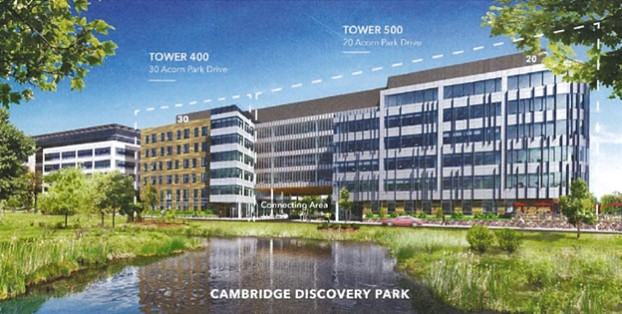
TABLE OF CONTENTS
|
|
|
Page |
SUMMARY OF BASIC TERMS |
iv |
|
|
ARTICLE I |
1 |
|
|
ARTICLE II LEASE OF PREMISES |
9 |
|
|
Section 2.1 Lease Of The Premises |
9 |
Section 2.2 Common Rights |
9 |
Section 2.3 Parking |
9 |
Section 2.4 Lease Term |
10 |
Section 2.5 Security Deposit |
10 |
Section 2.6 Measurement |
11 |
Section 2.7 Right of First Offer |
11 |
Section 2.8 Lease Amendment |
12 |
ARTICLE III CONDITION OF PREMISES; SIGNS |
13 |
|
|
Section 3.1 Base Building Work; Tenant’s Work; Rooftop Equipment |
13 |
Section 3.2 Allowance |
15 |
Section 3.3 Signs |
16 |
Section 3.4 Rooftop Equipment |
16 |
Section 3.5 Use of Union Labor |
17 |
Section 3.6 LEED Certification |
17 |
ARTICLE IV BASE RENT; ADDITIONAL RENT |
18 |
|
|
Section 4.1 Base Rent |
18 |
Section 4.2 Certain Additional Rent |
18 |
Section 4.3 Taxes |
19 |
Section 4.4 Insurance Costs |
19 |
Section 4.5 Operating Costs |
19 |
Section 4.6 Tenant’s Utility Costs |
20 |
Section 4.7 Tenant’s Audit Rights |
20 |
ARTICLE V USE OF PREMISES |
20 |
|
|
Section 5.1 Permitted Use |
20 |
Section 5.2 Restrictions on Use |
20 |
Section 5.3 Hazardous Materials |
21 |
Section 5.4 Tenant’s Operation of A Vivarium |
22 |
ARTICLE VI LANDLORD’S SERVICES |
22 |
|
|
Section 6.1 Landlord’s Services |
22 |
Section 6.2 Extraordinary Use |
23 |
Section 6.3 Interruption; Delay |
23 |
Section 6.4 Additional Services |
24 |
ARTICLE VII |
24 |
|
|
Section 7.1 Rent |
24 |
Section 7.2 Utilities |
24 |
Section 7.3 No Waste |
24 |
Section 7.4 Maintenance; Repairs; and Yield-Up; Decommissioning |
24 |
Section 7.5 Alterations by Tenant |
25 |
Section 7.6 Trade Fixtures and Equipment |
25 |
Section 7.7 Compliance with Laws |
26 |
Section 7.8 Contents at Tenant’s Risk |
26 |
Section 7.9 Exoneration, Indemnification, Hold Harmless and Insurance |
26 |
Section 7.10 Landlord’s Access |
26 |
Section 7.11 No Liens |
27 |
Section 7.12 Compliance with Rules and Regulations |
27 |
|
|
|
Page |
Section 7.13 Further Construction |
27 |
ARTICLE VIII SUBLETTING AND ASSIGNMENT |
28 |
|
|
Section 8.1 Subletting and Assignment |
28 |
ARTICLE IX RIGHTS OF MORTGAGEES AND GROUND LESSORS; ESTOPPEL CERTIFICATES |
29 |
|
|
Section 9.1 Subordination to Mortgages and Ground Leases |
29 |
Section 9.2 Lease Superior at Mortgagee’s or Ground Lessor’s Election |
30 |
Section 9.3 Notice to Mortgagee and Ground Lessor |
30 |
Section 9.4 Limitations on Obligations of Mortgagees, Ground Lessors and Successors |
30 |
Section 9.5 Estoppel Certificate By Tenant |
30 |
Section 9.6 Amendment of Declaration |
30 |
ARTICLE X CASUALTY |
31 |
|
|
Section 10.1 Damage From Casualty |
31 |
Section 10.2 Abatement of Rent |
31 |
Section 10.3 Landlord’s Right to Terminate |
31 |
ARTICLE XI EMINENT DOMAIN |
32 |
|
|
Section 11.1 Eminent Domain; Right to Terminate and Abatement in Rent |
32 |
Section 11.2 Restoration |
32 |
Section 11.3 ,3 Landlord to Control Eminent Domain Action |
32 |
ARTICLE XII DEFAULT AND REMEDIES |
32 |
|
|
Section 12.1 Event of Default |
32 |
Section 12.2 Landlord’s Remedies |
33 |
Section 12.3 Reimbursement of Landlord |
34 |
Section 12.4 Landlord’s Right to Perform Tenant’s Covenants |
34 |
Section 12.5 Cumulative Remedies |
34 |
Section 12.6 Expenses of Enforcement |
34 |
Section 12.7 Landlord’s Default |
34 |
Section 12.8 Limitation of Landlord’s Liability |
35 |
Section 12.9 Late Payment and Administrative Expense |
35 |
ARTICLE XIII MISCELLANEOUS PROVISIONS |
35 |
|
|
Section 13.1 Brokers |
35 |
Section 13.2 Quiet Enjoyment |
35 |
Section 13.3 Tenant’s Request for Landlord’s Action |
35 |
Section 13.4 Notices |
35 |
Section 13.5 Waiver of Subrogation |
35 |
Section 13.6 Entire Agreement; Execution; Time of the Essence and Headings and Table of Contents |
36 |
Section 13.7 Partial Invalidity |
36 |
Section 13.8 No Waiver |
36 |
Section 13.9 Holdover |
36 |
Section 13.10 When Lease Becomes Binding |
36 |
Section 13.11 Recordation |
36 |
Section 13.12 Financial Statements; Certain Representations and Warranties of Tenant |
36 |
Section 13.13 Confidentiality |
37 |
Section 13.14 Summary of Basic Terms |
37 |
ARTICLE XIV BUILDING 100 LEASE |
37 |
|
|
Exhibits: |
|
A – 1 |
Property Description (Project) |
A – 2 |
Property Description (Parcel 400 and Parcel 5 |
B-1 |
Survey Showing Parcel Boundaries |
B-2 |
Site Plan Showing Footprint of the Building |
C |
Premises Floor Plan |
D-1 |
List of Base Building Plans |
D-2 |
General Description of Tenant’s Work |
E |
Rules and Regulations |
F |
Form of Letter of Credit |
G |
Secretary’s Certificate |
H |
Certificate of Insurance |
I |
Electronic Funds Transfer (EFT) Form |
J |
Intentionally Omitted |
K-1 |
Prohibited Hazardous Materials |
K-2 |
Hazardous Materials Requiring Prior Notice to Landlord |
L |
Mechanical Penthouse Mezzanine Plan |
SUMMARY OF BASIC TERMS
LEASE
OF PREMISES AT CAMBRIDGE DISCOVERY PARK,
CAMBRIDGE, MASSACHUSETTS
TO
FOG PHARMACEUTICALS, INC.
DATED AS OF April 22, 2019
The following is a summary of certain basic terms of this Lease which is intended for the convenience and reference of the parties. Capitalized terms used, but not defined, in this Summary of Basic Terms, have their defined meanings in this Lease. In addition, some of the following items or terms are incorporated into this Lease by reference to the item or term or to this “Summary of Basic Terms”.
1. Landlord: 400 Discovery Park, LLC, a Delaware limited liability company.
2. Tenant: Fog Pharmaceuticals, Inc., a Delaware corporation.
3A. Premises: The leasable space on the first (1st) through sixth (6th) floors of Tower 400, consisting of an agreed upon 114,490 square feet, as depicted on Exhibit C. subject to measurement pursuant to Section 2.6 below. The Building and the Other Buildings which are currently part of the Project are depicted on Exhibit B-2. In addition, pursuant to Section 3.4 below, Tenant may use portions of the roof of Tower 400 for the installation, use, maintenance, repair and replacement of Rooftop Equipment (as defined below).
3B. Building: The six-floor building to be constructed by Landlord as part of the Project, consisting of (i) two separate towers to be located on Parcel 400 (“Tower 400”) and Parcel 500 (“Tower 500”) and (ii) a connecting area (the “Connecting Area”) over the Discovery Way 2 “Connection Parcel” which connects Tower 400 and Tower 500, which parcels are shown on Exhibit B-1 and which building is shown on Exhibit B-2 (collectively, the “Building”). The Building shall be deemed to include Tower 400, Tower 500, the Connecting Area, all of which are depicted on Exhibit B-2. and any other improvements existing on or above Parcel 400, Parcel 500 or the Discovery Way 2 “Connection Parcel” from time to time.
3C. Project: The land described in Exhibit A-1 and depicted on Exhibit B-1 (the “Land”), together with the Building, the Other Buildings and any other improvements now or hereafter thereon, now commonly known as Cambridge Discovery Park, Cambridge, Massachusetts, together with other areas used from time to time for parking for the Buildings. The Land is subject to an Amended and Restated Declaration of Easements, Covenants, Conditions and Restrictions for Cambridge Discovery Park, dated December 21, 2009, and filed with the Middlesex County Registry District of the Land Court (the “Land Court”) as Document No. 1522053, and recorded with the Middlesex County Registry of Deeds (the “Registry”) in Book 54081, Page 298; as further amended by First Amendment of Amended and Restated Declaration of Easements, Covenants, Conditions and Restrictions for Cambridge Discovery Park, recorded with the Registry on June 9, 2010, in Book 54804, Page 106 and filed with the Land Court as Document No. 1534150, and as further amended by Second Amendment of Amended and Restated Declaration of Easements, Covenants, Conditions and Restrictions for Cambridge Discovery Park, dated December 29, 2011, and recorded with the Registry in Book 58222, Page 10, and filed with the Land Court as Document No. 1587003; as affected by Second Amendment of Amended and Restated Declaration of Easements, Covenants and Restrictions for Cambridge Discovery Park dated December 29, 2011, recorded with the Registry in Book 58222, Page 15 and filed with the Land Court as Document No. 1587003, as further affected by Third Amendment of Amended and Restated Declaration of Easements, Covenants and Restrictions for Cambridge Discovery Park dated September 30, 2014, recorded with the Registry in Book 64326, Page 507 and filed with the Land Court as Document No.1682362; as affected by a Clarification of Amended and Restated Declaration of Easements, Covenants, Conditions and Restrictions dated March 17, 2015, filed with the Land Court as Document No. 1694302 and recorded with the Registry in Book 65074, Page 69, as further affected by a Fourth Amendment of Amended and Restated Declaration of Easements, Covenants, Conditions and Restrictions for Cambridge Discovery Park, dated March 17, 2015, filed with the Land Court as Document No. 1694303 and recorded with the Registry in Book 65074, Page 89, as further affected by a Supplemental Declaration of Covenants, Conditions and Restrictions, filed with the Land Court as Document No. 1700551 and recorded with the Registry in Book 65074, Page 130, as further affected by Fifth Amendment to Amended and Restated Declaration of Easements, Covenants, Conditions and Restrictions for Cambridge Discovery Park, dated December 21, 2018, and recorded with the Registry in Book 72052, Page 324 (as the same has been and may be hereafter amended from time to time, the “Declaration”). The Project may be expanded and/or contracted in accordance with the terms and provisions of the Declaration.
3D. Leasable Square Footage of the Premises: 114,490 square feet, subject to remeasurement pursuant to Section 2.6 below.
3E. Leasable Square Footage of the Building: An agreed upon 283,247 square feet.
3F. Leasable Square Footage of the Project: An agreed upon 696,150 square feet, consisting of (i) an agreed upon 283,247 square feet in the Building, and (ii) an agreed upon 412,903 square feet in the Other Buildings. The Leasable Square Footage of the Project may change from time to time as additional Other Buildings are constructed.
4A. Allowance: Landlord shall provide Tenant an allowance for the payment of costs of alterations and improvements to the Premises (the “Allowance”) equal to $185 per square foot multiplied by the Leasable Square Footage of the Premises (estimated to be $21,180,650.00), subject to adjustment pursuant to Section 2.6. in addition, at the written request of Tenant at any time prior to the Commencement Date, Tenant may increase the Allowance in an amount up to $25 per square foot multiplied by the Leasable Square Footage of the Premises (the “Excess Allowance”), subject to adjustment pursuant to Section 2.6; provided, however, that the aggregate amount of any such Excess Allowance requested shall be repaid by Tenant to Landlord by increasing the monthly installments of Base Rent (such additional monthly installments being the “Excess Allowance Base Rent”) by an amount that would fully amortize the Excess Allowance, with interest at the rate of eight and one-half percent (8.5%) per annum (including capitalized interest on the Excess Allowance from disbursement until commencement of amortization), in equal consecutive monthly installments of principal and interest over the Initial Term, commencing on the Commencement Date and irrespective of the portion of Excess Allowance that has then-been disbursed to Tenant. Notwithstanding the foregoing, at the expiration of Tenant’s right to disbursements of the Allowance, (i) Landlord shall calculate the amount of the Excess Allowance that has actually been disbursed to Tenant, and (ii) if the amount of the disbursed Excess Allowance is less than the amount requested by Tenant and being used to calculate the Excess Allowance Base Rent, Landlord shall adjust the Excess Allowance Base Rent over the remainder of the Initial Term such that the amount of the Excess Allowance that has actually been disbursed to Tenant is so fully amortized over the Initial Term pursuant to the provisions above in this paragraph.
4B. Base Building Work: Landlord shall cause the work described on the Base Building Plans (as defined below) to be performed as provided in Section 3.1(c) (such work, the “Base Building Work”).
5A. Target Delivery Date: June 1, 2019, subject to extension for Excusable Delay as provided in this Lease.
5B. Target Substantial Completion Date: December 31, 2019, subject to extension for Excusable Delay as provided in this Lease.
5C. Delivery Date: The date on which Partial Completion occurs.
5D. Substantial Completion Date: The date on which Landlord achieves Substantial Completion of the Base Building Work and tenders delivery of the Premises to Tenant.
5E. Commencement Date: The earlier to occur of (i) the date that is six (6) months after the Substantial Completion Date, and (ii) the date on which Tenant commences the conduct of its business in the Premises; provided, however, that in the event that the parties are unable to obtain a certificate of occupancy, temporary certificate of occupancy or a final building department sign off for Phase 1 on or before the date that is six (6) months after the Substantial Completion Date (such date to be extended for any Excusable Delay) solely due to the Landlord’s failure to achieve Substantial Completion of the Base Building Work or due to one or more defects in the Base Building Work, the Commencement Date shall be delayed until the earlier of (1) the date on which Landlord has achieved Substantial Completion of the Base Building Work and cured such defects so that a certificate of occupancy, temporary certificate of occupancy or a final building department sign off for Phase 1 can be issued or (2) the date on which Tenant commences the conduct of its business in the Premises.
5F. Lease Term: From the Commencement Date through the eleventh (11th) Lease Year, subject to extension as provided in Section 2.4(b).
5G. Extension: Tenant shall have the right to extend the Lease Term for two (2) consecutive terms of five (5) years each in accordance with Section 2.4(b).
6. Permitted Use: Subject to applicable Legal Requirements, the Premises may be used for general office, research and development, pharmaceutical manufacturing and laboratory purposes only (including a vivarium pursuant to Section 5.4) and uses ancillary thereto and for no other purpose.
7. Security Deposit: $2,855,094.38 in the form of cash or letter of credit
8. Tenant’s Parking Allocation: Tenant’s Parking Share of parking spaces in the Parking Garage B, subject to Section 2.3.
9. Base Rent: Subject to adjustment pursuant to Section 2.6, Base Rent shall be as follows:
|
|
|
|
|
|
|
|
|
|
Period |
|
Annual Rate |
|
Monthly Rate |
|
PSF Rate |
Lease Year 1* |
|
$ |
7,613,585.00 |
|
$ |
634,465.42 |
|
$ |
66.50 |
Lease Year 2 |
|
$ |
7,803,924.63 |
|
$ |
650,327.05 |
|
$ |
68.16 |
Lease Year 3 |
|
$ |
7,999,022.74 |
|
$ |
666,585.23 |
|
$ |
69.87 |
Lease Year 4 |
|
$ |
8,198,998.31 |
|
$ |
683,249.86 |
|
$ |
71.61 |
Lease Year 5 |
|
$ |
8,403,973.27 |
|
$ |
700,331.11 |
|
$ |
73.40 |
Lease Year 6 |
|
$ |
8,614,072.60 |
|
$ |
717,839.38 |
|
$ |
75.24 |
Lease Year 7 |
|
$ |
8,829,424.41 |
|
$ |
735,785.37 |
|
$ |
77.12 |
Lease Year 8 |
|
$ |
9,050,160.02 |
|
$ |
754,180.00 |
|
$ |
79.05 |
Lease Year 9 |
|
$ |
9,276,414.02 |
|
$ |
773,034.50 |
|
$ |
81.02 |
Lease Year 10 |
|
$ |
9,508,324.38 |
|
$ |
792,360.37 |
|
$ |
83.05 |
Lease Year 11 |
|
$ |
9,746,032.48 |
|
$ |
812,169.37 |
|
$ |
85.13 |
*Notwithstanding the Annual Rate and Monthly Rate for Lease Year 1 stated above, so long as an Event of Default does not then exist, Base Rent during Lease Year 1 shall be abated as follows: during (I) Months 1 through 6 of Lease Year 1, Base Rent shall be paid at the Annual Rate of $2,540,300.00 and a Monthly Rate of $211,691.67, and (ii) Months 7 through 12 of Lease Year 1, Base Rent shall be paid at the Annual Rate of $5,080,600.00 and a Monthly Rate of $423,383.33. The total amount of the Base Rent payable during Lease Year 1 shall be adjusted In the event that the Leasable Square Footage of the Premises is adjusted pursuant to Section 2.6, with such adjustment to be made by increasing or decreasing each payment of Base Rent due during Months 7-12 of Lease Year 1 by a proportionate share of such increase (with the excess, if any, adjusted in the second payment of Base Rent due after the amount of such adjustment is determined). Month 1 shall commence on the Commencement Date; provided, however, that if the Commencement Date is not the first (1st) day of a calendar month, Month 1 shall commence on the first (1st) day of the calendar month commencing after the calendar month in which the Commencement Date occurs, and during such partial calendar month in which the Commencement Date occurs, Tenant shall pay Base Rent at the Annual Rate and Monthly Rate stated above for Lease Year 1 (i.e., $7,613,585.00 and $634,465.42, respectively, but subject to adjustment pursuant to Section 2.6) prorated for the number of days during the Lease Term that occur during such partial month.
Tenant’s obligation to pay Base Rent shall be subject to the Building 100 Rent Credit (as defined in Article XIV below).
The Base Rent during the Extension Terms will be determined in accordance with Section 4.1(b).
10A. Additional Rent: (a) Tenant’s Project Share of (i) Project Taxes, (ii) Project insurance Costs and (iii) Project Operating Costs, (b) Tenant’s Building Share of (i) Building Taxes, (ii) Building Insurance Costs and (iii) Building Operating Costs, (c) Tenant’s Utility Costs, and/or (d) Other Additional Rent.
10B. Tenant’s Utility Costs: Tenant shall be responsible for the payment of the costs of all utility services provided to the Premises and/or the HVAC equipment and systems exclusively serving the Premises (“Tenant’s Utility Costs”), as provided in Section 4.6.
10C. Other Additional Rent: Includes all fees, charges (including parking charges), expenses, fines, assessments, interest or other sums payable by Tenant pursuant to this Lease other than (a) Tenant’s Project Share of (i) Project Taxes, (ii) Project Insurance Costs and (iii) Project Operating Costs, (b) Tenant’s Building Share of (i) Building Taxes, (ii) Building Insurance Costs and (iii) Building Operating Costs and (c) Tenant’s Utility Costs due under this Lease.
10D. First Payment: First month’s Base Rent in the amount of $211,691.67, plus the Security Deposit in the amount of $2,855,094.38, shall be paid upon execution of this Lease.
11. Utilities: Unless separately metered or submetered to the Premises, utilities shall be supplied by Landlord as part of the Operating Costs.
12. Brokers: Jones Lang LaSalle New England, LLC, having an office at 1 Post Office Square, Boston, MA 02109 (“Landlord’s Broker”), and Colliers International New England LLC, having an office at 160 Federal Street, 11th Floor, Boston, MA 02110, Attn: Evan Gallagher, Senior Vice President, (“Tenant’s Broker”).
13A. Tenant’s Address For Notices, Telephone Number, E-Mail and Taxpayer Identification No.:
|
|
Before the Commencement Date: |
|
|
|
Fog Pharmaceuticals, Inc. |
|
100 Acorn Park Drive |
|
Cambridge, MA 02140 |
|
Attn: John J. Doherty |
|
Telephone: (617) 201-3103; E-Mail: jdoherty@fogpharma.com |
|
|
|
Tenant T J.D.# 47-4505725 |
|
|
After the Commencement Date: |
|
|
|
30 Acorn Park Drive |
|
Cambridge, MA 02140 |
|
Attn: John J. Doherty |
|
Telephone: (617) 201-3103; E-Mail: jdoherty@fogpharma.com |
|
|
|
Tenant T.I.D.# 47-4505725 |
|
|
|
with a copy to: |
|
|
|
Latham & Watkins LLP |
|
12670 High Bluff Drive |
|
San Diego, CA 92130 |
|
Attention: Stephanie L. Fontanes |
|
Telephone: (858) 523-5449; Email: stephanie.fontanes@lw.com |
|
|
13B. |
Landlord’s Address for Notices : |
|
|
|
400 Discovery Park, LLC |
|
c/o The Bulfinch Companies, Inc. |
|
116 Huntington Avenue, Suite 600 |
|
Boston, MA 02116 |
|
Attention: Robert A Schlager |
|
Telephone: (781) 707-4000; E-Mail: ras@bulfinch.com |
|
|
|
with a copy to: |
|
|
|
400 Discovery Park, LLC |
|
c/o The Bulfinch Companies, Inc. |
|
116 Huntington Avenue, Suite 600 |
|
Boston, MA 02116 |
|
Attention: Mark R. DiOrio, Esq. |
|
Telephone: (781) 707-4000; E-Mail: mrd@bulfinch.com |
|
And: |
|
|
|
Vorys, Sater, Seymour and Pease LLP |
|
301 East Fourth Street, Suite 3500 |
|
Cincinnati, OH 45202 |
|
Attention: Charles C. Bissinger, Esq. |
|
Telephone: (513) 723-4084; E-Mail: ccbissinger@vorys.com |
LEASE
THIS LEASE (this “Lease”), made as of the 22nd day of April, 2019 between 400 Discovery Park, LLC, a Delaware limited liability company, and Fog Pharmaceuticals, Inc., a Delaware corporation, is as follows.
W I T N E S E T H:
ARTICLE I
CERTAIN DEFINITIONS
In addition to the words and terms defined elsewhere in this Lease, the following words and terms shall have in this Lease the meanings set forth in this Article (whether or not underscored):
“Additional Rent” has the meaning set forth in Item 10A of the Summary of Basic Terms.
“Allowance” has the meaning set forth in Item 4A of the Summary of Basic Terms.
“Amenity Building” means any building constructed in the Project, all or substantially all of which is used to provide amenities for the Project.
“Bankruptcy Laws” means any existing or future bankruptcy, insolvency, reorganization, dissolution, liquidation or arrangement or readjustment of debt law or any similar existing or future law of any applicable jurisdiction, or any laws amendatory thereof or supplemental thereto, including, without limitation, the United States Bankruptcy Code of 1978, as amended (11 U.S.C. Section 101 et seq.), as any or all of the foregoing may be amended or supplemented from time to time.
“Base Building Plans” means the plans and specifications for the Base Building Work prepared by Landlord’s Architect and listed on Exhibit D-1, as the same may be modified from time to time pursuant to the terms of this Lease.
“Base Building Work” has the meaning set forth in Item 4B of the Summary of Basic Terms.
“Base Rent” has the meaning set forth in Item 9 of the Summary of Basic Terms.
“Broker” has the meaning set forth in Item 12 of the Summary of Basic Terms.
“Building” has the meaning set forth in Item 3B of the Summary of Basic Terms.
“Building Insurance Costs” means those Insurance Costs which directly relate to, or are primarily for the benefit of, the Building, as reasonably determined by Landlord.
“Building Operating Costs” means those Operating Costs which directly relate to, or are primarily for the benefit of, the Building, as reasonably determined by Landlord.
“Building Taxes” means those Taxes attributable to the value of the Building, as reasonably determined by Landlord if the Building is not then separately taxed.
“Building 100” means the building identified as such on Exhibit B-2.
“Building 200” means the building identified as such on Exhibit B-2.
“Building 600” means the building identified as such on Exhibit B-2.
“Buildings” means, collectively, the Building and the Other Buildings.
“Business Dav” means Monday through Friday, except holidays. The term “holiday” means (a) the federal day of celebration of the following holidays: New Year’s Day, President’s Day, Memorial Day, July 4th, Labor Day, Thanksgiving, Christmas and (b) the Friday after Thanksgiving.
“Commencement Date” has the meaning set forth in Item 5E of the Summary of Basic Terms.
“Common Areas” means all areas of the Project, as designated by Landlord from time to time, located inside or outside of the Buildings, which are not intended for the use of a single tenant and which are intended (a) for the non-exclusive common use of Landlord, Tenant and other tenants of portions of the Project and their respective Invitees and/or (b) to serve the Project, including but not limited to the Common Areas, as defined in the Declaration. Common Areas include, without limitation, common lobbies of multi-tenant Buildings, common restroom facilities of multi-tenant Buildings, elevators and stairwells of multi-tenant Buildings, the Food Service Area, if any, sidewalks, the Parking Areas, access drives, landscaped areas, utility rooms, storage rooms and utility lines and systems and the Common Facilities.
“Common Facilities” means those facilities, if any, located on the Project which Landlord designates from time to time as “common facilities,” including, but not limited to, building systems, pipes, ducts, wires, conduits, meters, HVAC equipment and systems, electrical systems and equipment, plumbing lines and facilities, and mechanical rooms.
“Connecting Area” has the meaning set forth in Item 3B of the Summary of Basic Terms.
“Declaration” has the meaning set forth in Item 3C of the Summary of Basic Terms.
“Delivery Date” has the meaning set forth in Item 5C of the Summary of Basic Terms.
“Environmental Law” means the Comprehensive Environmental Response, Compensation, and Liability Act (“CERCLA”). 42 U.S.C. §9601 et seq„ the Resource Conservation and Recovery Act, 42 U.S.C. §6901 et seq., the Hazardous Materials Transportation Act, 49 U.S.C. §1802 et seq., the Toxic Substances Control Act, 15 U.S.C. §2601 et seq., the Federal Water Pollution Control Act, 33 U.S.C. §1251 et seq., the Clean Water Act, 33 U.S.C. §1321 et seq., the Clean Air Act, 42 U.S.C. §7401 et seq., the Massachusetts Oil and Hazardous Material Release Prevention and Response Act, Chapter 21E of the Massachusetts General Laws, all regulations promulgated thereunder, and any other federal, state, county, municipal, local or other statute, law, ordinance or regulation (including any state or local board of health rules, regulation, or code), or any common law (including common law that may impose strict liability or liability based on negligence), which may relate to or deal with human health, the environment, natural resources, or Hazardous Materials, all as may be from time to time amended or modified.
“Estimated Tenant’s Work Cost” has the meaning set forth in Section 3.2.
“Event of Default” any of the events listed in Section 12.1.
“Excess Allowance” has the meaning set forth in Item 4A of the Summary of Basic Terms.
“Excess Allowance Base Rent” has the meaning set forth in Item 4A of the Summary of Basic Terms.
“Excess Costs” has the meaning set forth in Section 3.2.
“Excusable Delay” means any delay in the performance of the Base Building Work to the extent caused by (a) Tenant’s failure to perform, or delay in the performance of, any obligation which Tenant is required to perform under this Lease, (b) any act of Tenant, or Tenant’s agents, employees or contractors, including without limitation, any Tenant’s Work that delays the completion of the Base Building Work, (c) any failure to act by Tenant, or Tenant’s agents, employees or contractors, where Tenant has a duty to act pursuant to this Lease, pursuant to any other agreement with Landlord and/or under applicable Legal Requirements, (d) any other delays caused by Tenant, including without limitation, delays due to requests by Tenant for changes to the Base Building Work or change orders requested by Tenant, or (e) Force Majeure. For the avoidance of doubt, for purposes of clause (c) above, John Moriarity & Associates, when acting in its capacity as Landlord’s Contractor, shall not be treated as Tenant’s agent, employee or contractor.
“Extension Terms” mean the First Extension Term and the Second Extension Term, collectively and individually as the context may require.
“First Extension Term” means the period of five (5) years beginning at the end of the Initial Term.
“Floor Area” means, as of the date of determination, the rentable square feet of floor area of the Building, Other Buildings, Common Areas or Premises, as applicable, measured by Landlord’s Architect in accordance with Section 2.6.
“Food Service Area” means any space in any of the Buildings designated by Landlord and/or Other Landlords from time to time as a food service area for the non-exclusive common use of Tenant and other tenants of portions of the Project and their respective Invitees, rather than for the exclusive use of a single tenant or for the exclusive use of tenants of a single Building.
“Food Service Costs” means the total costs to Landlord and/or Other Landlords (net of any revenue realized by Landlord from food service operations) of providing food service in the Food Service Area, if any, including but not limited to any subsidy paid to a food service operator, all costs of operating, maintaining and repairing the Food Service Area, all costs of utility services provided to the Food Service Area, and any such costs allocated to Landlord and/or Other Landlords pursuant to the Declaration.
“Force Majeure” means any (i) strike, lockout or other labor trouble or industrial disturbance (whether or not on the part of the employees of either party hereto), (ii) governmental preemption of priorities or other controls in connection with a national or other public emergency, civil disturbance, riot, war, sabotage, blockade, embargo, inability to secure customary materials, supplies or labor through ordinary sources by reason of regulation or order of any government or regulatory body, (iii) shortages of fuel, materials, supplies or labor, (iv) lightning, earthquake, fire, storm, tornado, flood, washout explosion, inclement weather or any other similar industry-wide, Project-wide or Building-wide cause beyond the reasonable control of Landlord, or (v) any other cause, whether similar or dissimilar to the above, beyond either party’s reasonable control.
“Forrester” means Forrester Research, Inc., a Delaware corporation.
“Forrester Agreement” means that certain Agreement Regarding Project Rights dated September 29, 2009, entered into between Forrester and BHX, LLC, a Massachusetts limited liability company, as Trustee of Acorn Park I Realty Trust, a Massachusetts nominee trust.
“GAAP” means generally accepted accounting principles, consistently applied.
“Hazardous Materials” means, at any time, (a) any “hazardous substance” as defined in §101(14) of CERCLA (42 U.S.C. §9601 (14)) or regulations promulgated thereunder; (b) any “solid waste,” “hazardous waste,” or “infectious waste,” as such terms are defined in any Environmental Law at such time; (c) asbestos, urea-formaldehyde, polychlorinated biphenyls (“PCBs”), bio-medical materials or waste, nuclear fuel or material, chemical waste, radioactive material, explosives, known carcinogens, petroleum products and by-products and other dangerous, toxic or hazardous pollutants, contaminants, chemicals, materials or substances which may be hazardous to human or animal health or the environment or which are listed or identified in, or regulated by, any Environmental Law; and (d) any additional substances or materials which at such time are classified or considered to be hazardous or toxic under any Environmental Law.
“Infrastructure Improvements Phase” means the portions of the Infrastructure Work included in one or more Work Plans. For clarity, the parties acknowledge and agree that the Infrastructure Improvements Phase may be undertaken simultaneously with any other Phase in accordance with the applicable Infrastructure Work Plans.
“Infrastructure Work” means the Tenant’s Work included in the Infrastructure Work Plans consisting of equipping the Premises with HVAC, electrical, plumbing, vacuum system and nitrogen system work for the Premises, including, but not limited to, risers, piping, chases, electric panels, rooftop equipment and other HVAC, mechanical, electrical and plumbing equipment, as further described in Exhibit D-2.
“Infrastructure Work Plans” means the reasonably detailed plans and specifications to be approved in advance in writing by Landlord with respect to the Infrastructure Work prior to the commencement thereof in accordance with the terms hereof; provided that such Infrastructure Work Plans need not be stand-alone plans and specifications and, instead, may be included in Tenant’s Work Plans with respect to one or more other Phases.
“Initial Term” means the period beginning at 12:01 a.m. on the Commencement Date and ending at 11:59 p.m. on last day of the eleventh (11th) Lease Year.
“Insurance Costs” means the costs of insuring the entire Project, including without limitation the Buildings and other improvements now or hereafter situated thereon, and all operations conducted in connection therewith, with such policies, coverages and companies and in such limits as may be selected by Landlord and/or Other Landlords (and/or which may be required by their lenders), including, but not limited to, fire insurance with extended or with all-risk coverage, commercial general liability insurance covering personal injury, deaths and property damage with a personal injury endorsement covering false arrest, detention or imprisonment, malicious prosecution, libel and slander, and wrongful entry or eviction, rent loss or business interruption insurance, worker’s compensation insurance, plate glass insurance, contractual liability insurance, boiler insurance, and fidelity bonds.
“Invitees” means employees, workers, visitors, guests, customers, suppliers, agents, contractors, representatives, licensees and other invitees.
“Land” means the land described in Exhibit A-1 and depicted on Exhibit B-1.
“Landlord” means 400 Discovery Park, LLC, a Delaware limited liability company, its successors and assigns.
“Landlord’s Architect” means Stantec Architecture and Engineering, P.C., or any other architect or architectural firm(s) designated by Landlord.
“Landlord’s Contractor” means John Moriarty & Associates or any other general contractor designated by Landlord.
“Leasable Square Footage” means, (a) when used with respect to the Premises, the sum of (i) the agreed upon Floor Area of the Premises, plus (ii) Tenant’s Building Share of the agreed upon Floor Area of the Common Areas of the Building, and (b) when used with respect any of the Buildings, the agreed upon Floor Area of such of the Buildings.
“Lease Term” means the Initial Term and, if Tenant timely and properly exercises its rights to extend pursuant to Section 2.4(b), the First Extension Term and the Second Extension Term, if applicable.
“Lease Year” means the twelve (12) month period beginning on the Commencement Date and on each anniversary of the Commencement Date throughout the Lease Term; provided, that, if the Commencement Date is not the first day of a calendar month, the first Lease Year shall consist of the partial calendar month beginning with the Commencement Date and the next subsequent twelve (12) months, and each subsequent Lease Year shall commence on the first day of the month after the calendar month in which the Commencement Date occurs.
“Legal Requirements” means all applicable present and future laws, statutes, rules, regulations and requirements of governmental authorities, and other legal requirements of whatever kind or nature that are applicable to the Property, including, without limitation, all zoning laws and building codes, environmental laws and the Americans With Disabilities Act of 1990 (including the Americans With Disabilities Act Accessibility Guidelines for Buildings and Facilities), permits and approvals (including without limitation, the Master Special Permit), and any amendments, modifications or changes to any of the foregoing.
“Master Special Permit” means the special permit for the Project, as evidenced of record by the following: (i) Notice of Decision and Special Permit Decision No. PB 198, dated October 19, 2004, filed with the Cambridge City Clerk’s office on November 4, 2004, recorded with the Registry at Book 44214, Page 304, and filed with the Land Court as Document No. 1357501 on December 1, 2004; (ii) Notice of Decision, PB 198 Minor Amendment #1, dated March 1, 2005, filed with the Cambridge City Clerk on April 8, 2005, recorded with the Registry at Book 44968, Page 403, and filed with the Land Court as Document No. 1370387 on April 8, 2005, (iii) Notice of Decision, PB 198 Minor Amendment #2, dated October 20, 2009, filed with the Cambridge City Clerk on December 3, 2009, filed with the Land Court as Document No. 1519909 on December 3, 2009; (iv) Notice of Decision, PB 198 Amendment #3 (Major), dated October 21, 2014, filed with the Cambridge City Clerk on December 1, 2014, recorded with the Registry at Book 65188, Page 42, and filed with the Land Court as Document No. 1696019; (v) Notice of Decision, PB 198 Amendment #4 (Minor), dated October 21, 2014, filed with the Cambridge City Clerk on December 1, 2014, recorded with the Registry at Book 65188, Page 59, and filed with the Land Court as Document No. 1696020; and (vi) Notice of Determination (Revised w/clerical corrections), PB 198 Amendment #5 (Minor), dated May 3, 2016, filed with the Cambridge City Clerk on May 18, 2016, recorded with the Registry at Book 67779, Page 292, and filed with the Land Court as Document No. 1737380.
“Operating Costs” means all costs, expenses and disbursements of every kind and nature (except Taxes and Insurance Costs) which Landlord and/or Other Landlords shall pay or become obligated to pay in connection with operating, managing, maintaining, repairing or replacing the Project or elements thereof, all as determined by Landlord, including such costs, expenses and disbursements as are allocated to Landlord and/or Other Landlords pursuant to the Declaration. Operating Costs shall include, by way of illustration, but not be limited to: all charges payable by Landlord and/or Other Landlords in connection with the maintenance and repair of the Project; all charges payable by Landlord and/or Other Landlords to provide janitorial service to the Project; all charges payable by Landlord and/or Other Landlords in connection with the maintenance, repair and replacement of HVAC equipment and systems; all charges payable by Landlord and/or Other Landlords to provide utility services to the Project, except to the extent excluded pursuant to clauses (f) or (g) below; all costs related to the operation of any shuttle or other transportation service between the Project and public transportation stations; all costs incurred in connection with traffic mitigation and/or compliance with the PTDM Plan for the Project and any other transportation demand management plans and/or applicable Legal Requirements in connection with traffic mitigation and/or transportation demand management; all costs related to any police details at any entrances to the Project; all costs related to removal of trash, debris, and refuse; all costs related to removal of snow and ice; all costs of pest and vermin control; all costs of providing, maintaining, repairing and replacing of paving, curbs, walkways, landscaping, planters, roofs, walls, drainage, utility lines, security systems and other equipment; all costs of painting the exterior and Common Areas of the Building; all costs of repaving, resurfacing, and restriping Parking Areas and drives; all costs of lighting, cleaning, waterproofing, repairing and maintaining Common Areas, Common Facilities and other portions of the Project; all surcharges, costs and expenses that may result from any Environmental Laws or other laws, rules, regulations, guidelines or orders, except to the extent excluded pursuant to clause (k) below; all costs of licenses, permits and inspection fees, except to the extent directly attributable to the space of
a particular tenant or arising in connection with new improvements or alterations; all legal, accounting, inspection and consulting fees, except to the extent excluded pursuant to clauses (e) or (m) below; except to the extent excluded below, all costs of capital repairs or replacements (but not improvements) hereafter made to the Building or Common Areas, amortized over their expected useful life based upon and including a market rate of interest; all costs of wages, salaries and benefits of operating personnel engaged in managing and operating the Project, to the extent reasonably allocable to the Project, including welfare, retirement, vacations and other compensation and fringe benefits and payroll taxes; the Food Service Costs; all costs for communications devices and/or services used in managing and operating the Project, to the extent reasonably allocable to the Project; the amount of any insurance deductible paid by Landlord and/or Other Landlords in connection with an insured loss; and management fees equal to (i) four percent (4.0%) of gross rents during Lease Years 1 and 2, and (ii) three percent (3.0%) of gross rents during the portion of the Lease Term occurring after Lease Years 1 and 2 (which management fees may be payable to an affiliate of Landlord). However, notwithstanding the above, the following specific items shall not be included in Operating Costs: (a) the cost of alterations to space in the Buildings leased to others; (b) principal, interest and fees relating to debt service or ground rent payments; (c) any cost or expenditure for which Landlord and/or Other Landlords are reimbursed by insurance proceeds or eminent domain proceeds; (d) costs for which Landlord and/or Other Landlords are reimbursed under warranties provided by contractors who have warranty obligations; (e) leasing commissions, attorneys’ fees and collection costs related to negotiation and enforcement of tenant leases unless the matter involves enforcing compliance with rules and regulations or other standards or requirements for the benefit of all tenants of the Building or Project; (f) the cost of providing gas and electrical service to space leased to tenants; (g) expenses which are billed directly, or reasonably allocable exclusively, to any tenant of the Building or Project; (h) salaries and bonuses of officers and executives of Landlord and/or Other Landlords and administrative employees above the level of property manager or building supervisor and Landlord’s or Other Landlords’ general overhead; (i) the cost of any work or service performed on an extra-cost basis for any tenant of the Building or Project; (j) any cost, other than the management fee provided for above, otherwise included in Operating Costs representing an amount paid to a person or entity affiliated with Landlord and/or Other Landlords which is in excess of the amount which would have been paid on an arms-length basis in the absence of such relationship; (k) any costs necessary to cure any violation of any Legal Requirement existing as of the date of this Lease, including any violation of Environmental Laws; (I) depreciation, other than the amortization of capital repairs or replacements hereafter made as provided above; (m) costs of selling, syndicating, financing, mortgaging or hypothecating any of Landlord’s and/or Other Landlords’ interest in the Project; (n) all income or corporate excise taxes assessed against Landlord and/or Other Landlords; (o) costs of developing and constructing any new building at the Project or any addition to or expansion of any of the Buildings, including Landlord’s costs to complete the Base Building Work; (p) costs of renovating any Building (but not ordinary maintenance, repairs and replacements of elements of the Buildings); (q) costs of capital improvements, except to the extent required by a Legal Requirement becoming effective after the date of this Lease or made to effect future savings in Operating Costs (but, in such event, only to the extent of the savings); (r) costs arising from Landlord’s and/or Other Landlords’ negligence or willful misconduct; (s) costs arising from a breach by Landlord of any Legal Requirement not caused by Tenant or its Invitees; (t) charitable or political contributions and membership fees or other payments to trade organizations; (u) the Allowance; (v) costs (i.e., interest and penalties) incurred due to Landlord’s default of this Lease or any other lease, mortgage, or other agreement, in each case affecting the Building or Project; (w) costs of environmental testing, monitoring, removal or remediation of any Hazardous Materials in the Project that are in existence at the Project prior to the Commencement Date except to the extent caused or exacerbated by Tenant or its Invitees; (x) the costs of acquiring investment-grade art; and (y) any item that, if included in Operating Costs, would involve a double collection for such item by Landlord.
“Other Additional Rent” has the meaning set forth in Item 10C of the Summary of Basic Terms.
“Other Buildings” means the buildings other than the Building located in the Project from time to time, including Building 100, Building 200, Building 600, Parking Garage A, Parking Garage B, any Amenity Building and any building hereafter developed and constructed in the Project. A building hereafter developed and constructed in the Project will be included in the Other Buildings from and after such time as a certificate of occupancy is issued for such building.
“Other Landlords” means, collectively, (a) the owner, from time to time, of Building 200, (b) the owner, from time to time, of Parking Garage A, (c) the owner, from time to time, of Building 100, (d) the owner, from time to time, of Building 600, (e) the owner of any Amenity Building, and (f) each “Additional Party” (as defined in the Declaration).
“Parking Areas” means those portions of the Project which may be used for parking as depicted on the Site Plan, as such areas may be changed by Landlord and/or Other Landlords from time to time. The Parking Areas include Parking Garage A and Parking Garage B.
“Parking Garage A” means the building identified as such on Exhibit B-1.
“Parking Garage B” means the building under construction on “Parcel Garage B” as shown on the Site Plan.
“Parking Garage B Owner” means 400 Discovery Park, LLC, a Delaware limited liability company, its successors and assigns, as the owner of Parking Garage B.
“Partial Completion” means, with respect to the Base Building Work, that the Base Building Work has been completed to the point that, provided that Landlord and Tenant and their respective contractors reasonably cooperate and coordinate with each other, Tenant may thereafter perform the Tenant’s Work substantially continuously without material interference from performance of the Base Building Work.
“Permitted Transferee” means (a) an entity controlling, controlled by or under common control with Tenant, (b) an entity which succeeds to Tenant’s business by merger, consolidation or other form of corporate reorganization, or (c) an entity which acquires all or substantially all of Tenant’s assets or stock; provided, however, that an entity may not become a Permitted Transferee through or as a part of a bankruptcy or other similar insolvency proceeding.
“Permitted Use” has the meaning set forth in Item 6 of the Summary of Basic Terms.
“Person” means any individual, partnership, joint venture, trust, limited liability company, business trust, joint stock company, unincorporated association, corporation, institution, or entity, including any governmental authority.
“Phase” means Phase 1, Phase 2 or Phase 3.
“Phase of the Work” means the Phase 1 Work, the Phase 2 Work, the Phase 3 Work or the Infrastructure Improvements Phase, as applicable.
“Phase 1” means the portion of the Premises that is so described on Exhibit D-2.
“Phase 1 Leasable Square Footage” means the Leasable Square Footage of Phase 1, which is estimated to be 44,500 Leasable Square Feet.
“Phase 1 Tenant’s Work Plans” means the reasonably detailed plans and specifications to be approved in writing by Landlord with respect to the Phase 1 Work prior to the commencement thereof in accordance with the terms hereof.
“Phase 1 Work” means the portions of the Tenant’s Work included in the Phase 1 Tenant’s Work Plans and consisting of the Tenant’s Work for the substantial completion of Phase 1, as generally described in Exhibit D-2, excluding the portion of the Tenant’s Work to be completed in the Infrastructure Improvements Phase (even if included in Phase 1 Tenant Work Plans and/or completed simultaneously with the Phase 1 Work).
“Phase 2” means the portion of the Premises that is so described on Exhibit D-2.
“Phase 2 Leasable Square Footage” means the Leasable Square Footage of Phase 2, which is estimated to be 49,750 Leasable Square Feet.
“Phase 2 Tenant’s Work Plans” means the reasonably detailed plans and specifications to be approved in writing by Landlord with respect to the Phase 2 Work prior to the commencement thereof in accordance with the terms hereof.
“Phase 2 Work” means the portions of the Tenant’s Work included in the Phase 2 Tenant’s Work Plans and consisting of the Tenant’s Work for the substantial completion of Phase 2, as generally described in Exhibit D-2, excluding the portion of the Tenant’s Work to be completed in the Infrastructure Improvements Phase (even if included in Phase 2 Work Plans and/or completed simultaneously with the Phase 2 Work).
“Phase 3” means the portion of the Premises that is so described on Exhibit D-2.
“Phase 3 Leasable Square Footage” means the Leasable Square Footage of Phase 3, which is estimated to be 19,100 Leasable Square Feet.
“Phase 3 Tenant’s Work Plans” means the reasonably detailed plans and specifications to be approved in writing by Landlord with respect to the Phase 3 Work prior to the commencement thereof in accordance with the terms hereof.
“Phase 3 Work” means the portions of the Tenant’s Work included in the Phase 3 Tenant’s Work Plans and consisting of the Tenant’s Work for the substantial completion of Phase 3, as generally described in Exhibit D-2, excluding the portion of the Tenant’s Work to be completed in the Infrastructure Improvements Phase (even if included in Phase 3 Work Plans and/or completed simultaneously with the Phase 3 Work).
“Pre-Approved Sublease” means a sublease of any portion of the Premises to the existing subtenant of Tenant in Building 100 (the “Existing Subtenant”) which is in substantially the form of the Sublease dated December 15, 2016 between Tenant and the Existing Subtenant and which is accompanied by a Landlord, Sublessor and Sublessee Agreement in substantially the same form as the Landlord, Sublessor and Sublessee Agreement dated December 15, 2016 between Building 100 Landlord, Tenant and the Existing Subtenant
“Premises” has the meaning set forth in Item 3A of the Summary of Basic Terms.
“Project” has the meaning set forth in Item 3C of the Summary of Basic Terms.
“Project Insurance Costs” means all Insurance Costs other than (a) Building Insurance Costs and (b) Insurance Costs which relate solely to, or are primarily for the benefit of, any of the Other Buildings, as reasonably determined by Landlord.
“Project Operating Costs” means all Operating Costs other than (a) Building Operating Costs and (b) Operating Costs which relate solely to, or are primarily for the benefit of, any of the Other Buildings, as reasonably determined by Landlord.
“Project Taxes” means those Taxes attributable to the value of the Land.
“Registry” has the meaning set forth in the definition of “Project” in Item 3C of the Summary of Basic Terms.
“Roof Warranty” has the meaning set forth in Section 3.4.
“Rooftop Equipment” has the meaning set forth in Section 3.4.
“Rules and Regulations” means the rules and regulations promulgated by Landlord and Other Landlords with respect to the Project, a copy of which is Exhibit E hereto, as the same may be modified by Landlord and Other Landlords from time to time upon notice to Tenant
“Second Extension Term” means the period of five (5) years beginning at the end of the First Extension Term.
“Security Deposit” has the meaning set forth in Item 7 of the Summary of Basic Terms.
“Site Plan” means the site plan attached hereto as Exhibit B-2 which depicts the approximate size and layout of the Land, the Building, Building 100, Building 200, Building 600, Parking Garage A and Parking Garage B.
“Substantial Completion” means the substantial completion of the Base Building Work, as determined by Landlord’s Architect, and receipt of all governmental approvals required by applicable governmental authorities to signify completion of the Base Building Work (but only if and to the extent that the Inspectional Services Department of the City of Cambridge issues such approvals for the level of completion contemplated by the Base Building Plans).
“Substantial Completion Date” has the meaning set forth in Item 5D of the Summary of Basic Terms.
“Summary of Basic Terms” means the Summary of Basic Terms which is affixed to this Lease immediately after the table of contents of this Lease.
“Target Delivery Date” has the meaning set forth in Item 5A of the Summary of Basic Terms.
“Target Substantial Completion Date” has the meaning set forth in Item 5B of the Summary of Basic Terms.
“Tax Fiscal Year” means July 1 through June 30 next following, or such other tax period as may be established by law for the payment of Taxes.
“Taxes” means (a) all taxes, assessments, betterments, water or sewer entrance fees and charges including general, special, ordinary and extraordinary, or any other charges (including charges for the use of municipal services if billed separately from other taxes), levied, assessed or imposed at any time by any governmental authority upon or against the Land (including without limitation, any of the foregoing allocated to the Building under the Declaration), the Buildings, or the fixtures, signs and other improvements thereon then comprising the Project and (b) all attorneys’ fees, appraisal fees and other fees, charges, costs and/or expenses incurred in connection with any proceedings related to the amount of the Taxes, the tax classification and/or the assessed value of the Project. This definition of Taxes is based upon the present system of real estate taxation in the Commonwealth of Massachusetts; if taxes upon
rentals or any other basis shall be substituted, in whole or in part, for the present ad valorem real estate taxes, the term “Taxes” shall be deemed changed to the extent to which there is such a substitution for the present ad valorem real estate taxes. For purposes of this definition of Taxes, if assessments may be paid in installments, only the current installments of such assessments shall be included in Taxes. Notwithstanding anything to the contrary in this Lease, Taxes shall not include any net income, franchise, capital stock, estate or inheritance taxes imposed by the state or federal government or by any agency, branch or department thereof and further excluding fines, penalties and/or interest incurred as a result of Landlord’s failure to pay any Taxes when due.
“Tenant” means Fog Pharmaceuticals, Inc., a Delaware corporation, its permitted successors and permitted assigns.
“Tenant’s Architect” means an architect be selected by Tenant and approved by Landlord.
“Tenant’s Building Share” means the amount (expressed as a percentage) equal to (a) the Leasable Square Footage of the Premises divided by (b) the Leasable Square Footage of the Building. The percentage determined by the preceding sentence shall be rounded upward to the nearest one-tenth of one percent (0.1%). Initially, Tenant’s Building Share shall be 40.5% (114,490/283,247). Tenant’s Building Share shall be recalculated at any time at which the Leasable Square Footage of either the Premises or the Building is changed.
“Tenant’s Contractor” means, (i) with respect to the Phase 1 Work and the Infrastructure Work, Landlord’s Contractor in its capacity as the Tenant’s contractor for the Phase 1 Work and the Infrastructure Work, and (ii) with respect to the Phase 2 Work and/or Phase 3 Work, a contractor selected by Tenant and approved by Landlord as provided in Section 3.1(f).
“Tenant’s Invitees” has the meaning set forth in Section 2.3.
“Tenant’s Parking Share” means the product of (a) Tenant’s Building Share and (b) the number of parking spaces in Parking Garage B, reduced by the lesser of (i) the number of parking spaces allocated from time to time to Building 600 and (ii) 85 parking spaces.
“Tenant’s Project Share” means the amount (expressed as a percentage) equal to (a) the Leasable Square Footage of the Premises divided by (b) the Leasable Square Footage of the Project; provided, however, that for purposes of determining Tenant’s Project Share of the Food Service Costs, Tenant’s Project Share means the amount (expressed as a percentage) equal to (i) the Floor Area of the Premises divided by (ii) the Floor Area of all leased and occupied space in the Buildings. The percentage determined by the preceding sentence shall be rounded upward to the nearest one-tenth of one percent (0.1 %). Initially, Tenant’s Project Share (other than with respect to Food Service Costs) shall be 16.5% (114,590/696,150). Tenant’s Project Share shall be recalculated at any time at which the Leasable Square Footage of either the Premises or the Leasable Square Footage of the Project is changed, and Tenant’s Project Share with respect to Food Service Costs shall be recalculated upon each change in the level of occupancy of the Buildings.
“Tenant’s Share” means, as applicable, Tenant’s Building Share or Tenant’s Project Share, as applicable.
“Tenant’s Utility Costs” has the meaning set forth in Item 10B of the Summary of Basic Terms.
“Tenant’s Work” has the meaning set forth in Section 3.1.
“Tenant’s Work Costs” means all costs of designing and performing Tenant’s Work.
“Tenant’s Work Plans” means the Phase 1 Tenant’s Work Plans, the Phase 2 Tenant’s Work Plans, the Phase 3 Tenant’s Work Plans and/or the Infrastructure Work Plans, as applicable.
“Tower 400” has the meaning set forth in Item 3B of the Summary of Basic Terms.
“Tower 500” has the meaning set forth in Item 3B of the Summary of Basic Terms.
ARTICLE II
LEASE OF PREMISES
Section 2.1 Lease Of The Premises. Landlord does hereby lease the Premises to Tenant, and Tenant hereby leases the Premises from Landlord, upon and subject to the terms and provisions of this Lease and all zoning ordinances, and easements, restrictions, and conditions of record.
Section 2.2 Common Rights. The Premises are leased subject to, and with the benefit of, the non-exclusive right to use in common with others at any time entitled thereto the Common Areas and Common Facilities for all such purposes as such areas may be reasonably designated, but only in connection with lawful business in the Building and in accordance with the Rules and Regulations. Landlord and/or Other Landlords shall have the right from time to time to designate or change the number, locations, size or configuration of the Buildings, including, without limitation, the Common Areas, exits and entrances, and to modify or replace the Common Facilities, and to permit expansion and new construction therein, provided that the same would not have a material adverse effect on Tenant’s access to the Premises and/or use and enjoyment of the Premises. Tenant shall not have the right to use those portions of the Common Areas designated from time to time by Landlord and/or Other Landlords as for the exclusive use of one or more other tenants, provided that Landlord shall not, and shall not permit (to the extent Landlord may do so under the Declaration) any Other Landlords to, make such a designation as would materially adversely affect Tenant’s access to the Premises and/or use and enjoyment of the Premises. Landlord may, but shall not be required to, provide or share in Amenity Facilities (as defined in the Declaration) as Common Areas within the Project from time to time; provided, however, that, pursuant and subject to the terms and provisions of this Lease and the Declaration, Tenant shall have the right, in common with others entitled thereto, to use the existing Food Service Area and fitness center located in Building 200 for such time as such Food Service Area and/or fitness center (as applicable) are Amenity Facilities and Landlord has the right to use such areas pursuant to the Declaration. Prior to providing or accepting any Amenity Facility, other than the existing Food Service Area and such fitness center, as a Common Area, Landlord will consult with Tenant, but Landlord may provide or accept any such Amenity Facility in the exercise of Landlord’s reasonable discretion.
Section 2.3 Parking.
(a) Subject to the Rules and Regulations, Tenant and its employees, invitees, assignees, subtenants, and anyone claiming by or under Tenant or for whom Tenant is responsible (collectively, “Tenant’s Invitees”) are authorized to use Tenant’s Parking Share of the parking spaces in Parking Garage B, in common with Landlord, other tenants of the Project and the general public from time to time. Tenant shall pay to or at the direction of Landlord and otherwise in accordance with the provisions of the Master Special Permit, a monthly parking charge, in addition to Base Rent, for each parking space that Tenant is authorized to use based on the fair market charge for similar spaces in the market area of the Project and at the same rate charged to similarly situated users at the Building, as determined and adjusted by Parking Garage B Owner from time to time. Tenant shall not (i) permit any of Tenant’s Invitees (other than visitors) to park in spaces designated as “visitor” spaces, (ii) permit any of Tenant’s Invitees to park in spaces designated as “reserved” spaces (unless reserved for Tenant), (iii) permit the total number of passenger automobiles parked in Parking Garage B by Tenant’s Invitees, at any time, to exceed Tenant’s Parking Share of the parking spaces existing in Parking Garage B from time to time, (iv) permit any passenger vehicles of Tenant’s Invitees to park in any Parking Areas other than Parking Garage B, and (v) except for delivery trucks using designated loading and unloading facilities, permit any of Tenant’s Invitees to park any vehicle on the Project other than passenger automobiles. Landlord and/or Other Landlords may, from time to time, designate one or more spaces in Parking Garage B as reserved for the exclusive use of one or more of the tenants of the Project and/or for Landlord’s and/or Other Landlords’ Invitees, so long as Landlord causes to be available to Tenant the parking required by this Lease (i.e., Tenant’s Parking Share of parking spaces).
(b) Landlord assigns to Parking Garage B Owner any and all right, title and interest with respect to the parking charges for the parking spaces that Tenant is authorized to use (such parking charges being called “Tenant’s Parking Charges”). Landlord hereby directs Tenant and Tenant’s Invitees to pay Tenant’s Parking Charges to Parking Garage B Owner or to an operator of Parking Garage B designated by Parking Garage B Owner (an “Operator”) pursuant to the provisions of the Master Special Permit, which payments shall satisfy Tenant’s obligations under this Lease with respect to Tenant’s Parking Charges as if they had been made directly to Landlord. Tenant acknowledges that Landlord has assigned to Parking Garage B Owner any and all right, title and interest with respect to Tenant’s Parking Charges, and shall pay Tenant’s Parking Charges to Parking Garage B Owner or the Operator when due.
Section 2.4 Lease Term.
(a) The Lease Term shall commence at 12:01 a.m. on the Commencement Date and shall end at 11:59 p.m. on the last day of the eleventh (11th) Lease Year. At the request of Landlord or Tenant made on or after the Commencement Date, Landlord and Tenant will execute a written amendment to, and restatement of, the Summary of Basic Terms pursuant to Section 2.6, setting forth the Commencement Date.
(b) Provided an Event of Default does not then exist, Tenant shall have the right to extend the Lease Term for two (2) periods of five (5) years each by giving Landlord written notice of extension, which notice must be received by Landlord not earlier than 18 months, nor later than 15 months, prior to the then- expiration date of the Initial Term or First Extension Term, as applicable. If such extension becomes effective, the Lease Term shall be automatically extended upon the same terms and conditions as were applicable to the Initial Term (with respect to the First Extension Term) and the First Extension Term (with respect to the Second Extension Term), except that (i) Base Rent for each Extension Term shall be as set forth in Section 4.1(b), (ii) there shall be no further right to extend or renew the Lease Term beyond the Extension Terms, and (iii) there shall be no right to extend or renew the Lease Term for the Second Extension Term if Tenant does not timely exercise its right to extend the Lease Term for the First Extension Term. The right of extension provided under this Section 2.4(b) is personal to Fog Pharmaceuticals, Inc. and is not exercisable by any subtenant or assignee permitted hereunder other than a Permitted Transferee.
Section 2.5 Security Deposit.
(a) Simultaneously with the execution and delivery of this Lease, Tenant shall deliver to Landlord the Security Deposit, which shall be in the form of cash or a letter of credit which satisfies the conditions of Section 2.5(b) (“Letter of Credit”).
(b) If the Security Deposit is in the form of a Letter of Credit, such Letter of Credit must satisfy all of the following conditions: (i) the Letter of Credit must be in the form attached hereto as Exhibit F, or in such other substantially similar form as Landlord may approve, with an expiration date not less than one year after the date of the Letter of Credit; (ii) the beneficiary of the Letter of Credit must be Landlord or Landlord’s designee; (iii) the Letter of Credit must be irrevocable, unconditional and transferable one or more times without charge to Landlord; (iv) the Letter of Credit must be issued by a bank satisfactory to Landlord in its reasonable discretion; and (v) the Letter of Credit must provide that it may be drawn at a location in Boston, Massachusetts. If, at any time, the issuer of the Letter of Credit gives notice of its election not to renew, extend and/or reissue the Letter of Credit, then Tenant shall, not later than 30 days prior to the expiration of the term of the Letter of Credit, deliver to Landlord (1) a replacement Letter of Credit satisfying all of the above conditions or (2) cash in the full amount of the expiring Letter of Credit; and if Tenant fails to timely deliver to Landlord a replacement Letter of Credit as provided above or cash in the full amount of the expiring Letter of Credit, such failure shall constitute an Event of Default and, in addition to any other rights which Landlord might have by reason of such Event of Default, Landlord may draw on the Letter of Credit and hold the proceeds of such drawing as the Security Deposit. If (x) Landlord shall reasonably feel insecure with the creditworthiness of the bank issuing the Letter of Credit and Tenant shall fail, within ten (10) Business Days after notice, to either provide a replacement Letter of Credit as provided above or cash in the full amount of the existing Letter of Credit, or (y) Tenant fails to provide Landlord with cash in the full amount of the Letter of Credit within ten (10) Business Days after (I) any proceedings under the Bankruptcy Code, receivership or any insolvency law are instituted with the issuer of the Letter of Credit as debtor or (II) the bank issuing the Letter of Credit is taken over by the Federal Deposit Insurance Corporation, the Resolution Trust Corporation or a similar entity, then such failure by Tenant under clauses (x) or (y) of this sentence shall constitute an Event of Default and, in addition to any other rights which Landlord might have by reason of such Event of Default, Landlord may draw on the Letter of Credit and hold the proceeds of such drawing as part of the Security Deposit.
(c) The Security Deposit is security for the faithful performance and observance by Tenant of the terms, provisions and conditions of this Lease and is not an advance payment of rent. If an Event of Default occurs, Landlord may use, apply or retain the whole or any part of the Security Deposit to the extent required for payment of any Base Rent, Additional Rent, or any other sum as to which Tenant is in default or for any sum which Landlord may expend or may be required to expend by reason of the occurrence of an Event of Default, including, but not limited to, any damage or deficiency accrued before or after summary proceedings or other re-entry by Landlord, including the costs of such proceeding or re-entry and further including, without limitation, reasonable attorney’s fees. Landlord shall always have the right to apply the Security Deposit, or any part thereof, as aforesaid, without notice and without prejudice to any other remedy which Landlord may have, or Landlord may pursue any other such remedy in lieu of applying the Security Deposit or any part thereof. No interest shall be payable on the Security Deposit and Landlord shall have the right to commingle the Security Deposit with other funds of Landlord. If Landlord shall apply the Security Deposit in whole or in part, Tenant shall immediately upon demand pay to Landlord the amount so applied, or cause the Letter of Credit to be reinstated, to restore the Security Deposit to its original amount. Because elements of Additional Rent may be subject to annual reconciliation based on actual amounts determined to be due, in addition to the other rights provided herein to Landlord regarding the Security Deposit, Landlord shall have the right, in its discretion, upon the end of the Lease and delivery of the Premises in accordance with the terms hereof, to hold a portion of the Security Deposit until such reconciliation, at which time Landlord has the right to deduct any amounts then determined to be due from the remaining Security Deposit and return any balance of the Security Deposit to Tenant; provided that
Landlord may not withhold from the Security Deposit an amount greater than the amount which Landlord reasonably estimates will be owing by Tenant upon completion of such reconciliation. If the remaining Security Deposit is not sufficient to pay Tenant’s obligations hereunder, Tenant shall pay the same within ten (10) Business Days of billing from Landlord. In the event of a sale or other transfer of the Project, or leasing of the entire Project including the Premises subject to Tenant’s tenancy hereunder, Landlord shall transfer the Security Deposit then remaining to the vendee or lessee, Landlord shall thereupon be released from all liability for the return of such Security Deposit to Tenant, and Tenant shall look solely to the new landlord for the return of the Security Deposit then remaining. Tenant will not assign or encumber or attempt to assign or encumber the Security Deposit, and neither Landlord nor its successors or assigns shall be bound by any such assignment, encumbrance, attempted assignment or attempted encumbrance.
Section 2.6 Measurement. At the written request of Tenant made prior to the date that is 90 days after the Substantial Completion Date or at Landlord’s option, Landlord’s architect shall make actual measurements of the Premises and the Building, and shall determine the Leasable Square Footage of the Premises and the Building in accordance with the “Standard Method for Measuring Floor Area in Office Buildings”, BOMA 2010 Method B published by the Building Owners and Managers Association (“BOMA Standard”). The Leasable Square Footage of the Premises, Leasable Square Footage of the Building, the Base Rent, Tenant’s Building Share, Tenant’s Project Share, Tenant’s Share, Tenant’s Parking Share, the Allowance, the Excess Allowance, the Phase 1 Leasable Square Footage, the Phase 2 Leasable Square Footage and the Phase 3 Leasable Square Footage shall be adjusted on the basis of such determination. Tenant shall have the right, at its sole cost and expense, to have the Premises and the Building re-measured by a licensed architect applying the BOMA Standard. If such re-measurement results in a discrepancy of greater than two percent (2%) in the Leasable Square Footage of the Premises, a third architect shall be chosen by mutual agreement of Landlord’s architect and Tenant’s architect. Such third architect shall be paid equally by Landlord and Tenant and shall perform another measurement of the Premises and the Building. The determination of such third architect shall be the final determination of Leasable Square Footage of the Premises and the Building and shall be binding on Landlord and Tenant; provided, however, that in no event shall the Leasable Square Footage of the Premises be greater than the amount determined by Landlord’s architect, nor shall it be less than the amount determined by Tenant’s architect. Without limiting the generality of the foregoing, Landlord, in its discretion, may, from time to time, elect to add to and/or eliminate some or all of the amenity space contemplated for the Building and, in the event of any such change in the square footage of the amenity space, the Leasable Square Footage of the Premises will be recomputed in accordance with the BOMA Standard.
Section 2.7 Right of First Offer.
(a) Grant of Right. Subject to: (x) the rights of other tenants of the Building under leases existing and in effect as of the date of this Lease (and amendments and modifications thereto), (y) the rights of Forrester, its successors and assigns, under the Forrester Agreement (and amendments and modifications thereto), and (z) solely with respect to floor two (2) of Tower 500, the rights of any other tenants of Tower 500 and/or the Connecting Area under leases for Tower 500 and/or the Connecting Area (and amendments and modifications thereto) (the rights of such other tenants of the Building and/or Forrester, its successors or assigns referred to in the foregoing clauses (x), (y), and (z), are sometimes referred to herein as the “Superior Rights”). Tenant shall have, and Landlord hereby grants to Tenant, a right of first opportunity to lease any portion of floors two (2) through six (6) of the Building (other than the portions thereof included in this Lease as of the Commencement Date) (the “ROFO Space”) when it is or becomes available for lease after the Commencement Date and only during the Lease Term (as may be extended from time to time in accordance with this Lease), on and subject to the terms and conditions set forth in this Section 2.7. Commencing on the Commencement Date, Landlord will not enter into any lease of any of the ROFO Space with a tenant other than Tenant (a “Third-Party Lease”) unless and until Landlord has given to Tenant a Notice of Availability (as defined below) with respect to such ROFO Space and Tenant has failed to exercise its right to lease such ROFO Space pursuant to subsection (c) below. However, notwithstanding any other provisions of this Section 2.7 to the contrary, (i) Tenant’s rights under this Section 2.7 shall not apply to: (A) rights granted to any tenant pursuant to the first (1st) lease entered into by Landlord for any applicable space in the Building, (B) any rights contained in any lease (or amendment to any lease) entered into by Landlord on or before June 30, 2022, or (C) the Superior Rights, (ii) Landlord may extend or otherwise amend any lease for ROFO Space, or enter into a new lease for ROFO Space with the then-existing tenant of such ROFO Space, without regard to this Section 2.7, and (iii) so long as any such lease (i.e., referenced in the preceding clauses (i) and (ii)) is in effect, the subject space shall not be considered to be available for purposes of this Section 2.7 unless and until such subject space is no longer subject to the Superior Rights and/or the conditions set forth in the preceding clauses (i) and/or (ii).
(b) Notices of Availability. At any time during the Lease Term that any portion of the ROFO Space (the “Subject Space”) is, becomes or is about to become available for lease, Landlord may give written notice to Tenant of the availability of such Subject Space (a “Notice of Availability”). Any such Notice of Availability shall specify the date on or about which such Subject Space is expected to become available for lease (if it is not then available), the effective rent (including Base Rent and Additional Rent, if applicable) at which Landlord is willing to lease such Subject Space, and such other terms which Landlord desires to specify. Tenant shall not disclose to third parties, other than Tenant’s employees, consultants and other agents who have a need to know, the contents of any Notice of Availability, and Tenant shall cause all such employees, consultants or agents to respect the confidentiality of the contents thereof.
(c) Exercise of Right. Unless an Event of Default then exists, Tenant shall have the right, exercisable by written notice given by Tenant and received by Landlord within ten (10) Business Days after Landlord gives such Notice of Availability to Tenant, to lease the Subject Space specified in the Notice of Availability. Tenant’s right to lease ROFO Space under this Section 2.7 shall apply only to the entire Subject Space specified in a Notice of Availability, and Tenant shall not have the right under this Section 2.7 to lease less than all of such Subject Space.
(d) Addition of Space to Lease. If Tenant exercises its right to lease any ROFO Space pursuant to subsection (c) above, then, as of the date which is the later of (i) ten (10) Business Days after Landlord’s receipt of Tenant’s notice of exercise of its right to lease such Subject Space or (ii) the date specified in the Notice of Availability, such Subject Space shall be added to and become a part of the Premises and subject to the terms and conditions of this Lease; provided that (x) Landlord shall not be responsible for making any improvements or alterations to such Subject Space, except to the extent provided for in the Notice of Availability; (y) the effective rent (including Base Rent and Additional Rent, if applicable) for the Subject Space shall be the effective rent set forth in the Notice of Availability, and (z) the terms and conditions of this Lease with respect to such Subject Space shall be modified by any terms set forth in the Notice of Availability. Promptly after Tenant exercises its right to lease any ROFO Space pursuant to subsection (c) above, Landlord and Tenant shall enter into an amendment of this Lease incorporating such ROFO Space as part of the Premises, subject to the terms and conditions of this Lease and incorporating any additional terms set forth in the Notice of Availability.
(e) One-Time Right. If Landlord gives a Notice of Availability and (i) Landlord does not receive Tenant’s notice of exercise pursuant to subsection (c) above within the period specified therein (which shall not be less than ten (10) Business Days), or (ii) Tenant declines to exercise its right to lease the Subject Space made available to Tenant in the applicable Notice of Availability, then Tenant’s right of first opportunity provided for in this Section 2.7 shall lapse with respect to such Subject Space, and Landlord shall be free to lease such Subject Space to third parties, provided that any such Third-Party Lease shall provide for rental payments, the net present value of which are equal to or greater than ninety-five percent (95%) of the net present value of the rental payments that would have been due pursuant to the terms in the Notice of Availability, as calculated over the shorter of (i) the term specified in such Third-Party Lease and (ii) the term specified in the Notice of Availability, and using a discount rate selected by Landlord in its reasonable discretion (a “Qualified Third-Party Lease”). So long as Tenant’s right of first opportunity provided for in this Section 2.7 has not otherwise lapsed, if Landlord desires to enter into a Third-Party Lease with respect to any Subject Space specified in a Notice of Availability that is not a Qualified Third- Party Lease, then Landlord shall, before entering into such Third-Party Lease, give another Notice of Availability (a “Follow-up Notice”) to Tenant, specifying the lower effective rent and any other changes in the terms set forth in the applicable Notice of Availability, and the respective rights and obligations of Landlord and Tenant with respect to such Follow-up Notice shall be the same as those with respect to the subject Notice of Availability, except that Tenant shall have five (5) Business Days after Landlord gives the Follow-up Notice to elect to lease the applicable Subject Space on the terms specified in the Follow-up Notice. In the event that Landlord enters into a Qualified Third-Party Lease (or a non-Qualified Third-Party Lease for which Tenant has received a Follow-up Notice, but failed to exercise its right to lease the applicable Subject Space pursuant to the Follow-up Notice, as provided herein) for such Subject Space, Tenant’s right of first opportunity provided for in this Section 2.7 shall lapse and terminate for the applicable Subject Space and, thereafter, Landlord shall be free to lease such Subject Space to third parties without complying with this Section 2.7.
(f) Termination of Right. Tenant’s right of first opportunity provided for in this Section 2.7 shall terminate twelve (12) months before the expiration of the Initial Term, unless Tenant timely exercises the then-applicable extension option pursuant to Section 2.4(b) to extend the Lease Term, and, if Tenant timely exercises such extension option, twelve (12) months before the expiration of the then- applicable Extension Term.
(g) Rights Personal to Party Executing this Lease. The rights in this Section 2.7 are personal to Fog Pharmaceuticals, Inc. and are not assignable or transferable other than to a Permitted Transferee. Tenant’s rights under this Section 2.7 will lapse and be of no further force and effect upon any assignment of this Lease other than to a Permitted Transferee.
(h) Event of Default. If an Event of Default shall have occurred and be continuing, Landlord shall have no obligation to give any Notice of Availability to Tenant, and Tenant shall have no rights under this Section 2.7 if an Event of Default exists on the date on which Tenant attempts to exercise its right to lease any ROFO Space.
Section 2.8 Lease Amendment. If, pursuant to any provision of this Lease, there results a change in any of the terms or amounts in the Summary of Basic Terms (including, without limitation, the Leasable Square Footage of the Premises, the Leasable Square Footage of the Building, the Leasable Square Footage of the Project, the Allowance, the Base Rent, Tenant’s Building Share, Tenant’s Project Share or Tenant’s Parking Share) then in effect, Landlord and Tenant will promptly execute a written amendment to, and restatement of, the Summary of Basic Terms, substituting the changed (or confirmed) terms and recomputed amounts in lieu of each of the applicable terms and amounts then in effect which have been changed. As of the effective date of the amendment to the Summary of Basic Terms, the changed terms (and recomputed amounts) will be effective for all purposes of this Lease, and the amended and restated Summary of Basic Terms will be a part of, and incorporated into, this Lease.
ARTICLE III
CONDITION OF PREMISES; SIGNS
Section 3.1 Base Building Work; Tenant’s Work; Rooftop Equipment.
(a) Base Building Plans. A list of the Base Building Plans are attached as Exhibit D- 1 to this Lease. Landlord may modify the Base Building Plans from time to time; provided, that, if any modification of the Base Building Plans would result in a change in the Base Building Work which would materially affect (i) the layout or Leasable Square Footage of the Premises, or (ii) Building systems so as to materially affect the quality of services to the Premises, Landlord will give Tenant written notice of such modification and such modification will be subject to Tenant’s approval, which approval shall not be unreasonably withheld or delayed. If, pursuant to the immediately preceding sentence, any modification of the Base Building Plans requires Tenant’s approval, Tenant shall, within five (5) Business Days after receipt of the proposed modification, by written notice to Landlord, approve or disapprove the modification. In any disapproval of any modification, Tenant shall specify in reasonable detail the respects in which the proposed modification is not satisfactory to Tenant. If, within five (5) Business Days after receipt of any proposed modification of the Base Building Plans, Tenant does not so respond in writing to Landlord, Landlord shall provide Tenant with a second written notice requesting approval for such proposed modification. If Tenant fails to respond in writing to such second notice within two (2) Business Days after receipt by Tenant of such second notice, Tenant will be deemed to have approved the proposed modification.
(b) Performance of Base Building Work. Landlord shall cause Landlord’s Contractor to perform the Base Building Work in a good and workmanlike manner and substantially in accordance with the Base Building Plans using first quality, new materials and in compliance with all applicable Legal Requirements. Subject to Excusable Delay, Landlord shall use commercially reasonable efforts to cause Partial Completion to be achieved on or before the Target Delivery Date. From and after the Delivery Date, (i) Landlord shall coordinate the performance of any ongoing Base Building Work with the performance of the Tenant’s Work so as not to materially interfere with, delay or increase the Tenant’s Work Costs and to maintain harmonious labor relations and (ii) Tenant shall coordinate the performance of the Tenant’s Work with the performance of the Base Building Work so as not to materially interfere with, delay or increase the cost of the performance of the Base Building Work and to maintain harmonious labor relations. If any of the Base Building Work is delayed as a result of an Excusable Delay, (i) the Target Delivery Date and the Target Substantial Completion Date, as applicable, shall be extended upon notice from Landlord to Tenant for a reasonable period of time under all of the circumstances, and (ii) if the Excusable Delay is caused by Tenant (for example (but not in limitation) due to delays caused by Tenant’s request and/or by change orders requested by Tenant (provided, that any such changes shall be subject to Landlord’s approval in its sole discretion)), the Commencement Date shall be deemed to have occurred on the date that Substantial Completion would have occurred if not delayed by the Excusable Delay caused by Tenant. Landlord shall give Tenant written notice of any extension of the Target Delivery Date and/or the Target Substantial Completion Date pursuant to the immediately preceding sentence. Landlord reserves the right to make changes in the Base Building Work from time to time as Landlord deems necessary and/or appropriate in order to complete the performance of the Base Building Work in a timely manner, provided that such changes do not have a material adverse impact on the size, quality, functionality or aesthetic appearance of the Building or the Premises or on the performance of the Tenant’s Work or the cost thereof. Without limiting the generality of the foregoing, Landlord may, upon prior notice to Tenant, substitute comparable materials to minimize delays.
(c) Responsibility for Base Building Work Costs. Landlord shall be responsible for the entire cost of the Base Building Work, except to the extent that the cost of the Base Building Work is increased as the result of changes requested by Tenant in writing and agreed to by Landlord the costs of which shall be set forth in such notice.
(d) Acceptance of Premises; Warranty. Tenant’s taking possession of the Premises on or after the Commencement Date shall be conclusive evidence, as against Tenant, that the Premises were in good order and satisfactory condition in substantial accordance with the Base Building Plans when Tenant took possession, except for (i) punch list items on a list signed by both parties within forty-five (45) days after the Commencement Date, and (ii) any claims of breach of Landlord’s warranty set forth below in this Section 3.1(d). Landlord hereby warrants to Tenant that the Base Building Work shall be performed (x) in a good and workmanlike manner, (y) free from defects in workmanship and materials, and (z) in compliance with Legal Requirements. Tenant shall be deemed to have waived any claim under such warranty except for such matters of which Tenant advises Landlord in writing on or before the first anniversary of the date on which Landlord achieves Substantial Completion. Nothing herein shall relieve Landlord of its maintenance and repair obligations under this Lease nor limit repairs under warranty by Landlord’s Contractor regardless of when discovered.
(e) Construction Representatives. Each of Landlord and Tenant shall have a construction representative who shall be the primary contact person for such party during the design and construction process and who shall be authorized to make day-to-day decisions in the design and construction process. Landlord’s construction representative shall be Robert A. Schlager. Tenant’s construction representative shall be John Doherty. Each of Landlord and Tenant may change its construction representative by written notice given to the other from time to time.
(f) Tenant’s Work; Late Delivery.
(i) Except for the Base Building Work, Tenant, at Tenant’s cost (to the extent such costs exceed the Allowance and the Excess Allowance, if applicable), will perform each Phase of Work as Tenant deems necessary to initially equip, furnish and use the Premises for the Permitted Use in accordance with Legal Requirements (any such work being called “Tenant’s Work”). All of Tenant’s Work shall be performed in a good and workmanlike manner using new and high quality materials, in accordance with Legal Requirements, substantially in accordance with the applicable Tenant’s Work Plans (with only such changes, if any, as may be approved in writing by Landlord), and in accordance with the requirements of Section 7.5.
(ii) Tenant shall conduct Tenant’s Work in a manner consistent with a construction management plan approved in writing by Landlord and in a manner that does not unreasonably interfere with any other tenant of the Building, including, but not limited to, taking steps to mitigate construction noise and vibration and to control dust. If any other tenant of the Building notifies Landlord of any objectionable construction related activities, Tenant, at its own cost, shall take all commercially reasonable actions required to eliminate such objectionable construction related activities. Failure to eliminate such objectionable construction related activities from the Premises shall constitute a default by Tenant under this Lease (which default is subject to applicable notice and cure periods).
(iii) Notwithstanding the provisions of Section 7.5 below, Tenant shall engage Landlord’s Contractor to perform the Phase 1 Work and the Infrastructure Work; provided, that subject to Sections 3.5 and 7.5, Tenant may engage other contractors approved by Landlord pursuant to Section 7.5 to perform the Phase 2 Work and/or Phase 3 Work.
(iv) Landlord may conduct such inspections of the Tenant’s Work as Landlord, in its sole discretion, determines. All such inspections and reviews are for the sole benefit of Landlord, and Landlord shall have no liability or obligation to Tenant or any other Person with respect to Tenant’s Work. Landlord shall use commercially reasonably efforts to minimize any disruption to, or interference with, the performance of Tenant’s Work during such inspections.
(v) Commencing as of the Delivery Date, subject to the provisions hereof, Tenant, through Tenant’s Contractor for the Phase 1 Work and the Infrastructure Work, may enter the Premises for purposes of constructing the Phase 1 Work and Infrastructure Work, and only the Phase 1 Work and Infrastructure Work. Commencing on the Substantial Completion Date, subject to the provisions hereof, Tenant, or any agent, employee or contractor of Tenant, may enter the Premises for constructing the Phase 2 Work and the Phase 3 Work. Notwithstanding any provision herein to the contrary, if Partial Completion does not occur on or before the Target Delivery Date, or Substantial Completion does not occur on or before the Target Substantial Completion Date, Landlord shall not be in default hereunder, this Lease shall not be void or voidable, nor shall Landlord be liable for any loss or damage resulting therefrom; provided, however, in either such event, if (i) Partial Completion does not occur on or before July 1, 2019 (other than as a result of Excusable Delay), then (A) the Substantial Completion Date shall be extended one day for each day after the Target Delivery Date to the Delivery Date (the “Additional Number of Days”), and (B) Tenant shall be entitled to a one day abatement of Base Rent for each of such Additional Number of Days, which shall be applied after the Commencement Date; and (ii) if Substantial Completion does not occur on or before the date that is the later of; (1) the Additional Number of Days, if any, after February 1, 2020 (other than as a result of Excusable Delay), and (2) the date that is thirty-one (31) days after Target Substantial Completion Date, if the Delivery Date occurs on or before the Target Delivery Date, Tenant shall be entitled to a one day abatement of Base Rent and Additional Rent for each day thereafter until the occurrence of Substantial Completion, which shall be applied following the Commencement Date and shall be in addition to any abatements pursuant to clause (i) of this Section 3.1(f)(v). Notwithstanding the foregoing, in the event that Substantial Completion does not occur on or before July 1, 2020 (as such date may be extended by Excusable Delay), Tenant may, within ten (10) days thereafter, terminate this Lease by written notice to Landlord. In the event of a termination of this Lease pursuant to the immediately preceding sentence, (x) neither Landlord nor Tenant shall have any further rights or obligations under this Lease except for those rights and obligations that expressly survive termination, and (y) Landlord shall promptly return to Tenant the Letter of Credit, all pre-paid Rent and any other sums previously delivered to Landlord by Tenant.
(vi) Tenant hereby acknowledges and agrees that, with the exception of Landlord’s obligation to deliver the Premises to Tenant on the Substantial Completion Date with the Base Building Work Substantially Completed, (x) the Premises are being leased by Tenant in their condition as of the Substantial Completion Date, “As Is,” without representation or warranty by Landlord, and (y) as of the Commencement Date, Tenant has inspected the Premises and Common Areas of the Building and has found the same satisfactory subject to Tenant’s rights under Section 3.1(d).
(g) Any entry by Tenant, its agents, employees and/or contractors into the Premises prior to the Commencement Date shall be at Tenant’s own risk solely for the purpose of designing and performing Tenant’s Work, installing fixtures and equipment, and otherwise preparing the Premises for occupancy by Tenant. During the period of any entry by Tenant prior to the Commencement Date pursuant to the above provisions of this Section, Tenant shall be subject to the insurance obligations set forth in Sections 7.8 and 7.9 and to all other obligations of Tenant under this Lease with respect to the Premises, other than the obligations to pay Base Rent and Additional Rent, and, prior to any such entry by Tenant prior to the Commencement Date, Tenant shall furnish Landlord with a certificate of insurance confirming its procurement of the insurance required by Sections 7.8 and 7.9.
Section 3.2 Allowance.
(a) Subject to the terms and conditions of this Lease, Landlord will provide an amount up to the aggregate amount of the Allowance (and Excess Allowance, if applicable) to or for the benefit of Tenant to pay or reimburse Tenant for costs of Tenant’s Work for each Phase of the Work; provided that no more than ten percent (10%) of the Allowance, in the aggregate, may be used for so-called “soft costs.”
(b) Disbursement of the Allowance (and Excess Allowance, if applicable) to reimburse Tenant for Tenant’s Work Costs shall be conditioned upon the subject Tenant’s Work having been performed in accordance with the provisions of this Lease and Landlord’s receipt of a request for such portion of the Allowance (and Excess Allowance, if applicable) with the following backup reasonably satisfactory to Landlord: (i) properly completed and fully executed requisition on AIA Forms G-702 and G- 703 duly certified by Tenant’s Contractor and Tenant’s Architect (separate AIA Forms G-702 and G-703 shall be provided for each portion of Tenant’s Work for which a disbursement is requested) and unconditional lien waivers from the applicable Tenant’s Contractor(s) and each direct or indirect subcontractor, material supplier and equipment lessor with a contract or contracts in excess of $25,000.00 with respect to any Phase of the Work; (ii) evidence of satisfactory completion of any governmental inspections required with respect to the Tenant’s Work; and (iii) such other certificates and any other reasonable requirements of Landlord or Landlord’s construction lender (if any) including, without limitation, confirmation that the work and materials to be paid for with respect to any particular disbursement are satisfactory to Tenant and are in accordance with the terms and provisions of the contract with the applicable Tenant’s Contractor, the relevant Tenant’s Work Plans and applicable Legal Requirements.
(c) Prior to the commencement of each Phase of the Work, Landlord and Tenant shall, each acting reasonably, determine and agree upon the estimated Tenant’s Work Cost applicable to such Phase of the Work on the basis of the relevant Tenant’s Work Plans and Tenant’s contract(s) for the performance of such Phase of the Work (the “Estimated Tenant’s Work Cost”). If the Estimated Tenant’s Work Cost exceeds the Allowance (and Excess Allowance, if applicable) available for such Phase of the Work (the amount of the difference for such Phase of Work being referred to herein as the “Excess Costs”). Tenant shall be responsible for payment in full of such Excess Costs and Landlord shall not be obligated to disburse any portion of the Allowance (or Excess Allowance, if applicable) until such Excess Costs have been paid in full by Tenant. Subject to the foregoing, Tenant may request disbursements of the Allowance (and Excess Allowance, if applicable) from time to time as Tenant’s Work progresses, but not more frequently than monthly. So long as no Event of Default is then existing and provided Tenant submits the documentation required for disbursements pursuant to Section 3.2, on or before the third (3rd) Business Day before the end of a calendar month, Landlord shall make disbursements of the requested installment of the Allowance (and Excess Allowance, if applicable) in an amount equal to 95% of the Tenant’s Work Costs (100% for “soft” costs) for the applicable portion of Tenant’s Work (and Landlord shall be entitled to retain the remaining 5% as retainage) on or before the last calendar day of the month following such submission. So long as no Event of Default is then existing, upon providing the documentation required for disbursement pursuant to Section 3.2 and compliance with other applicable provisions of this Lease, Landlord shall disburse all retainage held by Landlord with respect a Phase of the Work only following completion of all of Tenant’s Work for such Phase of the Work. Landlord may inspect Tenant’s Work as a condition to authorizing any disbursement of the Allowance and/or the Excess Allowance to confirm the status of Tenant’s Work and that Tenant’s Work is being performed in accordance with the provisions of this Lease.
(d) Except as otherwise provided in this Section 3.2 or as otherwise agreed in writing by Landlord and Tenant, the portion of the Allowance that shall be available for Tenant’s Work in each Phase shall be as follows:
(i) in Phase 1, $185 per square foot of the Phase 1 Leasable Square Footage (“Phase 1 Tl Allowance”), plus (A) up to $85 per square foot of the Phase 2 Leasable Square Footage to the extent such Tenant’s Work is for Infrastructure Work related to the Phase 2 Leasable Square Footage and such Infrastructure Work is being performed simultaneously with the Phase 1 Work (the “Phase 2 Infrastructure Tl Advance”), plus (B) up to $85 per square foot of the Phase 3 Leasable Square Footage to the extent such Tenant’s Work is for Infrastructure Work related to the Phase 3 Leasable Square Footage and such Infrastructure Work is being performed simultaneously with the Phase 1 Work (the “Phase 3 Infrastructure Tl Advance”):
(ii) in Phase 2, $185 per square foot of the Phase 2 Leasable Square Footage, plus (A) any Phase 1 Tl Allowance not allocated to Tenant for the Phase 1 Work pursuant to clause (i) above, minus (B) the portion of the Phase 2 Infrastructure Tl Advance allocated to Tenant in Phase 1; (“Phase 2 Tl Allowance”); and
(iii) in Phase3, $185 per square foot of the Phase 3 Leasable Square Footage, plus (A) any Phase 1 Tl Allowance not allocated to Tenant for the Phase 1 Work pursuant to clause (i) above, plus (b) any Phase 2 Tl Allowance not allocated to Tenant for the Phase 2 Work pursuant to clause (ii) above, minus (C) the portion of the Phase 3 Infrastructure Tl Advance allocated to Tenant in Phase 1 pursuant to clause (ii) above.
(e) Except as otherwise provided in this Section 3.2 or as otherwise agreed in writing by Landlord and Tenant, the portion of the Excess Allowance that shall be available for each of the Phase 1 Work, the Phase 2 Work and the Phase 3 Work shall be the lesser of (x) the amount of the Excess Allowance requested by Tenant and (y) $25 multiplied by the Leasable Square Footage of the applicable Phase.
(f) So long as no Event of Default is then existing, and subject to Tenant’s compliance with Section 3.2, but subject to the last sentence of this Section 3.2(f), (i) upon completion of Tenant’s Work for any Phase of the Work and payment in full of all of the Tenant’s Work Costs related thereto, the remaining, undisbursed balance, if any, of the Allowance and Excess Allowance allocated to such Phase of the Work pursuant to Section 3.2(d) or Section 3.2(e), as applicable, shall be made available to Tenant to be (A) reallocated to other Phases of the Work or (B) applied to reimburse Tenant for Excess Costs previously paid by Tenant and (ii) upon completion of all Tenant’s Work and payment of all of the Tenant Work Costs related thereto, Landlord shall disburse all of the remaining Allowance (and Excess Allowance, if applicable), if any, not previously disbursed to Tenant to the extent of any Excess Costs paid by Tenant in any Phase that have not been reimbursed to Tenant from the Allowance or Excess Allowance. Notwithstanding anything to the contrary contained herein, any portion of the Allowance and/or Excess Allowance for which Tenant has not duly requested and qualified for disbursement within eighteen (18) months after the Commencement Date shall be forfeited by Tenant.
(g) For the avoidance of doubt, and notwithstanding anything to the contrary in this Lease, in no event shall Landlord have any obligation to disburse any amount on account of the Allowance or Excess Allowance (i) in excess of the total amount of the Allowance or available Excess Allowance, as applicable, or (ii) on account of any portion of the Premises that is not to be completed (either to the full extent needed for use for its intended purpose or to the full extent of the Infrastructure Work, as applicable) pursuant to the Tenant’s Work Plans for the applicable Phase. In the event that the Tenant’s Work Costs or any alterations and improvements to the Premises exceeds the amount of the Allowance (plus the Excess Allowance, if applicable) available therefor, Tenant shall be entirely responsible for such excess.
Section 3.3 Signs. Tenant shall have the right, at Landlord’s cost, to be identified on the tenant directory at the main entrance of the Building and on the monument signs at both entrances to the Project, in addition, subject to Landlord’s reasonable approval of the size, style, design, materials, method of attachment to the Building and placement, and subject to all applicable rules and regulations of the City of Cambridge, Tenant shall have the right, at its sole cost and expense, to install signage (i) at Tenant’s entrance to the Premises, which right shall be non-exclusive, and (ii) on the exterior façade of Tower 400, which right shall be exclusive with respect to the façade of Tower 400 (the “Exterior Sign”). Except for the Exterior Sign permitted under this Section, Tenant shall not erect any signs which are visible from the exterior of the Building. Tenant shall not erect signs except in compliance with all applicable Legal Requirements, and Tenant shall be solely responsible for confirming that any proposed sign is in compliance with all such Legal Requirements. In addition, if the aggregate size of exterior signs on the façade of the Building is limited by applicable Legal Requirements, Tenant’s Exterior Sign shall not exceed Tenant’s Building Share of such aggregate size. Tenant shall maintain its signs in good repair and condition. Tenant shall remove any such signage permitted by the above provisions of this Section 3.3, at its sole cost and expense, at the expiration of the Lease Term and shall be responsible for repairing (or the costs for Landlord’s repair of) any damage to the Building resulting from such removal. The rights, if any, of Tenant to install or erect any sign on the exterior or outside of the Building shall be personal to Fog Pharmaceuticals, Inc., and shall not inure to the benefit of any subtenant or assignee permitted hereunder other than with the prior written consent of Landlord to the assignment of such rights or to a Permitted Transferee; provided, that any replacement sign(s) for a Permitted Transferee shall be subject to the foregoing provisions of this Section 3.3.
Section 3.4 Rooftop Equipment. Tenant, at its sole cost and expense, shall have the right (it being understood that Landlord may grant, extend or renew similar rights to others) to install, maintain, repair, replace and use mechanical and communications equipment and an emergency generator on a portion of the roof of Tower 400 equal to Tenant’s Building Share of any space on such roof made available to tenants in the Building for such purposes or other similar purposes (collectively, the “Rooftop Equipment”): provided, that (A) prior to commencing any installation or maintenance of the Rooftop Equipment, Tenant shall obtain Landlord’s prior written approval (in Landlord’s reasonable discretion) of the proposed size, weight, location and screening of the Rooftop Equipment, the method for fastening the same to the roof, the method and location and size of any cables, conduit, wiring and other equipment necessary for the Rooftop Equipment to serve the Premises, Tenant’s design and specifications of the foregoing and Tenant’s plan to provide power to the Rooftop Equipment, (B) such installation and/or replacement by Tenant shall comply strictly with all Legal Requirements and the conditions of any bond or warranty maintained by Landlord on the roof (the “Roof Warranty”) and the Rules and Regulations, (C) Tenant and its Permitted Transferee(s) shall use all the Rooftop Equipment solely for its internal use, (D) Tenant shall not grant any right to use the Rooftop Equipment to any other party other than its Permitted Transferee(s), (E) such Rooftop Equipment shall not interfere with the use and enjoyment of the Building by any tenant thereof and shall not interfere with the use of any Rooftop Equipment installed by Landlord, and (F) Tenant shall obtain, at Tenant’s sole cost and expense, any necessary federal, state and municipal permits, licenses and approvals necessary for the installation and use of the Rooftop Equipment and deliver copies thereof to Landlord. The term “Rooftop Equipment” shall also include all cables, conduit, wiring and other equipment installed by Tenant in any portion of the Building to serve the same. Tenant shall install the Rooftop Equipment in a manner that does not void or
jeopardize the Roof Warranty and at Landlord’s request, Tenant shall obtain a written confirmation from the issuer of the Roof Warranty that any installation, repair, replacement and removal of the Rooftop Equipment has not voided the Roof Warranty and/or use a contractor for such installation specified by Landlord. Landlord may supervise or perform any roof penetration related to the installation of any Rooftop Equipment and Landlord may charge the cost thereof to Tenant. Tenant agrees that all installation, construction, maintenance and removal shall be performed in a neat, responsible and workmanlike manner, using generally acceptable construction standards, consistent with such requirements as shall be imposed by Landlord and consistent with the plans and specifications approved by Landlord for the installation of the Rooftop Equipment Tenant further agrees to label each cable, conduit, wiring and other equipment placed by Tenant in the Building, with identification information as required by Landlord. Tenant shall repair any damage to the Building caused by Tenant’s installation, maintenance, replacement, use or removal of the Rooftop Equipment. Tenant’s rights under this Section 3.4 are also subject to the provisions of Sections 3.5 and 7.5 below.
Notwithstanding anything to the contrary contained herein, the Landlord and Tenant acknowledge and agree that the Mechanical Penthouse Mezzanine which is located above the sixth floor of Tower 400 and is depicted on Exhibit L attached hereto is not included in the Premises and is not part of the roof. Therefore, Tenant does not have any right to use the Mechanical Penthouse Mezzanine for any purpose, nor the right to place equipment, materials or other property therein.
The Rooftop Equipment shall remain the property of Tenant and Tenant may remove the Rooftop Equipment at its cost at any time during the Term; provided, that Tenant shall remove all of the Rooftop Equipment at Tenant’s cost and expense upon the expiration or termination of this Lease unless Landlord otherwise agrees in writing that such removal shall not be required. Tenant shall promptly repair and restore any damage to the Building, Project and any Common Areas and any Common Facilities caused by Tenant’s removal of the Rooftop Equipment. If Tenant does not so remove the Rooftop Equipment by the expiration or earlier termination of the Term, the same shall be an Event of Default, and at Landlord’s election, the Rooftop Equipment shall be deemed abandoned and at Landlord’s option in its sole and absolute discretion, shall thereupon become the property of Landlord, in which case Landlord may possess, use, dispose of (at Tenant’s sole cost and expense) and otherwise enjoy the beneficial incidents of the ownership thereof as Landlord deems appropriate. Landlord makes no warranty or representation that the Building or any portions thereof are suitable for the use of the Rooftop Equipment, it being assumed that Tenant shall satisfy itself thereof. Except to the extent arising from the gross negligence or willful misconduct of Landlord, Tenant shall protect, defend, indemnify and hold harmless Landlord from and against claims, damages, liabilities, losses, costs and expenses of every kind and nature, including attorneys’ fees, incurred by or asserted against Landlord arising out of Tenant’ installation, maintenance, repair, replacement, use or removal of the Rooftop Equipment, including without limitation, any voiding of the Roof Warranty caused by the installation, maintenance, repair, replacement, use or removal of the Rooftop Equipment, during the Term.
Section 3.5 Use of Union Labor. Tenant covenants and agrees that all contractors and subcontractors at any tier performing any construction, repair, refurbishment or restoration, including, without limitation, any Tenant’s Work, tenant improvements, build-out, alterations, additions, improvements, renovations, repairs, remodeling, painting and installations of fixtures, mechanical, electrical, plumbing, data, security, telecommunication, low voltage or elevator equipment or systems or other equipment, or with respect to any other construction work in, on, or to the Premises (including any such work performed by any person who contracts to provide services to any portion of the Premises, such as cable, DSL, communications, telecommunications or similar service) shall: (a) be bound by and signatory to a collective bargaining agreement with a labor organization (i) whose jurisdiction covers the type of work to be performed on the Premises, and (ii) who is an Approved Building Trades Department Contractor or Subcontractor (as hereinafter defined); and (b) observe area standards for wages and other terms and conditions of employment, including fringe benefits (collectively, the “Union Labor Requirement”). For purposes hereof, an “Approved Building Trades Department Contractor or Subcontractor” is a contractor or subcontractor who is currently affiliated with the Building and Construction Trades Department of the AFL- CIO (the “BCTD”) or, if no such BCTD-affiliated contractor or subcontractor is available for a particular trade (e.g., carpentry work), a contractor or subcontractor which is affiliated with a national trade union which was formerly affiliated with the BCTD and which recognizes (and will recognize and respect, for its work on the Premises), the jurisdictional limitations established by the local BCTD.
Section 3.6 LEED Certification. Tenant acknowledges that Landlord has registered the Building with an application for LEED Certification at a level not lower than silver and may seek certification at a higher level. Tenant agrees to cooperate, at no material cost to Tenant, with Landlord’s reasonable request in connection with any such certification.
ARTICLE IV
BASE RENT; ADDITIONAL RENT
Section 4.1 Base Rent.
(a) Subject to the Building 100 Rent Credit (as defined below in Article XIV), Tenant shall pay Base Rent in the amounts set forth in Item 9 of the Summary of Basic Terms. Base Rent shall be payable in equal monthly installments of one-twelfth (1/12th) of the annual Base Rent then in effect and shall be paid without offset for any reason, in advance, on the first day of each calendar month during the Lease Term. Base Rent and Additional Rent shall be paid by an “electronic funds transfer” system arranged by and among Tenant, Tenant’s bank and Landlord by Tenant submitting to Landlord a completed electronic transfer form as set forth in Exhibit I. The parties acknowledge and agree that the obligations owing by Tenant under this Section 4.1 are rent reserved under this Lease, for all purposes hereunder, and are rent reserved within the meaning of Section 502(b)(6) of the Bankruptcy Code or any successor provision thereto.
(b) (i) The Base Rent per square foot for each Extension Term will be the then fair market rent per square foot for the Premises (the “Market Rent”), determined in accordance with this Section 4.1(b); provided that in no event shall the Base Rent for (x) the First Extension Term be less than the Base Rent in effect immediately prior to the expiration of the Initial Term, and (y) the Second Extension Term be less than the Base Rent in effect immediately prior to the expiration of the First Extension Term. For a period of 30 days after Tenant gives to Landlord written notice of exercise of the extension option pursuant to Section 2.4(b) (such period being called the “Negotiation Period”). Landlord and Tenant shall negotiate in good faith to attempt to agree upon the Market Rent, and, in the course of such negotiations, each party may from time to time submit modified proposals to the other. If the parties agree upon the Market Rent prior to the determination of the arbitrator pursuant to Section 4.1(b)(ii), whether such agreement is reached during or after the Negotiation Period, the Market Rent shall be as so agreed.
(ii) If the parties are unable to agree upon the Market Rent within the Negotiation Period, then each party shall, upon selection of an arbitrator pursuant to Section 4.1(b)(iii), simultaneously submit to the arbitrator for binding arbitration a proposal as to the Market Rent. The Market Rent shall be determined as of the commencement of the applicable Extension Term at the then current arms-length negotiated base rents being charged for comparable space in comparable buildings located in the City of Cambridge, taking into consideration all relevant factors, including, but not limited to, location, building age and quality, amenities, parking, access to public transportation, permitted uses, condition of the Premises and lease term. The Market Rent may include escalations at various points during the applicable Extension Term. The arbitrator shall not have the right to modify any provision of the Lease except Base Rent. Within 30 days after both parties have submitted such proposals to the arbitrator, the arbitrator shall select one of the proposals as more closely approximating the Market Rent appropriate for the applicable Extension Term, and, unless the parties have then agreed upon the Market Rent, the proposed Market Rent set forth in such proposal selected by the arbitrator shall be deemed to be the Market Rent.
(iii) If the parties are unable to agree upon the Market Rent within the Negotiation Period, then the parties shall, within 15 Business Days after the end of the Negotiation Period (such 15 Business Day period being herein called the “Selection Period”), attempt to agree upon an arbitrator to whom to submit the determination of Market Rent for binding arbitration pursuant to Section 4.1(b)(ii). If the parties are unable to agree upon an arbitrator within the Selection Period, then, at the end of the Selection Period, each party shall select an arbitrator and, within 15 Business Days after the end of the Selection Period, the arbitrators shall agree upon an arbitrator to whom the determination of Market Rent shall be submitted for binding arbitration pursuant to Section 4.1(b)(ii). If such arbitrators are unable to agree promptly upon an arbitrator, an arbitrator shall be selected by the American Arbitration Association. Any arbitrator selected by either party, by the arbitrators selected by the parties or by the American Arbitration Association shall be independent of both parties and shall have such experience, either as a licensed real estate broker or as an appraiser for at least ten years, as would qualify such arbitrator as an expert with respect to leasing terms in the market area of the Project. Such arbitrator shall make the determination required pursuant to Section 4.1(b)(ii) within 30 days after selection. The parties shall share equally the fees and expenses of the arbitrator to whom the determination of Market Rent is submitted. Landlord and Tenant shall each pay the fee of the arbitrator selected by it.
Section 4.2 Certain Additional Rent. Tenant shall pay, without offset for any reason, all payments of Additional Rent payable by Tenant to Landlord hereunder. If Tenant fails to pay any Additional Rent, Landlord shall have all the rights and remedies available for failure to pay Base Rent. The parties acknowledge and agree that the obligations owing by Tenant under this Section are rent reserved under this Lease, for all purposes hereunder, and are rent reserved within the meaning of Section 502(b)(6) of the Bankruptcy Code or any successor provision thereto.
Section 4.3 Taxes.
(a) Tenant shall pay to Landlord, as Additional Rent, an amount equal to Tenant’s Share of Taxes (being Tenant’s Building Share of Building Taxes and Tenant’s Project Share of Project Taxes). Such amounts shall be estimated in good faith by Landlord at the end of each Tax Fiscal Year, and shall be payable to Landlord in equal estimated monthly installments on the first day of each calendar month during the Lease Term (prorated for any partial months), subject to readjustment from time to time as reasonably determined by Landlord and when the actual amounts are determined. After readjustment, any shortage shall be due and payable by Tenant within thirty (30) days of demand by Landlord and any excess shall, unless an Event of Default then exists, be credited against future Additional Rent obligations, or refunded if the Lease Term has ended and Tenant has no further obligations to Landlord. If the taxing authority provides an estimated tax bill, then monthly installments of Taxes shall be based thereon until the final tax bill is ascertained. Landlord shall furnish to Tenant, upon Tenant’s request, but not more than once in any year, a copy of the most recent tax bill and any estimated tax bill.
(b) If, after Tenant shall have made any payment under this Section 4.3, Landlord shall receive a refund (the “Refund”) of any portion of the Taxes paid on account of any Tax Fiscal Year in which such payments shall have been made as a result of an abatement of such Taxes, by final determination of legal proceedings, settlement or otherwise, Landlord shall, within thirty (30) days after receiving the Refund, pay to Tenant (unless an Event of Default then exists) an amount equal to (i) Tenant’s Share of the Refund, which payment to Tenant shall be appropriately adjusted if Tenant’s Share of Taxes covered a shorter period than covered by the Refund, less (ii) Tenant’s Share of all expenses incurred by Landlord in connection with such proceedings (including, but not limited to, attorneys’ fees, costs and appraisers’ fees). Landlord shall have sole control of all tax abatement proceedings.
(c) Tenant’s obligation in respect of Taxes shall be prorated for any partial Tax Fiscal Year at the beginning or end of the Lease Term. If the final tax bill for the Tax Fiscal Year in which such expiration or termination of this Lease occurs shall not have been received by Landlord, then within thirty (30) days after the receipt of the tax bill for such Tax Fiscal Year, Landlord and Tenant shall make appropriate adjustments of estimated payments.
(d) Without limiting the generality of the foregoing, Tenant shall pay all rent and personal property taxes attributable to its signs or any other personal property including but not limited to its trade fixtures, the existing or any future floor coverings, wall treatments and light fixtures in the Premises.
Section 4.4 Insurance Costs. Tenant shall pay to Landlord, as Additional Rent, amounts equal to Tenant’s Project Share of Project Insurance Costs and Tenant’s Building Share of Building Insurance Costs. Tenant’s Project Share of Project Insurance Costs and Tenant’s Building Share of Building Insurance Costs shall be estimated in good faith by Landlord at the end of each calendar year, and shall be payable in equal estimated monthly installments on the first day of each calendar month during the Lease Term (prorated for any partial months), subject to readjustment from time to time as reasonably determined by Landlord and also when actual Project Insurance Costs and Building Insurance Costs are determined. After a readjustment, any shortage shall be due and payable by Tenant within thirty (30) days of demand by Landlord and any excess shall, unless an Event of Default then exists, be credited against future Additional Rent obligations, or refunded promptly if the Lease Term has ended and Tenant has no further obligations to Landlord. Landlord shall provide Tenant upon request with reasonable supporting documentation for the Insurance Costs.
Section 4.5 Operating Costs. Tenant shall pay to Landlord, as Additional Rent, amounts equal to Tenant’s Project Share of Project Operating Costs and Tenant’s Building Share of Building Operating Costs. For purposes of determining Tenant’s Project Share of Project Operating Costs for any year during which the Project is less than ninety-five percent (95%) occupied, the actual Project Operating Costs shall be equitably adjusted to reflect ninety-five percent (95%) occupancy and normal, ongoing operation. For purposes of determining Tenant’s Building Share of Building Operating Costs for any year during which the Building is less than ninety-five percent (95%) occupied, the actual Building Operating Costs shall be equitably adjusted to reflect ninety-five percent (95%) occupancy and normal, ongoing operation. Tenant’s Project Share of Project Operating Costs and Tenant’s Building Share of Building Operating Costs shall be estimated in good faith by Landlord at the end of each calendar year, and shall be payable in equal estimated monthly installments on the first day of each calendar month during the Lease Term (prorated for any partial months), subject to readjustment from time to time as determined by Landlord and also when actual Project Operating Costs and Building Operating Costs are determined. After a readjustment, any shortage shall be due and payable by Tenant within thirty (30) days of demand by Landlord and any excess shall, unless an Event of Default then exists, be credited against future Additional Rent obligations, or refunded promptly if the Lease Term has ended and Tenant has no further obligations to Landlord. Landlord shall provide Tenant upon request with reasonable supporting documentation for the Operating Costs and access to Landlord’s books and records in the event of an audit as provided in Section 4.7.
Section 4.6 Tenant’s Utility Costs. Landlord shall, to the extent practical and at its sole expense, cause the Premises to be separately metered or submetered for electric and gas use, including, without limitation, with respect to all variable air volume (“VAV”) boxes and pre-heaters, HVAC equipment and systems, lighting and outlets serving the Premises, such that Tenant’s Utility Costs are allocated based on the actual use of such utilities within the Premises. If the Premises are separately metered or submetered such that the utility provider bills Tenant directly for Tenant’s Utility Costs, Tenant shall pay Tenant’s Utility Costs directly to the utility provider promptly as due and payable. If the Premises are separately metered or submetered such that the utility provider bills Landlord for electric service provided to the Building and Landlord bills Tenant for Tenant’s Utility Costs, Tenant shall pay such bills for Tenant’s Utility Costs within thirty (30) days after receipt.
Section 4.7 Tenant’s Audit Rights. Annually, Landlord shall furnish to Tenant a report setting forth in reasonable detail the Project Operating Costs, Building Operating Costs, Project Insurance Costs, Building Insurance Costs, Project Taxes and Building Taxes for the immediately preceding calendar year (in the case of Operating Costs and Insurance Costs) or Tax Fiscal Year (in the case of Taxes). Tenant shall have the right to audit Landlord’s books and records relating to Operating Costs, Insurance Costs and/or Taxes with respect to the period covered by each such report by delivering a notice of its intention to perform such audit to Landlord within sixty (60) days after Tenant’s receipt of such report, in which event Tenant shall perform such audit within ninety (90) days after Tenant’s receipt of such report. If, as a result of such audit, Tenant believes that it is entitled to receive a refund of any Additional Rent paid by Tenant in respect of Operating Costs, Insurance Costs and/or Taxes, Tenant shall deliver to Landlord, no later than ninety (90) days after Tenant’s receipt of the aforesaid report, a notice demanding such a refund, together with a statement of the grounds for each such demand and the amount of each proposed refund. The cost of any such audit shall be paid by Tenant, except that, if it is established that the Additional Rent in respect of Operating Costs, Insurance Costs and Taxes charged to Tenant for the period in question was overstated by more than five percent (5.0%), the reasonable out-of-pocket cost of such audit paid to a third party other than an employee of Tenant up to a maximum of $5,000.00, shall be paid or reimbursed to Tenant by Landlord. An overstatement shall not be deemed to exist due to a Refund. Any audit shall be performed by either (a) Tenant’s regular employees or (b) a reputable certified public accountant reasonably acceptable to Landlord whose compensation is not, directly or indirectly, contingent in whole or in part on the results of the audit. If Landlord determines that a report previously furnished by Landlord was in error, Landlord may furnish a corrective or supplemental report to Tenant within two years after the original report was furnished, and if such corrective or supplemental report results in increased Additional Rent, the periods for Tenant to request and perform an audit of Landlord’s books and records relating to Operating Costs, Insurance Costs and/or Taxes with respect to the period covered by the corrective or supplemental report shall be reinstated and commence as of Tenant’s receipt of such corrective or supplemental report.
ARTICLE V
USE OF PREMISES
Section 5.1 Permitted Use. Tenant shall use and occupy the Premises only for the Permitted Use. Landlord does not make any representation or warranty to Tenant that Tenant’s use of the Premises for the Permitted Use will comply with Legal Requirements, and Tenant is responsible for confirming such compliance.
Section 5.2 Restrictions on Use. Tenant shall use the Premises in a careful, safe and proper manner, shall not commit or suffer any waste on or about the Project, and shall not make any use of the Project which is prohibited by or contrary to any Legal Requirements (including, but not limited to, the Master Special Permit) or the Declaration, or which would cause a public or private nuisance. Tenant, at its own expense, shall obtain any and all permits, approvals and licenses necessary for use of the Premises for the business and activities of Tenant and/or Tenant’s Invitees. Tenant shall not overload the floors or other structural parts of the Building; and shall not commit or suffer any act or thing on the Project which is illegal, dangerous, or which unreasonably disturbs other tenants. Tenant shall not do or permit to be done any act or thing on the Project which will invalidate or be in conflict with any insurance policies, or which will increase the rate of any insurance, covering the Building or any of the Other Buildings. If, because of Tenant’s failure to comply with the provisions of this Section or due to any use of the Premises or activity of Tenant or any Tenant’s Invitees in or about the Project, the Insurance Costs are increased, Tenant shall pay Landlord the amount of such increase. Tenant shall cause any fire lanes located within the Project to be kept free of all parking associated with its business or occupancy. Tenant and each of Tenant’s Invitees shall conduct its business at all times so as not to unreasonably annoy or be offensive to other tenants and occupants of the Project. Tenant shall not permit the emission of any objectionable noise or odor from the Premises and shall at its own cost install such extra sound-proofing or noise control systems and odor control systems, as may be needed to eliminate noise, vibrations and odors, if any, emanating from the Premises being heard, felt or smelled outside the Premises. Tenant shall not place any file cabinets, bookcases, partitions, shelves or other furnishings or equipment in a location which blocks any windows. Landlord shall use commercially reasonable efforts to include provisions similar to those set forth above in this Section 5.2 in leases with other tenants of the Project, subject to such changes as Landlord may negotiate in good faith.
Section 5.3 Hazardous Materials.
(a) Tenant (i) will not conduct any activity on or in the Premises or the Project that will use, store, dispose of, generate, release or produce any Hazardous Materials, except for such activities that are both (1) part of the ordinary course of Tenant’s business activities and (2) conducted in accordance with all Environmental Laws and Legal Requirements and with good scientific and laboratory practices; (ii) will not use the Premises in any manner for the storage of any Hazardous Materials except for storage of such materials that are both (1) used in the ordinary course of Tenant’s business and (2) properly stored in a manner and location satisfying all Environmental Laws and Legal Requirements and with good scientific and laboratory practices; (iii) will not install any underground tanks of any type; (iv) will not permit any Hazardous Materials to be brought onto the Premises, except in the ordinary course of Tenant’s business and in compliance with all Environmental Laws and Legal Requirements, with good scientific and laboratory practices and otherwise subject to Section 5.3(b) below, and (v) will obtain and maintain all licenses, permits, registrations and consents required by applicable law (including, without limitation, Environmental Laws) (collectively, the “Required Permits”) to use or store any Hazardous Materials in the Premises and to dispose of the same and will promptly provide each Required Permit to Landlord upon Tenant’s receipt thereof. If there is a release of any Hazardous Materials at the Premises or any Hazardous Materials are brought or found on the Premises in violation of the provisions of this Section, Tenant shall immediately notify Landlord in writing of the same and the same shall be immediately removed by Tenant, with proper disposal, and all required cleanup procedures shall be diligently undertaken pursuant to all Environmental Laws and Legal Requirements and with good scientific and laboratory practices. Tenant will maintain on the Premises a list of all materials stored at the Premises for which a safety data sheet (an “SDS”) was issued by the producers or manufacturers thereof, together with copies of the SDS’s for such materials, and shall deliver such list and SDS copies to Landlord upon Landlord’s request therefor. Except for Hazardous Materials that existed in or on the Premises as of the Commencement Date and which were not brought onto the Premises by Tenant or any of Tenant’s Invitees, Tenant shall remove all Hazardous Materials from the Premises in a manner acceptable to Landlord before the earlier of the date Tenant vacates the Premises and the date Tenant’s right to possess the Premises ends. Landlord may enter the Premises and conduct environmental inspections and tests therein as it may require from time to time, provided that Landlord shall not unreasonably interfere with Tenant’s business and shall use reasonable efforts to minimize the interference with Tenant’s business. Such inspections and tests shall be conducted at Landlord’s expense, unless they reveal the presence of Hazardous Materials in violation of the above provisions of this Section or that Tenant has not complied with the requirements of this Section, in which case Tenant shall reimburse Landlord for the cost thereof within 30 days after Landlord’s request therefor. Tenant shall indemnify, defend upon demand with counsel reasonably acceptable to Landlord, and hold the Landlord Parties harmless from and against, any liabilities, losses, claims, damages, interest, penalties, fines, reasonable attorneys’ fees, experts’ fees, court costs, remediation costs, and other expenses which result from the (i) use, storage, handling, treatment, transportation, release, threat of release or disposal of Hazardous Materials in or about the Premises or the Project by Tenant or Tenant’s Invitees, (ii) any failure by Tenant or any of Tenant’s Invitees to comply with applicable Environmental Laws and/or Required Permits (including without limitation, the failure to obtain any Required Permit), or (iii) any failure by Tenant or any of Tenant’s Invitees to comply with the provisions of this Section 5.3, including without limitation any contamination to the Project arising from any such failure by Tenant or any of Tenant’s Invitees.
(b) Attached hereto as Exhibit J is a complete list of all Hazardous Materials and quantities intended by Tenant to be used and stored by Tenant in the Premises as of the Commencement Date. Tenant shall not use or permit to exist in the Premises any Hazardous Materials other than those listed on Exhibit J and only in such quantities permitted by applicable Legal Requirements (the “Permitted Hazardous Materials and Quantities”) Tenant shall provide Landlord with an updated Exhibit J within five (5) Business Days of written request therefor; provided, however, that, subject to the following provisions of this Section 5.3, Tenant may make reasonable adjustments to the types of Hazardous Materials and quantities used or stored in the Premises, as required by Tenant’s business operations, so long as (i) such types and quantities are materially consistent with the types, risk level and quantities of the Permitted Hazardous Materials and Quantities and are not any of the types of Hazardous Materials listed on Exhibit K-1 (and if any such Hazardous Materials are of the types listed on Exhibit K-2, Tenant shall provide Landlord with at least ten (10) Business Days’ prior written notice prior to using or storing the same in the Premises and shall permit Landlord to review any application for any Required Permit required for the same at least ten (10) Business Days’ prior to filing the same and permit Landlord to attend any hearing or meeting with any governmental entity responsible for issuing any Required Permit), and (ii) to the extent that any portion of the Premises are included in a “control area” under 527 CMR that includes an area larger than such portion of the Premises, such types and quantities of Hazardous Materials subject to regulation under 780 CMR 307 to be used (or for which Tenant obtains or seeks to obtain Required Permits to use) in each such portion of the Premises do not exceed the proportionate share that such portion of the Premises bears to such control area. In addition, Tenant shall complete and deliver to Landlord a Hazardous Materials audit checklist, in a form reasonably acceptable to Landlord, at least annually within thirty (30) days of each anniversary of the Commencement Date or at sooner intervals upon Landlord’s written request if Landlord has reason to believe that Tenant has violated the provisions of this Section 5.3 or other provisions of the Lease governing Hazardous Materials. In addition to the foregoing, Tenant shall comply with all terms, conditions and guidelines contained in any MWRA permit applicable to the Premises and agrees to further acknowledge such agreement to so comply in writing upon request of Landlord.
The provisions of this Section 5.3 shall survive the expiration or earlier termination of this Lease.
Section 5.4 Tenant’s Operation of A Vivarium . Tenant may operate a vivarium within a specific portion of the Premises that is approved as to location and size in advance in writing by Landlord, such approval not to be unreasonably withheld, conditioned or delayed. Subject to Sections 3.5 and 7.5, the vivarium shall be constructed in accordance with all applicable Legal Requirements (including without limitation, Environmental Laws) and in accordance with plans and specifications approved in writing by Landlord and shall include a vacuum-enabled disposal facility for bedding waste and any other noxious wastes. The vivarium shall be used for biopharmaceutical research and development and the handling and testing of animals approved in advance in writing by Landlord (the “Permitted Animals”). If Tenant proposes to use any animals other than the Permitted Animals in its operations, it shall first obtain the prior written consent of Landlord, which consent shall not be unreasonably withheld, conditioned or delayed. Animal testing, solely of Permitted Animals, shall be permitted subject to the following: (i) all testing shall be conducted in strict compliance with all applicable Legal Requirements (including without limitation, Environmental Laws), best scientific and medical practices and in a manner consistent with the highest standards of the industry; (ii) all animals carcasses or any waste product related thereto (including, without limitation, any cages or other containers of the Permitted Animals), shall be disposed of, at Tenant’s sole cost and expense, by a qualified and licensed waste disposal company engaged by Tenant, and not in any common disposal receptacles at the Project, and in strict compliance with all applicable Legal Requirements (including without limitation, Environmental Laws), best scientific and medical practices and in a manner consistent with the highest standards of the industry; (iii) no odors, noises or any similar nuisance shall be permitted to emanate from or permeate outside the vivarium; (iv) Tenant’s use of the vivarium shall not interfere with the quiet use and enjoyment by other tenants or occupants of the Building or their respective premises in the Building; and (v) Tenant shall be solely responsible for obtaining any permits, approvals, licenses or the like to install and use the vivarium. Tenant shall keep the Permitted Animals solely within the vivarium and shall be responsible, at Tenant’s sole cost and expense, for all vermin control relating in any way to the vivarium. Tenant shall procure and deliver to Landlord copies of all necessary permits and approvals necessary for the use and operation of the vivarium before allowing any Permitted Animals into the Premises and shall maintain such permits and approvals during the Lease Term and deliver to Landlord copies thereof from time-to-time upon Landlord’s written request. All deliveries of the Permitted Animals to the Premises shall be made through the freight elevator in the Building and shall not interfere with, damage or adversely affect any items being delivered or any deliveries being made to Landlord or any other tenants or occupants. Prior to the expiration or earlier termination of the Lease, Tenant shall remove the vivarium and all contents of the vivarium, including without limitation all animals, from the Premises and shall repair any damage caused by such removal at its sole cost and expense. Tenant shall protect, defend, indemnify and hold harmless Landlord from and against claims, damages, liabilities, losses, costs and expenses of every kind and nature, including reasonable attorneys’ fees, incurred by or asserted against Landlord arising out of Tenant’ installation, maintenance, repair, replacement, use or removal of the vivarium, except to the extent arising from the gross negligence or willful misconduct of Landlord. In addition, for the avoidance of doubt, Tenant’s rights with respect to the vivarium shall be subject to the provisions of Sections 3.5, 5.3, 7.3, 7.4 and 7.5 hereof.
ARTICLE VI
LANDLORD’S SERVICES
Section 6.1 Landlord’s Services. Landlord shall furnish to the Building the services set forth below in this Section, subject to the conditions stated in this Lease and in a manner consistent with other Class A buildings in the same Cambridge sub-market area as the Building. The cost of certain of these services are to be (i) paid by Tenant, as provided in this Lease, or (ii) included in Operating Costs, Insurance Costs or Taxes, as applicable.
(a) Building. Landlord shall maintain and keep in good condition and repair the exterior and structure of the Building and mechanical elements of the Building, including the roof and roof structure, and the utility lines and systems outside the Building (except to the extent those utility lines or systems are the property or responsibility of the applicable utility company).
(b) Systems. Subject to Tenant’s obligations under Section 7.4, Landlord shall operate, maintain and repair the heating, ventilating and air conditioning system, the plumbing system and the electrical system of the Building. Landlord shall provide heating and air conditioning services to the Premises to heat and cool the Premises at temperatures in accordance with ASHRAE standards from 8:00 a.m. to 6:00 p.m., Monday through Friday, and 9:00 a.m. to 1:00 p.m., on Saturdays, excluding holidays (such hours, the “Business Hours”). If Tenant desires heating or air conditioning services at the Premises at any time other than Business Hours, Landlord shall use reasonable efforts to arrange for such “after hours” heating or air conditioning service, and Tenant shall pay for such service as Additional Rent at a flat rate of $150.00 per hour per floor or portion thereof, subject to reasonable adjustment by Landlord from time to time on the basis of changes in Landlord’s costs of providing the service. Notwithstanding the foregoing, Tenant shall be responsible for operating, maintaining and repairing any laboratory systems serving the Premises or any other systems installed by Tenant.
(c) Water and Sewer. Cold and hot water at standard Building temperatures will be available for ordinary drinking, cleaning, sanitary, lavatory and laboratory purposes. Landlord may install a water meter at Tenant’s expense and thereby measure Tenant’s water consumption. Tenant shall pay Landlord, as Additional Rent, within thirty (30) days after invoice the cost of all water
consumption so metered, including without limitation any and all sewer rents, taxes or levies assessed by any governmental authority or utility in connection with metered consumption. Such meter and installation equipment shall be maintained in good working order and repair at Tenant’s expense. Any water or sewer services charged directly to Tenant or to other tenants of the Building shall not be included in Operating Costs.
(d) Elevators. Landlord will provide automatic, operator-less elevators in the Building; provided, that Landlord may restrict Tenant from accessing elevators that do not serve the portions of the Building in which the Premises are located.
(e) Common Areas. Landlord shall provide heating and air conditioning for the Common Areas inside the Building during business hours. Landlord shall clean, provide lighting, repair, maintain and provide janitorial services for the Common Areas including, to the extent reasonable, the Parking Areas, in order to maintain the Common Areas in a manner substantially similar to the manner and standard that Landlord provided such services prior to the date of this Lease. Notwithstanding the above, any damage to the Common Areas or Common Facilities caused by any of Tenant’s Invitees shall be the sole responsibility of Tenant.
(f) Waste Removal. Subject to the provisions of (i) Section 7.3 with respect to Lab Areas (as defined therein) and (ii) Sections 5.3 and 5.4, Landlord shall provide or arrange for ordinary and reasonable waste removal services for the Building. In the event that Landlord determines that Tenant’s quantity of waste is excessive in comparison to other tenants of the Building, or, in the event that Landlord determines that Tenant’s waste is other than waste generated by typical office use, Landlord may bill Tenant directly as Additional Rent for any such additional cost therefor or require that Tenant be responsible for disposing of its own waste.
(g) Janitorial Services. Subject to the provisions of (i) Section 7.3 and (ii) Sections 5.3 and 5.4, Landlord shall supply or cause to be supplied routine janitorial services for the Common Areas. Such services may be revised from time to time by Landlord in its sole discretion.
(h) Taxes. Landlord shall pay or cause to be paid all Taxes levied upon or with respect to the Project, subject to Tenant’s obligations with respect to Taxes pursuant to Section 4.3.
(i) Insurance. Landlord shall procure and maintain, or cause to be procured and maintained, in full force and effect, fire, casualty and extended coverage insurance with respect to the Project, with vandalism and malicious mischief endorsements, liability insurance with respect to the Common Areas, rent loss insurance and such other insurance upon or with respect to the Project as Landlord and/or Other Landlords determine to be necessary, appropriate and/or desirable (comparable to other similar properties in the City of Cambridge) or is required by Landlord’s and/or Other Landlords’ lender, all with such limits of coverage as Landlord, Other Landlords or their lender may deem necessary, appropriate and/or desirable, subject to Tenant’s obligations with respect to Insurance Costs pursuant to Section 4.4.
(i) Shuttle Service. Landlord and/or the Other Landlords shall provide or cause to be provided shuttle service to and from the Project and Alewife Station in Cambridge, Massachusetts in accordance with the transportation management plan for the Project. In addition, shuttle service beyond what is required by the transportation management plan may be provided. The costs of all shuttle service provided pursuant hereto shall be included in Operating Costs.
Section 6.2 Extraordinary Use. Tenant acknowledges that the services to be supplied by Landlord after occupancy by Tenant will be sufficient only for ordinary office and laboratory uses. Any additional capacity or structural support, as determined by Landlord, needed for uses beyond such uses, shall be subject to Landlord’s prior written approval, which approval shall not be unreasonably withheld.
Section 6.3 Interruption; Delay. Landlord shall have no responsibility or liability for failure or interruption of any such repairs or services referred to in this Article VI, or for any interruption in utility services, caused by breakage, accident, strikes, repairs, inability after exercise of reasonable diligence to obtain supplies or otherwise furnish services, or for any cause or causes beyond the reasonable control of Landlord (but Landlord, in respect of those matters for which Landlord is responsible, will promptly commence and use diligent efforts to restore such services or make such repairs as soon as possible), nor in any event for any indirect or consequential damages; and failure or omission on the part of Landlord to furnish such service or make such repair shall not be construed as an eviction of Tenant, nor render Landlord liable in damages, nor entitle Tenant to an abatement of Base Rent or Additional Rent, nor release Tenant from the obligation to fulfill any of its covenants under this Lease, except as provided in Articles X and XI with respect to eminent domain and damage by fire or other casualty. If any of such services are interrupted by a cause or causes within the reasonable control of Landlord so as to render the Premises, or a significant portion thereof, untenantable and such interruption of services continues for five (5) consecutive Business Days after Tenant gives Landlord written notice thereof, Tenant shall be entitled to an abatement of Base Rent in proportion to the portion of the Premises rendered untenantable for each day after such fifth (5th) Business Day that such untenantable condition continues by reason of such interruption in services and such interruption.
Section 6.4 Additional Services. Should Tenant request any additional services, Tenant agrees to pay to Landlord as Additional Rent therefor Landlord’s actual costs for providing such service, plus an additional fifteen (15%) percent of such costs as an administrative fee, within thirty (30) days of Landlord’s billing Tenant therefor.
ARTICLE VII
CERTAIN OBLIGATIONS OF TENANT
Section 7.1 Rent. Tenant will promptly pay the Base Rent and Additional Rent, including without limitation any and all fees, charges, expenses, fines, assessments or other sums payable by Tenant to Landlord (or to the applicable provider of utilities) at the time and in the manner provided for in this Lease, all of which shall be deemed to be obligations to pay Base Rent or Additional Rent.
Section 7.2 Utilities. In addition to gas and electricity which is the subject of Section 4.6 and water and sewer which is the subject of Section 6.1(c), Landlord reserves the right at its expense to cause any or all of Tenant’s other utilities to be separately metered or submetered. In the event that Tenant is billed directly by a utility provider, then Tenant shall pay such bills directly to such utility provider prior to their due dates. In the event Tenant’s utility usage is separately metered or sub-metered by Landlord, Tenant shall pay the billed charges therefor to Landlord as Additional Rent within thirty (30) days of Landlord’s billing therefor. In the event Tenant’s utility usage is not separately metered, then, except for Tenant’s Utility Costs, Tenant shall pay for such usage as a part of the Operating Costs. Tenant agrees that its use of electric current shall never exceed the capacity of existing feeders, risers and wiring installations in the Building. Tenant shall not make or perform any alterations to wiring, installations, lighting fixtures or other electrical facilities in any manner without the prior written consent of Landlord, which Landlord will not unreasonably withhold or delay. Any risers or wiring to meet Tenant’s excess electrical requirements, if requested by Tenant and approved by Landlord, will be installed by Landlord at Tenant’s expense.
Section 7.3 No Waste. Tenant shall not overload, damage or deface the Premises nor shall it suffer or permit the same to be done, nor shall it commit any waste. Notwithstanding the foregoing, with respect to any portion of the Premises used for laboratory (including without limitation, for vivarium purposes), research and development or manufacturing purposes (collectively, the “Lab Areas”), Tenant shall be responsible, at its sole cost and expense, for providing cleaning and janitorial services thereto in a neat and first-class manner consistent with the cleaning standards generally prevailing in comparable buildings in and around the Greater Boston area for laboratory space or as otherwise reasonably established by Landlord in writing from time to time, using an insured contractor or contractors selected by Tenant and approved in writing by Landlord and such provider shall not interfere with the use and operation of the Building or Project by Landlord or any other tenant or occupant thereof. Tenant shall also be responsible to arrange for, at Tenant’s sole cost and expense, any waste (including laboratory waste) and refuse removal services for Tenant’s laboratory operations at the Premises. All such waste (including laboratory waste) and refuse removal shall be performed in compliance with applicable Environmental Laws and Legal Requirements using licensed laboratory waste disposal companies. All waste (including laboratory waste) and refuse that Tenant is responsible to remove per the provisions above in this paragraph shall be stored in the Premises and shall be removed on a daily basis.
Section 7.4 Maintenance; Repairs; and Yield-Up; Decommissioning . Except for items that are Landlord’s responsibility under Section 6.1, Tenant will keep the Premises neat and clean and maintain the same in good repair, condition and appearance, subject to reasonable wear and tear and damage by fire or other casualty. Tenant’s obligation to so maintain and repair the Premises shall apply to ail of the Premises, including, without limitation, all doors, glass, fixtures, interior walls, floors, ceilings, and any other systems exclusively serving the Premises (including, without limitation, all laboratory, utility systems and the HVAC systems and units exclusively serving the Premises). There is excepted from Tenant’s such obligations under this Section only (a) damage to such portions of the Premises not the responsibility of Tenant under this Lease and originally constructed by Landlord, and (b) repairs and work which are otherwise the specific responsibility of Landlord hereunder. At the end of the Lease Term or sooner termination of this Lease, Tenant shall peaceably surrender and deliver up the Premises to Landlord, broom clean, with all utilities safely capped, and in good repair and condition, subject to reasonable wear and tear and damage by fire or other casualty, and remove all signs and lettering and all personal property, goods and effects belonging to Tenant or anyone claiming through or under Tenant. Tenant shall cause all maintenance and repair work to conform to Legal Requirements. Tenant shall keep the Premises clear of all filth, trash and refuse. If Tenant fails to perform Tenant’s obligations under the above provisions of this Section, then Landlord will have the right (but not the obligation), without waiving any default by Tenant, to cause such obligations to be performed upon not less than five (5) Business Days prior written notice to Tenant (or a shorter period of prior written notice, or a contemporaneous written notice, if appropriate in Landlord’s reasonable judgment in light of the nature of Tenant’s obligations to be performed), giving Tenant the opportunity to have its representative observe the performance of such obligations if practical, and if Landlord causes any of such obligations to be performed as permitted above, the costs and expenses reasonably incurred by Landlord in connection therewith shall be due and payable by Tenant to Landlord as Additional Rent upon demand.
On or before the date that Tenant, and anyone claiming by, through or under Tenant, vacates the Premises, and immediately prior to the time that Tenant delivers the Premises to Landlord, Tenant shall, to the reasonable satisfaction of Landlord; (i) cause the Premises to be decommissioned in accordance with the regulations of the U.S. Nuclear Regulatory Commission and/or the Massachusetts Department of Public Health for the control of radiation, cause the Premises to be released for unrestricted use by the Radiation Control Program of the Massachusetts Department of Public Health for the control of radiation, and deliver to Landlord the report of a certified industrial hygienist stating that he or she has examined the Premises (including visual inspection, Geiger counter evaluation and airborne and surface monitoring) and found no evidence that the Premises contains any Hazardous Materials, or is otherwise in violation of any Environmental Law; (ii) decommission the Premises to the satisfaction of Landlord’s environmental, health and safety consultant and otherwise in accordance with applicable laws and best practices for similarly used laboratory space, and to the satisfaction of Landlord and any governmental authority involved in the closure; (iii) terminate all licenses, permits, registrations and consents obtained by Tenant for the use or storage of Hazardous Materials at the Premises; (iv) remove from the Premises and dispose of all Hazardous Materials stored in the Premises by Tenant or any of Tenant’s Invitees in compliance with applicable laws (including, without limitation, all Environmental Laws); (v) decontaminate all surfaces and fixed equipment in the Premises; (vi) review and remediate and properly dispose of any specific Hazardous Materials that may be associated with any laboratory and/or research and development fixtures used by Tenant in the Premises; and (vii) provide to Landlord a copy of its most current chemical waste removal manifest and a certification from Tenant executed by an officer of Tenant that no Hazardous Materials or other potentially dangerous or harmful chemicals brought onto the Premises from and after the date that Tenant first took occupancy of the Premises remain in the Premises.
Section 7.5 Alterations by Tenant. Except as otherwise expressly set forth hereinbelow, Tenant will not make any change in, or addition to, the Premises without first obtaining, on each occasion, Landlord’s consent in writing as provided below (which consent shall not be unreasonably withheld), and then only at Tenant’s expense, and in a lawful manner and upon such terms and conditions as Landlord, by such writing, shall reasonably approve, which shall include, without limitation, (a) maintenance of insurance in form and substance reasonably satisfactory to Landlord, and (b) compliance with Sections 7.9, 7.11 and 7.12. Notwithstanding the foregoing, so long as Tenant provides Landlord with at least ten (10) days’ prior written notice of and sufficiently describing the same, and subject to the Rules and Regulations and the terms and provisions set forth in Section 3.5 and this Section 7.5 below that do not otherwise require Landlord’s consent, Landlord’s consent shall not be required with respect to any alterations, additions or improvements to the Premises which (i) are not structural in nature, (ii) are not visible from the exterior of the Building, (iii) do not affect or require modification of the Building’s electrical, mechanical, plumbing, HVAC or other systems, (iv) in the aggregate do not cost more than $50,000.00 per project, and (v) are not part of the Phase 1 Work, the Phase 2 Work or the Phase 3 Work or the Infrastructure Work. Any alteration or addition shall be consistent in appearance with the rest of the Building and the Project and shall be made only after duly obtaining (and providing to Landlord copies of) all required permits and licenses from all governmental authorities. Tenant will deliver to Landlord in writing a schedule setting forth the details and location of all such proposed alterations or additions and detailed plans and specifications. The contractor(s) performing the work shall be subject to Landlord’s approval, which will not be unreasonably withheld. All approved repairs, installations, alterations, additions or other improvements made by Tenant shall be made in a good and workmanlike manner, between such hours as approved in writing by Landlord, and in such a way that utilities will not be interrupted and other tenants and occupants of the Project will not suffer unreasonable inconvenience or interference as determined by Landlord. Tenant’s Invitees shall be given such reasonable access to other portions of the Building and the mechanical systems as may be necessary or appropriate to perform such work. Both during and after the performance of any such work, Landlord shall have free access to any and all mechanical installations in the Premises, including, but not limited to, air conditioning, fans, ventilating systems, machine rooms and electrical closets; and Tenant agrees not to construct or permit the installation of partitions and/or other obstructions in the Premises which might interfere with Landlord’s free access to the Premises or Building, or impede the free flow of air to and from air vents and other portions of the heating, ventilating and air conditioning systems in the Building. Unless Landlord elects otherwise, but subject to Section 7.6, all installations, alterations, additions or improvements in or to the Premises (excluding removable laboratory and/or research and development equipment or other trade fixtures installed in or to the Premises, but including fume hoods and laboratory benches) shall be the property of Landlord and shall remain upon, and be surrendered with, the Premises at the end of the Lease Term or sooner termination of this Lease.
Section 7.6 Trade Fixtures and Equipment. Any trade fixtures (other than fume hoods and laboratory benches) installed in, or attached to, the Premises by, and at the expense of, Tenant shall remain the property of Tenant. Tenant shall have the right, at any time and from time to time during the Lease Term, to remove any and all such trade fixtures (other than fume hoods and laboratory benches) which it may have installed in, or attached to, the Premises, during the Lease Term. In addition, prior to the end of the Lease Term or sooner termination of this Lease, Tenant shall remove all of Tenant’s trade fixtures unless Landlord gives Tenant a written waiver for same (if Tenant requests, Landlord shall state in writing whether it will grant a waiver at the time Tenant installs a trade fixture). At any time that Tenant removes any of its trade fixtures, Tenant shall promptly repair the Building as a result of any damage to, or destruction of, the Building caused by the removal of any of its trade fixtures.
Section 7.7 Compliance with Laws. Tenant, in its use of the Premises and at its sole expense, shall comply with all Legal Requirements, including, without limitation, all Legal Requirements related to the use, storage, discharge, release, removal or existence of Hazardous Materials. Tenant agrees that the Premises shall be kept in a sanitary and safe condition in accordance with all Legal Requirements.
Section 7.8 Contents at Tenant’s Risk. All inventory, equipment, goods, merchandise, furniture, fixtures and property of every kind which may be on or about the Premises shall be at the sole risk and hazard of Tenant, and if the whole or any part thereof shall be destroyed or damaged by fire, water or otherwise, or by the use or abuse of water or by the leaking or bursting of water pipes, or by rising water, or by roof or other structural leak, or by loss of electrical service, or in any other way or manner, no part of such loss or damage shall be charged to or borne by Landlord in any case whatsoever, except that the foregoing shall not exculpate the Landlord from its own negligent acts or omissions. Tenant agrees to maintain full and adequate insurance coverage on all of its property at the Premises and in the remainder of the Building, including physical damage, theft and business interruption insurance, or Tenant shall be a self-insurer thereof, in which case Tenant shall so advise Landlord in writing and shall be fully responsible for all such damage, and shall indemnify and save harmless Landlord from any loss, cost, expense, damage or liability resulting from Tenant’s failure to have such insurance as required in this Lease. Such insurance on Tenant’s property shall contain a waiver of subrogation clause in favor of Landlord, or shall name Landlord as an additional insured for the sole purpose of preventing a subrogation claim against Landlord. If Tenant is a self-insurer, in whole or in part, Landlord shall be entitled to the same benefits it would have enjoyed had insurance covering the loss in full with a waiver of subrogation clause been in effect, or as if the Landlord has been named on insurance covering the loss in full as an additional insured for the purpose of preventing a subrogation claim.
Section 7.9 Exoneration, Indemnification, Hold Harmless and Insurance. Except to the extent arising from the gross negligence or willful misconduct of Landlord, Tenant will exonerate, indemnify, defend, save and hold harmless Landlord (and any and all Persons claiming by, through or under Landlord) from and against all claims, proceedings, defenses thereof, liabilities, costs, and expenses of any kind and nature, including legal fees, arising from: (i) any breach of this Lease by Tenant or any of Tenant’s Invitees or other Person claiming by, through or under Tenant; and/or (ii) any misconduct or negligence of any of Tenant’s Invitees, or arising from any accident, injury or damage occurring in, on or about the Project, which such accident, damage or injury results from the negligence or misconduct on the part of Tenant or any of Tenant’s Invitees. This exoneration, indemnification and hold harmless agreement shall survive the termination of this Lease.
From and after any early occupancy by Tenant, if any, allowed by Landlord, and thereafter during the Lease Term and any period of holding over, Tenant shall maintain in full force and effect a policy of commercial general liability insurance under which Landlord (and its designees) and Landlord’s mortgagee(s) are included as additional insureds. Each such policy shall be endorsed to provide Landlord with thirty (30) days prior written notice of cancellation or non-renewal (except such period shall be ten (10) days in the event of non-payment of premiums), and Tenant shall deliver to Landlord prior to any early occupancy, prior to commencement of the Lease Term, at the expiration of any then effective coverage and at such other times upon request by Landlord (not to exceed twice in any calendar year) a satisfactory written certificate of insurance coverages in substantially in the form attached hereto as Exhibit H or the renewal or replacement of such coverages. The minimum limits of liability of such insurance shall be One Million Dollars ($1,000,000.00) combined single limits for bodily injury and property damage, each occurrence, and Two Million Dollars ($2,000,000.00) limits aggregate, together with an overall umbrella coverage of an additional Five Million Dollars ($5,000,000.00). Tenant shall not permit any contractor to do any work at or furnish any materials to be incorporated into the Premises without first delivering to Landlord satisfactory evidence of the Contractor’s commercial general liability insurance, worker’s compensation insurance, automobile insurance and, if required by Landlord’s lender, statutory lien bonds, each reasonably acceptable to Landlord and complying with any insurance specifications provided by Landlord. All insurance requirements imposed upon Tenant or its contractors under this Lease shall be subject to the further requirement that the forms of coverage and all companies providing insurance coverage should be licensed in the Commonwealth of Massachusetts, be in sound financial condition, maintain an A.M. Best rating of A- or better, and be reasonably acceptable to Landlord. Tenant agrees that Landlord shall not be responsible or liable to Tenant, or to those Persons claiming by, through or under Tenant, for any loss or damage that may be occasioned by or through the acts or omissions of Persons occupying or using adjoining premises or any part of the Project, or otherwise, or for any loss or damage resulting to Tenant or those Persons claiming by, through or under Tenant, or its or their property, except that the foregoing shall not exculpate the Landlord from acts of its own negligence.
Section 7.10 Landlord’s Access. Landlord and its representatives shall have the right without charge to it and without reduction in Base Rent or Additional Rent, upon at least 24 hours’ prior notice and only during Business Hours (except during emergency events in which Landlord shall not be required to give such prior notice) and in such manner as shall not unreasonably interfere with Tenant’s business, to enter the Premises for any reasonable purpose (including, without limitation, showing the Premises to prospective purchasers, tenants and lenders) and to make entry for the purpose of investigating repair or maintenance problems and to make such repairs or changes as Landlord deems advisable, and to maintain, use, repair, replace, relocate or introduce pipes, ducts, wires, meters and any other Landlord’s fixtures serving or to serve the Premises or other parts of the Project (which shall be installed above ceilings, behind walls, along existing columns, or in other areas which do not interfere with Tenant’s business), or to maintain or repair any
portion of the Project, and, in case of an emergency, whether resulting from circumstances in the Premises or elsewhere on the Project, Landlord or its representatives may enter the Premises (forcibly, if necessary) at any time to take such measures as may be needed to cope with such emergency; provided, however, except in case of an emergency, Tenant shall have the right to have a representative present with Landlord in the event that Landlord is seeking to access areas within the Premises that Tenant has notified Landlord of in writing that it considers to be “restricted areas” (acting reasonably) unless such representative is not provided after a reasonable opportunity to have such representative present. Such access shall include, but not be limited to, the right to open floors, walls, ceilings, and building systems for the foregoing purposes so long as Landlord promptly restores the same to substantially the same condition as existed immediately prior to opening such items. In addition, except where Landlord’s entry occurs in the event of an emergency or in connection with the making of necessary repairs or maintenance to the Building, Tenant may restrict Landlord’s access to the portions of the Lab Areas comprising Tenant’s funghi laboratory and microbiology laboratory (so long as Tenant provides Landlord with prior written notice and a plan showing such areas in detail) (such areas are, collectively, the “Restricted Lab Areas”) and, except where Landlord’s entry occurs in the event of an emergency, may (i) condition any third-party’s access to the Restricted Lab Areas on such third-party entering into a commercially reasonable non-disclosure agreement and (ii) delay such entry, for not more than five (5) days, in order to allow Tenant to complete any ongoing experiments and/or manufacturing steps. Landlord acknowledges that any access by Landlord to the Premises may provide Landlord with access to Tenant’s proprietary information which exposure could be detrimental to Tenant’s business and intellectual property interests. Upon the request of Tenant, Landlord will execute a reasonable and customary non-disclosure and confidentiality agreement (“NDA”) with respect to such access and shall return such NDA within five (5) Business Days of such request.
Section 7.11 No Liens. Tenant shall not permit any mechanics’, laborers’ or materialmen’s liens to stand against the Project or Tenant’s interests in the Premises, this Lease, or the estate created hereby for any labor or materials furnished to Tenant or claimed to have been furnished to Tenant in connection with work of any character performed or claimed to have been performed in or on the Premises by or at the direction or sufferance of Tenant. Landlord may condition the right of Tenant to do any work which could result in a lien upon the Project or Tenant’s interests in the Premises, this Lease, or the estate created hereby on the delivery and recording of statutory lien bonds (if required by Landlord’s lender) or indemnities satisfactory to Landlord.
Section 7.12 Compliance with Rules and Regulations. Tenant covenants that all of its Invitees will comply with the Rules and Regulations and all other reasonable rules and regulations as Landlord may from time to time hereafter promulgate to regulate the conduct generally of all the tenants of the Building. Landlord, however, shall have the reasonable right to change the Rules and Regulations and to waive any one or more of them in the case of any one or more tenants. Landlord shall enforce the Rules and Regulations, if at all, in a non-discriminatory manner.
Section 7.13 Further Construction. Landlord shall have the right, but not the obligation, to construct an expansion or additional phase of the Building (an “Addition”). If Landlord elects to construct an Addition, Tenant shall cooperate with Landlord in connection with Landlord’s plans to construct the Addition and the construction of the Addition, and neither Tenant nor any of its Invitees shall take any action which will interfere with such plans or construction. Without limiting the generality of the foregoing, Tenant agrees to provide (at no cost to Tenant) such assistance and cooperation as Landlord may request, from time to time, in order for Landlord to timely obtain all licenses, permits, approvals and certificates of occupancy as may be necessary and/or appropriate in connection with an Addition. Landlord shall plan the construction of any Addition and related staging in a manner reasonable under the circumstances to minimize any material interference with Tenant’s access to and/or use of the Premises during the performance of such construction, which planning shall include reasonable advance written notice to Tenant of Landlord’s construction activities which are likely to disturb Tenant’s ongoing experiments or lab work in the Premises to facilitate the taking of protective steps by Tenant. Tenant acknowledges that, from time to time, dust, noise, vibrations and interruptions to power and other utilities (including water and sewer) and/or inability to maintain the temperature in the Building at customary levels may, among other construction-related interference, occur on a temporary basis in connection with the construction of an Addition. Tenant is responsible to safeguard, insure and protect adequately its property (including any sensitive electronic equipment and computers) during the construction process and Landlord shall not be liable to Tenant for any direct or indirect damage or loss suffered by Tenant as a result of Landlord’s construction activities provided that they are undertaken in a manner consistent with this Section. Tenant shall notify Landlord if any such construction-related interference should occur. Upon receipt of written notice from Tenant, Landlord shall undertake those measures reasonable under the circumstances to minimize any material interference with Tenant’s access and/or use of the Premises during the performance of any such construction by Landlord. Tenant shall not be entitled to any abatement of rent or to claim any constructive eviction as a result of Landlord’s construction activities if Landlord has complied with the requirements of this Section.
ARTICLE VIII
SUBLETTING AND ASSIGNMENT
Section 8.1 Subletting and Assignment.
(a) Except as hereinafter set forth, Tenant shall not assign, mortgage, pledge or encumber this Lease nor sublet all or any part of the Premises, nor permit or allow the use of all or any part of the Premises by third party users, such as concessionaires, without, on each occasion, obtaining Landlord’s written consent thereto; provided that, no such consent shall be required for (i) the Pre-Approved Sublease or (ii) subject to Section 8.1(b)(ii), an assignment of this Lease to a Permitted Transferee. Landlord will not unreasonably withhold, condition or delay its consent to any assignment of this Lease or sublease of all or any part of the Premises under the circumstance described in Section 8.1(b)(i); otherwise, the consent of Landlord to an assignment, sublease or other transaction covered by this Section 8.1(a) will be within Landlord’s sole discretion. As used herein, the term “assign” or “assignment” shall be deemed to include, without limitation: (x) any transfer of Tenant’s interest in this Lease by operation of law or the merger or consolidation of Tenant with or into any other firm or corporation; or (y) the transfer or sale of a controlling interest in Tenant (whether in a single transaction or a series of transactions) and whether by sale of its capital stock or otherwise, other than by reason of a sale of a portion of the capital stock of Tenant to raise capital which does not result in a change in the day-to-day control of Tenant or sales of stock on a recognized exchange.
(b) (i) Landlord will not unreasonably withhold or delay its consent to any assignment of this Lease or any sublease of all or any part of the Premises, so long as (A) the assignment or sublease will not violate the terms of the Declaration; (B) the assignee or subtenant and its proposed use is of a character consistent with the Project; (C) the assignee’s or subtenant’s proposed use is permitted under the terms of this Lease; (D) the assignee or subtenant is qualified to do business in the Commonwealth of Massachusetts and has all applicable permits and licenses to do business from the Premises; (E) Tenant pays to Landlord all of Landlord’s reasonable expenses arising out of such assignment or sublease, including, without limitation, reasonable attorneys’ fees not to exceed $3,500.00; (F) there does not then exist an Event of Default and no Event of Default will be created as a result of the proposed assignment or sublease or the proposed use by the assignee or subtenant; (G) each of Landlord’s mortgagees has consented in writing to such assignment or sublease if such mortgagee’s consent is required pursuant to the terms of the applicable financing documents; (H) if a sublease, there is not more than a total of one (1) subtenant, including the proposed subtenant under the proposed sublease, • in occupancy of the Premises or portions thereof; and (I) if a sublease, the proposed sublease prohibits any assignment of the sublease or any sub-sublease of any portion of the Premises without the prior written consent of Landlord.
(ii) Notwithstanding anything to the contrary in Section 8.1(a), Landlord’s prior written consent to an assignment of this Lease to a Permitted Transferee shall not be required, so long as: (1) the Permitted Transferee assumes this Lease pursuant to a customary document reasonably satisfactory to Landlord; (2) the assignee is qualified to do business in the Commonwealth of Massachusetts and has all applicable permits and licenses to do business from the Premises; (3) Tenant pays to Landlord all of Landlord’s reasonable expenses arising out of such assignment, including, without limitation, reasonable attorneys’ fees not to exceed $3,500.00; (4) there does not then exist an Event of Default and no Event of Default will be created as a result of the proposed assignment or the proposed use by the assignee; (5) the successor to Tenant has a tangible net worth, computed in accordance with GAAP, at least equal to the greater of (i) the tangible net worth of Tenant immediately prior to such merger, consolidation or transfer computed in accordance with GAAP, or (ii) the tangible net worth of Tenant herein named on the date of this Lease computed in accordance with GAAP; and (6) each of Landlord’s mortgagees has consented to such assignment if such mortgagee’s consent is required pursuant to the terms of the applicable financing documents.
(c) In the event of any permitted assignment of this Lease or sublease of ail or any part of the Premises by Tenant (including, but not limited to, the Pre-Approved Sublease), Tenant shall be jointly and severally liable with the new tenant for the payment of any and all Base Rent and Additional Rent which may become due by the terms of this Lease and for the performance of all covenants, agreements and conditions on the part of Tenant to be performed hereunder. Tenant shall also pay to Landlord fifty percent (50%) of any rent received as a result of the assignment or sublease which exceeds the Base Rent and Additional Rent payable hereunder on a per square foot basis, after taking into account the costs of the assignment or sublease amortized on a straight-line basis over the remaining Lease Term. No such assignment shall be valid or effective unless and until the new tenant and Tenant execute and deliver to Landlord an agreement, in form and substance reasonably satisfactory to Landlord, pursuant to which inter alia, such new tenant assumes all of the obligations of Tenant under this Lease; and the new tenant delivers to Landlord evidence of the insurance coverages required to be maintained by such new tenant under the terms of this Lease. No such sublease shall be valid or effective unless and until (i) the new tenant and Tenant execute and deliver to Landlord an agreement, in form and substance reasonably satisfactory to Landlord, pursuant to which inter alia, such subtenant (A) assumes all of the obligations of Tenant under this Lease with respect to the portion of the Premises that is subject to such sublease, (B) agrees to execute and deliver such estoppel certificates and subordination agreements in the same forms as Landlord may require of Tenant under this Lease, (C) acknowledges that Landlord has no obligations to such subtenant under this Lease, the sublease or otherwise, (D) agrees to maintain the same insurance coverages as the insurance coverages which Tenant is required to maintain under this Lease and to provide evidence thereof to Landlord in
accordance with the terms of this Lease, and (E) agrees that, in the event of the termination of this Lease, at Landlord’s sole option, either (1) such sublease shall be automatically terminated and such subtenant shall immediately surrender the subleased portion of the Premises to Landlord in accordance with the terms of this Lease for surrender of the Premises upon termination of this Lease or (2) such sublease shall become a direct lease of the subleased portion of the Premises between Landlord and such subtenant on the terms and conditions set forth in such sublease; and (ii) such subtenant delivers to Landlord evidence of the insurance coverages required to be maintained by such subtenant under the agreement referenced in clause (ì) above. No modification of the terms of this Lease or any course of dealing between Landlord and any assignee or sublessee of Tenant’s interest herein shall operate to release or impair Tenant’s obligations hereunder.
(d) Notwithstanding anything to the contrary contained in this Article VIII or other provisions of this Lease, in the event that Tenant seeks Landlord’s consent to an assignment of this Lease (other than to a Permitted Transferee) or a sublease of fifty percent (50%) or more of the Premises (other than to a Permitted Transferee or pursuant to the Pre-Approved Sublessee), Landlord, at its option, may terminate this Lease (or if the request is for a sublease of less than all of the Premises, at Landlord’s option, Landlord may terminate this Lease only as to the portion requested to be sublet and Landlord and Tenant shall execute an amendment to this Lease to modify the Premises and to adjust Base Rent and Tenant’s Share based upon the approximate remaining leasable square footage to the Leasable Square Footage of the Building and the Project). In such an event, Landlord may enter into a new lease with the proposed assignee or sublessee or any other party on any terms and provisions acceptable to Landlord in Landlord’s sole discretion for the Premises or the portion of the Premises released from this Lease. Notwithstanding the above provisions of this Section 8.1(d) to the contrary, if Landlord exercises its option to terminate this Lease in whole or in part under this Section 8.1(d), Tenant may, by written notice given to Landlord within three (3) Business Days after Landlord exercises such option, withdraw Tenant’s request for Landlord’s consent to the subject assignment or sublease, in which event this Lease shall not terminate.
(e) During the eighteen (18) months prior to expiration of the Lease Term, (i) any sublease of all or any portion of the Premises or any assignment of the Lease (other than a sublease or assignment to a Permitted Transferee) shall be made, if at all, only through Landlord or a broker designated by Landlord (including The Bulfinch Companies, Inc.), as broker (in which event Tenant shall directly engage such broker and such broker will agree to actively market the applicable portion(s) of the Premises), and (ii) Tenant shall not offer or solicit offers for ail or any portion of the Premises for sublease other than through Landlord or a broker designated by Landlord (including The Bulfinch Companies, Inc.). Notwithstanding the foregoing provisions of this Section 8.1(e), Tenant shall have no obligation to pay a brokerage commission to Landlord or a broker designated by Landlord in the event that Tenant enters into a sublease during the eighteen (18) months prior to the expiration of the Lease Term with a subtenant that directly contacts Tenant (without any direct or indirect solicitation by Tenant) unless either (i) such subtenant was in contact with Landlord or any broker designated by Landlord regarding a lease or sublease of space in the Building or elsewhere in the Project prior to entering into such sublease or (ii) Tenant has agreed to pay such brokerage commission. This Section 8.1(e) shall not be applicable prior to the eighteen (18) months prior to expiration of the Lease Term.
(f) Tenant shall not enter into any arrangements with any subtenant or assignee to circumvent, or which have the effect of circumventing, (i) Tenant obligation to share rents received from a sublease or assignment or (ii) any other provisions of this Article VIII.
ARTICLE IX
RIGHTS OF MORTGAGEES AND GROUND LESSORS; ESTOPPEL CERTIFICATES
Section 9.1 Subordination to Mortgages and Ground Leases. Tenant agrees that this Lease is and shall be and remain subordinate to the lien of any present or future mortgage or mortgages, or ground lease, upon the Project, irrespective of the time of execution or time of recording of any such mortgage or mortgages, or ground lease, and to all renewals, extensions, and modifications therefor or amendments thereto; provided, however, that as a condition to such subordination to any present or future mortgage or ground lease, the mortgagee or ground lessor must agree in writing not to disturb Tenant’s possession of the Premises pursuant to the terms of this Lease so long as no Event of Default exists. Tenant agrees that it will, upon ten (10) Business Days’ advance written request from Landlord or any holder of a mortgage on all or a portion of the Project or the ground lessor thereof, execute, acknowledge, and deliver any and all instruments reasonably deemed necessary or desirable by Landlord, or such holder to give effect to, or notice of, such subordination, provided that such subordination includes a non-disturbance agreement for the benefit of Tenant on commercially reasonable terms and conditions specified by the mortgagee or ground lessor. Upon ten (10) Business Days’ written request from Landlord, any holder of a mortgage or ground lease on the Project or any successor in interest to Landlord, whether by purchase, foreclosure, deed in lieu of foreclosure or otherwise, Tenant shall enter into a recognition and attornment agreement, in the form reasonably requested by such party, with such party. Landlord represents and warrants that as of the date of this Lease there are no mortgages encumbering the Property except a mortgage in favor of Citizens Bank, National Association, as administrative agent (the “Current Mortgagee”). Landlord hereby agrees to use commercially reasonable efforts to obtain for Tenant, a subordination,
non-disturbance and attornment agreement from Current Mortgagee with respect to its mortgage, in the standard form customarily employed by Current Mortgagee with such customary commercially reasonable changes as Tenant may reasonably request.
Section 9.2 Lease Superior at Mortgagee’s or Ground Lessor’s Election. At the request in writing of any mortgagee, or ground lessor, of the Project, this Lease shall be deemed superior to such mortgage, or ground lease, whether this Lease was executed before or after such mortgage, or ground lease, and Tenant shall execute such documents to effect the foregoing in recordable form as such mortgagee, or ground lessor, shall request.
Section 9.3 Notice to Mortgagee and Ground Lessor. Upon receipt of a written request from Landlord or any holder of a mortgage, on all or any part of the Project, or the ground lessor thereof, Tenant will thereafter send any such holder copies of all notices (including, but not limited to, notices of default or termination) given by Tenant to Landlord in accordance with any provision of this Lease. In the event of any failure by Landlord to perform, fulfill or observe any agreement by Landlord herein or any breach by Landlord of any representation or warranty of Landlord herein, any such holder may at its election cure such failure or breach for and on behalf of Landlord within thirty (30) days after the time provided herein for Landlord to cure the same or such longer period as may be reasonably necessary to cure the default. In the event of any inconsistency between this Section and any similar provision in any subordination, non-disturbance and attornment agreement entered into by Tenant and any mortgagee or ground lessor, the provisions of such subordination, non-disturbance and attornment agreement shall be controlling.
Section 9.4 Limitations on Obligations of Mortgagees, Ground Lessors and Successors. Tenant agrees that the holder of a mortgage or ground lease or any successor-in-interest to any of them or to Landlord shall not be: (a) bound by any payment of an installment of Base Rent or Additional Rent which may have been made more than thirty (30) days before the due date of such installment; (b) bound by any amendment or modification to this Lease made without the consent of the holder of a mortgage or ground lease or such successor in interest; (c) liable for any previous act or omission of Landlord (or its predecessors in interest); (d) responsible for any monies owing by Landlord to the credit of Tenant or subject to any credits, offsets, claims, counterclaims, demands or defenses which Tenant may have against Landlord (or any of its predecessors in interest); (e) bound by any covenant to undertake or complete any construction of the Premises or any portion thereof; or (f) obligated to make any payment to Tenant other than any security deposit actually delivered to holder of a mortgage or ground lease or such successor in interest. Further, Tenant agrees that it will not seek to terminate this Lease by reason of any act or omission of Landlord until Tenant shall have given written notice of such act or omission to the holder of such mortgage or ground lease (at such holder’s last address furnished to Tenant) and following the giving of such notice such holder shall have the right, but shall not be obligated, to remedy such act or omission within thirty (30) days after the time period provided for in this Lease for Landlord to cure the same or such longer period as may be reasonably necessary to cure the same so long as such holder is diligently prosecuting such cure. In the event of any inconsistency between this Section and any similar provision in any subordination, non-disturbance and attornment agreement entered into by Tenant and any mortgagee or ground lessor, the provisions of such subordination, non-disturbance and attornment agreement shall be controlling.
Section 9.5 Estoppel Certificate By Tenant. Tenant agrees, at any time and from time to time, within ten (10) Business Days after written request by Landlord or any holder of a mortgage on all or a portion of the Project or the ground lessor thereof, (a) to execute, acknowledge and deliver to Landlord a statement in writing certifying that (except as may be otherwise specified by Tenant): (i) this Lease is presently in full force and effect and unmodified; (ii) Tenant has accepted possession of the Premises; (iii) any improvements required by the terms of this Lease to be made by Landlord have been completed to the satisfaction of Tenant; (iv) no rent under this Lease has been paid more than thirty (30) days in advance of its due date; (v) the addresses for notices to be sent to Tenant is as set forth in this Lease or as specified in such certificate; (vi) Tenant as of the date of executing the certificate has no charge, lien or claim of offset under this Lease, or otherwise, against rents or other charges due or to become due hereunder; (vii) Tenant is not in default under this Lease; (viii) to the best of Tenant’s knowledge, Landlord is not in default of this Lease; and (ix) such other information as Landlord may reasonably request about this Lease or Tenant’s occupancy; and (b) to deliver information in form satisfactory to Landlord and such holder or ground lessor concerning Tenant’s operations as may be reasonably requested, including but not limited to historic and current financial statements of Tenant, but only if such recipients agree in writing to keep such information confidential.
Section 9.6 Amendment of Declaration. Tenant agrees that the Declaration may be amended from time to time without the consent of Tenant, so long as such amendment does not materially adversely affect the use and enjoyment of the Premises by Tenant pursuant to this Lease, materially increase Tenant’s obligations in respect of Additional Rent, or further restrict Tenant’s ability to sublease or assign this Lease. All references herein to the Declaration shall be references to the Declaration as amended from time to time. Landlord shall provide Tenant with copies of any future amendments of the Declaration.
ARTICLE X
CASUALTY
Section 10.1 Damage From Casualty.
(a) If any portion of the Premises or the Building affecting Tenant’s use of the Premises is damaged by fire or other casualty, Tenant shall give Landlord written notice of such casualty promptly after Tenant becomes aware of such casualty. Within sixty (60) days after Tenant gives Landlord written notice of such casualty or Landlord otherwise becomes aware of such casualty, Landlord shall reasonably estimate, and give Tenant written notice of, the period commencing with the date of such notice (the “Restoration Period”) that Landlord anticipates will be reasonably required to perform the restoration work with respect to the damage to the Premises and other portions of the Building affecting Tenant’s use of the Premises which is the responsibility of Landlord as provided below. If Landlord reasonably estimates that either (i) Tenant will not be able to occupy more than 50% of the Premises at any time during the nine months after the commencement of the Restoration Period or (ii) the Restoration Period will be longer than one year (or if less than one year, longer than the remaining Lease Term), then either Landlord or Tenant may terminate this Lease by giving to the other written notice of termination within fifteen (15) Business Days after Landlord gives Tenant written notice of such estimate. Such notice of termination shall be effective on the date thereof, and if Tenant is then occupying the Premises, Tenant shall thereafter have a reasonable period of time in which to vacate the Premises. If (i) Landlord reasonably estimates that the Restoration Period will be one year or shorter, or (ii) Landlord reasonably estimates that the Restoration Period will be longer than one year but neither Landlord nor Tenant exercises its right to terminate this Lease as set forth above, then this Lease shall not terminate; and in such event, Landlord shall, unless Landlord exercises its termination right pursuant to Section 10.3, with reasonable dispatch, repair or rebuild so much of the Premises (and those portions of the Building affecting Tenant’s use of the Premises, as applicable) as were originally constructed by Landlord to substantially their condition immediately prior to the casualty (subject, however, to Legal Requirements then in existence), and Tenant shall concurrently (to the extent practical and consistent with good construction practices) (i) repair and restore so much of the Premises as were constructed by Tenant or are the responsibility of Tenant under this Lease and (ii) repair and restore its fixtures and personal property (but only to the extent of the proceeds of insurance carried or required by this Lease to be carried by Tenant).
(b) If, pursuant to Section 10.1(a), Landlord is required to restore the Premises (and those portions of the Building affecting Tenant’s use of the Premises, as applicable) and Landlord fails to substantially complete such restoration by the end of the Restoration Period (subject to extension for delays described in Section 10.1(c) and for delays beyond the reasonable control of Landlord), then Tenant shall have the right to terminate this Lease upon thirty (30) days prior written notice to Landlord. If Landlord fails to substantially complete such restoration work within such thirty (30) day period, then this Lease shall terminate as of such thirtieth (30th) day.
(c) Landlord shall not be responsible for any delay in commencement of restoration which may result from delays in adjustment or collection of insurance proceeds. Notwithstanding any other provisions of this Section 10.1 to the contrary, Landlord shall not be obligated to commence repair or restoration work prior to receipt of sufficient insurance proceeds, nor shall Landlord be required to expend sums in excess of “net recovered insurance proceeds”. The term “net recovered insurance proceeds” shall mean the amount of any insurance proceeds actually recovered by Landlord, less the cost of obtaining the same (including attorneys’ fees and appraisal fees) and less the amount thereof required to be paid to a mortgagee or ground lessor.
Section 10.2 Abatement of Rent. In the event that the provisions of Section 10.1 shall become applicable, the Base Rent, Tenant’s Project Share of Taxes and Project Operating Costs, and Tenant’s Building Share of Building Operating Costs shall be abated or reduced proportionately for the period in which, by reason of any such damage or destruction, there is substantial interference with the operation of the business of Tenant in the Premises, having regard to the extent to which Tenant may be required to discontinue its business in the Premises, and such abatement or reduction shall continue (but may be adjusted from time to time based on the extent of the interference with Tenant’s operations) for the period commencing with such destruction or damage and ending with the substantial completion by Landlord of such work, repair and/or reconstruction as Landlord may do.
Section 10.3 Landlord’s Right to Terminate. Notwithstanding the foregoing, Landlord may terminate this Lease following: (a) damage or destruction to the Premises to the extent of fifty (50%) or more of the cost of replacement thereof; (b) damage or destruction to the Building to the extent of thirty (30%) or more of the cost of replacement thereof; or (c) the refusal of the applicable insurance carrier to pay funds sufficient for the cost to repair or replace or the refusal of any applicable mortgagee or ground lessor to release the insurance proceeds for such purposes. Landlord may exercise the right to so terminate this Lease by written notice to Tenant given within sixty (60) days after the date of the damage or sixty (60) days after the date Landlord receives written notice of such damage, whichever is later. Such notice of termination shall be effective on the date thereof.
ARTICLE XI
EMINENT DOMAIN
Section 11.1 Eminent Domain; Right to Terminate and Abatement in Rent. If the Premises or any part thereof, or the whole or any substantial part of the Building, shall be taken, or if a conveyance shall be made in anticipation thereof, for any street or other public use, by action of the municipal, state, federal or other authorities, or shall receive any substantial direct or consequential damage for which Landlord or Tenant shall be entitled to compensation by reason of anything lawfully done in pursuance of any public authority, after the execution hereof and before the expiration of the Lease Term, then this Lease and the Lease Term shall terminate at the election of Landlord (given by written notice to Tenant within ninety (90) days of the taking or within ninety (90) days of notice of the taking to Landlord), and such election may be made in case of any such taking notwithstanding the entire interest of Landlord may have been divested by such taking; and if Landlord does not so elect, then in case of any such taking or destruction of, or damage to, the Premises, rendering the same or any part thereof unfit for use and occupation, a just proportion of the Base Rent according to the nature and extent of the injury sustained by the Premises as determined by Landlord, shall be suspended or abated until the Premises or, in case of such taking, what may remain thereof, shall have been put in proper condition for use and occupation. To the extent that the Premises, upon having been put in proper condition for use and occupation are smaller, the Base Rent shall be reduced for the balance of the Lease Term in the same proportion which the reduction in space bears to the original Leasable Square Footage of the Premises. In the event of a taking of any portion of the Building, Tenant’s Share shall be recomputed.
Section 11.2 Restoration. If this Lease is not terminated as provided in Section 11.1, Landlord shall apply so much of the available proceeds of the eminent domain award as are required to restore the Project and the Premises to a condition, to the extent practical, substantially the same as that immediately preceding the taking, but subject to zoning laws and building codes then in existence. If the available proceeds of the eminent domain award are insufficient, in Landlord’s judgment, for that purpose, Landlord shall have no obligation to expend funds in excess of said proceeds and Landlord shall have the right to select which portions of the Project, if any, shall be restored. The term “available proceeds” shall mean the amount of the award paid to Landlord, less cost of obtaining the same (including attorneys’ fees and appraisal fees) and less the amount thereof required to be paid to a mortgagee or ground lessor. In the event Landlord fails to commence restoration of the Project and/or the Premises within sixty (60) days after the taking, Tenant shall have the right to terminate the Lease upon sixty (60) days’ prior written notice to Landlord.
Section 11.3 Landlord to Control Eminent Domain Action. Landlord reserves all rights to compensation for damage to the Premises or any part thereof, or the leasehold hereby created, heretofore accrued or hereafter to accrue, by reason of any taking for public use of the Premises or any portion thereof, or right appurtenant thereto, or privilege or easement in, through, under or over the same, and by way of confirmation of the foregoing Tenant hereby assigns all rights to such damages heretofore accrued or hereafter accruing during the Lease Term to Landlord. Provided, however, nothing herein contained shall limit Tenant’s right to any separate award for the taking of personal property, moving and other relocation expenses, or other items the payment of which shall not reduce the award payable to Landlord.
ARTICLE XII
DEFAULT AND REMEDIES
Section 12.1 Event of Default. As used herein, “Event of Default” shall mean the occurrence and/or existence of any one or more of the following: (a) (i) Tenant shall fail to pay any installment of Base Rent, Additional Rent or any other amount due under this Lease on or before the date on which the same becomes due and payable, and such failure continues for five (5) days after written notice from Landlord thereof or (ii) Landlord having given the notice specified in the foregoing clause (a)(i) to Tenant twice in any twelve (12) month period, Tenant shall fail, on a third occasion within the twelve (12) months following the giving of the first such notice by Landlord, to pay any installment of Base Rent, Additional Rent or any other amount due under this Lease on or before the date on which the same becomes due and payable; or (b) Tenant shall neglect or fail to perform or observe any of the other covenants or undertakings herein on its part to be performed or observed and such neglect or failure shall continue for thirty (30) days after notice to Tenant; provided, however, that if the default is other than a default under clause (a) above, or clauses (c) through (i) below, and is such that it cannot be cured within thirty (30) days, but is capable of being cured, such thirty (30) day period shall be extended by up to sixty (60) additional days provided that Tenant commences to cure such default within said thirty (30) day period, continues to do so diligently, and thereafter completes such cure within not more than ninety (90) days following the notice of default; or (c) there is filed by Tenant any case, petition, proceeding or other action under any Bankruptcy Law; or (d) any other proceedings shall be instituted against Tenant under any Bankruptcy Law and not be dismissed within sixty (60) days; or (e) Tenant shall execute an assignment of its property for the benefit of its creditors; or (f) a receiver, custodian or other similar officer for Tenant shall be appointed and not be discharged within sixty (60) days; or (g) the estate hereby created shall be taken by execution or by other process of law and is not redeemed by Tenant within thirty (30) days thereafter; or (h) an assignment or sublease in violation of the terms of this Lease; or (i) any other event constituting an Event of Default under other Sections of this Lease.
Section 12.2 Landlord’s Remedies.
(a) Upon the occurrence of an Event of Default, Landlord may, immediately or at any time thereafter (notwithstanding any license or waiver of any former breach or waiver of the benefit hereof, or consent in a former instance), and without further demand or notice, in person or by agent or attorney, enter the Premises or any part thereof and repossess the same as of its former estate, or terminate this Lease by written notice to Tenant, and in either event expel Tenant and those claiming through or under it and remove their effects (forcibly, if necessary) without being deemed guilty of any manner of trespass and without prejudice to any remedy which might otherwise be used for arrears of Base Rent or Additional Rent or breach of covenant, and upon entry or written notice of termination, or automatic termination, both as aforesaid, this Lease shall terminate and Landlord, in addition to all other remedies which it may have at law or equity, and not in limitation thereof, shall have the remedies provided in this Article XII.
(b) If, pursuant to Section 12.2(a), Landlord terminates Tenant’s right of possession of the Premises without terminating this Lease, then Tenant shall pay to Landlord during the remainder of the Lease Term the Base Rent and Additional Rent in installments as and when the same become due and payable, subject to reduction by any rent actually received by Landlord as a result of a re-letting of the Premises (net of the reasonable and customary costs of re-letting, including remodeling costs, brokerage commissions and attorneys’ fees). Landlord shall exercise commercially reasonable efforts to re-let the Premises to mitigate damages, and Landlord may re-let the Premises or any part or parts thereof, either in the name of Landlord or otherwise for a term or terms which may, at Landlord’s option, be less than or exceed the period which would otherwise have constituted the balance of the Lease Term and may grant concessions or free rent. The marketing of the Premises in a manner similar to the manner in which Landlord markets other premises within Landlord’s control within the Building shall be deemed to have satisfied Landlord’s obligation to use “reasonable efforts” hereunder. In no event shall Landlord be required to (i) solicit or entertain negotiations with any other prospective tenant for the Premises until Landlord obtains full and complete possession of the Premises (including, without limitation, the final and unappealable legal right to relet the Premises free of any claim of Tenant), (ii) relet the Premises before leasing other vacant space in the Building, or (iii) lease the Premises for a rental less than the current fair market rent then prevailing for similar office space in the Building. The good faith failure of Landlord to re-let the Premises or any part or parts thereof, or, if the Premises are re-let, the good faith failure to collect the rents due under such re-letting, shall not release or affect Tenant’s liability for damage so long as Landlord does not act arbitrarily or capriciously. Any suit brought to collect the amount of the deficiency for any month or other period shall not prejudice in any way the right of Landlord to collect the deficiency for any subsequent month or period by a similar proceeding. Landlord, at Landlord’s option, may make such alterations, repairs, replacements and decorations on the Premises as Landlord in Landlord’s sole but reasonable judgment considers advisable and necessary for the purpose of re-letting the Premises, and the making of such alterations or decorations shall not operate or be construed to release Tenant from liability hereunder.
(c) If, pursuant to Section 12.2(a), Landlord terminates this Lease, Tenant shall forthwith pay to Landlord as damages, in addition to all sums which were due prior to the date of such termination, a sum equal to the amount by which the Base Rent and Additional Rent for the remainder of the Lease Term exceeds the fair rental value of the Premises for the remainder of the Lease Term, discounted to present value using a then market rate of interest as reasonably determined by Landlord. For the purposes of computing damages payable pursuant to this Section 12.2(c), the Additional Rent with respect to Taxes, Insurance Costs and Operating Costs for the remainder of the Lease Term will be assumed to be the product of such Additional Rent for the most recently ended fiscal, calendar or lease year, as the case may be, times the number of years remaining of the Lease Term. For the purposes of this Article, if Landlord elects to require Tenant to pay liquidated damages in accordance with this Section 12.2 the total rent shall be computed by assuming the Tenant’s Project Share of Project Taxes, the Tenant’s Project Share of Project Operating Expenses, the Tenant’s Project Share of Insurance Costs, the Tenant’s Building Share of Building Taxes, the Tenant’s Building Share of Building Operating Expenses and the Tenant’s Building Share of Insurance Costs under this Lease to be the same as were payable for the twelve (12) calendar months (or if less than twelve (12) calendar months have been elapsed since the date hereof, the partial year) immediately preceding such termination of re-entry.
(d) Tenant will be responsible to Landlord for all expenses which Landlord may incur in connection with the enforcement of Landlord’s rights after an Event of Default, including, without limitation, reasonable legal expenses, attorneys’ fees, brokerage fees, and the cost of putting the Premises in good order or preparing the same for rental.
(e) Tenant, for itself and any and all persons claiming through or under Tenant, including its creditors, upon the termination of this Lease and of the term of this Lease in accordance with the terms hereof, or in the event of entry of judgment for the recovery of the possession of the Premises in any action or proceeding, or if Landlord shall enter the Premises by process of law or otherwise, hereby waives any right of redemption provided or permitted by any statute, law or decision now or hereafter in force, and does hereby waive, surrender and give up all rights or privileges which it or they may or might have under and by reason of any present or future law or decision, to redeem the Premises or for a continuation of this Lease for the term of this Lease hereby demised after having been dispossessed or ejected therefrom by process of law, or otherwise.
Section 12.3 Reimbursement of Landlord. Upon the occurrence of an Event of Default, Tenant will, in addition to paying Landlord all amounts due under the terms and provisions of this Lease, including, without limitation, Section 12.9, reimburse Landlord for all reasonable expenses incurred by Landlord in collecting such rent or in obtaining possession of, or in re-letting the Premises, or in defending any action, including expenses for reasonable counsel fees and commissions. Tenant further agrees that, if on termination of this Lease by expiration or otherwise, Tenant shall fail to remove any of its property from the Premises as provided for herein, Landlord shall be authorized, in its sole option, and in Tenant’s name and on its behalf, either (a) to cause such property to be removed and placed in storage for the account and at the expense of Tenant; or (b) to sell such property at public or private sale, with or without notice, and to apply the proceeds thereof, after the payment of all expenses of removal, storage and sale, to the indebtedness, if any, of Tenant to Landlord, the surplus, if any, to be paid to Tenant. All sums payable by Tenant under this Article XII shall be deemed Additional Rent.
Section 12.4 Landlord’s Right to Perform Tenant’s Covenants. Tenant covenants and agrees that, if it shall at any time fail to make any payment or perform any other act on its part to be made or performed as in this Lease; provided, Landlord, in its sole discretion may after due notice and after the expiration of the cure period provided in this Lease, to, or demand upon, Tenant, make any payment or perform any other act on the part of Tenant to be made and performed as in this Lease provided, in such manner and to such extent as Landlord may reasonably deem desirable, and in exercising any such rights, Landlord may pay necessary and incidental costs and expenses, employ counsel, and incur and pay reasonable attorneys’ fees. The making of any such payment or the performing of any other act by Landlord pursuant to this Article shall not waive, or release Tenant from, any obligations of Tenant in this Lease contained. All sums so paid by Landlord and all reasonably necessary and incidental costs and expenses in connection with the performance of any such act by Landlord shall, except as otherwise in this Lease expressly provided, be payable to Landlord on demand, and Tenant covenants to pay any such sum or sums promptly, and Landlord shall have (in addition to any other right or remedy of Landlord) the same rights and remedies in the event of the non-payment thereof by Tenant as in the case of default by Tenant in the payment of the Base Rent. Whenever practicable, Landlord, before proceeding as provided in this Section, shall give Tenant notice in writing of the failure of Tenant which Landlord proposes to remedy, and shall allow Tenant such length of time as may be reasonable in the circumstances, consistent with any grace periods contained herein, but not exceeding ten (10) Business Days from the giving of notice, to remedy the failure itself and, if Tenant shall not remedy the failure in the time so allowed, Landlord shall be deemed to have given “due notice” and may proceed as provided in this Section; provided, however, that nothing in this Section shall prevent Landlord from acting without notice to Tenant in case of any emergency wherein there is danger to property or person or where there may exist any violation of Legal Requirements including but not limited to the presence of Hazardous Materials, in which event no notice shall be required.
Section 12.5 Cumulative Remedies. The specified remedies to which Landlord may resort under the terms of this Lease, or under the provisions of applicable law, are cumulative and not intended to be exclusive of any other remedies or means of redress to which Landlord may be lawfully entitled in case of any breach or threatened breach by Tenant of any provisions of this Lease. The failure of Landlord to insist in any one or more cases upon the strict performance of any of the covenants of this Lease or to exercise any option contained herein shall not be construed as a waiver or a relinquishment for the future of such covenant or option. Receipt by Landlord of any Base Rent or Additional Rent payment with knowledge of the breach of any covenants hereof shall not be deemed a waiver of such breach. No waiver by Landlord of any provision of this Lease shall be deemed to have been made unless expressed in writing and signed by it. In addition to the other remedies provided in this Lease, Landlord shall be entitled to restraint by injunction of any violation or attempted or threatened violation of any of the covenants, conditions or provisions of this Lease.
Section 12.6 Expenses of Enforcement. Tenant agrees to pay all reasonable expenses and reasonable attorneys’ fees incurred by Landlord in enforcing any obligation or any remedies hereunder including, without limitation, in connection with collection of Base Rent or Additional Rent, recovery by Landlord of the Premises, or in any litigation in which Landlord shall become involved by reason of any act or negligence of any of Tenant’s Invitees or any breach of this Lease by Tenant. Landlord agrees to pay all reasonable expenses and reasonable attorneys’ fees incurred by Tenant in enforcing any obligation or any remedies hereunder including any litigation in which Tenant shall become involved by reason of any act or negligence of Landlord or any breach of this Lease by Landlord.
Section 12.7 Landlord’s Default. Landlord shall not be deemed to be in default hereunder unless such default shall remain uncured for more than thirty (30) days following written notice from Tenant to Landlord specifying the nature of such default, or such longer period as may be reasonably required to correct such default. Landlord’s liability to keep, maintain, and repair shall always be limited to the cost of making such repair or accomplishing such maintenance or repair. In no event whatsoever shall Landlord be liable for consequential or any indirect damages. The provisions of this Section are further subject to the provisions of Articles X and XI dealing with eminent domain and fire and other casualty, and Section 6.3 dealing with interruption of services. Tenant hereby acknowledges and agrees that the obligations of Tenant hereunder shall be separate and independent covenants and agreements, that the obligations of Tenant hereunder, including, without limitation the obligation to pay Base Rent and Additional Rent and other sums due hereunder, shall continue unaffected, unless the requirement to pay or perform the same shall have been terminated or abated pursuant to an express provision of this Lease. Landlord and Tenant each acknowledges and agrees that the independent nature of the obligations of Tenant hereunder represents fair, reasonable, and accepted commercial practice with respect to the type of property subject to this Lease.
Section 12.8 Limitation of Landlord’s Liability. The obligations of Landlord hereunder shall be binding upon Landlord and each succeeding owner of Landlord’s interest hereunder only during the period of such ownership, and Landlord and each succeeding owner shall have no liability whatsoever except for its obligations during each such respective period. Tenant hereby agrees for itself and each succeeding holder of Tenant’s interest, or any portion thereof, hereunder, that any judgment, decree or award obtained against Landlord or any succeeding owner of Landlord’s interest, which is in any manner related to this Lease, the Premises or Tenant’s use and occupancy of the Premises or the Common Areas, or the remainder of the Project, whether at law or in equity, shall be satisfied out of Landlord’s equity in the land and buildings then comprising the Project to the extent then owned by Landlord and such succeeding owner, and further agrees to look only to such assets (or proceeds thereof) and to no other assets of Landlord, or such succeeding owner, for satisfaction. Neither Landlord nor any Person executing this Lease on behalf of Landlord, nor any partner, limited or general, or any officer, director, employee, member, trustee, beneficiary, or owner of Landlord, nor any subsequent Landlord, or any partner, limited or general, or any officer, director, employee, member, trustee, beneficiary, or owner of any subsequent Landlord shall have any personal liability hereunder. The remedies provided to Tenant in this Lease are exclusive, and Landlord will not be liable under any theory of recovery, whether based on contract, tort or otherwise.
Section 12.9 Late Payment and Administrative Expense. If Tenant shall fail to pay Base Rent, Additional Rent or other charges after the same become due and payable under this Lease, such unpaid amounts shall bear interest from the due date thereof to the date of payment at the lesser of (a) a per annum rate equal to two and one-half percent (2.5%) plus the prime rate of Bank of America (or any successor) in effect on the day the payment became due and subject to change thereafter or (b) the maximum rate permitted by applicable law (“Interest Payment”); provided that no such late payment shall apply to the first delinquent payment by Tenant in any 12 month period. In addition, if Landlord is required to redeposit any check which is returned for insufficient funds or if Tenant shall fail to pay Base Rent, Additional Rent or other charges on or before the date on which the same become due and payable, then Tenant shall also pay to Landlord an administrative expense charge (“Administrative Expense”) of three percent (3.0%) of the amount thereof for each calendar month or part thereof after the due date of such payment until such payment is received by Landlord. The provisions herein for Interest Payment and Administrative Expense shall not be construed to relieve Tenant of the obligation to pay Base Rent, Additional Rent and all other charges when due under this Lease and shall be in addition to and not in limitation of Landlord’s other remedies as provided for in this Lease.
ARTICLE XIII
MISCELLANEOUS PROVISIONS
Section 13.1 Brokers. Each party represents that it has not dealt with any Person in connection with the Premises or the negotiation or execution of this Lease other than officers, employees and attorneys of Landlord and Brokers. Each party shall indemnify and save harmless the other from and against all claims, liabilities, costs and expenses incurred as a result of any breach of the foregoing representation. The broker’s fees payable to Brokers for this Lease, if any, shall be payable by Landlord subject to and in accordance with the terms of a separate agreement between Landlord and Brokers.
Section 13.2 Quiet Enjoyment. Tenant shall, upon paying all Base Rent and Additional Rent due hereunder and observing and performing all of the terms, covenants and conditions on Tenant’s part to be observed and performed, peaceably and quietly have and hold the Premises (including, without limitation, Tenant’s rights pursuant to Section 2.2 and Section 2.3) without hindrance or molestation by any Person or Persons lawfully claiming by, through or under, Landlord, subject, however, to the terms of this Lease.
Section 13.3 Tenant’s Request for Landlord’s Action. In the event that at Tenant’s request Landlord takes any action which is not required of Landlord pursuant to this Lease, Tenant shall pay, as Additional Rent, Landlord’s reasonable attorneys’ fees, expenses and disbursements in connection with such action, with payment to be made by Tenant within thirty (30) days after billing therefor by Landlord. Landlord will give Tenant a good faith estimate of such costs of any such action prior to commencing such action.
Section 13.4 Notices. Any notice, demand, request or statement required or intended to be given or delivered under the terms of this Lease shall be in writing, shall be addressed to the party to be notified at the address or addresses set forth in the Summary of Basic Terms or at such other address in the continental United States as each party may designate for itself from time to time by notice hereunder, and shall be deemed to have been given, delivered or served upon the earliest of (a) three (3) days following deposit in the U.S. Mail, with proper postage prepaid, certified or registered, return receipt requested, (b) the next Business Day after delivery to a regularly scheduled overnight delivery carrier with delivery fees either prepaid or an arrangement, satisfactory with such carrier, made for the payment of such fees, or (c) receipt of notice given by electronic mail, telecopy or personal delivery.
Section 13.5 Waiver of Subrogation. Landlord and Tenant hereby release each other, to the extent of their respective insurance coverages, from any and all liability for any loss or damage caused by fire, any of the extended coverage casualties, or other casualties insured against, even if such fire or other casualty shall be brought about by the fault or negligence of the party benefited by the release or its agents, provided, however, this release shall be In force and effect only with respect to loss or damage occurring during
such time as the policies of fire, extended coverage and other insurance, maintained by the releasing party shall contain a clause, or be subject to a statutory provision ,to the effect that such release shall not affect said policies or the right of the releasing party to recover thereunder. Tenant and Landlord each respectively covenant and agree that its fire, extended coverage, and other insurance policies will include such a clause. To the extent that Tenant is a self-insurer with respect to personal property, the provisions of Section 7.8 shall be applicable.
Section 13.6 Entire Agreement; Execution; Time of the Essence and Headings and Table of Contents. This Lease together with all Exhibits referred to herein and the Summary of Basic Terms, sets forth the entire agreement between the parties hereto and cannot be modified or amended, except in a writing duly executed by the respective parties. This Lease, together with all Exhibits referred to herein and the Summary of Basic Terms, supersedes all previous written and oral negotiations, understandings and agreements regarding the subject matter of this Lease. Neither Landlord nor any Person acting on behalf of Landlord has made any representations to Tenant on which Tenant has relied in entering into this Lease except any representations expressly stated in this Lease. This Lease is executed as a sealed instrument and in multiple counterparts, all copies of which are identical, and any one of which is to be deemed to be complete in itself and may be introduced in evidence or used for any purpose without the production of any other copy. Time is of the essence with respect to the obligations of Tenant and Landlord to be performed within a specific time frame in this Lease. The headings throughout this Lease and the Table of Contents are for convenience of reference only, and shall in no way be held or deemed to define, limit, explain, describe, modify or add to the interpretation, construction or meaning of any provision of this Lease.
Section 13.7 Partial Invalidity. If any term or condition of this Lease or its application to any Person or circumstance shall to any extent be in violation of or unenforceable under any law, rule, regulation or order (including any court order) now existing or hereafter enacted or entered by any court or other governmental entity having competent jurisdiction (including after all appeals therefrom), the remainder of this Lease, or the application of such term or condition to Persons or circumstances other than those as to which it is invalid or unenforceable, shall not be affected thereby and shall be enforceable to the fullest extent not prohibited by law.
Section 13.8 No Waiver. No assent, express or implied, by Landlord to any breach of any agreement or condition herein contained on the part of Tenant to be performed or observed, and no waiver, express or implied, of any such agreement or condition shall be deemed to be a waiver of or an assent to any succeeding breach of the same or any other agreement or condition; the acceptance by Landlord of Base Rent or Additional Rent due hereunder (whether such payment is made by Tenant or another Person), or silence by Landlord as to any breach, shall not be construed as waiving any of Landlord’s rights hereunder unless such waiver shall be in writing. No payment by Tenant or acceptance by Landlord of a lesser amount than shall be due Landlord from Tenant shall be deemed to be anything but payment on account, and the acceptance by Landlord of a check for a lesser amount with an endorsement or statement thereon, or upon a letter accompanying said check, that said lesser amount is payment in full shall not be deemed an accord and satisfaction, and Landlord may accept said check without prejudice to recover the balance due or pursue any other remedy.
Section 13.9 Holdover. If Tenant remains in the Premises beyond, or fails to remove the Rooftop Equipment prior to, the expiration of this Lease at the end of the Lease Term, or sooner following an early termination as provided for herein, such holding over shall not be deemed to create any tenancy, but Tenant shall be a daily Tenant at sufferance only subject to all of Tenant’s obligations set forth herein, but at a Base Rent equal to one and one-half (1%) times the Base Rent then most recently in effect and Additional Rent and other charges provided for under this Lease, with such Base Rent and Additional Rent to be charged on a monthly basis for each calendar month or portion thereof for which Tenant holds over, without proration for a partial calendar month. The acceptance of a purported rent check following termination shall not constitute the creation of a tenancy at will, it being agreed that Tenant’s status shall remain that of a daily Tenant at sufferance, at the aforesaid daily rate. Tenant shall also pay to Landlord all damages, if any, sustained by reason of any such holding over. Otherwise, such holding over shall be on the terms and conditions set forth in this Lease as far as applicable.
Section 13.10 When Lease Becomes Binding. The submission of this document for examination and negotiation does not constitute an offer to lease or a reservation or an option for the Premises, and this document shall become effective and binding only upon the execution and delivery hereof by both Landlord and Tenant and the receipt by Landlord of the Security Deposit and the first monthly installment of Base Rent. All negotiations, considerations, representations and understandings between Landlord and Tenant are incorporated herein and may be modified or altered only by agreement in writing between Landlord and Tenant, and no act or omission of any employee or agent of Landlord shall alter, change or modify any of the provisions hereof.
Section 13.11 Recordation. Tenant shall not record this Lease with any registry of deeds or land court, and any such recordation will be void and constitute an Event of Default under this Lease.
Section 13.12 Financial Statements; Certain Representations and Warranties of Tenant. From time to time at the request of Landlord (but not more often than 2 times in any calendar year), Tenant shall provide to Landlord, any actual or potential mortgagee and any actual or potential ground lessor or any representative of any of the foregoing, copies of Tenant’s annual financial statements (audited if available), certified as true and correct by the president or chief financial officer of Tenant; provided, however, that in no
event shall Tenant be obligated to provide copies of any such financial statements at a time when providing same would be violation of applicable securities laws. Tenant represents and warrants to Landlord, its successors and assigns that: (a) ail financial statements of Tenant previously provided to Landlord (or available to Landlord on Tenant’s web site) have been prepared in accordance with GAAP (except for footnotes), were true, complete and correct as of their respective dates and fairly and accurately reflect the financial condition of Tenant; (b) there has been no material adverse change in the financial condition of Tenant subsequent to the date(s) of such financial statements; (c) all financial statements of Tenant provided to Landlord after the date hereof (or available to Landlord on Tenant’s web site) will be prepared in accordance with GAAP (except for footnotes), will be true, complete and correct as of their respective dates and will fairly and accurately reflect the financial conditions of the Tenant; (d) Tenant is a corporation organized and existing in good standing under the laws of the State of Delaware and is authorized to transact business in the Commonwealth of Massachusetts; (e) the execution, delivery and performance of this Lease by Tenant has been duly authorized; and (f) this Lease is valid and binding upon the Tenant and is enforceable against Tenant in accordance with the terms hereof.
Section 13.13 Confidentiality. Tenant acknowledges that the terms under which Landlord has leased the Premises to Tenant, (including, without limitation, the rental rate(s), term and other financial and business terms, constitute confidential information of Landlord (“Landlord’s Confidential Information”). Tenant covenants and agrees to keep Landlord’s Confidential Information confidential; provided, however, that (a) Landlord’s Confidential Information may be disclosed by Tenant to those of its officers, employees, attorneys, accountants, lenders and financial advisors (collectively, “representatives”) who need to know such information in connection with Tenant’s use and occupancy of the Premises and for financial reporting and credit related activities (it being understood that Tenant shall inform the representatives of the confidential nature of Landlord’s Confidential Information and that the representatives shall be directed by Tenant to treat Landlord’s Confidential Information confidentially in accordance with the terms of this Section), and (b) unless required by applicable law, any other disclosure of such information may only be made if Landlord consents in writing prior to any such disclosure.
Section 13.14 Summary of Basic Terms. The Summary of Basic Terms which is affixed to this Lease sets forth certain basic terms and information which is thereafter referred to in the main text of this Lease. Every reference to the Summary of Basic Terms, or to a particular item thereon, shall have the effect of incorporating the Summary, or the particular item thereof, into the main text of this Lease.
ARTICLE XIV
BUILDING 100 LEASE
Reference is hereby made to that certain Lease dated September 22, 2016 (the “Building 100 Lease”) between Tenant, as tenant, and Landlord’s affiliated entity, 100 Discovery Park DE, LLC, a Delaware limited liability company, as landlord (“Building 100 Landlord”), pursuant to which Tenant leases from Building 100 Landlord approximately 22,442 square feet of space in Building 100, which building is owned by Building 100 Landlord (such space, the “Building 100 Premises”). Tenant hereby agrees and acknowledges that Building 100 Landlord is an express third-party beneficiary to the provisions of this Article XIV and has the right to enforce the provisions of this Article XIV directly against Tenant.
Commencing as of the Commencement Date, Building 100 Landlord shall have the right to terminate the Building 100 Lease upon thirty (30) days’ prior written notice to Tenant. Tenant acknowledges and agrees that Tenant shall vacate, yield-up and surrender to Building 100 Landlord the Building 100 Premises in accordance with the terms and provisions of the Building 100 Lease, including without limitation, Section 7.4 thereof, on or before such thirtieth (30th) day after Tenant receives such notice from Building 100 Landlord (the “Building 100 Lease Expiration Date”). Notwithstanding any provision of the Building 100 Lease to the contrary, if Tenant fails to surrender the Building 100 Premises to Landlord on or before the Building 100 Lease Expiration Date in the condition required in the Building 100 Lease had the Lease Term under the Building 100 Lease expired, then, without limiting Building 100 Landlord’s other rights and remedies under the Building 100 Lease, Tenant shall be deemed to be in holdover and a tenant at sufferance with respect to the Building 100 Premises and the terms and provisions of Section 13.9 of the Building 100 Lease shall be applicable to the continued occupancy of the Building 100 Premises from and after the day after the Building 100 Lease Expiration Date.
Tenant shall continue to pay all Base Rent, Additional Rent, Other Additional Rent, utility charges and all other payments under the Building 100 Lease on account of the Building 100 Premises through the Building 100 Lease Expiration Date, all in accordance with the terms and provisions of the Building 100 Lease; provided, however, that from and after the Commencement Date and continuing through and including the Building 100 Lease Expiration Date, and provided that no Event of Default exists under this Lease and “Event of Default” (as defined in the Building 100 Lease) exists under the Building 100 Lease, Tenant shall receive a credit against Base Rent and Additional Rent due under this Lease in an amount equal to the Base Rent and Additional Rent paid by Tenant under the Building 100 Lease (such credit is referred to herein as the “Building 100 Rent Credit”). The Building 100 Rent Credit shall be personal only to Fog Pharmaceuticals, Inc. and shall apply only for so long as Fog Pharmaceuticals, Inc. is the tenant under this Lease and the Building 100 Lease.
Notwithstanding the provisions of Article VIII of the Building 100 Lease, from and after the date hereof, (a) Tenant shall (I) not sublet the Building 100 Premises or assign the Building 100 Lease, (ii) not market the Building 100 Premises to be sublet or the Building 100 Lease to be assigned, and (iii) cooperate with Landlord’s efforts to relet the Building 100 Premises (or any portion thereof), and (b) Landlord may enter the Building 100 Premises at all reasonable times for the purposes of showing the same to potential tenants thereof.
[Signature Pages Follow]
Tenant and Landlord, each by its duly authorized officer, have signed this Lease as of the date first set forth above.
|
|
TENANT: |
|
FOG PHARMACEUTICALS, INC. |
|
By: |
/s/ Gregory L. Verdine |
Name: |
Gregory L. Verdine |
Title: |
President & CEO |
|
Duly Authorized |
|
|
LANDLORD: |
|
400 DISCOVERY PARK, LLC |
|
By: |
/s/ Robert A. Schlager |
Name: |
Robert A. Schlager |
Title: |
Vice President |
|
Duly Authorized |
EXHIBIT A-1
PROPERTY DESCRIPTION (PROJECT)
CAMBRIDGE DISCOVERY PARK
THE FOLLOWING PARCELS OF LAND MORE PARTICULARLY SHOWN ON A PLAN ENTITLED “SUBDIVISION PLAN OF LAND IN ARLINGTON, BELMONT AND CAMBRIDGE, MASSACHUSETTS” PREPARED BY BSC GROUP, INC., DATED DECEMBER 29, 2016, AND RECORDED AT MIDDLESEX REGISTRY OF DEEDS, SOUTHERN DISTRICT, AS PLAN 121 OF 2017:
ARLINGTON PARCEL
DISCOVERY WAY 1
DISCOVERY WAY 2
LARGE WETLAND PARCEL
PARCEL 100
PARCEL 200-300
PARCEL 400
PARCEL 500
PARCEL 600
PARCEL GARAGE A
PARCEL GARAGE B
PARCEL K
PARCEL L
PARCEL M
PARCEL N
PARCEL P
PARCEL Q
PUMP STATION PARCEL
SOUTH PARCEL
WIM WAY
PRIVATE WAY PORTION OF ACORN PARK LOCATED IN ARLINGTON
EXHIBIT A-2
PROPERTY DESCRIPTION
PARCEL 400
A CERTAIN PARCEL OF LAND SITUATED SOUTHWESTERLY OF CONCORD TURNPIKE, AND NORTHERLY OF ACORN PARK, IN THE CITY OF CAMBRIDGE, IN THE COUNTY OF MIDDLESEX, COMMONWEALTH OF MASSACHUSETTS, BOUNDED AND DESCRIBED AS FOLLOWS:
BEGINNING AT A POINT AT THE MOST SOUTHEASTERLY CORNER OF THE HEREIN DESCRIBED PARCEL, SAID POINT BEING IN THE NORTHERLY SIDELINE OF ACORN PARK AT ITS INTERSECTION WITH WESTERLY LINE OF DISCOVERY WAY AS SHOWN ON A PLAN REFERENCED BELOW, THENCE
|
|
N 89°27’22” W |
A DISTANCE OF FIFTY FIVE AND EIGHTY-TWO HUNDREDTHS (55.82) FEET TO A POINT; THENCE |
|
|
SOUTHEASTERLY |
CURVING TO THE LEFT ALONG THE ARC OF A CURVE HAVING A RADIUS OF TWO THOUSAND TWO HUNDRED THIRTEEN AND TWENTY-EIGHT HUNDREDTHS (2213.28) FEET, A LENGTH OF EIGHTY SIX AND THIRTY-SEVEN HUNDREDTHS (86.37) FEET TO A POINT, PREVIOUS TWO COURSES BY SAID NORTHERLY SIDELINE OF ACORN PARK; THENCE |
|
|
N00°00’00”W |
BYPARCELQ A DISTANCE OF TWO HUNDRED SEVENTEEN AND TWENTY- FIVE HUNDREDTHS (217.25) FEET TO A POINT; THENCE |
|
|
EASTERLY |
CURVING TO THE RIGHT ALONG THE ARC OF A CURVE HAVING A RADIUS OF THREE HUNDRED EIGHTY SEVEN AND FIFTY HUNDREDTHS (387.50) FEET, A LENGTH OF SIXTEEN AND ONE HUNDREDTH (16.01) FEET TO A POINT; THENCE |
|
|
S 74°22’47” E |
A DISTANCE OF SIXTY NINE AND FORTY-SEVEN HUNDREDTHS (69.47) FEET TO A POINT; THENCE |
|
|
SOUTHEASTERLY |
CURVING TO THE RIGHT ALONG THE ARC OF A CURVE HAVING A RADIUS OF EIGHTY THREE AND SEVENTY-SEVEN HUNDREDTHS (83.77) FEET, A LENGTH OF ONE HUNDRED SEVEN AND SEVEN HUNDREDTHS (107.07) FEET TO A POINT; THENCE |
|
|
S 01’08’56” E |
A DISTANCE OF TWENTY NINE AND THIRTY-THREE HUNDREDTHS (29.33) FEET TO A POINT; THENCE |
|
|
S01°20’50”W |
A DISTANCE OF EIGHTY FIVE AND NINETY-TWO HUNDREDTHS (85.92) FEET TO THE POINT OF BEGINNING, THE PREVIOUS FIVE (5) COURSES BY DISCOVERY WAY. |
THE ABOVE DESCRIBED PARCEL OF LAND CONTAINS AN AREA OF 27,471 SQ. FT. MORE OR LESS, OR 0.631 ACRES MORE OR LESS, AND IS MORE PARTICULARLY SHOWN ON A PLAN ENTITLED “SUBDIVISION PLAN OF LAND IN ARLINGTON, BELMONT AND CAMBRIDGE, MASSACHUSETTS” PREPARED BY BSC GROUP, INC., DATED DECEMBER 29, 2016, AND RECORDED AT MIDDLESEX REGISTRY OF DEEDS, SOUTHERN DISTRICT, AS A PLAN 121 OF 2017.
PARCEL 500
A CERTAIN PARCEL OF LAND SITUATED SOUTHWESTERLY OF CONCORD TURNPIKE, AND NORTHERLY OF ACORN PARK, IN THE CITY OF CAMBRIDGE, IN THE COUNTY OF MIDDLESEX, COMMONWEALTH OF MASSACHUSETTS, BOUNDED AND DESCRIBED AS FOLLOWS:
BEGINNING AT A POINT AT THE MOST NORTHEASTERLY CORNER OF THE HEREIN DESCRIBED PARCEL AS SHOWN ON A PLAN REFERENCED BELOW, THENCE
|
|
S 15°16’24”W |
A DISTANCE OF ONE HUNDRED THIRTY NINE AND SIXTY-SIX HUNDREDTHS (139.66) FEET TO A POINT; THENCE |
|
|
WESTERLY |
CURVING TO THE RIGHT ALONG THE ARC OF A CURVE HAVING A RADIUS OF THIRTY AND NO HUNDREDTHS (30.00) FEET, A LENGTH OF THIRTY NINE AND FORTY-ONE HUNDREDTHS (39.41) FEET TO A POINT; THENCE |
|
|
N 89”27’22” W |
A DISTANCE OF ONE HUNDRED FORTY-FIVE AND EIGHTY-FIVE (145.85) FEET TO A POINT, PREVIOUS THREE (3) COURSES BY THE NORTHERLY SIDELINE OF ACORN PARK; THENCE |
|
|
NORTHERLY |
CURVING TO THE RIGHT ALONG THE ARC OF A CURVE HAVING A RADIUS OF NINETY AND NO HUNDREDTHS (90.00) FEET, A LENGTH OF TWENTY EIGHT AND EIGHTY-FOUR HUNDREDTHS (28.84) FEET TO A POINT; THENCE |
|
|
N 01 “20’50” E |
A DISTANCE OF FIFTY SEVEN AND SEVENTY HUNDREDTHS (57.70) FEET TO A POINT; THENCE |
|
|
N 01 “08’56” W |
A DISTANCE OF TWENTY NINE AND EIGHTY-SEVEN HUNDREDTHS (29.87) FEET TO A POINT; THENCE |
|
|
NORTHWESTERLY |
CURVING TO THE LEFT ALONG THE ARC OF A CURVE HAVING A RADIUS OF ONE HUNDRED EIGHT AND SEVENTY-SEVEN HUNDREDTHS (108.77) FEET, A LENGTH OF NINETY AND EIGHTY-SIX HUNDREDTHS (90.86) FEET TO A POINT, PREVIOUS FOUR (4) COURSES BY DISCOVERY WAY; THENCE |
|
|
N 40°38’04” E |
A DISTANCE OF THIRTY TWO AND NINETY-NINE HUNDREDTHS (32.99) FEET TO A POINT; THENCE |
|
|
S 74”09’36” E |
A DISTANCE OF TWO HUNDRED FORTY AND FIVE HUNDREDTHS (240.05) FEET TO THE POINT OF BEGINNING, THE PREVIOUS TWO COURSES BY PARCEL 600. |
THE ABOVE DESCRIBED PARCEL OF LAND CONTAINS AN AREA OF 38,268 SQ. FT. MORE OR LESS, OR 0.879 ACRES MORE OR LESS, AND IS MORE PARTICULARLY SHOWN ON A PLAN ENTITLED “SUBDIVISION PLAN OF LAND IN ARLINGTON, BELMONT AND CAMBRIDGE, MASSACHUSETTS” PREPARED BY BSC GROUP, INC., DATED DECEMBER 29, 2016, AND RECORDED AT MIDDLESEX REGISTRY OF DEEDS, SOUTHERN DISTRICT, AS A PLAN 121 OF 2017.
DISCOVERY WAY 2 “Connection Parcel”
A CERTAIN PARCEL OF LAND SITUATED SOUTHWESTERLY OF CONCORD TURNPIKE, AND NORTHERLY OF ACORN PARK, IN THE CITY OF CAMBRIDGE, IN THE COUNTY OF MIDDLESEX, COMMONWEALTH OF MASSACHUSETTS, BOUNDED AND DESCRIBED AS FOLLOWS:
BEGINNING AT A POINT AT THE MOST SOUTHEASTERLY CORNER OF THE PARCEL HEREINAFTER DESCRIBED, SAID POINT BEING ON THE NORTHERLY SIDELINE OF ACORN PARK AS SHOWN ON A PLAN REFERENCED BELOW, THENCE
|
|
N 89°27’22” W |
ALONG SAID NORTHERLY LINE OF ACORN PARK A DISTANCE OF TWENTY NINE AND FIFTY-EIGHT HUNDREDTHS (29.58) FEET TO A POINT; THENCE |
|
|
N 0°20’50” E |
A DISTANCE OF EIGHTY FIVE AND NINETY-TWO HUNDREDTHS (85.92) FEET TO A POINT; THENCE |
|
|
N 0°08’56” W |
A DISTANCE OF TWENTY NINE AND THIRTY-THREE HUNDREDTHS (29.33) FEET TO A POINT; THENCE |
|
|
NORTHWESTERLY |
CURVING TO THE LEFT ALONG THE ARC OF A CURVE HAVING A RADIUS OF EIGHTY THREE AND SEVENTY-SEVEN HUNDREDTHS (83.77) FEET, A LENGTH OF SIXTY NINE AND EIGHTY-TWO HUNDREDTHS (69.82) FEET TO A POINT, PREVIOUS THREE (3) COURSES BY PARCEL 400; THENCE |
|
|
N 40°38’04” E |
ACROSS DISCOVERY WAY A DISTANCE OF TWENTY FIVE AND NO HUNDREDTHS (25.00) FEET TO A POINT; THENCE |
|
|
SOUTHEASTERLY |
CURVING TO THE RIGHT ALONG THE ARC OF A CURVE HAVING A RADIUS OF ONE HUNDRED EIGHT AND SEVENTY-SEVEN HUNDREDTHS (108.77) FEET, A LENGTH OF NINETY AND EIGHTY-SIX HUNDREDTHS (90.86) FEET TO A POINT; THENCE |
|
|
S 01°08’56” E |
A DISTANCE OF TWENTY NINE AND EIGHTY-SEVEN HUNDREDTHS (29.87) FEET TO A POINT; THENCE |
|
|
S 01°20’50” W |
A DISTANCE OF FIFTY SEVEN AND SEVENTY HUNDREDTHS (57.70) FEET TO A POINT; THENCE |
|
|
SOUTHERLY |
CURVING TO THE LEFT ALONG THE ARC OF A CURVE HAVING A RADIUS OF NINETY AND NO HUNDREDTHS (90.00) FEET, A LENGTH OF TWENTY EIGHT AND EIGHTY-FOUR HUNDREDTHS (28.84) FEET TO THE POINT OF BEGINNING, THE PREVIOUS FOUR (4) COURSES BY PARCEL 500. |
THE ABOVE DESCRIBED PARCEL OF LAND CONTAINS AN AREA OF 4,942 SQ. FT. MORE OR LESS, OR 0.113 ACRES MORE OR LESS, AND IS MORE PARTICULARLY SHOWN ON A PLAN ENTITLED “SUBDIVISION PLAN OF LAND IN ARLINGTON, BELMONT AND CAMBRIDGE, MASSACHUSETTS” PREPARED BY BSC GROUP, INC., DATED DECEMBER 29, 2016, AND RECORDED AT MIDDLESEX REGISTRY OF DEEDS, SOUTHERN DISTRICT, AS A PLAN 121 OF 2017.
EXHIBIT D-2
GENERAL DESCRIPTION OF TENANT’S WORK
Fog Pharma Fit-Up Phase 1, 2, 3 Scope of Work
400 Cambridge Discovery Park
Cambridge, MA
April 8, 2019
Fog Pharma
Lab/ Office Fit-out Phase 1 (Approximately 44,500 SF)
Scope of Work
PHASE 1 DESCRIPTION
Fog Pharma consists of a tenant fit-up of the first floor (partial; 2500 SF), consisting of office support conferencing center. Including Lab infrastructure ( M.E.P, RODI, Vac, Air, and Nitrogen) for future space. To be caped and valved at unfinished space. The Second Floor to have (partial; 10,500SF) consisting of 40/60% Office/Chemistry lab. With Lab Infrastructure ( M.E.P, RODI, Vac, Air, and Nitrogen) forfuture space to be caped and valved at unfinished space. The Third Floor to have (partial; 10,500SF) consisting of 40/60% Office/Chemistry lab. With Lab Infrastructure ( M.E.P, RODI, Vac, Air, and Nitrogen) for future space to be caped and valved at unfinished space. The Fourth Floor to have ( partial; 10,500 SF) consisting of 40/60% Office/Biology lab. With Lab Infrastructure ( M.E.P, RODI, Vac, Air, and Nitrogen) for future space to be caped and valved at unfinished space. The Fifth Floor (Partial; 00 SF) to have 50/50% Office/Biology Lab Infrastructure ( M.E.P, RODI, Vac, Air, and Nitrogen) for future space to be caped and valved at core shafts. The Sixth Floor (Partial 10,500 SF) Consisting of 80/20, Office/Biology Lab, and break/lunch area. All of Phase 1 to be Office fit-out, with Lab Infrastructure ( M.E.P, RODI, Vac, Air, and Nitrogen) To be Valved and capped at core shafts.
Lab/ Office Fit-out Phase 2 (Approximately 49,750 SF)
Scope of Work
PHASE 2 DESCRIPTION
Fog Pharma consists of a tenant fit-up of the first floor (partial; 2500 SF), consisting of Lab Support area. Including Lab infrastructure ( M.E.P, RODI, Vac, Air, and Nitrogen) for future space to be caped and valved at unfinished space. The Second Floor to have (partial; 5250 SF) consisting of 100% Process Manufacturing lab. The Third Floor to have (partial; 10,500SF) consisting of 40/60% Office/Chemistry lab. The Fourth Floor to have (partial; 10,500SF) consisting of 40/60 Office/Biology lab. The Fifth Floor (Partial; 21,000 SF) to have 50/50 Office/Biology. The Sixth Floor (Partial; 00 SF).
Lab/ Office Fit-out Phase 3 (Approximately 19,100 SF)
Scope of Work
PHASE 3 DESCRIPTION
Fog Pharma consists of a tenant fit-up of the first floor (Partial; 3350 SF), consisting of Lab Support area. The Second Floor to have (partial; 5250 SF) consisting of 100% Process Manufacturing lab. The Sixth Floor (Partial; 10,500 SF) Consisting of 80/20, Office/Biology Lab, and break/lunch area. All of Phase 3 to be Office fit-out. Lab Infrastructure to be Valved and capped at shaft walls if needed.
EXHIBIT E
RULES AND REGULATIONS
400 Discovery Park, LLC (“Landlord”), hereby promulgates the rules and regulations (the “Rules and Regulations”) set forth below with respect to the use of the buildings (the “Buildings”) and related amenities located at and known as Cambridge Discovery Park, Cambridge, Massachusetts (the “Property”) by tenants (collectively, the “Tenants,” and individually, a “Tenant”) of the Buildings. Any space within the Buildings leased by a Tenant is called “Premises.” The Rules and Regulations are as follows:
1. Sidewalks, doorways, vestibules, stairways, elevators, corridors, halls and other similar areas within the common areas of the Property (the “Common Areas”) shall not be obstructed by any Tenant or used for any purpose other than ingress and egress to and from the portion of the Property leased by the applicable Tenant and for going from one part of the Property to another part of the Property.
2. No sign, advertisement, notice or other lettering shall be exhibited, inscribed, painted or affixed by a Tenant on or to any window, door, corridor or other part of the Buildings which is visible from outside of the Premises without the prior written consent of Landlord.
3. Landlord will provide and maintain a directory board in a Common Area identifying the Tenants. Without the prior written consent of Landlord, no Tenant shall be entitled to maintain any other directory or identifying sign in any Common Area.
4. Movement of furniture, office equipment or any bulky material which requires movement through the Common Areas of the Buildings shall be restricted to such hours as Landlord may reasonably designate, and such movement shall be subject to such restrictions as Landlord may reasonably impose.
5. Landlord shall have the authority to limit the weight of, and to prescribe and restrict the positioning and manner of installation of, safes, file cabinets and other heavy equipment.
6. No Tenant shall use, or permit any person making or receiving any delivery to its Premises to use, any hand trucks except those equipped with rubber tires and side guards.
7. Subject to applicable security restrictions imposed by any governmental body for which Tenant is performing services, all locks for doors in each Tenant’s Premises shall be building standard and no Tenant shall place any additional lock or locks on any door in its Premises without Landlord’s prior written consent. All requests for duplicate keys shall be made through Landlord and charged to the Tenant Upon termination of a Tenant’s tenancy, the Tenant shall deliver to Landlord all keys to the Tenant’s Premises, to interior doors within the Tenant’s Premises, to doors within the Common Areas and to exterior Building doors which have been furnished to or obtained by the Tenant.
8. Corridor doors, when not in use, shall be kept closed.
9. Each Tenant shall lock all doors of its Premises leading to Common Areas at the close of its working day.
10. No curtains, blinds, draperies or other window treatments shall be attached to or hung in any window of the Premises of a Tenant on an exterior wall of the Buildings or on an interior wall of any Building dividing the Premises from Common Areas without the prior written consent of Landlord, which consent shall not be unreasonably withheld.
11. Plumbing fixtures and appliances shall be used only for the purposes for which they were designed and constructed, and no sweepings, rubbish, rags or other material shall be thrown or placed therein. The cost of repairing any damage resulting from misuse of the plumbing fixtures or appliances by a Tenant or its employees, agents or invitees shall be borne by the responsible Tenant.
12. No Tenant shall use or permit the use of its Premises, or any part thereof, for lodging, for manufacturing, for any immoral or illegal purpose, or for any other purpose which is not permitted by the terms of its lease.
13. No vending machines shall be allowed in any Premises without the prior written consent of Landlord, except for vending machines for the sole use of Tenant, its employees and invitees.
14. Each Tenant shall, at its expense, provide artificial light and electric current for the employees of Landlord and/or Landlord’s contractors while performing janitorial or other cleaning, maintenance or repair services in the Tenant’s Premises.
15. No Tenant will make or permit any of its employees, agents or invitees to make any improper noises in the Buildings or to otherwise interfere in any way with other Tenants or persons having business with them.
16. No Tenant shall cause any unnecessary janitorial labor or services by reason of the Tenant’s willful misconduct or carelessness or indifference in the preservation of good order and cleanliness.
17. No birds or animals of any kind shall be brought onto or kept on the Property, other than laboratory animals used in a Tenant’s permitted use of its Premises in accordance with applicable laws.
18. Without the prior written consent of Landlord, no Tenant shall use the name of the Project or any picture of the Project or Buildings in any materials promoting or advertising the business of the Tenant, except that each Tenant may use the address of the Project as the address of its business.
19. Each Tenant shall cooperate with Landlord to assure the effective operation of the heating and air conditioning systems serving the Tenant’s Premises and the Buildings. Without limiting the generality of the immediately preceding sentence, each Tenant will, at the request of Landlord, close its window treatments when the sun’s rays fall directly on windows of its Premises.
20. Neither Landlord nor the Property manager will be responsible for lost or stolen money, jewelry or other personal property from any areas of the Property, regardless of whether the loss or theft occurs when the area in question is locked.
21. Landlord may, in its discretion, institute security measures in the operation of the Property, and Tenants will comply with all such security measures. Such security measures may include, but are not limited to, requiring persons entering the Building or the Property to identify themselves to a watchman or other person designated by Landlord and to sign in and sign out of the Property, denying access to persons who are not properly identified or appear suspicious, and conducting fire or other emergency drills. The exercise of such security measures by Landlord and any resulting interruption of a Tenant’s business shall not constitute an eviction or disturbance of a Tenant’s use and possession of its Premises, render Landlord liable to the Tenant for damages, or relieve a Tenant from its obligations under its lease.
22. No bicycles or vehicles shall be brought into or kept in any Building. All bicycles and vehicles brought onto the Property shall be driven and parked only in designated, paved areas.
23. Parking on the Property shall be subject to the restrictions set forth in this paragraph and, with respect to any particular Tenant, to any additional restrictions on parking set forth in such Tenant’s lease. Each Tenant and such Tenant’s employees, agents and invitees shall have the right, in common with others and in connection with the conduct of Tenant’s business at the Property, to park passenger vehicles on portions of the Property which have been striped for parking; provided, however that (a) no Tenant or its employees or agents may park in any space marked “visitor,” and (b) no Tenant or its employees, agents or invitees may park in any space marked “reserved,” unless reserved for such Tenant, and (c) persons parking their vehicles will do so exclusively within the marked parking space lines. No Tenant or its employees, agents or invitees shall have a right to park vehicles on the Property for purposes other than in connection with the Tenant’s business at the Property. Landlord shall have no responsibility to any Tenant or any Tenant’s employees, agents or invitees for any theft, loss of or damage to any vehicle or its contents on the Property. Each Tenant’s parking rights, except as otherwise expressly provided in its lease, are in common with other Tenants and on a first come, first served basis, and, except as otherwise expressly provided in its lease or other written agreements with Landlord, no Tenant has the right to any designated parking spaces or to any particular number of parking spaces.
24. All vehicles brought onto the Property by Tenant, its employees, agents, customers and invitees shall be in good condition and appearance and shall be drivable. No such vehicles shall be leaking oil or other fluids.
25. Each Tenant will deposit its garbage, trash and refuse only in approved trash containers within the Tenant’s Premises or in designated trash receptacles placed by Landlord within the Common Areas. No Tenant shall deposit any hazardous, flammable or explosive substances in any trash receptacle on the Property.
Landlord reserves the right to rescind, alter or waive any of the Rules and Regulations, and to adopt such additional rules and regulations as part of the Rules and Regulations, from time to time as Landlord reasonably deems it appropriate for the safety, protection, care and cleanliness of the Property, the operation thereof, the preservation of good order therein or the protection and comfort of the Tenants and their employees, agents and invitees. An alteration or waiver of any of the Rules and Regulations in favor of one Tenant shall not, other than with the consent of Landlord, operate as an alteration or waiver in favor of any other Tenant. Landlord shall not be responsible to any Tenant for the non-observance or violation by any other Tenant of any of the Rules and Regulations, nor for the enforcement of any of the Rules and Regulations against any other Tenant. No Tenant shall have the right to enforce any of the Rules and Regulations against any other Tenant.
EXHIBIT F
FORM OF LETTER OF CREDIT
IRREVOCABLE STANDBY LETTER OF CREDIT NUMBER
ISSUE DATE:
ISSUING BANK:
SILICON VALLEY BANK
3003 TASMAN DRIVE
2ND FLOOR, MAIL SORT HF210
SANTA CLARA, CALIFORNIA 95054
BENEFICIARY:
400 DISCOVERY PARK, LLC
C/O THE BULFINCH COMPANIES, INC.
116 HUNTINGTON AVENUE, SUITE 600
BOSTON, MA 02116
ATTENTION; ROBERT A SCHLAGER
APPLICANT:
AMOUNT: US$ ( AND XX/100 U.S. DOLLARS)
EXPIRATION DATE:
LOCATION: SANTA CLARA, CALIFORNIA
DEAR SIR/MADAM:
WE HEREBY ESTABLISH OUR IRREVOCABLE STANDBY LETTER OF CREDIT NO. SVBSF IN YOUR FAVOR AVAILABLE BY YOUR DRAFTS DRAWN ON US AT SIGHT IN THE FORM OF EXHIBIT “A” ATTACHED AND ACCOMPANIED BY THE FOLLOWING DOCUMENTS:
1. THE ORIGINAL OF THIS LETTER OF CREDIT AND ALL AMENDMENT(S), IF ANY.
2. BENEFICIARY’S SIGNED STATEMENT STATING EITHER AS FOLLOWS:
(A) “AN EVENT OF DEFAULT (AS DEFINED IN THE LEASE) HAS OCCURRED BY FOG PHARMACEUTICALS, INC. AS TENANT UNDER THAT CERTAIN LEASE AGREEMENT BETWEEN TENANT AND 100 DISCOVERY PARK DE, LLC AS LANDLORD..”
OR
(B) BENEFICIARY IS ENTITLED TO DRAW UPON THIS LETTER OF CREDIT UNDER THE TERMS OF SAID LEASE.”
PARTIAL DRAWS AND MULTIPLE PRESENTATIONS ARE ALLOWED.
THIS LETTER OF CREDIT SHALL BE AUTOMATICALLY EXTENDED FOR AN ADDITIONAL PERIOD OF ONE YEAR, WITHOUT AMENDMENT, FROM THE PRESENT OR EACH FUTURE EXPIRATION DATE UNLESS AT LEAST 60 DAYS PRIOR TO THE THEN CURRENT EXPIRATION DATE WE SEND YOU A NOTICE BY REGISTERED MAIL OR OVERNIGHT COURIER SERVICE AT THE ABOVE ADDRESS (OR ANY OTHER ADDRESS INDICATED BY YOU, IN A WRITTEN NOTICE TO US THE RECEIPT OF WHICH WE HAVE ACKNOWLEDGED, AS THE ADDRESS TO WHICH WE SHOULD SEND SUCH NOTICE) THAT THIS LETTER OF CREDIT WILL NOT BE EXTENDED BEYOND THE CURRENT EXPIRATION DATE. IN NO EVENT SHALL THIS LETTER OF CREDIT BE AUTOMATICALLY EXTENDED BEYOND
. IN THE EVENT OF SUCH NOTICE OF NON-EXTENSION, YOU MAY DRAW HEREUNDER WITH A DRAFT STATED ABOVE AND ACCOMPANIED BY THIS ORIGINAL LETTER OF CREDIT AND AMENDMENT(S), IF ANY, ALONG WITH YOUR SIGNED STATEMENT STATING THAT YOU HAVE RECEIVED A NON-EXTENSION NOTICE FROM SILICON VALLEY BANK AND YOU HAVE NOT RECEIVED A REPLACEMENT LETTER OF CREDIT ACCEPTABLE TO YOU.
THIS LETTER OF CREDIT IS TRANSFERABLE ONE OR MORE TIMES, BUT IN EACH INSTANCE ONLY TO A SINGLE BENEFICIARY AS TRANSFEREE AND ONLY UP TO THE THEN AVAILABLE AMOUNT, ASSUMING SUCH TRANSFER TO SUCH TRANSFEREE WOULD BE IN COMPLIANCE WITH THEN APPLICABLE LAW AND REGULATION, INCLUDING BUT NOT LIMITED TO THE REGULATIONS OF THE U. S. DEPARTMENT OF TREASURY AND U. S. DEPARTMENT OF COMMERCE. AT THE TIME OF TRANSFER, THE ORIGINAL LETTER OF CREDIT AND ORIGINAL AMENDMENT(S), IF ANY, MUST BE SURRENDERED TO US AT OUR ADDRESS INDICATED IN THIS LETTER OF CREDIT TOGETHER WITH OUR TRANSFER FORM ATTACHED HERETO AS EXHIBIT “B” DULY EXECUTED. THE CORRECTNESS OF THE SIGNATURE AND TITLE OF THE PERSON SIGNING THE TRANSFER FORM MUST BE VERIFIED BY BENEFICIARY’S BANK APPLICANT SHALL PAY OUR TRANSFER FEE OF % OF 1 % OF THE TRANSFER AMOUNT (MINIMUM US $250.00) UNDER THIS LETTER OF CREDIT.
FACSIMILE PRESENTATIONS ARE PERMITTED. SHOULD BENEFICIARY WISH TO MAKE PRESENTATIONS UNDER THIS LETTER OF CREDIT ENTIRELY BY FACSIMILE TRANSMISSION IT NEED NOT TRANSMIT THIS LETTER OF CREDIT AND AMENDMENT(S), IF ANY. EACH FACSIMILE TRANSMISSION SHALL BE MADE AT: (408) 496-2418 OR (408) 969-6510 ; AND SIMULTANEOUSLY UNDER TELEPHONE ADVICE TO: (408) — —OR (408) — —, ATTENTION: STANDBY LETTER OF CREDIT NEGOTIATION SECTION WITH ORIGINALS TO FOLLOW BY OVERNIGHT COURIER SERVICE; PROVIDED, HOWEVER, THE BANK WILL DETERMINE HONOR OR DISHONOR ON THE BASIS OF PRESENTATION BY FACSIMILE ALONE, AND WILL NOT EXAMINE THE ORIGINALS. IN ADDITION, ABSENCE OF THE AFORESAID TELEPHONE ADVICE SHALL NOT AFFECT OUR OBLIGATION TO HONOR ANY DRAW REQUEST.
DRAFT(S) AND DOCUMENTS MUST INDICATE THE NUMBER AND DATE OF THIS LETTER OF CREDIT.
DOCUMENTS MUST BE FORWARDED TO US BY OVERNIGHT DELIVERY SERVICE TO: SILICON VALLEY BANK, 3003 TASMAN DRIVE, SANTA CLARA CA 95054, ATTN: INTERNATIONAL DIVISION.
WE HEREBY AGREE WITH THE BENEFICIARY THAT DRAFTS DRAWN UNDER AND IN ACCORDANCE WITH THE TERMS AND CONDITIONS OF THIS LETTER OF CREDIT WILL BE DULY HONORED UPON PRESENTATION TO US ON OR BEFORE THE EXPIRATION DATE OF THIS LETTER OF CREDIT OR ANY AUTOMATICALLY EXTENDED EXPIRATION DATE.
IF ANY INSTRUCTIONS ACCOMPANYING A DRAWING UNDER THIS LETTER OF CREDIT REQUEST THAT PAYMENT IS TO BE MADE BY TRANSFER TO YOUR ACCOUNT WITH ANOTHER BANK, WE WILL ONLY EFFECT SUCH PAYMENT BY FED WIRE TO A U.S. REGULATED BANK, AND WE AND/OR SUCH OTHER BANK MAY RELY ON AN ACCOUNT NUMBER SPECIFIED IN SUCH INSTRUCTIONS EVEN IF THE NUMBER IDENTIFIES A PERSON OR ENTITY DIFFERENT FROM THE INTENDED PAYEE.
THIS LETTER OF CREDIT IS SUBJECT TO THE INTERNATIONAL STANDBY PRACTICES (ISP98), INTERNATIONAL CHAMBER OF COMMERCE, PUBLICATION NO. 590.
IRREVOCABLE STANDBY LETTER OF CREDIT NUMBER
EXHIBIT A
DATE: REF. NO.
AT SIGHT OF THIS DRAFT
PAY TO THE ORDER OF US$
US DOLLARS
DRAWN UNDER SILICON VALLEY BANK, SANTA CLARA, CALIFORNIA, STANDBY
LETTER OF CREDIT NUMBER NO. DATED
|
|
TO: SILICON VALLEY BANK |
|
3003 TASMAN DRIVE |
|
SANTA CLARA, CA 95054 |
(BENEFICIARY’S NAME) |
|
|
|
Authorized Signature |
GUIDELINES TO PREPARE THE DRAFT
1. DATE: ISSUANCE DATE OF DRAFT.
2. REF. NO.: BENEFICIARY’S REFERENCE NUMBER, IF ANY.
3. PAY TO THE ORDER OF: NAME OF BENEFICIARY AS INDICATED IN THE L/C (MAKE SURE BENEFICIARY ENDORSES IT ON THE REVERSE SIDE).
4. US$: AMOUNT OF DRAWING IN FIGURES.
5. US DOLLARS; AMOUNT OF DRAWING IN WORDS.
6. LETTER OF CREDIT NUMBER: SILICON VALLEY BANK’S STANDBY L/C NUMBER THAT PERTAINS TO THE DRAWING.
7. DATED: ISSUANCE DATE OF THE STANDBY L/C.
8. BENEFICIARY’S NAME: NAME OF BENEFICIARY AS INDICATED IN THE L/C.
9. AUTHORIZED SIGNATURE: SIGNED BY AN AUTHORIZED SIGNER OF BENEFICIARY.
IF YOU HAVE QUESTIONS RELATED TO THIS STANDBY LETTER OF CREDIT PLEASE CONTACT US AT .
IRREVOCABLE STANDBY LETTER OF CREDIT NUMBER
EXHIBIT B
TRANSFER FORM
DATE:
|
|
|
|
TO: SILICON VALLEY BANK |
RE: IRREVOCABLE STANDBY LETTER OF CREDIT |
3003 |
TASMAN DRIVE |
NO. ISSUED BY |
SANTA |
CLARA, CA 95054 |
SILICON VALLEY BANK, SANTA CLARA |
ATTN: |
INTERNATIONAL DIVISION |
L/C AMOUNT: |
|
STANDBY LETTERS OF CREDIT |
|
|
GENTLEMEN:
FOR VALUE RECEIVED, THE UNDERSIGNED BENEFICIARY HEREBY IRREVOCABLY TRANSFERS TO:
(NAME OF TRANSFEREE)
(ADDRESS)
ALL RIGHTS OF THE UNDERSIGNED BENEFICIARY TO DRAW UNDER THE ABOVE LETTER OF CREDIT UP TO ITS AVAILABLE AMOUNT AS SHOWN ABOVE AS OF THE DATE OF THIS TRANSFER.
BY THIS TRANSFER, ALL RIGHTS OF THE UNDERSIGNED BENEFICIARY IN SUCH LETTER OF CREDIT ARE TRANSFERRED TO THE TRANSFEREE. TRANSFEREE SHALL HAVE THE SOLE RIGHTS AS BENEFICIARY THEREOF, INCLUDING SOLE RIGHTS RELATING TO ANY AMENDMENTS, WHETHER INCREASES OR EXTENSIONS OR OTHER AMENDMENTS, AND WHETHER NOW EXISTING OR HEREAFTER MADE. ALL AMENDMENTS ARE TO BE ADVISED DIRECTLY TO THE TRANSFEREE WITHOUT NECESSITY OF ANY CONSENT OF OR NOTICE TO THE UNDERSIGNED BENEFICIARY.
THE ORIGINAL OF SUCH LETTER OF CREDIT IS RETURNED HEREWITH, AND WE ASK YOU TO ENDORSE THE TRANSFER ON THE REVERSE THEREOF, AND FORWARD IT DIRECTLY TO THE TRANSFEREE WITH YOUR CUSTOMARY NOTICE OF TRANSFER.
|
|
|
SINCERELY, |
|
SIGNATURE AUTHENTICATED |
|
|
|
|
|
The name(s), title(s), and signature(s) conform to that/those on file with us for the company and the signature(s) is/are authorized to execute this instrument. |
(BENEFICIARY’S NAME) |
|
|
|
|
|
|
(SIGNATURE OF BENEFICIARY) |
|
(Name of Bank) |
|
|
|
|
|
|
(NAME AND TITLE) |
|
(Address of Bank) |
|
|
|
|
|
|
|
|
(City, State, ZIP Code) |
|
|
|
|
|
|
|
|
(Authorized Name and Title) |
|
|
|
|
|
|
|
|
(Authorized Signature) |
|
|
|
|
|
|
|
|
(Telephone number) |
|
|
|
EXHIBIT G
SECRETARY’S CERTIFICATE
The undersigned hereby certifies that he/she is the Secretary of Fog Pharmaceuticals, Inc., a Delaware corporation (the “Corporation”), and that the execution and delivery of that certain Lease, dated as of April 22, 2109, by and between 400 Discovery Park, LLC, as Landlord, and the Corporation, as Tenant (the “Lease”), by , the of the Corporation (the “Authorized Signatory”), has been duly authorized by either: (a) a vote of the Board of Directors of the Corporation, or (b) an action by unanimous consent of such Board of Directors, in either case, which is in full force and effect as of this date and that the Authorized Signatory has in fact signed the foregoing Lease.
EXHIBIT K-1
Prohibited Hazardous Materials
1)Explosive Materials: as defined in 18 USC 841 (c) of the Federal explosives statutes in United States Code, CHAPTER 40—IMPORTATION, MANUFACTURE, DISTRIBUTION AND STORAGE OF EXPLOSIVE MATERIALS.
2)Oxidizer Class 4: As defined in 780 CMR as an oxidizer that can undergo an explosive reaction due to contamination or exposure to thermal or physical shock. Additionally, the oxidizer will enhance the burning rate and is capable of causing spontaneous ignition of combustibles.
3)Organic Peroxides: As defined in 780 CMR.
Unclassified detonable: Organic peroxides which are capable of detonation. These peroxides present an extremely high explosion hazard through rapid explosive decomposition.
Class I: Class I organic peroxides are capable of deflagration, but not detonation. These peroxides present a high explosion hazard through rapid decomposition.
4)Unstable (reactive) materials: As defined in 780 CMR.
Class 4: Materials that in themselves are readily capable of detonation or explosive decomposition or explosive reaction at normal temperatures and pressures. This class includes, among others, materials that are sensitive to localized thermal or mechanical shock at normal temperatures and pressures.
Class 3: Materials that in themselves are capable of detonation or explosive decomposition or explosive reaction, but that require a strong initiating source or that must be heated under confinement before initiation. This class includes, among others, materials that are sensitive to thermal or mechanical shock at elevated temperatures and pressures.
5)Water-reactive materials: As defined in 780 CMR.
Class 3: Materials which react explosively with water without requiring heat or confinement.
6)Cryogenic liquids (flammable or oxidizing): As defined in 780 CMR as any liquid that has a boiling point below -200°F (-129X).
7)Highly Toxic Gas: As defined in 527 CMR as a chemical that has a median lethal concentration (LC50) in air of 200 parts per million by volume or less of gas or vapor, or 2 milligrams per liter or less of mist, fume, or dust, when administered by continuous inhalation for 1 hour (or less if death occurs within 1 hour) to albino rats weighing between 0.44 lb and 0.66 lb (200 and 300 grams) each.
8)Unstable (reactive) gas: As defined in 527 CMR as a gas that, in the pure state or as commercially produced, will vigorously polymerize, decompose, or condense; become self-reactive; or otherwise undergo a violent chemical reaction under condition of shock, pressure, or temperature.
9)Pyrophoric gas: As defined in 527 CFR as a gas with an auto ignition temperature in air, at or below a temperature of 130°F (54.4°C).
Exhibit K-2
Hazardous Materials Requiring Prior Notice to Landlord
1)Selected biological agents and toxins (Select Agents) as defined by the Federal Select Agent Program (http://www.selectagents.gov/) which have the potential to pose a severe threat to public, animal or plant health or to animal or plant products and require registration to possess, use or transfer. Select Agents are regulated under 7CFR Part 331, 9 CFR Part 121 and 42 CFR Part 73, and may also be regulated by the Town of Needham.
2)Chemicals that present a high level of security risk under the April 2007 Department of Homeland Security—Chemical Facilities Anti-Terrorism Standards (CFATS) regulation (http://www.dhs.gov/identifying-facilities-covered-chemical-security-regulation), that are at or above the applicable Screening Threshold Quantity.
3)The following chemicals:
Perchloric Acid
Picric Acid
Pyrophoric Material: As defined in 780 CMR as a chemical with an auto ignition temperature in air, at or below a temperature of 130T (54.4°C).
Oxidizer Class 3: As defined in 780 CMR as an oxidizer that will cause a severe increase in the burning rate of combustible materials with which the oxidizer comes in contact or that will undergo vigorous self-sustained decomposition due to contamination or exposure to heat.
Toxic Gas: As defined in 527 CMR as a gas that has a median lethal concentration (LC50) in air of more than 200 parts per million, but not more than 2,000 parts per million by volume of gas or vapor, or 2 milligrams per liter but no more than 20 milligrams per liter of mist, fume, or dust, when administered by continuous inhalation for 1 hour (or less if death occurs within 1 hour) to albino rats weighing between 0.44 lb and 0.66 lb (200 and 300 grams) each.
Corrosive Gas: As defined in 527 CMR as a gas that causes visible destruction of or irreversible alterations in living tissue by chemical action at the site of contact.
4)Radioactive Materials and Devices: as regulated in 105 CMR 120 Radiation Control Program.
FIRST AMENDMENT OF LEASE
THIS FIRST AMENDMENT OF LEASE (this “Amendment”) is entered into to be effective as of the 21st day of December, 2019 by 400 Discovery Park, LLC, a Delaware limited liability company (“Landlord”), and Fog Pharmaceuticals, Inc., a Delaware corporation (“Tenant”).
Recitals
A. Landlord and Tenant are parties to a Lease dated as of April 22, 2019, (the “Lease”) pursuant to which Landlord has leased to Tenant (i) 114,490 leasable square feet of space on the first (1st) through sixth (6th) floors (the “Premises”) of the building located at and commonly known as Tower 400, 30 Acorn Park Drive, Cambridge Discovery Park, Cambridge, Massachusetts. All capitalized terms used in this Amendment that are defined in the Lease and not otherwise defined in this Amendment shall have the meanings given in the Lease.
B. Landlord and Tenant desire to amend the Lease to: (i) establish new terms and conditions for the performance of the Tenant’s Work; and (ii) make certain other changes to the Lease, on and subject to the terms and conditions set forth below.
Statement of Amendment
For good and valuable consideration, the receipt and sufficiency of which are hereby acknowledged, Landlord and Tenant hereby agree as follows:
1. Summary of Basic Terms.
(a) Item 4C is hereby inserted into the Summary of Basic Terms immediately following Item 4B:
“4C. Tenant’s Work: Landlord shall perform the Tenant’s Work as set forth in Section 3.1(g).”
(b) Item 5D in the Summary of Basic Terms is deleted in its entirety and the following is substituted in place thereof:
“5D. Substantial Completion Date: December 12, 2019, it being acknowledged that such date was the date on which Landlord achieved Substantial Completion of the Base Building Work.”
(c) Item 5E in the Summary of Basic Terms is deleted in its entirety and the following is substituted in place thereof:
“5E. Commencement Date: February 10, 2020.”
(d) Item 5H is hereby inserted into the Summary of Basic Terms immediately following Item 5G:
“5H. Target Tenant’s Work Completion Date: February 15, 2020, subject to extension due to Excusable Delay and/or as provided in Section 3.1.”
(e) Item 5I is hereby inserted into the Summary of Basic Terms immediately following Item 5H:
“5I. Tenant’s Work Completion Date: The date on which Landlord achieves Substantial Completion of the Tenant’s Work and tenders delivery of the Premises to Tenant. Landlord and Tenant acknowledge that the Tenant’s Work Completion Date occurred on February 7, 2020.”
2. Definitions.
(a) The definition of “Excusable Delay” is hereby deleted in its entirety and the following is substituted in place thereof:
““Excusable Delay” means any delay in the performance of the Base Building Work or Tenant’s Work to the extent caused by (a) Tenant’s failure to perform, or delay in the performance of, any obligation which Tenant is required to perform under this Lease, (b) any act of Tenant, or Tenant’s agents, employees or contractors, including without limitation, any Tenant’s Work that delays the completion of the Base Building Work or Tenant’s Work, (c) any failure to act by Tenant, or Tenant’s agent, employees or contractors, where Tenant has a duty to act pursuant to this Lease, pursuant to any other agreement with Landlord and/or under applicable Legal Requirements, (d) any other delays caused by Tenant, including without limitation, delays due to requests by Tenant for changes to the Base Building Work or Tenant’s Work, or change orders requested by Tenant, or (e) Force Majeure.”
(b) The definition of “Substantial Completion” is hereby deleted in its entirety and the following is substituted in place thereof:
““Substantial Completion” (a) with respect to the Base Building Work, means the substantial completion of the Base Building Work, as determined by Landlord’s Architect, and receipt of all governmental approvals required by applicable governmental authorities to signify completion of the Base Building Work (but only if and to the extent that the Inspectional Services Department of the City of Cambridge issues such approvals for the level of completion contemplated by the Base Building Plans); and (b) with respect to the Tenant’s Work, means the substantial completion of the Tenant’s Work in accordance with the Tenant’s Work Plans and receipt of all governmental approvals required by applicable governmental authorities to signify completion of the Tenant’s Work (but only if and to the extent that the Inspectional Services Department of the City of Cambridge issues such approvals for the level of completion contemplated by the Tenant’s Work Plans).”
(c) The definition of “Tenant’s Work” is hereby deleted in its entirety and the following is substituted in place thereof:
““Tenant’s Work” means the alterations and improvements to be made to the Premises pursuant to Section 3.1(g) to initially prepare the Premises for Tenant’s occupancy, as and to the extent set forth in the approved Tenant’s Work Plans.”
(d) The definition of “Tenant’s Work Costs” is hereby deleted in its entirety and the following is substituted in place thereof:
““Tenant’s Work Costs” means all costs of performing the Tenant’s Work, including, but not limited to, general construction and mechanical equipment, but specifically excluding legal fees.”
(e) The definition of “Tenant’s Work Plans” is hereby deleted in its entirety and the following is substituted in place thereof:
““Tenant’s Work Plans” means the plans and specifications for the Tenant’s Work, to be prepared and adopted as provided in Section 3.1(f), as the same may be modified from time to time pursuant to the terms of this Lease.”
(f) The following additional definitions are hereby added in proper alphabetical location:
““Target Tenant’s Work Completion Date” has the meaning given in Item 5H of the Summary of Basic Terms. All references in this Lease to the Target Tenant’s Work Completion Date shall be references to the Target Tenant’s Work Completion Date as extended due to Excusable Delay and/or as provided in Section 3.1.”
““Tenant’s Contribution” has the meaning given in Section 3.2.”
““Tenant’s Work Completion Date” has the meaning given in Item 5I of the Summary of Basic Terms.”
(g) The definitions of the following terms are hereby deleted:
“Infrastructure Improvements Phase”
“Infrastructure Work”
“Infrastructure Work Plans”
“Phase”
“Phase of the Work”
“Phase 1”
“Phase 1 Leasable Square Footage”
“Phase 1 Tenant’s Work Plans”
“Phase 1 Work”
“Phase 2”
“Phase 2 Leasable Square Footage”
“Phase 2 Tenant’s Work Plans”
“Phase 2 Work”
“Phase 3”
“Phase 3 Leasable Square Footage”
“Phase 3 Tenant’s Work Plans”
“Phase 3 Work”
“Tenant’s Contractor”
3. Section 2.4(a) (Lease Term). The following sentence is hereby added at the end of Section 2.4(a):
“Notwithstanding anything to the contrary in this Lease, but subject to the terms and conditions of Section 3.1(i), Tenant shall not have the right to use and occupy the Premises for the Permitted Use unless and until the Tenant’s Work Completion Date has occurred.”
4. Section 3.1(b) (Performance of Base Building Work). The third sentence of Section 3.1(b) is hereby deleted.
5. Section 3.1(d) (Acceptance of Premises; Warranty). Section 3.1(d) is deleted in its entirety and the following is substituted in place thereof:
“(d) [Intentionally deleted.]”
6. Section 3.1(f) (Tenant’s Work; Late Delivery). Section 3.1(f) is deleted in its entirety and the following is substituted in place thereof:
“(f) Tenant’s Work Plans. A list of the approved Tenant’s Work Plans is attached hereto as Exhibit M. Tenant shall not make material changes in any approved Tenant’s Work Plans without the prior written consent of Landlord, which consent shall not be unreasonably withheld, conditioned or delayed. Tenant shall be fully responsible for the compliance of the Tenant’s Work Plans with all Legal Requirements and for assuring that the Tenant’s Work Plans provide for Tenant’s Work that will be in compliance with all Legal Requirements and will satisfy Tenant’s requirements. Landlord’s approval of Tenant’s Work Plans shall not be, and shall not be deemed to be, a certification, representation or warranty by Landlord that the same are adequate, complete or in compliance with Legal Requirements. Landlord may, at its election, have one or more architects and/or engineers selected by Landlord review proposed Tenant’s Work Plans and/or any proposed changes thereto. All such reviews shall be for the sole benefit of Landlord and neither Landlord nor such architects and/or engineers shall have any liability or obligation to Tenant or any other Person with respect to the Tenant’s Work Plans or the Tenant’s Work.”
7. Section 3.1(g). Section 3.1(g) is deleted in its entirety and the following is substituted in place thereof:
“(g) Performance of Tenant’s Work. Landlord shall use commercially reasonable efforts to cause Landlord’s Contractor to perform the Tenant’s Work in a good and workmanlike manner and substantially in accordance with the Tenant’s Work Plans. Subject to Excusable Delay, Landlord shall use commercially reasonable efforts to cause Landlord’s Contractor to cause Substantial Completion of the Tenant’s Work to be achieved by the Target Tenant’s Work Completion Date. If any of the Tenant’s Work is delayed as a result of an Excusable Delay, the Target Tenant’s Work Completion Date shall be extended upon notice from Landlord to Tenant for a reasonable period of time under the circumstances. Landlord reserves the right to make changes in the Tenant’s Work from time to time as Landlord deems necessary or appropriate in order to complete the performance of the Tenant’s
Work in a timely manner or to accommodate the requirements of other tenants of the Building, provided that such changes do not have a material adverse impact on the size, quality, functionality or aesthetic appearance of the Premises. Without limiting the generality of the foregoing, Landlord may, upon prior notice to Tenant, substitute materials to minimize delays. Tenant hereby confirms its approval of the pricing set forth in Exhibit N attached hereto for the Tenant’s Work contemplated by the Tenant’s Work Plans in the amount of $22,617,679.00 (the “GMP Amount”). Tenant acknowledges that, as an accommodation to Tenant, Landlord is acting as a conduit between Tenant and Landlord’s Contractor for the performance of the Tenant’s Work, and, except to the extent expressly set forth herein, Landlord shall have no liability in connection therewith.”
8. Section 3.1(h) (Change Orders). Section 3.1(h) is hereby inserted into the Lease immediately following Section 3.1(g):
“(h) Change Orders. Tenant may request changes in the Tenant’s Work from that provided for in the Tenant’s Work Plans by giving Landlord written notice of the proposed change(s) with such details, plans and specifications as may be required by Landlord. In response to such request by Tenant, Landlord shall, within five (5) Business Days after Landlord’s receipt of such request, provide Tenant with a proposed change order, setting forth (i) the change in the Tenant’s Work Costs due to such change(s), (ii) the expected delay beyond the Target Tenant’s Work Completion Date, if any, in achieving Substantial Completion of the Tenant’s Work in connection therewith and (iii) any conditions imposed by Landlord in connection therewith. Tenant shall, within five (5) Business Days after receipt of a proposed change order, either reject or accept it. If Tenant rejects a proposed change order (or fails to respond within the specified period), the Tenant’s Work shall not be changed. If Tenant approves a proposed change order, then (x) Tenant shall execute and deliver to Landlord the change order within the specified five (5) Business Days period, together with payment of any increase in Tenant’s Contribution due to the change order, and (y) the Target Tenant’s Work Completion Date shall be extended for the period of delay specified per clause (ii) above.”
9. Section 3.1(i) (Tenant’s Work; Pre-Term Occupancy). Section 3.1(i) is hereby inserted into the Lease immediately following Section 3.1(h):
“(i) Tenant’s Work; Pre-Term Occupancy. Tenant will perform all work, if any, in addition to the Tenant’s Work as is necessary to equip, furnish and use the Premises in accordance with Legal Requirements, on and subject to the conditions set forth in Section 7.5. Landlord shall afford Tenant and its contractors reasonable access to the Premises and the appropriate Common Areas during the course of the Tenant’s Work for the purposes of installing voice communication, data communication and security equipment and otherwise preparing the Premises for Tenant’s occupancy. If Tenant enters the Premises prior to the Tenant’s Work Completion Date to perform such work, such entry shall be at Tenant’s own risk solely for the purpose of preparing for occupancy by Tenant and installing fixtures and equipment; provided that in so entering the Premises prior to the Tenant’s Work Completion Date, Tenant shall not interfere with Landlord’s construction activities. During the period of any entry by Tenant prior to the Tenant’s Work Completion Date pursuant to the above provisions of this Section, Tenant shall be subject to the insurance obligations set forth in Sections 7.8 and 7.9 and to all other obligations of Tenant under this Lease, other than the obligations to pay Base Rent and Additional Rent if such entry is prior to the Commencement Date, and, prior to any such entry by Tenant prior to the Tenant’s Work Completion Date, Tenant shall furnish Landlord with a certificate of insurance confirming its procurement of the insurance required by Sections 7.8 and 7.9.”
10. Section 3.1(j) (Acceptance of Premises; Warranty). Section 3.1(j) is hereby inserted into the Lease immediately following Section 3.1(i):
“(j) Acceptance of Premises; Warranty. Tenant’s taking possession of the Premises on or after the Tenant’s Work Completion Date shall be conclusive evidence, as against Tenant, that the Premises were in good order and satisfactory condition in substantial accordance with the Base Building Plans and Tenant’s Work Plans when Tenant took possession, except for (i) punch list items on a list signed by both parties on or prior to the Tenant’s Work Completion Date and which are able to be completed by Landlord’s Contractor within forty-five (45) days after the Tenant’s Work Completion Date, and (ii) any claims of breach of Landlord’s warranty set forth below in this Section 3.1(j). Landlord hereby warrants to Tenant that the Base Building Work shall be performed (x) in a good and workmanlike manner, (y) free from defects in workmanship and materials, and (z) in compliance with Legal Requirements. Tenant shall be deemed to have waived any claim under such warranty except for such matters of which Tenant advises Landlord in writing on or before the first anniversary of the date on which Landlord achieves Substantial Completion of the Base Building Work. Landlord shall assign to Tenant any and all warranties provided by Landlord’s Contractor with respect to the Tenant’s Work and, at Tenant’s request, shall cooperate with Tenant’s efforts to enforce any and all such warranties against Landlord’s Contractor. Nothing herein shall relieve Landlord of its maintenance and repair obligations under this Lease nor limit repairs under warranty by Landlord’s Contractor regardless of when discovered.”
11. Section 3.2 (Allowance). Section 3.2 is deleted in its entirety and the following is substituted in place thereof:
“Section 3.2 Allowance. Landlord shall be responsible for the Tenant’s Work Costs, to the extent of the Allowance, and Tenant shall be responsible for all Tenant’s Work Costs in excess of the Allowance. Tenant has authorized Landlord to proceed with the Tenant’s Work on the basis of the GMP Amount, subject to any changes in the GMP Amount caused by change orders requested by Tenant or any Excusable Delay. If the Tenant’s Work Costs exceed the Allowance (the amount of the difference being referred to herein as the “Excess Costs”), Tenant shall pay the amount of the Excess Costs to Landlord (any such payment by Tenant to Landlord on account of Excess Costs being “Tenant’s Contribution”) in accordance with the terms and conditions of this Section 3.2. The parties confirm that, as of December 21, 2019, the Excess Costs have been determined to be $1,437,029.00, and Tenant has paid $1,437,029.00 of such amount on or before the effective date of this Amendment. Tenant shall be responsible for any costs associated with voice and data, security systems, furniture and signage, which will not be included in Tenant’s Work Costs. Landlord shall disburse the Allowance and any Tenant’s Contribution paid by Tenant to Landlord to pay Tenant’s Work Costs, and Landlord shall be entitled to first utilize Tenant’s Contribution to pay such Tenant’s Work Costs. With reasonable promptness after completion of the Tenant’s Work, or at any time after a re-measurement as contemplated by Section 2.6 of the Lease results in an adjustment to the Allowance, Landlord shall submit to Tenant a statement of the amount of the actual Tenant’s Work Costs and/or adjusted Allowance, as applicable, together with reasonably detailed backup information, and of the difference between the actual Tenant’s Contribution and the amount previously paid by Tenant to Landlord in respect of Tenant’s Contribution. Within 30 days after Landlord submits such statement to Tenant, the difference between the actual Tenant’s Contribution on the basis of such statement and the amount previously paid by Tenant to Landlord in respect of Tenant’s Contribution shall be reconciled by Tenant or Landlord, as appropriate, paying to the other the amount of the difference.”
12. Section 7.4 (Maintenance; Repairs; and Yield-Up; Decommissioning). The third sentence of Section 7.4 is hereby deleted in its entirety and replaced with the following:
“There is excepted from Tenant’s such obligations under this Section only (a) damage to such portions of the Premises not the responsibility of Tenant under this Lease and originally constructed by Landlord as part of the Base Building Work, and (b) repairs and work which are otherwise the specific responsibility of Landlord hereunder.”
13. Section 7.5 (Alterations by Tenant). Subsection (v) of the second sentence of Section 7.5 is hereby deleted in its entirety and replaced with the following:
“(v) are not part of the Tenant’s Work.”
14. Section 7.8 (Contents at Tenant’s Risk). Section 7.8 is deleted in its entirety and the following is substituted in place thereof:
“Section 7.8 Contents at Tenant’s Risk. All inventory, equipment, goods, merchandise, furniture, fixtures and property of every kind which may be on or off the Premises shall be at the sole risk and hazard of Tenant, and if the whole or any part thereof shall be destroyed or damaged by fire, water or otherwise, or by the use or abuse of water or by the leaking or bursting of water pipes, or by rising water, or by roof or other structural leak, or by loss of electrical service, or in any other way or manner, no part of such loss or damage shall be charged to or borne by Landlord in any case whatsoever, except that the foregoing shall not exculpate Landlord from its own negligent acts or omissions. Tenant agrees (a) (i) to maintain full and adequate insurance coverage on all of its property on or off the Premises and in the remainder of the Building, including physical damage, theft and business interruption insurance, or (ii) Tenant shall be a self-insurer thereof, in which case Tenant shall so advise Landlord in writing and shall be fully responsible for all such damage, and shall indemnify and save harmless Landlord from any loss, cost, expense, damage or liability resulting from Tenant’s failure to have such insurance as required in this Lease and (b) to maintain builder’s risk insurance for the period during which the Tenant’s Work is being performed in an amount sufficient to provide not less than 100% Replacement Cost coverage of loss, and Tenant shall deliver to Landlord prior to commencement of the Tenant’s Work, at least thirty (30) days prior to the expiration of any then effective coverage, and at such other times upon request by Landlord, a satisfactory written certificate of insurance coverages substantially in the form attached hereto as Exhibit O or the renewal or replacement of such coverage. All insurance on Tenant’s property shall contain a waiver of subrogation clause in favor of Landlord, or shall name Landlord as an additional insured for the sole purpose of preventing a subrogation claim against Landlord. If Tenant is a self-insurer, in whole or in part, Landlord shall be entitled to the same benefits it would have enjoyed had insurance covering the loss in full with a waiver of subrogation clause been in effect, or as if Landlord has been named on insurance covering the loss in full as an additional insured for the purpose of preventing a subrogation claim.”
15. Article XIV Building 100 Lease. The following sentence is hereby added at the end of Article XIV:
“Notwithstanding anything herein to the contrary, the Building 100 Lease Expiration Date shall be February 29, 2020.”
16. Exhibit M (Tenant’s Work Plans). Schedule 1 attached to this Amendment is hereby attached as Exhibit M to the Lease.
17. Exhibit N (Schedule of Values). Schedule 2 attached to this Amendment is hereby attached as Exhibit N to the Lease.
18. Exhibit O (Certificate of Insurance – Builder’s Risk). Schedule 3 attached to this Amendment is hereby attached as Exhibit O to the Lease.
19. Hazardous Materials List. Exhibit J of the Lease is hereby deleted in its entirety and replaced with Exhibit J that is contained in Schedule 4 of this Amendment.
20. Inconsistencies; Continuing Effect of Lease. To the extent that the provisions of this Amendment are inconsistent with the provisions of the Lease, the provisions of this Amendment will control and the Lease will be deemed to be amended hereby. Except as amended by this Amendment, the provisions of the Lease remain in full force and effect.
21. Multiple Counterparts. This Amendment may be executed in multiple counterparts, each of which will be an original, but all of which, taken together, will constitute one and the same Amendment.
[SIGNATURE PAGE FOLLOWS]
IN WITNESS WHEREOF, Landlord and Tenant have executed this Amendment as of the date first set forth above.
|
|
|
|
LANDLORD: |
|
400 DISCOVERY PARK, LLC |
|
|
By: |
/s/ Robert A. Schlager |
Name: |
Robert A. Schlager |
Title: |
Vice President |
|
TENANT: |
|
|
FOG PHARMACEUTICALS, INC. |
|
|
By: |
/s/ Gregory L. Verdine |
Name: |
Gregory L. Verdine |
Title: |
President & CEO |
SECOND AMENDMENT OF LEASE, CONFIRMATION OF TERMS AND RECONCILIATION
THIS SECOND AMENDMENT OF LEASE, CONFIRMATION OF TERMS AND RECONCILIATION (this “Amendment”) is entered into on June 18, 2020, to be effective as of the 1st day of July, 2020 (the “Effective Date”), by 400 Discovery Park, LLC, a Delaware limited liability company (“Landlord”), and Fog Pharmaceuticals, Inc., a Delaware corporation (“Tenant”).
Recitals
A. Landlord and Tenant are parties to a Lease dated as of April 22, 2019 (the “Original Lease”), as amended pursuant to that certain First Amendment of Lease dated effective as of December 21, 2019 (the “First Amendment,” and the Original Lease, as amended by the First Amendment and as hereafter amended, the “Lease”) pursuant to which Landlord has leased to Tenant all of the leasable space on the first through sixth floors (collectively, the “Premises”) of the building located at and commonly known as Tower 400, having been assigned U.S. Post Office address 30 Acorn Park Drive, Cambridge Discovery Park, Cambridge, Massachusetts. All capitalized terms used in this Amendment that are defined in the Lease and not otherwise defined in this Amendment shall have the meanings given in the Lease.
B. Landlord and Tenant desire to amend the Lease to memorialize: (i) the re-measurement of the Premises pursuant to Section 2.6 of the Lease, (ii) changes to the calculations of certain terms of the Lease as a result of such re-measurement and (iii) certain other changes to the Lease, on and subject to the terms and conditions set forth below.
Statement of Amendment
For good and valuable consideration, the receipt and sufficiency of which are hereby acknowledged, Landlord and Tenant hereby agree as follows:
1. Measurement. Landlord and Tenant confirm that the Premises and Building have been re-measured pursuant to Section 2.6 of the Lease, resulting in an increase of the Leasable Square Footage of the Premises from 114,490 Leasable Square Feet to 121,721 Leasable Square Feet, which measurement of the Premises and Building shall be deemed final between the parties, and there shall be no further re-measurement of the Premises or Building pursuant to Section 2.6 of the Lease or otherwise. Accordingly, pursuant to Section 2.8 of the Lease, the calculations of the following amounts made pursuant to the terms of the Lease are hereby updated in the Lease effective as of the Effective Date to reflect such re-measurement:
|
|
|
(a) |
Leasable Square Footage of the Premises: |
121,721 |
|
|
|
(b) |
Leasable Square Footage of Tower 400: |
121,721 |
|
|
|
(c) |
Leasable Square Footage of Tower 500 and the Connecting Area: |
164,481 |
|
|
|
(d) |
Leasable Square Footage of the Building: |
286,202 |
|
|
|
(e) |
Leasable Square Footage of the Project: |
699,105 |
|
|
|
(f) |
Allowance: |
$22,518,385
(121,721 x $185) |
|
|
|
(g) |
Tenant’s Building Share: |
42.6%
(121,721/286,202) |
|
|
|
(h) |
Building Share of Tower 500 and the Connecting Area: |
57.4% |
|
|
|
(i) |
Tenant’s Project Share (or “Campus Expenses”): |
17.5%
(121,721/699,105) |
|
|
|
(j) |
Project Share of Tower 500 and the Connecting Area: |
23.5% |
|
|
|
(k) |
Tenant’s Parking Share: |
127 parking
spaces |
|
|
(l) |
Base Rent: Base Rent shall be paid in monthly installments at the Annual Rate as follows: |
|
|
|
|
|
|
|
|
|
|
PERIOD |
|
ANNUAL RATE |
|
MONTHLY
INSTALLMENT
RATE |
|
PSF RATE |
Lease Year 1* |
|
$ |
8,094,446.50 |
|
$ |
674,537.21 |
|
$ |
66.50 |
Lease Year 2 |
|
$ |
8,296,503.36 |
|
$ |
691,375.28 |
|
$ |
68.16 |
Lease Year 3 |
|
$ |
8,504,646.27 |
|
$ |
708,720.52 |
|
$ |
69.87 |
Lease Year 4 |
|
$ |
8,716,440.81 |
|
$ |
726,370.07 |
|
$ |
71.61 |
Lease Year 5 |
|
$ |
8,934,321.40 |
|
$ |
744,526.78 |
|
$ |
73.40 |
Lease Year 6 |
|
$ |
9,158,288.04 |
|
$ |
763,190.67 |
|
$ |
75.24 |
Lease Year 7 |
|
$ |
9,387,123.52 |
|
$ |
782,260.29 |
|
$ |
77.12 |
Lease Year 8 |
|
$ |
9,622,045.05 |
|
$ |
801,837.09 |
|
$ |
79.05 |
Lease Year 9 |
|
$ |
9,861,835.42 |
|
$ |
821,819.62 |
|
$ |
81.02 |
Lease Year 10 |
|
$ |
10,108,929.05 |
|
$ |
842,410.75 |
|
$ |
83.05 |
Lease Year 11 |
|
$ |
10,362,108.73 |
|
$ |
863,509.06 |
|
$ |
85.13 |
* Notwithstanding the Annual Rate and Monthly Installment Rate for Lease Year 1 stated above, so long as an Event of Default does not then exist, Base Rent during Lease Year 1 shall be abated as follows:
|
|
|
|
|
|
|
|
|
|
PERIOD |
|
ANNUAL
RATE*** |
|
MONTHLY
INSTALLMENT
PAYMENT |
|
PSF RATE |
2/10/2020 – 2/29/2020 |
|
$ |
7,883,109.50 |
|
$ |
453,052.27** |
|
$ |
66.50 |
3/1/2020 – 6/30/2020 |
|
$ |
2,627,747.50 |
|
$ |
218,978.96 |
|
$ |
66.50 |
7/1/2020 – 8/31/2020 |
|
$ |
2,698,171.00 |
|
$ |
224,847.58 |
|
$ |
66.50 |
9/1/2020 – 2/28/2020 |
|
$ |
5,396,275.50 |
|
$ |
449,689.63 |
|
$ |
66.50 |
** Reflects proration for partial month.
*** The abated rent schedule mirrors the scheduled phase-in of Base Rent from the Original Lease, as increased proportionally by the increased Leasable Square Footage of the Premises determined by the re-measurement. In addition, by agreement of the parties, the portion of the increased Leasable Square Footage of the Premises attributable to the amenity space (i.e., the fitness center and Food Service Area) is not being added until its July 1, 2020 opening date.
(i) Tenant’s obligation to pay Base Rent shall be subject to the Building 100 Rent Credit (as defined in Article XIV of the Lease).
(ii) Tenant shall pay to Landlord any shortfall in Base Rent owing from any prior period upon the effectiveness of this Amendment in accordance with the reconciliation schedule dated as of June 22, 2020 and approved by the parties (the “Reconciliation Schedule”).
(iii) The Base Rent during the Extension Terms will be determined in accordance with Section 4.1(b) of the Lease.
2. Allowance. Notwithstanding the completion of the Tenant’s Work, as of the Effective Date, Landlord and Tenant acknowledge that a portion of the Premises comprised of approximately 9,878 square feet has not been completed to the full extent needed for use for its intended purpose. Notwithstanding anything to the contrary in the Lease, Landlord and Tenant hereby agree that, to provide for completion of the buildout work for such space, $987,800.00 of the Allowance (representing $100.00 per square foot) (the “Remaining Allowance”) shall be reserved pending the completion of such space and disbursed to Tenant in accordance with the terms and conditions of Sections 3.2(a), 3.2(b), 3.2(c), 3.2(f) and 3.2(g) of the Original Lease. Any such work shall be subject to the terms and conditions of Section 7.5 of the Lease and, except for the application of the Remaining Allowance as provided herein, shall be conducted at Tenant’s sole cost and expense. Notwithstanding anything to the contrary contained in the Lease, any portion of the Remaining Allowance that Tenant has not duly requested and qualified for disbursement by December 31, 2022 shall be forfeited by Tenant.
3. Reconciliation of Tenant’s Contribution. Landlord and Tenant confirm that the Tenant Improvements Costs for the Tenant’s Work have been determined to be $21,975,547.00, and the portion of the Allowance available therefor is $21,530,585.00 (i.e., $22,518,385.00 - $987,800.00). Accordingly, the Excess Costs of the Tenant’s Work are $444,962.00 (i.e., $21,975,547.00 – $21,530,585.00). Tenant previously paid $1,437,029.00 to Landlord as Tenant’s Contribution. Accordingly, pursuant to Section 3.2(f) of the Lease, Landlord will refund the amount of $992,067.00 (i.e., $444,962.00 – $1,437,029.00), which amount the parties agree will be offset by all amounts owed by Tenant to Landlord in accordance with the Reconciliation Schedule. The parties agree that any reconciliation payments will be made to within two (2) Business Days following the date on which this Amendment has been fully executed, delivered and become effective, with the Tenant acknowledging that the effectiveness of this Amendment will be subject to Landlord’s receipt of all necessary approvals from its partners and lender.
4. Current Additional Rent. Landlord and Tenant hereby confirm that, as of the Effective Date, the monthly installment amount being collected for each of the following categories of Additional Rent is as follows:
|
|
|
|
|
|
|
|
|
|
|
|
Annual Rate |
|
Monthly
Installment
Rate |
|
PSF Rate |
Project Operating Costs and Building Operating Costs |
|
$ |
1,883,024.00 |
|
$ |
156,919.00 |
|
$ |
15.47 |
Project Insurance Costs and Building Insurance Costs |
|
$ |
40,168.00 |
|
$ |
3,347.00 |
|
$ |
0.33 |
Project Taxes and Building Taxes |
|
$ |
730,326.00 |
|
$ |
60,861.00 |
|
$ |
6.00 |
Parking |
|
$ |
266,700.00 |
|
$ |
22,225.00 |
|
|
N/A |
Tenant shall pay to Landlord any shortfall in Additional Rent owing from any prior period upon the effectiveness of this Amendment in accordance with the Reconciliation Schedule.
5. Reallocation of Certain Responsibilities. Landlord and Tenant have agreed that, notwithstanding anything to the contrary in the Lease, the responsibility for coordinating certain services and the maintenance, repair and replacement of certain systems and equipment shall be allocated as set forth on Schedule 1 attached hereto.
(a) Tower 400 – Landlord Responsibility - Partial Building Expenses. Notwithstanding anything to the contrary in the Lease, Tenant shall reimburse Landlord for 100% of the costs of maintaining, repairing and replacing the items identified on Schedule 1 as “Tower 400 - Landlord Responsibility (otherwise known as ‘Partial Building Expenses’)” (collectively, “Partial Building Expenses”) as Additional Rent, which Partial Building Expenses shall be estimated in good faith by Landlord from time to time, and shall be payable in equal estimated monthly installments on the first day of each calendar month during the Lease Term (prorated for any partial months), subject to readjustment from time to time as determined by Landlord and also when the actual Partial Building Expenses for any period are determined. After a readjustment, any shortage shall be due and payable by Tenant within thirty (30) days after demand by Landlord and any excess shall, unless an Event of Default then exists, be credited against future Additional Rent obligations, or refunded promptly if the Lease Term has ended and Tenant has no further obligations to Landlord. Landlord shall provide Tenant upon request with reasonable supporting documentation for the Partial Building Expenses for the preceding calendar year and access to Landlord’s books and records with respect thereto in the event of an audit as provided in Section 4.7 of the Lease.
(b) Tower 400 – Tenant Responsibility – Paid Directly by Tenant to Vendors/Suppliers. Notwithstanding anything to the contrary in the Lease, Tenant shall be solely responsible for the maintenance, repair and replacement of the items identified on Schedule 1 as “Tower 400 – Tenant Responsibility – Paid Directly by Tenant to Vendors/Suppliers,” with any maintenance, repairs and replacements conducted in accordance with Section 7.4 of the Lease. Tenant shall pay the costs of any such items directly to the applicable vendors and/or suppliers.
(c) Tower 400 - Tenant Responsibility – Tenant to Request Work Orders From Landlord and Landlord to Bill Tenant. Notwithstanding anything to the contrary in the Lease, Tenant shall be solely responsible for the items identified on Schedule 1 as “Tenant Responsibility – Tenant to Request Work Orders From Landlord and Landlord to Bill Tenant,” but Landlord shall maintain and repair such items in response to work orders issued by Tenant, and Tenant shall pay Landlord for the costs of such maintenance and repairs within 15 days after Landlord issues an invoices therefor (such invoices to be issued from time to time as determined by Landlord and may include prepayments for materials and equipment that need to be ordered).
(d) Operating Costs. Landlord and Tenant acknowledge that some of the expenses designated as “Partial Building Expenses” would otherwise constitute “Operating Costs” that would be aggregated with corresponding expenses for Tower 500 and the Connecting Area, and for which Tenant and other tenants of the Building would otherwise be responsible for their respective Building Shares. Notwithstanding anything to the contrary in this Amendment and/or the Lease, the calculation of Operating Costs shall exclude: (i) Partial Building Expenses (and the corresponding expenses for Tower 500 and the Connecting Area, excluding the fitness center and Food Service Area), and (ii) the costs of providing Tower 500 lobby security guard(s) and janitorial services for the Common Areas of Tower 500 (excluding the fitness center and Food Service Area).
Except as specifically noted in this Amendment, the allocation of responsibility for services and maintenance, repairs and replacements shall be as set forth in the Lease.
6. Future Closure of Amenity Space. Notwithstanding anything to the contrary in the Lease and/or this Amendment, in the event that the fitness center and/or Food Service Area is closed for a period of more than fifteen (15) consecutive Business Days, the portion of the Base Rent attributable to the Leasable Square Footage of such amenity space shall be abated commencing on the next following Business Day and continuing through the duration of the closure.
7. Section 10.1 (Damage From Casualty). Section 10.1(a) of the Lease hereby deleted in its entirety and the following is substituted in place thereof:
(a) If any portion of the Premises or the Building affecting Tenant’s use of the Premises is damaged by fire or other casualty, Tenant shall give Landlord written notice of such casualty promptly after Tenant becomes aware of such casualty. Within
sixty (60) days after Tenant gives Landlord written notice of such casualty or Landlord otherwise becomes aware of such casualty, Landlord shall reasonably estimate, and give Tenant written notice of, the period commencing with the date of such notice (the “Restoration Period”) that Landlord anticipates will be reasonably required to perform the restoration work with respect to the damage to the Premises and other portions of the Building affecting Tenant’s use of the Premises which is the responsibility of Landlord as provided below. If Landlord reasonably estimates that either (i) Tenant will not be able to occupy more than 50% of the Premises at any time during the nine months after the commencement of the Restoration Period or (ii) the Restoration Period will be longer than one year (or if less than one year, longer than the remaining Lease Term), then either Landlord or Tenant may terminate this Lease by giving to the other written notice of termination within fifteen (15) Business Days after Landlord gives Tenant written notice of such estimate. Such notice of termination shall be effective on the date thereof, and if Tenant is then occupying the Premises, Tenant shall thereafter have a reasonable period of time in which to vacate the Premises. If (i) Landlord reasonably estimates that the Restoration Period will be one year or shorter, or (ii) Landlord reasonably estimates that the Restoration Period will be longer than one year but neither Landlord nor Tenant exercises its right to terminate this Lease as set forth above, then this Lease shall not terminate; and in such event, Landlord shall, unless Landlord exercises its termination right pursuant to Section 10.3, with reasonable dispatch, repair or rebuild so much of the Premises (and those portions of the Building affecting Tenant’s use of the Premises, as applicable) as were originally constructed by Landlord (but excluding Tenant’s Alterations (as defined below)) to substantially their condition immediately prior to the casualty (subject, however, to Legal Requirements then in existence), and Tenant shall concurrently (to the extent practical and consistent with good construction practices) (i) repair and restore the following (collectively, “Tenant’s Alterations”) (A) Tenant’s Work, (B) any other alterations made pursuant to Section 7.5 (whether performed by Landlord or Tenant) and (C) so much of the Premises as were constructed by Tenant or are the responsibility of Tenant under this Lease and (ii) repair and restore its fixtures and personal property (but only to the extent of the proceeds of insurance carried or required by this Lease to be carried by Tenant). Landlord shall have no obligation to insure Tenant’s Alterations and/or any fixtures or personal property of Tenant. Tenant shall, at its sole cost and expense, insure such fixtures and personal property and the value of Tenant’s Alterations.”
8. Inconsistencies; Continuing Effect of Lease. To the extent that the provisions of this Amendment are inconsistent with the provisions of the Lease, the provisions of this Amendment will control and the Lease will be deemed to be amended hereby. Except as amended by this Amendment, the provisions of the Lease remain in full force and effect.
9. Multiple Counterparts; Electronic Signatures. This Amendment may be executed in multiple counterparts, each of which will be an original, but all of which, taken together, will constitute one and the same Amendment. This Amendment may be electronically signed and the electronic signatures appearing on this Amendment are the same as handwritten signatures for the purposes of validity, enforceability and admissibility.
[SIGNATURE PAGE FOLLOWS]
IN WITNESS WHEREOF, Landlord and Tenant have executed this Amendment as of the date first set forth above.
|
|
LANDLORD: |
|
400 DISCOVERY PARK, LLC |
|
|
By: |
/s/ Robert A. Schlager |
Name: |
Robert A. Schlager |
Title: |
Vice President |
|
TENANT: |
|
FOG PHARMACEUTICALS, INC. |
|
|
By: |
/s/ Gregory L. Verdine |
Name: |
Gregory L. Verdine |
Title: |
President & CEO |
Schedule 1
Allocation of Responsibility
Tower 400 - Landlord Responsibility (otherwise known as “Partial Building Expenses”):
•Hot Water recovery pumps
•Tower 400 Water Treatment
•Tower 400 Life Safety Generator
•Waste Removal, subject to the provisions of (i) Section 7.3 of the Lease with respect to Lab Areas (as defined therein) and (ii) Sections 5.3 and 5.4 of the Lease
•Exterior window cleaning
Tower 400 - Tenant Responsibility – Paid Directly by Tenant to Vendors/Suppliers:
•Tower 400 Cleaning – night and day, and consistent, at minimum, with the janitorial standards applied to Tower 500 from time to time
•Tower 400 Lobby Security, consistent, at minimum, with the levels and hours of lobby security service applied to Tower 500 from time to time
•Tower 400 Compressed air
•Tower 400 Standby generator
•Tower 400 Hazardous material removal
•Tower 400 1 ductless split in cold room
•Tower 400 Interior Pest control
•Tower 400 Lighting Control and Wattstopper
Tower 400 - Tenant Responsibility – Tenant to Request Work Orders From Landlord Tenant and Landlord to Bill Tenant:
EX-21.1
Exhibit 21.1
List of Subsidiaries
|
|
|
|
Subsidiary |
Jurisdiction of Incorporation |
Parabilis Security Corporation |
Massachusetts |
Parabilis Medicines (Shanghai) Ltd Co |
Shanghai, China |
EX-23.1
Exhibit 23.1
CONSENT OF INDEPENDENT REGISTERED PUBLIC ACCOUNTING FIRM
We hereby consent to the use in this Registration Statement on Form S-1 of Parabilis Medicines, Inc. of our report dated April 2, 2026 relating to the financial statements of Parabilis Medicines, Inc., which appears in this Registration Statement. We also consent to the reference to us under the heading “Experts” in such Registration Statement.
/s/ PricewaterhouseCoopers LLP
Boston, Massachusetts
May 19, 2026
EX-FILING FEES
S-1
S-1
EX-FILING FEES
0001657677
Parabilis Medicines, Inc.
N/A
N/A
0001657677
2026-05-08
2026-05-08
0001657677
1
2026-05-08
2026-05-08
iso4217:USD
xbrli:pure
xbrli:shares
|
Calculation of Filing Fee Tables
|
|
S-1
|
|
Parabilis Medicines, Inc.
|
|
Table 1: Newly Registered and Carry Forward Securities
|
☐Not Applicable
|
|
|
|
Security Type
|
Security Class Title
|
Fee Calculation or Carry Forward Rule
|
Amount Registered
|
Proposed Maximum Offering Price Per Unit
|
Maximum Aggregate Offering Price
|
Fee Rate
|
Amount of Registration Fee
|
Carry Forward Form Type
|
Carry Forward File Number
|
Carry Forward Initial Effective Date
|
Filing Fee Previously Paid in Connection with Unsold Securities to be Carried Forward
|
|
Newly Registered Securities
|
|
Fees to be Paid
|
1
|
Equity
|
Common Stock, par value $0.0001 per share
|
457(o)
|
|
|
$
100,000,000.00
|
0.0001381
|
$
13,810.00
|
|
|
|
|
|
Fees Previously Paid
|
|
|
|
|
|
|
|
|
|
|
|
|
|
|
Carry Forward Securities
|
|
Carry Forward Securities
|
|
|
|
|
|
|
|
|
|
|
|
|
|
|
|
|
|
Total Offering Amounts:
|
|
$
100,000,000.00
|
|
$
13,810.00
|
|
|
|
|
|
|
|
|
Total Fees Previously Paid:
|
|
|
|
$
0.00
|
|
|
|
|
|
|
|
|
Total Fee Offsets:
|
|
|
|
$
0.00
|
|
|
|
|
|
|
|
|
Net Fee Due:
|
|
|
|
$
13,810.00
|
|
|
|
|
|
1
|
Maximum Aggregate Offering Price estimated solely for the purpose of calculating the registration fee pursuant to Rule 457(o) under the Securities Act of 1933, as amended. Includes the aggregate offering price of additional shares that the underwriters have the option to purchase from the registrant, if any.
|
|
|
Table 2: Fee Offset Claims and Sources
|
☑Not Applicable
|
|
|
|
Registrant or Filer Name
|
Form or Filing Type
|
File Number
|
Initial Filing Date
|
Filing Date
|
Fee Offset Claimed
|
Security Type Associated with Fee Offset Claimed
|
Security Title Associated with Fee Offset Claimed
|
Unsold Securities Associated with Fee Offset Claimed
|
Unsold Aggregate Offering Amount Associated with Fee Offset Claimed
|
Fee Paid with Fee Offset Source
|
|
Rules 457(b) and 0-11(a)(2)
|
|
Fee Offset Claims
|
|
|
|
|
|
|
|
|
|
|
|
|
|
Fee Offset Sources
|
|
|
|
|
|
|
|
|
|
|
|
|
|
Rule 457(p)
|
|
Fee Offset Claims
|
|
|
|
|
|
|
|
|
|
|
|
|
|
Fee Offset Sources
|
|
|
|
|
|
|
|
|
|
|
|
|
|
Table 3: Combined Prospectuses
|
☑Not Applicable
|
|
|
Security Type
|
Security Class Title
|
Amount of Securities Previously Registered
|
Maximum Aggregate Offering Price of Securities Previously Registered
|
Form Type
|
File Number
|
Initial Effective Date
|
|
|
|
|
|
|
|
|
|